




Abstract
With the great economic significance of the souvenir business, academic interest in the souvenir field is increasing. The purposes of this study are to examine the holistic development of souvenirs research from 1981 to 2020, identify research themes and gaps, and suggest future research directions. With the tool of VOSViewer software, bibliometric analysis and systematic quantitative literature review were conducted. The research identifies five existing themes: (1) the souvenir object itself; (2) economic significance and socio-cultural impact; (3) souvenir business and ecology; (4) souvenir shopping behavior; and (5) souvenir shopping satisfaction and its consequences. This thematic map contributes to understanding the essence of souvenirs and their relationship with other tourism system elements; it reveals the possibility of exploring tourism phenomena and addressing the challenges through the souvenir field perspective. It has practical implications for the stakeholders to address issues and struggles for development in the context of the COVID-19 pandemic.
Introduction
Souvenirs are an integral part of tourism (Swanson & Timothy, 2012). Authentic souvenirs are one kind of product of cultural exchange and interaction between producers’ society and external audiences (Canavan, 2016; Graburn, 1976). On the tourist side, the more interested in the host culture, the more likely they would buy souvenirs (S. Kim & Littrell, 2001). Tourists’ satisfaction with souvenir shopping experiences is an important determinant of destination loyalty (Sthapit et al., 2018; Suhartanto, 2018). On the destination side, the souvenir business brings local communities important economic supplements (Conndy-Kirch, 1982; Husa, 2020) and provides a way for cultural preservation and development (E. Cohen, 1989). However, it may disturb residents’ established livelihoods and put local culture at risk of loss (Lasso & Dahles, 2018). Therefore, souvenirs link a complex relationship among objects, people, places, economy, culture, and ecology (Decrop & Masset, 2014; Morgan & Pritchard, 2005).
In practice, souvenir purchases comprise a significant proportion of tourism shopping expenditure (Suhartanto, 2018). According to the Handicrafts market: Global industry trends, share, size, growth, opportunity, and forecast 2019 to 2024, the global handicrafts market was worth US$ 583.4 billion in 2018 (IMARC Group, 2019). Handicraft is known as one of the most important types of souvenirs (Swanson & Timothy, 2012), and the handicraft business is a tourism-related business (Soukhathammavong & Park, 2019). From this evidence, it can be estimated the global souvenir market was worth billions of dollars in 2018. In many destinations, their souvenir business has played an important role since the early stages of tourism development (Conndy-Kirch, 1982; Soukhathammavong & Park, 2019). However, the global tourism crisis caused by the COVID-19 pandemic makes the souvenir industry face enormous challenges (Sigala, 2020).
It can be seen that the academic interest in this field is growing. It is because the economic significance of souvenirs is great, and the challenges are huge. Although the published articles in this field reflect much knowledge about souvenirs from different perspectives, there is still much to learn (Masset & Decrop, 2021; Swanson & Timothy, 2012). Researchers need to deeper understand its complexity in tourism (Schilar & Keskitalo, 2018), identify research gaps, and then make contributions to tourism study and the souvenir industry (Peters, 2011). A systematic review is essential because it can provide a more precise and comprehensive understanding of the research progress and gaps in souvenir research. It will be conducive to the multi-faceted knowledge creation in this field that many researchers are concerned about (Haldrup, 2017; Love & Kohn, 2001). Therefore, this study aims to conduct a systematic literature review to help researchers understand current research, the main research areas of interest, and research opportunities. Thus, this review attempts to answer three questions: (1) What is the current state of research in the field of souvenirs? (2) What are the research themes in this field? (3) What is the potential research opportunities for researchers? This literature review also identifies the key business issues for practitioners to pay attention to and find out the directions to address them.
Methodology
Research Approach
This study employed a systematic quantitative approach. Compared with the traditional narrative review, this type of review provides replicable and objective coverage of a focused area (Weed, 2006). This method is suitable for mapping the knowledge boundaries and identifying research gaps in this area (Pickering & Byrne, 2014). The research process of the systematic quantitative review in this study was adapted from Mascarenhas et al. (2018), Pickering and Byrnea (2014), and Yang et al. (2017; see Figure 1).

The process of the systematic quantitative review.
Data Collection
After research question formulation in Step 1, “souvenir” in topics was used as the search terms (Step 2). In the meantime, types of souvenirs that drew tourists’ interest were identified: “handicraft,” “craft,” “textile,” “handcraft,” “tourist art,” and “postcard.” Therefore, search terms included: souvenir; handicraft/craft/textile/handcraft/postcard + tourism/tourist/travel; tourist + art. Web of Science (WoS) and Scopus are most frequently selected as the data source for bibliometric analysis (Mongeon & Paul-Hus, 2016). WoS provides coverage of high-impact journals in social science, but this coverage is also a limitation. In the initial data collection stage, this study had tried WoS and Scopus. The results from searching WoS were not satisfactory because the journal articles on souvenirs collected from WoS were much less than from Scopus. Comparatively, all articles identified in WoS were also in Scopus. In fact, on the positive side, Scopus is one of the largest and identified powerful databases in scientific fields, containing many unique documents (Sánchez et al., 2017). On the negative side, literature that is in other databases but not in Scopus will be omitted for analysis. In practice, Scopus has been frequently used for making comprehensive understandings of sub-fields of tourism study (e.g., Trupp et al., 2020; Yung & Khoo-Lattimore, 2019). Therefore, this study selected Scopus as the data source. To ensure the quality of the review, the selection criteria were considered. Research articles and literature reviews published in English-language academic journals were considered; conference papers and articles of which research domains are not related to tourism were excluded; articles of which search terms only mentioned in the abstract but not the research focus was excluded. In Step 3, as of December 2020, the search of research articles published in English in Scopus resulted in 2,702 records. The timespan was from 1981, as the first publication identified was in 1981. After removing 1,011 duplicate references, the 1,691 records were screened. Literature in the field of medicine and health, transportation, sociolinguistics, and history were removed because the findings were not concerned by tourism researchers and practitioners. Conference papers were also removed. Then, to ensure a precise, comprehensive knowledge about souvenirs in the field of tourism is understood, articles only mentioned those search terms in the abstract but not closely linked to research purpose were eliminated. Therefore, the abstracts were read to ensure the appropriateness of selection criteria. Additionally, another search in the Scopus was conducted by looking through the reference lists of selected papers to ensure that important contributions were not missed (Jin et al., 2017). After the screening process, 248 records were eligible for literature analysis. Under the guideline of Preferred Reporting Items for Systematic Reviews and Meta-Analysis (PRISMA) suggested by Moher et al. (2009), a flow chart in Figure 2 listed the selection criteria, the number of articles screened, included, and excluded.

PRISMA flow diagram detailing steps in the identification and screening of sources.
Research Tools and Data Analysis
In Step 4, VOSviewer software version 1.6.5 was applied for bibliometric analysis. VOSviewer is an effective tool for systematic literature review because it is useful for constructing and viewing bibliometric maps and identifying term clusters and their reference networks (van Eck & Waltman 2010; Waltman et al., 2010).
In order to understand the current state of the research in the field of souvenirs, the bibliometric analysis included: (1) analysis of the number of publications per year was used to identify research trends; (2) citation analysis, co-citation analysis, and co-authorship were used to identify prominent journals, influential researchers, impactful institutions, and research contributions of countries and regions; (3) co-occurrence analysis of terms in titles and abstracts were used to understand research themes. Then in Step 5, content analysis was conducted for discussion and research agenda.
Research Findings
Research Periods and Progress
For understanding research progress in this field, according to the changes in the depth and breadth of research achieved, the reviewed articles were classified into three periods. The research in this field is evolving from narrower topics to broader topics.
Figure 3 shows the number of research publications yearly. In period 1 (1981–2000), the research yield is limited. In period 2 (2001–2010), publication in this field shows a flat increase. Since 2011, there was particular growth of academic interest in souvenirs, and the number of publications grew from 58 (2001–2010) to 152 (2011–December 2020). This result indicates that the topics related to souvenirs are a novelty, and researchers’ interest in them is increasing.

Number of papers on the topic of souvenirs published annually (1981–2020).
Period 1 (1981–2000)
Early research mainly explained the evolution of souvenirs, described the development of regional souvenir business, and analyzed the interaction between the souvenir business and society, economy, and culture. In this period, initial research emerged which explored the typology of souvenirs; the function, meanings, and values of souvenirs. This period was dominated by case study research in which the discipline of anthropology was most used. The research area was mostly concentrated in North America and the Asia Pacific.
Period 2 (2001–2010)
During this period, the research object expanded from the souvenir to other parts of the tourism system related to souvenirs. The important feature of this stage is that the buyers-tourists who are the core elements of the tourism system receive attention. Scholars revealed shopping behavior and discussed souvenir business strategies. Cultural sustainability and ecological issues related to certain types of souvenirs began to receive attention. More disciplines helped develop knowledge and theories in this field, which came from marketing, psychology, geography, art, and law. The research region was expanded to Europe.
Period 3 (2011–2020)
In the expansion period, the volume of papers dedicated to the study of souvenirs is increasing rapidly. Significant progress was the depth and breadth of souvenir research. Swanson and Timothy’s (2012) review provided a good guide for further studies. A notable feature of this research phase is that some researchers from the lens of souvenirs to study other important tourism issues, such as tourist revisit intention and place attachment; destination image; rural tourism; the impact of tourism retailers on cultural tourism experience; the sustainability of destination economy, culture, and ecology. The research methodologies were more diversified to experimental research, visual research, content analysis, and grounded theory.
Prominent Journals of Published Articles
The articles were published in 123 journals covering the fields of tourism, culture, business, anthropology, geography, food, and so on. The prominent journals of published articles were analyzed by the rank of research yield, and the rank of citation in the Scopus. Out of the top 10 most productive journals, 90% were tourism research journals. This indicates tourism research journals are the preferred outcomes for publications. It implies that there are many research opportunities for researchers to take souvenir research in different perspectives of tourism, such as souvenirization of an ethnic tourist destination. Thus, scholars have focused on souvenir research in the tourism field. Additionally, Annals of Tourism Research and Tourism Management have generated the most publications (see Table 1). When ranked by total citations, Annals of Tourism Research (3,030 citations), Tourism Management (936 citations), Journal of Travel Research (491 citations) are the journals whose papers attracted the most citations. However, when ranked by citations per publication, The Journal of Popular Culture (212.00 citations), Annals of Tourism Research (104.48 citations), and Social and Cultural Geography (90.00 citations) emerges as the journals with articles of a high frequency of per publication (see Table 1). It is because souvenirs are visible symbols of local ethnicity, and selling souvenir art to tourists contributes to cultural change (Graburn, 1976, 1984). The souvenir is a messenger of the local culture, and it becomes a memento for tourists who save it (Gordon, 1986). Therefore, articles in these journals deeply influence academic interests.
Top 10 Journals (1981–2020).

Most Influential Researchers and Most Co-Cited Articles in the Field of Souvenir Study
Regarding the most influential researchers in the field of souvenir study, co-citation analysis was used, which examines a relationship that whether two authors, two sources, or two publications are both cited in a paper’s reference list. Based on the threshold of at least 20 author co-citations, 66 meet the condition. Table 2 lists the top 10 co-cited researchers for the period between 1981 and 2020. It can be found that Littrell, M. A. is the most influential researcher (6,288 link strength), followed by Swanson, K. K. (3,862 link strength), Timothy, D. J. (3,653 link strength), Cohen, E. (2,625 link strength), and Anderson, L.F. (2,258 link strength). It was identified that the active academic periods of these five most influential scholars covered the research period 1, period 2, and period 3 of the souvenir study, respectively.
Ten Most Influential Researchers (1981–2020).
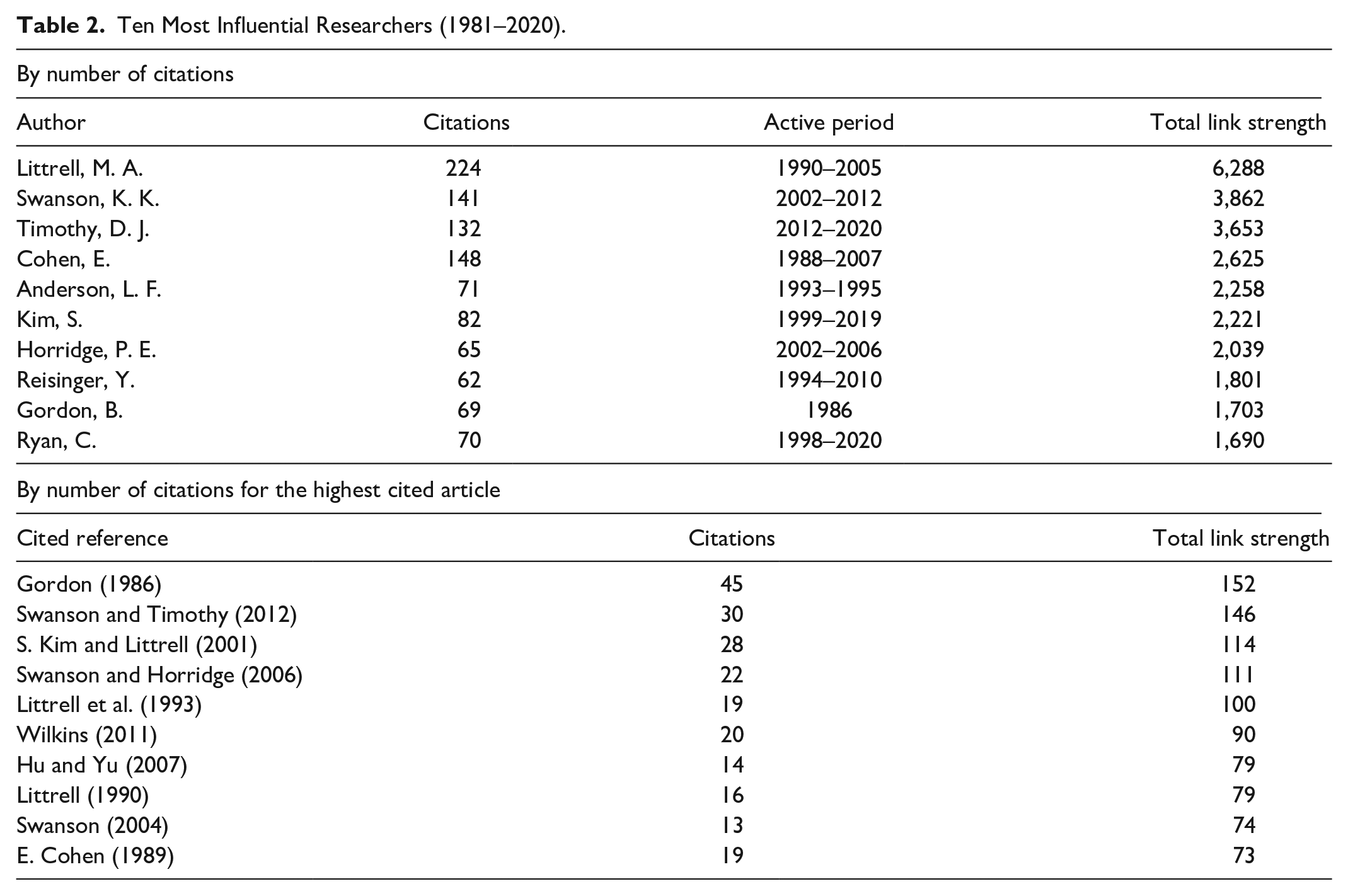
Regarding the highly co-cited articles in the field of souvenir study, Table 2 lists the top 10 most co-cited articles. As it can be seen, Gordon (1986) (“The souvenir Messenger of the extraordinary”) is the most cited article whose author took the souvenir as a subject for academic study in the introduction research period (Swanson & Timothy, 2012). After Gordon (1986), Swanson and Timothy (2012), and S. Kim and Littrell (2001) were followed. It suggests that these highly cited articles built fundamental knowledge for further souvenir research. Besides, it is found among these papers, except Swanson and Timothy (2012) and Wilkins (2011), all were publications between period 1 and period 2. This indicates that the citations of important papers need a long time to gather.
Research Contributions of Institutions, Countries, and Regions in the Field of Souvenir Study
Regarding the ranking of institutions, there are 279 institutions involved in this research field. The top 10 institutions which published the most papers were taken into account. Table 3 shows that three American universities, one university in Israel, and one Canadian university rank the first five. Researchers in North America were interested more in this field and made many publications. However, when considering the rank by total citation, Hebrew University of Jerusalem, Israel ranks the first, followed by four American universities. When looking at where articles on souvenir studies were published, the analysis identified 49 countries and regions. Among them, the United States, Australia, United Kingdom, Taiwan, and Mainland China are the most productive places (see Table 3). Regarding the research contribution of places in souvenir study by citations, United States, Israel, United Kingdom, Australia, and Canada contributed most impactful research in souvenir study. As it should be noted, the outcomes of souvenir study by the institutions in Asian countries are very limited, which implies that souvenir study is under-researched in the Asian institutions. Additionally, although many studies in the field of souvenirs are in the context of developing countries and regions, it seems more institutions located in developed countries and regions produce more impactful research outcomes. It may be because tourists of developed countries contribute more to the tourism development of developing places.
Top 10 Institutions and Countries/Regions (1981–2020).

Furthermore, regarding how international research collaboration was carried out in this academic field, Figure 4 shows that international academic collaboration in this field is limited. The results indicate that the collaboration between the United States, China, and Canada is relatively stable; the United Kingdom, Finland, and Russia cooperate frequently, and Australia and Iceland cooperate often.

Collaboration between countries and regions in the field of souvenir study.
Co-Occurrences of Terms in Titles and Abstracts
The analysis of co-occurrences of terms in titles and abstracts of articles can be used to identify research topics (van Eck & Waltman, 2011). With the function of text mining of VOSviewer, a term map in which terms are located in such a way that the distance between two terms indicates the relatedness of the terms. The shorter distance, the stronger correlation between the two terms (van Eck & Waltman, 2011). A term map of research themes in the field of souvenir study can be determined by co-occurrences of terms in titles and abstracts. Titles and abstracts that reflect an article’s critical information were demonstrated as suitable as sources to be used to extract terms for co-occurrences analysis of topics (W. Kim et al., 2016; Meng et al., 2020; van Eck & Waltman, 2011).
To perform the co-occurrence analysis, noun phrases should be “normalized.” Therefore, “souvenirs” was replaced by “souvenir.” Based on a full counting method and with the threshold of at least 10 occurrences of a term of 5,458 terms, 164 meet the threshold. For each of the 164 terms, a relevance score was calculated. Then 98 terms that ranked in the 60% most relevant were selected. After deleting 4 terms that are not closely related to the research topics (Informa UK Limited, addition, term, article), 94 terms gathered in five clusters can be seen in Figure 5. Each cluster of terms representing a research theme that emerges from reviewed publications is called: (1) souvenir object itself (Cluster 1 with blue nodes), (2) souvenir business and its socio-cultural impact (Cluster 2 with red nodes), (3) souvenir business and ecology (Cluster 3 with purple nodes), (4) souvenir shopping behavior (Cluster 4 with green nodes), and (5) souvenir shopping satisfaction and its consequences (Cluster 5 with yellow nodes).

Clusters of terms in titles and abstracts of articles in the dataset.
As it can be noted, the clusters are all interconnected, and comparatively, Cluster 1, Cluster 2, and Cluster 3 are closer together and can be regarded as the supply side; Cluster 4 and Cluster 5 are closer together and can be regarded as the demand side.
In order to identify the characteristics of the research topics in the development of time, a map of overlay visualization was output (Figure 6). This map is the same as the visualization term in Figure 5, except for the color of items. The color of an item is determined by the score (a publication year) of the item. So, in Figure 6, blue represents the early publication period, green represents the medium period, red represents the recent publication period. The trend indicates that research on tourist behavior related to souvenirs is increasing rapidly, and academic interest in sustainability issues related to souvenirs is weak but growing.

Terms in titles and abstracts in a given average time-period in the dataset (overlay visualization).
Discussion of Research Themes Identified by Co-Occurring Terms
Cluster 1: Souvenir Object Itself
The term cluster exhibits 18 frequently co-occurring terms, as shown in Table 4. In the VOSviewer term co-occurrence network, larger labels, and circles represent greater importance of the term (van Eck & Waltman, 2009). As seen in Figure 5, terms of “object,” “meaning,” and “image” are prominent. This reveals that they are the main subthemes in this cluster.
Terms With Most Co-Occurrence in Reviewed Articles.

Object
In Figure 5, the node of “object” is linked with terms of meaning, time, and space, which reveals a complex message attached to souvenirs. Researchers analyzed which objects are included in tourist souvenirs. Therefore, the typology of souvenirs helps researchers into thoughts. Gordon (1986) made classification by souvenirs’ descriptive characteristics. This typology has been employed in many empirical studies. Subsequently, some researchers developed typologies based on functional and symbolic dimensions (Decrop & Masset, 2014; Swanson & Timothy, 2012), and others segment souvenirs by the degree of consumption experience (Anastasiadou & Vettese, 2019). The recent typology of souvenirs highlights the diversity of tourist demands in consumption, which infers that the souvenir evolution is continuing based on consumption trends. Understanding the souvenir consumption trends is necessary because it would affect the souvenir design for which should consider cultural connotations as well as to meet present tourism market needs.
Meaning
Identifying the meanings of souvenirs provide a way to understand why souvenirs have a magical attraction. The terms that often appear at the same time as “meaning” indicates that souvenirs have symbolic meaning because they serve as a medium that connects time and space (Morgan & Pritchard, 2005), place and person (Swanson & Timothy, 2012), travel memory, and daily life (Haldrup, 2017). They represent the self-identity of tourists that used to describe themselves in some aspects, such as a desire for an imaginary ideal lifestyle, a narrative of a tourist’s interaction with a place, life, time, persons, and other cultures (Love & Kohn, 2001; Morgan & Pritchard, 2005). Additionally, souvenirs as gifts express the practice of maintaining good social relations with others. It can be seen that the multiple and dynamic meanings of the souvenir go beyond the object itself, revealing that tourists get a unique psychological experience from the souvenir. Souvenirs are also meaningful to artisans (Schilar & Keskitalo, 2018). Therefore, in order to extend our knowledge of the meaning of souvenirs, it is necessary to understand which metaphors the souvenirs designed by crafters reflect and how to present these metaphors.
Image
Another subtheme is the image reflected by souvenirs. Souvenirs convey parts of the projected destination image that are expected by tourists (Mariné-Roig, 2011). Postcards were often used to assess their role in representing a destination image (Markwick, 2001a; Milman, 2012), and were found to evoke tourists’ emotions and indirectly affect a travel desire (Yüksel & Akgül, 2007). Mariné-Roig (2011) observed souvenirs displayed in shops and identified different coexisting and conflicting cultural tourist images in Barcelona. Lund et al. (2018) discussed the role of souvenirs of Atlantic Puffin in shaping the Arctic landscapes of Reykjavík. These findings imply that the image of souvenirs could be used to investigate the destination representations in the eyes of tourists. Besides, it may be efficient for destination image rebuilding to design and promote souvenirs with elements consistent with destination identity. Such research is important because it can help destination marketing organizations to identify whether souvenirs are effective place promotion tools.
Cluster 2: Economic Significance and Socio-cultural Impact
This cluster exhibits 28 frequently co-occurring terms, as shown in Table 4. As seen in Figure 5, terms of “craft,” “development,” “production,” “community,” and “identity” are prominent. Research focusing on this theme consists of studies based on economic development, product evolution, production, and its socio-cultural impact on local communities. As seen in Figure 5, craft or handicraft was the type of souvenir that was frequently studied. Most studies in this area relate to specific case studies, while some findings depend on a destination context.
Economic development
This subtheme includes economic significance, challenges, and management strategies.
Researchers are concerned about the economic significance of souvenir business for peripheral areas. The development of souvenir business changes the local economic structure in which handicraft trade is no longer a part of the local traditional agricultural economy but a critical export trade and a part of the global economy (Chifos, 2006). It adjusts economic relationships as the change of target consumers from locals to outsiders (Schiller, 2008). The souvenir business alters the participation of grassroots level citizens in the tourism industry and improves their economic empowerment (Chifos, 2006; Nason, 1984). Thus, the souvenir business plays a significant role in poverty alleviation. Prince (2017) reported that craft artists innovate and restructure rural spaces to participate in tourism. On the contrary, the research of the economic impact of souvenir business on developed places is limited.
When emphasizing the economic significance, the central principle is managing the business to seize opportunities and overcome challenges. Schiller (2008) revealed that tourism added a functional conflict between heritage preservation and economic competition to a souvenir marketplace in Florence. Trupp (2015) raised an issue about the sustainability of immigrant souvenir vendors’ embeddedness in the urban economy structure in Thailand. Similarly, Lasso and Dahles’ (2018) findings challenged the view that tourism livelihoods are sustainable. In fact, under the COVID-19 pandemic situation, the global tourism economy and the local souvenir economy are in decline (Sigala, 2020). In addition to COVID-19, it is important for researchers to consider the research in what challenges should be paid attention to and how to deal with them because such research will contribute to the sustainability of the souvenir business.
Product evolution
This subtheme includes products evolution, craft artists’ practices, and crafters’ efforts. Content analysis in this area indicates that many souvenirs are commercialized from regional ethnic arts, tools, and handicrafts.
In the evolution course, their shapes, function, meanings, and symbolism are developed (Torabian & Arai, 2016). Articles associated with this topic also consider how the process takes place. It happens under the complex interaction of political, economic, and social, and cultural factors (E. Cohen, 1989; Horner, 1993; Nason, 1984). Craftsmen, intermediaries, outside enterprises, retailers, tourists, governments, and Non-Governmental Organizations interact in the product development (e.g., Nason, 1984; Trinh et al., 2014). Husa (2020) reported that guests and hosts mutually negotiated which kind of items should be considered “typically Thai” for production. Thus, souvenirs can be regarded as products of economic, social, and cultural exchange between destinations and the outside world.
Another topic focuses on craft-artists’ practice in rural tourism (Prince, 2017) through souvenir business and woodcrafter’s efforts for their work accepted as fine art (Chibnik, 2006). These studies discussed the roles of artists and crafters as well as the roles of arts and souvenirs. Their roles are not opposite, so it is essential to explore how arts and souvenirs could be integrated into a specific tourism context.
Production
Several articles related to “production” consider how to produce good souvenirs. Hitchcock and Teague (2000) pointed out that good souvenirs are made by skilled crafters who have revived traditional objects to suit the new market. Research findings enlighten practitioners in five ways to produce a good souvenir: ensuring the cultural authenticity being maintained and vouched for on labels (Asplet & Cooper, 2000); valuing the effect of culture in the sustainable development of souvenirs (Chifos, 2006); breaking the opposition relationship between art and souvenirs and enhancing the artistic quality (Thompson et al., 2012); incorporating the co-creation of tourists in production (Anastasiadou & Vettese, 2019); and increasing level of innovation (Naidu et al., 2014). About innovation, digital technology, augmented reality, and 3D printing technologies are applied. These products are demonstrated their capability to enhance personality and interactive experience and the possibility to influence revisit desire (e.g., Anastasiadou & Vettese, 2019; Petrelli et al., 2017). Indeed, new technology helps tourists to find diverse approaches to record and share travel experiences and keep in touch with destinations, residents, and objects. Thus, whether the importance of souvenirs with traditional forms for tourists would decline need further concern.
Community
As can be seen in Figure 5, “community” is located at the center of Cluster 2. It indicates local communities are very active in the souvenir business, which attracts much academic attention. Content analysis reveals that the souvenir business may provide retailers’ cash with low production costs, freedom to participate in other socioeconomic activities (Conndy-Kirch, 1982), and help ethnic suppliers construct self-image and equal relationships with outsiders (e.g., Cone, 1995). In contrast, it may exacerbate socioeconomic inequality (J. H. Cohen, 2001), or resulting in traditional livelihood loss (Lasso & Dahles, 2018). Therefore, accessing to what degree the impact of tourism and how tourism development should be on poverty alleviation and residents’ well-being from the perspective of the souvenir business will have implications for sustainable tourism.
In addition to the discussion on the social impact of the souvenir business, researchers paid attention to the cultural impact of the souvenir business on communities. Producing, displaying, and selling authentic souvenirs is accompanied by the cultural exchange between residents and external audiences. As a positive impact, from the community side, cultural identity, national identity, culture preservation, cultural change and innovation, social value change, and self-identity of residents, especially women, have been identified (E. Cohen, 1989; Markwick, 2001b; Nason, 1984). However, despite many related papers discussing the positive impact of souvenir business on culture, some studies concerned cultural exchange ownership and cultural loss issues. Blundell (1993) and Simons (2000) pointed out that cultural autonomy is related to the sustainable development of indigenous tourism and indigenous communities. Two case studies proved that over-tourism could easily cause culture loss (Lasso & Dahles, 2018; Milman, 2015). Therefore, keeping a balance of dynamic cultural exchange between souvenir supply-side and demand-side is an issue.
Cluster 3: Souvenir Business and Ecology
Cluster 3 exhibits only eight frequently co-occurring terms, as shown in Table 4, which indicates that research articles on this theme are limited. Furthermore, in Figure 6, it can be noted that terms belonging to Cluster 3 are more frequently used in the recent period. The theme is called souvenir business and ecology. The interaction between souvenir objects and ecology plays an influence on souvenir business development and the livelihood of communities. Therefore, as seen in Figure 5, a strong connection exists between this cluster and Cluster 2—some exploratory research associated with this theme. For instance, Chifos (2006) took Chiang Mai as a case and explored the potential power for environment-friendly and community sustainability by souvenirs produced by natural resources and traditional knowledge. Ansari et al. (2019) augured that the increase in the number of tourists of a national park in Indonesia and their demand for butterfly souvenirs may lead to over-exploitation of raw material, which in turn can cause ecological degradation. They discussed how to use visitors’ sociopsychological information to minimize the negative impacts caused by over-tourism. Lee et al. (2019) found that the development of the souvenir business of pineapple cake in city areas made the agricultural environment of distant areas change. In practice, most souvenir enterprises are small-scale, their impacts on the ecosystem are easily neglected. Therefore, souvenir producers can know the importance of producing eco-friendly souvenirs. On the other hand, travellers can know the importance of consuming eco-friendly souvenirs.
Cluster 4: Souvenir Shopping Behavior
This cluster exhibits 28 frequently co-occurring terms as shown in Table 4. It is composed of a number of articles analyzing tourists’ souvenir shopping behavior. As seen in Figure 5, terms of “motivation,” “factor,” “difference,” and “retailer” are prominent.
Motivation
Some papers analyzed souvenir shopping motivation. It has been found that twofold motivations, travel motives (e.g., F. Li & Ryan, 2018; Swanson & Horridge, 2006), and purchase motives (e.g., F. Li & Ryan, 2018; Wilkins, 2011) that affect shopping behavior. In addition, food souvenirs are the most concerned research object, and most of the relevant research was conducted on Asian tourists. Researchers found that food souvenirs consist of sensory, utility, and symbolic dimensions (Lin & Mao, 2015) that influence tourists’ purchase motivation (Lin, 2017).
Factor
Looking at the node of “factor” and its’ co-occurring terms, it was identified topics associated with it mainly includes factors influencing shopping motivation (e.g., Ansari et al., 2019; Huang et al., 2020); key factors in shopping decisions; and price, culture, authenticity, shopping attitude that influencing the key elements of decision-making (e.g., Asadi et al., 2014; M. Li & Cai, 2008; Park, 2000; Revilla & Dodd, 2003); and factors influencing shopping satisfaction (e.g., Altintzoglou et al., 2016; Oviedo-García et al., 2016).
Difference
Content analysis reveals that for the market segmentation, several articles explored the souvenir purchasing behavior of different groups. Some articles profiled tourist behavior by consumer segmentation used variables related to travel behavior, like tourism styles (e.g., Littrell et al., 1994; Oh et al., 2004), and travel motivation (Kong & Chang, 2012). The other category explored the purchase behavior of specific groups, like craft selection criteria and shopping involvement (Hu & Yu, 2007). The first category neglected the depth of the souvenir shopping experience, while the second category did not thoroughly combine shopping experience with tourism styles. Therefore, it is necessary for researchers to link tourists’ characteristics with their shopping experiences in segmenting and profiling tourist behavior, to predict their purchase behavior. As for studies on shopping characteristics of specific groups, women, Chinese tourists, pilgrims, and honeymoon tourists, souvenir gift buyers were focused on (e.g., Anderson & Littrell, 1995; Gao et al., 2017; Shtudiner et al., 2019; Ünal et al., 2017).
Retailer
The term “retailer” in this theme emphasizes the important role of retailers in tourists’ souvenir shopping behavior, and also reveals that understanding tourists’ purchasing behavior can help retailers carry out effective marketing. Several studies examined effective marketing strategies for souvenir retailers. For instance, limiting purchasing opportunities to in-store only could increase purchase likelihood (Abendroth, 2011); the brand effect could promote souvenir sales (Liao et al., 2014); for authenticate souvenirs, storytelling is a common retailer’ strategy (Schilar & Keskitalo, 2018; Soukhathammavong & Park, 2019).
Cluster 5: Souvenir Shopping Satisfaction and Its consequences
This cluster exhibits 12 frequently co-occurring terms, as shown in Table 4. As seen in Figure 5, the boundaries between this cluster and Cluster 4 are quite blurred since both themes are about tourist behavior related souvenirs. Articles located in this cluster mainly analyzed souvenir shopping satisfaction and its antecedents and consequences. Terms of “effect,” “satisfaction,” “quality,” “intention,” “model,” and “food souvenir” are prominent in this theme. The term “souvenir authenticity” has a specific and essential location.
Antecedents of souvenir shopping satisfaction
The main feature of related articles in this cluster is that they are often analyzed by establishing structural models to test the factors influencing souvenir shopping satisfaction. For example, Oviedo-García et al. (2016) identified factors that consist of shopping satisfaction. Later on, Vega-Vázquez et al. (2017) studied the effect of shopping value on tourist shopping satisfaction, overall tourist satisfaction, and positive word-of-mouth. Similarly, Suhartanto (2018) examined the effect of satisfaction with shopping attributes on overall shopping satisfaction and found the relationship between overall shopping satisfaction, tourist satisfaction, destination image, and destination loyalty. Improving shopping satisfaction is an integral part of a retailer’s business strategy. Knowing the antecedents of souvenir shopping satisfaction helps practitioners to offer a better shopping environment to have the best practical performance.
Consequences of souvenir shopping satisfaction
Articles in this Cluster explored how far-reaching impact does souvenir shopping satisfaction has on tourists’ travel behavior. It has been identified that shopping satisfaction positively affects customer loyalty (Gallarza et al., 2017), and destination loyalty (Suhartanto, 2018). A satisfying and co-creative shopping experience contributes to long-lasting memories, and through the effect of memories, tourists’ attachment to the destination is enhanced (Sthapit et al., 2018). This type of emerging research explored the role of shopping satisfaction experience in predicting travel behavior providing in-depth explanations of the role of souvenirs in destination marketing.
Souvenir authenticity
It can be seen from Figure 5 that compared with the positions of other nodes in Cluster 5, the nodes of souvenir authenticity are located at the edge of this theme. Its location is just at the center of the division between the tourist side (Cluster 4 and Cluster 5) and the supply side (Cluster 1, Cluster 2, and Cluster 3). This suggests that by means of souvenir authenticity, both sides can communicate well. For tourists, shopping for souvenirs often reflects a desire of tourists to seek authentic experiences (Xie et al., 2012). Authenticity is a key factor considered when looking for souvenirs (Lee et al., 2009). Good souvenirs are perceived as authentic reminders of a tourist destination and express a personal relationship (Horner, 1993). Researchers summarized criteria used to perceive authenticity in crafts (e.g., Elomba & Yun, 2017; Revilla & Dodd, 2003) and to define authentic quality in food souvenirs (Ho et al., 2021). Researchers also identified that the more familiarity with the local culture, the stricter the authenticity that tourists hold (Revilla & Dodd, 2003). From the supplier perspective, place and culture reflection, use of natural materials, traditional equipment, and handmade processing are generally accepted determinants of authenticity (Soukhathammavong & Park, 2019; Trinh et al., 2014). Suppliers generally hold the view of dynamic authenticity and believe souvenir design should be developed based on tourist expectations. They apply strategies to authenticate souvenirs (e.g., Asplet & Cooper, 2000; Schilar & Keskitalo, 2018). Researchers have indicated how tourists and suppliers perceive the authentic quality of souvenirs. This type of research is essential because it highlights the process and content of the authenticity negotiation that is beneficial to provide a valuable reference for how to promote the healthy operation of the tourism system on the premise for stakeholders to achieve common goals.
Research Agenda
The thematic map and its content analysis have produced important information to enlighten future research directions. From Figure 5, it can see the role of tourists, suppliers (retailer), communities, and recipients (friend) in the field of souvenirs. This evidence is consistent with Cave et al.’s (2013) view that souvenirs can be regarded as material traces of the interaction between tourism actors, giving insight into globalized tourism. Thus, the research agenda is based on the roles of stakeholders of souvenirs. Except for the above four stakeholders, local governments who are responsible for the macro-level management of the destination tourism industry should be included. Research themes and future directions are reorganized in Table 5.
Research Agenda for Souvenir Study.

Tourist
During the past 20 years, tourist behavior related souvenirs has received growing attention. Although a large number of relevant documents have appeared in the past 10 years (see Figure 6), the research time on related topics is short, and there are issues that need attention. Researchers can consider research directions based on issues. Five research directions are recommended below.
Time-pressure shopping setting influencing souvenir sales
Researchers can test different time-pressure related shopping settings for selling souvenirs. In many souvenir stores, it is common to observe that tourists do not purchase any item after browsing through products. There is a theory called “limited edition effect.” The limited edition effect shows that products become more attractive if they have a “limited edition” label on them (Nunoi et al., 2013). Therefore, examining the effects of different time-pressure shopping settings such as limited edition on tourist souvenir purchase intention will benefit souvenir marketing. Researchers can conduct experimental research on this topic.
Profiles of the behavior related to souvenirs of specifical types of tourists
Tourism style impacts souvenir purchase behavior (Littrell et al., 1994; Oh et al., 2004). Buying souvenirs is the main travel activity for specific types of tourists such as cultural tourists and cruise visitors (Cave et al., 2012; Chen & Huang, 2018). Souvenirs are cultural products. Researchers can explore whether cultural tourists hold different consumption behavior from other types of tourists. Besides, the travel activities of cruise visitors on the destinations may be under time pressure. A comparative study on the souvenir purchase behavior of cruise visitors and stayover tourists is helpful to provide a valuable reference for the design of cruise ship tourism products.
Multi-faceted shopping experience of creative tourists
The tourist experience is regarded as a key element of value creation within the tourism industry (Prebensen & Foss, 2011). A satisfactory and co-creative souvenir shopping experience contributed to long-lasting memories. According to Packer and Ballantyne’s (2016) model of visitor experience, a positive or pleasant experience contains multi-facets. While in the context of souvenir consumption, further research needs to understand the detailed facets of tourist experience related to souvenirs. Creative tourism brings new opportunities for the souvenir business. It can combine selling creative experience, which is engaged in handicraft co-creation and in-depth social interactions. Packer and Ballantyne’s (2016) model of visitor experience can be used to examine the multi-faceted shopping experience of creative tourists because of this model’s strength in characterizing the content and intensity of visitor experience for different groups.
Sense of well-being possibly enhanced by souvenirs
Although souvenirs are mainly consumed in the post-trip period, limited research in this area has been found. Souvenirs play an important role in linking the relationship between tourism and everyday life (Morgan & Pritchard, 2005); the passage of time and gaining tourist experience affect the meanings of souvenirs (Collins-Kreiner & Zins, 2011). It infers that souvenirs possibly enhance tourists’ sense of well-being in a short or long time (Sthapit et al., 2018). Therefore, whether and how a sense of well-being can be enhanced by souvenirs need empirical research.
Suppliers
For suppliers, the souvenir trade helps to get economic benefits. Compared with tourist behavior research, the research of souvenir business started from an early period (see Figure 6). It can be seen in Figure 5 that term “development” is clearly connected to the term “strategy” and term “problem,” which indicates that the issue of business sustainability should be taken seriously.
Feasibility of the transformation from onsite to online business triggered by COVID-19
The COVID-19 pandemic may bring long-term, transformative changes to the tourism industry (Sigala, 2020). Global tourism has been suffering an unprecedented crisis (Sigala, 2020), which forces the souvenir business to struggle to deal with the challenge. During COVID-19, consumers’ online shopping and virtual tourism experience are increasingly growing in many countries (Donthu & Gustafsson, 2020; Sigala, 2020). The online consumption trends may provide opportunities for souvenir retailing (Lu et al., 2021). Researchers can develop research models that combine the knowledge of souvenir shopping and virtual tourism. An experimental approach is recommended.
Souvenir branding
Souvenir branding is an important yet under-researched topic. Researchers could focus on the development of the branding strategy of souvenirs. Souvenirs reflect the relationship of objects, place, and culture. This infers that souvenirs might be affected by a destination brand, place of origin brand, culture brand, and product brand. Researchers could explore how to choose the best branding strategy for souvenir enterprises. Furthermore, for economic sustainability, researchers can explore how a souvenir brand can be promoted through tourism while not relying solely on tourism to increase their exports.
Souvenir innovation
To make souvenir products meet the demand for consumers who buy souvenirs either onsite during travel or online in daily life, product innovation is important to be considered. To address the issue, researchers can investigate the innovative attributes of souvenirs that affect the purchase motivation of those with travel experience and those non-visitors. In addition, researchers can analyze how these innovative attributes increase consumer values so as to affect consumers’ consumption satisfaction response.
Souvenir production and environmental sustainability
Souvenir business is an integral part of destination tourism. The ecological exchange occurs between places that are sources of souvenirs and destinations (Lee et al., 2019). Researchers can examine the relationship between souvenir production and environmental sustainability. In ecologically vulnerable destinations, big data about production and exploitation of sources of souvenirs before COVID-19 and during COVID-19 may be potential items that can be used to examine parts of the impacts of tourism on the ecosystem and then enlightens possible ways for management.
Communities
The results of cultural exchange through souvenirs from tourist perspectives
In Figure 5, the term “souvenir authenticity” is just in the middle of the tourist side and the community side. This evidence to some degree supports that souvenir objects is a cultural exchange result. Cultural exchange is a two-way process. While previous studies have explored the results of the cultural exchange for destination communities, there is limited understanding of what changes have been made to external audiences-tourists. The communication with producers and sellers, the participation in products co-creation, and the consumption and appreciation of souvenirs may have some degree of impacts on tourists’ beliefs, social value, esthetics, and attitude. Researchers can make exploration.
Governments
Destination promotion through the medium of souvenirs
One of the primary tasks of local governments is destination promotion. As reported, certain souvenirs have been used as a tool for destination image reconstruction (China National Radio, 2019; Wang, 2019). However, its mechanism and effect are unknown. Researchers can explore the path that souvenirs influencing destination image. Researchers can also analyze what strategies the government can provide for souvenir suppliers to collaboratively build destination brands.
Souvenir Gift Recipients
Destination image and travel intention triggered by souvenirs
In Figure 5, the node of the term “friend” apparently appears on the edge of the cluster-tourist shopping behavior. This phenomenon enlightens further thinking since friends are the main recipients of souvenir gifts. One motive to buy souvenirs is maintaining a social relationship through gift-giving. Tourists’ gift giving behavior acts on gift recipients. However, the limited literature only focuses on tourists’ shopping behavior motivated by gift-giving; knowledge about recipients is overlooked. Although souvenirs contain rich information about a destination, there is a lack of research on whether a good gift will generate a positive destination image and whether such objects will arouse a visit interest. Researchers are recommended to explore whether a gift will trigger a recipient’s destination image and travel intention. Such research is essential because, through the effect of these tangible items, it may be possible to enhance the destination promotion effect in the context of travel restrictions on the COVID-19 pandemic. Thus, researchers can study the effect of souvenirs on the destination image and destination behavior intention from the perspective of recipients. This may also be a new approach to understanding the image formation of the destination of non-visitors, through perception and experience of recipients who never visited the destination where souvenirs were bought. Additionally, researchers can also conduct comparative studies to explore whether the influence of souvenir tourism on the behavior intentions of recipients is different in the two contexts (domestic tourism and international tourism).
Conclusions
This article conducted a systematic method to reveal the current state of study in the field of souvenirs. The research periods and progress, prominent journals, influential researchers and citations, research contributions of institutions, and regions have been investigated. Five research themes were identified through the analysis of the co-occurrence of terms in titles and abstracts. Knowledge in each theme has been analyzed, the gaps and potential research opportunities have been discussed.
The Theoretical Contributions
This research makes several academic contributions. First, this is the first systematic quantitative review that provides a holistic picture of souvenir study during the past three decades. This review provides researchers with references and helps them to prepare and plan their souvenir research in tourism. Second, it identified a thematic map which is important for researchers to understand the essence of tiny souvenirs and their relationship with other important elements of the tourism system. It emphasizes the academic importance of souvenirs, not only its functions, meanings, and values, but their reflection of many important phenomena and issues, such as tourism retailing, authenticity, travel experience, tourist post-trip behavior, potential tourist pre-trip behavior, destination marketing, social and cultural exchange in tourism and tourism poverty alleviation, and sustainability. This study has identified gaps in previous literature and recommends a research agenda that enables researchers to look beyond the narrow domain and capture new topics from a cross-stakeholder perspective.
The Practical Implications
First, the results emphasize to the governments the importance of souvenir business in destination tourism. Second, it enables the governments to understand which tourism elements and how they are closely related to the souvenir business. Such knowledge would scientifically guide tourism development. Third, this study also provides a reference for souvenir suppliers, especially crafters, retailers, and other micro-entrepreneurs, to have an understanding of tourist behavior related to souvenirs. It further helps these stakeholders realize the significance of the souvenir industry and their work to the destination economy, society, and culture, and then contribute to the tourism of sustainability. Last, this study has considered the COVID-19 impact on the souvenir business and has pointed out some issues that the practitioners should pay attention to and the directions for solving them.
Limitations and Future Research
The results of the bibliometric analysis are based on the 248 articles published in international journals in Scopus as of December 2020. Until December 2020, no souvenir research in the context of COVID-19 had been identified published online, but it was believed that related research was undertaken at that time. Therefore, there is a limitation of its representation for the entire body of souvenir research. It suggests that future researchers could use more academic databases and include the analysis of souvenir studies with the impact of the COVID-19 pandemic. Furthermore, the research agenda based on the thematic map may overlook some research opportunities. Future studies would explore more sub-topics according to the map.
Footnotes
Declaration of Conflicting Interests
The author(s) declared no potential conflicts of interest with respect to the research, authorship, and/or publication of this article.
Funding
The author(s) disclosed receipt of the following financial support for the research, authorship, and/or publication of this article: This study was supported by the Social Science Planning Research Program of Chengdu, China (No. YN2320200292).
