




Abstract
Recent trends in academia and the business community have seen a shift in focus in knowledge management (KM) issues from technology adoption to the interplay between organizational and technology management, with a special interest in the integration of KM technology and organizational design. Organizational structure is fundamental in this exploration as it encapsulates how an enterprise manages knowledge, communicates, allocates decision-making power, and implements control mechanisms, thereby portraying the efficacy of an organization’s operations. This study aims to formulate and test a theoretical model based on the Organizational Knowledge/Information Processing Model, examining the relationships between environmental pressure, organizational innovativeness, KM technology, organizational size, centralization, and formalization. Using a structural equation modeling approach, the study analyzed survey data collected from 220 companies to explore how these variables interact and influence each other. The analysis revealed that in response to competitive pressure, organizations primarily employ KM systems, centralization, and formalization. Additionally, KM systems were found to act as mediators, enhancing both centralization and formalization within the organizations. The study concludes that competitive pressure drives organizations to adopt KM systems, which in turn facilitate increased centralization and formalization. This highlights the critical role of KM technology in shaping organizational structure and processes, ultimately impacting the effectiveness of organizational operations.
Introduction
Medium and large-sized enterprises are integral to the country’s economic development, significantly contributing to GDP, employment, and industrial growth (Choudhary & Sangwan, 2018). Take Vietnam as an example, these enterprises, which represent a substantial portion of the industrial and service sectors, play a crucial role in driving economic modernization, attracting foreign investment, and enhancing technological capabilities (Kokko & Thang, 2014). Despite their importance, medium and large enterprises face several challenges that can impede their growth and competitiveness. Key issues include navigating a complex regulatory environment, securing adequate financing, managing skilled labor shortages, and keeping pace with rapid technological advancements (Gherghina et al., 2020). Additionally, these enterprises must contend with increasing competitive pressures both domestically and globally, which require them to be agile and innovative (Holbeche, 2023).
In this dynamic context, the adoption of Knowledge Management (KM) systems becomes essential for enhancing organizational efficiency, decision-making, and innovation. Effective KM practices can help these enterprises to better manage their resources, streamline operations, and maintain a competitive edge (Lai et al., 2022). Therefore, understanding the impact of organizational structure and KM systems on medium and large enterprises is critical for formulating strategies that support their sustainable growth and economic contribution. This study addresses these vital concerns by examining how KM systems and competitive pressures influence the organizational structures.
Organizational Structure and KM Systems
Organization structure is the foundation of business operations and a key factor in achieving corporate goals and performance. Traditionally, the relationship between organizational structure design and situational factors has been extensively explored (Joseph & Gaba, 2020). However, in the face of rapid changes in the competitive environment and the widespread application of knowledge management (KM) technology, designing an appropriate organizational structure remains a highly challenging task for businesses. Environmental variables, such as environmental uncertainty, can significantly impact organizational structures (Haarhaus & Liening, 2020). Nonetheless, there is still a lack of empirical evidence in this research field. Various contextual variables, including technology, have been extensively studied for their impact on organizational structures (Putra & Santoso, 2020). Despite this, there is no clear consensus on these effects. As a result, the organizational literature is still filled with confusion and contradictions regarding the significant influence of certain contextual variables on organizational structures.
From a theoretical perspective, organization structure primarily reflects the distribution of decision-making authority and control mechanisms within an organization (Gerloff, 1985). As businesses become increasingly complex, these two management activities constitute the core activities of a company (Daft, 2015). The quality of decision-making and control capabilities reflected by the organization structure often have a significant impact on the effectiveness and efficiency of business operations. Furthermore, hyper-competition (Foss & Knudsen, 2013) has become the norm in today’s business environment. In this operating environment, companies must constantly innovate and adapt to respond to the pressures exerted by customers and competitors. Since organization structure provides varying degrees of flexibility and controllability to a company and determines its ability to respond quickly and compete efficiently, businesses operating in highly dynamic, complex, and rapidly changing environments require appropriate decision-making authority and control mechanisms (Mikalef et al., 2021).
KM Systems and Organizational Design
The application of KM technology has gradually become deeply ingrained in the operational activities of businesses, with KM systems becoming an important tool for designing effective organizational structures (Rezaei et al., 2021). This viewpoint is regarded as one of the most significant contributions to contingency literature (Zhao & Detlor, 2023). Nonetheless, there is a limited amount of empirical research that specifically investigates the role these requirements have in influencing organizational design. The automation and communication capabilities of KM systems provide managers with more choices when it comes to organizational restructuring and structure design. To some extent, they even replace the functions of formal organizational structures (Chatterjee et al., 2020). Therefore, driven by environmental and technological forces, how managers design effective decision-making and management control mechanisms becomes a primary topic of discussion in this study. To offer further insights into the factors linked to an organization’s KM requirements, this study, grounded in the KM perspective, develops and tests an integrated model incorporating constructs related to organizational contexts, KM, and structures.
Research Purpose and Objectives
Reviewing past literature, it is evident that the influence of contextual factors on organizational structure is a widely explored perspective in formal organizational research (Rabhi et al., 2023). Particularly in organizational theory, the impact of environmental, technological, and scale factors on centralization and formalization within organizations has been extensively studied (Dominguez Gonzalez, 2023). However, from the perspective of KM, the impact of environmental pressures on organizational adoption of KM technology, as well as the influence of the environment and KM systems on organizational structure, remains a highly worthy topic of investigation.
The debate regarding the impact of KM systems on centralization within organizations has spanned in many studies (Mahmoudsalehi et al., 2012; Raziq et al., 2020). Calcaterra and Kaal (2021) pointed out that the “technological imperative” perspective has led to different interpretations, resulting in a debate over whether KM technology leads to centralization or decentralization. However, a closer examination of the root of the issue reveals that the relationship between KM technology and organizational structure is not a uni-directional causal relationship (Antunes & Pinheiro, 2020). Additionally, KM systems are not solely causal agents in influencing organizational structure (Chaurasia et al., 2020). In other words, the KM capabilities provided by KM systems can be seen as tools for managers to design organizations. Therefore, the intentions and actions of managers themselves are the primary factors influencing organizational structure. The managerial action imperative perspective may, to some extent, fall into the trap of determinism, and institutional forces such as organizational inertia, existing political power dynamics within the organization, and external environmental factors impose various constraints on managers’ choices (Kraemer et al., 1989), but this perspective still holds considerable explanatory power.
The purpose of this study is not to contribute to the ongoing debate on the “technological imperative” issue. As we gain a deeper understanding of the various impacts of KM technology and the environment on organizations, we also develop a more profound awareness of how organizations operate. In many industries, the competitive environment characterized by rapid changes has already taken shape. However, there is a lack of studies on the effects of competitive pressures in the business environment on the application of KM systems is limited. On the other hand, the boundary-spanning capabilities of KM systems and their KM capacities can potentially replace or even surpass traditional organizational management and control practices. Therefore, they are likely to have a significant impact on the way organizations operate.
Given these considerations, this study is based on contingency theory and identifies important situational variables that influence organizational structure and the application of KM systems, such as competitive pressures, organizational innovativeness, and organizational size. While organizational innovativeness is not the main variable explored in contingency theory, viewing KM as an important requirement for organizational innovation (Acosta-Prado et al., 2021) necessitates adjustments in KM system application and organizational structure. Furthermore, the concept of competitive pressures differs from the traditional environmental uncertainty adopted in conventional organizational research. The primary reason is that since managerial actions are key factors influencing the design of the organizational structure and the application of KM systems, competitive pressures have a deeper impact on the decision-making and actions of managers than environmental uncertainty (Laguir et al., 2022).
Therefore, this study focuses on analyzing the organizational level, where the selection and measurement of conceptual variables are chosen to reflect overall organizational phenomena. These variables include competitive pressures, organizational innovativeness, organizational size, the role of KM systems, formalization, and centralization. Among them, competitive pressures represent the intensity of external environmental competition faced by the organization, organizational innovativeness represents the overall climate of innovation within the organization, and the role of KM systems represents the significant role played by KM technology in the organization. Formalization and centralization, on the other hand, represent two dimensions of organizational structure.
Therefore, the main objective of this study is to address the following questions:
Whether competitive pressures have an impact on organizational structure, the role of KM systems, and organizational innovativeness?
Whether organizational contextual factors (organizational innovativeness and organizational size) influence the role of KM systems and organizational structure?
To evaluate whether the role of KM systems has an impact on organizational structure?
By addressing these questions, this study aims to understand the interplay between competitive pressures, KM systems, and organizational structure, contributing to the development of strategies that support the sustainable growth and competitiveness of enterprises.
Theoretical Background
The main argument is that organizational context influences the organizational structure, and the environment directly or indirectly affects organizational structure through organizational context (Figure 1). From the perspective of contingency theory, this framework adopts a selection approach, which asserts that regardless of organizational adaptation or natural selection, currently, surviving organizational entities should exhibit congruence between their contextual factors and organizational structure (Koçak et al., 2023).

Conceptual model.
While some studies argue that strategic choice and political processes are the ultimate determinants of organizational structure (Hanelt et al., 2021), the analysis conducted in this study recognizes that the environment and organizational context impose constraints on managerial decision-making. Consequently, within the scope of these constraints on organizational design, they will also influence organizational structure. After all, decision-makers choices and actions are limited by market forces (Walker et al., 2019). Therefore, under the premise of competitive pressures and rational organizational decision-making, there should be a certain level of internal consistency between organizational structure and contextual factors.
Based on the knowledge/information processing view (Galbraith, 1974), this study explains the impact of environmental uncertainty on organizational structure. Furthermore, it extends this viewpoint by examining the competitive pressures imposed on managers in rapidly changing environments, as well as the flexibility provided by KM technology in organizational design. The study argues that competitive pressures will affect both organizational structure and the role played by KM technology. As a result, KM technology and organizational structure become complementary mechanisms for organizations to respond to competitive pressures and the associated KM processing requirements.
Knowledge/Information Processing View
Galbraith (1974) argued that as the level of task uncertainty increases, decision-makers require higher knowledge/information processing capabilities to achieve their desired performance. Formal organizations need to be designed to align task requirements and organizational capabilities to meet the economies of scale and KM needs of tasks. As organizational knowledge/information processing requirements increase, there is a need to satisfy internal coordination and communication needs in the design. Regarding the knowledge needs for decision-making and control, Simon (1973) pointed out that in the post-industrial era, decision-making has replaced the workflow and become a central activity of enterprises. Thus, organizational performance is not only influenced by workflow efficiency but also closely related to the quality of decision-making. In other words, to ensure the coordination and effective functioning of the entire organization, the organization must have corresponding vertical KM capabilities. In general, the principle of decision-making is the co-location of knowledge and decision authority, achieving higher quality with minimal knowledge asymmetry (Bingham & Eisenhardt, 2011).
In general, the optimal distribution of decision-making authority depends on minimizing the cost of knowledge scarcity. Therefore, when the nature of decision-making is highly related to specific problem situations, organizations tend to adopt a decentralized structure. On the other hand, when the nature of decision-making is related to overall organizational goals or policies, organizations tend to adopt a centralized design (Su et al., 2020). Overall, from the perspective of organizational KM, environmental uncertainty triggers the KM needs of organizations in decision-making and coordination control. Through organizational design, organizations enhance their KM needs and performance through specialized units, formal coordination mechanisms, and appropriate distribution of decision-making authority. The following will explain the role of KM systems in fulfilling organizational KM requirements.
KM Systems Are Key Tools for Meeting Organizational Knowledge Needs
KM systems have the effects of automation and informating (Alavi & Leidner, 2001). From a knowledge/information processing perspective, the automation capability provided by KM technology satisfies the KM needs of specialized departments and reduces the need for routine tasks to be handled through organizational structure. On the other hand, the informating capability provided by KM technology allows knowledge to be communicated transparently across units within the organization, enhancing coordination and KM capabilities across units (Xiaoping & Tao, 2021). At the organizational level, both centralization and decentralization are organizational designs that reduce the cost of knowledge scarcity. The automation and informating capabilities of KM systems increase the KM capabilities of frontline personnel, providing them with more resources for decision-making. The automation effect enables top-level managers to effectively control decision-making knowledge and exercise control. In other words, through appropriate KM system design and usage, organizations can more effectively achieve goals such as coordination among specialized departments, flexible decision-making, and effective management control. Therefore, the KM capabilities provided by KM systems not only facilitate effective organizational design but also, to some extent, serve as alternative options for organizations to respond to KM needs (Su et al., 2020).
The Impact of Competitive Pressures on Organizational KM Needs in a Hypercompetitive Environment
The business environment in modern enterprises has gradually transformed into a hypercompetitive environment characterized by rapid change (Montiel-Campos, 2021). Traditional approaches relying on a single competitive advantage, such as cost and quality, speed and agility, location, and deep pockets, are no longer sufficient to survive in this fast-paced competitive environment. In such an environment, discontinuous change has become the norm for business competition, where every company seeks temporary competitive advantages through different strategies and actions, disrupting the advantages of existing market leaders and market equilibrium. In other words, in a hypercompetitive environment characterized by rapid change, companies must constantly expand their competitive stance and develop new competitive advantages to strive for market leadership. Lagging is not an option, as it may lead to elimination from the market.
The impact of a hypercompetitive environment characterized by rapid change on organizational structures is twofold. On one hand, the reality of discontinuous environmental changes signifies that companies must continuously innovate; otherwise, they risk being eliminated by the environment. Therefore, organizations need to maintain a certain level of innovation capability and foster an innovative culture. On the other hand, due to the threat-rigidity effects, top-level management tends to limit KM capabilities, tighten control, and consolidate decision-making authority and resources to avoid decisions that may lead to the loss of competitive advantages or even survival opportunities for the company (O’Kane & Cunningham, 2012). From a perspective of strategic decision-making, a hypercompetitive environment often requires adjustments at the structural and strategic levels (Zhen et al., 2021). Therefore, high-quality decision-making relies on managers’ comprehensive understanding of the entire organization and consideration of knowledge, leading to a centralization of decision-making power within the company to avoid erroneous decisions.
Managers’ strategic decisions serve as causal agents that influence organizational structures (Child, 1972), while the cultural values of the dominant coalition within the organization and the institutional norms of the environment are key factors that shape strategic decision-making. In other words, the symbolic significance created by a hypercompetitive environment and competitive pressures leads organizations and managers to recognize the necessity of organizational innovation, which in turn influences their decision-making and behavior (Meyer & Vaara, 2020). To maintain legitimacy and support, this study argues that the design of organizational structures and the adoption of KM systems should reflect the organization’s innovation needs.
Research Variables
Organizational structure refers to the division of personnel into different work units and the mechanisms used to integrate and coordinate these units within an organization (Robbins et al., 2017). Key features of organizational structure include formal and informal organization, differentiation, and integration mechanisms. Formalization, complexity, and centralization as commonly studied structural elements. In this study, the focus is primarily on formalization and centralization (Eva et al., 2021). On one hand, these variables are frequently used to investigate phenomena related to KM systems (Prior et al., 2022). On the other hand, these two elements represent complementary mechanisms of organizational control and integration (Child, 1972), which are essential aspects of organizational design. The concept of formalization typically refers to the use of specialized employees, formal policies, job descriptions, and cost and quantity controls within an organization. In this study, the definition of formalization, based on Fredrickson (1984), is the “degree to which rules or procedures dictate employee behavior.” On the other hand, there is a general consensus among scholars regarding the concept of centralization. In this study, centralization is defined as the “degree to which decision-making authority or evaluative activities are concentrated” (Fredrickson, 1984).
Competition Pressure
In organizational theory, environmental factors include uncertainty, resource munificence, and the degree of competition (Pfeffer, 1982). In this study, the competition pressure is adopted as the primary concept to explore the environment. The reason for this choice is that the dependent variable of the study is organizational structure, with a focus on control and integration mechanisms in organizational design. Joseph and Gaba (2020) stated that competition leads to increased control in organizations and contributes to a more structured organizational environment. Kreiser et al. (2020) with the threat-rigidity model, suggest that in environments characterized by threats, organizational responses differ from situations of environmental abundance. Nadkarni and Barr (2008) point out that organizations respond and take action based on managers’ understanding of their environment. For managers, competition pressure is a motivating force that restricts or triggers their decision-making. Therefore, in this study, the competition pressure is measured to capture the intensity of competitive forces faced by organizations. Although this concept is concise, it adequately represents the market environment and challenges faced by organizations.
Role of KM System
From an organizational design perspective, KM systems are essential mechanisms for organizational KM. The automation and informatization capabilities of KM systems can satisfy the economies of scale and KM needs in organizational work design (Oubrich et al., 2021), making KM systems a choice for responding to environmental pressures alongside formal organizational structures. Additionally, Oliva et al. (2019) pointed out that KM systems reflect how organizations structure activities such as knowledge collection and processing. Of course, for KM systems to have an impact on organizations, they must play a significant role in organizational operations. Therefore, this study emphasizes “KM system role” as an indicator of the organizational reliance on KM systems to meet KM needs, focusing on evaluating the current role of KM systems in various aspects of organizational functioning.
Organizational Innovativeness
The impact of the environment on businesses is reflected not only in the organizational structure but also in the organization’s innovativeness. Generally, organizational innovation can be observed in three dimensions: new product innovation, administrative management innovation, and technological innovation (Camisón & Villar-López, 2014). These three types of innovation collectively represent the organization’s innovativeness. In the context of this study, the role of KM technology represents the significance of KM technology in various aspects of organizational strategy, management, and operational support. Organizational innovation, as demonstrated in many cases, highlights the vital role played by KM technology in facilitating innovation. In other words, the organization’s innovativeness to some extent determines its inclination toward innovation in new products, administrative management, and technology. These three dimensions of innovation heavily rely on KM technology. Therefore, this study adopts a similar concept in previous studies (Camisón & Villar-López, 2014; Chen et al., 2020), focusing on the overall innovative climate within the organization, with organizational innovativeness representing the innovative aspect of the organizational culture.
Organizational Size
Organizational size has always been one of the most commonly explored contextual factors in contingency theory (Fourné et al., 2019; Ongena & Ravesteyn, 2020). In this study, to examine the existence of technological determinism, the variable of business size is included in the research model to control for potential spurious effects.
Hypothesis Development
The Relationship Between Environment and Organizational Structure
The relationship between competitive pressure and formalization in organizational structure is well-documented in the literature. Competitive pressure reflects the intensity of rivalry within an industry and the ease with which customers can switch to alternative suppliers (Thong & Yap, 1995). Under high competitive pressure, organizations face a rapidly changing environment that demands quick and accurate decision-making (Niu et al., 2021). To cope with this pressure, organizations often turn to formalization, which involves establishing rules and procedures to govern employee behavior and decision-making processes. Formalization ensures that actions are consistent and predictable, reducing the likelihood of errors in a high-pressure environment (Victer, 2020). Additionally, the threat-rigidity model suggests that in the face of environmental threats such as competition, organizations tend to limit communication channels and increase formalization to maintain control and coordination (Kreiser et al., 2020). Formalized structures provide a framework for efficient knowledge management and decision execution, which are crucial when competitive actions need to be swift and precise (Teece, 2007). Therefore, the higher the perceived competitive pressure, the greater the necessity for structured control mechanisms, leading organizations to adopt higher levels of formalization.
Competitive pressure exerts a significant influence on the centralization of organizational structures. As competitive environments become more intense, organizations must rapidly gather, process, and respond to external knowledge to make timely strategic decisions (Haarhaus & Liening, 2020). High-speed environmental changes necessitate centralized decision-making to ensure that strategic responses are coherent and aligned with organizational goals (Teece, 2007). Centralization involves concentrating decision-making authority at the top levels of management. This is particularly advantageous in competitive contexts where the cost of knowledge scarcity for top management is higher than for lower-level decision-makers. By centralizing decision-making, organizations can streamline processes, reduce decision-making errors, and respond more effectively to competitive pressures (Laguir et al., 2022). Moreover, the threat-rigidity model indicates that under conditions of environmental threat and uncertainty, organizations are likely to centralize control to mitigate risks and enhance decision accuracy (Kreiser et al., 2020). Centralization allows top managers to exert greater control over critical decisions, such as capital budgeting and new product introductions, which are essential for maintaining competitive advantage (King & Sabherwal, 1992). Thus, the higher the perceived competitive pressure, the more likely organizations are to centralize their decision-making processes to ensure effective and timely responses to environmental challenges.
Hypothesis 1: The higher the perceived competitive pressure experienced by the organization, the greater the tendency toward formalization in organizational structure.
Hypothesis 2: The higher the perceived competitive pressure experienced by the organization, the greater the tendency toward centralization in organizational structure.
Environmental and Organizational Context
When organizations face intense competitive pressure, they may adopt proactive strategies in addition to passive structural adjustments (Koçak et al., 2023). Among the various strategic choices, product innovation is considered to be highly related to environmental pressure (Laguir et al., 2022). When companies face intense competition or volatile customer preferences, they may adopt a “differentiation” competitive strategy, making product features, production technology, and administrative innovation highly important (Porter, 1985). Similarly, when the business environment is more stable or market segments are clearly defined, companies may pursue a “low-cost” strategy that requires innovation in production processes, quality management, and new production technologies (Porter, 1985). Therefore, whether it is product or production technology innovation, it needs to have the drive for continuous innovation and support from organizational culture. This means that organizations must possess a high level of innovativeness at the organizational level. Therefore, this study proposes the following hypothesis:
Hypothesis 3: The higher the perceived competitive pressure experienced by the organization, the greater the organizational innovativeness.
Studies have different perspectives and classification methods regarding the role and usage of KM technology in organizations. Burstein et al. (2008) classified the use of enterprise KM systems into transaction processing, management reporting, and management decision support. Abubakar et al. (2019) classified KM systems based on their strategic relevance to the organization, including operational support, management support, and decision support. Regardless of the perspective or classification adopted by scholars, it is widely recognized that the impact of KM technology on organizations goes beyond operational automation. It extends to areas such as management control, organizational boundary spanning, and overall organizational efficiency (Acharya et al., 2022).
From an organizational design perspective, businesses can adopt different organizational structures (such as hierarchical, divisional, cross-functional teams, departments, and matrix) based on their business needs and efficiency requirements. However, different organizational structures possess varying levels of KM capabilities (Joseph & Gaba, 2020). Additionally, KM systems can provide coordination and control mechanisms between different units and the required KM capabilities tailored to specific decision-making and work unit designs (Marques Júnior et al., 2020). In other words, to some extent, KM systems can be seen as a choice for organizations to respond to competitive pressures and uncertainty, alongside organizational structure design. Therefore, this study argues that the role of KM systems reflects the organization’s reliance on them as their KM mechanism. In the face of high competitive pressures, internal control, market knowledge, and inter-organizational connectivity become essential needs, which incentivize businesses to leverage the role of KM systems.
Hypothesis 4: The higher the perceived competitive pressure, the higher the role of KM systems in the organization.
The Dimension of Organizational Context
Many studies have pointed out the significant relationship between organizational innovativeness and the adoption or investment in KM technology (M. Shahzad et al., 2020; K. Shahzad et al., 2022). Organizational innovation activities involve multiple units, experts, and work processes that are not confined to a specific time or location. For example, innovative product strategies often require collaboration across marketing, production, and research and development departments (Lamore et al., 2013). Such interdependent relationships between departments often require the use of integrative methods or tools, such as organizational teams or KM systems (Marques Júnior et al., 2020). KM technology has long been recognized as an innovative technology (Di Vaio et al., 2021), and empirical research findings have shown that organizations with higher innovativeness are more likely to perceive success opportunities in investing in innovative technologies (Weerakoon et al., 2020). Therefore, this study argues that organizations with higher innovativeness are more inclined to adopt KM technology, making their KM systems more important.
Hypothesis 5: The higher the organizational innovativeness, the higher the role of its KM system.
Organizational Context and Structure
Organizational innovativeness necessitates the establishment of structured processes and guidelines to manage the complexity and diversity of innovative activities. As organizations engage in higher levels of innovation, they encounter increased interdependencies among various departments and units (Raveendran et al., 2020). Formalization, characterized by the implementation of explicit rules, procedures, and standardized practices, provides a reliable framework to coordinate these interdependencies effectively (Dominguez Gonzalez, 2023). It ensures that innovative efforts are aligned with organizational goals and that there is consistency in how tasks are performed, which is crucial for maintaining quality and efficiency during the innovation process. Moreover, formalization helps in documenting best practices and lessons learned, creating a repository of knowledge that can be leveraged for future innovation activities (Pesch et al., 2021). By establishing clear protocols and formalized communication channels, organizations can enhance transparency, reduce ambiguity, and facilitate smoother cross-functional collaboration, all of which are essential for sustaining high levels of innovativeness.
Organizational innovativeness thrives in environments where decision-making authority is decentralized (Huang et al., 2023). Innovation often requires rapid responses to emerging opportunities and challenges, which is facilitated by empowering individuals and teams at various levels of the organization to make decisions autonomously. Decentralization promotes a culture of creativity and experimentation, as employees closer to the operational frontlines are often better positioned to identify and exploit innovative opportunities (Walheiser et al., 2021). By distributing decision-making power, organizations can tap into the diverse perspectives and expertise of their workforce, fostering a more dynamic and responsive innovation process. Additionally, decentralization reduces bottlenecks associated with centralized decision-making, allowing for faster implementation of innovative ideas (Walheiser et al., 2021). It encourages a sense of ownership and accountability among employees, motivating them to actively contribute to the organization’s innovation agenda (Chebbi et al., 2020). Therefore, higher levels of organizational innovativeness are likely to be associated with lower levels of centralization, as decentralized structures are more conducive to the agile and adaptive behaviors required for successful innovation.
Hypothesis 6: The higher the level of organizational innovativeness, the higher the level of formalization in the organization.
Hypothesis 7: The higher the level of organizational innovativeness, the lower the level of centralization in the organization.
The Role of KM Systems and Organizational Structure
The impact of KM systems on organizational centralization is a topic that has sparked much debate and involves complex relationships. Although there have been many controversies among scholars regarding the relationship between KM and centralization, perhaps the greatest contribution of KM technology is providing researchers with a clearer framework and deeper understanding of this issue (Mahmoudsalehi et al., 2012). Poole and van de Ven (1989) also emphasized that clarifying the unit and level of analysis is crucial for resolving paradoxes. Indeed, in the context of KM systems and organizational centralization, analyzing the unit and level of analysis can help us achieve clearer results and insights into this issue.
The impact of KM systems on the distribution of decision-making power within organizations primarily stems from the capabilities of “automation” and “informationization” in KM. From the perspective of individual organizational units, the automation capabilities of KM systems enhance the KM capabilities of operational decision-making within those units. Therefore, in terms of administrative functions, the use of KM systems tends to lead to decentralization within organizations (Liao et al., 2011). Recent studies tend to support decentralization (Adana et al., 2023; Darvishmotevali, 2019). The explanation for this is that in the early stages of enterprise computerization, lower-level units were not familiar with the application of innovative KM technology, and the effects of computerization tended to favor centralized control through KM systems. However, in recent years, KM systems have become more decentralized as they have become more accessible and embedded at various levels of organizational management. This has allowed lower-level units to effectively utilize KM technology and gain full authorization from top executives (Darvishmotevali, 2019).
From the perspective of organizational level analysis, the informating capabilities of KM technology enable top-level executives to effectively control the activities of various levels within the organization and facilitate the ease of re-centralizing decision-making authority (Child, 1972). In this hierarchical analysis, important decisions concerning the organization as a whole, such as strategic decisions and management control functions, are not decentralized to the middle and lower levels of the organization through the application of KM systems. Instead, the knowledge collection, analysis, and reporting capabilities of KM systems provide top-level executives with more accurate and real-time knowledge/information processing and decision-making abilities.
In summary, the application of KM systems at the organizational unit level enhances the KM capabilities of departmental units and allows organizations to decentralize decision-making authority to some extent. However, this practice is not true decentralization but rather a re-centralization of decision-making authority at the departmental level, which was previously dispersed across middle and lower-level organizational units. For the overall organization, while some routine decision-making authority is delegated to the departmental level, the assistance of KM systems enables the effective centralization of less-structured and critical decision-making authority at the top-level of the organization. This effect is particularly relevant under high levels of competitive pressure, where it aligns with the KM needs of top executives for centralized control. In other words, the higher the organization’s reliance on KM systems, the greater the degree of centralization.
Hypothesis 8: The higher the role of KM systems, the greater the degree of centralization in the organization.
The use of KM systems can enhance consistency and regularity in monitoring and performance evaluation (Chourides et al., 2003). KM systems use can provide people with real-time knowledge/information based on existing rules and procedures (Adana et al., 2023). In fact, before implementing computers or establishing KM systems, businesses must rationalize or formalize their previously uncertain work methods and processes to enable successful utilization of the KM systems. From a KM perspective, the use of KM systems reflects the system designers’ preplanning and formalization of business operations and uncertainty. Therefore, once KM systems are successfully implemented in business operations, all activities involving KM systems must adhere to formalized workflows and procedures. Thus, this study proposes:
Hypothesis 9: The higher the role of KM systems, the more likely the organization’s structure will tend to be formalized.
Organizational Size
Many studies hold opposing views regarding the “technology imperative” perspective, suggesting that the relationship between technology and organizational structure occurs under certain circumstances. For example, the coordination between organizational size and KM technology is a key factor in decentralizing decision-making (Andrews, 2017). Farooq et al. (2021) stated that organizational size moderates the relationship between KM technology and organizational structure. Therefore, to control for the potential moderating effect of organizational size on the research, it is necessary to incorporate it into the research model for investigation.
From the perspective of departmental communication, as the organizational size increases, the number of departmental units also tends to increase. To achieve knowledge sharing, organizations need to utilize integrated tools or methods (S. K. Singh et al., 2021). This provides greater opportunities for utilizing KM systems to improve communication efficiency. From the perspective of resource allocation, larger organizational size generally implies more abundant resources, allowing these organizations to have the capacity for planning and implementing KM systems, assuming other conditions remain constant. Larger organizations provide positive incentives for the full utilization of KM technology (Cudanov et al., 2009). Furthermore, as explained earlier regarding innovation and organizational structure, as organizational size increases, the number of units and their level of specialization also tend to increase. To meet the needs of coordination and control, organizations tend to adopt more standardized procedures and explicit policies, reducing decision-making variations among lower-level units while achieving the goal of granting authority to subunits (Abbott & Snidal, 2021). Therefore, this study argues that:
Hypothesis 10: The larger the organizational size, the higher the role of KM systems.
Hypothesis 11: The larger the organizational size, the higher the level of formalization in the organizational structure.
Hypothesis 12: The larger the organizational size, the lower the level of centralization in the organizational structure.
Based on the hypotheses, the research model is proposed (Figure 2):

Research model.
Method
Procedures
The purpose of this study is to investigate the effects of external environmental factors (competition pressure) on organizational variables (organizational size, KM system role, and innovativeness) and organizational structure (formalization and centralization), as well as the moderating role of contextual variables on the relationship between organizational variables and organizational structure. Among these, the impact of KM system roles on other research variables is a key topic of interest in this study. Generally, larger organizations tend to have more resources and investments in KM technology, which can significantly influence their operational processes and organizational structure. Therefore, this study focuses on sampling medium and large-sized enterprises in Vietnam to collect data. However, it should be noted that the findings of this study may not be generalizable to smaller businesses due to the sampling focus on medium and large-sized enterprises.
The design of the questionnaire in this study primarily relied on the operationalization results of variables from relevant studies. A preliminary survey, developed using measures identified from the literature, was translated into Vietnamese. Two researchers in the field of KM reviewed and validated the questionnaire items. For variables where no existing questionnaires were available, the researcher designed the items based on previous relevant research literature. To ensure the face and content validity of the questionnaire, four senior knowledge managers were invited to provide feedback on the questionnaire items. Following this, a pilot test was carried out during a meeting of IS managers in Vietnam. During the pilot test, 84 questionnaires were distributed on site, and 21 complete responses were received. The results of the test showed that all the questionnaire items had Cronbach’s alpha values above .7, indicating acceptable reliability (Cronbach, 1947).
This study used a proportional stratified random sampling method to select the sample for the questionnaire. The sampling frame consisted of the enterprises in the top 500 based on Vietnam’s Ministry of Finance in 2022. The sample is considered representative of medium to large-sized firms in Vietnam. The companies were stratified based on their industry sector, and a proportional number of samples were randomly selected from each stratum. This sampling approach ensured that the sample represented different industries in proportion to their size in the population.
This study placed strong emphasis on ethical compliance. Approval for the survey process was granted by the Research Ethics Review Committee at Ho Chi Minh City University of Economics and Finance (UEF) on September 1, 2023 (Approval No. 720/QD-UEF). Prior to participation, all respondents were provided with detailed information regarding the study’s objectives, procedures, and their rights. They signed a written consent form confirming their voluntary agreement to participate. The research process was conducted in strict compliance with the ethical principles set forth in the Declaration of Helsinki, ensuring participants’ rights, privacy, and confidentiality were fully respected throughout the study.
Data Analysis
In this study, the data analysis includes the following steps: (1) Constructing first-order factor models for the research variables and their corresponding measurement items, forming a confirmatory factor analysis (CFA) model. The CFA is used to examine whether the measurement items satisfy the requirements of unidimensionality, convergent validity, and discriminant validity. (2) Assessing the reliability of the measurement items using Cronbach’s alpha coefficient. This step evaluates the internal consistency of the variables. (3) Conducting a structural equation modeling analysis. This analysis examines the relationships among the research variables using the constructed measurement models. AMOS 24.0 and SPSS 24.0 are utilized for the data analysis. By following these steps, the study aims to validate the measurement items, assess their reliability, and analyze the relationships among the variables using structural equation modeling.
Measures
In this study, the concepts examined include competitive pressure, innovativeness, organizational size, the role of KM systems, formalization, and centralization. Among these, the role of KM systems is a multi-dimensional concept, while the others are single-dimensional in this study. Most of these concepts are measured using 3 to 5 items. In terms of measurement scales, organizational size is measured using a categorical scale, while the others are measured using Likert scales.
Competitive pressure: In this study, competitive pressure reflects the intensity of product or service competition in the industry in which the organization operates. This measure is primarily based on Thong and Yap (1995). This measure assesses factors such as how easily customers can switch to alternative suppliers, the level of competition among existing rivals, and the availability of substitute products or services.
Organizational innovativeness: As mentioned earlier, organizational innovativeness can manifest in various aspects, such as product innovation strategies, innovative workflow processes, or even innovative management techniques (Damanpour, 1991). Given the lack of a universally accepted operationalization of the concept, this study measures organizational innovativeness by assessing the overall innovative climate within the organization. This approach captures the organization’s innovation outcomes across different levels, providing a comprehensive view of its innovative capabilities.
KM system role: The impact of KM technology on organizations has always been a topic of great interest among KM scholars. However, from an empirical research perspective, it has been challenging to operationalize the effects of KM systems. Since the introduction of the “strategic grid” framework (McFarlan et al., 1983), researchers have been able to position the influence of KM systems on organizations based on their current and future roles. However, the main limitation of this framework is the lack of specific operational items, making it difficult for researchers to precisely position organizations according to the strategic grid. Therefore, Neumann et al. (1992) developed a scale to assess the role of KM systems in organizational strategies based on the concept of the strategic grid, providing a framework for related research to follow. While the scale (Neumann et al., 1992) provided a foundation for operationalization, researchers have found it challenging to meet the requirements of a unidimensional construct in confirmatory factor analysis (CFA) when using these items. Therefore, researchers have opted to use exploratory factor analysis to focus on the analysis of the current role of KM technology in organizations and obtained three dimensions: operational support, managerial support, and strategic support. As these three dimensions adequately represent the different aspects of the impact of KM systems on organizations, this study measures the role of KM systems to different levels of the organization using these dimensions. The researchers selectively adopted questionnaire items from Neumann et al. (1992) for operationalizing the variables in this study.
In this study, the variables were analyzed using a second-order factor model. The rationale behind this approach is twofold. Firstly, it allows for the simultaneous verification of the unidimensionality of the operationalized items and the parsimony of the model. Secondly, since individual dimensions cannot independently represent the role of KM systems in the organization, a higher-order second-order factor is used to represent the internal consistency of the three dimensions.
Formalization and centralization: The measurement of formalization and centralization is primarily based on King and Sabherwal (1992). Centralization was measured to determine the extent to which key decision-making authority is concentrated at the highest levels of management. These decisions encompass areas such as capital budgeting, new product launches, market entry strategies, pricing for new product lines, and senior personnel hiring and firing. Formalization was assessed to gauge the extent to which employees’ actions are regulated by formal rules and procedures within the organization. As these questionnaires have been widely utilized by previous studies (Agostini et al., 2020; Ganji Bidmeshk et al., 2022), this study adopts them as a basis for operationalization.
Organizational size: In organizational context research, organizational size is typically measured using a single objective metric, such as the number of full-time employees (Vaccaro et al., 2012), sales revenue (Premkumar & King, 1992), or total assets (Camisón-Zornoza et al., 2004). Although organizational size is a multidimensional construct, the aforementioned measurements tend to exhibit high correlations. Therefore, this study employs two indicators, namely the number of full-time employees and total assets, to measure organizational size. It is worth noting that studies suggest a curvilinear relationship between size and organizational structure (Carter, 1984). Thus, in the design of the measurement scale, this study incorporates intervals that increase exponentially to account for the standardized nonlinear relationship mentioned above.
Results
The study sent out a total of 1,000 mail questionnaires, out of which 987 were successfully delivered. The number of questionnaires collected was 236. After excluding incomplete and unusable questionnaires, there were 220 valid questionnaires, resulting in an effective response rate of 24.44%. The sample characteristics of the collected questionnaires are presented in Table 1. To ensure that the collected questionnaires adequately represent the entire population, the study compared the basic characteristics of the sample before and after the collection. A chi-square test was conducted at a significance level of 5% to examine whether there were significant differences in the company’s basic characteristics (industry, total assets, revenue) between the early and later collected samples. The results indicated no significant differences, suggesting that the collected questionnaires have a certain level of representativeness for the population (Armstrong & Overton, 1977).
Demographic Statistics.

At this stage, the study first examined the unidimensionality of several items and analyzed whether the measurement variables had convergent validity and discriminant validity to demonstrate the reasonableness and credibility of the measurement results. The analysis method used in this study was CFA, which aimed to achieve the three testing goals mentioned above (Bagozzi & Yi, 1988). The study included six constructs, with KM systems role consisting of three dimensions: Operation Support, Management Support, and Strategy Support. To test these three constructs and the measurement of the other five constructs, the study constructed a first-order factor model with eight factors. The maximum likelihood estimation method was used to conduct the confirmatory factor analysis. In the factor model, the variance of all factors was set to 1, and the correlations between factors were estimated using QS. The goodness-of-fit indices and estimated parameters of the analysis results can be seen in Table 2.
First-order Factor Analysis.
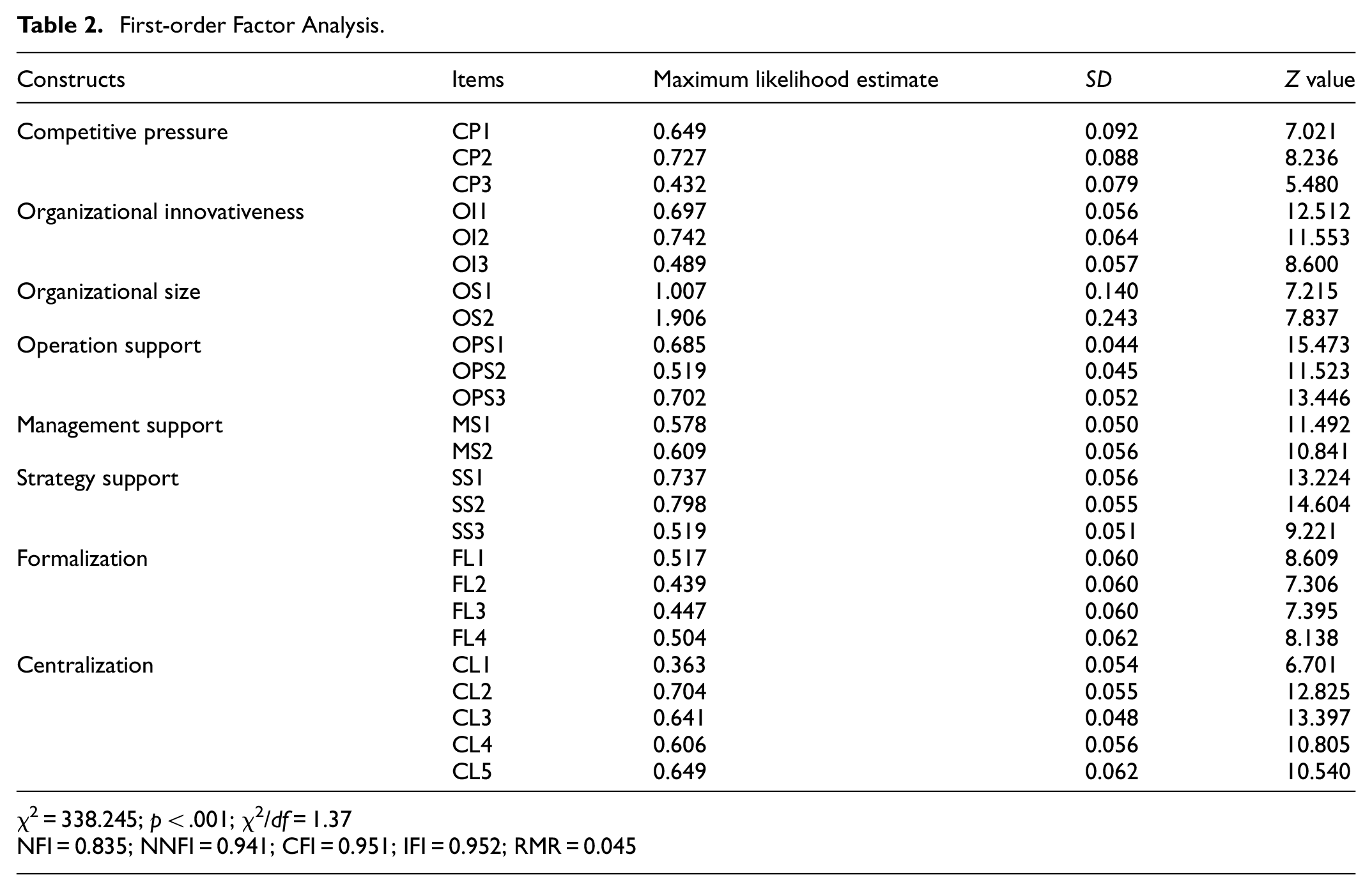
First, the chi-square statistic (χ2) in Table 2 (χ2 = 338.245, p < .001) and the goodness-of-fit index (NFI = 0.835 < 0.90) suggest that the fit between the measurement model and the data is not good. However, the chi-square statistic is easily influenced by factors such as sample size, degrees of freedom, and non-normal distribution, and using this statistic alone to assess model fit may not be appropriate (Anderson & Gerbing, 1988). Similarly, the NFI index is sensitive to sample size, and in the case of this study with a sample size of 220 compared to 25 research variables, it may not be suitable to solely rely on these indices for assessment.
Bentler (1990) suggests using the Comparative Fit Index (CFI) to assess the overall fit of the model. Generally, a CFI value greater than 0.9 is considered acceptable. Additionally, other common fit indices such as the chi-square to degrees of freedom ratio (χ2/df) with a threshold value of less than 5 or even 2 (McIver & Carmines, 1981), and NFI, NNFI, and IFI with recommended values greater than 0.9 (Bentler, 1990) can be used. In terms of these fit indices, the analysis results of this study meet the recommended threshold values, indicating an acceptable fit between the model and the data.
Based on Table 2, it can be observed that all the estimated parameter values for the measurement items of the constructs are significant at the 1% level, indicating that all the questionnaire items converge to their respective measurement constructs at an acceptable level. This demonstrates that the measurement results of this study achieve acceptable convergent validity. Furthermore, the confidence intervals for the correlation coefficients between the variables, within two standard deviations, do not include 1 for all variables, indicating that all the research variables achieve acceptable discriminant validity (Anderson & Gerbing, 1988). Discriminant validity, to some extent, indicates that the research constructs are not the same. Therefore, this test suggests that the subsequent analysis of the substantive relationships between constructs is less likely to be confounded by measurement issues.
After evaluating the discriminant validity and convergent validity of the questionnaire items, we confirm that the items in this study’s questionnaire meet the acceptable criterion for unidimensionality. Hence, the subsequent reliability testing becomes meaningful (Anderson & Gerbing, 1988). The values on the diagonal of Table 3 represent Cronbach’s alpha values for each variable. Except for competition pressure and formalization, which are slightly lower, Cronbach’s alpha values for the remaining variables are above .7 (Cronbach, 1947), indicating an acceptable level of reliability for the questionnaire of this study.
Correlations Among Constructs and Cronbach’s Alpha.

Note. CP = competitive pressure; OI = organizational innovativeness; OS = organizational size; OPS = operation support; MS = management support; SS = strategy support; FL = formalization; CL = centralization.
p = .05.
Measurement Model
According to the proposed research hypotheses, this study constructed a structural equation model as shown in Figure 3. In the model, the role of KM systems is represented by a second-order factor model, with its first-order factors represented by three dimensions. The variances of competition pressure and organizational size, which are exogenous factors, are set to 1. The estimation results are presented in Table 4.
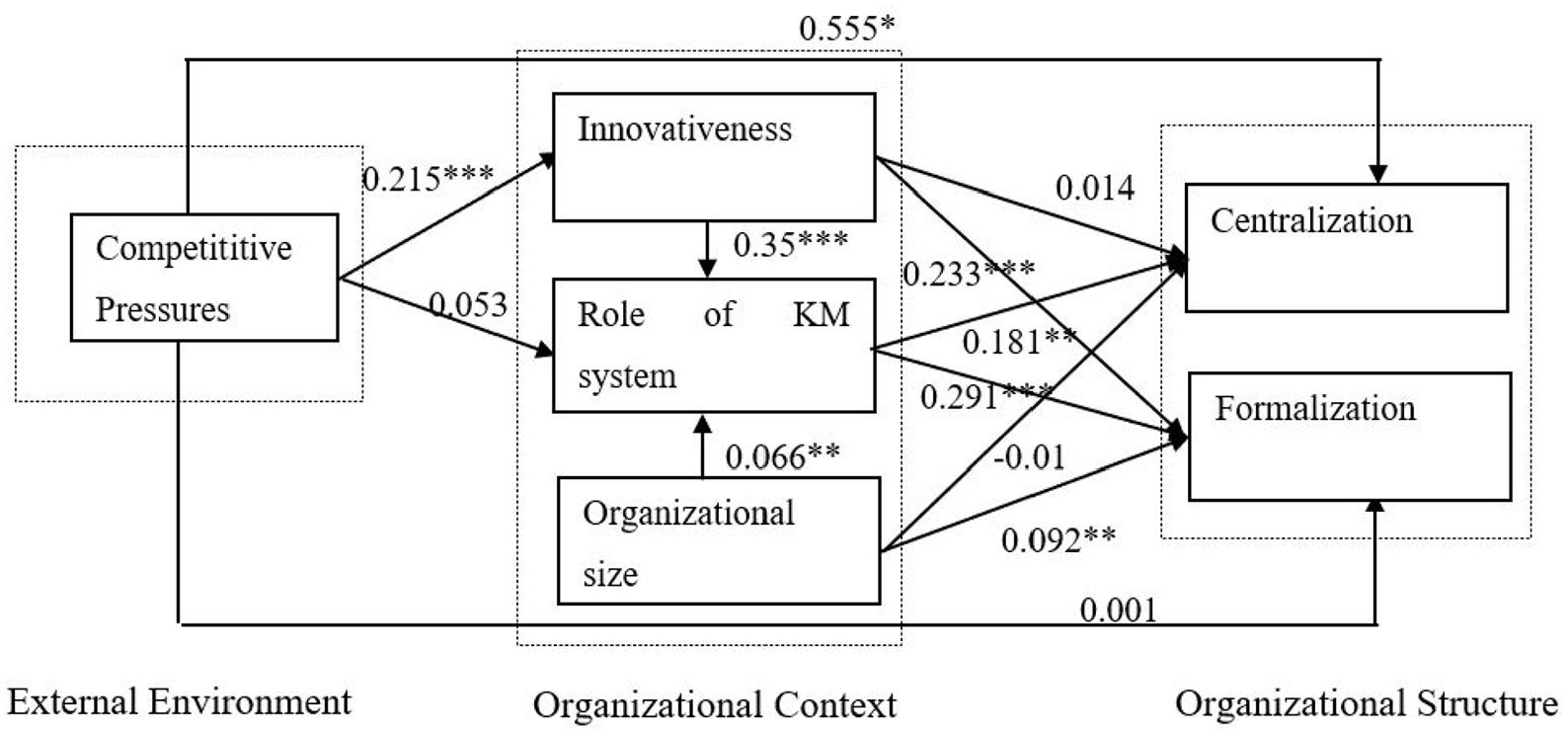
Path analysis.
SEM Analysis Results.
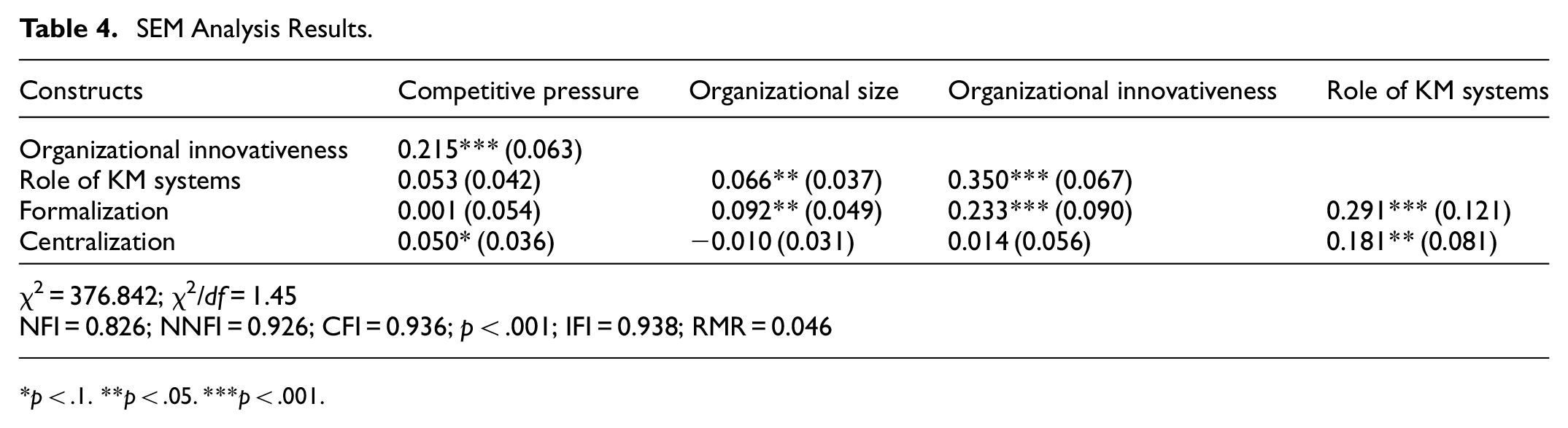
p < .1. **p < .05. ***p < .001.
Similar to the results of the CFA analysis for the measurement model, the model fit indices, including the chi-square test and NFI, do not meet the acceptable criteria. However, the other indices reach acceptable levels. The entire model consists of 12 paths, and under the 5% significance level, 8 paths are found to be significant (see Table 4). The results of hypothesis testing are presented in Table 5.
Hypothesis Testing.

Hypothesis Testing Results
In Table 4, it is shown that competition pressure has a significant direct effect on decentralization (H2) at a one-tailed test with a significance level of 10%. However, the direct relationship between competition pressure and formalization (H1) is not significant. This result partially supports the threat-rigidity model (Staw et al., 1981), suggesting that under high competition pressure, organizations may tend to centralize power and enhance control to reduce potential decision-making errors. On the other hand, the non-significant direct relationship between competition pressure and formalization may indicate that decentralization and formalization are different choices for organizational control. However, this result is not consistent with some literature suggestions.
According to the hypotheses in this study, competition pressure has a highly significant direct effect on organizational innovation (H3). Although the direct effect of competition pressure on the KM system role (H4) is not significant, the direction of influence is consistent with the hypotheses. On the other hand, the direct effect of organizational innovation on the KM system role (H5) is highly significant, indicating that organizational innovation plays an important mediating role between competition pressure and the KM system role.
In terms of the direct effects of situational variables on organizational structure, organizational innovation has a significant positive impact on formalization (H6), but its effect on centralization (H7) is weak. On the other hand, the KM system role has significant positive effects on centralization (H8) and formalization (H9). From the observed relationships, it can be inferred that the KM system role serves as a mediator between organizational innovation and centralization, as well as between the KM system role and formalization. This may explain why the negative covariance relationship between organizational innovation and centralization is not significant when considering the direct positive effects between organizational innovation and KM system role and between KM system role and centralization. As a result, the testing results show an insignificant relationship between the two variables.
Lastly, the direct effects of firm size on KM system role (H10) and formalization (H12) are both significant and positive, while the effect on centralization is negative but not significant. This result suggests that larger organizations tend to use KM systems and formalization mechanisms to maintain and control their organizational operations. Moreover, in terms of statistical significance, even when controlling for firm size, the relationship between the KM system role and formalization, as well as centralization, remains significant. This indicates that the observed relationships are less likely to be caused by spurious effects.
Discussions and Implications
Discussions
The current study found that competition pressure significantly affects decentralization (H2), aligning partially with the threat-rigidity model (Staw et al., 1981), but contrary to this model, it leads to decentralization rather than centralization. This suggests that organizations under high competition pressure recognize the need for swift, localized decision-making while centralizing strategic controls to mitigate risks. Additionally, competitive pressure did not significantly impact formalization (H1), diverging from Tagod et al. (2021). Instead, our findings imply that organizations prioritize flexibility and responsiveness over rigid procedures in highly competitive environments, supporting differentiation-integration theory (Lawrence & Lorsch, 1967).
The study’s findings that organizational innovativeness positively impacts formalization (H6) but has a weak effect on centralization (H7) provide a mixed comparison with existing literature. While Damanpour (1991) suggested that innovation often leads to more organic, less formalized structures, our results indicate that innovative organizations may still formalize certain processes to manage the complexities of innovation. The significant positive effects of the KM system role on both centralization (H8) and formalization (H9) align with Balasubramanian et al. (2019), who posited that KM systems provide structured approaches to managing knowledge and processes. This supports the view that KM systems help balance the need for flexibility and control, fostering a structured yet innovative organizational environment.
Our findings regarding firm size indicate that larger organizations tend to implement KM systems and formalization mechanisms (H10 and H12), which corroborates Gupta and Achhnani (2024). These studies found that larger organizations have the resources and structural complexity that necessitate and support the use of KM systems and formalization to maintain control and coordination. However, the non-significant effect of firm size on centralization suggests that size alone does not dictate centralization levels, diverging from Dutta et al. (2022), who found a positive correlation between firm size and centralization. This indicates that other factors, such as organizational culture and leadership style, may play more critical roles in determining centralization levels.
Based on the theory of organizational KM requirements, the role of KM systems and the formalization and centralization of organizations are seen as responses to environmental competitive pressures. The empirical results show that the impact of competitive pressure on the role of KM systems and organizational centralization can be explained through two mediating models (Figures 4 and 5).

Innovativeness as a full mediator in the relationship between competitive pressure and the role of KM system.
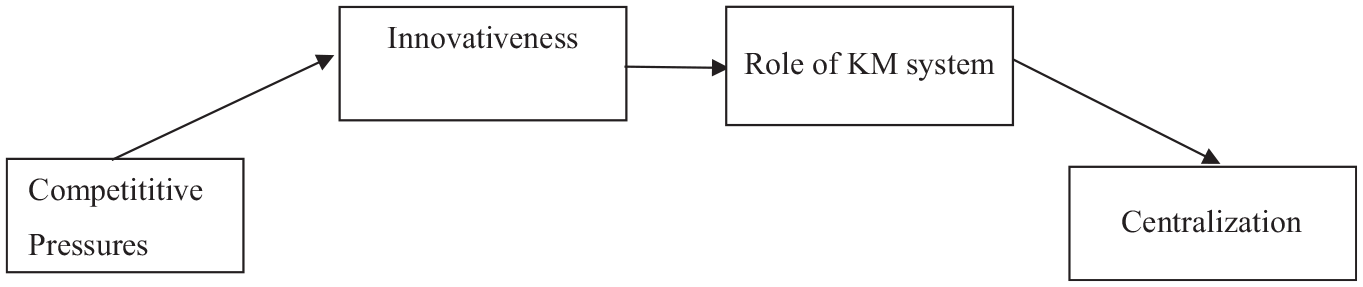
Innovativeness and Role of KM system as partial mediators in the relationship between competitive pressures and centralization.
In Figure 4, we present the complete mediation model of pressure, organizational innovation, and centralization (Venkatraman, 1989). While the research hypotheses suggest that competitive pressure directly influences the role of KM systems and that competitive pressure indirectly affects KM systems through organizational innovation, the analysis results show only an indirect effect between competitive pressure and the role of KM systems. This implies that although competitive pressure increases the incentive for organizations to rely on KM systems, organizations must possess a certain level of innovation to effectively utilize and depend on KM systems in response to competitive pressure.
Figure 5 presents the partial mediation model of competitive pressure, organizational innovativeness, the role of KM systems, and centralization (Venkatraman, 1989). Unlike Figure 5, competitive pressure not only has a direct positive effect on organizational centralization but also indirectly affects centralization through organizational innovation and the role of KM systems. This result demonstrates that the alignment between the role of KM systems and centralization is a crucial mechanism for organizations to respond to their KM needs.
Similar relationships can be observed between competitive pressure, organizational innovativeness, the role of KM systems, and formalization. Therefore, overall, the role of KM systems should be regarded as a vital tool for effective organizational design, regardless of whether managers choose decentralization, centralization, or formalization. By leveraging the “automation” and “informational” capabilities of KM systems, organizations can effectively respond to competitive pressures in their environment.
Furthermore, in traditional contingency theory research, organizational size has been considered as an intervening variable influencing the relationship between technology and organizational structure. The results of this study, however, indicate that even when controlling for organizational size, the role of KM systems still significantly affects formalization. This finding demonstrates the strong impact of the role of KM systems on formalization and suggests that KM systems can be seen as a means for managers to enhance coordination and integration in response to increased organizational size. Moreover, the role of KM systems acts as a complete mediating variable between organizational size and centralization, highlighting the role of KM systems as a crucial tool for managers to exercise control through centralization after the increase in organizational size.
Theoretical Implications
Overall, this study, which was based on the knowledge/information processing model and contingency perspective, has obtained empirical support for the proposed research model. However, regarding the causal relationship between KM technology and organizational structure, there are still many factors that warrant further investigation.
Firstly, this study primarily focused on the organizational level, and the definitions and measurements of organizational context and structure were aggregated. However, the knowledge/information processing model (Galbraith, 1974) was developed to address how organizations should be designed to provide appropriate KM capabilities under task uncertainty. Therefore, to avoid diluting the relationship between technology and organizational structure at larger analytical units and to gain a better understanding of the KM capabilities provided by KM technology, future research should consider setting the analytical unit at a specific organizational functional structure (such as departments). Additionally, the measurement of KM technology should primarily focus on the dominant KM technologies in use (Wetzels et al., 2009).
Although this study focuses on the impact of high-speed competitive environments and the threat-rigidity model on organizational design considerations by top managers, it is true that factors such as management philosophy, organizational strategic orientation, cultural background, and institutional forces, which can influence decision-making at the organizational level, were not further explored and modeled in this study. Many studies suggest that the relationship between technology and structure should be viewed as a multi-variable relationship, and effective organizational design should reflect internal consistency among these factors (Tallon et al., 2019).
Furthermore, the fit between organizational structure and environmental contingencies (Fourné et al., 2019) should have implications for organizational performance, according to the law of interaction in the contingent perspective. Therefore, for future research, the impact of KM technology on organizations should be extended to the examination of organizational performance, and the alignment between KM technology and organizational structure should be investigated to determine if it has a substantive impact on organizational performance. Additionally, this study suggests that future research should employ different measurement approaches for KM technology, organizational context, and organizational performance, or gather data from multiple informants, to avoid the issue of common method bias (J. Singh, 1995) associated with relying solely on a single method.
Finally, many studies have started to explore the interaction between KM technology and organizational structure from the perspective of the theory of structuration (Chouikha Zouari & Dhaou Dakhli, 2018). They argue that the same KM technology can have different effects in different institutional contexts (Agostini et al., 2020). Due to the limitations of cross-sectional data in this study, the interactive relationship between KM technology and organizational structure at different time points could not be further examined. However, this study believes that only through further exploration of the dyadic relationship between KM technology and organizational structure can managers effectively harness the potential of KM technology and discover new opportunities for its application.
Practical Implications
For practitioners, the findings offer several actionable insights. Organizations facing high competition pressure should consider decentralizing decision-making to enhance responsiveness and agility. Decentralization allows for quicker, localized decision-making, which is critical in a competitive landscape. However, to avoid potential pitfalls of decentralization, such as inconsistency and misalignment with organizational goals, it is essential to implement formalized processes. These processes ensure consistency and coordination across different units and functions, providing a balanced approach to managing competition pressures.
The study emphasizes the importance of fostering an innovative climate within organizations. Promoting innovation enables organizations to leverage KM systems effectively, enhancing decision-making and standardizing processes. This is particularly beneficial for larger organizations, which, as the findings suggest, tend to rely on KM systems and formalization mechanisms to maintain control over their operations. Larger firms should continue to invest in KM technologies to capitalize on their structural complexity and resource availability, ensuring they remain competitive and innovative.
Furthermore, the positive impact of firm size on the KM system role and formalization indicates that larger organizations have the resources and capabilities to implement advanced KM technologies and formalized processes. Smaller organizations, while not having the same resource base, can still benefit by emulating these practices. Investing in KM systems and developing formalized procedures can support innovation and operational efficiency, allowing smaller firms to compete more effectively with larger counterparts. By focusing on creating an innovative culture and leveraging KM systems, smaller organizations can enhance their adaptability and resilience in a dynamic market environment.
Additionally, the findings highlight the need for a nuanced approach to organizational structure. While decentralization is beneficial for fostering innovation and responsiveness, formalization remains crucial for maintaining order and consistency. Managers should strive to balance these elements, ensuring that decision-making authority is appropriately distributed while maintaining clear and standardized processes. This balanced approach can help organizations navigate the complexities of modern business environments, where flexibility and control are both essential for success.
Limitations and Future Research
While this study provides significant contributions, it is not without limitations. The cross-sectional nature of the data limits the ability to infer causality. Future research could employ longitudinal designs to better understand the causal relationships between competition pressure, organizational innovation, KM systems, and organizational structures.
Additionally, the study’s focus on organizations within a specific context may limit the generalizability of the findings. Future research should explore these relationships across different industries and cultural settings to validate and extend the results. Furthermore, the study did not account for several influential factors, such as management philosophy, strategic orientation, cultural background, and institutional forces, which significantly impact decision-making and organizational design. Incorporating these elements in future research could provide a more comprehensive understanding of the interactions between KM technology and organizational structure.
Footnotes
Acknowledgements
The authors would like to thank Ho Chi Minh City University of Economics and Finance (UEF), Vietnam for funding this work.

Ethical Considerations
Ho Chi Minh City University of Economics and Finance (UEF) granted the authors permission to use the scale for this academic research.
Consent for Publication
All the authors declare their consent for publication.
Author Contributions
(1) Thuy Dung Pham Thi: Manuscript writing and formatting; (2) Van Kien Pham: Manuscript revision and writing; (3) Nam Tien Duong: Data collection and analysis.
Funding
The author(s) received no financial support for the research, authorship, and/or publication of this article.
Declaration of Conflicting Interests
The author(s) declared no potential conflicts of interest with respect to the research, authorship, and/or publication of this article.
Data Availability Statement
The data that supports the findings of this study are available from the corresponding author upon request.