




Abstract
Currently, English as a foreign language (EFL) teachers are supposed to recognize that, creativity among students can be developed through knowledge management practices. The current study aimed to investigate EFL teachers’ knowledge management practices from learner insight. The explanatory mixed method research design was used to investigate the phenomenon. Quantitative data was collected from 298 A-Level students through a survey questionnaire, and qualitative data was collected through 7 A-Level students through an in-depth semi-structured interview. The findings suggested that EFL teachers arrange seminars and co-curricular activities to create knowledge; discussion in and outside classrooms are used to share knowledge; social media and movies are used to utilize knowledge; and notebooks are used to store knowledge in the EFL classroom. The study revealed that benchmark and technological devices to manage knowledge are not frequently practiced by EFL teachers. The study concluded that teachers should be trained in the area of knowledge management regularly.
Keywords
Introduction
Creativity in English as a foreign language (EFL) context has been considered as one of the key skill of the 21st century. This useful tool is used by EFL teachers to handle difficulties on a daily basis as well as in their professional lives. Creativity enhances knowledge and skills among learners in an interactive environment which help to retain knowledge for a long-term memory (Bennet & Bennet, 2008). Day and Conklin (1992) assert that the second language teacher’s comprises of four kinds of knowledge: subject matter knowledge. Teaching knowledge—knowledge of general teaching approaches, principles, and practices. The particular knowledge of how to epitomize content knowledge in varied ways that students can comprehend; and Support knowledge to learn English. According to social constructivist’s perspective, knowledge is the product of human interaction. This type of knowledge promotes imagination among the learners and fostering pedagogical knowledge of the teachers in the foreign language classroom (Chen et al., 2009). In the interactive learning environment, learners construct a new form of knowledge with the help of existing knowledge (Ismail, 2017). According to Weda (2016), the teacher’s role in the transmission of information to students is the most fascinating aspect. This is because lecturers have a very significant part to play in improving students’ skills. Ahmed, Akhtar, et al. (2020) explain that, In Pakistan, secondary education is strongly optimistic that learning management, as applied by the industrial enterprise, would be adopted. Various strategic practices in large industries have been used to accomplish their targets today in a multinational context. These activities include strategic strategy, knowledge management, and leadership in knowledge and strategic planning in the sense of a learning organization.
Bereiter and Scardamalia (2010) specified, “the emerging knowledge age in EFL poses an educational challenge that can be best met by adopting knowledge management and knowledge building pedagogies” (p. 11). Previous researches on English as a foreign language context shows insufficient and unsatisfactory learning condition in the institute to create knowledge and promote creativity among learners (Ahmed, Khan, et al., 2020; Ismail, 2017). Teaching of English as a foreign language in Pakistani context is always considered as a big challenge for language teachers (Ahmed, Akhtar, et al., 2020). Pakistan is a diverse country with over 70 languages spoken, with Urdu serving as the national language and English serving as the official language (Yasmin & Sohail, 2017). With a colonial past, Pakistani culture suffers from extreme class division and class awareness; as a result, English takes precedence over native languages. English is widely utilized in government sectors, higher education institutions, the court, and business, despite several recent initiatives to improve the Urdu language. Despite that the ability to communicate in English is widely seen as a key to success in job creation and survive in the society (Ahmed, Khan, et al., 2020), secondary level students of Pakistan have a poor degree of proficiency English (Ahmed, Akhtar, et al., 2020). In this context, the role of secondary school English subject teacher is very important to enhance the knowledge and skills of the English language learner. Therefore, the Sindh Education and Learning Department (SELD) is putting its effort to improve the learning management of English subject teacher by organizing several in-service trainings (Ahmed, Khan, et al., 2020).
In an academic institution, teachers need to implement knowledge management practices as a teaching pedagogy (Yasmin & Sohail, 2017). Knowledge management (KM) is “An ability of an organization to use its collective knowledge through a process of knowledge generation, sharing and exploitation enabled by technology to achieve its objectives” (Cong & Pandya, 2003, p. 26). Knowledge management (KM) has a broad range of activities, such as knowledge creation, knowledge sharing, knowledge utilization, and knowledge documentation or storing. Information management encourages people, individuals, and whole organizations to develop, exchange, and apply knowledge collectively and consistently to accomplish their strategic and organizational goals (North & Kumta, 2014).
Statement of the Problem
Knowledge management was introduced in business industries since last many decades as it has got the deepest roots and very much importance in the field of industry. By considering its importance, it must be made as part of the education sector because society is turning from an industrial age to digital age in the field of education, therefore KM is as much important in the education sector, as in the industrial sector (Sallis & Jones, 2012). Knowledge management is also significant for EFL learning (Hantoobi et al., 2021), however, most of the teachers in Pakistan are not using it properly during teaching and learning process (Younas et al., 2012), despite of being component components of National professional Standards for Teacher in Pakistan (Ministry of Education, 2009). Therefore, this study explored the practices used by EFL teachers in the A-level classroom for knowledge management.
KM is an important area in EFL classrooms and review of researches informs that a lot of exploration has been done by researchers to address and highlight relatable issues which are closely related to KM in a standard classroom. Kurniawan (2014) debated and presented the significance and the role of knowledge management in school. Lee et al. (2010) focused on how the KM processes work in a secondary school setting. Likewise, Ugurlu (2013) emphasized on the knowledge related to school management for primary teachers. In the domain of higher education, Mahdi et al. (2019) investigated the advantages and disadvantages of knowledge management practices. In the wake of the emergence of digital technology in education, Awang et al. (2011) documented the KM progress in technology enabled smart school. A conceptual model for knowledge management in higher education was proposed by Ojo (2016). In different countries based on the context and setting different factors affect the knowledge management process differently. Younas et al. (2012) exposed how perception of the teachers hinder knowledge management practices in the Pakistani setting. This was further explored by Yasmin and Sohail (2017). These researchers reported the KM strategies which make learners autonomous in their EFL classroom. Researches in knowledge management are conducted around the world to explore the different dimensions of knowledge management. The present research is unique and well needed as it is covering the need of A-Level students and teachers’ practice of knowledge management in EFL classroom from students’ perspective since the opinion of students is as important in an interactive setting (Martin & Bolliger, 2018).
Implicitness and Explicitness
Implicitness and explicitness are used in different settings (Roca, 2015). The present study will discuss implicitness and explicitness from the learners’ perspective about knowledge management practices of their EFL teachers in the EFL classroom.
The agreement of explicitness is associated with general grammar activities that inspire students to recognize the fundamental rules of the language. Furthermore, building unambiguous feedback or using teaching techniques for developing a specific skill. Explicit EFL learning occurs in formal educational surroundings, in which the students follow the traditional method of FL learning in which teacher-centered teaching is done in the classroom (Roca, 2015, 2017).
On the other Implicitness, refer to the other method of learning which are interactive in nature, which is a student-centered approach, which encourages activities which are used to improve language attainment. The learners are directed to communicate through activities in natural environments in which participation is a must for language learning. Language is communicated primarily by the students, and the teachers’ role which is secondary to be a facilitator to guide students to communicate even if there is any mistake takes place while communicating (Roca, 2015, 2017).
Research Question
What are the perceptions of EFL learners about knowledge management (KM) practices implemented by their EFL teachers with reference to knowledge creation, knowledge practices, knowledge sharing, and knowledge utilization in the EFL classroom?
Literature Review
Definition of Knowledge Management
The functions of education are always supported by the knowledge plan, that is, the production of knowledge, the codification, and the distribution of information (Hantoobi et al., 2021; Ramachandran et al., 2013). In fact, institutions have traditionally been used as transfer mechanisms to provide a knowledge base for students to work and prosper in graduate studies (Al-Kurdi et al., 2020).
In this article, knowledge management is defined as an organized and thoughtful attempt, supported by key knowledge management strategic facilitators, to develop and implement knowledge practices at the secondary level in the ELF classroom. Knowledge practices comprise a set of processes that generate, collect, codify, store, share, and apply knowledge among academics. A number of key policy enables, like strategies and leadership, organizational culture, information technology, and performance measurements are supporting the application of these practices. In conjunction, the management of knowledge and the presence of key strategic KM facilitators are essential to ensure the effective application of KM at the secondary level in the EFL classroom. Given the definition, these sections examine the practice of KM and major strategic support for theoretical and practical aspects. The following sections are impressive.
Knowledge Management From Business to Education
In order to recognize and formalize employee knowledge in support of innovation and competitiveness, the business community has developed a growing concern (Chiu & Chen, 2016). Not surprisingly, much of this literature examines corporate knowledge management applications, including the various conceptions of organizational, human knowledge, and the management of knowledge strategies (Edge, 2005).
Simultaneously, the interest in the application of knowledge management in the educational sector has been increasing. This limited research body includes: improving quality and efficiency at organization, reducing costs (Mc-Evoy et al., 2019), and decreasing interagency fragmentation; and potential benefits of public sector knowledge management (Edge, 2005).
Knowledge Management in EFL Classroom
Knowledge management is considered as an effective process when it is easily accessible and promotes innovations along with the requisite formalities to produce measurable results (Awang et al., 2011). Educational institutions sometimes associate different formalities to ensure structure communication which hinder the creativity and spontaneity of the students by decreasing their freedom of speech (Ahmed, Khan, et al., 2020). However, innovation and imagination are the pre-requisite for the EFL learner to explore knowledge and interpret information (Awang et al., 2011).
As explained by Fullan (2002) that, “despite being in the learning business, EFL educational organizations and local education authorities are notoriously poor knowledge sharers” (p. 409). In a regular working environment, teachers have no time to interact with peers to improve their teaching by sharing ideas which decreases their capacity to share knowledge. However, knowledge in the EFL classroom is needed to be disseminated, shared, and stored which is found missing in many EFL institutions. On the other hand, the workload of EFL teachers not only include teaching but other extracurricular activities and responsibilities hinders them in sharing their knowledge with their colleagues (Santosh & Panda, 2016). Teachers have also complained about lost time and irregular workflow which holds them for discussion and sharing knowledge with other colleagues (Awang et al., 2011). Another factor is the equality culture of the education system in which EFL teachers are more accountable and are expected to perform the task for which they are not paid for (Santosh & Panda, 2016). According to Awang et al. (2011), “the norm of equality is ‘egalitarianism’, under which one responds to demands for assistance, but does not deserve any special benefits for doing so.” The major rationale for this behavior is because peers are a non-judgmental by providing unsolicited knowledge, skills, and experience.
In the context of Pakistani EFL classrooms of secondary levels, numerous pedagogic institutions have adopted KM concepts and processed its predominant aspects, tools, or procedures. However, academic service organizations, particularly EFL organizations, have recently expressed a growing interest in using knowledge management techniques. Information communication and technology facilitates knowledge management practices by “the collection, sorting, storing and distributing of large quantities of data to the right people at the right time” (Ahmed, Khan, et al., 2020; Kurniawan, 2014). According to Tiwana (2002), there are four main components of KM processes such as “knowledge creation, knowledge sharing, knowledge utilization, and knowledge storing.”
Existing Models of Knowledge Management
For the creation of a knowledge management model, three analytical conceptualizations may be drawn up. The first is Belenky et al. (1986) Ways of Knowledge Model, which describes the stages of individual epistemological growth and the ways of perception used at each point. Epistemic creation refers to the advancement of views on the flora of science and the way of knowledge (Ismail, 2017). These include silence, received knowledge, subjective knowledge, procedural knowledge, and constructed knowledge are all the five basic phases of development.
The second model of knowledge management is the Chain Model which is established in business contexts (Singh, 2012). Its motive is to let the organizations’ to develop a competitive advantage. There are activities which are primary activities such as resources. The primary activities include knowledge attainment, selection, generation, acclimatization, and production (Ismail, 2017).
Bereiter and Scardamalia’s knowledge creation are the third knowledge management model (Bereiter & Scardamalia, 2010, 2014; Scardamalia & Bereiter, 2002). Scardamalia and Bereiter (2002) define knowledge creation as ”the manufacturing and repeated development of the idea of value to a community in which the accomplishment of the community is counted more than individual achievements” (p. 1371). As Scardamalia and Bereiter (2002) debate, the knowledge building involves the launch of successful knowledge building societies in terms of socio-cognitive standards.
Suggested Models of Knowledge Management
Current research suggests a knowledge-management approach that integrates three models into a full instruction outline in order to gain perspective EFL teachers from their knowledge of better foreign language teaching. This paradigm initiates a shift in the new system of students’ views and assumptions, such as the assumption of the essence of knowledge, the appraisal, and acquisition of knowledge (Ismail, 2017). This is the first step, and it is important for the building of information.
The second stage applies to creating knowledge management and knowledge-building community in a connectivity atmosphere. Bereiter and Scardamalia’s (2010) inform what works well in this phase; aspects such as unrestricted knowledge, democratize knowledge, systematic knowledge building, and knowledge building dialogue are all the examples of such kind. This phase establishes the manner in which the students are directed into creating reasoning and social norms to participate in the knowledge building with different from the people of the society. Ismail (2017) argue, constitute an element aspect in the accomplishment of knowledge building and knowledge management activities.
The Knowledge Chain Model (Singh, 2012) suggested in the related knowledge management literature, the third phase incorporates the essential processes of knowledge management as conversed in knowledge sighting and detection, knowledge attainment, the organization of knowledge, assessment, and knowledge improvement, transfer of knowledge, usage of knowledge, and the creation of new knowledge. Which further divides into two subcategories. One includes managing knowledge, the attainment of knowledge, assessment, and coordinating while another emphasis on how knowledge is created (Ismail, 2017). Managing knowledge is the base for creating new knowledge. This recommended model was field-tested on EFL teachers’ in the Emirati.
The Dimensions of Knowledge Management
Knowledge creation
Knowledge creation is “the internal processes of generating, creating, building, constructing and developing knowledge is known as knowledge acquisition. Both terms are all about gaining useful and new ideas and insights” (Daud & Yusuf, 2008, p. 170).Whereas, knowledge creation, according to Nonaka and Takeuchi (2007), is an organization’s ability to generate effective and creative ideas and concepts for many aspects of its operations, such as management technique, technical procedures, and production. Mertins et al. (2003) define knowledge generation or creation as “tools and efforts” that allow the production of outside techniques and information in order to extract implicit knowledge.
Research investigating the nature of knowledge management in the Turkish context showed that some of the qualities that seem to be of interest to Turkish EFL teachers include comprehension of the subject taught and empathy for learning difficulties (Çelik et al., 2013). In addition, a large-scale study of Chinese EFL teachers employed in the mainland, China demonstrated how awareness is created in teaching, which seems to help build supportive attitudes toward teachers (Li & Walsh, 2011).
Knowledge sharing
Younas et al. describe knowledge sharing as “the level of intra-organizational cooperation along with the exchange of documents, ideas news, things learned and any other information that is relevant” (p. 4). Information sharing is accomplished by combining existing knowledge with the creation of new knowledge (Mahdi et al., 2019). One of the major aims of KM practice and research is to increase information exchange between members of an organization, therefore knowledge sharing is a basic activity of KM (Baharun et al., 2021; Shin, 2004).
Alimirzaee and Ashraf (2016) assert the importance of research on knowledge sharing by teachers, which results in improving knowledge. When speaking about the EFL teachers, researchers disclose that the EFL teachers may seem to vary in the knowledge they possess, methods they practice and so on as sharing of knowledge led them to know the numerous pedagogical aspects which are used for teaching EFL classrooms. The EFL teachers usually benefit from the interactive debates, conferences, consultations, their colleagues teaching methodologies and experience. There are kinds of knowledge sharing, which are real and virtual. Real knowledge sharing related to the EFL teachers’ associations, physical or face to face dealings with their colleagues while the virtual knowledge sharing involves digital or web-based context where interactions happen through electronic media outside real-life situations. Teachers believe that professional development plays a vital role in language teaching and learning, especially while interacting in dialogues (Alimirzaee & Ashraf, 2016).
Knowledge utilization
The main purpose of appropriate knowledge is to utilize it in different scenario (Mahdi et al., 2019). Individuals and collective learning processes for new EFL learners are only permitted through knowledge utilization. Lee et al. (2010) describe knowledge utilization as “the stage whereby putting together the published information papers and knowledge users should pull together their expertise and put it to practical action” (p. 12). During this process, information on how to change KM’s approach is provided.
Similarly, all of these research focused on the English as a foreign language subject when it came to knowledge utilization strategies. Students were assigned a task to write down a summary of the movie based on their notes or interpretation which they have noted down during the movie viewing session. This practice helps EFL teachers to assign home assignment to students due to lack of time allocation of periods at school (Kusumaningrum, 2016). Moreover, students were also instructed to write down the summary of the movie as a group assignment (Merita, 2014). Students were also assigned a task to collect data from the internet source for the movie which they are going to be watched at school, and summarize it for the later discussion (Wang, 2015). Furthermore, the knowledge utilization practiced were also made through role play, in which students were divided into a group of three, and they were assigned a task to perform certain scenes of a movie in front of a class by creating a dialogue of that particular movie which they have already watched. This activity was followed by EFL teachers’ remarks which help students to improve their choice of words and pronunciation (Kusumaningrum, 2016). Wang (2015) also measured the Chinese students’ knowledge utilization skills by a qualitative research method, and it was found that the Chinese EFL teachers are practicing to utilized knowledge by assigning students a role-play activity in a group of two members in English as a foreign language classroom, that enhance the Chinese students’ pronunciation skills.
Knowledge storing
Small and Sage (2006) describe knowledge storing in the institutional record as “separating knowledge into various categories, transferring knowledge, and saving knowledge” (p. 156). Organizational memory has not been given its due importance by many organizations which results in the increase turnover of the employee. The outsourcing measures taken by organization lead them toward the decrease of knowledge. It is suggested that in the future, Knowledge needs to preserved and indexed using the appropriate mechanism to make it accessible so it can be retrieved it when needed (Mahdi et al., 2019).
Research Methodology
The current study used the explanatory mixed method design that requires qualitative data to clarify and expand quantitative findings in order to provide a detailed insight into the study (Creswell et al., 2003). The population of the study was comprised of the students enrolled in the Cambridge examination system (CIEC) at A-level. A-level students are those students who are enrolled in grade 12 of Cambridge board examination and aged between 16 and 19. For quantitative data collection, 298 A-level students were selected randomly from 30 private sector educational institutes of Karachi, which are affiliated with the Cambridge international examination system. From each institute on an average 10 students of A-level were selected through a simple random sampling technique. For qualitative data collection, 7 students were selected through a convenience sampling technique from 298 students who showed their willingness for participation in an interview. Since in the Cambridge system, assessment is based on the conceptualization of concepts and application of knowledge rather than testing of memory; therefore sample was limited to the A-Level students (Siddiqui & Mustafai, 2019).
Quantitative data was collected with the help of an adopted tool entitled with “Students’ perception on KM practices in EFL classroom scale” designed by Weda (2018). The tool contains 23 items which was based on 5 points Likert scale (1 = Strongly Disagree and 5 = Strongly Agree) to determine the students’ perceptions on knowledge management practices by their teachers in the EFL classroom. The 23 items of the questionnaire is divided into four sections. The first six statements constructed on students’ knowledge creation perspectives. The next nine statements constructed on students’ knowledge sharing perspectives. The next four statements constructed on students’ knowledge utilization perspectives. The last four statements constructed on students’ knowledge storing perspectives.
Before it was used to collect the data, the questionnaire was checked, and a pilot study was performed with 35 A-level students. The pilot analysis was used to see if the language of the questions was appropriate and if it was possible to complete the tasks. As a part of this process, small improvements in the form of language were made in the initial proposal, all the items of the tool were retained as they showed a cronbach alpha reliability of more than .8. Data was collected by using a survey technique. The questionnaire was distributed through personal visits to the educational institutes. A semi-structured open-ended interview was used to enrich and endorse quantitative results. During the interview sessions, the themes were coded for the quantitative elements of the questionnaire. Seven volunteers, who were responders to the questionnaire administered, were interviewed for 20 to 25 minutes. The reason for using targeted, semi-structured, open-ended interviews was to consider the point of view of the respondents rather than generalizations.
Findings From the Survey
Knowledge Creation Perspectives
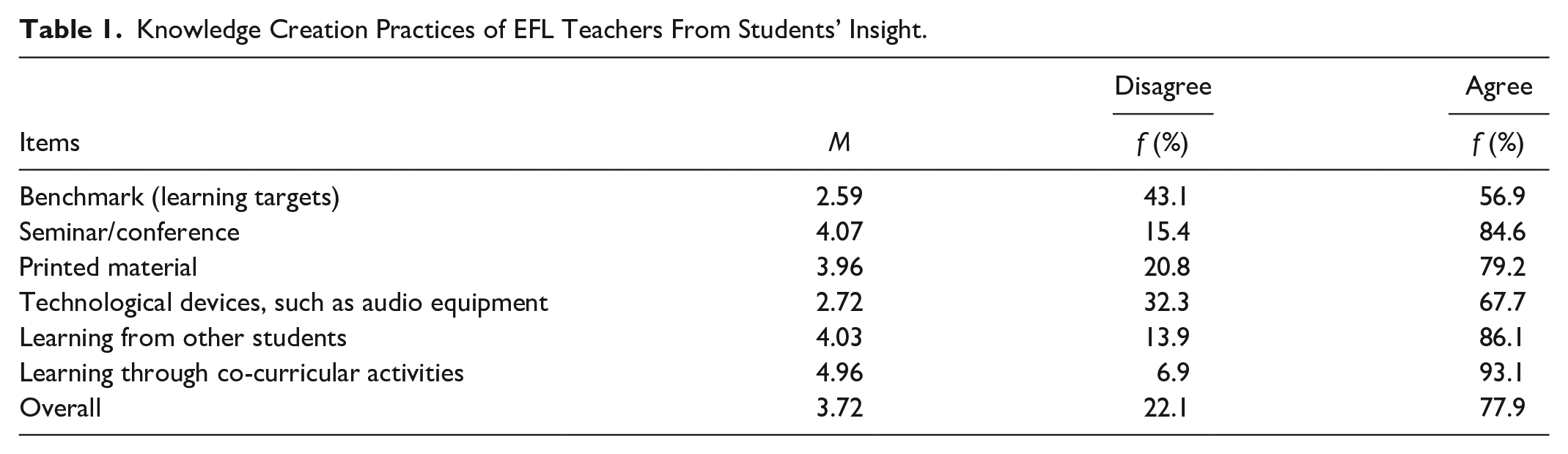
To assess the perception of students of EFL classrooms, they were asked to reflect on knowledge sharing practices by their teacher (see Table 1). Data shows that 93.1% students agreed that their teachers facilitate them to create knowledge through co-curricular activities. Moreover, 86.1% students showed their agreement that knowledge creation is done through communicating with other students; 84.6% are of the opinion that seminar and conferences are the significant source of creating knowledge. About 79.2% participants responded that the printed material is also a source of creating knowledge. Audio equipment as a source of knowledge creation was supported by 67.7% respondent while the lowest participant (56.9%) considered benchmark used by their teachers as a knowledge creation source in the EFL classroom. Overall, it was found that 77.9% students agreed that they have knowledge creation practices in their EFL classroom while 22.1% denied.
Knowledge Creation Practices of EFL Teachers From Students’ Insight.
Knowledge Sharing Perspectives
Knowledge sharing practices by teachers in the EFL classroom were measured from A-level students’ perspective and results are shown in Table 2. Results shows that 79.2% of A-level students are agreed that their teachers create such environment in which knowledge is shared in the EFL classroom during the teaching learning process. Whereas, 52.4% to 66.9% A-level students responded that their teachers make them practice to share knowledge from classroom to people outside the classroom or from classroom to other organization. While, 80.8% students agreed that they share knowledge as an individual student from classroom learning. All of the elements of knowledge sharing have a mean score of less than 4.00, indicating that general sharing practices in the EFL classroom need to be improved. Overall, it was also found that 70.2% students agreed that they have knowledge sharing practices in their EFL classroom while 29.8% denied.
Knowledge Sharing Practices of EFL Teachers From Students’ Insight.

Knowledge Utilization Perspectives
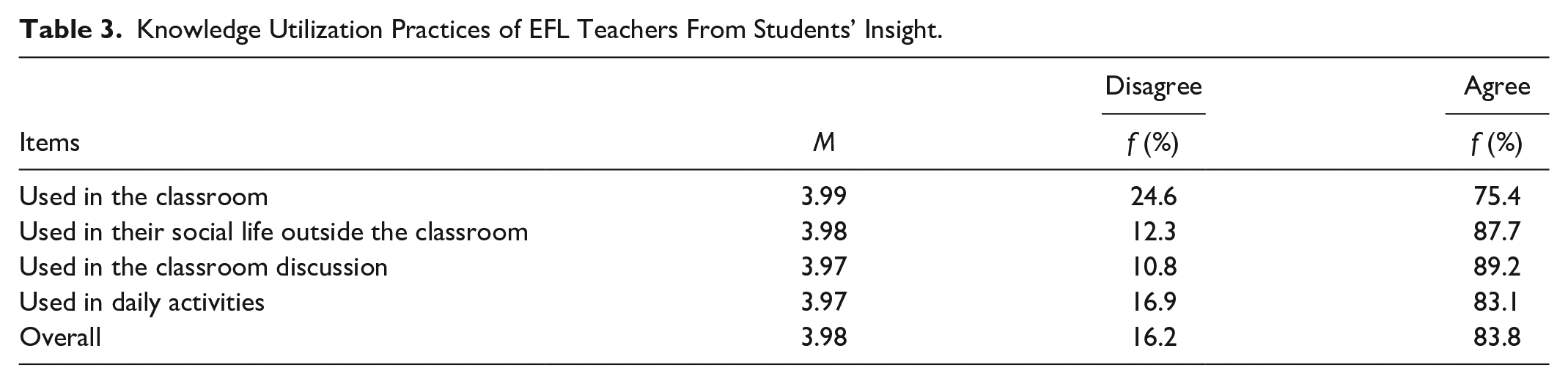
Results of A-level students’ perception about their teachers’ practices of knowledge utilization in the EFL classroom are shown in Table 3. About 89.2% EFL students of A-Level agreed that their teachers apply a discussion technique in the EFL classroom to utilize knowledge. Whereas, 69.6% students reported that knowledge is utilized in outside the classroom by social interaction. All of the elements of knowledge utilization have a mean score nearest to 4.00, indicating that knowledge sharing practices are better as compared to general sharing practices in the EFL classroom. Overall, it was found that 83.8% students agreed that they have knowledge utilization practices in their EFL classroom while only 16.2% denied.
Knowledge Utilization Practices of EFL Teachers From Students’ Insight.
Knowledge Storing Perspectives
To assess the perceptions of students of EFL classrooms, they were asked to reflect on knowledge storing practices by their teacher (see Table 4). Results indicates that 84.6% students of A-level 84.6% agreed that their EFL teachers make them practice to store knowledge for their own need while 57.7 % agreed that their EFL teachers make them practice to store knowledge for other students’ need either of the classroom or from another classroom. About 74.6% students of A-Level agreed that their EFL teachers make them practice to store the knowledge in the notebook. Whereas 69.2% participants responded that they use laptop or computer to store knowledge which is gained in the EFL classroom. As the mean score was less than 4.00, it implies that practicing of knowledge storing in electronic devices, such as the laptop and knowledge storage for other students was very low. Likewise, various knowledge storage techniques are also found less practiced in the EFL classroom, as their mean was lower than 4.00. Overall, it was found that 71.5% students agreed that they have knowledge storing practices in their EFL classroom while 28.5% denied.
Knowledge Storing Practices of EFL Teachers From Students’ Insight.

Findings From Interviews
Theme: Knowledge Creation
Benchmarks set by teachers in the specific learning area are very essential to create knowledge practices in the EFL classroom as the benchmarks help the students to work hard to create knowledge. In contrast, cooperative learning activities which the teachers practice in the college help students to learn from other students, which is more beneficial than the teacher made benchmarks because the social learning theory of Bandura claims the students learn from one another by imitating and observing. As one of the participants proclaimed, “according to me doing extracurricular activities which the teachers’ plans make me so excited and engaged, so knowledge is created by hands-on activities.” Knowledge creation depends on organization culture, as it is believed that watching audiovisual and working reading and writing on the printed material provided by the teacher are very useful for students to create knowledge. Seminar and conference which are held in college, help any student to be more confident and knowledgeable.
Theme: Knowledge Sharing
Sharing knowledge with one another is an important part of the EFL classroom. Students wish to interact with their teachers and their peers so that knowledge is shared among themselves. Interacting outside the school with the community which teachers organize is one way of sharing the knowledge to one another. Knowledge sharing can be possible by interacting and communicating with all the other departments within the college, which the teachers deliberately create is another way of sharing knowledge. It is also found from an interview that visiting scholars and students create an atmosphere for sharing of knowledge, as one of the participant shared, “I believe that discussing different college system, way of assessment number of reference book used in EFL classroom and the videos used for listening and speaking practices.” Participants also proclaimed that “We believe while interacting in the playground or in the cafeteria or in the common room are a very useful way of sharing knowledge to one other. We actually learn this way.” The biggest barrier to knowledge exchange in EFL classrooms is a lack of sociability due to a lack of employment. Practices of knowledge sharing between teaching and non-teaching personnel should be the focus of EFL classes. It is also found from the interview that culture is the most important barrier that prevents school-based instructors from sharing knowledge.
Theme: Knowledge Utilization
Teachers always make students interact in the classroom before he/she begins the session. Students also interact on social media about what they have learnt in the classroom. Classroom discussion on any topic is the right way to utilize the knowledge one learnt in the EFL classroom. Knowledge utilization can be useful when students use it in their daily routine, in college and also at home, just like one of the other participants agreed on knowledge utilization by this way as he said, “I make sure to communicate with my friends on social media like Instagram, Facebook, WhatsApp, and Twitter about what I have learnt in EFL classroom, so it helps my friends also to learn what I have learnt in my EFL classroom.” Participants also acknowledged that the discussions held in the EFL classroom are very useful for real life as it helps students to communicate more freely, easily, and purposefully. It has also been shown that social life interaction is required for knowledge utilization. Movies also help students to properly recognize, remember, and comprehend vocabulary. It has also decided that subtitles will facilitate improved comprehension of the English language and help learners develop new vocabulary when they seek to assess the influence of English films through learners’ subtitles.
Theme: Knowledge Storing
Knowledge can be stored in students’ mind as the knowledge created is forever in his mind. Most of the work which the students do are in the exercise book, in the form of writing or drawing or labeling. One of the participant said, “The knowledge is everywhere.” It is recorded in the leisure, documented in the laptop, commuters, tablets, mobiles, and other electronic Media so that it can be used by other students as well as preserving for future purposes. It is also confirmed that knowledge should be stored for the need of learners in the classroom, in other classrooms, or for any ones use. The knowledge which stored in electronic devices or print media can be used for the daily purpose for the same semester and also for future semesters, and the this stored knowledge can not only be used by the student himself but also for other students of different colleges/schools/and universities. EFL students must learn to apply what they’ve learned in the classroom to the needs of other students, whether they’re in the same classroom or not. Knowledge should be stored on electronic devices such as computers and cellphones. Knowledge storage in EFL classrooms can be improved by providing basic ICT facilities. Moreover, technology integration in the classroom has a significant impact on students’ learning therefore, it can also be used to store knowledge which minimize fear of the English language among EFL learner
Discussion
The present study investigated the EFL students’ insight into their EFL teachers’ knowledge management practices in the EFL classroom. Knowledge management practices were analyzed under four dimensions, which were knowledge creation, knowledge sharing, knowledge utilization, and knowledge storing. Findings of the study reveal that EFL teachers’ knowledge utilization practices in EFL classroom are better than knowledge sharing, knowledge creating, and knowledge storing practices. It is also disclosed that A-Level students are not satisfied with their teachers’ knowledge sharing practices as its means score value was lowest among all other dimensions.
In the EFL classroom of A-level, teachers arranged seminars and conferences for their students so that students can create their knowledge. It is the one approach to create knowledge of individuals in a specific field (Wong & Aspinwall, 2004). Similarly, for the creation of knowledge, face-to-face discussions, community gatherings, university conferences, and forums are easier, while collaborative lesson-learned libraries, groupware, and electronic data exchange are more suitable for specific knowledge (Tsui et al., 2009). EFL teachers are also arranging co-curricular activities for their students in which they create knowledge. It is also supported that students’ active participation in co-curricular activities will aid students in acquiring or creating knowledge, which cannot be transmitted from formal teaching practices (Elshahawy, 2020; Xiao & Luo, 2009). Printed material is also one of the source which EFL teachers are using in their EFL classroom to create knowledge. Knowledge creation depends on organization culture, as it is believed that watching audiovisual and working reading and writing on the printed material provided by the teacher are very useful for students to create knowledge. Knowledge culture creates educational environment for EFL students to enrich their knowledge (Ismail, 2017). In 2002, Fullan’s findings also supported the role of school’s culture to hinder knowledge sharing. He found that in school environment, teachers are mostly not allowed to share their knowledge, therefore, it is not developed in the students. EFL teachers are also creating such environment in their classroom where students communicate with each other, and knowledge is created. While utilizing benchmark or set standards need to be implemented in the EFL classroom for creating knowledge. Benchmark plays the vital role in the knowledge creation practices in the EFL classroom as the benchmark used by the teachers help the students to work hard to create knowledge (Weda, 2018). It was also found that audio equipment are not utilizing in the EFL classroom by EFL teachers for creating knowledge, although audio-visual aids can make EFL classroom more interactive (Mathew & Alidmat, 2013). Moeller and Reitzes (2011) agree that teachers need to create knowledge through technology in their classroom. Students benefit from an EFL classroom that is resourceful, interesting, and learner-centered.
Sharing knowledge with one another is an important part of the EFL classroom. Students wish to interact with their teachers and their peers so that knowledge is shared among themselves. Interacting outside the school with the community which teachers organize is one way of sharing the knowledge to one another. This is also supported by Salmon (2002) that learning communities provide opportunities for collaborative learning to develop via the sharing of knowledge, resources, and the meaningful construction of knowledge. Similarly, Alimirzaee and Ashraf (2016) believe that collaborative learning improves the performance of learners, both for group knowledge sharing and the construction of individual knowledge. Knowledge sharing can be possible by interacting and communicating with all the other departments within the college, which the teachers deliberately create is another way of sharing knowledge. It is also found from an interview that visiting scholars and students create an atmosphere for sharing of knowledge. The biggest barrier to sharing information in an EFL classroom is a lack of social interaction (Alimirzaee & Ashraf, 2016). Practices of knowledge sharing between teaching and non-teaching personnel should be the focus of EFL classes. It is also found from the interview that culture is the most important barrier that prevents school-based instructors from sharing knowledge (Weda, 2018; Younus et al., 2012).
Knowledge utilization can be useful when students use knowledge in their daily routine, in college and also at home. It is also found that EFL teachers make students interact in the classroom before he/she begins the session. Discussions held in the EFL classroom are very useful for real life as it helps students to communicate more freely, easily, and purposefully. Classroom discussion on any topic is the right way to utilize the knowledge one learnt in the EFL classroom. This is in line with Iman and Angraini (2019), the small grouping of EFL students encouraged them to effectively involve their counterparts and lecturers and develop their teamwork and social life skills. This assertion is endorsed by Menggo (2016), who said that conversation teaching would trigger the participation of teachers and learners in the thought process and encourage students to utilize knowledge. Students also interact on social media about what they have learnt in the classroom. To utilize the knowledge, social interaction is required (Kane, 2017). Movies also help students to properly recognize, remember, and comprehend vocabulary. It has also decided that subtitles will facilitate improved comprehension of the English language and help learners develop new vocabulary when they seek to assess the influence of English films through learners’ subtitles (Ebrahimi & Bazaee, 2016; Kusumaningrum, 2016; Merita, 2014; Wang, 2015).
The last dimension of knowledge management was knowledge storing practices of EFL teachers. According to A-level students, their EFL teachers make them practice to store knowledge for their own need. Most of the time, this knowledge is stored in students’ notebook. Most of the work which the students do are in the exercise book, in the form of writing or drawing or labeling are used to store knowledge which students gain in their EFL classroom (Lin & Wu, 2010; Weda, 2016, 2018). Knowledge gained in EFL classroom can also be stored in leisure, documented in the laptop, commuters, tablets, mobiles, and other electronic media, so that it can be used by other students as well as preserving for future purposes (Neches et al., 1991), but it is found in this study that EFL teachers are not practicing this. The knowledge which stored in electronic devices or print media can be used for the daily purpose for the same semester and also for future semesters, and this stored knowledge can not only be used by the student himself, but also for other students of different colleges/schools/and universities (Solano et al., 2017).
Conclusion
The study aimed to explore the current use of knowledge management practices in English as a foreign language classrooms from the learners’ point of view. To conclude, practices followed for the knowledge management fail to meet the required standard for EFL learners. Knowledge management (KM) has four dimensions which are knowledge creation, knowledge sharing, knowledge utilization and knowledge storage. Results also indicates that knowledge sharing is practiced less as compared to other dimensions of KM in the A-level classroom, so it is needed to focus on this dimension of knowledge management. For creating knowledge, seminars; face-to-face discussion; co-curricular activities; printed material; benchmarks; and audio equipment can be utilized. Knowledge is shared when students interact with each other either communicate in the classroom or interact outside the classroom with communities. Discussion, social media, and movies contribute in utilizing the information in the EFL classroom. EFL teachers make students practices to store knowledge for themselves and for others also by asking them to note down lectures in a notebook. Electronic devices are also the best source for EFL learners and teachers to store knowledge for a long time period.
Implications
The present research focused specifically on the knowledge management of EFL teachers as perceived by A-Level students. The implications can be extended to other stages and contexts of the teaching of foreign languages. Underneath are some suggestions of the knowledge management for foreign language teaching, educational policymakers, and decision-makers.
Implications for Foreign Language Teachers
In general and secondary language or foreign language education in particular, the conventional buildings-and-books environments of education will not do much to improve knowledge competitiveness among learners. It is possible that reliance on given textbook reading, and teachers are the only sources of information that would make learners knowledge receiver rather than constructors. Information is fractured, skewed, and presented in a manner that creates a little clear benefit for implementation and imagination, improvisation, and the creation in a very narrow window. Such work environments need to be restructured to support learners in information management. Of course, without reframing the values of a foreign language, teachers and learners’ belief about knowledge—their personal epistemologies—cannot be easily restructured. Reframing their inadequately epistemological views of teachers and learners about knowledge should also consider in teacher education.
Implications for Policy Makers
Key competencies of education are awareness, development, and progress; therefore instructional policy, priorities, and curriculum choices need to be revisited in a manner that enable them to develop a balance framework to make EFL teachers and EFL learners capable for practicing knowledge management practices in the EFL classroom. Knowledge management in the EFL classroom can be enhanced by providing equipment facilities and basic ICT trainings. Moreover, technology integration in the classroom has a significant impact on students’ learning therefore, it can also be used to store knowledge which minimize fear of English language among EFL learner.
Implications for Future Researches
The present study was limited to the perception of students about their teachers’ knowledge management practices in the EFL classroom. This study can be replicated to investigate the effect of teachers’ knowledge management practices on students’ academic performance in general writing and reading performance in particular through experimental research design. Moreover, this study was limited to A-Level EFL students of Cambridge board, so before generalizing conclusion, there is also a need to be tested these knowledge management practices at the intermediate level of Karachi board. This research was limited to the current practices of knowledge management in the EFL classroom, so it is also recommended for future research to explore issues and challenges that EFL teachers are facing while implementing knowledge management during teaching and learning process. Furthermore, in present research, overall students’ perceptions were discussed irrespective of gender, hence for future research is recommended in order to see whether language performance and proficiency can be related to gender and their knowledge management skills.
Footnotes
Acknowledgements
We would like to acknowledge Shaheed Zulfiqar Ali Bhutto Institute of Science and Technology, Karachi, Pakistan for supporting our research work.
Declaration of Conflicting Interests
The author(s) declared no potential conflicts of interest with respect to the research, authorship, and/or publication of this article.
Ethical Approval
All ethical requirements have been fulfilled in terms of consent from participants before conducting study.
Funding
The author(s) received no financial support for the research, authorship, and/or publication of this article.
