




Abstract
The study used qualitative analysis techniques to examine knowledge management practices in Ethiopian public research universities. The study data were gathered through interviews with 18 key informants from public research universities in Addis Ababa, Hawasa, and Arba Mich. The collected data were analyzed using MAXQDA software. Thematic analysis was used to categorize the themes. The study’s findings revealed that knowledge management practices (knowledge creation, sharing, and transfer) in universities are practised with limited effort. Factors such as human resources practices, leadership, institutional, resources, and infrastructure influence university knowledge management practices. Based on the study analysis, a knowledge management framework was established, and codes were generated in this study using the software. Knowledge-based views and institutional theories are supported by the study’s results.
Plain language summary
Knowledge management is essential to utilizing the intellectual capital of the organization. Universities considered as “the hub of knowledge.” Hence, these resources must be investigated and evaluated by using different research techniques. In line with this, this study inquiries into the practices of knowledge management using a qualitative research method.
Introduction
Knowledge management (KM) is a vital discipline in various organizations. KM becomes popular in public administration, management, public policy, business administration, library science, and information sciences (Kothari et al., 2011). The KM principles, methods, and practices become essential to facilitate smooth operations, increase efficiency and effectiveness, maintain the quality of products and services, and show how obstacles will be remedied over time (Nguyen & Mohamed, 2011). In the past, academicians, experts, and other individuals used the motto “Knowledge is Power.” Knowledge is essential for human life and institutional achievements when appropriately managed. The motto of “knowledge power” changed through time to “sharing knowledge is power.” This means that “knowledge is a means, not an end by itself.” Without managing it in creative and systematic methods, the expected outcomes will not be achieved (Ahmad et al., 2017).
Knowledge has become the resource, rather than a resource, is what makes the new society unique Drucker (1993)
The current trend shows that the development of technological infrastructures and the economic system has shifted to a knowledge-based economy. This advancement enables the organization to apply different KM processes and methods. KM is applied in organizations regardless of the size, type, and nature (Grover & Davenport, 2001; J. Tian et al., 2009). Recently, business and public organizations have attempted to know and measure the actual effect of KM on their economic and operational performances (Gomezelj Omerzel et al., 2011). Effective KM practices enable organizations to succeed in all aspects, especially in creating new systems, inventing new products, and diversifying ideas within the organization (Martinez-Conesa et al., 2017). In the last few decades, organizations have launched different tools to maximize the efficiency and achievement of institutions to compete in this globalization era. The tools are the theory of X and Y, management by objective, the matrix organization, TQM, downsizing, system thinking, strategic IS, ISO9000 certification, the BSC, BPR, customer relationship management, and currently KM, which is well recognized and used by different organization executives (Wilson, 2002).
Around the world, the significance of KM has become recognized in higher institutions, colleges, and public and research universities in their internal and external activities (Garcia-Holgado et al., 2015). Universities are “the hub of knowledge” because KM processes such as identification, creation, sharing, transfer, acquisition, preservation, and diffusion are applied frequently. The university system and subsystems are interconnected with knowledge-related tasks (Fullwood et al., 2013; Hoq & Akter, 2012). KM is vital in public research universities to apply effective teaching and R&D and to prepare for strategic planning (Al-Kurdi et al., 2018; J. Yang et al., 2019). In universities, KM practices like knowledge sharing can be performed by organizing curriculum review meetings, annual seminars, and publications. Knowledge is easily created in academic institutions through classrooms, and knowledge transfer is also executed in universities by dealing with industries and the public sector (Veer-Ramjeawon & Rowley, 2020). Universities are the starting point of KM practices to protect against loss of knowledge, to show remedies for the business and public sectors, to facilitate nonstop learning, and to increase the quality of professionals managing the knowledge will benefit the institutions (Gold et al., 2001; Yeh et al., 2006). Therefore, research on KM practices in universities is promising and motivates us to identify the following gaps;
Gap Identification of the Study
The discussions above, prior findings, and the researcher’s experiences provide a baseline to identify the following justifications. First, the prior studies of KM focus on business organizations. The primary interests of the research in business organization were maximization of intellectual capital, generating profits, and enabling a competitive advantage in this competitive environment. Hence, previous studies have not emphasized KM research in public organizations, currently, more research is needed concerning KM practices in academic settings and public organizations (Fullwood et al., 2013). The second motivating factor is that several scholars believe that KM will be a “fad” soon (Wilson, 2002) and others argue that KM is an “enduring” tool. It will continue as long as the organization is established (Grant, 2011). These “fad” and “enduring” concepts are explored in this study by evaluating the KM practices in the universities. The following research gap pertains to the need for further studies on interdisciplinary KM practices and knowledge flow between various disciplines at higher learning institutions. The fourth knowledge gap indicates partial implementation and integration of KM technologies in universities, particularly in developing countries, and a need for further analysis relating to cultural factors that may hinder or encourage knowledge sharing among faculty and staff members. The final knowledge gap pertains to the sustainability problem of KM practices, including strategies that will allow for knowledge continuity in light of faculty or staff turnover or changes in priorities at the institutional level and long-term strategies for KM that provide continuity in knowledge assets over time despite losses due to the turnover of staff. This challenge is better suited for research and sending potential solutions to universities (Awan et al., 2023; Fullwood et al., 2013; Ul-Durar et al., 2023). Thus, the previous discussion and the gaps identified can be a base to answer the research question of this study: Do selected Ethiopian public research universities implement KM practices, and what factors influence the effectiveness of these practices?
Hence, based on the discussion above and the questions, the study aims to investigate KM practices in universities and factors that may affect these practices based on the theories of the knowledge-based view and institutional theories in Ethiopian public research universities.
Literature Review
What is Knowledge?
Land, labor and capital now pale in comparison to knowledge as the critical asset to be managed in today’s knowledge economy. Drucker
Scholars try to define “knowledge” based on their understanding, the time they live and where they have stayed. The Greek philosophers Socrates, Plato, and Aristotle defined “knowledge as a truth.” The Greek thinkers elaborated that an accurate statement can be considered knowledge. Over time, in the 17th and 18th centuries, thinkers Descartes, Leibnitz, and Locke forwarded their ideas or definitions of knowledge. They defined knowledge as “accurate, provable facts.” In addition, Hiegel and Kante also describe it as “knowledge as true belief” (Wickramasinghe, 2005). Davenport et al. (1998) defined what follows:
Knowledge is a fluid mix of framed experience, values, contextual information, and expert insight that provides a framework for evaluating and incorporating new experiences and information. It originates and is applied in the minds of knowers. In organizations, it often becomes embedded not only in documents or repositories but also in organizational routines, processes, practices, and norms.
The above definition indicates that knowledge is attached to individuals, organizations, and the community’s routine operations. Knowledge can be a source of motivation and energy for work, show the way outs for the community to solve challenges, and identify the available favorable conditions as long as it is enriched, developed, and shared with the employees of the organization that aligns with the strategy (Ahmad et al., 2017; Huber, 2015). Knowledge is the collection of different entities in organizations (Keri & Saunders, 2019). Generally, the Greek philosophers’ understanding is the most critical baseline for modern thinkers to philosophize about knowledge. Aristotle mapped knowledge into five levels. The first level is “Episteme.” It is a fact that there is scientific evidence or knowledge. The second level is “techne,” which includes the skills used by the person and actions taken by the individual to do something. The third level mentioned by Aristotle is “phronesis.” This knowledge is directly attached to the experience of the person, the wisdom and self-knowledge available in the person’s mind. The fourth is “nous.” This level indicates the person’s judgment or intuition, and the final level is “Sophia.” This is related to assumptions, theories about the universe, truth, and facts or principles (Schwartz, 2008).
Knowledge Management Practices
In the academic setting, KM is well recognized and researched by scholars, and currently, a vast literature has been published by researchers on KM (Ondari-Okemwa & Minishi-Majanja, 2013). KM is a nonstop process that includes the strategic affairs of the organization. It increases productivity, efficiency, and effectiveness, enhances the quality-of-service provisions, establishes information systems, motivates workers to be creative, assures work-related competencies, and enables the organization to manage the available documents properly (Zhao et al., 2012). KM is a field of study that investigates how knowledge is identified, created, acquired, shared, transferred, codified, and applied in the organization to foster attention and increase the capacity of the institutions. KM studies the organization’s intangible assets (Andreeva & Kianto, 2012; Giacosa et al., 2017). It is a systematic process that facilitates the smooth utilization of the available knowledge resources in organizations effectively and efficiently (Donate & Sánchez de Pablo, 2015; Ferreira et al., 2022).
Theories
Knowledge-Based View Theory
Knowledge-based view (KBV) promotes the relevance of data, information, and knowledge for improving organizational performance. These concepts of KBV arise from the theory of RBV. It examines the impact of information on the success and failures of the organizations. Information or knowledge is essential for achieving the organization’s mission and vision (Martín-de Castro, 2015). The knowledge-based view is a management philosophy that promotes the strategic relevance of knowledge resources for distinctive competencies and advantages. It is clear that the activities of the organizations are attached to knowledge-related tasks, and the organizational performance will show significant improvement (Shujahat et al., 2019; Teece, 2000). Knowledge-based view theory realizes that organizations better create a conducive climate for their knowledge workers, managers, and other individuals to transform the organization better. Knowledge is a unique resource of the institutions and is managed by a qualified workforce and utilized efficiently for continuous improvement of the operations of the departments (Al Sayegh et al., 2023; Kraaijenbrink et al., 2010).
Institutional Theory
According to institutional theory, the culture, system, values, norms, and other social behaviors of an organization’s members have a major influence on the general operation of the organization. The regulations adopted by the management, board of directors, and senior executives may influence the success of an organization. The organization’s policy, legislative authority, regulations, and by-laws may be essential for both the direct and indirect benefits that may develop from within the organization. Institutional theory tries to balance the pressures from institutions and the actual interests set by the higher officials in the environment. This theory analyzes the organization and natural environment surrounding the institutions. Scholars believe that every activity of an organization is better bound by rules, regulations, policies, values, and norms (Shubham et al., 2018). The institutional theory focuses on the organizational administrative and social aspects such as structure, regulations, rules, and principles that can govern the institutions’ overall operations. This theory became recognized in the 1970s to explore the organization’s environment or context. It emphasizes how social issues shape the overall structure of the organizations and investigates how institutions interact with the environment, how changes happen in the institutions (Lawrence & Shadnam, 2008). Institutional theory is classified as historical, political, and sociological institutional theory. According to some explanations, the nongovernmental organization is involved in the organization’s political stability (Amenta & Ramsey, 2010).
How KBV and Institutional Theory Integrated in This Study?
By integrating the KBV theory with Institutional theory in KM research within universities, the framework will thoroughly review how knowledge develops, disseminates, and embeds within academic settings. The critical insights derived from this integration include that knowledge can be perceived as an asset related to the strategic institutional context. From the KBV perspective, knowledge is vital to universities in developing and improving their competitive advantage. This provides a significant drive toward better research, innovation, and improving the quality of Education. However, institutional theory states that universities work under closely organized formal structures based on the expectations of regulatory, cognitive, and cultural elements such as accreditation standards, demands for research, and academic norms. All these perspectives are put together to promote a holistic approach in KM research by emphasizing how institutional norms and values KM are a strategic asset (Abdi et al., 2018; Donate & Guadamillas, 2011; Lawrence & Shadnam, 2008). This framework also pinpoints some of the pressures universities are confronted with in knowledge-sharing practice. In this respect, institutional theory explores how coercive pressures, such as regulatory pressures related to emulating successful universities, and normative pressures, or professional standards, all shape the contours of KM practices (Jiao et al., 2022).
On the other hand, the KBV perspective develops an understanding of how universities respond to such pressures to develop knowledge-sharing practices that enhance their strategic knowledge base. This, therefore, enables the researcher to explore precisely how specific institutional pressures influence particular KM practices, such as developing and implementing digital knowledge repositories, the creation of collaborative platforms, or establishing knowledge-sharing policies. For instance, it may be interesting to study how the accreditation pressure influences the strategic steps of the universities toward institutionalizing their KM practices or the way they learn and implement models of KM already in use among other top-ranking universities to add to the credibility and performance of their functions.
Another significant contribution of theoretical integration is that it helps identify and eliminate bottlenecks in sharing knowledge from university structures. The institutional theory explains to a great degree how rigid structures, hierarchical and bureaucratic cultures, and processes hinder the movement toward knowledge sharing. While these barriers may persist, through the lens of KBV, researchers can discover ways of using knowledge strategically and create KM frameworks that address these institutional barriers to effective leveraging. For example, an open, collaborative culture may be best enabled by establishing cross-functional research teams or informal knowledge-sharing networks to facilitate knowledge-sharing interactions across different layers of the hierarchy (Shehzad et al., 2023). Finally, this framework helps assess institutional leadership’s role in shaping KM strategies.
Meanwhile, institutional theory focuses on the role of university leaders in supporting appropriate, fitting, or proper KM practices within institutions. By combining these perspectives, KM research can explore how leaders balance institutional mandates with strategic KM objectives and how their initiatives help align KM practices with the University’s mission and long-term goals. In general, combining KBV with Institutional theory provides a comprehensive view of universities in KM by showing how knowledge can be managed as a strategic resource within institutional norms. The latter is rewarding both from the viewpoint of enriching theoretical insight and providing valuable insight into practical ways KM practices might thrive in academic institutions within their unique organizational and regulatory environments (Abdi et al., 2018; Donate & Guadamillas, 2011). Based on the objective, the literature review, and the theories supported, the researchers designed the methodology and analyzed the data in the following sections.
Methods
The researcher follows a deductive approach for the entire research process. The deductive approach is appropriate for testing the prior theories (Braun & Clarke, 2012). This study examined institutional and KBV theories to select the study variables and develop a theoretical framework.
The key informants who participated in the study were purposely selected from Ethiopian public research universities. In Ethiopia, there are eight research universities, of which the researcher purposely selected three universities to undertake this study. The researcher chose 18 leaders, including department heads, deans, coordinators, directors, and vice presidents, based on their Position within the University’s leadership. The respondents shared their thoughts on how they feel about the issues they face, the KM they are practising, and other pertinent information. Regarding the KM at the universities, they shared their feelings in their native language (Amharic) without any restrictions. Six key informants were selected from the three universities, and based on the guidelines, they gave their verbal consent to record the interview and to disclose their opinions. The key informant’s Position was from Hawas University; two respondents were department heads, a college dean, a faculty dean, and a scientific director, and the remaining were research and technology transfer directors. At Addis Ababa University 6, respondents were selected. At this University, three department heads, a postgraduate associate dean, a research and technology transfer associate dean, and a school dean were interviewed for this study (see Table 1).
Key Informants’ Positions and Time.

Source. Interview Record (2024).
The researcher also interviewed six leaders at Arbaminch University about KM practices. The key informant positions are college community and research services coordinator, vice president, university training center coordinator, college dean, college community and research services coordinator, and education quality assurance coordinator (see Table 1).
The data were collected using interview techniques. The researcher interviewed the appropriate key informants about how they manage university knowledge. The interview questions are semi-structured and standardized to measure KM in Ethiopian public research universities. The items are adapted from Gohwong (2012), which invites participants to answer the questions posed by the interviewer. The questions aim to examine KM practices within the University. To begin, how does your University manage knowledge, particularly in research, knowledge transfer, knowledge sharing, and academic services? How is knowledge effectively transferred to industry and other external stakeholders?
Regarding leadership, how do university leaders support academics in fostering KM practices such as knowledge creation, sharing, and transfer? At national and institutional levels, the number of research publications remains limited, and what are your thoughts? What are your thoughts on this issue, and what suggestions do you have to encourage staff participation in research and publication efforts? What challenges has your University faced in teaching and learning, academic services, knowledge sharing, and knowledge transfer? How are staff members rewarded at your University, and is there a performance appraisal system that aligns with KM practices? Do you believe the existing infrastructure adequately supports KM within the University? Finally, what recommendations would you provide to improve KM practices at your institution? After the interview recording, the researcher transcribed the audio into text. Finally, the transcribed data is encoded into MAXQDA software for analysis.
Thematic analysis is used for analysis and interpretation. The study codes are linked to the raw data, enabling us to compare the concepts with the available data. This method is appropriate for the current practices of KM in Ethiopian public research universities and is suitable for data collected through interviews. It is helpful to compare the frequency of the themes to which the study participants respond. The research follows the steps of Miles and Huberman to apply thematic analysis, which include data reduction, data display, analysis, and conclusion (Figure 1). It is essential to categorize, focus, and organize data and then draw conclusions by verifying the data the researcher understands (Miles & Huberman, 1994). In this phase, the participants’ responses are coded based on the researcher’s interpretation of the respondents’ answers. The codes are assigned using a table to connect the data into one theme or code. After data reduction in this study, the next step is data display. Following data reduction and verification, the final data is displayed by arranging concepts and thoughts. The data displayed through tables and figures in this study were obtained using MAXQDA software. The final step is concluding. Based on the data display and analysis, conclusions are drawn by investigating the associations between the variables mentioned by the study participants (Miles & Huberman, 1994).

Data management flow.
Results and Analysis
Knowledge Creation Practices in Ethiopian Public Research Universities
Creating new knowledge is connected to the scientific socialization of academics, combining scientific results, the publication of research findings, and other associated activities. Today, developing new knowledge is the most essential objective that universities try to accomplish. An evaluation of the requirement of creating knowledge at universities was conducted from both an external and an internal perspective (Siadat et al., 2012). Knowledge creation processes within educational institutions are carried out as normal activities both within and outside the classroom. The code related to “knowledge creation” was referenced in the codes (see Table 2). According to the MAXQDA software, the interview’ results and transcription are as follows (see Table 2 and Figure 2). The activities of creating knowledge undertaken in Ethiopian institutions are pretty important. Concerning knowledge creation, the key informant (AA5) indicates that;
…… The teaching-learning (knowledge creation) practices in the University and the university offer the most desirable position, with its limitations, we are doing great by teaching students.
Challenges of KM Practices in EPRU.

Source. Interview Record (2024).
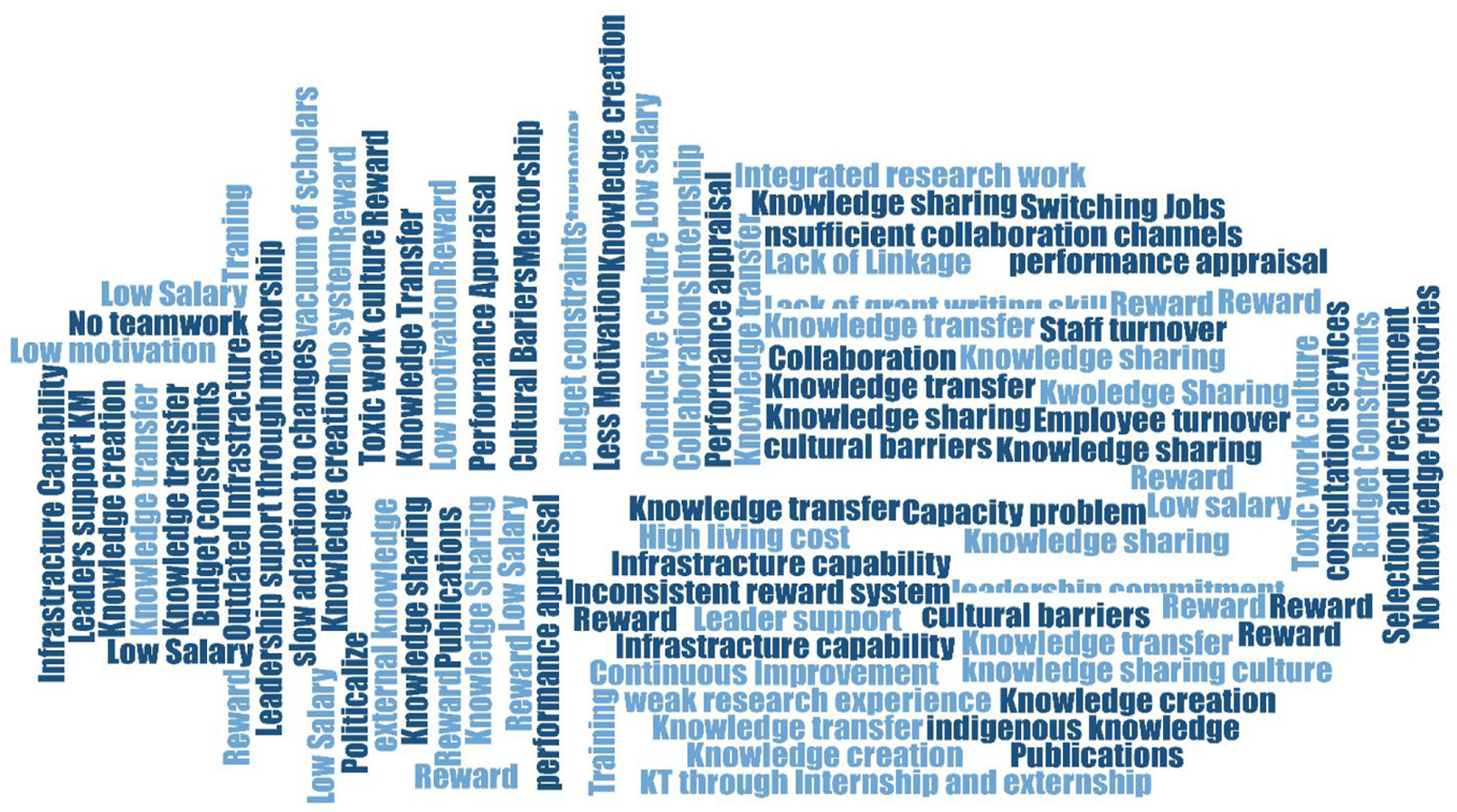
Study codes cloud.
The faculty members are always engaged in assessing before opening a new program at the University. The teaching-learning (knowledge creation) practices will be facilitated after the validation of the curriculum. The key informant (AA3) suggested that:
……….. There is an assessment of the newly opened departments; the team will evaluate the contribution of the curriculum at the international level and how the department will be competitive with other schools. Finally, the validation process will be going on at the university level…
The above response can be evidence that knowledge creation practices started by doing assessments since inception.
Knowledge Sharing Practices in Ethiopian Public Research Universities
Higher education institutions function as repositories of knowledge and have evolved beyond the mere dissemination of information to students. Public universities consider knowledge a public value, whereas academic staff view it as private. Academicians may have a lack of trust, lack of time, individualistic attitudes, ineffective methods of capturing knowledge, inadequate technology, and top-down decision-making processes (Javaid et al., 2020; Sadiq Sohail & Daud, 2009).
In Ethiopian public research institutions, knowledge exchange practices are fostered among staff members through conferences, review meetings, seminars, and workshops. The procedures should be carried out continuously and implemented in all departments and schools. Some educational institutions have taken steps to facilitate knowledge exchange among their staff members. The procedures, however, are not uniform throughout all of the schools. Key informants (AA5, AA3, and AA2) pointed out that:
………. There is a lack of readiness among experienced academics to discuss the findings that they obtained from their study. However, some staff members share their knowledge with government officials in different Media….
A key informant (AA1, MA1, and MA2) indicates that despite the limitations, the Ethiopian public research universities have established systems for exchanging knowledge, a connection made between the question and the mission of the University. The staff members participate in various symposiums, use social media to disseminate knowledge to the community, and hold meetings based on routine. However, some staff members confirmed that they did not participate in the workshops and seminars held at the college and department levels and that college-level meetings do not occur regularly. Key informants (AA5) described the knowledge sharing practices as follows;
…… experienced professors are not ready to share their knowledge with newly hired academicians and other faculty members for the time being. It is not an acceptable culture for the institution to encourage sharing knowledge………….
Knowledge Transfer Practices in Ethiopian Public Research Universities
The knowledge transfer process refers to transferring expertise, technical information, or technology from one organizational environment to another (Cheng, 2021; Demarinis Loiotile et al., 2022; Thomas & Paul, 2019). Public research universities have a core objective of transferring knowledge, which involves creating knowledge assets via research and development activities and then sharing that knowledge with students. Key informant (MA5) indicates that, to put our research findings into practice, we collaborate with nongovernmental organizations, which have more expertise in putting theories into practice and play a significant role in transferring knowledge to the community. He pointed out that;
…………for instance, if we come up with a brand-new food item, we would transfer it to nongovernmental organizations, and they would handle it out to the community. Among the many industries, we have a solid partnership. Community centre research is something that we do………………….
The Roles of Leaders Fostering KM Practices
In Ethiopia, public research university leaders have been selected by the forum of academicians at the university level. Based on their academic performance, experience, publications, and rating, they will hand over the Position based on their strategic plan. However, recently, during the leadership selection processes, there has been an intervention from political agents, and incompetent and corrupt leaders have been assigned to the universities. On top of that, some leaders are doing well by motivating their faculty members, planning routine tasks, and facilitating the teaching-learning activities and the entire KM practices. Key informants (HA4, HA1, HA3, HA4, HA6, and HA5), states that:
…………Leaders play a pivotal role in supporting academics, fostering knowledge creation, and sharing and transferring culture through mentorship, resources, and recognition. University leaders actively support teachers in creatively sharing and transferring knowledge by offering guidance and resources and recognising their efforts. While leaders support us, we need to do better in helping teachers and researchers to share knowledge. We need more resources to create a better environment for sharing and creating knowledge. Leadership support for academicians in KM practices is somewhat lacking, hindering knowledge creation, sharing, and transfer of full potential. Some leadership actively supports academicians by providing resources, mentorship, and recognition to encourage a culture of knowledge creation, sharing, and transfer, promoting vibrant academic environments………….
University leaders try to apply a transactional leadership style during their operations in their institutions. They motivate the best performers by preparing some criteria to select the right candidate. Key informants (AA6, AA1) responded that;
…………. there is a practice to reward employees. However, I am not quite sure it is sustainable and consistent. There are practices to reward employees in different categories (teaching and learning, research and community) service practices. There are publication incentives for academicians. The University motivates the staff who engage in research activities. The University motivates staff based on the number of publications. There is money for staff who publish articles at the international level. Recognition on an annual basis (universities, graduations), outstanding teachers, published impact journals, and the best research findings are the criteria to reward researchers. Rewards for women provided, to promote their skills, with its limitations……………
Reward and KM Practices
Universities must reward their workers to improve their overall performance and obtain center of excellence. The necessity of giving workers rewards was reaffirmed by key informants (HA3 and HA6). When employees at a university publish articles in reputable journals and share their expertise with the university community, they are rewarded for their efforts. On the other hand, AA6 needs to trust the procedures for rewarding employees who perform well at the University. He described it as follows;
……………. the practice to reward employees, however, I am not quite sure it is sustainable and consistent. There are practices to reward employees in different categories (teaching and learning, research and community) service practices. There are limited publication incentives for academicians…….
The key informants (MA2, MA3, and MA4) assert that the University’s reward system lacks validity. Top achievers need more recognition, as the focus is mostly on lower-level employees. The absence of a structured approach and inadequate selection criteria further contribute to this issue.
Performance Appraisal and KM Practices
The use of individual knowledge for business productivity, enrichment of the depth of business knowledge, establishing core skills, and creativity and innovation are the activities that are part of the KM activities that support individual performance. According to El-Farr (2011), there is a good correlation between the processes of KM and the performance-related activities of both individuals and groups. According to Obaidat and Otair (2019), several aspects of KM, such as the sharing of information and the application of acquired knowledge, affect the function of job performance appraisals.
According to the responses of key informants (HA1, AA6, HA2, HA4, AA5, AA4, AA2, AA1, MA1, MA2, MA3, MA5), a performance assessment system that acknowledges contributions to KM practice is required to guarantee a culture of excellence. When a result is necessary for promotion actions, a performance assessment is implemented. The review does not include the duties associated with serving the community, publishing, or any other extracurricular activity, especially KM activities. Key informant MA3 states that:
……. performance appraisal is done haphazardly. It cannot differentiate between staff who did great and those who did not. The record-keeping style is not good. There is no ongoing evaluation. We failed to do that at the country level, and it is not aligned with KM practices……
Challenges of KM Practices in Universities
To obtain a response from the key informants, the researcher formulated a question to be asked during the interview. The question must be answered is, “What challenges has your university faced regarding teaching and learning, academic services, knowledge sharing, and knowledge transfer?” In their interviews, the key informants brought up several issues in universities. Their responses were entered into the MAXQDA program, and the codes were sorted into broad categories and subcategories or challenges (see Table 2). The detailed responses are described below.
Resource Related Factors
Universities must have access to resources to ensure that their day-to-day operations are more successful. Except for Addis Ababa University, other universities in Ethiopia cannot administer their resources and operations. This is the most significant obstacle that universities must overcome. The leaders of the universities have given less attention to the activities associated with KM, particularly the sharing and transfer of knowledge. Key informants (HA6 and HA5) responded that:
……. Despite the fact that the budget that has been granted is insufficient, the government has lately reduced the budget. Additionally, the university officials focus more on routine tasks than on KM activities. Because of the inadequate funding for the research, researchers cannot move further with their research and transfer the knowledge.
Institutional Related Challenges
The challenges encountered by universities under institutional challenges are structural problems in Ethiopian universities. According to key informant responses, public research universities are state-owned entities managed by the government and operate with a well-defined organizational structure. Some universities may need a well-established KM strategy. The depletion of valuable institutional knowledge may arise from the documentation of procedures that need to be more consistent, adequate, or both. Inadequate documentation hinders the transfer of knowledge among personnel and across time. AA6 described the structural problem and its consequences as follows:
…… the academic environment is not supportive of research work. Staff are switching their job to other income-generating activities. The problem is a structural problem; it is not supportive for KM practices, especially for knowledge transfer……
Universities may possess knowledge transfer systems that could be more complex or manageable, especially regarding onboarding or off-boarding personnel. Consequently, there is a possibility for inefficiency and gaps in knowledge. The second challenge mentioned by the key informants is culturally related barriers in Ethiopian public research universities. Cultural barriers substantially influence the outcomes of KM strategies inside universities. Recognition, whether in the form of prizes or appreciation, may serve as a potent motivator for promoting knowledge exchange. Key informant (MA6 and AA5) states that;
……. there are limited practices at the community level that effectively use and distribute knowledge, and there is no mechanism to recognize and reward great achievers. Both of these shortcomings are present in the University. The team does not have a culture that encourages cooperation. There is no culture of knowledge sharing at the University. Furthermore, the University does not have a solid culture of research…….
The other institutional challenge mentioned by the key informants is a bureaucratic process in KM practices. In public research universities, bureaucratic processes can provide considerable obstacles to successfully implementing KM methods inside universities. The presence of bureaucracy, which is defined by inflexible frameworks, official protocols, and an emphasis on guidelines and policies, can obstruct the unrestricted dissemination of knowledge and slow the progress of innovation. Bureaucratic universities sometimes encompass several tiers of decision-making. The accumulation of knowledge tends to be centralized among higher-ranking individuals, which might pose difficulties for lower-ranking personnel in terms of their ability to contribute and exchange their valuable perspectives. Key informant (HA4) described the bureaucratic experiences of the University;
…..there are bureaucratic obstacles that hinder the transfer of existing knowledge to the community. We are currently encountering difficulties in obtaining funding for research projects from the University’s finance department. To engage in research and knowledge-related activities, bureaucratic obstacles are a significant challenge and impediment for academicians.…
The third challenge under the institutional factor is the need for linkage and interdisciplinary research practices in Ethiopian public research universities. There are limitations to undertaking research across departments and working together from one school to another. The critical informant (AA2) elaborated on the problem as follow:
…..there is no integrated research work from one school to another. The department is the boundary. There are no interdisciplinary research practices in the universities……
Universities may have difficulties in creating efficient methods for the transmission of knowledge. Lack of connection in the transmission of knowledge can result in gaps in knowledge, mainly when employee changes occur. In universities with poor coordination of learning and development efforts, there may be a disconnect between individual skill development and the overall knowledge requirements of the universities. This might lead to a discrepancy between the abilities that individuals gain and the talents that the business demands. Insufficient connection between knowledge and decision-making processes might result in businesses failing to capitalize on the opportunity to utilize existing insights for strategic decision-making. Key informant (AA2) mentions the challenges as follows about linkage problems in the University;
"…. neither the practices of continually creating new knowledge nor the dissemination of that knowledge to the community are prevalent. It is not possible to establish coordinated industrial linkages. When it comes to creating cooperation with the universities, there needs to be more knowledge transfer practices among the personnel and parties involved.
The last challenge mentioned by the key informants is the politicalizing KM practices. The government politicizes the actions that are associated with KM, and each work is closely connected to the dynamic politics of the country. Activities such as the allocation of funds, the transfer of knowledge, and the transmission of expertise are strongly connected to politics. Key informant (AA5) stated it as follows;
…. all activities are subject to politicization. We are not anticipating competition but rather grappling with matters of survival. Additionally, there is a capacity issue concerning publishing articles in recognized journals. Furthermore, there is a lack of sufficient acknowledgment from the government for articles published within the institution….
Leadership Related Challenges
Effective leadership is essential for the success of KM practice in universities. However, many obstacles might emerge when leaders need more complete involvement or when their leadership approach fails to accord with the beliefs of KM. Leaders must capably convey the significance of KM to the universities. Key informant (HA1) indicates that;
…………… Leaders do not play a pivotal role in supporting academics, fostering a culture of knowledge creation, sharing, and transfers through mentorship, allocating resources, and recognition…….
Leaders who exhibit a reluctance to change or need to convey the advantages of change effectively may face opposition from employees, impeding the adoption of KM. Leaders ought to implement mechanisms to acknowledge and incentivize staff for their valuable contributions to the dissemination of information. Without such incentives, employees may exhibit less motivation to engage in KM techniques actively.
Infrastructure Related Challenges
Infrastructure-related obstacles can substantially affect the execution and achievement of KM endeavors inside universities. These problems may encompass technologies, procedures, and assets crucial for generating, disseminating, and using knowledge. Obsolete systems and outdated technologies can impede the effective storage, retrieval, and dissemination of knowledge. The University’s infrastructure is not modernized and does not support the current KM era. Key informant (HA5, AA3) gave attention on it;
…………. teaching aid equipment like projectors and computers are outdated, the laboratory materials used in the universities are obsolete and not used by other countries…….
The presence of old technologies might hinder cooperation and affect the efficacy of KM approaches. Interoperability issues among diverse software systems and technologies might impede the smooth exchange of knowledge. Lack of integration across systems might provide difficulties in transferring knowledge across many platforms inside the universities. Insufficient organizing and structure of knowledge might result in challenges when finding and accessing knowledge. Insufficient establishment of a precise knowledge architecture might lead to confusion and impede the efficiency of KM endeavors. Limited bandwidth or network challenges can affect the speed and reliability of accessing and sharing knowledge, especially in universities.
Discussions
In this study, leadership contributes to the success and failures of the Ethiopian University’s KM practices. Concerning leadership, universities are experiencing a coordination problem and an absence of monitoring and evaluation practices. This study result is similar to the findings of Samad et al. (2014) mission and vision, strategy, school culture, intellectual model, learning organization, leadership management, teamwork, learning community, knowledge sharing, new knowledge generation, and digital advancement have significant relationships with the understanding of KM, at different levels. This study is consistent with the findings of Y. Yang (2024), which state that the efficiency of previous integration and knowledge needs influence the degree of integration of the following periods via balanced integration, over-integration, or delayed integration. In Indonesia, transformational leadership positively affects KM practices (Sudibjo et al., 2022; Turriago-Hoyos et al., 2016). A study conducted by Son et al. (2020) highlights the significance of practising transformational leadership to stimulate individuals’ knowledge-sharing behaviors. In this study, in addition to leaders, we examined the role of teachers in creating knowledge in the universities. Likewise, the study result conducted by X. Yang et al. (2021) revealed a significant correlation between each teacher’s number of created knowledge products, knowledge products sold, and the number of knowledge products purchased from others (Zhang et al., 2020). There is a significant difference between junior and senior academicians regarding knowledge technologies, knowledge acquisition, knowledge storage, and knowledge dissemination (Kiran et al., 2013).
In our discussions,
We assure that in Ethiopian public research universities,
The above analysis of the qualitative data discussion enables us to develop a conceptual framework for understanding KM practices in Ethiopian public research universities.
KM Framework in Ethiopian Public Research Universities
The knowledge framework has been established as follows, considering the gaps specified in the problem definition of the study, objectives, theories addressed in the literature review, and the data utilized in the study. The engagement of various actors and organizations is necessary to reach the desired level of effectiveness in KM. Knowledge management is considered essential in universities, which are seen as locations where knowledge is preserved. The researcher evaluated how resources are vital in universities (infrastructure, leadership, and human resources) and institutional challenges from the knowledge-based view and institutional theory. Furthermore, the researcher has thoroughly investigated how rules, regulations, and policies affect the effectiveness of KM in universities based on the institutional theory perspective. As a result, the KM framework depicted in Figure 3 was developed based on the proposed theories and qualitative data analysis.

KM framework in the universities.
Conclusions
Based on the research questions, the researcher evaluated university KM practices through the knowledge-based view and institutional theories. We confirmed that KM practices in the universities are a continual process, and this study result supports the idea of “KM is enduring,” which causes debates between “fad” and “KM is enduring.” Hence, our significant findings are:
KM practices in Ethiopian universities are continuously applied with limited effort.
Institutional, HRM, infrastructural, and resource-related factors affect university KM practices.
The data analysis indicates that codes have been identified under major themes using MAXQDA software.
Knowledge-sharing practices are also applied to the staff with limited frequency. Workshops, seminars, and conferences have been used carefully to share knowledge among academicians. The universities also tried to transfer knowledge to the community based on the community’s needs. The practices implemented were based on “demand-driven approaches.”
The availability of infrastructure in universities could be more satisfactory. There needs to be more classrooms, internet services, computers, smart rooms, and other facilities. The existing infrastructure (laboratories) is outdated. However, utilizing the existing infrastructure efficiently is also limited.
Human resources practices such as performance appraisal, reward, training, recruitment, and selection influence universities’ KM practices.
There are also resource constraints, such as budget, skilled manpower, and other relevant resources, that support the KM practices in Ethiopian public research universities.
The leaders of the universities cannot establish a system that motivates academicians who engage in knowledge creation, sharing, and transfer activities.
The researcher found a limited research culture, an absence of a teamwork culture, and integration problems across departments.
Institutional factors (structural problems, cultural barriers, and bureaucratic processes) affect university KM practices.
Practical Implications of the Study
The practical implications of this study for research universities demonstrate how implementing KM practices can enhance the efficiency of utilizing intangible resources. KM (knowledge creation, sharing, and transfer) is a routine university task. Therefore, this study highlights potential challenges that universities face when practising KM.
This study may show how to build interdisciplinary bridges and nurture partnerships that enhance research quality and impact. Evidence has suggested that faculty involved in active KM practices are more likely to collaborate with other departments, broadening research opportunities and increasing shared insights.
This study emphasized on knowledge repository and technologies. This may help universities retain institutional knowledge, which is particularly important in academics because a high turnover disrupts continuity. Repositories and knowledge-sharing programs would be set up at universities to capture knowledge from experienced staff members as an asset and help incoming faculty members and students.
The study investigates the role of organizational culture in universities. This may stimulate a dynamic and flexible university culture by fostering a society where learning and sharing knowledge are continuous.
The researchers recommended that universities establish departments responsible for managing knowledge practices. This ensures the exploitation of existing knowledge and the exploration of new knowledge. Policy makers also consider establishing a Ministry of Knowledge Economy at the country level to explore and exploit university knowledge for the country’s development.
Limitations of the Study
The study’s primary limitation is that it is limited to public research universities; the study did not include private universities in Ethiopia. The participants in the study were academicians. Other staff members, such as administrative workers, library workers, and others, were not included in the study, and the scope of the research was restricted in Ethiopia. The other limitation is the lack to address the influence of dynamic nature of politics in Ethiopia considered as a limitation in KM research.
Future Research Directions
Researchers in the future better to undertake a study on knowledge hiding. Because university employees may have knowledge hiding experience, these issues need examined scientifically. Moreover, theoretical and practical aspects suggested as follows;
This will involve future research directions in KM in universities from
Theories of KM in this area focus on how interdisciplinary collaborations effectively create, store, and disseminate knowledge, including how obstacles to interdisciplinary knowledge flows may be overcome. Indeed, insight into the dynamic processes of the social knowledge networks among faculties, students, and external partners is paramount to enhancing collaborative frameworks. It also reshapes KM to focus on how students contribute to and use the knowledge repositories within universities. While the student-driven content creation involves various theories, understanding the student’s contribution as a knowledge contributor requires aspects of student-driven content creation and peer-to-peer knowledge sharing.
A personalized learning platforms keep developing, theoretical research might explore how the KM systems support adaptive learning; this aspect may include managing the trade-offs for privacy and personalization. Universities increasingly contribute to research in sustainability and thus call for theories on sustainable KM practices. How KM systems can facilitate environmental and social sustainability within and beyond academia is a promising area of research.
The
Applied research can be conducted on automated processes for capturing, summarizing, and categorizing knowledge from lectures, workshops, and conferences, creating an accessible knowledge base for future students and researchers.
Footnotes
Author’s Note
Erstu Tarko Kassa is now affiliated with Department of Management, Woldia University, Woldia, Ethiopia.

Ethical Considerations
Key informants gave their permission verbally to answer the interview questions.
Funding
The authors received no financial support for the research, authorship, and/or publication of this article.
Declaration of Conflicting Interests
The authors declared no potential conflicts of interest with respect to the research, authorship, and/or publication of this article.
Data Availability Statement
All data are included in the manuscript.