




Abstract
With the mature development of the sharing economy, user perception has become a new breakthrough point in the research of consumer’s continued purchase intention for paid knowledge enterprises. From the perspective of enterprises, positive stimuli from user perception can enhance the expectation confirmation and satisfaction of paying knowledge users, thereby influencing their continued purchase intention. However, current investigations indicate limitations in studying the antecedent variables affecting expectation confirmation of paying knowledge users. Therefore, this study, through LDA topic analysis, identified user perception factors, constructed a conceptual model of expectation confirmation for paying knowledge users, and involved 201 participants in the survey research, followed by analysis of the collected questionnaires using smartPLS 4.0. The research findings indicate that firstly, users’ perception of the content quality, service quality, and usability of online courses has a positive impact on expectation confirmation. Secondly, expectation confirmation and perceived usefulness have a positive influence on user satisfaction, thereby stimulating their intention for continued purchases. Thirdly, non-certified courses exhibit stronger learning characteristics, as customers tend to make purchases and engage in learning based on their interests and hobbies, while certified users focus more on the intrinsic value of the product. Our study provides empirical evidence for paid knowledge enterprises to enhance users’ satisfaction and continued purchase intention of online course.
Introduction
With the ongoing iteration and updating of knowledge dissemination methods, the explosive growth of platforms providing knowledge content output and learning, and the innovative development of knowledge sales models, the concept of knowledge payment is demonstrating astonishing commercial value. According to the “Global Entertainment and Media Industry Outlook (2020–2024)” released by PwC, as of the end of 2019, the global output value of the entertainment and media industry has reached 2.1 trillion US dollars. The entertainment and media industry, as one of the rapidly emerging industries in the pandemic, is expected to have a production value of $2.5 trillion by 2024. Among them, knowledge digitization shows explosive development, accounting for over 70% of industry revenue. Knowledge payment, as a result of consumer upgrading, magnifies the value provided by content in the current era of mobile internet rising, and the continual acceleration of its commercial process has also led to the realization of monetization of knowledge payment’s own value (M. Zhang et al., 2020). “Knowledge payment” has swiftly become a common phenomenon level noun as a significant component of knowledge digitization. Research on knowledge payment is of great importance in the current digital era as it plays a crucial role in the monetization of valuable information and expertise. According to a study by Luyan et al. (2019), knowledge payment platforms have significantly impacted the way individuals consume information and engage in lifelong learning. These platforms have created new opportunities for content creators to monetize their expertise and for users to access personalized and in-depth knowledge on a wide range of topics. Furthermore, the study conducted by Huang et al. (2019) underscores the importance of user satisfaction and perceived usefulness in driving user engagement and loyalty in knowledge payment models. By understanding user preferences, expectations, and perceived value, knowledge payment platforms can tailor their offerings to meet the needs of their users effectively. In conclusion, research on knowledge payment is essential for understanding the dynamics of online learning environments, exploring user behavior and preferences, and optimizing the monetization of knowledge and expertise. The new wave of “knowledge economy” has resulted in a new “knowledge economy,” but it has also spurred conversations and reflections among many scholars on this phenomenon: What factors affect consumers’ preferences for “knowledge payment” products? What kind of knowledge products should practitioners create to meet consumers’ knowledge needs?
Courses and learning programs offered via the Internet bring a new dimension to virtual education and raise practical issues specific to the payment of knowledge, expanding its future possibilities. Knowledge payment refers to a charge paid by consumers to obtain specific knowledge, which essentially translates knowledge into marketable items or services with economic value (S. Zhou et al., 2022). The rapid development of online knowledge payment, as a new model of commercial economy (J. Zhang et al., 2019), has brought great convenience to people while also promoting economic progress (Haidi & Hamdan, 2023). With the rapid growth of the economy, people are paying more attention to the actual value that products can bring and their own quality of life. The new generation of customers has become accustomed to acquiring virtual things and is more open to purchasing knowledge than previous generations. Knowledge payment has changed traditional knowledge acquisition methods and capabilities, opened up new ways to acquire knowledge, and provided users with new choices for learning knowledge (Jia, 2019). With the continuous development of knowledge payment, it will create enormous economic value, and knowledge payment platforms should pay more attention to the needs of core users in order to achieve better development. However, the majority of previous research on users’ willingness to continue spending relies solely on questionnaire data surveys, neglecting topic analysis of users’ sentiments about purchasing paid course comments on the platform. Hence, this research employs Latent Dirichlet Allocation (LDA) topic analysis methodology to examine user-generated comments on courses and identify precursors influencing their satisfaction, thereby contributing significantly to field. In the context of the rapid development of the knowledge payment industry, how to enhance users’ continuous purchasing willingness and enhance their loyalty is a major concern for existing enterprises (Y. Zhao et al., 2018). Consumer knowledge payment may not be a one-time behavior. After consumers purchase courses and feel value from them, they will continue to purchase knowledge (Ren et al., 2021). The theory of expectation confirmation holds that the higher people expect the result, the higher their satisfaction with the actual result. Therefore, trust issues have become one of the most important obstacles between unfamiliar buyers and sellers (Shankar et al., 2002), and providing high-quality products and services is the foundation for improving user loyalty. Consumer expectations of items, as a catalyst in the transaction process, can increase transactions in the lack of product description information, as it can help consumers successfully identify worthy firms and minimize the ambiguity and complexity of online purchases (Gefen et al., 2003). Bhattacherjee (2001) pointed out that the expectation confirmation theory was mostly applied in the research of user satisfaction in the commercial field in the early stage, and as it continued to be applied, it gradually focused on user behavior in the IS field in the later stage. The expectation confirmation hypothesis states that users confirm or adjust their purchasing behavior based on the difference between their expected value of a product and their perception of real product information. However, in addition to the product’s worth, there are several extrinsic variables that influence users’ ongoing purchasing habit (Martínez-Navarro et al., 2019). Therefore, for enterprises, paying attention to the actual perception gap of users from the perspective of expectation confirmation, reducing users’ perceived risks, and formulating corresponding marketing policies to improve the quality of services provided by knowledge contributors, promoting users’ continuous purchasing behavior, has great prospects. Enterprises should understand their consumers’ needs and expectations and attempt to meet them. If clients’ expectations are met, the firm will gain more trust and loyalty. However, in existing studies, most of them are based on existing expectation confirmation models to explore consumer satisfaction, and there is a lack of research focus on combining the antecedent variables that affect knowledge payment user satisfaction with the expectation confirmation model for overall discussion. Therefore, it is necessary to improve this important research weakness, optimize the expectation confirmation model, and discuss how the antecedent variable enhances users’ perception of expectation confirmation, thereby promoting users’ continued purchase intention.
Many studies have discussed the factors that affect the expected confirmation of paid course users, but existing literature research has certain limitations in the construction of the antecedent variables of the expected confirmation model. The main focus is on the continuous use behavior of users in online knowledge acquisition under IS systems, and there is a lack of research on the use of LDA topic analysis to extract user real evaluations as the antecedent variables of the expected confirmation model and the formation mechanism of continuous purchase intention of knowledge paying users. It is easy to deviate from the actual user perception factors by not paying attention to the actual comments of knowledge paying users. Therefore, in order to address the gaps in the literature in these areas, this study attempts to propose a comprehensive expectation confirmation model, using LDA topic analysis method to induce user perception (content quality, perceived ease of use, service quality) as the antecedent variables of the expectation confirmation model, and then understand the entire process of user knowledge payment.
This study has made certain contributions to enriching existing literature and expanding the theoretical and practical significance of knowledge payment research under expected confirmation. Firstly, this study conducted a thematic analysis of feedback from Tencent paid course users and applied it to questionnaire questions to optimize previous scales. Secondly, we explored the optimization of the expectation confirmation model by using user perception as the antecedent variable. Once again, we use literature analysis and LDA themed training analysis to explore the dimensions of user perception factors. The research not only broadens the research field of expectation confirmation theory, but also further understands the current perceived value of users toward knowledge paid products, providing empirical evidence on how to promote the continuous purchase intention of knowledge paid users. Finally, we choose to study certified and noncertified courses, which are the two main types of online education that serve different learning goals and needs. Online certification courses focus on helping learners obtain qualification certification through professional exams, while noncertification courses focus more on providing knowledge and skills for learning. Comparative study of these two courses helps us understand the impact of different educational goals on curriculum design, teaching methods, and learning outcomes, optimize the allocation of teaching resources, improve educational quality, and promote educational equity.
The rest of this article is organized as follows. Firstly, the theoretical background of knowledge payment and expectation confirmation was introduced. Secondly, we propose our research model and hypotheses. Then, introduce the research methods and results. Finally, we discussed the importance of the research findings and proposed research limitations and future research directions.
Literature Review and Theoretical Background
Knowledge Payment Behavior
The advent of online knowledge payment has removed the constraints of conventional knowledge payment, widened the area of knowledge supply, and improved the efficiency of information acquisition for knowledge demand. Knowledge suppliers play a crucial role in the knowledge payment process. Coursaris and Liu (2009) confirmed that computer mediated network communication has been proven to promote interactive activities between users. Understanding the sharing behavior of knowledge providers is the key to implementing knowledge payment, and self-expression, peer cognition, and social learning are the main motivations for users to participate in knowledge sharing. Van Deursen and Helsper (2017) pointed out that online knowledge sharing behavior is influenced by social structural factors and individual agency factors. Quigley et al. (2007) found from behavioral motivation and goal setting that knowledge benefits and interaction costs directly affect user sharing behavior.
From a micro perspective, the behavioral characteristics of knowledge demanders are mainly influenced by opinion leader characteristics, price utility, and content quality (Y. Zhao et al., 2018). Till (1998) pointed out that the popularity and professionalism of opinion leaders can positively affect the willingness of knowledge demanders to pay. J. Zhang et al. (2019) pointed out that the higher the price, the lower the willingness of knowledge demanders to pay. Qi et al. (2019) pointed out that the quality of knowledge products can affect the purchasing intention of knowledge demanders. Therefore, knowledge products should focus on product quality and enhance the willingness of knowledge demanders to pay. From a macro perspective, the behavioral characteristics of knowledge demanders are mainly influenced by social influences and social values. Keh and Xie (2008) pointed out that online word-of-mouth and interpersonal influence can have an impact on the purchasing behavior of knowledge demanders. When there are a large number of online comments, high quality issues, and strong willingness to pay for surrounding knowledge, it will promote the willingness of knowledge demanders to pay. Sameer (2012) pointed out that the willingness of knowledge demanders to pay is significantly influenced by social value. In summary, both knowledge providers and demanders play a catalytic role in knowledge payment behavior, reflecting that the user experience of online courses is closely related to the providers and demanders of course knowledge. However, there is currently a lack of research in the field on whether the perception of knowledge demanders can stimulate their willingness to continue purchasing. Based on this, it is necessary to study whether user perception can stimulate their willingness to continue purchasing.
The user’s perception of the quality of course content is the foundation for improving students’ learning willingness and teaching effectiveness. Pereira et al. (2015) pointed out that the continuous purchase intention of online learning users is influenced by the richness and intrinsic quality of the courses. J. Lin et al. (2021) believes that the characteristics of a platform can have an impact on information quality, which in turn affects users’ sustained purchasing behavior. Delone and McLean (1992) pointed out that users’ willingness to continue purchasing is effectively influenced by the quality of information. According to research on perceived simplicity of use, knowledge paying customers frequently favor simple to operate products when purchasing knowledge paying products, which can considerably increase the user experience and learning efficiency. Davis (1993) argue that perceived ease of use is used in technology acceptance models to explain the decisive factor in the widespread acceptance of new technologies such as computers. Consumers’ perception of the “ease of use” of products can have an impact on their long-term purchasing behavior. According to service quality research, Delone et al. suggested an improved information system success model in 2003, pointing out that product service quality has a direct impact on users’ willingness to continue using it. At the same time, it is established from the standpoint of information systems and user behavior that service quality will affect consumers’ willingness to continue utilizing. (DeLone & McLean, 2003). User perception influences the user’s sense of experience as well as their level of product and value recognition, affecting their pleasure and, in turn, their inclination to continue purchasing. According to previous study, three user perceived aspects: content quality, perceived ease of use, and service quality can all influence users’ inclination to continue purchasing. However, in current research, more and more scholars are starting to use user perception as an antecedent factor to explore its impact on continued purchase intention (Bhatti & Husin, 2020). User perception includes the perception and evaluation of product or service quality, value, satisfaction, and other aspects by users. Research suggests that user perceived positive experiences can improve their satisfaction and loyalty, thereby influencing their continued purchase intention (Zeithaml et al., 2018). There is still a certain gap in research on continued purchase intention based on user perception as a leading factor. Limited research has shown that user perception factors have a significant impact on continued purchase intention, but a systematic theoretical framework and in-depth empirical research have not yet been formed. Therefore, the purpose of this study is to address an important research gap by attempting to investigate the factors that influence the continued purchase intention of knowledge payment customers from the perspective of user perception.
Modified Expectation Confirmation Theory
Existing expectation confirmation theories frequently influence expectation confirmation models by relevant elements. This article will use expectation confirmation theory as a starting point to explore how the antecedent variables of expectation confirmation theory affect users’ continued purchase intention. The theory of expectation confirmation was proposed by Oliver (1980) and improved by Bhattacherjee (2001), ultimately forming the widely used expectation confirmation theory model. Gupta et al. (2020) validated that satisfaction, post adoption self-efficacy, and post adoption usefulness were found to be powerful prerequisites for users’ continued purchase intention. Product performance confirmation has a positive impact on customer satisfaction, which in turn has a positive impact on consumer behavior and willingness to repurchase. Qin et al. (2021) proposed that users’ perception of the “usefulness” and “confirmation” of a product affects their own perception of the “satisfaction” of the product, and their “satisfaction” also affects customers’ willingness to continue purchasing. Therefore, this study is based on the theory of expectation confirmation to explore the reliability of the continuous purchase intention of knowledge paying users. Secondly, the Technology Acceptance Model (TMA) can be used to explain and predict the acceptance of information systems, and it is one of the most influential theoretical models in the field of information technology acceptance research (Venkatesh & Davis, 2000). In the TMA model, perceived ease of use and usefulness can influence users’ behavioral intentions. Davis (1993) have demonstrated through research that perceived ease of use can have a positive impact on perceived usefulness, thereby affecting users’ continued willingness to purchase. Therefore, this study is based on a technology acceptance model and explores the reliability of the study on the impact of perceived ease of use on the willingness of knowledge paid (Tencent Classroom) users to continue using it. Finally, the study introduced the success model of information systems, which believes that system quality and information quality determine user satisfaction with information systems and in turn have an impact on organizational performance (DeLone & McLean, 2003). In 2003, service quality was incorporated into the success model of information systems, and the impact of both individuals and organizations was integrated into net benefits. Satisfaction was the main criterion for evaluating the success of information systems, confirming that information quality and service quality can positively affect users’ willingness to continue purchasing. Therefore, this study is based on the success model of information systems and explores the impact of content quality and service quality on the continuous purchase intention of knowledge paid (Tencent Classroom) users, which has strong theoretical support. In summary, combining the technology acceptance model with the information system success model can successfully optimize the model based on the expectation confirmation model (Lu et al., 2019). It is simple to sort out the correlations between numerous factors and conduct subsequent data analysis by combining the study’s antecedent variables with the expectation confirmation model. Through a review of existing literature, it has been found that there are still problems in the study of users’ continuous purchase intention under the background of knowledge payment. The existing literature focuses mostly on users’ continuous use behavior in IS systems and online knowledge acquisition, but there is a paucity of study on the mechanism of knowledge payment users’ continuous purchase intention. In response to existing research problems, the “expectation confirmation theory” is used as the theoretical basis, We have established a framework of “user perception expectation confirmation process subsequent behavior” for users’ continuous purchase intention, identified the perception factors that affect users’ continuous purchase intention in the context of knowledge payment based on Tencent Classroom, and clarified their mechanism and impact pathways on consumers’ continuous purchase intention.
LDA Theme Analysis
The LDA theme model is a text analysis model proposed by scholar Blei et al. (2003). The proposed model effectively compensates for the shortcomings of PLSA (Probabilistic Implicit Semantic Analysis Model) and improves the accuracy and efficiency of deep level text content mining and semantic analysis. Brandt et al. (2017) proposed the LDA topic model, which suggests that each document contains several topics, with each topic containing several words. From the document to the topic, and then to the words, the three layers are selected through a certain probability, that is, each document selects a certain topic according to a certain probability, and a certain topic selects a certain word according to a certain probability. Repeat the above steps to obtain a complete document. Gosal et al. (2019) believe that research on LDA topic models generally focuses on sentiment analysis, topic mining, text classification, and topic evolution, or improves existing LDA topic models through research on related algorithms and recommendation algorithms. The basic focus of using LDA theme models in foreign countries is on deepening theme models and conducting research in different fields, mainly applied in different aspects such as collaborative filtering (X. Zhou & Wu, 2016), personalized recommendation (S. Chen et al., 2020), image classification annotation and retrieval; Deepening mainly focuses on the study of extended models such as the “Author Theme Model” (Luo, 2012) and the “Layered Dirichlet Process” (Mario et al., 2021). The LDA model is commonly used in fields such as social media, image processing, text classification and clustering, and community methods (Hou et al., 2020). In the field of text classification and clustering, the LDA topic model extracts the topic set of the research text by distributing the topic probability of the document (Lyu et al., 2022), in order to mine the topic of the text. Previous studies have shown that LDA based topic models can effectively classify short texts (Xie, 2021). H. Zhao et al. (2021) utilized this method to achieve topic mining and trend evolution, and combined it with co-occurrence network graph to explore topic distribution. They constructed a topic mining and sentiment analysis model using LDA model to mine topics of interest to learners and analyze emotional polarity (Seshadri et al., 2015).
To cluster comment texts, the first step is to conduct topic mining, and determining the number of topics included in the online course comment texts involved is a key factor to ensure that subsequent topic mining and clustering achieve reasonable results. Course review text, as an important interactive medium in the online learning process, can truly reflect learners’ learning experience, interest topics, emotional attitudes, and other characteristics toward the course (K. Wang & Zhang, 2020). By mining the comment text of online courses, the focus issues that learners pay attention to during the online learning process can be extracted, indirectly reflecting the satisfaction of the course. Information science scholars have applied LDA theme modeling to content analysis, analyzing overall themes in survey data (Baumer et al., 2017); Improving the performance of LDA topic models to better analyze large amounts of text data (Liu & Xu, 2017); And according to the LDA model research, the text theme can measure the relevant measurement indicators of the target content. From this, researchers have applied the LDA model to the field of education, analyzing different types of comment text data to discover the distribution of topics that learners are concerned about.
Online course platforms already have an abundance of resources, and learners’ assessment experiences output during the learning interaction process are rapidly developing with complicated and diversified data. As a result, topic analysis of online course comment texts is of great significance. Therefore, this study uses the LDA topic model to study the comment texts left by learners during Tencent’s classroom learning process, excavates user attention topics, and discovers the focus of learners’ attention, providing reference and reference for the future construction of online education platforms.
Research Model and Hypotheses
Construction of Antecedent Variables
Through literature research, it has been found that the continuous purchase intention of knowledge paying users based on the expectation confirmation model is influenced by three user perception factors: content quality, perceived ease of use, and service quality. However, this is only a conclusion drawn from existing literature. To further verify this conclusion, it is necessary to start with Tencent Classroom Knowledge Paid Course Comment Data to understand the true perception of users. This article will conduct data mining on the knowledge paid course reviews of Tencent Classroom, and utilize LDA topic training for additional subject classification.
Get Text Data
Following an inquiry, it was discovered that Tencent Classroom provides a total of eight course categories across five price ranges. In order to ensure the comprehensiveness and reliability of the data, this study used the Octopus tool to crawl popular review data from five price ranges of eight courses, totaling 40 course reviews with 14,831 review data crawled. Firstly, integrate the crawled comment data and merge it into one file. Secondly, segment the comment data with ROSTCM6. Finally, in order to ensure the validity of the comment data, synonyms were replaced to ensure the normal operation of subsequent data. In the crawled data, due to some data being blank or invalid, such as “…,” it is necessary to delete this type of data to ensure its validity.
LDA Theme Training Analysis
This article uses Python tools to conduct LDA topic analysis on the collected paid course review data of Tencent Classroom, and summarizes each topic to explore the key factors that affect Tencent Classroom users’ continuous purchasing intention. In LDA topic analysis, Perplexity is used to determine the optimal number of topics, thereby achieving the optimal topic category for text data. In LDA, the lower the level of topic confusion, the better the model fits the data and the stronger its ability to predict new documents. The calculation of topic confusion is based on the average prediction probability of each word in the document by the model. Specifically, it is the inverse of the model’s prediction probability for each word, followed by taking the average and then taking the exponent. As shown in Figure 1, the degree of confusion varies with the number of different topics. When the topic is three, the degree of confusion reaches a minimum inflection point, indicating that the three topics are the optimal number of classified topics. Therefore, this study divides the number of topics in text data into three. The three circles in Figure 2 represent the visualization of text mining as three themes. It can be observed that the circles of the selected three themes have significant differences and are far apart, indicating relatively good coherence between the themes.

Theme confusion.

LDA visualization.
Extract Relevant Variables
Although the LDA model can automatically and effectively extract topics and their corresponding feature words from text, its essence is a machine learning method, so there are certain differences in the accuracy of text topic classification. In the actual output results, there may be situations where the classification words corresponding to the topic are meaningless, and the comment data texts crawled have a high similarity. In order to avoid the impact of meaningless word meanings on subsequent analysis, this study will further divide the keywords of specific themes and manually integrate and screen the results of LDA operation.
As indicated in Table 1, this article extracts high-frequency words from three themes, removes invalid words, and selects the top 10 key words that best describe the theme. From the LDA theme training results, it can be found that the existing user perception factors of Tencent’s paid classroom courses are perceived ease of use, content quality, and service quality, further verifying the conclusions drawn through the aforementioned literature analysis method. And by crawling knowledge payment review data, we can further understand user concerns. In the subsequent questionnaire survey method, key vocabulary obtained from big data analysis can be applied to the questionnaire scale to conduct a questionnaire survey on Tencent users, which is more authentic and reliable.
Topic Vocabulary Distribution.

Proposing of Research Hypotheses
User Perception and Value Confirmation
The quality of course content is the foundation for improving students’ learning willingness and teaching effectiveness. Y. Wang et al. (2008) found that the quality of course content and the usefulness of outcomes to users can positively impact expectations of the course, confirming the importance of user perception in confirming the value of the product. Perceived ease of use refers to the degree to which users feel comfortable using the system. Thong et al. (2006) argue that user perceived ease of use has a positive impact on user perceived usefulness and expected validation. At the same time, paying knowledge users tend to prefer simple products when purchasing knowledge paid products compared to complex usage steps, which means that perceived ease of use can greatly enhance the user’s experience. Therefore, we predict that perceived ease of use can promote user recognition of product value. Based on information systems and from the perspective of user behavior, the author confirmed that service quality has an impact on users’ persistent purchasing behavior by influencing their “usefulness” of product services (Cheng, 2014). This means that the relevant service quality of a product is worth predicting for user value confirmation. Based on the above review of existing research, we propose the following hypothesis:
H1a: There is a positive affect between “content quality” in user perception and “perceived usefulness” in value confirmation.
H1b: There is a positive affect between “content quality” in user perception and “expected confirmation” in value confirmation.
H1c: There is a positive affect between “perceived ease of use” in user perception and “perceived usefulness” in value confirmation.
H1d: There is a positive affect between “perceived ease of use” in user perception and “expected confirmation” in value confirmation.
H1e: There is a positive affect between “service quality” in user perception and “perceived usefulness” in value confirmation.
H1f: There is a positive affect between “service quality” in user perception and “expected confirmation” in value confirmation.
Expected Confirmation and Perceived Usefulness
Perceived usefulness refers to the subjective perception of how much help and value a product or service can bring to users, which directly affects their loyalty to the product or service. Gupta et al. (2020) pointed out that in the product payment scenario, users’ perception of the value expectation of the purchased product can positively affect their perception of the product’s usefulness, thereby having a positive impact on product satisfaction. In other words, the perceived ease of use generated by consumers during the purchase process has a huge impact on verifying the product’s expectations or worth. The greater the user’s perceived ease of use of the product, the easier it is for them to identify the product’s worth, driving a rise in satisfaction. Therefore, based on the above review of existing research, this article proposes the following hypothesis:
H2: There is a positive affect between “expected confirmation” and “perceived usefulness.”
Expectation Confirmation and Satisfaction
Expectation confirmation is the comparison and confirmation between customers’ expectations of a service or product and the actual service or product received. Users can determine whether the product is worth purchasing and whether they can achieve their own satisfaction by confirming their expectations of the actual value of the product. Hayashi et al. (2004) confirmed that the higher a user’s perception of expected “confirmation” of a product, the higher their level of “satisfaction” with the product. This demonstrates the importance of value awareness in influencing consumer pleasure. Furthermore, numerous previous studies have revealed the substantial relationship between consumers’ confirmation of product expectations and their created satisfaction. Based on the review of existing studies, this article proposes the following hypothesis:
H3: There is a positive affect between “expectation confirmation” and “satisfaction.”
Perceived Usefulness and Satisfaction
Perceived usefulness refers to the satisfaction of users in judging and measuring the help that a product or service can bring, as well as the subjective perception of the value of the product or service that directly affects users’ satisfaction with the product or service. C. Lin and Bhattacherjee (2010) studied the perceived usefulness of a product or service by users to determine whether the product is worth purchasing, verifying a strong correlation between user perceived usefulness and satisfaction. Based on previous research, we propose that users with high perceived usefulness are more likely to have higher satisfaction with products or services. Through the review of existing research, this study proposes the following hypothesis:
H4: There is a positive affect between perceived usefulness and satisfaction.
Perceived Usefulness and Continued Purchase Intention
Through research, it has been found that there is a close positive relationship between perceived usefulness and continued purchase intention. In other words, the higher the perceived usefulness of a product or service, the more likely it is for customers to generate continued purchase intention. Qin et al. (2021) believed that the more “useful” perceived users perceive a product, the higher their continued purchase intention. Based on the above review of existing research, this study proposes the following hypothesis:
H5: There is a positive affect between perceived usefulness and continued purchase intention.
Satisfaction and Continued Purchase Intention
Through research, it has been found that when customers feel that their products or services meet or exceed their expectations and have a pleasant experience, they will generate satisfaction with the brand. In future purchases and usage, if the brand’s products and services can continuously meet customer needs and expectations, then customer satisfaction will be improved and to some extent, the continued purchase intention will be enhanced. Qin et al. (2021) believe that satisfaction can positively affect the continued purchase intention. Based on the above review of existing research, this study proposes the following hypothesis:
H6: There is a positive affect between “satisfaction” and “ continued purchase intention .”
Construction of Conceptual Models
This study will be conducted from the following five aspects: (1) Exploring the mechanism of the three dimensions of user perception (content quality, perceived ease of use, and service quality) on the two dimensions of value confirmation (perceived usefulness, expected confirmation). (2) Explore the mechanism by which expectation confirmation affects perceived usefulness. (3) Explore the mechanism of the effects of expectation confirmation and perceived usefulness on satisfaction. (4) Explore the mechanisms by which perceived usefulness and satisfaction affect sustained purchase intention. (5) Explore the effectiveness of user perception factors in both certification and noncertification courses.
Research Methods
Construct Measurement
This study obtained data on user perception, expectation confirmation process, and related variables of research and non research through a questionnaire survey. Therefore, in order to ensure the quality and rigor of the questionnaire, the specific reference principles are as follows: Firstly, the scale of this study is based on the questionnaire foundation of existing researchers on relevant issues, and is revised in combination with the feature words obtained through big data analysis methods. Therefore, when editing a scale, it is important to ensure both the completeness of the scale and the reasonable use of feature words. We cannot make modifications based on our own subjective assumptions, and can only make reasonable revisions based on the specific circumstances of the research. Secondly, when editing a questionnaire, in order to avoid semantic errors, it should be set as short and concise as possible, and there should be no overly long or difficult to understand sentences. And when editing questionnaire scales, guiding statements should be avoided to ensure the authenticity and reliability of the data. Finally, ensure the authenticity and validity of the data. After collecting questionnaire data, invalid data should be removed, including respondents choosing the same options, filling out data with short time and obvious data errors, to ensure the authenticity and reliability of the questionnaire data.
The research model consists of seven factors (see Figure 3), each of which is measured by multiple items, each of which is measured on a five point Likert scale, ranging from 1 = “strongly disagree” to 5 = “strongly agree.” The questionnaire items in this survey tool have been used from existing literature to improve the reliability and effectiveness of the study (Ryan et al., 2006). We tested the completion of the Chinese questionnaire on Tencent Classroom Knowledge Pay users’ continued purchase intention. The final version of the survey project is shown below.

Conceptual model.
Item of Dependent Variables
The dependent variable of this study is the continuous purchasing behavior of users in the context of knowledge payment (Tencent Classroom), combined with the feature words obtained from the LDA theme training in the previous section. The feature words with higher frequency and reflecting continued purchase intention were selected and revised into the scale Table 2.
Continuous Purchase Intention (CPI).

Item of Independent Variables
This study adopts a model based on the theory of expectation confirmation called “user perception expectation confirmation process subsequent behavior,” where the independent variables are three factors of user perception. At the same time, combined with LDA theme analysis, Tencent Classroom Knowledge Payment Course Comment Feature Words were adjusted accordingly in the context of knowledge payment to form the final user perception scale, as shown in Tables 3, 4 and 5.
Content Quality (CQ).

Perceived Ease of Use (PEU).

Service Quality (SQ).

By studying certified and non-certified courses, the effectiveness of user perception factors can be evaluated. Evaluating user perception factors can be achieved through the following steps: Firstly, the established indicators for evaluating user perception factors can help measure user perception and experience of the course. Secondly, collecting user feedback and comments on certified and noncertified courses can provide information about user perception factors. By using quantitative and qualitative analysis methods to analyze the collected data, and through comparative analysis, we can understand the impact of different types of courses on user perception factors, identify advantages and areas for improvement. Finally, based on a comprehensive analysis of the evaluation results, improvement suggestions and optimization measures are proposed to enhance user satisfaction and course quality.
Item of Mediating Variables
The mediating variable scale of this study mainly adopts the theory of expectation confirmation as the research theoretical framework, studies the user’s continued purchase intention, and simplifies the questionnaire. Combining with the LDA theme feature words mentioned above, the scale is revised to form a scale. The scales of perceived usefulness, expected confirmation, and satisfaction in this study were set with three items, as shown in Tables 6, 7 and 8.
Perceived Usefulness (PU).

Expectation Confirmation (EC).

Satisfaction (SA).

Item of Course Categories
This study divides Tencent’s classroom courses into certification and noncertification categories. After studying existing literature, it has been found that there is currently no unified scale for the certification and noncertification courses of knowledge paid courses. Most scales are mainly directly applied to existing achievements or modified for reference. Therefore, this study based on the crawling analysis of Tencent’s classroom knowledge paid course review data and adjusted the scale settings of existing literature, ultimately forming a measurement scale suitable for both non textual and textual categories in this study, as shown in Tables 9 and 10.
Certification Course.

Noncertification Course.

Data Collection and Analysis Techniques
This study aims to investigate the role of content quality, perceived ease of use, and service quality as antecedents of user perception in determining the satisfaction of paying knowledge users with online courses. When selecting a topic, participants are concentrated among undergraduate students and other groups with a high demand for online courses, who are the fastest users to accept paid courses to obtain the latest data. Firstly, Hair et al. (2014) propose a 10-fold rule in which the prospective variable with the most observed variations in a single conformation is chosen as the benchmark, with a sample size 10 times the number of observed variables for that potential variable. In contrast, the sample size in this study is much higher than 10-fold, so the use of sample data is scientific. This study conducted questionnaire release and collection from February 20 to April 1, 2022. Considering that sample size may affect the persuasiveness of the results, the questionnaire was rereleased and collected from September 18 to October 7, 2024, to enrich the sample size. The survey subjects of this study are users who have purchased Tencent Classroom APP knowledge paid courses, and users who have purchased Tencent Classroom knowledge paid courses nationwide are selected. The combination of online and offline questionnaire surveys has good representativeness and is therefore used as a source of target data. In order to ensure the rationality of the selected respondents, this study requires them to have purchased paid courses on the Tencent Classroom app and have participated in paid course learning for a certain period of time. The questionnaire is aimed at Tencent Classroom paying knowledge users. We distributed the questionnaire to some users who have experienced this service and received 427 valid questionnaire responses. In the process of selecting survey samples, Hair et al. (2014) proposed the existence of a 10-fold rule. It is proposed that when constructing a structural plane model, the minimum sample size should be at least 10 times that of the maximum path. Among them, the sample size required for the 13 structured paths should be at least 130, which means there should be at least 130 Tencent Classroom user perception data. Among the participants, 48.48% were males and 51.52% were females. In our study, all respondents have experienced the course services provided by Tencent Classroom, and the questionnaire can more accurately reflect the respondents’ feelings. Therefore, the samples in this study are representative and fair. This project intends to use Structural Equation Modeling (SEM) to validate the above theory. There are mainly two types of SEM methods: variance method and covariance method. Compared to the variance method, partial least squares (PLS) has better applicability in cases of non normal distribution and extremely small sample size. This project intends to use the Kolmogorov Smirnov test method to perform a non normal distribution (p < .01) on the sample data. Therefore, it is appropriate to apply partial least squares (PLS) in this field in this article. The results of the questionnaire survey were mainly path tested using Smart PLS4.0 software, and relevant theories were validated.
Data Analysis Methods
Descriptive Statistical Analysis: This study conducted a basic survey on the situation of Tencent classroom paying knowledge users. This study conducted questionnaire release and collection from February 20 to April 1, 2022. Considering that sample size may affect the persuasiveness of the results, the questionnaire was rereleased and collected from September 18 to October 7, 2024, to enrich the sample size. The statistical results of the two questionnaire surveys are as shown in Table 11.
Descriptive Statistical Results.
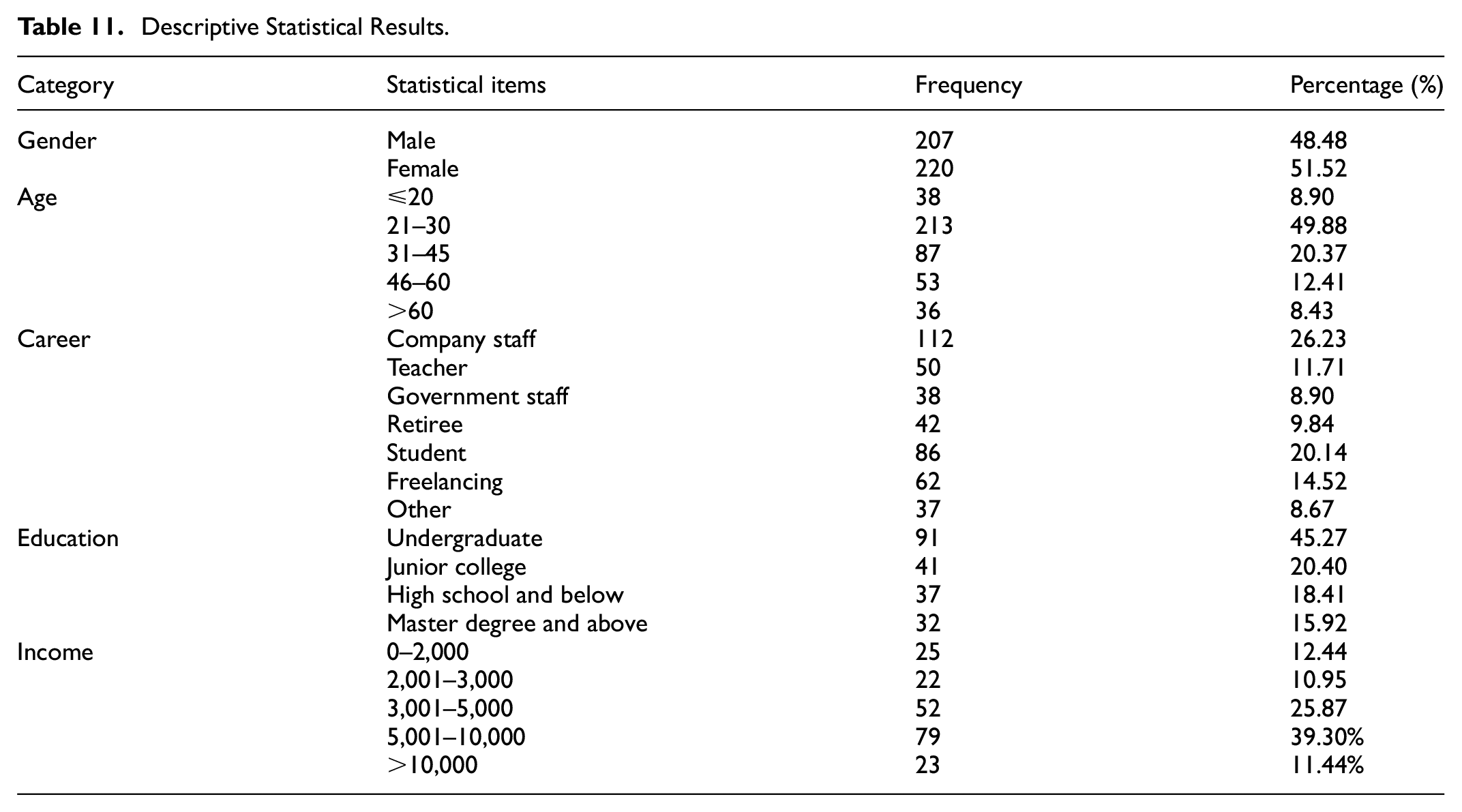
Among the 427 respondents, 207 were male, accounting for 48% of the total, and 220 were female; About 65.81% of the samples have a bachelor’s degree or above. This distribution is relatively similar to the actual gender distribution of Chinese netizens (Qiu, JP, Wei, KY,&Yao, R, 2023). According to Aurora Big Data data, 47.6% of users of knowledge payment applications are between the ages of 20 and 24. Most of them have high education and income, are concentrated in first- and second-tier cities, and have certain purchasing power. They not only have greater demand for products, but also have greater demand for discernment and quality. This is consistent with the trend of descriptive statistical analysis results of this sample. The surveyed subjects mainly have a bachelor’s degree, master’s degree or above, accounting for 65.81% of the entire sample (H. Zhao et al., 2021).
The main demographic characteristics of the sample are very similar to the study by Tan et al. (2023), which investigated the influencing factors that determine users’ knowledge payment decisions, as well as Aurora Big Data’s (2021) report on knowledge payment users. Aurora’s position in the market has also been recognized by customers. Many companies and organizations have made Aurora a core part of their data strategy. Therefore, the sample of this study is representative and impartial (Ying et al., 2023).
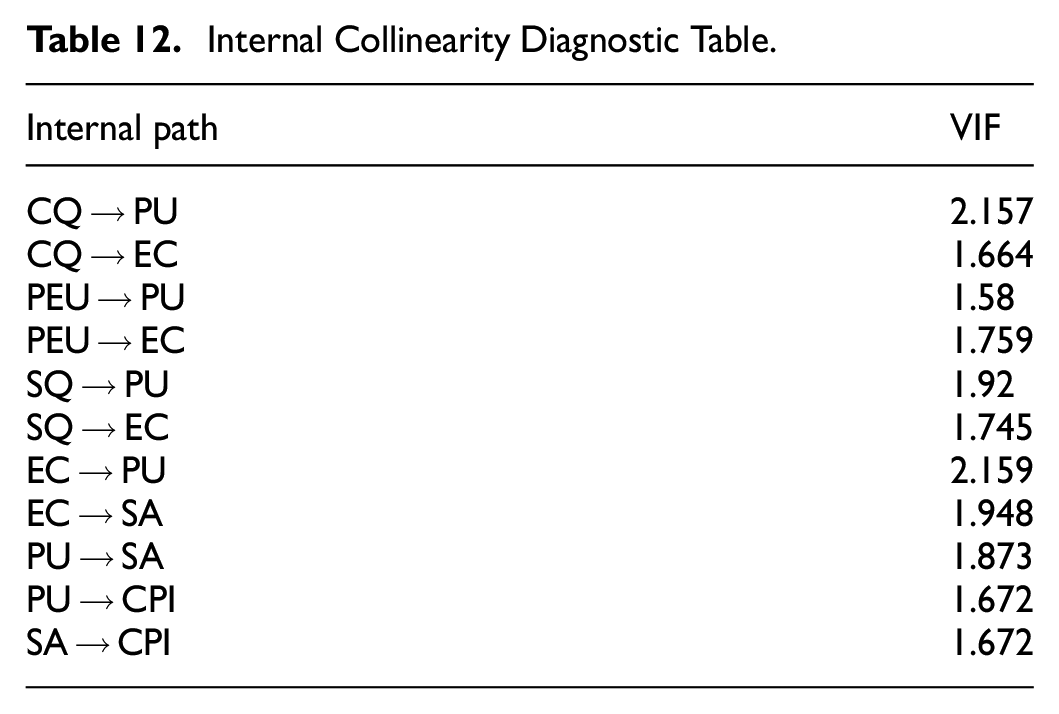
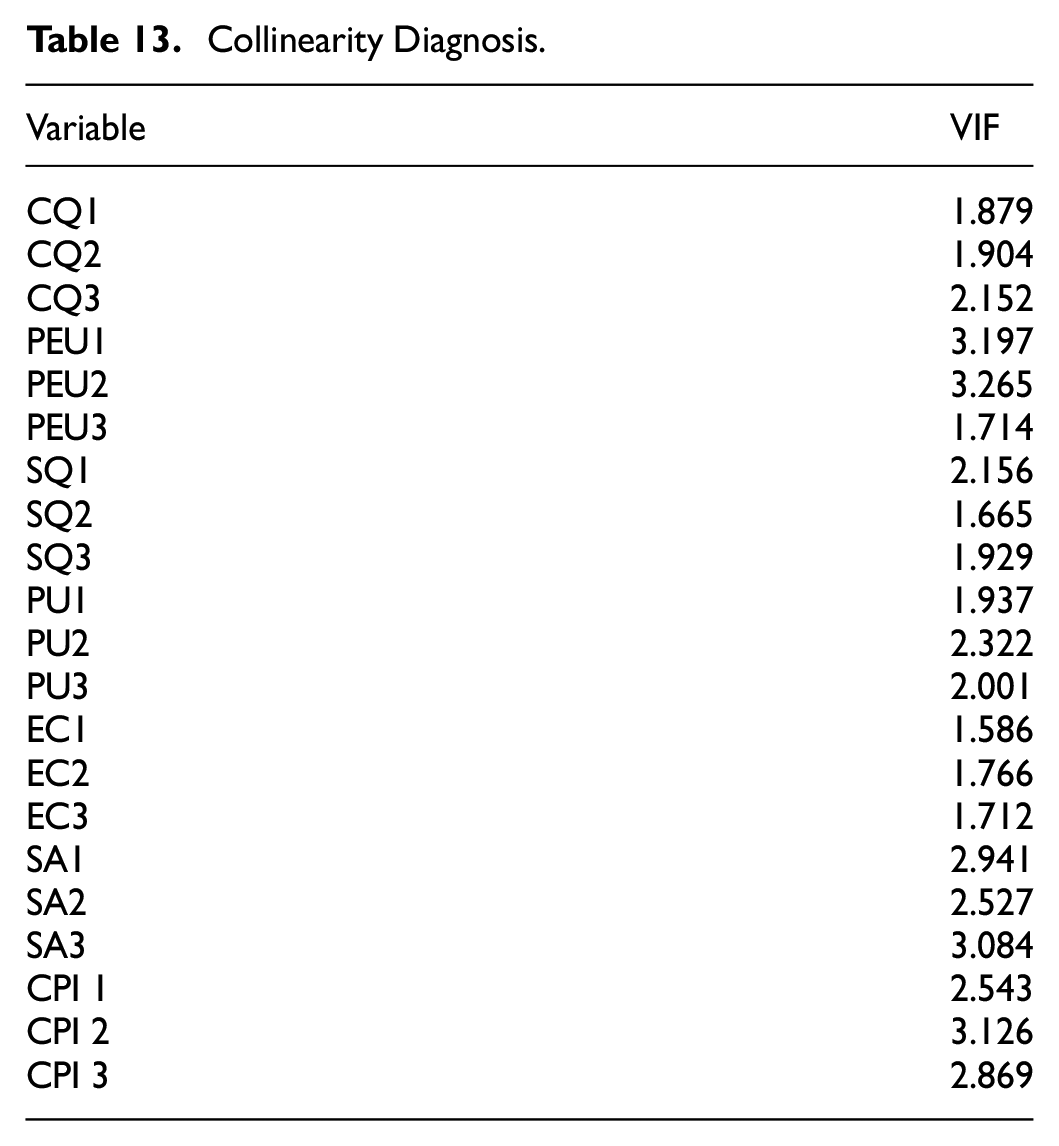
Collinearity diagnosis: Through collinearity diagnosis, the degree of collinearity between various factors can be detected, thereby avoiding deviation in path coefficients. The Variance inflation factor (VIF) is commonly used in existing studies to make collinearity judgments. When the VIF value is between 0 and 10, there is no collinearity; The VIF ranges from 10 to 100, indicating a multicollinearity relationship; When the VIF exceeds 100, severe multicollinearity will occur. This study used the PLS Algorithm algorithm of Smart PLS 4.0 to calculate the internal variance inflation factor and external variance inflation factor, as shown in Tables 12 and 13, respectively. From the table, it can be seen that the VIFs are all less than 4, and there is no multicollinearity between the variables.
Internal Collinearity Diagnostic Table.
Collinearity Diagnosis.
Inspecting the Measurement Model
Reliability Test
Reliability testing is often referred to as reliability analysis, which tests the degree to which the observed variables have “true” values and whether they are “error free.” Most existing studies use Cronbach’s coefficient values (α) to measure the reliability of the sample. When Cronbach’s α > .7 indicates high consistency within the sample. This study calculates that all variables Cronbach’s α are greater than .7, with values ranging from .800 to .904 (Bagozzi & Yi, 1988), indicating a high reliability of the scale in this study, as shown in Table 14.
Cronbach’s for Each Variable α Value.

Validity Test
Validity testing can effectively measure the validity of a questionnaire. The higher the validity, the higher the degree of agreement between the survey content and actual results, and it can better reflect the authenticity of the verified event. This study measured the combined validity of the scale using three indicators: standardized load of each indicator, average variance extracted (AVE) of factor extraction, and composite reliability (CR). The calculation results show that the load values of each index are above 0.7, and at p < .05, the load values of each index reach a very significant level. And all average variance values (AVE) exceeded 0.5, and the composite reliability value (CR) exceeded 0.7, as shown in Table 15. Each indicator exceeds the threshold value, indicating that the scale has good convergent validity (Straub et al., 2004).
Standardized Load, AVE, CR Values for Each Indicator.

By analyzing the correlation between various factors and the square root of AVE, they were tested, and the results are shown in Table 16. The square root influence of various factors on AVE is significantly greater than its correlation coefficient with other factors, and the discriminant validity of this scale is good. The values on the diagonal in the table are the square roots of the mean variance index extracted from the scale. AVE square roots are usually compared with other correlation coefficients of the variable. If the square roots of AVE values of each variable are greater than the correlation coefficients of the variable with other variables, it indicates that the scale has good discriminant validity.
Square Root of AVE and Factor Correlation Coefficient.

Results
Hypothesis test results for independent variables, dependent variables, and intermediate variables: Through Smart PLS4.0 analysis and Bootstrapping repeated sampling (5,000 times), the impact of user perception factors on the path significance of continued purchase intention was found. The results are shown below in Table 17.
Hypothesis Test Results.

The results of the above inspection are as follows:
The impact of user perception on value confirmation: In the role of user perception in value confirmation, the path coefficient of the “content quality” of user perception factors affecting “perceived usefulness” is 0.465, reaching a significant level; The path coefficient of the impact of user perception factors on “expected confirmation” is 0.549, reaching a significant level; The path coefficient of the “perceived ease of use” of user perception factors affecting “perceived usefulness” is 0.149, reaching a significant level; The path coefficient of “perceived ease of use” of user perception factors affecting “expected confirmation” is 0.166, reaching a significant level; The path coefficient of the impact of user perceived factors on perceived usefulness is 0.233, reaching a significant level; The path coefficient of the impact of user perception on “service quality” and “expectation confirmation” is 0.164, which is significant. Therefore, it is assumed that H1a, H1b, H1c, H1d, H1e, and H1f are valid.
The mechanism of action between expected confirmation and perceived usefulness: In the impact of expected confirmation on value confirmation, research has found that expected confirmation can positively promote perceived usefulness, with a path coefficient of 0.150, reaching a significant level. Therefore, the research hypothesis H2 holds.
The mechanism of action between expectation confirmation and perceived usefulness and satisfaction: In the impact of expectation confirmation and perceived usefulness on satisfaction, research has found that expectation confirmation can positively affect satisfaction, with a path coefficient of 0.314, reaching a significant level. Perceived usefulness performance has a positive impact on satisfaction, with a path coefficient of 0.385, which is significant. Therefore, the research hypothesis H3 and H4 holds.
The mechanism of the relationship between perceived usefulness, satisfaction, and sustained purchase intention: In the study of the impact of perceived usefulness and satisfaction on sustained purchase intention, it was found that perceived usefulness performance positively affects users’ sustained purchase intention, with a path coefficient of 0.483, reaching a significant level. Satisfaction can positively affect users’ continued purchase intention, with a path coefficient of 0.393, reaching a significant level. Therefore, it is assumed that H5 and H6 are valid, as shown in Figure 4.

Structural model test results.
Hypothesis test results of certification courses: Through Smart PLS4.0 analysis, verify the theoretical assumptions of the certification course, and verify the path significance of the certification course through Bootstrapping repeated sampling (5,000 times). The results are listed in Table 18.
Hypothesis Test Results of Certification Courses.

The comparative analysis results found that all hypothesis tests passed in the certification courses, indicating that content quality, perceived ease of use, and service quality can affect the continued purchase intention of certification course users. The specific test results are shown in the following Figure 5.

Test chart for the structural model of certification courses.
Hypothesis test results for noncertification courses: Validate the theoretical hypothesis of noncertification courses through Smart PLS4.0 analysis, and verify the path significance of noncertification courses through Bootstrapping repeated sampling (5,000 times). The results are listed in Table 19.
Hypothesis Test Results for Non Certification Courses.

The comparative analysis results found that all hypothesis tests passed in noncertification courses, indicating that content quality, perceived ease of use, and service quality can affect the continued purchase intention of certification course users in noncertification courses. The specific test results are shown below in Figure 6.

Test chart for structural model of noncertification courses.
Discussion
The purpose of users’ knowledge payment behavior is to explore multiple ways to learn knowledge, improve their own abilities and levels, and achieve personal value for different goals. Combining existing theories and previous research, this article extracted three antecedent variables through LDA thematic analysis, and explored the relationship between these three concepts and paying knowledge users satisfaction and continued purchase intention. The results indicate that the quality of content, perceived ease of use, and service quality in online courses can affect consumers’ level of expected confirmation, thereby affecting satisfaction and continued purchase intention. This has a similar perspective to research in related fields (S. Zhang et al., 2016).
Firstly, taking content quality as an example, according to He et al. (2022), when the knowledge provided by the knowledge provider meets the goals of the knowledge demander, it can effectively improve the recognition level of the demander’s expectations, thereby improving product satisfaction and stimulating their subsequent continued purchase intention (He et al., 2023), effectively improving the user stickiness of the product. In the field of paid courses, consumers attach great importance to whether the quality of product content can bring effective progress and results to themselves. That is to say, the data in this article also reflects that knowledge providers, by focusing on and optimizing the content quality of products, can not only enable users to obtain expected knowledge, but also generate secondary or even sustained purchasing behavior, effectively enhancing the development potential of products.
Perceived ease of use is described as the ease of operation for consumers when experiencing a product. In Thong et al. (2006)’s study, products that are easy to operate are considered to play an important role in improving customer satisfaction. Qin et al. (2021) takes users who purchase paid knowledge as an example to study the purchasing behavior of the knowledge demander, which is consistent with the research direction of this article. Data shows that users often tend to choose operations or use simple products, indicating that perceived ease of use can effectively improve user satisfaction during consumption. Therefore, perceived ease of use plays an important role in improving paying knowledge users satisfaction. In addition, the user perception factors proposed in this article have a significant impact on the effectiveness of authenticated and non authenticated courses. Firstly, the user perception factors of online courses directly affect the confirmation of user expectations for the course. Certified courses usually attract more users who are interested in learning and improving their abilities by satisfying their sense of recognition and achievement, thereby improving user satisfaction. Non certified courses may be more attracted by interest and course content, and user satisfaction may be influenced by expectations for course quality.
Finally, service quality can be understood as the degree to which the service work meets the needs of the served party. Cheng (2014) pointed out that good service quality can provide positive feedback for users’ purchasing experience, and it has been proven that service quality can affect user satisfaction, indirectly having a significant impact on users’ continued purchase intention. From this, it can be considered that service quality is an important condition that affects the satisfaction of paying knowledge users, in line with the goal of stimulating consumers’ continued purchase intention courses by improving service quality.
Compared with similar literature in recent years, we believe that studying user knowledge payment behavior should not be limited to traditional expectation confirmation model frameworks, but should also focus on the causes and consequences of user generated expectation confirmation. Taking the research of Jia (2019) and J. Lin et al. (2021) as examples, the author focuses on the factors that affect users’ continued purchase intention. We can gain a more comprehensive understanding of the influencing factors of users’ knowledge payment process and better implement targeted product optimization measures by conducting research on the antecedent variables that generate user perception of expectations, as well as the entire process of subsequent satisfaction and continued purchase intention.
Conclusion
Implications for Researchers
Overall, this study enriches existing literature on users’ continued purchase intention in the context of knowledge payment from multiple perspectives. Firstly, we utilized the LDA method to extract user perception as the antecedent variable for optimizing the expectation confirmation model, and established a new model for studying the expectation confirmation of knowledge paying users. This study confirms that user perception has a positive impact on the process of expectation confirmation, and explores the relationship between the three dimensions of user perception and the perceived usefulness and expectation confirmation of value confirmation. It is found that the three factors of user perception have a positive impact on both dimensions of value confirmation, further enriching the theory of expectation confirmation and providing insights for future research in the context of knowledge payment, The study of users’ continued purchase intention provides a new theoretical framework. Secondly, LDA theme analysis was used to extract and confirm the three dimensions of user perception. This study further defines user perception factors through data mining and divides them into three dimensions: content quality, perceived ease of use, and service quality, providing theoretical and data support for user perception dimensions in the context of knowledge payment. Finally, a survey questionnaire was optimized to investigate user satisfaction with the use of online courses. This study conducted LDA topic training by crawling comments from Tencent course knowledge paying users, further extracting topic variables, and combining the topic feature words that users pay attention to into the questionnaire scale, which can further reflect the users’ true perception state. The questionnaire has been expanded and improved to assess users’ continued purchase intention in the context of knowledge payment.
Implications for Practitioners
This study confirms that course satisfaction is directly influenced by user expectation confirmation and perceived usefulness, while perceived ease of use, content quality, and service quality, as perceived by users, directly affect user expectation confirmation and perceived usefulness. From the results of this study, several practical conclusions can be drawn. Firstly, the content quality, service quality, and perceived ease of use of online courses have a positive impact on the confirmation of user expectations. This indicates that knowledge payment enterprises should focus on product value and improve the quality of product content, which helps to meet user expectations for product confirmation. On the one hand, relevant enterprises can understand the needs, preferences, pain points, and other information of target users based on the questionnaire scale, and develop corresponding content strategies based on this information to meet the needs of users as the center and provide valuable content. On the other hand, integrate relevant product professional information with high-quality content, and try to focus on user experience and simplify optimization details when displaying the product, so that users can understand the advantages and characteristics of the product. Only by fully understanding user requirements and providing users with a more tailored and superior product experience can we establish a loyal user base and extend the user cooperation chain. Secondly, the confirmation of user expectations and perceived usefulness have a positive impact on their satisfaction, thereby positively affecting their continued purchase intention. That is to say, when selling related knowledge products, knowledge paying enterprises should pay attention to the confirmation of users’ expectations and perceived usefulness, thereby enhancing users’ continued purchase intention. Responding rapidly to user needs, promptly resolving user comments, and giving fast suitable answers, for example, can meet user expectations for the brand and increase their continued purchase intention. Thirdly, in both certification and noncertification courses, different user perception factors have varying degrees of impact. In comparison, non-certification courses have a more required learning character due to their customers’ more frequent purchasing and studying based on their own interests and hobbies, while certification users pay more attention to the inherent value of the product. This reflects that noncertification course users are more concerned about the user perception of the product and pay attention to its usability. Targeted optimization of the user perception of different types of courses by enterprises can enhance their perceived usefulness and effectively enhance their willingness to continue using them.
Limitations and Future Research Directions
There will definitely be variances in the results due to the continual changes in the knowledge payment market and the focus of this study on Tencent Classroom APP. Therefore, there are still some areas for improvement in this study. Firstly, in terms of user perception classification, this study combines information system success models, technology acceptance models, and analysis of comment data on paid courses on Tencent Classroom APP to identify three types of content quality, perceived ease of use, and service quality. It explores the impact of three user perception factors on continued purchase intention. There are many different sorts of users, and this study cannot corroborate all of the benefits of the three information sources in research, despite the fact that major results have been established that can better reflect genuine user perception. There may also be more suitable types of information worth exploring. Secondly, the measurement of users’ perception of knowledge paid products in this study is based on past time periods, but the individual’s perception may constantly change with the situation of the knowledge paid industry. Therefore, using questionnaire surveys and comment data crawling methods to collect research data can only represent the user’s perception of knowledge paid products during a certain period of time. In future research on knowledge payment, factors with smaller variations can be selected for research.
Footnotes
Acknowledgements
Firstly, I would like to express my deepest gratitude to my supervisor for his significant contribution to my paper. I have benefited greatly from his patience, encouragement, and excellent guidance, from planning the questionnaire to revising the paper. At the same time, I am very grateful to the comrades who helped me complete the survey questionnaire. They provided me with statistical data for my paper and provided me with great support in my survey.

Ethical Considerations
(1) The data analyzed in this article is sourced from online questionnaire surveys and belongs to quantitative analysis. (2) All participants are aware of the research purpose and have anonymity. (3) The data obtained are all true.
Funding
The author(s) disclosed receipt of the following financial support for the research, authorship, and/or publication of this article: This work was supported by Chengdu University of Technology “Double First-Class” initiative Construction Philosophy and Social Sciences Key Construction Project [ZDJS202304]; Sichuan Province higher Education Personnel Training quality and teaching reform project [JG2021-739]; Philosophy and Social Science Research Foundation Project of Chengdu University of Technology [YJ2022-ZD013]; Sichuan Network Literature Development Research Center [WL WX-2022003]; Research Center for Systems Science and Enterprise Development [Xq22C05]; National college student innovation and entrepreneurship project training program [2021 106 16015].
Declaration of Conflicting Interests
The author(s) declared the following potential conflicts of interest with respect to the research, authorship, and/or publication of this article: (1) The article I will submit is entirely original and has no plagiarism or improper citation. (2) The submission of this article was completed by me in the process of learning, research, or work, and there is no conflict of interest. I will not receive any relevant honors or compensation for this. (3) I have clearly understood that the copyright of the submitted article belongs to this publication, and this publication has the right to copy, disseminate, and digitize the relevant articles. (4) I have clearly understood that publishing my article in this journal indicates recognition of the article, but the articles published in this journal are only for academic exchange and cannot be used for commercial purposes. (5) I guarantee that the submitted article has not been published in academic institutions both domestically and internationally, and will not be resubmitted or reprinted in any other academic institution during or after the submission period.
Data Availability Statement
Data sharing not applicable to this article as no datasets were generated or analyzed during the current study.