



Abstract
Given the huge investment made in developing government applications (APPs), it is essential for them to achieve the levels of performance needed to ensure service quality and meet public needs. Although public loyalty is crucial to the success of government APPs, few studies have analyzed the characteristics of service quality or the continuous use of government APPs and their associations. The present study has developed a theoretical model to show how government APPs service quality promotes continuance intention. A questionnaire survey of 388 government APP-users in China and a structural equation model have been used to verify this theoretical model. The empirical results show that overall service quality has an indirect positive impact on government APPs users’ continuance intention through expectation confirmation, perceived usefulness, and user satisfaction. This study enriches our understanding of service quality and government APPs continuance intention, while also exploring government APPs development, design, and promotion.
Introduction
In 2021, mobile devices helped 90% of the Internet population to access the Internet (Statista, 2022). The ubiquity of mobile webs and devices continues to drive the use of mobile clients and the applets that embed them; together, these constitute applications (APPs) (C. Hsu & Lin, 2015; Tam et al., 2020). With the development of Industry 4.0, APPs have become a key digital platform for enhancing virtual-reality interaction and simulation capabilities (Mourtzis, 2020, 2022). As a consequence, digital government construction in various countries has turned rapidly toward the development of government APPs, which aim to improve the accessibility, equity, and affordability of public services.
Early mobile government (m-government) relied primarily on the design of the web, SMS, and social media; often, they provided only one-way message-service functions, such as news releases, message pushes, and SMS notifications (Al-Hubaishi et al., 2017; Wang, 2014; Zou et al., 2023). Government APPs are integrated applications of new-generation information and communication technologies (ICTs), which include artificial intelligence, big data, and 5G. Compared to traditional forms of m-government, they offer simpler service processes, richer service content, flexible service times, accurate service supplies, and smart service systems (Chen et al., 2016; Guo et al., 2022; Sharma et al., 2018). The 2022 United Nations E-Government Survey describes government APPs as key platforms for sharing public information, providing online services, and enabling political communications on the future of digital government (United Nations, 2023). Countries such as China, the U.S., and South Korea are actively developing and promoting government APPs at the policy-making, organizational, and technical levels to improve public services, information services, communication channels, and citizen participation (Mossey et al., 2019; Zheng & Ma, 2021).
The Importance of the Continuous Use of Government APPs
Information systems (IS) and their successful economic, social, and political applications depend primarily on continuous use by users, rather than initial adoption (Alruwaie et al., 2020). User retention has thus become critical to the performance and success of mobile services; understanding how users develop continuance intention can lead to a more effective delivery of new APPs or the adjustment of APP functionality to meet user needs (Tam et al., 2020). Although most consumers have a strong interest in trying new technologies, it can be difficult to persuade them to use such technologies consistently (C. Wu et al., 2022). Government APPs often require significant government investment, including financial resources, information infrastructures, and human resources, as they provide a wide range of public services, comprehensive service functions, and 24/7 access services (Mossey et al., 2019; Sharma et al., 2018).
Government APPs Service Quality and Continuance Intention
Most government APPs are designed to optimize government business processes; their service quality must be strengthened to meet the diverse and personalized service needs of the public. Insufficient service quality has led to a lack of continuance intention among government APPs (Zheng & Ma, 2021). Service quality is a key factor, known to have a significant impact on improving user continuance intention, which directly determines the performance and legitimacy of IS investments (Li & Shang, 2020). To ensure the success of government APPs, it is therefore essential to improve service quality.
Formulation of a Research Question
According to the UN, many countries need to focus on improving service quality and the continuous use of government APPs when designing and implementing digital-government policies (United Nations, 2023). Existing studies of the continuous use of mobile services tend to focus either on commercial APPs, such as e-commerce, news, social networking, and short videos (Mouakket, 2015; Nguyen-Phuoc et al., 2021; Sheu & Chang, 2022; Tam et al., 2020), or on traditional web-based e-government and first-generation m-government services (Ahmad & Khalid, 2017; Alruwaie et al., 2020). Government APPs have received insufficient attention. User-perceived value is essential for the adoption of government APPs (Wang et al., 2020). To be valued, government APPs must pay more attention to the quality of service processes and results. Such concerns underpin the key question addressed in this study: How can government APPs improve service quality to better meet public expectations and needs, thereby improving continuance intentions?
To provide theoretical insights into the way in which governments can encourage members of the public to use government APPs regularly, this study introduces service-quality theory into the expectation-confirmation model (ECM) and develops a new theoretical model of government APPs service quality, thus helping to improve continuance intention. A questionnaire survey method and structural-equation model have been used to verify the relationship between the service quality, perceived usefulness, expectation confirmation, satisfaction, and continuance intention of government APPs. These findings can support government initiatives designed to realize the public value of government APPs.
The remainder of the paper is structured as follows. Section 2 presents a comprehensive review of the relevant literature. Section 3 presents a theoretical model of government APPs service quality, proposing ways to strengthen continuance intention and developing research hypotheses. Section 4 presents the data sources and methods. Section 5 discusses the results of the econometric model. Section 6 presents a discussion, implications, limitations, and directions for future research. The final conclusions are presented in Section 7.
Literature Review
The Function of Government APPs in Public-Service Delivery
Government APPs are defined as mobile applications, developed by a government using mobile-network technology, new-generation ICTs, an information infrastructure, and integrated government IS. The role that government APPs play in improving the quantity and quality of public-service delivery includes: 1) Improving public-service convenience. Due to their mobility, government APPs enable citizens to obtain ubiquitous services that traditional e-government cannot provide (Mensah & Mwakapesa, 2022); 2) Improving the equity and accessibility of public-service allocation. The vast majority of people use smart phones, narrowing the digital divide between different regions and groups and enabling governments to provide users with adequate and timely information; even rural users with less developed digital skills find it easy to operate government APPs and obtain services (Liu et al., 2014); 3) Improving the personalization and accuracy of public services. Government APPs are cable of high levels of personalization (Liu et al., 2014) and can provide users with personalized and customized public services and accurate public information; and 4) Improving government transparency and accountability. Government APPs are expected to accelerate the two-way flow of information between the government and its citizens, create equitable and transparent decision-making procedures (Chen et al., 2016), and enhance citizen participation by promoting mobile democracy and accountability (Alshammari et al., 2022).
E-Government Service Quality
E-government service quality can be defined as the degree to which the online public services provided by e-government systems meet the needs of citizens by promoting information services, online transactions, and interactions between the government and members of the public (Li & Shang, 2020). M-government-service quality has also begun to attract the attention of scholars. Shareef et al. (2014) divide the composition of m-government service quality into four dimensions: connectivity, interactivity, understandability, and authenticity. By contrast, Al-Hubaishi et al. (2017) divide m-government service quality into interaction, environment, information, systems, networks, and outcome quality.
Continuous Use of E-Government
Continuous use generally refers to the later adoption behavior of IS users; it is a key indicator used to measure user loyalty and the successful implementation of IS (Wang et al., 2020). E-government requires a huge investment and can only achieve its maximum value and performance if citizens use it continuously (Li & Shang, 2020). Hu et al. (2009) used eTax as a case study to conduct a two-stage empirical study of 518 participants before and after using e-government services in Hong Kong; they also established an e-government continuous-use model.
Recent studies have focused primarily on the initial use, acceptance, and adoption of e-government services. Most of these studies have used technology-adoption models, including the theory of reasoned action, the diffusion of innovations, TAM, the theory of planned behavior, the unified theory of the acceptance and use of technology, and the e-government adoption model, to explore factors that predict the initial adoption of government APPs (Ahmad & Khalid, 2017; Creutzberg et al., 2023; Hung et al., 2013; Liu et al., 2014; Mensah & Mwakapesa, 2022; Sharma et al., 2018).
Predictors of the Continuous Use of E-Government
Factors that predict the continuous use of e-government have become a focus of research; prior studies have determined the factors that drive the intention to continue using e-government based on the following theoretical perspectives: IS, service quality, adoption, and expectation confirmation. According to Alruwaie et al. (2020), personal factors, e-government systems, citizens’ prior experiences, and social influence can predict citizens’ continuous use of e-government. Li and Shang (2020) have shown that e-government service quality and perceived value encourage citizens to use e-government services continuously. Hu et al. (2009) have shown that perceived usefulness, convenience, and security predict the continuous use of online government services.
Literature Summary
Many prior studies have confirmed the positive role of government APPs in public-service delivery and analyzed the effects of e-government service quality on continuous use. In recent years, attention has shifted from e-government to m-government. Although the positive role of service quality in promoting the continuous use of e-government has been verified, recent studies still have the following limitations: 1) They tend to analyze traditional WWW-based e-government and first-generation web-based m-government, without adequately researching service quality or the continuous use of government APPs; 2) Most research on the use of government APPs analyzes initial-use behavior but ignores continuing government APPs use after the initial adoption. 3) Given the various forms of e-government systems, previous studies have focused on a wide range of different dimensions and indicators of e-government service quality and continuance-intention, making them difficult to apply to government APPs; 4) Previous studies have failed to conduct a correlation analysis of service quality, perceived usefulness, expectation confirmation, satisfaction, and government APPs continuance intention.
Theoretical Model and Research Hypotheses
Theoretical Basis
Service-Quality Theory
Service quality is a type of consumer perception generated by the interaction between customers and service providers (Lehtinen & Lehtinen, 1982); it includes customer perception and experience based on service process (Al-Hubaishi et al., 2017; Chan et al., 2022). Grönroos (1982) divided service quality into two aspects: the technical quality of service performance and the functional quality of service personnel attitudes perceived by consumers during the service process. Rust and Oliver (1993) added the dimension of environmental quality, namely, the environment in which customers receive services. Parasuraman et al. (1988) segmented service quality into five dimensions: tangibles, reliability, assurance, responsiveness, and empathy.
Several studies have attempted to capture and measure service quality accurately. Of these, the SERVQUAL scale proposed by Parasuraman et al. (1988) is the most representative. As previously mentioned, the SERVQUAL scale divides service quality into five dimensions, using 22 specific questions to measure the service quality perceived and expected by consumers. The difference between the two lies in the service quality score.
In the field of e-government, service quality theory is generally applied to traditional forms of e-government (Aljukhadar et al., 2022; Li & Shang, 2020; Sá et al., 2016) and web-based m-government (Al-Hubaishi et al., 2017; Shareef et al., 2014). Few studies have applied this theory to government APPs. The present study therefore uses the combined service characteristics of government APPs to determine service quality. The application of service-quality theory to government APPs will help governments explore the basic strategies of government APPs, improving the quality of public services from a public-needs perspective and ultimately improving the quality and accessibility of online public services.
Expectation Confirmation Theory
In response to concerns about consumer satisfaction, Oliver (1980) introduced expectation confirmation theory, which was supplemented and improved by Churchill and Surprenant (1982). According to this theory, consumers judge whether they are satisfied by comparing their pre-consumption expectations and post-consumption performance perceptions; their levels of satisfaction then affect their repurchasing behavior. Figure 1 depicts classical expectation-confirmation theory, which includes the following processes: 1) Consumers generate expectations based on pre-consumption experiences, which influence their purchase intentions. 2) Consumers form a perception of actual performance when they finish using a product or service (i.e., perceived performance). 3) Consumers compare pre-purchase expectations with actual post-purchase performance perceptions, resulting in confirmation. 4) The degree of confirmation ultimately affects consumer satisfaction. 5) The degree of satisfaction also fosters consumer repurchase intentions.
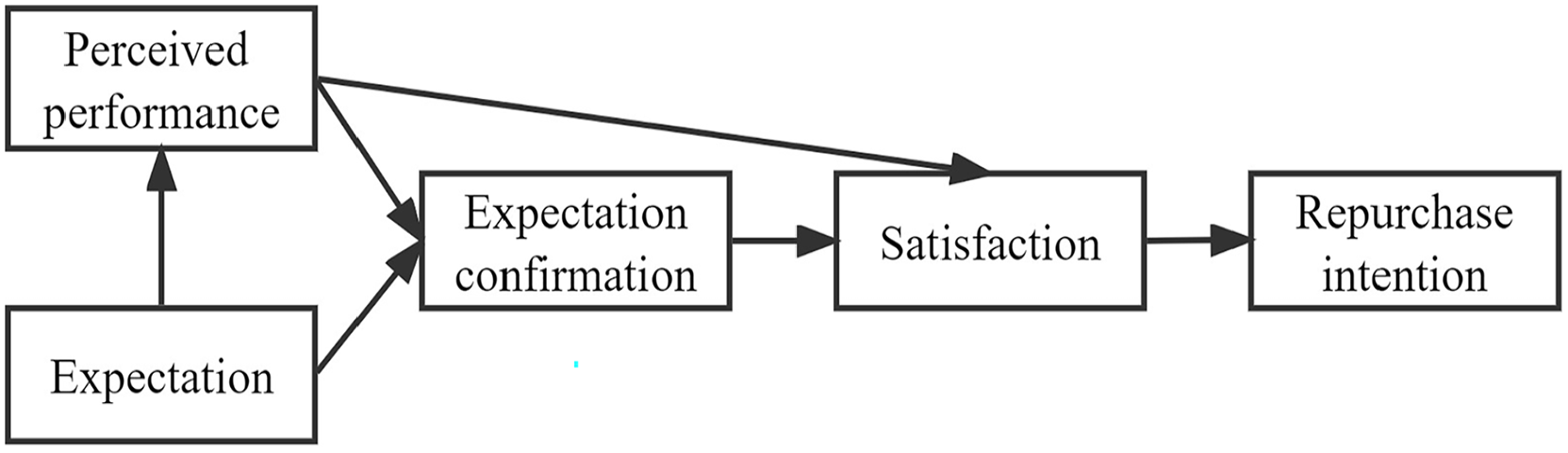
Classical expectation-confirmation theory.
Expectation–Confirmation Model
Bhattacherjee (2001) proposed an ECM for IS based on expectation-confirmation theory, as follows: 1) IS continuance intention is affected by satisfaction and perceived usefulness. 2) User satisfaction is affected by expectation confirmation and perceived usefulness. 3) Perceived usefulness is affected by expectation confirmation.
The ECM is shown in Figure 2. Although this model is derived from classical expectation-confirmation theory, there are certain differences between the two. While expectation-confirmation theory includes both pre-consumption expectations and post-consumption performance perceptions, the ECM focuses on expectation confirmation after users have received services. It replaces post-consumption perceived performance with perceived usefulness.

Expectation
The ECM explains how the mechanism of expectation confirmation influences satisfaction and continuance intention from the perspective of customer psychology. The present study uses the ECM to study government APPs continuance intention and explores the way in which government APPs service quality can improve continuance intention. The aim is to understand the whole-process government APPs experience, including satisfaction and loyalty.
Theoretical Model
Since its introduction, the ECM has been applied to the continuous use of IS, especially online or via mobile services, such as online shopping (I. Wu et al., 2020), mobile health (C. Wu et al., 2022), online education (Baker-Eveleth & Stone, 2015; Dai et al., 2020; Lee, 2010), mobile payments (Gupta et al., 2020; Loh et al., 2022), smart fitness wearables (Gupta et al., 2021; Park, 2020), transportation-sharing APPs (Gupta et al., 2021; Park, 2020), and smartphone banking services (Susanto et al., 2016). These studies show that, in the case of online or mobile services, expectation confirmation affects users’ perceived usefulness and satisfaction, which in turn affects their satisfaction and continuance intention; thus, user satisfaction is a key factor in forming continuance intention. Although the ECM is a good match for e-government services (Alruwaie et al., 2020), no prior studies have applied this model to government APPs. To evaluate the effects of government APPs service quality on user continuance, the present study introduces service quality into the ECM and constructs a theoretical model of government APPs service quality to strengthen continuance intention.
Based on the SERVQUAL scale, Cronin and Taylor (1992) argued that measuring customer service-quality expectations after consumption was an a-posteriori behavior and likely to lead to errors. For this reason, they further simplified the SERVQUAL scale and proposed a new method of evaluation called the SERVPERF evaluation method. The SERVPERF scale inherits the following five dimensions of service quality from the SERVQUAL scale: tangibles, reliability, assurance, responsiveness, and empathy. In terms of improvement, SERVPERF abandons the difference method used by SERVQUAL and replaces the perceived and expected SERVQUAL services with “service performance”.
Kaisara and Pather (2011) have pointed out the need to modify service-quality indicators, based on service characteristics in the applied field, when applying the SERVPERF scale. Based on the characteristics of government APP services, this study therefore integrates previous studies of IS service quality; retains the three dimensions of tangibles, responsiveness, and empathy; and adds security (Kaisara & Pather, 2011), information quality (Alanezi et al., 2011; Bhattacharya et al., 2012; Kaisara & Pather, 2011), and efficiency (Baker-Eveleth & Stone, 2015; Janita & Miranda, 2018; Papadomichelaki & Mentzas, 2012).
As shown in Figure 3, the present study explores the relationship between government APPs service quality, perceived usefulness, expectation confirmation, satisfaction, and continuance intention, while also constructing a theoretical model of the influence of government APPs service quality on continuance intention. The corresponding research hypotheses are formulated in accordance with this theoretical model.

Theoretical model of the service quality of government APPs promoting the improvement of continuance intention.
Research Hypotheses
Service Quality and Perceived Usefulness
Perceived usefulness is the users’ perception of the degree to which a specific IS helps them complete a specific transaction (Davis, 1989). The tangibles, information quality, efficiency, security, responsiveness, and empathy of government applications embody their service quality. When the level of service quality is high and the design of government APPs is reasonable, the higher the information quality, efficiency, security, response speeds, and care for users, and the more likely users are to feel that government APPs help them to conduct public affairs to a higher degree. Li and Shang (2020) confirm that e-government service quality has a positive impact on perceived usefulness. According to Gupta et al. (2020), the perceived quality of a user interface constitutes the overall usefulness of a digital service. The good design of a service carrier’s vision, navigation, kinesthetics, and information, in particular, plays a major role in creating a meaningful experience. The present study therefore verifies the impact of various dimensions of service quality on perceived usefulness to determine which dimensions of government APPs service quality affect perceived usefulness and its degree. The relevant hypotheses are as follows:
H1a: The tangibles of government APPs positively affect perceived usefulness;
H1b: The information quality of government APP positively affects perceived usefulness;
H1c: The efficiency of government APPs positively affects perceived usefulness;
H1d: The security of government APPs positively affects perceived usefulness;
H1e: The responsiveness of government APPs positively affects perceived usefulness;
H1f: The empathy of government APPs positively affects perceived usefulness.
Service Quality and Expectation Confirmation
Expectation confirmation refers to the degree of agreement between actual-use performance and perceived expectations after users receive services (Bhattacherjee, 2001). Government APPs are mobile applications that citizens use to meet their public service needs through mobile terminals. Service quality determines the extent to which users have the ability and experience to access and use government APPs, forming attitudes toward expectation confirmation. When the levels of service quality are higher, users’ actual performance perceptions and expected performance are more consistent after they use government APPs; thus, expected confirmation levels are higher. Alruwaie et al. (2020) have confirmed that service quality has a positive impacts on e-government expectation confirmation. We therefore formulate the following hypotheses:
H2a: The tangibles of government APPs positively affect user expectation confirmation;
H2b: The information quality of government APPs positively affect user expectation confirmation.
H2c: The efficiency of government APPs positively affects user expectation confirmation;
H2d: The security of government APPs positively affects user expectation confirmation;
H2e: The responsiveness of government APPs positively affects user expectation confirmation;
H2f: The empathy of government APPs positively affects user expectation confirmation.
Expectation Confirmation and Perceived Usefulness
Prior to using government APPs, users have expectations of service quality; after use, they form an actual performance perception of service quality, thus developing expectation confirmation. After using an IS, users can evaluate and adjust their previous perceptions of usefulness by assessing the extent to which their expectations are satisfied (Mishra et al., 2022). Expectation confirmation can amplify the perceived usefulness of government APPs, particularly when users are uncertain about their initial expectations. The extent to which government APPs can meet user service-quality expectations affects their perceived usefulness. Existing studies have confirmed that expectation-confirmation plays a crucial role in helping users to assess the perceived usefulness of IS services, especially in relation to commercial APPs, mobile payments (Loh et al., 2022), and smart wearable devices (Park, 2020). The present study therefore proposes the following hypothesis:
H3: Government APPs expectation confirmation has a positive effect on perceived usefulness.
Expectation Confirmation and Satisfaction
Satisfaction is a user’s overall positive evaluation after receiving a service (Johnson & Fornell, 1991). Users form an expectation before obtaining government APPs services; the more government APPs services can meet users’ core needs for public services, the higher their degree of expectation confirmation. Users with high expectation confirmation evaluate government APPs more positively and ultimately increase their satisfaction. Previous studies of the continuance of commercial APPs confirm that the degree of expectation-confirmation positively affects satisfaction (Gupta et al., 2020, 2021; C. Hsu & Lin, 2015). Accordingly, the following hypothesis is formulated:
H4: Government APPs expectation confirmation positively affects user satisfaction.
Perceived Usefulness and Satisfaction
The main function of government APPs is to meet citizens’ need to obtain high-quality public services anytime and anywhere. Citizens’ satisfaction with government APPs depends on the degree to which online services meet their needs. In short, the degree to which government APPs are “useful” to users and create user satisfaction. After using government APPs, users who receive the help they need to meet their public-service needs perceive APPs as more useful and feel more satisfied. Studies confirm that the perceived usefulness of mobile services has a significant positive impact on user satisfaction (Loh et al., 2022; Susanto et al., 2016). Accordingly, the following hypothesis is formulated:
H5: The perceived usefulness of government APPs positively affects user satisfaction.
Perceived Usefulness and Continuance Intention
Continuance intention reflects users’ subjective tendency to repeatedly purchase or use services (Alruwaie et al., 2020). Compared with traditional e-government and m-government, government APPs provide many additional benefits when providing public services, such as greater precision, agility, and flexibility. This enhanced performance facilitates users’ development of continuance intentions after using government APPs. Studies have confirmed that the perceived usefulness of online services can help to develop users’ continuance intentions (Baker-Eveleth & Stone, 2015; Gupta et al., 2021; Thong et al., 2006). Accordingly, the following hypothesis is formulated:
H6: The perceived usefulness of government APPs positively affects user continuance intention.
Satisfaction and Continuance Intention
Satisfaction is a positive emotional state that users experience after using a service—an overall assessment of how well the service meets their needs (Loh et al., 2022). Satisfaction is considered the main driving force that prompts users to develop continuance intention. The more the services and information that government APPs provide meet the needs of the public, the more satisfied users will be with government APPs, and the more willing they will be to use government APPs again. Technology-acceptance theory (Davis, 1989) and expectation-confirmation theory (Bhattacherjee, 2001), and studies of web-portal applications (Lin et al., 2005), social-network services (Mouakket, 2015; Kang et al., 2009), mobile payments (Gupta et al., 2020), and smart wearable devices (Park, 2020) all verify that user-continuance intentions are directly affected by user satisfaction. Accordingly, the following hypothesis is formulated:
H7: The satisfaction of government APPs positively affects user continuance intention.
Materials and Methods
Measures
To ensure the reliability and validity of the empirical analysis, the measurement items were determined using the research model proposed above, combined with the existing relevant literature and the characteristics of government APPs. All items were measured using a 5-point Likert scale (with responses ranging from 5 (strongly agree) to 4 (agree), 3 (somewhat agree), 2 (disagree), and 1 (strongly disagree). The higher the score, the higher the level of item recognition. A small-scale questionnaire pre-test was conducted among some groups used government APPs and 36 items were ultimately determined, based on the judgment of reliability and validity.
Measurement of Government APPs Service quality
This study adopts the SERVPERF evaluation method, which uses service performance to measure government APPs service quality. In accordance with the theoretical model and based on the SERVPERF scale and characteristics of government APPs, government APPs service quality includes six dimensions: tangibles, information quality, efficiency, security, responsiveness, and empathy. The definition, measurement, and source of government APPs service quality are listed in Table 1.
Measurement of Service Quality of Government APPs.

Measurement of Expectation Confirmation of Government APPs
Bhattacherjee (2001) defines expectation confirmation in the ECM as the degree of agreement between users’ perceptions of an information system’s actual use performance and their expectations. Based on this definition, combined with the characteristics of government APPs and measurements drawn from related research, the definition, measurement, and source of expectation confirmation for government APPs are shown in Table 2.
Measurement of Expectation Confirmation of Government APPs.
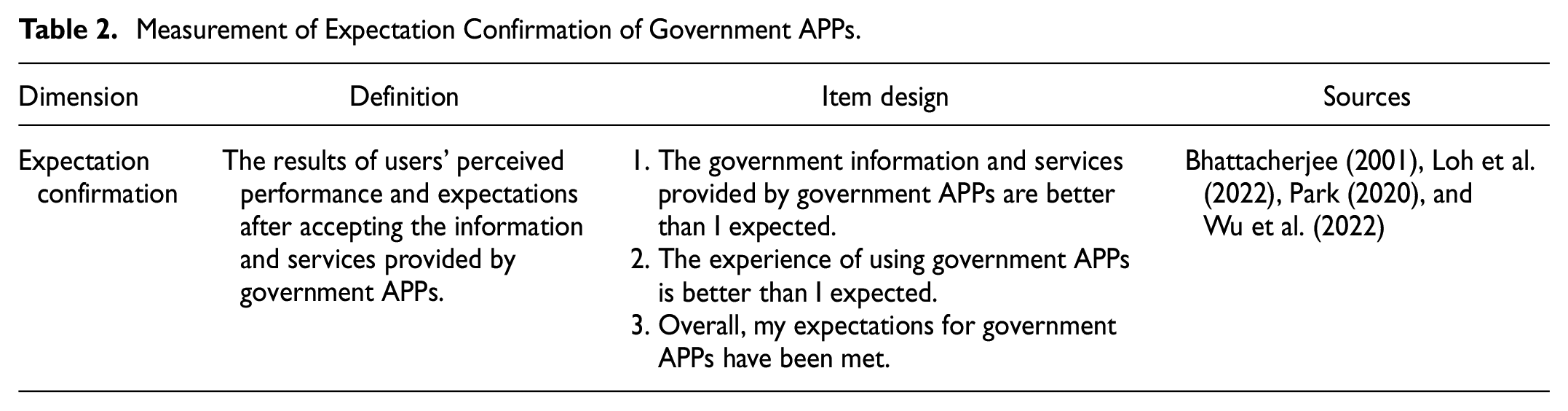
Measuring the Perceived Usefulness of Government APPs
As an important variable in the TAM, perceived usefulness was first defined by Davis (1989) as the degree to which users believe that a specific information system improves the performance of a specific piece of work or transaction. Bhattacherjee (2001) has defined perceived usefulness as users’ perception of the benefits gained from using IS. This definition was refined in 2008 to reflect the beliefs accumulated by consumers as a usefulness-cognition experience after consuming products and services (Bhattacherjee et al., 2008). Table 3 presents the definition, measurement, and source of the perceived usefulness of government APPs on existing research.
Measurement of Perceived Usefulness of Government APPs.
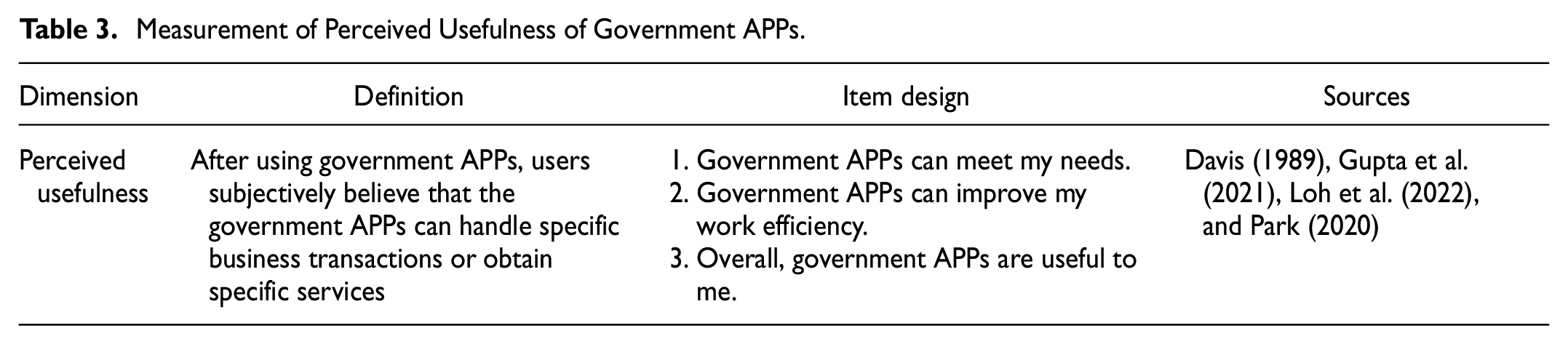
Measurement of Satisfaction of Government APPs
According to Howard and Sheth (1969), satisfaction is a state in which consumers compare costs and benefits to judge the reasonableness of consumption behavior. Oliver (1980) has defined satisfaction as a customer’s emotional response to a specific transactional behavior. Johnson and Fornell (1991) regarded satisfaction as the overall evaluation of customers’ experiences of purchasing a product or service. Table 4 presents the definition, measurement, and sources of satisfaction of government APPs and their impact on existing research.
Measurement of Satisfaction of Government APPs.

Measurement of Government APPs Continuance Intention
Bhattacherjee (2001) defines continuance intention as a user’s willingness to continue using an IS. This definition regards continuance intention as repurchase intention in the field of consumer behavior; this is a subjective variable that follows on from user acceptance. Table 5 presents the definition, measurement, and sources of government APPs continuance intention, based on existing research.
Measurement of Continuance Intention of Government APPs.

Data Collection
Given the continued prevalence of COVID-19 and the need for pandemic prevention, this study used the online survey platform “Questionnaire Star” (https://www.wjx.cn) to design and distribute questionnaires between March 2, 2021 and April 1, 2021. An online survey of Chinese residents was conducted using social networks (WeChat and QQ). All respondents completed the survey on the questionnaire-platform website with the assistance of trained interviewers. The following criteria were used: survey respondents had to be at least 18 years old, able to read and understand the questionnaire, living in China, and owning and using a smartphone or tablet. A total of 461 questionnaires were received from respondents. After collection, the questionnaires were screened to ensure that all respondents used government APPs. Invalid and incomplete questionnaires were eliminated. Ultimately, 388 valid questionnaires were retained, representing an effective response rate of 84.16%.
Data Analysis
This study relied on SPSS 23.0 and AMOS 21.0 for data management and analysis. Figure 4 presents a flowchart of the study. First, SPSS 23.0 was used to produce descriptive statistics, making it possible to understand the respondents’ basic structure- and distribution-related characteristics. Second, SPSS 23.0 was used to conduct reliability and validity tests on the core variables. Finally, AMOS 21.0, adopted to construct a structural equation model, was used to verify the theoretical model and research hypotheses and to judge the path relationship between variables.

Flowchart of the methods used in this study.
Results
Respondents’ Background Characteristics
Table 6 lists the respondents’ background characteristics. Overall, 54.6% were men. Almost all respondents (97.1%) were ≤45 years old. Around 78% of respondents had a college education; 91.8% had 6 or more years of Internet usage. Most respondents used provincial government applications (64.2%). Compared with APPs downloaded from the Internet or Alipay applet, most respondents (79.6%) were more accustomed to using government APPs through the WeChat applet, indicating that government APPs embedded in social networks were the most popular. Most respondents (85.3%) used government APPs for civic and social development services. In addition, 63.4% of respondents used government apps 2 to 10 times per month, and 16% used government apps more than 10 times per month.
Background Characteristics of the Respondents.

Reliability and Validity Tests
Reliability refers to the consistency of results when the same thing is measured multiple times, reflecting the stability and reliability of the measurement. Cronbach’s alpha test is the most widely used test of reliability test. Generally, a questionnaire with a Cronbach’s alpha coefficient over .8 indicates good reliability (Cronbach, 1951). Table 7 presents the reliability test results. The Cronbach’s alpha for each variable exceeded .8, indicating that the measurement had good internal consistency and high reliability.
Reliability Test Results.

Validity indicates the correctness and validity of the questionnaire. The higher the validity, the better the results obtained by the questionnaire, reflecting the true values of the measured variables. This study used the convergent validity of the questionnaire to measure its validity. Convergent validity relies on average variation extraction (AVE) and combined reliability (CR). When the AVE is greater than 0.5 and the CR greater than 0.7, the questionnaire ha good validity. The validity test results presented in Table 8 show that the questionnaire was valid.
Validity Test Results.

This study also calculated the correlation coefficient matrix of all factors and the square root of their AVE; these results are summarized in Table 9. The square root of the AVE of all factors was greater than the corresponding correlation coefficient with other factors, indicating that the questionnaire had good discriminant validity.
Discriminant Validity Analysis.

Structural Equation Model Validation
To construct the structural equation models, this study used AMOS 21.0 to calculate the model’s goodness-of-fit. Six model-fit indices were used: CMIN/DF, CFI, GFI, AGFI, RMSEA, and RMR. As Table 10 shows, CMIN/DF = 1.498, CFI = 0.977, GFI = 0.891, AGFI = 0.871, RMSEA = 0.036, and RMR = 0.055. Apart from GFI, which is slightly below 0.9, all indicators achieved a good fit (Byrne, 2016). These results show that the structural equation model had a good fit.
Goodness of Fit of the Structural Equation Model.
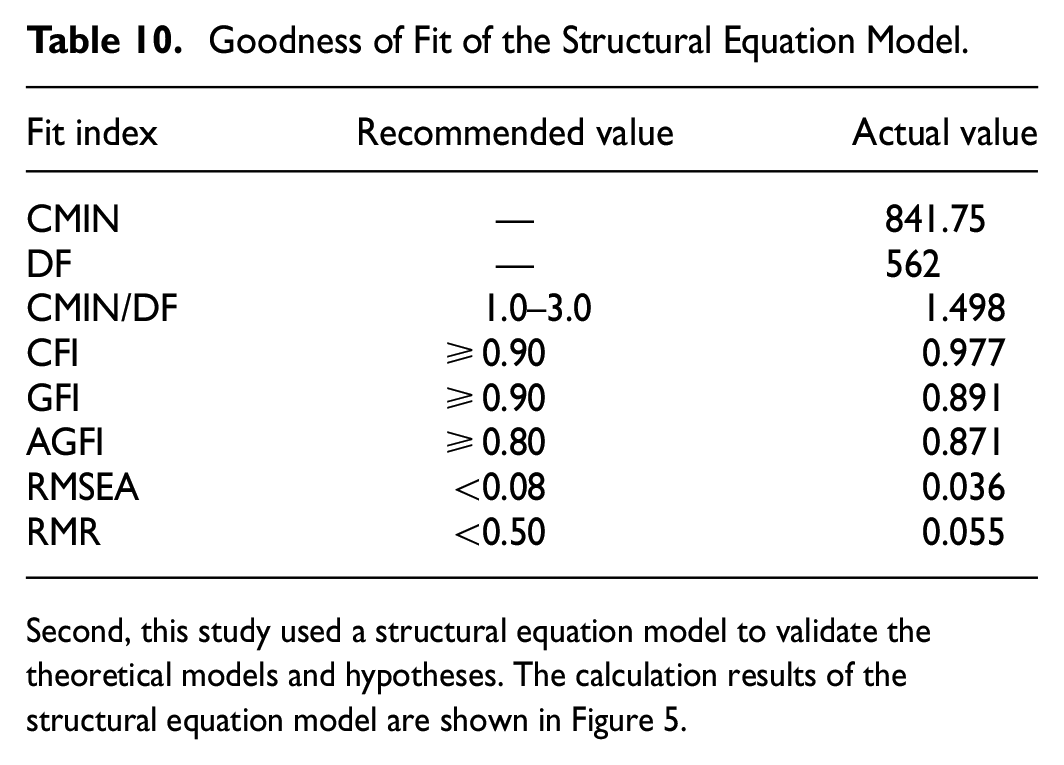
Second, this study used a structural equation model to validate the theoretical models and hypotheses. The calculation results of the structural equation model are shown in Figure 5.

Hypothesis-testing results.
Specifically, Table 11 presents the results of the structural-equation model. As expected, information quality (β = .118, p = .039), efficiency (β = .243, p < .001), security (β = .100, p = .046), and empathy (β = .191, p < .001) positively affect the perceived usefulness of government APPs. Hence, H1b, H1c, H1d, and H1f are supported. H2a, H2c, H2d, and H2f are supported because tangibles (β = .154, p = .004), efficiency (β = .253, p < .001), security (β = .113, p = .008), and empathy (β = .089, p = .049) positively affect the expectation confirmation of government APPs. These results also show positive correlations between expectation confirmation and perceived usefulness (β = .199, p = .020), expectation confirmation and satisfaction (β = .557, p < .001), perceived usefulness and satisfaction (β = .160, p = .014), perceived usefulness and continuance intention (β = .460, p < .001), and satisfaction and continuance intention (β = .151, p = .014), indicating that H3, H4, H5, H6, and H7 are supported.
Summary of Results.

However, some results are unexpected. The tangibles (β = .049, p > .05) and responsiveness (β = .111, p > .05) of government APPs have no significant effect on perceived usefulness, suggesting that H1a and H1e are not supported. The information quality (β = .054, p > .05) and responsiveness (β = .088, p > .05) of government APPs have no significant effect on expectation confirmation, suggesting that H2b and H2e are not supported.
Discussion
Main Findings
Continued use is one of the most important research areas in the field, as it directly determines IS success. The same is true for e-government, which requires significant investments. However, related research on e-government continuance has generally focused on traditional WWW-based e-government and first-generation web-based mobile e-government. Government APPs, as a new generation of e-government systems, are likely to become the dominant form of e-government in the future, due to the popularity of modern wireless-network technology, artificial-intelligence technology, and smartphones. However, the continued use of government APPs remains poorly understood.
To bridge this research gap, the present study developed and tested a new theoretical model to understand and verify the extent to which huge investments in government APPs match service quality and public loyalty. As an innovation, this study introduces the theory of service quality into the theory of expectation confirmation; it constructs a theoretical model of government APPs service quality that strengthens continuance intention and examines the relationship between service quality, expectation confirmation, perceived usefulness, satisfaction, and continuance intention through a questionnaire survey and structural-equation model. This research yields the following new findings:
The Service Quality of Government APPs Helps to Improve Perceived Usefulness
Overall, government APPs service quality was shown to promote perceived usefulness. Related studies in the fields of library information services (Landrum et al., 2010), mobile wallets (Gupta et al., 2020), and traditional e-government (Li & Shang, 2020) support this conclusion. Specifically, the information quality, efficiency, security, and empathy of government APPs has been shown to have a positive effect on perceived usefulness, while tangibles and responsiveness have an insignificant effect.
Among the four predictors cite above, efficiency has the greatest impact. Efficiency reflects a government APP’s ability to provide public services. One important reason for members of the public to use government APPs is to access business processing or information queries more efficiently; in other words, members of the public can use mobile phones to conduct public affairs and obtain public services and information efficiently and accurately and at a low cost.
Empathy toward government APPs also has an important impact on perceived usefulness. Empathy is reflected in the personalization of services provided by government APPs and the positive service attitude of government staff involved. The perceived usefulness of government APPs is affected by the extent to which authorities are able to provide users with personalized services that meet their needs and to provide timely feedback on the progress of online processing and the attitudes of online service personnel. Such perceptions, in turn, affect user satisfaction and continuance intentions. In service-oriented governments, the authorities thus demand improved empathy in government APPs.
Information quality reflects the authority, usefulness, and legibility of information provided by government APPs. However, government APPs information quality has less impact on perceived usefulness than efficiency or empathy. The reason for this is that, on the one hand, the information on government APP primarily comes from the government and other officials, whose authority and accuracy of information can usually be guaranteed. On the other hand, however, government APPs can often provide users with information related to business procedures, thereby increasing the usefulness and pertinence of the information available to meet user service needs and improve perceived usefulness.
Compared to efficiency, empathy, and information quality, the security of government APPs has a significant but less pronounced impact on perceived usefulness. The security of government APPs improves perceived usefulness for two main reasons. First, the government often customizes government APPs through purchasing services provided by digital service companies. In implementing such procedures, the government generally has high security requirements for government APPs to ensure user information security, stable system operations, and payment security and avoid public dissatisfaction and legal issues. As government APPs are generally designed to convey government leadership and can easily gain public trust, the public tends to assume that government APPs have high levels of security.
Tangibles reflect the visual experience of government APPs, including the operational interface design and navigation settings. The results of our empirical analysis show that tangibles have an insignificant impact on perceived usefulness because the application of government APPs is still in its infancy, and users pay more attention to practicality—whether government APPs can meet the core public-service needs. By contrast, users do not require sophisticated operation interface designs or highly diversified information forms from government APPs. At the same time, government APPs currently have a relatively mature operation interface design technology and service provision model, enabling the tangible design of government APPs to meet public expectations of the public. Responsiveness is the speed at which government APPs respond to user-command operations, handle business, address suggestions, and respond to emergencies. The present study confirms that the responsiveness of government APPs does not significantly affect their perceived usefulness. As the functional scope of Chinese government APPs currently involves businesses with clear procedures and mature applications, the information systems involved are generally stable, offering quick responses to business processing, suggestions, and emergencies.
The Service Quality of Government APPs Helps to Improve Expectation Confirmation
The results of this empirical analysis show that overall service quality significantly affects the expectation confirmation of government APPs, an outcome consistent with the results of traditional e-government-related research (Alruwaie et al., 2020). Among all the dimensions of service quality, the tangibles, effectiveness, security, and empathy of government APPs have a significant impact on expectation confirmation, while information quality and responsiveness have an insignificant impact on expectation confirmation.
Of the four factors that affect perceived expectations, efficiency has the greatest impact. When members of the public choose to use government APPs, their main requirement is for the APP to achieve its core functions, including business processing and information queries, efficiently. Only when core needs are met can the App’s actual perceived performance meet or exceed its user-expected performance. The tangible aspects of government APPs also have an important impact on expectation confirmation, likely because users have high expectations for the visual design and design technology of relatively developed APPs,. They believe that government APPs, as official forms of IS, should be equipped with higher levels of technology, enabling good tangibles to lead to higher-level expectation confirmation. Compared to efficiency and tangibles, however, security has a relatively small impact on expectation confirmation. Because government APPs are designed with government oversight, users generally assume that they have high-level security, producing a relatively low impact on expectation confirmation. Among the four influencing factors, empathy has the least influence on expectation-confirmation. Compared with core functions, users have a relatively weak need for polite and personalized polite services.
As the empirical results show, the influence of information quality on expectation-confirmation is insignificant. On the one hand, members of the public trust information provided by official IS; on the other hand, the information in government APPs comes from the government, which guarantees its quality. At the same time, responsiveness has no significant effect on expectation confirmation. This is because China’s government APPs have developed mature operational procedures and emergency-management solutions for dealing with business, opinions, complaints, and emergencies; these solutions are sufficient to meet user response needs.
The Expectation Confirmation of Government APPs Helps to Improve Perceived Usefulness
As the empirical-analysis results show, the expectation confirmation of government APPs significantly affects their perceived usefulness, in line with the ECM proposed by Bhattacherjee (2001). This finding is consistent with other research in the field of mobile services, including, but not limited to research on commercial APPs (Tam et al., 2020), mobile payments (Loh et al., 2022) and smart wearable devices (Park, 2020). When the experience of using government APPs provides users with high-level expectation confirmation, the service performance they perceive exceeds their expectations. For such users, the greater the effect of government APPs on their access to public services, the greater their perceived usefulness. Finally, the analysis above shows that the four service-quality dimensions of government APPs, namely tangibles, effectiveness, security, and empathy, can indirectly and positively affect perceived usefulness through expectation confirmation.
The Perceived Usefulness of Government APPs Strengthens User Satisfaction
The results confirm that the perceived usefulness of government APPs has a significant positive impact on satisfaction. Several ECM studies have confirmed this positive effect (Bhattacherjee, 2001; Bhattacherjee et al., 2008; Hsu & Chiu, 2004), which has also been validated in the field of mobile services (Loh et al., 2022; Susanto et al., 2016). Government APPs play an active role in improving the quantity, quality, and accessibility of public services. The more government APPs core functions match public service needs, the higher the levels of user satisfaction with government APPs. Thus, the development and design of government APPs must match the public-service needs of users in their basic principles and core functions. Combined with the previous analysis, information quality, efficiency, security, empathy, and expectation confirmation indirectly and positively affect user satisfaction with government APPs through perceived usefulness.
Government APPs Expectation Confirmation Strengthens User Satisfaction
This study confirms the positive impact of government APPs on user satisfaction, verifying this conclusion in government and other information services (Bhattacherjee, 2001), online shopping platforms (M. Hsu et al., 2006), mobile wallets (Gupta et al., 2020) and traditional forms of e-government (Alruwaie et al., 2020). After using government APPs, users compare their actual perceived performance with their expected performance before use. When the actual perceived performance meets or exceeds expectations, the positive expectations of users are confirmed; they experience positive emotions and feel satisfied. Simultaneously, it can be seen from the previous analysis that tangibles, effectiveness, security, and empathy indirectly and positively affect satisfaction with government APPs through expectation confirmation.
The Perceived Usefulness of Government APPs Strengthens Continuance Intention
This study also verifies the positive role played by the perceived usefulness of government APPs in forming users’ continuance intentions, a finding supported by previous studies on mobile Internet services (Thong et al., 2006), electronic textbooks (Baker-Eveleth & Stone, 2015) and smart fitness wearables (Gupta et al., 2021). The usefulness of government APPs determines the extent to which their core functions solve issues related to government business management and public-service acquisition, which underpin their continuous use. In addition, this analysis shows that information quality, efficiency, security, empathy, and government APPs expectation confirmation can improve users’ continuance intention by improving perceived usefulness.
Satisfaction With Government APPs Strengthens Continuance Intention
Finally, this study verifies that user satisfaction with government APPs significantly affects continuance intention. Many studies have confirmed the positive impact of satisfaction on continuance intention (Bhattacherjee, 2001; Bhattacherjee et al., 2008; Mouakket, 2015). User satisfaction with government APPs-related products and services determines whether individuals will continue to use government APPs as important tools for handling government business and securing public services.
Combining the above analyses, perceived usefulness has a direct impact on continuance intention and an indirect impact on the continuance intention through satisfaction. In addition, expectation confirmation has an indirect impact on continuance intention through satisfaction, while service quality has an indirect influence on continuance intention through perceived usefulness, expectation confirmation, and satisfaction. To strengthen users’ intention to continue using government APPs, it is essential to comprehensively improve service quality, expectation confirmation, usefulness, and satisfaction with government APPs.
Research Implications
Large investments in government APPs can only succeed by meeting the needs of the largest possible number of people, enabling them to conduct government business and obtain public services. User loyalty plays a crucial role in this process. Compared with traditional e-government products, government APPs have more complete functions, are closer to people’s daily lives, offer more convenient access and smart features, and provide services anytime, anywhere, and everywhere. For these reasons, government APPs are used much more frequently by members of the public than traditional e-government products. However, while many studies have analyzed the continuance intention in relation to IS products and service from the perspective of expectation confirmation theory, few studies have explored continuance intention, as government APPs have only been widely used for a relatively short period of time. The present study introduces the theories of service quality and expectation confirmation into the field of government APPs to further expand the application of these two theories and investigate continuance in relation to the latest generation of e-government systems.
Service quality and continuance are critical to the performance of government APPs. Service quality also determines user satisfaction and continuous use of government APPs. However, few previous studies in the field of e-government have attempted to analyze government APPs service quality, with some ignoring the link between service quality and continuous use. This study innovates by constructing a theoretical model of government APPs service quality to strengthen continuance intention. In addition, it uses an empirical analysis to verify the relationship between service quality, expectation confirmation, perceived usefulness, satisfaction, and continuance intention. Finally, it expands our theoretical understanding of the key factors that drive the continuous use of government APPs.
Implications for Practice
This study suggests useful ways to improve government APPs service quality and user loyalty. First, those who develop and design government APPs must abandon the traditional concept of government-led, top-down services, and place citizens at the center, making efforts to meet users’ public-service needs the main goal of government APP projects and related policies. Specific policies or measures can include transforming the government into a service-oriented system, building a smooth channel for public-need surveys before implementing government APP projects or considering post-implementation user feedback, and promoting good interactions between the government, enterprises, and the public in relation to the development, design, use, operation, and maintenance of government APPs.
Second, the authorities must continuously improve the interface, functions, and information settings of government APPs in order to enhance their service quality and public value. Specific measures can include the following: 1) Optimizing interface design and efficiently promoting the interface layout, navigation settings, and information prompts of government APPs through government-enterprise cooperation to meet the needs of citizens. 2) Upgrading the content and information quality of government APPs to improve the reliability, timeliness, applicability, and accuracy of government business processes, public services, and public information; and 3) improving the efficiency of government bodies responsible for APP design and application processes. In particular, the authorities should focus on the convenience and practicality of government APPs, expand their business scope, simplify operations and handling procedures, and help members of the public obtain remote public services. IN addition, 4) the security of government APPs should be strengthened. Here, the authorities must ensure user-information security, information-system security, and payment security at multiple levels of legislation, policy, management, and technology in order to enhance public trust.
Finally, the authorities should strengthen the humanistic care and inclusiveness of government APPs. Whether or not they provide customized services, feedback on the progress of business procedures, and the attitude of online service personnel will affect user perceptions of service quality, satisfaction, and continuance intention. Specific measures can include the following: 1) Strengthening the training of government APP online service personnel; improving their online service abilities, attitudes, and professionalism; and using intelligent customer-service robots to support online processing. 2) Based on user surveys, the authorities should also develop and design government APPs in accordance with public needs, developing interface customization functions that allow users to customize the interface to reflect their personal needs. 3) Additional care is needed for special groups—in particular, digitally vulnerable groups—by supporting multilingual versions, voice interactions, and special versions for elderly people. 4) The authorities must also provide sufficient digital guides in government-service halls, digital-service kiosks, and public self-service facilities to guide and help digitally vulnerable groups access online services.
Limitations and Future Research Directions
This study has several limitations. First, the empirical analysis is based on Chinese respondents. Cultural differences in other countries and regions will lead to different characteristics and correlations in service quality and the continuous use of government APPs (Dwivedi et al., 2016; Wang et al., 2020). Future research should analyze further the regional heterogeneity of service quality and the continuous use of government APPs; a comparative analysis in a different cultural context should also be conducted. Second, this study does not focus on differences in service quality and continuous use between different types of government APPs; in future, a comparative analysis of different types of government APPs should be carried out (e.g., comprehensive government APPs vs. government APPs for specialized businesses, central government APPs vs. local government APPs, independent government APPs vs. government applets embedded in social software or payment software). As government APPs are still in the initial stage of development, the present study could only access a relatively small number of users with insufficient stickiness, resulting in a limited sample size, which has made it difficult to measure users’ actual usage behavior. The theoretical model constructed in this study should therefore be applied to the further study of continuance-intentions. Future research should expand the sample size and analyze the continuous use behavior of larger groups of users.
Conclusion
Government APPs have broad prospects of breaking through the time and space limitations of traditional e-government systems. The convenience, flexibility, precision, and intelligence of government APPs have greatly enhanced the accessibility, fairness, and affordability of public services. These characteristics are of great significance in meeting the diverse and personalized service needs of citizens. Although governments worldwide are investing heavily in widely deployed government APPs, there are insufficient theory and evidence to determine whether government APPs service quality meets the inherent needs of members of the public. The present study has developed a theoretical model of government APPs service quality to strengthen continuance intention, based on service-quality theory and expectation-confirmation theory; it thus explores the link between service quality, expectation confirmation, perceived usefulness, satisfaction, and continuance intention. A questionnaire survey of 388 Chinese government APPs users and a structural equation model have been used to measure and verify the impact of service quality on continuance intention. The empirical-analysis results show that service quality can improve user satisfaction and continuance intention toward government APPs by improving expectation confirmation and perceived usefulness. This research illuminates the process through which users form the intention to continue using government APPs and provides theoretical guidance and a practical basis for the government to improve APP service quality and continuance-intention.
Footnotes
Acknowledgements
The authors would like to thank the National Social Science Fund of China, the Fundamental Research Funds for the Central Universities and the Huazhong University of Science and Technology Double First-Class Funds for Humanities and Social Sciences for funding this study. We also acknowledge the reviewers and editors of the SAGE Open for helping improve this study.
Abbreviations
APPs: mobile applications
m-government: mobile government
ICTs: information and communication technologies
IS: information system
ECM: expectation-confirmation model
TAM: technology acceptance model
AVE: average variation extraction
CR: combined reliability
Author Contributions
Declaration of Conflicting Interests
The author(s) declared no potential conflicts of interest with respect to the research, authorship, and/or publication of this article.
Funding
The author(s) disclosed receipt of the following financial support for the research, authorship, and/or publication of this article: This work was supported by the National Social Science Fund of China (grant number: 21AZZ013), the Fundamental Research Funds for the Central Universities (grant numbers: YCJJ20230683, 2023JYCXJJ008), and the Huazhong University of Science and Technology Double First-Class Funds for Humanities and Social Sciences (Research on the Functional Mechanism of Digital Government in the Coordinated Development of Digital Economy and People’s Livelihood, Non-traditional Security Research Center Construction). The funders had no role in the design of the study; the collection, analysis, and interpretation of data; or the writing of the manuscript.
Ethics Statement
Not applicable.
