




Abstract
Online-to-offline mobile applications (O2O apps), which attract potential customers online and entice them to purchase in physical stores, are growing in popularity. However, little is known about the mechanisms by which satisfaction with O2O apps is formed through offline experiences. Drawing on the expectation confirmation model (ECM), this study proposes that the confirmation of expectations through offline experiences is the key to explaining satisfaction with O2O apps. Response data from 271 consumers of Kakao Hair, an O2O application that is widely used for hair shop customers in South Korea, were collected and analyzed. The analysis found that the confirmation of expectations through offline experiences directly influences O2O app satisfaction, and indirectly influences O2O app satisfaction through trust in and the perceived usefulness of O2O applications. This study contributes to both ECM literature and mobile application literature by demonstrating how confirmation of expectations through offline experiences affect O2O app satisfaction and intention to continue using O2O apps.
Introduction
Online-to-offline mobile apps (O2O app) are growing in popularity (Li & Yang, 2014). O2O apps integrate offline and online channels by attracting potential customers online and directing them to physical stores or services (i.e., online-to-offline) (He et al., 2016; Hwang & Kim, 2018; Kim et al., 2021). O2O apps benefit both consumers and product or service providers (e.g., physical stores). O2O apps allow consumers to access useful information about products and services and compare them to make purchasing decisions. Consumers can also receive discounts on products and services through the O2O app. Moreover, O2O apps allow product or service providers to advertise their products or services through the O2O app, as well as access useful customer information that can be used to drive further purchases (Chen et al., 2019). Accordingly, the number of O2O apps is growing in the application market, and more and more people are using O2O apps for restaurant reservation, hairdressing services and hotel reservations. Several O2O apps, such as Airbnb, have become major mobile platforms worldwide, and the O2O app market size in China was US$257 billion in 2018, with a 20% annual growth rate (Kim et al., 2021).
Despite the increasing popularity of O2O apps, our understanding of the mechanism by which O2O app satisfaction is formed is limited. While previous research studies have investigated O2O app satisfaction, these studies have focused on the online channel (i.e., the effect of personal perception of the O2O app on O2O app satisfaction) (Hwang & Kim, 2018; Kim et al., 2021), offering a somewhat limited theoretical explanation of how O2O app users’ offline experiences affect their O2O app satisfaction. Given the nature of O2O apps—specifically, their integration of online and offline channels—users’ offline experiences may influence their perception of and satisfaction with O2O apps. Additionally, from a practical standpoint, previous studies do not provide sufficient guidance on how to manage O2O app users’ offline experiences to support the success of O2O apps.
The aim of this study is to provide theoretical explanations for and practical insights regarding how satisfaction with O2O apps is formed through offline experiences. In this study, we focus on the post-usage stage within IS use theory with the goal of understanding the O2O app satisfaction mechanism. First, we draw on the expectation confirmation model (ECM). ECM focuses on the perception of IS to explain the continued use of IS and suggests that users’ intention to continue using IS is determined by their satisfaction with IS and that satisfaction with IS is influenced by confirmation of expectation from IS use and perceived usefulness of IS (Bhattacherjee, 2001). Also, ECM suggests that confirmation of expectation from IS use indirectly influences satisfaction through the perceived usefulness of IS (Bhattacherjee, 2001). Given that the expectation may be formed through the use of O2O apps and confirmation of expectations may be formed through offline experiences, this study suggests that individuals’ offline experience is the key to explaining users’ satisfaction with O2O apps. More specifically, this study argues that the confirmation of expectations through offline experiences directly influences satisfaction with O2O apps and indirectly influences satisfaction with O2O app through the user’s perceived usefulness of the O2O app.
Second, to further explain how satisfaction with O2O apps is formed through offline experiences, we extend ECM by introducing trust as a mediator between confirmation and satisfaction. Trust in IS is the perception of IS users who believe that information systems are reliable (Lee & Chung, 2009). Trust has been considered an important factor in IS use (Kim et al., 2018; Reichheld & Schefter, 2000; Singh & Sirdeshmukh, 2000). Previous trust literature suggests that trust is formed through the process of setting expectations and confirming them (Garbarino & Johnson, 1999; Kim & Benbasat, 2003; Lee & Chung, 2009). Thus, we suggest that confirmation of expectations through offline experiences indirectly influences O2O app satisfaction through trust in the O2O app. Motivated by this line of thinking, this study seeks to answer the following research question:
To answer this research question, we developed a structural equation model describing a theoretical satisfaction mechanism that shows how O2O app satisfaction is formed through offline experiences (i.e., confirmation), collected survey data from 271 O2O app users in South Korea, and used PLS-based SEM to test our hypotheses. This study contributes to the expectation confirmation literature as well as mobile application literature by demonstrating how confirmation of expectations through offline experiences affects users’ satisfaction with online-to-offline apps.
This article is presented as follows: Sections 2 and 3 discuss the theoretical background of the research and present the research hypotheses. These are followed by Section 4, where the research methodology is explained. Section 5 offers the results from the data analysis. In Section 6, we discuss the theoretical contributions and practical implications of the findings. Finally, limitations and conclusions that can be drawn from this study are presented.
Theoretical Background
Online-to-Offline Mobile Application
With the development of internet and mobile technologies, the integration of online and offline channels in retail and ecommerce is emerging in two directions: online-to-offline and offline-to-online (Hwang & Kim, 2018). For example, businesses can attract potential customers online and direct them to physical stores (i.e., online-to-offline) or extend offline services or products to an online platform to make customers buy online (i.e., offline-to-online) (He et al., 2016; Kim et al., 2021). Among the two types of online-offline integrations, this study focuses on online-to-offline mobile applications (O2O apps) because they account for the majority of online-offline integration cases (Chen et al., 2019).
O2O apps are mobile applications that connect product/service providers with potential customers (Hwang & Kim, 2018). O2O apps are adopted by a variety of offline-service (e.g., restaurant, hotel, etc.) and offline-product (e.g., clothing, retail, etc.) industries where consumers need to visit stores to purchase or use products/services in fulfillment processes. Products and services are categorized into offline-good, offline-service, electronic-good, and electronic-service depending on product characteristic and fulfillment process (Francis & White, 2004). O2O apps can be used in offline-good or offline-service industries because these are the industries where businesses can attract customers online and direct them to offline stores. However, O2O apps cannot be used in electronic-good or electronic-service industries because these are the industries where customers can only consume products or services online. O2O apps provide consumers useful information about products or services online, allow them to compare alternatives to make purchasing decisions, and direct them to physical stores or services offline. O2O apps benefit both customers and product/service providers. Consumers who use an O2O app are able to search for useful information about products/services and receive discounts.
While exploring information online, consumers form cognitive attitudes such as perceived usefulness and trust toward offline products/services at pre-usage stage, leading to purchasing decision. The advent of information and communication technology (ICT) enables consumers to use digital tools such as O2O apps and form new digital habits that are effective in evaluating alternatives online (Rydell & Kucera, 2021). On the other hand, businesses can increase revenue by exposing their products or services to potential customers online and driving them to physical stores. In addition, O2O apps allows consumers to write reviews that have a significant impact on the perceptions (e.g., usefulness, trust, etc.) and purchasing decisions of existing and potential customers (Drugău-Constantin, 2019; Mirica, 2019). Thus, O2O apps serves as a co-creation platform for businesses to communicate with customers and improve products/services (Graessley et al., 2019; Meilhan, 2019; Watson & Popescu, 2021). Accordingly, more and more people are using O2O apps such as OpenTable in the United States for restaurant reservation and Kakao Hair in South Korea for hairdressing services (Chen et al., 2019). Despite the growing popularity of O2O apps and the importance of user satisfaction to their success, our understanding of the mechanism by which O2O app satisfaction is formed is limited. Most previous studies on O2O apps have focused on potential users’ intention to use O2O apps or strategic implications for service development (Du & Tang, 2014; He et al., 2016; Hwang & Kim, 2018; Wu et al., 2015; Zhang & Lee, 2014). While several research studies have investigated O2O app satisfaction, these studies have focused only on the online channel by examining the effect of personal O2O app perception on O2O app satisfaction (Hwang & Kim, 2018; Kim et al., 2021). However, given that the nature of O2O apps is to benefit consumers by integrating online and offline channels (Chen et al., 2019) and that consumers’ perceptions of O2O apps can be affected by their offline experiences, it is necessary to examine how those offline experiences affect consumer satisfaction with O2O apps.
Expectation Confirmation Model
Focusing on the post-adoption stage of IS use, the expectation confirmation model (ECM) refines previous expectation conformation theory (ECT) (Oliver, 1977, 1980) to account for IS continuance usage and, ultimately, the difference between acceptance and continuance behaviors (Bhattacherjee, 2001; Hsu & Lin, 2015). While ECT argues that customer expectations are important in explaining post-purchase satisfaction, ECM suggests that confirmation of expectations is a critical factor in predicting user satisfaction and continued use intention (Bhattacherjee, 2001; Oliver, 1993; Tam et al., 2020). According to ECM, an individual’s continued use intention is explained by three constructs: satisfaction with IS use, perceived usefulness of IS, and confirmation of expectation from IS use. Specially, as shown in Figure 1, ECM suggests that (1) IS continuance intention is determined by user satisfaction with IS use and perceived usefulness of IS; (2) user satisfaction, in turn, is influenced by perceived usefulness and confirmation of expectation from IS use; and, (3) perceived usefulness is affected by confirmation (Bhattacherjee, 2001). Because ECM provides a theoretical explanation for the satisfaction and continued use of IS, which is critical to IS success, ECM has been adopted by various IS studies in different contexts, such as Web portal, e-commerce, IPTV, e-learning, and mobile apps (Chiu et al., 2021; Lee & Kwon, 2011; Lin, 2012; Tam et al., 2020).
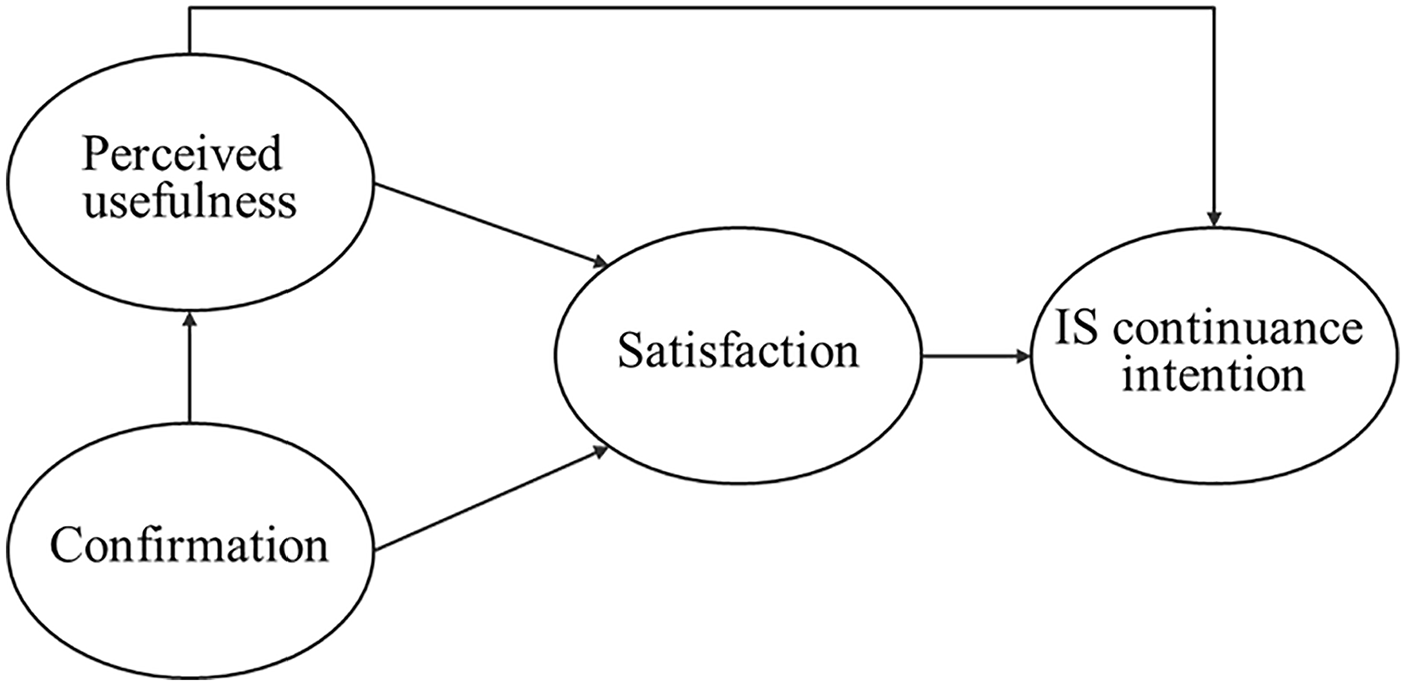
Expectation confirmation model.
As shown in Figure 2, this study extends ECM by introducing trust as a mediator between confirmation and satisfaction. Trust has been conceptualized as the perception of customers who believe in the quality and reliability of a product/service (Garbarino & Johnson, 1999) or the credibility and honesty of a product/service provider (Morgan & Hunt, 1994). Therefore, trust is an important factor in building relationships between buyers and sellers (Kim et al., 2009; Sirdeshmukh et al., 2002). Moreover, in the context of online retail and IS use, trust is considered a critical antecedent to purchase or use (Kim et al., 2009; Reichheld & Schefter, 2000; Singh & Sirdeshmukh, 2000). Given that trust is an important factor in forming a relationship and an antecedent of IS use, it is necessary to examine the role of trust in both the pre- and post-usage stage of IS because users’ perceptions may change after using IS. Specifically, trust in the pre-usage stage may influence adoption of IS and trust in the post-usage stage may affect continued use of IS. In this study, we focus on the post-usage stage of IS, and, as shown in Figure 2, we suggest that confirmation of expectations is the key to building trust in IS and that trust may influence IS continuance intention through satisfaction.

Extended expectation confirmation model.
Model Development and Hypotheses
In this section, we present our research model and hypotheses. Our research model is depicted in Figure 3.

Research model.
Confirmation of Expectations Through Offline Experiences and Satisfaction with O2O Apps
To investigate the mechanism by which satisfaction with an O2O app is formed, we draw on ECM (Bhattacherjee, 2001), in which an individual’s confirmation of expectation from IS use influences their perception of and satisfaction with IS. We suggest that confirmation of expectations through offline experiences directly influences O2O app satisfaction and indirectly influences O2O app satisfaction through trust in and the perceived usefulness of the O2O app.
O2O apps are mobile applications that provide users with useful information about products or services online, allow them to compare alternatives to make purchasing decisions, and direct them to offline stores or services to purchase. When O2O app users search for information about a product or service in the O2O app online, they may evaluate alternatives and form expectations for the product or service that they decide to purchase offline (Oliver, 1993; Oliver & DeSarbo, 1988). While experiencing the product or service offline, O2O app users may evaluate the value of the product or service against their expectations (Bhattacherjee, 2001; Oliver, 1993; Tam et al., 2020). When the perceived value of the offline product or service is greater than their expectations formed online (i.e., high level of confirmation), O2O app users’ satisfaction with the O2O app may be high; however, when the perceived value of the offline product or service is lower than their expectation formed online (i.e., low level of confirmation or disconfirmation), O2O app users’ satisfaction with the O2O app may be low. Therefore, the confirmation, which is the agreement between their expectations obtained online and the perceived quality of their offline experiences, may positively influence O2O app users’ satisfaction with an O2O app. Thus, we hypothesize the following:
Mediating Role of Trust
Trust in IS is the perception of IS users who believe that IS are reliable (Lee & Chung, 2009). Trust is considered an important factor in explaining satisfaction in IS and online IS use (Gummerus et al., 2004; Reichheld & Schefter, 2000; Singh & Sirdeshmukh, 2000).
Trust in O2O apps, which may positively influence satisfaction with them, can be influenced by the confirmation of expectations through offline experiences because O2O app users may perceive O2O apps as trustworthy when their offline experiences meet or exceed the expectations they formed through the use of O2O apps. Previous trust literature has demonstrated that trust is formed through the process of setting expectations and confirming them (Garbarino & Johnson, 1999; Kim & Benbasat, 2003; Lee & Chung, 2009). Additionally, prior research has consistently demonstrated that trust in IS positively influences satisfaction with IS (Gummerus et al., 2004; Harris & Goode, 2004; Sfenrianto et al., 2018; Singh & Sirdeshmukh, 2000). Thus, we propose the following hypothesis:
Mediating Role of Perceived Usefulness
Perceived usefulness is the perception of IS users who believe that using information systems can improve their work performance (Davis, 1989). Perceived usefulness is a well-known key factor that influences satisfaction with IS. In fact, prior research has consistently demonstrated that the perceived usefulness of IS positively influences satisfaction with IS (Calisir & Calisir, 2004; Ghazal et al., 2016; Liaw & Huang, 2013; Zviran et al., 2005).
The perceived usefulness of an O2O app, which may positively influence satisfaction with the O2O app, can be influenced by the confirmation of expectation through offline experiences because O2O app users may find O2O apps useful when the value of offline service/product meets or exceeds their expected value formed through the use of O2O app. Additionally, previous expectation-confirmation literature suggests that the confirmation of expectation positively influences satisfaction (Bhattacherjee, 2001; Tam et al., 2020). Thus, we propose the following hypothesis:
Method
Data Collection
In order to fulfill the purpose of the study, we hired a survey agency to administer an online survey of those who reside in South Korea. This agency randomly selected 1,000 from its pool of verified survey panelists. The question asking about the previous experience of visiting the hair shop through the Kakao Hair mobile O2O application was placed at the beginning of the questionnaire. When a respondent answered that he/she had never had such experience, the survey was closed right away and he/she was not allowed to proceed with the survey any more. The questionnaires were distributed for about 2 weeks in August 2021, and the responses of 271 people who visited the hair shop through the Kakao Hair mobile O2O application were used for analysis. Figure 4 shows the Kakao Hair mobile O2O application. In order to test the non-response bias, the respondents for the previous week and the respondents for the following week were classified. As a result of the t-test, the difference between the two groups was not statistically significant (χ2 = 2.74, p = .39), so we concluded that there is no concern about non-response bias (Hair et al., 1998).

Kakao Hair mobile O2O application.
The general characteristics of the survey subjects are shown in Table 1. Among the respondents, the ratio of men (53.5%) and women (46.5%) was similar, and the ratio of people in their 20s (25%) and 40s (28%) was similar. As for occupation, office workers were the highest at 50.9%, followed by professionals (12.2%), and then students (11.8%). In terms of educational background, bachelor’s degrees accounted for the majority (76.8%), while half of the respondents were married, and half were unmarried. In terms of annual income, $20 to $30 K was the highest at 24.0%, followed by $30 to $40 K, and, finally, $40 to $50 K.
Characteristics of Respondents (N = 271).

Measurement Items
A survey method was used to gather data for this study, and all questions and variables included in the survey were revised and supplemented based on previous studies and theories. The questionnaire was divided into six parts, consisting of a total of 24 questions, including four questions about confirmation, three questions about trust in the O2O app, four questions about the perceived usefulness of the O2O app, three questions about satisfaction with the O2O app, four questions about continuance use intention, and six questions about demographic characteristics. Four questions about gender, age, education, and income level were added as demographic questions, which were also used as control variables. The measurement items used in this study are presented in the Appendix.
The items were measured on a 5-point Likert-scale in which 5 represented “strongly agree,” 4 represented “agree,” 3 represented “neutral,” 2 represented “disagree,” and 1 represented “strongly disagree.” Demographic characteristics were collected using a nominal scale.
Data Analysis and Results
Reliability and Validity
We used the values of Cronbach’s α and factor loading to assess convergent validity. It is considered reliable and acceptable if a factor loading’s minimum value is greater than 0.7 (Fornell & Larcker, 1981; Nunally, 1978). In this process, one item for confirmation was excluded. Table 2 shows that all factor loadings and α values exceeded .7; thus, all items are considered reliable and valid. Also, this study achieved sufficient internal consistency because composite reliability and average variance extracted values (AVEs) were higher than 0.8 and 0.5, respectively. Table 3 further shows that the square root of AVEs is greater than all the correlation coefficients among other variables, demonstrating discriminant validity (Fornell & Larcker, 1981).
PLS Quality Criteria and Factor Loadings.

Contribution of each loading to its assigned construct (in bold).
Means, standard deviations, correlations, and reliability and validity measures.
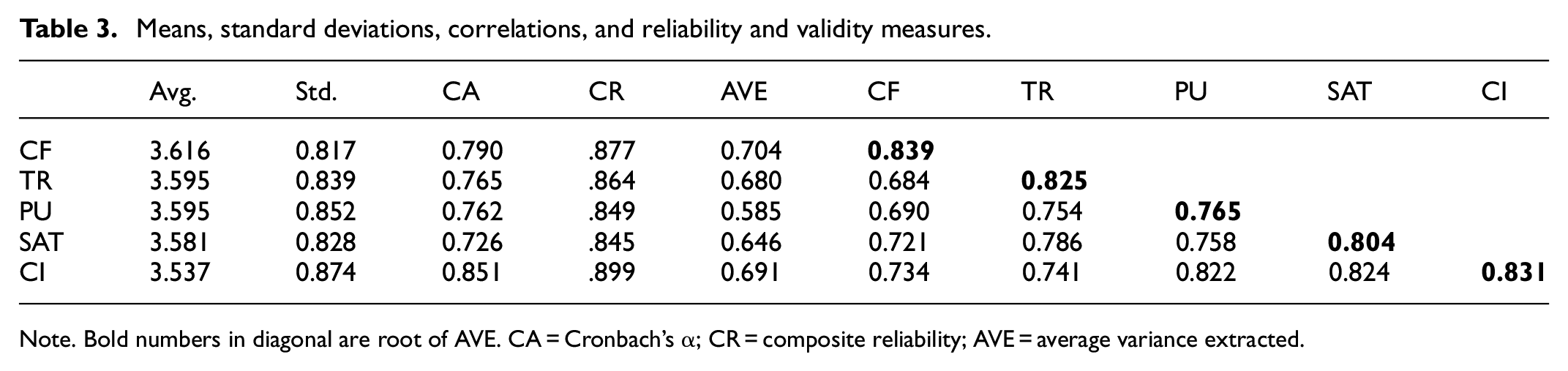
Note. Bold numbers in diagonal are root of AVE. CA = Cronbach’s α; CR = composite reliability; AVE = average variance extracted.
Common Method Bias
Three marker variable items unrelated to this study were included in the questionnaire for the common method bias (CMB) test (Lindell & Whitney, 2001). Since the correlation between marker variable and the variables we used did not exceed .07 on average, we can conclude that CMB was not a concern with our data.
Structural Model Test
After confirming the reliability and validity of this study, the structural model test was conducted as the next step; Figure 5 displays the results. First, we found that confirmation has a significant effect on satisfaction with O2O apps (β = .218, t = 4.958), supporting H1. Second, confirmation showed a positive relationship with both the perceived usefulness of O2O apps (β = .327, t = 5.909) and trust in O2O apps (β = .609, t = 11.471). Third, the perceived usefulness of O2O apps (β = .389, t = 7.030) and trust in O2O apps (β = .344, t = 6.028) were both positively related with O2O app satisfaction. Finally, although not set as a hypothesis, the structural model analysis confirmed that the perceived usefulness of O2O apps had a statistically significant effect on trust in O2O apps (β = .531, t = 8.799) and continuance use intention (β = .417, t = 7.593). Furthermore, while satisfaction with O2O apps had a significant effect on continuance use intention (β = .408, t = 7.831), trust in O2O apps did not (β = .105, not significant). Therefore, all paths of the research model were found to be valid except the relationship between trust in O2O apps and continuance use intention. Four control variables—gender, age, education, and income level—were found to have no statistically significant effects on the relationships among other variables. All R square values show a range from 51.1% to 75.7%, so the explanatory power of this study model can be judged to be appropriate.

Results of structural model test.
To better understand the role of the two mediators—the perceived usefulness of O2O apps and trust in O2O apps—in our model, we followed Preacher and Hayes (2008) and performed bootstrapping in a 2-step procedure. The results of mediation analysis are presented in Table 4. Since VAF of both hypotheses are larger than the 20% threshold level, that indicates that both the perceived usefulness of O2O apps and trust in O2O apps have partial mediating effects. These findings lead us to accept both H2 and H3 about the mediator roles.
Mediation Analysis in PLS-SEM.
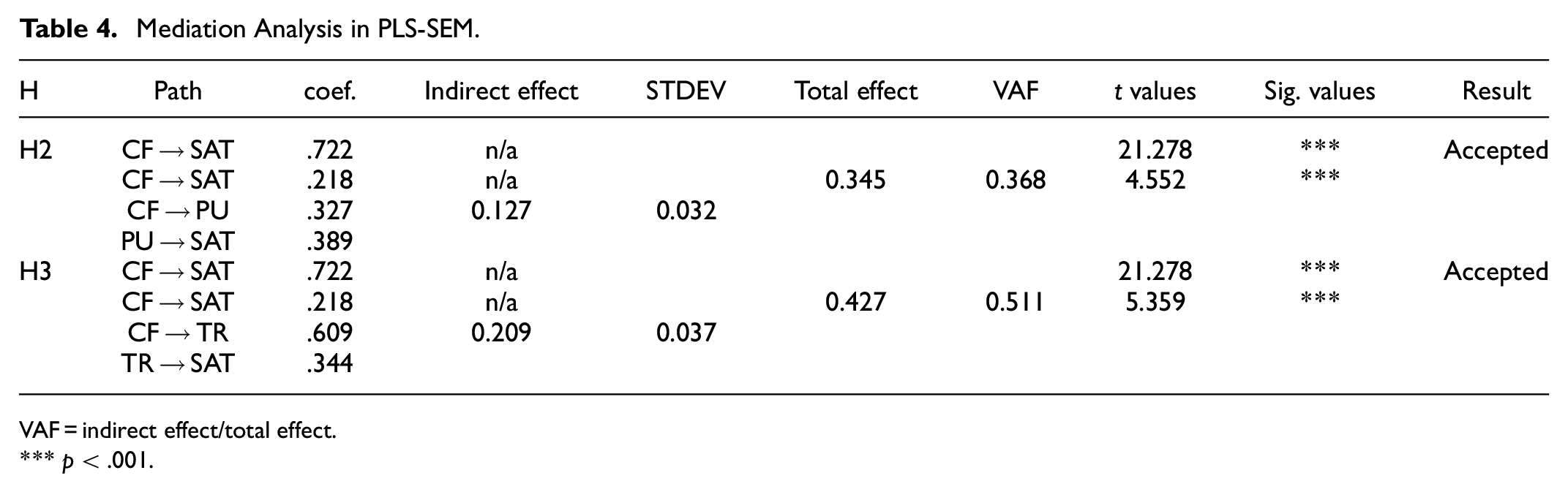
VAF = indirect effect/total effect.*** p < .001.
Discussion
Despite the nature of O2O apps (i.e., integration of online and offline channels), most previous studies on O2O apps have focused on users’ perceptions of O2O apps (Hwang & Kim, 2018; Kim et al., 2021; Wu et al., 2015; Zhang & Lee, 2014), offering a somewhat limited theoretical explanation of how O2O app users’ offline experiences affect O2O app satisfaction. Given that the offline experiences of O2O app users can affect their perceptions of O2O apps, this study demonstrates the mechanism by which O2O app satisfaction is formed through O2O app users’ offline experiences. Specifically, drawing on ECM, this study demonstrates that confirmation of expectations through offline experiences directly affects satisfaction with O2O apps and indirectly influences satisfaction with O2O apps through trust in and the perceived usefulness of the O2O app. ECM provides a theoretical explanation for the satisfaction and continued use of IS, and thus ECM has been adopted by various IS studies (Chiu et al., 2021; Lee & Kwon, 2011; Lin, 2012; Tam et al., 2020). However, although trust has been considered a critical antecedent to IS use (Kim et al., 2009); Reichheld & Schefter, 2000; Singh & Sirdeshmukh, 2000), previous ECM literature neglected to integrate trust into the mechanism of satisfaction and continued use of IS. Given that trust is formed through the process of setting expectations and confirming them (Garbarino & Johnson, 1999; Kim & Benbasat, 2003; Lee & Chung, 2009), this study extends ECM by introducing trust as a mediator between confirmation and satisfaction and empirically demonstrates that confirmation of expectations is the key to building trust in O2O app and that trust influences continuance intention through satisfaction.
Conclusion
Despite the growing popularity of O2O apps and the importance of user satisfaction to the success of O2O apps, our understanding of the mechanism by which O2O app satisfaction is formed is limited. This study examined how O2O app users’ offline experiences influence satisfaction with and continued use of O2O apps. Specifically, we demonstrated that confirmation through offline experiences directly affects satisfaction with O2O app and indirectly influences satisfaction with O2O apps through trust in and the perceived usefulness of O2O app. Also, we validated the extended expectation confirmation model proposed in this study.
Theoretical Implications
This study contributes meaningfully to several research streams. First, this study contributes to the mobile application literature by empirically examining the effect of confirmation of expectations through offline experience on O2O app satisfaction. Although several research studies have investigated O2O app satisfaction, these studies focused on online channels by examining the relationship between personal O2O app perception and O2O app satisfaction (Hwang & Kim, 2018; Kim et al., 2021). However, since a critical characteristic of O2O apps is to benefit customers by integrating online and offline channels (Chen et al., 2019), the offline experience of O2O app users can affect their perception of O2O apps. Therefore, to fully understand the mechanism by which O2O app satisfaction is shaped, it is necessary to understand how users’ perceptions of one channel affect their perceptions of another channel. This study empirically demonstrates that confirmation of expectations through offline experience is the key to explaining customer satisfaction with O2O apps.
Second, this study contributes to trust literature by demonstrating the role of trust in the post-usage stage of O2O apps. Because users’ perceptions may change after using O2O apps, the role of trust in the post-usage stage may differ from trust in the pre-usage stage. Specifically, trust in an O2O app in the pre-usage stage may influence adoption, while trust in an O2O app in the post-usage stage may affect the continued use of O2O apps. Focusing on the post-usage stage of O2O apps, this study empirically demonstrates that confirmation of expectations is the key to building trust in O2O apps in the post-usage stage and that trust in O2O apps influences users’ continuance use intention through satisfaction.
Third, this study contributes to expectation confirmation literature by extending the ECM. Specifically, this study extends the ECM by introducing trust as a mediator between confirmation and satisfaction. Although trust is considered a critical antecedent of IS use (Kim et al., 2018; Reichheld & Schefter, 2000; Singh & Sirdeshmukh, 2000), trust has not been incorporated into the ECM. As shown in Figures 2 and 4, this study extends the ECM by incorporating trust into the previous model and empirically validating it.
Practical Implications
This study has practical implications for O2O app managers. Although the attributes of O2O apps, such as information quality and systems quality, may be important factors for the success of O2O apps (DeLone & McLean, 2004), the findings of this study suggest that the confirmation of expectations through offline experiences is the key to explaining satisfaction with and continued use of O2O apps. Therefore, for the success of O2O apps, O2O app managers may need to manage the level of confirmation of expectations through offline experiences. For example, O2O app managers can remove offline services or products that have a bad reputation because these services or products may lead to a low level of confirmation of expectations (i.e., lower perceived value through offline experience than expected value formed online).
Limitations and Directions for Future Research
Our study has some limitations that merit future research. First, this study focuses on online-to-offline apps that attract potential customers online and direct them to physical stores or services to examine the effect of customers’ offline experience on their perceptions of O2O apps. Future research may be able to focus on another type of integration of online and offline channels, namely, offline-to-online, which extends offline services or products to online platforms to encourage customers to purchase online. Second, the context of this study is an O2O app for hair dressing services, and the boundary condition for generalization of the results of this study is online-to-offline apps that can be used in offline-good or offline-service industries. However, given that different levels of costs involved when consumers use O2O apps (e.g., the extent to which consumers have difficulty evaluating information in O2O apps, or the extent to which consumers strive to visit offline stores) can influence consumers’ perceptions of O2O apps, future research needs to examine whether the theorized relationships between constructs are valid across various O2O apps that requires different levels of costs to use O2O apps. We hope that this study leads to additional research on how user perceptions formed in one channel affect user perception in another channel.
Footnotes
Appendix

| Questionnaire items | Source |
|---|---|
| Confirmation | Bhattacherjee (2001), Kim et al. (2018) |
| The hair shop service used through “Kakao Hair” is consistent with expectations. | |
| Hair shop service is better than expected through “Kakao Hair.”(R)(D) | |
| The hair shop service used through “Kakao Hair” meets overall expectations. | |
| The hair shop service used through “Kakao Hair” met my expectations. | |
| Trust in O2O App | Kim and Ahn (2007), Kim and Kim (2019), Yang (2016) |
| “Kakao Hair” is reliable. | |
| I trust “Kakao Hair.” | |
| I have trust in “Kakao Hair” through experience. | |
| Perceived usefulness of O2O App | Bhattacherjee (2001), Kim et al. (2018) |
| Using “Kakao Hair” increases the efficiency of my hair care. | |
| The advantage of using “Kakao Hair” is greater than the disadvantage of not using it. | |
| “Kakao Hair” provides convenience for my hair care. | |
| “Kakao Hair” is generally useful to me. | |
| Satisfaction with O2O App | Bhattacherjee (2001), Kim et al. (2018) |
| I am generally satisfied with “Kakao Hair.” | |
| I am very satisfied with “Kakao Hair.” | |
| I am very satisfied with my experience with “Kakao Hair.” | |
| Continuance use intention | Bhattacherjee (2001), Kim et al. (2018) |
| I will continue to use “Kakao Hair.” | |
| I think I will continue to use “Kakao Hair.” | |
| I am thinking of continuing to use “Kakao Hair” when I use the hair shop. | |
| I want to continue using “Kakao Hair” more than any other way. |
(R) stands for the reverse measured items.
(D) stands for the dropped items.
Declaration of Conflicting Interests
The author(s) declared no potential conflicts of interest with respect to the research, authorship, and/or publication of this article.
Funding
The author(s) disclosed receipt of the following financial support for the research, authorship, and/or publication of this article: This work was supported by Hankuk University of Foreign Studies Research Fund and also This work was supported by Yong In University Research Fund of 2021.
