




Abstract
Many merchants are keen to boast of their products in advertisements. With the emergence of social media platforms, many consumers seek information shared by other users on those platforms to inform their purchasing decisions. However, existing research predominantly dwells on the influence of social media on consumer decision-making, and few studies have examined how advertising performance is influenced by information shared by other consumers on social media. Using restaurant advertisements as an example, this research investigates how the information shared by other consumers on social media affects merchants’ advertising performance with two studies, drawing upon the expectation confirmation theory. In Study 1, the proposed research model is tested with 220 effective data by using partial least squares technique. The results show that the confirmation level of expectation aroused by advertisement affects the perceived quality and satisfaction of consumers, which in turn affects their purchase behavior. In Study 2, an experiment of one-factor (advertising expression: very good vs. good vs. control condition) design with 120 participants is conducted. The results show that the expression of “good” enhances the desire to buy more than “very good.” The findings enrich the research on advertising performance by integrating the effect of social media information, expand the scope of the expectation confirmation theory, contribute novel knowledge to advertising language research, and hold implications for enterprise advertising strategies in the era of social media.
Plain language summary
Why was the study done? Advertisements provide an opportunity for merchants to increase their visibility and reputation. However, we find that many merchants' advertisements exaggerate in terms of content in order to attract consumers' interest, without considering that the interested consumers will further understand the product through social media, thus affecting their purchase decision. We hope to use this study to explicitly remind merchants to consider the impact of messages on social media when designing advertisements. What did the researchers do? The research team conducted a questionnaire survey and an experiment with consumers to explain why information shared by other consumers on social media affects the effectiveness of merchants’ advertising, and how advertising language can be better used. In this way, we can understand why the design of advertising content should take into account the information on social media, and the exaggerated advertising language often used by merchants is inappropriate. What did the researchers find? Taking restaurant advertisement as an example, study 1 used 220 data from consumer surveys, which shows that the confirmation level from information shared by other consumers on social media of expectation aroused by advertisement affects the perceived quality and satisfaction of consumers, which in turn affect their purchase intention. Study 2 compared the perceived quality, satisfaction, and purchase intention of 120 participants who were randomly divided into three groups: those who watched an advertisement with the expression of “very good,” those who watched an advertisement with the expression of “good,” and those who did not watch an advertisement. The results show that using “good” to describe a product in an advertisement promotes purchase intention more than using “very good”.
Keywords
Introduction
Please image: Near noon, Ann, who is shopping, receives a mobile advertisement from a nearby fast food restaurant. Although it appears to be a high-quality restaurant, Ann further watches short videos of the restaurant shared by other customers on TikTok. How will these short videos affect the advertising performance of restaurant? This is a highly typical scenario in the shopping process during the era of social media.
Advertising provides opportunity for merchants to improve their popularity and reputation. Many merchants are keen to boast of their products in advertisements. In the traditional environment, consumers will enter the store after being attracted by advertising. Even if they find that the product is not as good as advertised, they will buy it because of the sunk costs of the visit. In the era of social media flooding, many merchants still advertise in this way. Does this still work in the era dominated by social media?
In the current landscape of social media, customers who are interested in a product in an appealing advertisement may further use social media to learn about the actual situation of the product, and then make the final purchase decision. The ability of an advertisement to increase product interest is the reach rate of the advertisement, whereas the sale of a product depends on conversion rates. There is a distance between the conversion rate and the reach rate of advertising, because the real situation of the product learned from social media have a crucial impact on the purchase decision. The sales and profits of companies are ultimately determined by the purchase decisions made by consumers. Therefore, it is very important to understand how information shared by other consumers on social media affects the purchase decisions of potential customers who are aroused product interest by the advertisements published by merchants.
From the literature, previous studies focus on the impact of social media information from other consumers on consumption decisions (N. Kim & Kim, 2018; Kumar et al., 2023; Lin et al., 2024). However, there is little research on the effect of social media information on advertising performance. In order to fill this gap, this study investigates why information shared by other customers on social media affects the performance of advertising from merchants and how to improve advertising performance by using different expression with two studies. Specially, Study 1 aims to reveal how the purchase intention of potential consumers who are interested in product advertised by merchant is influenced by information shared by other consumers on social media. Study 2 aims to investigate the influence of differences between two prevalent product description in advertisements (very good vs. good) on purchase intention, so as to provide reference for enterprise advertising strategy.
This study has important theoretical and practical implications. Theoretically, the findings enrich the research on advertising performance by integrating the effect of social media information, expand the scope of the expectation confirmation theory, and contribute novel knowledge to advertising language research. In practice, the findings can help managers improve advertising performance in the social media era.
Literature Review
Social Media Marketing
Since the widespread adoption of social media, numerous studies have delved into consumer behavior pertaining to information sharing and advertising on these platforms (e.g., Ashley & Tuten, 2015; Lin et al., 2024; Mukherjee & Banerjee, 2019; Plume & Slade, 2018; Y. Zhang et al., 2020; Zhao et al., 2022).
In the field of consumer information sharing behavior, some studies are devoted to exploring the reasons behind consumers’ willingness to spread information on social media platforms. For example, Plume and Slade (2018) examine the motivations of consumers to share sponsored advertisements on social media. This kind of behavior is the commercial background of this research. In addition, some studies investigate how consumers’ information sharing behaviors on social media platforms influence the behaviors of their peers and fellow users. For example, Lin et al. (2024) delve into the effect of consumer-generated visual advertising in social media brand communities on purchase intention toward brands. The existence of this influence indicates that it is necessary for this study to examine the influence of information shared on social media by other customers on the advertising performance of merchant.
In the field of advertising, some studies investigate people’s response to social media advertising (Ashley & Tuten, 2015; Y. Zhang et al., 2020). For example, Mukherjee and Banerjee (2019) investigate social media users’ attitude toward social networking advertising. Wajid et al. (2021) observe people’s reactions to message appeal in social media advertisements. In addition, some studies investigate how social media advertising affects consumers’ response. For example, Zeng et al. (2022) examine the effectiveness of agentic and communal advertising appeals delivered through private messages and public feeds communication channels on social media. Zhao et al. (2022) test the impact of image-text matching on consumer engagement in social media advertising. Although these are also advertising studies related to social media, these studies focus on social media advertising, while this study focuses on the impact of social media messages on merchant advertising.
Overall, these studies have enriched our understanding of the impact of social media information on consumers. However, although there have been a large number of studies on social media information, these studies mainly focus on the direct impact of social media information, including social media advertising, on consumers’ purchase decisions, but ignore the indirect impact of social media information on the effectiveness of merchant advertising. In today’s social media era, this is a gap in advertising research.
The Extended of Expectation Confirmation Theory
Expectation confirmation theory (ECT) is extensively utilized within the realm of consumer behavior, serving as a framework to delve into consumer satisfaction and subsequent post-purchase behaviors. It was first proposed by Oliver (1980). Later, Bhattacherjee (2001) developed an improved ECT to study users’ continuance intention toward information systems. It suggests that users’ confirmation level affects their cognitive belief (perceived usefulness in information system contexts), and these two variables jointly influence users’ satisfaction, and then cognitive belief and satisfaction determine their continuance intention. “Disconfirmation” refers to the situations of perceived performance lagging expectation and “confirmation” refers to the reverse situations (Bhattacherjee, 2001). As the new ECT has been widely recognized and applied by scholars (Ayanso et al., 2015; Hu et al., 2016; D. Liu et al., 2016), the present study is based on this theory.
Oliver (1980) and Bhattacherjee (2001) both emphasize the importance of expectations in the decision process. According to Helson (1959), expectations can be influenced by the content of advertising. A shopping cycle consists of two stages (Buyukkurt, 1986). In the realm of social media, using restaurant advertisement as an example, in the first stage, customers receive information from an attractive advertisement, which arouses their expectations of the restaurant. In the second stage, customers view information about the restaurant shared by other consumers on social media, learn the actual situation of the restaurant, judge the situation against expectations, form their cognitive beliefs and satisfaction about the restaurant, and then make a purchase decision. That is to say, in the initial purchase stage, the expectation triggered by advertisements will also be influenced by social media information to form expectation confirmation, thus affecting the purchase decision. Therefore, although the ECT is used to explain consumers’ continuous intention, this study proposes that it can also be used in the initial purchase decision stage. The continuance decision process can be regarded as the third stage (see Figure 1).

The initial and continued decision process in the social media context: Taking restaurant advertisement as an example.
Study 1: How Social Media Information Influence Advertisement Performance
Hypotheses
In accordance with ECT, the degree of confirmation of expectations based on prior usage is positively correlated with users’ cognitive beliefs (Bhattacherjee, 2001). Wang et al. (2013) have shown that the confirmation of initial expectations following direct experience determines consumers’ post-experience beliefs. In the context of social media, potential consumers who learn the actual situation of advertising product from other consumers on social media can also obtain consumption experience of the product. Therefore, the confirmation level of expectation from social media information may also influence consumers’ cognitive beliefs about the advertised product. When an advertisement can arouse consumers’ interest in the product involved, it indicates that the product meets the needs of the consumers. The quality of a product is a paramount factor that significantly influences consumers’ purchase decisions (Chen et al., 2022; S. Kim et al., 2025). For products that are in demand and cannot be determined to buy, uncertainty about the quality of the product may be a very important factor (Zhu & Zhang, 2024). In addition, perceived quality is an important cognitive belief (Siu et al., 2012). Accordingly, this study proposes that the confirmation extent of expectations on an advertised product from social media information is positively associated with consumers’ perceived quality of the product. The hypothesis is as follows.
According to ECT, the confirmation level of expectation from prior use positively affects users’ satisfaction (Bhattacherjee, 2001). Many studies have also confirmed that expectation confirmation positively affects user satisfaction (Chiu et al., 2023; Tseng et al., 2024). For example, expectation confirmation on travel apps affects users’ experiential satisfaction (Tseng et al., 2024). In the context of social media, when consumers confirm the expected benefits through observing the actual conditions of an advertised product by learning the information from other consumers on social media, their feelings of satisfaction toward the product will be aroused. Accordingly, this study postulates that the confirmation level of expectations of an advertised product is positively associated with consumers’ satisfaction with the product.
According to ECT, users’ cognitive beliefs, which are determined by the confirmation level of expectations, positively affect satisfaction (Bhattacherjee, 2001). Beliefs based on consumers’ confirmation level of expectations are found to be the major determinants of consumer satisfaction (LaTour & Peat, 1980; Wang et al., 2013). Perceived quality is an important cognitive belief (Siu et al., 2012). Satisfaction is an affective response to the quality appraisal (Bagozzi, 1992; McAlister, 1982). Previous studies indicate that perceived quality significantly affects satisfaction (Chinelato et al., 2023; Gotlieb et al., 1994). Therefore, the current study hypothesizes that the perceived quality of an advertised product is positively associated with consumers’ satisfaction.
According to ECT, users’ cognitive beliefs, which are determined by the confirmation level of expectations, are positively associated with continuance intention (Bhattacherjee, 2001). Many studies have demonstrated that perceived quality positively affects purchase intention (Song et al., 2021; Yan et al., 2019; J. Zhang et al., 2024). For example, Yan et al. (2019) show that perceived quality positively affects consumers’ purchase intention for private labels. Song et al. (2021) find that perceived quality affects luxury fashion brand owners’ purchase intention in different cultures. Accordingly, this study proposes that the perceived quality of consumers of an advertised product is positively associated with their purchase intention.
For consumer-oriented companies, consumer satisfaction is a necessary factor for success (2017). According to ECT, user satisfaction affects continuance intention (Bhattacherjee, 2001). Many studies have demonstrated that user satisfaction positively affects purchase intention (Chiu et al., 2023; Gotlieb et al., 1994; Namin, 2017). For example, Gotlieb et al. (1994) indicate that the behavioral intention of consumers is affected by their satisfaction. In the context of restaurants, Namin (2017) also finds that consumer satisfaction can improve behavioral intention. Accordingly, this study proposes that the satisfaction of consumers with an advertised product is positively associated with their purchase intention.
Zhu et al. (2015) argue that individuals across varying age groups may possess distinct consumptive conceptions. Some studies find that males and females have significant differences in processing advertising messages (Darley & Smith, 1995; Meyers-Levy, 1989). However, Wong et al. (2015) discover that gender does not exert a discernible influence on consumers’ behavioral intention toward utilizing mobile advertising. In order to control the possible influence of age and gender, the current study incorporates both as control variables in examining purchase intention.
Given that the primary objective of this study is to delve into the aforementioned key research variables, explicit hypotheses regarding the influence of age and gender on purchase intention have not been formulated.
Figure 2 presents the research model.

The research model.
Method
Data Collection
Participants from a famous university in China were randomly invited to take part in the study with monetary incentives, ostensibly initiated by a nearby fast-food restaurant, aimed at gaining insights into consumers’ intention to patronize the restaurant. An obscure fast-food restaurant with passable traffic far from the university was randomly selected to shoot videos by an experienced cameraman. The cameraman was asked to shoot videos from the perspective of customers who consumed in the restaurant, which should include at least the information about food, service, and environment. Finally, a video was selected as the background material (the name of the restaurant was not included) based on the evaluation of 10 postgraduate students.
In addition, a mobile phone short message advertisement was designed. The content of the advertisement is that “Dear customer, we sincerely recommend the 19-yuan special set meal of ‘flying start’ and ‘love you without more words’ to you, which has a 95% favorable rating. Our restaurant provides high-quality service and a comfortable environment for patrons! Note: customers who consume in our restaurant today will get a free drink.” Ten marketing postgraduates who like fast-food were recruited to evaluate the advertisements. They thought that the advertisement was attractive. The 10 students did not participate in the final experiment.
Before starting the survey, each participant was presented with an informed consent form outlining the voluntary nature of participation and the right to withdraw from the study at any time without facing any consequences. Once consent was granted, the participants proceeded with the survey. Participants first completed an imagined shopping trip writing task with the beginning and ending of “Today, I am shopping in the Optical Valley Walking Street. . .. Now, it is time for lunch. I plan to eat a meal at a fast-food restaurant.” Then, they read the advertisement mentioned above. Next, they answered their interest in the restaurant involved in the advertisement. Participants who had interest in the restaurant and voluntarily opted to proceed with the second segment of the survey continued.
In the second segment, the participants watched the video mentioned above. They were told that the video had been posted by a consumer on a social platform. All participants were then requested to complete evaluations pertaining to their perception of confirmation, the food, service and atmospherics quality and satisfaction of the restaurant, purchase intention, and age and gender. As this study employed restaurants as the background material, and food, service and atmospherics quality are the key attributes of restaurants (Jang & Namkung, 2009; Y. Liu & Jang, 2009; Qin & Prybutok, 2008), this study used the evaluations of the food, service and atmospherics quality as the second-order dimensions of perceived quality.
Two hundred forty students, including undergraduates, postgraduate student, doctoral candidates, and a few MBA students, participated in the survey. Five questionnaires were discarded because the participants said that they had no interest in fast-food and 15 questionnaires were discarded because of the incompleteness of the answers. The effective sample comprises 220 participants, with a gender distribution of 44% men and 56% women. Their ages span from 18 to 50 years, broken down into the following age groups: 18 to 25 years (43%), 26 to 30 years (21%), 31 to 35 years (25%), 36 to 40 years (7%), and 41 to 50 years (4%). According to Chin (1998), the recommended minimum sample size for PLS analysis is 10 times the number of items for the most complex construct. As the most complex construct has four items, the sample size of the study meets the requirement.
Measurement
Confirmation, food quality, service quality, atmospherics quality, satisfaction, and purchase intention were measured. Confirmation refers to the perception of a consumer of the congruence between expectations of the advertised restaurant and its actual conditions from video information shared by other consumers on social media. Three items derived from the scale developed by Bhattacherjee (2001) were used to measure the construct of conformation.
Food quality pertains to the general assessment of a customer on the quality of food provided by the advertised restaurant after viewing video information. Four items derived from the scale developed by Peng et al. (2017) were used to measure the construct of food quality. Service quality pertains to the general assessment of a customer on the quality of service provided by the advertised restaurant after viewing video information. Three items derived from the scale developed by Michon et al. (2015) and Peng et al. (2017) were used to measure the construct of service quality. Atmospherics quality pertains to the general assessment of a customer on the quality of environment provided by the advertised restaurant after viewing video information. Three items derived from the scale developed by Siu et al. (2012) and Ryu and Lee (2017) were used to measure the construct of atmospherics quality.
Satisfaction refers to a consumer’s feelings about the actual conditions of the advertised restaurant after viewing video information. Four items derived from the scale developed by Bhattacherjee (2001) were used to measure the construct of satisfaction. Purchase intention refers to the likelihood that a consumer would decide to consume in the advertised restaurant after viewing video information. Three items derived from the scale developed by Dodds et al. (1991) were used to measure the construct of purchase intention.
The items of confirmation, food quality, service quality, atmospherics quality, and purchase intention used five-point Likert scales anchored between “strongly disagree (1)” and “strongly agree (5).” The satisfaction items were measured using a five-point semantic differential scale. The items were originally created in English and administered in Chinese in the questionnaire. To ensure comparability, the English items underwent a process of translation into Chinese by one bilingual individual, followed by a back-translation into English by another bilingual individual.
Result
To test the research model, we utilized the SmartPLS four software developed by Ringle et al. (2024).
Measurement Model
The reliability of the measurement model was assessed by the values of Cronbach’s Alpha and composite reliability (CR). As shown in Table 1, all Cronbach’s Alpha and CR values exceeded .8, aligning with the standards set by Nunnally (1978) and Chin and Gopal (1995). These results conclusively indicate that the measurement model possesses good reliability.
Latent Variables Statistics.

The validity of the measurement model was evaluated through the assessment of both convergent and discriminant validity. Regarding convergent validity, the results indicate that all measurement items exhibit factor loadings exceeding 0.8, and the average variance extracted (AVE) values are all above 0.7 (Table 1). This signifies that the measurement model possesses good convergent validity, in accordance with the criteria set by Fornell and Larcker (1981). About discriminant validity, the results show that the correlations between all latent constructs are notably lower than the corresponding square root of AVE (Table 2). The discriminant validity of the measurement model is good as well (Fornell & Larcker, 1981). Collectively, these results demonstrate that the construct validity of the measurement model is good.
Correlation of Constructs and AVE Values.
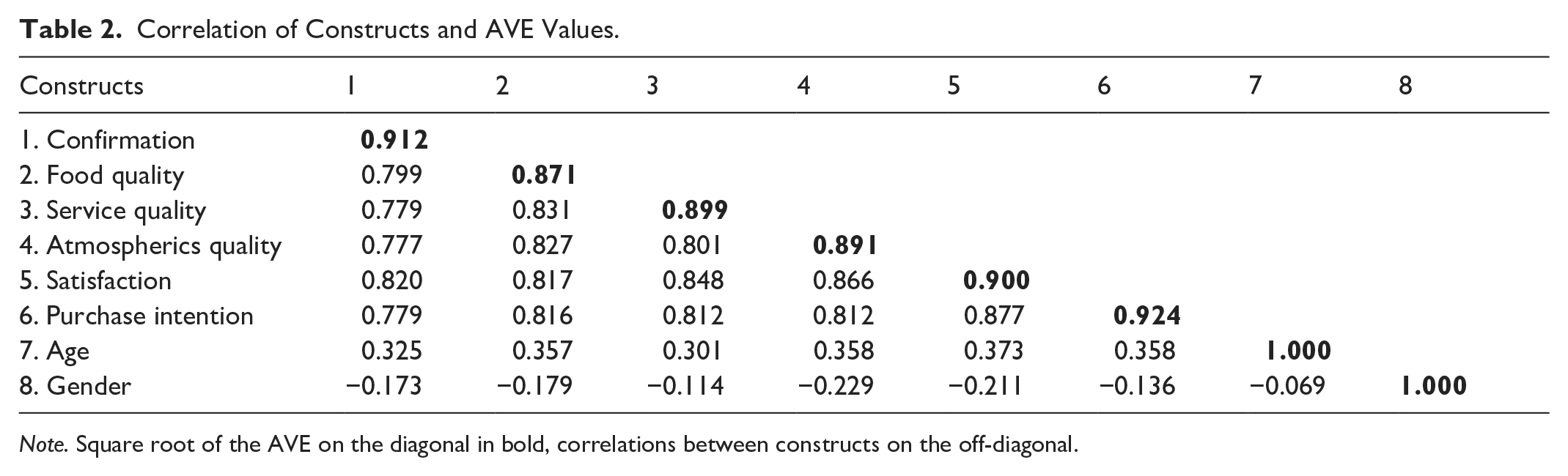
Note. Square root of the AVE on the diagonal in bold, correlations between constructs on the off-diagonal.
Structural Model
To investigate the hypotheses, a structural model was tested. The outcomes indicate that the standardization path coefficients associated with the hypotheses are statistically significant at p < .01. Furthermore, the R2 value for purchase intention stands at .805, highlighting a strong predictive power of the model.
Figure 3 shows that perceived quality (β = .409, p < .001) and satisfaction (β = .512, p < .001) are antecedents of purchase intention. As this study proposed that perceived quality and satisfaction would positively influence purchase intention, H4 and H5 are supported. Confirmation (β = .230, p < .01) and perceived quality (β = .704, p < .001) are antecedents of satisfaction. As this study proposed that confirmation and perceived quality would positively influence satisfaction, H2 and H3 are supported. Confirmation is an antecedent of perceived quality (β = .838, p < .001). As this study speculated that confirmation would positively influence perceived quality, H1 is supported.
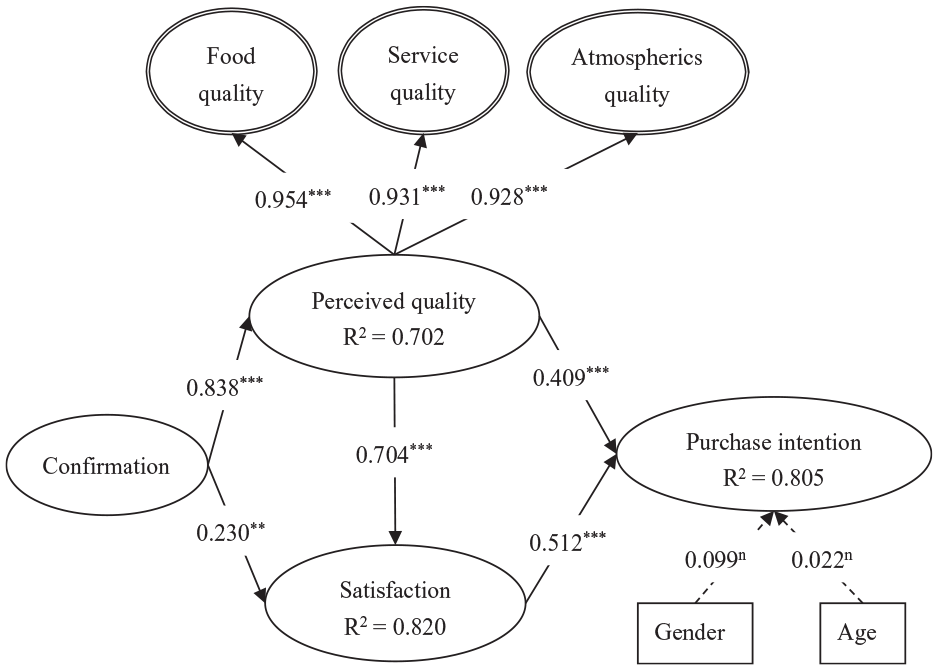
The structural model.
In terms of the impact of control variables, neither age nor gender exhibited significant effects on purchase intention.
Discussion
The results of Study 1 show that confirmation from product information sharing by other people on social media significantly affects the perceived quality and satisfaction of consumers toward an advertised product, and thus affects their purchase intention. The information from an attractive advertisement can arouse the expectations of consumers about the advertised product. The expectations play as initial reference points for consumers to evaluate the quality of the product and form their affective response. The findings demonstrate that the confirmation level of expectation from information sharing by other people on social media is an important antecedent which influences the decision of consumers who have been attracted by an advertisement. It suggests that the ECT can be extended to explain the effect of consumption experience sharing by other customers on the performance of product advertisement in the context of social media.
In addition, unlike Bhattacherjee (2001), which uses perceived usefulness as the cognitive belief in information system contexts, this study shows that perceived quality is a pivotal cognitive belief in the context of confirmation from information sharing by other people on social media.
Since expectations triggered by advertising can serve as an internal reference point to influence consumers’ purchase decisions, we will further examine the influence of commonly used advertising expressions on purchase decisions. Next, Study 2 will examine the impact of different advertising expressions (good vs. very good) on purchase decisions. The relationship of Study 1 and 2 is shown in Figure 4.

The relationship between Study 1 and Study 2.
Study 2: Good Versus Very Good: Does Advertising Expression Matter?
Study 1 confirms that merchant advertising influences consumers’ expectation confirmation of products when viewing information shared by others on social media. So, what kind of words should be used to describe the product? “Good” and “very good” are two common expression manners. Do these two different expression manners affect the performance of advertisements when consumers view information shared by others on social media? Study 2 will provide direct implications for the design of advertising content by comparing the effects of viewing advertisements with these two expression manners on purchase intention. Since “very good” statements may evoke higher levels of consumer expectations than “good” statements, we speculate that using “very good” statements compared to “good” statements will reduce participants’ expectation confirmation of products when viewing information shared by others on social media, and thus reduce purchase intentions.
Method
Participant and Design
A total of 120 undergraduate students from a large university in China (59% are female) were randomly invited to participate in the one-factor (advertising expression: very good vs. good vs. control condition) design with monetary incentives. Using G*Power to calculate the sample size, the effect size f = 0.4, α = .05, 1 – β = .8, the minimum required sample size was 66. Therefore, the sample size of the study meets the requirement. Participants were randomly allocated to one of the three groups.
Procedure
The cover story, writing task, process, and video employed in this study mirrored those utilized in study 1, except that the advertisement was different. Two mobile advertisements were designed to manipulate the “very good” and “good” expression manner. The two advertisements had the same content, except that one used the word “very” several times in its presentation and the other did not. Specifically, participants who were randomly assigned to the “very good” condition read “Dear customer, Food Bar officially opened along Optical Valley Walking Street. Our restaurant is very comfortable. You will taste very tender and delicious meals at very affordable prices. We will provide a very excellent service. It will be the best fast-food restaurant you have ever been to. We look forward to your visit!” Participants who were randomly assigned to the “good” condition read “Dear customer, Food Bar officially opened along Optical Valley Walking Street. Our restaurant is comfortable. You will taste delicious meals at affordable prices. We will provide high-quality service. We look forward to your visit!.” After reading the advertisement, participants who had interest in the restaurant and voluntarily opted to proceed with the second segment of the survey continued. All participants chose to continue learning more about the restaurant. To avoid being distracted by irrelevant information, those who were randomly assigned to the control group were not exposed to any mobile advertising. The feedback of the control group served as a baseline for comparison with the other two groups.
Then, the participants watched the video mentioned in Study 1. After watching the video, all participants were requested to complete evaluations pertaining to their perception of the food, service and atmospheric quality of the restaurant, satisfaction, purchase intention (1 = strongly disagree, 5 = strongly agree), and their age and gender. In addition, participants in the “very good” and “good” conditions were asked to fill out their extent of confirmation. Measures for the variables were the same as in study 1.
Result
Confirmation
The item scores on the confirmation level of expectation (α = .916) were averaged. As expected, participants in the “good” condition reported feeling higher expectation confirmation compared to those in the “very good” condition (Mvery good = 2.32, SD = 0.583; Mgood = 3.84, SD = 0.514; F(1, 79) = 152.675, p < .001).
Purchase Intention
The item scores on purchase intention were averaged (α = .909). ANOVA on purchase intention indicated a significant difference between the “very good,” “good” and control condition (F(2, 119) = 28.697, p < .001). Planned contrast showed that participants in the “good” condition reported higher purchase intention (Mgood = 3.65, SD = 0.740 vs. Mcontrol = 3.33, SD = 0.654, t = 2.029, p = .046) than participants in the control condition. The participants in the “very good” condition reported lower purchase intention (Mvery good = 2.51, SD = 0.692 vs. Mcontrol = 3.33, SD = 0.654, t = −5.482, p < .001) than those in the control condition.
Restaurant Evaluations
The item scores on food quality (α = .905), service quality (α = .917), and atmospheric quality (α = .888) were averaged. ANOVA on food quality (F(2, 119) = 39.229, p < .001), service quality (F(2, 119) = 19.995, p < .001), and atmospherics quality (F(2, 119) = 29.797, p < .001) revealed a notable disparity among the “good,” “very good,” and control condition. Planned contrast showed that participants in the “good” condition reported higher evaluations of food quality (Mgood = 3.73, SD = 0.527 vs. Mcontrol = 3.29, SD = 0.463, t = 3.886, p < .001), service quality (Mgood = 3.63, SD = 0.631 vs. Mcontrol = 3.18, SD = 0.766, t = 2.921, p = .005), and atmospheric quality (Mgood = 3.82, SD = 0.523 vs. Mcontrol = 3.43, SD = 0.650, t = 2.969, p = .004) than participants in the control condition. The participants in the “very good” condition reported lower evaluations of food quality (Mvery good = 2.71, SD = 0.554 vs. Mcontrol = 3.29, SD = 0.463, t = −5.144, p < .001), service quality (Mvery good = 2.68, SD = 0.609 vs. Mcontrol = 3.18, SD = 0.766, t = −3.179, p = .002), and atmospheric quality (Mvery good = 2.74, SD = 0.718 vs. Mcontrol = 3.43, SD = 0.650, t = −4.416, p < .001) than participants in the control condition (see Figure 5).
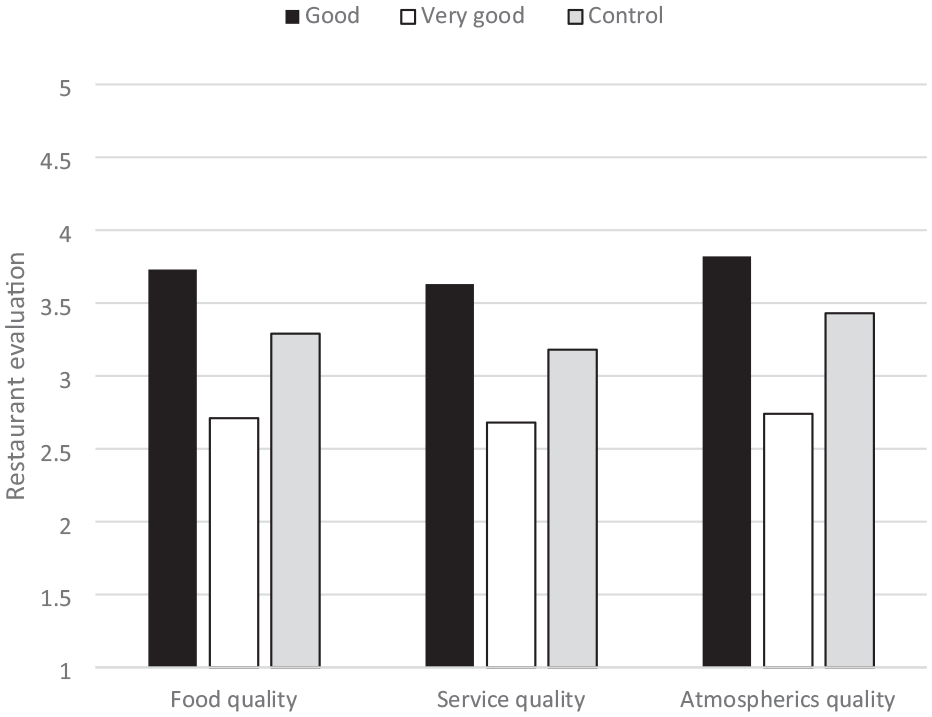
The difference in restaurant evaluations among “good,” “very good,” and “control” group of advertisement content.
Mediating Effect
By using advertising expression (1 = very good, 2 = good) as the independent variable, confirmation, perceived quality (the item scores on food quality, service quality, and atmospherics quality were averaged) and satisfaction as mediators, and purchase intention as dependent variable, the Hayes’s PROCESS Model 6 with 5,000 bootstrap samples was used to test the serial mediating effect (Hayes, 2018). The result shows that the 95% bias-corrected CI surrounding the indirect effect of advertising expression on purchase intention did not contain zero (indirect effect = 0.4259; 95% CI [0.1748, 0.7601]). The result indicated that confirmation, perceived quality and satisfaction play as serial mediators between the relationship between advertising expression and purchase intention.
Discussion
The results of this experiment once again demonstrate that information shared by other consumers on social media will affect advertising performance, because the expectation aroused by advertising information will affect consumers’ expectation confirmation after viewing social media information, and then affect their perceived quality and satisfaction, and finally affect their purchase intention.
In addition, the experimental results show that both the “good” and “very good” expression manner in advertising can attract consumers’ product interest. However, ads that use the “very good” statement can reduce consumers’ expectation confirmation after viewing information shared by other consumers on social media, thus reducing their purchase intention.
Conclusion, Implications, and Future Research
Conclusions
Advertising serves as a ubiquitous marketing tool embraced by merchants. Study 1 firstly examined the effect of information shared by other customers on social media on the performance of merchants’ advertising. The results of study 1 show that the confirmation of expectation aroused by merchants’ advertising from information shared by other customers on social media influences purchase intention through perceived quality and satisfaction. This study reveals why the information shared by other consumers on social media influences the performance of merchants’ advertising. Second, Study 2 tested the influence of different expression manner (very good vs. good) in advertisements on advertising performance. The results show that “very good” and “good” have the same effect in arousing customer interest, but “very good” (vs. “good”) expression decreases the confirmation extent of expectation when viewing information shared by other consumers, and finally decreases purchase intention. This study reveals that merchants use the expression of “good” in advertisements to describe a product is better than the expression of “very good.”
Theoretical Implications
Our findings are of great significance to academic research. Firstly, the goal of our study is to gain insights into why information shared by other consumers on social media influences the performance of merchants’ advertising and how to improve advertising performance. There is a distance between the conversion rate and the reach rate of advertisement. Although previous studies have widely pointed out that merchant advertising will affect customers’ initial expectations (Helson, 1959; Topaloglu & Fleming, 2017) and social media information affects consumer decisions (Ashley & Tuten, 2015; Chinelato et al., 2023; Lin et al., 2024), these studies overlooked how advertising performance is influenced by information shared by other consumers on social media. In the era of mobile Internet, it is common for merchants to advertise and consumers to share their personal consumption experiences on social media. This study is one of the first to combine the two and examine the consequences of social media messages on the performance of merchant advertising, which complements the research on advertising performance.
Secondly, the findings demonstrate that expectation confirmation by information shared by other consumers on social media is an important antecedent which influences the purchase decisions of customers who have been aroused product interest by merchant advertising. Though the ECT was developed to understand post-purchase evaluations (Bhattacherjee, 2001; Oliver, 1980) and has been widely used to explain continuance intention (Ayanso et al., 2015; Hu et al., 2016; D. Liu et al., 2016), the present study demonstrates that ECT can be used to explain the advertising performance of merchants in the context of social media. In addition, unlike Bhattacherjee (2001), which suggests that perceived usefulness represents a key cognitive belief in the intention to continue to use, this study finds that perceived quality is an important cognitive belief in the initial purchase intention context. The findings extend the ECT.
Thirdly, the present study demonstrates that the expression of “good” in advertisements to describe a product is better than the expression of “very good.” These two are the advertising description languages often used by merchants. This study found that both statements can arouse consumer interest in the product; However, it will lead to a difference in the final advertising performance. The conclusion is consistent with the theory of expectation thresholds (Topaloglu & Fleming, 2017). Compared with the expression of “good,” “very good” increases the expectation threshold of consumers, leading to differences in satisfaction after learning the actual situation of products through the social media information shared by others, thus reducing the advertising effect. This study contributes new knowledge to the research of advertising performance from the perspective of descriptive language.
Practice Implications
Our findings have implications for merchants. First, as expectation confirmation by social media information affects the purchase intention of consumers who have been aroused product interest by advertising from merchants, merchants should recognize that, besides designing attractive advertisements to increase interest, careful consideration of how the information sharing by other consumers on social media will influence the degree of expectation confirmation of consumers is also important. In practice, some merchants often only pay attention to the attraction of the content of advertisements to increase consumers’ product interest. They often make extravagant claims for their products and services to attract the attention of potential consumers. Though the reach rate of this kind of advertisement is good, the conversion rate is often unsatisfactory. Failure to consider the impact of information shared by other consumers on social media on consumer decisions is an important reason. Therefore, merchants should avoid using exaggerated words in advertising, and can present real products by displaying details. For example, restaurants can show details in advertisements such as the cleanliness of the kitchen, the cooking process of chefs, and the real scene of waiters receiving customers.
Second, given the pivotal role of perceived quality in the influence of information sharing by other consumers on social media on the merchant advertising performance, merchants should pay attention to improving the confidence of consumers in product quality after their interest having been aroused by advertisements. For example, merchants can advertise product quality by engaging opinion leaders in online and offline media that are often used by potential consumers. By studying other customers’ displays and reviews of their products and services on social media, merchants can dig out the key quality points of customers’ concerns and present the real situation of these points in advertisements.
Third, as the expression of “good” in merchant advertisements to describe a product is better than the expression of “very good” in influencing advertising performance, merchants should minimize the use of expressions such as “very good” in their advertisements, especially when the purpose of the advertisement is to arouse the interest of consumers. Merchants can use expressions similar to “good,” which can not only arouse consumers’ interest, but also avoid pushing consumers’ expectations to a high level to negatively affect their final purchase intention.
Limitation and Future Research
Although our findings are of great significance, there are still some limitations that need further investigation in future research. First of all, the data collected are entirely from students in China, so participants from different cultural backgrounds need to be included in future research. The Eastern culture of China advocates modesty, while the Western culture advocates self-expression. This may lead consumers in Western countries to narrow the difference between “very good” and “good.” Secondly, as the background material solely featured restaurants, it is recommended that future research endeavors encompass a wider array of store types for a more comprehensive analysis. For example, future research could further examine the stability of the results of online purchases of clothing. Thirdly, the moderating role of product type needs to be investigated in future research. For example, people tend to value brand reputation more when buying luxury products, which may lead to the purchase of luxury products being less affected by social media information than non-luxury products. Fourthly, the moderating role of other expression manners in advertisements needs to be investigated in future research.
Footnotes
Acknowledgements
The authors thank the editors and anonymous reviewers of this journal for their review.

Ethical Approval
This is a consumer behavior study, which was conducted ethically. Before taking the surveys, all participants read a consent form that informed them of their voluntary participation, and their ability to drop out at any time without penalty. That is, it belongs to “implied consent on completion of a questionnaire.” In addition, all participants were aware that the survey was anonymous. According to the Research Ethics of the authors’ university, this study is exempt from ethics review because the content of the study did not have a negative effect on the participants.
Author Contributions
Conceptualization, Lili Su and Dong Hong Zhu; methodology, Dong Hong Zhu; validation, Lili Su and Dong Hong Zhu; formal analysis, Lili Su; data curation, Lili Su; writing—original draft preparation, Lili Su; writing—review and editing, Dong Hong Zhu; visualization, Dong Hong Zhu.; supervision, Dong Hong Zhu. All authors have read and agreed to the published version of the manuscript.
Funding
The author(s) received no financial support for the research, authorship, and/or publication of this article.
Declaration of Conflicting Interests
The author(s) declared no potential conflicts of interest with respect to the research, authorship, and/or publication of this article.
Data Availability Statement
Data will be made available on request.