




Abstract
The paradigm of currency has shifted today in which the transformation from conventional currency to digitalization is getting higher lately. Cryptocurrency is one form of digital currency today. Cryptocurrencies is developed based on blockchain technology. The existence of cryptocurrency makes it a new and popular transaction model among its users, community, industry, and government. This is crucial study to measure the level of acceptability of cryptocurrency to understand the level of users’ sustainability in the future. Through the expectation confirmation model (ECM), this study develops the integration concept between ECM and technology readiness (TR). The method employed to measure the results of the hypothesis in this study was structural equation modeling. There are nine hypotheses proposed in the present study. Of the nine tested hypotheses, it was found that there are eight accepted hypotheses which are positive and have significance, while one hypothesis was rejected. The results of this study can be used as a guide and understanding of cryptocurrencies and the continued use of cryptocurrencies.
Introduction
Cryptocurrencies have become the interest of many people to be used as a transaction tool to replace conventional currencies. The popularity of cryptocurrencies as an innovative way of cashless financial transactions using blockchain technology resources is increasing (Bhattacherjee & Park, 2014). Cryptocurrency is a transformative platform that enables financial transactions to be cashless, peer-to-peer, or direct to the exclusion of the needs of third parties such as banking institutions. Cryptocurrency is a new currency that can be owned by anyone without any international boundaries with the same value and with minimal impact (Garg et al., 2013). Transactions can be made at any time without any transfer fees. Cryptocurrency is a Blockchain based technology. Blockchain is principally a digital implementation of a hypothesis, which enables the storage of identically copied data from the same transaction quickly and securely, using a series of computers on the same network (Hu et al., 2019). This ledger is ideally distributed to every computer in the network and is facilitated by its very strong security, compared to the centralized control commonly used today (Tsai et al., 2019). The significance and role of cryptocurrencies has grown substantially, from mere speculation to investment instruments; the cryptocurrency industry is growing rapidly. In addition, the use of cryptocurrencies is not limited to financial transactions. Several industries have now started using transaction mechanisms using digital money.
Many countries and individuals are still questioning about cryptocurrencies and their benefits, although cryptocurrencies have developed rapidly and have become an important trend today (Desjardins, 2016). In addition, researchers have analyzed and discussed various existing issues related to cryptocurrencies. However, limited studies have explored the use of cryptocurrencies in terms of priority order and the mechanisms of quality measurement or analyzed models of the individual behavior of cryptocurrency users’ (Garg et al., 2013). The extent to which users accept or adopt cryptocurrencies has always been a major research interest in the field of information systems (Venkatesh et al., 2012).
Expectation confirmation model (ECM) is a framework developed by Bhattacherjee (2001) which is used to measure and understand users’ ongoing intentions toward new technologies or new systems. Currently, many studies use ECM as an extension of the existing theory (Garg et al., 2013; Gholami et al., 2017). However, there is currently a lack of research combining personality-based and cognitive antecedents to gain a better understanding of the sustainable use of cryptocurrencies. Due to the widespread use of information technology in almost every sector of the economy and the rapid progress of information systems, a clear understanding of the readiness of users to use cryptocurrencies is very important. The impact of technology readiness (TR) must be clearly understood to determine user preferences and perceptions (Cheng et al., 2015; Davis et al., 1989; Tsai et al., 2019). Therefore, this study uses technology readiness as an antecedent from the psychological aspect of cryptocurrency users to explain the cognitive dimensions of ECM.
The application of cryptocurrency technology is influenced by complex and contextual factors. To distinguish this study from the existing ECM literature, this research has been extended from previous studies (Garg et al., 2013; Gholami et al., 2017; Hu et al., 2019; Reyes-Menendez et al., 2018; Venkatesh et al., 2012). This study investigates the effect of technology readiness, perceived usefulness, confirmation, satisfaction, and continuous intention. Based on the concept of technology readiness and the ECM framework, this study tries to develop an integrated model to explain and predict continuous intention to use cryptocurrency.
Many empirical researches regarding the expansion of ECM have been conducted (Kuo et al., 2013; Wu et al., 2011) and several studies have combined and filled the gaps in research on personality-based determinants and perceptive encountered. Furthermore, those studies contribute to the assessment of user continuous intention in cryptocurrency users. Therefore, the first point of the contribution of this research is to develop a conceptual model to predict and evaluate the continuous intention of cryptocurrency users and related problems. Another key point is to provide evidence whether the personal characteristics of users can also influence the perception of cryptocurrency users and further influence their willingness to use the technology product. Therefore, the technology readiness proposed by Parasuraman (2000) is used as an antecedent to assist researchers in understanding the relationship between cryptocurrency users and support for ECM. For cryptocurrency users, they believe that digital life is now increasingly closely related to their real world. Thus, every cryptocurrency activity must be integrated with various types of online devices such as mobile applications and can be widely applied and used comfortably in private areas (G.-J. Wang et al., 2019). This study develops an integrated model designed to predict and explain the sustainable use of cryptocurrencies based on the concepts of TR and ECM. The results obtained can be a useful reference for cryptocurrency providers or users in developing new markets and refining the model design. In addition, this study can also improve our understanding of the antecedents of continuous intention for cryptocurrency users. Thus, this study provides practical implications and academic references to gain further insight into the use of cryptocurrencies.
Literature Review
Definition of Cryptocurrency
Cryptocurrency is digital money, which is commonly used for online or virtual transactions. Highly reliable cryptocurrencies are equipped with complex encryption algorithms to protect the security of this digital money (G.-J. Wang et al., 2019). The term “crypto-monetary” comes from two words, namely cryptography and money. Digital currencies are decentralized, in contrast to conventional currencies which are centralized. There is no third-party acting as an intermediary in a transaction. Payments using digital currencies are made directly or peer to peer from sender to recipient.
All transactions made on cryptocurrency are recorded and monitored by the network infrastructure. These transactions are recorded by cryptocurrency miners and earn commissions which are collected as digital money. Cryptocurrencies have been produced since the 1990s and have only been recognized by the world community in the last 10 years (Narayanan et al., 2016). Several forms of cryptocurrency exist today and the most famous is Bitcoin, which is a pioneer of cryptocurrency. There are also other cryptocurrencies known such as Litecoin, Ethereum, Monero, Ripple, and others (Mayatopani, 2021; G.-J. Wang et al., 2019). Bitcoin remains among the top ranking of the most used digital currencies today (Adinolfi, 2016; Desjardins, 2016).
In addition, the existence of blockchain technology makes transactions in cryptocurrencies more secure. Blockchain is basically a distributed directory that records every transaction activity in a decentralized, valid, and error-free method. This method provides an evaluation of the facilities, security, and practicality of cryptocurrency transactions compared to conventional banking systems (Aggarwal et al., 2019; Luu et al., 2017). Cryptocurrencies have several advantages over conventional currencies that users can consider as follows:
Using blockchain technology. The payment procedure in cryptocurrency is fast, secure, and simple.
Can be controlled. Blockchain cannot perform two different transactions on the same cryptocurrency.
Have a high level of confidentiality for personal data. Can carry out financial transactions without revealing real identity.
Potential for high price increase in the future.
It is universal. Everyone can use cryptocurrency without binding rules and conditions.
Transparent, which allows each user to see the various transaction activities that have been carried out without knowing the identity of the other person who made the transaction.
Have complete control over the privacy of its users. Each user will be responsible for their own cryptocurrency.
Fast and accurate. Transactions using cryptocurrencies are faster when compared to transactions through banks (Blau, 2018).
Besides having advantages, cryptocurrencies also have several drawbacks that prospective new users must pay attention to or at least have to be careful in transacting, especially for users who have been using cryptocurrencies for a long time. That is:
Risks breaking laws in areas or countries that prohibit the existence and trading of cryptocurrencies.
Has high volatility. The value of cryptocurrencies can suddenly rise or fall drastically quickly.
The future value of a cryptocurrency is impossibly predicted. So it has a high potential for loss. Vice versa, cryptocurrency exchange rates are sometimes too high.
Since cryptocurrencies are complex by nature and have highly randomized encrypted codes that the average human cannot easily remember, investing in cryptocurrencies requires users to have digital wallets to provide them with highly secure and accessible storage space. Losing the encrypted code or failing to remember it means losing their cryptocurrency (Fauzi et al., 2020)
Three variations of cryptocurrencies that look like conventional currencies exists, namely Bitcoin, Ethereum, and Ripple. They can be used as a form of transaction and payment. What makes cryptocurrencies different from cash are the digital and virtual elements that underlie them. Blockchain technology allows cryptocurrencies to be decentralized so that no company or authority, such as a government or central bank, has full power or control to issue or change it (Li et al., 2019).
Anyone can trade cryptocurrencies in the market like buying conventional currencies. However, cryptocurrencies tend to be highly volatile. Trading with cryptocurrencies can be very risky. Cryptocurrencies have the potential to become one of the major mediums of exchange in the world although they have not yet gained sufficient attractiveness in most sectors of the global economy and market today.
Blockchain is almost identical to cryptocurrency (Glaser, 2017). Blockchain is basically a type of digital record-keeping system that is stored in a series or chain of virtual data blocks. The digital information stored in each block along the chain can contain details such as the date, time, amount, or the person who made the transaction. To distinguish existing blocks, each block in the chain is encrypted to produce a unique but immutable identifier or signature. This is known as a hash. Since each block can contain a large amount of information, multiple transactions can be accounted for in each block. Blockchain is the basic concept behind today’s cryptocurrencies.
Technology Readiness
The growth of technology and information technology systems is growing in many sectors, including the digital money sector. Information technology and information systems can be characterized as an integrated component, used as a medium for monitoring within the scope of an organization or institution in order to collect, process, store, and distribute data, processed into information so that it has value or as a source of knowledge, then they are used as a decision-making material (Parasuraman & Colby, 2001). In addition, information technology and information systems can also help managers to analyze problems and visualize complex challenges. The information provided by the information system can be analyzed and processed based on big data. Thus, they produce a data visualization of what has happened in the past, what is currently happening, and what might happen in the future (Chen & Chen, 2009). Information technology and information systems are a collection of computer hardware and software and humans who operate and process data using these hardware and software (Bhattacherjee & Barfar, 2011; Ali Qhal, 2020).
Parasuraman (2000) states that technology readiness refers to a person’s tendency to use and utilize new technology to achieve the desired goals both in everyday life and in the world of work.
Furthermore, there are four important components that can affect users’ readiness to use and utilize technology, namely:
Optimism. That is a positive view of new technology. It is the perceived belief in the technology. With the technology, it can increase productivity, good control, flexibility, and efficiency in daily activities and in the world of work.
Innovativeness. It is a tendency or nature and habit to become a trendsetter in the use of new technology, so that it is always up to date in the use of new technology.
Discomfort. It is part of a negative perspective or discomfort when using technology, which is felt during daily activities or in the world of work. The tendency is still to use traditional methods.
Insecurity. There is a sense of insecurity from users in using technology, one of which is for personal reasons or privacy.
These four mentioned components of technology readiness have previously been widely used in predicting and measuring the level of user readiness, but not many studies that measure the level of user readiness in cryptocurrencies have been found.
Expectation Confirmation Model (ECM)
The Expectation Confirmation Model (ECM) was created by Bhattacherjee (2001) as part of the concept of expectation confirmation theories (ECT; Oliver, 1980). ECM focuses on variables that affect information technology and IT user behavior and loyalty as a standard for long-term IT sustainability. That is, the success of information technology and information systems is highly dependent on the continuity of its users and not when it is first used or after adoption (Bhattacherjee, 2001). ECM theory has several main constructs, namely perceived usefulness, confirmation, and satisfaction. This can determine the continuation of an information technology or information system product. In this case, it is related to someone’s intention to use or make transactions using cryptocurrencies. The willingness to use or repurchase is highly dependent on the level of previous satisfaction. According to Oliver (1980), satisfaction is obtained by confirming expectations for a product or service.
Confirmation
Confirmation expectation is defined as a cognitive belief that represents one’s expectations in using a product or service. When faced with the existing reality, it is then used as an evaluation process (Bhattacherjee, 2001). Some consumers have certain expectations about an item or service at pre-purchase. This is generally based on experiences or other people’s information obtained from product reviews or word of mouth (D. J. Kim et al., 2009). The confirmation expectation paradigm assumes that a person’s satisfaction is part of the decision to make a purchase transaction. This decision is determined by the main construct, namely the initial (pre-adoption) expectation of the product or service.
There are three stages of confirmation expectations. First, buyers or users have expectations about a product or service before buying or using a product. Second, the experience of using it can build perceptions about results or performance. Third, by assessing perceived performance, they can provide a reference, whether they confirm (positive perception) or not (negative perception) the expectations they have before making a purchase (Hong et al., 2006). It is positive perception or confirmation if the experience in using and transacting with cryptocurrencies exceeds their expectations. Meanwhile, it is disconfirmed if the experience in using and transacting with cryptocurrencies does not exceed or fall short of meeting their expectations. In other words, confirmations and disconfirmations can be affected by the user’s experience of using and transacting with cryptocurrencies.
Continuance Intention
Intention serves as the best metric in linking the direct interaction between attitudes and behavior (Bhattacherjee, 2001). Intention to reuse means a situation where someone has a strong desire to reuse a product or service. In relation to this study, the intention to reuse is a situation in which a person has the drive and intention to reuse and re-transact with cryptocurrencies (Liao et al., 2007; Tran et al., 2021; Tseng et al., 2022). Transactions with cryptocurrencies can be considered as an activity or process of information seeking, mining, buying, and selling of cryptocurrencies (Albayati et al., 2020).
Cheng et al. (2015) concluded, that the intention to repurchase is a manifestation of the results of a person’s evaluation of something that has been used or consumed before. Cheng et al. (2015) stated that the repurchase intention indicator provides a strong possibility to buy more cryptocurrencies in the future. In general, a person’s tendency to make consecutive purchases is always due to the level of satisfaction with their previous purchases. Repeated purchases are critical to the survival and success of the cryptocurrency business (Bhattacherjee, 2001). Customer repurchases are critical to the success and profitability of the cryptocurrency business. This will provide higher cryptocurrency turnover. Albayati et al. (2020) suggested several factors that could affect repurchase intention.
Psychological factors. This includes consumers’ experiences of past events. This affects consumer attitudes and beliefs on a product. Consumer experience in previous purchases is very influential in determining attitudes and next purchasing decisions.
Personal Factors. The personality of a consumer will affect the perception and purchase decision making. Manufacturers need to create a situation that consumers expect to generate repurchase interest.
Social factors. These include the group factors in which a person appears frequently that influence attitudes, opinions, and buying behavior.
Research Model and Hypotheses Development
The concept of technology readiness consists of two positive perspective variables and two negative variables. Positive variables, namely optimism and innovation, become a reference for users to adopt new technology and services products. However, two obstacles with a negative perspective, namely discomfort and insecurity, pose a challenge for users to adopt this new technology or service. The role of information distribution in new technologies is important as a means to measure users’ readiness to adopt a product or service (Burke, 2002; Massey et al., 2006). Previous research has developed and experimentally measured the results of the integration of technology readiness with the technology acceptance model (TRAM). TRAM offers an effective measurement with respect to electronic services to demonstrate that technology readiness is closely related to perceived utility and user intention. Other studies have also shown that the relationship between technology readiness and satisfaction has substantial and beneficial value (J. C. Lin & Hsieh, 2007; Yen, 2005). An empirical study revealed that, there is a substantial relationship in studies related to the implementation of new technologies, where a sense of anxiety and satisfaction is always felt by users when implementing the technology (Meuter et al., 2003). Furthermore, Oliver (1980) suggested that psychological features and expectation confirmation theory be adopted from a theoretical perspective as the basis of this research. This study suggests four hypotheses based on the above literatures:
H1: Technology Readiness positively and significantly affects the perceived usefulness of using cryptocurrency.
H2: Technology Readiness has a positive and significant effect on the satisfaction of using cryptocurrency.
H3: Technology Readiness positively and significantly affects expectation confirmation on the use of cryptocurrency.
H4: Technology Readiness has a positive and significant effect on continuance intention to use cryptocurrency.
In this study, satisfaction is defined as a psychological state in the context of cryptocurrency services and transactions that arises from the comparison between expectations and performance outcomes of cryptocurrencies. Empirically, this study confirms that satisfaction depends on user confirmation. Similar to the research of Thong et al. (2006) and Recker (2010), it consistently shows a beneficial effect on satisfaction. Many relevant ECM investigations have shown a favorable correlation between usefulness and confirmation (D. J. Kim et al., 2009; Limayem & Cheung, 2008; Lee, 2010). Satisfaction is positively influenced by confirmation in another study conducted (Lin & Chen, 2012) in terms of cellular business. Therefore, the next hypothesis is presented.
H5: Confirmation of expectations positively and significantly affects the perceived value of using cryptocurrency.
H6: Confirmation of expectations positively and significantly affects the satisfaction of using cryptocurrency.
Important determinants of sustainable system use are identified based on perceived usefulness. In empirical research on online learning systems, satisfaction, and sustainability are influenced by perceived usefulness (Liao et al., 2007). Another study confirmed that there is a strong relationship between perceived usefulness and satisfaction and continues intention (S. C. Chen et al., 2009). Other studies also regularly show that perceived usefulness is a driver of satisfaction and continuous intention (B. Kim, 2011; Lee, 2010; Limayem et al., 2007; Premkumar & Bhattacherjee, 2008). Therefore, the next hypotheses are proposed.
H7: Perceived usefulness has a positive and significant effect on user satisfaction for cryptocurrency users
H8: Perceived usefulness has a positive and significant effect on user continues intention of cryptocurrency users.
User satisfaction is the key factor in adopting a new technology (Au et al., 2008). In the ECM model, satisfaction can affect the user’s continuous intention. In addition, continuous intention is assessed based on positive experiences in the past (Bhattacherjee et al., 2008; S. C. Chen et al., 2012; Hong et al., 2006). Therefore, the next hypothesis is proposed.
H9: User continues intention is positively and significantly influenced by user satisfaction from.
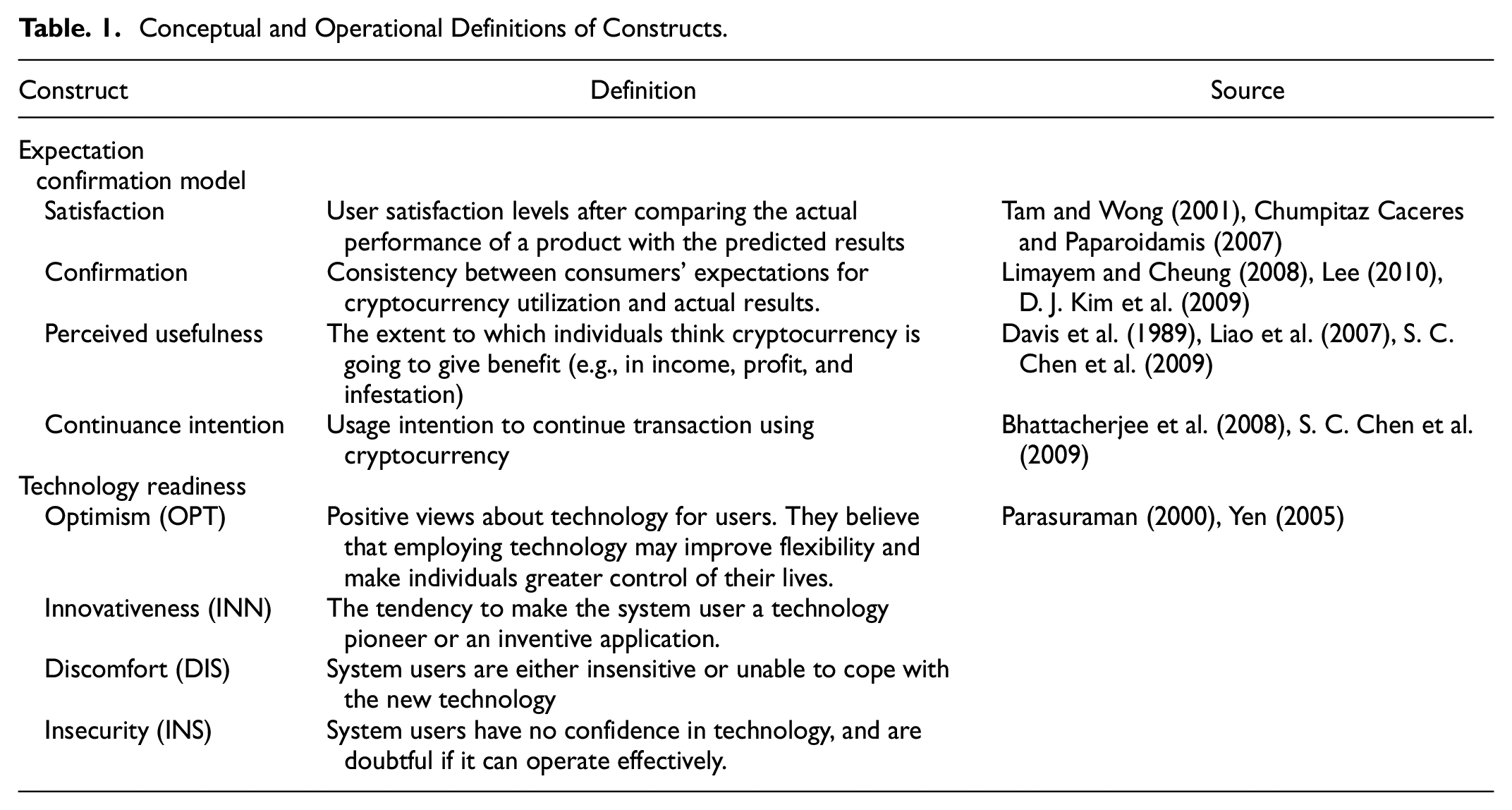
Furthermore, in this study the technology readiness and perceptions of cryptocurrency use and continuous intention are linked. Indirect assessment was conducted on the involved variables that explain the impact. The mediator variable consists of expectation confirmation, perceived usefulness, and satisfaction. This shows that there is a relationship between the main predictors of technology readiness and other variables, namely satisfaction and user continuous intention of using cryptocurrency. In this study, the following hypotheses were built based on the theoretical model above (Figure 1; Tables 1 and 2).
H10a: The relationship between technology readiness and continuous intention to adopt cryptocurrency is mediated by perceived usefulness (TR-PU-CI).
H10b: The relationship between technology readiness and satisfaction with the use of cryptocurrency is mediated by perceived usefulness (TR-PU-SAT).
H10c: Expectation confirmation is a mediator between technology readiness and perceived usefulness (TR-CON-PU).
H10d: Expectation confirmation becomes a mediator between technology readiness and user satisfaction for cryptocurrency users (TR-CON-SAT).
H10e: The relationship between technology readiness and user continuous intention is mediated by user satisfaction (TR-SAT-CI).

Framework integration of TR, ECM, and hypothesis.
Conceptual and Operational Definitions of Constructs.
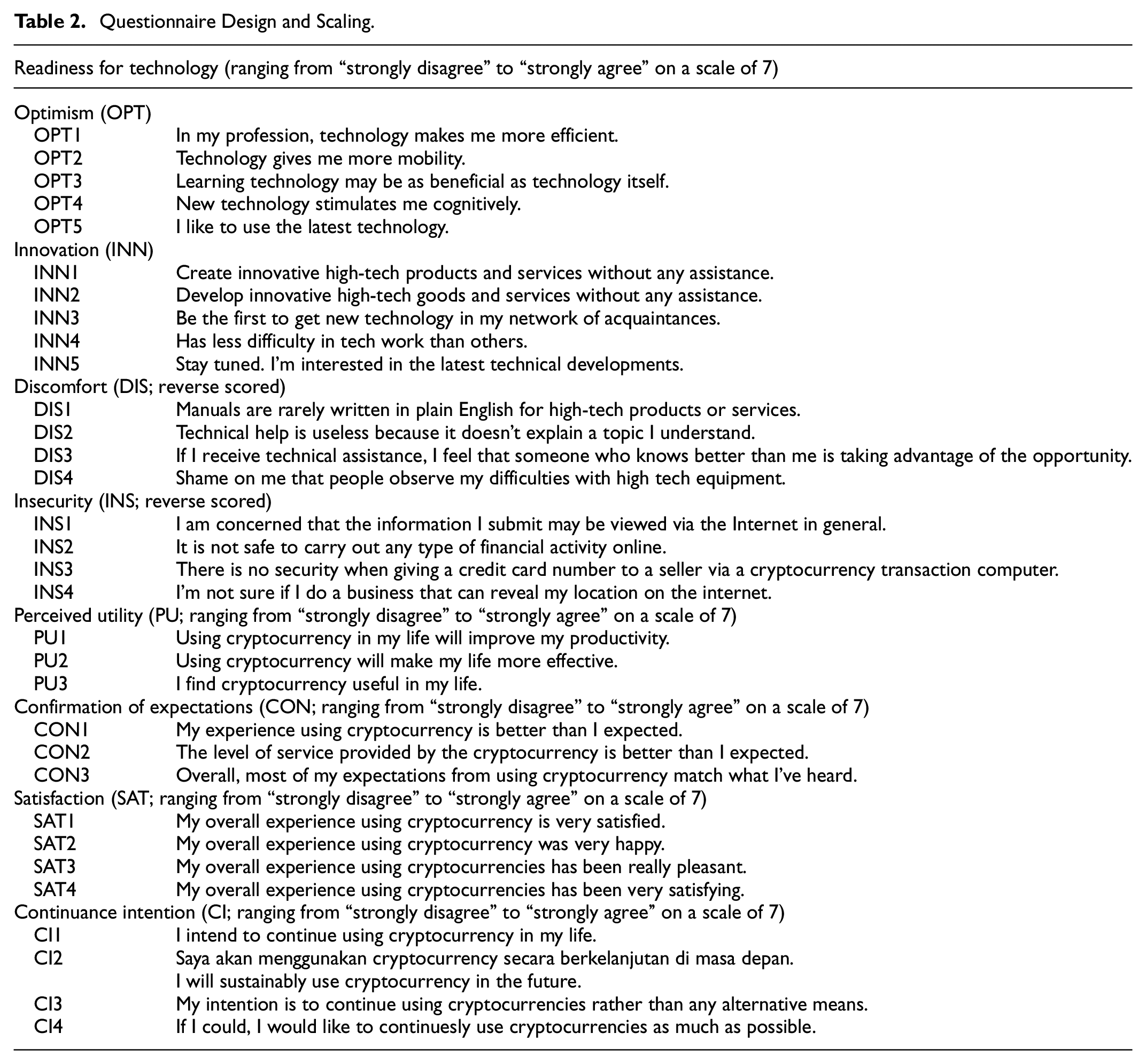
Questionnaire Design and Scaling.
Research Methodology
The two theoretical concepts, namely TR and ECM were integrated in this study, which was then followed by the measurement process for each variable and variable item. In the beginning, the benchmarks used were reliability and validity, using references of Yen (2005), Limayem et al. (2007), Venkatesh et al. (2003), and Y. S. Wang and Shih (2009).
Four experts, on the other hand, were invited to review the questions content in a focus group discussion, consisting of two professors and two practitioners in the cryptocurrency field, to ensure that each question used is factual. In data collection, the methods used are distributed online. The advantages of this online distribution are flexible, low cost, fast response, and wider distribution scalability (Tan & Teo, 2000). In order to obtain high-value external validity, the data collected come from users who have experience with cryptocurrency transactions.
Three hundred and twenty-two (322) samples that are valid and meet the requirements in general were obtained in this study. The respondents consisted of 182 men (56.52%) and 140 women (43.48%). According to their age, the respondents consisted of 82 people under 25 years old (25.47%), 150 people between 26 and 39 years old (46.58%), and 90 people over 40 (27.95).
If the respondents were categorized based on their experience in using cryptocurrencies, there are 71 people who have less than 1 year of experience (22.05%), 160 people who have 2 to 4 years of experience (49.69%), and 91 people who have more than 4 years of experience using cryptocurrency (28.26%). The cryptocurrencies used by respondents were varied, including Bitcoin, Ethereum, Tether, Xrp/ripple, Bitcoin cash, Binance coin, Polkadot, Chainlink, and others.
Data Analysis and Results
SmartPLS Version 2.0 with the concept of partial least square-structural equation modeling (PLS-SEM) was used in this study to assess the validity and results of our hypothesis (Ringle et al., 2005). Several reasons why PLS-SEM is used, because it is part of multiple regression analysis and it can handle non-normal data, small amounts of data. In addition, PLS-SEM can also handle data simultaneously for both formative and reflective models (Anderson & Gerbing, 1988; Fornell & Larcker, 1981; Hair et al., 2014).
The Cronbach alpha value, the composite reliability (CR) value and the average variance extract (AVE) value were used as indicators of the assessment of convergent validity. Each variable or construct must have a Cronbach alpha value and a value (CR) greater than .7, while the AVE value must be greater than .5 as suggested by Hair et al. (2014). As shown on Table 3, it is found that each value of the variable or construct has met the standard value of convergent validity.
Validity Analysis and Convergent reliability.

In addition, discriminant validity is determined based on the value of the items construct that is in the cross-loading value. If the value of each latent element is smaller than the value of the loading factor, then it can be stated that it has fulfilled the validity of each variable and it passes the benchmark of discriminant validity (Hair et al., 2016). Table 4 demonstrates that this research has fulfilled the discriminant validity element.
Factor Loadings and Cross-Loadings.

The next step was to determine the path coefficient used to assess the correlation among latent variables. The bottom line used was R 2. In general, the greater the value of R 2, the better the value of the existing framework capability and the influence of exogenous factors on endogenous variables is stated to be stronger. Path and R 2 values are measures for the level of suitability for research that applies empirical data. The findings for each path coefficient, t-value, and hypothesis results are shown in Table 5 and Figure 2.
Summary of Inner Model Results.

Note. **p <.01; ***p <.001.

Framework of integration TR and ECM result.
A bootstrap algorithm was used to obtain the value of the t-value and the level of significance in order to test the hypothesis in this study (Chin, 1998). Bootstrapping is a non-parametric technique to predict the precision of PLS-SEM, and bootstrapping was used to measure the significance value of the path coefficient based on the empirical data obtained.
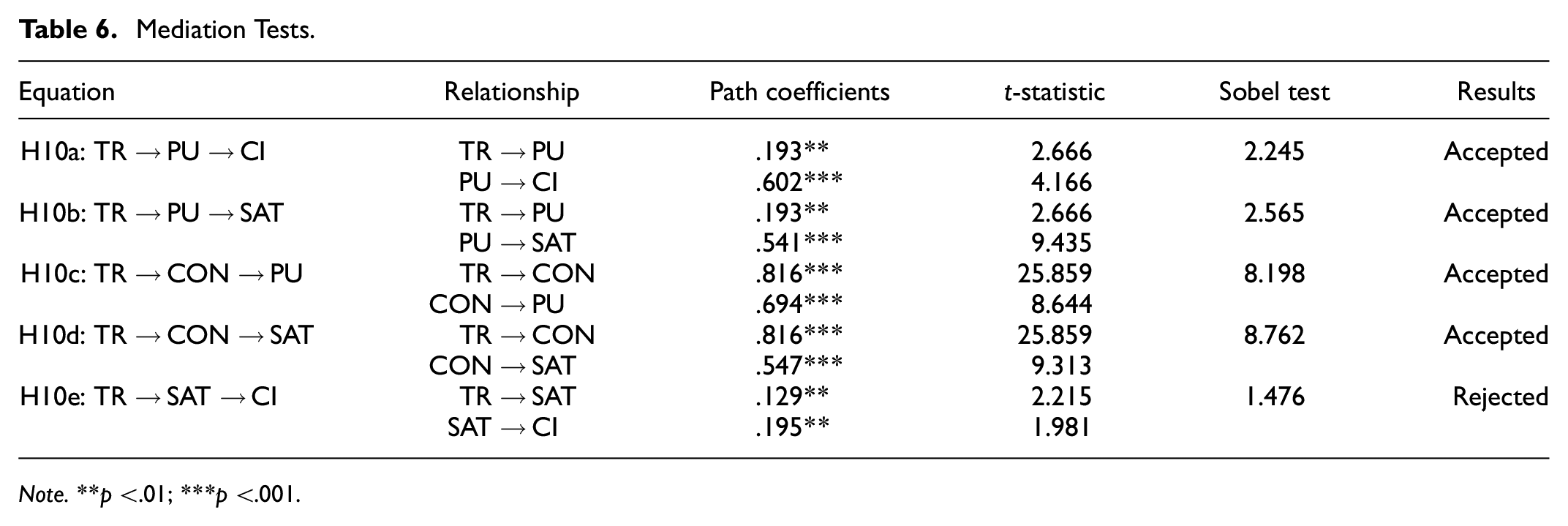
To produce a significant value so that the hypothesis can be accepted, the t-value must be greater than 1.95 (Hair et al., 2011). Table 6 shows that there is one hypothesis which is rejected, namely H4 (TR CI: β = .043, t-value = 0.494). Meanwhile, H1 to H3 was significant and accepted (TR PU: β = .129, t-value = 2.666; TR SAT: β = .129, t-value = 2.215; TR CON: β = .816, t-value = 25,859). Furthermore, H5 to H9 was also significant and accepted (CON PU: β = .694, t-value = 8.644; CON SAT: β = .547, t-value = 9.133; PU SAT: β = .541, t-value = 9.435; PU CI: β = .602, t-value = 4.166; SAT CI: β = .195, t-value = 1.985).
Mediation Tests.
Note. **p <.01; ***p <.001.
Furthermore, the analysis result for the R 2 value on the confirmation variable is .666, which means that the 66% confirmation variable is influenced by the technology readiness variable. Next, the value of R 2 on the perceived usefulness variable is .738, meaning that 73% of the perceived usefulness variable is influenced by the confirmation variable and the technology readiness variable. The R 2 value of the satisfaction variable is .89, which means that 89% of the satisfaction variable is influenced by the perceived usefulness variable, confirmation variable, and technology readiness variable. While the R 2 value of the continuous intention variable is .66, which means that 66% of the continuous intention variable is influenced by the perceived usefulness variable, confirmation variable, technology readiness variable, and satisfaction variable.
Test of Mediating Effects
To measure the effect of TR and ECM moderators on the continuation of cryptocurrency use, this study then uses the Sobel Test to determine the value and significance of the mediating effect (Tan & Teo, 2000). The mediating effect was assessed using five equations (Table 6). For example, the TR-PU-SAT is set to predict the technology readiness mediation pathway to satisfaction through perceived usefulness. From the results of the analysis used with the Sobel test in Table 6, it shows that, there are four significant mediating effects. However, the TR-SAT-CI which was used to measure the mediation pathway from technology readiness to continue intention through satisfaction, was found to be not significant.
Research Analyzes and Discussion
The analyses result and discussion of each variable consisting of TR, PU, CON, and SAT on CI and the results of the nine existing hypotheses are presented in the following.
The value of TR path coefficient on PU for hypothesis 1 is .198. This means that the TR variable in PU in this study is positive and shows significant correlation so that the hypothesis is accepted. Cryptocurrency is a new technology for most people. The level of usability in transacting using cryptocurrencies is one of the main focuses for new users as well as existing users. TR as an antecedent variable has an important role in PU. The ease of transacting using cryptocurrencies can be felt without being burdened with complicated features. In addition, users believe that transacting using cryptocurrencies can benefit them in the long run.
For hypothesis 2, TR is considered to have a substantial relationship with SAT with a path coefficient value of .129. To achieve the level of satisfaction for cryptocurrency users, TR has a big role. The level of satisfaction is felt when the TR value is positive and is more dominant than the negative perceived value. The level of satisfaction felt by each individual is not the same. Each user has their own perception of the level of satisfaction, but the level of satisfaction in the present study is measured by the feelings of cryptocurrency users in terms of convenience, security, improving the quality of technological innovation and the perception that cryptocurrency has value for individuals.
For hypothesis 3, it is in line with the SAT. TR is correlated with CON with a path coefficient value of .816. TR has a significant impact on CON. This study proves that the user’s perception before using cryptocurrency and after getting experience using cryptocurrency are positive. In hypothesis 4, the opposite occurs for TR to CI in which the impact is indirectly significant being the value of the path coefficient of .043.
For hypothesis 5, the result is in line with the idea verified by Recker (2010). The concept of ECM is the level of user expectations. Our empirical data show the positive value and significant impact of CON on PU with a path coefficient value of .694. Then it is validated as a cognitive belief to convince people in the cryptocurrency context to be able to apply information technology and systems in a sustainable manner. Later, this idea was used by many researchers in other fields. Previous literature has shown that PU is affected by CON. This shows that user expectations and real experience in transacting using cryptocurrencies will affect their perception of using cryptocurrencies. That is, the functions and services of cryptocurrency providers must meet user expectations in order to experience the value or benefits of cryptocurrencies. This can increase the perceived benefits of cryptocurrency users.
For hypothesis 6, our empirical findings show that there is a positive relationship between CON and SAT with a path coefficient of .547. This is in line with studies conducted by many previous researchers such as C. S. Lin et al. (2005), Roca et al. (2006), and Thong et al. (2006). It is confirmed that the user happiness affects his views and it is factually confirmed. This will affect customer satisfaction, user expectations, and experience in cryptocurrency transactions. The level of confirmation generated by technology readiness and perceived benefits affect user satisfaction. If the two variables meet user expectations, then their satisfaction can increase.
For hypothesis 7, our empirical findings show that PU and SAT have a positive path coefficient with a value of .541. This means that cryptocurrency consumers will feel happy when they think they can benefit from cryptocurrencies in the short or long term. As a result, the quality of service and understanding of services tailored to the needs of the industry and market must be right on target. This is very important for service providers so that it increase the happiness of cryptocurrency users.
For hypothesis 8, our empirical data show a good influence of PU on CI and it can be concluded with a path coefficient with a value of .602. This means that cryptocurrency providers must offer their targeted market based on services that customers need. This encourages consumers to experience and continue to take advantage of the results of the service. Thus, encouraging the community or large companies to get involved in cryptocurrency investments. Therefore, it is important to understand user demand and enrich the features functionality of cryptocurrency providers to improve usability for the cryptocurrency user community.
The consistency of the ECM concept was shown on hypothesis 9 testing. Our empirical findings show that SAT has a positive relationship to CI with a path coefficient value of .195. Research using ECM has shown in the past that satisfaction has a major influence on the drive to continue using a product or service. Excited users intend to use technology and information systems more closely. The higher the level of customer satisfaction in utilizing cryptocurrency technology, the greater the tendency for loyalty to using cryptocurrency technology in the future. In addition, individuals who trust cryptocurrencies can provide encouragement to their community to participate in cryptocurrency transactions.
Conclusions and Future Work
Many managerial implications can be deducted of this study. First, technical readiness is directly related to the perceived usefulness of continuing to use cryptocurrencies. This study differs from previous research and revises the existing ECM theory of Recker (2010). In this study, technology readiness is a special psychological structure for certain people in determining the psychological perception of users who adopt cryptocurrency. This research also presents and confirms through mediation tests, as well as an integrated model used to measure and handle cryptocurrency end users. The results of this study indicate that the integration of technology readiness and ECM has been shown to increase the accuracy of the proposed model in modeling, in addition to measuring constructs directly or by using a mediator construct.
Perceived usefulness and satisfaction felt by cryptocurrency users are both the highest among the construct variables in the post-adoption ECM concept. Based on post-adoption experience, user perception about cryptocurrency is very important. This perception in turn has an influence on satisfaction and sustainability in using cryptocurrencies. Furthermore, impression is a big influence in determining the next step before using cryptocurrency. Positive results after using cryptocurrency will result in positive decisions as well. These insights can be used to increase the competitive advantage of service providers and to help people understand the value of cryptocurrencies.
This study aims to develop a model that integrates the substance of the technology readiness variable with ECM to explain user continuous intention of cryptocurrency. Based on the results of the theoretical framework that has been studied, this study proves that by integrating technology readiness into the ECM, it provides a holistic and comprehensive description of the user’s perception of cryptocurrencies. Furthermore, we argue that the variables of technology readiness, perceived usefulness, confirmation expectation and user satisfaction have an impact on user continues intention of cryptocurrency. In addition, we have succeeded in collecting data empirically, validating, and strengthening the function of the variables used to determine the main indicators of user continuous intention cryptocurrencies.
Some of the limitations in this study can be used as a reference for future research. First, the extensions we adopted from ECM are generic. Second, the data in this study is still limited to certain countries. Third, the empirical validation of this study does not consider other factors that must be considered, such as regulations from one country, especially regarding the legality of cryptocurrencies. So that it is possible to have an impact on differences of opinion among subsequent researchers regarding the perception of cryptocurrency users. Therefore, it is necessary to further develop and prove the extended ECM concept with other different variables.
Footnotes
Declaration of Conflicting Interests
The author(s) declared no potential conflicts of interest with respect to the research, authorship, and/or publication of this article.
Funding
The author(s) received no financial support for the research, authorship, and/or publication of this article.
