




Abstract
With the implementation of low-carbon policies and the rapid growth of e-commerce, an increasing number of manufacturers are adopting dual-channel sales. However, many face financial constraints and difficulties in securing loans from financial institutions due to their creditworthiness. The emergence of e-commerce platform (ECP) and third-party logistics (3PL) financing services offers a viable solution to these financial challenges. Despite their benefits, differences exist in the operational decisions of dual-channel supply chains under a manufacturer-driven power structure. Additionally, both channel differential pricing and uniform pricing strategies significantly impact supply chain operations. This study explores financing strategies for financially constrained manufacturers within an eco-friendly dual-channel supply chain involving a manufacturer, 3PL, and ECP. Optimization models are developed to determine the optimal carbon emission reduction levels and pricing strategies for both approaches. The analysis identifies conditions under which ECPs are incentivized to provide financing and the factors influencing manufacturers’ preference for ECP financing over 3PL financing. The results indicate that manufacturers’ financing decisions are influenced by channel price differentials, transportation fee discounts, unit production costs, and financing expenses. Notably, the ECP financing strategy is independent of channel price differences. Furthermore, findings demonstrate that channel price differences, financing expenses, transportation costs, and discount rates negatively impact carbon emission reduction levels.
Keywords
Introduction
In recent years, environmental pollution, the greenhouse effect, and other climate-related issues have become increasingly severe (W. Chen et al., 2024; R. Tang et al., 2023). In response, many countries and regions have introduced laws, regulations, and policies to encourage enterprises to reduce carbon emissions, such as low-carbon subsidies and carbon allowance trading policies (Mandal et al., 2024; T. Zhang et al., 2025). According to data, 73.7% of the Chinese public is willing to pay more for environmentally friendly products, and 27.5% are even willing to cover the full cost of their carbon emissions (Lu et al., 2024; Pei et al., 2022). Against this backdrop, an increasing number of manufacturers are adopting low-carbon production strategies (Phan et al., 2023; X. Xu et al., 2024).
However, many manufacturers face financial constraints due to the high investment costs associated with carbon reduction technologies and production equipment (Siqin et al., 2022; N. Yan et al., 2020). Additionally, with the rapid advancement of information technology and logistics, consumer purchasing patterns are shifting from offline to online. To capture a larger market share, more manufacturers are partnering with e-commerce platforms and adopting dual-channel strategies. While this approach expands market reach, it also requires significant capital investment, further exacerbating financial pressures on enterprises (Chang et al., 2023; P. Ma & Li, 2023).
A survey conducted by World Business indicates that approximately 43% of small and medium-sized enterprises (SMEs) in developing countries experience financial gaps (Huang et al., 2020; Rath et al., 2024; Xia et al., 2024).
However, in practice, capital-constrained manufacturers struggle to secure loans from banks or other financial institutions due to a lack of collateral, small business size, and other factors (T. Tang et al., 2024; R. Tang & Yang, 2020). To alleviate financial pressure on their partners, e-commerce platforms and third-party logistics companies have introduced supply chain financial services (Xie et al., 2025).
Supply chain financing (SCF) is a financing model that considers supply chain enterprises as an integrated system and develops financial solutions based on cargo rights and cash flow control, leveraging trading relationships and industry characteristics (Jena et al., 2023; Sun et al., 2023). With the rapid expansion of e-commerce platform (ECP) and third-party logistics (3PL) financing, these financing modes have become essential components of SCF (C. Ma et al., 2022; C. Wang et al., 2019).
ECP financing is a supply chain financing model in which the e-commerce platform, as the dominant player, provides financial services to capital-constrained partners (X. He et al., 2024). In contrast, 3PL financing involves third-party logistics enterprises offering financial assistance to their financially constrained partners (Baruník & Ellington, 2024).
For example, the U.S. e-commerce giant Amazon launched its SME loan service in 2011. Between June 1, 2019 and May 31, 2020, Amazon provided over $1 billion in loans to suppliers in the United States, China, and other countries to support their growth (Hua et al., 2021; F. Wang et al., 2019). Similarly, JD, one of China’s largest e-commerce platforms, began offering financing services to suppliers in 2013. By October 2017, JD had provided loans totaling approximately RMB 500 billion to 200,000 small and medium-sized enterprises. Additionally, several 3PL companies, such as DHL, Schenker, Panalpina, and TNT, also offer financial services to their partners (J. Li et al., 2020).
Currently, most literature on supply chain financing focuses on single-channel supply chains or traditional dual-channel supply chains, with limited research on financing decision-making in low-carbon dual-channel supply chains (Cao & Yu, 2018; J. Y. Chen et al., 2019; Heydari et al., 2020; Widrick et al., 2018). Even fewer studies examine the impact of 3PL and ECP financing models on financing decisions. Therefore, investigating financing strategy choices for low-carbon dual-channel supply chains under different pricing strategies is of significant importance. This study explores the effects of pricing strategies on carbon emission reduction, pricing, and financing decisions within supply chains.
This article considers an eco-friendly dual-channel supply chain system comprising a capital-constrained manufacturer, an e-commerce platform, and a third-party logistics provider. Using game theory, it systematically analyzes the pricing strategies of the eco-friendly dual-channel supply chain under 3PL and ECP financing. The study also compares the optimal decision-making of the manufacturer and the e-commerce platform in both financing scenarios and validates the findings through numerical simulations. These simulations further confirm the robustness of the conclusions.
To contribute to the field of supply chain finance and offer practical decision-making guidance for eco-friendly dual-channel supply chain financing, the study focuses on a financially constrained manufacturer selling eco-friendly products through both direct retail and ECP distribution channels. In this system, the 3PL provides logistics services, while the ECP manages product delivery to consumers via its logistics network. This study aims to answer the following key questions: (1) How do members of the eco-friendly supply chain establish pricing and carbon emission strategies under 3PL and ECP financing scenarios? (2) What effects do channel price differences, financing expenses, and transportation fee discounts have on equilibrium strategies? (3) How can the manufacturer identify the optimal financing scenario, and under what conditions should the ECP provide funding?
The structure of this paper is as follows. Section 2 reviews the relevant literature. Section 3 presents the model formulation. Section 4 analyzes the equilibrium strategies under 3PL and ECP financing modes. Section 5 provides numerical analysis, and Section 6 discusses the findings. Finally, Section 7 presents the conclusions.
Literature Review
Supply Chain Financing
In supply chain management, previous studies have primarily focused on the operational decisions of enterprises without capital constraints under stochastic market demand (Y. Li et al., 2016). However, with rapid economic development and intensifying market competition, an increasing number of enterprises face capital constraints, significantly affecting their growth and sustainability (Chang et al., 2022; Gong et al., 2020). As a result, the intersection of operations and financing within eco-friendly supply chains has attracted considerable academic interest (Liu & Zheng, 2024).
Various perspectives on supply chain financing have been explored, including the advantages of trade credit over bank credit, irrespective of a producer’s investment in carbon emission reduction (J. Wang et al., 2022). For example, Cao et al. (2019) examined a low-carbon supply chain comprising suppliers and manufacturers and found that trade credit outperforms bank credit, regardless of whether the manufacturer invests in carbon emission reduction. Similarly, Hua et al. (2019) found that retailers prefer suppliers’ deferred payment services when interest rates are low. Yang et al. (2021) investigated how enterprise risk aversion influences financing strategy selection, demonstrating that trade credit creates a mutually beneficial scenario when supplier risk aversion is at a moderate level.
Supply chain finance sits at the intersection of supply chain management and financial management. Initially, scholars approached supply chain finance from two perspectives: finance-oriented and supply chain-oriented (Avinadav & Levy, 2024; Shao, 2021). The finance-oriented perspective views supply chain finance as a set of financial solutions in which financial institutions play a crucial role, primarily providing financing services such as factoring and reverse factoring based on accounts receivable and accounts payable (Qin et al., 2020).
In contrast, the supply chain-oriented perspective adopts a broader view, expanding financing targets beyond accounts receivable and accounts payable to include inventory financing and fixed asset financing (X. Chen et al., 2020). In this context, the role of financial institutions diminishes, as core supply chain enterprises, distribution firms, or e-commerce platforms can also act as supply chain financial service providers (Qi et al., 2023).
For example, Lam et al. (2019) empirically analyzed the impact of buyer intermediaries on supplier financing and found that buyer intermediaries’ financing services significantly enhance channel performance. X. Chen et al. (2019) examined supply chain optimization strategies in the context of third-party logistics (3PL) companies acting as supply chain coordinators, providing both purchasing and financial services. Their findings highlighted the critical role of 3PLs as intermediaries. Similarly, Huang et al. (2019) investigated the impact of 3PL financing services on supply chain operations and found that such services can achieve a Pareto improvement in supply chain profitability.
Sun et al. (2023) constructed a dual-channel supply chain system consisting of a capital-constrained manufacturer, an e-commerce platform, and a 3PL provider, analyzing the manufacturer’s financing strategy choices. Tao et al. (2023) developed a game theory model of the ORP financing mode, revealing that online retailers prefer ORP financing over bank credit.
From the perspective of current supply chain finance research, most studies have examined the impact of trade credit and bank credit on enterprise pricing and coordination decisions, aiming to identify optimal financing strategies. However, fewer studies have explored e-commerce platform financing and third-party logistics (3PL) financing strategies. Additionally, existing research has largely overlooked the influence of power structures and pricing strategies within supply chain channels.
This paper addresses this gap by investigating the ORP and 3PL financing models, with a particular focus on the financing challenges faced by online producers that rely on carbon-intensive production.
Dual-Channel Supply Chain Decision-Making
The rise of online platforms has significantly boosted economic growth and social activity. To attract more potential customers, manufacturers have expanded their traditional offline distribution channels by integrating third-party sales platforms, transitioning from single-channel to dual-channel supply chains (Priya et al., 2023). However, the adoption of new sales channels increases financial pressure on manufacturers, intensifying their need for financing.
Currently, many scholars focus on pricing decisions, competition, and coordination in dual-channel supply chains (Moraux et al., 2023). For example, Zhou et al. (2018) examined how free-riding behavior affects supply chain members’ pricing, service strategies, and profits under both differentiated and uniform pricing strategies. Liang and Sun (2022) introduced channel price differentiation to mitigate channel conflicts and analyzed its impact alongside free-riding behavior on supply chain decisions.
Additionally, some studies explore pricing strategies in relation to manufacturers’ decisions to establish direct sales channels (Wang et al., 2024; Y. Yan et al., 2019; Y. Zhang & Hezarkhani, 2021). In terms of competition, J. Xu et al. (2018) proposed a coordinated supply chain model incorporating online and offline price discount contracts by examining optimal pricing decisions and profits in centralized and decentralized dual-channel systems. Nouri-Harzvili et al. (2022) investigated pricing strategies for green competitive services in retail channels within a two-channel supply chain for consumer electronics and proposed a combined two-part tariff contract to optimize decision-making.
Many scholars studying dual-channel supply chains have used modeling and validation to demonstrate that dual-channel conflicts can be coordinated. Gao et al. (2021) conducted a comparative study on two-part tariff contracts and uncoordinated contracts, finding that introducing a coordination contract improves overall supply chain profits and environmental sustainability. However, a single coordination mechanism often yields limited benefits or fails to achieve the desired outcomes. Some studies suggest that compensation mechanisms can help resolve dual-channel conflicts (Z. Li et al., 2021).
Several studies have integrated compensation mechanisms to enhance coordination in dual-channel supply chains. Ishii (2020) proposed a framework based on boundary and compensation systems to address dual-channel conflicts, highlighting that a manufacturer’s learning ability further facilitates coordination. Hosseini-Motlagh et al. (2022) examined conflicts between e-retailers and traditional retailers arising from differences in service offerings. Their findings indicate that the joint coordination of hybrid fee and tariff contracts effectively mitigates conflicts and fosters a win-win outcome for dual-channel supply chains.
Contributions of this Paper
The increasing complexity of online supply chains and eco-friendly practices presents significant challenges for producers, ECPs, and 3PL firms. Many firms face capital constraints due to the high costs of research and development and production equipment, limiting their ability to effectively participate in dual-channel supply chains. Additionally, financing arrangements between ECPs and 3PL providers can substantially influence operational decisions and overall supply chain profitability.
However, existing literature often overlooks these financial constraints and their impact on supply chain strategies. This study addresses this gap by examining how ECP and 3PL financing models affect producers’ operational choices and the overall profitability of the supply chain, particularly within an eco-friendly framework that incorporates subsidies. Compared with previous studies, the contributions of this study are:
Development of a game model for low-carbon dual-channel supply chain financing decisions. A game model is constructed to analyze financing decisions within a low-carbon dual-channel supply chain comprising a capital-constrained manufacturer, an e-commerce platform (ECP), and a third-party logistics (3PL) provider. Based on the operational flow of e-commerce supply chains, this study examines the financing behaviors and strategic choices within this structure. The model further explores the impact of ECP and 3PL financing strategies on the manufacturer’s low-carbon emission reduction and pricing decisions.
Investigation of financing strategies under different channel power structures and pricing strategies. This study explores financing strategies in dual-channel low-carbon supply chains, considering variations in channel power structures and pricing strategies. By comparing equilibrium solutions across different configurations, it explains the impact of power dynamics and pricing strategies on financing decisions. Additionally, it identifies optimal financing strategy selection methods.
Materials and Methods
Channel power refers to the ability of a channel member to influence and control the behaviors of other members. In the eco-friendly dual-channel supply chain, two primary channel power structures exist between e-commerce platforms and manufacturers. The first is the E-power structure, where e-commerce platforms act as market leaders and manufacturers as followers. An example is the partnership between T-mall and small to medium-sized manufacturers, where T-mall holds a dominant position. The second is the M-power structure, in which the manufacturer leads the market and the e-commerce platform follows, as seen in the collaboration between iPhone and JD, where iPhone holds the dominant position.
Manufacturers sell eco-friendly products through dual channels: an offline sales channel, where products are sold directly to consumers at retail prices, and an online sales channel, where products are sold to the e-commerce platform at wholesale prices, which then sells to consumers at retail prices. 3PL firms deliver products from both channels to the final consumers.
Due to capital constraints, manufacturers require external funding to sustain production and operations. They can obtain loans from either the e-commerce platform or the 3PL enterprise to alleviate financial pressures. Within this dual-channel supply chain system, both e-commerce platforms and 3PL logistics enterprises can provide financing to capital-constrained manufacturers. However, it remains unclear whether manufacturers prefer ECP financing or 3PL financing strategies.
Furthermore, while existing studies indicate that channel power structures influence manufacturers’ financing decisions, they do not address how different financing modes affect strategy choices in dual-channel supply chains. The model in this research is developed against this backdrop.
Under the M-power structure, when the manufacturer and the e-commerce platform adopt differential pricing strategies, the Stackelberg game sequence unfolds as follows: (1) The manufacturer first selects a financing strategy based on the financing interest rate. (2) The manufacturer determines the level of carbon emission reduction, the wholesale price, and the retail price, considering the chosen financing strategy and market demand information. (3) The e-commerce platform sets its retail price based on the manufacturer’s decisions. (4) At the end of the selling season, the manufacturer repays the loan principal and interest to either the e-commerce platform or the 3PL firm. (5) The manufacturer and the e-commerce platform pay the 3PL firm for freight charges at the end of the selling season.
Model Description
This study examines an eco-friendly supply chain consisting of a manufacturer (
The manufacturer distributes eco-friendly products through two channels:
Due to financial constraints, the manufacturer requires external financing to support its eco-friendly investments and ensure operational stability. To alleviate financial pressure, it can borrow from either the ECP or the 3PL. Within this supply chain, the manufacturer and ECP engage in both cooperation and competition, while the ECP and 3PL maintain a competitive relationship.
Price differentiation serves as a key strategy for the manufacturer to manage channel conflicts. By adjusting price variations between the channels, the manufacturer can influence demand and achieve equilibrium. Figures 1 and 2 illustrate the operation of the eco-friendly supply chain under 3PL and ECP financing modes, respectively.

3PL financing mode.

ECP financing mode.
Table 1 presents the variables and parameters utilized in the models.
Definitions of Variables and Parameters.

Assumptions and Parameters
Consumers are required to wait for delivery, with the assumption that the delivery times for 3PL are longer than those of ECP (l m > l e ). The product demand is affected by carbon emission reduction level.
Demand for online direct sales channel:

Demand for online distribution channel:

Here, a denotes the total market demand, 0 < θ < 1 represents the cross-price coefficient, 0 < ϕ < 1 signified the transportation time coefficient, and 0 < λ < 1 represents the carbon emission reduction sensitivity coefficient. The market prices for direct and distribution channels are represented as p m = pe + Δ, Δ is an exogenous variable.
(2) The manufacturer’s carbon reduction cost is denoted as ke2/2, a form frequently utilized in the literature (Y. Li et al., 2022). For the sake of simplicity, logistics costs for both the ECP and the 3PL are assumed to be zero.
(3) The manufacturer’s initial capital is set as y = 0, with a risk-free market financing expense of zero. All parties involved manufacturer, ECP, and 3PL are regarded as risk-neutral.
(4) Under the ECP financing scenario, logistics fee for the 3PLis t. In the case of the 3PL financing mode, logistics fee is η t , where 0 < η ≤ 1 represents the discount on transportation fees.
Results
This section examines the manufacturer’s optimal pricing and eco-friendly production decisions under two financing scenarios, as well as the impact of key parameters.
Optimal Decision Under 3PL Financing Mode
When an eco-friendly manufacturer secures a loan from3PL, the decision-making process unfolds as follows. Initially, the manufacturer sets the carbon reduction level eT and wholesale price wT. Following this, the ECP establishes the retail price for online distribution channel. In this financing mode, the profits for manufacturer, ECP, and 3PL are expressed as follows.


Here, the total loan amount and repayment are denoted accordingly

If k ≤ 3k
1
, both
The price difference Δ and cross-price coefficient θ influence retail prices.
Higher 3PL financing expense
Theorem 1(1) examines unit transportation fees in the eco-friendly supply chain and their effect on both wholesale and retail distribution prices. It reveals a negative relationship between the carbon emission reduction level (λ) and the transportation fee discount (η). The impact of η on wholesale and distribution prices depends on the carbon emission reduction cost coefficient (k).
As η rises, manufacturers receive lower transportation fee discounts under the 3PL financing model. When k is low, manufacturers can more easily achieve carbon emission reductions. Consequently, with lower investment costs and higher transportation fees, they tend to reduce wholesale prices to offset the demand loss associated with a decrease in λ. However, as both k and η rise, manufacturers are forced to raise wholesale prices, leading the ECP to increase retail prices to maintain its profit margins.
Theorem 1(2) suggests that an increase in the price difference does not necessarily lead to a rise in ECP distribution. When the cross-price coefficient (θ) is relatively low, a larger price difference results in a decline in the distribution price. In response, manufacturers are likely to lower wholesale prices, which then influences the ECP’s pricing strategy. This reduction in wE, combined with declining market demand, may compel manufacturers to decrease eE to minimize eco-friendly costs. This finding implies that in dynamic interactions between manufacturers and retailers, an increasing price difference does not always lead to a reduction in eco-friendly levels or wholesale prices.
Theorem 1(3) establishes that an increase in 3PL financing represented as rT, will consistently reduces the manufacturer’s carbon emission reduction level. The impact of rT on pricing decisions is influenced by the manufacturer’s unit production cost (c).
When c is relatively high, both wholesale and retail prices tend to rise as rT increases.
When c falls within a specific range, wholesale and distribution prices initially decrease before eventually rising as rT escalates. This result contrasts with prior findings, which suggest a positive correlation between manufacturer and ECP pricing strategies and 3PL financing costs.
Optimal Decision Under ECP Financing Mode
When a manufacturer borrows from the ECP, the decision-making process involves setting the carbon emission reduction level and the wholesale price. The profits for the manufacturer and ECP under this mode are represented as follows.


In line with the principle of profit maximization, the subsequent proposition and theorem can be inferred as follows by employing backward induction.

Price differences (Δ) have a similar impact regardless of the financing mode.
Higher ECP financing expense rE leads to reduced eE and lower retail prices.
Theorem 2(1) asserts that both eE and wT decline as the price difference (Δ) increases. Additionally, when the cross-price coefficient (θ) is low, an increase in the price difference results in a decline in the distribution price. Conversely, when
Theorem 2(2) indicates that both carbon emission reductions and distribution prices decline as financing expense rE of the ECP increases. This occurs because an increase in rE raises financing costs for the manufacturer, compelling them to reduce carbon emission reduction investments to ease financial pressure. The ECP provides financing to help manufacturers cover these costs. By lowering retail prices, the ECP mitigates the decline in demand for distribution channels caused by reduced carbon emission reductions.
However, this also results in increased financing costs for the manufacturer. When the unit production cost (c) is high, wholesale prices tend to increase with rE. In cases where c falls within a specific range, wT initially decreases before eventually rising as rE continues to increase. This outcome suggests that, regardless of the financing model, the effect of financing expenses on manufacturers’ wholesale prices is fundamentally linked to their unit production costs.
Comparative Analysis of Equilibrium Results
Theorem 3 demonstrates that carbon emission reduction levels eE in the two financing modes are influenced by the ECP financing expense (re), particularly when the transportation fee discount rate (η) is set at 1. When rE is relatively high, the 3PL financing model outperforms the ECP financing model in terms of carbon reductions.
Additionally, even when the ECP financing expense (re) is higher than the 3PL rate (rE > rT), the carbon emission reduction level under ECP financing can still exceed that of 3PL financing. Therefore, when the transportation fee discount rate is equal to 1, the ECP financing mode proves to be more advantageous for manufacturers seeking to reduce carbon emissions.
(1) If
(2) If
Here,


Theorem 4(1) establishes that wholesale prices wE in the two financing modes are influenced by
This phenomenon can be explained by the fact that the impact of ECP and 3PL financing expenses on wholesale prices is contingent on
Theorem 4(2) indicates that while the influence of the transportation fee discount rate
Numerical Analysis
This section presents a numerical simulation of the optimal profits for each enterprise within the eco-friendly supply chain. The analysis examines how parameters such as price differences and financing expenses influence the optimal financing strategies of manufacturers and ECPs.
The parameter assignments are based on actual research, literature references (P. He et al., 2020; B. Li et al., 2018; Mandal et al., 2024; Safarzadeh & Rasti-Barzoki, 2019), and data collected through questionnaires and other sources. The goal is to closely approximate real-world conditions. However, due to the difficulty of obtaining complete empirical data, a comprehensive empirical study is not feasible. Instead, this study employs simulation methods to help capital-constrained manufacturers identify optimal financing schemes and understand the factors affecting financing choices. The aim is to assist manufacturers in reducing financing costs and improving access to funding.
Following related literature (S. Chen et al., 2022; P. Ma & Meng, 2022; Zou et al., 2021), the parameters are set as follows: a = 100, t = 10, lm = 5, le = 3, ϕ = 0.5, s = 4, rT = 1, k = 10, c = [12, 50] and Δ = [−10, 0].
Optimal Manufacturer Profits Under Two Financing Modes
Figure 3a illustrates that the ECP financing model serves as the equilibrium financing strategy for manufacturers when the ECP financing expense is relatively low (rE < B5) and the price difference is also modest (Δ = −10). As the ECP financing expense rises, the disparity between manufacturers’ profits in the two financing modes diminishes. Once rE exceeds B5, the 3PL financing model becomes the optimal choice for manufacturers.

Manufacturer’s optimal profits under two financing modes: (a) Δ = −10, η = 1, and rT = 0.1, (b) Δ = 0, η = 1, and rT = 0.1, and (c) Δ = −10, and rT = rE = 0.1, and (d) Δ = 0 and rT = rE = 0.1.
In Figure 3b, it is evident that when the price difference is relatively high (Δ = 0), manufacturers consistently opt for the ECP financing mode, regardless of the ECP financing expense.
Figure 3c demonstrates that when both Δ and η are low (Δ = −10 and η < η4), the 3PL financing model is the preferred strategy for manufacturers. However, as η increases, the profit gap between the two financing modes narrows. If η surpasses η
4
, the ECP financing model becomes the equilibrium strategy for manufacturers. Notably, the threshold for η decreases as the unit production cost (
Figure 3d reveals that when both Δ and
In conclusion, the manufacturer does not always choose the ECP financing mode to secure funds. Instead, this decision depends on multiple factors, including financing expense, the discount rate of the transportation fee, unit production cost, and price difference.
Impact of Parameters on Enterprises’ Operation Decisions and Profits
This section examines how specific parameters, particularly the price difference and financing expense, influence the selection of financing modes.
Strategic Price Difference
Figure 4a illustrates that the effect of price difference on the manufacturer’s profit is independent of the financing mode employed. The analysis reveals that manufacturers can attain optimal profits when the price difference is relatively low across both financing modes. This observation aligns with real-world e-commerce scenarios, where direct selling prices are often lower than retail prices in distribution channels.
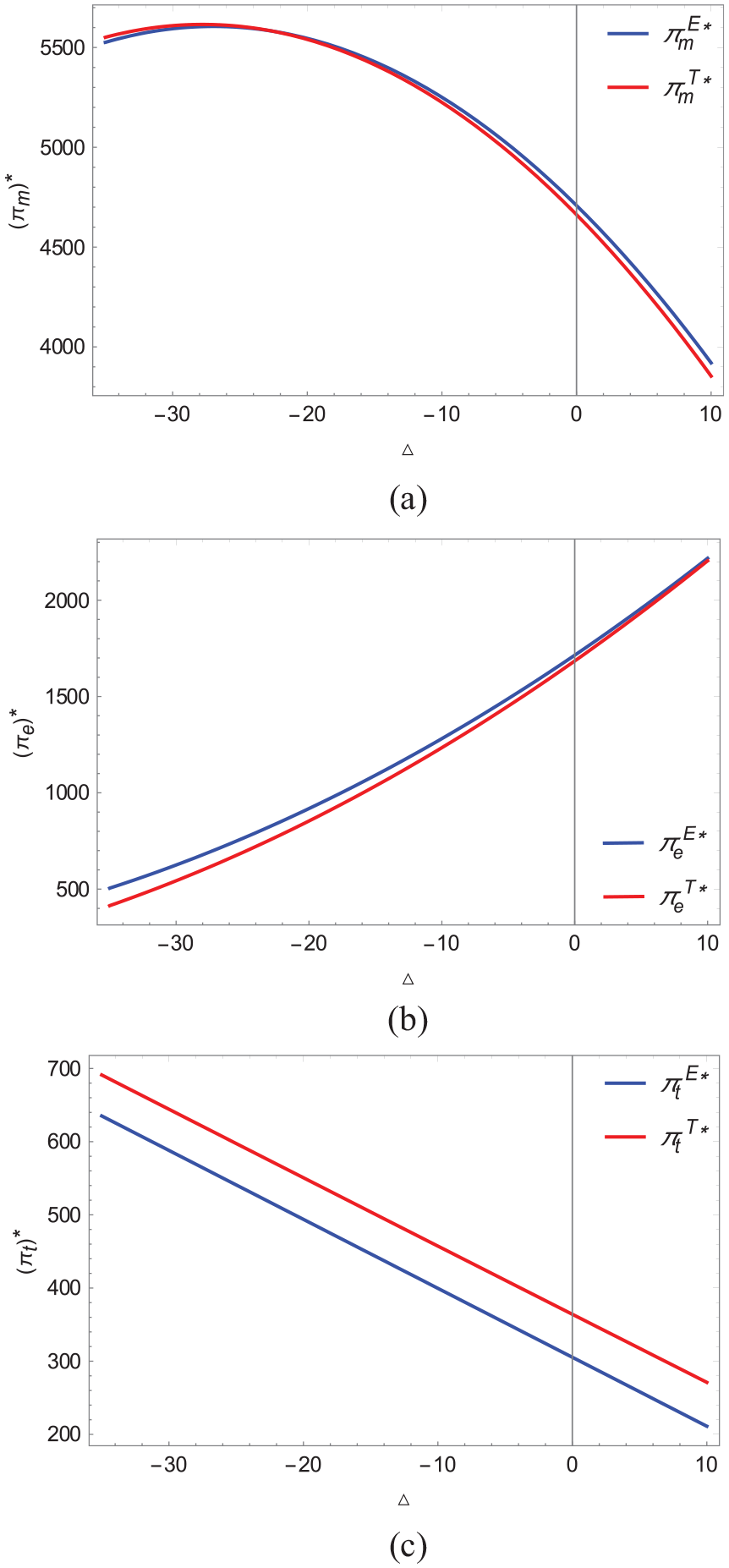
Impact of Δ on enterprises’ profits: (a) the manufacturer’s profits, (b) the ECP’s profits, and (c) the 3PL’s profits.
Furthermore, when the price difference remains below a certain threshold, manufacturers achieve higher profits under the 3pl financing mode. This outcome highlights the connection between financing strategy choices and price differences, emphasizing the importance of selecting a financing strategy that aligns with market conditions and competitive pricing. Making informed decisions in this regard can significantly enhance profitability and competitiveness in the market.
Figure 4b illustrates that ECP’s profit increases as the price difference grows under both financing modes. This suggests that the ECP prefers manufacturers to raise the price difference. Consequently, the ECP consistently achieves higher profits under its own financing mode compared to the 3PL financing mode. As a result, the ECP is more inclined to provide funding to financially constrained manufacturers in most scenarios. This behavior is reflected in the practices of e-commerce giants for example, JD.com and Amazon, which have actively expanded their supply chain finance services.
Figure 4c indicates that the 3PL’s profit decreases as the price difference increases under both financing modes. This signifies that the 3PL prefers manufacturers to reduce the price difference. Therefore, the 3PL is also willing to provide funding to financially constrained manufacturers under most conditions, as demonstrated by companies like Eternal Asia, which offer financing services to their partners.
These trends highlight the differing incentives faced by ECPs and 3PLs in financing strategies and their implications for manufacturers.
Financing Expense on the Manufacturer’s Profit
Figure 5 demonstrates the varying impact of the ECP’s financing expense on the manufacturer’s profit. Notably, the effect of the ECP’s financing expense is independent of the price difference. Conversely, the manufacturer’s profit consistently decreases with an increase in the 3PL’s financing expense, regardless of the price difference or unit production cost.

Impact of financing expense on manufacturer’s profits: (a) Δ = 0, c = 12, (b) Δ = 0, c = 50, and (c) Δ = −10, c = 12.
Specifically, Figure 5a illustrates that the manufacturer’s profit decreases as both financing expenses increase. This indicates a specifically negative relationship between the financing expense and the manufacturer’s profit in this scenario. Figure 5b presents a situation where the price difference remains zero, but the unit production cost increases to 50. In this case, the manufacturer’s profit initially decreases with an increasing ECP financing expense, reaches a minimum point, and then starts to rise again. Conversely, the manufacturer’s profit continues to decrease with an increase in the 3PL’s financing expense. This suggests that while the ECP’s financing rate can have a multifaceted impact on profits, the 3PL’s financing rate consistently undermines profitability.
Figure 5c shows that the manufacturer’s profits decline with an increase in both financing expenses. This finding reinforces the notion that an increase in the 3PL’s financing rate consistently detracts from the manufacturer’s earnings. Furthermore, it indicates that under certain conditions, raising the ECP’s financing rate does not necessarily result in lower manufacturer profits, highlighting a potential advantage in specific contexts.
Financing Expense on the ECP’s Profits
Figure 6 demonstrates that the ECP’s profit is significantly affected by both the price difference and the unit production cost. Notably, the ECP’s profit consistently decreases as the 3PL’s financing expense increases, regardless of other variables. Figure 6a indicates that when Δ = 0 and c = 12, the ECP’s profit initially rises with the ECP’s financing expense up to a certain threshold before beginning to decrease. This implies that there is a specifically optimal financing expense for the ECP that maximizes profits, particularly when Δ is relatively high and c is low.

Impact of financing expense on ECP’s profits: (a) Δ = 0, c = 12, (b) Δ = 0, c = 50, and (c) Δ = −10, c = 12.
In contrast, Figure 6b presents a scenario where both
Figure 6c shows that when
Financing Expense on 3PL’s Profits
Figure 7 illustrates the relationship between the profit of the 3PL and the financing expense set by the ECP, offering critical insights into their operational strategies. The results suggest that higher financing expenses from the ECP can negatively impact the 3PL’s competitive position, likely due to increased financing costs for manufacturers, which in turn reduce the demand for 3PL services.

Impact of financing expense on 3PL’s profits.
In contrast, when the 3PL uses its own financing mode, it benefits from higher financing expenses. This suggests that the 3PL can leverage higher financing expenses to enhance its profitability, particularly when providing financing to financially constrained manufacturers.
Moreover, Figure 7 reveals that the 3PL can achieve higher earnings under the ECP financing mode compared to its own financing mode when financing expenses are relatively low. This implies that, in certain market conditions, collaboration with the ECP may prove more advantageous than direct competition. Given these dynamics, the 3PL should consider extending loans to financially constrained manufacturers at relatively high financing expenses, as this strategy is likely to enhance its profit margins in its financing mode. However, if both financing expenses are the same and relatively low, the 3PL may find it unbeneficial to offer loans to manufacturers. In such cases, a thorough evaluation of overall market conditions and demand for financing is essential to assess the viability of its lending strategy.
Discussion
Applicability of the Model
With the rapid development of the economy, environmental issues such as resource depletion and climate change are increasingly attracting attention. More manufacturers are upgrading their production equipment and investing in eco-friendly technologies to produce more sustainable products. Furthermore, advancements in information technology and the logistics industry have encouraged more manufacturers to collaborate with E-commerce platforms and establish their own official online stores, enabling dual channel sales. However, research and development in eco-friendly technologies and equipment upgrades require significant capital investment. Combined with the higher operational costs of dual-channel distribution, manufacturers often face financial constraints that hinder the growth of low-carbon supply chains.
In an eco-friendly dual-channel supply chain system, both E-commerce platforms and 3PL providers can offer financial support to capital-constrained manufacturers. However, it remains unclear whether a manufacturer will opt for an ECP financing strategy or a 3PL financing strategy, as both serve as viable financing options within the supply chain. Currently, limited research has conducted a comparative analysis of ECP and 3PL financing strategies, with even fewer studies examining their effects on carbon emission reduction and pricing decisions in a low-carbon dual-channel supply chain.
Building on this gap, this study investigates the financing decisions of supply chains under M-power structure and a channel differential pricing strategy. It analyzes the impact of different financing modes on the financing decisions of manufacturers and E-commerce platforms, as well as how these strategies influence carbon emission reduction and pricing decisions within the supply chain.
Major Findings
This research highlights the critical role of strategic pricing in shaping financing decisions and influencing profitability across different financing modes. It is essential for supply chain members to carefully consider their pricing strategies in relation to their financing approaches (Sun et al., 2023; Xia et al., 2024). Building on these insights, the following sections will further explore the implications of these findings, emphasizing the importance of understanding how various financing expenses affect manufacturer profitability.
Additionally, the study examines the complex dynamics of financing expenses and their varying impacts on manufacturer profitability across different scenarios (Pei et al., 2022; Qin et al., 2021). The analysis reveals that while the 3PL’s financing expense consistently exerts a negative effect on the manufacturer’s profit, the impact of the ECP’s financing expense is more nuanced and dependent on the unit production cost. This finding reinforces the need to assess both financing modes and their associated costs when evaluating their effects on manufacturer profitability (Hua et al., 2021; Liang & Sun, 2022). Such insights are crucial for manufacturers seeking to optimize their financing strategies in a competitive market.
Furthermore, it is crucial for ECP to strategically adjust its financing expenses in response to price differences and unit production costs to maximize profitability. Notably, ECP may achieve higher earnings under the 3PL financing mode compared to its own, particularly when financing expenses are relatively low. This finding underscores the importance of strategic financial decision-making in fluctuating market conditions (Jena et al., 2023; Nouri-Harzvili et al., 2022), emphasizing the need for adaptive financial strategies to effectively navigate changing market dynamics.
In summary, financing expense strategies are critical for 3PL enterprise. By understanding the implications of ECP’s financing expenses on profitability, 3PL can make informed decisions regarding lending practices and competitive positioning within the supply chain finance landscape (Mandal et al., 2024; Rath et al., 2024). This strategic understanding enables the 3PL to navigate the complexities of supply chain finance successfully. Overall, these dynamics highlight the importance of financing strategies for both ECP and 3PL in optimizing their respective profits.
Implications
The theoretical implications of this research enhance the existing literature on eco-friendly supply chain finance by revealing how different financing expenses impact manufacturer profitability. Practically, the findings provide manufacturers and supply chain entities with actionable insights to refine their financing strategies, thereby improving their competitive positioning in the market. The emphasis on adaptive financial strategies further illustrates the need for stakeholders to remain responsive to evolving market dynamics, ensuring sustainable profitability in a rapidly changing economic landscape. The practical implications of our research lie in the following aspects:
(1) The analysis of operational and financing decisions in dual-channel supply chains under capital constraints provides theoretical guidance for manufacturers in pricing, carbon emission reduction, and financing strategies.
(2) With the expansion of financial services offered by 3PL providers and E-commerce platforms, capital-constrained manufacturers now have multiple financing options, such as ECP financing or 3PL financing. A comparative evaluation of these two financing strategies can help manufacturers select the most suitable financing solution based on their specific circumstances.
Limitations and Future Research
This study has certain limitations. First, a simplified model is used to analyze financing strategies and supply chain decisions, which may not fully capture the complexities of real market dynamics and external environmental factors. Future research can explore how financing decisions contribute to the development of sustainable supply chains, with a particular focus on the influence of policies, market incentives, and consumer behavior on supply chain financing.
Second, further investigation is needed to examine how ECP financing and 3PL financing strategies under E-power dominance affect pricing decisions and low-carbon emission reduction in dual-channel supply chains. Additionally, a comparative analysis of the M-power and E-power structures should be conducted to provide deeper insights into their impact on supply chain operations.
Conclusions
This study provides important contributions to the field of eco-friendly supply chain financing by analyzing the complex relationships between pricing strategies and financing expenses. It demonstrates that strategic pricing plays a fundamental role in financing decisions and profitability across different modes, emphasizing the need for supply chain members to take a nuanced approach to pricing within their financial strategies. The study addresses the manufacturer’s capital shortage problem and its options for obtaining loans from either the ECP or 3PL enterprises to maintain normal production and business operations. Key conclusions include:
(1) Channel power structure is a key factor influencing the financing strategy choices of manufacturers and E-commerce platforms. Under the channel differential pricing strategy, manufacturers prefer the 3PL financing strategy under the M-power structure and the ECP financing strategy under the E-power structure. E-commerce platforms are more inclined to provide financing services to manufacturers under the M-power structure, while the 3PL financing strategy is more advantageous in terms of overall supply chain system performance.
(2) Both channel power structure and financing strategy influence the impacts of freight rate and financing rate on supply chain carbon reduction and pricing decisions, but they do not affect the impacts of freight rate and financing rate on the optimal expected profits of manufacturers and e-commerce platforms. Manufacturers’ financing decisions are determined by the ratio of 3PL firms’ freight rates to manufacturers’ unit production costs. When the ratio is small, the ECP financing strategy becomes the financing equilibrium for both the manufacturer and the e-commerce platform. Conversely, when the ratio is large, the 3PL financing strategy becomes the equilibrium for both firms. When the ratio falls within a specific range, a financing conflict arises between the manufacturer and the E-commerce platform. Additionally, under the channel differential pricing strategy, the 3PL financing strategy proves more advantageous in terms of supply chain system performance. The overall performance of supply chains under the M-power structure is higher than that under the 3PL financing strategy within the ECP financing framework.
(3) The prerequisites for the financing decisions of the manufacturer and the e-commerce platform (ECP) differ under the M-power structure. As dominant players, manufacturers prefer the 3PL financing strategy, while e-commerce platforms, as followers, are more willing to provide financing services to manufacturers. Under the M-power structure and ECP financing strategy, the M-power structure is more favorable to supply chain system performance when the unit production cost is higher.
Footnotes
Acknowledgements
Not applicable.

Ethical Considerations
Not applicable.
Consent Details
Not applicable.
Author Contributions
All authors contributed to the study conception and design. Material preparation, data collection and analysis were performed by Qiang Sun and Changsuo Chen. The first draft of the manuscript was written by Changsuo Chen. The revised draft of the manuscript was written by Qiang Sun. All authors commented on previous versions of the manuscript. All authors (Qiang Sun, Changsuo Chen) contributed to specific aspects and to further elaborate the manuscript. All authors read and approved the final manuscript.
Funding
The author(s) disclosed receipt of the following financial support for the research, authorship, and/or publication of this article: This work was supported by the National Social Science Fund of China (24BGL213).
Declaration of Conflicting Interests
The author(s) declared no potential conflicts of interest with respect to the research, authorship, and/or publication of this article.
Data Availability Statement
Data sharing not applicable to this article as no datasets were generated or analyzed during the current study.