



Abstract
The most commonly used pricing approaches adopted by companies worldwide are based on costs, customer value, and competition. The purpose of the present study is to review the current status of publications on pricing globally with the addition of Brazilian literature, identify the most cited authors and highest publishing institutions, and outline further research opportunities. To this end, we use the bibliometric method to analyze relevant publications from the following four databases: Web of Science, Emerald, Elsevier, and Spell. A total of 286 papers from 195 periodicals and 31 journals (primarily from marketing, accounting, economics, and production engineering) are reviewed. The findings show that pricing is a complex and multifaceted topic involving far more than merely establishing selling prices, and that pricing managers face substantial challenges. The results also reveal that the cost-based pricing approach is superior to the perceived customer-value-based and the competition-based approaches. Finally, the findings show that pricing remains an underresearched topic, and is thus a fertile ground for further investigation.
Introduction
Historically, pricing and its related approaches have evolved from cost accounting. Cost accounting offers managers valuable information for planning and control, internal decision making and strategic management, investment decisions, definition of profit margin, and competitiveness. Among the most critical challenges in cost accounting is the process of establishing the relationship between cost and pricing (Krishnan, 2011). Pricing is an integral part of business strategies related to the support of economic activities and an order-qualifying requirement associated with strategic positioning and achievement of business goals (Caregnato et al., 2014).
Pricing is a relevant resource and a vital tool for any company’s financial life—and one of the most crucial, challenging, and subjective decisions. Its complexity and implementation difficulties present major challenges to many organizations (Avlonitis & Indounas, 2006; Hinterhuber & Liozu, 2012, 2014; Shi et al., 2015; Tian et al., 2005; Wagner & Beinke, 2006).
To date, pricing has received little attention from academia and practitioners, which makes it one of the most neglected elements in the marketing mix (Ingenbleek, 2007; Kienzler & Kowalkowski, 2017; Nagle & Müller, 2018; Somervuori, 2014). However, pricing plays a pivotal role in generating revenue, as well as influences business continuity and profitability (Jobber & Shipley, 2012).
A company’s pricing is a form of communication to customers, a language that can carry more weight than a thousand words (Docters et al., 2003). Pricing has a strong impact on sales volume and market share. In addition, pricing has an immediate influence on demand, manifesting itself faster than the other marketing elements (Melo et al., 2013). Despite its importance, however, less than 5% of companies have an organizational unit responsible for pricing (Hinterhuber & Liozu, 2014). In the absence of a specialized pricing function, there is a risk that responsibilities for pricing are diffused throughout the organization, which makes them ill-defined. According to Liozu and Hinterhuber (2013), a specialized pricing function is a vital contributor to operational and financial performance. Moreover, to minimize the negative effects of pricing on corporate business, companies must be proactive and adopt measures to avoid conflict between various management functions within the organization (Lancioni, 2005).
Pricing is a competitive strategy and is typically hidden from customers (Indounas & Avlonitis, 2011; Ingenbleek & Van der Lans, 2013). Regarding global pricing strategies, the price is predominantly based on cost, the value perceived by customers, and competition (Amaral & Guerreiro, 2018; Hinterhuber, 2008; Indounas & Avlonitis, 2011; Ingenbleek et al., 2003; Ingenbleek & Van der Lans, 2013; Liozu et al., 2012). These approaches can be applied to the pricing of existing products, new products, and products under development (Ingenbleek et al., 2013).
Despite the significance of pricing as a strategic element, available literature shows that research on the subject has seldom appeared on the radar screens of academics and practitioners (Avlonitis & Indounas, 2005, 2006; Carricano et al., 2010; Den Hertog & Thurik, 1995; Indounas, 2009). According to Amaral and Guerreiro (2018), relevant empirical studies on the topic, both national and international, remain scarce. Seeking to fill this gap in the literature, Oyadomari et al. (2018) discussed pricing in the light of different objectives and purposes. For example, the authors focused on management to prioritize the decision-making process.
Against this background, in the present study, we aimed to analyze the national and international literature on pricing, seeking to contribute to available research and to showcase opportunities for future research. The motivation for studying pricing is justified, as it offers companies a competitive advantage. Figure 1 shows the areas that are crucial in this field.

The research topic.
Theoretical Framework
In most companies, internal financial considerations from management accounting and foreign market considerations from marketing are antagonistic forces when it comes to setting and deciding on a target price (Farley et al., 1980). Thus, setting and changing the list price of a product or service are considered critical activities (Danes & Lindsey-Mullikin, 2012), a multidisciplinary and extremely complex process that involves production, finances, legal, and marketing aspects (Cavusgil, 1996; Díaz, 2006).
In this respect, the parties responsible for setting prices within their companies—before these prices are accepted in the market—should take into account the unique characteristics of the markets in which they operate (Indounas, 2018), as well as customer demands and other factors (Martins & Moraes, 2012). Hinterhuber and Liozu (2012) reported that companies with top-level managers tend to be more successful in pricing. Such managers understand the consumer, who, in addition to using intuition, compares the price of an existing product with that of a new one (Campbell, 2007; Iveroth et al., 2013; Kuester et al., 2015).
Taking into account the aspects of management functions, the cost manager wants to set a price that is high enough to cover costs and expenses. In addition, the price should generate a competitive profit margin that allows quick negotiation (Farley et al., 1980). Marketing professionals, in turn, set prices based on the value of a product or service for customers (Hinterhuber, 2008). To avoid conflict, pricing decisions should combine both strategies (Nagle & Müller, 2018; Smith & Nagle, 1994). Pricing based on costs plus margin does not necessarily entail that the company uses cost-based pricing (Guerreiro & Amaral, 2018). In fact, the selling price involves both quantitative (calculations, different costing methods) and qualitative aspects (value generation, marketing focus, and cost area) (Buiga et al., 2017), as well as some elements from the field of economics.
Pricing can be applied both to existing products, i.e., those already on the market, and to new products, i.e., those at the launch stage. New products and services are developed to introduce technology-driven content, new characteristics of quality, performance, cost, and distribution that meet customer demands. Since this is a development process, pricing targeted at new products/market entrants involves specific methods and techniques, as well as the definition of the company’s competitive strategy (Cauchick Miguel, 2009; Rozenfeld et al., 2006). The cost of a product begins at the design stage and increases throughout the life cycle of that product (Kaygusuz, 2011).
An important stage of a new product’s life cycle is its market launch; at this stage, the price must be set. This requires close attention to possible market changes, as a new (and innovative) product can be disrupted by competitors (Cardoso & Beuren, 2006). In addition, pricing requires follow-up on the product after its launch to anticipate possible discontinuity and incorporate all the product needs throughout its life cycle (Rozenfeld et al., 2006). In this case, prices can be set under the following two distinct categories: (a) new products or services and (b) negotiation (existing products) (see Figure 1).
According to Las Casas (2011), when introduced to the market, any product progresses through several stages—some within longer time frames, and others within shorter ones. These frames range from the moment the product is launched to its definitive withdrawal. Therefore, an existing product can be defined as the one that has advanced through all its life cycle stages—namely, introduction, growth, maturity, and decline (Kotler & Keller, 2012).
Overall, the three main approaches to pricing include cost-, competition-, and customer-value-based approaches. According to Hinterhuber and Liozu (2012), companies considerably differ in their pricing approaches. However, most companies tend to employ one of the three aforementioned approahces. While all these approaches have their limitations, all of them can be applied to both existing and new products.
Cost-based pricing is derived from cost accounting data (Hinterhuber, 2008). Companies favor this approach due to its simplicity in setting prices (Avlonitis & Indounas, 2005; Guilding et al., 2005; Hinterhuber, 2008; Ingenbleek, 2007). This method can be used in every type of pricing decision, regardless of customer type (Indounas, 2006).
A second approach—i.e., competition-based pricing—takes market prices as a reference, usually among specific competitors. In this way a company can compare its profit level in relation to different prices and make them more appealing than the competition’s by managing its resources to reduce costs, meet demand, and increase productivity (Foxall, 1972). Normally, the prices of products and services are based on the competition, which significantly influences the company’s results (De Vargas & Scarpin, 2014). Using this strategy, a manager has to evaluate management actions (Pohland & Kesgin, 2017), conduct a detailed study of market conditions and options, observe competitors’ practices, and identify what customers want (Aalto-Setala, 2005).
Finally, there is pricing based on the value of a product or service attributed by customers. In this approach, the company uses the perception of the value delivered to its target audience as the basis for setting prices. In the literature, this approach is increasingly recognized as the preferable one (Hinterhuber, 2008; Ingenbleek et al., 2003; Liozu et al., 2012). Nevertheless, this approach is difficult to implement operationally (Calabrese & Francesco, 2014). Value is a key concept in marketing transactions, and the phenomenon of acceptable value links thoughts about perceived quality to buying behavior (Danes & Lindsey-Mullikin, 2012; Dodds, 1991).
To distinguish the second and third approaches, Indounas (2013) argued that competition-based pricing can drive growth towards the development of strategic prices, even though turbulence has a strong influence, causing this development to occur more rapidly.
Research Methodology
To achieve the main objective of the present study—namely, to review the state of the art in the field and to obtain a broader view on pricing—we performed a bibliometric survey based on a set of laws and principles that apply statistical techniques to describe aspects of the literature and other means of data analysis (Kobashi & Dos Santos, 2006). We used Zipf’s law (word frequency), Lotka’s law (author productivity), and Bradford’s law (periodical productivity; Guedes & Borschiver, 2005).
To identify national periodicals, we relied on an extensive list from Neto et al. (2017), followed by Spell’s database. We based our search of periodicals on the keywords pricing and sales pricing (see Table 1). The search yielded a datacase of papers, including those from institutions conducting pricing research, such as Hinterhuber & Partners, a consulting company. Other publications were discarded.
Keywords summary.

Note. NA = not applicable.
International papers were downloaded from the Sucupira Platform on the Capes Portal. The databases used included Web of Science, Emerald, and Elsevier. The research covered the period from 1945 to May 2019, and the keywords setting price, price formation, and price strategy were used (see Table 1). To complement the research, Brazilian papers were also researched, resulting in a total of 107 journals. In total, we downloaded 88 periodicals, 63 of which we employed, resulting in 107 national papers for further analysis. Data collection was conducted in May 2019. Table 1 shows the different keywords used when researching international or national papers.
After we eliminated duplicate papers and those not relevant to the subject area, the final number of national and international papers amounted to 286.
Results
For the two major categories of pricing for new products and negotiation/existing products, Table 2 presents the results of the approaches used in the papers and the results of the subcategories for several identified aspects.
Categories and subcategories: New products and negotiation.

Source. Prepared by the authors based on the collected data.
Note. ABC = activity-based costing; RKW = Reichskuratorium für Wirtschaftlichtkeit; C.A. = Target Costing.
Of the 286 analyzed papers, eight addressed the new products category, and 246 referred to the negotiation/existing products category.
Pricing based on the value perceived in the marketing area is referred to by Hinterhuber (2008). Pricing based on the market value is referenced by Kotler and Keller (2012). The new products category did not mention the costing method that was used. In the negotiation/existing product category, the most frequently used costing methods were variable (9.4%) and absorption (9.0%), followed by the activity-based costing (ABC) method (4.3%).
The negotiation category involved research in the areas of costs or management (40.6%), marketing (36.7%), and economics (10.8%). Regarding the type of research used for the new products category, 37.5% of the publications were quantitative, and 50.0% were qualitative. In the negotiation category, 57.2% of the studies were quantitative, and 56.1% were qualitative. In the new products category, case studies were used in 12.5% of the eight papers published, and no field research was performed. The survey methodology accounted for 3.0% of the reviewed studies, and the literature review and documentation methodologies accounted for 2.0% each. In the negotiation category, the above methodologies accounted for 57.9%, 22.7%, 19.1%, 28.1%, and 11.5% of the papers, respectively.
The papers were evenly split for the sector and new products categories: 50.0% of the studies focused on manufacturing, while the other 50.0% focused on commerce. In the negotiation category, 33.8% focused on the manufacturing sector, 33.1% on the service sector, and 26.3% on the trade sector.
Table 3 lists periodicals that published more than two articles over the study period. For example, Journal of Product & Brand Management was the most productive, with 25 publications, followed by the University of São Paulo’s RAUSP Management Journal, with 10 publications in the subject area. Most periodicals published three articles.
Most frequently cited periodicals.

Note. USP = Universidade de São Paulo; CRCRJ = Conselho Regional de Contabilidade do Estado do Rio de Janeiro; UFMG = Universidade Federal de Minas Gerais; UNEMAT = Universidade do Estado do Mato Grosso; FGV = Fundação Getúlio Vargas; CFC = Federal Accounting Council; REGE = Revista de Gestão; UNIMEP = Universidade Metodista de Piracicaba; UFPE = Universidade Federal do Pernambuco.
The number of published scientific papers does not necessarily indicate research quality and impact. Therefore, Figure 2 presents the periodicals that achieved the highest number of citations, i.e., those that published the most frequently cited papers and, consequently, that had a greater impact on the researched scientific subject area.
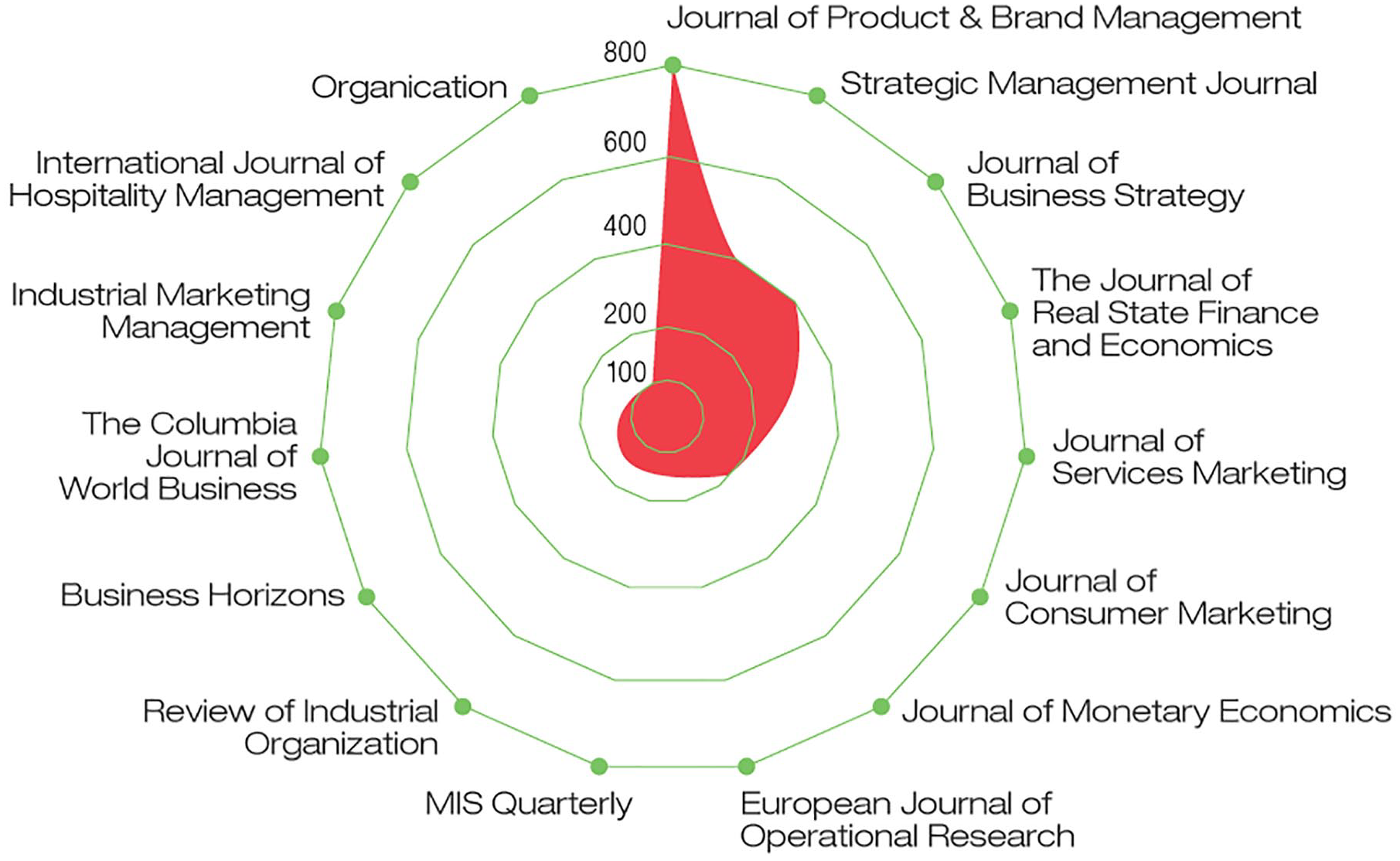
Most frequently cited periodicals.
In principle, the most frequently cited periodicals (especially those accumulating over 100 citations) also have a greater tendency towards theoretical and scientific influence in research on the topic. According to the results, Journal of Product & Brand Management was the most influential periodical, as it had 12.82% of the total number (795) of citations. The Strategic Management Journal was the second in terms of the number (408) of citations.
To complete this overview, Figure 3 presents the most frequently cited institutions. As mentioned above, the inclusion threshold of 200 citations meant that Brazilian institutions were not highlighted in the analyses. Since international institutions presented a significantly higher number of citations, their publications can be assumed to have had a greater impact on the scientific environment of the researched area.

Most frequently cited institutions.
The University of São Paulo is the Brazilian institution with the highest number of citations (110), and it also has a large number of publications. With regard to international institutions, Hinterhuber & Partners, a leading consulting company specialized in pricing, has the largest overall citations. This institution combines studies and analyses from the academic field with business experience. Consequently, it is globally positioned among the leading consulting companies in pricing strategy. The other institutions with many citations are primarily from the United States and European institutions (see Table 2).
Figure 4 shows the top frequent countries where the analysis reported in the reviewed papers was conducted. As can be seen in Figure 4, there was a clear bias in the number of Brazilian research papers. Also, the analyzed papers reported on study phenomena in Brazil, thus presenting a significantly greater number of papers than those that focused on other countries (see Table 1). Figure 4 shows the most frequently researched countries in the reviewed studies.

Countries addressed by the reviewed papers.
From the set of all papers compiled, we found that the reviewed studies focused on 53 different countries; of these, the most prominent are shown in Figure 4. Brazil was the most extensively covered country; research was conducted on the country level, including the Brasilian market on the whole, companies located in Brazil, and case studies involving the Brazilian context. Brazil was followed by the United States (focused on in 21.1% of the reviewed papers), the UK (7.48%), Germany (5.44%), Spain (3.74%), and the Netherlands (3.40%).
Table 4 lists the authors/co-authors with the most publications on the subject and their respective citations over the years considering all papers published, disseminated, and analyzed in the present study; only single authors and, in the case of multi-author papers, main authors are included. Overall, of 620 identified authors and co-authors, only 3.23% published three or more papers.
Authors/first authors with most publications.

The most prominent authors were Antônio Artur Souza, Andreas Hinterhuber, Kostis A. Indounas, Stephan M. Liozu, and Deonir Toni. Antônio Artur Souza published nine papers during the study period, which amounted to 3.06% of all publications. Importantly, of 620 authors and co-authors, 57 (9.19%) published more than one paper, representing 21.91% of all publications, which implies that 78.09% were isolated publications published by single authors, given that a large number of authors and co-authors (563 researchers) published only one paper on the subject.
In general, as suggested by the number of citations of the authors/co-authors listed in Table 4, the results follow the bibliometric pattern of Lotka’s Law, according to which only a few authors are responsible for publishing a more significant number of papers, thus concentrating knowledge and developing research with a greater impact.
The most influenctial of these authors is Antônio Artur Souza, who holds a PhD in management science from Lancaster University. Antônio Artur Souza is currently a professor at the Federal University of Minas Gerais and, in 2017, he worked as a postdoctoral researcher in finance at the University of Grenoble. Furthermore, Andreas Hinterhuber is an associate professor in the Management Department at Ca’ Foscari University of Venice and specializes in pricing research. Kostis Indounas received his PhD in marketing from the Athens University of Economics and Business and is a professor in the same faculty. He is also a member of the European Marketing Academy and the Greek Marketing Academy. Stephan M. Liozu is affiliated with Case Western Reserve University and has authored several books on pricing, price innovation, sales, and other related areas. Finally, Deonir Toni is a Brazilian marketing professor at the University of Caxias do Sul, Rio Grande do Sul.
Figure 5 presents the most frequently cited researchers in our sample. The range of 200 citations or more indicates that the research produced by these authors has had a great impact, as illustarted by a significant number of citations.

Researchers cited over 200 times.
As can be seen in Figure 5, the author with the highest number of citations in our sample was Andreas Hinterhuber; his works were cited 486 times (7.84% of all citations). Hinterhuber’s most impactful work is the paper entitled “Customer Value-Based Pricing Strategies: Why Companies Resist,” published in Journal of Business Strategy in 2008; this paper was cited 272 times.
Furthermore, as can be seen in Figure 5, the 2003 study entitled “Pricing Process as a Capability: A Resource-Based Perspective” by Shantanu Dutta, Mark Bergen, and Mark J. Zbaracki was cited 408 times.
Conclusion, Limitations, and Future Research Directions
In this study, we analyzed the bibliometric characteristics of a total of 286 papers. Our major objective was to review the national and international literature on pricing, observing the current stage, with a vision of unlocking opportunities for future research.
Based on the results of our literature review, we observed that a significant number of reviewed papers were related to the problems that decision makers face when setting selling prices; this complexity is the result of a variety of factors, including cognitive biases, political dynamics, and managerial incentives (Lancioni, 2005). In addition, a substantial portion of reviewed research examined the challenges faced by companies at the stage of implementing pricing strategies (Avlonitis & Indounas, 2006; Hinterhuber & Liozu, 2014).
Previous research reported that companies set their prices when they develop a new product or set prices for existing products (Kotler & Keller, 2012). This is well aligned with the two major categories of the research—namely, pricing of new products and pricing of existing products.
It was also apparent that of the three main pricing approaches used in the market— namely, cost-based, competition-based, and perceived customer-value-based approaches—can be applied to the pricing of a new product, a product in negotiation, or an existing product (Ingenbleek et al., 2013). However, different studies embrace only one of these three approaches. The perceived customer-value-based approach is supported by marketing professionals. This became evident in previous research that analyzed papers on marketing (Liozu & Hinterhuber, 2012). Accounting professionals typically use the cost-based approach (Farley et al., 1980; Nagle & Müller, 2018).
Another conclusion is that, regardless of the specific approach used—be it cost-, value-based, or competition-based—what is vital in this context is cost information. This is because one of the parameters for the development of a new product is to go to the market to determine how much customers are willing to pay for it and then design and produce it at that target cost. Once the production cost is set by the sum of the direct and indirect costs, a company using the value-based approach can use various marketing strategies to add value to the product and to charge a premium price.
For an existing product, it is important to remember that, previously, it was a new product. When the market becomes segmented, competitors offering similar or substitute products appear, and the industry has to adapt and use different pricing strategies—and all these strategies are based on the product cost. Imagine Product X sold at Supermarket A for $10. How would Supermarket B keep up with the competitor selling Product X for $10 if the cost of this product is $11? From our market experience, we witnessed several retailers declaring bankruptcy because of not knowing the product cost or for trying to keep pace with their competitors.
The present study has several limitations. First, our review was limited to only four databases. Accordingly, in future research, the database should be expanded to include more studies in the analysis. In terms of databases and papers analyzed, our research focused on the studies published in English and Portuguese languages. Therefore, in further research, it would be necessary to analyze studies published in other lanaguges in order to obtain a more holistic view on pricing.
In addition, future research could further explore the issues related to the cost-based approach to identify its prescriptive effectiveness. In the future, it would also make sense to deepen the analysis of the perceived customer-value-based pricing approach, as this has been recognized as superior to other approaches. Future studies could also expand strategy analysis on how companies make pricing decisions based on competitors and identify how costs and management practices affect pricing in companies.
Other important avenues for future research include pricing approaches for solutions (Bonnemeier et al., 2010; Keränen & Jalkala, 2013; Prior, 2013; Sharma & Iyer, 2011), pricing approaches and pricing models for digital products, pricing governance models, value quantification (Hinterhuber & Snelgrove, 2016/2017), as well as further research on analytical tools such as pricing dashboards or price variance analysis that are useful in the context of price realization, such as pricing dashboards or price variance analysis.
Footnotes
Acknowledgements
An earlier draft of this paper, entitled “Estabelecimento de Preços: Estágio Atual e Oportunidades de Pesquisas,” was presented at the XXVI Brazil Conference on Pricing [Congresso Brasileiro de Custos]—Curitiba, Paraná (PR), Brazil, November 11–13, 2019.
Declaration of Conflicting Interests
The author(s) declare no potential conflicts of interest with respect to the research, authorship, and/or publication of this article.
Funding
The author(s) received no financial support for the research and/or authorship of this article.
