




Abstract
On October 29, 2022, a large-scale stampede occurred in Seoul, South Korea, which caused worldwide shock and garnered global attention and discussion. In this article, a study on the thematic characteristics of social media platforms during major sudden risk events is carried out utilizing online agenda setting. Furthermore, the consensus and divergence between the official and public agendas in risk communication are analyzed to understand their interactive relationship. The study reveals that the risk communication of the stampede comprises seven core issues across three stages, including risk information, warnings, preparedness, uncertainty reduction, utility, assurance, and public risk perception. These findings offer insights for media coverage to focus on critical aspects, assist the government in conducting effective administration and risk communication, and provide empirical evidence for the agenda-setting in the field of sudden safety accidents within the online realm, aiming to complement current academic research.
Plain language summary
Study aims to analyze the consensus and divergence between the official and public agendas in risk communication, aiming to understand their interactive relationship. Why was the study done? The Itaewon Stampede attracted widespread attention and discussion on social platforms due to its sudden occurrence, high death toll, and involvement of multiple countries. Against the backdrop of significant unexpected security incidents, risk communication has become a crucial balancing point in government governance, social sentiment, and the effectiveness of implementation. What did the researchers do? This study is based on the Itaewon Stampede and employs the agenda network analysis method. By examining 615 valid official and public agendas and 72,918 comments collected from the YouTube platform using the search keyword “Itaewon” from October 15, 2022, to February 1, 2023. What did the researchers find? Official agendas effectively transmit information to the public agenda and exhibits the highest influence in agenda setting among various topics. However, both discourse fields demonstrate information asymmetry and temporal lag. Public agendas cover a more comprehensive range of issues and favor holding public officials accountable. In the incident, the overall sentiment of the agendas tends to be negative, except for users’ positive recognition of specific individuals’ contributions. The resonance of emotional aspects of the agenda suggesting that public agendas can exert pressure on official agendas, influencing their attribute selection and value orientation over time. What do the findings mean? This study demonstrates the relevance of official and public agendas. It analyzes the public focus in security emergencies, which provides help for the government to effectively manage and the media to participate in risk communication.
Introduction
A stampede incident is a chaotic situation during a particular event or activity when a crowd gathers excessively, and some, or even a majority, of individuals cannot regain their footing promptly after stumbling or falling due to unstable movement (de Almeida & von Schreeb, 2019). Consequently, they are stepped on or crushed by others, and the situation cannot be controlled or halted immediately. Stampede incidents often result in severe casualties, jeopardize social order and safety, and have profoundly negative societal implications. Such incidents have become increasingly prevalent in modern life, with related reports quadrupling since 1990 (Alhadhira, 2024). These incidents predominantly transpire during religious festivals and large-scale entertainment events, for which the individuals responsible for organizing these activities bear the responsibility for inadequate planning, improper design, insufficient supervision, and poor management.
On the evening of October 29, 2022, a large-scale stampede incident that shocked the world occurred in Itaewon, Longshan District, Seoul, South Korea. In this incident, 159 individuals lost their lives due to factors such as asphyxiation, and several others were injured. This event marked the highest number of casualties in South Korea since the sinking of the “Sewol” ferry in 2014 and is regarded as the ninth deadliest stampede incident of the 21st century (Ha, 2023). It has garnered significant attention and sparked widespread discussions. The following are vital milestones during the Itaewon stampede in South Korea.
October 29, 2022, marked the first Halloween in 2 years in South Korea after the relaxation of pandemic-related restrictions, allowing people to celebrate without the requirement of wearing face masks. The district of Itaewon in Seoul, South Korea, is renowned for its plethora of trendy restaurants, nightclubs, bars, and other entertainment venues. Over 100,000 young individuals flocked to Itaewon on that particular day to partake in the Halloween festivities. At 10:15 p.m., numerous individuals stumbled almost simultaneously in front of a bar, leading to a cascading effect of continuously pushing people down from behind. Ultimately, a severe crush and stampede ensued.
On October 30, 2022, President Yoon Suk-yet of South Korea delivered a televised speech addressing the Seoul stampede incident, declaring a national mourning period from October 30 until midnight on November 5. On November 1, 2022, a unique investigation headquarters was established in South Korea to investigate the Itaewon stampede. On January 3, 2023, the South Korean government decided to reclassify one of the injured victims, who had previously died by suicide, as a fatality, bringing the reported death toll to 159 individuals, as reported by the Korean News Agency (Yonhap). On January 13, 2023, after a 74-day investigation, the Special Investigation Headquarters of the South Korean National Police Agency released its final investigation report, unveiling the causes of the incident and attributing it to professional negligence by relevant public officials. Consequently, 23 individuals, including Park Hee-yeong, the mayor of Longshan District, and former commissioner Lee Lim-jae of the Longshan Police Station, were transferred to the prosecution by the South Korean National Police Agency’s special investigation headquarters.
The Itaewon stampede in South Korea has sparked intense discussions worldwide, with internet users on platforms such as Twitter and YouTube mourning the victims, expressing their condolences, and engaging in reflections and demands for accountability. Against the backdrop of significant unexpected security incidents, risk communication has become a crucial balancing point in government governance, social sentiment, and the effectiveness of implementation. It entails the interactive process of exchanging information and opinions among individuals, groups, and institutions (Rickard, 2021). Studying the public’s risk perception in major incidents aims to enable the target audience to understand risks and, based on their values, influence them or their communities. This line of research has been a popular topic since the 1980s. To this day, the interaction between official and public agendas in risk communication remains a focal point of interest in communication studies.
Based on the Itaewon treading incident in South Korea, the agenda network analysis research method is employed in this study. By examining 615 valid official and public agendas and 72,918 comments collected from the YouTube platform using the search keyword “Itaewon” from October 15, 2022, to February 1, 2023, we aim to address the following four research questions:
Question 1: Which accounts actively construct topics related to the Itaewon incident? What potential risk characteristics are evident in the dissemination of these topics?
Question 2: What unique communication characteristics and impacts do overall agendas and comments exhibit in risk communication?
Question 3: Are there differences between the official discourse and public discourse in agenda-setting?
Question 4: What characteristics are evident in the public’s emotional expressions and behaviors during the Itaewon incident?
This research innovatively introduces new perspectives and new methods into existing issues. Although risk communication and agenda-setting are already mature areas of research, this paper, through a detailed analysis of the stampede in Itaewon, South Korea, places the research context in the specific scenario of a major safety emergency. This specific case not only has strong practical significance, but also provides a new analytical framework by analyzing the interaction between official and public agendas on social media platforms, and explores the unique role of network agenda setting in responding to security emergencies. At the same time, we used a combination of network agenda setting and sentiment analysis, which is a major innovation in this study. While traditional agenda-setting studies focus more on how the media influences the public’s concerns, this paper further combines sentiment analysis to explore how the interaction between the official and public agenda influences the public’s perception of risk. This pattern of emotional resonance and interaction has received little attention in previous studies. This methodological innovation has not only enriched the application scenarios of agenda setting theory, but also provided an operable technical path for similar research in the future.
In the sense of social reality, although the study focuses on the Itaewon stampede in South Korea, its analytical methods and the revealed patterns of agenda interaction have the potential to extrapolate to other similar emergencies. Whether responding to natural disasters, public health crises, or other large-scale public events, the research methods proposed in this paper can be replicated and applied by other researchers to risk communication research in different countries and cultural contexts, thus expanding the breadth and depth of research in this field. At the same time, it provides a new perspective to understand and deal with risk communication in emergencies in practice, which can understand the public’s focus on disaster in major emergency safety accidents. This paper analyzes their emotional trends, expectations and core demands of the government, and provides reference and help for media reports to grasp the key points, effective government administration, and good risk communication.
Literature Review
Online Agenda Setting: Official Agenda and Public Agenda
Agenda setting, as a classic theory in communication research, emphasizes the role of media in shaping audience perception. In 1922, Walter Lippmann first proposed in his book “Public Opinion” that mass media largely influence the public’s understanding of the external world and events. He introduced the concept of the “pictures in our heads,” or the pseudo-environment, which differs from the real environment (Arnold-Forster, 2023). Subsequently, McCombs and Shaw conducted the Chapel Hill study, where they found and demonstrated a strong correlation between the perceived importance of different issues in the presidential election among Chapel Hill residents and the local news media coverage. This formalized the agenda-setting theory (Cheng, 2021; Schmierbach et al., 2022). The agenda-setting theory suggests that the media plays a significant role in shaping political reality by selecting and presenting different news topics. Audiences understand the importance of issues based on the amount of news coverage and its positioning, as the media may set the agenda (M. E. McCombs & Shaw, 1972).
The agenda-setting can be divided into three levels. The first level, as mentioned earlier, is the media agenda, which determines the public’s focus on news events. The second level, attribute agenda setting, emphasizes how the media informs people about how to think about issues or objects. It examines the relationship between the media and the attributes associated with news objects and how these attributes shape public opinion (M. McCombs & Valenzuela, 2020). Attributes contribute to the salience of objects on the public agenda. By highlighting the attributes of events in news coverage, such as positive or negative aspects and macro-political perspectives, the media can influence how audiences think about these issues (Gilardi et al., 2022).
The third level of agenda setting is network agenda setting, which suggests that the media’s transmission of news agendas is an integrated process composed of interconnected elements. Therefore, the media agenda also informs the audience about how to relate different news items, influencing the network relationships of the public agenda (M. McCombs & Valenzuela, 2020). The world is interconnected, as is human thinking, composed of associated objects and attributes forming a network of associations (Zhuravskaya et al., 2020). The network media agenda refers to the prominent influence of valued objects or attributes on the networked public agenda’s objects or attributes (Luo et al., 2019). Guo and McCombs (2011) proposed this effect in their study on the attributes of political candidates in the Texas gubernatorial and U.S. Senate elections, demonstrating that the attribute network depicted by the news media significantly influences the network in the public’s minds. They highlight the difference between the third level of agenda setting and the previous two levels in their article, and the theoretical framework of this study is based on this distinction.
In the real world, there is a complex interaction between official agenda setting and public agenda setting. Despite claiming to observe and report through self-negating norms of objectivity and impartiality, media organizations still participate in much of the political process (H. Semetko, 2023). Public officials, politicians and other official institutions set the agenda through press conferences, policy statements and other forms, and the media reports these contents to convey the issues to the public, thereby affecting public cognition and achieving the purpose of policy promotion and public opinion guidance (Wanta, 2023). The media has a dual role as the disseminator of the official agenda and the shaper of the public agenda. However, there is also the initiative of the public, who will interpret and sift through the information provided by the media according to their own experience, knowledge and interests. While traditional agenda-setting theories emphasize the media’s influence on the public agenda, in practice, the public agenda may also influence the media’s reporting focus in turn (Huh & Park, 2024). This means that public agenda setting is not a single step, one-way function, and is not completely controlled by the official agenda, but a mutual, dynamic, and complex interactive process continuously constructed by news organizations and the general public (Wang et al., 2023).
The three-level structure of agenda-setting is widely acknowledged in academia, and numerous scholars have conducted independent examinations of network agenda-setting concerning various events. For instance, Tahamtan et al. (2022) provided empirical evidence for agenda-setting theory by investigating the interrelationship between the agenda of the World Health Organization’s official Twitter account and the agenda of its 7.5 million Twitter followers during the COVID-19 pandemic. Barberá et al. (2019), through a fine-grained temporal analysis of the Twitter feeds of lawmakers and the public during the 113th U.S. Congress, suggest that lawmakers are more likely to follow rather than dominate discussions of public issues. Guo and Vargo (2020) conducted a qualitative and computer-aided analysis of millions of news articles to explore how fake news, misinformation, and satire affected the emerging media ecosystem during the 2016 U.S. presidential election. Su and Borah (2019) compared the tweets and the agenda in newspapers before and after President Trump’s announcement of the United States’ withdrawal from the Paris Agreement, arguing that newspapers influenced Twitter before the announcement, while Twitter in turn influenced newspapers within 5 days of the announcement. However, Twitter’s influence was found to be short-lived, and the newspaper reverted to one-way influence 5 days after the announcement.
Overall, there are several gaps in the existing network agenda-setting research: First, the research mainly focuses on political election, war and public policy, and the research on major emergencies is relatively limited. Only a few studies have been conducted on events such as the 8.8-magnitude earthquake in Chile (Valenzuela et al., 2017) and the 7 July London bombings (Guzek, 2019). These studies focused on catastrophic events and did not address issues of public safety, government governance or media cooperation. Second, existing research has largely focused on the outcomes of agenda-setting, while understanding of the psychological stages of the process remains limited. Finally, there is a lack of cross-cultural and cross-media studies. Existing studies mainly focus on the relationship between the media and the public in western countries, with little understanding of the agenda-setting mechanism in other cultural contexts. Therefore, starting from the stampede accident in Itaewon, South Korea, this paper examines the complex dynamic interactive process of network agenda setting between the media and the public in public safety emergencies. By providing empirical proof for network agenda-setting, this study has important academic value in filling the research gap in agenda-setting research.
Research on Risk Communication and Perception in Emergency Events
With the development of global modernization, the profound direct and indirect structural changes in society vividly demonstrate the representation of the current risk society. Risk has replaced material scarcity and has become the central theme of society (S. J. Liu et al., 2024). Theories of risk communication and risk perception, as core areas in health communication, are influenced by factors such as public behavior, social context, and risk decision-makers, affecting their communicative effectiveness (Covello, 1997; Covello et al., 2001; Fernandez-Lores et al., 2024; Morgan et al., 2002).The World Health Organization defines risk communication as “the exchange of real-time information, advice, and opinions between experts and those facing health, economic, or social threats.” In this regard, Balog-Way et al. (2020) pointed out the main research areas of ris k communication by collecting 1,370 keywords. While climate change, natural disasters (especially floods, hurricanes, earthquakes), nuclear power, and nanotechnology have aroused great interest in risk perception, trust, uncertainty, media, and decision-making have also received significant attention. Risk communication research emphasizes the application of various theoretical models, addressing individuals, groups, and the underlying social environment. Current research on risk communication mainly focuses on three pathways.
Firstly, it focuses on the impact of individual risk perception on the effectiveness of risk communication, emphasizing the necessity of understanding the public’s psychology and emotions before conducting risk communication. Relevant research results indicate that risk communication can no longer be seen as a passive, one-way process, as it is directly related to risk perception (Goerlandt et al., 2020; Heydari et al., 2021; Scherer & Cho, 2003). At the same time, the role of opinion leaders in influencing public risk perception is also significant (Honora et al., 2022; T. Liu et al., 2020). Siegrist and Árvai (2020) suggest that risk perception research can generally be divided into three approaches. One approach has been to focus on how participants perceived various characteristics of a hazard and how this influenced perceived risks. A second approach has been to identify characteristics of participants that are correlated with or predictive of risk perceptions. And a third approach focuses on the various heuristics that have been proposed to better explain the process behind how people formulate risk perceptions. In the context of digitalization, 3D visualization methods are recognized as effective tools for enhancing public awareness of disaster risks (Zhu et al., 2024).
Secondly, efforts are devoted to researching approaches that can bridge the gap between different groups, primarily the relationships between government, experts, the public, and the media. Boholm (2019) believes that government-expert communication is a primary element of risk assessment and decision-making, which can be seen as internal communication. Expert-public communication aims to bridge the gap between expert and public views on public health issues through strategic communication. Massive social media data generated during emergencies can assist in emergency management (Abrams & Greenhawt, 2020; Gu et al., 2022; Zhang et al., 2020). Relevant research shows that messages from government agencies have positive user effects, while national media and trusted experts are more favored by users in emergency situations.
Thirdly, an interdisciplinary perspective is taken to respond to the challenges of risk communication in new contexts, attempting to adjust and awaken existing risk communication models to address long-term, dynamic, ever-changing, and persistent risks and crises. Scholars draws on academic achievements in communication, sociology, anthropology, public health, emergency management, law, and technology. They propose that research should explore how to best utilize existing framework and other models to help understand the nature of public attention (Habbal et al., 2024; Heath & O’Hair, 2020; Sutton et al., 2021; Zhu et al., 2024). Stewart (2024) approaches risk communication in crisis events and emphasizes the necessity of using mixed methods to mitigate disaster risks.
The Crisis and Emergency Risk Communication (CERC) model was proposed and widely applied in the context of risk and crisis (Reynolds & Seeger, 2005; Zurro-Antón et al., 2023). Based on thousands of literature and practical applications, Miller et al. (2021) point out that the CERC model is likely to be subjected to theoretical testing and generate new knowledge in crisis and risk communication. Elhersh et al. (2024) validated the significant contribution of social media to effective health communication strategies during crises using the CERC model. Herovic et al. (2020) found through research on earthquake prediction and warning that soliciting and responding to feedback during the pre-crisis stage of CERC can help spokespersons clarify or correct any information that the audience finds unclear or fundamentally inaccurate. This can not only improve the effectiveness of risk communication in the pre-crisis stage but also throughout the entire earthquake crisis lifecycle. Furthermore, Ow Yong et al. (2020) also explored risk communication strategies in an acute hospital in Singapore based on the CERC model, suggesting that while regular updates are understandable, actionable, accurate, concise, timely, clear, and helpful, it is necessary to consider segmenting the internal population of the hospital and addressing their concerns based on their sociodemographic characteristics.
Despite its importance and growing institutional interest in it, studies on emergency risk communication systems, mechanisms and detailed practices remain limited (Frost et al., 2019). Researchers primarily focus on risk events manifested through natural disasters (such as earthquakes and tsunamis) and diseases (Jeong & Kim, 2024), examining the interplay among media, government, and individuals in physical disaster contexts, as well as risk warning measures in online ecological spaces. While there are studies on stampede events, they mostly concentrate on new psychological research related to crowd crush disasters (Barr et al., 2024) or on understanding the causes of stampedes to apply crowd evacuation models (Chen & Lu, 2024). However, there is a lack of research on the network risks that may arise from sudden crisis events, and little attention is given to the differential impacts of crises across various hierarchical levels among different stakeholders. Therefore, this study analyzes major sudden risk events using online agenda-setting as the primary method, focusing on how different official and public agendas influence societal risk and crisis communication. This approach will further enrich the theories of risk communication and the collaboration and convergence of agenda-setting.
Research Design
Research Case and Objectives
Nowadays, internet media plays an increasingly crucial role in social communication during emergencies, thanks to its explosive information dissemination and dynamic tracking capabilities. The tragic incident of the “Itaewon Stampede” attracted widespread attention and discussion on social platforms due to its sudden occurrence, high death toll, and involvement of multiple countries. This study selects the “Itaewon Stampede” as a research case to examine the network agenda-setting theory independently. We chose Korean texts from YouTube as our research corpus, focusing on the period from October 15, 2022, to February 1, 2023. By searching for “Itaewon” as the keyword, we follow the timeline of event development and analyze the official agenda based on tweets published by verified users ranked by popularity. To explore the public agenda, we consider content posted by non-verified users, including opinion leaders and other users. Additionally, we examine the comments within the specific content as linguistic data to understand the risk perceptions related to the official and public agendas.
Data Collection and Evaluation
The CERC model categorizes risk communication in emergency events into five stages: pre-crisis, initial crisis, maintenance, resolution, and evaluation. Subsequently, scholars have further delineated the stages of risk communication on social media into three parts: pre-crisis, in-crisis, and post-crisis, consolidating the maintenance, resolution, and evaluation stages into the post-crisis phase. Due to the distinct time sequence of the Itaewon stampede, the period from October 15, 2022, to October 28, 2022, is defined as the “pre-crisis” phase; the period from the occurrence of the stampede on October 29, 2022, to November 22, 2022, is defined as the “in-crisis” phase. Finally, the announcement of a national investigation by the South Korean National Assembly on November 23, 2022, is defined as the “post-crisis” phase.
We chose YouTube as the source of sample data. YouTube is one of the largest video sharing platforms in the world with a huge user base. Compared to other social media platforms such as twitter, official sources on YouTube are diverse and authoritative. Official channels such as government agencies, news media, and international organizations from all over the world release video content such as press conferences, policy interpretations and official statements on the YouTube platform, which makes the presentation of the official agenda more intuitive and three-dimensional. In contrast, other platforms rely mainly on short text and limited links to images or videos, limiting the depth and complexity of information. At the same time, the real-time comment function and interaction on YouTube allow us to directly compare the official video content with the immediate reaction of the public, which is enough for us to capture the public agenda information we need. When studying the interactive relationship of agenda setting, YouTube can provide richer context and background information for research, with sufficient extensiveness.
What is more noteworthy is that the YouTube platform plays a dual role in this case analysis, not only as a place for public opinion after the incident, but also as a publicity tool before the incident, which is highly typical. Before the accident, South Korea’s famous media MBC had released a promotional video on the platform about the Halloween event held in Itaewon. The video spread widely, causing a high degree of public attention to the event, and eventually attracted a large number of people to Itaewon to participate in the event, which became one of the direct causes of the tragedy. Some have accused MBC of promoting too much. YouTube became the earliest media platform involved in the setting of the accident agenda, providing us with important information nodes before the accident and supplementing our analysis needs for the whole process of the accident. This kind of response provides a panoramic perspective for the research, which greatly enhances the representative sample and the comprehensiveness of the analysis.
Using Python software, 1,189 pieces of information were collected for the official and public agendas, excluding irrelevant information, resulting in 615 pieces of Korean language information. The titles and video information were indicators of the official and public agendas. Due to the large number of overall comments, a selection process was conducted using YouTube’s authentication information, along with factors such as video views, comment counts, and the subscription counts of the publishing IDs. The comments from selected videos were then further refined to include only English comments through data cleaning. This process yielded a final dataset of 72,918 valid comments, with 50,077 comments from official sources and 22,901 comments from the public (Table 1).
Data Collection and Cleansing.

Research Methods
This study employed a context-based semantic word vector model, word2vec, to perform semantic modeling on the YouTube corpus. A total of 100 keywords were extracted from the official agenda and public agenda. A semantic matrix of these keywords was constructed using the word vectors obtained from the trained model, allowing for further analysis and comparison of the agenda networks of different entities and their similarity levels.
Furthermore, the VADER sentiment analyzer from the Natural Language Toolkit (nltk) library in Python was utilized to conduct sentiment analysis. The sentiment tendencies were analyzed for trends, and Granger causality tests were performed to explore the effectiveness of risk communication between the official and public entities.
Word2vec Model
The Word2Vec model was proposed by Tomas Mikolov and his research team at Google. A shallow neural network language model converts words into word vectors. These word vectors measure the similarity between texts based on the similarity of their vector representations in a vector space. In this study, the Term Frequency-Inverse Document Frequency (TF-IDF) algorithm was used to extract an equal number of keywords from the corpora of different entities. Then, using the word vectors obtained from the model, the cosine distance was calculated between the keywords to measure their latent semantic strength. A semantic matrix of keywords was constructed based on their cosine distances. Higher values in the semantic matrix indicate higher similarity between the keywords. If a keyword has high similarity with other keywords, it suggests that the keyword holds an essential position in the agenda of the relevant entity.
Agenda Network Analysis
Existing studies on network agenda setting primarily rely on content analysis, where keywords are encoded as elements, and co-occurrence analysis is performed among these elements. However, this method is subjective, time-consuming, and inefficient when dealing with large-scale corpora. This study employs an unsupervised classification algorithm, utilizing the modularity calculation in the social network analysis tool Gephi to perform cluster analysis on the semantic matrix of keywords. The clustering results represent different communities within the agenda, enabling the identification of other entities’ agendas. These agenda networks are visualized to define the relationships between additional agenda items clearly.
Similarity of Agenda Networks
In calculating the similarity of agendas, this study adopts an approach focusing on the similarity of the authors’ interests. Using the trained model mentioned earlier, several words with the highest cosine similarity to a particular keyword are obtained. The cosine distances between these words and the keyword are then calculated to serve as their word vectors, forming the agenda matrix accordingly. The rows and columns of the matrix represent the extracted keywords, and the values in the matrix represent the cosine distances between the row and column keywords. Jensen-Shannon distance is employed to compute the similarity of agendas among different entities. It is a method used to measure the similarity between two probability distributions.

In the given formula,

After obtaining the pairwise similarity

A higher value of
Sentiment Analysis
Sentiment Analysis, also known as opinion mining, is the process of extracting, analyzing, and processing texts that contain emotional content using natural language processing and text-mining techniques. By incorporating sentiment lexicons, text can be analyzed and assigned sentiment scores. This study uses the VADER (Valence Aware Dictionary and Sentiment Reasoner) sentiment analysis tool, available in the Natural Language Toolkit (nltk) library in Python. VADER is a rule-based sentiment analysis tool that utilizes a set of rules and lexicons to analyze the text sentiment. It can classify text into positive, negative, and neutral sentiments and provides corresponding sentiment scores. The tool can also identify emoticons and abbreviations in the text and consider them part of the sentiment expression.
Granger Causality Test for Sentiment Polarity
To answer the question of emotion flow between different entities, this study employs the Granger causality test to reveal the relationship between different agendas and public sentiment. Initially proposed by Granger, the Granger causality test is a method used to analyze causal relationships between economic variables. In the context of this study, if variable x can better predict variable y by considering their past values together rather than relying solely on the past values of y, then x can be viewed as a Granger cause of y. Compared to the previously used lagged cross-correlation analysis, the Granger causality test is more suitable for analyzing information propagation rates in the context of the Internet.
This study utilizes the TF-IDF algorithm to extract keywords, specifically focusing on “nouns”“proper nouns”“organizations”“other proper nouns”“idioms”“adjectives”“verbs”“adverbs,” and “gerunds.” A total of 100 keywords are extracted from the agenda and comment corpora. Gensim, an open-source third-party Python toolkit, trains word2vec models on the corpus. The model is configured as follows: the CBOW model is chosen, the feature vector dimension is 50, the window size is 5, and the minimum word frequency for computing word vectors is 1, while the remaining options are set to default. Once the model is obtained, the cosine distance between the keywords is calculated, and a semantic matrix of the keywords is constructed.
The researcher imports the semantic matrix into Gephi, utilizing the built-in Force Atlas layout as a visualization tool for the agenda network. Modularity calculation is performed on the web to identify communities within the agenda. The top 20% weighted connections based on keyword similarity are retained in the agenda’s semantic matrix to highlight the semantic strength between keywords. Node size and font size are determined by the node’s degree of centrality, with larger nodes and fonts indicating a higher degree of centrality. The researcher obtains keyword clustering results by conducting block model analysis on the semantic matrix. Based on these keywords, the researcher manually summarizes the agenda and presents the findings in Table 2.
Topic Attributes of Posted Articles and Comments.

The seven main themes mentioned above are primarily adapted from the CERC model, encompassing the three stages of risk communication in the Itaewon stampede. Together, they construct the core issues of the event:
Topic 1: Risk Information provides accurate and comprehensive risk information to the public, including the time, location, characteristics, and negative impacts of the stampede incident. During significant safety events, various stakeholders describe the event’s causes, consequences, and process in detail, aiming to reduce information asymmetry among the public and help them understand the truth behind the event. Additionally, discussions among the public also arise, with some connecting the stampede incident to the Sewol ferry disaster.
Topic 2: Warnings aim to alert the public by conveying risk factors and dangerous information related to the stampede incident. This includes emphasizing the dangers of the stampede event and factors that could lead to harm, such as overcrowding, narrow passages, and loss of control. The lack of regulation following the relaxation of epidemic prevention measures is an essential warning in this incident.
Topic 3: Preparedness focuses on officially introducing emergency personnel and guiding the public to take appropriate actions during the stampede incident. Various stakeholders remind the public to seek assistance from emergency personnel and report emergencies promptly. They also guide actions, such as avoiding pushing and maintaining calm, to help the public protect themselves during similar crises.
Topic 4: Uncertainty Reduction includes news releases, interviews, and other channels to reduce uncertainty. In the case of the Itaewon stampede, news was disseminated through multimedia and wide-ranging channels. Various stakeholders continuously provided updates on casualties and the progress of investigations through videos, text, images, and other forms of media, which were widely spread on platforms like YouTube, Twitter, and TikTok. Some media outlets, such as MBC, played a critical role in the information dissemination chain, as they were the primary media promoting Halloween in Itaewon before the tragedy and thus faced public anger over the incident.
Topic 5: Utility focuses on specific personal preventive measures. Some topics used 3D technology to reconstruct the stampede incident, aiming to explain how the stampede occurred in narrow passages and how individuals can effectively escape and ensure safety in similar events through appropriate techniques.
Topic 6: Assurance seeks to reassure the public by mentioning government interventions, emphasizing accountability, and addressing management failures. The government appears as a critical stakeholder in the “post-crisis” phase, with the Korean president and political parties, as well as the underlying political system, believed to require the removal of all obstacles. The government takes a proactive approach to monitoring the dynamics of the stampede incident and providing a just declaration to society.
Topic 7: Public Risk Perception mainly involves changes in public emotions, attitudes, and aspirations after the Itaewon incident. Play, parties, and festivals originally defined aspects of life in the Itaewon area, representing joyous emotions. However, after the incident, public emotions notably shifted from optimistic to pessimistic, such as sadness and crying.
Findings
Official and Public Risk Agendas
By utilizing web scraping on the official agenda and public agenda accounts mentioned earlier, a crawler was used to collect data on posting frequencies. This data generated Word Clouds for the official agenda accounts and the public agenda accounts, as shown in Figures 1 and 2, respectively. In the official agenda accounts, “ytnnews24” ranked first with 85 posts, followed by “newskbs” with 58 posts. The subsequent accounts were “jtbc_news” with 57 posts, “mbcnews” with 51 posts, and “sbsnews” with 38 posts. The top five accounts with the highest posting frequency are all mainstream official media in South Korea (YTN, KBS, JTBC, MBC, SBS), possessing influence and a solid audience base in the country’s media landscape. They provide the public with various information and perspectives through program content and reporting styles.
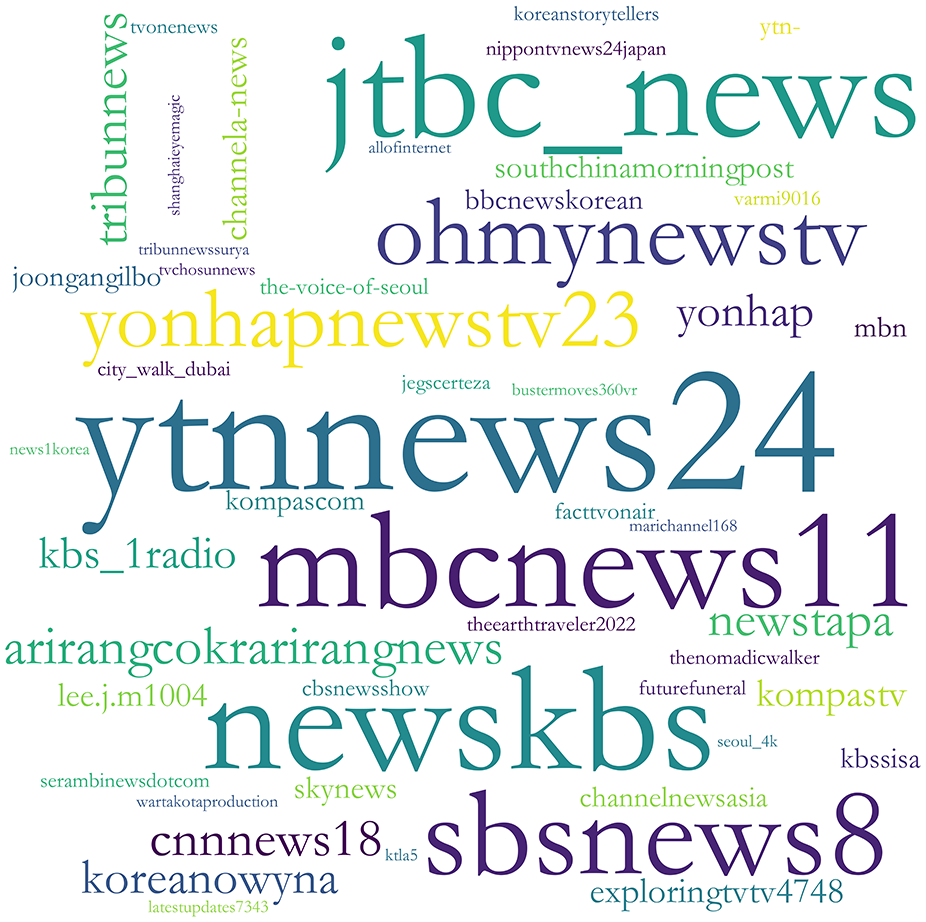
Word cloud of official agenda accounts.

Word cloud of public agenda accounts.
In public discourse, “99weed” takes the lead with 22 published articles, followed by “huvicraft” with nine articles. Subsequently, we have “applehotnews2959,”“nadujamtv,” and “seoulkoreawalk” with 6, 6, and 5 articles, respectively. The number of subscribers to public agenda accounts is significantly lower than official agenda accounts. The public agenda primarily consists of information disseminated by opinion leaders and ordinary citizens, serving as supplementary insights to the event. The accounts in the public agenda tend to focus their communication on specific segments or topics related to the incident. For instance, the account “99weed” consecutively posted on social platforms with on-the-ground videos following the stampede incident. The initial video, titled “Shortly before the Itaewon stampede on Halloween,” captured the vibrant atmosphere of the party before the tragedy unfolded. Subsequently, on November 1st, the account released a video titled “Halloween Itaewon Alley situation before Itaewon stampede,” showcasing the congested condition in a narrow alley near the Hamilton Hotel, providing a glimpse of the chaotic crowd and the suffering individuals within it.
From the overall frequency of publications, it is evident that official media outlets have a higher agenda-setting rate than the public agenda. Official media outlets possess more significant access to information resources and have played a continuous role throughout the entire process of the stampede incident, including its occurrence, the subsequent national political investigation, and accountability measures. Their consistent coverage has facilitated their comprehensive involvement in the event. On the other hand, the public agenda has managed to retrospectively gather primary-source information, integrating it into the narrative of the event as “eyewitnesses.” This has led to the supplementation of details and the ultimate convergence of information flow between the official and public discourse.
In reality, the ability demonstrated by risk communicators during risk communication plays a crucial role in influencing its effectiveness. Despite the advantage of official agenda-setting in terms of publication frequency, the public agenda has actively collected, organized, and interpreted information through various channels. It has further reflected upon and supplemented potential biases, information gaps, or vested interests that may be present in official reports. The official and public agendas have constructed an information network surrounding the Itaewon stampede.
Effectiveness of Risk Communication and Public Information Behavior
(1) The agenda has effectively facilitated the transmission of information regarding overall comments
By examining Figures 3 and 4, it becomes apparent that both the official and public agendas on the YouTube platform played a significant role in disseminating information to the general public regarding the Itaewon stampede. For one thing, it can be observed that both official and public agendas focused on critical aspects related to significant sudden safety events, particularly in the “risk information” attribute. As depicted in the graph, high-frequency word descriptions related to the time and location dimensions are prominent, including keywords such as “Seoul,”“capital,”“South Korea,”“Itaewon,” and “Halloween.” These nodes are located at the core of the network. Additionally, descriptions and narratives centered around the event itself, such as “stampede,”“tragedy,”“horror,”“horrible,”“happen,” and “die” also hold significance. This indicates that the agendas closely monitored and reported on the development and progression of the event, tracking and conveying relevant information.

Social network of agenda attributes.

Social network of overall comments.
Similarly, in the social network of overall comments, there is a significant amount of discussion surrounding the event. Time and location information, including “Itaewon” and “Halloween” and event-related information such as “accident” and “disaster” are prevalent. Research suggests that in the Itaewon stampede, agenda attributes impacted the social network of overall comments, effectively transmitting information through the depiction of risk information. The official media, as well as mainstream and social media, played the role of information disseminators in risk communication, providing the general public with accurate and in-depth risk information about the nature of the Itaewon incident, its occurrence, impacts, and response measures. This kind of information dissemination helps the public understand the current state of the risk, reducing anxiety, and panic-driven behaviors, stabilizing social emotions, and guiding orderly actions.
At the macro level, agenda-setting is not just a one-way transmission of information, but a key driver of public opinion formation. By describing and following events in detail, the official agenda effectively directs public attention to important risk information, ensuring the accuracy and timeliness of information dissemination. This dynamic demonstrates that official agendas have a powerful influence in shaping the public agenda and are a force to be reckoned with in risk communication.
(2) There is still a mismatch and time lag between the agenda and the societal discourse, indicating a disparity between information supply and demand
Comparing the social networks depicted in Figures 3 and 4, it is clear that significant disparities persist between the agenda and public interests following the Itaewon stampede. The discussions among the general public have become more diverse, encompassing political issues and scrutinizing government responsibility. Conversely, the overall agenda needs more substantial discourse, displaying a notable lag.
In the social network graph of overall comments, in addition to the aforementioned collective focus on core event-related information, several other discussion points emerge. Firstly, there is an analysis of the roles that the government, police, and law should assume in the Itaewon incident. Key terms include “national,”“policeman,”“illegal,” and “government.” Secondly, there is a heightened demand for accountability, manifesting as appeals for investigations, accusations, and disclosures, as indicated by terms such as “arrest,”“investigation,”“sue,” and “broadcasting.” Simultaneously, the general public expresses greater levels of dissatisfaction and anger, conveyed through terms like “criticize,”“bad,” and “profanity omitted.” In contrast, official and public agendas primarily employ descriptions and depictions of the calamitous nature of the event, focusing on discussions involving celebrities (“celebrate” and “famous”) and various social media platforms. There needs to be more divergence in the discourse surrounding the event and a need for more emphasis on accountability, policy transparency, crisis warnings, etc. Consequently, the depth of analysis needs to be more superficial, underscoring a disconnect between the supply and demand of social discourse.
This mismatch reveals an important reality in risk communication: official agendas often fail to fully cover public concerns, especially in the late stages of emergencies. This could not only trigger an emotional backlash from the public, but also lead to a sense of alienation from official information. This phenomenon shows that the official agenda must be more sensitive and flexible in responding to the actual needs of the public in order to effectively promote social stability and crisis management.
Moreover, the research presents a line graph illustrating the agenda trends and overall comments over time (Figure 5). It can be observed from the graph that the trends of the agenda and overall comments align for the most part. However, during the peak of general discussions around November 4, 2022, an absence in the agenda is noticeable. Furthermore, in early January 2023, when the Special Committee for the Investigation of the Itaewon Stampede held its inaugural hearing, the media agenda reached its zenith. They began focusing on communicating a summary of the crisis, its response measures, future risk management strategies, etc. However, this did not incite a significant increase in social discussions. During the “in crisis” phase, the general public exhibits a heightened demand for information, and they are more susceptible to intense and diverse emotions such as panic, anxiety, confusion, and dissatisfaction. Consequently, they may seek real-time information updates, share personal experiences, and critique or commend the government’s response measures on social media platforms. In the “post-crisis” phase, public sentiment tends to stabilize, and the efficiency of official risk communication diminishes. To strengthen the efficacy of risk communication, the media should progressively advance the timing of agenda setting to meet the information needs of most of society.
(3) As the settler of the public agenda, the public ascribe the responsibility of the official media in risk communication
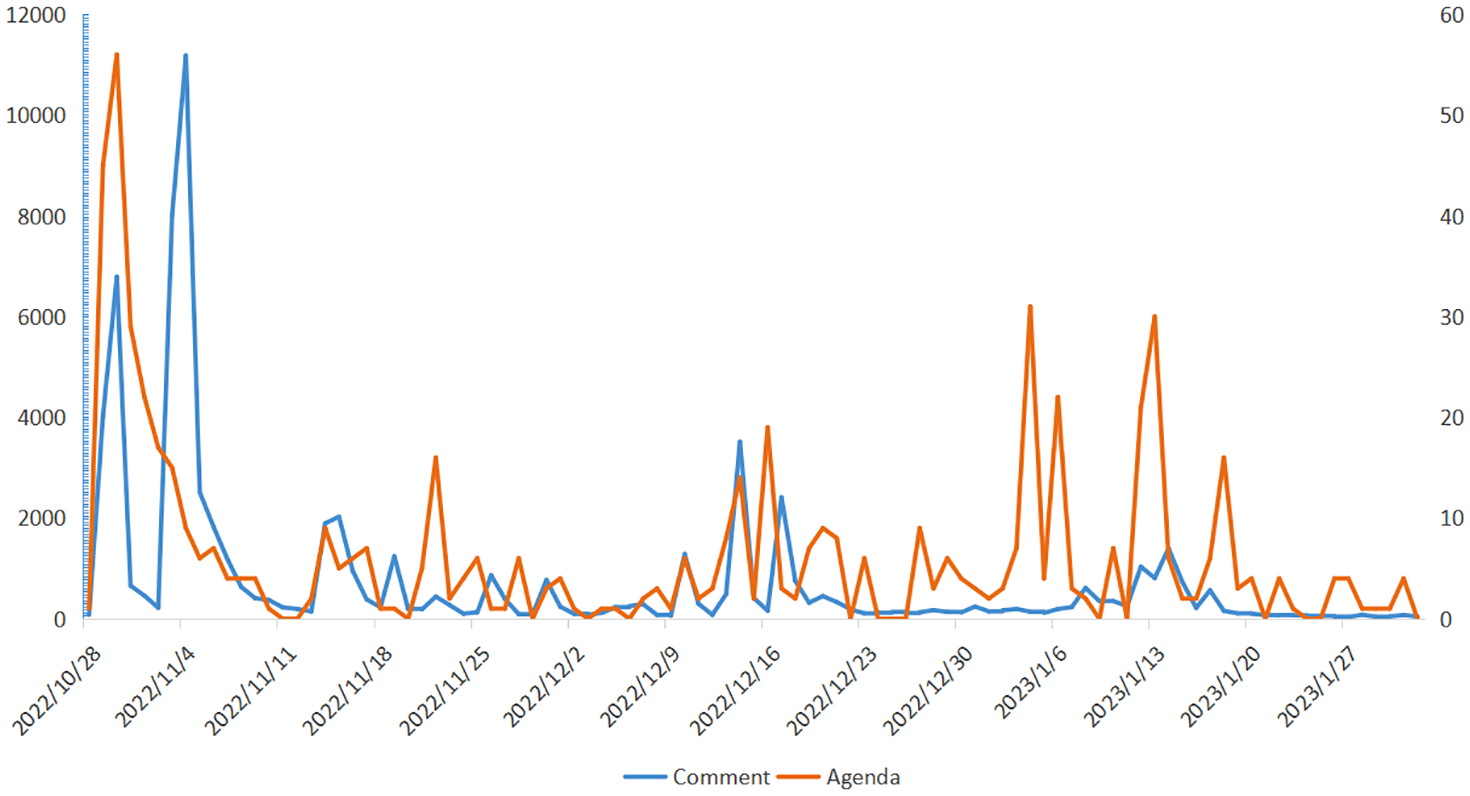
Quantity of agenda and public discussions.
In Figure 4, “mbc” is a node with a heavy proportion, which is not reflected in Figure 3. This suggests that the official and public agenda has avoided discussing the responsibility of the media to report on itself. However, as can be seen from the comments, the public has shown strong dissatisfaction with the agenda-setting of the official media, especially MBC. This dissatisfaction not only stems from the accident itself, but also reflects the public’s unique understanding of the role and responsibility expectations of the official media in major security incidents.
The day before the accident, MBC ran a promotional report on the upcoming Halloween event in Itaewon. Halloween is not an official holiday in South Korea, but MBC exaggerated its promotion, which is not in line with the standards of traditional state media. Subsequently, the report caused widespread attention, attracting a large number of people to Itaewon to participate in the event. After the accident, the public was quick to place some of the blame on MBC, arguing that its excessive and irresponsible promotion of the event, ignoring potential safety risks, ultimately led to the tragedy. Public criticism of MBC has focused on its status as an official media outlet, arguing that MBC failed to exercise its duty of care in carrying out such coverage and did not fully consider the potential security risks of the event. The criticism reflects the public’s high expectations that official media should assume higher moral and social responsibilities on issues involving public safety and ensure that the release of information does not cause potential risks.
Meanwhile, We-media, which also promotes Itaewon’s activities, has not faced similar criticism. The public has been tolerant of the reports from the media, believing that those who survived the accident were lucky to survive and escape. This very different response illustrates the different expectations the public has for the “We media” and the official media. We media is regarded as the voice of an individual or a small group, and the content it spreads is often regarded by the public as the sharing of personal opinions or interests. Therefore, when a risk incident is caused, the public is more likely to attribute the responsibility to their own judgment or chance, rather than the we media itself. This reflects that we media is more of a disseminator or witness of information in the eyes of the public, rather than a leader of the agenda or a promoter of events.
This contrast in the interaction between the agenda and comments highlights the public’s perception of the different positions of official media and we media in risk communication. As an official media, MBC is not only a transmitter of information, but also a setter of the public agenda and a guide of public opinion. The public expects state media to act prudently when reporting public events, especially major ones involving security, and to thoroughly assess the possible social impact of the reports. In such public security incidents, missteps in agenda-setting by state media can lead to a crisis of public trust. This will not only weaken the credibility of official media, but may also have a negative impact on their subsequent risk communication efforts. Therefore, when pushing the agenda, the media must be aware of the potential impact their coverage can have on public behavior, especially when it comes to sensitive issues such as crowds gathering and large-scale public events. Avoid unnecessary publicity in order to attract attention and ensure that its coverage does not become a trigger for risk. When faced with real risks and crises, official media must find a balance between providing timely and accurate information and avoiding causing unnecessary panic or risks, improve the credibility of official media and promote more effective risk communication.
The Consistency and Differences of the Topics
Official Discourse: Points of Agreement and Divergence
Figure 6 represents the social network graph of official agenda attributes, while Figure 7 depicts the social network graph of official agenda comments. Table 3 displays the clustering analysis of media coverage on official agenda comments, and Table 4 presents the clustering analysis of media coverage on official agenda comments. Based on these findings, the Itaewon stampede exhibits a balanced bidirectional relationship between agenda and comments within official discourse, encompassing both shared topics and the collision of derivative themes. For one thing, it can be observed that agenda and comments exhibit shared topics within the official discourse. Both the “senders” and “receivers” of information focus on the basic details of the event, such as the location and time, with “Itaewon” serving as a central node connecting other elements. There is also a shared concern regarding the negative impacts of the incident (casualties and property damage).
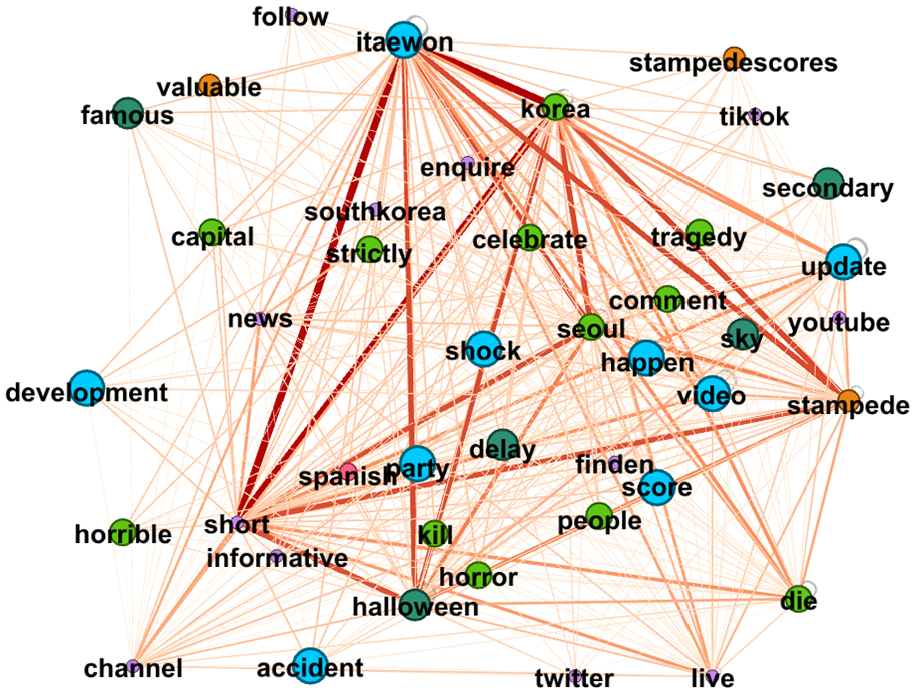
Social network of official agenda attributes.
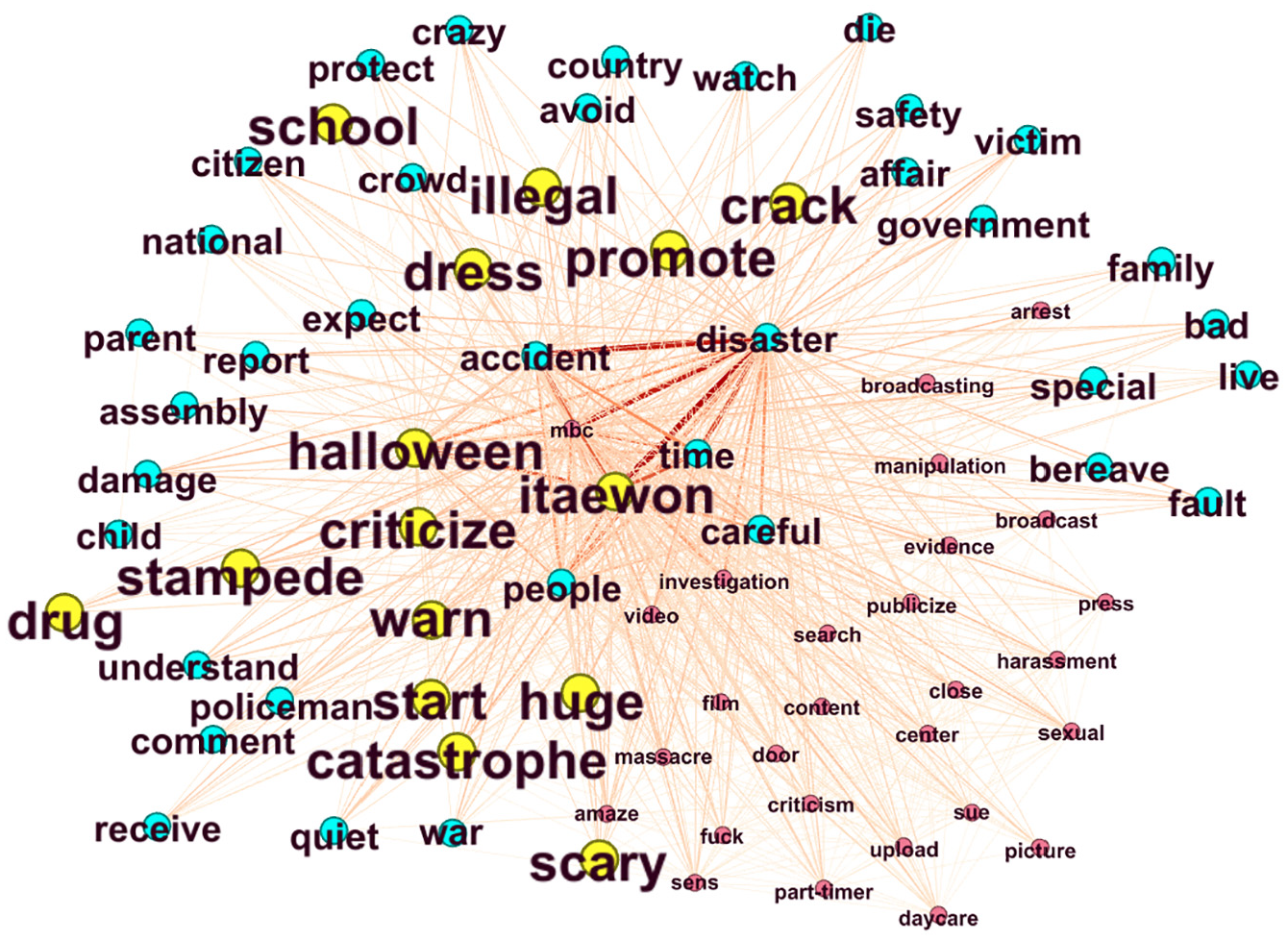
Social network of official agenda comments.
Cluster Analysis of Official Agenda Reporting.

Cluster Analysis of Official Agenda Comments.

However, the differences between agendas and comments are more pronounced within social network relationships. Firstly, due to the responsibility of disseminating information, official media channels emphasize the channels through which news is communicated. Social media platforms such as “YouTube” and “Twitter” are the primary channels for transmitting official agenda information. Secondly, adhering to the principle of news authenticity, official media outlets refrain from publishing content that includes subjective speculation. In contrast, the comments on official agenda discussions contain speculations about the causes of the incident, such as attributing it to “drug” use as a catalyst for the stampede. Thirdly, in reporting on the victims, official agenda coverage focuses not only on basic information, such as the number of fatalities but also includes the nationality of the victims as a news element. On the other hand, individual and familial hardships become the more crucial topics requiring attention for comments on the official agenda.
Lastly, and most importantly, the comments reveal the fear and anxiety among the general public regarding sudden public incidents. This, in turn, places higher demands on the functions of official media. In addition to dispelling uncertainty, official media outlets also need to address the psychological needs of the anxious and panicked public for “order demands.” This includes providing a sense of security, regularity, and certainty, which can help individuals feel safe and secure. Our findings reveal that the interaction between official agendas and official comments is not merely a process of information transmission and feedback. It is also an intertwining of emotions and values. Within this interaction, the pathways of information dissemination, the intensity of emotional expression, and the trends in topic evolution together form a complex social-psychological network. This novel macro description not only elucidates the role of official media during public emergencies but also reflects the psychological needs and emotional fluctuations of the public during crises, providing valuable insights for information dissemination and public opinion guidance in similar future events.
Public Discourse: Native and Derivative
Figure 8 represents the social network graph of public agenda attributes, while Figure 9 depicts the social network graph of public agenda comments. Table 5 displays the clustering analysis of media coverage on public agenda comments, and Table 6 presents the clustering analysis of media coverage on public agenda comments. Based on these findings, the Itaewon stampede exhibits an original and derivative relationship between agenda and comments within the realm of public discourse. From the agenda-setting regarding the event’s occurrence and negative impacts to the public’s independent interpretation and analysis of the stampede incident, the network of agenda relationships is significantly more robust than comments. Moreover, the emotional resonance and independent thinking within the comment network provide rich social-psychological resources for the deepening and expansion of the agenda.

Social network of public agenda attributes.

Social network of public agenda comments.
Cluster Analysis of Public Agenda Reporting.

Cluster Analysis of Public Agenda Comments.

In the public agenda comments, “Itaewon,”“people,” and “play” occupy central positions within the network, indicating that in the public’s perception, Itaewon was once, or should have been, a place for people to relax and engage in leisure activities. However, following the stampede incident, the closure of some commercial regions in Itaewon and a decrease in visitors have deprived the area of its former vibrancy. This topic was not extensively covered in the agenda network but is prominently present in the comments, resonating with most people. To some extent, Itaewon has evolved beyond a simple geographical reference and activity hub. It now symbolizes a lifestyle and spiritual pursuit. The shifts in regional perception reveal the impact of the stampede event on Itaewon’s socio-cultural significance, while also reflecting the public’s profound reflection and emotional projection regarding this transformation.
Testing the Effectiveness of Agenda Setting
After analyzing the aforementioned official discourse and public discourse, this study aims to examine the agenda-setting effects between the official agenda, public agenda, and their corresponding comment fields. To achieve this, JS distance was used to calculate the similarity of agenda matrices across different domains, and smaller values indicate higher similarity between the subjects. As shown in Table 7, the official agenda has the most significant influence on the public agenda, official comments, and public comments. This is closely related to the authority of the official agenda and its proactive agenda-setting nature. Although the previous analysis revealed a mismatch and temporal nature of information supply and demand in the public agenda and public comments, with some criticisms of MBC media for excessive promotion and sensationalism, the official media still plays a central role in risk governance. It continues to fulfill tasks such as information dissemination and policy disclosure in risk communication.
Effectiveness of Agenda Setting for Official and Public Agendas.

Emotional Resonance and Dynamics of Agenda Setting
The Interplay Between Negative and Positive Emotions
This study investigates the sentiment orientation of official and public comments regarding the Itaewon incident and uses it as supporting evidence for risk perception. The sentiment orientation of each user comment was calculated using natural language processing techniques. High-frequency sentiment words were identified through frequency analysis, and their origins were traced to explore the specific factors that triggered user emotions. The study found that the overall sentiment orientation of the comments was negative. Most of the public expressed negative sentiments toward the number of deaths caused by the incident and believed that there may have been malicious intent behind the event. However, a considerable portion of the public expressed encouragement, approval, and praise for the actions of the police and firefighters in rescuing and assisting the victims. They also praised the prosecutor’s impartial conduct during the investigation process.
Firstly, the VADER sentiment analyzer from NLTK was utilized to calculate the sentiment orientation of the comment texts. The sentiment intensity of the text was measured on a scale from −1 to 1, with negative values indicating negative sentiment and positive values indicating positive sentiment. The overall average score was −0.055, as shown in Table 8.
Sentiment Analysis.
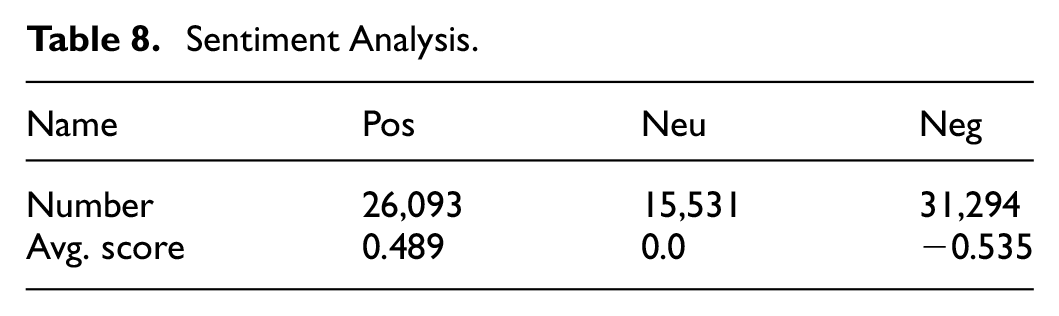
The sentiment analysis results indicate that nearly half of the comments express negative sentiment, accounting for 43%. Positive sentiment comments reached 36%, while the overall sentiment orientation of the comments leans toward the opposing side.
Next, to identify the specific risk elements that trigger social emotions, this study selected 13 words with clear emotional orientation from the top 100 ranked by frequency, as shown in Table 9. These high-frequency sentiment words were then traced back to their context in the comment texts to explore the objects or factors that generated positive or negative societal emotions.
High-Frequency Words in Sentiment Analysis.

The study identified four main factors underlying negative sentiment.
Firstly, the fear, pain, and traumatic experiences caused by the deaths in the Itaewon stampede. The tragic consequences of numerous injuries and fatalities in the stampede have triggered societal concerns about personal safety and raised questions about the management of public venue safety. This sense of fear encompasses concerns for individual safety, social order, and public governance.
A parent who has lost a child. My heart is breaking for the rest of my life. It’s sad and sad..child carelessness.
The second factor is the sorrow and sadness expressed toward the death of specific individuals, such as the idol Lee Ji Han. This has evoked mourning and emotional resonance within society, reflecting the emotional attachment of individuals to idol figures.
The third factor is the rejection and speculation surrounding specific media coverage. Some members of the public believe that MBC’s reporting had ill intentions in deliberately influencing public opinion. Additionally, there were perceptions of biased, uncertain, or shallow analysis in the media’s coverage of the event.
The fourth factor is the need for more trust in government institutions and the national system. Korean leaders and their government have become targets of criticism, and there is a sense of distrust toward their response measures and public safety management. This lack of trust reflects the gap between the public’s expectations and the reality of government institutions, which subsequently affects societal attitudes toward the event.
Indeed, positive emotions stem from recognizing contributions made by specific individuals. For example, the police, firefighters, doctors, and other medical personnel who provided dedicated care to the injured are appreciated and praised. Their efforts and dedication in caring for the victims have generated positive societal sentiments.
Police officer, you did your best. Do not lose courage and cheer up. This police officer prevented further damage and did his best. Please do not feel guilty and work harder~~!
Additionally, many comments focus on Itaewon as one of Seoul’s most prosperous regions, once a vibrant and joyous place but now marred by tragedy.
Haha. Is Itaewon a place where you would normally lose your life? Wherever I go in downtown Seoul, I have to dry everything. This is the time to ban the Halloween festival. What is the Itaewon disaster? I went to the Halloween Festival and was killed in disorder.
Despite the significant number of casualties resulting from the stampede incident, which would typically be expected to elicit predominantly negative emotions in public sentiment analysis, the recognition of certain individual narratives has somewhat mitigated the overwhelming pain associated with this immense tragedy. This insight provides valuable implications for subsequent risk communication efforts, suggesting that directing attention toward individuals or groups that have made exceptional contributions can help alleviate emotional distress during emergencies. Additionally, vigilance should be exercised regarding the societal shifts in emotional response toward Itaewon and festive occasions.
The Resonance of Emotions Between Topics and Comments
This article utilizes the SentimentIntensityAnalyzer, a VADER sentiment analysis tool from the Natural Language Toolkit (nltk) library in Python, to conduct sentiment analysis on sentences. It calculates the sentiment scores for four modules between October 15, 2022, and February 1, 2023, and visualizes the results using the Plotly library for analysis.
Figure 10 illustrates the fluctuating sentiment patterns of each module over time. The public sentiment toward the Itaewon stampede event is negative, ranging between 0 and 0.25, with slight upward trends. This suggests that as the investigation results were revealed, society gradually reduced its attention to the event, leading to a calming of emotions. The official agenda and comments reached peak values during specific periods, indicating a differentiated yet assimilated resonance of emotional responses to the agenda. Although the earlier analysis showed a relatively low emphasis on the official discourse framework regarding accountability and reflection on sensitive issues, it does not imply avoidance or negligence on the part of the authorities. Through the influence of public agendas and comments, the official media gradually engaged in retrospective evaluation and introspection of their prior reporting practices. This process reflects the interactive relationship between the official and public discourse fields, with the public discourse field gradually influencing the attribute selection and value orientation of official reporting.

Changes in sentiment analysis scores.
Conclusions
The present study employs a research method based on the Itaewon stampede in South Korea, utilizing a network agenda-setting approach and referencing the CERC model. By analyzing 615 valid official and public agendas and 72,918 related comments collected from the YouTube platform using “Itaewon” as the search keyword, this research utilizes the Word2vec model and sentiment analysis algorithms to explore the agenda characteristics on social media platforms during major emergency risk events. The study aims to analyze the consensus and discrepancies between official and public agendas in risk communication and understand their interactive relationship. It provides reference and assistance for media reporting focus, practical administrative actions by the government, and risk communication. Additionally, it offers empirical evidence for agenda-setting in the field of sudden safety incidents in academia.
Unlike the positive image traditionally established by official media in risk communication, this study reveals that official media can also pose potential safety threats while fulfilling their information dissemination responsibilities, underscoring the necessity of proactive risk communication. The interaction between agendas and comments transcends mere transmission and feedback of information, it represents a negotiation of diverse values and emotional narratives. At the same time, caution is warranted regarding the public’s evolving perceptions of the Itaewon area following the incident, which could lead to a series of cognitive risks within the social structure. The lingering uncertain risk factors associated with such emergencies, although not immediately visible, may contribute to the systemic existence of risks for a prolonged period. Issues related to accountability and unresolved perceptions and emotions raise higher demands for future dynamic and long-term risk governance and situational order.
From the perspective of a new emotional resonance and interaction model, this study uses a combination of online agenda setting and sentiment analysis to explore how the interaction between the official and public agenda affects the public’s risk perception, which has important adaptability to the current debate in the field of risk communication and crisis management. A central debate in the current field of risk communication is the interaction and antagonism between the dissemination of official information and public response. This paper reveals the information asymmetry and time lag between the two, which directly reflects the widespread existence of trust crisis in current risk communication. The study emphasizes the role of emotion in risk communication, adapts to the debate on timeliness and information mobility, and supports the idea that government and media response speed and information transparency need to be improved during crisis events. The paper also puts forward a new perspective on the accountability mechanism in risk management.
Limitations and Future Research
This paper also has some limitations. Firstly, the integration of agenda-setting theory with risk communication theory is somewhat ahead of the curve, making it difficult to apply within conventional frameworks. Instead, the paper focuses more on the application of NLP techniques, which, although effective for analyzing word frequency and sentiment, may fall short in capturing the broader context and nuanced meanings within the text. These techniques might overlook the deeper semantic relationships that exist between topics and the intricate structure of the underlying semantic networks. Furthermore, by only analyzing messages from South Korea, the study lacks comprehensive coverage. It does not take into account the broader spectrum of data, nor does it engage in long-term tracking of the effects of risk communication. This limitation suggests that the findings may not be easily generalizable to other cultural contexts, particularly those with different social and media structures. Additionally, the paper does not explore the long-term dynamics between public sentiment and agenda setting, missing the opportunity to analyze how events may continue to influence public opinion over time.
If future researchers seek to build on this work, several potential avenues for enhancement could be considered. For instance, more sophisticated semantic analysis methods, such as deep learning models, could be introduced to achieve a more profound understanding of the interplay between text context and topic. Incorporating agenda attributes into the analysis could provide a more comprehensive picture of agenda-setting, capturing its multidimensional facets more accurately. Furthermore, designing studies that span a longer timeframe and involve cross-cultural comparisons would allow researchers to better observe how agenda-setting and public sentiment evolve over time across different regions and social environments. Such approaches would offer deeper insights into how public sentiment can be managed and guided more effectively in the long run, particularly in response to various risk-related events.
Footnotes
Acknowledgements
We are appreciated by the State Key Laboratory of Media Convergence and Communication of Communication University of China for its financial support and topic selection guidance for this study; Meanwhile, Prof. Shen Hao, Associate Professor Yunfang Cui and Dr. Yuan Fang’s valuable comments on this paper have helped the study to gain deeper significance
It is worth mentioning that some of the findings of this paper have been previously recognized and presented at the International Association for Media and Communication Research Lyon23 and OCP23

Ethics Approval and Consent to Participate
Not applicable.
Consent for Publication
All authors have read and agreed to the published version of the manuscript.
Author Contributions
All authors contributed to study conception and design, data collection, analysis and interpretation of results, draft manuscript preparation, reviewed results and approved the final version of the manuscript.
Funding
The author(s) disclosed receipt of the following financial support for the research, authorship, and/or publication of this article: China Postdoctoral Science Foundation (2023M743278) and the Fundamental Research Funds for the Central Universities (CUC23GY011).
Declaration of Conflicting Interests
The author(s) declared no potential conflicts of interest with respect to the research, authorship, and/or publication of this article.
Data Availability Statement
Research Data that support the findings of this paper is openly available.