




Abstract
Active consumer engagement on social media platforms can effectively enhance brand awareness, loyalty, and word-of-mouth. While numerous studies have examined the impact of content and media characteristics on consumer engagement (CE), the specific effect of different brand attributes on CE on Douyin remains underexplored. To address this research gap, this study applies attribute agenda-setting theory to explore how brand attributes drive consumer engagement on Douyin. The study used survey data from the Chinese sportswear brand ERKE’s customer community on Douyin. The partial least squares structural equation modeling (PLS-SEM) was employed to examine how media use, attribute agenda-setting, and the need for orientation (NFO) contribute to brand communication effectiveness on Douyin. Findings showed that all direct impacts were statistically significant, but no differences between structural models for different NFO groups were found. The study highlighted the role of attribute agenda-setting in brand communication, showing that emphasizing substantive attributes stimulates primer CE while emphasizing affective attributes fosters deeper CE. This work extends agenda-setting theory and offers insights for branded content management, suggesting a balance of substantive and affective attributes to enhance CE.
Plain Language Summary
This study explores how brands can effectively engage customers on social media platforms like Douyin (China’s TikTok). Using the Chinese sportswear brand ERKE as a case, the research investigates how emphasizing specific brand traits—like product quality (substantive attributes) or emotional connections (affective attributes)—influences customer interactions. Key findings show that when brands highlight practical features (e.g., affordability, durability), customers are more likely to consume content (e.g., watching videos) passively. However, when brands focus on emotional themes (e.g., pride, gratitude), customers engage more deeply by commenting, sharing, or creating their content. The study also reveals that frequent social media use strengthens these effects, as users exposed to more branded content become more influenced by the brand’s messaging. Interestingly, the research found no major differences between groups with varying levels of interest or uncertainty about the brand (Need for Orientation), suggesting that consistent content strategies work broadly across audiences. For businesses, the takeaway is clear: balancing practical and emotional content can boost engagement. Start with solid product-focused messaging to build recognition, then weave in emotional stories to inspire deeper interactions. Regularly posting and encouraging user participation (e.g., challenges, shares) can further amplify a brand’s impact.
Introduction
Social media has evolved into the dominant space for routine interactions between brands and consumers (Arendt, 2024; Bae et al., 2022). In China, Douyin (the Chinese counterpart of TikTok) plays a central role in driving brand visibility and consumer engagement (Jiang, 2023; Wang & Li, 2024). Brands invest heavily in always-on content production, community management, and paid boosts on Douyin (Wu et al., 2023). For instance, ERKE has accumulated more than 13 million followers, posted nearly 2,800 videos, and appeared 35 times on Douyin’s hot-search list between March 2023 and March 2024. However, despite such extensive activity and visibility, conceptual clarity regarding the content attributes that most effectively drive customer engagement has not been fully established.
This uncertainty constitutes a managerial dilemma in which social media content production demands substantial resources while outcomes remain unpredictable. Some posts achieve virality, whereas others are overlooked (Theodorakopoulos et al., 2025). Furthermore, managers often depend on subjective judgment when determining whether to emphasize substantive attributes such as product quality and functionality or affective attributes such as humor and inspiration (Soremekun et al., 2024). This gap underscores the need for empirical investigation into the content attributes that most effectively drive different forms of customer engagement.
Agenda-setting theory offers a useful framework to address this challenge. Agenda-setting originates in the study of political communication effects, which posits that identifying audience opinions is influenced by the content they access in the media (Abdi-Herrle, 2018; Conway-Silva et al., 2018; McCombs & Shaw, 1972), thereby influencing their political and social participation behavior and decision-making (Moon, 2013). The original agenda-setting hypothesis focused on testing the correlation between the salience of objects in media coverage and the audience’s perception of object salience (McCombs & Shaw, 1972). Later research hypotheses also identified that media prominence of object attributes or themes influences how audiences perceive object salience (attribute agenda setting; McCombs & Stroud, 2014). The attribute agenda-setting perspective suggests that emphasizing certain attributes affects the salience assigned by audiences and influences subsequent attitudes and behaviors (Almakaty, 2025).
While previous research has extensively documented these effects in political contexts (Conway-Silva et al., 2018; Moon, 2013), its application to brand communication remains underexplored. Existing research has primarily examined how specific factors within short-form video content, such as information quality and creator cues including humor and follower count, shape consumer engagement (Luo et al., 2025; Meng et al., 2024; Walsh et al., 2024). For instance, Walsh et al. (2024) indicate that content creator popularity and brand size function as significant determinants of consumer engagement. Meng et al. (2024) identify that trustworthiness, expertise, attractiveness, and authenticity in short-form ads significantly influence engagement. Zhang and Zhang (2025) conduct a multimodal empirical investigation into short-form brand video advertisements, demonstrating that visual features, and speech text features are the most influential determinants of consumer engagement behaviors. Nevertheless, the impact of agenda-setting effects of brand content on consumers’ perceptions of the brand and its influence on consumer engagement and decision-making has not been theoretically conceptualized as a mechanism that links brand-generated content to consumer engagement.
To address this gap, this study employs attribute agenda-setting theory to investigate the presence of agenda-setting effects in brand communication, specifically examining how brand attributes in Douyin videos influence consumer engagement. Previous research identifies that corporate media content positively influences CE (Cuevas-Molano et al., 2021). This is extremely similar to the hypothesis of agenda-setting theory in which the attributes of the media’s salient objects positively influence the audience’s propensity for political engagement (Moon, 2013). Therefore, this study proposes the hypothesis that the salience of brand attributes in branded media positively influences CE. Furthermore, from the empirical results, Van Doorn et al. (2010) indicate that CE is a multidimensional link between a customer and a brand which transcends mere purchase behavior and probably with deeper interactions to achieve positive outcomes, such as enhancing brand image (Loureiro & Lopes, 2019) and cultivating brand loyalty (Samala et al., 2019). Similarly, both the media and candidates share the same objective in agenda-setting, with candidates leveraging the media to promote the salience of their positive attributes in order to enhance voter familiarity and favorability, ultimately influencing the referendum outcome (Camaj & Weaver, 2013). Based on the similarities mentioned above, CE may seem to be an outcome of the role of agenda-setting effects in brand communication, but it has not yet been tested by research.
Therefore, based on this background, the following research questions are formulated to guide this study.
The theoretical importance of this study lies in the innovative testing of agenda-setting effects in brand communication and provides valuable insights for brands seeking to effectively promote their content on social media platforms. CE as a predictive outcome of agenda-setting effects for brand attributes, the research tests the critical role of agenda-setting-related concepts on CE. While in political communication, the behavioral implications of agenda setting have been discussed by numerous scholars such as Kiousis and McDevitt (2008), Moon (2013), and Feezell (2018), its impact on CE in brand communication has not been fully investigated. It is also inconclusive whether there are differences in the impact of the salience of attributes of different dimensions on CE. Therefore, previous research in the field of political communication provides conceptual support for this study’s model, which employs media use and need for orientation (NFO) as antecedents influencing the impact of attribute agenda-setting, and examines the impact of attributes in brand agenda-setting by differentiating them into substantive and affective separately on the different dimensions of CE, thereby bolstering the PLS-SEM in a theoretically robust manner.
Literature Review
Attribute Agenda-Setting Effects
This study builds on the attribute agenda-setting theory, an extension of the classic agenda-setting theory (McCombs & Shaw, 1972). Whereas traditional agenda-setting theory emphasizes how media highlight certain issues to shape public perceptions of their importance, attribute agenda-setting focuses on how media and brand communication emphasize specific attributes of an object, such as a brand, product, or political candidate, thereby shaping audience perceptions of those attributes and influencing subsequent behaviors (Almakaty, 2025; McCombs, Shaw, & Weaver, 2018).
Within attribute agenda-setting theory, attributes are generally divided into substantive and affective dimensions (Arendt, 2024). Substantive attributes capture the functional, measurable, and utilitarian features of a brand or product, such as quality, price, or performance, which facilitate rational evaluation and strengthen perceptions of brand competence and credibility (Bae et al., 2022). In contrast, affective attributes reflect the emotional connections and responses that brands evoke, including trust, attachment, excitement, or empathy, thereby fostering emotional bonds with consumers and playing a critical role in cultivating loyalty and shaping long-term attitudes (Ahn & Back, 2018; Ghorbanzadeh & Rahehagh, 2021).
Previous research has shown that both substantive and affective attributes influence consumers’ brand perception and engagement behaviors. For instance, Wang et al. (2021) argue that brands’ strategic focus on specific attributes can influence consumer perceptions, which ultimately affects their purchase intentions and brand loyalty. Xi et al. (2022) similarly confirm that increasing the salience of brand attributes can lead to more positive consumer behaviors, such as a higher likelihood of choosing and purchasing branded products.
However, there is some debate in the literature regarding the impact of affective attributes on consumer behavior. Studies by Alwi and Kitchen (2014) have demonstrated that both cognitive and affective attributes play a crucial role in shaping corporate image, with affective attributes often having a stronger influence on consumer behavior. This aligns with the findings of Li et al. (2020), who suggest that affective attributes significantly contribute to brand loyalty. However, some studies have found that affective attributes do not have a positive effect on customer behavior (Anatolevena Anisimova, 2007). Anatolevena Anisimova (2007) found that while cognitive attributes may directly impact consumer behavior, affective attributes do not always have a significant effect, particularly when consumers prioritize functional over emotional benefits. Moreover, the impact of attributes on CE has not yet been discussed.
In summary, in brand communication, the salience of brand attributes on different dimensions affects consumer perceptions of the brand, but there is a debate on whether it positively affects customer engagement and behavior. This study employs attribute agenda-setting theory to explore how brand content on Douyin influences consumer engagement. Specifically, it investigates the impact of increasing the salience of substantive and affective attributes on enhancing consumer engagement. This study lays the foundation for exploring how attribute-level salience translates into consumer engagement, thus addressing a critical gap in previous brand communication research.
Media Use and Attribute Agenda-Setting
Attribute agenda-setting theory suggests that the media plays a significant role in shaping the individual’s perception of issues and attributes (Chung et al., 2023). In the context of brand communication, previous research has identified an audience’s media use intensity as a significant predictor of attribute agenda setting effectiveness (Camaj & Weaver, 2013). Specifically, it is found that media use intensity predicts the extent to which mass media sets an audience’s attribute agenda (Camaj & Weaver, 2013). The extent of media use is typically evaluated by assessing audience media exposure and media attention (Shi & Nagler, 2020), both of which directly impact media agenda-setting effects (Camaj & Weaver, 2013). The greater the intensity of media use, the stronger attribute agenda-setting effect on the audience. On social media, Feezell (2018) found that the more frequently audiences use social media to access information, the more significant the agenda-setting effect they are subjected to.
Previous studies indicate that media use positively affects consumers’ perceptions of both substantive and affective brand attributes (Dzreke & Dzreke, 2025). Regular media exposure enhances consumers’ awareness and comprehension of product features, which can substantially influence their evaluation of substantive attributes. A study by Dzreke and Dzreke (2025) on the impact of social media platforms revealed that 70% of consumers rely on social media to gather product information and features, thus shaping their purchasing decisions. Moreover, media usage, particularly through social media platforms, cultivates positive emotional connections and enhances emotional engagement with brands by exposing consumers to brand narratives, customer stories, and influencer content. Barreda et al. (2020) observe that social media interactivity and rewards can improve brand image, thereby strengthening emotional attachment to the brand. To explore how media use affects customer attribute agenda-setting effects in the field of social media brand communication, the following hypothesis is proposed:
Customer Engagement (CE)
Van Doorn et al. (2010) conceptualize CE as a behavioral structure, defining it as the customer’s actions and interactions with a company/brand/product. This concept distinguishes itself from expenditure by emphasizing interaction rather than mere spending. Today, social media serves as a substantial driver of CE by fostering two-way interactions between customers and organizations (Deighton & Kornfeld, 2009; Dwyer, 2007; Vivek et al., 2012).
Most recent studies have determined that CE is a multidimensional construct, with a consensus that CE encompasses a continuous sequence of emotion, behavior, and cognition (Alvarez-Milan et al., 2018; Hollebeek, 2018). According to Hollebeek (2018), cognitional CE consists of self-elaboration and a personalized understanding of the brand that is generated through user interactions. Emotional CE refers to the short-term or long-term emotional connection the user builds with the brand, while behavioral CE is comprised of the tangible actions that take place between users and brands.
This study acknowledges the multifaceted character of customer engagement but focuses on behavioral customer experience for three main reasons. Firstly, behavioral CE remains implicit in its conceptualization, and defining it as such does not exclude its psychological relevance (Harmeling et al., 2017). Additionally, the abstract nature of other CE dimensions makes them difficult to evaluate and manipulate, while measuring behavioral CE is relatively intuitive and straightforward. Finally, as this study examines the interaction between a sports brand and its customers on Douyin, and recent research has underscored the significance of behavioral CE in the consumer goods industry (Alvarez-Milan et al., 2018), this dimension is determined to best fit the context of this study.
In this study, customer engagement is conceptualized as the central dependent variable. It is measured through three distinct levels: Consumption, Contribution, and Creation, all of which represent different degrees of engagement. Consumption refers to passive brand-related activity, such as browsing content (Muntinga et al., 2011). This level of engagement does not involve direct interaction between users and the brand and therefore constitutes the lowest degree of engagement (Schivinski et al., 2016). Contribution represents the user response in brand-to-point or point-to-content interactions (Shao, 2009), signifying a medium level of CE.
Commenting on an article or “liking” a piece of content marks the user’s transition from a passive observer to a contributor to the media (Schivinski et al., 2016). According to Schivinski et al. (2016), commenting is a kind of creating. While Muntinga et al. (2011) argued that creation is also a sort of engagement, and it is regarded as the highest degree of participation in the context of CE and typically involves some form of user empowerment, such as spontaneously helping the brand spread information and recommended content (Tiu Wright et al., 2006), as well as user participation in the creation of user-generated content (UGC) including creating content related to the brand (Schivinski & Dabrowski, 2014). These actions of creation may stimulate further consumption and/or additional contributions by peers. In most research, sharing and UGC are treated as the main manifestations of creation.
Media Use and CE
In agenda-setting studies, media use refers to the frequency with which audiences engage with media and how much of their attention is devoted to specific thematic content (Camaj & Weaver, 2013; Drew & Weaver, 1990). In CE research, media use is usually characterized by active customer engagement in messages on social media. This engagement takes the form of actions such as quoting, liking, sharing, or leaving comments (Van Krieken, 2019). These online interactions also serve as crucial predictive indicators in CE studies (Schivinski et al., 2016). Scholars consider these indicators to be indicative of consumer media exposure and attention. Oh et al. (2017) point out that the number of likes on Twitter may indicate not only the degree of consumer exposure to media but also conscious attention to specific content. In other words, media use is mentioned more as a behavioral representation of CE.
The proliferation of social media, particularly short-form video platforms, has significantly facilitated consumers’ access to brand-related information in a seamless and convenient manner (Papakonstantinidis, 2017). Additionally, media use now empowers consumers to publicly and effortlessly articulate their attitudes and opinions toward various brands through interactions such as commenting, liking, and sharing (Buzeta et al., 2020). Extant literature highlights that social media has rendered the CE more intricate and dynamic, fostering not only direct communication between customers and brands but also facilitating dialogue among customers themselves (Prentice et al., 2020). In this context, media use further enables consumers to assume roles as active participants and co-creators in the construction of brand narratives (Lim & Rasul, 2022). Therefore, the following hypothesis is proposed:
Attribute Agenda-Setting and CE
Previous research has emphasized the crucial role that specific brand attributes play in shaping customer perceptions and driving their behaviors (Ahn & Back, 2018; Ghorbanzadeh & Rahehagh, 2021). Golan et al. (2007) identified a correlation between the salience of attributes towards candidates in political advertisements and the salience of attributes perceived by the audience. Political advertisements attempt to identify certain candidate issues and attributes as more salient than others (Golan et al., 2007). Subsequently, previous research has identified attribute agenda-setting effects as having a significant impact on audience political participation (Kiousis & McDevitt, 2008; Moon, 2013). There seems to be a similar need for brand content, where the real purpose of agenda setting is to focus consumers’ attention on specific brand attributes. Several scholars have emphasized that the salience of brand attributes has a significant impact on consumers’ perceived brand image, and that this relationship ultimately influences customers’ responses and behaviors. Vinhas Da Silva and Faridah Syed Alwi (2006) found an empirical relationship between brand attributes and customers’ perceived corporate image. Anatolevena Anisimova (2007) found that firms’ emphasis on the attributes in question made it easier for consumers to identify the brand and had a significant effect on consumer attitudes and behavioral loyalty. Ab Hamid et al. (2023) separated brand attributes into cognitive and affective and find that the salience of some attributes in brand content had a positive effect on customer loyalty and behavior.
However, a review of the relevant literature suggests that while the salience of specific attributes in brand content plays a prominent role in customer perceptions and behavior, research on the brand agenda-setting effect on CE is more limited. Based on these insights, the following hypotheses are proposed.
Need for Orientation (NFO) and Agenda Setting
Need for Orientation (NFO) refers to an individual’s psychological disposition toward information, impacting agenda-setting effects (McCombs et al., 2018). Initially introduced by McCombs and Weaver (1973), NFO emphasizes that the public actively seeks information, influencing their susceptibility to agenda-setting effects (Matthes, 2006).
NFO, initially comprising relevance and uncertainty dimensions (McCombs & Weaver, 1973), delineates interest and information need. High interest with limited information results in high NFO, forming four levels: high, active involvement (high relevance, low uncertainty), passive involvement (low relevance, high uncertainty), and low (Camaj, 2014).
Research has shown that high NFO is associated with stronger adoption of media agendas and increased media use, driving attribute agenda-setting effects (Camaj & Weaver, 2013; Weaver, 1980). Though NFO has not been explicitly studied in brand communication, it can be seen as a precursor to information-seeking behavior, which serves as an important intrinsic motivator influencing consumer perceptions of the brand (Qin, 2020). As NFO rises, engagement with detailed, factual brand information increases, amplifying substantive attribute agenda-setting effects. Einwiller et al. (2010) emphasized that individuals’ levels of relevance or uncertainty independently predict individuals’ information seeking about company behavior or issue positions, and that they are two of the key factors of NFO. Logically, the higher NFO, the stronger the motivation for information seeking, the higher the degree of media use, and thus the more significant the influence of attribute agenda setting (Camaj & Weaver, 2013).
The relationship between NFO and affective attributes is more complex. Traditionally, individuals with high Need for Orientation (NFO) have been considered to focus predominantly on substantive attributes rather than affective attributes (Matthes, 2006). However, recent research challenges this perspective, suggesting that high-NFO individuals may also respond positively to emotional attributes when these attributes are aligned with brand-related, informational content (Jindal et al., 2023). Affective attributes, which tap into the emotional and experiential facets of a brand, appeal to consumers’ emotions, values, and sense of identity (Vo et al., 2025). As previously discussed, in the context of brand communication, consumers with high NFO actively seek, process, and deeply engage with brand information (Qin, 2020). Chang (2013) argues that in narrative advertising, the uncertainty introduced by the plot motivates consumers to allocate more cognitive resources, which, in turn, enhances their perception and experience of the emotional cues within the advertisement. This deeper processing amplifies the emotional effectiveness of the ad, ultimately leading to stronger emotional responses to the brand and fostering more positive engagement. Therefore, the following hypotheses are proposed:
NFO and CE
NFO has been established as a psychological motivator shaping audience information-seeking behavior (Camaj, 2019). In brand communication contexts, this motivational disposition can significantly impact customer engagement (CE) across its behavioral dimensions of consumption, contribution, and creation by activating distinct cognitive and behavioral mechanisms (Qin, 2020; Silaban et al., 2022).
Individuals with high NFO demonstrate increased consumption of brand-related media content, as active information seeking serves to alleviate their uncertainty and satisfy relevance-based interests (Cornelissen et al., 2019). This cognitive need drives more frequent exposure to brand messages and seek advice, facilitating passive yet attentive consumption behaviors (Carlson et al., 2019; Wang & Lee, 2020).
Furthermore, high NFO may also promote contribution behaviors, such as liking and commenting, as users attempt to engage in social learning and acquire additional information through interaction with other consumers (Silaban et al., 2022). Additionally, users with high NFO may generate original content when they perceive that existing information is insufficient or when they wish to establish themselves as knowledgeable sources within the community (Wang & Lee, 2020).
High-NFO individuals are more likely to engage with content that resonates emotionally, as it reduces uncertainty and fosters an emotional connection with the brand (Matthes, 2006). Moreover, driven by both substantive and affective needs, high-NFO individuals contribute to discussions and create content to express their emotional responses, thereby enhancing their engagement in consumption, contribution, and creation (Silaban et al., 2022; Wang & Lee, 2020).
Based on the discussion of the existing research, we have developed a research model (Figure 1).

Research model.
Methods
This study employed media content analysis and survey research to examine customer engagement of ERKE, a Chinese sportswear brand. Founded in 2000, ERKE faced near bankruptcy but made a remarkable comeback in 2021, generating approximately 3.323 billion CNY (around 470 million USD) in revenue within a year. This revival is credited to charitable donations and responsive engagement with consumer feedback on Douyin, salvaging the brand’s reputation. Given its rapid comeback and the pivotal role of Douyin in its brand strategy, ERKE presents a unique and significant example for examining how a brand can utilize media platforms to set an agenda, build brand equity, and engage consumers effectively. By focusing on ERKE, this study provides valuable insights into how brands in the Chinese sportswear sector use social media to drive customer engagement and set brand-attribute agendas, which is relevant not only to ERKE but also to other companies operating in similar industries.
The study collected ERKE’s short video content from its official Douyin account. Two primary reasons guided the selection of Douyin for this study. Firstly, Douyin, a leading short-video platform in China, serves as the company’s primary platform to promote its products and services, with a follower base of 13 million, ensuring extensive consumer reach. Secondly, elite media sources tend to set the news agenda due to high homogeneity among different media sources (Dearing & Rogers, 1996). Comparatively, the author found a high degree of content homogeneity and lower quantity on other platforms when examining ERKE’s information release. Therefore, this study utilizes Douyin as a platform for data collection due to its alignment with ERKE’s strategy and its broader implications for brand agenda-setting within the sportswear sector.
A total of 2,795 short videos posted by ERKE on Douyin between March 14, 2023, and March 14, 2024, were collected. This period corresponds to ERKE appearing 35 times on Douyin’s hot search list, establishing its peak visibility among sportswear brands. This period was selected to quantify the brand-attribute agenda-setting influences.
Content Analysis
The first step in agenda setting research is to measure the media agenda through content analysis (Camaj, 2014). In this study, the official ERKE Douyin account is the medium for the brand attribute agenda setting. Brand attribute agenda setting was determined by systematically examining the frequency of brand-specific attributes in the content, which in turn enabled the identification of individual attribute agenda setting effects.
Firstly, the authors devised a codebook that would allow researchers to define and identify the substantive and affective attributes of ERKE’s content. Seven substantive attributes were initially identified according to a method previously employed by Ragas and Roberts (2009). These attributes are determined by analyzing ERKE’s news content and other documents, such as its “Manifesto,” on its official website. The seven substantive attributes are social responsibility, national brand identity, high-tech orientation, good quality, good value for the money, fashionable appeal, and internationalization.
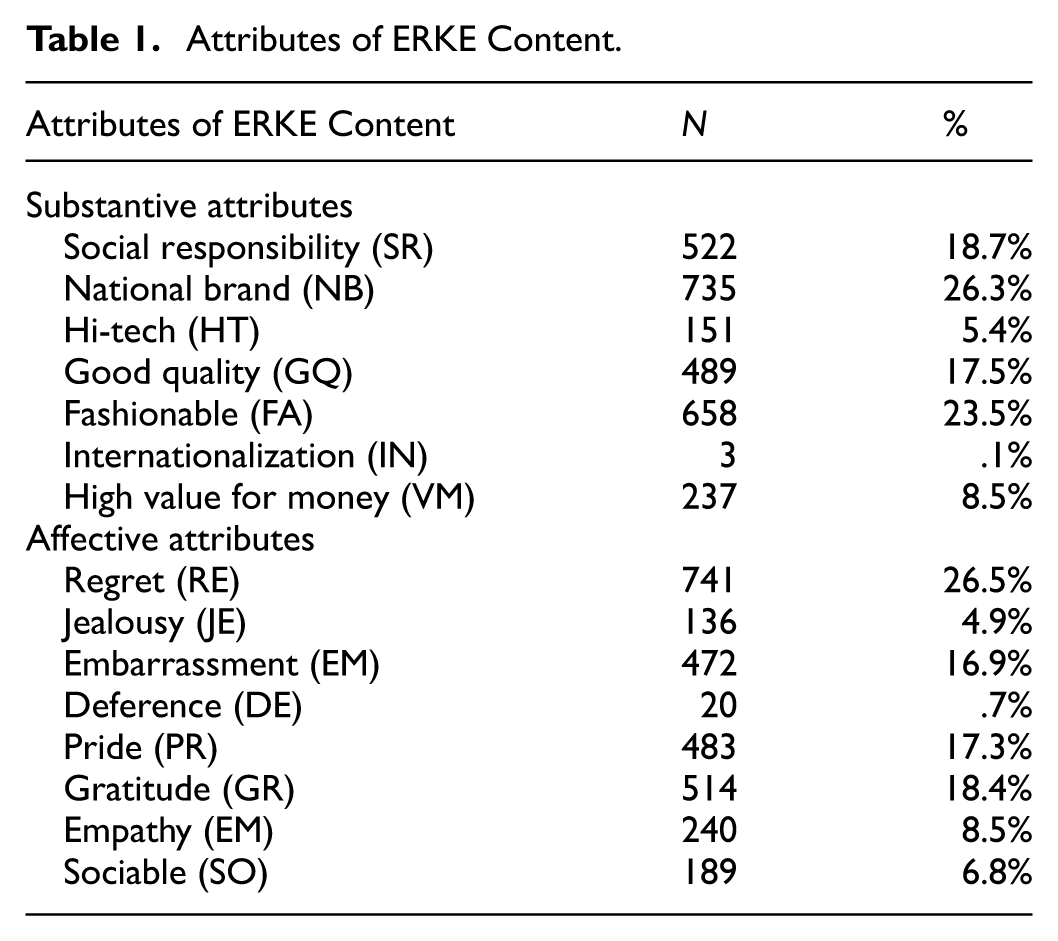
Drawing on the classification of social emotions outlined by Chakrabarti and Berthon (2012), the research categorized eight affective attributes as follows: regret, jealousy, embarrassment, deference, pride, gratitude, empathy, and sociability. Chakrabarti and Berthon’s (2012) social emotion model was derived from basic emotions and highlights the importance of these social emotions in communication field and on social media platforms. This method is not only pertinent relevant for exploring the influence of affective attributes on an audience but also serves the research’s original intention to examine consumer engagement on social media platforms. Finally, each attribute was coded as either present (1) or absent (0). The coders determined the salience of each attribute by ranking the frequency with which these attributes appear in ERKE’s content, indicating the brand’s agenda setting. The specific interpretation of each attribute is shown in Table 1.
Attributes of ERKE Content.
Coder Training
To ensure the reliability of the coding process, approximately 30% of the videos were randomly selected and independently coded by two coders. Intercoder reliability was found to be high, as indicated by Krippendorff’s alpha values. The values for the substantive attributes were as follows: SR (.96); NB (.96); HT (.77); GQ (.94); FA (.95); IN (.66); VM (.96). Krippendorff’s alpha values for the affective attributes were as follows: RE (.94); JE (.95); EM (.88); DE (.63); PR (.86); GR (.79); EP (.75); SO (.75). The remaining videos were then equally and randomly assigned between the two coders for independent coding.
Questionnaire for Data Collection
The second phase of this study involved the administration of a web-based survey conducted on Wenjuanxing.com, a platform similar to Qualtrics and SurveyMonkey (Sanghera et al., 2020; Wang et al., 2020). With a sample database of over 6 million respondents, Wenjuanxing.com provides access to an authentic, diverse, and representative population by verifying personal information.
The target population for this survey consisted primarily of Chinese social media users who are familiar with short-form video content and have previously engaged with ERKE’s brand on Douyin. This demographic is particularly relevant for examining the impact of social media content on customer engagement and brand perception. Sample selection was based on a screening process that assessed participants’ interest in sportswear brands and their level of engagement with ERKE’s Douyin content. Only respondents who met these criteria were allowed to proceed with the survey.
Participation in the survey was voluntary and anonymous, and no personally identifiable or sensitive information was collected. Participants received information about the study’s purpose, procedures, and potential risks, including the right to withdraw at any time. Informed consent was obtained at the start of the survey, with participants required to review a consent form on the first page and click “I Agree” before proceeding. The survey included only non-invasive questions on consumer engagement and brand perception, minimizing potential harm. The benefits of this research, such as advancing understanding of social media marketing strategies and contributing to agenda-setting theory, outweigh the minimal risks. All responses were anonymized and securely stored to ensure confidentiality during peer review and analysis.
The minimum sample size for this study was calculated by Daniel Soper’s calculator to be 256, which is a widely recognized method of sample size calculation (Chandrahaas & Narasimhan, 2022; Ramantyo & Dhewi, 2022). The survey was conducted from June 12th to June 20th, 2024. A total of 512 responses were submitted, and 105 were disqualified due to not meeting the screening criteria. Specifically, these responses were excluded for the following reasons: (1) insufficient engagement with ERKE’s Douyin content, (2) incomplete or irrelevant answers, (3) contradictory responses, and (4) inconsistent response patterns, such as straight-line answers or lack of variation in responses. Ultimately, 407 valid questionnaires were retained for further analysis.
Development of Measurement
To ensure the content’s validity, adjustments were made to the measures of all existing constructs to align with this study in accordance with previous research. The questionnaire itself consisted of four components (excluding demographics): media use, CE consumption, CE contribution, and CE creation.
Individual Attribute Agenda-Setting Index (IASI)
An important variable in this study is the IASI, which utilizes alternative measures employed in similar studies (Camaj, 2014; Moon, 2013). IASI measures the gap between the salience of positive attributes in the media and the importance that audiences place on these attributes. Higher scores indicate a stronger connection between the media and the public agenda, capturing the basic concept of attribute agenda setting (Camaj, 2014). The findings of Camaj (2014) and Moon (2013) demonstrated the validity of the index.
The procedure for creating the IASI involved two steps designed to match respondents’ perceptions of brand attributes with brand attribute agenda setting. The first step was to measure respondents’ attribute agendas, using a 7-point Likert scale. Participants rated their identification with 15 brand attributes, with the question: To what extent do you identify with each brand attribute? In agenda-setting research, attributes mentioned more frequently in brand content should be more recognizable than those mentioned less often. Perception of a given attribute was determined by multiplying its intensity by a weight (% of each attribute in Table 1), representing the trait percentage within the total sample. The responses allowed the author to calculate the IASI (Formula 1; Moon, 2013), which evaluates the extent to which attributes are linked with a brand and examines the extent to which the frequency of brand promotion aligns with customers’ familiarity with these attributes. According to the Formula 1, both the substantive individual attribute agenda-setting index (SA-IASI) and the affective attribute agenda-setting index (AA-IASI) are calculated:

X = the perceived level of attributes by respondents on a 7-point scale; Y = the weight of attribute (%); n = the number of attributes.
Media Use
The study’s media use concept builds on prior agenda-setting research, incorporating questions adapted from previous studies on media use (Camaj, 2014; Drew & Weaver, 1990; Moon, 2013; see Table 2). A 7-point Likert scale was employed to measure respondents’ media exposure (1: less than once a week to 7: more than 6 days a week), while a similar scale measured respondents’ media attention (1: not paying attention at all to 7: paying constant attention). These variables’ results evaluated respondents’ media use levels.
The Measurement of Constructs.
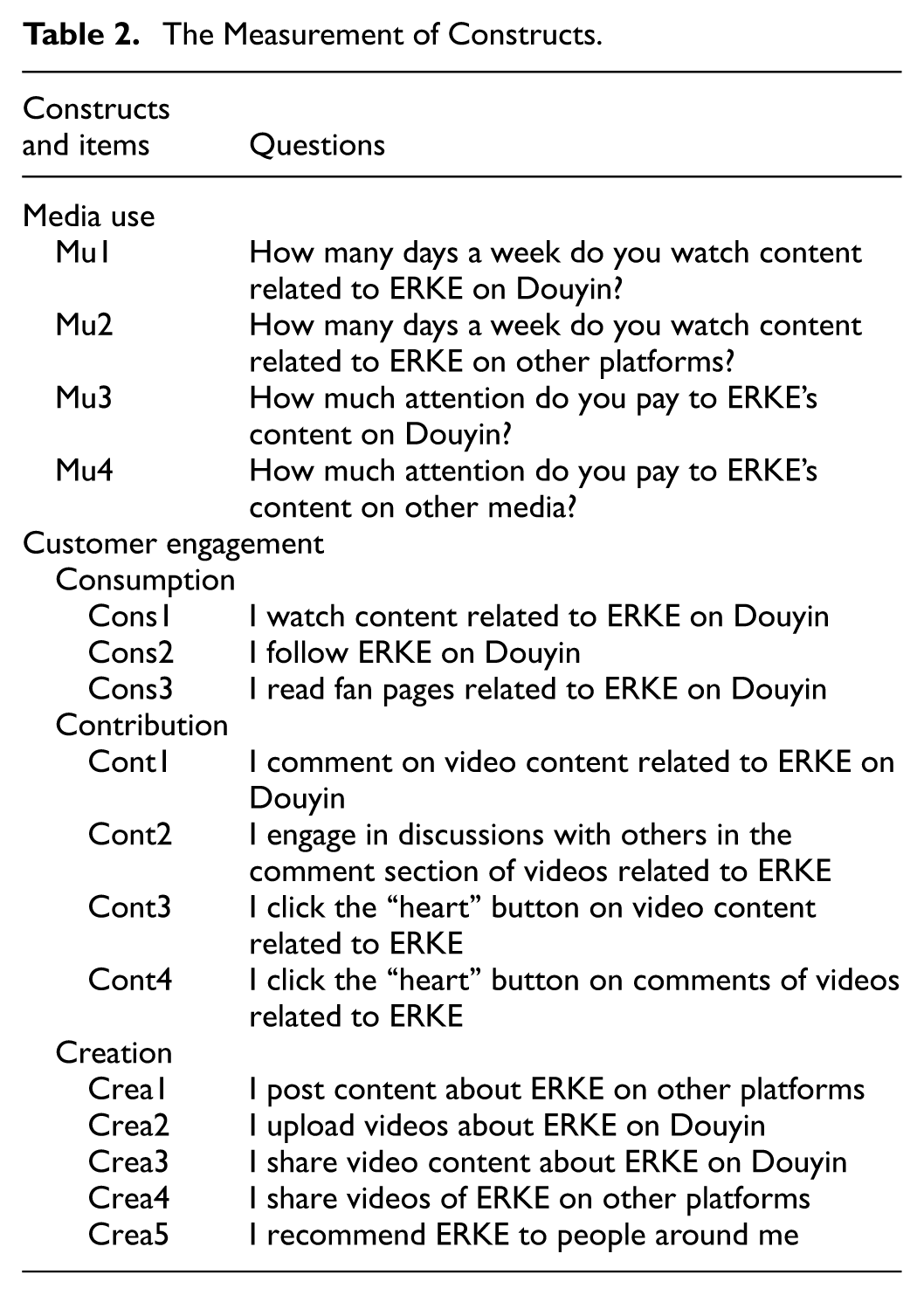
Customer engagement measurements were adapted from Schivinski et al. (2016), employing a 7-point Likert scale (1: “Never” to 7: “All the time”) to measure CE among respondents (see Table 2 for posed questions).
Need for Orientation (NFO)
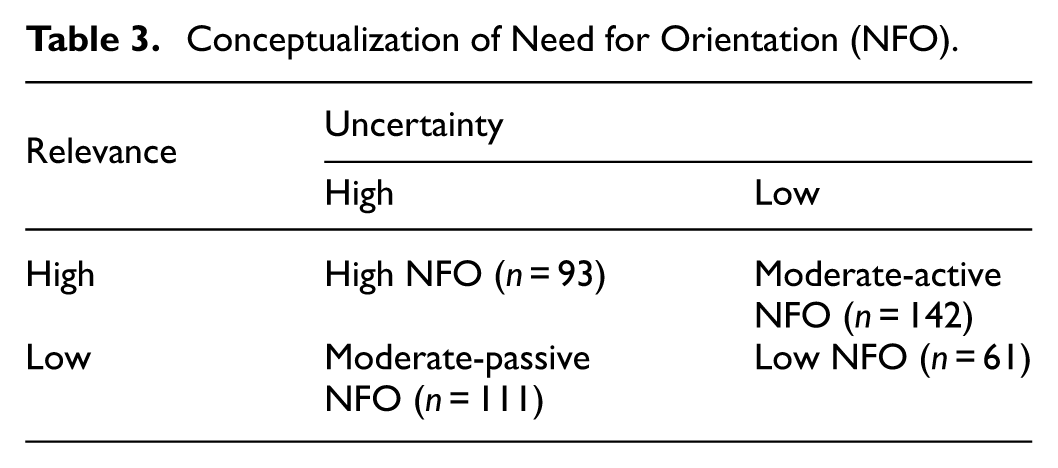
Drawing on prior theoretical frameworks, the NFO concept was treated as a construct encompassing relevance and uncertainty (McCombs & Weaver, 1973). These distinct elements were initially regarded as separate measures but were later amalgamated into a unified measure, simplifying their quantification. Consistent with prior work by Camaj (2014), this study determined respondents’ NFO levels according to their responses to two questions. First, respondents were asked, “How interested are you in ERKE videos on Douyin?” to determine their level of brand relevance. If they answered, “extremely interested” or “very interested,” they were categorized as “high relevance.” Conversely, if they answered, “moderately interested,”“slightly interested,” or “not interested,” they fell into the “low relevance” class. The second question posed was, “What is the extent of your preference for ERKE?” If they answered, “moderately like,”“slightly like,” or “no preference,” they were categorized as “high uncertainty.” If they responded, “extremely like” or “very like,” they were considered to have “low uncertainty.”
Finally, these two sub-measures were transformed into four dimensions in accordance with the NFO measure proposed by Camaj (2014). NFO was categorized into high NFO (high relevance, high uncertainty), medium active involvement NFO (high relevance, low uncertainty), medium passive involvement NFO (low relevance, high uncertainty), and low NFO (low relevance, low uncertainty). The four-group typology is presented in Table 3.
Conceptualization of Need for Orientation (NFO).
Analytic Procedures
This study aimed to apply agenda-setting principles to social media brand communication and predict agenda-setting’s significance in the certain field and its impact on consumer engagement (CE). Partial Least Squares Structural Equation Modeling (PLS-SEM) was employed as the prediction method in this study. PLS-SEM is a causal prediction method for SEM that emphasizes prediction in the estimation of statistical models that are structured to provide causal explanations (Sarstedt et al., 2017a). PLS-SEM is particularly suitable when the analysis involves testing theoretical frameworks from a predictive perspective or when the research goal is to better understand by exploring theoretical extensions to established theories (Hair et al., 2019). Using PLS-SEM, the study explored the causal relationship between media use as the independent variable, attribute agenda-setting as the mediator, and CE as the dependent variable. Additionally, Partial Least Squares Multigroup Analysis (PLS-MGA) was utilized to examine differences in consumer groups based on Need for Orientation (NFO). The study conducted a weighted treatment of brand attribute recognition and used Smart-PLS 4.0 software to evaluate the model. The evaluation of Common Method Bias (CMB) revealed no bias, as indicated by variance inflation factor (VIF) values below 3.3 and the identification of a single factor explaining 37.4% of the variance, which is lower than threshold for bias (50%).
Results
Sample Profile
The demographic details of the participants are outlined in Appendices A and B. Among them, 52.1% were male, and 86.5% were 40 years old or younger. Over half (55.6%) of participants held bachelor’s degrees. Each demographic characteristic demonstrated a relatively balanced distribution.
Correlation Analysis Between Variables
Before assessing the model, correlations between attribute agenda-setting effects and other key variables were examined (see Table 4). Significant relationships were observed between the variables, which enabled the exploration of their direct and indirect impacts on each other.
Correlation Analysis Between Variables.
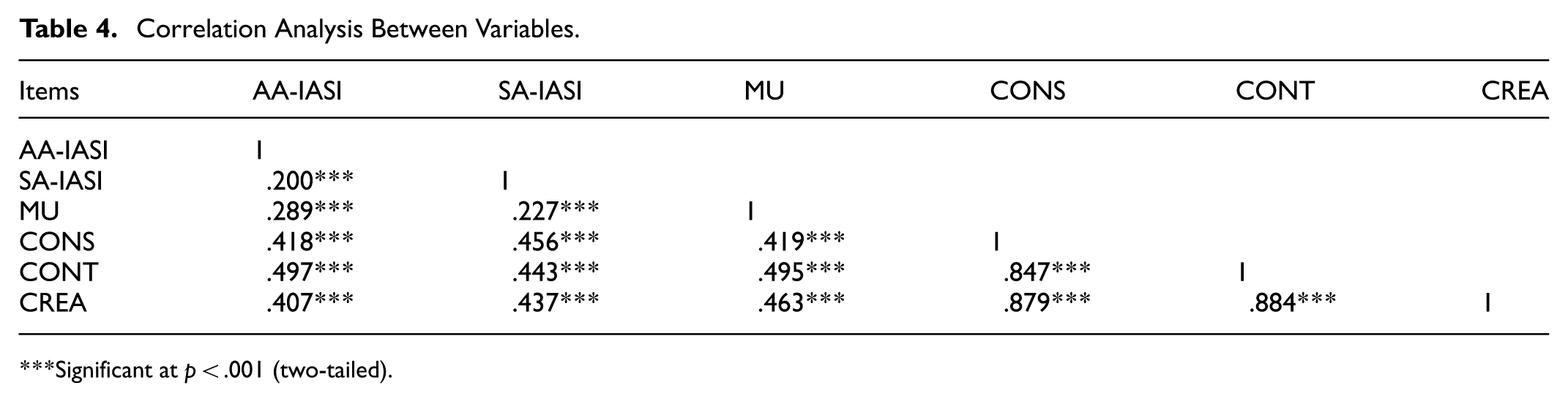
Significant at p < .001 (two-tailed).
Evaluation of Measurement Model
Corresponding to Hair et al.’s (2019) measurement model assessment criteria, this research explored factor loadings, composite reliability, convergent validity, and discriminant validity. The attribute agenda-setting index was calculated as an intuitive observed variable, and therefore, no further examination was required (Moon, 2013).
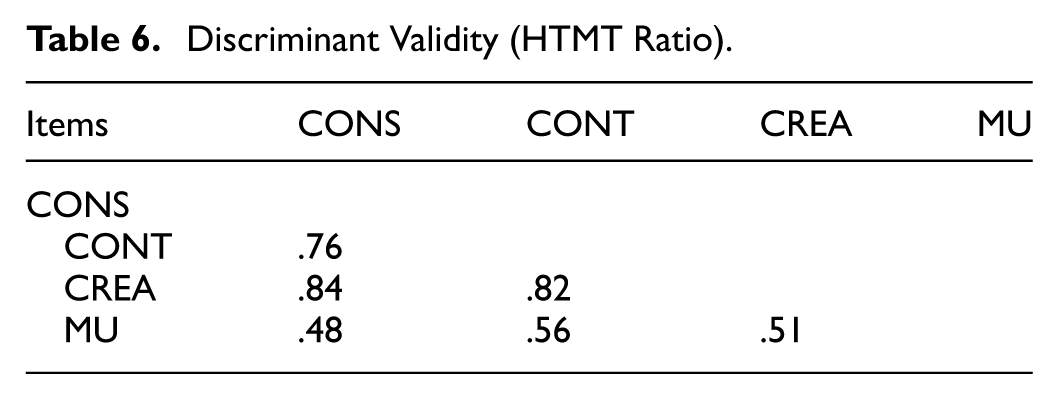
Hair et al. (2019) state that all factor loadings must exceed .7 to indicate item reliability. In this study (see Table 5), all factor loadings meet this criterion. Composite reliability (CR) is used to assess internal consistency (Joreskog, 1971), and all CR values in this study exceed .7. Additionally, convergent validity is determined by the average variance extracted (AVE), which surpassed .5, as proposed by Hair et al. (2013). Finally, the Heterotrait–Monotrait (HTMT) ratio was employed to assess discriminant validity. As shown in Table 6, all HTMT ratios are below .85, as recommended by Henseler et al. (2015). Therefore, all pertinent measures support the assertion that the measurement model is reliable and effective.
Convergent Validity.

Discriminant Validity (HTMT Ratio).
Evaluation of Structural Model
To evaluate the model’s results, the assessment was standardized to include model fit and the coefficient of determination (R-squared). Statistical significance and relevance were further investigated through the utilization of path coefficients (Hair et al., 2019).
Prior to examining structural relationships, the model’s collinearity was analyzed using VIF to minimize the possibility of bias in the regression results. The results showed that all VIF values in this study were below the threshold of 5.0 that was proposed by Hair et al. (2013).
The model fit was also evaluated (χ2 = 296.14, p < .001), with other statistical data also indicating a good fit: Normed Fit Index (NFI) = .94, Standardized Root Mean Residual (SRMR) = .037. Adhering to recommendations for composite standards (e.g., NFI > .9 and SRMR < .10) by Hu and Bentler (1999), the model fit in this study was deemed satisfactory.
Recognizing that demographic variables may act as exogenous variables impacting the structural model, the study investigated the possibility of demographic characteristics acting as control variables influencing the dependent variables. The findings revealed that none of the demographic variables significantly impacted the dependent variables. Consequently, demographic variables were excluded from measurements of the structural model (gender: −.033, p = .652; age: −.011, p = .794; education: .010, p = .8; income per month: .013, p = .727).
Subsequently, the R-squared values of the endogenous latent variables, consumption (.38), contribution (.46), and creation (.42) were examined, indicating that all the predictor variables could explain 38%, 46%, and 42% of these latent variables, respectively.
Finally, path coefficients (β) were examined, employing bootstrapping with 5,000 resamples to calculate the importance of the paths. The results in Table 7 indicate that all paths are significant at p < .001. The standardized coefficients of media use (H1) suggest a direct influence on both substantive (.22, p < .001) and affective (.29, p < .001) attribute agenda-setting effects. Meanwhile, media use was also found to have a significant positive effect on consumption (.26, p < .001), contribution (.32, p < .001), and creation (.30, p < .001; H2). Additionally, H3 was also supported, as the findings confirmed that brand substantive attribute agenda-setting effects directly influence CE, with the most significant effect observed for consumption (consumption .34; contribution .3; creation .30). Meanwhile, results supporting H4 suggest that brand affective attribute agenda-setting effects also have a direct influence on CE, with contribution being the most affected aspect (consumption .27; contribution .34; creation .32). Therefore, H1, H2, H3, and H4 are supported.
Structural Model TEST.
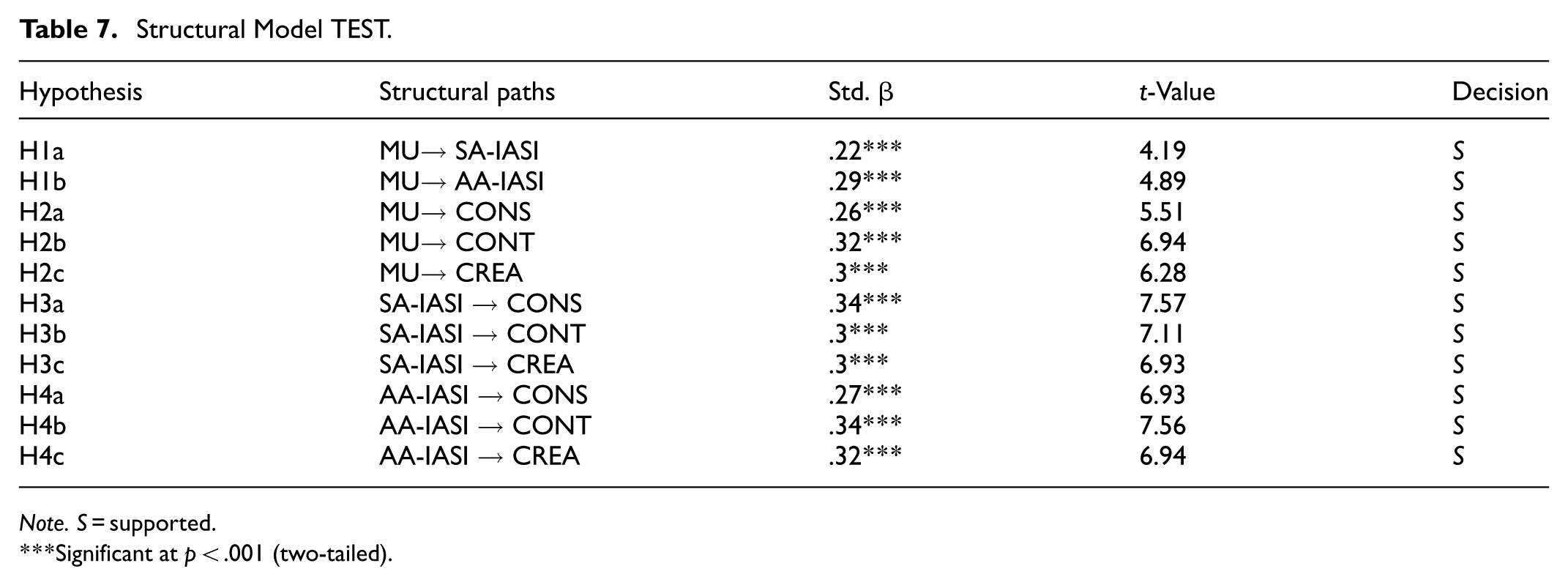
Note. S = supported.
Significant at p < .001 (two-tailed).
NFO Group Differences in the Model
LS-MGA was performed to explore distinctions within the group of high and other NFO groups using Hensler’s bootstrap-based MGA method (Cheah et al., 2020). Following Cheah et al.’s (2020) recommendations, comparable sample sizes were maintained across groups, variables were kept consistent, and the indicators passed relevant reliability and validity tests. Subsequently, the measurement invariance of composite (MICOM) test was conducted, and only when all variables passed this test did the researchers proceed with the MGA analysis of intergroup differences (Cheah et al., 2020). The results of the MICOM test, determined to be satisfactory, are provided in Appendices A and B.
The results of the analysis exploring differences between the high NFO group and the other three NFO groups, shown in Table 8, indicate that none of the hypotheses were fully supported. Specifically, no difference was found in the impact of media use intensity on the agenda-setting effect of consumer affective attributes among different NFO groups. Although most of the hypotheses were not supported, a few exceptions were noted. First, high NFO have a more substantial impact on contribution (H8b) and creation (H8c) in substantive agenda-setting effects compared to the low NFO group. Additionally, the results reveal a significant distinction between the high NFO and those low NFO groups in terms of media use impacts on CE (H7). However, as the results were negative, the hypothesis was not supported.
Path Differences by High NFO and Other Three NFO.

Note. H = high NFO; A = active involvement NFO; P = passive involvement NFO; L = low NFO; NS = not supported.
Significant at p < .05.
The model uncovered significant path relationships among key variables, notably highlighting distinctions primarily observed among the high NFO group and other groups. However, no significant differences emerged among groups concerning media use and attribute agenda-setting effects. Consequently, H5, H6, and H7 were not supported, as the study found no substantial variations in media impact when comparing the high NFO group to others.
Significant differences were only detected between the high NFO and low NFO groups regarding substantive attribute agenda-setting and CE, specifically in contribution and creation. Nonetheless, no significant variations were noted between the different NFO groups, thereby not supporting H8. Moreover, there were no obvious distinctions within groups of high and low NFO concerning affective attribute agenda-setting and CE, leading to the non-support of H9.
Discussion and Conclusion
By addressing research questions 1 and 2, this study constitutes the inaugural exploration into the connection between agenda-setting (including media use and attribute agenda-setting) and the brand’s customer engagement on social media. It extends agenda-setting theory by focusing on attribute agenda-setting for future consumer engagement research. The fit statistics underscore the effectiveness of the SEM, with significant direct effects observed along each path. This model served to establish the substantial positive impact of agenda-setting effects on CE on a social media platform. Furthermore, the results from the MGA test indicated that no significant differences exist between the high NFO group and other NFO groups with respect to their receptiveness to brand agenda-setting effects and their engagement with brand content on Douyin. This research introduces an innovative framework that lays the groundwork for future studies seeking to investigate the implications of brand communication and agenda-setting theory in commercial contexts.
The Impact of Agenda-Setting Effects on Customer Engagement
Regarding Hypothesis 1, the findings indicate that media use has a significant positive effect on brand substantive and affective attributes. This supports prior research, which suggests that social media platforms allow for greater exposure to key brand messages, enabling customers to form stronger brand perceptions based on attribute salience (Barreda et al., 2020; Dzreke & Dzreke, 2025). Furthermore, the results of Hypothesis H2 show that media use has a significant positive impact on customer engagement across all dimensions. This is consistent with previous studies that high-frequency media use not only increases customers’ attention to and consumption of brand content but also stimulates more interaction and creative behaviors (Prentice et al., 2020; Lim & Rasul, 2022). Customers actively participate in brand communication through social media interactions such as commenting, liking, and sharing, thus helping spread brand content.
Regarding Hypothesis H3, the results show that substantive attribute agenda-setting significantly impacts customer engagement across all dimensions. This finding supports prior research, which suggests that Substantive attributes, such as product quality, price, and functionality, are more likely to trigger cognitive responses from customers, promoting consumption behaviors and initial interactions (Ahn & Back, 2018; Ghorbanzadeh & Rahehagh, 2021). Moreover, Hypothesis 4 results show that affective attribute agenda-setting significantly impacts customer contribution and creation. This finding is consistent with previous literature, which highlights that affective attributes, such as trust and emotional resonance, better stimulate customers’ emotional responses, promoting interaction and content creation behaviors (Ghorbanzadeh & Rahehagh, 2021). Additionally, the interactivity of social media platforms allows customers to actively participate in content dissemination, forming deeper emotional connections and enhancing engagement.
Although these findings are derived from the Douyin context, the underlying mechanism of attribute agenda-setting is not inherently platform-specific. Global short-form video platforms such as TikTok and Instagram operate under highly similar content formats, algorithmic recommendation logics, and user engagement affordances (Kaye et al., 2020), suggesting that the differentiated effects of substantive and affective brand attributes on customer engagement are likely to extend beyond the Chinese context. Recent agenda-setting research further indicates that attribute salience effects remain robust across digital platforms and media environments, supporting the cross-platform applicability of attribute-based agenda-setting mechanisms (Almakaty, 2025). Nevertheless, the relative salience and effectiveness of specific attributes may vary across cultural contexts due to differences in cultural values and meaning-making processes, underscoring the importance of contextual factors in shaping engagement outcomes (Osobajo et al., 2023).
The Role of NFO in Attribute Agenda-Setting and Customer Engagement
The results of hypotheses H5 to H9 revealed differences among NFO groups in the impact of media use and brand attribute agenda setting on customer engagement, but most of the hypotheses were not supported. Regarding hypotheses H5 and H8, the results showed no significant differences between the high-NFO group and other groups, leading to the rejection of both hypotheses. This contradicts previous research (Carlson et al., 2019; Qin, 2020; Wang & Lee, 2020). The inconsistency may be due to the fact that substantive attributes, such as product quality and price, are universally relevant to consumers, resulting in similar responses across all groups regardless of NFO level. These attributes likely have a broader influence on brand communication, with minimal variation attributable to individual NFO differences (Bae et al., 2022; McCombs & Shaw, 2018). Furthermore, the heterogeneity within NFO groups may not have been fully accounted for; some high-NFO individuals may not prioritize substantive attributes over low-NFO individuals, particularly in contexts involving complex product information. As a result, NFO levels appear to have minimal impact on consumer responses to substantive attributes, which may explain the lack of support for these hypotheses.
Hypotheses H6 and H9 proposed that high NFO groups have a stronger impact on media use and customer engagement with affective attributes. However, the results did not support these hypotheses, revealing no significant differences between high-NFO and other groups regarding affective attributes. This may be because affective attributes, such as brand trust, are less dependent on an individual’s information needs. Moreover, affective attributes likely play a more foundational role in brand communication by fostering an emotional connection with consumers, independent of their level of active information seeking, and thus do not significantly influence media use or engagement.
Regarding Hypothesis H7, the results of this study show no significant difference in the impact of media use on customer engagement between high-NFO and low-NFO groups. While high-NFO groups exhibited higher engagement in consumption, contribution, and creation, these differences were not statistically significant compared to other groups. High-NFO individuals were more likely to actively seek information, resulting in higher engagement; however, low-NFO individuals exhibited similar engagement behaviors when exposed to effective brand content. Moreover, customer engagement is influenced not only by NFO levels but also by factors such as the quality of brand communication and emotional appeal.
Theoretical and Practical Implications
This study extends agenda-setting theory by applying it to brand communication on social media, focusing on how brand attributes influence consumer engagement (CE). It introduces a dual perspective of brand substantive and affective attributes and highlights their distinct impacts on engagement behaviors. Specifically, substantive attributes drive consumption behaviors, while affective attributes foster deeper engagement, such as contribution and creation. Furthermore, this research advances the agenda-setting framework by examining how social media platforms, particularly Douyin, amplify these effects. By allowing consumers to actively engage with and shape the brand narrative, social media enhances the influence of brand attribute salience. This study provides a foundational model for future research into the role of media in brand communication, emphasizing the interactive nature of digital platforms in shaping consumer perceptions and engagement.
This study provides insights into brand communication management for organizations, emphasizing practical strategies to enhance customer engagement. The findings confirm that brand attribute agenda-setting has a significant positive impact on CE, underlining the importance of consistently highlighting specific attributes in social media content. Frequent changes in brand attributes can confuse consumers and weaken brand recognition. Therefore, to drive initial consumer engagement, brands should emphasize substantive attributes such as product quality, affordability, and performance. These attributes appeal to consumers’ cognitive needs, attracting those who prioritize functional benefits. To deepen engagement, brands should incorporate emotional appeal by focusing on affective attributes like trust, excitement, and social responsibility. Content that tells compelling stories or showcases customer experiences can evoke emotional responses, prompting consumers to share posts, leave comments, and participate in discussions.
Second, customers’ media use affects their perception of the brand’s agenda, which ultimately guides their engagement. Although brands cannot predict the intensity of each consumer’s media use, based on this study’s confirmation of the actual role of media use on CE, there are a number of viable ways in which they can increase the intensity of use of branded media and thus increase the likelihood of CE. Brands can maintain customer attention and engagement with branded media through a variety of means, such as daily check-ins, incentives, or multimedia entry methods.
Furthermore, this study offers valuable insights for policymakers aiming to enhance brand communication practices in the digital landscape. By highlighting the impact of agenda-setting theory, the study suggests the development of frameworks and guidelines to help brands identify and emphasize the most effective brand attributes in their digital content. Policymakers can support the creation of tools that assist brands in measuring the substantive and affective impacts of their communication strategies, enabling more informed decision-making. These insights can guide the formulation of best practices, ensuring brands communicate more effectively, foster consumer engagement, and contribute to a healthier digital marketing environment.
Limitations and Future Research
This study pioneers the application of agenda-setting theory within the social media marketing context, specifically examining the effectiveness of attribute agenda setting by a sportswear brand within the Douyin community. While this study is conducted within the Chinese Douyin context, which may limit the direct generalizability of the findings, it provides a valuable foundation for understanding attribute agenda-setting in social media brand communication. Platforms such as TikTok and Instagram share similar short-form video ecosystems, suggesting that the observed agenda-setting mechanisms could potentially extend to other contexts. Future research could adopt cross-cultural or multi-platform designs to examine how cultural values and platform-specific features moderate the effectiveness of substantive versus affective brand attributes.
Future studies should aim for larger sample populations to enhance the findings’ generalizability. Although the study qualitatively examines CE through its behavioral dimensions, CE is a multidimensional concept. Future researchers could improve understanding by incorporating cognitive and emotional dimensions to examine the impact of brand content dissemination on CE.
To conclude, this study establishes a constructive foundation for future study to delve into the nuances of agenda-setting theory in diverse marketing contexts.
Footnotes
Appendix
Measurement Invariance of Composite Models (MICOM).

| Constructs | Configurational invariance S1 | Compositional invariance S2 | Partial measurement invariance | Equal mean assessment S3a | Equal variance assessment S3b | Full measurement invariance | |||
|---|---|---|---|---|---|---|---|---|---|
| Original Correlation | 5.00% | Original differences | Confidence interval | Original differences | Confidence interval | ||||
| H NFO vs A NFO | |||||||||
| MU_ | Yes | .997 | .885 | Yes | .753 | [−.260, .279] | .009 | [−.418, .426] | No/yes |
| SA_IASI | Yes | 1 | 1 | Yes | −.051 | [−.259, .242] | .035 | [−.489, .436] | Yes/yes |
| AA_IASI | Yes | 1 | 1 | Yes | −.002 | [−.269, .256] | −.112 | [−.519, .487] | Yes/yes |
| CONS | Yes | .991 | .989 | Yes | −.02 | [−.284, .269] | −.238 | [−.509, .444] | Yes/yes |
| CONT | Yes | .999 | .994 | Yes | .042 | [−.289, .255] | −.28 | [−.499, .470] | Yes/yes |
| CREA | Yes | .998 | .994 | Yes | .055 | [−.276,.250] | −.295 | [−.548, .448] | Yes/yes |
| H NFO vs P NFO | |||||||||
| MU_ | Yes | .991 | .893 | Yes | 1.013 | [−.266 .281] | .26 | [−.351, .308] | No/yes |
| SA_IASI | Yes | 1 | 1 | Yes | .148 | [−.267,.277] | −.207 | [−.429, .408] | Yes/yes |
| AA_IASI | Yes | 1 | 1 | Yes | .039 | [−.289,.283] | −.273 | [−.564, .581] | Yes/yes |
| CONS | Yes | .995 | .986 | Yes | .166 | [−.271,.278] | −.493 | [−.478, .455] | Yes/no |
| CONT | Yes | .994 | .991 | Yes | .28 | [−.284, .287] | −.497 | [−.498, .440] | Yes/yes |
| CREA | Yes | .999 | .994 | Yes | .168 | [−.284, .278] | −.389 | [−.351, .308] | Yes/yes |
| H NFO vs L NFO | |||||||||
| MU_ | Yes | .998 | .997 | Yes | 1.706 | [−.348, .322] | −.902 | [−.310, .357] | No/no |
| SA_IASI | Yes | 1 | 1 | Yes | .496 | [−.333, .341] | −.412 | [−.420, .508] | No/no |
| AA_IASI | Yes | 1 | 1 | Yes | .535 | [−.328, .322] | −.94 | [−.489, .553] | No/no |
| CONS | Yes | .998 | .983 | Yes | .987 | [−.330, .313] | −.667 | [−.387, .425] | No/no |
| CONT | Yes | .999 | .995 | Yes | 1.05 | [−.317, .337] | −.916 | [−.396, .395] | No/no |
| CREA | Yes | .996 | .995 | Yes | 1.003 | [−.324, .332] | −.615 | [−.357, .407] | No/yes |
Note. S1 = normally, this is automatically established; S2 = the original correlation is higher than 5% and the permutation p-value is higher than .05; S3 = (a) not all confidence intervals of latent variable score means include the original differences value, so there is not equal means, (b) not all confidence intervals of latent variable score variances include the original differences value, so there is not equal variances.
Acknowledgements
We would like to extend our deepest gratitude to Fang Wu from Shanghai Jiao Tong University. Thank you for your invaluable advice and support in our article. Your expertise has greatly contributed to our research.

Ethical Condiserations
Ethical approval was obtained from the University of Salford Ethics Panel (Approval No. 6766). All participants (or their legal guardians) provided informed consent prior to their inclusion in the study.
Funding
The authors received no financial support for the research, authorship, and/or publication of this article.
Declaration of Conflicting Interests
The authors declared no potential conflicts of interest with respect to the research, authorship, and/or publication of this article.
Data Availability Statement
The data used to support the findings of this study are included within the article.