




Abstract
Media development requires substantial funding, and therefore, donors, foreign governments, nongovernmental organizations (NGOs), and foundations have found a way to play an influential role through their financial support. However, it appears that the donors are also fighting a losing battle considering the rapidly changing political-economic structures of contemporary society spearheaded by the very private sector they enhanced. This study generally presents a systematic review of “foreign aid” to Africa as a base “to explore how donor funders and private investment impact media functions.” The work also sheds light on the extent to which donor support impacted the governance system within the media political economy of Africa. It establishes that donors, who are the very saviors, are also a threat to media freedom because they set the agenda for content, resulting in undue influence on the type of stories that are told. As a result, media development becomes constricted.
Introduction
Media development has come a long way (Peters, 2010), dating back to (over) 50 years during which international nongovernmental organizations (NGOs) and donors have been working to enhance media operations (Nelson and Susman-Peña, n.d., p. 7). This is due to the significant role media play in the developmental agenda of nations, hence the label “media for development or development communications” (Cary & D’Amour, 2013, p. 28). To Coyne and Leeson (2009), this symbiotic relation between media and development is tantamount to the “chicken and egg” paradox (p. 71). Berger (2010) distinguished between the concepts “media development” and “media for development” that the object of the former is the media itself, whereas the object of the latter is the role of the media in society. Making a case for media development as a strategic economic and development subject, onetime president of World Bank stated, A free press not only serves as an outlet for expression, but it also provides a source of accountability, a vehicle for civic participation, and a check on official corruption. A free press also helps build stronger and more effective institutions. (Wolfensohn, 2005, p. 461)
Cary and D’Amour (2013, p. 31) concurred, “In the aid process, treat media as an important part also of economic and overall social development, and as well as a part of governance and civil society.” This resonates with the position of media development experts that media development directly and indirectly buttresses all forms of development, both economic and governance (Susman-Peña, 2012). Thus, the need to interweave the media into all sectors and facets of public life cannot be understated. For instance, in 2012, 16 projects were launched by the United States Agency for International Development (USAID) across the global employed media and/or communication strategies as part of the program to achieve success (Cary & D’Amour, 2013). In the Ghanaian experience, the public perceive the efficacy of aid on three major indicators: first, the extent of community familiarity with a project; second, media reports on the said project; and third, the extent of donor credibility (Aryeetey & Cox, 1997). By this, Nelson and Susman-Peña’s (n.d.) justification for media development that “At a time when the world is being transformed by mobile communications and social media, billions of people still live in countries where the production and distribution of vital information relies on a rickety, easily manipulated media infrastructure” (p. 10) should be given more attention.
Amid these constructive observations, the term “media development” itself remained somewhat undefined. This informs United Nations Educational, Scientific and Cultural Organization’s (UNESCO) endorsement of a 5-point indicator of media development which encapsulates [i] a system of regulation conducive to freedom of expression; [ii] plurality and diversity of the media, a level economic playing field and transparency of ownership; [iii] media as a platform for democratic discourse; [iv] professional development of journalism and the role of professional nongovernmental institutions; [v] infrastructural capacity which includes new communication technologies, sufficient to support pluralist media and media access. (UNESCO, 2008; Zrinjka, 2011, p. 2)
However, to Berger (2010), the elaboration of the indicators still lack a general definition and proposes that media development is the “deepening of ‘media density’ which increase media infrastructure and/or the institutional/organisational base—which is necessary (albeit not sufficient) to undergird increases in the production and consumption of journalism” (p. 554). Furthermore, Brownlee (2017) defines media development as efforts by organizations, people, and governments to develop the capacity and quality of the media sector within a specific country or region. This presupposes that efforts to enhance media development require an “all hands on deck” approach especially in contemporary times that citizen journalism is on the rise.
Despite the significance of the notion of media development, its funding is somewhat obscured in the entire aid inflow. Price (2002) observed that media assistance from donor governments is placed within broader domains of international development and donors do not designate specific departments to media initiatives. To Karikari (2014), without specifically labeling media development as such, most of the international donor agencies have a space for them in their development assistance packages. By this, media assistance programs tend to fall under the canopy of humanitarian aid in the context of civil society, governance, and democracy, among others. The broad categorization under which media aid is captured obscures it to the extent that statistically media development donor support for strengthening the quality, independence, and sustainability of the media has comprised only about 0.5 percent of overall aid to developing countries [and most significantly]; most stakeholders in international development have never even heard of media development. (Susman-Peña, 2012, p. 4)
For instance, just a few million dollars in donor funding go to civil society groups in Ghana and Uganda, and this is split into meager grants among the many organizations (Robinson & Friedman, 2005) including media. However, generally, global media assistance from donor sources to the developing world sees an upward trend yearly and it is estimated to be about US$650 million per annum (Myers, 2014). Beyond these donor activities, private entities have also invested heavily on the same media industry on a large scale.
This study seeks to examine the role foreign aid generally plays in African economies as a background to explore underlying issues in donor funding of media and its repercussions and, most importantly, to ascertain whether private media investors are frustrating donor efforts in enhancing the development of the media within the political economy structures of Africa. In this study, the terms “media donation” and “media aid” are used interchangeably. Furthermore, this work does not intend to make comparison between media aid from the West and that from China but to present generalized arguments.
Overview: Foreign Aid and African Economies
Foreign aid gained prominence at the end of the Cold War (Brownlee, 2017; Cary & D’Amour, 2013; Easterly, 2005; Lancaster, 2007; Myers, 2014; Price, 2002; Schiffrin, 2010), but as an institution, it dates back to 1947 with the Marshall Plan (Bräutigam & Knack, 2004, p. 256; Brownlee, 2017) and it comes in different types: humanitarian, subsistence, military, bribery, prestige, and foreign aid for economic development (Morgenthau, 1962). Aid, particularly from the West to Africa, according to most estimates has risen approximately to US$600 billion per annum since the 1960s (Akonor, 2008). This informs the finding that “At the dawn of this century, more than fifty percent of sub-Saharan African budgets and seventy percent of their public investment came from foreign aid” (Kanbur, 2000, p. 1077).
Although several attempts have been made to eradicate poverty in Africa through aid, the move received massive backing in 2005 when Tony Blair appealed to the G-8 on the subject, leading to a doubling of aid to the continent to US$50 billion a year from US$25 billion to finance the big push, on one hand, and to cancel loans owed to them, on the other (Akonor, 2008; Easterly, 2005). The Big Push model asserts that “Africa is poor because it is stuck in a ‘poverty trap’. To get out of the poverty trap, they [Africa] need a large aid-financed increase in investment” (Easterly, 2005, p. 5), hence the big push. However, to Moyo (2009), Giving alms to Africa remains one of the biggest ideas of our time—millions march for it, governments are judged by it, celebrities proselytize the need for it. Calls for more aid to Africa are growing louder, with advocates pushing for doubling the roughly $50 billion of international assistance that already goes to Africa each year. (p. 1)
It is worth noting that beyond Africa, aid distribution is across the globe extending to Central and Eastern Europe (Becker, 2007) as well as to the Latin America, Asia, and the Pacific. The influx of aid to Africa (and elsewhere) from foreign sources is believed to have some benefits; many scholars have questioned its efficacy (Akonor, 2008; Alesina & Weder, 2002; Aryeetey & Cox, 1997; Easterly, 2005; Kanbur, 2000; Moyo, 2009; Riddell, 2014). To Kanbur (2000, p. 2), the quantum of aid to Africa does not appear to be aiding its development. A number of reasons account for this. Akonor (2008) in his “aid quantity argument” (p. 1074) pointed out two major underlining issues. First, it is a deception to quote the amount of aid to Africa in aggregation because it magnifies its significance, whereas the average amount per person per week/day is insignificant. The claim that Africa received billions of dollars in aid over 50 years averages “only about ten dollars per person per year or twenty cents per person per week” (p. 1075). Second, considering the wealth of Western nations, the quantum of aid to Africa is infinitesimal; citing the United States with the largest gross domestic product (GDP) in the world, only one hundredth of its budgetary allocation goes to Africa as foreign aid. Akonor finally concludes that foreign aid is not a solution to the challenges of Africa’s development because it has generated a “welfare-continent mentality” where most African economies revolve and depend on foreign aid which compromises state sovereignty. Similarly, Riddell (2014, p. 39) reiterated, “aid’s potential contribution has been consistently over-played” on the pretext that with many people globally who need help from rich “outsiders,” a false impression created is that real development is an illusion without aid. Writing on “Why foreign aid is hurting Africa,” Moyo (2009) showed that the continent has economic potential, but “money from rich countries has trapped many African nations in a cycle of corruption, slower economic growth and poverty; [and argued that] cutting off the flow would be far more beneficial” (p. 1). Despite the incidence of corruption in Africa (Meredith, 2005; Moyo, 2009) which “aid ineffective” critics point to as the underlining factor (Riddell, 2014), Moyo further noted that funders are unperturbed. This is a posture that appears to signify that donors have inherent interests in donation transactions. Putting this into perspective, Riddell (2014) reiterated, The key problem lies in the political will of donors to change current practices and the unwillingness of individual donors to sacrifice more than they already have of the freedom they currently enjoy to deciding how to allocate and to determine how to deploy their own aids. (p. 34)
With aid to Africa increasing exponentially, the concern of many Ghanaians is not whether aid is good. Instead, they ask, “When do we [Ghanaians] reach that threshold level from which we can take off and make aid redundant?” (Aryeetey & Cox, 1997, p. 68). Many African nations have posed similar questions. By this, Africa appears to have reached its crossroads when Ghana’s president, Nana Akufo-Addo, stressed that Africa beyond aid is possible, making reference that 30% of the world’s resources are in Africa and that Ghana and Cote d’Ivoire alone produce 60% of the world’s 100 billion cocoa industry but accrue less than US$6 billion (Ghanaweb, 2017).
In a situation where scholars have questioned the efficacy of the generality of aid, the questions are as follows: How is the media specifically positioned in relation to donor inflows to the sector? How does the interplay between donor funding and private investment impinge media development efforts? What are its implications for the independence of the media? How do the political economy structures of Africa embrace media aid? The need to interrogate these issues and to propose the way forward is imperative.
Donor Funding, Private Investment Versus Media Operations
The sophistication of contemporary media operations makes a stable funding source an indispensable requirement to its effective functioning and coupled with the “right-to-know” phenomenon which has gained global acceptance; many donor partners find it imperative to voluntarily provide assistance to the media. This has been conceptualized as “media development.” In the words of Eric Newton of Knight Foundation, “media development aid creates the independent journalism that tells you whether all the other aid is being stolen. Just as freedom of expression supports all other freedom, media aid supports all other aid” (Nelson & Susman-Peña, n.d., pp. 10–11). However, Reporters Without Borders notes, “at the turn of the 21st century, nearly half of the world population still lacks access to free information.” Writing on the motive of media assistance, Price (2002) noted that the European Commission, United States, Foundations, and other donor governments “identify media freedom as crucial to building democratic, prosperous societies. These donors view efforts to promote democratic governance and assist media as a fundamental element of international development work” (p. 1). Over the years, international development agencies and private philanthropic organizations operate in Africa and elsewhere in the world. It is the expectation of donors that the outcome of media assistance program enhances skills of media practitioners, improves media organizations, and betters the entire media system (Becker, 2007). In one account, Nee (2011) explains that the frequently cited benefit of donor funding according to the leaders of foundation-funded not-for-profit news is that they wield the “freedom to choose stories based on merit and public impact rather than popularity” because they did not have to “pander to commercial interests to generate more traffic” (p. 116). However, the question is how long will the funding last? Is it indefinite? What happens if funding is not sustained? How true is this assertion beyond countries in the West? Moreover, the concentration of donor assistance in a group of organizations can have adverse effect on internal administrative capacity and skew the structure of civil society (in this case media) by supporting only organizations that satisfy donor application and reporting requirements. Thus, the desires of donors significantly influence the agendas, activities, and growth trajectories of organizations (Robinson & Friedman, 2005). Peters (2010) explored the future of journalism and challenges that confront media development questioning whether the importation of U.S.–Europe funding model is compatible to the developing world. She noted that in the former Soviet Union, many of the private media outlets created with foreign donor funding have transformed into business entities interested less in quality journalism than in profits and good relations with the authorities. This is reflected in Susman-Peña’s (2012) identification of patterns that precede media assistance programs as [1] A country experiences a political shift or humanitarian crisis that acts as a trigger for donor intervention to support the media. [2] Initial investments in supporting the media sector are meant to help stabilize the country and support its transition toward democracy or out of war. [3] After donors perceive a certain level of success, they draw down their support and usually alter the type of support they provide; some withdraw completely. (p. 4)
This suggests that donor funding into creating new or supporting existing media outlet is a temporary project, and once the funding tunnel is shut, the “marketplace survival syndrome” sets in leading media into the commercialization phenomenon. Myers (2014) puts this into perspective that “donor-supported activities to help establish plural media systems in Africa were dwarfed by the private efforts of thousands of local entrepreneurs, politicians, and religious groups who set up private media outlets once the political and economic conditions were right” (p. 8). By this, it appears that in an attempt to establish resilient media front, donor funders who cannot sustain the outlets they created and/or supported rather prepare a landscape fertile enough for some private business investors to plant “thorns” through sensationalism which negates ethical practices. For instance, the more donor funders run training programs to enhance the quality of media reporting, the more some private media investors recruit unqualified hands into the profession because they are unprepared to pay competitive salaries due to high investment returns agenda (Nyarko & Teer-Tomaselli, 2017), and this is evident in many African and other developing world calling into question the truthfulness of news. For instance, in a study of 16 African countries where citizens rated the trustworthiness of private and public media in their countries, it was evident that are “only five where citizens trust private more than government broadcasters: Benin, Kenya, Nigeria, Senegal, and Zambia. By comparison, there are nine countries where trust in private broadcasters is significantly lower than trust in their government competitors” (Moehler & Singh, 2011, p. 279).
Specifically in Ghana, the Media Ownership Monitor (MOM) project showed that 72% of the readership prefers state-owned print for information and entertainment compared with private papers (Reporters Without Borders, 2017). In Kenya, a private sector media practitioner notes, “editors are now required to think like business managers [rather] than journalists, sometimes it becomes very tricky to balance between doing journalism and doing business” (Maina, 2014, p. 50). The Nigerian experience buttresses the situation when Jideofor (2016) notes, If there’s a cholera outbreak from contaminated water sources and the Ministry of Water Resources is doing an event, reporters will cover the event and not bother about the cholera outbreak itself. This is not because they don’t care; [editorial choices] have mostly become economic decisions. The Ministry will pay for the event to be covered, that is how the system works. You aren’t supposed to pay for news but you can pay to make news.
Clearly, this challenge is far beyond training of practitioners because it is rooted in the economic structure of the African continent itself. Such editorial decisions by some private media outlets tend to frustrate the efforts of donor funders to develop them. Attention should be drawn to the fact that on a continuum of “funding flow” in the media industry are two opposing forces where on one side are donor organizations, NGOs, and governments that aim at the development of the media and its freedom, and the other side is dominated by local and foreign business investors with a return on investment motives. This somewhat “aim-contradiction interplay” frustrates the efforts of donor agencies, thus making them fight a losing battle. This argument does not negate the fact that some governments and private investors genuinely invest in media to enhance democratic ideals and people’s right to know (Becker, 2007).
Media Concentration, Mergers, and Takeovers
Beyond local private media operations, media multinational corporations and conglomerates have shown close interests in favorable investment climate in the Third World (Herman & Chomsky, 2002), which is attributed to the post–Cold War democratization project leading to creating a conducive media environment. However, these investment drives have metamorphosed into huge “concentrations” in the global media marketplace, and Africa is not spared. Writing on why China is making a big play to control Africa’s media, York (2017) noted that Chinese investors have collaborated with allies of South Africa’s ruling African National Congress (ANC) to acquire Independent News and Media, one of the most powerful media groups in the country, which owns daily newspapers in all of the main cities. He showed that China’s media activities are prevalent in Kenya (see also Gagliardone, Stremlau, & Nkrumah, 2012) with growing presence in another 13 African countries. Also, Ghana’s largest private media company Multimedia Group recently attracted foreign investment interest from South Africa’s media giant Times Media Group, and according to industry players, it is one of the most significant mergers of South and West African media entities (Myjoyonline, 2013). Kabral Amihere, a seasoned Ghanaian journalist had cautioned the rate at which businesses are investing heavily into the media industry for their own interests (Bokpe, 2018). The repercussions of these media takeovers are the transfer of undiluted socio-political cultures from foreign investor countries to the media landscape of the recipient countries. With China’s monopolistic structure of its domestic media, reporters expect an intense grip of freedom of expression of the African media, especially with the launch of the China International Television headquartered in Nairobi. The following comment by African reporters and ex-reporters at CCTV as reported by York (2017) is evident: They [the African reporters] were told to provide positive news on China, to omit negative words such as “regime,” and to ignore countries such as Swaziland that have diplomatic relations with Taiwan. Chinese demand for ivory could not be mentioned in stories about Africa’s poaching crisis. Another recalled how human-rights questions had to be avoided in an interview with an authoritarian African leader. “I knew it would be cut out of my story, so I self-censored.”
When the voice of the people and reporter freedom is usurped in this manner due to such media mergers and takeovers, it hampers the efforts of foundation-funded organizations to establish a resilient media system. Beyond this, Western governments have also invested heavily in media projects in Arab nations to the extent that such interventions have assumed the status of an industry (Brownlee, 2017) and to Hassan and Sabir (2011), the objective of the West pushing huge sums of funds to NGOs is to enable them promote their cultures in Pakistan. For instance, China’s massive investments in Africa’s print, broadcasting, and satellite television stations are part of its long-time drive to strengthen Beijing’s soft power with motives that go beyond diplomacy to cover foreign aid, business links, training programs, scholarships at academic institutes, and the media (Gagliardone et al., 2017; York, 2017). Brownlee (2017) concurs, this kind of media development gesture is the means to achieving soft power which is “the ability to attract and co-opt rather than coerce, as a means of persuasion, through intangible means such as culture, values and institutions of politics” (p. 2279). The actual threat that awaits the African media is their escape from state control only to be swallowed by foreign interests (Martin, 1992).
Local Media and Donor Funding Agenda-Setting: Misdirected Perspectives
Considering the strategic position of the media in society vis-à-vis donor inflows to them, the development trajectory of recipient countries is somewhat misdirected and hampered because salient issues that media should champion are either overlooked or given less publicity in favor of donor reporting specifications. For instance, “Galamsey,” a practice which comes from two words “gather” and “sell,” had been a major environmental challenge facing Ghana. It is an illegal local level mining mainly in gold. Recently, Chinese and other foreign nationals got involved, leading to the destruction of the country’s land and water resources. To mitigate this, the Ghanaian media demonstrated its power of advocacy and criticality when Citi FM, a radio station based in Accra, and the “Media Coalition against Galamsey” waged an effective offline and online #StopGalamseyNow campaign against the menace, but this initiative was short-lived. Although it is evident that the media per its public interest mandate are eager to pursue the galamsey agenda, funders, however, have not cheered them on financially, irrespective of its environmental significance because their agenda is utterly different. The Strengthening Transparency, Accountability and Responsiveness (STAR) Ghana Foundation and its Danish International Development Agency Danish International Development Agency (DANIDA), European Union (EU), and United Kingdom AID (UKAID) partners focus on democracy and governance (Ghanaweb, 2018) without a space for environment. However, the questions that arise are the following: Would the media sustain the galamsey campaign if they have had funding from donors? Why should donors fund media to advocate other issues than more pressing one like galamsey which is destroying the environment? Moreover, in Nigeria, the Fulani and farmers feud leading to hundreds of killings has been a major challenge over the past 50 years (Nwachukwu, 2018). Ghana is also battling with the same Fulani–farmers clashes, but in both countries, the media only set intermittent agenda on these issues and one wonders why the media had not been loud enough although the menace is still ongoing. By this, it appears that the rhetoric “we determine where to put our donation” without regard to specific pressing local issue still looms, thus making donors assume agenda-setting-deterministic posture.
Writing on media distortion and Western bias, The Guardian (2014) explains that donor funding only abound when a local problem could escalate to other parts of the world. Picard (2015) reiterates, “Western development agencies and programmes have tended to pursue media development efforts that support their home nations’ immediate foreign policy objectives rather than longer-term development objectives” (p. 3). These contrast the observation by Malan (2018) that “Donor-funded journalism is a complex sphere, frequently characterized by balancing acts between the priorities of two vastly different environments.” Africa should not expect that the donors from the West, China, or abroad would fund media campaign to constrain their very interests. Ghana having received one of the most generous loan packages that China has ever granted to any African country amounting to US$3 billion in 2011 as part of a US$13 billion agreement to enhance infrastructural development with media forming a critical part of this transaction (Gagliardone et al., 2012), how can the country and its media complain about the invasion of Chinese on its mining sites? How does Ghana expect China to provide funding to Ghanaian media to educate society, leading to eradication of illegal mining? An example is the “controversial deportation” of Aisha Huang, a Chinese financier of galamsey nicknamed “Galamsey Queen” from Ghana after the government decided to discontinue her prosecution purportedly to compensate for a Chinese US$2 billion Sinohydro project (Ashigbey, 2019). This resonates with the following positions: that “foreign aid” generally is hurting the broader African economies and the continent would be better off if it stops flowing (Moyo, 2009), and Akonor’s (2008) description of Africa’s reliance on foreign aid as a “welfare-continent mentality” is emerging in its journalism–donor funding relationship. It follows that although the African media has the capacity to set agenda pertinent to local issues, the emergence of donor concepts such as philanthro-journalism (Scott, Bunce, & Wright, 2017), coupled with media development and media for development (Berger, 2010; Cary & D’Amour, 2013) whose application appear to have conceptual challenges, has switched the African media to a “stay back mode” waiting for donor funders to pay the cost of publication for critical issues that impinge on their own development before they launch campaign into them. Riddell’s (2014) observation that the impact of aid has been repeatedly overstated and misconstrued implies that without donation from industrialized countries, real development is impossible. Such observation is fast taking roots in media circles in Africa. By this, Africa risks its sovereignty and development trajectories, and the growth of its media is bleak because donor funders can, at times, impede media development. Thus, in as much as advertising is deemed to allow newsroom freedom (Nyarko & Teer-Tomaselli, 2018), it is in the same vein that attention should be paid to donors who restrict coverage of issues to their special interests “and so determine the kinds of beats that get covered” (Schiffrin, 2017). Furthermore, Schiffrin echoed the position of Leon Willems, Director of Policy and Programmes at Free Press Unlimited (Amsterdam), in a statement, I understand that donors want to specifically contribute to certain topics that they think are in need of support. But as a journalist, I think this is a scary tendency that infringes on media’s independence and in (our) mind the independence is crucial for public trust. Donors have to be cautious not to be too interventionists [in their approach].
On the contrary, donors should come to terms that it is not a question of what they perceive to be salient themes, but rather there is the need to allow local practitioners to determine what is key in their own environments. It appears that donor funders, the very group who are rather expected to help strengthen the media and make them more resilient, can be a threat to media freedom.
Interrogating Donor Funding and Representation of Africa’s Image
Speaking of communication managers of major global aid agencies, Cottle and Nolan (2007) examined how communication tactics designed to create awareness, raise funds, and support have been integrated into contemporary ubiquitous media logic. Their study showed that as the number of humanitarian agencies and NGOs increased coupled with intense competition, these agencies now branded themselves in the media and deploy celebrities and other packages to draw media attention. To them, ethically, aid agencies have jeopardized the very thing(s) they have toiled to achieve over the years. Furthermore, Wright (2019) explained, Much as we might wish otherwise, decontextualized and stereotypical imagery are likely to predominate in the media content provided by aid-workers to journalists in these kinds of circumstances [emergencies and disaster appeals]. The reason for this is quite simple: starving babies still bring in the cash.
This negative representation of imagery that connotes misery and pity has been criticized by many scholars (Campbell, 2007; Chouliaraki, 2011; Höijer, 2004; Moeller, 1999). In his study of the “The Freelancer–NGO Alliance” that uses a Kenyan waste story to reveal contemporary foreign media coverage, Conrad (2015) analyzed the content of African images and argues that “issues of identity, representation, and ideology are not dominating the current media ecology of foreign reporting; they are being hotly contested within it” (p. 277). He explains that the images presented at photography exhibition and fundraising events are “artworks” without news article, so the “spectators” are “audience” of philanthropists and NGOs. Conversely, images convey message more easily than text. To Ogazi (2010), among the many questions that Africans domiciled in the West have posed is, [We] Africans want to know why the Western media overlook the contributions made by Africans towards the West’s development [especially its mineral endowments and growth], but instead focused on diseases, handouts and food aids from the West?; instead of a balanced reporting, and acknowledging, the role and influence of multi-national corporations and neocolonialism in shaping and influencing Africa’s policies for their benefits. (p. 31)
Ogazi (2010) further explained, “African media will never devote their time and resources to portray Westerners negatively as Westerners have done to Africa’s image and reputation” (p. 39), and where they may wish to present the real story (not counterattack), such attempts are severely constrained by the very inflow of media aid under conditions with different reporting trajectories. It is no mistake that NGOs in Kenya focus on marginalized, secluded, and rural communities (Maina, 2014) where “negative information” which is a “precious mineral” abounds for funders, and this is true for all African and some parts of the Latin American and Asian countries. The Guardian (2014) puts it this way: “with the ability of the media to unearth buried stories, it appears that aid to the media has become the contemporary mechanism to extract the dark side of the [African] continent which is a money making machine.” By this, Africa indirectly trades off its reputation for the very funding that donors, who are also beneficiaries, claim to have given to the African media. In Asia, Hassan and Sabir (2011) explained that “on ‘behalf of Western powers’, NGOs were highlighting a ‘wrong image of Pakistan’ to the world” (p. 219).
This study does not intend to present a picture that donor funding is totally undesirable but argues that the one-sided exposure of local conditions in foreign media is hurting the image of nations whose media receive donor funding. It follows that having been exposed to negative news about Africa, chances of individual foreign investors to invest there are somewhat quashed. According to the Ford Foundation (2012), many media establishments are exploring innovative partnerships and sources of funding. Thus, donor funding should not be misconstrued as liberty to impose on recipient media firms just because the global media funding environment is dominated by “funding seekers” and “funding givers.” However, the contention is that whereas the former are seeking funding to keep them advocating for pressing issues pertinent to their societies, the latter have local information-gathering agenda for releasing funding. Defining the actual role of donor funders on the website of The World Bank, Jideofor (2016) explains that donors have two opportunities in the West African media space: The first is in boosting citizen engagement. The ability of media to influence governance hinges on how well it can engage and activate an audience. Media must ignite public dialogue, incorporate and amplify citizen voices, and motivate audiences to take political action. Secondly, funders can help media get closer to long-term sustainability by providing investments that are responsive to media’s core operational needs (instead of funding for specific issues) and that are tailored to their stage of growth. In this way, funders can empower media with the freedom to pursue the open and self-directed exploration and experimentation that is so important to successful innovation.
To Jideofor, donors seem to have deviated from their core mandate and that the need to draw their attention to them is imperative. He explained that donors have the opportunity to educate the masses to make them full participants in public sphere discourse to question policy and to help create sustainable financial avenues for media to function effectively. These propositions tend to take donors into direct newsroom agenda-setting and ultimately interfere with supposed free and independent media.
Media Growth and Development in Africa: Ideological Perspectives
The overall increase in media development assistance from donor agencies to developing countries reflects the interests that foreign governments and foundations have shown in the type and quality of media abroad. After the Second World War, the United States and its allies heavily sponsored training for media practitioners and provided other media development assistance. This was to be able to control the media in nations they occupied (Becker, 2007).
In another account, Myers (2014) noted that “After the fall of communism in 1989, Western governments, non-governmental organizations (NGOs), foundations, and other donors began a concerted effort to provide assistance to the media to develop them along Western lines” (p. 2; see also Gagliardone et al., 2012). It is in this same context that Dunning (2004) wrote, “Once competition with the Soviet Union for African clients had receded, Western donors could much more credibly threaten to withdraw aid if democratic reforms were not enacted by recipient states” (p. 413). This situation appears to linger on, and it is worsening in Africa in a disguised fashion between the United States and China, an ally of Russia: If there is an “information war” between China and the US on an African battleground, as former U.S. Secretary of State Hillary Clinton suggested at a Congressional committee hearing in 2011, it appears that China is beginning to win the war. (York, 2017)
This reflects the debates that whereas China’s engagement with Africa is a threat to Africa’s own interest as well as to the West (Jacques, 2009; Taylor, 2006), others welcome it as an economic and development opportunity to utilize (Marks, 2007; Moyo, 2009).
Similarly, the Middle East also became an ideological domination battlefield for the United States and the Soviets (Brownlee, 2017). It is in this vein that Lancaster (2007) concludes that after the struggle between the giants (the West and Former Soviet Union) in Africa subsided, donor focus on providing foreign aid and assistance generally changed. Now emphasis was placed on prescribing a liberalized media formula for developing countries (Gagliardone et al., 2012) to enhance private sector participation (Putzel & Van der Zwan, 2006) and to end state monopolies in African nations and other nondemocratic nations around the world. In Russia, USAID projects were packaged in ways to enhance the development of independent regional television stations (Becker, 2007).
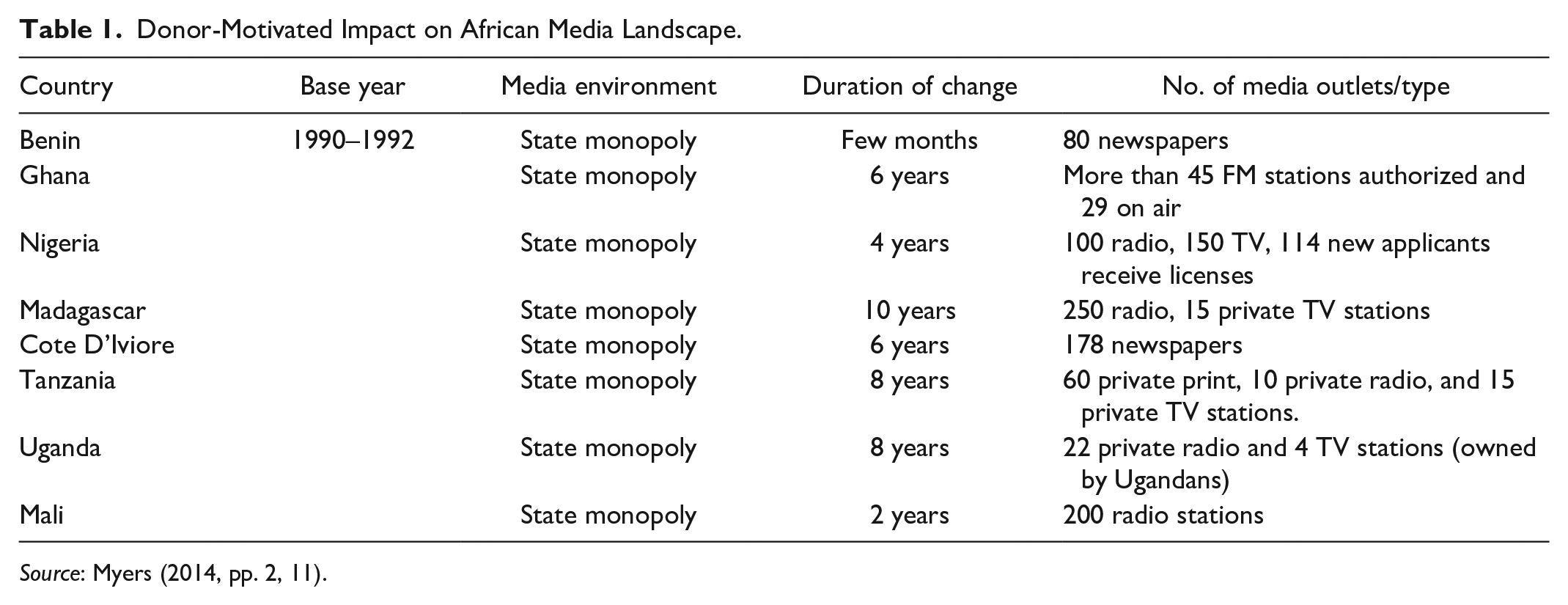
This “democratic-implementation agenda” by the West gave rise to a dramatic change in the political terrain of Africa where many hardened autocratic governance states like Ghana, Togo, Ivory Coast, and Nigeria, among others, adopted democratic rule in the 1990s which impacted the media environment as evident in Table 1.
Donor-Motivated Impact on African Media Landscape.
Source: Myers (2014, pp. 2, 11).
Describing the situation, Kwame Karikari remarked, “Since the 1990s the independent media have grown like the savannah grass after prolific rainfalls following a long drought” (cited in Myers, 2014, p. 2) reechoing the postulation that a symbiotic relationship exists between democracy and media (Camaj, 2012; Gunther & Mughan, 2000). Notwithstanding, it is evident that at the cornerstone of foreign aid programs is a desire to implement an ideology amid other motives. Today, “the principles and the models that informed the evolution of media systems in the West became standards against which to measure how free or how developed a country and its media were” (Gagliardone et al., 2012, p. 178). To Conrad (2015), it is vital to question: If external funders are emerging to enhance the work of journalists, then our key focus should be “how” and “why” these partnerships are occurring.
Political Economy of the Media in Africa
Generally, the ability of most African civil society organizations to generate sufficient funds from local sources is constrained by relatively low levels of industrialization (Robinson & Friedman, 2005), and media is no exception. For instance, De Beer et al. (1995) observed that Africa is considered as media-starved with fewer print, broadcasting, and information and communication technology infrastructure in comparison with any other continents. Although over the past few years Africa has witnessed a fast developing telecommunications system, it is hardly accessible especially in some rural settlements. Furthermore, robust media organizations (Le Monde Afrique, Ringier, Canal+, Lagardère, Slate, Quarzt, BBC, Bloomberg, among others) from developed nations have expanded their businesses in Africa. However, this growth has not been synonymous to the growth of independent and sustainable local media which the continent requires for pluralism (Zotto, 2015, p. 1). Three major socio-political and economic issues which tend to constrain the growth of the African media are evident.
Firstly, the fragile nature of Africa’s growing economy makes many African ventures in newspapers, wire services, television / radio stations and Internet services struggle to sustain such undertakings (Alison, 2013). Myers (2014) recorded that private media that emerged from the late 1980s were established with meager amounts of capital, and the only exception were tougher economies like Nigeria, Kenya, and South Africa. Most of the print outlets in countries like Madagascar, Malawi, Sierra Leone, Angola, Nigeria, and Ghana, among others, are urban-based with cover prices or subscription fees expensive for the ordinary man (Nyarko & Mensah, 2017). To address this, media development funds have been created by some African countries. In 2012, the Ghana government launched a media fund to sustain its media, but it was unsuccessful purportedly due to implementation lapses. The South African Media Development Fund established by the Media Institute of South Africa (MISA) is the most successful African media funding organization that offers loans to media outlets at competitive rates because they cannot afford credit from traditional banks. Second, the political and legal climate to some extent does not support the development of the media. Although many African countries have constitutions that profess freedom of the media and of information, the “freedom concept” oftentimes exists only in rhetoric but remains impracticable in many African nations because portions of those provisions are vague and tied to some other requirements Nyarko, Mensah, & Owusu-Amoh, 2018. Third, the Africa media ecology is dominated by political owners, their affiliates, and some businessmen whose agenda is more political than civil. This informs comment by Riddell (2014, p. 34–35) that what donors lack falls within the confines of political economy and real politick. [It is] “not so much getting donors to decide on what to do, but for them to understand the complexities of the context in which they give aid and work together to contribute to effective change.” For instance, the challenges of the African media exceed donor-driven training projects (Schriffin, 2010; Susman-Peña, 2012) which may yield limited impact on the larger media ecology (Schriffin, 2010, p. 405). The question is, How good are trained media practitioners whose environment of operation does not have information law passed to give them freedom to explore and source relevant information from officialdom (Nyarko & Teer-Tomaselli, 2018) to solve problems of society? The “teaching [of] western journalism norms and practices has widely failed to yield improvements in journalism in many regions [of Africa] because they have not accounted for their social and cultural realities” (Picard, 2015, p. 5). In a panel discussion at the international conference on media development and sustainability in Africa, Jean Marie Etter, Director of the Foundation Hirondelle, observed, Journalists embrace this deontology but applying it is a completely different story. Applying this deontology in many parts of Africa makes you part of a minority and might create difficulties for journalists to earn money. It is thus very important to distinguish between what you can learn through training and what you can finally apply. (p. 5)
These present scenarios where some donor-funded media projects get stifled in the socio-political and economic systems of the recipient African countries. Media development assistance should rather focus more on creating institutional structures that build media capacity over time (Susman-Peña, 2012). This shortfall is as a result of failure of donor agencies and governments over the years to come to terms with the critique of the disconnect between the dictates of foreign paradigms and local African conditions. Thus, it appears that when a “Third World country uses political economy as an analytical tool, it becomes embroiled in a global ‘one size fits all’ framework which fails to address specific intricacies of the region” (Hamusokwe, 2018, p. 2). This notion of applying Westernized paradigms to non-Westernized states is described by Tomaselli (2009) as “an uncontextualised set of textualised metatheories that have little or no relevance to local conditions” (p. 14). For instance, the economic/business segment of media training rarely centers on development or advocacy but rather focuses on subject that epitomizes Western agenda, mainly of U.S. and European stock markets, emphasizing profits and economic indicators (Schiffrin, 2010). Tomaselli (1992) questioned the impact of this line of reporting on ordinary citizens when he remarked, “Think of SABC-TV News reporting on the financial markets: what ‘bus passengers’ can possibly made sense of jargon like ‘politics depresses market sentiment’, or ‘gold rested easier’, let alone understand the intricacies of the BA rate or market indexes” (p. 107). With emphasis on Africa, Picard (2015) summarizes, Many media development efforts have sought to replicate media forms and practices found in developed countries, without fully recognising wide differences in the relative importance of media types in varying locations. What is worse is that there is an effort to recreate media types and systems that are declining and failing in the developed world. (p. 5)
The normative theories of the press by Siebert et al. (1956) and more recently the three systems of media and politics (liberal, democratic corporatist and polarized pluralist models) by Hallin and Mancini (2004) were tested and conceptualized using the West as its database; they continue to be applied in the developing world despite the massive criticisms concerning applicability within its own borders.
Conclusion
This review has shown that media assistance from donor sources enhanced the development of the African media generally especially after the Second World War, but the inability of outlets to sustain their operations financially usher them into the “operational survival phase” where private investors take over with sensationalism and profit-oriented objectives that tend to contradict the traditional functions of the media which donors envisaged. Moreover, the application for funding eligibilities, criteria, and prescribed reporting themes become conditions which to some extent strip off media’s ability to determine its own agenda, and ultimately independence. By this, the very models, “philanthro-journalism” and/or “NGO-funded” to protect and establish a resilient media system, are somewhat becoming a threat to media freedom in a masquerading form. Whenever donors are in the driving seat of setting media agenda, (a) local pressing issues are ignored or given less attention and (b) image of recipient countries is dented. These put the African media on the path to becoming controlled because as long as its quest for donor assistance is unceasing, then its susceptibility to demands of donors will abound.
Furthermore, scholars over the years have pointed out that funders have not considered local conditions enough, especially the political economy within which the media operates. However, donor transactions have not changed significantly because the notion of modeling African media based on foreign cultures, traditions, and identities persists, and this could influence the reporting styles of the African media. This is evident through numerous training programs run separately by donors for Africa media practitioners.
Recommendations
First, media development assistance should go beyond training programs to tackle fundamental issues within the socio-political and economic structures of Africa if donors are to see appreciable success. The question that follows is how successful is a training program for African media practitioners if local legal structures do not allow them to access freely their most vital resource, that is, information, to function. Second, donors need to sustain the outlets they have created and/or supported to ensure the development of the media. Moreover, media regulatory and professional bodies should be assigned vetting roles to approve “agenda themes” by funders to ascertain its relevance to pressing issues in African societies. This is because the African media practitioner best understands the challenges of the continent from the cultural, traditional, and political-economic perspectives and could better set significant agenda and report them. Third, African countries should make the creation of “Media Development Fund” a policy at the African Union (AU) summit level, and the fund should be managed by a media secretariat established by the media itself to aid the growth and development of the African media in line with the developmental agenda of the continent. Finally, in as much as private investments in the media industry leads to huge concentrations, they should be encouraged in a democracy because they are sources of employment, revenue to the state, and, most importantly, report the news. However, media regulatory bodies in Africa should scrutinize licenses issued to prospective outlets without necessarily restricting entrance to ensure that hiring qualified practitioners who are ethically conscious into the landscape is a condition.
Footnotes
Declaration of Conflicting Interests
The author(s) declared no potential conflicts of interest with respect to the research, authorship, and/or publication of this article.
Funding
The author(s) received no financial support for the research, authorship, and/or publication of this article.
