



Abstract
Extending the recent theorizing of the message-centric approach to instructional risk and crisis communication, this study identifies two distinct instructional strategies used by regulatory authorities and adopts a goal-attainment approach to measuring the effectiveness of both strategies in instructing nonscientific publics about impending risks. Specifically, we conducted a quasi-experiment immediately after a substandard vaccine incident in China to examine the differential effects of regulators’ instructional press releases on stakeholders’ risk perceptions and behavioral intentions. We found that the explanation-focused buffering strategy is significantly more effective in both heightening individuals’ cognitive risk perception and reducing their affective risk perception, while the personalization-focused bridging strategy shows more effectiveness in sustaining individuals’ intention to consume and positively evaluate domestic vaccines. Additionally, the findings highlight the need to tailor instructional message strategies to regulatory organizations’ ultimate goals of communication activities. Practical implications for government regulators and risk communicators are also discussed.
Keywords
Introduction
The cumulative prominence of environmental, food safety, and public health risks requires the public to evaluate potential negative impacts on themselves and family members through messages provided by government regulators and expertise agencies. Since risk communication is an interactive process necessitating the “exchange of information and opinions among individuals, groups, and institutions” (National Research Council, 1989, p. 21), regulatory authorities are expected to facilitate a dialogic communication with nonscientific publics and ensure information openness and transparency such that the public skepticism in the decision making process can be eased in the two-way symmetrical interaction (Dozier et al., 2013; Kasperson et al., 2010). The ideal form of dialogic risk communication is, however, extremely vulnerable to the sudden surge of chaotic conditions in sharply intensified risks (Sellnow, Lane, et al., 2017). This acute risk situation has been more prominent with the rapid development of mobile communication and increasing chaos on social media. During COVID-19, for example, tweets posted by federal and state-level public health agencies in the U.S. were found to be inconsistent and incongruent at the early stage of the pandemic outbreak (Wang et al., 2021). Moreover, both forms and sources of health risk communication are likely to influence public stakeholders’ information-seeking behaviors and their perceptions of government agencies’ crisis response strategies during the global pandemic (Moreno et al., 2020). To facilitate informed judgments and decisions, regulatory authorities tend to shift from pursuing “interacting arguments” (Sellnow et al., 2008, p. 10) to providing instructional risk and crisis messages for self-protection, which ought to be clearly expressed and carefully selected, and more importantly, to help the public overcome time constraints, reduce cognitive complexities, and plan future actions (Sellnow & Sellnow, 2010).
In recent years, considerable efforts have been made to explicate the message-centric approach to risk communication and to expand models for evaluating the effectiveness of instructional risk and crisis messages (e.g., Sellnow, Lane, et al., 2017; Sellnow-Richmond et al., 2018). This line of literature tends to converge on the idea that instructional messages are most effective when they are distributed rapidly to target audiences (McIntyre et al., 2011), shared via multiple channels (i.e., both traditional and new media channels), and expressed in actionable guidelines that directly instruct multi-stakeholders how to protect themselves from immediate risks. In measuring the actual performance and learning outcomes of instructional risk and crisis communication, however, much attention focuses on the self-reported message effectiveness (Noar et al., 2010; Sellnow, Lane, et al., 2017), while failing to capture the goal-directed properties of instructional messages as well as nonscientific publics’ “real” presentative perceptions of impending risks. Moreover, prior studies tend to see risk context as a macro-level structure that isolates social and cognitive perspectives of risk judgments and decision-making (Lee & Lemyre, 2009). Since advances in the message-centric approach to risk communication have long made normative assumptions about Western societies and cultures (Lyu, 2012), it is crucial to reexamine the utility of ethnocentric instructional models against other social contexts as an essential supplement to extant literature.
Extending the recent theorizing of the message-centric approach to instructional risk and crisis communication, the present study identifies two distinct instructional strategies used by regulatory authorities and investigates their differential effects on nonscientific public’s perception and decision-making process following a substandard vaccine incident in China. To do so, we begin by distinguishing explanation-focused buffering strategy from personalization-focused bridging strategy to describe organizational communicators’ conflicting understandings of strategic communication and explicate how these two message strategies have been embraced by regulatory communicators when facing acute and intensified risks. Next, we introduce the research context within which a goal-attainment approach has been proposed to measure the effectiveness of both communication strategies in instructing public stakeholders about impending risks. Specifically, we conduct a quasi-experiment to examine the differential effects of regulators’ instructional press releases on individuals’ affective risk perception, cognitive risk perception, and behavioral intentions. Finally, practical implications for government regulators and risk communicators are discussed.
Instructional Strategies in Risk and Crisis Communication
Strategic communication generally refers to “the purposeful use of communication by an organization to fulfill its mission” (Hallahan et al., 2007, p. 3). Instructional risk and crisis communication can be considered as strategic communication since it comprises an organization’s goal-oriented communication activities demonstrating its self-presentation and promotion by communication professionals (Holtzhausen & Zerfass, 2015). This form of communication has been designed to engage various external stakeholders (e.g., shareholders, customers, communities) via multiple media channels. In this study, the strategic communication implemented by regulatory authorities primarily aims at reaching out to nonscientific publics. With limited heuristics for evaluating potential risks, nonscientific publics tend to rely on messages announced and delivered by government regulators through multiple channels to monitor the risk surroundings. Organizational and institutional communicators therefore face pressing challenges in producing and distributing instructional messages that provide protective information for the public and facilitate effective risk communication.
To produce effective instructional risk messages, organizational communicators have used strategies that either set a buffer or form a bridge between regulatory authorities and nonexperts. While buffering is usually used to defend and restore an organization’s strategic position or reputation, bridging takes a more proactive and balanced approach to communication practices by reaching out to stakeholders to realize communication value that leads to mutual understanding within a relational communication management framework (Ledingham & Bruning, 1998; Zerfass & Viertmann, 2017). The distinction echoes the relational shift underway in the PR and strategic communication paradigm (Van Ruler & Dejan, 2005; Wang & Huang, 2020). Specifically, buffering strategies reflect an organization’s reputation orientation which considers the ultimate goal of strategic communication as the dissemination of self-image. In line with this orientation, communicators tend to emphasize the importance of building and maintaining organizational reputation, especially in crisis and risk scenarios (Argenti & Druckenmiller, 2004; Sims, 2009). In contrast, bridging strategies mirror the organization-public relationship (OPR) orientation which concludes that communication practice can enhance effective crisis and risk communication only if it builds a long-term relationship of mutual trust and helps balance the strategic goal with the expectations of strategic publics (Dozier et al., 2013).
Buffering Strategies
As invisible risks have increasingly overwhelmed individuals’ personal knowledge and sensory experiences (Beck & Ritter, 1992), the predicament of instructional risk communication often manifests as the tension between the objective reality and the subjective construction of risks. In scenarios of acute risks, communicators taking the approach of buffering tend to uphold a strong sense of technical rationalism that adheres strictly to scientific experts’ opinions and recommendations while considers nonscientific publics as an uncertain and ignorant group of individuals easily influenced by irrational factors such as extreme emotions and social biases (Klinke & Renn, 2002). Central to this view is that risks are socially constructed rather than existing in an objective nature; therefore, individuals are assumed to passively accept most socio-scientific facts and arguments delivered by communicators and experts. This is in line with the advocating function of strategic communication that aims to protect an organization from external changes and environmental influences (Cancel et al., 1999).
Communication scholars have also highlighted the pressing need for risk and crisis communicators to broadcast and share instructional messages to public stakeholders through channels afforded by both traditional mass media and new media (e.g., Huang, 2004; Seeger, 2006; Sellnow-Richmond et al., 2018). In addition to emphasizing the urgency and multiple channels of information distribution, communication professionals usually prioritize scientific explanations about the potential threats or hazards in a logical manner. To implement this explanation-focused buffering strategy, they often use scientific language to interpret the impending risky states, provide public safety measures with reference to scientific proof and international scientific standards, and emphasize the active and adequate actions taken by the government authorities (Frisby et al., 2014). In practice, elements of explanation focus on providing the latest news of the background, the current situation, and the scientific estimation of potential threats. These explanations are expected to be accurate and gained from credible sources. This communication pattern is largely oriented toward one-way communication, which disseminates messages via monolog (Williams & Olaniran, 1998). Moreover, the asymmetrical communication activities aim to influence public stakeholders leaving the organization itself unchanged (Dozier et al., 2013).
Bridging Strategies
Despite the effectiveness of logical explanations in strengthening instructional risk and crisis messages (Frisby et al., 2013), buffering has been criticized to be a linear and injection-like process which aims to instill the minds of the general public with professional and technical risk information but proves to be against the effective risk communication (Heath, 1995). This “egocentric” way of strategic communication shows that organizations are loath to adapt to the external environment and thus more inclined to persist in their own goal attainment without considering nonscientific publics’ opinion (Sha, 2009; Wonneberger & Jacobs, 2016). Contrary to the conservative approach to the organizational environment, bridging reflects an organization’s desire to adapt to dynamic external variations and public expectations, and thus covers more open and proactive communication activities. According to the contingency theory (Cancel et al., 1999), bridging endorses the accommodating role of communicators who move beyond an aggregation of symbolic activities undertaken from the organizational stances (Heath & Toth, 1992) and seek changes toward a two-way symmetric communication between an organization and its multiple stakeholders.
In practice, risk communicators’ openness to changes and adjustments throughout the communication process has distinguished bridging as a method for exchanging risk information via dialog (Williams & Olaniran, 1998). In situations of acute and intensified risks, the explanation-focused instructional messages might psychologically slacken individuals’ vigilance and restrain them from taking immediate and appropriate actions (Slovic, 2010). Instead, the bridging calls for a personalization-focused communication strategy which extends beyond disseminating information and incorporates messages underlining personal responses as public perceptions of the impending risk escalate (Seeger, 2006). Since nonscientific publics cannot be assumed to fully comprehend what constitutes an appropriate and adequate self-protective action, risk communicators seek to instruct them what to do to guard themselves against the potential harms or hazards (Coombs, 2009). Contents of these instructional messages must help affected stakeholders understand, internalize, and personalize the risk conditions, and more importantly, motivate them to act upon the instructed information. Compared with the buffering strategies which often attempt to frighten stakeholders with information about consequences and severity of exposure to risks, the bridging strategies used by organizational communicators focus on actionable guidelines and mutual benefits between organizations and stakeholders, which reveal applicability to a wider range of risk and crisis communication practices (Dozier et al., 2013).
An emerging body of communication research has provided insight into how risk messages can be personalized to facilitate effective instructions. The IDEA model proposed by Sellnow and Sellnow (2013, 2014) has demonstrated applicability across risk types and cultures (Frisby et al., 2014; Sellnow, Iverson, et al., 2017; Sellnow et al., 2019). Grounded on the experiential learning theory, the IDEA model contends that the content of an optimal instructional risk and crisis message should capture four components: internalization, distribution, explanation, and action. In addition to explanation and distribution (i.e., instructional messages should be distributed through multiple communication channels to reach target audiences), internalization and action constitute the major elements addressing the best practice of personalizing effective risk and crisis message design to affected individuals and communities. On the one hand, internalization aims to maintain audiences’ attention by highlighting timeliness, proximity, and personal relevance of crisis events. Messages lacking internalization are likely to restrain nonscientific publics from taking appropriate self-protective actions. On the other hand, action offers specific guidelines for the meaningful protection of self and others. Such actionable instructions ought to be expressed in a precise manner. For instance, in cases of emergencies where immediate precautionary or avoidance actions are required (e.g., warnings to evacuate coastal areas because of an inbound tsunami), ambiguous statements such as “stay safe” or “take care” are useless. Instead, proactive action recommendations involving numeric data or even visual messages can be more effective in heightening self-protective motivations and may be more adequate to be disseminated in such a context.
Context of the Study
Over the past decade, drug safety issues have become an ever-increasing concern in China and weakened public trust toward regulatory authorities and public health policies. During an unannounced inspection in July 2018, Changchun Changsheng Life Sciences Ltd., a domestic vaccine manufacturer in China’s northeastern Jilin province, was revealed to have provided ineffective vaccines and falsified production and quality control record. China’s National Drug Administration (NDA) then suspended production at the company and withheld all problematic batches of vaccines involved to ensure they were not placed on the market (Jourdan, 2018). Although no deaths or injuries were reported, the substandard vaccine incident sparked one of China’s largest public outcries in recent years, challenging both the institutional trust of public stakeholders and the risk management of government regulators (Kuo, 2018).
Potential “side-effects” of substandard vaccines could be devastating but are usually of high uncertainty for nonscientific publics to fully recognize and comprehend. Although citizens in China are capable of using diverse channels and digital platforms to seek out risk messages and build connections with other public stakeholders, they have limited ways to evaluate the essentiality of risks and need to rely on government regulators and scientific experts to monitor the risk surroundings. Hence, people seek suggestions and support from regulatory authorities to form their intuitive judgments and assess the extent to which they are vulnerable to risks (Viklund, 2003). Under such circumstances, regulatory authorities faced the dilemma between pursuing effective instructional risk communication and stabilizing the domestic vaccine market in China. By providing scientific proof, dismissing rumor, and instructing authentic risk information, regulators were expected to inform the public of “what,” “when,” and “where” about the Changsheng incident and specific guidelines on meaningful protection of self and others. This could help nonscientific publics thoroughly understand potential harms, especially when the harmful consequences are sporadic and delayed (Slovic, 1987). In practice, however, quality-assured vaccines constitute one of the most cost-effective health measures an individual can take and are critical for reducing diseases, disability, death, and inequity worldwide (Andre et al., 2008). In China, the Expanded Program on Immunization implemented has made the country free from polio and dramatically reduced vaccine-preventable diseases including measles, mumps, rubella, and hepatitis A and B among children.
The dilemma has become more confounding for regulatory authorities, given a recent series of vaccine scandals in China. According to a survey conducted by the CDC, the suspected infant deaths of hepatitis B vaccines in 2013 led to an immediate 45% drop of the public trust toward vaccine safety in Shenzhen as well as a sharp decline of the vaccination rate of hepatitis B. Shortly after the announcement of Changsheng substandard vaccine incident, online searches for the tourist destination with “vaccine” as the keyword soared and parents in mainland China reportedly scrambled to Hong Kong to get their children vaccinated. Although the major concern of the incident rests on the disclosed scandal of data integrity in the production of batches of rabies vaccine rather than the safety and efficacy of affected vaccines, nonscientific publics’ confidence crisis and increased vaccination resistance may lead to a greater prevalence of related diseases and even an outbreak of mass diseases, with consequences far more serious than the incident per se (Larson et al., 2011).
As thus, regulatory authorities sought to not only preserve nonscientific publics’ right to get access to effective instructional messages, but also protect vaccine manufacturers from a flood of liability claims and thereby stabilize the domestic vaccine market. Nonetheless, the widespread anxiety expressed during the incident was blamed to be aggravated by the inaccurate and inconsistent instructional risk messages national regulators communicated to public stakeholders (Leng & Huang, 2018). Therefore, this study aims to examine and improve instructional risk and crisis communication provided in times of acute risks to public stakeholders using the Changsheng substandard vaccine incident as a case study.
Goal-Attainment Approach to Measuring Message Effectiveness
Gauging the effectiveness of instructional risk and crisis communication has been an imperative challenge for risk communicators, since assumed learning outcomes of nonscientific publics vary across projects and studies. An emerging body of literature has extensively addressed this issue. For example, Sellnow, Lane, et al. (2017) developed a measurement framework incorporating individuals’ cognitive learning (comprehension/understanding), affective learning (perceived value/relevance), and behavioral learning (behavioral actions). They contended that against the backdrop of a sudden crisis, behavioral actions are more important largely because “appropriate self-protective actions ultimately mitigate harm and save lives” (p. 555) while the other two learning outcomes serve as essential catalysts for encouraging individuals to carry out desired behavioral actions (see also Sellnow-Richmond et al., 2018). Moreover, Sellnow et al. (2012) found that exposure to messages incorporating all elements of the IDEA model can increase one’s intention and confidence in adopting protective behaviors regardless of the impact of learning styles. Another line of research urges attention to self-reported efficacy and knowledge. In their close examination of actual news stories and press releases, for instance, Frisby et al. (2014) demonstrated that individuals watching mediated instructional messages reported significantly higher levels of self-efficacy and knowledge to take self-protective actions during an egg recall crisis.
These recent approaches to measuring the utility of instructional messages, however, suffer from a lack of conceptual clarity and are largely oriented toward the readily designed model of instructional risk and crisis communication. Moreover, the self-reported effectiveness of instructions (e.g., perceived value, relevance, understanding) is doubtful because nonscientific publics’ judging criteria and weighting priorities of messages issued by crisis spokesperson or news media are likely to differ across cases and contexts. In the present study, we propose a goal-attainment approach to measuring the utility of both explanation-focused buffering strategies and personalization-focused bridging strategies in instructing public stakeholders about impending risks. This approach echoes the goal-directed conceptualization of strategic communication (Holtzhausen & Zerfass, 2015) and defines the effectiveness of instructional messages as the extent to which the effects of a given message-centric strategy fulfills an organization’s ultimate goal of communication activities. Specifically, this definition suggests several criteria that should be satisfied: First, measures of utility should be consistent with organizational goals. Second, organizational objectives should be considered as functional wholes evaluating the big-picture performance. Third, criteria should be system relevant and applicable across organizations and entities.
As per the above discussion, there were two major objectives of Chinese regulatory authorities after the exposure of Changsheng substandard vaccine incident. On the one hand, communication practitioners within regulatory bodies sought to ensure nonscientific publics’ access to effective instructional messages to guard them against potential harms and threats. This objective primarily requires communicators to heighten public stakeholders’ cognitive risk perception, which is generally the perceived likelihood that an individual will be affected by domestic vaccines at some point in the future. This probability-based assessment is deeply rooted in the psychometric approach to pondering risk perception (Slovic et al., 1982), particularly the considerable scholarship on risk judgment and decision-making. It classifies and quantifies risk perception in terms of multiple qualitative properties of the public’s expressed preference, such as dread, controllability, susceptibility, distribution, and benefits (Kunreuther et al., 1990; Sjöberg, 2004). The cognitive risk perception thus equates perceiving risks with assessing the probability of potential hazards and vulnerabilities based on one’s logical, rational, and rule-based reasoning. As a recent example, Roh and Lee (2018) categorized risks in terms of the controllability and demonstrated that perceptions of intrinsic risks (i.e., risks arising from normal operation) and extrinsic risks (i.e., risks posed by uncontrollable accidents such as natural disaster) have distinct effects on risk acceptance of nuclear power generation. In response to the significance of heightening nonscientific publics’ perceived probability of potential threats and harms brought by domestic vaccines, the first research question (RQ1) was posited: Which instructional message strategy (i.e., explanation-focused buffering vs. personalization-focused bridging) used by regulatory authorities is more effective in heightening individuals’ cognitive risk perception?
On the other hand, regulatory communicators endeavored to stabilize the domestic vaccine market by protecting vaccine manufacturers against numerous liability claims. In practice, this objective necessitates both reducing individuals’ affective risk perception (i.e., calming the public panic) and maintaining their behavioral intentions in consuming domestic vaccine. Unlike the cognitive risk perception driven by probability-based assessments, the affective risk perception represents an emotional reaction or response to the threat or harm. A growing body of risk research demonstrates that negative affects such as fear, anger (Lerner et al., 2003), and psychological stress (Sobkow et al., 2016) are of crucial importance to how people perceive risks. The second research question (RQ2) was thus posited: Which instructional message strategy (i.e., explanation-focused buffering vs. personalization-focused bridging) used by regulatory authorities is more effective in reducing individuals’ affective risk perception? Moreover, it is usually imperative for risk communication managers and policymakers to improve the effectiveness in intervening and influencing the public’s behavioral intentions toward domestic vaccines (Chen, 2015). Measures applied to gauge the behavioral intention differ greatly across disciplines. Crisis communication scholars, for example, employ word-of-mouth (WOM) to predict whether public stakeholders intend to say good or bad things about companies after a crisis has occurred (Coombs & Holladay, 2008). In marketing and consumer scholarship, the purchase intention has been underlined to examine the likelihood of purchase behavior after being exposed to various promotions and advertisements (Grewal et al., 1998). From the perspective of government regulators, sustaining the use and positive WOM of domestic vaccine after the Changsheng incident would be a challenging task of risk management. Therefore, the third set of research questions (RQ3a-b) was raised: Which instructional message strategy (i.e., explanation-focused buffering vs. personalization-focused bridging) used by regulatory authorities is more effective in maintaining individuals’ (a) use intention and (b) WOM intention of domestic vaccine?
Method
Shortly after the Changsheng substandard vaccine incident, we conducted a quasi-experiment with posttest-only evaluation design to test the research questions raised above. Data collection procedures, participants, message stimuli, and measurements are provided below.
Data Collection
Via Baidu Cloud (https://cloud.baidu.com/product/qss.html), an online survey panel, we recruited 454 participants for an online survey about risk perceptions and risk communication. The sampling database authenticates participants through a real-name system that covers more than 300 cities in China. The sample was limited to Chinese IP addresses and those who had a Baidu account verified through their mobile phone. Eligible participants were required to provide consent at the outset and were briefed on the substandard vaccine incident in July 2018. Participants were then randomly assigned to three different conditions: (1) control group; (2) treatment group A: explanation-focused buffering strategy; and (3) treatment group B: personalization-focused bridging strategy (all message elements addressed in the IDEA model). Participants assigned to the control group completed the questionnaire without receiving any stimulus message, while those assigned to two treatment groups provided responses after being presented the message stimulus, which consisted of a press release issued by government regulators. The survey was designed to require a response to each item; therefore there was no missing data. Each participant was paid 8RMB (equivalent to 1.13 USD) upon completing the questionnaire and debriefed on the fictional origin of the official government press release they had read. Ethical approval was granted by the Survey and Behavioral Research Ethics Committee (SBREC) at the university where the corresponding author worked.
Participants
Of the participants, 33.5% (n = 152) were randomly assigned to the control group; 31.9% (n = 145) to the explanation group; and 34.6% (n = 157) to the personalization group. Individual differences among participants were assumed to be equally distributed across three groups because of random assignments. Specifically, 51.1% (n = 232) were female and 91.2% (n = 414) aged between 18 and 40. 81.5% (n = 370) reported having a bachelor’s degree or above. In addition, 21.4% (n = 97) reported earning a monthly household income of less than 5,000 RMB, 38.8% (n = 176) between 5,000 and 10,000 RMB, 31.1% (n = 141) between 10,001 and 20,000 RMB, and 8.8% (n = 40) more than 20,000 RMB. One contentious issue of public concern that arose during the substandard vaccine incident was that Changsheng was suspected of selling ineffective DPT vaccines used to inoculate children against diphtheria, whooping cough, and tetanus. 61.0% (n = 277) of participants reported having one or more children whose care they are responsible for.
Message Stimuli
Before designing the message stimuli, we intensively collected information about the substandard vaccine incident to learn about various causes, consequences, and responses issued by all parties involved in the controversy. To validate this publicly shared information, we also consulted official documents issued by local, provincial, and central governments, announcements released by the China Food and Drug Administration (CFDA) and the Chinese Center for Disease Control and Prevention (CDC), and the newly passed Vaccine Administration Law of the People’s Republic of China. Taking this step ensured a thorough understanding of the crisis event as well as the ecological validity of message stimuli.
Different press releases were designed for each treatment group (see the appendix). These messages were based on an official statement issued by the State Administration of Market Regulation (SAMR) in China. As can be observed from the figures in the appendix, the message developed for the explanation treatment condition group contains information focused primarily on the outbreak of the incident. It provides accurate information about what is happening and what has been done to mitigate the problem. In addition to the material included in the explanation condition (i.e., source credibility, scientific information, and lucid interpretation), the message stimulus provided for the personalization group also incorporates components addressed in the IDEA model other than explanation and distribution, that is, internalization and action steps to be taken for self-protection. The internalization component was designed to maintain audience attention and aid message retention by highlighting proximity and personal relevance. We accentuated proximity by stating that Changsheng sold 653,120 doses of ineffective DPT vaccines across the country. Personal relevance was addressed by depicting the fact that China’s drug regulator accused Changsheng of fabricating production and inspection records related to rabies vaccines particularly those for infants and children. Moreover, we included specific actionable directives suggested by the SAMR to encourage people to take proactive and appropriate action to prepare for or respond to the risks engendered by the substandard vaccine incident. These suggestions included: (1) immediately ascertaining their vaccination records and those of close relatives; (2) identifying whether they or their relatives were inoculated with a diphtheria vaccine with the batch number of 201605014-01 or with any rabies vaccine produced by Changsheng; and (3) calling or going to the local hospital for a timely re-vaccination at no additional cost. Graphic templates for government press releases were used to make message stimuli more realistic for participants. We also kept the two press releases approximately the same length in a purposive way to exclude any exogenous effects created by heuristic cues other than the content of stimuli.
Measures
Cognitive and affective risk perceptions
Slovic (1987) suggested that a risk event may affect subsequent risk perceptions not only of the parties involved, but also entire industries that may have only been indirectly responsible for accident outcomes. The substandard vaccine incident stirred a wave of criticism of the entire health care industry as Changsheng comprised a sizable share of the vaccine market in China. In order to reflect the holistic risk context and to avoid potential one-sided evaluation, risk perceptions were measured by assessing participants’ perceptions of “domestic vaccines” rather than vaccines produced by a specific company. Items were adapted from Ferrer et al. (2016) and selected based on their applicability to the incident we focused on in this study. Participants were asked to state their agreement (1 = strongly disagree to 7 = strongly agree) with five items concerning cognitive risk perception (reverse coded; M = 4.18, SD = 1.44, Cronbach’s α = .93) and six items concerning affective risk perception (M = 5.42, SD = 1.23, Cronbach’s α = .92). Table 1 presents items and standardized factor loadings for both dimensions of risk perception.
Scale Items for Risk Perceptions and Standardized Factor Loadings.

Note. All items were measured on a 7-point scale (1 = strongly disagree to 7 = strongly agree).
Use intention and WOM intention
Items were adapted from prior studies on behavioral intentions (Coombs & Holladay, 2008; Grewal et al., 1998). For use intention, participants stated their level of agreement (1 = strongly disagree to 7 = strongly agree) on whether they would: (1) allow their relatives to inject domestic vaccines; (2) select domestic products when they were next due for vaccinations; (3) inject domestic vaccines themselves. Responses were averaged to form a scale (M = 4.35, SD = 1.55, Cronbach’s α = .91). For WOM intention, in the event that their relatives or friends turned to them for advice, participants were asked whether they would: (1) encourage them to inject domestic vaccines; (2) recommend domestic vaccines to them; (3) say positive things about domestic vaccines. These responses were measured on a seven-point scale ranging from 1 (strongly disagree) to 7 (strongly agree). Three items were averaged to form a scale (M = 3.86, SD = 1.65, Cronbach’s α = .92).
Following the dependent measures, we included manipulation check items at the end of the questionnaire. Participants in the two treatment groups were asked to state their level of agreement (1 = strongly disagree to 7 = strongly agree) with statements that the message: (1) provides a succinct description of the vaccine incident (explanation); (2) provides an explanation of the incident that is easy to understand (explanation); (3) makes me realize potential risks the vaccine incident has posed to me (internalization); (4) makes me realize that the vaccine incident is relevant to me (internalization); (5) gives me specific action steps I should take (action); and (6) makes me know the efficient action steps I should take (action).
Results
With respect to the manipulation checks, results of the independent-sample t-test revealed that compared with the explanation treatment group, the personalization group reported a higher level of perceived internalization, t (153) = 2.09, p < .05, and intention to act, t (153) = 3.89, p < .001. But the two groups demonstrated no difference in perceived explanation, t (153) = 1.17, p = .244. Hence, the effectiveness of the manipulation in this study is satisfactory.
To answer RQ1-3, we firstly performed a one-way multivariate analysis of variance (MANOVA) to compare individuals who received no message in the control condition to those who viewed either explanation-focused or personalization-focused instructional messages in the treatment conditions. As shown in Table 2, a meaningful pattern of Pearson correlations can be observed among all dependent variables. This suggested the appropriateness of conducting the MANOVA (Meyers et al., 2006). In addition, the Box’s M value of 130.87 was associated with a p-value of .10, which was evaluated to be non-significant according to Huberty and Petoskey’s (2000) guideline (i.e., p < .005). This revealed that the covariance matrices between the groups were assumed to be equal for the purpose of the MANOVA.
Psychometric Properties of Measurement Scales.

Note. n = 454. *p < .05. **p < .01. ***p < .001.
Specifically, we examined whether there would be one or more mean differences of dependent variables between three message conditions. Results indicated a statistically significant MANOVA effect, Wilk’s Λ = .913, F (4, 448) = 5.97, p < .001, partial η2 = .051, power = 1.000. This suggested that regulatory authorities’ different instructional strategies contributed to significant gaps in individuals’ risk perceptions of and behavioral intentions toward domestic vaccine. Prior to performing a series of follow-up analyses of variance (ANOVAs), we tested the assumption of homogeneity of variance for all four dependent measures with Levene’s F tests. Although one of the four Levene’s F tests (i.e., WOM intention) was statistically significant (p > .05), the assumption of variance homogeneity was largely met because a closer inspection of the standard deviations (SD; see Table 2) demonstrated the robustness of ANOVA since none of the largest SD was more than four times the size of the smallest (Howell, 2010). As exhibited in Table 3, all of the four ANOVAs were statistically significant, with effect sizes (partial η2) ranging from .017 (p < .05) to .029 (p < .01). This confirmed the results of the MANOVA that three types of message stimulus led to different levels of effectiveness in heightening cognitive risk perception, reducing affective risk perception, and maintaining behavioral intentions.
One-way ANOVAs with Risk Perceptions and Behavioral Intentions as Dependent Variables and Message Type as Independent Variable.
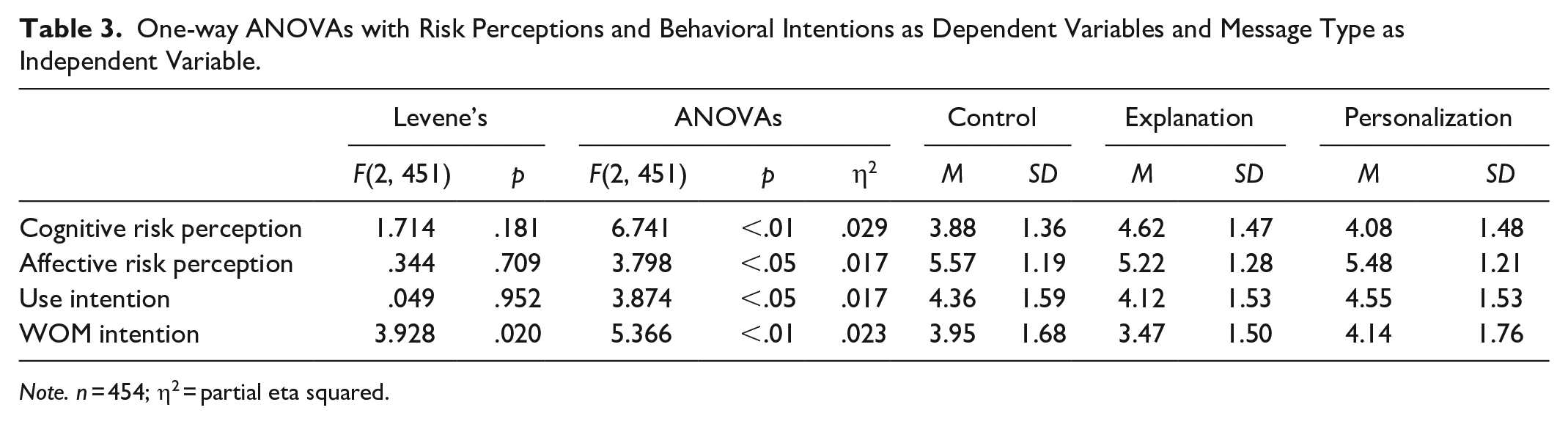
Note. n = 454; η2 = partial eta squared.
Finally, we conducted a series of post-hoc analyses with Fisher’s LSD to investigate individual mean differences of outcome variables across three instructional message conditions. As presented in Table 4, results showed that 6 out of 12 post-hoc mean comparisons were statistically significant (p < .05). Moreover, the trend of the effect was not linear. In specific, participants receiving the treatment explanation message reported significantly higher means of cognitive risk perception than those receiving either no message stimulus (95% CI = [0.291, 0.754]) or the treatment personalization message (95% CI = [−0.593, −0.138]). Also, the explanation condition exhibited significantly lower means of affective risk perception than the control condition (95% CI = [−0.512, −0.055]), while the mean difference between personalization condition and the control condition revealed no significance in this regard (95% CI = [−0.298, 0.148]). That is, on average, the explanation message was more effective than the personalization message in (1) heightening participants’ perceived likelihood that they will be affected by domestic vaccines (i.e., cognitive risk perception) and (2) reducing the public panic and negative emotions or reactions to the threat or harm (i.e., affective risk perception). In contrast, participants receiving the personalization message reported significantly higher means of use intention (95% CI = [0.054, 0.508]) and WOM intention (95% CI = [0.180, 0.636]) than those being exposed to the explanation message. In other words, the personalization message demonstrated more effectiveness than the explanation message in sustaining participants’ intention (1) to select domestic products for vaccination in the future (i.e., use intention) and (2) to say positive things about domestic vaccines (i.e., WOM intention). One noteworthy finding is that the explanation condition revealed even lower means of both use intention (95% CI = [−0.381, 0.074]) and WOM intention (95% CI = [−0.530, −0.072]) than the control condition.
Mean Differences in Risk Perceptions and Behavioral Intentions Between Message Types Expressed as Cohen’s d.

Note. Values for statistically significant post-hoc comparisons (p < .05) based on Fisher’s LSD test are presented in bold. MD = mean difference; CI = confidence interval; LL = lower limit CI; UL = upper limit CI.
Overall, the findings not only supported the imperative for regulatory communicators to apply instructional risk and crisis communication in their official press releases in the acute risk situation, but more importantly, highlighted the need to tailor instructional message strategies to regulatory organizations’ ultimate goals of communication activities.
Discussion, Implications, and Limitations
Grounded on the message-centric approach to regulatory authorities’ instructional risk and crisis communication, this study investigated the differential effects of explanation-focused buffering strategy and personalization-focused bridging strategy on nonscientific publics’ perception and decision-making process following a substandard vaccine incident. Results demonstrated that regulatory communicators’ different instructional press releases led to remarkable gaps in participants’ risk perceptions of and behavioral intentions toward domestic vaccine. Compared with those exposed to no instructional message stimulus, individuals receiving either explanation-focused or personalization-focused press releases reported different levels of cognitive perception, affective risk perception, and behavioral intentions. Moreover, the prospected differential effectiveness of instructional messages was validated that the explanation-focused message turned out to be more effective than the personalization-focused message in heightening individuals’ cognitive risk perception and reducing their affective risk perception, while the personalization showed more effectiveness than the explanation in sustaining individuals’ use intention and WOM intention. In line with communicators’ conflicting understandings of strategic communication (Cancel et al., 1999), the findings exhibited that buffering and bridging represent two distinct philosophies or worldviews of how instructional communication should be functioning in scenarios of acute risks. This echoes the argument of Zerfass and Viertmann (2017) that in practice, the polarity of defensive and proactive strategies is reflected in communication professionals’ interpretation of the value-based management: buffering strategies usually equate organizational value with shareholder value, which highlights creating and maintaining a favorable image in the communication marketplace; while bridging strategies pay closer attention to the stakeholder value, which incorporates various stakeholders’ expectations and interests into the management framework and goes beyond an organization’s positioning in marketplace to its cultural and social environment.
A closer inspection of a series of post hoc analyses suggests an explicit challenge to prior empirical evidence supporting the predominantly positive effect of personalized messages in instructing public stakeholders about impending risks (e.g., Sellnow, Iverson, et al., 2017). By using a goal-attainment approach to measuring the information effectiveness, the present study reveals that the explanation appeared a cut above the control message in achieving both goals regarding risk perceptions, while the personalization failed to obtain any significant advantage over the control condition in accomplishing the regulatory authorities’ desired communication effects. One possible explanation is that the cognitive risk perception was aided by the buffering strategy of providing participants with concrete information about the Changsheng incident, which enabled them to access a richer network of cognitive associations related to the risk event. Meanwhile, prior research emphasizes that people rely more on affects and emotions in unfamiliar cases (Plessner & Czenna, 2008). The explanation-focused strategy is more likely to increase individuals’ familiarity with risk objects and thus reduce their panic and negative emotions to the potential threats. It should be noted that the online survey was conducted against the backdrop of a recent series of Chinese drug safety scandals, among which vaccine issues were at the center of controversies and debates. In situations of limited knowledge, individuals are more inclined to access affective associations toward an unfamiliar risk object than to construct cognitive associations. Subsequent iterations of the method used here can delve deeper into the question of how unfamiliarity can make people fall back on more intuitive perception and decision-making processes—and how that in turn affects the utility of instructional risk and crisis communication.
Another noteworthy point is that although cognitive risk perception was positively correlated to its affective counterpart (Pearson r = .20, p < .001), the explanation message prompted their changes in completely different directions. This provides support for the emerging dual-process theory as a new avenue to understand risk perception by outlining two categorically distinct modes of processing (Peters & Slovic, 1996). Specifically, the cognitive risk perception represents the analytic process which is slow, deliberate, sequential, and controlled with high cognitive effort and more involvement of consciousness, while the affective risk perception denotes the heuristic process which is fast, intuitive, parallel, and automatic with low cognitive effort and less involvement of consciousness (Epstein, 2014). This concurred dual-process view of risk perception suggests that affect and cognition play different, if not mutually exclusive, roles in shaping how the public perceive risk events. Put in differently, nonscientific publics do not only think, but also feel about risks (Slovic & Peters, 2006).
The contrast between two treatment conditions reveals that the personalization-focused strategy was significantly more effective than the explanation-focused strategy in retaining individuals’ intention to consume and positively evaluate domestic vaccines, and thus more likely to mitigate the public vaccination resistance and stabilize the domestic vaccine market. As mentioned earlier, the personalization-focused strategy aims to not only help nonscientific publics understand and internalize the risky surroundings, but more importantly, motivate them to take the instructed self-protective action steps. Compared to instructional messages focusing on creating accurate comprehension through scientific explanation and logical reasoning, the bridging strategy used by regulatory communicators caters to the psychological proximity and personal relevance of information receivers. Moreover, the specific actionable guidelines provided in press releases may enhance the mutual understanding between public stakeholders and regulators. It should also be noted that in China, people tend to perceive regulatory authorities as closer to the central government, which earns much more public trust than the local government (Li, 2004). The bridging strategies stressing the accommodating role of organizational communicators may further enhance the trustworthiness of regulators, which is conducive to restoring and rebuilding the public image of domestic vaccine market.
Practical Implications
Findings from this study also suggest several takeaways for risk communication practitioners. First, despite the scholars’ efforts in advocating a stakeholder-centric pattern to implement and evaluate risk and crisis communication (Falkheimer & Heide, 2014; Heath & Johansen, 2018), this study uses a direct message comparison to demonstrate one research-practice gap constantly witnessed in embracing a relational and two-way dialogic framework (Rybalko & Seltzer, 2010). The assumed positive outcomes of bridging strategies that emphasize the organization-public mutual trust and openness to adjustments throughout the communication process are problematic. Instead, the goal-attainment approach to assessing the effectiveness requires practitioners to tailor communication strategies to an organization’s ultimate objective. Second, the organizational goals in accommodating the crisis may also vary across different phases of the crisis. Immediately after the outbreak of the crisis, the prior goal of regulatory authorities is often to guard nonscientific publics against potential threats or harms in a strict manner. Under such circumstances, the explanation-focused strategy is more likely to heighten the perceived susceptibility and calm the public panic, and therefore beneficial to achieving the organizational goal. In a later phase, the personalization-focused strategy may suit well with the goal to stabilize the domestic vaccine market and reduce the vaccination resistance, primarily through maintaining individuals’ intentions to continue using or recommending domestic vaccines. Hence, the contrast between these two message strategies is not absolute. It should be rather the priority sequence than the yes-or-no question that draws essential considerations from practitioners to choose appropriate goal-directed communication activities. Third, our findings might serve as a starting point for further investigations on how different risk perceptions and behavioral intentions could be targeted individually and how the magnitude and direction of each component changes. This would help communication practitioners to generate the maximum impact on the learning outcomes of public stakeholders.
Limitations and Future Research
There are several limitations of this study and suggestions for future research to be addressed. First, designed from the goal-directed perspective of government regulators in the context of the Changsheng substandard vaccine incident, this study measures only the intention to perform desirable behaviors, that is, domestic vaccine use and WOM. Consequences and effects of these actions are restricted to participants, their immediate family members, and close friends. However, other behaviors of crucial importance to the risk management of drug safety may have consequences beyond the individual level. For instance, participating in anti-violence activism may impact not only individuals’ lives, but also the functioning of the larger community. According to the theory of planned behavior (Ajzen, 1991), the motivational component that drives the behavioral intention may vary with anticipated consequences. High levels of personalization in instructional messages may be sufficient to motivate intentions to retain the use of domestic vaccines, but insufficient to arouse intentions to sign a petition supporting domestic vaccines. It is therefore necessary to investigate other types of behavioral intention in measuring the utility of instructional risk and crisis communication. One such focus should be on the communicative behavioral intention, the specific mechanism of which merits more scholarly attention considering the rapid development of mobile communication and social media. Another notable limitation rests on the sampling strategy. Concerning the educational background, 81.5% (n = 370) of participants reported having a bachelor’s degree or above, far exceeding the national average (8.73%, National Bureau of Statistics, 2011). We are thus unable to generalize our findings to the wider Chinese public. Despite the inherent restrictions of the online sampling database, the gap necessitates a more systematic sampling frame in future investigations. Finally, the random assignments implemented in the quasi-experimental design assumes that individual differences are equally distributed across various conditions. However, the message-centric approach to risk communication has further demonstrated the multiplexity of public stakeholders that contributes to varying understandings and framing strategies of different cultural groups (Sellnow et al., 2012). As thus, risk communicators are not able to control how the public perceive and respond to risk messages, but instead, have to take cultural factors such as normative beliefs and values, perceptions of relational intentions, and worldviews into account. Blindly ignoring multi-stakeholders in the process of risk communication will only arouse negative emotions such as anxiety, anger, and fear, which could cause serious consequences far beyond the risk per se.
Supplemental Material
sj-docx-1-sgo-10.1177_21582440211061525 – Supplemental material for Exploring the Effects of Instructional Message Strategies on Risk Perceptions and Behavioral Intentions: The Case of a Substandard Vaccine Incident
Supplemental material, sj-docx-1-sgo-10.1177_21582440211061525 for Exploring the Effects of Instructional Message Strategies on Risk Perceptions and Behavioral Intentions: The Case of a Substandard Vaccine Incident by Xiao Wang, Yi-Hui Christine Huang, Qiudi Wu and Ivy Wai-Yin Fong in SAGE Open
Footnotes
Declaration of Conflicting Interests
The author(s) declared no potential conflicts of interest with respect to the research, authorship, and/or publication of this article.
Funding
The author(s) disclosed receipt of the following financial support for the research, authorship, and/or publication of this article: This work was supported by the General Research Fund from the Research Grants Council of the Hong Kong Special Administrative Region, China (Grant No. 14616617); and the GESIS (Leibniz Institute for the Social Sciences) Grant (Grant No. GG-2019-017).
Ethical Approval
Ethical approval was granted by the Survey and Behavioral Research Ethics Committee (SBREC) at the Chinese University of Hong Kong (No. SBRE-19-090).

Data Availability Statement
The data that support the findings of this study are available from the corresponding author, Yi-Hui Christine Huang, upon reasonable request.
Supplemental Material
Supplemental material for this article is available online.
References
Supplementary Material
Please find the following supplemental material available below.
For Open Access articles published under a Creative Commons License, all supplemental material carries the same license as the article it is associated with.
For non-Open Access articles published, all supplemental material carries a non-exclusive license, and permission requests for re-use of supplemental material or any part of supplemental material shall be sent directly to the copyright owner as specified in the copyright notice associated with the article.
