



Abstract
Teacher empowerment is characterized as teachers’ individual and professional development, supporting them, providing them with comfortable working conditions and materials, and fostering constructive communication. The study sought to understand how principals approach teacher empowerment and what constitutes optimum teacher empowerment. The study was developed as a qualitative research, with 11 principals from Turkish public schools interviewed throughout the 2023–2024 academic year. The principals began by explaining how ideal empowerment should be, followed by sharing current empowerment practices. The study was divided into four themes: individual and professional development, support, sources, communication and collaboration. Ideal teacher empowerment was also grouped under the same themes. The study concludes and compares the ideal and current teacher empowerment by recommending that school principals be taught in teacher professional development, teacher empowerment, raising awareness, and ensuring development both before and during their tasks.
Introduction
Organizations try to provide the best level of efficiency from their staff. Various investigations and theories have been done for this goal in the past and present (Başaran, 2000). In the 1930s and 1950s, several studies were conducted that emphasized employees’ feelings and thoughts (Koçel, 2003) and aimed to improve their performance in favor of the organization by empowering them (Eren, 2022). The Human Relations Approach proposed by Elton Mayo and colleagues, the Hawthorne Studies, and Kurt Lewin’s research can be regarded as the first approaches to employee empowerment (Doğan, 2003). By creating the right conditions and making effective use of the individual’s power (Kuru-Çetin, 2018), McGregor’s Theory later sought to develop the potential of the individual (Efil, 2006).
Employee participation in organizational decision-making was promoted in the 1960s (Margulies & Kleiner, 1995). Indeed, ideas like overall quality management and quality circles gained popularity in the management sector in the 1980s (Başaran, 2008). The idea of empowerment began to acquire traction after these ideas were acknowledged (Doğan, 2003; Eren, 2020). The groundwork for empowerment was established in 1982 by Peters and Waterman’s book “In Search of Excellence” (Wilkinson, 1998), and in 1986, Block’s book “The Empowered Manager” made the first appearance in the management literature (Hopfl, 1994). Nonetheless, it is evident that during those years, empowerment was not completely comprehended and was only briefly discussed.
In educational institutions, this concept is known as “teacher empowerment” however, it is referred to as “personnel empowerment” in other organizations. Research on this topic was centered in the 1980s on how school principals could guarantee organizational success and inspire teachers (Blase & Blase, 1996). To account for this, research on teacher empowerment can be said to have accelerated in the 1980s and 1990s. The foundation of teacher empowerment in education is actually found in the research on the subject conducted by Howley (1990), Maeroff (1988), Melenyzer (1990), Mertens and Yarger (1988), Short (1992), Short and Rinehart (1992), Sprague (1992), and Whitaker and Moses (1990). Teacher empowerment has been able to make its way into the educational literature thanks to the groundbreaking work of these academics. In fact, empowerment studies concentrate on motivation since it is essential to inspire the teacher.
Theories of motivation like “Expectancy Value Theory,”“Self-Determination Theory,” and most notably Bandura’s (1977)“Self-Efficacy Theory” can be regarded as crucial steps to employee empowerment because they are predicated on persuading people to believe in their own abilities and in themselves (Bandura, 1989). These three theories served as the foundation for this study. The Expectancy Value Theory states that teachers will be more successful if they have high expectations for the job they will accomplish, think positively about the purpose of the work, and are steered toward this. In accordance to the Self-Determination Theory, granting instructors competence and autonomy can help them succeed and build commitment. Convincing others of their own strength and self-worth is the foundation of the Self-Efficacy Theory. According to these three theories, teacher empowerment may be brought about by persuading teachers that they will succeed, giving them a sense of purpose in their job, empowering them to feel independent, and boosting their desire to succeed. The goal of the current study was to figure out the optimal level of teacher empowerment and the actions taken by school principals in this regard.
Conceptual Framework
Teacher empowerment (TE) guides and supports teachers in their professional development (Short, 1994), improves their competencies (Ahmad et al., 2025; Spreitzer, 1995), and motivates them for their own growth (Stojanovski, 2025) and problem-solving skills. TE is to guarantee that teachers are independent in their work while performing their professional duties, according to Melenyzer (1990). To put it briefly, teachers have faith in their professional knowledge, skills, and ability (Liang et al., 2024). Different authors have given TE different definitions. Examining TE definitions reveals that there are, in fact, four viewpoints. These are “Individual and professional development, support, providing resources, communication and collaboration.”
Individual and Professional Development
The term “individual and professional development” (TE) refers to the following: ensuring the personal and professional development of teachers; organizing trainings and activities for their development; providing mentorship, guidance, and information activities; increasing their technological skills; promoting their hobbies; granting them autonomy, trusting them, and providing feedback (Ahmad et al., 2025; Ahmed, 2024; Avidov-Ungar, 2016; Avidov-Ungar et al., 2014; Bogler & Somech, 2004; Calisici Celik & Kiral, 2022; Çelik & Konan, 2020; Dail et al., 2018; Davis & Wilson, 2000; Dee et al., 2002; Kiral, 2015; Kiral, 2019; E. Kiral, 2020; Liang et al., 2024; Ritter, 2019; Short, 1992; Short et al., 1999; Yao et al., 2024; Yunus et al., 2021).
Support
TE is defined and used in the context of “support” as praising the teacher, being grateful for what they do, encouraging them, rewarding them, giving them gifts, honoring them at a ceremony or on social media, motivating them (Avidov-Ungar & Arviv-Elyashiv, 2018; Blase & Blase, 1996; Bogler & Somech, 2004; Çelik & Konan, 2020; Cetin & Kiral, 2018; Kiral, 2015; Pearson & Moomaw, 2005; Ritter, 2019; Short, 1994; Short et al., 1999; Yao & Ma, 2024).
Providing Resources
TE is defined and used as “providing resources” to increase teachers’ access to resources, improve their physical environment and working conditions, and improve their material and social rights (Blase & Blase, 1996; Cetin & Kiral, 2018; Kiral, 2015; Pearson & Moomaw, 2005; Yao & Ma, 2024).
Communication and Collaboration
TE is defined and used as “communication and collaboration,” making teachers feel valued, listening, chatting, collaborating, planning, and doing projects and activities, making decisions together, resolving conflicts, creating a positive climate (Ahmed, 2024; Ahrari et al., 2021; Avidov-Ungar & Arviv-Elyashiv, 2018; Blase & Blase, 1996; Calisici Celik & Kiral, 2022; Davis & Wilson, 2000; Friesen & Brown, 2020; Hemric et al., 2010; Jiang et al., 2019; Kiral, 2015, 2019; Pearson & Moomaw, 2005; Short, 1994; Short & Rinehart, 1992; Yunus et al., 2021; Zembylas & Papanastasiou, 2005).
TE has been implemented in a variety of ways and offers the educational system and teachers several advantages. The use of this concept is required because of the increased productivity and performance of teachers, the increased motivation and morale of teachers, and the increased student accomplishment achieved by TE (Keiser & Shein, 2000). The highest degree of teacher performance will benefit school principals if they completely implement TE. Because, according to June et al. (1999), TE is the best method for school principals to establish an efficient school (Avidov-Ungar, 2016; Stojanovski, 2025). Teachers will work to further their careers when they believe they are trusted (Avidov-Ungar, 2016). At the center of the understanding of professionalism is confidence in one’s competence and appreciation of the importance of the positive morale that comes from feeling important (Mertens & Yarger, 1988).
The dimensions of TE have been categorized by various authors. Short (1992) states that TE consists of participation in decision making, professional development, autonomy, influence, self-efficacy, and status. Bredeson (1989) categorized TE as providing resource support, creating a vision, trusting, praising, feedback, and listening. According to Blase and Blase (1996), teachers influence and empower teachers by making them feel competent, providing support and creating a vision.
An important dimension of empowerment is professional development (Avidov-Ungar, 2016). Teachers’ perceptions and beliefs that the school they work in provides a professional development and continuous learning environment contribute to the development of the school (Kiral, 2015). If the conditions for empowerment can be followed with the right strategy, teachers’ potential, quality (Calisici Celik & Kiral, 2022), and capacity of their work can be increased (Ahmad et al., 2025; Liang et al., 2024). The literature provides evidence that empowered teachers have improved school performance (Bogler & Somech, 2004; Short et al., 1994), increased job satisfaction (Yao & Ma, 2024) and motivation (Davis & Wilson, 2000), and are more likely to stay in their positions (Snodgrass Rangel et al., 2020). Bredeson and Johansson (2006) states that teachers who are influenced by the behaviors of school principals are high-energy, positive, more innovative, and have higher motivation levels. Studies on TE also confirm this. The researches about TE is shown in Table 1.
The Researches About Teacher Empowerment.

Table 1 shows many studies on TE. TE is a common subject for research. The majority of studies, particularly quantitative ones, are about the relationship between TE and multiple concepts. This study differs from others in that it displays what principals do qualitatively. Previous research exposed the perspectives of teachers rather than principals, and the principal element was addressed in a fairly inclusive manner. However, the purpose of this study is to expose both principals’ TE and the ideal TE. This research is expected to serve as a model for other principals with a focus on teacher development. This study is expected to close a gap in the literature about the practice of empowerment by school principals, the ideal TE, and the significance of TE for professional growth.
When the duties, authorities, and responsibilities of the school principal in legal texts in Türkiye (Preschool and Primary Education Institutions Regulation, Secondary Education Institutions Regulation, National Education Basic Law) are examined, it is possible to classify them as related to personnel, students, education, training, and school management. Analyzing the tasks associated with students, education, and training in schools reveals that each one of them encompass school staff, or teachers in particular. Teachers are actually directly involved in personnel-related duties, and they are also involved in some school management-related positions. Therefore, teachers need to be empowered in order to do a better job, to embrace the organization they work for, and to feel loyalty to the school.
Schools and education have an impact on how societies are structured. The most effective possible planning of the educational system and its implementation are therefore crucial. The education system will regress if teachers, one of its most crucial components, are not taken into consideration while it is being planned. Since teachers are among the most crucial components of the educational system’s success, their professionalism, tools, drive, and effectiveness are crucial.
Empowering teachers is essential for a strong education system. This includes ensuring teachers’ professional development, supporting them, providing resources including working conditions, establishing positive communication, and cooperation with them. These approaches do not only benefit the teacher individually. It also positively affects students and the country. Because it is inevitable that empowered teachers will produce better quality work, which directly affects the education system. Therefore, empowering teachers, in short, investing in teachers, can be considered as a strategic approach that increases the educational level and welfare of not only the teacher, but also the students, the school, the education system, and ultimately the society as a whole.
The purpose of this study is to figure out how school principals view ideal TE, how they now implement TE, and how close to they are to achieving ideal TE. What makes this study unique and significant is the disclosure of the current state of affairs and the definition of optimal TE. Through the prism of the principles, the degree to which the ideal is realized was ascertained. This is supposed to serve as a roadmap for future principals, provincial and district superintendents of education, and ministries of education.
It is evident that principals help the school achieve its objectives. In this case, it is crucial to raise school leaders’ understanding, proficiency, and awareness of empowerment so that they can facilitate teacher empowerment. Because of this, the study seeks to ascertain what principals’ existing TE is and how ideal TE should be. Answers to the following questions were sought based on this primary goal.
How can ideal TE be done according to principals?
How do principals do TE?
What are the differences between ideal and current TE?
Method
Research Design
The study is a basic qualitative research. The most important feature of basic qualitative research focuses on how individuals construct reality in their interactions with their social world. Basic qualitative research is concerned with how people explain their lives, how they construct their worlds, and what meaning they give to their experiences. The whole aim is to understand how people understand their lives and experiences (Merriam, 2009). In this study, it is aimed to determine how ideal TE should be, principals’ current TE, and compare ideal and current TE.
Participants
The study was conducted in a city in western Türkiye in the 2023–2024 academic year with school principals who were continuing their postgraduate education. The criterion sampling method was preferred when selecting the principals. The participant criteria in this study were to be a postgraduate student. According to Drennan and Clarke (2009), postgraduate education gives individuals the ability to think analytically and solve problems more practically. In addition, it has benefits such as improving learning ability, developing personal skills, holistic thinking (Dehghani et al., 2011), increasing potential, critical perspective, realizing goals, strengthening human relations, strengthening interpersonal ties, improving professional competence (Alabaş et al., 2012), and improving understanding capacity (Nas et al., 2016). In this study, principals who are postgraduate students were selected because they try to improve themselves in courses, and have different perspectives and innovations.
What is important in qualitative research is that it provides an in-depth understanding of a phenomenon or is meaning-oriented (Yildirim & Simsek, 2008). Generally, the focus is on how a particular issue, process, situation, subculture or social interactions occur and their causes. For this reason, small samples are used (Dworkin, 2012). The researcher met the postgraduate students, explained the study. Then they made an appointment at a convenient time and place. According to O’Reilly and Parker (2013), in qualitative research, the adequacy of sample size is measured by the depth of data. Therefore, samples should consist of participants who best represent the research topic. In this study, the number of principals can be considered adequate. Information about the principals who participated in the study is given in Table 2.
Participants.

When Table 2 is examined, it is seen that five of the principals participating in the research are principals, six are vice principals; four are female, seven are male; one pre-school, five elementary school, two middle school, three high school principals; the seniority of the principals varies between 3 and 24 years. In addition, maximum diversity was applied in terms of experience type and school type when selecting the participants. An attempt was made to choose principals with varying levels of experience in school management. In this survey, there are more male principals than female principals. The explanation for this is because there are few female principals pursuing postgraduate courses in the region where the research was done. It cannot be said that this is a prejudiced, male-dominated viewpoint. Because the proportion of female principals with postgraduate degrees is already low. The majority of them have previously taken part in the research.
Data Collection and Analysis
The researcher read the TE literature and then created the semi-structured interview form. It was presented to the opinions of two experts in the Educational Administration field and one in the Turkish field. The questions were also discussed verbally with one principal and a pilot interview was conducted. Then, the draft form was finalized (Appendix 1- Final form of semi-structured interview form). First, the ethics committee permission was applied to collect the data. The interviews began after the permissions. The interviews were transcribed and totaled 61 pages. The interviews were conducted at the time and place of the participants’ requests. No pressure was applied to the participants, and they were treated on a voluntary basis. The interview recordings were transcribed in a Word document using the “listen-write” method. The transcripts were checked twice, and it was confirmed that the participants’ statements were transcribed accurately and completely without any changes. Code names were used to identify each participant. Interviews were analyzed by content analysis. First, the research codes were listed, then the similar ones were grouped and the theme names were given to these grouped codes.
The thematic analysis process consists of a number of stages as stated by Braun and Clarke (2006, 2019). It consists of reading and rereading the data, coding, identifying themes, reviewing themes, defining, and making sense of themes, and reporting. All of these stages were used in this study by making controls and necessary confirmations.
Validity and Reliability
To ensure the validity and reliability of the present study, the following procedures were used: meeting the participants in advance, establishing a trusting environment, participant confirmation, direct quotations, using audio recordings, taking notes during the interview, transcribing the data, and using code names (Patton, 2014). In order to ensure the reliability of the study, the identities and school information of the participants were kept confidential, participants were given code names, and their opinions were used in the study through direct quotations. The necessary issues for the participant to trust the researcher were explained by making explanations such as that the participant could leave the interview at any time and not answer the questions they did not want. Interviews were conducted at a time and place deemed appropriate by the participants, and no coercion was applied at any stage of the study.
In the research conducted, what was done during all the process was reported in a clear, detailed, objective. The researcher would allow the evaluation of another researcher, audio recordings were taken, the audio recordings were transcribed, two control listenings were made after transcription, and care was taken to ensure that the audio recordings and the transcribed text were the same. After the recorded interview was transcribed, participant confirmation was obtained from all participants. The confirmed data was used in the study with direct quotations and ethical considerations were taken into account. Direct quotations are given in the study without any changes. Code names were used according to the participants’ requests. The researcher showed the codes to an expert, and since they gave opinions in the same direction with the expert in coding, it was seen that there was full compliance.
The Researcher’s Role
During the research, the researcher acted in accordance with scientific and ethical principles, kept the school and identity information of the principals confidential, and the statements revealing their identities and school names were removed from the text of the article. While analyzing and reporting the study, it was conducted impartially, objectively, and transparent. Participants were not forced to participate in the interview, and the whole process was completed on a voluntary basis.
Findings
In the study, in line with the views of the participants, it was determined what ideal is and how principals do empowerment. Both ideal and current TE were discussed under four headings. These are individual and professional development, support, resources, communication, and collaboration. Then, the ideal and current TE were compared.
Ideal Teacher Empowerment
School principals were asked how to do ideal TE. The word cloud created from the principals’ codes regarding ideal TE is given in Figure 1.

Word cloud about ideal teacher empowerment.
As seen in the word cloud in Figure 1, some of the code words can be expressed as; encouragement, professional development, training, rewarding, praise, respect, feedback, communication, mentoring, increasing resources, listening, acting ethically. These code words are given under the themes of individual and professional development, support, resources, communication, and collaboration.
Individual and Professional Development
The principals stated that ideal TE is achieved through “individual and professional development”. For example, Melih stated that “Ideal TE is achieved by conducting professional studies aimed at teacher development, continuous learning” while Yavuz added “In order to provide ideal TE in schools, the needs of teachers should first be determined. The individual learning styles and interests of each teacher in the school should be determined, and professional development goals should be taken into consideration. Supporting teachers' professional development, motivating them, and increasing their job satisfaction should be done continuously, and long-term plans should be created for it to be sustainable and effective.” Achieving the ideal teacher and increasing the performance and capacity of teachers is, of course, possible by developing teachers individually and professionally. A teacher who develops individually and professionally can empower and work more efficiently.
Support
Some principals stated that the ideal TE would be “supporting the teacher”. Mesut “I think ideal TE is ensuring the participation of the teacher in decisions in the educational environment. This will ensure school peace”; Mert “I think empowerment studies should be carried out within the framework of equity, by exhibiting sincere, fair and equal practices, and in a way that will increase the motivation of the employees. When this is done, it is seen that the work in the school is carried out harmoniously and synchronously. If we treat everyone the same without ostracizing anyone, we will also contribute to the development of the institutional culture.” When teachers are supported, they will work harder and try to do their best. Therefore, supporting teachers can be considered as an element of ideal TE.
Providing the Resources
Principals think that ideal TE is possible by providing teachers with the resources they need. Ozan stated, “Teachers should be provided with training and resources on the effective use of technology in education. Teachers should be guided on how to integrate technology into their teaching practices”; Fahriye said “School principals must have full authority, be impartial, and have extensive criteria for rewarding teachers. Rewards must be tangible and material, and praise alone should not be used instead of rewards.” Teachers who are not lacking in resources, who has a good working environment and who is financially supported in their work and projects will use their capacity to the fullest. This can be expressed as an element of ideal TE.
Communication and Collaboration
There are also principals who think that “Communication and Collaboration” is essential for ideal empowerment. Yunus implied “Collaboration should be provided between teachers; a collaborative environment should be established for experienced or trained teachers to share information with other teachers. In addition, teachers should be given regular feedback. Principals should conduct regular inspections and provide positive feedback”; Hamit stated “Rest and entertainment opportunities should be provided for teachers to relieve stress and relax, and the number of activities to be done jointly, where they can communicate and be friendly with each other should be increased.” It is clear that effective communication and collaboration are essential to optimal empowerment. Conflicts can be minimized and issues can be resolved more quickly with a positive approach. Cooperation can result in stronger and more effective collaboration. Thus, it can be concluded that communication and collaboration are crucial in the ideal TE.
Current Teacher Empowerment
How principals empower teachers was themed within the framework of the research questions of the study, and these findings are presented below. The themes created are shown in Figure 2.

Principals’ practices on teacher empowerment.
As seen in Figure 2, TE is grouped under four themes. These are: Individual and professional development, support, communication with sources, communication, and collaboration. There are subthemes and codes under each theme. Direct quotes related to the themes are given below.
Practices of Principals about Teacher Empowerment
Direct quotations are given under the themes created in line with the answers given by the principals.
Individual and Professional Development
When the principals were asked the question “How do principals do TE?”, some of the principals responded that they do some activities for the individual and professional development of teachers. For example, Hamit said, “I discover the different talents of teachers. I encourage teachers to participate in projects and activities where they can use their interests and skills. If a teacher has a hobby such as painting, I try to help them organize an exhibition”; Ozan “I encourage a culture of trust and autonomy by allowing teachers to make decisions about teaching methods, classroom management and professional development”; Didem “The English teachers were teaching with classical methods. We noticed this, talked to the teachers one byone to make them realize this, motivated them to participate in local in-service training, and stated that we would provide the necessary support and sources.” According to the remarks, principals place a high value on teachers’ personal and professional development and engage in a variety of actions and conversations to that end. They believe that these contribute positively to teacher development.
Support
When the principals’ responses are analyzed, the principals stated that they support teachers emotionally and psychologically. Fahriye “I go into their classrooms every day and say good morning and good lessons. I always chat with the teachers after class. When there is an activity or show they do well, I say that I like it and praise them”; Didem “I share the successful results of our school sports teams or academic studies in WhatsApp groups and on social media by tagging the relevant teachers and students.” Bengi “In my personal opinion, the most special day for a person is their birthday. At school, I always try to celebrate birthdays, even if it is with a small cake or cupcake. We always do something special on Teachers' Day. We buy gifts, have lunch, and organize a Teachers' Day dinner in the evening. In this way, relationships are strengthened” and Mesut stated “I value our teachers, I praise successful teachers, I chat with them, celebrate their birthdays, send messages on holidays, etc., I share their sadness in cases of illness or death related to them or their family; I share their joy in cases of weddings, births, etc. I thank them verbally after their successes, I try to reward them by offering a plaque or certificate of achievement.” In order to help teachers perform more effectively and create a healthy school climate, principals make an effort to provide them with emotional and psychological assistance. Students and the school will both be impacted by the teacher’s emotional condition when they feel supported.”
Providing the Resources
When the principals’ responses were analyzed, it was concluded that they provide teachers with “material, financial, and physical environment sources.” Ozan “I provide teachers with access to resources including educational materials, technology tools and research-based applications. I help teachers increase their teaching effectiveness and student success by providing them with the necessary resources”; Mert said “I value teachers’ opinions; I make the schedules according to their requests.” Didem stated “Our physical education teacher has established teams in fields such as volleyball and futsal and participates in competitions with students around the country. He needs organizations such as vehicles and accommodation to participate in tournaments. Although the school’s resources are insufficient, I found sponsors and ensured that they participated in the competitions without paying any fee to our school”; Fahriye added “When the school’s budget is sufficient, I ask all teachers what their educational needs are and try to get what they want. I give priority to their requests in situations related to their own classes.” Teachers will feel more empowered and motivated to work if they are given resources in a variety of forms, their deficiencies addressed, and their educational needs met.
Communication and Collaboration
The statements of principals indicate that they communicate and collaborate with teachers. Reyhan “I try to include teachers in decisions at meetings. For example, there was going to be a collaboration with other schools on April 23rd Children’s Day. An official letter came. I gathered teachers and explained the situation. I asked what we could do. There were very good ideas, there were volunteers. We made our plan together, in other words, I empowered the teachers by both motivating them and including them in the decision”; Hamit said “I observe teachers in classroom environments. I conduct surveys and interviews. I examine satisfaction and performance data. I give feedback, I try to collaborate to achieve better”; Yavuz stated “I work in a school where the majority of children come from disadvantaged families. I constantly support my teachers in this regard. I listen to the ideas and concerns of the teachers. We are doing many projects on this subject. These projects both contribute to the professional development of our teachers and enable teachers to collaborate and share information with each other”; Ozan added “I encourage collaboration among teachers through professional learning communities, mentoring, and observations each other. I provide opportunities for teachers to collaborate on projects where they can share their ideas. I provide feedback and I create a school climate where they can give feedback to each other.” Teachers will feel empowered as a result of positive language and communication since they will be contented at school. Similarly, using positive words to establish collaboration is another way to gain advantage over teachers. If teachers are to be more efficient, collaboration and communication should be actively exploited.
Comparing Ideal and Current Teacher Empowerment
The practices that reveal the ideal TE stated by the participants and the empowerment they actually do are given in the Table 3 based on the interviews (See also Graph 1).
Comparing Ideal and Current Empowerment.

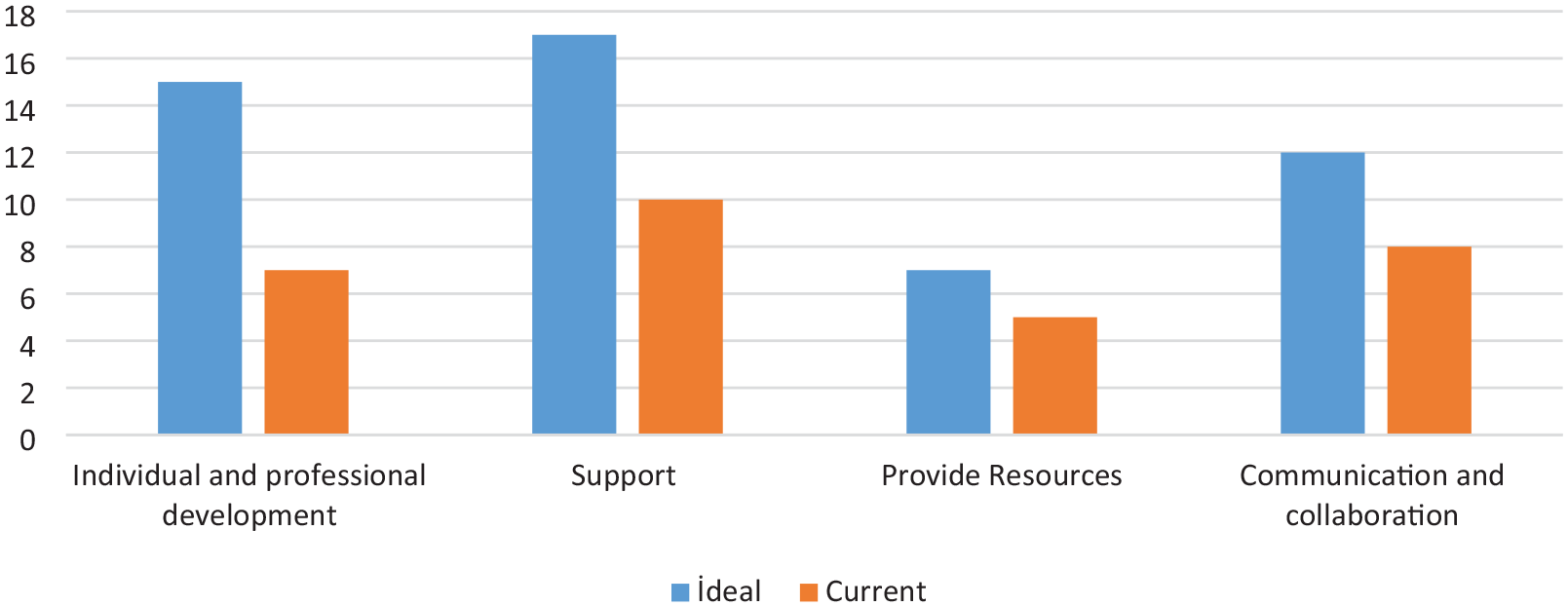
Ideal and current teacher empowerment.
As seen Table 3, principals mentioned many practices as ideal TE. When asked what they do themselves, they did not specify all of the practices they mentioned in ideal TE. It is understood from this table that principals’ perceptions of ideal TE and what they actually do. Detailed comments are below.
Individual and Professional Development
Creating professional development communities, providing training for teachers who feel weak, increasing training for new teachers, conducting teacher performance evaluation, conducting situation analysis, vision development studies, increasing the sharing of scientific studies, and generally improving individual and professional skills. It has been determined that many of the ideal TE measures in the table are not currently being implemented. In particular, it is noteworthy that new teachers and teachers who feel weak are not trained or directed to training. Deficiencies such as professional development communities, situation analysis and performance evaluation can be considered as obstacles to long-term TE.
Support
Individual encouragement methods such as praise, thanks, and affirmation, development of professional policies, studies to increase professional prestige, reduction of bureaucratic burdens. What is seen in the table is the lack of personal encouragement and motivation methods. In addition to this, the lack of studies to increase the prestige of teachers’ professions can also be considered as an important finding. Reducing bureaucratic procedures is also an important need in terms of alleviating the workload of teachers and can be considered as an important element in TE.
Providing Resources
What is stated in the Ideal TE but lacking in the current situation are identified as rights and material improvements (improving salaries and personal rights). The lack of material improvements and rights may have negative effects on teachers’ motivation and long-term commitment. However, the realization of these elements can be done by the Ministry of National Education (MONE). The Ministry’s consideration of these could be beneficial in terms of TE.
Communication and Collaboration
Communicating with teachers and getting to know them, creating an environment of cooperation, giving importance to teachers’ ideas, - taking their suggestions into consideration and solving problems, ensuring school peace, ethics, and positive climate. In the table, it can be seen that getting to know individual teachers well, having conversations with them, and taking their suggestions into consideration can be seen as an important element. This can be considered as a finding showing that teachers are not sufficiently included in decision-making processes and their individual contributions are ignored.
The issues common to both ideal and current TE are professional development, trust, feedback, and support mechanisms for teachers, improvement of physical working environments, and teacher involvement in activities and projects. Graph 1 reveals the ideal and current TE more clearly.
As can be seen in Graph 1, in the ideal TE, the participants focus most on support, and personal and professional development. Providing resources seems to be close to each other in terms of both ideal and current TE. The reason for this can be interpreted as the fact that resourcing is more centralized management, that is, it depends on the MONE.
Discussion
This qualitative study was conducted to determine how ideal TE should be from 11 school principals, what to do for TE, and compared them. According to the findings, TE activities carried out by the principals were discussed under four themes: providing teachers’ individual and professional development, resources, support, communication and collaboration. The most important of these is to ensure the individual and professional development of teachers. Because it is in the interest of organizations that individuals keep their knowledge up to date and renew themselves in order for the school to achieve its goals. Professional development of teachers is not only an issue that concerns the individual teacher. When taken as a whole, it affects the student, the parent, the class, the school, the district, the province, the nation, and the educational system of that nation. Hence, it is imperative that educators revitalize themselves on a personal and professional level. According to Kiral (2021), there is a need to update teachers’ training and expertise for a number of reasons, including the advancement of science and technology over time, modifications to current systems, and staff members’ becoming outdated and forgetting of prior information.
Teachers are empowered when they are supported, encouraged, and given inspirational remarks (Avidov-Ungar et al., 2014). They are also encouraged to refresh themselves (Kang et al., 2021). One of the most crucial responsibilities of principals should be to inspire and empower teachers (Darling-Hammond, 2000). Improvement will result from the empowered teacher’s increased creativity, performance, capacity, achievement, and interest (Avidov-Ungar & Arviv-Elyashiv, 2018). Naturally, principals who understand this should strive to support teachers’ professional and personal growth (Avidov-Ungar, 2016).
The process of enhancing teachers’ abilities and performance as well as creating educational policies and practices heavily relies on professional development activities (Leithwood et al., 2008). Because professional development activities have been shown to improve teachers’ performance (Belay, 2016), increase their professional competencies and accomplishments (Panagiotopoulos et al., 2019), foster their growth, and boost their commitment (Bogler & Somech, 2004). Professional development for teachers entails both self-improvement and raising the standard of student learning (Dail et al., 2018), which in turn raises the standard of the educational system (Darling-Hammond et al., 2017). Accordingly, principals’ primary goal is to support teachers’ professional and personal development by choosing different trainings and employee incentive programs (Tietjen & Myers, 1998), establishing the ideal conditions in their schools, fostering teachers’ professional and personal growth, creating opportunities for them (Blase & Blase, 1996), establishing a learning school, offering opportunities for continuous learning (Davis & Wilson, 2000), and giving teachers continuity to grow throughout their time in school (Short, 1992). School principals who lead effectively create a sufficient learning environment, foster cooperation among all teachers (Hammond, 2018), and lead the way in teacher professional development (Avidov-Ungar et al., 2014; Kang et al., 2021).
In addition to individual and professional development, school principals’ support for teachers is extremely vital in TE. Since school principals have an impact on teachers in terms of achieving school and educational goals, as well as enhancing teachers’ dedication and belonging to the school, principals are expected to provide teachers with the support they require. In addition to giving assistance, they should act as facilitators in the distribution of resources. Ensuring that teachers work in a comfortable and calm setting, enhancing their working conditions, and providing emotional and psychological support would empower teachers and increase their willingness to do their duties (Derinbay, 2011). Melenyzer (1990) defines administrative support as the provision of resources, time, money, materials, project preparation, and training support. If principals want sustained development in their schools, they should not only assure teachers’ personal and professional development, but also support them in many ways and enable their access to resources.
Principals should take the lead in communication in addition to these other responsibilities (Payne & Wolfson, 2000). The primary goal of principals should be to value teachers (Calisici Celik & Kiral, 2022), encourage them to share their professional development experiences through communication and collaboration, improve their working conditions, give them a comfortable and peaceful work environment, listen to their complaints, deal with their problems, and reward them by praising their accomplishments (Derinbay, 2011). People can operate with good feelings when they feel supported (Spreitzer et al., 1997) because they know and believe that the administration is behind them in their activities inside the organization and encourages them in the work they will perform (Aselage & Eisenberger, 2003; Rhoades et al., 2001).
Cooperation and teamwork foster a sense of belonging and commitment in TE, according to Kirkman and Rosen (1999). Teachers who are empowered with a sense of teamwork are more ready to work. Cooperation in schools also boosts achievement since team members share decisions and duties (Somech, 2005). Teachers collaborate to solve problems, share duties, and pick up new skills when collaborative work is encouraged in classrooms. Teachers will become more trusting and communicate more positively if collaborative work is encouraged in schools and given more attention by principals (Dee et al., 2002). Principals should apply TE since it has numerous advantages for the growth of the school and the educational system. It can be said that “ideal TE” will be achieved after teacher empowerment—which is described as “working for the personal and professional development of teachers, providing support and resources for teachers, and providing an environment of communication and cooperation”—is fully implemented.
Conclusion
The teacher is one of the most crucial components of the educational system. The school system is powerful if the teacher is powerful. It appears typical for a teacher who is an expert in their field and enjoys teaching to have both academic achievement and strong social skills. High-achieving students with strong social and academic abilities will also guarantee the advancement of the educational system. In light of all of this, teachers need to be equipped with strategies that will guarantee their professional growth and boost their sense of fulfillment at work. Teachers’ professional competence can be raised by implementing measures that keep their professional knowledge and abilities up to date. Teachers will be empowered by practices like professional information and in-service training, which will enable them to stay current and have greater professional competency. Additionally, a teacher who feels appreciated and a part of the organization they work for will be more productive. A teacher will feel content and at ease in the workplace and have more job satisfaction if they are involved in decision-making, have their unique needs taken into consideration, and are rewarded, motivated, and valued. In order to boost teachers’ motivation and empower them, school principals encourage their input on choices related to the school, acknowledge their accomplishments, and, when needed, demonstrate empathy for their personal struggles.
Ensuring teachers’ professional and personal development, creating a meaningful and supportive working environment, providing them with access to resources, establishing communication, and collaboration can positively affect their motivation and job performance. Increasing a teacher’s self-belief, in short, empowering them, enables them to be more effective on students and to experience professional satisfaction. It is important for the development of the system that ideal TE is listed and standardized by MONE and that principals are informed of what they need to do.
Limitations and Recommendations
School principals can be trained on TE and made aware of the issue, as well as trained on issues such as motivation, communication, mentoring, and professional leadership, ensuring their development both before and during their duties. MONE can perform studies to improve teachers’ prestige and reputation, as well as to raise their financial and other privileges. The study was done with principals who held postgraduate degrees. The fact that comments from principals without a graduate degree were not acquired can be considered a limitation of this study. This study was conducted with public school principals; a further study might be conducted with teachers. The research was restricted to Western Türkiye. With national programs from MONE, TE research can be conducted in all regions of Türkiye in the future. The creation of Erasmus projects on this topic allows for the observation and comparison of TE practices across nations. Only ideal and current TE were the subject of this investigation. It is also possible to design several research on TE with Artificial Intelligence (AI) that concentrate on how AI may empower teachers.
Footnotes
Appendix 1

Funding
The author received no financial support for the research, authorship, and/or publication of this article.
Declaration of Conflicting Interests
The author declared no potential conflicts of interest with respect to the research, authorship, and/or publication of this article.
Data Availability Statement
Data was collected, recorded, and analyzed by the researcher and all data is kept in a secure environment.