




Abstract
The present study ascertained the two-factor mediation role of psychological empowerment and career commitment in the association between emotional intelligence and innovative teaching behaviors of Student Teachers of English in Southeast Chinese University. There are 295 Student Teachers of English in Chinese University to participate in an empirical investigation using the Emotional Intelligence Scale, Psychological Empowerment Scale, Career Commitment Scale, and Innovative Teaching Behavior Scale. Structural equation model (SEM) data analyses were administered using SPSS 24.0 and AMOS 24.0 to test the proposed mediation role. The results showed that there was a significant positive correlation between four independent variables and dependent variable. Two-factor mediation analysis showed that emotional intelligence affects innovative teaching behaviors through two mediation variables. The present results highlight the essential effects of two mediation variables in cultivating innovative teaching behaviors. The current study provides empirical evidence for improving the innovative teaching skills of student English teachers in Chinese University and offers worthwhile educational practice implications.
Plain Language Summary
This study explored how future English teachers in Chinese universities develop innovative teaching methods. Researchers wanted to understand if emotional intelligence (the capability to manage emotions and understand others’) boosts creativity in teaching, and whether this happens through two key factors: feeling confident and motivated in their role (psychological empowerment) and being dedicated to teaching as a long-term career (career commitment). The authors surveyed 295 student teachers using questionnaires to measure these traits. The results showed that emotionally intelligent teachers were more likely to feel empowered and committed to their careers. These two factors, in turn, encouraged them to try new, creative teaching approaches. The findings suggest that training programs for future teachers should focus not just on emotional skills but also on building their confidence in the classroom and passion for teaching. Strengthening these areas could help teachers become more adaptable and inventive in their methods.
Keywords
Introduction
The role of innovation as a fundamental engine for sustainable development and organizational advancement is extensively acknowledged in extant literature (Fellnhofer, 2017). In educational practice, innovative teaching behavior (ITB) refers to the ability of educators to combine new strategies, creative problem-solving techniques, and interactive methods to engage students in meaningful learning. For Student Teachers, especially in second language teaching environments, the integration of innovative methods is essential to improve teaching and learning outcomes. However, teaching is not just the transfer of knowledge; it is an active process of emotional communication and regulation (Goran & Negoescu, 2015). Emotional intelligence (EI) has garnered significant attention in the field of education due to its impact on various aspects of teaching and learning (Jennings & Greenberg, 2009). As a critical factor influencing how individuals manage their emotions and relationships, EI plays a pivotal role in shaping effective teaching behaviors, especially in a diverse and challenging classroom environment (Hochschild, 2012). Grounded in Salovey and Mayer's (1990) model of emotional intelligence and Spreitzer’s (1995) theory of psychological empowerment (PE), this study examines how EI fosters ITB through the mediating roles of PE and career commitment (CC) among Student Teachers of English in Chinese universities. In the context of Student Teachers in Chinese universities, EI becomes even more relevant as it directly affects their adaptability, communication skills, and overall ability to foster positive learning experiences for students (Kariou et al., 2021; Wang et al., 2021). Although EI has been shown to have a significant impact on teachers’ teaching effectiveness, psychological health, career commitment, and professional behavior (Greenier et al., 2021; Ma, 2023), the relationships between EI, ITB, PE, and CC in student English teachers of Chinese university remain under-explored, particularly through a dual-mediation lens. Prior research has predominantly investigated these constructs separately or primarily within Western settings, creating a knowledge gap regarding how EI facilitates innovation among non-Western student-teacher populations. This research addresses this void by examining the two-factor mediating role of PE and CC in the link between EI and ITB, thus offering insights valuable for both theoretical progress and practical applications in teacher education.
Literature Review
EI and ITB of Student Teachers of English
In recent years, the concept of emotional intelligence (EI) has gained increasing attention in the field of education, particularly in relation to teachers’ professional development and classroom practices (Khassawneh et al., 2022; Valente et al., 2020; Yin et al., 2017). EI has been shown to be a critical factor in fostering effective teaching and learning environments. This concept is particularly relevant for Student Teachers, who are in the process of developing both their content knowledge and pedagogical skills. The development of EI in Student Teachers of English can play a significant role in promoting innovative teaching behaviors, which are essential for engaging students in dynamic and effective language learning.
Innovative Teaching Behavior (ITB) theoretically refers to educators’ capacity to generate, promote, and implement new and constructive ideas, methods, and strategies to improve teaching effectiveness and student learning outcomes (Messmann & Mulder, 2017). Within the framework of organizational innovation and educational research, ITB is conceptualized as a multi-stage process that includes problem recognition, idea generation, implementation of new instructional approaches, and the diffusion of refinements based on reflective practice (Thurlings et al., 2015). In the context of second language education, innovative teaching is particularly critical. It moves beyond traditional knowledge transmission to embrace student-centered, interactive, and adaptive pedagogical practices that respond to diverse learner needs and dynamic classroom environments (Richards et al., 2019). Such behaviors are not merely supplementary but are essential to creating engaging, effective, and meaningful language learning experiences. Practically, the practical importance of innovative teaching behavior has been amplified in contemporary educational settings, especially following global shifts toward digitalization and personalized learning. Teachers who exhibit innovation are better equipped to integrate technology meaningfully, design cognitively engaging tasks, and foster critical thinking and creativity among students. Moreover, in East Asian educational contexts, including China, where exam-oriented traditions often dominate classroom instruction, encouraging innovation among teachers helps balance examination requirements with the development of students’ comprehensive language abilities (Lee, 2010). For Student Teachers, cultivating innovative teaching behaviors is a cornerstone of professional readiness. It signifies their ability to not only master pedagogical content knowledge but also to adapt and thrive in unpredictable teaching scenarios. Innovative teaching is thus not an optional trait but a necessary competency linked with teacher efficacy, career longevity, and positive student outcomes (Huang et al., 2021).
Despite broad recognition of its importance, the drivers of ITB, especially among Student Teachers of English, remain underexplored. While prior research has examined factors such as self-efficacy, leadership support, and organizational culture, limited attention has been given to the role of EI and its interaction with motivational constructs like PE and CC in fostering innovation. This study seeks to address this gap by situating ITB as a critical dependent variable and examining how it can be systematically promoted through teachers’ emotional and psychological resources.
EI is conceptualized as a set of interrelated cognitive abilities involving the processing of emotional information (Salovey and Mayer's, 1990). This ability-based model comprises four distinct yet hierarchical dimensions: First, the competency to perceive emotions entails the ability to accurately decipher emotional states—both in oneself and others—from non-verbal signals like body language and facial expressions, as well as verbal cues such as tone of voice.
This foundational skill enables teachers to recognize students’ emotional states—such as confusion, interest, or frustration—during instructional activities. Second, Using Emotions to Facilitate Thought involves harnessing emotions to prioritize thinking, direct attention, and enhance cognitive processes such as problem-solving and creativity. For example, a teacher might channel students’ excitement into a lively debate or use a calm atmosphere to encourage reflective writing. Third, Understanding Emotions entails comprehending the causes and consequences of emotions, including how they evolve and interact. This includes interpreting complex emotional blends (e.g., anxiety mixed with anticipation before a test) and recognizing cultural or contextual influences on emotional expression. Finally, Managing Emotions refers to the reflective regulation of emotions in oneself and others to achieve personal or social goals. This involves staying open to emotional experiences, evaluating strategies for emotional regulation, and modifying emotional responses to promote growth and constructive outcomes—such as de-escalating classroom conflicts or maintaining composure under stress. Together, these dimensions form a coherent framework that underscores EI as a measurable, developable capacity essential for effective teaching, adaptive classroom management, and the fostering of a supportive learning climate. Therefore, it is necessary to investigate the extent to EI probably play a critical role in facilitating the engagement of Student Teachers of English in innovative teaching behaviors during their internships.
The Mediating Role of PE
Spreitzer (1995) conceptualizes PE as an intrinsic form of motivation, defining it as a multifaceted construct with four essential elements: meaning, competence, autonomy, and impact. This cognitive state is shaped by the work environment and manifests through four distinct yet interconnected dimensions. First, meaning refers to an individual’s sense of purpose and personal connection to their work goals, where the individual perceives their work as aligning with their own values and standards. Second, competence (or self-efficacy) is the belief an individual holds in their own capability to perform tasks skillfully and successfully, embodying a sense of mastery. Third, self-determination represents autonomy in the initiation and regulation of actions, including feelings of choice regarding work methods, pace, and effort. Finally, impact refers to an individual’s perceived capacity to shape strategic, administrative, or operational outcomes at work, grounded in the conviction that their efforts can produce meaningful change. Crucially, Spreitzer posits that these four dimensions form a synergistic whole; for an individual to experience true psychological empowerment, they must perceive a significant degree of all four cognitions simultaneously. This motivational construct thus serves as a formative mediator through which organizational conditions—such as supportive leadership or access to resources—translate into proactive, adaptive, and innovative work behaviors, as empowered employees feel more confident, purposeful, and capable of driving change.
The mediating role of PE is particularly significant in the field of education. For instance, studies have explored the relationship between PE and teachers’ CC, finding that PE not only enhances teachers’ work engagement but also improves their job satisfaction and career stability (Jiang & Tong, 2025). Researchers have suggested that psychological empowerment can promote innovative behavior among pre-service music teachers. When pre-service music teachers feel that their work is meaningful, their opinions are valued, and they can manage their work independently, they are usually more motivated to come up with new ideas and innovative solutions. Psychological empowerment acts as a mediating variable to promote pre-service music teachers’ innovative behavior by enhancing teachers’ self-efficacy and autonomy. Despite the mounting recognition of psychological empowerment as a critical determinant of innovative behavior, research on its antecedents, especially within the context of English language teaching and as a mediator between emotional intelligence and innovation, remains relatively under-explored. This is particularly evident in non-Western educational settings, where cultural factors may influence the link between empowerment and innovation.
In this current study, the mediation role of PE holds important theoretical and practical significance. First, it is expected to reveal the complex association between teachers’ EI and teaching behavior, emphasizing the mediation role of PE. Second, it may provide a new perspective for teacher training and professional development, highlighting the role of psychological empowerment in enhancing teachers’ teaching ability and job satisfaction. Additionally, this research may offer empirical evidence for educational policymakers to support the cultivation and improvement of teachers’ psychological empowerment.
The Mediating Role of CC
CC is a multiple dimensions construct that encompasses both an individual’s intrinsic motivation to grow within their chosen profession and their extrinsic investment in that career (Blau, 1985). It includes psychological attachment, the desire for career development, and the perceived alignment between personal and career goals. Research shows that high levels of career commitment significantly predict teachers’ work engagement and overall well-being (Pourtousi & Ghanizadeh, 2020). For Student Teachers of English, CC goes beyond mere job satisfaction. Previous studies have shown that emotional intelligence can effectively predict teachers’ work engagement and CC (Akin, 2021). In addition, research suggests that teachers with stronger CC are more likely to implement innovative teaching strategies to address the changing needs of the educational landscape (Sena, 2020). However, the mediating function of CC between EI and ITB has not been sufficiently tested, especially among preservice teachers who are still forming their professional identities. This study addresses that gap.
The Two-Factor Mediating Role of PE and CC
PE and CC serve as critical determinants of employee attitudes and behaviors in the workplace (Bin Saeed et al., 2019). PE refers to an individual’s sense of control, competence, meaningfulness, and impact in their work, which can directly influence their motivation and overall job satisfaction. On the other hand, CC reflects an employee’s dedication to their career path and long-term professional goals, often influencing their job stability and willingness to invest in the organization. Winei et al. (2023) note that there is a positive relationship between PE and CC. Empirical evidence suggests that educators exhibiting high levels of PE and CC tend to show greater professional involvement and dedication to their roles (Bogler & Somech, 2004). In educational settings, emotional labor, such as emotional regulation and emotional perception, has been shown to strengthen psychological empowerment, thereby promoting more innovative teaching behaviors (Diana & Sudarma, 2021).
PE and CC are important factors that influence a teacher’s ability to innovate and effectively manage their emotional responses in the classroom (Jiang & Tong, 2025). PE refers to the sense of control, self-efficacy, and meaningfulness that individuals feel in their work. In the context of Student Teachers, feeling empowered can lead to greater self-confidence, which in turn enhances their ability to implement innovative teaching methods. CC, on the other hand, reflects the degree to which teachers are dedicated to their professional growth and the long-term success of their teaching careers. This commitment can drive the continuous development of teaching behaviors, including innovation.
The relationships among EI, ITB, PE, and CC of Chinese student college English teachers remain underexplored, particularly through an integrated dual-mediation model. Although previous studies have emphasized the individual effects of these factors, few have examined how they are interconnected within a single theoretical framework, and none have simultaneously tested the mediating roles of PE and CC in the EI-ITB relationship among Chinese preservice English teachers. This research seeks to address this void by examining the two-factor mediation involving PE and CC within the EI–ITB link, thus contributing to a more nuanced comprehension of the psychological processes underlying pedagogical innovation.
Conceptual Framework
Based on the theories of EI, PE, CC, and ITB in literature review and the current research aims, a conceptual framework was proposed in Figure 1.

Conceptual framework.
Research Hypotheses
Based on the conceptual framework above, three research hypotheses were proposed.
Methodology
Participants
The participants in this study were Student Teachers of English enrolled in English education projects at three universities in Southeast China. These institutions, which include both comprehensive and normal universities, are known for their well-established English education curricula. The sample comprised senior undergraduate students, all of whom participated in data collection after completing their teaching internships.
A multi-stage sampling process was employed for this study. First, three universities (including both comprehensive and normal universities) in Southeast China were purposively selected due to their well-established English education curricula and their representativeness of teacher training institutions in the region. Within these universities, a criterion sampling strategy was used to recruit participants. The criteria required that they be (a) senior-year undergraduate students and (b) have fully completed their teaching internships. All students meeting these criteria were invited to participate. The final sample consisted of those who provided informed consent and volunteered to join the study, ensuring that all participants were at a similar stage of professional development and could draw upon recent internship experiences during data collection.
The study was conducted in December 2024. An online questionnaire was distributed to 326 senior students in English education. After excluding 31 incomplete responses, the final sample included 295 Student Teachers of English, resulting in a response rate of 90.49%. Table A1 in Appendix A concludes the demographic profile of the participants, including gender, age, educational background, and the type of internship school. The study underwent ethical review and was approved in accordance with the principles of the Declaration of Helsinki. In addition, each student participating in the study provided informed consent.
Instruments
All scales used in this study were originally developed for general teacher or organizational populations. To ensure their appropriateness and conceptual equivalence for Student Teachers of English in China, a rigorous cross-cultural adaptation process was implemented, including translation, expert review, cognitive interviews, and pilot testing.
Adaptation Process
Translation and Back-Translation
Except for Innovative Teaching Behavior and Psychological Empowerment scales, all the others two scales were independently translated into Chinese by two applied linguistics researchers fluent in both English and Chinese. The two translated versions were compared and synthesized into a single Chinese version. This version was then back-translated into English by a third bilingual translator who had no prior exposure to the original scales. The back-translated version was compared with the original by the research team to identify and resolve any discrepancies in meaning, ensuring semantic and conceptual equivalence.
Pilot Study and Item Modification
A pilot study was administered with 58 student teachers of English from the same population. Reliability analysis showed high internal consistency: Emotional Intelligence (α = .924), Psychological Empowerment (α = .948), Career Commitment (α = .878), and Innovative Teaching Behavior (α = .952). Exploratory factor analysis confirmed the unidimensionality of each construct, with all items loading above 0.6 on their respective factors.
Measures
Emotional Intelligence
In this study, EI was measured using the Emotional Labor Scale developed by Diefendorff et al. (2005). The instrument contains 16 items grouped into four distinct dimensions: emotional regulation, emotional self-assessment, emotional assessment of others, and emotional use, with each dimension comprising four items. Responses were collected using a 7-point Likert-type scale, where 1 indicated “Strongly Disagree” and 7 represented “Strongly Agree.” This measure demonstrated high reliability in the current sample, yielding a Cronbach’s α of .911, which supports its internal consistency.
Innovative Teaching Behavior
To assess innovative teaching practices, this research utilized the Mandarin version of the Teacher Innovative Work Behavior Scale, initially developed by Zhang et al. (2012). The instrument contains three items. Respondents provided their answers on a 7-point Likert scale, where 1 indicates “Strongly Disagree” and 7 corresponds to “Strongly Agree.” Reliability analysis demonstrated excellent internal consistency, with a Cronbach’s alpha of .888, confirming the scale’s high reliability in this sample.
Psychological Empowerment
PE was assessed using a four-item scale derived from Spreitzer’s (1995) PE Scale, as adapted and validated for Chinese populations by Chaoping et al. (2006). Participants used a 7-point Likert scal, where 1 denotes “Strongly Disagree” and 7 denotes “Strongly Agree.” The internal consistency of the scale was excellent in the current sample; the computed alpha value of .905 indicates high reliability.
Career Commitment
CC was measured by excerpting the 4 items of CC Scale proposed by Carson and Bedeian (1994). Participants used a 7-point Likert scal, where 1 denotes “Strongly Disagree” and 7 denotes “Strongly Agree.” The scale exhibited superior internal consistency in this current study, achieving a Cronbach’s alpha of .783, which reflects a good reliability.
Data Analyses
Data analysis was performed with SPSS 24.0 and AMOS 24.0. Confirmatory factor analysis was carried out to examine convergent and discriminant validity, while the overall reliability and validity of the data were also assessed. A two-factor mediation model was evaluated using bootstrapping with 5,000 resamples to produce 95% confidence intervals; results indicated a significant mediation effect. These analytical techniques enhanced the rigor, validity, and accuracy of the findings, thereby strengthening the reliability of the conclusions drawn.
Results
Confirmatory Factor Analysis of Variable Reliability and Validity
Composite reliability (CR) reflects the overall reliability of a set of measurement variables, indicating the internal consistency of the constructs involved. According to the guidelines established by Fornell and Larcker (1981), all CR values in this analysis exceed the minimum threshold of 0.6, demonstrating acceptable reliability. On the other hand, the average variance extracted (AVE) measures the explanatory power of the latent variables concerning their respective measured variables. Fornell and Larcker (1981) recommend an AVE value greater than 0.5 for adequate validity.
To ensure both composite reliability and convergent validity, all variables were treated independently without relying on correlation. And based on the output of un-correlation through Confirmatory Factor Analysis. The data presented in Table 1 was convergence validity.
Convergence Validity.

Indicates that the result is significant at p < .001.
Table 1 presents the results of the non-standardized point estimates, all of which are positive, with Z-values exceeding 1.96 and p-values less than .000. The standardized point estimates, represented as factor loadings, are all greater than 0.6, indicating that the constructs exhibit strong reliability. Additionally, the squared multiple correlations (SMC) are all above .36, further confirming the reliability of the constructs. The composite reliability values surpass .8, and the convergent validity is above 0.5, aligning with the standards set by statistical scholars (Fornell & Larcker, 1981).
To investigate discriminant validity among the various variables, a correlation analysis was conducted in confirmatory factor analysis. And based on the output of correlation of confirmatory factor analysis. The data presented in Table 2 was discriminant validity.
Discriminant Validity.

Table 2 demonstrates that the bolded AVE square root values exceed all related values, indicating strong discriminant validity. Additionally, the data quality assessment through Confirmatory Factor Analysis (CFA) confirms that the reliability and validity of the variables are excellent.
Common Method Bias
Since the exogenous variables and endogenous variable data in this study are mainly derived from the same questionnaires, Common Method Bias (CMB) may exist. CMB can cause systematic measurement errors, causing the estimation bias of the actual relationship between theoretical constructs (Podsakoff & Organ, 1986).

According to the recommendations of statisticians, this study adopts the Confirmatory Factor Analysis method (CFA method) to check the CMB (Lindell & Whitney, 2001). The processing is as follows:
① Model 1: Making all constructs into a one-factor structure, that is, all items are related to only one common factor, and setting this construct as CMV.
② Model 2: Theoretical CFA is entirely relevant.
③ Comparing the difference of the degrees of freedom and chi-square value between model 1 and model 2, a significant difference means that the fit of model 1 is much worse than that of model 2, indicating that one-factor structure does not exist, so CMB is not serious.
Figure 2 is a single factor of all constructs in Model 1, and Figure 3 is a multiple factor of all constructs in Model 2. By comparing the degrees of freedom and chi-square values of the two models, the results in Table 3 are obtained.

Model 1.

Model 2.
As shown in Table 3, the chi-square difference between the two models is significant (p = .000), indicating that common method bias cannot pose a serious threat to interpreting the present research findings.
CFA CMB Check.
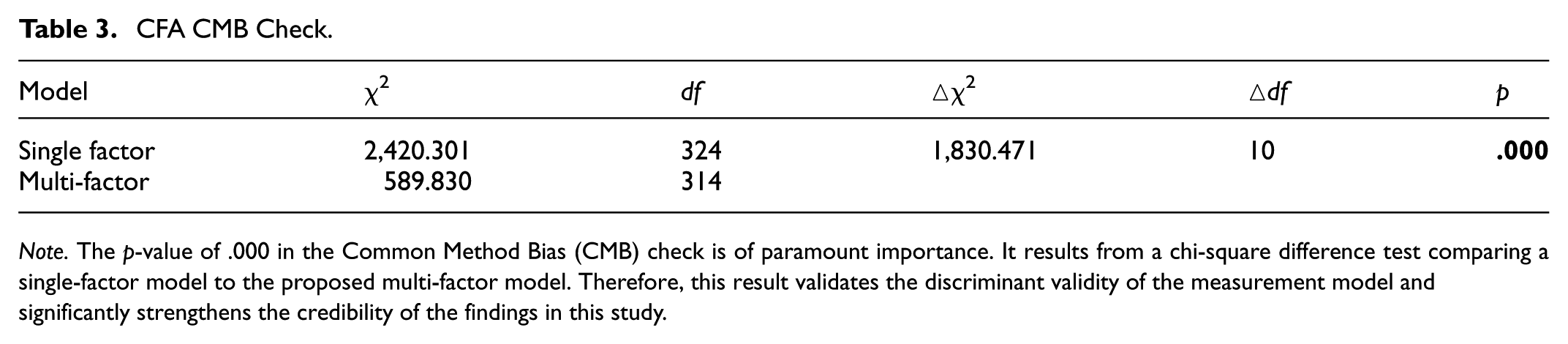
Note. The p-value of .000 in the Common Method Bias (CMB) check is of paramount importance. It results from a chi-square difference test comparing a single-factor model to the proposed multi-factor model. Therefore, this result validates the discriminant validity of the measurement model and significantly strengthens the credibility of the findings in this study.
Mediation Effect Testing
According to the proposed conceptual framework, a structural equation modeling (Figure 4) was established and mediation effect was analyzed.

Two-factor mediation model.
A good model fit can be seen in Figure 4. Chi-square is 610.087, df is 315, Chi-square/df is 1.937 which is lower than 3. GFI is 0.863 and AGFI is 0.836, which are close to 0.9. RMSEA is 0.056 which is lower than 0.08.
As shown in Figure 4, after controlling for PE and CC, EI was found to have a positive correlation with ITB(β = .24 standardized regression weights), and (β = .382, SE = 0.179, CR = 2.133, p = .033 regression weights) thereby supporting H1. Furthermore, EI was found to have a positive correlation with PE (β = .54); EI was found to have a positive correlation with CC (β = .76); EI was found to have a positive correlation with ITB (β = .36); CC was found to have a positive correlation with ITB (β = .19).
The mediation effect of PE and CC on the relationship between EI and ITB was assessed using two-factor mediation model of structural equation modeling. The 95% confidence intervals for the estimated effects were derived via bootstrap analysis (5,000 resamples). Based on the output of two-factor mediation model in Table 4, PE was found to have an indirect effect on the relationship between EI and ITB with (effect = 0.306, SE = 0.101, 95% CI = [0.144, 0.557] in Bias-Corrected), which indicated statistical significance; although CC was found not to have an indirect effect on the relationship between EI and ITB with (effect= 0.229, SE = 0.177, [−0.108, 0.599] in Bias-Corrected), total indirect effect of PE and CC was (effect = 0.536, SE = 0.217, [0.141, 0.989] in Bias-Corrected). These results provide support for Hypotheses H2 and H3.
Total, Direct, and Indirect Effect (=295).

Note. EIPEITB = a1 × b1, EICCITB = a2 × b2. TIE = total indirect effect; DE = direct effect; TE = total effect.
A contrast of indirect effect between PE and CC in Table 4 was found that PE accounts for 57.2% indirect effect while CC accounts for 42.8%. That is, PE is 7.7% indirect effect higher than CC on the relationship between EI and ITB, thereby supporting H4.
Discussion
This study elucidates the dual mediation of PE and CC in the correlation between EI and ITB among Student Teachers of English in Chinese universities. The findings confirm that EI significantly enhances ITB, with PE serving as a significant mediator, while CC did not demonstrate a statistically significant mediating effect. These insights refine our understanding of the motivational mechanisms through which EI fosters pedagogical innovation, highlighting the distinct roles of empowerment and commitment pathways. Guided by both theory and practice, the subsequent discussion delves deeper into these outcomes to present a holistic interpretation.
The Relationship Between EI and ITB
The finding that EI directly promotes ITB (Hypothesis 1) lends empirical support to a body of literature underscoring EI’s significance for effective teaching (Khassawneh et al., 2022; Valente et al., 2020). It verifies that teachers with elevated EI are more capable of navigating intricate classroom interactions and implementing innovative practices, upholding the theorized connection between emotional skills and creative teaching. In China’s high-stakes educational environment, where preservice teachers often face pressure to adhere to traditional methods, EI may empower them to navigate stressors and embrace creativity. This finding extends existing literature by highlighting EI’s applicability in fostering innovation even within rigid curricular frameworks, suggesting that emotional skills mitigate barriers to pedagogical experimentation.
EI, as a multifaceted construct encompassing emotional regulation, self-assessment, assessment of others, and emotional use, provides teachers with essential skills to manage classroom challenges and interpersonal dynamics. These competencies collectively enhance educators’ capacity to innovate by fostering a supportive classroom environment and enabling adaptive teaching practices. Within China’s relational and exam-oriented educational context, EI assists preservice teachers in balancing cultural expectations with innovative student-centered approaches, though the dominant mediation mechanisms appear to operate through motivational rather than purely affective pathways.
These components align with China’s cultural emphasis on guanxi (relational harmony), where emotional attunement fosters collaborative learning environments. However, the pressure to conform to standardized curricula often stifles creativity. EI equips preservice teachers to balance institutional expectations with student-centered innovation, a tension documented in studies of East Asian education systems (Yin et al., 2017).
The Mediating Role of PE
In this study, the findings further confirm that psychological empowerment significantly mediates the relationship between EI and ITB, thus supporting Hypothesis 2. The present result extends the scope of existing empirical work on this subject, thereby validating and refining earlier theoretical propositions. Previous studies support the notion that PE mediates the impact of EI on ITB. For instance, a study by Ghafoor et al. (2011) found that emotionally intelligent teachers reported higher levels of PE, which subsequently correlated with creativity and innovation in their teaching methods. This aligns with findings from research on workplace dynamics, where empowered individuals exhibit higher levels of job satisfaction and are more likely to engage in innovative behaviors (Seibert et al., 2011). In summary, the interplay between EI, PE, and ITB highlights the importance of fostering these attributes in educators. By nurturing EI, teachers’ PE can be enhanced, thereby laying the groundwork for the development of ITB.
The significant mediating role of PE (supporting Hypothesis 2) represents a key finding of this study. This result aligns with Spreitzer’s (1995) PE theory and extends its application to the context of pre-service teacher innovation. Our findings demonstrate that emotionally intelligent teachers develop a greater sense of meaning, competence, self-determination, and impact in their teaching role, which in turn motivates them to experiment with innovative teaching methods. This mediation pathway is consistent with previous research in organizational behavior (Seibert et al., 2011) and educational contexts (Zhu et al., 2019), confirming that empowerment serves as a critical psychological mechanism that translates emotional skills into innovative practices.
The Mediating Role of CC
Based on the bootstrapping results in Table 4, the indirect effect of CC on the connection between EI and ITB was not statistically significant (effect = 0.229, SE = 0.177, 95% CI = [−0.108, 0.599] and [−0.128, 0.572]), as both confidence intervals include zero. Therefore, Hypothesis 3, which proposed that CC mediates this relationship, is not supported.
Nevertheless, the positive point estimate (0.229) for the indirect effect indicates a promising trend. The lack of statistical significance could be attributed to insufficient power, a consequence of the limited sample size. Previous research has suggested that the positive effects of EI on teaching behaviors may become more pronounced when teachers display higher CC (Tschannen-Moran & Woolfolk Hoy, 2001). CC represents an individual’s psychological attachment to their profession, which affects how teachers engage in their roles (Meyer et al., 1993).
Thus, while the current study did not find statistically significant mediation effects for CC, the theoretical importance of this construct remains relevant. Future research with larger samples would be valuable to further explore this relationship.
In summary, although CC was not found to have a significant mediating role in the correlation between EI and ITB, the intersection of EI, CC, and ITB has attracted great interest in educational research. Teachers with elevated EIare more inclined to employ innovative methods because they can better assess the emotional climate of the classroom and respond to students’ needs in creative and effective ways. By leveraging EI and fostering CC, Student Teachers of English in Chinese university may create more engaging and successful ITB.
The Comparative Strength of Mediating Pathways
The comparison of mediating effects (supporting Hypothesis 4) revealed that PE accounted for a substantially greater proportion of the indirect effect (57.2%) than CC (42.8%), with a 7.7% difference in their mediating strength. This differential impact emphasizes the primacy of PE as a mechanism through which EI influences innovative teaching behaviors. This finding advances our theoretical understanding by quantifying the relative importance of these two pathways and suggests that interventions targeting PE may be particularly effective in fostering innovation among Student Teachers of English.
The stronger mediating effect of PE may be attributed to its more immediate and proximal nature in influencing daily teaching practices. While CC reflects a broader, longer-term orientation toward the teaching profession, PE directly affects teachers’ sense of agency and effectiveness in their current teaching role, making it a more potent catalyst for innovation implementation.
Conclusion
This study provides empirical evidence that EI enhances ITB both directly and through the mediating mechanism of PE, though not significantly through CC in this Student Teachers of English. These findings yield concrete implications for teacher education development and policy-making: For Teacher-Education Programs, firstly, it is suggested to integrate explicit emotional skill training into curricula through modules focused on emotion regulation, situational awareness, and empathetic communication, using role-playing and classroom scenario simulations. Secondly, it is needed to embed opportunities for PE by providing preservice English teachers with greater autonomy in lesson design, encouraging experimentation with teaching methods, and creating structured reflective practices that reinforce a sense of competence and impact. Thirdly, it is meaningful to develop mentorship and scaffolding systems that help preservice English teachers internalize a sense of purpose and efficacy early in their training, particularly during teaching practicums. For Educational Policy, firstly, it is necessary to revise teacher certification standards to include EI and innovative instructional competence as key indicators, supported by relevant professional development offerings. Secondly, it is necessary to promote school cultures that reduce excessive administrative control and encourage teacher-led innovation, granting educators more autonomy to adapt and create teaching methods in response to student needs. Thirdly, it is needed to allocate resources for ongoing innovation support, such as establishing teaching innovation funds, communities of practice, and recognition mechanisms that reward creative and adaptive teaching behaviors.
By implementing these targeted strategies, teacher-education programs and policymakers can more effectively foster the EI and PE necessary for teachers to develop and sustain innovative teaching practices, ultimately enhancing educational quality and student engagement.
Despite providing valuable insights into these relationships, this study has limitations regarding generalizability. Its exclusive focus on Student Teachers of English from Southeast China restricts the applicability of the findings to wider populations. Expanding the scope to include diverse cultural and educational contexts in future work would strengthen the external validity of the results. Additionally, this study focused on PE and CC as mediators; future studies should incorporate other potential factors such as organizational support, teaching self-efficacy, and cultural dimensions to better explore the wider array of mechanisms driving ITB.
Footnotes
Appendix A
Participant Demographics (N = 295).

| Variable | Category | Frequency | Percentage |
|---|---|---|---|
| Gender | Male | 96 | 32.54 |
| Female | 199 | 67.46 | |
| Age | 22–25 Years | 283 | 95.93 |
| Over 25 years | 12 | 4.07 | |
| Education level | Undergraduate | 295 | 100.00 |
| School type | Primary | 56 | 18.98 |
| Middle | 211 | 71.53 | |
| High | 28 | 9.49 |
Acknowledgements
We deeply appreciate all the participants in this research for their support, and also our gratitude to Ningde Normal University for funding support.

Ethical Considerations
Ethical approval (NDNU-20241212) has been obtained from Ningde Normal University Ethics Committee. The procedures used in this study are in accordance with the principles of the Declaration of Helsinki.
Consent to Participate
The study underwent ethical review and was approved in accordance with the principles of the Declaration of Helsinki. In addition, each student participating in the study provided informed consent.
Author Contributions
Yanli Tong: Conceptualization, methodology, investigation, resources, project administration, writing—original draft preparation, funding acquisition, writing—review and editing, and supervision. Xin Jiang: data curation, software, formal analysis, and validation. All authors have read and agreed to the published version of the manuscript.
Funding
The authors disclosed receipt of the following financial support for the research, authorship, and/or publication of this article: This work was supported by the Ningde Normal University “English Language Skills Cognitive Diagnosis” scientific research innovation team (grant number 2024T05).
Declaration of Conflicting Interests
The authors declared no potential conflicts of interest with respect to the research, authorship, and/or publication of this article.
Data Availability Statement
The raw data supporting the conclusions of this article will be made available by the corresponding author, without undue reservation.