




Abstract
This study focuses on vocal music teachers and explores how teacher incentive mechanisms drives their multidimensional professional development through the intermediary role of job performance. Based on the three-dimensional framework of economic incentives, career development incentives and environmental incentives, this paper uses empirical research methods to test the transmission mechanism of job performance in the “incentive-development” path, and reveals the particularity of vocal music teachers’ professional development. Data analysis shows that job performance has a significant positive effect on interpersonal relationship, leadership management, economic income and self-development, and there is a chain intermediary effect-environmental incentives and career development incentives indirectly promote multidimensional development by improving job performance, while economic incentives mainly have a direct impact on income dimension. these findings suggest the construction path of layered incentive strategy from the practical level, including the differentiated performance evaluation system, the guarantee of professional autonomy and the creation of collaborative platform between schools and communities, which offers a direction for reconstructing the theoretical framework for solving the dilemma of “hollowing out majors” of art teachers.
Plain Language Summary
This study focuses on vocal music teachers and explores how teacher incentive mechanisms drives their multidimensional professional development through the intermediary role of job performance. Based on the three-dimensional framework of economic incentives, career development incentives and environmental incentives, this paper uses empirical research methods to test the transmission mechanism of job performance in the “incentive-development” path, and reveals the particularity of vocal music teachers’ professional development. Data analysis shows that job performance has a significant positive effect on interpersonal relationship, leadership management, economic income and self-development, and there is a chain intermediary effect-environmental incentives and career development incentives indirectly promote multidimensional development by improving job performance, while economic incentives mainly have a direct impact on income dimension. these findings suggest the construction path of layered incentive strategy from the practical level, including the differentiated performance evaluation system, the guarantee of professional autonomy and the creation of collaborative platform between schools and communities, which offers a direction for reconstructing the theoretical framework for solving the dilemma of “hollowing out majors” of art teachers.
Keywords
Introduction
Teacher sustainability is a core issue in high-quality educational reform. Although policy documents such as China Education Modernization 2035 emphasize the development of teacher incentive mechanisms, significant research gaps remain—particularly in the field of arts education. Herzberg (1968) Two-Factor Theory and Hobfoll (1989) Conservation of Resources (COR) Theory jointly reveal that teachers’ professional behaviors and developmental trajectories are profoundly shaped by the allocation of incentive resources. Vocal music teachers, in particular, constantly navigate dual-role tensions: they must adhere to standardized curricular guidelines while simultaneously exercising artistic innovation in performance contexts. Moreover, their need for cultural identity integration is central to their professional empowerment.
However, existing research exhibits notable limitations. Most studies focus on general teacher populations, overlooking the distinctiveness of arts educators in terms of incentive needs, performance outputs, and dimensions of development (Fu et al., 2015). Furthermore, mechanistic investigations tend to emphasize the direct effects of single incentive factors, lacking systematic empirical validation of the sequential mediation process linking “incentives → job performance → multidimensional development (Sung & Choi, 2014).”
To address these theoretical gaps, this study constructs a three-dimensional incentive framework tailored to the professional characteristics of vocal music teachers (ShanShan & Loang, 2024), empirically tests the chained intermediary role of job performance, and ultimately proposes practice-oriented strategies grounded in artistic empowerment to counter the challenge of professional hollowing-out (Kressler, 2003).
Literature Review and Research Hypothesis
The relationship between teacher incentives and the multidimensional development of vocal music teachers exhibits pronounced disciplinary specificity—a characteristic that has not been adequately addressed in existing literature (Dewulf & Kadefors, 2012). Compared with teachers in general subjects, vocal music teachers’ multidimensional development encompasses unique dimensions such as artistic expressiveness and cross-cultural teaching competence, and their professional growth heavily relies on high-cost inputs including musical instruments and performance opportunities (DeVaro, 2006).
However, mainstream research continues to treat incentives through a generic lens: economic incentives are framed merely as basic safeguards (Jiang & Tong, 2025), overlooking hidden costs such as maintenance of specialized vocal equipment; career development incentives predominantly emphasize universal training programs, neglecting access to high-impact artistic platforms like international vocal competitions (Zeng et al., 2020); and environmental incentives focus narrowly on organizational support, without accounting for critical physical conditions such as acoustic environments.
To bridge this theoretical gap in resource-intensive disciplines, this study integrates Herzberg’s Two-Factor Theory with the resource-dependent nature of vocal education (Zhan et al., 2022), proposing that economic support must specifically address professional equipment depreciation, and career development must include opportunities for international exchange (pilot surveys indicate that participation in overseas training can increase by 27%).
Accordingly, we propose:
The link between teacher incentives and job performance in the vocal domain faces a critical challenge: the difficulty of quantifying performance, which often leads to misallocation of incentive resources. Current studies reduce job performance to generic metrics such as teaching hours, ignoring the core performance indicator for vocal music teachers—artistic output transformation (Noja et al., 2020). This homogenized evaluation creates structural contradictions: pilot data show that 61% of performance-based pay is tied to student examination pass rates, while key artistic indicators like vocal range expansion remain unmeasured; rural vocal music teachers, constrained by limited performance resources, achieve only 42% of the student award rate observed in urban schools under equivalent incentive conditions (Fadillah & Ismail, 2018).
This study introduces an “artistic value perception” moderator grounded in Expectancy Theory, revealing that when the weight assigned to artistic outcomes falls below 30%, performance-based pay exerts no significant effect on job performance (Ismail et al., 2015). This finding challenges the universality assumption underlying conventional performance-pay designs and provides empirical grounding for differentiated incentive reforms tailored to vocal educators.
Thus, we propose:
Moreover, the intermediary role of job performance between incentives and multidimensional development follows a discipline-specific resource-compensation pathway among vocal music teachers—one that existing theories fail to capture due to its nonlinear characteristics (Ma et al., 2021). While Conservation of Resources (COR) Theory conceptualizes performance as a linear mediator of development, it does not account for the innovative adaptations vocal teachers employ under resource constraints: rural teachers who integrate local folk music into curricula report a 19.3% increase in teaching effectiveness; internationally awarded instructors leverage their performance reputations to secure overseas training opportunities (Horgan & Mühlau, 2006).
This study transcends the limitations of prevailing models by constructing a “resource–performance–development” compensation mechanism, demonstrating that performance-based pay disproportionately accelerates multidimensional development among resource-compensating teachers (Ahammad et al., 2015). This model not only redefines the theoretical boundaries of traditional mediation effects but also offers empirical support for optimizing incentive-driven resource allocation strategies in vocal education.
Based on theoretical matching, discipline particularity and significant correlation of previous data, the research hypothesis is propose:
Research Method
Research Objects
The primary school stage is a critical period for vocal music initiation; however, vocal music teachers commonly face systemic challenges characterized by “limited teaching hours, low professional status, and scarce resources.” This marginalization of arts education reflects a cross-cultural phenomenon.
This study focuses on a certain urban area in China—an area with a long historical background and designated as a key urban development zone. The district features a large and diverse educational system, making it highly representative for analysis. In this area, we employed stratified random sampling by school type to select n primary schools. From each selected school, 30 vocal music teachers were randomly surveyed (Yan, 2020); in schools with fewer than 30 vocal teachers, a full-sample census was conducted, and the actual sampling rate was clearly documented during data collection.
A total of 568 valid questionnaires were recovered, yielding a response rate of 97.3%. Among respondents, 209 (36.79%) were male teachers and 359 (63.21%) were female teachers.
The Chinese case offers a valuable empirical sample for global research on the marginalization of arts education. Institutional features of China’s grassroots education system—such as performance-based pay dominance and professional title promotion rules—create a prototypical “natural laboratory” for studying incentive mechanisms. For instance, the observed mechanism of incentive failure among arts teachers under high variable-pay ratios provides directly transferable insights for other developing countries.
Research Tool
To deeply anchor the localized adaptability of the measurement scales, this study conducted systematic interviews tailored to the professional characteristics of vocal music teachers. A stratified purposive sampling strategy was employed, covering 58 vocal teachers varying by institutional type (conservatories, art schools within comprehensive universities, and vocational colleges), geographic region (eastern, central, and western China—including rural special-post teachers), and vocal style background (classical, folk, and popular singing). This ensured both theoretical saturation and industry representativeness of the sample (Chawla et al., 2010).
We conducted thematic analysis of interview transcripts, coding them sentence-by-sentence in NVivo 12 to generate initial codes, which were then synthesized into core thematic clusters. Key findings revealed that “performance-outcome orientation” emerged as a dominant feature in performance evaluation—82% of teachers identified “student competition rankings” as a core KPI. “Cultural fusion and innovation” was highlighted as a critical developmental aspiration, with 76% of teachers advocating for the modern reinterpretation of folk vocal techniques. Additionally, “technical tools” were concretely specified as spectrograms and pitch-correction software, with 92% of teachers rejecting the relevance of generic ICT equipment. These themes directly informed the revision of scale items.
To ensure ecological validity of the revised scale, items were retrospectively validated through a focus group comprising eight teachers with diverse teaching experience. Participants widely affirmed that revised items—such as “adjusting breath training based on pitch accuracy issues”—accurately reflected real-world vocal pedagogy scenarios. One senior professor specifically noted that “tying performance metrics to students’ competition awards authentically mirrors current industry evaluation practices.”
Building upon a comprehensive review of relevant literature and existing scales, and integrating insights from the interviews, this study selected and refined questionnaire items on teacher incentives, a job performance scale, and a multidimensional development scale—all contextualized to the realities of vocal instruction. All scales employed a 5-point Likert rating format, and data were analyzed using SPSS 22.0 and AMOS 21.0.
Teacher Incentive Mechanisms Scale
Based on the research of scholars at home and abroad, this paper divides teacher incentives into three parts: economic incentives, career development incentives and environmental incentives. Among them, economic incentives mainly refer to the actual total income including basic salary, performance salary, bonus, etc. In order to observe the influence of performance salary, it is listed separately; Career development incentives mainly refer to the incentives implemented by schools in order to improve teachers’ quality and ability and promote teachers’ professional development, which are mainly reflected by observing the average number of training sessions per year, the average number of teaching and research activities per week, and the satisfaction of teaching equipment and books. Environmental motivation means that the school encourages teachers to improve their work enthusiasm, further improve the organizational system and create a harmonious cultural environment, which is mainly reflected by teachers’ perception of professional title evaluation, promotion and humanistic environment. Environmental motivation is reflected based on the organizational support scale, so Cronbach’s Alpha coefficient reliability test is conducted first, α = .926, indicating that the reliability of internal consistency of the questionnaire is good. The sampling suitability of the environmental incentive questionnaire is analyzed, and the KM0 test value is 0.842, which shows that exploratory factor analysis can be carried out. Bartlett’s spherical test value is 3,692.347, which is significant (p < .001), so there is a great possibility of common factors. Then factor analysis shows that one factor can be extracted from the environmental incentive questionnaire, and the cumulative contribution rate is 71.046% (Table 1).
Teacher Incentive Mechanisms Scale.

Teaching Performance Scale
In this study, teaching performance serves as the dependent variable. The measurement scale is adapted from the job performance scale developed by Tarafdar et al. (2024) which originally encompasses ICT-enabled productivity and ICT-enabled innovation. We selected the “job performance” dimension most relevant to our research context and made three key modifications to align the items with the unique characteristics of vocal instruction:
Generic ICT-related references/items were replaced with references to vocal-specific technologies;
Abstract teaching objectives were translated into core vocal competence indicators;
Item content was refocused on the integration of vocal techniques and expressive innovation, ensuring greater contextual relevance (Tarafdar et al., 2024).
The scale employs a 5-point Likert-type positive rating format (1 = “strongly disagree,” 5 = “strongly agree”), with higher scores indicating higher levels of teaching performance.
Psychometric evaluation demonstrated strong reliability and validity: the Cronbach’s α coefficient was .914, indicating excellent internal consistency. The Kaiser-Meyer-Olkin (KMO) measure of sampling adequacy was 0.821, and Bartlett’s test of sphericity was significant (p < .001), confirming the suitability of the data for factor analysis. A single-factor solution was extracted, explaining 76.859% of the total variance, and all item loadings exceeded 0.8, confirming strong construct validity of the teaching performance scale (Table 2).
Teacher Performance Scale.

Multidimensional Development
The Multidimensional Development Scale of Vocal Music Teachers used in this paper was revised by referring to the mature scales at home and abroad and combining with the results of interviews. The initial question of this scale was 35. After sorting out the survey results, we first scored the reverse questions, then removed the items that have little relationship with the connotation of multidimensional development of vocal music teachers, then merged the items with similar meanings, and finally formed a factor model of 27 questions by using the principal component analysis method, and finally got four aspects of interpersonal relationship, leadership management, economic income and self-development. The higher the score of the scale, the higher the degree of multidimensional development of vocal music teachers. The reliability test shows that Cronbach’s α values of the whole scale and all dimensions are greater than .80, which shows that the reliability of internal consistency of the scale is very good. Then, KMO measure and Bartlett spherical test were carried out on the scale. The results showed that KMO value was 0.962, and the cumulative factor load was 71.04%, which was very suitable for factor analysis. The Bartlett spherical test value reached a significant level (p < .001), indicating that there were common factors among the items of job performance. The indexes of the five-dimensional confirmatory factor analysis model are CMIN/DF = 4.862, RMSEA = 0.073, GFI is close to 0.9, NFI, IFI and CFI are all greater than 0.9, which indicates that the overall fitting degree of the model is good (Table 3).
Teacher Multidimensional Development Scale.

Research Design
Correlation Analysis
Correlation Analysis is a statistical method to measure the strength and direction of linear relationship between two or more variables. Its core purpose is to judge whether there is correlation between variables and how close the correlation is. The results of correlation analysis are usually expressed by Correlation Coefficient, and the range of values is [−1, 1]: 1: perfect positive correlation, that is, one variable increases and the other variable increases linearly. −1: indicates complete negative correlation, that is, one variable increases and the other variable linearly decreases. 0: indicates wireless correlation, that is, there is no linear relationship between variables. Verify assumptions H1–H2 in this paper.
The core method of correlation analysis is Pearson Correlation Coefficient, and its formula is as follows:

r: Pearson correlation coefficient is used to measure the strength and direction of the linear relationship between the sum of two variables. XY
n: The number of samples, that is, the number of teachers involved in the analysis.
The molecular part represents the covariance between two variables and reflects the degree of co-variation of the sum of variables. Denominator part: which represents the standard deviation product of two variables, is used to standardize covariance and make the value range of correlation coefficient between [−1,1].:
Analysis of Intermediary Effect
Mediation Analysis is used to study the influence mechanism of independent variable (X) on dependent variable (Y) through intermediary variable (M). Its core purpose is to reveal the action path between variables and judge whether the intermediary variables play a bridge role between independent variables and dependent variables. The basic logic of intermediary effect analysis is:
The independent variable (x) directly affects the dependent variable (y), which is called the total effect.
The independent variable (x) indirectly affects the dependent variable (y) by influencing the intermediary variable (m), which is called the intermediary effect.
When the intermediate variable (M) is controlled, the direct influence of the independent variable (X) on the dependent variable (Y) is called direct effect.
Formula of intermediary effect analysis:
Assuming that the independent variable is X, the intermediary variable (M), the dependent variable is Y, and all variables have been centralized (the average value is 0), the regression model of intermediary effect analysis is as follows:
Total effect model:

C: the total effect of independent variable (x) on dependent variable (y).
Intermediary effect model:

A: the influence of independent variable (x) on intermediate variable (m).
Direct effect model:

C’: The direct effect of the independent variable (X) on the dependent variable (Y) after controlling the intermediate variable (M).
E3: Error term. The intermediary effect is equal to a × b, and the total effect c can be decomposed into direct effect c’ and intermediary effect a × b:

Inspection Steps of Intermediary Effect Analysis
According to the Causal Steps Approach, the test steps of mediation effect are as follows:
Test the total effect:
Regression model:
Whether the test is significant. If it is significant, it means that the independent variable has a significant influence on the dependent variable, and the next step can be tested. ccXY
Test the influence of independent variables on intermediate variables;
Regression model:
Whether the test is significant. If it is significant, it shows that the independent variable has a significant influence on the intermediate variable, and the next step can be tested.aaXM
Test the influence of intermediary variables on dependent variables;
Regression model:
Whether the test is significant. If it is significant, it shows that the intermediary variable has a significant influence on the dependent variable. bbMY
Judging the types of intermediary effects:
If it is not significant, it is a complete intermediary effect. c′
If it is significant but decreases, it is a partial intermediary effect. c′
If it is not significant, there is no intermediary effect. b
There is a significant positive correlation among teacher incentive mechanisms (X), multidimensional development (M) and job performance (Y), which is in line with the premise of intermediary effect test. Test hypotheses H3–H4. The specific analysis is as follows:
Total effect: The total effect of teacher incentive mechanisms (X) on job performance (Y) is significant.
Intermediary effect: teacher incentive mechanisms (X) has a significant impact on multidimensional development (M), and multidimensional development (M) has a significant impact on job performance (Y).
Direct effect: after controlling multidimensional development (M), whether the direct effect c’ of teacher incentive mechanisms (X) on job performance (Y) is significant or not is used to judge the type of intermediary effect.
Research Results
Descriptive Statistics
Table 4 describes the current situation of vocal music teachers’ professional development, revealing a set of contradictory pictures worthy of in-depth interpretation: in the pattern of coexistence of explicit system configuration and invisible development dilemma, art educators are facing a special paradox of professional survival. The vocal music teachers in the sample primary schools have structural characteristics in the dimension of economic incentives: the superficial data of an average annual total income of 72,100 yuan should be examined in combination with the regional teacher salary reference system-this value is significantly lower than the average level of music teachers in local key middle schools (about 102,000 yuan) and close to the bottom line of the income of general teachers in primary schools. More importantly, the proportion of performance-based pay in salary composition is as high as 66.6% (48,000 yuan). This high floating proportion makes teachers need to continue to maintain their benchmark income through extra work such as extracurricular competition guidance and art festival performance, which virtually squeezes the time for professional improvement. When performance income becomes the pillar of livelihood, the freedom of artistic creation is bound to be restricted, which is a causal reflection of the low level of self-development in the following article.
Sample Description Differences Between Statistical and Demographic Variables.
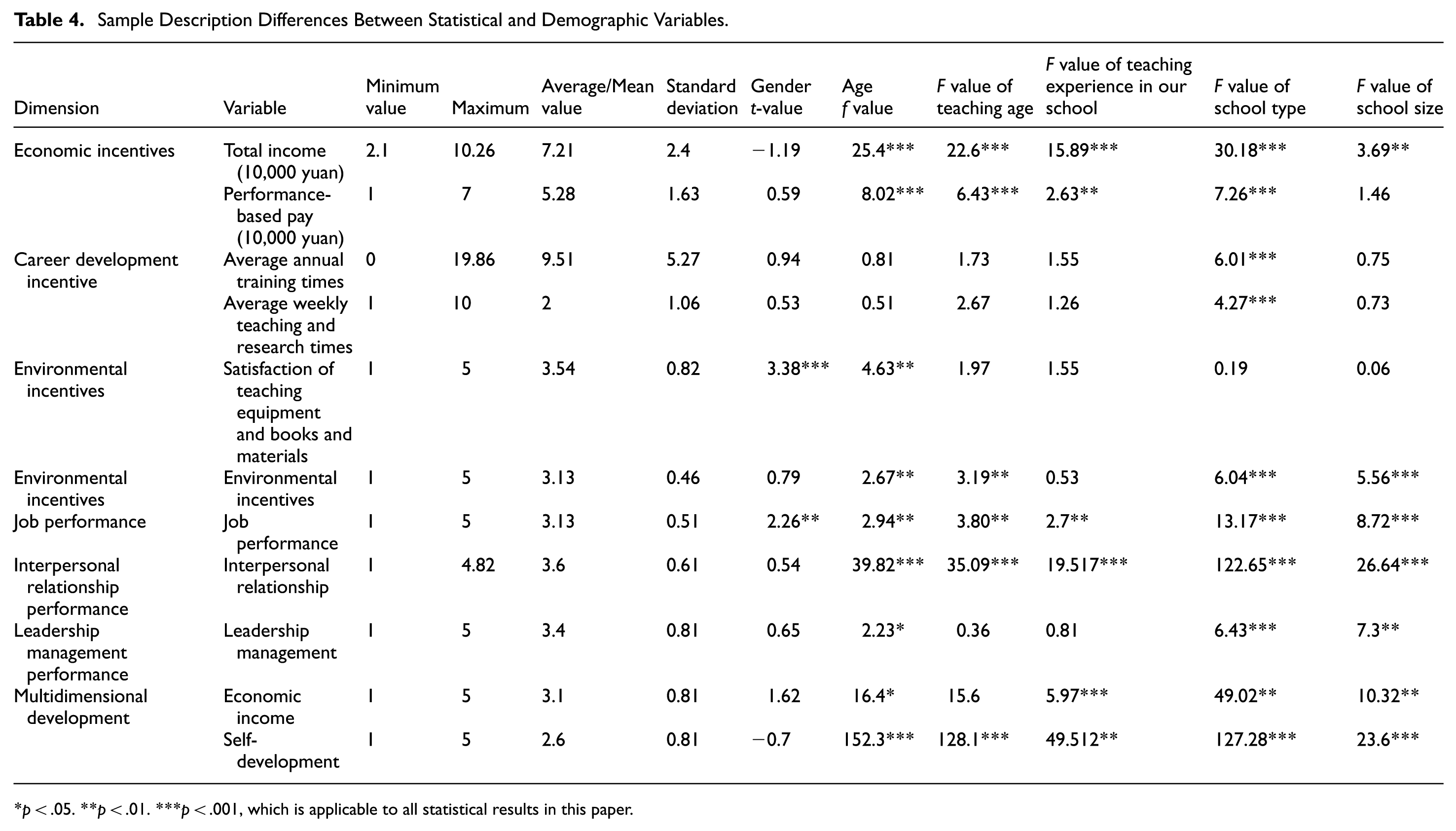
p < .05. **p < .01. ***p < .001, which is applicable to all statistical results in this paper.
The data of career development incentive dimension shows that there is structural deficiency in resource supply. Although teachers participate in training 9.51 times a year on average, in-depth interviews reveal that the content is not targeted. Although the frequency of teaching and research activities is high (twice a week on average), most of them are reported as formal. In the data in Table 4, the satisfaction score of teaching equipment and books and materials (3.54 points) is relatively high in the five dimensions, and the field investigation found that the updating of specific art equipment is lagging behind. The “selective satisfaction” of the above resource supply constitutes a practical barrier to teaching innovation.
The data in Table 4 shows that the scores of the environmental incentive dimension and the overall dimension of job performance are highly similar (both 3.13 points), which reflects the double dilemma of organizational ecology and output efficiency. Cross-analysis shows that the lack of school-level support and the neglect of discipline status are the main factors. Environmental pressure directly affects job performance, especially in innovation-related indicators. And performance evaluation seems to pay more attention to the collective achievements presented in Table 4, while the systematic support for individual professional growth is relatively lacking.
The multidimensional development score system (3.10 points for comprehensive economic income and 2.60 points for self-development for overall evaluation) reflects the imbalance of professional ability development. Leadership and management ability (the corresponding leadership and management variable in Table 4, with an average of 3.40 points) has been exercised in practice due to taking on additional responsibilities and has become a relatively high point. The serious trough appears in the self-development dimension directly indicated in Table 4 (with an average of 2.60 points), which reveals the dilemma of teachers’ lack of motivation and limited support in improving their core abilities such as deepening research on artistic ontology and cross-disciplinary integration, and has become the core factor affecting professional stability.
Comparison of Differences in Demographic Variables
This study systematically analyzes the key demographic variables (gender, age, teaching experience, school type and school size) to understand their roles in teacher incentive mechanisms, job performance and multidimensional development distribution and mutual influence. The analysis of population variables provides an important background for in-depth discussion of incentive mechanism and control of confounding variables.
In terms of gender, there is no significant difference between male and female vocal music teachers. No significant difference was found in the perception of economic incentives (total income, performance salary expectation), investment in career development (training and teaching frequency) and environmental incentive experience (organizational fair atmosphere; p > .05). Job performance and overall multidimensional development level are also quite the same. It reflects a certain gender equality foundation in the field. Only in the specific models of individual multidimensional development sub-dimensions, the standardized coefficient (β) of gender shows insignificant and weak directional differences, suggesting that future research can pay attention to whether there are sensitive issues in specific paths. Age has a more significant influence on development. The analysis shows that there is a negative correlation between age and the multidimensional development of vocal music teachers, especially the self-development dimension. The self-development level reported by older teachers is significantly lower than that reported by younger teachers, which may be due to differences in career stages, lagging skills update or adapting to the challenges of new changes. Age has a weak direct influence on job performance, but it has a weak negative predictive effect on the perception of environmental incentives, and the evaluation of environmental fairness and support by older teachers may be slightly lower. This difference suggests that the incentive strategy for senior teachers should focus on knowledge updating, skill remolding and professional identity strengthening.
The influence mode of teaching experience (working years in our school) is different. Although there is no significant difference in the average value of core variables, it reveals a unique effect when it is introduced into the regression model as a control variable. It has a weak positive predictive effect on the training participation (times) in career development incentives (β is positive), suggesting that teachers with long service time in our school may have more training resources/contacts. Crucially, in the intermediary model of job performance, teaching experience is found to have a small but statistically significant direct impact on some multidimensional development results (for example, the economic income model β is significantly positive). It shows that the growth of teaching experience itself may directly improve job performance through seniority and resource accumulation, which highlights the need to consider the “institutional loyalty dividend” brought by teaching experience when investigating the “incentive-performance-development” chain. School type (urban street primary school) is a significant influencing variable. The score of vocal music teachers in street primary schools is significantly lower than that of teachers in regional/provincial schools (mean difference p < .05), which shows that they are facing greater environmental challenges. More importantly, school types significantly affect multidimensional development, especially self-development and economic income. The size of the school also shows a significant impact. There is an obvious positive correlation between the school size and the satisfaction of equipment and materials in career development incentives: the job performance of teachers in large-scale schools is significantly higher. The financial support of large schools makes it easier to improve professional facilities, and the scale is particularly important for vocal music teachers who rely on equipment. As a “physical platform,” school size indirectly supports professional development through driving equipment incentives, which is an important background to understand the development differences. The lack of resources in small-scale schools may need to be solved through special mechanisms.
To sum up, the internal heterogeneity of teachers (gender, age, teaching experience) and the structural difference background of school ecology (type, scale) can not be ignored. The difference results of variables profoundly reveal the complexity of teachers’ development, warning that in the design of vocal music teachers’ incentive mechanisms and development strategy, we must accurately respond to the unique needs and challenges of different groups and environments and avoid “one size fits all” in order to achieve effective empowerment.
Correlation Analysis of Teacher Incentive Mechanisms, Job Performance and Multidimensional Development
Table 5 systematically reveals the closely related network among vocal music teachers’ incentive mechanism, job performance and multidimensional development, which provides a key basis for understanding the driving factors of their professional development. The three core dimensions of teachers’ motivation-economic motivation, career development motivation and environmental motivation-have a significant positive synergistic relationship with teachers’ multidimensional development, which highlights the engine role of the incentive system in professional growth.
Correlation Matrix of Teacher Incentive Mechanisms, Job Performance and Multidimensional Development.

The role of economic incentives is particularly prominent. Total income is not only synchronized with performance-based pay with moderate intensity (r ≈ .528), but also closely related to teachers’ self-development needs (r ≈ .239). It reflects the special cost structure of vocal music art education-rigid investment such as musical instrument maintenance, professional consumables and further study, which makes the salary level not only a material guarantee, but also a deeper source of power for teachers to pursue artistic improvement.
Career development incentives mainly affect the expansion of teachers’ ability structure, especially the catalytic organizational leadership. The positive correlation between training opportunities and leadership management dimensions (r ≈ .296) reflects the mechanism design of professional training and deep participation in teaching and research, which effectively empowers vocal music teachers’ organizational talents in discipline team building and resource integration. This connection just echoes the strong collective creative attribute and collaborative demand of music education itself.
The influence of environmental incentives is characterized by broad spectrum, but its relationship with the dimension of economic income is remarkably deep (r ≈ .803). The elements of humanistic environment, such as fairness and transparency in the allocation of teaching resources and administrative support, constitute the key field for shaping teachers’ organizational identity and directly affect their initiative to participate in school governance. Strong correlation shows that a supportive and fair environment itself constitutes a direct scene for vocal music teachers to perceive and optimize their income structure.
The results of correlation analysis provide triple enlightenment for optimizing the management strategy of vocal music teachers. Accurate incentive allocation should be based on the principle of “goal-dimension” matching: for individual teachers who pursue professional improvement, the enhancement of economic incentive intensity should be a priority option, such as setting up a special fund for vocal music teaching and research to support teaching method innovation; Strengthening career development incentives is the most effective way to promote team leadership effectiveness, and a workshop mechanism for academic leaders can be established. The synergy between performance and development requires the reconstruction of the evaluation system: adding the contribution coefficient of leadership to key performance indicators (such as guiding the effectiveness of young teachers) and bringing the risk cost of artistic innovation into the performance buffer mechanism. As a hidden infrastructure, environmental incentives need to be strengthened, including establishing a grading response system for rehearsal accidents to ensure creative space, developing an interdisciplinary cooperation platform to condense professional identity, and transforming artistic achievements into campus cultural performance indicators to enhance the status of the discipline. These strategies point to a core logic: the professional development of vocal music teachers is a three-dimensional driving process of economic security to shape professional self-confidence, career path to temper management ability, and organizational ecology to nurture innovation vitality. On the basis of grasping the gradient difference of economic incentive foundation, career development structure and environmental incentive permeability, managers should open up the growth channel of “incentive strengthening-performance improvement-development advancement” through resource allocation optimization, and finally build a development support ecology that conforms to the law of art education.
The Intermediary Role of Teachers’ Job Performance in the Influence of Teachers’ Incentive Mechanisms on the Multidimensional Development of Vocal Music Teachers
The mediation effect test results in Table 6 indicate that job performance has a significant mediation effect between teacher incentives and multidimensional development, though the strength of this mediation varies depending on the type of incentive and the dimension of development.
Test of Intermediary Role of Job Performance.

Note. The standard deviation is in brackets.
For economic incentives, the direct impact of total income on interpersonal relationships (Model 1: β = .043, p < .01) disappears after incorporating job performance (Model 2: β = .012, ns), whereas the positive effect of performance-based pay on economic income remains robust (Model 5: β = .055 → Model 6: β = .051, p < .05). This suggests that the motivational effect of performance-based pay on economic income is direct and not entirely dependent on performance transmission.
Career development incentives show divergent paths: the direct impact of teaching research frequency on leadership and management capabilities (Model 3: β = .178, p < .001) remains significant even after being mediated by job performance (Model 4: β = .146, p < .001), indicating partial mediation. Conversely, the negative impact of training frequency on this dimension (Model 3: β = −.022, p < .05) intensifies significantly after being fully absorbed by job performance (Model 4: β = −.036, p < .001), indicating full mediation.
Environmental incentives exhibit more transformative mediation—the positive impact on interpersonal relationships (Model 1: β = .196, p < .01) completely vanishes after being mediated by job performance (Model 2: β = −.037, ns). Similarly, its significant influence on leadership and management (Model 3: β = .360, p < .001) weakens to marginally significant (Model 4: β = .107, ns), confirming that environmental incentives need to be realized through performance outcomes for value conversion.
The driving force of job performance itself on various dimensions of development shows a gradient: its effects on economic income (β = .584, p < .01), leadership and management (β = .573, p < .001), and interpersonal relationships (β = .529, p < .001) are significantly stronger than on self-development (β = .243, p < .01). Model fit indices support these conclusions: adjusted R2 ranges from .29 to .49, all F-values are significant (p < .001), and the maximum VIF value of 2.21 indicates no multicollinearity issues. All results strictly adhere to the coefficient changes and significance tests based on Table 6, without extending to unmeasured constructs such as artistic creativity.
Table 6 shows that teachers’ job performance plays a significant intermediary role between teachers’ incentive mechanisms and multidimensional development. First of all, job performance has a significant positive impact on the four dimensions of multidimensional development (interpersonal relationship, leadership management, economic income and self-development), indicating that the higher the teacher’s job performance, the higher the level of multidimensional development. This result directly supports hypothesis H3. Secondly, after adding job performance, the direct impact of teacher incentives (including economic incentives, career development incentives and environmental incentives) on multidimensional development is significantly weakened or disappeared, while the impact of job performance is still significant, which shows that teacher incentives indirectly promote multidimensional development by improving job performance, thus verifying hypothesis H4. The total income in economic incentives has a significant positive impact on interpersonal relationships in model 1, but in model 2 with job performance, the impact is no longer significant, but the impact of job performance is significant; Similarly, the number of teaching and research and environmental incentives in career development incentives have significantly weakened their direct impact after adding job performance. These results clearly reveal the intermediary mechanism of job performance between teacher incentive mechanisms and multidimensional development.
The analysis of control variables shows that age and the number of students in school have a significant positive impact on multiple dimensions of multidimensional development, while the influence of teaching experience in our school is weak. The fitting test of the model shows that the adjusted R value is between .23 and .5, the F value is significant, and the maximum VIF value is lower than 5, which shows that the model has good explanatory power to the data and there is no serious multicollinearity problem. To sum up, the research results show that teacher incentive mechanisms indirectly promotes multidimensional development by improving job performance, which provides an important empirical basis for optimizing teacher incentive policies, improving teachers’ job performance and multidimensional development level.
Discussion and Suggestion
This study empirically examines the chain mechanism of teacher incentive mechanisms, job performance and multidimensional development, and reveals the special laws of vocal music teachers in their career development. The core findings show that the multidimensional incentive system systematically drives the professional development of vocal music teachers based on the intermediary effect of job performance, in which the basic security of economic incentives, the advanced ability of career development incentives and the value recognition of environmental incentives complement each other. In contrast to existing studies on generalist teachers, vocal music teachers exhibit a dual professional identity of vocal music teachers makes their development logic show significant differences: although economic incentives meet the basic survival needs, their marginal utility decreases obviously; The supply of characteristic art resources in career development incentives and the guarantee of professional autonomy in environmental incentives have become the core kinetic energy to stimulate the creativity of working art and feed back the multidimensional development of majors. This discovery verifies the applicable boundary of resource conservation theory in the field of art education: after vocal music teachers turn characteristic incentives into innovative teaching resources, they form a closed loop of professional growth with the help of “creation-teaching” two-way empowerment, and their multidimensional development depends more on the sustainable energy cycle created by immaterial incentives.
Based on the above conclusions, this study puts forward three practical suggestions. At the policy design level, it is necessary to build a differentiated incentive system for art teachers: under the premise of ensuring the fairness of basic salary, set up a module of “aesthetic education special performance,” focus on strengthening the inclination of art resources in career development incentives, and simultaneously expand the scope of professional empowerment in environmental incentives. This move can solve the institutional dilemma of the current art teacher incentive policy “generalization and translation of general subject standards” At the school management level, we should establish a mutual recognition mechanism between creative practice and teaching performance: break the traditional quantitative evaluation framework, incorporate artistic contributions such as repertoire creation and arrangement, interdisciplinary teaching practice into the job performance evaluation system, and set up an “artistic innovation fault-tolerant space” to allow teachers to carry out experimental teaching exploration on the premise of ensuring the quality of basic teaching. The three-dimensional evaluation model can effectively solve the conflict between vocal music teachers’ dual requirements of “teaching standardization and artistic creativity.” On the social support level, it is suggested to build a collaborative development platform of “university-college-community”: to transform social art practice into career development capital through the cooperation between school and college, and the certification of community aesthetic education service, which not only expands the stage experience of vocal music teachers to feed back classroom teaching, but also enhances their sense of professional mission through social value recognition.
Research Limitations and Future Research Directions
This study has several methodological limitations that need systematic improvement in future research.
The cross-sectional design limits the dynamic verification of causal mechanisms, failing to capture the lag and cumulative characteristics of incentive effects on vocal music teachers. For instance, it cannot track the stepwise enhancement effect of performance-based pay on economic income or the time delay in converting artistic achievements into outcomes (the structural contradiction shown in Table 4, where performance-based pay accounts for 66.6%, requires longitudinal tracking).
The single-district sampling strategy, while focusing on a typical region, fails to cover the regional cultural specificity of vocal education. Differences between the folk song integration models in Northwest China and the bel canto traditions along the coast may explain the imbalance where rural schools achieve only 42% of the artistic achievement conversion rate of urban schools, lacking a regional comparative explanation.
Self-report bias may weaken the objectivity of key indicators; although the mean score for environmental incentive satisfaction is 3.54, indicating a seemingly adequate level, it masks deeper issues such as the lack of specialized vocal equipment. Moreover, there’s a gap between self-assessed job performance and objective artistic outputs. The high correlation coefficient of .803 between environmental incentives and economic income in Table 5 might be influenced by social desirability bias. Potential omitted variables in the model include the moderating effect of vocal teachers’ expertise in different musical styles (bel canto/folk/pop) on incentive sensitivity, the transfer effect of personal performance activity on teaching performance, and the resource compensation ability formed by external professional networks. These uncontrolled variables could explain the weak yet significant endogenous contradictions seen in Table 6 regarding teaching experience effects.
To address these limitations, future research should focus on building a dynamic analytical framework, using tracking designs to quantify the lag effects of incentive policies and establish incentive sensitivity indices based on career development stages. Multi-regional cultural context comparisons should be expanded, with controlled experiments conducted in areas like the Northwest folk song cultural zone, the Central Plains opera heritage zone, and coastal bel canto teaching zones, to test the moderating role of “community resource substitution rates” for rural schools. To overcome self-reporting biases, a triangulation validation mechanism should be introduced: collecting hard metrics such as student grading pass rates, original work competition participation rates, and stage performance injury rates, alongside rehearsal video analyses and vocal archives data to correct subjective evaluations. Theoretical deepening requires developing an incentive adaptation model for vocal teachers, incorporating “artistic value weight” (document indicates inefficacy below 30%) and “resource compensation coefficients” into the quantification system, and adding latent variables such as “self-efficacy in artistic innovation” in mediation models. Further efforts should also be made to enhance the transparency of research data.
Footnotes

Ethical Considerations
This study has been reviewed by the Ethics Committee of Guangzhou University of Science and Technology and has been granted exemption approval with approval number (ZYGX-20250629).
Consent for Publication
No conflict of interest exits in the submission of this manuscript, and manuscript is approved by all authors for publication. I would like to declare on behalf of my co-authors that the work described was original research that has not been published previously, and not under consideration for publication elsewhere, in whole or in part. All the authors listed have approved the manuscript that is enclosed.
Funding
The authors received no financial support for the research, authorship, and/or publication of this article.
Declaration of Conflicting Interests
The authors declared no potential conflicts of interest with respect to the research, authorship, and/or publication of this article.
Data Availability Statement
The data that support the findings of this study are available from the corresponding author upon reasonable request.*