




Abstract
This study is an attempt to investigate the impact of educational facilities of a school on various aspects of self-efficacy, confidence, and character building of the underprivileged people in Dera Jutta, a village in Southern Punjab. Trust for Rural Uplift and Community Education (TRUCE) was initiated in the year 2000, and under its auspices, Nafisa Mai School was started. To gain insight into the project, data were collected from students of Grade 10 and teachers of all classes with the help of semistructured interviews and in-depth probes. Detailed classroom observations were also conducted to gain insight into the facilities and methodology. Data were analyzed by coding them into themes. The results reveal a high level of student satisfaction related to the academic and cocurricular facilities and activities. Findings also show that although many students drop out after primary and middle school, 100% success rate is witnessed in terms of pass percentage at the matriculation level. The teachers’ interviews portray immense satisfaction and dedication in terms of job satisfaction and facilities. The greatest impact revealed both by students and teachers however was not just in terms of academic achievement but in various aspects of self-efficacy, confidence, and character building. The entire village and its adjoining areas have benefited from the school initiative, along with other community ventures of TRUCE in empowering the community.
Keywords
Introduction
The role of education in society is universally considered to be pivotal and crucial. No words can stress how essential education is for development, upliftment, and social mobility, particularly, for a developing country. The entire skill set of a country is dependent on the type of institutions it has to develop and nurture them.
In 2013 to 2014, a survey conducted by Pakistan Social and Living Standards Measurement (PSLM) reported that literacy rates in urban Pakistan was higher (74%) as compared with the rural areas (49%). Furthermore, Pakistan Economic Survey 2014 to 2015 reported on the gender disparity in urban areas which was 81% for males as compared with 66% for females. It is pointed out by Wasti (2015) in the Pakistan Economic Survey 2015 to 2016 that the education budget remained the same as previous years, that is, 2.1%.
Punjab, the second largest province by area and largest in terms of population, is subdivided in three different broad areas, which are North, Central, and South Punjab. This case study focuses on a small village in rural South Punjab, by the name of Dera Jatta, at a distance of 100 kilometers from Rahim Yar Khan District. Like other areas of the belt, it was neglected and never given opportunity to prosper.
Although areas adjoining Dera Jatta were witnessing growth, this village remained marginalized and backward. There was a dearth of good schools. In 2000, there was just one middle school for boys only, which was situated on the main highway, and was more of a hazard than a blessing. The people were illiterate, backward, lacked moral values and basic ethics, and had no exposure to proper agricultural or business skills. Inhabitants of this village were deprived of proper health care and had no sense of hygiene and cleanliness, civic duties, or even sense of recreation. Crime was rampant, and children grew up like wild weed with no proper care or guidance. In this scenario, in the year 2000, a school was started by the name of Nafisa Mai school, under the banner of Trust for Rural Uplift and Community Education (TRUCE) with the motto “An Oasis of Literacy in a Desert of Poverty” to transform the lives of the inhabitants. The school went on to become a success story despite the deplorable conditions. Farah et al. (cited in Retallick, 2005) elaborate success stories of schools that perform well and leave a mark on their students, teachers, and the immediate stakeholders along with the communities as follows: A task-oriented, orderly, and relaxed school/classroom climate prevails in the successful schools. They contain competent teachers who attend regularly and express ownership of and commitment to the school, are able to implement the curriculum completely and on time, and with concern for student learning. Parents (both fathers and mothers) become aware of these school characteristics through the attitudes and behaviour of their children. (p.8)
Such a school model was conceived and implemented by the founders of Nafisa Mai School, Dera Jatta, in 2000. The school started off in a makeshift straw hut in the land owned by the Trust’s founder members, to soon flourish into a commanding structure, spread over 6,000 square yards, boasting some of the best facilities to meet the needs of the generation.
One of the unique features of the school was the blend of modern facilities maintaining traditional heritage. It was constructed as an ecologically friendly, green architecture, cost-effective, yet fulfilling the needs of a growing and developing youth with open courtyards, an amphitheater where various workshops and events of national and religious importance have been held, ample playgrounds, proper lighting and ventilation, and easy and safe access to their homes. For this purpose, a road was built to link the highway to the school. It also boasts of a hygienic canteen that provides free snacks to the pupil. Keeping in mind the safety of the children, no vendors are allowed around or inside the building. There is also a state of the art computer lab, as well as a modest library to meet the needs of the curious mind.
Despite recognizing the fact that education serves as the backbone of the economy, the state and quality of education for the masses of Pakistan remained dismal for decades. Hoodbhoy (2007) aptly elucidates that “education remains a low-priority issue for the Pakistani state, evident both from historically low levels of funding and a chronic inability to take major steps toward reform now that funding is likely to increase.”
Punjab, Pakistan’s largest province, took several education reform initiatives, the most notable being the emergency enrollment campaign for out of school children. Retaining children in schools and preventing dropouts in secondary classes were yet another challenge. Moreover, recent assessments by ASER have shown that students’ basic knowledge and levels of understanding of grade-level subjects are pathetic.
Quality in Education
Quality education, includes in its realm the relevance of learning, the extent of child’s involvement in the learning process, the system of management and provision of educational facilities, pedagogical methods, quality of teachers, curricula, and so on (Imran, 2008). Huxley (2008) throwing light on the barriers inhibiting attainment of quality education in South Asia enlists some of the major reasons, with lack of qualified and trained teachers that result in low student achievement being foremost. He also mentions teacher absenteeism as another major cause and links it to poor training. Other factors which contribute to the malady are caste system, ethnic differences, gender discrimination, low levels of enrollment, high dropout rates, and poverty. To alleviate the issue of poverty, it is recommended by researchers to invest in education for long-term benefits, as it would lead to increased levels of skills and productivity as well as provide opportunities for social mobility. Empirical research suggests that the remedy to this situation lies in reformed educational policies, enhanced educational expenditure in budgetary allocations, improvement of school infrastructure and facilities, and trained and efficient teachers, particularly, females to act as role models for their pupil. These measures can only be successful if there is public–private partnership, involvement of nongovernmental sectors, local communities, and international associations.
Huxley (2008) suggests manifold strategies to achieve quality and rights-based education as the following:
Equality of opportunities right to education
At the very outset, this strategy emphasizes equal access to education to boys and girls. Girls should not be deprived from education due to poverty or distance of access to schools. It also suggests provision of incentives and stipends to the deserving marginalized, “nonformal education (NFE) for older, out-of-school, and hard-to reach children,” adequate facilities, as well as mutual involvement of schools, parents, and communities.
2. Equality of pedagogy right in education
This focuses on the equality in respect, consideration, attention, curricula, and pedagogical methods for both the gender. Stereotyping should be discouraged, and books should depict positive images of boys and girls. Moreover, teachers should be trained to give equal focus to boys and girls and protect them from harassment, bullying, abuse, and other forms of violence and punishment.
3. Equality of outcomes right through education.
The third aspect focuses on the “result of education and beyond” and focuses on the outcomes of education. It emphasizes as explained by Seel (cited in Heijnen-Maathuis, 2008), on the provision of “lifelong learning professional training, empowerment and positive participation in society, decision-making power, control of resources etc.” Characteristics of teachers’ with high and low self efficacy is presented in Table 1 below.
Showing Characteristics of Teacher’s High and Low Self-Efficacy.

In Pakistan, improvement of quality was addressed by promoting decentralization in schools (Multi-Donor Support Unit [MSU], 2001), whereby School Management Committees were created to ensure greater community involvement. This was done with the intention to “make schools more responsive to the local community and eliminate top-down approaches thereby creating a broader base for decision-making” Memon, (as cited in Retallick, 2005).
Teachers’ Self-Efficacy
According to George (2011), self-efficacy involves how a teacher feels about his or her ability to do his or her job. Bandura further explains four primary sources of self-efficacy: “. . . mastery experiences, vicarious experiences, social persuasion, and physiological factors” (cited in Putman, 2012). In other words, the belief that one possesses the ability to perform his or her job/tasks with mastery is dependent upon previous experiences, training, and environment. According to Bandura (1977), self-efficacy is “How one judges his or her own capabilities to reach goals and to persist in the face of obstacles and challenges.” Similarly, teachers’ self-efficacy beliefs refer to “teachers’ beliefs in their capabilities to perform specific teaching tasks at a specified level of quality in a specified situation” (Dellinger, Bobbett, Olivier, & Ellett, 2008). Furthermore, teachers with a high sense of self-efficacy are confident that even the most difficult students can be reached if they exert extra effort, and their children’ achievement is better (Brookover, Beady, Flood, Schweitzer, & Wisenbaker, 1979); whereas teachers with lower self-efficacy feel a sense of helplessness when it as to do with dealing with difficult and unmotivated students Gibson & Dembo (cited in Durowoju & Onuka, 2012). This view is presented in the table below as adapted from Carroll, B. F. (2011).
Durowoju and Onuka (2015) recommend that teachers should be exposed to self-efficacy enhancement program to enable them imbibe the spirit of self-efficacy in carrying out their assignments.
Schools play a vital role in developing and sustaining rural communities and are crucial to developing countries sustainable growth and development. According to Philips (cited in Onuka and Emunemu, 2009), in the United States of America, “rural” means a small town having a population of 25,000 people and less, whereas in Nigeria, “rural” is rather defined by the amenities available or nonexistent. Such amenities include electricity, pipe-borne water, motorable roads, and health facilities, among others. The situation in Dera Jatta is comparable with Nigeria.
For students to succeed in education, they need to possess feelings of Self-Worth, Active Engagement, and Purpose. These are elaborated by Quaglia (cited in Carroll, 2011) as follows:
Teachers care about my problems and feelings
Teachers care about me as an individual
Teachers care if I am absent from school
Teachers respect students
I put forth my best effort in school
I enjoy being in school
Teachers enjoy working with students
Teachers make school an exciting place to learn
School is boring
My teachers present lessons in different ways
At school, I am encouraged to be creative
Students are supportive of each other
I see myself as a leader
Other students see me as a leader
Teachers encourage students to make decisions
Teachers expect me to be successful
I know the goals my school is working on this year
School is preparing me well for my future
Keeping in mind the assumption of quality, self–efficacy, and conditions as discussed above, the present study was qualitative in nature although many studies have utilized questionnaires as tools for such investigations. However, Bandura (2006) explains, “Scales of perceived self efficacy must be tailored to the particular domain of functioning that is the object of interest.” Therefore, this study drew out themes on self-efficacy from the qualitative data collected.
The present study explored the extent of access to quality education in a school (Nafisa Mai School) being run under a trust in Dera Jutta, a remote village in south Punjab, and its impact on the self-efficacy of teachers and confidence and character building of the students. The literature review thus accounts the prevalent school conditions in Pakistan, particularly Punjab, what quality in education entails and what is implied by teachers’ self-efficacy, particularly, in the rural context.
Research Questions
The major research questions that guided this study were,
Method
To gain insight into the project, data were collected from students of Grade 10 and teachers of all classes with the help of semistructured interviews and in-depth probes. Each teacher was interviewed for 1 to 2 hours. Interviews were transcribed, and themes were generated and analyzed from their responses. Detailed classroom observations were also conducted to gain insight into the facilities and methodology. Besides classroom observations students’ performances, cocurricular activities such as dances, plays, recitation, PT display were also observed to gain insight of their level of confidence and self-efficacy behavior.
Population and Sample
The population of the study were the staff and students of Nafisa Mai School. In depth interviews were conducted from 12 female teachers of various grades and five students from Grade 10. These 12 female teachers were identified as R1-R12 for the purpose of data analysis. Besides this, detailed observation was conducted by the researcher in each class, from the primary till secondary level.
Data Collection Tools
Data were collected with the help of semistructured in-depth interviews of the teachers and students of Nafisa Mai School to investigate the impact of the school’s facilities on the various aspects of their lives, spread over a span of few days. The interview protocol for the teachers consisted of seven open-ended questions, revolving around experiences regarding their work, workplace environment, their colleagues, the facilities offered by the school, benefits of the school to the community, and so on. In total, 12 teachers participated in the study. Similarly, interviews were taken from five students with the help of a semistructured interview protocol. Questions were asked regarding the similar themes as that of the teachers. Greater insight regarding students was also obtained by classroom observation and observation of cocurricular activities, utilizing an observation schedule and field notes. The observation focused on elements of self-confidence, self-discipline, initiative, personal grooming, and general conduct and behavior. The school was about to host its annual day, and festivities were being planned. Students’ performances, cocurricular activities such as dances, plays, recitation, and PT display were also observed to gain insight of their level of confidence. Teachers’ soft skills and etiquettes were observed during event management and other similar occasions.
Data Analysis
Although the data were qualitative in nature, it still varied a lot. Data were analyzed through content analysis method utilizing the guiding themes of experience, support, and facilities, as well as encouragement. However within these themes, some new ones also emerged that were included in the findings.
Results
An in-depth interview was conducted with the teachers to find out how the teachers’ self-efficacy beliefs evolved during their years of service at TRUCE. These are explained below in their personal as well as academic experiences. The interview also focused on how have the facilities provided by NMS helped improved the teachers and the students. The teachers were also asked to detail the difference the school made in the community on the whole.
Experience
The experiences narrated by the teachers fell into two broad themes, viz., personal and academic and extracurricular experiences which are elaborated below.
Self-efficacy through personal experiences
All the teachers expressed their views that the area has prospered in the last decade. There was no school there, now people come from other villages to enroll their students. “No woman in my family is allowed to step out, that too for a job. The schools repute convinced my father to allow me to teach here” (R3, R5).
They informed that the school had a policy of admitting students in nursery only. These students then continue up to Class 10. “Thus we are able to groom and improve them,” they commented. However, in the process, we have been groomed too. Besides that, we have received best of trainings free of cost. The teachers reported that their students are taken for educational trips and excursions through which they also benefited. Traveling is also a learning experience: Being women we had little opportunity of growth. The school is a great platform to meet others, socialize, share our sorrows and joys, participate in events etc. . . . (R1, R7, R12) People who didn’t want to send their children to school now come and implore the school to admit their children. (R1, R7, R9) We are proud to arrange, participate and display our skills on the annual sports day, school drama and annual mela (funfair). (R2)
Another reported that when the children reached higher classes some parents objected on both the genders studying together. The school management would not compromise on quality, and specialist teachers were few and not easily available. To my surprise, the admission told the parents to take their boys out, as the school would not stop educating the girls. The girls’ parents had no objection on their studying in the co- education class. I was amazed at the level of trust in the administration.
In response to a query as to why they did not slack, they commented that there was close accountability, electronic monitoring, and also rewards and incentives for work done well:
We get two bonuses, monthly lunch party, free of cost conveyance and above all respect.
The teachers also shared their personal involvement in convincing the parents not to pull out the children after middle school. They commented that the enrollment drops at this level as the parents want the children to become earning hands. Girls are also married off early, just after puberty. The school administration and staff were tackling the issue hands on to address the community needs while helping the children alongside.
Self-efficacy through academic and extracurricular experiences
It was unanimously reported that they felt more confident as teachers. They all agreed that the trainings they had received were very useful. There was a sense of ownership and belonging among all the staff. Students who had completed their matriculation were hired as assistant teachers, went on for further studies, or worked in the vocational center.
Talking about their experience as teachers they elaborated that they had learnt skills on how to engage all the students in activities, particularly, those teaching the younger classes. They also said that they now felt capable of handling student’s disciplinary and class management issues in a better way. One of the teachers (R3) commented she could tell when there was an issue at home interfering with a student’s performance in school.
Elaborating on their own relationship and commenting on personal jealousy or politics the teachers mostly agreed that “There is a spirit of teamwork among the staff” (R1, R3, R4, R7, R10).
“The school has a policy of allowing students to assist parents in the fields in the cotton and wheat harvesting season.” This was allowed when high absenteeism was observed during this period. Classes were adjusted during other months. “Internal assessment timings are adjusted to suit the needs of the pupil. We are truly catering to the villagers needs,” R5 commented. “We are a well reputed school, and people are willing to pull children out from bigger private schools at a distance and send them here” (R6, R8).
In 2004, the Nafisa Mai School organized an Art Competition for 10 students (five boys and five girls), organized by the Heritage Foundation. This was a great initiative and acknowledged by the foundation by holding annual competition in the school premises. This has inculcated a lot of confidence among the students. Traveling to the northern areas was also an exhilarating experience.
A summary of the emerging themes is presented in Table 2.
Themes From Teachers Interview.

The second research question investigated how the facilities provided by Nafisa Mai School helped in improving the teachers and the students. This was addressed with the help of in-depth interviews with both teachers and students, as well as personal observation by the researcher. The results are presented for the both as follows.
Facilities for Teachers
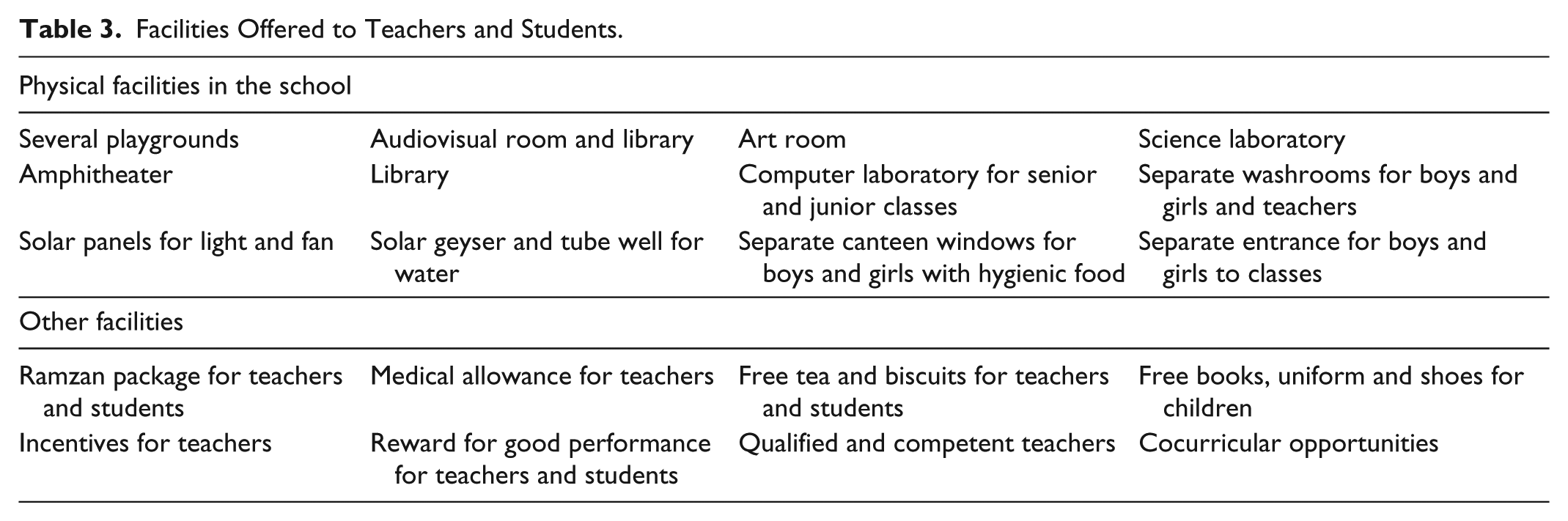
All 12 respondents were immensely satisfied with the school facilities and felt it helped improve them as a teacher and a human being. The school has a playground; auditorium; audiovisual room; art room; computer and science laboratories; a library; well lit and well ventilated atmosphere; uninterrupted electricity with solar panels for fan, light, and warm water supply; wash rooms; a canteen for boys and girls, separately; environmental friendly building design; and above all, dedicated teachers. There is also a mosque in the area to cater for our moral and spiritual growth, and people from all sects are welcome there. “The school has every facility, even those which you can’t even think of. There is even a van to pick and drop us free of cost” (R1, R4, R8, R11, R12).
They all further elaborated that “We even get daily tea and biscuits on the school account,” and “Students do not need to incur any expense at all.” They added that they are also given Ramzan package, bonus, and medical allowance.
It was unanimously voiced that “With the school we also got electricity, roads, a vocational centre and a health care unit. We are now a civilized village.”
Point of pride for all teachers was that fact that these children do not need extra coaching or tuitions.
Facilities for Students
All the students said they were facilitated at every stage of education. They were provided books, stationary, transport, uniform, shoes, and refreshments free of cost. Besides that, they expressed immense satisfaction over the school facilities. There were separate entrances to their classes for boys and girls, as well as separate windows in the canteen. They all expressed that the school facilities gave them a chance to nurture and develop into better human beings. One student elaborated, “before the school, children in the village had no constructive past time, were ill mannered and uncouth. Now I feel like a well groomed person.” They expressed satisfaction with the teachers’ knowledge and conduct toward them.
“We have the most reputed teachers for grade ten coming to teach us. I feel very confident. Now I can help my younger siblings at home” (S4). All the students expressed that they feel like a useful member of the community. They look forward to hosting events and being in the limelight now. There was a sense of pride in identifying themselves as students of the school.
The themes discussed above are presented in Table 3.
Facilities Offered to Teachers and Students.
The third and last research question investigated what difference the school has made in the community on the whole. Results are discussed as the behavioral change reported by the participants and also observed by the researcher. Results are thematically presented below.
Behavioral Change
Perhaps the most significant change the village has witnessed is in terms of behavioral change. Teachers all opined in one way or another that since the school started, they are witnessing what R6 called “culture amid agriculture.” They said that the students have learnt to respect elders, and where no one ever greeted each other properly, now they say salaam (greeting). In fact, they asserted, the children go home and teach other family members the values and good behavior which they learn from school.
The children are now responsive which is evident as “Their PT display shows the sense of discipline they have acquired” (R1, R11).
“In the beginning I was overwhelmed by the children, how will I manage, but over the years I feel independent and confident after teaching here” (R1, R3, R4, R7). Everyone now has confidence in the credibility of teachers and results, they elaborated. All the teachers proudly claimed that these children do not cheat in exams. These responses have been thematically summarized and presented in Table 4.
Benefits of the School on the Community.
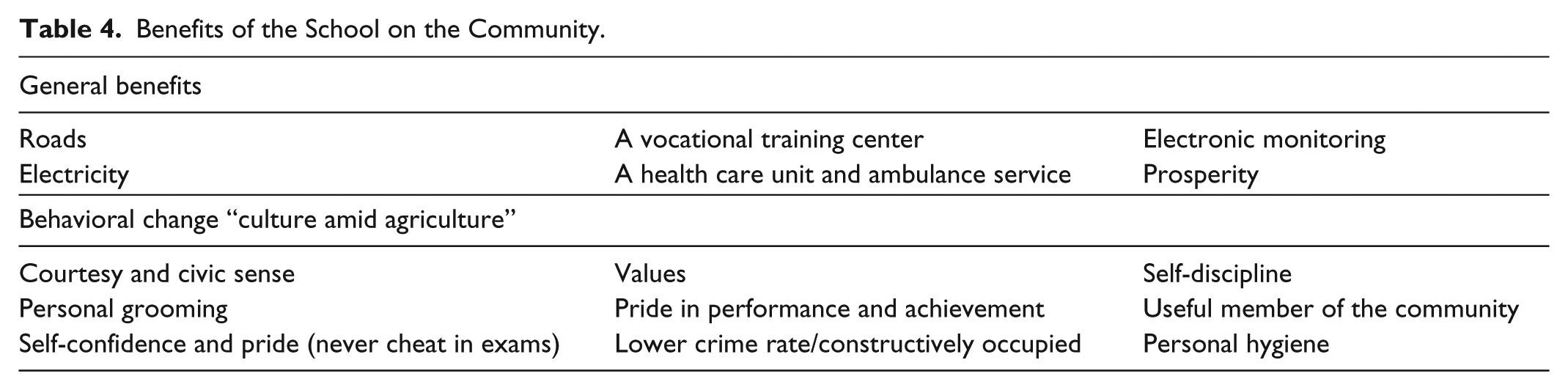
They further said that children have learnt basic etiquettes. We learnt table manners, about personal hygiene, communication skills, and etiquettes of conducting ourselves. There was no concept of washrooms, and the entire field served that purpose. Now every house has a toilet (R1, R5, R6, R9, R11, R12). They expressed their confidence to speak in front of others and how they took: “a lot of pride in myself and my achievements.”
The school has paved the way for opportunities of employment they elaborated. Many of the teachers commented that the crime rate in the village has gone down. Street fights were common, children would be seen idle during the day whiling the time away. There is a drastic change. Sometimes the younger lot get amazed when told of these incidents. They are a thing of the past.
All the students opined that their teachers have taught them to be honest and never cheat. They mentioned an incident at a board exam where the invigilator tempted them to provide them the answers to the questions, and they all flatly refused saying “we are taught not to cheat.” Their humble background and confidence made them famous in the adjoining areas.
They proudly told that not only did we refuse but our school also got 100% result, and there was not a single failure: “We would want to be associated with the school for all our life and give back what it has done for us.”
Results of the Observation
Student observations were conducted in the classroom environment, where they were seen to be fully involved. Teachers tried their best to make their classes interactive. It was however noted that translation method was prevalent among them. There was no tardiness observed during classes, and time was efficiently utilized.
Observations were also conducted at the annual play, morning assembly, funfair, and sports day. Immense confidence, self-assurance, and poise were displayed by the students at all the events. The children acted as gracious hosts in all the functions, mingled with the guests confidently, and displayed good behavior.
In the morning assembly exemplary discipline was observed when 350 students took their place. The children were impeccably dressed in their uniform, with not a hair out of place. The PT display was another example of unity and discipline. The art collage on the school wall was a masterpiece they all felt proud of. The following table elucidates the changes that were reported and witnessed and thematically presents the benefits of the school on the community.
Discussion
The results report that the school fulfills the criteria of being a quality and rights-based institution as elucidated by Huxley (2008), meeting the conditions of equality of opportunities, right to education, equality of pedagogy right in education, and equality of outcomes right through education.
The findings of the study reveal high levels of self-efficacy displayed by the teachers. As mentioned in the literature review, teachers with high levels of self-efficacy display confidence, assist their students, are proud of their work and accomplishment, and give time to their work Gibson & Dembo (cited in Durowoju & Onuka, 2012). The teachers have expressed high levels of satisfaction related to their personal experience, academic experience, the facilities provided to them, and the positive changes in the community of Dera Jatta.
In comparing responses from teachers to students, Quaglia (cited in Carroll, 2011) found significant differences in how teachers and student perceive School Pride, where more teachers (85%) agreed with the statement that “I am proud of my School” as compared with 49% students. In this study, however, responses of the students and teachers were not significantly different. Both of them have expressed explicitly the pride they take in the school.
Carroll (2011) highlights Bandura’s assertion of “. . . reciprocal relationship between teacher efficacy and school systems. School success or failures are based on the cumulative nature of teacher’s self-efficacy, yet a teacher’s perception of self-efficacy can be influenced by how the school system functions to meet student-learning needs.” The results reveal that the teachers’ self-efficacy is high due to the repute of the school, and the way it caters to the need of the community, which they all highlighted in one way or the other.
The teachers and students have also exhibited the belief that it is possible to excel and perform despite the challenges of being a downtrodden, poor, underdeveloped, and underprivileged community should there be a desire to do so. In this remote rural village, with leadership and guidance, the villagers have witnessed a phenomenal change not just in respect of schooling and education but have also seen the other benefits which have been reaped as a result of education.
Conclusion
George (2011) has explained self-efficacy with how a teacher feels about his or her ability to do his or her job. With this view, the results reveal a high level of teacher self-efficacy in this study. Page, Pendergraft, and Wilson (2014) in their study assert that teachers in rural and suburban areas have demonstrated higher level of self-efficacy as compared with urban teachers, and they attribute it to the level of familiarity in the villages where everybody knows each other closely. This can also be attributed to the sample in this study.
Teachers and students both have demonstrated conditions of Self-worth, Active Engagement, and Purpose, which act as contributors in their success and high self-efficacy, as explained by Quaglia (cited in Carroll, 2011). What is perhaps the most notable outcome of the school is the change in the living condition and character building of the villagers that it fostered and nurtured. It is suggested that people from the community come forward and participate in the rural upliftment programs, particularly education, and not just sit and wait for the government to take initiatives. It is also suggested that similar models should be adopted in other remote villages for research purpose and community welfare and upliftment.
Footnotes
Declaration of Conflicting Interests
The author(s) declared no potential conflicts of interest with respect to the research, authorship, and/or publication of this article.
Funding
The author(s) received no financial support for the research, authorship, and/or publication of this article.