




Abstract
In the healthcare industry, high employee turnover rates pose significant challenges for organizations, individuals’ well-being, and delivering high-quality patient care. Moreover, turnover exacerbates the burden on employees to exceed their agreed-upon work hours, resulting in oversights and a decline in the morale of the remaining personnel. Drawing on the theories of planned behavior and social exchange theory, this study aimed to examine the influence of organizational politics on turnover intentions while considering the mediating role of psychological safety and work engagement in this process. A convenience sampling strategy was utilized to collect data from 350 employees in public hospitals in Ghana. Using SMART-PLS 4 in structural equation modeling to analyze the data obtained from the Ghana public hospital, this study identified organizational politics’ significant and positive influence on turnover intentions, psychological safety, and work engagement. This study further identified a significant positive relationship between psychological safety and turnover intentions. However, the study revealed a significant but negative relationship between work engagement and turnover intentions. The study also found a significant partial mediation role of psychological safety and work engagement in the relationship between organizational politics and turnover intentions. Establishing norms centered on trust, transparency, and employee involvement, alongside innovative initiatives, is pivotal in curbing organizational politics, fostering staff commitment, and retaining talent within public hospitals.
Plain Language Summary
High employee turnover in healthcare threatens companies, patients, and well-being. Turnover also forces staff to work longer than agreed, causing oversights and lowering morale. This study used planned behavior and social exchange theory to analyze how organizational politics affect turnover intentions and how psychological safety and work engagement mediate this process. We used convenience sampling to sample 350 Ghanaian public hospital personnel. This study used SMART-PLS 4 in structural equation modeling to analyze Ghana public hospital data and found that organizational politics positively affect turnover intentions, psychological safety, and work engagement. This study found a strong positive correlation between psychological safety and turnover intentions. The study found a strong but unfavorable connection between work engagement and turnover intentions. The study also indicated that psychological safety and professional engagement partially mediated organizational politics and turnover intentions. Trust, transparency, and employee involvement, combined with new initiatives, reduce organizational politics, boost staff commitment, and retain talent in public hospitals.
Keywords
Introduction
The turnover of employees in the healthcare sector has significant implications for both organizations and the delivery of high-quality patient care (Romi et al., 2022; Sija, 2022; Szilvassy & Širok, 2022). Hwang and Chang (2008) argue that a high turnover rate in the healthcare industry results in increased expenses for managing human resources and recruiting new employees. These costs include the time and effort required to hire, educate, and train a new staff member. Moreover, turnover exacerbates the burden on employees to exceed their agreed-upon work hours, resulting in oversights and a decline in the morale of the remaining personnel (Widener, 2023). Turnover intentions (TI), which serve as a prelude to actual turnover (Diko & Saxena, 2023), have received significant attention over the years due to their potential impact on organizational productivity and employee well-being. In the unique context of Ghana’s public healthcare institutions, it is imperative to address turnover issues due to a diversity of compelling factors, such as employees leaving the country for other countries due to a higher level of organizational politics (OP).
Ghana’s public hospitals face difficulties due to limited resources (Obeng, Arhinful, Tessema, & Nuhu, 2025). These limitations frequently lead to inadequate personnel, restricted availability of necessary medical resources, and despoiled infrastructure. As a result, healthcare workers working in public hospitals in Ghana experience distinct pressures that lead to their desire to leave their jobs (Odonkor & Adams, 2021; Atan and Obeng, 2024). TI is a metric that gauges whether employees in a corporation or organization have the intention to quit their jobs or if the organization intends to terminate individuals from their roles (Härenstam et al., 2024). Factors such as job dissatisfaction, waning enthusiasm, and insufficient organizational support are prevalent, prompting employees to contemplate leaving their roles (Dall’Ora et al., 2020).
Furthermore, OP play a significant role in influencing TI within Ghana’s public hospitals. OP encompasses the strategies and actions undertaken by employees in a firm to obtain and leverage authority and resources in order to achieve a specific goal (Hochwarter et al., 2020). The exertion of power to sway decision-making processes and resource allocation negatively impacts various facets of the work atmosphere, including work engagement (WE), job satisfaction (JS), psychological safety (PS) and innovative climate (IC; Maximo et al., 2019; Obrenovic et al., 2020; Silva de Carvalho Chinelato et al., 2020). This phenomenon exacerbates the complexities of employee turnover. It emphasizes the importance of comprehending and dealing with the interaction between the OP and the employee’s intent to leave.
WE is a favorable demeanor or a positive mental state while working, which results in beneficial work outcomes (Schaufeli, 2013). Employees who exhibit high work engagement demonstrate strong energy, dedication, and immersion in their work (Rahmadani & Schaufeli, 2022). PS is the ability to feel secure enough to take social risks, express dissenting opinions, openly address problems, and share unpleasant news without fear of negative consequences or pressure to soften the truth (Clark, 2020). IC is how individuals perceive their organizational environment as supportive of creativity and innovation (Ye et al., 2022). This includes promoting creativity, granting autonomy and freedom, providing resources, creating pressure, and identifying creative obstacles.
Despite the growing body of literature on turnover intentions and associated factors, there remains a scarcity of data-driven research that comprehensively examines the collective impact of OP, PS, WE, and the moderating role of an IC within Ghana’s public hospital context (Edmondson & Bransby, 2023). This research gap presents an opportunity to unravel the dynamics contributing to TI and develop evidence-based strategies to mitigate turnover challenges in Ghana’s healthcare sector.
Therefore, this study aims to evaluate the influence of OP on TI within Ghana’s public hospitals. Additionally, it explores the mediating roles of PS and WE and investigates how an IC moderates the relationships among these variables. By employing the Theory of Planned Behavior (TPB) and the Social Exchange Theory (SET), this study seeks to comprehensively grasp the multifaceted aspects contributing to TI among healthcare workers in Ghana. The study attempts to find answers to the following questions: Firstly, how does OP affect TI? Secondly, how does OP affect WE and PS? Thirdly, how do WE and PS influence TIs? Further, how does IC moderate the relationship between OP and TI and WE and TI? Answers to these questions seek to contribute empirically to the literature and provide practical insight on promoting the well-being of employees in public hospitals in Ghana, resulting in the minimization of TI. Moreover, using a cross-sectional design and convenience sampling, this study found a significant influence of OP on WE, PS and TI and further revealed moderating effect of IC on the relationship between OP and TIs and WE and TI.
This study has the potential to stimulate beneficial transformation within Ghana’s health sector in the following ways: First and foremost, policymakers can utilize this information to create focused plans and interventions to enhance employee retention and address turnover difficulties. This study aimed to offer discernments into the effect of OP, WE, PS, and IC on TI. Healthcare institutions can use the findings to make informed policy decisions about organizational culture, leadership development, and resource allocation. Policymakers can use the results of this study to promote structural modifications that promote an encouraging workplace culture and increase employee welfare, ultimately resulting in improvements in patient care quality and healthcare service delivery. Furthermore, health service administrators and human resource (HR) managers might integrate the findings from this study to design focused interventions that target the underlying factors contributing to TI among healthcare workers. Administrators and HR managers can improve employee morale, job satisfaction, and perceived organizational support by comprehending the mediating role of WE and PS and implementing targeted initiatives.
Theoretical Review and Hypothesis Development
The theoretical frameworks of the TPB and SET, which help clarify the interconnections between OP, PS, WE, IC, and TI, serve as the foundation for this study. The TPB provides a theoretical rationale for investigating TI as a substitute for actual turnover and identifies behavioral intention as the primary precursor to concrete action. The TPB posits that an employee’s attitude toward their job, perception of social pressure related to turnover, and perception of their own control over the decision to stay or quit influence their desire to stay or quit (Haque et al., 2019). Researchers widely recognize the TPB as an exceptionally advantageous theory that attracts attention across various domains and circumstances (Azhar et al., 2023; Soffer et al., 2023). Ajzen (1991) incorporated the concept of perceived behavioral control into the Theory of Reasoned Action. Ajzen observed that most individual activities are not entirely within one’s self-imposed control, leading to the development of TPB. According to the TPB, the desire to engage in a given behavior directly precedes and influences that behavior (Bamberg et al., 2003). Consequently, the greater the number of people who express the desire to carry out a specific action, the more likely they are actually to do it (Weick & Sutcliffe, 2001). The TPB model classifies the three determinants of intention as attitude, subjective norm, and perceived regulations. The attitudes of employees play a vital role in a company, as they have an impact on their intentions and performance (Kloutsiniotis & Mihail, 2018). Positive or negative evaluations of the probability of participating in a specific action influence the attitudes of employees.
Scholars (such as Hur & Abner, 2024; Sheeran et al., 2016) have conducted research that demonstrates a significant and notable association between attitude and intention in diverse settings. Contrarily, additional research has discovered that attitude has an adverse impact on the desire to leave a job (Dorigan et al., 2020). According to Vakola and Nikolaou (2005), employees’ favorable attitude toward the organization enhances their inclination to remain with the company.
Taylor and Todd (1995) discovered that peers, significant others, and role models shape employees’ subjective norms and compliance attitudes. Subjective norms are the perceived significance of others, such as co-workers, supervisors, family, and friends, in exerting social pressure or influencing a person’s decision to continue working or leave a job (Kammeyer-Mueller et al., 2024; Asare Obeng et al., 2025). It causes an employee to think about whether the majority of people they consider important support, endorse, and agree to their continued employment. Schwab et al. (2021) asserted that social and peer factors had a greater impact on behavior than personal attitudes. Sasmita and Piartrini (2019) discovered that subjective norms have a detrimental impact on TI. Researchers examined the behaviors of health workers and found that subjective standards significantly negatively impacted workplace allegiance conduct (Shimamura et al., 2021; Yu et al., 2021).
The SET associated with (Homans, 1958) aims to gauge the level of effort an individual puts forth during a one-on-one interaction. The review by Cropanzano et al. (2017) asserts that the SET bases the relationship between two social entities on each entity’s adherence to the implicit and explicit norms of social interactions. Trust, commitment, and loyalty, are traits that define the quality of such partnerships. These traits are contingent upon affection, social standing, knowledge, wealth, and resources that individuals often put into relationships (Wu, 2021). The SET asserts that the principle of reciprocity, along with other openly agreed upon laws, forms part of the social regulations, and standards of exchange (Stafford & Kuiper, 2021). The SET suggests that a network of relationships interconnects employees, and the strength of these relationships influences their choice to remain with or depart from their positions (Xuecheng et al., 2022). The SET states that TI occurs when management or co-workers disregard agreed-upon rules, whether tacit or explicit (Mendryk, 2020). Therefore, if there is a violation of previous agreements, an employee may choose to leave the organization of their own accord. Therefore, management’s efforts to reinforce agreed-upon norms, whether implicit or explicit, serve as a strategy to retain talented individuals.
Relationship Between OP and TI
OP encompasses an organization’s strategies and activities to acquire authority and resources to achieve desired outcomes (Hochwarter et al., 2020; Louis & Maertens, 2021). OP is a ubiquitous and unavoidable aspect of an organization’s social structure (Dappa et al., 2019; Eboyi, 2021). Nazir et al. (2024) describe perception of OP as a framework that examines an individual’s perception of self-centered behaviors exhibited by colleagues and their tendency to manipulate organizational policies, often at the expense of others. Miller et al. (2008) founded this construct on the premise that individuals prioritize their perceptions over objective reality. Saad and Elshaer (2017) consider perception of OP more biased than objectivity. Furthermore, it consists of deliberate acts undertaken to achieve individual objectives rather than an organization’s (Murtaza et al., 2024; Olufayo & Akinbo, 2022).
OP is considered detrimental to individuals because it can lead to difficulties in organizational citizenship behaviors, JS, job stress, job performance, and TI (N. A. Khan et al., 2019). The attitudes of employees are affected by how they perceive office politics toward their organization, colleagues, and mentors, ultimately influencing their level of JS (H. S. U. D. Khan et al., 2021). OP delineates the cultural dynamics within a working environment and has a direct impact on employee happiness (Dappa et al., 2019). Researchers in the field of positive organizational psychology found that it is linked to negative job outcomes such as feelings of depression (Cho & Yang, 2018; De Clercq & Belausteguigoitia, 2017). Employees will experience dissatisfaction if they view the organization as unjust in determining their awards and promotions. Typically, scholars assert that many negative work consequences stem from the political atmosphere within an organization (Ferris et al., 2013; Hochwarter et al., 2020). Lack of justice can result in the emergence of OP, which in turn can give rise to peculiar attitudes and actions (Kirchheimer, 2015).
In a workplace characterized by political dynamics, employees often experience a sense of powerlessness and become the targets of political actions by their colleagues (Block, 2016). Therefore, in such a setting, individuals tend to resort to impression management strategies, distracting them from their actual work and significantly reducing their motivation and job satisfaction (Erkutlu & Chafra, 2016; Mughal et al., 2023). Due to a strong sense of powerlessness and excessive distractions, certain employees frequently avoid work and withdraw from social interactions with colleagues, becoming increasingly disconnected from the organization (Agina et al., 2023; Kaelen et al., 2021; Edonomokumor et al., 2025). As a result, these factors lead to a decline in JS, an increase in TI, and stress.
Labrague et al. (2017) found a clear correlation between OP and TI. Employee turnover has a negative impact on firms because it leads to a decline in production. The literature demonstrates that turnover significantly negatively impacts productivity, resulting in substantial financial costs of millions of dollars (Jabutay & Rungruang, 2021; Moon et al., 2023). When an employee is discontented with arbitrary organizational regulations and procedures or becomes annoyed by the political behavior of colleagues or supervisors, it can lead to emotional exhaustion, apathy toward job responsibilities, and a lack of professionalism. These elements have a detrimental effect on the individual, resulting in a range of physical and mental challenges such as fatigue, headaches, depression, anxiety, and adverse effects on family and social connections. This situation may intensify the inclination to resign from the job, often resulting in high employee turnover (Arias Rodriguez et al., 2024; Nauman et al., 2023). The current research aligns with earlier findings that suggest OP is the primary factor contributing to turnover intention (Parvaiz et al., 2015).
Drory et al. (2022), Zeffane and Bani Melhem (2017), and Ferris et al. (2000) have extensively explored the link between OP and employees’ intentions to depart from their workplaces, highlighting the detrimental effects of such politics on individual inclinations. Erkutlu and Chafra’s (2016) research emphasizes how OP can generate a hostile work environment, reduce JS, and erode employee loyalty, thereby increasing the likelihood of employees leaving their jobs.
In contrast, De Clercq et al.’s (2023) study suggests that OP negatively impacts individuals’ social adaptive behavior, ultimately increasing their tendencies to leave the organization. Further supporting this, Vigoda’s (2000) study on OP and work outcomes found an inverse relationship between the perception of OP and job attitudes, a positive correlation with intentions to leave the organization, and a stronger positive correlation with careless conduct.
A study by Iqbal Khan et al. (2020) discovered that perceived OP had a detrimental impact on JS. Furthermore, the study revealed a positive impact on negligent behavior and the intention to leave the organization. Bedi and Schat’s (2013) study demonstrated a negative correlation between POP, JS, and organizational citizenship behaviors. They also found a strong correlation between these characteristics and intentions to leave. C. Li et al. (2020) discovered that perceived OP exacerbates the negative impact of felt accountability on JS due to increased uncertainty.
Disgruntled employees often seek alternative employment opportunities, conducting a cost-benefit analysis before ultimately deciding to leave their current position (Ramlawati et al., 2021). OP can have an impact on the efficient functioning of organizations and their individual parts. This discussion led us to formulate the following hypothesis:
Relationship Between OP and PS
PS perception is how individuals see the potential outcomes of taking interpersonal risks in their work environment (Edmondson & Lei, 2014; K. H. Lee et al., 2020). Khan et al. (2020) defined PS as expressing and utilizing one’s true self without worrying about detrimental effects on one’s self-perception, social standing, or professional trajectory. PS influences individuals’ assumptions of responsibility in their organizational responsibilities (Edmondson et al., 2016). Therefore, when workers feel psychologically secure in the hospital setting, they are more inclined to perceive a lower level of OP and demonstrate greater engagement and dedication to their tasks.
This study conceptualizes PS as a predictive variable for health providers’ work efforts. Meanwhile, Vigoda-Gadot (2007) found that the perception of OP moderately mediated the impact of leader-in-role behavior on organizational citizenship behavior. Interconnected concepts of social exchange connection and leader-in-role behavior have the potential to influence employees’ sense of PS. Svibovich (2020) posited that PS facilitates individuals in overcoming defensiveness, also known as “learning anxiety,” which arises when they encounter information that contradicts their expectations, or desires, hence impeding productive behavior. According to Edmondson (2003), PS does not imply that people are close friends or that there is no strain or problem in the setting. Instead, it characterizes a climate where the emphasis is on constructive dialog that facilitates the early detection of issues and the achievement of common objectives since individuals are less inclined to prioritize self-preservation.
The idea of PS may also influence the perception of OP and vice versa. When employees perceive less OP, they are more likely to feel supported, which can enhance PS (Edmondson, 2003). This promotes equitable access to resources and information. Moreover, this is likely to diminish sentiments of uncertainty and protectiveness among co-workers. Further, experiencing a sense of PS facilitates the process of giving and receiving feedback, which fosters organizational learning (Edmondson, 2018). Chen et al. (2023) asserted that feedback-seeking, like help-seeking, is crucial for achieving successful task completion, and has comparable interpersonal hazards. Soliciting feedback from colleagues or external parties exposes the individual to a state of vulnerability because they are more likely to receive unfavorable criticism. PS empowers individuals to openly address difficulties and job obstacles without fear of negative consequences. In this scenario, employees prioritize the advantages of voicing their opinions and obtaining knowledge rather than dwelling on the potential negative consequences, such as the possibility of feeling embarrassed for the speaker (Edmondson, 2003).
While there is a scarcity of empirical research on the relationship between OP and PS, existing studies indicate a possible negative influence of OP on PS (Burakova et al., 2022). Miller et al. (2008) conducted a study that found a strong and favorable correlation between employees’ perceptions of OP and PS. This implies that when individuals gained a greater understanding of OP, their sense of PS and level of comfort in the job increased. An increased understanding of OP has the capacity to instill a feeling of assurance and trust within employees.
On the other hand, Li et al. (2014) found an inverse relationship between employees’ perceptions of OP and their PS. Their study indicated that individuals who perceived higher levels of OP reported lower PS. Consequently, this decreased PS correlated with reduced JS and an increased likelihood of intending to leave their current employment.
Similarly, Detert and Burris (2007) explored the impact of OP on voice behavior, a form of employee expressiveness. Their research uncovered an inverse correlation between individuals’ perceptions of OP and their inclination to engage in voice behavior. This suggests that in environments characterized by heightened political dynamics, employees tend to be hesitant to voice their opinions or express themselves freely. Drawing from these discussions, the following hypothesis is formulated:
Relationship Between PS and TI
Research has shown that PS in the workplace has positive effects, such as increased job stability and an improved ability for workers to handle crises (Edmondson, 2018; Newman et al., 2017; Vu et al., 2022). PS, although typically viewed as a variable at the group level, actually stems from the individual perspectives of workers and their sense of safety during interactions with others (Maximo et al., 2019). The differences in emphasis have made the construct applicable at various levels (Ruggeri et al., 2020). Nonetheless, as widely agreed, a strong sense of PS significantly reduces the impression of psychosocial hazards on the job.
PS is essential in healthcare organizations due to the high-intensity nature of the work, frequent interdisciplinary collaboration, and the potential for mistakes resulting from weariness or miscommunication (Hebles et al., 2022). The absence of PS can have significant adverse effects on serving clients and, even more so, on caring for patients (Obrenovic et al., 2020). Research has shown that in a setting with inadequate PS, employees abstain from expressing their concerns or seeking assistance due to the fear of seeming vulnerable, harming their reputation, or jeopardizing their employment position (El-Zoghby et al., 2022; Gibaldi & Cusack, 2019). In contrast, a workplace with sufficient levels of PS would foster a setting where employee feel more comfortable sharing their worries and challenges without worrying about rejection or negative repercussions in terms of their employment position (Sherf et al., 2021). Workers must establish PS to communicate the challenges arising from work-related stress openly. Researchers have discovered that fostering a more positive work environment requires employees to express their concerns calmly and securely (Pevec, 2023Obeng, Arhinful, Mensah, & Gyamfi, 2025).
Workers must clearly understand how psychologically safe the workplace is to effectively communicate and seek assistance when facing challenges or difficulties with their job responsibilities. An employee’s perception of their workplace directly impacts their ability to perform well, especially in a high-intensity work environment (Amatori et al., 2023). The perception of workplace safety and interpersonal relationships within an organization can significantly affect the well-being of workers who experience stress or encounter stress-related challenges (Hirschle & Gondim, 2020). When individuals experience cognitive stress that impacts their ability to concentrate or utilize their knowledge while performing tasks, they must have an environment that encourages open communication of these snags. This can significantly enhance their positive attitudes toward their job and organization (Darvishmotevali & Ali, 2020).
Sherf et al. (2021), suggest that employees perceiving higher PS within their work environment are likely to feel increased security and support thus reducing their intent to depart from the organization. Again, Edmondson (1999) and Rangachari and Woods (2020) uncovered a significant link between higher levels of PS and reduced work outcomes in the healthcare sector. Contrarily, Obrenovic et al. (2020) examined the impact of work-family conflict on both PS and TIs. Their findings indicated a negative correlation, suggesting that heightened work family conflict led to a decline in psychological safety, subsequently increasing the likelihood of employees seeking alternative employment. Similarly, Frazier et al. (2017) conducted a study across various industries, revealing a negative correlation between PS and TI. Consistent empirical data consistently indicates that higher PS at work aligns with reduced intentions to leave. This emphasizes the significance of promoting a work milieu that promotes PS to mitigate employees’ inclination to seek employment elsewhere. From these discussions, the following hypothesis is formulated:
Relationship Between OP and WE
WE is a mental state associated with a good and fulfilling job. It is characterized by vigor, dedication, and absorption (Obeng, Arhinful, Mensah, & Owusu-Sarfo, 2024; Schaufeli & Bakker, 2010). Vitality refers to the capacity for psychological resilience and high levels of energy in a professional context. Dedication is a profound and unwavering dedication to one’s job, characterized by a deep understanding of its significance, the presence of challenges that fuel motivation, the ability to find inspiration, a sense of pride, and a great excitement for the tasks at hand. Absorption is the state of being intensely engaged and fully immersed in one’s work. When individuals believe that they have satisfactory working conditions, which encompass equitable remuneration, job stability, and chances for personal development, they are more inclined to experience contentment and a sense of security in their work setting (Korir & Ndegwa, 2020; Lu et al., 2023).
Scholars have extensively examined the impact of OP on organizational commitment, job burnout, JS, job stress, and strain. However, further investigation is necessary to fully explore its correlation with employee engagement (Mersha & Kuhil, 2022). The results of studies investigating the relationship between OP and employee engagement indicate the presence of unfavorable correlations. The overindulgence in political activities inside firms diminishes employees’ JS, fosters feelings of emotional neglect, and intensifies their intention to leave the company (Lasswell, 2018; Wei, 2024). According to Nazir et al. (2024), OP have a detrimental impact on work-related emotions and undermine employee engagement.
OP causes employees to experience physiological withdrawal from their jobs. This is because they believe that powerful individuals within the organization receive the greatest rewards and benefits. Consequently, the organization experiences a decrease in employee engagement, JS, and commitment (Byrne et al., 2017; Murtaza et al., 2024). Aggarwal et al. (2022) found that individuals in lower positions are more susceptible to the influence of OP compared to those in higher positions. This leads to heightened job anxiety, decreased JS, and increased TI among employees (De Clercq et al., 2023).
Blau proposed the SET in 1964, elucidating that employee are more likely to exert greater effort when they expect corresponding advantages from their organization. The SET theory suggests that social exchange principles establish interpersonal connections, including those between companies and their employees. These principles encompass both concrete and abstract elements. Employees anticipate that their organization will satisfy their material and emotional requirements (Anand et al., 2023). Fulfilling these needs encourages employees to actively contribute to achieving organizational objectives (Pancasila et al., 2020). To ensure employee satisfaction, we must regard the trade as just and equal, using mutually agreed-upon means. The SET is crucial in comprehending organizational fairness and justice in the workplace’s dynamics. It employs helping behavior, social support, trust, and reciprocity (Lin et al., 2020). Essentially, individuals are driven to perform exceptionally well when they believe their rewards align with their objectives and are not influenced by adverse organizational politics.
The TPB posits that individuals’ attitudes toward an activity substantially impact their intention to partake in that action (S. Zhang et al., 2021). Within the context of OP, individuals develop perspectives by analyzing political behaviors in the workplace (Dang & Joshi, 2023). Individuals with favorable attitudes toward OP, perceiving it as a tool to acquire influence or progress in their professional lives, are more inclined to engage in political activities (Offe & Offe, 2019). In contrast, holding unfavorable opinions about politics and viewing it as harmful to cooperation or moral principles can result in individuals avoiding or abstaining from engaging in political endeavors (Hibbing et al., 2014). When employees see their colleagues or superiors supporting and participating in political initiatives, they may feel pressured to conform to these norms to be accepted or avoid unfavorable social repercussions (Nazir et al., 2024). On the other hand, a culture that encourages transparency and teamwork can reduce the need to participate in political activities (Clack, 2021; S. B. Memon et al., 2020).
According to the TPB, attitudes, subjective norms, and perceived behavioral control combined influence individuals’ intentions, impacting their actual conduct (Hagger et al., 2022). Employees’ political beliefs, along with their subjective norms and perceived power over political activities, can influence their intention to actively participate in political dynamics or withdraw from them (Khalid & Ahmed, 2016). Therefore, employees’ involvement in OP can impact their levels of work engagement. Individuals who engage in politics and hold a favorable perspective on it may encounter a decline in concentration or confidence, leading to a diminished dedication to their professional responsibilities (Douglas et al., 2019). On the other hand, those who have a terrible opinion about politics and choose not to get involved can safeguard their dedication to their career by focusing on important duties and promoting a positive work atmosphere (Block, 2016).
Prior studies have shown that the level of WE among nurses plays a critical role in determining the quality of nursing care (Al Sabei et al., 2020; De Simone et al., 2018). It can also serve as an indicator of nurses’ JS, their connections with patients, and their likelihood of leaving their current position. Individuals with low WE are more likely to disengage from their professional duties, which has a negative impact on job performance and may even result in TI (M. A. Memon et al., 2018).
Cropanzano et al. (2017), asserted that when individuals view their work atmosphere as politically charged, they often experience heightened stress levels, decreased JS, and lower levels of WE. OP is likely to have an adverse impact on employee WE within the context of public hospitals in Ghana Obeng and Atan (2024). The presence of OP has the potential to deplete employees’ emotional and cognitive resources, consequently diminishing their level of WE (Cropanzano et al., 2017). Understanding and addressing the impact of OP on WE is crucial to enhancing employees’ overall well-being and productivity within a specific organizational setting. From this discourse, the following hypothesis is posited:
Relationship Between WE and TI
According to Ashraf and Siddiqui’s (2020) and Abdelwahed and Doghan’s (2023) findings, employees’ WE levels significantly impact employee productivity, organizational outcomes, and employee retention. According to Nimon et al. (2023), WE is connected with an employee’s behaviors, objectives, and attitudes. Therefore, engaged employees are more likely to be dedicated and less likely to leave the organization (Sahni, 2021; Schaufeli & Bakker, 2004). Furthermore, Nikolova et al. (2019) corroborated the perspectives of Schaufeli and Bakker (2004) and Sahni (2021) by affirming that it is indeed accurate that employees who are more engaged are also more likely to stay with an organization. Nimon and Shuck (2020) discovered that meaningful work contributes to developing three critical aspects of WE: absorption, devotion, and vigor. Employees are more likely to exhibit passion, energy, and enthusiasm in performing their jobs when they perceive their work as meaningful. Dai et al. (2019) stated that engaged employees are less likely to leave the firm. This is because their enthusiasm for their work generates favorable emotions toward their job, resulting in a reduced intention to resign.
Studies by Ntseke et al. (2022), X. Zhang et al. (2020), and W. Kim (2017) have demonstrated that WE influence TI. Al-Shbiel et al. (2018) conducted research in Jordan to validate the impact of WE. The study found that there is a negative correlation between WE and employees’ propensity to quit their jobs. Jaharuddin and Zainol (2019) discovered a negative correlation between WE and TI. Kundi et al. (2023) and Schaufeli (2013) found that engaged employees are less likely to quit their jobs because of the significant investment of time and effort they have made, as well as the valuable resources they have gained, such as work-related skills. In their 2016 study, S. B. Memon et al. (2020) discovered that WE among employees in the oil and gas sector in Malaysia is associated with a decrease in TI. This is because involvement creates a positive and satisfying mental state, as do job-related encounters, which are associated with increased work efforts, and improved well-being (Okros & Virga, 2023; Rothausen & Henderson, 2019). Over time, the staff’s good emotions and experiences will lead to improved work outcomes and recognition from the employer, ultimately reducing their intention to leave the job (DiPietro et al., 2020).
The study by M. Gupta and Shaheen (2017) revealed a negative correlation between disengaged people and job attachment, which in turn increases their inclination to quit. Tricahyadinata et al. (2020) conducted a study in Indonesia involving employees from diverse business sectors to investigate the relationship between WE and TI and identified a negative relationship. The explanation suggests that employees who lack enthusiasm for their jobs are more likely to resign. de Lange et al. (2008) conducted a longitudinal study that examined 871 Belgian employees to investigate the correlation between WE and TI. The findings revealed that employees with lower levels of work engagement were more likely to leave their current position and transition to another organization within a span of 16 months.
Additionally, Harter et al. (2002) and Robyn and Du Preez (2013) suggest that motivated employees exhibit stronger loyalty to their organizations, reducing their inclination to seek alternative employment. Ribeiro et al. (2023) further assert that increasing employee engagement can effectively decrease intentions to leave, thereby diminishing the desire of staff members to depart. In a study on occupational psychology within higher education institutions, Memon et al. (2016) identified a significant and negative association between WE and TI. Furthermore, Halbesleben’s (2010) meta-analytical findings support a negative correlation between WE and TI. Mersha and Kuhil (2022) discovered a detrimental and modest correlation between corporate politics and employee engagement. They found that OP accounted for 47.4% of the variance in employees’ involvement. Guo et al. (2019) found that when employees see their organization as political, WE are negatively associated with supervisor-rated in-role performance. The above discussions resulted in the development of the following hypothesis
Mediating Role of PS on the Relationship Between OP and TI
The most common form of a mediation hypothesis comes from Woodworth’s (1928) stimulus-organism-response (S-O-R) model. This model says an active organism stands between the stimulus and the response. The S-O-R model is based on the psychological view of stress. (Mladenović et al., 2023) say that highly stressful events can cause psychological distress, like feeling unsafe (Valente & Crescenzi-Lanna, 2022); these events are likely to cause stress responses (Crum et al., 2020).
The TPB and SET offer a conceptual structure for comprehending how individuals’ attitudes, subjective norms, and perceived behavioral control impact their intentions to participate in particular actions (Ajzen, 1991). Individuals’ attitudes toward political activities, perceptions of social norms surrounding politics, and opinions about their ability to negotiate political situations may influence their intentions to leave their employment in corporate politics.
SET theory proposes that individuals establish mutually beneficial relationships with their organizations, exchanging resources such as their effort, time, and commitment in return for incentives such as recognition, opportunities for professional growth, and work stability (Blau, 1964; Rayos & Borbon, 2022). Employees may feel less psychologically secure and consider leaving the company if they perceive OP as a breach of the psychological contract, where they do not receive fair treatment or opportunities for career growth because of their hard work.
Research has shown that PS in the workplace has beneficial effects, such as enhancing job stability and improving workers’ ability to handle crises (Newman et al., 2017; Rudolph et al., 2021). PS, although typically viewed as a variable at the group level, actually stems from workers’ perspectives, and their sense of safety during interpersonal interactions (Maximo et al., 2019). The differences in emphasis have made the construct applicable at various levels (Frazier et al., 2017). Nevertheless, it is universally agreed that a strong sense of PS significantly reduces the impression of psychosocial hazards in the workplace.
PS is essential in healthcare organizations due to the high-intensity nature of the work, frequent interdisciplinary collaboration, and the potential for mistakes resulting from weariness or miscommunication (Hebles et al., 2022). The absence of PS can result in significant adverse effects in serving clients and even more so in caring for patients (Carmeli & Gittell, 2009). Research has shown that in a setting where PS is lacking, employees refrain from voicing their concerns or seeking assistance due to apprehension about seeming vulnerable, harming their image, or jeopardizing their employment status (El-Zoghby et al., 2022). In contrast, a workplace with sufficient levels of PS would foster an environment where employees feel more comfortable sharing their worries and challenges without worrying about rejection or potential negative repercussions on their employment position (H. Lee, 2021). Workers must establish psychological safety in order to communicate the challenges caused by work-related stress openly. Fostering a more positive work environment requires employees to express their concerns calmly and securely (Hanaysha, 2016).
PS at the workplace allows employees to promptly acknowledge and communicate their need for assistance and any challenges they may face with their current job responsibilities (Liu et al., 2023). Employees’ perception of the workplace directly impacts their ability to perform well, especially in high-intensity work environments (Rantanen et al., 2021). The perception of workplace safety and interpersonal relationships within the organization can significantly affect the well-being of workers who experience stress or encounter challenges caused by OP (Wang et al., 2020). When individuals experience cognitive stress that impacts their ability to concentrate or utilize their knowledge while performing tasks, they must have an environment where they can openly express these difficulties. This can significantly enhance their positive attitudes toward their job and their organization (Rantanen et al., 2021).
Studying the influence of PS on workers’ well-being is relevant due to its importance in healthcare organizations (Edmondson & Lei, 2014; Simard & Parent-Lamarche, 2022). Stress-induced cognitive changes in high-pressure work environments may cause employees to be more inclined to leave the firm. However, if they perceive a psychologically safe setting, it can offset these desires and ultimately decrease TI.
Accordingly, the following hypothesis was formulated:
Mediating Role of WE on the Relationship Between OP and TI
In order to achieve their aims and objectives, organizations require employees who are deeply committed and involved in their work. Work engagement is defined by Schaufeli and Bakker (2004) as a positive cognitive state associated with work. Additional literature on WE also demonstrates favorable behaviors and attitudes toward work (Ozturk et al., 2021). Prior research by Gordon (2020) and Pattnaik and Panda (2020) has shown that supervisory support positively impacts WE. Studies by W. Kim (2017) and Xiong and Wen (2020) have also found a negative association between employees’ WE and TI.
Furthermore, while some scholars (such as Kaur & Kang, 2023; Lau et al., 2018) have claimed that OP can result in less participation, only a few studies have investigated this relationship experimentally. The existing associations prove that WE mediate the connection between organizational psychology and employees’ propensity to leave. Labrague et al.’s (2017) study found a negative correlation between OP and JS. Karatepe (2013) identified that WE mediate this relationship, connecting OP and TI. WE are considered a mechanism that connects OP to TI. It implies that employees become involved in their work due to a sense of obligation toward the organization, reducing their intention to leave the company. The instances of OP, which involve actions such as favoritism, unfairness, and manipulation, negatively impact the work environment and impede employees’ ability to engage with their jobs (Amegbe, 2024). As a result, this can result in diminished JS, heightened stress levels, decreased motivation, and eventually stronger intentions to resign.
Vigoda (2000) has illustrated the significant influence of OP on employees’ intentions to leave their current employment. Various studies, such as those by Karatepe (2013), and Landells and Albrecht (2019), have highlighted probable mediating roles of WE in the association between OP and TI.
On the other hand, higher levels of WE among employees are linked to increased JS, reduced stress, and heightened motivation Obeng, Arhinful, Mensah, & Owusu-Sarfo (2024). This can potentially mitigate the adverse effects of OP on employees’ inclination to leave the organization. Engaged employees are more likely to demonstrate higher commitment to their tasks and the organization Ampofo & Karatepe (2022), reducing their tendency to contemplate leaving their current employment.
In a study by Schaufeli & Bakker (2004) across multiple organizations, the relationship between job demands, including OP, and employee outcomes, particularly TI, was examined. The findings revealed that WE played a mediating role in this relationship. Increased levels of WE were observed to mitigate the adverse effects of job demands on TI.
Similarly, Demerouti et al. (2001) reported that WE served a moderating function in the relationship between job demands and TI. Individuals with high levels of WE experienced reduced adverse effects of job demands, leading to lower intentions to leave their current employment.
In the specific setting of public hospitals in Ghana, OP significantly influences employees’ inclinations to leave their positions. However, WE can serve as a crucial intermediary mechanism to bring to minimal, the adverse consequences of OP. Actively engaged employees are more likely to uphold their commitment to their tasks and the organization, particularly in times of political tension, diminishing their inclination to leave. Public hospital organizations must understand the mediating role of WE to effectively mitigate the repercussions of OP on employee TI. Thus, based on this discussion, the subsequent hypothesis is proposed:
Moderating Role of IC in the Relationship Between OP, WE, and TI
The notion of an IC is distinct from the actual implementation of innovation, such as organizations’ adoption or rejection of specific inventions. The former concept encompasses a wide range of factors that support innovation development. This includes established procedures for evaluating ideas, sufficient financial resources for innovation, and organizational and leadership backing (Popa et al., 2017; Ren & Zhang, 2015). According to Afsar and Umrani (2020), a supportive IC encompasses organizational procedures, actions, and behaviors that both reward and anticipate. Büschgens et al. (2013) found a strong correlation between IC and innovation acceptance and implementation. However, it is important to note that these two notions are distinct (Popa et al., 2017).
Participatory management methods, as demonstrated by M. S. Kim and Koo (2017) and S. Y. Kim and Fernandez (2017), link IC to enhanced employee engagement, JS, empowerment, and commitment. An effective innovation environment often consists of factors such as employee engagement, encouraging leadership, and chances to engage in novel activities. These components can enhance employees’ satisfaction with their work, motivation, and level of commitment to their jobs (Demircioglu & Berman, 2019). It is important to acknowledge that innovation cultures do not necessitate high levels of innovation and creativity from every employee. Certain staff members and managers may have limited ability in these areas. Managers with a strong IC assign staff different responsibilities to support these activities, including fact-checking, help, accounting, and others (Demircioglu & Berman, 2019). In such positions, employees also benefit from participatory management and supportive leadership.
One may argue that the IC emphasizes particular results, such as establishing protocols for evaluating employees’ ideas. Nevertheless, it is crucial to acknowledge that the innovation process might be characterized by its inherent unpredictability, encompassing unforeseen alterations and advancements (Marion & Fixson, 2021). Employee engagement and job engagement frameworks propose that employees with access to support, resources, and opportunities, crucial elements of an IC, are more inclined to actively participate in their work, resulting in lower turnover rates (Wallace et al., 2016). Moreover, by SET, the act of managers and the organization offering support in the workplace could potentially reduce employee turnover (Mohammed, 2020). Studies have shown that when companies prioritize their employees’ growth and advancement, it increases employee retention rates (Darko et al., 2024; Krishna & Garg, 2022). Studies indicate that increased levels of employee JS and organizational commitment are associated with reduced turnover rates in the public sector (Al Balushi et al., 2022; Malik et al., 2010). Newman et al. (2020) found that some aspects of the organizational climate, such as the degree to which an organization embraces innovation, might reduce TI.
Employees’ attitudes toward political actions, perceptions of social norms about politics, and judgments about their abilities to handle political events may influence their intent to quit their positions. If employees perceive organizational politics as a breach of the psychological contract and do not receive equitable treatment or opportunities for career advancement, their inclination to leave the company may intensify. An IC, marked by a culture of inventiveness and receptiveness to novel concepts, could mitigate the adverse impact of OP on employees’ inclination to leave the company (Al-Shami et al., 2023). In firms characterized by a robust culture of innovation, employees may view political actions as less harmful, as they are more inclined to prioritize possibilities for advancement, creativity, and personal growth. The presence of an IC may have a moderating influence on the link between OP, W, and TI. This emphasizes the significance of establishing a culture that promotes innovation and creativity in businesses. By fostering an inventive atmosphere, organizations can reduce the detrimental effects of OP on TI, improve employee engagement and JS, and cultivate a favorable work environment for achieving organizational success. From these discussions, we conjectured that:
Methodology
Research Design, Study Population, and Sample Size
A quantitative research approach was adopted for this study. Quantitative research involves collecting and analyzing numerical data, often using statistical methods to infer results from a sample to the entire population (Fischer et al, 2023; Obeng, 2023). It emphasizes objectivity, focuses on observable variables, and typically employs surveys, experiments, or structured observations.
The study focuses on employees in Ghana’s public hospitals. The study looks into OP in Ghanaian public hospitals, which substantially impacts organizational effectiveness and patient care quality. Despite the increased demand for quality healthcare services and limited resources, maintaining a healthy work atmosphere and retaining qualified workers are critical for achieving the best patient outcomes. However, OP undermines these objectives by encouraging power battles, favoritism, opaque decision-making, and a lack of openness. These dynamics generate sentiments of injustice, mistrust, and unhappiness among healthcare personnel, resulting in greater TI (Martinussen et al., 2020).
In Ghana’s public hospitals, high turnover rates impair the continuity of service, strain resources, and jeopardize patient outcomes. Furthermore, worker shortages and recruitment difficulties accentuate these issues, making attracting and keeping talented employees harder (Whysall et al., 2019). Addressing OP is critical to ensuring stability and enhancing patient outcomes. The study aims to improve retention rates, patient treatment quality, and the general health and well-being of the Ghanaian community.
The sample size of the public hospital employees was determined using the Yamane formula, which takes into account the total number of employees. The formulas are quoted below.

“n” = the sample size
“N” = the total number of employees in the industry
“e” = the margin of error set at 5%

“n” = 360
Therefore, the sample size arrived from the Yamane formula was 360.
Sampling Technique and Data Collection
We used purposive sampling to choose the 25 public hospitals in Ghana. Purposive sampling enables the deliberate selection of cases or individuals highly pertinent to the study’s aims (Obilor, 2023). This study deliberately chose public hospitals to guarantee that the sample accurately represents the specific group of interest: staff working inside Ghana’s public healthcare system. This methodology enables researchers to encompass various viewpoints and experiences pertinent to the study questions (Ames et al., 2019).
Subsequently, we utilized a convenience sample technique to distribute questionnaires to 360 individuals chosen from a diverse range of public hospitals throughout Ghana. This method made it easier to conduct an investigative, cross-sectional investigation. The distribution of surveys was conducted using a Google Forms, with respondents requested not to share the survey with their colleagues. The study was conducted between July 1st, 2023, and October 31st, 2023. The survey link was disseminated via email and various social media platforms like WhatsApp, ensuring comprehensive and convenient participation from the intended participants within the designated timeframe. Of the 360 surveys distributed, 350 were retrieved, yielding a response rate of 97.22%.
In order to guarantee a thorough and varied representation, we formulated both criteria for inclusion in the data collection. The study included healthcare workers from public hospitals in Ghana, such as doctors, nurses, administrative staff, and support personnel. Participants were required to have a minimum tenure of 7 months (Act 651) in their current roles, guaranteeing that they possessed enough expertise to assess organizational dynamics. The study excluded employees who have served less than 6 months and below. We further excluded national service personnel, those on attachments, and clinical services,
Measurement
Organizational Politics
The measurement items for each construct were derived from previous investigations (refer to Appendix 1). Fifteen items on the questionnaire of OP with 5 dimensions (3-items each) was obtained (Landells & Albrecht, 2019) use a 5-point Likert scale (Nyarko et al., 2024), with 1 denoting “strongly disagree” and 5 denoting “strongly agree,” to gauge employees’ perception of OP. The Cronbach’s alpha (α) value ranged was .88 to .95.
Turnover Intentions
The TIs Questionnaire (Malek et al., 2018) has four items that assess employee TIs on a 5-point Likert scale from 1 (strongly disagree) to 5 (strongly agree). The original authors performed an exploratory factor analysis on the same sample, demonstrating the scale’s uni-dimensionality. The α coefficient in this study was 0.898.
Psychological Safety
The PS questionnaire with 5 items was obtained from Edmondson (1999). This was measured on a 5-point Likert scale from 1 (strongly disagree) to 5 (strongly agree). The α was 0.71
Work Engagement
To measure WE, we used a nine item with three dimensions (3-item each) from Schaufeli and Bakker (2004). This was measured on a 5-point Likert scale from 1 (strongly disagree) to 5 (strongly agree). All the nine items contributed to α of .880.
Innovative Climate
We measured IC using the 8-item scale obtained from Bibi et al. (2020). This was measured on a 5-point Likert scale from 1 (strongly disagree) to 5 (strongly agree). The α was .947.
Control Variables
The model introduces control variables, such as educational level and tenure, following previous literature Brimeyer et al. (2010). Organizational tenure and educational level were measured via a five-point scale. Higher scores indicated longer tenure and more education.

Data Analysis and Results
Prior to analyzing the data, exploratory factor analysis was conducted in SPSS to delete all weaker items. OP, a higher-order construct, is made up of five dimensions (namely, communication, decision, relationship, resources, and reputation) with three items each. Item 3 of the decision dimension and resources dimension showed low factor loadings and were, therefore, deleted from the analysis.
The demographic analysis of the data demonstrated that most of the respondents were females at 58.37%. About 56% of the respondents were within 31 to 40 years, 36.6% had a diploma education, 52.6% were senior staff, and 12.9% were in top management positions. 51.7% of the respondents had been with their current hospitals for 1 to 5 years, and 57.7% were single. Table 1 summarizes the complete details of the respondents’ demographics.
Demographic Characteristics of Respondents (n = 350).

Table 2 displays descriptive statistics and a correlation matrix for the studied variables. A mean score of 3.709 suggests that, on average, participants perceive a significantly higher level of OP in their employment. This indicates the employees’ perception of power dynamics, favoritism, or other organizational political factions. An average score of 3.534 indicates that participants generally express moderate WE. This suggests that employees typically have a sense of engagement, enthusiasm, and dedication toward their work duties and obligations. A mean score of 3.666 suggests that, on average, individuals express a moderate level of TI. This implies that employees might be considering departing from their current positions or the company, but it is not a significant worry for most participants.
Descriptive Statistics and Matrix Correlation.
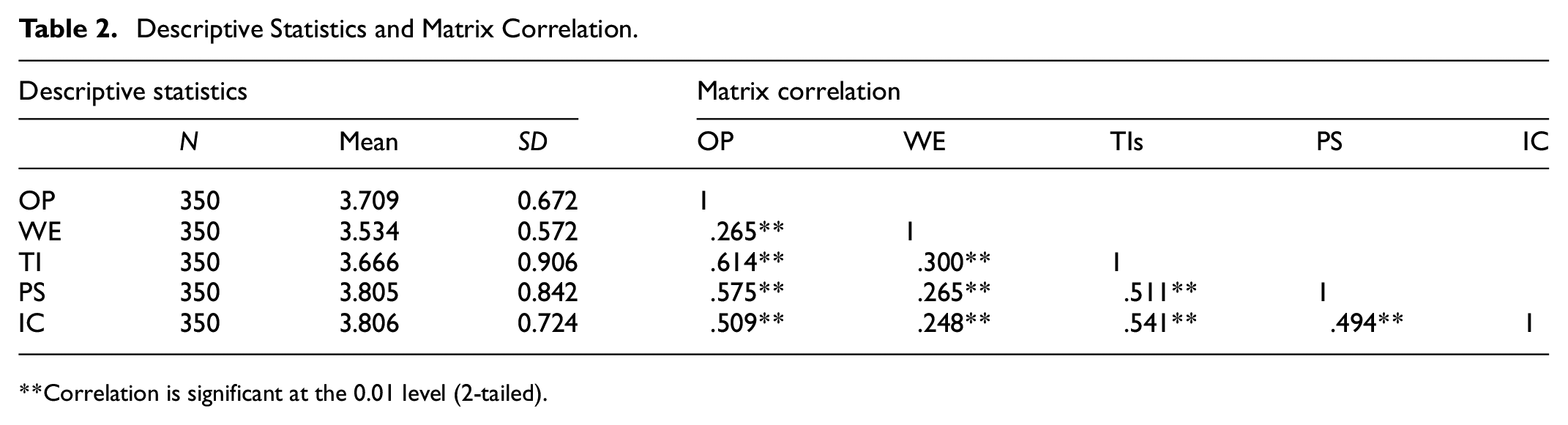
Correlation is significant at the 0.01 level (2-tailed).
The average score of 3.805 indicates that participants generally perceive a high level of PS in their workplace. This suggests that employees experience a sense of ease when it comes to expressing their thoughts, being willing to take chances, and participating in transparent communication without any apprehension of facing unfavorable outcomes. An average score of 3.806 indicates that participants generally report a high level of innovation in their jobs. Employees consider their organization to be encouraging creativity, experimentation, and the implementation of new ideas and approaches.
This study adopted the methodology of Arhinful and Radmehr (2023), Arhinful et al. (2023), Mensah and Bein (2023), and Arhinful et al. (2024) to evaluate multicollinearity in their earlier research. If the correlation coefficient between independent variables exceeded .70, they regarded multicollinearity as a problem. This investigation’s results suggest no multicollinearity issue, as the correlation coefficient between OP and IC does not exceed .70.
Assessment of Measurement Model
We employed Smart PLS 4.1.0.1, a renowned software for partial least squares structural equation modeling (PLS-SEM). This software is advantageous for dealing with non-normal data distribution and small sample sizes (Schuberth et al., 2023). The analysis was conducted in two primary stages: assessing the measurement model and investigating the structural model. The measurement methodology evaluated the reliability and validity of the indicators and their relevant constructs, essentially using confirmatory factor analysis (CFA; Hair et al., 2016; Obeng, Tessema, et al., 2024).
We utilized composite reliability (CR) and Cronbach alpha to assess reliability, with scores over .6 deemed satisfactory (Mohd Dzin & Lay, 2021). The results presented in Table 3 demonstrate high reliability for all constructs, as seen by the CR and Cronbach alpha values over .60 for each construct. This indicates a reasonable level of internal consistency inside the measurement model.
Internal Consistency and Validity.

Note. ABS = absorption; Com = communication; DED = dedication; DES = decision climate; REL = relationship; REP = reputation; RES = resources; VI = virgo.
We evaluated convergent validity using both the AVE and outer loadings. The outer loading, indicator reliability, measures how much an item contributes to its related construct. To obtain these values, we used the PLS technique, defaulting to 300 iterations and factor analysis as the weighting scheme. Risher and Hair (2017) state that factor loadings should ideally be more than 0.7 to indicate sufficient reliability. The item loadings in Table 3 ranged from 0.710 to 0.925, suggesting that the indication reliability is acceptable. We calculated the AVE of each of the constructs. Ab Hamid et al. (2017) and Obeng, Arhinful, Mensah, & Osei (2024) state that AVE values greater than 0.50 are deemed optimal. The results of both the outer loadings and the AVE indicate the presence of convergent validity of the constructs (Figure 1).

Measurement model.
Discriminant validity demonstrates the extent to which the indicators within distinct constructs exhibit correlations with one another. The study’s results for discriminant validity, assessed using HMT ratio. Following Legate et al. (2023) and Ab Hamid et al. (2017) recommendation, an HTMT value less than 0.9 is considered a good indicator of discriminant validity. The results shown in Table 4 indicate that discriminant validity well established. After analyzing the confidence interval generated through the bootstrapping technique in PLS-SEM with 500 resamples, it was seen that the empirical 95% confidence interval did not encompass the number 1. This suggests that there is adequate discriminant validity, as per Henseler et al. (2015) and Tessema et al. (2024).
Discriminant Validity: Heterotrait-Monotrait Ratio (HTMT).

Note. N = 350; ABS = absorption; Com = communication; DED = dedication; DES = decision; IC = innovative climate; PS = psychological safety; REL = relationship; REP = reputation; RES = Resources; TI = turnover intentions; VI = virgo.
Assessment of Structural Model
The structural model assessment (see Figure 2) is the second step in making sure that the research model is accurate enough. It looks at the path coefficients (β-values), coefficient of determination (R2), effect size (f2) predictive relevance of the model (Q2), and t-statistics values (Henseler & Sarstedt, 2013; Obeng, Arhinful, Mensah, & Mensah, 2025).
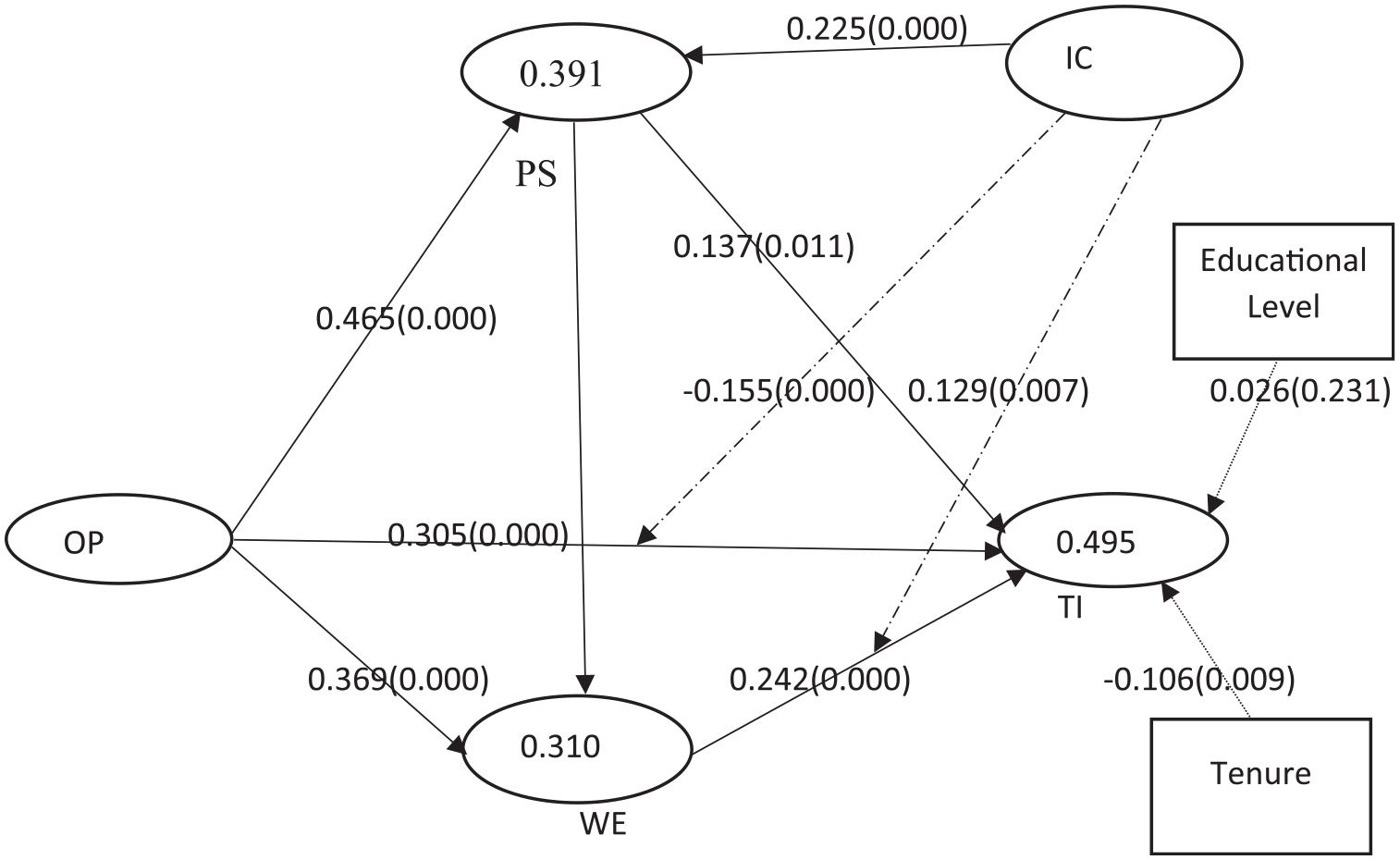
Structural model.
Coefficient of Determination (R2)
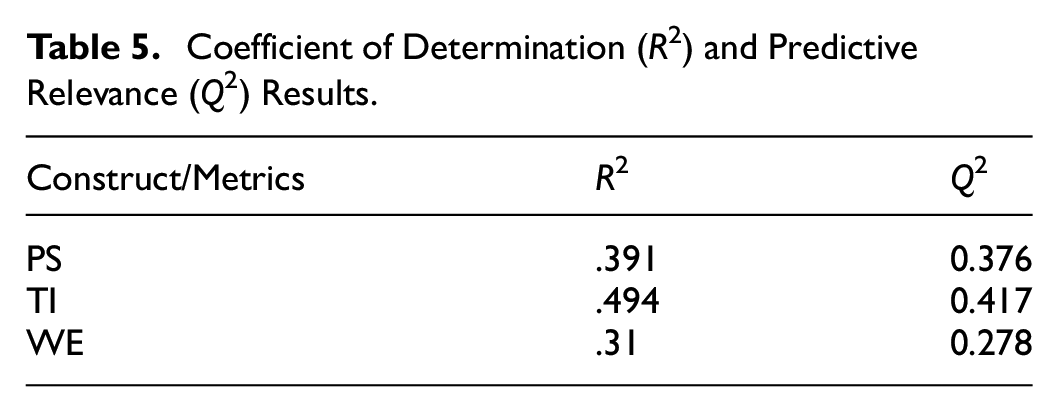
The R2 values, as presented in Table 5, serve to measure the variance explained within each of the endogenous constructs, reflecting the model’s predictive accuracy (Sarstedt et al., 2014). R2 values range from zero to one, with higher values indicating greater predictive accuracy (Chicco et al., 2021; Arhinful et al., 2025). In Table 4 and Figure 2, the R2 results for the endogenous constructs are displayed. For PS, the R is .391, signifying that OP can elucidate 39.1% of the variation in PS. Additionally, the R2 for WE stands at .310, indicating that OP accounts for 31% of the changes observed in WE. Moreover, TI exhibits an R2 of .494, suggesting that OP, PS, and WE combined can explain 49.4% of the variability found in TI.
Coefficient of Determination (R2) and Predictive Relevance (Q2) Results.
Predictive Relevance (Q2)
Apart from evaluating the R2 values for predictive accuracy, assessing Stone-Geisser’s Q2 value (Geisser, 1974; Stone, 1974) is crucial in determining predictive significance. Q2 employs a sample re-use approach, predicting the original values of data points by systematically removing them, employing an omission distance (Sarstedt et al., 2021). Predictive significance in PLS-SEM is demonstrated when the model accurately predicts indicator data points. For a particular endogenous latent variable, Q2 value above zero indicates the predictive importance of the PLS path model for that construct (Hair et al., 2021). A positive Q2 value signifies predictive relevance, while a negative value suggests the lack of predictive relevance (Chin et al., 2020). As presented in Table 5, the Q2 values for PS, TI, and WE are 0.376, 0.417, and 0.278, respectively, meeting the standards outlined by Hair et al. (2021). Consequently, the model demonstrates predictive significance.
Effect Size (f2)
The effect size (f2) presented in Table 6 demonstrates the significance of relationships between variables or the variance within groups. It offers insight into the practical implications of research findings (Nakagawa & Cuthill, 2007). A high f2 indicates substantial practical relevance, while a low value suggests limited applicability in practical settings. Practical significance refers to real-world implications of an effect, whereas statistical significance merely denotes the presence of an effect Peeters (2016). Relying solely on statistical significance can be misleading, particularly considering the sample size. Therefore, reporting effect sizes in research articles becomes imperative to illustrate practical relevance (Cohen, 2013). Cohen’s criteria classify effect sizes as small (0.2), medium (0.5), or large (0.8 or more). The f2 values for OP, PS, and WE, in this study are 0.09, 0.021, and 0.075, respectively. These values imply a small effect size for OP, PS, and WE.
f-Square (Effect Size) Values.

Hypothesis Testing
The study explored the effect of OP on TI by mediating the roles of PS and WE, also moderating the role of IC. Analyzing the standardized path coefficient (β-values) by running the PLS algorithm with the default configuration of 300 iterations using factor analysis as a weighting scheme is crucial for determining the strength of the associations between the latent variables. Figure 2 presents the outcomes of the PLS algorithm applied to the research model. We calculated the t-value using the bootstrapping process with 500 subsamples as the default configuration. According to Winship and Zhuo (2020), a relationship is considered significant if the t-value is equal to or greater than 1.96 at a 5% significance level (two-tailed significance level) and the p-value is less than .05. Table 7 provides the t-values, β-values, and p-values of the structural model. The results revealed that OP has a significant positive impact on TI (β = .305; t = 5.249; p < .001). Therefore, H1 is supported. Investigating the impact of OP on PS revealed a significant positive relationship (β = .465; t = 7.869; p < .001), thus, H2 was supported. Moreover, a significant relationship was found between PS and TI (β = .137; t = 2.295; p = .005), hence, H3 was supported. Further, examining the influence of OP on WE demonstrated a significant and positive relationship with (β = .396; t = 5.846; p < .001), hence, H4 was supported. Additionally, assessing the effect of WE on TI showed a significant and positive relationship (β = .242; t = 3.798; p < .001); therefore, H5 was supported. See Table 4 for the hypothesis results.
Direct, Indirect, Moderating Effects and Controls Results.

Mediation Analysis
After the analysis of the direct effect, the mediating analysis was conducted to ascertain whether PS and WE mediate the relationship between OP and TI. H6 projected whether PS mediates the relationship between OP and TI. This revealed a significant and positive partial mediation (β = .064; t = 2.185; p < .005), consequently, H6 was supported. H7 suggest that WE mediate the relationship between OP and TI. This demonstrated a significant positive partial mediation (β = .096; t = 3.168; p < .001), hence, H7 was supported. Table 4 depicts the mediating effect of the study.
Moderating Analysis
The results of the moderating analysis are presented in Table 4. H8 proposed that IC moderates the relationship between OP and TI such that the presence of higher level of IC could weaken the negative impact of OP on TI. This revealed a significant but negative influence with (β = −0155; t = 3.502; p < .0001). Hence, H8 was supported. H9 predicts that IC moderates the relationship between WE and TI. This showed a significant and positive moderation effect with (β = .129; t = 2.489; p < .001), hence, H9 was supported.
Control Variables
Employees’ educational levels (EL) and tenure (T) with their current hospital were controlled. The results of EL on TI show a positive but insignificant influence (β = .026; t = 0.736; p > .05). Conversely, the results of the T on TI show a significant and negative influence (β = −.106; t = 2.381; p < .001).
Goodness of Fit
Table 8 depicts the results of goodness of fit. However, some scholars (like Sahoo, 2019, and Prudon, 2015) advocate for the use of the Standardized Root Mean Square Residual (SRMR) and the Normed Fit Index (NFI) to evaluate model fit. This comparison ensures that the model is appropriately specified by contrasting the actual correlation matrix, based on observed data, with the one predicted by the model. The study’s model displays a satisfactory fit with an SRMR of 0.074, which falls below the threshold of 0.08, signifying good fit. Additionally, the NFI stands at approximately 0.8, indicating a favorable fit for the research model.
Model Fit.

Discussions
The discussion of findings is the heart of this study, providing a thorough analysis and explanation of the results gained during the data analysis procedure. This section looks into the important findings from the research, exploring how they correspond with the study objectives, contribute to the existing literature, and have implications for theory and practice. According to the findings, OP significantly and positively influence TI. The findings align with Huang et al.’s (2003), Chang et al. (2009), and Miller et al. (2008) who identifies a positive and significant relationship between perceived OP and TI. As a results, this finding was supported. However, De Clercq et al. (2023) suggested the contrary, stating that OP negatively impacts social adaptive behavior, potentially leading to increased turnover intentions. As employees become more aware of OP, it can negatively impact their JS, morale, and overall well-being and increase their likelihood of contemplating leaving their existing roles within the hospital (Chipeta et al., 2016). Essentially, if employees observe an increased occurrence of political behaviors such as favoritism, power battles, or unjust distribution of resources within the firm, they are more inclined to contemplate quitting their positions. OP can significantly impact individuals’ intentions to leave their jobs in a hospital setting (Martinussen et al., 2020).
This study highlights the significance of aggressively addressing and reducing OP to enhance employee retention and organizational success. Promoting transparency in decision-making procedures, resource allocation, and promotions helps mitigate perceptions of bias and foster trust among hospital staff (Chowdhury et al., 2023). Establishing a work environment prioritizing justice, equity, and meritocracy can reduce political conduct and increase employees’ sense of inclusion and belonging. Facilitating channels for transparent communication, constructive criticism, and meaningful discourse can empower employees to express their issues and complaints, thereby cultivating a work atmosphere that is more cooperative and nurturing (Singha, 2024). Nurturing ethical leaders who embody ethical leadership principles and serve as role models helps to establish a favorable organizational culture and reduce the occurrence of political behaviors. OP can harm employee morale and retention (Iqbal Khan et al., 2020). However, public hospitals in Ghana can counteract this by implementing initiatives and programs that encourage employee well-being. Examples include stress management workshops, mentorship programs, and employee assistance programs.
Further, this study revealed a significant and positive influence of OP on PS confirming the findings of Asamani et al. (2020) and Miller et al. (2008) hence H2 saw supported. On the contrarily Detert and Burris (2007) reported a significant but negative association between perceptions of OP and PS. The strong and favorable correlation between OP and PS indicates that when perceptions of OP rise, employees’ feelings of PS in the workplace also increase. At first glance, this discovery may appear paradoxical since one would anticipate that OP would diminish trust and impair PS.
Nevertheless, in settings where workplace politics is widespread, individuals may grow accustomed to political behaviors and develop strategies to negotiate these dynamics. The process of normalizing political activities in the workplace may unintentionally enhance employees’ sense of PS as they acquire the skills to adjust and handle their reactions to difficulties in the work environment (Edmondson & Besieux, 2021). Employees may see OP as a way to protect their status or progress their careers, contributing to a sense of PS. Despite the existence of OP, people may still feel comfortable expressing themselves in specific contexts or among trustworthy coworkers. This selective revelation of information may increase psychological stability within individual personal connections or group interactions, even in the face of larger organizational issues.
Additionally, in congruence with Obrenovic et al.’s (2020) findings, this study showed a significant and positive influence of PS and TI supporting H3. However, Frazier et al. (2017) proposed a negative link between PS and TI across industries, contrasting these results. TI tends to increase in tandem with views of PS, according to the strong and positive link between the two variables. Employees who feel psychologically comfortable in their work environment are more likely to experience JS and engagement (Dewi et al., 2021). Nevertheless, if other facets of their employment experience, such as the amount of labor, remuneration, or chances for career growth, are unsatisfactory, individuals may still contemplate resigning from their positions despite experiencing PS. Psychologically secure employees may have greater confidence in discovering other career prospects (Grailey et al., 2021). Hence, individuals could be more inclined to consider quitting their current jobs if they believe they can readily secure another career offering comparable levels of PS.
Furthermore, the findings of this study demonstrated a significant and positive relationship between OP and WE. B. Gupta (2011) reported similar results supporting H4. This contrasts with Cropanzano et al.’s (2017) assertion that politically sensitive work environments lead to stress, reduced JS, and lower WE. The correlation between OP and WE indicates that as employees’ perceptions of OP rise, their degree of WE also increases. This finding may initially seem absurd, as one would expect OP to erode employee enthusiasm and dedication to their jobs. However, individuals who engage in OP may view their positions and contributions as more crucial and noticeable inside the firm (Hochwarter et al., 2020). The enhanced sense of significance and prominence can result in higher levels of WE as people endeavor to excel in their positions and create a favorable influence, despite political dynamics. Employees who encounter OP may perceive their work as fundamentally demanding and ever-changing, necessitating them to adjust, innovate, and persist in facing difficulties. The drive to overcome obstacles and achieve success despite internal power dynamics can enhance employees’ levels of WE as they direct their energy and efforts toward attaining their objectives (Tariq et al., 2021).
Moreover, this study identified a significant and positive influence of WE on TI supporting H5. This finding contrasts M. Gupta and Shaheen’s (2017) and De Simone et al.’s (2018) findings on the negative correlation between WE and TI. The significant and positive impact of WE on TI indicates that as WE levels rise, TI tends to decline. In other words, employees who demonstrate greater commitment to their jobs are less likely to express plans to leave the hospital where they work. Engaged employees generally have greater JS and dedication to their roles and the organization (Riyanto et al., 2021). They get a sense of satisfaction and meaning from their work, which decreases their desire to find employment elsewhere. Engaged employees establish a psychological bond with their work and the organization, making quitting more intimidating (M. Kim & Beehr, 2023). Individuals may experience a strong sense of identification and pride linked to their jobs, making it difficult to see themselves working in a new environment.
Again, this study revealed a partial mediation role of PS and WE in the relationship between OP and turnover intentions confirming H6 and H7. This aligns with J. Li et al.’s (2014) findings on PS mediating the link between OP and employee voice behavior. Karatepe’s (2013) also reported that WE mediated the impact of perceptions of OP on various organizational aspects. The associations between OP and TI are not straightforward and are impacted by the existence of PS and WE. In simple terms, while OP can usually cause higher TI, PS and strong WE can partially mitigate this impact. In work environments characterized by PS and high employee engagement, individuals are less inclined to contemplate leaving the organization, even in the presence of OP (Clark, 2020). This may be due to the fact that individuals feel a sense of support, appreciation, and satisfaction in their positions, which surpasses the adverse effects of political dynamics.
The moderation effect of IC on the influence of OP and TI was confirmed in this study, supporting H8. This corresponds with Campbell et al.’s (2014) findings on factors like public service motivation, procedural justice, and IC influencing the impact of efficiency emphasis on TI. The results of this study indicate that the connection between OP and TI depends on the existence of an IC within the public hospitals in Ghana. Simply put, the extent of an IC either magnifies or reduces the effect of OP on TI. In hospitals characterized by a robust, IC, employees may have a sense of empowerment in their ability to manage and mitigate the adverse consequences of OP (Sun et al., 2022). By having access to other avenues for expressing oneself, offering ideas, and influencing decision-making processes, individuals are able to lessen the impact of political behaviors on their intentions to leave their current job. A progressive climate defined by receptiveness to change and adaptability may promote resilience among employees in response to OP (Prayag et al., 2024). They may perceive political issues as chances for innovation and problem-solving rather than as obstacles to their involvement or continuation within the business.
Additionally, the moderation effect of IC on relationship between WE and TI was confirmed in this study. This aligns with Aarons and Sommerfeld’s (2012) findings on IC associated with positive attitudes toward Evidence-Based Practice supporting H9. The confirmation of the moderation effect indicates that the connection between WE and TI is dependent on the existence of an IC. In workplaces with a strong IC, highly engaged employees are less likely to consider leaving their roles. They perceive their work as meaningful and satisfying, aligned with their values and objectives. Opportunities for innovation reinforce their commitment and resilience, making them proactive in problem-solving and less likely to entertain turnover intentions, even in challenging circumstances. This alignment with the organization’s objectives strengthens their dedication and reduces their desire to leave.
Conclusion
This study has offered valuable insights into the intricate relationship between organizational dynamics, employee attitudes, and TI in Ghanaian public hospitals. It has also made significant discoveries by analyzing the connections among OP, PS, WE, innovative climate, and TI.
Our study discovered a clear and favorable correlation between OP and TI, highlighting the negative effect of political behaviors on staff retention in a hospital environment. Although OP can have negative effects, our study found a clear and positive correlation between OP and PS. This emphasizes the complex ways in which employees react to and traverse political dynamics in their workplace.
Moreover, the research revealed a substantial and favorable impact of WE on TI, highlighting the significance of promoting employee engagement to decrease turnover and improve organizational stability. Furthermore, verifying the moderating impacts of the IC on the connections between OP and TI and the relationship between WE and TI underscores the crucial role of the organizational environment in shaping employee attitudes and behaviors.
These findings are significant for health service administrators, managers, policymakers, and HR experts who aim to enhance staff retention and organizational success in Ghanaian public hospitals. Hospitals may decrease TI, promote employee well-being, and ultimately improve patient care results by addressing the underlying causes of OP, building a supportive and inclusive work environment, and developing a culture of innovation and employee engagement.
Theoretical Implications
The study’s theoretical implications, based on the TPB and SET, provide valuable insights into employee TI in the context of organizational behavior, and management theory.
The study’s findings confirm the effectiveness of TPB in explaining staff TI in the specific setting of public hospitals in Ghana. The study examines the impact of OP, PS, and WE on TI. It confirms that attitudes, subjective norms, and perceived behavioral control are crucial in determining employees’ intentions to quit their positions. The recognition of OP as a substantial indicator of turnover intentions is consistent with the TPB’s focus on the perception of control over one’s actions. Employees’ perceptions of the firm’s general environment and ability to deal with political situations significantly impact their intentions to stay in their jobs. Furthermore, the study’s investigation of the mediating effects of PS and WE on the association between OP and TI enhances our comprehension of the cognitive mechanisms that influence employee decision-making. The study expands the applicability of the TPB to the healthcare sector by explaining how organizational characteristics impact employee attitudes and behaviors. It emphasizes the significance of including context-specific variables in models that predict behavior.
The empirical evidence supports the key principles of the SET, which addresses the interchange of resources and social interactions inside organizations. It confirms that the IC moderates the links between OP, WE, and TI. The study highlights the importance of the organizational setting in affecting how employees perceive fairness, reciprocity, and trust. These perceptions, in turn, affect their attitudes and behaviors toward the business. Furthermore, the recognition of WE as a notable predictor of TI is consistent with SET’s focus on the interpersonal interactions between people and their organizations. Engaged employees often establish a psychological contract with their firm, rewarding their hard work and contributions with support, acknowledgment, and opportunities for personal growth. Nevertheless, if the perceived exchange is interrupted due to factors such as OP or the absence of an environment that fosters innovation, employees may re-evaluate their dedication to the business, resulting in a desire to resign. Moreover, the study’s emphasis on the interplay between organizational characteristics and TI highlights the complex nature of social exchange relationships in the workplace. The study enhances our comprehension of how organizational environments influence the dynamics of social interchange and impact employee turnover decisions by examining the relationship between OP, WE, and IC.
Managerial Implications
The results of this study have significant practical implications for hospital administrators, policymakers, and HR specialists who aim to enhance the retention and performance of public hospital staff in Ghana. Managers should endeavor to establish a work climate that is open and inclusive, with minimal OP. Establishing transparent and equitable decision-making procedures, fostering open lines of communication, and cultivating a culture of trust and collaboration can accomplish this. Managers might implement regular town hall meetings or feedback sessions to enable employees to express their issues and contribute ideas regarding managerial decisions. By actively seeking and dealing with employee input, managers can reduce the negative impact of OP and strengthen a sense of ownership and dedication among personnel.
Managers should give priority to efforts that focus on improving PS in the workplace. This may entail offering training and assistance to managers in identifying and resolving PS concerns, fostering a culture of respect and inclusivity, and providing options for employees to access treatment and support as necessary. Managers can establish peer support programs or employee assistance programs (EAPs) to offer confidential counseling and support services to employees facing stress or psychological difficulties. By aggressively addressing their psychological well-being, managers can reduce employees’ desire to leave and improve overall employee contentment and productivity.
Managers should strive to cultivate a work environment that encourages employee engagement and enhances JS. Managers can accomplish this by acknowledging and incentivizing employee contributions, providing opportunities for skill enhancement and professional growth, and fostering a harmonious balance between work and personal life. Managers can provide flexible work arrangements, such as telecommuting or flexible scheduling, to satisfy employees’ particular demands, and preferences. Managers may improve WE and decrease TI by allowing employees to manage their work and personal lives properly. Managers ought to establish a culture that fosters innovation and ongoing enhancement within the firm. This could involve establishing a culture that encourages individuals to share their ideas and suggestions for process improvement, providing resources and support for innovative projects, and recognizing and celebrating significant creative achievements.
Managers can promote creativity by establishing interdisciplinary committees to address company difficulties collectively. This promotes a culture of innovation, enhancing staff motivation, involvement, and retention while driving enhancements in patient care and organizational efficiency. Allocating resources toward training and development activities gives employees the necessary expertise to excel and contribute to company objectives. This may encompass prospects for professional advancement, cross-departmental instruction, and initiatives for cultivating future leaders and guaranteeing smooth transitions. Managers can enhance work satisfaction, retention rates, and organizational success by prioritizing staff growth and development.
Social Implications
An in-depth understanding of organizational dynamics and the creation of a positive work environment have the potential to substantially elevate healthcare services. Exceptional patient care and superior outcomes are often intertwined with reduced turnover intentions among skilled and dedicated staff. Lower turnover rates not only benefit the economy by cutting recruitment and training costs but also enhance the efficiency of healthcare resource allocation, contributing to overall economic stability.
A professional environment that prioritizes psychological safety and engagement not only fosters the well-being of employees but also serves the community at large. Improved well-being and commitment among healthcare personnel can significantly impact community health outcomes and public perceptions of healthcare institutions. By enhancing work environments in public hospitals, faith in these institutions receives a substantial boost. Elevated worker satisfaction and reduced turnover rates play a pivotal role in enhancing public trust in the quality of healthcare services.
A supportive work atmosphere doesn’t just allow individuals to refine their professional skills but also ensures their longevity in their roles. This phenomenon is advantageous for hospitals as it nurtures healthcare practitioners’ professional growth, potentially attracting and retaining top talent in the field. By addressing the social implications highlighted in the study, public healthcare facilities in Ghana can markedly enhance the quality of life for both their staff and patients.
Limitations and Recommendation for Future Research
A constraint of the study was the failure to get specific questionnaires, and the rejection of others considered invalid, leading to a decrease in the sample size from the intended 360 to 350. Moreover, the study’s scope did not encompass private hospitals in Ghana, restricting understanding how OP in the private sector influences turnover intentions. Subsequent investigations could duplicate the findings within private hospitals to investigate this feature further. Additionally, future research is recommended to compare private and public hospitals in Ghana to ascertain whether the sector has a greater impact on TI within the country.
Footnotes
Appendix

| Construct | Dimension/Measure | Source |
|---|---|---|
| Organizational politics | Relationships | Landells and Albrecht (2019) |
| People ingratiate themselves to other people to achieve the outcomes they desire. | ||
| People improperly use their relationships to bypass organizational processes. | ||
| People cultivate relationships in order to get personal benefits. | ||
| Communication | ||
| Gossip drives the way that people interpret what goes on in this organization. | ||
| Gossip is the primary way in which information is shared. | ||
| Rumors are central to people’s understanding of what is happening in this organization. | ||
| Reputation | ||
| Individuals stab each other in the back to make themselves look good. | ||
| People try to make themselves look good by making others look incompetent. | ||
| People undermine others’ credibility behind their backs. | ||
| Decisions | ||
| People use their position to influence decisions to benefit themselves | ||
| People abuse their authority by making decisions that benefit themselves. | ||
| People pretend to consult and invite input even though decisions have already been made | ||
| Resources | ||
| People build up resources to increase their personal power, not to benefit the organization. | ||
| Too often, people unfairly obtain resources that could be better used elsewhere. | ||
| Resources are unfairly allocated based on individual influence rather than organizational priorities | ||
| Turnover intentions | I have searched for another job | Malek et al. (2018) |
| I plan on quitting this job within the next year | ||
| It would not take much to make me leave this hotel | ||
| I will probably look for a new job in the next year | ||
| Psychological safety | I am able to bring up problems and tough issues. | Edmondson (1999) |
| People in this organization do not reject others for being different. | ||
| It is safe to take a risk in this organization. | ||
| It is easy for me to ask other members of the organization for help. | ||
| No one in this organization would deliberately act in a way that undermines my efforts. | ||
| Work engagement | Absorption | Schaufeli and Bakke (2004) |
| I feel happy when I am working intensely | ||
| I am immersed in my work | ||
| It is difficult to detach myself from my job | ||
| Dedication | ||
| I am enthusiastic about my job | ||
| My job inspires me | ||
| To me, my job is challenging | ||
| Vigour | ||
| At my work, I feel bursting with energy | ||
| At my job, I am very resilient, mentally | ||
| At my work I always persevere, even when things do not go well | ||
| Innovative climate | Innovation is one of the most important values in this hospital | Bibi et al. (2020) |
| This hospital encourages team collaboration | ||
| This hospital provides support for innovation | ||
| This hospital clearly shares the firm’s vision with its employees | ||
| Employees are provided with autonomy and trusted | ||
| Information is shared in this hospital | ||
| Innovative ideas are rewarded | ||
| Resources are provided to the employees |

Ethical Considerations
Ethical clearance was obtained from my university.
Funding
The author(s) received no financial support for the research, authorship, and/or publication of this article.
Declaration of Conflicting Interests
The author(s) declared no potential conflicts of interest with respect to the research, authorship, and/or publication of this article.
Data Availability Statement
The data would be made available from the corresponding upon reasonable request.