




Abstract
Drawing on a perspective grounded in social information processing theory, this paper investigates the mechanism through which organizational innovative climate affects individual improvisational behavior. We developed a theoretical model for analyzing our hypotheses and conducted an empirical study by analyzing data from 356 employees who work for service enterprises. Our paper finds that organizational innovative climate impacts employees’ improvisational behavior by triggering their psychological safety perception. It is also found that employee’s creative self-efficacy plays a positive moderating role in the relationship between organizational innovative climate and employees’ improvisational behavior. The results of our study assert that improvisation is not just an inherently individual phenomenon. Rather, it is also affected by the characteristics of the organizations in which employees are embedded. We discuss the implications of these findings for understanding and promoting employees’ improvisational behaviors in the workplace.
Keywords
Introduction
In the current stage of development, China has to deal simultaneously with the slowdown in economic growth, making difficult structural adjustments, and absorbing the effects of previous economic stimulus policies. Despite of the economic environment, emerging information technologies have also rapidly infiltrating industries and transforming or even reshaping business models (Chang et al., 2022). The environment facing Chinese companies is increasingly volatile, complex, and unpredictable. If companies fail to withstand risks and cope with complicated situations timely, they will often be “passively beaten” or even subverted (Sun et al., 2019). Researches have shown that improvisation is an important capacity for companies to cope with rapid changes and obtain unexpected opportunities in the complex and volatile environment (Hu et al., 2018; Jackson & Philip, 2010).
But, enterprise’s improvisation boils down to employees’ improvisational behavior (Sun et al., 2019) to deal with environmental uncertainty and emergent issues. Existing literature have confirmed the positive outcome of improvisational behaviors, such as individual or organizational innovation performance (Ruan et al., 2015), team decision-making performance, entrepreneurial orientation (Li & Jiao, 2014), competitive advantage (Wang et al., 2017; Yu et al., 2018), and corporate performance (Wang et al., 2016). Although the importance of individual’s improvisational behavior has been clarified, how to effectively foster such behavior has always puzzled the company managers and scholars. Researches have shown that the antecedents of improvisational behavior at individual level mainly include personal traits, and individual’s human and social capital (Ma et al., 2021). What’s more, employees’ improvisational behavior is also affected by organizational leadership (Wang & Zhang, 2020). However, little work has been done to evaluate factors, especially the organizational environment factors, that influence employees’ improvisational behavior (Ma et al., 2021; Ruan et al., 2015).
According to the social information processing theory, employees’ psychology and behaviors are not only driven by individual needs or goals, but also by the surrounding environmental cues, which contains certain social information that may affect or regulate individuals’ psychology and behavior. Individuals can evaluate information as being more or less related to a specific attitude. For employees, one source of information is the person’s immediate organizational environment, which provides cues for employees to construct and interpret events. Mumford and Gustafson (1988) found that individual’s innovation is the result of complex interactions between individuals and the environment or context. As a form of deliberate extemporaneous composition and execution of novel action (Moorman & Miner, 1998), employees’ improvisational behavior must be inseparable from the organizational environment or climate. In line with social information processing, we suggest that organizational innovative climate may exert positive effect on employees’ improvisational behavior.
Furthermore, organizational environment also provides information about what an individual’s attitudes and opinions should be (Salancik & Pfeffer, 1978). For employees, organizational innovative climate as social context also provides indirect effect by which individuals use to construct psychological statement and outcome behavior. Zou and Yin (2017) found that organizational innovative climate releases less interpersonal risk signals to the members and encourage risk-taking behavior. Through the interpretation of safety climate signal, on one hand, members of the organization will internalize as their own psychological safety perception, and examine the organizational environment with a more positive attitude, thus forming an optimistic attitude and a sense of hope. On the other hand, they will be more open-minded in sharing knowledge and even propose new solutions to problems (Guo & Zhao, 2017). Hence, organization members can handle and grasp more information and quickly understand the external environment changes to avoid more uncertainty (Zou et al., 2018). All of the above will undoubtedly enhance members’ ability to be more ready-witted, and improve their self-confidence and effectiveness in dealing with problems in the work and get out of the predicament (Bergheim et al., 2015). Based on this logic, we anticipate that employees’ perception of psychological safety is a critical mediating variable between organizational innovative climate and improvisational behavior. That is, employees who are surrounded by organizational innovative climate are likely to translate the perception of psychological safety into improvisational behavior.
In addition, we suspect that employees’ creative self-efficacy also moderates the relationship between organizational innovative climate and psychological safety. Several authors have pointed out that improvisation can be an inherently stressful activity to undertake within organizations. And we would expect the psychological strain of improvisational behavior to be even greater for employees, since failure for them is likely to have exceptionally profound consequences—affecting reputation within the organization or their performance. However, even in the same organizational innovative climate, different employees with different personal traits would display different level of improvisational behavior. Under the situations that are full of uncertainty and risk, we expect that a key personal trait is individual’s creative self-efficacy, which refers to “the belief one has the ability to produce creative outcomes” (Tierney & Farmer, 2002). Research has found that individual self-efficacy is a key factor in connecting external environment to individual behavior (He, Zhou, et al., 2020). Employees need enough courage and determination to generate positive and creative outcomes, because improvisational behavior is a process full of unexpected risks, conflicts, uncertainties, and even failures. Therefore, our expectation is for employees who have higher level of creative self-efficacy, organizational innovative climate will be more likely to have positive effect on their improvisational behavior.
Our study aims to make some theoretical contribution to the literature by offering a conceptual model that links organizational innovative climate, psychological safety, employees’ improvisational behavior, and creative self-efficacy. First, OB researchers have been focusing on the positive outcomes of improvisational behavior or ability. However, the antecedent factors of this behavior have not been fully discussed in the existing literature so far. In order to enhance our understanding of how to foster employees’ improvisational behavior, the present study tries to examines its antecedent factors from the perspective of organizational climate. Second, prior studies mainly explore the positive impacts of improvisational behavior in newly start-up enterprises, but ignoring the existing companies. Actually, mature companies, especially those in the service sector, also requires employees to behavior spontaneously and creatively, because they usually encounter unexpected situations. There is still a significant lack of related empirical studies with the employees working for service companies. Furthermore, how organizational innovative climate influence employees’ psychological perception and facilitate their improvisation is still unexplored. Our study provides a theoretical framework that helps to better understand the mechanism of organizational innovative climate’s effect on employees’ improvisational behavior. Third, this study explores the moderating role of creative self-efficacy on the relationship between organizational innovative climate and employees’ improvisational behavior, which sheds new light on the theoretical knowledge of how creative self-efficacy foster the mechanism.
In summary, based on the theory of social information processing, this paper contributes to the literature about improvisation by exploring the mechanism of organizational innovative climate affecting on employees’ improvisational behavior and bring some enlightenment to enterprise management practice.
Theoretical Foundation and Hypotheses Development
Improvisation Behavior
Studies on improvisation behavior first appeared in the field of art, such as music, drama, and especially jazz (Huang & Peng, 2012). Improvisational behavior in arts means that performers do not play according to the script but activate improvisational acts during the performance based on the scenes. In the 1990s, scholars introduced the term “improvisational behavior” into organizational behavior studies. Early researches focused on the role of organizational conventions in creating stability from a behavioral perspective (Nelson & Winter, 1982). Subsequent researches were increasingly aware of the importance of flexibility so that organization actors can cope with uncertain situations (Turner & Rindova, 2012). Organizational management scholars’ interest in improvisational behavior is based on the fact that traditional top-down approaches to dealing with complex situations according to pre-planned processes are not conducive to cultivating employees’ ability to handle uncertainty (Su et al., 2015). Improvisational behavior is characterized by “innovation” and “spontaneity.” It is individuals’ innovative and useful solutions enable them to constantly adjust and quickly cope with complex situations. Therefore, how to improve employees’ improvisation ability has become an important goal of human resource management. Aiming at achieving the goal, managers must understand the underlying factors as well as the mechanism behind the motivation of employees’ improvisational behaviors.
Organizational Innovative Climate and Employees’ Improvisational Behavior
Employees’ attitude and behavior depends to a large extent on whether the climate of their organization is inclusive and stimulating. As a form of organizational climate, organizational innovation is shaped by its policies, processes, and rewards, and is the degree of organizational support for innovation perceived by employees. Amabile et al. (1996) found that employees’ perception of the work environment will affect their their intrinsic motivations, leading to differences in individual behavior. Organizational shared perception of innovation support formed by the members is behavior-oriented. If employees perceive that organization provides the resources and help they need for innovation, they tend to generate innovative behaviors (Yan & Zhang, 2017). Improvisational behavior is defined as the process of departure from organizational regulation and integrating creative decisions in a short period of time to deal with emergencies. Therefore, improvisation is a combination of “spontaneity” and “innovation” (Vera & Crossan, 2005). Traditional view holds that individuals’ action has a temporal sequence between composition and implementation, while improvisation has a high degree of temporal aggregation in the process of creation and execution (Moorman & Miner, 1998). So individuals have to react immediately and reconstitute existing resources to form an action (Cunha et al., 1999). As an innovative process, improvisational behavior means trying to develop new things related to the resources or situation at hand. Therefore, improvisation is an unconventional behavior that emphasizes the value of innovation and deviates from organizational practices. Improvisation exists in everyday work, which may be an improvement of practice or a new means/way of performing tasks or management (Diasio, 2016).
Earlier studies have found that individual improvisation means deliberate choice to deviate from or give up established organizational practices to deal with urgent problems (Magni et al., 2018). However, improvisational behavior is essentially an indeterminate “trial and error” action, which means a certain degree of risk to the individual. Therefore, individual improvisation may lead to positive or negative consequences (Vera & Crossan, 2005). Whether to perform this action depends on individual’s attitude or psychology to risk. According to the social information processing theory, individual behavior is influenced by the specific organizational context or environment in which he or she is embedded. If the organization creates a climate that supports and encourages innovation, and becomes a common belief or norm shared by the members, they will be bold enough to try to improvise and adapt to the situation rather than stick to the rules and regulations. Members in organizations with a high level of innovation tend to discuss and challenge the status quo in a constructive way, with the aim of exploring new ideas and solutions that are best suited for a particular activity. Zheng et al. (2009) proposed that individuals’ psychological perception and experience of organizational innovative climate helps them to cultivate, develop, and apply their innovative ability. Creativity stems from the individual’s sensitivity to the environment. The less the restraining factors in the environment, the more it helps the individual to break the cognitive inertia and form a new cognitive paradigm (Wang & Chang, 2017). Based on the “innovative” connotation of impromptu behavior, we believe that creating an organizational innovative climate that encourages breakthroughs in conventional approaches to finding new solutions to problems can help to improve members’ innovative thinking and promote improvisational behavior. In line with that, we hypothesize that
H1: Organizational innovative climate is positively associated with employees’ improvisational behavior.
Mediating Role of Psychological Safety
Kahn (1990) proposed that individual psychological safety is a subjective state that individuals do not have to worry about their negative influence on their image, status, and career development when presenting themselves. When individuals perform a task or conduct an action, they may measure whether it will adversely affect their own development or reputation. Such concern often puts some pressure on the individual and reduces their willingness to try improvisational behavior. And the estimate of risk happens to cater to the risky needs of impromptu behavior. Therefore, when making behavior decisions, employees of the company will make timely judgments based on their workplace climate or work experience. Therefore, the overall environment of the organization determines the emergence or suppression of employees’ innovation or impromptu behavior.
According to the theory of social information processing, when the organization transmits a signal to support the employee’s innovative ideas or creative execution, they will recognize and interpret the signal and respond accordingly. If the signal transmitted by the organization matches the individual’s values or beliefs, employees’ psychological safety will also be increased. They do not have to worry about their reputation or career development (Yuan et al., 2022) and will be dare to be more adept at improvising. Su et al. (2015) found that organizational innovative climate has a positive impact on employees’ psychological safety, thus promoting their innovative behavior. On the one hand, employees’ perception of a higher level of psychological safety from the organization will help to reduce their concerns about the risk of improvisation. They can speak freely in the work environment that is trustworthy and take proactive actions in social interactions and workplace. Psychological safety can effectively increase employees’ involvement in innovation work. On the other hand, because members perceive a higher level of psychological security, they are more willing to share the invisible knowledge required for improvisational behavior (He, Sun, et al., 2020). Studies have shown that in order to maintain their competitive advantage, many employees are often reluctant to share their unique and valuable knowledge and abilities. However, it may seriously hamper the dissemination of work experience or innovative knowledge and skills, thereby inhibiting employees’ ability to cope with unexpected situations. If employees work in an environment with a strong psychological security climate, they will form a working relationship with mutual trust, mutual support, mutual sharing, and mutual improvement, which will help employees identify and respond to new situations and challenges. In other words, employees with higher psychological safety can feel more vitality at work. It can make employees more willing to trust their leaders and colleagues, measure and judge the potential gains and losses, ultimately decide to take risks, and are more likely to make impromptu behavior in the face of difficulties and emergencies. Based on the above analysis, we propose the following hypothesis:
H2: Psychological safety plays a mediating role between organizational innovative climate and employee’s improvisational behavior.
Moderating Role of Creative Self-Efficacy
Self-efficacy is a kind of psychological belief when people try to achieve a certain goal (Hu & Shen, 2020). It will affect people’s emotional thinking mode, choice and behavior. As an important psychological cognition, self-efficacy is employee’s beliefs in overcoming difficulties. It is an important driving force for behavior display. It will mobilize employees’ emotions and motivations and affect their efforts and active behavior. Individuals with high self-efficacy have stronger motivations to choose difficult tasks, and they will set higher demand goals for themselves and stick to them. Studies have shown that self-efficacy is regarded as a positive cognitive factor, which is a driving force of individual self-regulation or a positive reflection of mental state (Wang & Zhang, 2018). When employees work in a company with high autonomy and harmonious atmosphere, they can better develop their own abilities and plan career development. When encountering some unfavorable factors, they can actively seek effective solutions. That is to say, self-efficacy plays a role in state regulation management. Morrison and Phelps (1999) found that self-efficacy is significantly associated with individual voluntary efforts and changes in the workplace. People with high self-efficacy tend to actively assess their ability to overcome risks associated with new actions.
As a form of self-efficacy, creative self-efficacy refers to individual’s belief in his ability to produce creative results (Tierney & Farmer, 2002). It is an important variable that affects employees’ improvisational innovation behavior and also the result of employees’ evaluation of their ability to carry out improvisation. It helps employees actively cope with the difficulties, risks, and uncertainties encountered in the innovation process, motivating them to generate and implement innovative ideas (Malik et al., 2015). Since self-efficacy plays an important role in regulating individual’s perception (Yang & Zhang, 2012), its level will influence their use of cognitive strategies and enhance/alleviate the impact of individual cognition on behavior. Our study speculates that the effect of organizational climate on psychological safety may be moderated by creative self-efficacy. Specifically, for employees with low creative self-efficacy, they are not confident enough to succeed in achieving creative results (Yang & Zhang, 2012) and are reluctant to actively seek for mutating stimuli and information that can stimulate innovation (Malik et al., 2015). Although organization may provide a high level of organizational innovative climate and psychological safety for individuals, those with low creative self-efficacy will choose the existing paradigms in the organization rather than to exert improvisation. On the contrary, for employees with high creative self-efficacy, their belief in success can effectively alleviate their uneasiness. It is easier for them to generate and implement innovative ideas rather than retain organizational habits or traditions when dealing with difficulties or emergencies. Regardless of whether psychological safety level is high or low, employees with high creativity and self-efficacy will choose to challenge the existing paradigm in the organization in the face of complex, unpredictable, and risky impromptu activities, and actively respond to difficulties. Therefore, this paper speculates that high creative self-efficacy enhances the impact of psychological safety on employee’s improvisational behavior.
H3: Creative self-efficacy plays a positive moderating role in the relationship between organizational innovative climate and employees’ improvisational behavior.
In summary, the research conceptual framework is shown in Figure 1.

Research conceptual framework.
Methods
Samples and Procedure
We conducted a questionnaire survey of employees from service companies in China to collect data. 385 employees from five different Chinese service organizations participated in the survey: two state-owned banks and two insurance companies and a large chained hotel. Before we conducted the survey, we have an informative meeting with representatives of the management and personnel departments. Most of the employees from the five organizations received paper-and-pencil questionnaires, which were accompanied by a letter that briefly introduced the goal of the survey. And the confidentiality and anonymity of the answers were also emphasized. After the employees fill out the questionnaire, they were kindly requested to return envelopes to a special box at their companies.
356 valid data were obtained from with an effective participation rate of 92.7%. The sample consisted of relatively young respondents with 86.5% being below 40 years old. More than half (59.8%) of the respondents in the sample were female. All of them were employed fulltime. In terms of education level, most of the employees (90.4%) graduated from vocational colleges or universities. Approximately 65.7% of respondents have worked for their current companies for 7 years or less and 34.3% have spent over 7 years in their current organization.
Measures
Organizational innovative climate was measured with eight items adapted from Zheng et al. (2009). Sample items included “Our company encourages employees to come up with creative ideas” and “Our company’s reward system have effectively promoted work innovation.” Higher scores indicated a stronger preference for organizational innovative climate. The Cronbach’s α was .919.
Psychological safety was measured with seven items adapted from Yang’s scale (2016). Sample items included “My colleagues will be tolerant if I made some mistakes at work” and “Our company allows certain risky behaviors at work.” Higher scores indicated a higher level psychological safety perception. The Cronbach’s α was .921.
Improvisational behavior was measured with six items adapted from Vera and Crossan’s scale (2005). Sample items included “I deal with unanticipated events on the spot” and “I take risks in terms of producing new ideas in doing my job.” Higher scores indicated a stronger improvisational ability. The Cronbach’s α was .904.
Creative self-efficacy was measured with seven items adapted from Carmeli and Schaubroeck’s scale (2007). Sample items included “When faced with difficult tasks, I am sure that I can accomplish them creatively” and “I can creatively accomplish most of the goals I set for myself.” Higher scores indicated a higher level of creative self-efficacy. The Cronbach’s α was .754.
Respondents were asked to indicate the extent to which they agree (1 = strongly disagree; 5 = strongly agree) with each item describing their perception in their workplace. We also included four control variables. Demographic characteristics like age, gender, education level, and work tenure were also included as control variables as they have been pointed out in prior research that may influence individual perceptions.
Data Analysis and Results
Reliability Test
SPSS 21.0 and AMOS 24.0 were used for data analysis. First of all, we tested the reliability and validity of all the constructs. Section “Measures” has shown that the Cronbach’s α values of all the variables were greater than .7, which indicates that all these variables have good reliability.
Discriminant Validity Test
In order to test discriminant validity of variables in the study, we compared our hypothesized model baseline four-factor model with a three-factor model, and a two-factor model (Table 1). In particular, our hypothesized four-factor model [with χ2/df = 2.124), CFI of .878, NFI of .904, TLI of .940, CFI of .947, and RMSEA of .056] showed better fit than other alternative models. Therefore, the discriminant validity of the constructs was confirmed. This suggests that the participants of our survey could distinguish the key constructs clearly.
Results of CFA and CMB Test of the Measurement Models (N = 356).
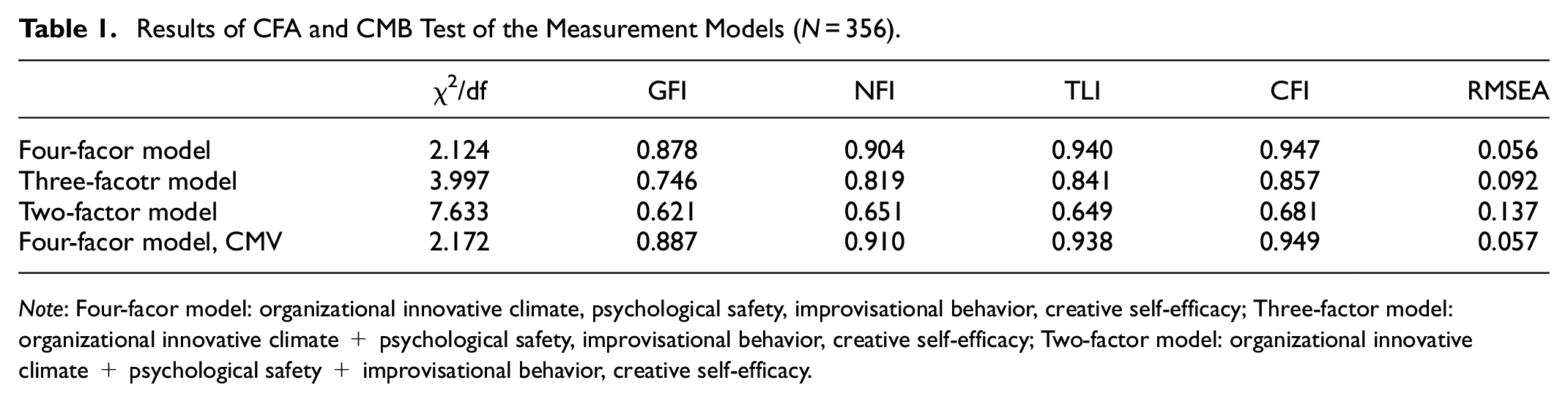
Note: Four-facor model: organizational innovative climate, psychological safety, improvisational behavior, creative self-efficacy; Three-factor model: organizational innovative climate + psychological safety, improvisational behavior, creative self-efficacy; Two-factor model: organizational innovative climate + psychological safety + improvisational behavior, creative self-efficacy.
Common Method Bias Test
Because all data were self-reported from employees themselves at a single time, it is possible that common method bias may threaten the validity of the research (Podsakoff et al., 2012). Therefore, we used two popular statistical approaches for testing CMB including Harman’s single-factor test and ULMC technique (i.e., controlling for the effects of an unmeasured latent method) (Tang & Wen, 2020; Richardson et al., 2009).
Harman’s one-factor method is commonly used to test CMB by Exploratory Factor Analysis (EFA). The EFA method assumes that there is a method factor that explains the common variation across all items of different traits in a study (Podsakoff et al., 2003). The more variance explained by the method factor, the more severe the bias. Podsakoff and Organ (1986) pointed out that if the single factor explained by EFA (unrotated) does not explain more than 50% of the variance, CMB was not serious. According to Chinese domestic application, it is generally believed that the variance explained by a single factor cannot exceed 40% (Tang & Wen, 2020). In our study, the first factor accounted for 36.588%, which shows that common method bias is not a serious for the present study.
In order to improve the accuracy of the CMB test result, we further used ULMC technique. That is, on the basis of the original baseline four factor, all their items are used as the index of the method factor, which was named CMV. The result in Table 1 shows that the fit of the model which was added CMV is not significantly improved compared with the baseline four-factor model. Therefore, we can further confirm that the CMB is not severe in our study.
Descriptive Statistics
Table 1 presents the means, standard deviations, AVE, and Pearson correlation coefficients among the study variables. In the present study, the AVE comparison method was applied to test the discriminant validity. As seen in Table 2, the root mean square of the AVE was greater than the correlation coefficients of the variables in each case. Hence, the variables have satisfactory discriminant validity. What’s more, except for creative self-efficacy which is used to test the moderating effect, the correlation coefficients between the rest variables are at a mid-correlation level, which is suitable for further model test. As shown in Table 2, organizational innovative climate was significantly correlated with psychological safety (γ = .613, p < .01) and improvisational behavior (γ = .566, p < .01), and psychological safety was significantly correlated with improvisational behavior (γ = .586, p < .01). Thus, the zero-order correlations for the study variables were all in the expected direction.
Means, Standard Deviations, AVEs, and Intercorrelations of Variables (n = 356).

Note: M, mean; SD, standard deviation.
p < .05. **p < .01 (two-tail test). Values in boldface on the diagonal are the square roots of AVE of each scale.
Hypothesis Testing
Structural model test results
In this study, Amos 24.0 software was used to perform model fit test on three variables which were included for direct and indirect effect test (i.e., organizational innovative climate, psychological safety, and improvisational behavior), and then the research hypothesis was verified one by one. Table 3 shows both the recommended values of fitting criteria and the model fitting testing results for the present study. The data show that the model fit values of this study are in line with the recommended criteria, indicating that the model and the sample data has good fitness.
Model Fit of Variables.

Note: The variables used to test the model fit include organizational innovative climate, psychological safety, and improvisational behavior.
Next, this study examines the relevance and significance of structural models. Hypothesis 1 proposed the positive effect of organizational innovative climate on employees’ improvisational behavior (i.e., the main/direct effect). Figure 2a and b show the results of the model path tests (the values in parentheses are unstandardized path coefficients). As shown in Figure 2a, organizational innovative climate has a positive relationship with on employees’ improvisational behavior (β = .62, p < .001). Thus, Hypothesis 1 was verified.

The results of model path tests. (a) The impact of organizational climate on individual improvisation and (b) The mediating effect of psychological safety.
Hypothesis 2 proposed the mediating effect of psychological safety. Figure 2b shows both the direct and indirect effect of organizational innovative climate on employees’ improvisational behavior. First, organizational innovative climate has a positive correlation with employees’ psychological safety perception (β = .665, p < .001) and psychological safety has a positive correlation with employees’ improvisational behavior (β = .405, p < .001). What’s more, because of the addition of mediating variable of psychological safety, organizational innovative climate has a positive correlation with employees’ improvisational behavior (β = .353, p < .001), indicating that psychological safety plays a partially mediating effect in the relation. These results lend support to our Hypothesis 2.
Moderating effect test
To verify the moderating effect of creative self-efficacy, hierarchical regression analysis was used by including the interaction term to verify the moderating effect of creative self-efficacy on the relationship between organizational innovative climate and employees’ improvisational behavior. Specifically, we centralized the variables of organizational innovative climate and creative self-efficacy to minimize the possibility of multicollinearity. With employees’ improvisational behavior as the dependent variable, we added the control variables, organizational innovative climate, creative self-efficacy, and the interactive term (organizational innovative climate × creative self-efficacy) to the models step by step. Table 4 shows the test results of moderating effect. In Model 3, we can see that creative self-efficacy positively moderates the relationship between organizational innovative climate and employees’ improvisational behavior (β = .302, p < .05), which supports Hypothesis 3.
Regression Summary for the Moderating Effect Test (N = 356).

Note: Interaction term = Organizational innovative climate × Creativeself-efficacy.
p < .05. ***p < .001.
General Discussion
The present research was motivated by our limited understanding of how organizational innovative climate influence employees’ improvisational behavior. Specifically, using arguments from the social information processing theory and with employees as the servery participants, this study argues that service enterprises with by highly organizational innovative climate are more likely to stimulate employees’ improvisational behavior. In addition, this paper contends that psychological safety plays a mediating role between organizational innovative climate and employees’ improvisational behavior. Furthermore, the results of the empirical analysis also provide support for the argument that the relationship between organizational innovative climate and employees’ improvisational behavior is moderated by employees’ creative self-efficacy.
Theoretical Implications
Our findings have implications for individual improvisation literature. First, by shedding light on employees’ individual improvisational behavior, our research adds to the increasing stream of research that has already moved from samples of newly start-up enterprises to investigate employees of established companies. Actually, organizations’ improvisation is largely reflected by spontaneous innovation capabilities of individual employees. Therefore, in recent years, more and more scholars have begun to explore the factors affecting individual employees’ spontaneous improvisational behavior (Magni et al., 2018). Our findings are topical, as service workers usually need to creatively and timely cope with different situations that may be complex, risky, or uncertain to avoid negative outcomes for their organizations. Thus, the present findings add to the growing body of research on employees’ improvisational behavior in the workplace.
Second, our research shows that organizational innovative climate is a predicator for employees’ improvisation. Through a systematic literature review, we found that, although certain literature explores the antecedents of employees’ improvisation from the different perspective, including personality traits (Brown et al., 2018; Hmieleski & Corbett, 2006; Hu et al., 2018), and cognitive and emotional aspects (Ding & Chen, 2017; Men et al., 2017), and different leadership styles (Wang & Su, 2019; Wang & Zhang, 2020), the existing research scarcely explores employees’ improvisation from the perspective of organizational climate. When employees perceive the organization’s innovative support for their own work, they will actively change their work attitudes and behaviors to respond to the organization. An organizational environment that advocates innovation is more likely to show work freedom and flexibility, and employees will give full play to their potential and have more room for behavioral choices, which promotes the frequent occurrence of innovative behaviors in the organization (Wang & Yu, 2019).
Third, the results broaden the scholarly understanding of the complex psychological processes through which organizational innovative climate influence individual-level improvisational behavior. To date, scholars have largely overlooked the possibility that organizational innovative climate may employees’ improvisation through the processing of workplace climate as social information. Individuals use information gathered in the organizational environment to improve self-perception and evaluation, build psychological safety, and then determine the action of their behavior. By deriving from social information processing theory, our research therefore extends the theoretical lens through which scholars can understand this phenomenon. Organizational innovative climate thus helps bring about individual improvisation by releasing a signal that supports proactive and risk-taking idea and behavior. This kind of signal will make employees feel psychologically safe. So, our study extends recent works portraying the important role of organizational climate in stimulating individual psychological perception.
Finally, the exploration of the moderating impact of employees’ creative self-efficacy helps to extend the understanding on how to foster the positive effect of organizational innovative climate on employees’ improvisation. Our findings suggest when individuals ultimately convert their underlying cognition of organizational environment to observable improvisational behavior, it is also very important to have one’s self-confidence in capacities to effectively perform creative behaviors and deal with any potential risks and uncertainty (Ogunfowora et al., 2021). This perspective aligns with previous research on the moderating effect of generalized self-efficacy, and creative self-efficacy beliefs in socio-cognitive models of individual’s behavior (Den Hartog & Belschak, 2012; Jex & Bliese, 1999). We acknowledge that creative beliefs has mostly been hypothesized and empirically shown to play a mediating (rather than moderating) role in analyzing how personal and social factors impact individual behavior (He, Zhou, et al., 2020). Rather, our findings suggest the unique value of creative self-efficacy is empirically shown in its capacity to explain under what conditions employees’ perception of organizational environment ultimately results in their improvisations.
Practical Implications
Our findings have practical implications for organizations. First, companies should strengthen the construction of organization’s internal innovation culture atmosphere, enhance resource support, leadership effectiveness and colleagues’ mutual communication. Actually, the training of employees’ improvisational behavior requires a lot of time, energy, and resources. It is an activity with high risk and high probability of failure. Companies should provide employees with a good foundation of capital, technology, equipment, as well as organizational rules and regulations for innovation. In addition, managers should build an innovative cultural atmosphere that encourages innovation and tolerates failure, provide employees with active and effective communication and feedback channels, help solve difficulties encountered by employees in unexpected situations, and promptly reward and commend employees for positive results of improvisational behavior.
Second, organizations should not only have a tolerant attitude towards employees improvisation failures. For employees, organizations’ fault-tolerant climate can relieve employees’ work anxiety and pressure, and enhance employees’ psychological safety. It helps employees to maintain a stable and positive psychological state. Only employees with a positive psychological state are more willing to put forward practical and creative opinions and ideas to deal with problems. If the employees show negative psychological symptoms, the organizations need immediate psychological counseling to get rid of it as much as possible. Of course, organizations should also pay attention to the summary of experience and lessons to create conditions for subsequent innovation success. Service companies also needs to pay special attention to employees’ psychological safety, because it plays a mediator role in the relationships between organizational innovative climate and employees’ improvisational behavior. If the employees show negative psychological symptoms, the organizations need immediate psychological counseling to get rid of it as much as possible to stabilize the emotional state of employees. Organizational leaders need to adopt some fault-tolerant behaviors in daily management.
Third, organizational strategies must also account for individual differences in employees’ creative self-confidence as this positively moderates the impact of organizational innovative climate on employees’ improvisation. If employees has a high level of creative self-efficacy, they will be more confident in improvisation and are more likely to perceive psychological safe and a sense of accomplishment in a work environment that supports innovation and risk-taking behavior. Thus, training and development exercises should be implemented to teach organizational leaders how to boost creative self-efficacy in their employees. It is particularly important to emphasize that managers should give clear, positive, and constructive feedback for employees with low creative self-efficacy, refuting their preexisting doubts about their ability to improvise. In addition, managers should also encourage organization members to share knowledge, experience, and skills, so that they can obtain more efficacy information. Organization leaders should provide opportunities to develop improvisation at work (e.g., setting some challenging simulations and practices), exposing employees more successful cases about leaders and reputable peers who routinely enact improvisation, and offering frequent feedback and encouragement, and helping employees to better manage stressors and negative emotional states that weaken creative efficacy beliefs (Ogunfowora et al., 2021).
Limitations and Future Research Directions
Our study has limitations that should be addressed in future research. First, we did not consider other potential theoretical explanations of how to boost employees’ improvisational behavior. We suggest follow-up studies consider other antecedents, mediating and moderating variables. Second, our survey was conducted only in service companies, which is suitable for research on improvisation. We suggest that future research to test out findings in other industries and to corroborate the generalization of our results. Finally, while there has been a growing body of researches on the positive outcomes of improvisation, it should be noted that efforts should be made to further testing the dark side of the employees’ improvisational behavior.
Footnotes
Declaration of Conflicting Interests
The author(s) declared no potential conflicts of interest with respect to the research, authorship, and/or publication of this article.
Funding
The author(s) disclosed receipt of the following financial support for the research, authorship, and/or publication of this article: This research was supported by Fujian Social Science Planning Youth Project (FJ2021C093), Fujian Innovation Strategy Research Project (2021R0092), Fujian Social Science Planning Youth Project (FJ2021C092), Introduction of Talents and Social Science Project of Minjiang University (MJY21045), Fujian Innovation Strategy Research Project (2022R0106).
