




Abstract
As a modern epidemic, burnout is the leading reason educators leave the profession. Guided by the job demands–resources theory, this study empirically examines the underlying processes associated with burnout and the direct relationships between job characteristics (i.e., job demands and job resources), turnover intention, and work engagement among a U.S. sample of educators (n = 855). Although both job demands and job resources were positively related to work engagement, job demands had a stronger influence. Job demands and job resources were related to burnout; however, job resources had a stronger effect. Burnout mediated the relationship between job demands and work engagement as well as job resources and turnover intention. This study shows that job demands and job resources play an important role in burnout and work engagement. As a workplace phenomenon, addressing burnout requires leaders and managers to create organizational strategies that strengthen and support the work environment. Findings from this study may help inform practice and policy changes, including the intentional development of supportive work environments, carefully crafted positions with person-fit in mind, and effective monitored paid time off policies and processes. Other recommendations and future research are also offered.
Burnout is a modern epidemic (Toppinen-Tanner, 2011) and remains a prevalent, global concern among educators; yet, decades of attention has been given to the recruitment and retention of educators in the literature (Ensle, 2005; Ntsoane et al., 2017; Toppinen-Tanner, 2011). Regarded as a highly stressful profession (Hwang et al., 2019), the most common reason that educators leave the profession is due to burnout (Kusy & O’Leary-Driscoll, 2020). Recently classified as a “workplace phenomena,” by the World Health Organization (2019), burnout results from unsuccessfully managed chronic workplace stress, and is characterized by exhaustion, cynicism, and reduced professional efficacy.
Although burnout is a prevalent and global problem, it is estimated to cost the U.S. economy upward of half a trillion dollars per year (Clifton, 2016). In fact, a recent report suggests that two thirds of full-time U.S. workers experience burnout on the job (Wigert & Agrawal, 2018) and excessive workplace stress causes 120,000 deaths each year (Goh et al., 2016). Burnout is associated with difficulties related to the working environment, including overwhelming job demands that when not effectively addressed lead to loss of work engagement, turnover, and potentially jeopardized organizational performance (Alarcon, 2011; Borr & Young, 2010; Glebbeek & Bax, 2004; Kim & Kao, 2014; Koutsimani et al., 2019).
The majority of the research on burnout has focused on human service occupations with an emphasis on health care (Maslach & Leiter, 2016b). Maslach and Leiter (2016b) assert that within such occupations, employees demonstrate selflessness, work long hours, and go over and beyond the call of duty. They add that organizational dynamics are complicated as these occupations are often shaped by social, political, and economic factors that result in work settings that are high in demands and low in resources.
Specifically, U.S. educators across all contexts (i.e., K–12, college, community, and nonformal education) confronting burnout cite teacher shortages (Leachman, 2019b) and increased workloads (Ladd & Sorenson, 2019), funding declines and stream changes (Leachman, 2019a), and restructured programs (Bradley et al., 2012; Ensle, 2005; Fischer, 2009). Although the external environment is a reality that cannot be fully controlled, burnout is an essential phenomenon that can be addressed through effective and intentional human resources management strategies (Bakker et al., 2014; Toppinen-Tanner, 2011).
Although the literature identifies high levels of burnout as a challenge for educators, studies have shown that job resources and work engagement help protect against burnout. In fact, work engagement has been considered the positive antithesis to burnout (Maslach & Leiter, 2016b). The current literature suggests relationships with a variety of antecedents and consequences of burnout offering a general agreement that “certain factors cause people to experience burnout and once burnout occurs, it causes certain outcomes” (Maslach & Leiter, 2016b, p. 5). First, a large body of literature points to the critical role that job characteristics—such as job demands—play in driving burnout as a factor in the working environment, specifically through excessive and chronic job demands that lead to day-to-day frustrations and unmet expectations, potentially effecting work engagement and turnover (Bakker et al., 2014). Second, burnout affects morale and educator affect—both of which are important to student and organizational outcomes (Kusy & O’Leary-Driscoll, 2020; Brown & Roloff, 2011). Third, high burnout rates among educators have been associated with loss of work engagement (Azeem & Nazir, 2008). And, finally, burnout is the most common reason for educators to leave the profession (Kusy & O’Leary-Driscoll, 2020). Yet, the causal assumptions and relationships have rarely been tested directly leaving a void in our understanding of the underlying processes of burnout with regard to antecedents and consequences. Drawing from the job demands–resources (JD-R) model—a promising tool used to examine educator burnout that has received confirmation in research studies (Maslach & Leiter, 2016b; Taris et al., 2017)—the present study empirically examines and considers two sets of issues: (a) the underlying processes associated with burnout and (b) the direct relationship between job characteristics (i.e., job demands and job resources) and turnover intention and work engagement.
Literature Review
Job Characteristics
Researchers consider job characteristics, or elements of the working environment to be a major driver of motivational and affective states that drive work outcomes. Job characteristics are the physical, psychological, social, or organizational aspects of a job, classified as job demands and job resources (Bakker & Demerouti, 2007). Described by physiological and psychological costs, job demands include negative factors such as excessive workloads, long working hours, and high levels of overcommitment (Demerouti et al., 2001). These job demands, when experienced chronically, deplete mental and physical energy can lead to negative outcomes, such as burnout (Demerouti et al., 2001; Russell, 2017; Van den Broeck et al., 2011).
Job resources help manage job demands and are particularly related to motivation and work engagement (Demerouti et al., 2001). Although job demands require sustained physical and/or psychological effort, job resources are characterized by a motivational process that can actively encourage work engagement (Hakanen et al., 2008). Examples of job resources include autonomy, feedback, rewards, job security, coworker and supervisor support, job control, and task significance (Bakker & Demerouti, 2007; Hakanen et al., 2008).
Burnout
Freudenberger (1974) was the first to describe burnout, as staff burnout. He defined this phenomenon as failing, wearing out, or becoming exhausted due to excessive demands on energy or resources. The modern—and leading—definition was proposed by Maslach et al. (1986) as the experience of exhaustion, where individuals who suffer from it become cynical toward the values of their occupation and doubt their ability to perform. Later Maslach and Leiter (2016b) described burnout as the result of prolonged interpersonal stressors at work due to “an overwhelming exhaustion, feelings of cynicism and detachment from the job, and a sense of ineffectiveness and lack of accomplishment” (p. 103).
Most recently, the World Health Organization (2019) classified burnout as a workplace phenomenon resulting from unsuccessfully managed chronic workplace stress characterized by exhaustion, cynicism, and reduced professional efficacy—the three dimensions developed by Maslach et al. (1986). Exhaustion is often characterized by chronic fatigue resulting from work overload, drained emotional resources, and feelings of tiredness. Exhaustion can lead to cynicism, described by Russell (2017) as the way in which employees distance themselves from work and develop negative attitudes toward work. As employees distance themselves emotionally and cognitively from their work, they are less involved with, or responsive to, the needs of other people or the demands of their job. According to Maslach (1998), distancing is an immediate reaction to exhaustion consistently found in burnout research. Finally, chronic, overwhelming demands in the workplace that contribute to exhaustion and cynicism will likely erode professional efficacy or an individual’s sense of accomplishment. Professional inefficacy is the loss of competence and productivity as well as the tendency to evaluate one’s past and present accomplishments at work negatively.
Considered a continuing and unfavorable work-related state of mind (Maslach et al., 1986), burnout develops when work-related effort exceeds an individual’s available energy leading to consistent and intense negative feelings (Schaufeli et al., 1993). In this way, when educators experience burnout, they become emotionally and cognitively distanced from their work, leading to quality deterioration in teaching and instruction (Huang et al., 2007; Lu & Gursoy, 2016). In a ComPsych Survey (2017), 60% of workers report an increase in work-related pressure over the past 5 years, with more than one third citing excessive workloads and tight deadlines.
Decades of research on burnout have identified several organizational risk factors and numerous work-related antecedents. Of the organizational risk factors, six key domains have been identified: workload, control, reward, community, fairness, and values (Schaufeli & Enzmann, 1998). Chief among the work-related antecedents that lead to reduced performance are excessive workload and time pressure, poor relationships with colleagues, lack of resources, lack of personal control, role ambiguity and role conflict, poor opportunities for promotion, lack of support, and lack of participation in decision making (Abel & Sewell, 1999; Azeem & Nazir, 2008; Fimian & Blanton, 1987; Friedman, 1970; R. T. Lee & Ashforth, 1996; Maslach & Leiter, 2004, 2016a).
Work Engagement
Work engagement, which is negatively correlated to burnout, emerged as an important employee performance and organizational management topic (MacLeod & Clarke, 2009; Maslach & Leiter, 2004; Rothmann, 2003) within the organizational psychology and business literature in the late 1990s (Simpson, 2009). According to Schaufeli et al. (2002), work engagement is defined as a “positive, fulfilling, work-related state of mind that is characterized by vigor, dedication, and absorption” (p. 74). Vigor is characterized by “high levels of energy, mental resilience, and effort while working, as well as persistence in the face of difficulties” (p. 74). Dedication refers to being “strongly involved in one’s work and experiencing a sense of significance, enthusiasm, inspiration, pride, and challenge” (p. 74). Absorption is characterized by “being fully concentrated and happily engrossed in one’s work, whereby time passes quickly and one has difficulty disconnecting from work” (p. 75).
The Society for Human Resource Management (SHRM; 2014) describes work engagement through conditions in the workplace (the environment and the work itself) and workers’ opinions and behaviors (how the employees perceive their relationship with their work and how they view others around them relating to their work). Engaged employees have positive attitudes and high levels of energy and enthusiasm (SHRM, 2014). They are also more likely to take initiative, develop their skills and abilities, and feel proud of their work (Bakker et al., 2006). Studies have shown that work engagement can be a protective measure for burnout (Maslach & Leiter, 2016a), and that burnout can be mitigated when organizations invest in programs promoting work engagement (Kusy & O’Leary-Driscoll, 2020). Although limited research on work engagement among educators exists, inferences can be drawn about some predictors of work engagement (Fleming et al., 2005; MacLeod & Clarke, 2009; Maslach & Leiter, 2016b; Rayton & Yalabik, 2014).
Turnover Intention
Burnout is a critical factor that affects educator’s intent to leave the profession (Kusy & O’Leary-Driscoll, 2020). The causal model of turnover (Mobley, 1977) has provided the theoretical framework for many studies on turnover and asserts that dissatisfaction at work may lead to thoughts and intentions of quitting, which is the direct precursor of actual voluntary turnover (Jeswani & Dave, 2012; Purk & Lindsay, 2006). This study sought to understand how the work environment and burnout influence the extent to which an employee plans to separate from their place of employment. For this reason, the turnover intention measure was used. Turnover intention is described as an individual’s behavioral intention or final step in the decision-making process before leaving the workplace (Bester et al., 2015). Several researchers found turnover intention to be an effective proxy for actual turnover (Cohen et al., 2016; Griffeth et al., 2000; Lambert et al., 2001; Purk & Lindsay, 2006; Steel & Ovalle, 1984).
Kusy and O’Leary-Driscoll (2020) reported that up to 30% of educators leave in the first 5 years and that 84% leave voluntarily. Compared with other public employees where 54% work until normal retirement age, only 26% of teachers work the same time period (Kusy & O’Leary-Driscoll, 2020). Turnover often emerges from poor relationships between peers and managers (Boyd et al., 2011; Campoli, 2017; Stanley, 2020), lack of opportunity for growth and development, and lack of challenging and meaningful work—many of the same factors that influence burnout (Emberland & Rundmo, 2010; SHRM, 2014; Wright & Bonett, 2007). The academic literature has identified several antecedents of turnover intention including uneven workloads, low employee morale, burnout, lack of relationship continuity, lack of collaboration and isolation (Kobischen, 2020), and problems with quality or productivity (Emberland & Rundmo, 2010; Farinde et al., 2016; Wright & Bonett, 2007).
Research Aims and Design
The JD-R model (Bakker et al., 2014) focuses on how and why burnout arises (Bakker & Demerouti, 2007). Introduced as an alternative employee health and well-being model to help explain the effects of job stressors, demands, and burnout (Demerouti et al., 2001), JD-R theory consists of key tenets from the work motivation, job design, and job stress literatures, and is helpful in identifying contributing factors of burnout (Bakker et al., 2005; Demerouti et al., 2001; Russell et al., 2018). In addition to collective and independent evaluation of job characteristics, JD-R provides a lens and basis to understand, explain, and make predictions about antecedents and consequences of burnout (Bakker et al., 2005, 2010; Demerouti et al., 2001; Russell et al., 2018). JD-R purports that poorly designed jobs and chronic job demands lead to mental and physical exhaustion, whereas job resources lead to a positive affective state, namely, work engagement (Bakker & Demerouti, 2007; Q. Hu et al., 2011). JD-R provides a more comprehensive approach to examine the effects of job characteristics on burnout and other outcomes, such as turnover intention and work engagement.
Job Characteristics, Burnout, and Work Engagement
In a 3-year cross-lagged study, Hakanen et al. (2008) found job demands drain energy and increase burnout, whereas job resources foster work engagement and retention. Later, Q. Hu et al. (2011) and Schaufeli and Taris (2014) supported a positive correlation between job demands and burnout as well as positive correlation between job resources and work engagement. In a study of preschool educators, Ahmad et al. (2020) found that excessive job demands lead to burnout and influence work engagement. In a study of 1,693 educators, Shaheen and Mahmood (2020) found environmental factors such as job characteristics to be a strong predictor of burnout. A study of 1,177 South African educators further supports the relationship between job characteristics and burnout (Jackson et al., 2006). Of note, in a Finnish study examining the role of burnout among teachers, Hakanen et al. (2006) found that burnout mediated the relationship between job resources and work engagement. Several studies have provided evidence that job demands are related to burnout (Bakker, Demerouti, & Schaufeli, 2005) and predict burnout over time (Hakanen et al., 2008) regardless of profession, sector, and country (Bakker & Demerouti, 2007; Manivannan, 2020).
Job Characteristics, Burnout, and Turnover Intention
Several researchers found that job resources are negatively associated with turnover intention (Hakanen et al., 2008; Schaufeli & Bakker, 2004). In a study of 100 educators, Padmasundari (2019) found that the stress of working as an early childhood educator can manifest as increased burnout and job turnover and burnout, leading to reduced teaching efficacy. Other research asserts poor performance leads to thoughts of leaving (Kusy & O’Leary-Driscoll, 2020). A qualitative study of 28 teachers in the U.S. Midwest supports the negative role of job demands in educators’ burnout (R. Richards et al., 2018). Grant et al. (2019) examined relationships between educators’ working conditions, well-being, motivation with professional commitment, and turnover intentions to move, leave, or remain. Using a national data set with 1,129 U.S. early childhood educators, Grant and team found a relationship between teachers’ working conditions and their turnover intentions. Their study shows that emotionally exhausted teachers were more likely to report intentions to leave (Grant et al., 2019). Through an examination of turnover intentions, job characteristics, job environmental characteristics, and person–organization fit, Raeesi Nafchi et al. (2020) found that all job characteristic variables with the exception of importance of job variable significantly affected turnover intention among 105 medical science personnel. Finally, Lyu and Lee (2018) found job characteristics to be a very important factor in the examination of the relationships between burnout, work engagement, and turnover intention among school foodservice professionals.
Burnout and Work Engagement
Researchers have consistently and negatively associated burnout with work engagement among educators (Schaufeli & Bakker, 2004; Schneider et al., 2018). The general literature identifies a negative association between burnout and work engagement (Mauno et al., 2007). Research has shown engaged employees are less likely to experience burnout and more likely to be attached to and satisfied with their organizations. Boles et al. (2000) found positive relationships between burnout and individual outcomes such as physical and emotional illness, increased job turnover, absenteeism, and reduced productivity. In addition to several studies that have examined the distinction between burnout and work engagement, researchers have also investigated burnout as an antecedent of engagement as well as the mediating effects of burnout on engagement (Simpson, 2009; Skaalvik & Skaalvik, 2010).
Burnout and Turnover Intention
Researchers have positively associated burnout with employee turnover (Lu & Gursoy, 2016; Mulki et al., 2008). In a study of 613 physical education high school teachers in 47 U.S. states, Y. H. Lee (2019) found burnout to be a predictor of turnover. Alarcon (2011) and Kim and Kao (2014) also find supportive relationships between burnout and reduced performance in the workplace often leading to several forms of withdrawal, ranging from absenteeism and intention to leave the organization. This research supports earlier studies that show an association between burnout and various negative reactions including absenteeism, intention to leave the job, job dissatisfaction, job withdrawal, and turnover (Maslach & Leiter, 2016b; Schaufeli & Enzmann, 1998).
Although there is a large body of literature establishing antecedents of burnout, there is limited evidence for the proposed relationships in this study. The present study empirically tests the associated claims of antecedents and consequences of burnout and helps fill the void in our understanding of the underlying processes of burnout. Undergirded by JD-R theory, the present study seeks to add to the literature by considering two sets of issues: (a) the underlying processes associated with burnout and (b) the direct relationship between job characteristics (i.e., job demands and job resources) and turnover intention and work engagement. Specifically, this study addresses four questions:
Hypotheses
To answer the four research questions, the following hypotheses were developed:
Method
This quantitative, cross-sectional study was conducted in the fall of 2016. A total of 855 full-time educators participated in the study, representing an overall response rate of 15.09%. All responses were anonymous and the data did not have any identifying information about the respondents. Prior to data collection, institutional review board approval was obtained from University of Maryland Eastern Shore (approval number 2017-014).
Study Participants
The sample consisted of Cooperative Extension educators who work in K–12, college, community, and other nonformal educational settings. Cooperative Extension educators are based in every county and state across the United States. Sociodemographic and job-related information is summarized and presented in Table 1. The sample was nationally representative and included diversity in age and tenure.
Sociodemographic Information of Study Participants (N = 855).

Note. Cooperative Extension, under the Association of Public and Land-Grant Universities, is structured in five regions to assure balanced representation.
The 1890 region includes 17 land-grant historically Black colleges and universities primarily in the Northeast and South. bNortheast region includes 13 institutions in the following states: CT, DE, ME, NH, NJ, NY, PA, MD, MA, RI, VT, WV, and DC. cNorth Central region includes 12 institutions in the following states: IA, KS, MI, ND, OH, IL, SD, MN, NE, WI, IN, and MO. dSouthern region includes 15 institutions in the following states/territories: AL, SC, AR, FL, GA, KY, LA, MS, NC, OK, PR, TN, TX, VA, and the University of the Virgin Islands. eWestern region includes 17 institutions in the following states/territories: AK, AZ, CA, CO, ID, MT, NV, NM, OR, UT, WA, WY, HI, American Samoa, Guam, Micronesia, and Northern Marianas Island.
Data Collection
This study employed survey methodology using a self-report web-based questionnaire (Qualtrics, Provo, UT, USA). The survey took approximately 20 min to complete and remained open for 6 weeks. To achieve a nationally representative sample, study participants were recruited from the Cooperative Extension professional associations: Association of Natural Resources Extension Professionals, National Association of County Agricultural Educators (NACAA), National Association of Community Development Extension Professionals, National Association of Extension 4-H Agents, and National Extension Association of Family and Consumer Sciences. The study participation announcement was distributed by the five Cooperative Extension professional associations. All associations, with the exception of NACAA, emailed invitations to participate to their respective membership.
Measurement
The final survey had 74 items consisting of four valid and reliable instruments: Demand-Induced Strain Compensation Questionnaire (DISQ 2), Maslach Burnout Instrument–General Survey (MBI-GS), Utrecht Work Engagement Scale (UWES), and Turnover Intention Scale (TIS) along with 10 demographic questions.
Job characteristics
The 33-item DISQ 2 measures job characteristics using a 5-point scale, ranging from 1 ([almost] never) to 5 ([almost] always). This scale assesses cognitive, emotional, and physical aspects of both job demands and job resources (DeJonge et al., 2007). One sample item representing job demands is “I have to do a lot of emotionally draining work” and one sample item representing job resources is “I have the opportunity to determine my own work method.”
Burnout
Using the leading measure of burnout, MBI-GS, burnout is conceptualized as exhaustion, cynicism, and professional efficacy. This instrument has 16 items and uses a 6-point Likert-type scale, ranging from 0 (never) to 6 (everyday; Maslach et al., 1986). One sample item from this scale is “I doubt the significance of my work.”
Work engagement
This nine-item instrument, UWES, assesses attitudes and perceptions regarding the work environment using a 6-point Likert-type scale, ranging from 0 (never) to 6 (everyday; Schaufeli & Bakker, 2003). One sample item from this instrument is “I am enthusiastic about my job.”
Turnover intention
This comprehensive six-item instrument, TIS-6, assesses voluntary turnover. Five of the six items on this scale are rated on a 5-point Likert-type scale ranging from 1 (never) to 5 (always), whereas the remaining item uses a similar but reverse-coded response to avoid a response bias (Bothma & Roodt, 2013). One sample item from this scale is “How often have you considered leaving your job?”
Data Analysis
Data were analyzed using Statistical Package for the Social Sciences (SPSS 23.0) and Analysis of a Moment Structures (AMOS 22). Before analyzing the relationships between variables, correlation and regression analyses were conducted to identify the direction, strength, and significance of relationships between the study variables. Structural equation modeling (SEM) was used to test the theoretical models and latent constructs. In SEM, models demonstrate presumed causal effects, and hypotheses represent presumed direct and indirect causal effects. The reliability and integrity of the research design were ensured through the consistent application of procedures for data collection, correction, and analyses as well as theory-driven model modifications. An alpha level of .05 was used to determine significance, thereby reducing the chance of Type I and Type II errors (deVaus, 2002). Confirmatory factor analysis (CFA) was conducted to test the overall fit of the hypothesized model.
Results
Results are presented for each analysis: mean scores for each construct, correlation, measurement model analysis, and hypothesis testing. Table 2 presents Cronbach’s alpha, mean scores, and the standard deviation (SD) for each construct—job characteristics, burnout, work engagement, and turnover intention. All constructs produced a positive Cronbach’s alpha in excess of .70 and were considered acceptable. To achieve acceptability, the TIS-6 was modified. Bothma and Roodt (2013) suggested that two items required reverse coding; however, there was no change to the Cronbach’s alpha. The two items—“To what extent is your current job satisfying your personal needs?” and “How often do you look forward to another day at work?”—were conceptualized as measures of job satisfaction rather than turnover intention. After review of item-total statistics, the two items were deleted increasing the alpha to .849. The mean scores represent the frequency and severity of each scale, and the SD, as listed in the final column, shows the amount of variation or dispersion among the data.
Study Constructs: Reliability and Mean Scores.

Correlations
Assessing correlations provides insight into the direction and strength of the relationship between variables in addition to identifying potential multicollinearity issues. Correlations for the latent variables in this study are presented in Table 3. All correlations were significant. No construct or variable correlation exceeded .9 indicating no concerns of potential multicollinearity or standard error inaccuracy (Blalock, 1963).
Construct/Variable Correlations.

Note. Correlations are significant at p = .05 level. *p < .05, ***p < .001.
Measurement Model Analysis
Five models were tested, as presented in Table 4. Each estimated model was evaluated using absolute, parsimonious, and incremental indices (L. T. Hu & Bentler, 1999). A one-factor model (CFA 1), with all indicators loading to the latent variable, was the first to be tested; however, this model did not fit the data well (χ2 = 19,346.845, df = 1,769, comparative fit index [CFI] = .443, root mean square error of approximation [RMSEA] = .108, standardized root mean square residual [SRMR] = .1252). Subsequently, a three-factor model (CFA 2) was tested as well as two four-factor models (CFA 3 and CFA 4), as presented in Table 5. None of these models fit the data sufficiently; however, a new model was developed based on the modification indices, and covariances were drawn to demonstrate correlations between residuals.
AMOS Results of Confirmatory Factor Analysis Models.

Note. n = 885; df = degrees of freedom; χ2 = chi-square; p = probability at .05 level; AMOS = Analysis of a Moment Structures; CFI = comparative fit index; RMSEA = root mean square error of approximation (with the 90% confidence interval); SRMR = standardized root mean square residual.
*significance at .05 level.
CFA 1 refers to the general-factor model where all study measures pointed to the same factor. bCFA 2, the variables were organized into three factors: job characteristics, burnout, and the outcome variable (work engagement and turnover intention combined). cIn CFA 3, the four factors were job characteristics, burnout, work engagement, and turnover intention. dIn CFA 4, the four factors were job demands, job resources, burnout, and the outcome variable (work engagement and turnover intention combined). eIn CFA 5, the five factors were job demands, job resources, burnout, work engagement, and turnover intention.
Squared Multiple Correlations.

After the modifications and respecifications, the hypothesized five-factor structure was tested, path coefficients between each latent variable were estimated, and fit indices were examined. Given the chi-square sample size sensitivity, the suggestions of L. T. Hu and Bentler (1999) as well as Gerbing and Anderson (1993) were followed to determine model fit: CFI ≥ .90, SRMR ≤ .08, and RMSEA ≤ .06. Therefore, the hypothesized five-factor structure fit the data best (χ2 = 4,314.219, df = 1,614, CFI = .914, RMSEA = .044, 90% confidence interval [CI] = [0.043, 0.046], SRMR = .0769). The five-factor model was overidentified (df = 1,614 > p = .347). Because the model was determined to fit the data well, convergent validity and discriminate validity were examined. Assessed by convergent validity and discriminant validity, construct validity was measured to test both the internal construct consistency and the extent to which the constructs differed. Using theory—instead of arbitrary cutoff levels—factor loadings were examined to identify internal consistency. The results of the construct validity analysis supported and confirmed the model; therefore, hypothesis testing was conducted using the five-factor model. Structural model path coefficients were produced to show the interrelationships between latent variables. The final structural model demonstrated the presumed direct and indirect causal effects between the constructs within the current study.
In addition to assessing model fit, the formula for a generalized squared multiple correlation (SMC) was applied. Using the SMC, the percentage of variance within each construct was determined. As presented in Table 5, burnout explained 39.8% of the variance in this study, whereas 79.6% and 71.6% of model variance were explained by the turnover intention and work engagement constructs, respectively. Each estimate falls within the CI and each construct is statistically significant at the p < .01 level.
Hypothesis Testing
After acceptable model fit and validity testing, path analysis and hypothesis testing were conducted. As demonstrated in Figure 1, standardized regression weights revealed a positive relationship between job demands and burnout (b = .317, p = .001), whereas a negative relationship was found between job resources and burnout (b = −.419, p = .001). A positive relationship between burnout and turnover intention (b = .856, p = .001) as well as a negative relationship between burnout and work engagement (b = −.949, p = .001) existed. When tested directly, the relationships between job demands and work engagement (b = .291, p = .004) as well as job resources and work engagement (b = .101, p = .001) were statistically significant. However, no relationship existed between job demands and turnover intention (b = .034, p = .316) or job resources and turnover intention (b = .035, p = .342). In addition to presenting the standardized estimates, Table 6 also includes the unstandardized estimates and effects of each direct relationship tested. A summary for each direct relationship tested is provided in Table 7.
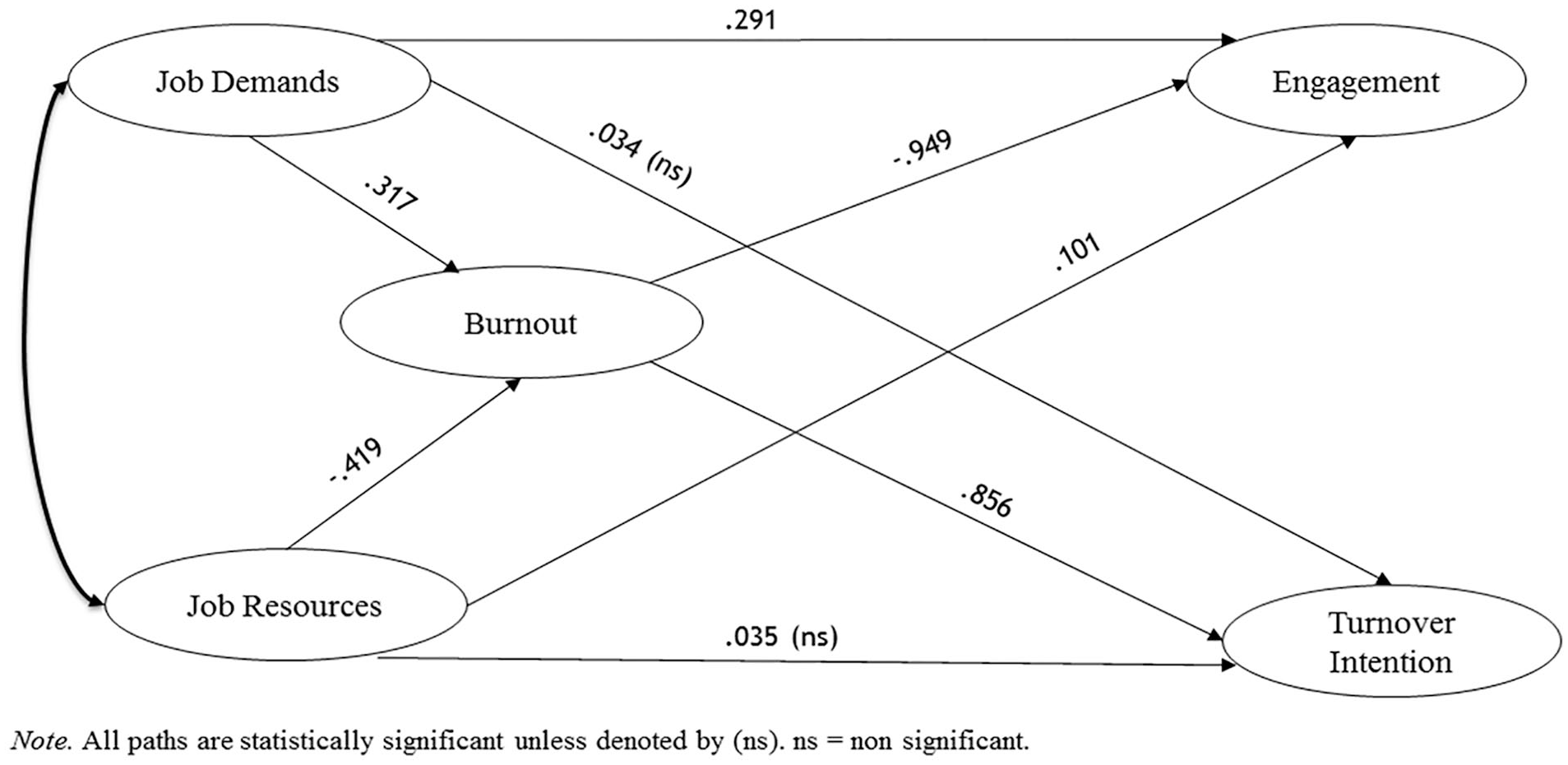
Standardized model path coefficients.
Standardized and Unstandardized Direct Estimates and Effects.

p < .001.
Hypothesis Testing Summary for Direct Relationships.

Hypothesis Testing: Mediation Analysis
In addition to making inferences about effects between latent variables, SEM using AMOS can also be employed to examine mediation effects (Collier, 2020; Kenny et al., 2015; Miller et al., 2020). Together with the direct path testing, as presented in Table 8, the extent to which burnout mediated the relationships between job characteristics and work engagement as well as job characteristics and turnover intention was determined. As demonstrated in Tables 9 and 10, the structural model was estimated both with and without the mediator to test Hypotheses 6 and 7. Table 9 indicates burnout did not mediate the relationship between job demands and turnover intention; however, when burnout was introduced to the relationship between job resources and turnover intention, the path became insignificant, indicating full mediation. Hypothesis 6a was not supported, yet Hypothesis 6b was supported. As referenced in Table 10, burnout fully mediated the relationship between job demands and work engagement; therefore, Hypothesis 7a was supported. When burnout was examined in the relationship between job resources and work engagement, the path remained statistically significant but the coefficient was reduced indicating partial mediation. As such, Hypothesis 7b was not supported.
Direct Path Examination for Mediation.

Note. Full model (Model 1) includes direct relationships between all variables as denoted in Figure 1. Model 2 = removal of direct relationship between job demands and turnover intention; Model 3 = removal of direct relationship between job resources and turnover intention; Model 4 = removal of direct relationship between job demands and work engagement; Model 5 = removal of direct relationship between job resources and work engagement; Full = full mediation; Partial = partial mediation; None = no mediation; ns = not significant; CFI = comparative fit index; RMSEA = root mean square error of approximation (with the 90% confidence interval); SRMR = standardized root mean square residual.
p < .05.
Hypothesis Testing: Mediation Analysis for Turnover Intention.

Note. Full = full mediation; None = no mediation; ns = not significant.
p < .001.
Hypothesis Testing: Mediation Analysis for Work Engagement.

Note. Full = full mediation; None = no mediation; ns = not significant.
p < .001.
Discussion
This study aimed to add to the literature on burnout by examining the underlying processes associated with burnout and the relationships between job characteristics (i.e., job demands and job resources), turnover intention, and work engagement as hypothesized by JD-R. Findings from this study indicate significant, direct, and positive effects between job demands and burnout, burnout and turnover intention, job demands and work engagement, and job resources and work engagement. The only direct, negative effects were found between job resources and burnout as well as burnout and work engagement. Surprisingly, neither job demands nor job resources had a significant direct effect on turnover intention. Although burnout was expected to fully mediate both dimensions of job characteristics in the relationship between work engagement and turnover intention, burnout only mediated the relationship between job resources and turnover intention as well as job demands and work engagement.
Contrary to the seminal research (Demerouti et al., 2001), the relationship between job characteristics and turnover intention was not significant. This was an important finding as job demands have helped previously explain turnover intention especially among educators (Emberland & Rundmo, 2010; Wright & Bonett, 2007). Job characteristics and other workplace factors may blur and vary based on personal factors and resources and may help to better explain job satisfaction (Schaufeli & Taris, 2014; Steyn & Vawda, 2014). A deeper examination of these factors and variables may be useful in more fully understanding the antecedents of turnover intention among educators. Although educators have to juggle job demands, these findings suggest that unsuccessful management of job demands may not lead to turnover intention.
In addition, the examination of job characteristics and work engagement offers a different—and unexpected—perspective. In this relationship, job demands had both a positive and more significant effect on work engagement than job resources. In fact, the positive relationship between job demands and work engagement was not expected. The literature negatively—and consistently—associates job demands and work engagement (Borst et al., 2017). Although job demands are often considered negative, they may not hinder the work environment and instead may create challenging work, in which meaning and enthusiasm are developed. J. K. Harter et al. (2002) suggest work engagement exists when employees feel they make meaningful contributions to the organization and have opportunities to grow and develop. This has significant implications for work engagement and other outcomes (J. Harter, 2020). When employees are given opportunities to find solutions to problems and innovate—which may be perceived as a job demand—work engagement is fostered. For educators who are finding creative and engaging ways to convey information to various learners, this may be stimulating and exciting. In fact, it is possible that those drawn to careers as educators may be more service oriented or mission driven. At the same time, it is important to realize that under excessive job demands, educators may experience burnout, which could diminish the quality of instruction.
In this study, job resources had a negative yet stronger effect on burnout than job demands. Although job demands are required for resources to be translated into a positive affect (Bakker et al., 2010), the interactive effects between job demands and job resources indicate that job resources can help reduce the burden of realized job demands or, in other words, job resources have the capacity to buffer job demands. Burnout mediated the relationship between job demands and work engagement. Put another way, educators can experience burnout and still be engaged. Burnout also mediated the relationship between job resources and turnover intention suggesting that the absence of job resources, in and of itself, will not encourage an employee to leave the organization. Rather, the lack of resources coupled with feelings of burnout will likely lead employees to contemplate leaving the organization (Boles et al., 2000; Maslach, 1998), which supports the theoretical framework. Next, the negative association between burnout and work engagement was larger and stronger than the relationship between burnout and turnover intention. This is a remarkable finding that aligns with the work of Arnold and Place (2010). They assert that educators strongly identify with their work and find it meaningful. As a component of work engagement, absorption is characterized by being fully concentrated and happily engrossed in one’s work, whereby time passes quickly and one has difficulty detaching from one’s work. It is reasonable to expect that an educator engrossed in work can have difficulty detaching. In this way, absorption may facilitate the exhaustion dimension of burnout among educators.
Limitations
Several limitations should be considered before any inferences can be made related to findings or conclusions. This study was cross sectional in nature, which does not accomplish definitive claims about causality. The study was dependent on voluntary participation; therefore, self-selection bias is possible. The research design and data collection only examined attitudes and perceptions related to the organization, and did not address perceived competence, confidence, or personal characteristics that might affect individual educators’ burnout, work engagement, or turnover intention. After conducting correlation analysis between the demographic variables and the outcome variables to ensure that no demographic variables were significantly related to the outcome variable, demographic variables were not included in the hypothesis testing. Finally, the deletion of two items from the Turnover Intention Scale (TIS-6) helped to better measure turnover intention within this population.
Drawing from JD-R theory, future research should consider an examination of job characteristics that foster work engagement—the antithesis of burnout and outcome of the motivational process identified in the theory. Future research should also consider how job characteristics and burnout relate to other organizational outcomes such as absenteeism, presenteeism, organizational commitment, organizational citizenship, performance, productivity, job satisfaction, and work-related well-being. Demographics and personal resources as well as perceptions of competency and confidence guided by the JD-R theory should be examined. More longitudinal studies that focus on the causality of job characteristics–burnout–engagement and job characteristics–burnout–turnover relationships are needed for enhanced clarity.
Conclusion and Recommendations
Undergirded by JD-R theory, the purpose of this study was to examine the underlying processes associated with burnout and the relationships between job characteristics (i.e., job demands and job resources) and turnover intention and work engagement as hypothesized in the JD-R model and theory among a national sample of educators. Advanced statistical analyses revealed support for seven of the 12 hypotheses tested. A review of the standardized solutions revealed that six of the eight direct paths were found to be statistically significant. These significant path coefficients reflected direct, positive effects between job demands and burnout, burnout and turnover intention, job demands and work engagement, and job resources and work engagement. Direct, negative effects were found between job resources and burnout as well as burnout and work engagement. The findings revealed significant, indirect effects between both aspects of job characteristics and work engagement. Although burnout was expected to fully mediate both dimensions of job characteristics and the relationship between work engagement and turnover, burnout only fully mediated the job resources and turnover intention relationship and the relationship between job demands and work engagement. In addition, results indicate burnout partially mediated the relationship between job resources and work engagement. Neither dimension of job characteristics was related to turnover intention. In fact—and contrary to assumptions from the JD-R theory—job demands did not directly relate to turnover intention.
There is no debate—burnout is an organizational problem that is prevalent among educators. Findings from this study should be reassuring as leaders and managers can implement strategies to mitigate burnout and reduce costs associated with lack of work engagement and turnover. It is the obligation of leaders and managers to modify heavy workloads, particularly when the impact is immensely consequential, and create supportive work environments, which offer a deliberate balance of job demands and job resources to maximize motivation and encourage goal achievement.
Leaders and managers should consider the specific job demands that educators face, and design jobs with supportive features that help protect against burnout. In addition, considering and examining job resources may prove to be a promising mechanism through which human resource practices and organizational policies can be adjusted. There is an overemphasis of self-care in much of the burnout literature although burnout is a workplace phenomenon. However, leaders and managers should take the opportunity to encourage educators to take time off as well as discuss burnout and job demands during one-on-one meetings. Having meaningful conversations with educators about job demands as well as job resources they may need is one way to begin to develop a supportive work environment.
Leaders and policy makers can use the results of JD-R theory–driven research to determine whether, and to what extent, additional policies, programs, and interventions should be created. Leaders need to build strategies and institute employee-focused policies and programs that mitigate burnout and support employee work engagement. The negative consequences of burnout are too serious for leaders and managers not to consider and implement interventions (Goh et al., 2016). When leaders assess the root cause of burnout, they can be more targeted in how they approach interventions. These findings can help leadership better identify what conditions are leading educators to experience burnout. With our results, we hope to inform potential effective interventions to prevent, manage, and cope with burnout. Knowing the nature of a problem empowers leaders and managers to develop more targeted solutions.
Burnout is a modern epidemic. As such, our workplaces are full of people who feel exhausted, cynical, and lack professional efficacy. The key findings in this study highlight the importance of clarifying antecedents and consequences of burnout and contribute to the literature by examining the underlying factors of burnout. Overall, addressing the work environment of educators is integral to improving the work life of educators and the overall education system. The negative consequences of burnout on educators and their institutions call for preventive measures. The relationships examined in this study can lead to more desirable individual and organizational outcomes.
Footnotes
Authors’ Note
Prior Publication of Data: This article is an excerpt of Mia Russell’s doctoral thesis. As such, data used in this study were collected for Mia Russell’s dissertation. Although no other manuscripts have been published using the full data set, two articles have been submitted using a portion of the data: Journal of Family and Consumer Sciences and Journal of Extension. The manuscript submitted to the Journal of Family and Consumer Sciences examines the engagement within the family and consumer sciences discipline. The manuscript submitted to the Journal of Extension includes an analysis, one way analysis of variance (ANOVA), to examine mean differences of all study variables across the five disciplines.
Declaration of Conflicting Interests
The author(s) declared no potential conflicts of interest with respect to the research, authorship, and/or publication of this article.
Funding
The author(s) received no financial support for the research, authorship, and/or publication of this article.
