



Abstract
The importance of the agri-food industry in Spain is widely recognised. Numerous studies have highlighted the economic impact of this sector on the Spanish economy, generating 15% of the country’s wealth. For this reason, this paper aims to present the territorial evolution of the growth of the agri-food industry in the Spanish regional economies as a whole in the period 1980 to 2018, focusing attention on the hypothesis of concentration in the agri-food sector of the New Economic Geography. Our method is based on the study of territorial disparities and econometric estimates. We find that the factors that explain the regional concentration of the stock of productive capital in the agri-food industry in Spanish regions include regional productive efficiency, the location and specialisation of the labour force, the size of the consumer market, the proximity to markets supplying raw materials and the territorial endowment of infrastructures. The competitiveness of the agri-food sector in Andalusia generates a source of potential and opportunities, although the lack of infrastructure has been limiting it. We propose a regional economic policy committed to investment in infrastructure in the Andalusian region. Besides, it is necessary to replicate the work with new data sources and methodology that allow us to contrast these results.
Keywords
Introduction
The agri-food industry is given by the process of adaptation, conservation, transformation and commercialisation of agricultural, livestock, forestry or fishing raw materials (Boucher & Riveros, 2000, p. 2; Ganeshkumar et al., 2017); That is, it includes actions that transform, conserve, manipulate or prepare agricultural raw materials to adapt them and make them more suitable for living beings’ consumption or food manufacturing processes’ needs. From the above, it follows that the above definition that agro-industry is an activity articulated around relations with the different agents involved in food production. These activities are included in the National Classification of Economic Activities (CNAE) within the food industries, beverage manufacturing and tobacco industries (Pardo Pardo, 1998).
In this sense, the objective of this paper is as follows. On the one hand, we present the territorial evolution of the growth of the agri-food sector in comparison with the Spanish productive fabric as a whole, based on a different approach to that used by conventional theory. We focus our attention on testing the hypothesis put forward by the New Economic Geography regarding the spatial location of agro-industrial activities in Spanish regions in the period 1980 to 2019, which is sufficiently broad to be able to focus attention on fundamentally structural aspects. On the other hand, we attempted to highlight some of the factors that explain the regional concentration of the stock of productive capital in the agri-food industry in the Spanish regions. Some of these factors are the regional productive efficiency (measured based on apparent employment productivity), the location and specialisation of the labour force (indicated by the ratio between employment and surface area of the local authorities under analysis), the size of the consumer market (assessed based on population density), the proximity to the raw material supply markets (analysed based on the size of the agricultural sector in each Spanish region) and the territorial provision of infrastructures (estimated based on the density of infrastructure per surface area of the regions studied). Finally, the aim is to analyse whether the territorial competitiveness of the Andalusian agri-food sector makes it a source of potential and opportunities for the economic development of the Andalusia region.
According to the theoretical framework on industrial location, this paper will hypothesise that the regional location of the agri-food industry in Spain is explained by the following elements: (a) the agri-food productive efficiency of the Spanish regions, so that the business location of this sector will be linked to the territories with the highest employment productivity in the agri-food sector; (b) the location and specialisation of the workforce, according to which the productive activity of this sector will be established in those regions with the highest per capita employment dedicated to agri-food activity; (c) the size of the consumer market, whereby the establishment of companies in the sector under study will occur with greater intensity in those regions with the highest population density; (d) the proximity to the markets supplying raw materials, so that agri-food companies will tend to locate in those regions with a more significant presence of a predominant agricultural sector; and (e) the territorial endowment of infrastructures, as regions with a higher level of infrastructures will be more prone to the location of a more significant number of companies in general, and of the sector under analysis in particular.
The novelty of this research lies in the approach used, which differs substantially from most of the studies carried out at the regional level in Spain. We have attempted to analyse the dynamics of the level of development of territories based on Gross Domestic Product (GDP) or Gross Value Added (GVA) per capita or inhabitant, as well as the factors explaining regional disparities in these variables. In this case, we will specifically analyse the regional growth of the agri-food sector from a different perspective, trying to identify factors that favour the geographical concentration of the agri-food industry in the Spanish regions over the long period under study. The study of concentration through the GVA per km2 allows us to analyse the productive density of the different territories from a different approach, which is more focused on the space of the territories than on their population.
This research is structured as follows. The second section provides a brief overview of the literature review. The third section presents the methodology and the statistical sources used. The fourth section presents the results obtained. The fifth section analyses the determinants of the location of the stock of agri-food productive capital in the Spanish regions. The sixth section examines the territorial competitiveness of the Andalusian agri-food sector, as well as its potential and opportunities. The fifth section contains the most significant reflections of the study, and the sixth and final sections present the bibliographical references used.
Literature Review
Location Theory
Von Thünen (1826). Weber (1929). Hotelling (1929), Christaller (1933), Lösch (1940), and Isard (1956, 1960) were the pioneers in applying the spatial location of productive activity to Economic Theory, explicitly taking into account territorial analysis in Economic Science. These studies focused on the distribution of economic activity, which continues to be one of the aspects of most significant interest in economic geography and territorial economics. Their scientific interest lies in the demand for rigorous information required for decision-making on the location of companies and for implementing territorial planning measures by Public Administrations, both of which are necessary for economic development and territorial planning. There is a close interrelation between social and economic activities and the territory. However, their examination will depend on the dimension being evaluated more intensively in the study, that is, the social or the economic one. If the social issue is the primary one, the spatial distribution of the different social groups would be explained based on their socio-demographic characteristics (type of family, income, age), focusing attention on the spatial forms of the residential distribution of the socio-economic strata (Duahu & Giglia, 2008; Grau & Reig, 2021). However, the study will focus primarily on whether the territory’s characteristics (natural resources, human resources, accessibility, infrastructures) influence the profitability of companies and the economic activities carried out. In this case, it would be of interest to analyse the spatial location trends of economic activities and their modifications over time since once they are established in the territory, they influence the labour market, the urbanisation process, environmental conditions, quality of life and population growth, among others (Handford et al., 2014; Lezoche et al., 2020; Mizik, 2021; Vite Pérez, 2011). Therefore, these approaches to localisation consider the territory as part of the entrepreneur’s needs for production, which is favourable to descriptions of the economic elements that are uniformly assumed to be found in an area and of social and institutional relations, not only following mercantilist criteria.
Scientific studies on location are characterised by Méndez (1997) describing location patterns specific to each type of activity and company, identifying forces that make it possible to justify business location decisions based on a causal relationship, and analysing the spatial evolution of productive activities, accurately pointing out changes in distribution factors and patterns. Thus, any attempt to explain the location maps of activities in the territory requires addressing both the decision-making process and the elements that explain the choice of a particular location (Bolzani et al., 2015; Fortunati et al., 2020; Martin et al., 2011; Peña Sánchez, 2006, 2007b, 2007c; Puga, 2010; Silverio & Sánchez, 2013). These factors are known as centripetal forces because they favour the territorial concentration of productive activity (Fujita & Krugman, 2003) and include, among others, the existence of external economies associated with the general development of industry and internal economies, dependent on resources internal to the company, such as organisation and efficiency in the use of productive factors (Marshall, 1920). In contrast, centrifugal forces are linked to agglomeration diseconomies (congestion and pollution), land scarcity and its consequent price increase, and rigidities in the mobility of productive factors (Krugman, 1997). Marshall (1920) argues that finding a more significant number of firms nearby allows them to generate positive externalities regarding knowledge spillovers, pooling of labour market resources and exchange of inputs, favouring firms’ productivity growth. At the same time, these advantages stemming from higher local density are affected by transport infrastructure, which allows for improved accessibility to other markets by extending the spatial scope over which firms exploit the advantages offered by agglomeration (Graham, 2007a, 2007b; Holl, 2013). Many works in this scientific knowledge field highlight the higher productivity of firms in larger, densely populated urban areas (Brülhart & Mathys, 2008; Combes et al., 2010, 2012).
Among the elements that make up external economies is the pool of skilled local labour, the availability of productive inputs and knowledge spillovers between firms sharing the exact location (Funk, 2014; Kumari et al., 2015; López-Bazo et al., 2004; Notarnicola et al., 2012; Pons et al., 2007; Viladecans-Marsal, 2004). Becattini (1987) adds a fourth factor, which he calls social capital, which contains a series of essential social and cultural factors derived from the work ethic, family and reciprocity and which influences all aspects of social life (Abbate et al., 2023; Molina et al., 2008; Peña Sánchez, 2008a, 2008b, 2010, 2011). Krugman (1991) also includes aspects such as chance, historical determinants, increasing returns (insofar as productive technology exhibits increasing returns to scale), transport costs and demand expansion.
Economic Disparities and New Economic Geography
Alonso (1980) suggests a theory of spatial convergence according to a competitive pattern. In other words, it is a model of the spatial distribution of an economy over time, in which in its growth phase, the geographical concentration would increase, while in its maturity phase, in an integrated market (with improvements in transport and communications), there would be a spatial dispersion of economic activity. This suggests that initially, there would be a process of agglomeration of productive activity, which would be reversed as the territory undergoes further economic development. Empirical evidence favoured the spatial convergence hypothesis in the United States for the period 1860 to 1987 (Kim, 1995).
The New Economic Geography, identified by the interaction between economies of scale, transport costs and agglomeration economies, disputes Alonso’s hypothesis (Vives, 2000). For the latter, territorial growth follows a logic of circular causation, in which the backwards (suppliers) and forward (customers) linkages of businesses lead to a concentration of activities that are progressively self-reinforcing, with the limit imposed at the moment when the centripetal forces leading to agglomeration begin to be offset by the centrifugal forces leading to dispersion (Krugman, 1997). Positive external effects reinforce the attraction to the territory, while adverse effects act as a repulsion force. In other words, the process of activity concentration is progressively reinforced, with the territory’s capacity tending to limit the self-agglomeration of productive activity. Thus, the interaction of these two types of forces (centripetal and centrifugal) is responsible for shaping the spatial structure of an economy (Fujita & Krugman, 2003). Centripetal or agglomerating forces include natural advantages (bays, rivers, central or strategic locations), pecuniary external economies (access to markets and access to products), and technological external economies (technological spillovers). Centrifugal forces include market forces (high real estate rents, centre-periphery economic relations, long distances) and non-market forces (pollution, congestion, dispersed natural resources). Dobado (2006) assesses the territorial inequality of economic activity at the provincial level in Spain in the 19th and 20th centuries. He differentiates between Sachs’ and Krugman’s geographical analysis, arguing for the complementarity of these approaches. In his work, however, he applies the former.
Empirical evidence shows that until the 1980s, there was a long period of convergence within a large group of countries (e.g., the European Union, the United States and Japan). We can find a sound synthesis of the empirical literature on inter- and intra-territorial convergence in developed countries and its conceptual and methodological bases in Sala i Martin (1999). Recently, however, there has been a generalised process of polarisation in which disparities have increased between and within countries. In some cases, such as the European Union, the process of regional convergence has come to a standstill, and in others, such as France and Spain, it is even showing signs of reversal (Garrido Yserte, 2002; Rabadán et al., 2019). It seems that globalisation is operating as a centrifugal force intensifying the difficulty of inter-territorial disparities in income levels. In any case, the regional convergence analyses were carried out using endogenous growth theory techniques. The New Economic Geography finds that human capital, knowledge and infrastructure are the conditioning elements of territorial growth (Corallo et al., 2020; Crozet et al., 2004; Gibbson et al., 2012; Graham & Kim, 2008; Head & Mayer, 2006; H. Hanson, 2005; Holl, 2012; Laursen et al., 2012; McCann & Shefer, 2003; Ottaviano & Pinelli, 2006; Peña Sánchez et al., 2018).
Some studies have focused on competitiveness as a fundamental element of the agri-food market in the European Union (Carraresi & Banterle, 2015; Matkovski et al., 2019). Two events have affected the competitiveness of the agri-food industry: the accession of Central and Eastern European countries to the European Union and the global economic crisis in 2008. It is demonstrated that agriculture and the food industry are interconnected in the European Union, sometimes showing divergent trends in competitiveness. Indeed, Germany and the Netherlands have benefitted from the enlargement opportunities, while France and Belgium have lost competitiveness. Italy and Spain have kept their situation the same. The countries of South-Eastern Europe have comparative advantages in the agri-food sector. Others analyse the link between innovation and market structure in the agri-food industry (Karantininis et al., 2010). In this case, it is shown that company size, export capacity and vertical integration determine innovation in the sector. Recently, the application of artificial intelligence in the agri-food industry has been analysed to improve productivity, efficiency and sustainability (Taneja et al., 2023). It emphasises how the recent evolution of artificial intelligence technology has transformed the agri-food sector by optimising efficiency, reducing waste and improving food safety and quality. Even with the above, there is research that indicates that there are still several gaps in research on the agri-food sector that should be addressed (Tell et al., 2016).
Methodology and Statistical Sources
Despite the scarce availability of statistical sources on the agri-food sector, for the evaluation of the productive efficiency of the agri-food sector, it is feasible to use an indicator of apparent labour productivity related to the quotient of Gross Value Added at factor cost (from now on, GVA), valued at constant 2015 prices, and the level of employment through the population employed in this sector (Ezcurra et al., 2008), although it is worth bearing in mind the limitations of this indicator (Ezcurra et al., 2008; Peña Sánchez, 2007a). At the same time, we have complemented this study with wage levels per employed person to represent the territorial competitiveness of the sector under examination.
The statistical sources consulted for the period under analysis were, on the one hand, the data provided by the National Statistics Institute (INE) and the Andalusian Statistics Institute (IEA); on the other hand, the BD.MORES Database of the Secretariat of State for Budgets and Expenditure of the Ministry of Finance and Public Function, updated in 2022 (Dabán et al., 2002); and, finally, the statistics of the Fundación BBVA (2000) referring to the stock of capital and infrastructure and the surface area of Spanish regions (Secretaría de Estado de Hacienda y Presupuestos del Ministerio de Hacienda y Función Pública [State Secretariat for Finance and Budgets of the Ministry of Finance and the Civil Service], Various year; Instituto Nacional de Estadística (IEA) [Andalusian Institute of Statistics, Various years; Instituto de Estadística de Andalucía (IEA) [Andalusian Institute of Statistics, Various years).
The methodology used in the work is given by Florence’s Geographical Association Coefficient, used to compare two defined characteristics, in our case, GVA generated (x) and surface area (y), in the Spanish regions (j), studying whether these characteristics are geographically associated through the expression:

The variables xj and yj are taken, not in their absolute value, but in terms of their percentage share. The extreme values that this coefficient can take are 0 and 1. It will take the value 0 for a situation of maximum inequality between the variables analysed, that is, when there is a maximum disparity in the distribution of the variables xj and yj, and in this case, we will say that these two variables are not geographically associated. It will take the value 1 for a situation of total equality between the variables in question, that is, when the existing disparity between the variables xj and yj that we are analysing is minimal so that, in this case, these variables are geographically associated.
Next, we will identify some factors that may have influenced the evolution experienced by the density of monetary wealth in the agri-food industry of the Spanish regional economy. To this end, and according to the following expression:

where GVA/SQ KM = monetary wealth per surface area, GVA/L = apparent productivity of employment and L/SQKM = localisation density of employment or territorial distribution of employment, we have applied the decomposition of the Theil index, which will allow us to establish whether the evolution in the territorial concentration of agri-food production has been favoured to a greater or lesser extent by the components into which we have decomposed this variable. However, for the intended analysis, we have also carried out the following decompositions:

where GVA/K = productivity of capital, that is, the generation of agri-food production obtained per unit of physical capital produced, and K/L = capitalisation of employment, meaning the amount of productive physical capital used per unit of employment (Luque-Vílches & Rodríguez Gutiérrez, 2021; Peña Sánchez et al., 2018).
The breakdown of GVA/SQKM = GVA/L * L/SQKM allows us to make the following decomposition of the Theil index:
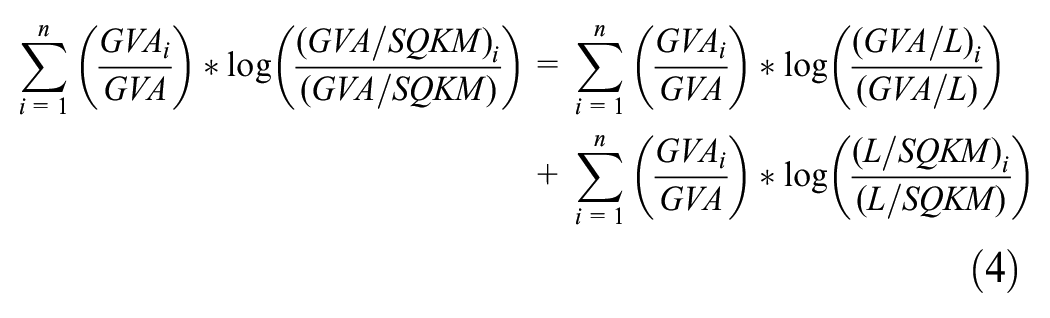
where ‘n’ is the number of regions considered (in our case, the 17 except Ceuta and Melilla). When the variable does not carry the subscript ‘i’, it refers to that of the Spanish regions as a whole, and when it carries the subscript, it refers to the i-th region. The first member is Theil’s index of the monetary wealth generated by the Spanish regions by surface area (GVA/SQKM), and the second member reflects its decomposition into apparent employment productivity (GVA/L) and territorial distribution (L/SQKM). We can use this index to express the relative inequality of a variable: when it is equal to zero, inequality is minimal and the higher the index, the greater the inequality between distributions, that is, this index varies between 0 and the logarithm of observed units, indicating minimum inequality in the first case and maximum inequality in the second, respectively (Pellegrini & Platino, 2014; Villaverde Castro, 2007).
Sigma convergence (σ) is a measure of dispersion. It is defined as the evolution over time of the standard deviation of the logarithm of, for example, in our case, the distribution of the capital stock of the agri-food sector (K/SQKM), for the case in which it is intended to assess the evolution of the dispersion of this variable, for the 17 Spanish regions. The expression used for its computation is as follows:

where ‘ln(K/SQKM)it’ represents the logarithm of the regional distribution of the agro-industrial capital stock of the i-th region in year ‘t’, ‘ln(K/km2)t’ is the logarithm of the national distribution of the agro-industrial capital stock of the Spanish economy, equivalent to a weighted average of the distribution of the variable under study of the Spanish regions and ‘17’ is the number of regions considered, except Ceuta and Melilla.
According to the premises set out above, in order to be able to carry out a joint assessment of the elements that may favour or limit the concentration of business activity in the agri-food industry in the Spanish regions in the period analysed (1980–2018), we have designed the following functional relationship. It should be borne in mind that what we are trying to analyse is the possible influence that the factors considered can have on the degree of concentration of business activity in the agri-food industry in the Spanish regional economy in the period 1980 to 2018 so that the interest focuses primarily on this question, and not so much on the theoretical development of an explanatory model of the location factors at a general level. To this end, we addressed this question by estimating the regression proposed, focusing mainly on the sign and significance of the parameters obtained. However, it is important to remember that this is an econometric exercise that attempts to assess the existence of economic relationships between the variables analysed (Rapún et al., 2004):

to calculate the parameters of the following estimation:

where K is the stock of productive capital of the agri-food industry, π is the apparent productivity of employment in the sector under study, Epc is the employment per capita of manufacturing activity in the agri-food sector, PD is the population density, G is the stock of productive public capital, Agr represents the production of the agricultural sector, km2 is the surface area of each of the ‘i’ Spanish regions, ‘t’ represents the year considered and u is the error term or random disturbance.
Results
The Agri-Food Industry in Spanish Regions
To identify some patterns of the spatial location of agri-food activities and their evolution over time, we have proceeded, as a starting point, to use an indicator of the density of monetary wealth generated by the agri-food industry in each region, given by the Gross Value Added per square kilometre. The permanence of the denominator of this expression makes the evolution of this magnitude depend only on the amount of added value generated in the territory in question so that its trajectory over time expresses the intensity with which agri-food economic activity is located in a given space. Thus, comparisons of the evolution of this variable between territories will indicate the spatial trends for the territorial location of the agri-food industry and the wealth generated by this sector in monetary terms.
Florence’s Geographical Association Coefficient of territorial GVA (Figure 1) does not show an evident polarisation process either, being lower in the case of the agri-food industry than in the case of all sectors in Spain. The spatial concentration of the generation of agri-food GVA tends to be maintained over the period analysed, which only occurs with the concentration of GVA of all sectors at a regional level. We can see that since 1985, there has been a decrease in the Florence coefficient of GVA of the sectoral set of Spanish regions, indicative of a process, albeit discontinuous over time, of geographical concentration of GVA in some Spanish regions, a process which changed its trend after 2001, stabilising until 2010, when it began to concentrate again. In the case of the agri-food industry, since 1991, there has been a slight trend towards the concentration of GVA generated, with apparent fluctuations, becoming more intense, especially since 2012, indicating a slight process of concentration of this industry in certain Spanish regions (Figure 2).

Florence Geographical Association Coefficient agri-food industry and total sectors (1980–2018).

Sigma convergence of the concentration of the agri-food sector in Spanish regions (1980–2018).
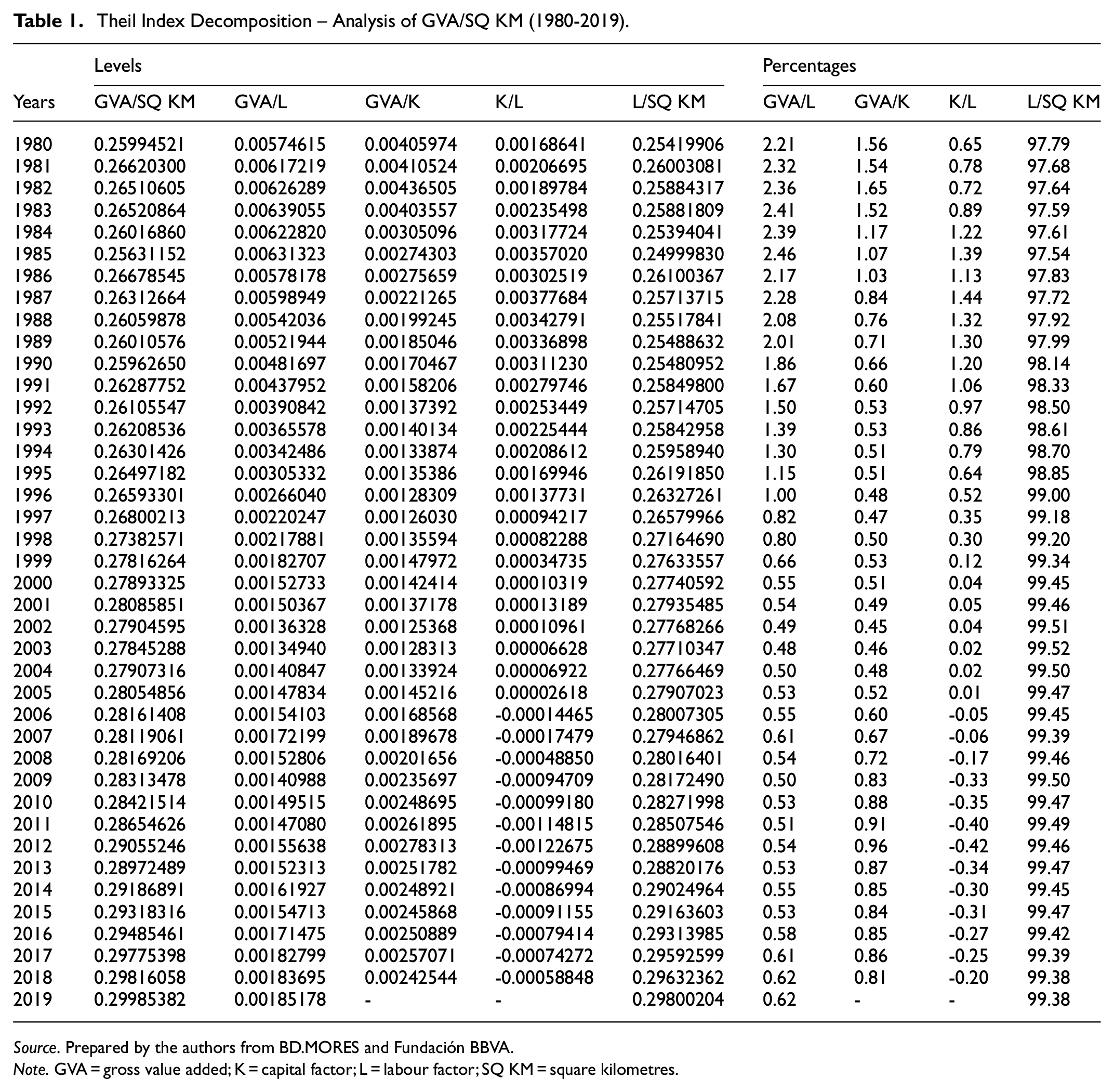
Table 1 shows that it is precisely from 1988 onwards that there is a slight geographical concentration of the monetary wealth generated in the agri-food industry of the Spanish regional economy, expressed by an increasing trend in the Theil index. The reasons behind this evolution are the greater territorial concentration of labour factors or territorial distribution of works (Villaverde, 1996) since the apparent productivity of regional employment undergoes, in the period analysed, an intense decrease in territorial disparities, sustained by both the decline in capital productivity differentials and the decline in the capitalisation of employment.
Theil Index Decomposition – Analysis of GVA/SQ KM (1980-2019).
Source. Prepared by the authors from BD.MORES and Fundación BBVA.
Note. GVA = gross value added; K = capital factor; L = labour factor; SQ KM = square kilometres.
On the other hand, it seems that the high geographical concentration of employment and the territorial differences in employment opportunities that this entails is what is causing an increase in the agglomeration of agri-food production activity, as predicted by the theories of endogenous growth, based on increasing returns and whose possible results give rise to agglomeration models. In this sense, the percentages of participation of each of the established elements in the territorial concentration of the GVA of the agri-food industry have evolved very unevenly. There have been significant decreases in the share of apparent productivity in employment, mainly due to the decrease in the capitalisation of employment.
Concentration of the Agri-Food Industry in Spain: Determining Factors
In this section, we will analyse, among others, the reasons that can explain the geographical settlement of the agri-food industry in the Spanish regions. In this sense, we have used the stock of productive capital of the regional agri-food industry as the variable under study to reflect the geographical location of the productive activities of this sector in Spain.
The determining factors of the business location of agri-food production that we have considered are (Goerlich & Mas, 2001; Hernández-Cortés & Pérez-Sánchez, 2020; Pelegrín Solé, 2002): productive efficiency, the location, size and specialisation of the labour market in this sector, the size of the consumer market, the level of infrastructures, as well as the proximity to the raw material markets, all of them considered territorially at the regional level. In order to quantify these factors, which the agri-food company can consider as essential elements in the decision to locate and set up industries in this sector, we have used some ‘proxy’ variables that can approximate the aspect we are trying to quantify.
To assess productive efficiency in the agri-food industry, we have considered the apparent productivity of jobs in the sector, which was analysed and calculated using the quotient between GVA and employment generated by the agri-food sector. To estimate the dynamism of the labour market and its specialisation, we have taken the employment per capita of the sector under study (percentage of employment concerning the population of each regional area). We have represented the size of the consumer market using population density. We have quantified territorial infrastructures based on the stock of public capital in terms of roads, ports, airports, railways and urban structures, whose spatial concentration substantially reduces transport costs, favouring the fluidity of economic activity. Finally, we have assessed the proximity to raw material markets through the intensity of regional production in the agricultural sector in each Spanish region (Table 2).
Determinants of the Industrial Location of the Agri-Food Sector in Spanish Regions. (Regression Models With Panel Data).

Source. Prepared by the authors from BD.MORES and Fundación BBVA.
Note. π = apparent productivity of employment in the sector under study; Epc = employment per capita of manufacturing activity in the agri-food sector; PD = population density; G = stock of productive public capital; Agr = production of the agricultural sector; SQ KM = square kilometres.
Significant at a significance level of 10%.
Significant at a significance level of 5%.
Significant at a significance level of 1%.
Concerning the intensity of the availability of infrastructures in the Spanish regions, it is necessary to highlight that transport costs and, therefore, the availability of adequate communication networks play a relevant role in explaining the business concentration processes of any productive sector in the territory. A good communication network favours the exploitation of agglomeration economies and, consequently, the activity concentration. However, more significant activity also favours an increase in infrastructure endowments. There is, therefore, a circular causation process in the style of Myrdal (1957, 1959) and Kaldor (1970), in which more extraordinary endowments reduce transport costs, increase activity in the territory and simultaneously require the expansion of transport networks. Consequently, cumulative growth processes will favour those already developed areas where the historical accumulation of surpluses and their subsequent reinvestment is reflected in a more significant endowment that reinforces their capacity to attract new investments and improve the profitability of existing ones (Méndez, 1997).
We have applied the White test to the estimates presented, finding that we have corrected the possible symptoms of heteroscedasticity, autocorrelation and multicollinearity. To test for multicollinearity, we calculated, on the one hand, the correlation matrix between the regressors and the determinant of this matrix and, on the other hand, the tolerance index. Both methods confirm the non-existence of multicollinearity. We have carried out an estimate of the previous expressions, assuming an autocorrelation scheme for the disturbances through an AR(1) process, taking the logarithm of the magnitudes and applying fixed effects models with panel data. This decision was taken after applying the Hausman statistic, rejecting the null hypothesis that the estimators in the fixed-effect method and the random-effects model do not differ substantially, so it is appropriate to apply the fixed-effect method.
Moreover, there is no evidence of endogeneity, slope heterogeneity or reverse causality, according to the tests applied (among them, the Hausman test, the Goldfeld and Quandt test and the Glesjer test, which is more ambitious than the previous one, as it tries to estimate the actual structure of heteroscedasticity). All the estimators calculated for the explanatory variables of the location of business activity in the agri-food industry are positive, as predicted by economic theory, and highly significant, with a confidence level of 99%. The regressions yield results that explain the relationship between the regional location of the productive capital stock of the agri-food industry in Spain and the factors favouring it in 1980 to 2018. Therefore, according to the results obtained in the different estimations presented, and with due caution, we can affirm that the regional productive efficiency of the sector under study, the capacity of the labour market, the level of the consumer market, the territorial endowment of productive public capital and the proximity to raw material markets seem to have been key elements that may have influenced, in the period analysed, business decisions on the geographical location of production plants in the agri-food sector in the Spanish regions.
Consequently, the intensity of the regional location of the productive plants of the agri-food sector has been influenced by previous factors. However, it would be helpful to know whether their regional location in Spain has intensified or, on the contrary, we have produced a decrease in business concentration in the agri-food sector. To this end, we have carried out a sigma convergence test to establish whether the productive capital of the agri-food sector has been distributed more equally or more unequally among the Spanish regions.
The analysis clearly shows how the distribution of productive capital in the agri-food industry in the Spanish regions underwent substantial crystallisation in the period analysed, which implies how the settlement of capital stock in this sector maintained inequality throughout the period analysed. In this sense, taking into account the decomposition in which the capital stock per square kilometre (K/SQ KM) can be broken down into the capitalisation of employment (K/L), jobs per capita (L/ population) and population density (Population/SQ KM), we can observe that it is the increase in the concentration of labour factors and population density that has led to the stabilisation of regional disparities in the agri-food capital stock, as the territorial distribution of the capitalisation of employment has decreased slightly over the period analysed.
Potentialities and Opportunities of the Agri-Food Industry in Andalusia
Following the econometric estimation proposed in the previous section, we present below the comparative data of the elements established as determinants of the concentration of agri-food activity for the Spanish regions (Table 3). We can see that Andalusia has a comparative advantage in two decisive elements, namely the density of population representative of consumptive activity and its proximity to markets supplying raw materials for the agri-food industry. However, it has limitations regarding apparent employment productivity, jobs per capita and infrastructure level. This last factor depends fundamentally on the investment decisions of the public sector, which is why a more significant investment effort in infrastructure by the public administrations in the Andalusian region would be necessary. Concerning the apparent productivity of employment, we will examine the weakness of this factor as an element of territorial competitiveness in the southern region of the Iberian Peninsula in more detail below.
Determinants of the Concentration of the Agri-Food Sector in Andalusia and Spain (2018; Spain = 100).

Source. Prepared by the authors from BD.MORES and Fundación BBVA.
π = apparent productivity of employment in the sector under study; Epc = employment per capita of manufacturing activity in the agri-food sector; PD = population density; G = stock of productive public capital; Agr = production of the agricultural sector; SQ KM = square kilometres.
We can approach the competitiveness of any economic activity by examining some indicators that favour it, including apparent employment productivity and wage costs. In the economic literature, the concept of competitiveness has been quite controversial and difficult to pin down. The indicators used to analyse it have been adapted to new theoretical developments in international trade. However, it is necessary to highlight that the emphasis of competitiveness studies has been shifting from the analysis of factors related to prices and costs in the context of classical trade theories, where the concept of competitiveness is linked to that of comparative advantage, towards the study of other aspects identified with product differentiation, in the context of the new theories of international trade (Bertolini & Giovannetti, 2006; Fernández Núñez & Paniagua, 2009; Fuster, 2006).
The apparent productivity of employment is generally considered to be an indicator of productive efficiency and an essential factor in the development of an economy (Table 4). Its evolution, therefore, becomes an element that will undoubtedly mark the path followed by economic growth. To establish a frame of reference for analysing Andalusian productivity in the agri-food industry, we have made a comparison with that experienced by the rest of the Spanish regions.
Apparent Productivity of Employment in the Agricultural Food Sector (Spain = 100).

Source. Prepared by the authors from BD.MORES and Fundación BBVA.
The apparent productivity of employment in the Andalusian agri-food industry has experienced a decreasing evolution from 1980 to 2019, with a loss of almost 10 points concerning the Spanish regional average. This phenomenon is a true reflection of the outstanding dynamic process of the Andalusian agri-food sector compared to the rest of the Spanish regions. Thus, the evolution recorded by the Andalusian agri-food sector has been very intense, intensifying the differences concerning the average of the Spanish regions. Moreover, the level of sectoral productivity in Andalusia was below the Spanish regional average throughout the period analysed. Based on the above, we can pose the following question. If, as we have seen in the methodology of this paper, we can break down the apparent productivity of employment (GVA/L) into the apparent productivity of capital and K/L the capitalisation of employment (Equation 3), one could ask about the values adopted by these magnitudes in the different productive sectors in order to detect how the capitalisation of labour in the agri-food sector has influenced Andalusian productivity and the differences existing between Andalusia and the Spanish regions as a whole
In order to establish the evolution of the two indicators under study in this section, Figure 3 shows the apparent employment productivity ratio and the employment capitalisation ratio of the agri-food industry, both for Andalusia concerning Spain (Spain = 100), over the broad period 1980 to 2018.

Apparent employment productivity and capitalisation of employment in the Andalusian agri-food industry (Spain = 100). SOURCE: Prepared by the authors from BD.MORES.
The figure above shows how the apparent employment productivity in the agri-food industry in Andalusia has moved cyclically over the long period examined, experiencing a reduction in the Spanish regional average in recent years. However, the figure’s most striking feature is the substantial reduction process experienced by the capitalisation of employment in Andalusia concerning the Spanish average in the agri-food industry. From this trend, the Andalusian agri-food industry could undergo an intense recapitalisation process concerning the average of the Spanish regions. This means that the capital per employee in the Andalusian region is becoming smaller and smaller. From the previous idea, we can deduce that the apparent productivity of employment in the Andalusian agri-food sector has been suffering a slight decrease concerning the average productivity of the Spanish regions due to the changes in the levels of capitalisation of employment experienced by the Andalusian region, as can be seen in the following table.
Conclusions
In this study, we have tried to answer certain questions related to the potential and opportunities in the industrial location of the agri-food industry in the Andalusian region. On the one hand, we have presented the territorial dynamics of the growth of the agri-food sector in comparison with the Spanish productive fabric as a whole, focusing our attention on testing the hypothesis put forward by the New Economic Geography regarding the spatial location of agro-industrial activities in the Spanish regions in the period 1980 to 2019, a sufficiently long period to be able to focus on the fundamentally structural aspects. On the other hand, we have tried to highlight some of the explanatory factors of the regional concentration of the productive capital stock of the agri-food industry in the Spanish regions, such as regional productive efficiency, the location and specialisation of the labour force, the size of the consumer market, the proximity to the raw material supply markets and the territorial endowment of infrastructures. And finally, we have tried to analyse whether Andalusia’s territorial competitiveness makes it a source of potential and opportunities for developing its agri-food sector.
The conclusions obtained from the analysis carried out on the location of business activities in the agri-food sector in the Spanish regions in the period 1980 to 2019 are as follows:
(1) The trend towards regional concentration of agri-food production activities in Spain has yet to be accentuated in recent years. The fact is that we have maintained a clear situation of polarisation around four areas such as Catalonia, Andalusia, Castile and Leon and the Valencian Community, whose evolution has placed them at the top of the rankings that attempt to reflect the territorial hierarchisation of wealth in the agri-food sector.
(2) The application of Florence’s Geographical Association Coefficient and the decomposition of the Theil Index allows us to observe a weak geographical concentration of agro-industrial monetary wealth in Spain. The reasons for this have been favoured, above all, by the evolution experienced by the capitalisation of employment and hindered by the regional agglomeration of labour factors and population density.
(3) Productive efficiency, the capacity and specialisation of the labour market, the size of the consumer market, the endowment of productive public capital and the proximity to raw material markets seem to have been critical elements for agri-food business organisations when it comes to geographically establishing production plants and equipment in Spanish regions.
(4) Some factors that have influenced the growth of private productive capital in the agri-food industry in the Spanish regions have been the evolution of employment per capita and the size of the consumer market. Suppose this premise is true, as we have found with the data we have explored. In that case, the differences that have been occurring in the location of the population, which generally tend to be in regions with a higher level of economic development, may become a crucial factor in the location of agro-industrial business activities in the future, which broadens the horizon for further research in this area.
(5) The empirical evidence on the location of agro-industrial activities in Spanish regions, according to the methodology used, seems to accept the hypothesis put forward by the New Economic Geography, which predicts phenomena of concentration and agglomeration of productive activities in the most economically developed territories, based on the assumptions of increasing returns and imperfect competition.
(6) The main comparative advantages of the Andalusian agri-food sector come from its consumer market, wage costs and the proximity of the agri-food industry to the supply of raw materials, evaluated based on the size of the agricultural sector in the Andalusian economy.
(7) Due to the weakness of infrastructure in Andalusia within the context of Spanish regions, public administrations must make a financial effort to invest in public capital to facilitate communication, lower transport costs and increase the competitiveness of its agri-food sector.
(8) The productivity of the agri-food sector in Andalusia has been losing strength in recent decades as a driving force for territorial competitiveness in the Spanish regions as a whole, mainly due to the recapitalisation process that the workforce has been undergoing. Therefore, national, regional, and local public administrations must attract investment to achieve higher activity levels in the agro-industrial sector.
(9) Finally, the analysis continues. There are still aspects not incorporated, limiting the study, such as, for example, the factors that favour the territorial concentration of the population, and which may undoubtedly be influencing business decisions on the location of the agro-industrial sector, opening up a new field of research that would need to be addressed. On the other hand, considering new statistical sources and scientific methodology could allow us to extend the research and obtain new results to shed light on the objectives addressed in this paper.
Footnotes

Author Contributions
All authors contributed equally to the manuscript’s conceptualisation, methodology, design, writing and revision. Each of them approves their final version for publication and assumes equal responsibility for the content of the work.
Funding
The author(s) disclosed receipt of the following financial support for the research, authorship, and/or publication of this article: This publication and research have also been partially granted by INDESS (Research University Institute for Sustainable Social Development of the University of Cadiz; Spain) and ‘Programa de Fomento e Impulso de la Actividad de Investigación y Transferencia’ (Program for the Promotion and Development of Research and Transfer activity) of the University of Cadiz (Spain).
Declaration of Conflicting Interests
The author(s) declared no potential conflicts of interest with respect to the research, authorship, and/or publication of this article.
Data Availability Statement
Data sharing not applicable to this article as no datasets were generated or analysed during the current study.