




Abstract
In line with previous studies of the relationship between foreign direct investment (FDI) and global value chains (GVCs), this work uses national panel data of 31 countries along the Belt and Road (B&R countries) from 2010 to 2017 to study the impact of Chinese outside foreign direct investment (OFDI) on the GVC positions of B&R countries and examines the threshold effects of infrastructure level and institutional quality on that impact. The results show that the improvement of B&R countries’ GVC positions is related to Chinese OFDI, and Chinese OFDI has significantly positive dynamic effect on improving the GVC positions of B&R countries. Infrastructure level and institutional quality have double threshold effects upon the effect of Chinese OFDI on improving the GVC positions of B&R countries. When infrastructure level successively exceeds the two thresholds, the effect of Chinese OFDI on improving the GVC positions of B&R countries gradually increases, and when institutional quality successively exceeds the two thresholds, the effect of Chinese OFDI on improving the GVC positions of B&R countries gradually decreases. Our study proposes that under the Belt and Road Initiative, to improve the GVC positions of B&R countries, B&R countries should further strengthen their cooperation with China and continue to attract Chinese OFDI. Moreover, to better play the role of Chinese OFDI in enhancing the GVC positions of B&R countries, China should further strengthen the infrastructure connectivity construction with B&R countries and pay attention to the institutional quality of B&R countries when investing in them.
Keywords
Introduction
Under the backdrop of economic globalization, an increasing number of countries are participating in global value chains (GVCs) production processes by virtue of their factor endowments and technology levels. Developed countries rely on their advantages in capital, technology and human resources, and obtain many more benefits in GVCs, so that they have higher GVC positions (Timmer et al., 2014). In contrast, most countries along the Belt and Road (B&R countries) are developing countries. They are more likely to take advantage of their inexpensive labor supply and undertake the tasks of standardized production, processing and assembly in GVCs and obtain fewer benefits, so that they have relatively lower GVC positions (Shi et al., 2022). B&R countries need to take effective measures to improve their GVC positions. Otherwise, they might fall into the low-end trap of GVCs, which can hinder the optimization and upgrading of industrial structure and sustainable economic development (L. Wang & Wei, 2018). In particular, due to the impact of COVID-19, the willingness of B&R countries to participate in GVCs is weakening (J. Sun et al., 2021).
Foreign direct investment (FDI) has been proven in theory and practice to help enhance GVC positions of host countries (S. He et al., 2021). Under the governance of Chinese government, Chinese outward foreign direct investment (OFDI) is more inclined to flow into developing countries, especially flow into B&R countries (Y. Yang & Li, 2021). Since the Belt and Road Initiative was proposed, Chinese OFDI in B&R countries has experienced an obvious growth trend. The Initiative is devised to reconfigure China’s external sector in order to continue its strong growth (Y. Huang, 2016). According to China’s Ministry of Commerce, from 2013 to 2019, Chinese OFDI in B&R countries reached US $117.31 billion, accounting for 65.36% of total stock of Chinese OFDI in B&R countries. In 2020 and 2021, despite affected by the impact of COVID-19, Chinese non-financial direct investment in B&R countries still reached US$17.79 billion and US$20.3 billion, with an increase of 18.3% and 14.1% year-on-year respectively. Additionally, the Belt and Road Initiative aims to enhance international cooperation, address issues of shared regional and global concern, increase developing countries participation in international community, and play a leading role in establishing a fair and just global governance system (C. Li et al., 2020), and it is also a path of win-win cooperation for common development and prosperity, and a path of peace and friendship that enhances understanding, trust and all-round exchanges (Pan, 2017). Z. Zheng et al. (2021) also pointed out that under this Initiative, China has deepened the GVC connection with B&R countries by cooperative construction, so as to achieve mutual benefit and win-win results. The improvement of GVC positions can help B&R countries improve their productivity, so as to obtain more benefits from GVCs (Jangam & Rath, 2021). For China, while the GVC positions of B&R countries have improved, it has also driven China to import a large number of intermediate products from B&R countries for industrial development (X. Zhang, 2022). Therefore, in view of the urgent need for B&R countries to enhance their GVC positions and of the rapid growth in Chinese OFDI in B&R countries, it is necessary for us to investigate the impact of Chinese OFDI on GVC positions of B&R countries.
Additionally, Chinese OFDI would be affected by host country’s economic development levels, market scale, technology levels, degree of openness, cultural factors, geographical distance, and bilateral trade (T. Deng et al., 2019; W. A. Khan et al., 2020; H. Y. Liu et al., 2017; X. Ren & Yang, 2020). However, research on Chinese OFDI from the perspective of host country’s infrastructure construction and institutional quality has attracted much attention recently (Iqbal et al., 2019; Y. Li & Rengifo, 2018; X. Wang & Anwar, 2022). The infrastructure level is an important indicator to measure investment environment of host country, especially, it is an important factor affecting the location choice of Chinese OFDI (H. Y. Liu et al., 2017). Moreover, whether Chinese OFDI should flow to countries with perfect institutions quality or countries with relatively lower institutional quality has always been the focus of academic debate, but no unified conclusion has been reached so far (C. He et al., 2015; Kamal et al., 2020). Furthermore, Prime (2012) pointed out that it is necessary to pay deliberate attention to building infrastructure and institutions of host country, which may affect the effect of FDI on promoting host country’s GVC upgrade.
Against the background, the authors first empirically test the impact of Chinese OFDI on GVC positions of B&R countries, and further explore whether infrastructure level and institutional quality of B&R countries can significantly affect the impact of Chinese OFDI on GVC positions of B&R countries and to what extent. The impacts of infrastructure level and institutional quality on the effect of Chinese OFDI are defined as the threshold effects of infrastructure level and institutional quality in this paper. It can provide important theoretical reference and empirical support for clarifying the relationship between Chinese OFDI, infrastructure level, institutional quality and the improvement of B&R countries’ GVC positions, and for attracting Chinese OFDI to improve GVC positions of B&R countries. Moreover, it has important practical significance for further strengthening bilateral international cooperation between China and B&R countries, speeding up the “going out” strategy of China and promoting high-quality development of B&R construction.
More specifically, this paper makes the following three main contributions. First, compared with most previous studies, which do not distinguish the sources of FDI, this paper investigate the improvement of GVC positions of B&R countries from the perspective of Chinese OFDI. Additionally, this paper discusses the mechanism of Chinese OFDI on improving GVC positions of B&R countries, providing a theoretical basis for promoting GVC upgrading of B&R countries, and providing a new perspective for related research on GVC upgrading. Second, this paper regards infrastructure level and institutional quality of B&R countries as important variables that affect Chinese OFDI inflow and its spillover effects, and focuses on analyzing how infrastructure level and institutional quality may affect the effect of Chinese OFDI on improving GVC positions of B&R countries. Meanwhile, this paper empirically test the threshold effect of infrastructure level and institutional quality upon the effect of Chinese OFDI on enhancing GVC positions of B&R countries, which provide important evidence for Chinese enterprises to “go out” to strengthen cooperation with B&R countries in infrastructure construction and to focus on institutions quality of B&R countries, so as to better play the role of Chinese OFDI in enhancing GVC positions of B&R countries. Finally, considering that a country’s GVC position index may be affected by its previous GVC position index and Chinese OFDI may have a dynamic effect on the GVC position index, this paper further uses a dynamic panel data model to verify sustainable improvements in B&R countries’ GVC positions and the dynamic spillover effects of Chinese OFDI by using the first-differences GMM and system GMM estimation methods based on the analysis of a static panel data model. Moreover, robustness test of the model are conducted by means of replacing the index for measuring GVC positions of B&R countries, thereby making the estimate results more robust. Furthermore, combined with empirical analysis, to promote B&R countries to climb along GVCs and promote B&R construction in a steady and sustainable way, this paper also proposes some targeted policy recommendations.
This article contains the following five sections. Section 2 presents the literature review. Section 3 presents the theoretical analysis and provides the research hypotheses. Section 4 outlines the model construction and describes the variables and data. Section 5 shows the empirical results. Section 6 concludes the article and puts forward suggestions.
Literature Review
Related Studies on FDI and the GVC of Host Country
Research on the influence of FDI on host country’s GVC has a long history and is a hot topic (Hsu & Chen, 2009; Yoon & Hur, 2018). Most studies show that FDI promotes GVC participation and GVC upgrading (Callegari et al., 2018; Klein et al., 2016; Moris, 2018; Sekuloska, 2018).
Some studies focus on effects for entire regions or nations, such as Thailand (Hobday & Rush, 2007), Turkey (Gersch, 2019), China and Mexico (Gereffi, 2008), Croatia (Kersan-Skabic, 2017), Africa (Fernandes et al., 2022), and Central and Eastern Europe (Grodzicki & Geodecki, 2016), and have shown that FDI can promote host country’s GVC upgrading. Some scholars also have studied FDI and GVC at industrial level, such as pharmaceutical industry (Zeller & Van-Hametner, 2018), electronics industry (Thorbecke, 2018), aerospace industry (McGuire & Islam, 2015), business service industry (Hardy et al., 2011) and automotive industry (Pavlínek et al., 2009; Pavlinek & Zenka, 2011), and found that FDI could affect the process, product and functional upgrading of these industries in GVCs. In contrast to the many scholars noting that GVC upgrading is related to FDI, Fessehaie (2012) and Vrh (2018) note that FDI could reduce the domestic value-added of exports and hinder GVC upgrading.
Some scholars also have discussed the internal mechanism. Murphree and Breznitz (2020) believed that FDI technological spillovers were the key to host country’s GVC upgrading. More intense GVC participation and upstream specialization were associated with a higher FDI flow (Amendolagine et al., 2019). Pavlínek (2012) demonstrated that, driven by a large FDI inflow, the automobile industry’s R&D was developed, which gave the automobile value chain a higher value-added function. Buelens and Tirpák (2017) further noted that FDI affects GVC upgrading by influencing the trade flows and trade composition of host country. Moreover, due to the different motivations behind and entry modes of FDI, FDI has had differing effects on GVC, thus possibly affecting the functional upgrading, product upgrading and process upgrading of GVCs in host country (Morris & Staritz, 2017).
Related Studies on the Threshold Effects of Infrastructure Level and Institutional Quality on FDI
Some scholars have studied the relationship between infrastructure level and FDI in host countries, such as Africa (Asiedu, 2006), China (Asongu et al., 2018), Pakistan (Rehman et al., 2011), South Asia (Behname, 2012), and Indonesia (Fitriandi et al., 2014), and have found that infrastructure development has significantly positive effect on attracting FDI (Wheeler & Mody, 1992). FDI inflows remain insensitive to changes in infrastructure till a threshold is reached and FDI inflows increase steeply with an increase in infrastructure (Chakrabarti et al., 2017). Moreover, in researches on the threshold effect of infrastructure level on FDI spillover effects, Roy (2022) pointed out that infrastructure level is the key absorptive capacity factor affecting FDI spillover effects. Gönel and Aksoy (2016), Tang and Zhang (2016) and Arora and Lohani (2017) also gained the similarly conclusion that FDI spillover effects depends on host countries’ absorptive capacity, and the strong absorptive capacity largely comes from high-quality infrastructure. Gupta et al. (2022) applied threshold regression model to analyze the threshold effect of infrastructure level on FDI spillovers and found that infrastructure construction level has a nonlinear threshold effect on FDI technology spillover. The more perfect the infrastructure is, the more significant the FDI technology spillover is. The host country can reap the benefits of FDI only after the infrastructure level reaches a certain threshold.
Moreover, Blonigen (2005) claimed that institutional quality was an important factor for attracting FDI. The better the institutional quality is, the more favorable it is for investors to invest in host country (Buchanan et al., 2012; H. Khan et al., 2022). In contrast, some scholars have indicated that host countries with good institutional quality might not attract more FDI (Kolstad & Wiig, 2012; Ramasamy et al., 2012). Additionally, Kurul (2017) showed that institutional quality affects FDI inflows positively only after this measure exceeds a certain threshold value. In studies on the threshold effect of institutional quality on FDI spillover effects, Slesman et al. (2015) applied a threshold regression model to examine the relationship between FDI inflows and economic growth, and found that FDI inflows have positive effects on growth only in countries with high-quality institutions. Huynh and Hoang (2019) also found that until institutional quality achieves a threshold, then beyond this threshold, FDI reduces air pollution in Asia. Similarly, most studies have shown that institutional quality has threshold effects on the effect of FDI on economic growth, improvements in the technological level, and improvement in the regional innovation capacity of host country (Huynh, 2021; T. Wang et al., 2022).
Related Studies on Chinese OFDI in B&R Countries
Since the Belt and Road Initiative was put forward, an increasing number of studies have been conducted on FDI in B&R countries (Hafeez et al., 2019; Latief & Lefen, 2018). Similarly, the number of studies on Chinese OFDI in B&R countries is also increasing (Bieliński et al., 2019; Du & Zhang, 2018).
Some scholars have used case studies to discuss the impact of Chinese OFDI on B&R countries, such as Y. Huang et al. (2017) have noted that Pakistan had a positive attitude toward Chinese OFDI and Chinese OFDI contributed to Pakistan’s economic development. Dimitrijević (2017) also pointed out that Chinese OFDI had significant impact on Serbia’s economic development and recovery. Some scholars have conducted empirical research to study the impact of Chinese OFDI on B&R countries. Kyophilavong et al. (2017) used CGE model to empirically study the impact of Chinese OFDI on economic performance and poverty reduction in Laos and showed that Chinese OFDI had a positive effect on Laos’ economic performance. In contrast, FDI could have a negative impact on B&R countries and that these countries consider environmental factors when introducing FDI (F. Yang & Yang, 2019). In addition to paying attention to the impact of Chinese OFDI on economic development of B&R countries, the environmental effects are also important issues for scholars (Thürer et al., 2020). L. Zhang et al. (2022) focused on the environmental responsibility of Chinese OFDI in B&R countries, pointing out that Chinese OFDI should not only contribute to local economic development but also be environmentally friendly.
Moreover, C. Sun and Shao (2017) showed that infrastructure development of B&R countries can effectively promote Chinese OFDI, but the promotion effect is limited to a certain extent by threshold value. H. Wang and Zhong (2021) pointed out that there is a threshold effect of infrastructure level upon the influence of Chinese OFDI on industrial structure upgrading of B&R countries. When infrastructure levels exceed the corresponding thresholds, the promoting effect of Chinese OFDI will be further enhanced. Furthermore, Selmier (2022) pointed that well-governed Chinese MNEs & SOEs looks to African countries with better institutions and even improve some countries’ institutions, while ethically-weak Chinese business interests are marginalized and curbed by China and local countries. H. Wu et al. (2020) found that whether Chinese OFDI can improve the green total factor productivity of B&R countries depend on B&R countries’ institutional quality, and the enhancement effect becomes greater when countries have better institutions. Similarly, Kamal et al. (2022) pointed out only when institutional quality level exceeds the threshold value, Chinese OFDI can reduce carbon emissions in B&R countries. Additionally, some scholars investigated the influence of Chinese OFDI on B&R countries’ GVC and pointed that Chinese OFDI has threshold effect of institutional quality on the rise of the green GVCs of B&R countries. When institutional quality crosses the threshold, Chinese OFDI will be more conducive to the promotion of B&R countries’ green GVCs (Yin & Yan, 2020).
Literature Review Summary
The above studies have provided a basis for our to analyze the impact of Chinese OFDI on GVC positions of B&R countries, but there are still some improvements to be made in current literature.
First, existing studies on relationship between FDI and GVC position of host country mostly focus on FDI overall level, but rarely investigate the impact of FDI on GVC positions from the perspective of Chinese OFDI. Given the fact that Chinese OFDI is growing, it is particularly necessary to explore the effect of Chinese OFDI on host country’s GVC position. Second, studies on Chinese OFDI in B&R countries mostly investigate the impact of Chinese OFDI on economic and social development of B&R countries. There is a lack of studies on relationship between Chinese OFDI and B&R countries’ GVC positions. Finally, although some scholars use infrastructure level and institutional quality to measure the absorptive capacity of host country to investigate its influence on FDI spillover effects, but they rarely involve investigating the threshold effects of infrastructure level and institutional quality on the ability of FDI to improve host country’s GVC position. Meanwhile, few studies have examined the threshold effects of infrastructure level and institutional quality upon the effect of Chinese OFDI on B&R countries’ GVC positions. Therefore, this paper builds panel data models for 31 B&R countries (The rationale for selection is elaborated in Section 4) from 2010 to 2017 to investigate the impact of Chinese OFDI on GVC positions of B&R countries and then constructs threshold models to further investigate the threshold effects of infrastructure level and institutional quality upon the effect of Chinese OFDI on improving B&R countries’ GVC positions.
Theoretical Analysis and Research Hypotheses
Analysis on the Mechanisms of Chinese OFDI
This paper believes that Chinese OFDI may promote the improvement of B&R countries’ GVC positions through the following three mechanisms.
First, the industrial transfer mechanism. Industrial transfer means that a country transfers its industries that have lost comparative advantages to developing country through OFDI (Kojima, 1978). B&R countries are mostly developing countries and their industrialization is not at high level. Most of China’s production capacity is superior to B&R countries. Through OFDI, China has transferred some of mature industries to B&R countries with low technology level, allowing them to undertake part of production or processing procedures (H. Chen et al., 2020). Chinese OFDI can effectively lead these B&R countries to integrate into GVCs network, which is conducive to improving their GVC positions (Morris & Staritz, 2017). Additionally, along with the industries transferring, Chinese OFDI has also expanded capital supply scale required for industrial development in B&R countries (H. Wang & Zhong, 2021). Meanwhile, highly efficient Chinese OFDI can stimulate domestic investment in B&R countries through scale economies effect and external economic effect to further narrow the funding gap and accelerate capital accumulation (Fu et al., 2020), so as to promote their industrial structure optimization and upgrading (Kapingura, 2018). It will help B&R countries climb along GVCs. Moreover, China’s industrial transfer through OFDI has also broken trade barriers and market monopoly, strengthened the market connection between host country and China, and expanded the bilateral market scale (Padilla-Perez & Gomes Nogueira, 2016). The expansion of market scale helps to strengthen industrial competitiveness and induce enterprises to increase investment in production equipment, develop technology and improve productivity, which is an important incentive to promote enterprises to carry out technological innovation and climb up GVCs (Hecker & Ganter, 2013). For B&R countries, undertaking China’s industrial transfer is conducive to increasing their income level, creating their consumer demand for domestic products, and expanding B&R countries’ market scale. Meanwhile, products produced by B&R countries can be sold to China through production network and supply chain network formed by industrial transfer, which is conducive to expanding their market scale in China, and ultimately promotes the improvement of GVC positions.
Second, the technology spillover mechanism. A country’s technological level innovation ability and productivity level are important internal factors that affect its GVC positions (Z. Deng et al., 2022; Mehta, 2021; Sampath & Vallejo, 2018), and many studies have confirmed that Chinese OFDI can improve technological level,innovation ability and productivity level of B&R countries (Razzaq et al., 2021; Uzagalieva et al., 2012). So, Chinese OFDI can promote the improvement of GVC positions of B&R countries through technology spillover effect mechanism. In detail, Chinese OFDI has a relatively advanced technology level and management experience, which can play a “demonstration effect” for B&R countries with lower technology levels (C. Chen, 2018), and the enterprises in B&R countries can upgrade their technology and products to improve their production efficiency through “imitation effect” (X. Wang et al., 2021), which can promote the improvement of GVC positions of B&R countries (V. Z. Chen et al., 2012). Additionally, after Chinese OFDI enters B&R countries, it will employ local labors and provide them with systematic and comprehensive training to meet the production needs of Chinese foreign-invested enterprises (Agbebi, 2019). The advanced professional technology and management concepts of Chinese foreign-invested enterprises will enter local enterprises with training personnel flow, resulting in generating technology spillovers to improve the production efficiency and technical levels of enterprises in B&R countries, as well as GVC positions (Miniesy & Adams, 2016). Moreover, with Chinese foreign-invested enterprises entering B&R countries, the original market equilibrium of B&R countries would be broken, and the competition pressure in domestic market is gradually increasing (AlAzzawi, 2012; F. Chen et al., 2014), which forces local enterprises to accelerate product upgrades and technological innovation to achieve GVCs upgrade and enhance their own competitiveness (Su et al., 2021); Otherwise, they will lose their original market shares. Furthermore, after Chinese foreign-invested enterprises enter B&R countries, they establish contacts with local upstream and downstream industries, and by setting higher technical standards and product quality standards for local enterprises in B&R countries, the enterprises can passively or actively carry out technological innovation and product upgrading, thus generating spillover effects and contributing to the improvement of their GVC positions (Ma & Liu, 2020; Razzaq et al., 2021).
Third, the intermediate goods trade mechanism. In current global trade pattern with highly detailed division of labor within products, the share of intermediate goods trade in a country’s trade structure represents the depth of its integration into GVCs network (Kwon & Ryou, 2015; Laget et al., 2020). B&R countries generally have a poor industrial base, especially developing economies in West Asia and the Middle East regions, whose export commodity structure is mainly energy, minerals and other raw materials, which inevitably leads to lower GVC positions (Z. Wu et al., 2020). Chinese OFDI is to transfer production processes that have lost cost advantages (such as clothing, sewing, and leather tanning) to those B&R countries (such as Bangladesh, Egypt, etc.) where the prices of production processes are lower and then ship the processed products back to China (Nguyen et al., 2021). In other words, Chinese OFDI may help B&R countries to integrate more deeply into GVCs network, transforming, and upgrading from exporting primary products such as energy and minerals to undertaking intermediate production and processing procedures, which is obviously conducive to enhancing their GVC positions.
Therefore, this paper proposes hypothesis H1: Chinese OFDI may be conducive to promote the improvement of B&R countries’ GVC positions.
Analysis of the Role of B&R Countries’ Infrastructure Level in Chinese OFDI Effect
Infrastructure is a public service system used to ensure normal progress of regional social and economic activities (Lovell & Taylor, 2013). Similarly, H. Liu et al. (2016) pointed out that in China-Kazakhstan international cooperation demonstration zone, the logistics industry and cross-border e-commerce platform can be developed to promote regional economic and social development by accelerating the construction of port infrastructure and constructing the “trinity” cross-border multimodal transportation channel of air, railway, and road. The perfect infrastructure can enable multinational companies to integrate the various production process stages and to reduce transportation cost and transaction cost, thus making it easier to attract foreign-invested enterprises entering into country to form industrial clusters (Arora & Lohani, 2017; Z. Li et al., 2021). Meanwhile, FDI spillovers are contingent upon the intensity of industrial agglomeration (Ning et al., 2016). The higher the degree of industrial cluster, the more obvious the FDI technology spillover effect (Thompson, 2002), which may promote GVC upgrading of local industry. Moreover, a good infrastructure level also makes vertical industries more closely related, which may more conducive to FDI technology spillovers (Yu et al., 2018).
According to the Global Competitiveness Report, there are significant differences in infrastructure level among B&R countries. However, infrastructure construction is the core of Belt and Road Initiative (Y. Huang, 2016). B&R countries have strengthened infrastructure connectivity, so that infrastructure level has been improved to varying degrees (Andrić et al., 2019; Tian & Li, 2019; X. Wang et al., 2020). The improvement of infrastructure level in B&R countries will help further promote the inflow of Chinese OFDI (F. R. Ren et al., 2022), and with the expansion of scale and quality of Chinese OFDI flowing into B&R countries, the technology spillover effect of Chinese OFDI is further improved (Shen & Li, 2017). Additionally, numerous studies have confirmed that infrastructure level has threshold effect on the technology spillover effect of Chinese OFDI. When infrastructure level is in different threshold ranges, there will be significant differences in the technology spillover effect of Chinese OFDI (H. Wang & Zhong, 2021). In generally, as infrastructure level improves and exceeds specific threshold values, the technology spillover effect of Chinese OFDI will increase significantly.
Therefore, this paper proposes hypothesis H2: There may be a threshold effect of infrastructure level of B&R countries on Chinese OFDI effect. When infrastructure level exceeds the threshold values, the effect of Chinese OFDI on improving B&R countries’ GVC positions may be gradually enhanced.
Analysis of the Role of B&R Countries’ Institutional Quality in Chinese OFDI Effect
The institution quality of host country is an important factor affecting FDI inflows (Ali et al., 2010; Blonigen, 2005; Buchanan et al., 2012). FDI tends to enter countries with higher institutional quality, which may be due to the poor institutional quality, such as ineffective resource protection, expropriation risks, frequent corruption, and lack of a stable political environment, which may increase the risks related to investment and operating costs, thereby hindering FDI inflows (Kolstad & Wiig, 2012; J. H. Yang et al., 2018). The poor institutional quality may also be seen as an intangible tax burden that reduces investment returns (Daude & Stein, 2007). But, a clean government can reduce the cost of foreign-invested enterprises and increase their return on investment, thereby attracting more foreign investment (Tun et al., 2012). Meanwhile, a strong rule of law can effectively protect the investors rights and is a favorable factor in attracting foreign investments (Ozekhome, 2022).
However, some scholars have realized that Chinese OFDI has institutional risk preference (Buckley et al., 2007). The reason may be that the poor institutional quality is easy to breed corruption (Bologna, 2017; H. Huang & Wei, 2006). Corruption can help foreign-invested enterprises to bypass excessive administrative controls in host country, shorten the project establishment time, and reduce transaction costs (Bologna & Ross, 2015; Egger & Winner, 2005). Moreover, a strict rule of law also means that host country has set strict market access standards for cross-border investors, such as environmental protection, labor rights protection, and society responsibility, which brings additional costs to company and curbs foreign capital inflow (C. He et al., 2015). Additionally, for China, due to the late start of Chinese OFDI and the fact that developed countries occupy most of market space in countries with good institutional environments, China tends to invest in countries with relatively poor institutional quality to meet the needs of development strategies (Y. Li & Rengifo, 2018).
With the deepening of Belt and Road Initiative, Chinese OFDI flows more to B&R countries with lower institutional quality The reason may be that most of Chinese foreign investment enterprises are state-owned enterprises, and such enterprises may have other strategic intentions in their investment and do not take profit maximization as the sole goal, so they are relatively insensitive to the institutional risks (Qi et al., 2022; J. Wang et al., 2021). Additionally, Chinese enterprises are more willing to invest in countries whose institutional quality level is closer to Chinas’ to better adapt to investment environment (S. Chen et al., 2021; De Beule & Zhang, 2022). Moreover, Zhao (2022) revealed that institutional quality improvement may play a significant role in hindering Chinese OFDI spillover effect, and Chinese OFDI spillover effect is more obvious in B&R countries with weak institutional quality (Such as Southeast Asia and West Asia regions). The imperfection institution reduces the constraints on Chinese OFDI to a certain extent, thereby indirectly promoting Chinese OFDI scale (W. A. Khan et al., 2020), maximizing Chinese OFDI’ efficiency (Mohamued et al., 2022), and then effectively exerting the industrial transfer effect, technology spillover effect and intermediate product trade effect of Chinese OFDI. Chinese OFDI spillover effect also has been confirmed in many studies that there is a threshold effect on institutional quality of host country (S. Ren et al., 2022; Yin & Yan, 2020).
Therefore, this paper proposes hypothesis H3: There may be a threshold effect of B&R countries’ institutional quality on Chinese OFDI effect. When institutional quality exceeds the threshold values, the effect of Chinese OFDI on improving B&R countries’ GVC positions may be gradually decreased.
Model Construction, Variable Selection, and Data Sources
Multiple Regression Model Setup
To assess whether and how Chinese OFDI affects B&R countries’ GVC positions, a widely used model is employed, which is shown as follows.

In Equation 1, the terms GVC_Position and CFDI represent GVC position index of B&R countries and Chinese OFDI, respectively. The subscript i denotes the focal B&R country, and the subscript t denotes the year. The constant term αi,t is used to capture individual effects by country. The coefficient β1 reflects the degree of influence of Chinese OFDI on the GVC positions of B&R countries. εi,t is a random disturbance.
In addition to Chinese OFDI, host country factors could also affect the its GVC position, such as consumption demand, export demand, material capital level, human capital level, and natural resource endowment (Fernandes et al., 2022; Kee & Tang, 2016; Zhong et al., 2021). Consumption demand is related to per capita GDP. With the growth of per capita GDP, people’s consumption demand for high-end industries increases, forcing domestic industrial structure adjustment, thus effectively promoting industrial structure upgrading and contributing to GVC position improvement (D. Zhang et al., 2020). The increase in export demand will force domestic companies to adopt advanced technologies to produce high-quality products to meet the needs of foreign consumers, which will help to climb along GVCs (Xiao et al., 2018). But for countries falling into low-end trap of GVCs, the growing export demand is mainly to satisfy developed countries’ gains in GVCs under their control. It will lead to a decrease in the proportion of domestic value-added contained in that countries’ exports, which will lead to a chain reaction that lowers their GVC positions (Mehta, 2022). Therefore, the countries’ growth in export demand will not promote its industrial upgrading, but will hinder their GVCs upgrade. Human capital plays a major role in determining GVC positions by influencing a country’s labor productivity, upgrading its export trade structure, and optimally allocating its resources (Aldaba, 2019). Human capital can digest and absorb cutting-edge technology, master advanced technology, and promote independent R&D improvement and technological innovation capacities, thereby enhancing GVC position (Mehta, 2021). Material capital is not only an important factor for a country’s economic growth but is also the basis for industrial structure optimization. Material capital is used to optimize industrial structure to enhance GVC position (H. H. Zheng et al., 2018). A country’s natural resource endowment is a prerequisite for industrial structure formation (Z. Li et al., 2019). A country with rich natural resources may lead to deindustrialization to some extent. Resource rich developing economies seem unable to successfully convert their depleting exhaustible resources into other productive assets (Van der Ploeg, 2011). Meanwhile, a country with rich natural resources will also attract resource-seeking multinational companies, but these companies fail to address crucial issues of governance, thus causing negative macro-level effects on host country and affecting the rise of GVC (Frynas, 2005). Additionally, in resource-rich countries, such as African countries, whether enterprises can get higher benefits in GVCs depends on country’s institutional endowment (Zoogah, 2018). Therefore, this paper adds these factors into Equation 1 as control variables, and the expanded Equation 1 is as follows.

In Equation 2, the terms PGDP, EX, CAP, HUM, and RES represent consumption demands, export demands, material capital levels, human capital levels, and natural resource endowments of B&R countries. The coefficients β2, β3, β4, β5, and β6 reflect the degree to which these variables influence B&R countries’ GVC positions. In addition, this paper conducts logarithmic processing on the core explanatory variable and control variables to eliminate the influence caused by different dimensions of each variable.
The GVC position index may persist over time; that is, a country’s GVC position index value may be affected by its previous index value. Therefore, a lag of the explained variable needs to be included. In this paper, the first-order lag term of GVC position index is added to Equation 2 as an explanatory variable. Additionally, in consideration of the possible dynamic effects of Chinese OFDI on GVC position index, the first-order lag term of Chinese OFDI is also added to Equation 2. However, the lag term of explained variable is likely to cause endogeneity problems in the model. To overcome this endogeneity problem, the first-difference GMM and system GMM methods are chosen to estimate the dynamic panel data model, which is shown as follows.

In Equation 3, the terms GVC_Positioni,t−1 and LnCFDIi,t−1 represent the first-order lag term of GVC position index and the first-order lag term of Chinese OFDI. The coefficients β1 and β2 reflect the degree to which the lag terms influence B&R countries’ GVC positions.
Threshold Model Setting
To verify the threshold effects of infrastructure level (IFR) and institutional quality (ZD) upon the effect of Chinese OFDI on improving GVC positions of B&R countries, this paper applies a threshold model designed by Hansen (1999) and uses infrastructure level and institutional quality as threshold variables in Equation 2. The term LnCFDIi,t is replaced with the interaction term LnCFDIi,t

Equation 4 is a single threshold model;
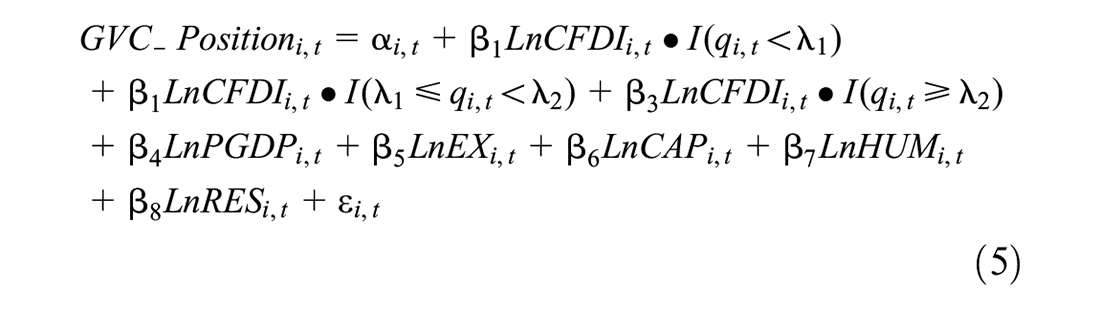
In the single threshold model, namely, in Equation 4, the threshold effect of infrastructure level or institutional quality on the effect of Chinese OFDI is measured as β2−β1. In the double threshold model, namely, in Equation 5, the threshold effects are measured as β2−β1 and β3−β2.
Variable and Data Descriptions
Explained Variable
Many scholars use a variety of methods to measure a country’s GVC position, such as the price of export products (Fontagné et al., 2008; Mulder et al., 2009) and the technical content of export products (Lall et al., 2006; Srholec, 2007) based on traditional trade, the “upstream degree” index (Antràs et al., 2012; Fally, 2011), trade value-added (Daudin et al., 2011; Johnson & Noguera, 2012) and indexes calculated based on the value-added trade accounting method (Hummels et al., 2001; Timmer et al., 2014). However, traditional trade statistics cannot truly reflect a country’s gains in trade, cannot eliminate the possible impact of “double counting,” cannot accurately measure a country’s GVC position, and can even lead to the emergence of completely contradictory views. While the “upstream degree” index can effectively measure the division of labor of a country in the GVC, it cannot measure the country’s value-added capacity or GVC position.
Using the value-added trade accounting method, Koopman et al. (2010) divided a country’s total exports into five parts: The domestic value of direct final goods exports, the domestic value of intermediate exports absorbed by direct importers, the domestic value of intermediate goods reexported to third countries, the domestic value of intermediate goods that return via imports, and the foreign value of goods exports. The specific decomposition is shown in Figure 1.
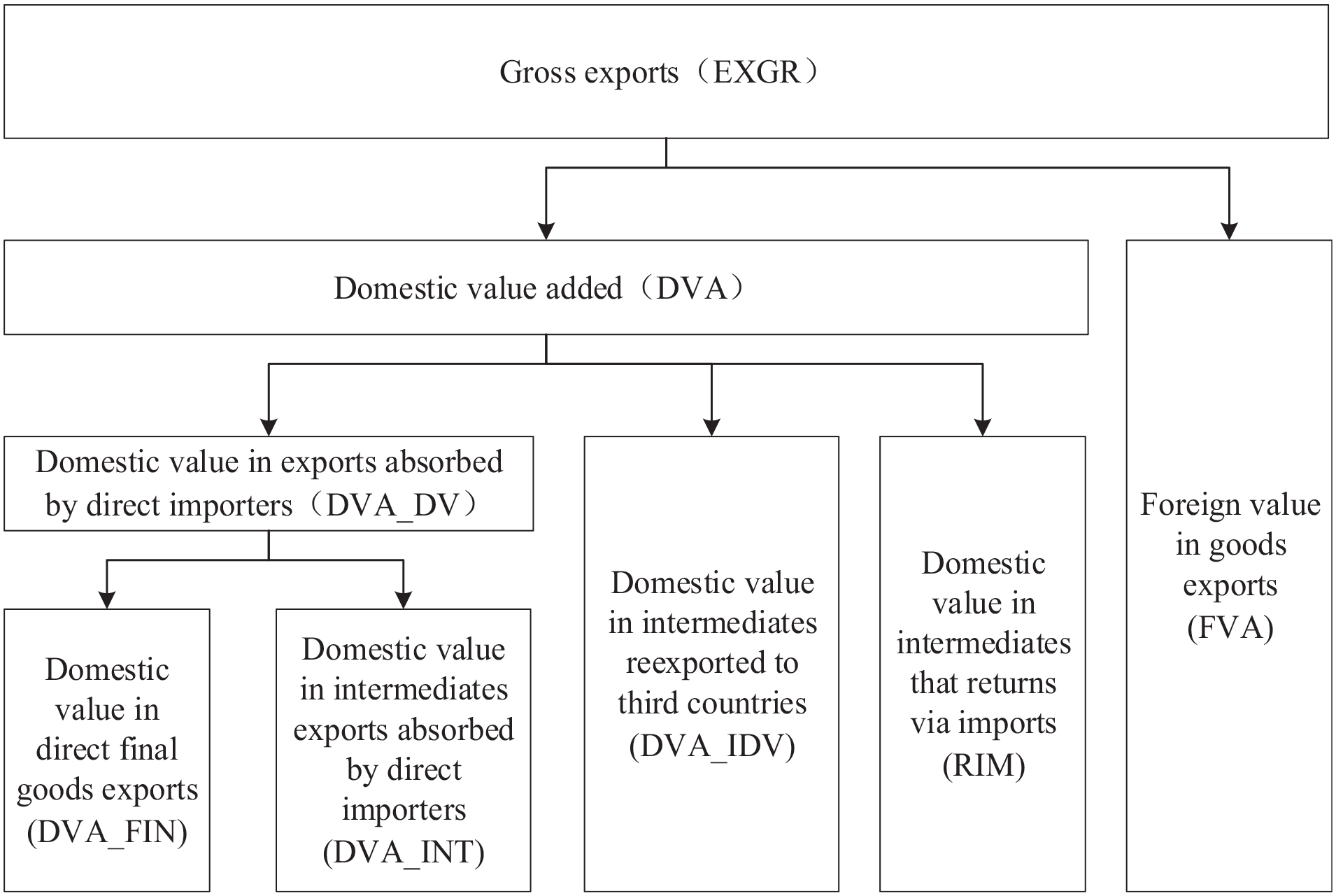
Total export value-added decomposition framework.
Based on the decomposition of total exports, Koopman et al. (2010) constructed a GVC position indicator, which is shown in Equation 6.

where GVC_Position represents a country’s GVC position index value; IV represents the added value of indirect exports, namely, the item DVA_IDV in Figure 1; FV represents the value-added of a country’s exports including foreign value-added, namely, the item FVA in Figure 1. E represents the total exports of a country calculated using value-added, namely, the item EXGR in Figure 1. Therefore, Equation 6 can be rewritten as follows:

This index not only measures the GVC position of a country but also explains its capacity for value-added. Therefore, an increasing number of scholars have used this index to measure a country’s GVC position.
This paper uses the calculation method of Koopman et al. (2010) and the UIBE GVC Index database established by University of International Business and Economics based on the multi-country input-output table published by Asia Development Bank to measure B&R countries’ GVC positions. Please refer to Supplemental Table A1 for the GVC position index of each B&R country during the year from 2010 to 2017.
Core Explanatory Variable and Control Variables
The core explanatory variable is Chinese OFDI in B&R countries. In this paper, the stock of Chinese OFDI in B&R countries is selected as proxy variable. There are five control variables in this paper. This paper uses the per capital GDP of B&R countries as a proxy variable for consumption demand, gross export as a proxy variable for export demand, the total fixed assets as a proxy variable for material capital levels, the human capital index as a proxy variable for human capital levels and the percentage of total natural resource rents to GDP to measure the natural resource endowment.
Threshold Variables
The threshold variables in this paper include infrastructure level and institutional quality of B&R countries. According to the definition of World Bank, infrastructure includes many dimensions, such as transportation, communication and energy. To accurately measure infrastructure level, this paper uses the method of Démurger (2001) and adopts the following three indicators: Transport infrastructure (TRN), which uses the quality of transport port infrastructure as a proxy variable for transport infrastructure, is derived from WDI database of World Bank; Information infrastructure (MFR), which uses the proportion of the number of people using the internet to total population as a proxy variable for information infrastructure, is derived from WDI database of World Bank; Energy infrastructure (ENG), which is measured by energy use per capita, is also derived from WDI database of World Bank. To avoid measurement error caused by simple summation, we refer to the study of H. Wang and Zhong (2021) and adopt the entropy weight method to construct a comprehensive index to reflect the infrastructure condition of B&R countries in this paper. Additionally, many indicators can reflect a country’s institutional quality, but in considering how institutional quality of B&R countries affects Chinese OFDI, this paper follows H. Wu et al. (2020) and Kouadio and Gakpa (2022), and chooses the Worldwide Governance Indicators (WGI) to measure institutional quality. This index comes from World Bank database. Please refer to Supplemental Tables A2 and A3 for the infrastructure levels and institutional quality of each B&R country during the year from 2010 to 2017, respectively.
All variable descriptions and data sources are shown in Table 1.
Variable Description and Data Sources.
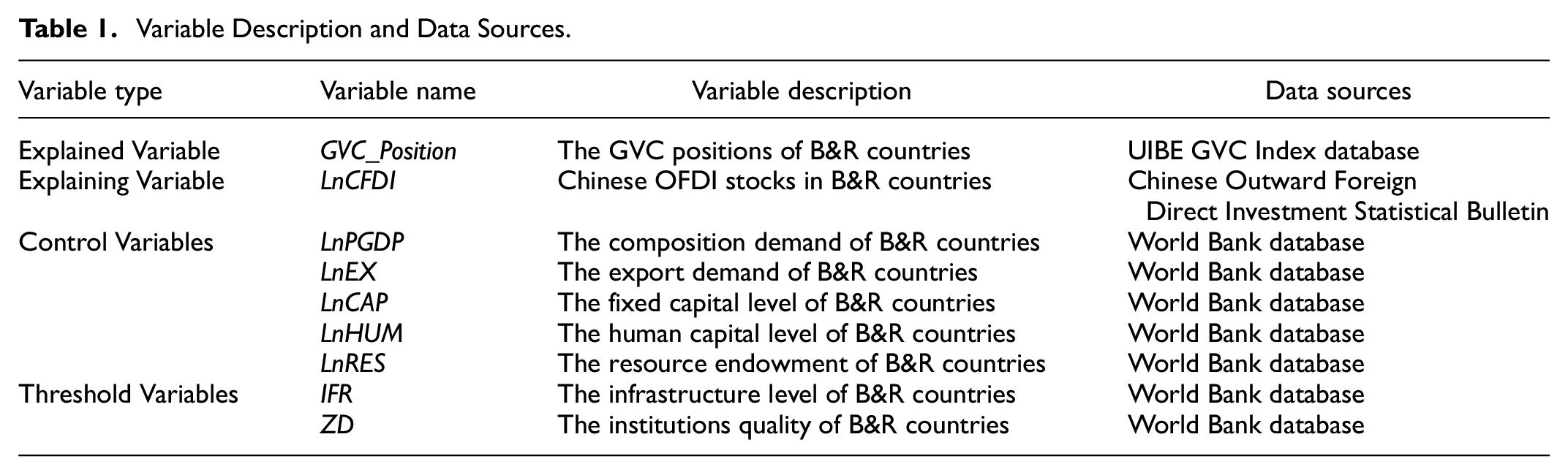
The number of countries and regions included in UIBE GVC Index database is 63, of which the number of B&R countries is 34 (The number of B&R countries announced by China’s official Belt and Road portal is 65 in total). Whether each country and region belongs to B&R countries is shown in Table 2.
A List of Countries/Regions of the UIBE GVC Index Database.

Considering that the data of Laos, Bhutan, and Maldives are seriously missing, this paper selects national level panel data on the remaining 31 B&R countries from 2010 to 2017 for research. The descriptive statistics of main variables are shown in Table 3.
The Descriptive Statistics of the Main Variables.

Empirical Analyses
Stationarity Test for Variables
The variables need to be tested by the LLC, ADF, and PP methods before performing the regression. The results show that all the variables are stationary. Table 4 shows the results.
The Stationarity Test of the Variables.

p < .1. **p < .05. ***p < .01.
The Panel Data Regression Model Results
This paper uses fixed-effects model and random-effects model to examine the effect of Chinese OFDI on GVC positions of B&R countries by estimating Equations 1 and 2 in STATA 15.0. Table 5 shows the results.
The Regression Results for the Panel Data Models.

Note. Standard errors are in parentheses.
p < .1. **p < .05. ***p < .01.
The regression results remain nearly the same under the fixed-effects model and random-effects model in both Equations 1 and 2 in Table 5. And, the Hausmann test results show that it is more appropriate to select a random-effects model for analysis.
In Equation 1, the regression coefficient of LnCFDIi,t is 0.0058 and significant positive under random-effects model, which implies that the value of B&R countries’ GVC position index increases by 0.0058 units for each 1% increase in Chinese OFDI. In Equation 2, the regression coefficient of LnCFDIi,t is also significant positive (0.0128) under random-effects model, which implies that the GVC position index of B&R countries increases by 0.0128 units for each 1% increase in Chinese OFDI. It indicates that Chinese OFDI can significantly promote the improvement of B&R countries’ GVC positions, which confirms the research hypothesis H1. Similarly, Mayer and Phillips (2017) provide a more nuanced view which fits well with our overall findings. In addition, the regression coefficients of LnPGDPi,t, LnEXi,t, LnCAPi,t, LnHUMi,t, and LnRESi,t are 0.0612, −0.0983, 0.0817, 0.0767, 0.0230, respectively, and each is highly significant. This implies that the increase of consumption demand, material capital and human capital of B&R countries, as well as with higher natural resource endowment are all conducive to promoting B&R countries to climb along GVCs, and the conclusion is consistent with the study of Torrecillas and Martínez (2022), while the increase of export demand is not conducive to promoting B&R countries’ GVC positions. It is consistent with the above analysis.
Considering that the above conclusion may be affected by the measurement error of GVC positions index of B&R countries. To make the above conclusions more persuasive, this paper adopts upstream index proposed by Antràs et al. (2012) as a substitute index to carry out robustness test, and uses the random-effects model to carry out regression in both Equations 1 and 2 under Hausmann test. The regression results are shown in Table 5. The regression coefficients of LnCFDIi,t are also positive. It indicates that the regression results do not substantially change the above conclusions after the variable substitution, which means that the estimation results are relatively robust.
Additionally, the regression results from the dynamic panel data model, namely, the regression results for Equation 3, are also shown in Table 5. First, whether under first-difference GMM or system GMM estimation method, the estimation coefficient of the first-order lag term of GVC position index is significantly positive, which indicates that the first-order lag term has significantly positive impact on current GVC position index, and the GVC position index is sustainable. Second, both the estimation coefficients of current Chinese OFDI and the first-order lag term of Chinese OFDI are also significantly positive, which indicates that Chinese OFDI has a dynamic effect on improving GVC position index of B&R countries. Finally, whether under first-difference GMM or system GMM estimation method, the regression coefficients of control variables are consistent with the results from the random-effects model above.
Test and Estimate Threshold Values
In this paper, the grid search method of Hansen (2000) is adopted for testing and estimating zero, one, two, and three thresholds for infrastructure level and institutional quality successively in double threshold model. After Lagrange multiplier testing, the F-statistics and corresponding bootstrapped p-values can be obtained. Table 6 shows the values.
The Results of the Threshold Tests.

p < .1. **p < .05. ***p < .01.
As shown in Table 6, when taking infrastructure level of B&R countries as threshold variable, the F-statistic is 19.61, which is larger than the critical value of 18.8146 at the 10% significance level under the null hypothesis of zero thresholds, and the corresponding bootstrapped p-value is .0667, so the null hypothesis of zero thresholds is rejected. In the test for two thresholds, the F-statistic is 13.75, which is larger than the critical value of 10.6003 at the 5% significance level under the null hypothesis of a single threshold, and the corresponding bootstrap p-value is .0167, so the null hypothesis of a single threshold is also rejected. Last, in testing for three thresholds, the F-statistic is 7.85, which is not larger than the critical value of 38.4416 at the 10% significance level under the null hypothesis of a double threshold, and the corresponding bootstrapped p-value is .9833, so the null hypothesis of a double threshold is not rejected. Therefore, there are two thresholds in infrastructure level of B&R countries. Following the same test method, two thresholds for institutional quality of B&R countries are also found.
After that, all the threshold values for infrastructure level and institutional quality and the corresponding 95% confidence interval are estimated, as shown in Table 7. All the second values are greater than all the corresponding first values for each threshold variable, and all the values are reasonable.
The Estimates of the Thresholds and Corresponding Confidence Intervals.

The Threshold Model Regression Results
This paper divides infrastructure level and institutional quality of B&R countries into three ranges according to the two corresponding thresholds. The coefficients of the explanatory variables were obtained by applying fixed-effects model and random-effects model. Table 8 shows the regression results.
The Regression Results of the Threshold Model.

Note. Standard errors are in parentheses.
p < .1. ***p < .01.
The regression results remain nearly the same under fixed-effects model and random-effects model, as shown in Table 8. And, the Hausmann test results show that it is still more appropriate to select random-effects model for regression.
When taking infrastructure level as threshold variable, the regression coefficients of LnCFDIi,t are significantly positive under random-effects model. As the infrastructure level successively exceeds the two thresholds, the estimated elasticity increases from 0.0088 to 0.0122 and then increases to 0.0128. The threshold effects of infrastructure level are 0.0034 and 0.0006. This means that when infrastructure level exceeds the first threshold value but does not exceed the second threshold, the effect of Chinese OFDI on improving GVC positions of B&R countries increases by 0.0034 units. When infrastructure level exceeds the second threshold, the positive effect of Chinese OFDI increases by 0.0006 units. When taking institutional quality as threshold variable, the regression coefficients of LnCFDIi,t are also significantly positive under random-effects model. As institutional quality successively exceeds the two thresholds, the estimated elasticity decreases from 0.0148 to 0.0100 and then decreases to 0.0063. The threshold effects of institutional quality are −0.0048 and −0.0037. This means that when institutional quality exceeds the first threshold value but does not exceed the second threshold, the effect of Chinese OFDI on improving GVC position of B&R countries falls by 0.0048 units. When institutional quality exceeds the second threshold, the positive effect of Chinese OFDI falls by 0.0037 units. The results imply that the effect of Chinese OFDI on improving GVC positions of B&R countries becomes more and more big when infrastructure level successively exceeds the first and the second thresholds, and the promotion effect of Chinese OFDI is slightly reduced when institutional quality successively exceeds the two thresholds. The regression results of the threshold model confirm the research hypothesis H2 and hypothesis H3.
Further Discussion
According to the two threshold values of the two threshold variables and Combined with the calculated values of B&R countries’ infrastructure level and institutional quality, B&R countries are divided into three groups. Table 9 reports the number of B&R countries in different threshold ranges during the year from 2010 to 2017.
The Number of B&R Countries in Different Threshold Groups by Year.

From Table 9, we can observe that there are seven B&R countries with infrastructure levels below the first threshold value, 24 countries’ infrastructure levels are between the first threshold value and second threshold value, and no country has an infrastructure level over the second threshold value in 2010. Then, there are four countries with infrastructure levels below the first threshold value, about 25 countries’ infrastructure levels are between the first threshold value and second threshold value, and about two countries with infrastructure levels over the second threshold value during the period of 2011 to 2013. Since the Belt and Road Initiative was put forward at the end of 2013, the infrastructure level of B&R countries has made great progress. From 2014 to 2017, the number of countries with infrastructure levels below the first threshold value fell from 7 to 2, and the number of countries with infrastructure levels between the first threshold value and second threshold value fell from 16 to 13, the number of countries with infrastructure levels over the second threshold value increased from 8 to 16.
Additionally, we observe that the number of B&R countries in different institutional quality threshold ranges is basically the same in 2010. There are 10 countries with institutional quality levels below the first threshold value, 10 countries’ institutional quality levels are between the first threshold value and second threshold value, and 11 countries with institutional quality levels over the second threshold value. As time passes, from 2010 to 2017, the number of countries with institutional quality levels below the first threshold value fell from 10 to 6, and the number of countries with institutional quality levels between the first threshold value and second threshold value increased from 10 to 16, while the number of countries with institutional quality levels above the second threshold value changed little, which fell from 11 to 9.
The above results show that infrastructure levels of B&R countries have been greatly improved. The reason is that infrastructure connectivity is an important part of the Belt and Road Initiative. Under this Initiative, more and more B&R countries are accelerating their infrastructure construction, and China also supports the infrastructure construction through financial support. According to the data of Chinese foreign infrastructure investment published in Belt and Road Infrastructure Development Index Report 2018, the value of new contracts signed by Chinese enterprises in B&R countries reached 144.3 billion US dollars in 2017, accounting for 54.4% of the newly signed contracts in the same period, and the completed turnover reached 85.5 billion US dollars, accounting for 50.7% of the total in the same period. These data well reflect that a considerable number of Chinese OFDI has participated in infrastructure construction, which has improved infrastructure levels of B&R countries. Combined with the threshold model analysis, it can be seen that the role of Chinese OFDI in enhancing B&R countries’ GVC positions is gradually increasing. However, there are still nearly half of B&R countries whose infrastructure levels have not exceeded the second threshold value. It indicates that there is still room for B&R countries further improving infrastructure levels to obtain more spillover effects of Chinese OFDI to improve GVC positions. Moreover, the overall institutional quality level of B&R countries is also gradually improving. However, compared with infrastructure level improvement, the improvement of institutional quality is small, and most of Chinese OFDI still flows into B&R countries with relatively lower institutional quality. Therefore, on the whole, the effect of Chinese OFDI on improving B&R countries’ GVC positions is not much diminished.
Conclusions and Policy Recommendations
In this paper, we utilize national-level panel data of 31 B&R countries from 2010 to 2017 to study the impact of Chinese OFDI on the GVC positions of B&R countries and the threshold effects of infrastructure level and institutional quality. Conclusions are drawn from the empirical results.
On the whole, Chinese OFDI inflows can improve the GVC positions of B&R countries, but this effect is affected by infrastructure level and institutional quality of B&R countries. Infrastructure level and institutional quality both have double threshold effects on the effect of Chinese OFDI on improving the GVC positions of B&R countries. When the infrastructure level improves and successively exceeds the first and the second thresholds, the improving effect of Chinese OFDI gradually increases, but when the institutional quality improves and successively exceeds the first and the second thresholds, the improving effect of Chinese OFDI gradually decreases. Moreover, there are about half of B&R countries whose infrastructure levels have not exceeded the second threshold. There is still room for further improvement in infrastructure levels of these countries, so as to obtain more spillover effects of Chinese OFDI to enhance GVC positions. In terms of institutional quality, the overall institutional quality is gradually improving, but the improvement is not significant, and even the institutional quality level of some countries does not rise but declines. Generally, the improvement of institutional quality does not significantly reduce the effect of Chinese OFDI on improving the GVC positions of B&R countries. Based on the empirical conclusions, some policy recommendations have been put forward.
First, China should unswervingly continue to implement the Belt and Road Initiative and carry our “going out” strategy, strengthen governance of Chinese OFDI in B&R countries, strengthen the all-round, multi-level and wide-ranging international cooperation with B&R countries and increase Chinese OFDI in B&R countries, which will lay a foundation for effectively exerting the effect of Chinese OFDI in enhancing the GVC positions of B&R countries.
Second, strengthen policy communication and promote investment facilitation. The above empirical results show that Chinese OFDI can effectively enhance the GVC positions of B&R countries. Therefore, China and B&R countries need to actively strengthen policy communication, promote the signing of bilateral investment cooperation agreements between China and B&R countries, and eliminate investment barriers, so as to improve the facilitation level of Chinese enterprises’ investment in B&R countries, so that the more and high-quality Chinese OFDI flows into B&R countries, improving investment efficiency, enabling Chinese OFDI to drive B&R countries to get rid of low-end GVCs and promote GVC upgrade.
Third, further promote the improvement of the infrastructure level of B&R countries. The threshold model regression shows that Chinese OFDI has a greater effect on improving the GVC positions of B&R countries with relatively higher infrastructure levels. The infrastructure level of B&R countries is currently uneven, and the infrastructure level of most B&R countries still has room for further improvement. Therefore, China can use the joint construction of the Belt and Road platform to advocate B&R countries to vigorously build infrastructure and encourage Chinese enterprises to focus on investing in infrastructure fields such as transportation, energy, and communications in B&R countries, so as to improve the infrastructure interconnection of B&R countries. Additionally, make full use of cooperation platforms such as the Asian Infrastructure Investment Bank and the Silk Road Fund to promote financial cooperation and financial integration among B&R countries, and provide financial support for infrastructure construction of B&R countries, especially actively provide financial support to B&R countries with poor infrastructure levels, so as to ensure that B&R countries can obtain more spillover effects of Chinese OFDI to improve their GVC positions.
Fourth, China should pay attention to the institutional quality of B&R countries when investing in them. From the above analysis, it can be seen that Chinese OFDI has a greater effect on improving the GVC positions of B&R countries with relatively lower institutional quality. Therefore, to better exert the effect of Chinese OFDI in improving the GVC positions of B&R countries, Chinese enterprises should prefer to invest in the B&R countries with relatively lower institutional quality. For the B&R countries with higher institutional quality, China should follow the principle of mutual benefit and win-win, transform the advantages of Chinese OFDI in production capacity, capital and technology into market and cooperation advantages, carry out extensive international cooperation, reduce the impact of institutional quality on Chinese OFDI spillover effect, and promote GVC upgrading in B&R countries.
Supplemental Material
sj-doc-1-sgo-10.1177_21582440231158027 – Supplemental material for An Empirical Study on the Impact of Chinese OFDI on the Global Value Chain Positions of Countries Along the Belt and Road and Threshold Effects
Supplemental material, sj-doc-1-sgo-10.1177_21582440231158027 for An Empirical Study on the Impact of Chinese OFDI on the Global Value Chain Positions of Countries Along the Belt and Road and Threshold Effects by Hui Wang and Xin Zhong in SAGE Open
Footnotes
Declaration of Conflicting Interests
The author(s) declared no potential conflicts of interest with respect to the research, authorship, and/or publication of this article.
Funding
The author(s) disclosed receipt of the following financial support for the research, authorship, and/or publication of this article: This research is supported by the Guangdong Basic and Applied Basic Research Foundation (No. 2021A1515110044), the Major Program of National Social Science Foundation of China (No. 19ZDA100) and the Special Program of National Social Science Foundation of China on “Belt and Road” Construction (No. 19VDL012).

Supplemental Material
Supplemental material for this article is available online.
References
Supplementary Material
Please find the following supplemental material available below.
For Open Access articles published under a Creative Commons License, all supplemental material carries the same license as the article it is associated with.
For non-Open Access articles published, all supplemental material carries a non-exclusive license, and permission requests for re-use of supplemental material or any part of supplemental material shall be sent directly to the copyright owner as specified in the copyright notice associated with the article.
