




Abstract
This study analyzes the effect of urban digital economy (UDE) development on manufacturing innovation efficiency from the perspectives of urban industrial agglomeration and government subsidies, using mixed panel data of Chinese cities and A-share manufacturing listed companies from 2011 to 2019. This study reveals the following findings: (1) There is a threshold effect of government subsidies and industrial agglomeration on the impact of UDE on the innovation efficiency of listed manufacturing industries. Quantitatively, the study identifies two thresholds for industrial agglomeration (−3.7468 and −1.5172) and two thresholds for government subsidies (16.6139 and 18.2936). (2) The impact of UDE on the innovation efficiency of the manufacturing industry is significantly enhanced with the increase in the level of urban industrial agglomeration. (3) The threshold effect of government subsidies is evident when the impact becomes more pronounced as government subsidies increase. Finally, we find regional and firm size heterogeneity in the effects from government subsidies and industrial agglomeration. This study broadens the scope of the study by considering government subsidies at the firm level and industrial agglomeration at the city level. There is a nonlinearity in the effect of UDE on manufacturing innovation efficiency. This finding enriches the theoretical framework of the relationship between UDE and firms’ innovation efficiency. Meanwhile, the findings provide clear guidance for policymakers: in the process of promoting the integration of the digital economy and the manufacturing industry, attention should be paid to optimizing the industrial agglomeration environment and the rational allocation of government subsidy resources.
Keywords
Introduction
The Chinese economy has entered a new normal phase of transformation and development (Guo et al., 2024; Jin et al., 2023). The digital economy (DE) has emerged as a pivotal driver of economic growth and innovation. With the rapid advancement of information and communication technologies (ICT), the digital economy has transformed traditional industries and created new opportunities for businesses and governments alike. China, as one of the world’s largest economies, has also taken a leading role in this digital transformation. Digital technology has accelerated the penetration of digital elements into diverse sectors and fostered their deeper integration with traditional industries (He et al., 2025).
In 2022, China’s DE reached RMB 50.2 trillion, constituting 41.5% of GDP. The Chinese Government has established the goal of integrating the DE with the real economy and accelerating the digitization of the manufacturing industry. At the national level in China, the government has declared the goal of using the DE to drive the development of the manufacturing sector, which suggests that the development of the digital economy mainly involves the development of high-tech industries and modern services (L. Liu et al., 2022). This objective has facilitated the development of industrial innovation clusters and accelerated the process of high-tech transformation of traditional industries in China.
Previous studies have mainly focused on the role of the digital economy at the micro-level, examining its impact on individual firms and their employees. For instance, Choudrie and Dwivedi (2006) found that ICT infrastructure can significantly enhance firms’ innovation by improving efficiency and reducing costs. Similarly, Rampersad and Troshani (2013) emphasized the importance of ICT investment policies in shaping technological capabilities and fostering innovation within organizations. Gault (2019) argues that digital technology affects innovation-building programs in companies, government departments, and the NPISH sector. Klymchuk et al. (2020) construct a theoretical model of business activity in the context of the DE. Concerning empirical analysis, Watanabe et al. (2018) empirically explore the creative disruptive platforms that can be built by adopting digital solutions across all industries in the DE. Bouncken et al. (2020) used the digital and sharing economy as a research framework to explore how coworking spaces can improve innovation efficiency. Sreckovic (2020) empirically analyzes organizational innovation in the DE. These studies cut through the lens of the DE and examine its impact on businesses, business innovation or individual business employees. Instead, they have not considered the impacts at the macro level of cities and the micro level of firms.
X. Huang et al. (2022) find that the development of the UDE contributes significantly to urban innovation. The development of the UDE has provided enterprises with advanced innovative environments (Malecki & Moriset, 2007). In the era of DE, enterprises can obtain and analyze data such as market information, customer demand, and technology development trend more efficiently by virtue of cloud computing and other technologies, which provides strong support for enterprise innovation (Gaglio et al., 2022). Simultaneously, the DE promotes cross-border integration among enterprises and industries, providing a broader space for corporate innovation. Therefore, several scholars have explored the impact of innovation activities of firms in the DE (Rachinger et al., 2019), its role in business model innovation (R. Li et al., 2022), and the role of digital transformation in firms’ innovation activities (Mancha & Shankaranarayanan, 2021). G. Chen et al. (2022) assert that developing an urban digital economy can improve environmental, social, and governance performance by increasing the intensity of firms’ innovation inputs and improving their innovation output capabilities. Peng et al. (2023) analyze the impact of the DE on firm innovation when firms face financing constraints. These studies provide valuable insights into the micro-level impact of the DE on firm innovation. However, they primarily focus on the firm level and do not systematically consider the city-level factors that may influence innovation efficiency. This gap in the literature highlights the need for a more comprehensive approach that integrates both city-level and firm-level perspectives. In China, the government guides the development of the DE. The DE is being piloted in the city first, with the government introducing relevant target industries to develop the DE and related industries. This has led cities to focus on digital economy-related industries when formulating their DE development goals, thus creating an industry clustering effect (K. Wu et al., 2023). This industry clustering effect is a key factor in understanding the impact of the UDE on manufacturing innovation efficiency. While previous studies have examined the role of industrial agglomeration in fostering innovation (e.g., Carlino & Kerr, 2015; Yang et al., 2021), they have not explicitly linked the development of the UDE to the formation of industrial clusters and their subsequent impact on innovation efficiency. This study aims to fill this gap by exploring the threshold effects of industrial agglomeration and government subsidies on the relationship between UDE and manufacturing innovation efficiency.
The formation of industrial clusters through digital economy policies has several implications for innovation efficiency. First, the industrial agglomeration effect can cause urban specialization, division of labor, and labor inflow (S. Zhang et al., 2023), thus providing cities with human resources and laying the foundation for innovation. Secondly, industrial agglomeration clusters enterprises with different knowledge backgrounds together, which facilitates the exchange of knowledge among them and leads to innovation through knowledge collision (Yu et al., 2023). This aligns with the Marshall-Arrow-Romer (MAR) externalities theory, which suggests that the concentration of similar firms in a region can enhance knowledge spillovers and innovation through increased interactions and competition. Finally, industrial agglomeration can also lead to intense market competition among homogeneous types of firms. Meanwhile, enterprises must increase product development and innovation to avoid being eliminated by the market, which compels them to innovate. To survive and thrive, enterprises are compelled to increase their investment in product development and innovation. This competitive pressure is consistent with Porter's (1985) competitive advantage theory, which suggests that intense competition drives firms to innovate to maintain their market positions. Despite these potential benefits, the impact of industrial agglomeration on innovation efficiency is not uniform. When the level of industrial agglomeration in the city where the enterprise is located is not high, then the above advantages are not obvious, resulting in no significant impact on enterprise innovation. Conversely, as the level of industrial agglomeration increases, the benefits of clustering become more pronounced, leading to significant improvements in innovation efficiency. This non-linear relationship between industrial agglomeration and innovation efficiency suggests the presence of threshold effects, which are critical to understanding the impact of the UDE on manufacturing innovation efficiency.
The Chinese government grants various subsidies and fiscal policies to capture the innovation dividends effected by the development of the DE. To realize innovation incentives for enterprises, the scope of state subsidies for the digital economy industry has been expanding, including innovation incentive subsidies and research and development (R&D) investments (Liang & Li, 2023). Regarding provincial-level digital economy subsidy policies, Guangdong, Guizhou, Shanghai, and many other regions have introduced financial subsidy policies for digital economy segments, such as big data. Five provinces–Hebei, Shanxi, Hubei, Shandong, and Anhui–have introduced special financial subsidy policies encompassing the entire DE industry to better develop the DE. The Wenzhou DE policy on the enterprise scale, R&D platform construction, and other aspects of the subsidy are extensive, proposed by the enterprise tax contribution of up to 20-million-yuan subsidy, integrated circuit manufacturing, sealing, and testing type of project according to the actual investment of 15% of the subsidy, and maximum of 20 million yuan. Fuzhou in the enterprise digital transformation, public platform construction subsidies, intelligent equipment production enterprise technological transformation incentives of up to 8 million yuan, to support the digital economy industry leading enterprises to build public service cloud platforms, big data centers, software innovation centers, and maximum subsidies of 10 million yuan. (The above data are obtained from the official websites of the governments of the provinces and cities.)
Therefore, it is of practical significance for this paper to analyze the impact of UDE development on the innovation efficiency of Chinese manufacturing listed companies from the perspectives of industrial agglomeration at the city level and government subsidies at the firm level. It broadens the scope by considering these two aspects. Simultaneously, considering the heterogeneity of regions and enterprise sizes can lead to more effective and targeted solutions. This study also provides a theoretical basis for the Chinese government to formulate relevant policies. In this context, the present study aims to fill this gap by examining the impact of UDE development on manufacturing innovation efficiency, with particular focus on the roles of industrial agglomeration and government subsidies. By integrating both city-level and firm-level perspectives, this study provides a comprehensive analysis of the mechanisms through which the digital economy influences innovation efficiency in the manufacturing sector. The findings of this study not only enrich the theoretical framework of the relationship between the UDE and firm innovation efficiency but also offer valuable insights for policymakers aiming to optimize industrial agglomeration and government subsidy policies.
Theoretical Analyses
Industrial Agglomeration Perspective
In the early stages of the development of the digital economy (DE), the low level of industrial agglomeration may have a negative impact on the innovation of enterprises. The industrial agglomeration formed at the early stage of the development of the DE may have a crowding-out effect (C. Chen et al., 2020; X. Li et al., 2021). This is mainly due to the increased competition among homogenized firms in order to survive. This crowding-out effect may adversely affect enterprise innovation. The crowding effect can cause problems such as rising prices of factors of production, shortages of infrastructure and raw materials in the agglomeration area, and requiring enterprises to compete for limited factors of production to ensure their development, leading to vicious competition (Lanz & Gasser, 2013). This environment hampers cooperation and knowledge dissemination among firms, thereby creating a closed innovation ecosystem that is detrimental to innovation. Additionally, knowledge and technology spillovers from DE development may not be conducive to innovation if they spread to regions with weak intellectual property (IP) protection. Firms in these regions may gain short-term economic benefits through imitation, but this undermines their long-term innovation incentives (S. Li & Wang, 2022). However, as the level of industrial agglomeration increases, the benefits of clustering become more pronounced. The development of the DE drives the agglomeration of related industries, facilitating mutual communication and learning among firms. This learning effect promotes the accumulation of technical knowledge, providing a foundation for technological innovation (You et al., 2021). Firms in agglomerated regions also face intense market competition, which compels them to innovate to maintain their market share (X. Zhang & Zhou, 2022). Moreover, the clustering effect attracts R&D factors and reduces the cost of matching production factors, enhancing the spread and accumulation of innovative factors (W. Pan et al., 2022). This not only allows companies to obtain the required factors of production in a timely manner but also reduces the cost of finding a match for the required factors of production. Simultaneously, the free flow of factors of production drives the exchange of knowledge among enterprises, thus accelerating the spread and accumulation of innovative factors of production. This exchange of knowledge establishes a good innovation environment for enterprises, facilitating the generation of innovative ideas and ultimately improving the efficiency of enterprise innovation. This creates a conducive environment for innovation, which aligns with the Marshall-Arrow-Romer (MAR) externalities theory and Porter’s competitive advantage theory.
Regional differences and firm size also play a role in the effectiveness of industrial agglomeration. Cities in the eastern region, with higher levels of DE development and industrial agglomeration, are more likely to benefit from these positive effects, while cities in the middle and western regions may lag behind due to fewer high-tech industries and lower levels of agglomeration (S. Li & Wang, 2022).
In summary, there is a threshold effect of industrial agglomeration in the impact of UDE on manufacturing innovation efficiency.
Government Subsidy Perspective
The threshold effect of government subsidies is as follows. First, the Chinese government dominates the digital economy policy and provides government subsidies to enterprises that conduct digital economy activities; thus, government subsidies exhibit the power of government intervention (Xiang, 2023). This government intervention forces manufacturing enterprises, in the context of market imperfections, to obtain a certain amount of government subsidies. This subsidy may be allocated toward profitability goals rather than R&D investment for innovation, or may be used for social goals, thereby weakening the incentive for enterprise innovation. When government subsidies continue to increase and are used more for enterprise R&D and innovation, enterprises have more funds to invest in innovative factors of production and stimulate innovation. Therefore, government subsidies have a threshold effect. This effect only manifests itself when government subsidies reach a certain level.
Second, the impact of government subsidies on innovation efficiency is complex and multifaceted. On one hand, when the amount of government subsidies is low, firms may allocate these subsidies to non-innovation activities, driven by short-term profit motives or other constraints. In such cases, the subsidies do not significantly contribute to innovation efficiency. On the other hand, as the subsidies increase, firms are more likely to have sufficient resources to invest in R&D and innovation activities. This increased investment can lead to higher innovation efficiency by enabling firms to develop new technologies, products, and processes.
Moreover, the effectiveness of government subsidies in promoting innovation efficiency also depends on the firm’s internal capabilities and external environment. Firms with strong R&D capabilities and effective management systems are more likely to utilize the subsidies efficiently for innovation. Additionally, the presence of a supportive innovation ecosystem, such as access to skilled labor, advanced infrastructure, and a favorable regulatory environment, can enhance the positive impact of subsidies on innovation efficiency.
However, there may have been policy failures regarding government subsidies. Government subsidies may crowd out firms’ R&D funds and resources in the short term (Boeing, 2016). Although firms that receive government subsidies may conduct innovative activities in the form of R&D expenditure, this precludes a lasting and effective incentive to innovate (Bronzini & Iachini, 2014). Q. Huang et al. (2016) found that when the amount of government subsidies is low, the impact on firm innovation is insignificant; however, the impact becomes significant when the subsidies are higher. Simultaneously, the amount of government subsidies varies by firm size, industry, and region (Bronzini & Piselli, 2016; Choi & Lee, 2017), thus indirectly affecting firm innovation.
Finally, when firms receive large subsidies, the “crowding-out effect” of financialization can outweigh the “reservoir effect,” thus negatively affecting firms’ innovation (Tao et al., 2021). Firms are more likely to face higher R&D risks when they receive large subsidies (J. Chen et al., 2018), which may leave them in need of more R&D resources to support their innovation activities. However, the level of financialization at this point is more likely to crowd out firms’ insufficient R&D and innovation resources.
Thus, from the perspective of government subsidies, the relationship between the DE and corporate innovation is characterized by the role of government subsidies as a “threshold.”
Methodology
When analyzing nonlinear relationships, the panel threshold model avoids the subjective delineation factor and provides a more accurate estimation of nonlinear relationships. We refer to Hansen’s (1999) approach to the model setting, which assumes the existence of a single-panel threshold.

where

From Equation 2, Equation 1 can be expressed as follows:
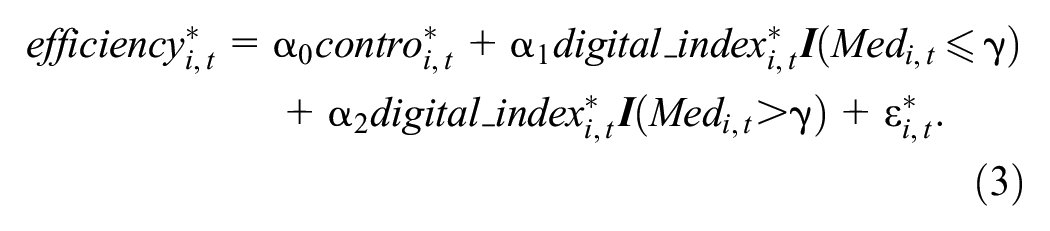
We further rewrite Equation 3 in matrix form:


At this point, the residual sum of squares (RSS) is obtained as

where

This yields

After obtaining the parameter estimates, it is necessary to test whether the threshold effect is significant. To verify that it is significant, the original hypothesis is
If there is a double threshold or multiple thresholds in this study, in the case of double thresholds, for example, the panel threshold model can be extended based on Equation 1 as

In Equation 9, the estimated

In turn, we can get the threshold value for the second step as

In this case,
Data
Explained Variable
The explained variable is the innovation efficiency of listed manufacturing enterprises (efficiency). The specific measurement method is obtained by adopting the method of Wang et al. (2022), using R&D input and number of R&D personnel as input, and patent authorization as output, and using heterogeneous stochastic frontier analysis (SFA) method.
Explanatory Variable
The core explanatory variable is the level of development of the UDE (digital). We refer to the indicator system of H. Liu and Li (2023) and use the entropy weight method to calculate the specific value of each city for that year to measure the level of digital economy development.
Threshold Variables
Industrial agglomeration (aggl): Considering the availability of data for Chinese cities, we adopt the indicators in Y. Zhou and Li (2023) and use the locational entropy measure to obtain city-level industrial agglomeration levels. We logarithmically process the values obtained from the measure. Government Subsidies (gov_subsidy): A measure of R&D subsidies received by listed manufacturing firms during the year, taken in logarithms.
Control Variables
The control variables at the city level are selected as follows: 1) Level of industrial structure (is), the methodology in Y. Zhou and Li (2023 was adopted, using the tertiary industry to secondary industry ratio measure. In regions with a more rational industrial structure, resources are fully utilized, and the complementarity between different industries is fully exploited, providing sufficient resource support for innovation. The industrial structure of the city directly affects the innovation input and output efficiency of manufacturing enterprises by optimizing resource allocation, promoting knowledge spillover, and facilitating technology exchange. This, in turn, enhances the innovation efficiency of the manufacturing industry. 2) Industrial structure transformation, where the industrial structure advanced (advan) and rationalization (ration) are obtained by using the methods constructed in the literature of Xiong and Li (2022). Industrial structural transformation is often accompanied by an increase in new industries. This provides new development opportunities for enterprises, especially in emerging industries, where they can rapidly adapt to new market environments by changing their product structure and technological developments, thereby improving their innovation capacity. The transformation of industrial structure has led to cross-fertilization between different industries, providing more exchange opportunities for enterprises (M. Li & Li, 2017). The cross-fertilization of different industries generates new technologies and management models from which enterprises can draw inputs to enhance their innovation capacity. An advanced and rationalized urban industrial structure significantly improves manufacturing innovation efficiency by optimizing resource allocation, promoting technological upgrading and knowledge spillover, and enhancing both the innovation input efficiency and the innovation output quality of manufacturing enterprises. 3) The level of openness to the outside world (open), which is measured using foreign investment as a share of GDP, referring to the methodology of Y. Zhou and Li (2023. The more open a city is to the outside world, the more it can come into contact with advanced technology and management experience, which can be absorbed and utilized for the enterprise’s innovation activities. At the same time, the opening of the city to the outside world enhances the spillover effect of knowledge and technology and stimulates the innovation of enterprises. 4) The level of urban development (dep), measured by the logarithm of GDP per capita. The higher the level of development a city has, the greater the environmental input for high-level talent to engage in innovation and entrepreneurship. Consequently, this results in higher financial support for firms to carry out innovative activities, which in turn favors innovation output (Galindo & Méndez, 2014). 5) Scientific research (sci), measured by fiscal expenditure on scientific endeavors as a share of GDP. City-level scientific research can significantly enhance urban innovation (Y. Zhou & Li, 2023). Government spending on science and technology allows firms to have more money to spend on R&D and reduces the risk of innovation (Olalere & Mukuddem-Petersen, 2023).
The firm-level control variables are as follows: 6) Firm size (size), measured using the logarithm of the firm’s total assets. Firm size has a dual effect on firm innovation. Large firms, with their abundant resources and strong resistance to risk, usually have an advantage in technological innovation, whereas small firms, with their flexibility and ability to innovate, may have unique innovative advantages in certain areas or aspects (Plehn-Dujowich, 2009). 7) Gearing ratio (lev): Many studies suggest that gearing affects firm innovation (Azim Khan, 2023; C. Li et al., 2023). (8) Return on assets (roa): ROA affects enterprise innovation (Sujud & Hashem, 2017). 9) Financial constraints (fc), measured as the ratio of accounts receivable to total assets. Financing constraints affect firms’ innovation (Guariglia & Liu, 2014). Financing constraints have a significant negative impact on corporate innovation, not only limiting firms’ investment in innovation but also affecting their R&D capabilities and choice of innovative projects, further inhibiting their innovative activities. 10) Total factor productivity (tfp), this indicator is calculated with reference to the methodology of Levinsohn and Petrin (2003). H. Liu and Li (2023 indicate that firms’ total factor productivity affects their innovation efficiency. 11) Cash-to-assets ratio (cash), calculated as the ratio of cash flow to total assets. X. Zhang and Zhou (2022 found that cash flow has a significant impact on corporate innovation. Enterprises must continuously invest funds when engaging in innovative activities. Good cash flow management ensures that firms have sufficient funds for innovative R&D, thereby supporting successful implementation of innovative activities. By contrast, a shortage of cash flow may limit a firm’s investment in innovation and prevent the firm from performing or continuing its innovation activities. Simultaneously, cash flows affect firms’ innovation decisions. When firms are cash-rich, they prefer risky but high-return innovative activities. Under cash flow constraints, firms may be more likely to choose innovative projects with lower risk and stable returns. 12) Income per employee (i.e., measured by the logarithm of the company’s per capita operating income. Su et al. (2023 showed that there is a strong association between employee income and firm innovation. Reasonable employee income can stimulate employee motivation to innovate. When employees receive compensation matching their performance and contributions, they are more likely to feel that their values are recognized. Consequently, employees are more motivated to explore new methods, technologies, and ideas that drive corporate innovation. 13) Nature of shareholding in the enterprise (soe), 1 for state-owned enterprises and 0 for non-state-owned enterprises. The existing literature suggests that the nature of the firm affects firm innovation (X. Pan et al., 2022; Salike et al., 2022).
The city data in this paper comes from China Urban Statistical Yearbook and China Economic and Social Development Statistical Database, with a data sample of 288 cities from 2011 to 2019. The enterprise-level data are from CSMAR (https://data.csmar.com/), and the data of manufacturing enterprises are retained. We processed the data as follows: For city data, we eliminated cities with more missing values of the variables. For a small number of missing values in the remaining data, we used the moving average method to fill in the gaps. For enterprise data, we excluded ST or *ST enterprises (where ST stands for “Special Treatment” and *ST stands for “Star Special Treatment,” both indicating companies that are under special handling or delisting risk warnings). We deleted enterprises with more missing values and filled in a small number of missing values using the industry annual average. The variables lev (leverage), roa (return on assets), finan (financial indicators), tfp (total factor productivity), cash (cash flow), and ipe (investment per employee) were winsorized at the 1% level. Finally, city data are matched with firm data to obtain a sample of 2,567 manufacturing firms from 2011 to 2019. Table 1 presents the basic statistics of the variables.
Basic Statistics for Variables.

Results and Discussion
Threshold Test Results
We use city-level industrial agglomeration (aggl) and firm-level government subsidies (gov_subsidy) as the threshold variables to test for threshold effects. Table 2 shows the results of the test after 500 samples were taken using the bootstrap method. The results in Table 2 reveal that there is a double threshold for both industrial agglomeration at the city level (aggl) and government subsidies at the firm level (gov_subsidy). In Figure 1, the threshold estimates are shown more visually with confidence intervals. The estimate of the threshold parameter is the value of
Threshold Sampling Test Results.

Denote significance at the 1% levels.
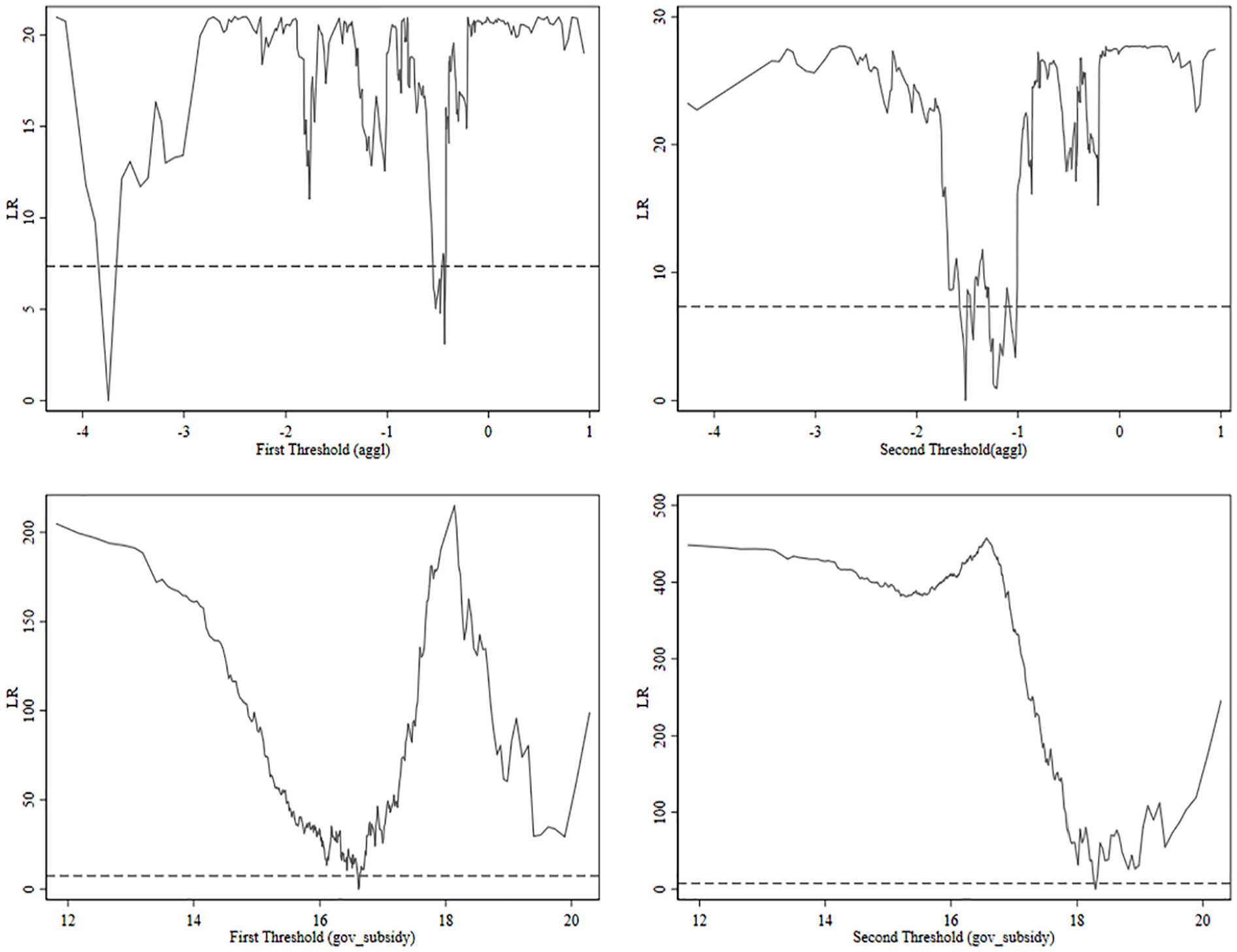
Thresholds and confidence intervals for threshold variables.
Threshold Effects of Industrial Agglomeration at the City Level
After using the bootstrap method to derive the two thresholds for industrial agglomeration, the sample was divided into three intervals based on the magnitude of these two values. The results of the Hausman test indicate that the empirical analysis uses a fixed effects (FE) model. Then, a FE model is used to estimate the impact of the UDE on manufacturing innovation efficiency. Table 3 presents the regression results of the UDE on manufacturing innovation efficiency when aggl is the threshold variable.
Regression Results of Industrial Agglomeration Threshold Effect.

Note. digital1 is the first interval:
Denote significance at the 1% levels.
In Table 3, the estimated coefficient of digital1 is negative and nonsignificant when industry agglomeration (aggl) is less than −3.7468, digital2 is significantly positive at the 1% level when aggl is between −3.7468 and −1.5172, and digital3 is significantly positive at the 1% level when aggl is greater than −1.5172 level. This result indicates that the UDE has a significant impact on manufacturing innovation efficiency when the industrial agglomeration is greater than the first threshold value of −3.7468. Moreover, the early stages of the digital economy do not create an industrial agglomeration effect, which is detrimental to firm innovation. This is similar to the findings of Li and Wang (2022); however, there is a difference in that we use industrial agglomeration as a research perspective and it is a threshold variable. In further extension, our study finds that the UDE does not form an industrial agglomeration effect in the early stage of development, which is not conducive to firm innovation. However, it is only at a later stage with the development of the UDE that it favors firm innovation. There is a difference between this and previous literature that emphasizes the advantages or disadvantages of the digital economy (Bonina et al., 2021; Q. Li et al., 2023; J. Liu et al., 2023). Our data use a mixed panel of cities and firms, which is different from the studies by Xu and Li (2022), and Q. Zhou et al. (2024). The data we use aims to explore micro effects and better illustrate the relationship between the UDE and manufacturing innovation efficiency in China. We introduce industrial agglomeration as a threshold variable, which is a unique perspective that differs significantly from the existing literature.
The development of the UDE has brought about a clustering effect of related high-tech industries. These clustered firms can not only enhance the product effect through competition but also form a learning effect, facilitating firms’ innovation output. Thus, the development of the UDE contributes to manufacturing innovation efficiency as the degree of industrial agglomeration increases. This finding aligns with the Marshall-Arrow-Romer (MAR) externalities theory, which suggests that industrial agglomeration enhances knowledge spillovers and innovation through increased interactions and competition. However, our study also highlights the threshold effects, which are not fully captured by traditional theories, suggesting that the benefits of agglomeration only become significant after reaching certain levels of industrial concentration.
The development of the UDE has brought about a clustering effect of related high-tech industries. These clustered firms can not only enhance the product effect through competition but also form a learning effect, facilitating firms’ innovation output. Thus, the development of the UDE contributes to manufacturing innovation efficiency as the degree of industrial agglomeration increases.
We can explain why this result occurs from two perspectives: the region where the firm is located and the size of the firm. Regionally, cities in the middle and western have relatively few high-tech enterprises, and the development of the UDE lags behind that of cities in the east. This also validates the theoretical analysis that the UDE does not immediately change the innovative activities of enterprises when the industrial agglomeration effect created by the development of the UDE is low. In eastern Chinese cities, the UDE has a higher level of development and is able to rapidly realize the agglomeration of high-tech industries. A few enterprises in the eastern cities have low industrial agglomeration levels. As the level of industrial agglomeration increases, the synergies of UDE development in business innovation can be “unleashed.”
Considering the size of enterprises, many small-scale enterprises in China belong to the same industry, and the digital economy policy clusters these enterprises together, resulting in greater competition among enterprises. Enterprises do not consider innovations that require long-term investments to survive. Simultaneously, the Chinese government focuses on the size of enterprises when formulating digital economy subsidy policies. However, small-scale enterprises do not receive more subsidies and have less money to spend on R&D for business innovation. Large-scale enterprises allocate more resources to digital transformation effected by the development of the UDE. Even in cities with lower levels of industrial agglomeration, where more R&D resources are invested, the urban digital economy does not have an obvious effect on firm innovation. When the city where the firm is located has a high degree of industrial agglomeration, intense market competition forces large-scale firms to invest more resources (including the firm’s own cash flow and subsidies received) in innovation to maintain market share. Higher levels of industrial agglomeration in cities can lead to large-scale firms investing more resources in innovation.
Thus, industrial agglomeration is an important threshold variable for the UDE to influence manufacturing innovation efficiency.
Threshold Effects of Government Subsidies at the Firm Level
Table 4 shows the regression results for gov_subsidy as a threshold variable. In Table 4, the estimated coefficient of digital1 is significantly positive at the 10% level when the government subsidy is less than 16.6139. When the government subsidy is between 16.6139 and 18.2936 or when the government subsidy is greater than 18.2936, digital2 and digital3 are significantly positive at the 1% level. Moreover, the estimated coefficient on the level of UDE development gradually increases, suggesting that increased government subsidies are more conducive to enhancing the manufacturing innovation efficiency. Unlike the literature that analyzes the relationship between government subsidies and firms’ innovation (Q. Li et al., 2021; Zuo & Lin, 2022), we take the perspective of government subsidies as a threshold and then analyze the impact of UDE on the innovation efficiency of manufacturing.
Regression Results of Government Subsidy Threshold Effect.

Note. When gov_subsidy is the threshold variable, there are three intervals: (1)digital1,
and * denote significance at the 1% and 10% levels, respectively.
In summary, there is a threshold effect of the UDE on manufacturing innovation efficiency, which is manifested in the fact that with the increase of government subsidies, the more the UDE can promote manufacturing innovation efficiency. The development of the UDE provides manufacturing enterprises with government subsidies such as technology and talent. When enterprises receive these subsidies, they spend more money on technological transformation and R&D investments leading to innovation. This finding is consistent with studies from other regions, such as South Korea and Italy, where government subsidies have been shown to significantly boost innovation efficiency in manufacturing sectors (e.g., Bronzini & Iachini, 2014; Choi & Lee, 2017). However, our study adds to the literature by highlighting the threshold effects, suggesting that the impact of subsidies is not linear and only becomes significant after reaching certain levels.
The reason for this result may lie in the following two points: (1) regionally speaking, the middle and western regions, owing to fewer resources, such as economy and financial expenditures, relative to the eastern region, are obviously at a disadvantage, and the government’s support for enterprises is relatively small. However, with the support of digital economy policies, once enterprises in middle and western cities receive government subsidies, they can quickly invest in enterprise R&D and innovation, which in turn improves the efficiency of enterprise innovation. For manufacturing firms in eastern cities, the level of UDE development is high, and the role of innovation for firms is high. Therefore, government subsidies for firms in eastern cities can promote development compared with those for firms in central and western cities.
(2) Regarding enterprise size, small-scale enterprises lack R&D funds, and a small amount of government subsidies cannot fully address the situation of small-scale enterprises lacking R&D funds, which affects their innovation efficiency. When there are more government subsidies, small-scale enterprises use the excess subsidized funds to invest in innovation. Small-scale enterprises use the digital economy to innovate their products and organizations, thus contributing to innovation efficiency. Large-scale firms have more capital and technological R&D staff and are more digitized. Even if the digital economy does not provide more government subsidies to large-scale firms, it can significantly and positively affect firm innovation. When government subsidies are further increased, the innovation efficiency of large-scale firms improves.
Thus, the impact of the UDE on manufacturing innovation efficiency also depends on the government subsidies that firms receive.
Robustness Tests
We use the number of patent applications as an output indicator and use the heterogeneity SFA method to measure the manufacturing innovation efficiency (effi_lnapply). We use effi_lnapply as a measure of manufacturing innovation efficiency for robustness test. The results of the robustness tests are in Table 5. In Table 5, the estimated coefficient of digital1 is negative and insignificant when the industry agglomeration (aggl) is less than −3.6584; digital2 is significantly positive at the 1% level when the industry agglomeration (aggl) is between −3.6584 and −1.4959; and digital3 is significantly positive at the 1% level when the industry agglomeration (aggl) is greater than −1.4959. This result suggests that UDE has a significant effect on manufacturing innovation efficiency when industry agglomeration is greater than the first critical value of −3.6584. The estimated coefficient on digital1 is significantly positive at the 10% level when the government subsidy is less than 15.8726. The estimated coefficients on digital2 and digital3 are significantly positive at the 1% level when the government subsidy is between 15.8726 and 18.0213; they remain significantly positive at the 1% level when the government subsidy exceeds 18.0213.
Robustness Test Regression Results.
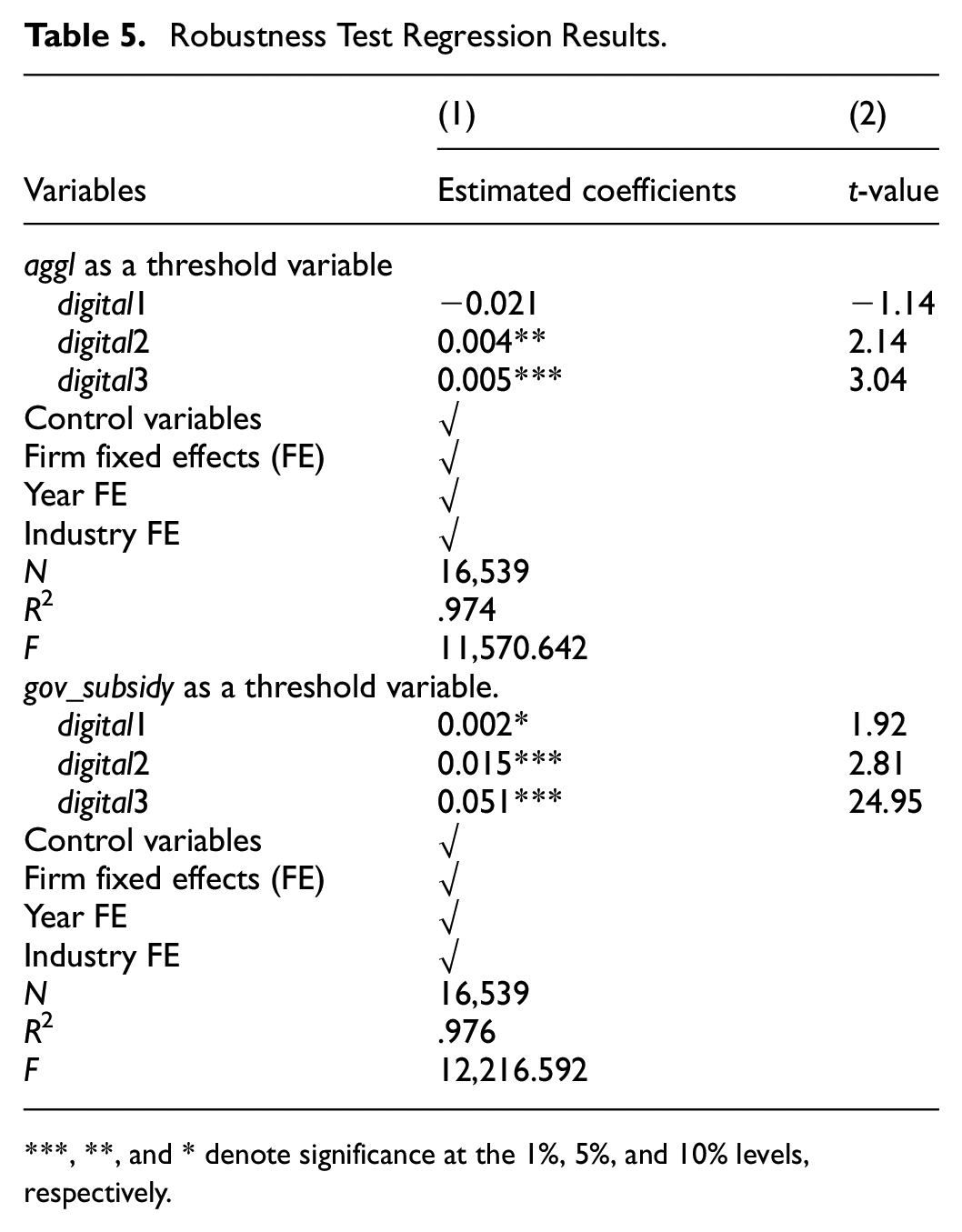
***, **, and * denote significance at the 1%, 5%, and 10% levels, respectively.
Additionally, the estimated coefficients on the level of UDE development increase gradually with higher government subsidies, suggesting that increased government subsidies are more conducive to improving the efficiency of manufacturing innovation. We note a slightly larger threshold for industrial agglomeration and a slightly lower threshold for government subsidies. However, the results do not change significantly after replacing the indicators, either using aggl or gov_subsidy as the threshold variable.
Heterogeneity Analysis
Following H. Liu and Li (2023), we analyze regional heterogeneity by dividing the sample into western, middle, and eastern regions based on the location of the firms. Heterogeneity in firm size is further taken into account by categorizing firms into small, medium and large firms based on their asset size at the end of the year. The results of the heterogeneity analysis are in Table 6. The results show that when industrial agglomeration (aggl) is used as a threshold variable, the UDE is inconducive to enhancing the level of manufacturing innovation when enterprises in the western and middle region have a low level of industrial agglomeration. However, when industrial agglomeration gradually increases, this negative effect in the middle region diminishes. When industrial agglomeration is further increased, that is, after crossing the two thresholds, the UDE has a positive effect on the manufacturing innovation efficiency. With a low level of industrial agglomeration, the UDE is not conducive to the manufacturing innovation efficiency of firms in the eastern region. However, unlike in the middle and western regions, the UDE can significantly improve the efficiency of manufacturing innovation when industrial agglomeration reaches the second threshold. This is because there are relatively few high-tech enterprises in the middle and western regions, and the level of development of the UDE is also relatively lagging behind. The development of the UDE in cities leads to lower levels of industrial agglomeration and does not immediately change the innovative activity of firms. A higher level of industrial agglomeration can only be achieved, and the UDE can play a role in firm innovation. Cities in the eastern region have a high level of digital economy development and are able to rapidly drive the agglomeration of high-tech industries. This leaves only a few firms under a low level of industrial agglomeration. When the level of industrial agglomeration increases, the impact of the UDE on the efficiency of manufacturing innovation is “unleashed.”
Heterogeneity Regression Results.

Note. t-Values are in parentheses.
, **, and * denote significance at the 1%, 5%, and 10% levels, respectively.
Also, the results in Table 6 show that the UDE can significantly improve manufacturing innovation efficiency only among small firms with low industrial agglomeration. Only in medium-sized enterprises with medium industrial agglomeration can UDE significantly enhance manufacturing innovation efficiency. In the case of large firms with a low degree of industrial agglomeration, the impact of the UDE on the innovation efficiency of the manufacturing industry is not significant. In the case of large-sized enterprises, when the degree of industrial agglomeration is low, the impact of digital economy on enterprise innovation is not significant. This is because small-scale enterprises belong to industry convergence; the digital economy may effectuate a counterproductive industrial agglomeration effect. After several industrial agglomerations, enterprise competition is larger, and money required for R&D is inadequate, which is inconducive to enterprise innovation. Medium-sized enterprises maintain a moderate degree of industrial agglomeration, which is conducive to the digital economy to promote enterprise innovation; the degree of industrial agglomeration is higher, and medium-sized enterprises are also burdened with additional “competition costs,” thus weakening enterprise innovation. Large enterprises have more innovative resources through digital transformation brought about by the development of the digital economy. Even in the case of lower industrial agglomeration, the impact of the UDE on the manufacturing innovation efficiency does not change significantly. However, when the degree of industrial agglomeration is high, fierce market competition will also force large enterprises to invest more resources in innovation to maintain their market share. Therefore, the good industrial agglomeration effect brought about by such a digital economy is also more conducive to innovation by large firms.
When government subsidies are used as the threshold variable in Table 6, the government subsidies received by enterprises in the western region need to reach a high level for the UDE to have a significant impact on manufacturing innovation efficiency. When government subsidies are low, the UDE will not have a significant impact on manufacturing innovation efficiency. However, when enterprises in the middle region receive less government subsidies, they are disadvantaged in terms of manufacturing innovation efficiency. As government subsidies increase, this disadvantage gradually diminishes until the urban digital economy has a significant positive impact on manufacturing innovation efficiency when government subsidies are higher. In the eastern region, the UDE positively promotes manufacturing innovation efficiency regardless of whether firms receive government subsidies or not.
Meanwhile, the impact of UDE on the innovation efficiency of small and medium-sized manufacturing enterprises is not obvious because small and medium-sized enterprises receive less government subsidies. The difference is that when the government subsidy reaches a high level, the urban digital economy has a significant positive effect on the manufacturing innovation efficiency of medium-sized firms. For large-sized firms, even with lower government subsidies, the urban digital economy can still significantly improve manufacturing innovation efficiency. And the role of the urban digital economy increases when government subsidies are further increased. Existing literature indicates that government subsidies have a significant impact on corporate innovation, which varies with the provision of government subsidies (Shao & Wang, 2023; R. Wu et al., 2020). However, our study adds to the literature by highlighting the threshold effects, suggesting that the impact of subsidies is not linear and only becomes significant after reaching certain levels.
Given the presence of two threshold variables in the heterogeneity analysis, and the multiple combinations arising from regional and firm-size heterogeneity, to facilitate readability, we provide a simplified explanation in Appendix A Table A1.
Conclusion and Policy Implications
We analyze the impact of UDE development on manufacturing innovation efficiency from the perspectives of industrial agglomeration at the city level and government subsidies at the firm level. We find threshold effects of industrial agglomeration and government subsidies in the impact of UDE on manufacturing innovation efficiency. The double-threshold values for industrial agglomeration are −3.7468 and −1.5172, and those for government subsidies are 16.6139 and 18.2936. When the industrial agglomeration level of a city is greater than −3.7468, the UDE has a significant positive effect on manufacturing innovation efficiency. However, when the industrial agglomeration level is low, no significant positive effect is observed. At the firm level, the impact of UDE on innovation efficiency in manufacturing increases as firms receive government subsidies. Finally, the threshold effect varies across regions and firm sizes. The findings of this study contribute to the existing literature in several ways. First, by identifying threshold effects of industrial agglomeration and government subsidies, we extend the understanding of how UDE influences manufacturing innovation efficiency. This nonlinearity enriches the theoretical framework of the relationship between UDE and firms’ innovation efficiency. Second, our study highlights the importance of considering both city-level and firm-level factors in analyzing the impact of UDE on innovation. This integrated approach provides a more comprehensive understanding of the mechanisms through which UDE affects innovation efficiency.
Moreover, the results suggest that the development of UDE and its impact on innovation efficiency are not uniform across regions and firm sizes. This heterogeneity underscores the need for tailored policies that consider local economic conditions and the specific characteristics of firms. The findings also imply that the benefits of UDE may not be immediate and can vary depending on the level of industrial agglomeration and government support.
The role of UDE in fostering manufacturing innovation efficiency has broader implications for digital transformation in emerging economies. As many emerging economies strive to integrate digital technologies into their manufacturing sectors, understanding the threshold effects of industrial agglomeration and government subsidies can provide valuable insights. For instance, policymakers in emerging economies can use these findings to design targeted policies that promote industrial clustering and provide appropriate levels of subsidies to maximize innovation efficiency.
In regions with lower levels of industrial agglomeration, policies should focus on creating favorable conditions for the development of high-tech industries and improving the overall business environment. This can include investments in infrastructure, education, and training programs to attract and retain skilled workers. In contrast, regions with higher levels of industrial agglomeration may benefit from policies that encourage further specialization and collaboration among firms to enhance innovation.
Based on the conclusions drawn above, we make the following policy recommendations:
(1) Create a Favorable Environment for Innovation: The government should create a favorable environment for innovation. City governments should formulate relevant policies to improve the level of industrial agglomeration in the digital economy and manufacturing industries, which will promote a clustering effect.
(2) Supportive Policies for the Digital Economy: The governments should develop supportive policies for the digital economy. It should increase subsidies to enterprises for technological innovation and provide tax incentives for digital transformation.
(3) Promote the Free Flow of Data: Governments should develop fiscal policies that support the free flow of data so that companies can streamline their business processes when utilizing digital technologies (L. Chen et al., 2019). Let digital technology serve the organizational structure of enterprises and promote the renewal of the organizational structure to improve the innovation output of enterprises and enhance the efficiency of enterprise innovation.
(4) Targeted Development in Middle and Western Regions: The government should analyze the development trend of the digital economy and emphasize its construction of the digital economy in middle and western China and small-scale cities. It should increase basic implementation of the digital economy; promote the construction of a digital China; accelerate the commercial construction of 5G; embark on the R&D of 6G; and utilize big data, artificial intelligence, and other digital constructions.
(5) Leverage City Characteristics: Cities should build on their own characteristics and utilize innovative effects. The development of the digital economy in cities requires talent, such as computer, big data, and artificial intelligence, and cities should formulate talent policies for the digital economy based on their own characteristics. Attracting specialized talent provides a platform for mutual learning and exchange for the accumulation of human capital; the overflow of knowledge and technology caused by the flow of talent is conducive to the commencement of innovative ideas and better promotes the development of the digital economy. Simultaneously, cities should formulate relevant policies to improve the level of industrial agglomeration of the digital economy and related manufacturing industries and give full play to the agglomeration effect of digital economy-related industries.
Limitations and Future Research
Limitations
The literature does not have a unified conceptual definition of the digital economy (Butenko & Isakhaev, 2020). This study has several limitations that should be acknowledged. First, the measurement of the UDE is based on existing literature and may not fully capture the complexity of digital economy development in Chinese cities. Future research could explore more comprehensive and refined indicators to better reflect the level of UDE. Second, the heterogeneous SFA model used in this study has been criticized for its difficulty in distinguishing between individual effects and inefficiency terms. This ambiguity may affect the accuracy of the innovation efficiency measurement. Third, while this study examines the impact of UDE on manufacturing innovation efficiency from the perspectives of industrial agglomeration and government subsidies, other potential factors such as the urban innovation environment and corporate tax burden are not considered. Future research could incorporate these additional factors to provide a more holistic view. Lastly, although the panel threshold model is advantageous in handling large samples and identifying structural mutation points, it has limitations in terms of data requirements, model complexity, and the selection of control variables.
Future Research Directions
Future research could focus on several promising directions. One potential area is the development of a more comprehensive index to measure the level of digital economy development in Chinese cities. This could involve integrating multiple dimensions such as digital infrastructure, digital talent, and digital innovation activities. Another direction is to improve the heterogeneous SFA model to enhance the accuracy of innovation efficiency measurement. This could involve exploring new methods to better distinguish between individual effects and inefficiency terms. Additionally, future research could examine the impact of the UDE on manufacturing innovation efficiency from other perspectives, such as the urban innovation environment and corporate tax burden, to provide a more comprehensive understanding. Finally, further exploration of the panel threshold model could address its limitations by developing more robust methods for selecting control variables and handling model complexity. This could lead to more reliable and interpretable results in future studies.
Footnotes
Appendix A. Results of Heterogeneity Analysis
Simple Interpretation of Heterogeneity Analysis Results.

| Western region | Middle region | Eastern region | Small-scale enterprises | Medium-scale enterprises | Large-scale enterprises | |
|---|---|---|---|---|---|---|
| ↓↓↓ | ↓ | ↓↓ | ↑↑↑ | —— | —— | |
| ↓↓ | —— | ↑↑↑ | —— | ↑↑ | ↑↑↑ | |
| ↑ | ↑ | ↑↑↑ | —— | —— | ↑↑↑ | |
| —— | ↓↓↓ | ↑↑↑ | —— | —— | ↑ | |
| —— | —— | ↑↑↑ | —— | ↑↑↑ | ↑ | |
| ↑↑↑ | ↑↑↑ | ↑↑↑ | ↑ | ↑↑↑ | ↑↑↑ |
Note. ↑indicates a positive effect, ↓ indicates a negative effect, and —— indicates no significant effect. The number of arrows indicates the degree of effect.
Acknowledgements
The authors are very grateful for the comments of the anonymous reviewers and the editors for their hard work.

Funding
The author(s) disclosed receipt of the following financial support for the research, authorship, and/or publication of this article: This work was supported by both the 2024 Scientific Research Key Project of the Anhui University Research Program of China (2024AH053002) and the Scientific Research Program of Fuyang Normal University of China (2023KYQD0043).
Declaration of Conflicting Interests
The author(s) declared no potential conflicts of interest with respect to the research, authorship, and/or publication of this article.
Data Availability Statement
Data will be made available on request.