




Abstract
The use of a new generation of information technology to promote the transformation of the manufacturing industry is an inevitable path to achieve rapid regional economic development at this stage. In order to explore the interaction between the digital economy and the high-quality development of the manufacturing industry, this paper examines the relationship between the role of the digital economy on the high-quality development of the manufacturing industry in a multidimensional way using panel data from 30 provinces, autonomous regions, and municipalities and 11 manufacturing sub-sectors in China from 2013 to 2022. The results of the study show that: the overall level of China’s digital economy and manufacturing development has increased year by year, and the inter-regional development gap has narrowed; capital- and technology-intensive industries are significantly more sensitive to the digital economy than labor-intensive industries; in the process of the high-quality impact of the digital economy on China’s manufacturing industry, innovation activities have become an important medium; the impact of the digital economy on the high-quality development of the manufacturing industry has shown a significant non-linear relationship, and the impact of the digital economy on different types of industries has shown a differentiation. Due to the sinking effect and network effect of digital technology, the digital economy has a threshold effect on the impact of the development of manufacturing industry, and the impact of the digital economy on the labor-intensive manufacturing industry shows “inhibition and then promotion,” while the capital and technology-intensive manufacturing industry shows “promotion and then inhibition and then promotion” characteristics.
Introduction and Literature Review
Over the past 40 years of reform and opening up, relying on large inputs of traditional factors of production, China’s manufacturing industry has continued to develop, with an average annual growth rate of up to 11%, making world-renowned achievements, and China has thus become a major manufacturing country in the world (S. Zhang et al., 2020; J. Zhang & Jin, 2011). However, in recent years, with the disappearance of the demographic dividend, the decline in the rate of return on capital, energy shortages and environmental pollution, the unoptimized economic structure and other phenomena highlighted, the manufacturing industry relying on resources (Chen et al., 2021), labor and other basic factors of production and sustained development model has been gradually denied (Liu & Hui, 2021). At the same time, a new generation of information technology represented by big data and artificial intelligence technology (Gigova et al., 2019; Usman et al., 2021), characterized by “high technology and strong penetration,” has gradually formed a new economic paradigm—the digital economy—through its integration with modern manufacturing (Ma & Zhu, 2022; Qin et al., 2016). The development of digital economy can effectively promote manufacturing technology innovation, model innovation, product innovation, and then change the original industrial development mode, and promote the sustained, high-quality development of manufacturing industry (Zhao et al., 2020). In recent years, the optimization and transformation of China’s economic structure cannot be separated from the digital economy’s continuous transformation of traditional manufacturing industry (Yu & Cong, 2021). Emerging “digital+manufacturing” platforms such as the China Aerospace Cloud Network INDICS platform and the Haier Intelligent Customization Platform continue to emerge, injecting new vitality into the high-quality development of China’s manufacturing industry (Figure 1).

China’s economic growth and energy consumption. (The data is sourced from the National Bureau of Statistics of China).
The digital economy has strong industrial penetration, integration and derivation, and can effectively promote the manufacturing industry’s technological innovation, model change and market expansion (Schöggl et al., 35; Song et al., 2022). As a result, the academic community has gradually turned its research attention to the role of the relationship between the digital economy and the development of the manufacturing industry. As we all know, the proposal and extension of “Solow’s paradox,” in the new information period, is based on the consensus that digital technology has a facilitating effect on industrial development (Xie et al., 2022). This effect may be a direct technological breakthrough brought about by the digital economy to industrial development, or it may be a change in industrial organization and industrial development mode brought about by a certain change in management thinking (Peng & Tao, 2022). Therefore, in a broader sense, the digital economy can play a catalytic role in industrial development through innovation. In addition, the digital economy is based on a new generation of information technology, which makes the relationship between the digital economy and the development of the manufacturing industry relatively complex due to the existence of information technology network effects (Ge et al., 2022). Through the above discussion, it can be found that the current research on the development of digital economy and manufacturing industry mostly lies in the definition of connotation, mode expansion and other theoretical research, while the specific connection between the two, the role of the path and quantitative research is relatively lacking. But is there consistency in the impact of the digital economy on different types of manufacturing? How is the black-box effect of the digital economy’s impact on manufacturing revealed? What kind of characteristics does the digital economy’s impact on manufacturing present? These theoretical issues seem to be insufficiently explored. And the above questions are the key to explore the role of the digital economy on the path of high-quality development of the manufacturing industry. Therefore, clarifying the current status quo of China’s digital economy and high-quality development of manufacturing industry, and clarifying the role of digital economy on the high-quality development of manufacturing industry not only enriches the current theory of digital economy and industrial development of manufacturing industry, but also provides useful reference for the reform of the economic development model of different countries in the world.
Theory and Mechanism Analysis
Theoretical Analysis of the Digital Economy on the High-Quality Development of Manufacturing Industry
In recent years, the digital economy has been gradually integrated into China’s economic and social development process. In fact, the digital economy as an emerging economic form, the impact on the traditional manufacturing industry has long exceeded the scope of technology, in the production management thinking, development mode and other aspects have an important impact. As we all know, the impact of the digital economy on the development of the traditional manufacturing industry will ultimately be reflected in the manufacturing industry’s ability to sustain high-quality development, but if we want to analyze the process, with “innovation” as the core of the intermediary role of the link, but always can’t be bypassed. In layman’s terms, innovation can be regarded as the medium through which the digital economy promotes the high-quality development of the manufacturing industry. The use of the digital economy to promote comprehensive innovation in manufacturing technology, organization and system, to promote knowledge and information overflow and restructuring, and to realize the transformation of the manufacturing industry in terms of production efficiency, technological paradigm, business model, etc., is an inevitable path to promote the development of the world economy in the new era (Guan & Guo, 2022; Figure 2).

“Internet+” influences the path of high-quality development of manufacturing industry.
Impact of the Digital Economy on Innovation
Knowledge itself has the characteristic of externality, which makes it show a certain degree of spillover, and this spillover is closely related to the effective transmission of knowledge. The essence of innovation lies in the transmission and integration of knowledge, so the spillover of knowledge will affect the innovation (Abbas & Sağsan, 2019). Similar to picture and sound information, knowledge as a special kind of information, it can not be delivered without the aid of communication media. There are different explanations for the causes of knowledge spillovers: one view is that spatial distance affects the effectiveness and accuracy of information transmission, resulting in differences in the reception of information in different regions, so the impact of spatial factors on knowledge spillovers cannot be ignored (Abbas, 2020). Another view is that, due to the cumulative effect of knowledge (Barton et al., 2020), knowledge transfer should flow from high to low potentials (Badamas, 2009). However, in general, this kind of communication media perturbation mainly unfolds through tangible and intangible space. The digital economy can not only lay a good technological foundation for knowledge transmission, enhance the efficiency of transmission and break down the spatial barriers to knowledge spillover. It can also serve as a kind of inclusive thinking, providing the concept of “sharing” of organizational structure and technology, breaking through the invisible “field” barriers, and providing strong support for knowledge spillover (Vlasov et al., 2022).
On the other hand, since innovation itself is a “high investment” and “uncertain output” behavior, unless there is a strong push from technology or a “push” from the market, participants in innovation activities generally have “inertia” in innovation. The digital economy promotes knowledge sharing, and utilizing the externalities of knowledge spillovers can effectively reduce the input costs of innovative activities and enhance the willingness of innovative subjects to innovate (Barreto et al., 2022). Because digital technology has a certain network effect, the development of the digital economy and its external role, also has a certain network. This is because with the increase of digital economic activity nodes, information exchange is more and more adequate. when the development of the digital economy to a certain critical degree, its role in promoting the economic system will be instantly amplified (Durst & Zieba, 2020).
Impact of Innovation on High-Quality Development in Manufacturing Industry
Technological innovation brought about by the digital economy can promote the transformation of the manufacturing industry from “epitaxial” development to “connotative” development. On the one hand, the digital economy to promote the production technology change, its impact is mainly reflected in: First, through the digital technology and the traditional manufacturing industry in the technology, products, equipment, interaction and integration, such as information sensing technology embedded in the traditional manufacturing industry, can enhance the level of equipment intelligence and thus promote the improvement of the production process. Second, information technology has “industrial derivativeness,” can directly give birth to new manufacturing industry. Such as through the Internet of things technology, can be from the design, manufacturing, packaging, and other life cycle of intelligent management, give birth to service-oriented manufacturing industry.
Digital economy can promote the innovation of industrial organization form of manufacturing industry. First of all, the digital economy can bring industrial integrated innovation. This kind of innovation breaks through the barriers between innovation subjects, effectively integrates and develops human resources, capital, information and technology, and has a revolutionary impact on the traditional organizational structure. For example, through the collaborative innovation platform of scientific research institutions, universities and enterprises, it expands and extends the enterprise innovation network, and strengthens the tightness of the collaborative development between enterprises and universities and scientific research institutes. In addition, the application of digital technology has also brought “decentralization, flattening and flexibilization” changes to the enterprise management structure.
The innovation brought about by the digital economy is also reflected in the promotion of manufacturing production, sales model change, and this change can meet the individual needs of consumers in the market. On the one hand, with the in-depth application of digital technology in the production of manufacturing enterprises, enterprise design, production, management and other links are gradually integrated and unified, and efficiency is improved. On the other hand, the development of the digital economy greatly reduces the cost of information exchange between producers and consumers, promotes e-commerce, personalized customization and other emerging marketing models, and promotes the integration of the manufacturing industry and the service industry.
Of course, the innovation brought by the digital economy is also a “double-edged sword,” while promoting the development of the manufacturing industry, there may also be some negative effects. For example, the development of the digital economy has forced the formation of enterprise sales model innovation. Although it can promote personalized customization, it may also bring high manufacturing costs to small and medium-sized enterprises, and reduce the production willingness of enterprises. Information service providers that master digital technology as an emerging resource are also prone to forming an “oligopoly,” which raises the cost of information collection for other enterprises and inhibits the development of the industry.
Analysis of the Mechanism of “Internet+” on the High-Quality Development of Manufacturing Industry
In this paper, we intend to analyze the mechanism of the digital economy by promoting the innovative activities of enterprises and then promoting the high-quality development of the manufacturing industry under the framework of D-S monopolistic competition, combined with the research foundation of Schrettle et al. (2014). Assume that

In Equation 1,

The optimal consumption of

Where, total revenue

Let the level of digital economy development be

Where is MC the marginal cost and

Where

When
Under a monopolistically competitive market, the firm’s profit maximization condition is that marginal cost equals marginal revenue and the firm’s profit is zero, so the firm’s profit function can be expressed as:

Substituting Equation 4 and taking the first order partial derivative with respect to the price yields:

On this basis, the relationship between product innovation intensity

Further taking the first order partial derivatives of Equation 10, we get:

It indicates that when the development level of digital economy reaches a certain degree, the innovation level of enterprises will increase along with the development of digital economy. It is worth noting that when
In summary, this paper proposes the following hypotheses: (1) the digital economy has a certain impact on the high-quality development of the manufacturing industry; (2) the digital economy can affect the high-quality development of the manufacturing industry through innovation; (3) due to the network effect of information technology and the “sunk cost” effect of innovation, the impact of the development of the digital economy on the high-quality development of the manufacturing industry is a non-linear relationship.
Research Design
Construction of the Indicator System
Although the current development of digital economy is in full swing, but its connotation definition in the academic community has not yet formed a unified conclusion. For example, some scholars believe that the digital economy is a new economic form developed by the deep integration of digital technology and traditional manufacturing industry, and some scholars believe that the digital economy is essentially a generalization of information technology and its application, and it is a new tool and a new element for social development. Therefore, in the quantitative analysis of the development of the digital economy, there are some differences. In fact, as a new economic paradigm, the development of digital economy has gone beyond technology itself. In order to analyze the current degree of development of China’s digital economy in a relatively complete manner, this paper constructs an index system reflecting the level of development of China’s digital economy on the basis of the Informatization Development Index of the National Bureau of Statistics of China, combined with the characteristics of the development of the digital economy, and with reference to some scholars’ researches (Gao & Zheng, 2020; Roper & Arvanitis, 2012). The details are shown in Table 1 below:
Evaluation Index System Of China’s Digital Economy Development.

In 2017, China began to implement a strategy of “high-quality development,” with “innovation,”“green,”“efficient,” and “livelihood” becoming the core elements of the strategy. “innovation,”“green,”“efficient,” and “people’s livelihood” have become the core elements of the strategy. Based on the interpretation of the connotation of high-quality economic development in the report of the Chinese government, this paper combines the research results of some scholars and constructs a high-quality development index system for China’s manufacturing industry, as shown below (Table 2):
Evaluation Indicator System for High-Quality Development of China’s Manufacturing Industry.

Source of Data
This paper collects and organizes data from 2013 to 2022 for 30 provinces, municipalities, autonomous regions (except Tibet) and some manufacturing subsectors in China. The required data come from China Statistical Yearbook, China Industrial Statistical Yearbook, CEIC Database, China Import and Export Statistical Yearbook, EPS Data Statistical Platform, China Science and Technology Statistical Yearbook, Statistical Bulletin of National Economic and Social Development of China’s Provinces, China Education Statistical Yearbook, China High-Tech Industry Statistical Yearbook, Wind Financial Information Terminal, Tencent Research Institute, and CNNIC’s “China Internet Development Status Statistical Report.”
Index Synthesis
In this paper, the entropy weight method is used to synthesize the index of the data collected for each indicator. At the same time, the relevant indicators are standardized as follows:
The normalization of the positive indicators was done as follows:

The normalization of the negative indicators was done as follows:

According to the above methodology, the development of digital economy and high quality development of manufacturing industry in each province are measured, and the results are shown in the following Figure 3:

The development status of the digital economy and the high-quality status of manufacturing in China from 2016 to 2022.
From the above results it can be seen that China’s digital economy development status has steadily improved during 2016 to 2022, representing the digital economy development status of different provinces gradually tends to be balanced, the level of digital economy development in the eastern and central regions is gradually close to the level of digital economy development, the level of digital economy development in inland areas such as Xinjiang and Inner Mongolia has improved more significantly, but the color difference in northeastern China has not changed much. And China’s manufacturing high-quality development situation is relatively stable during 2016 to 2022. The advantage of the eastern coastal region is obvious, but with the passage of time, the central region of Anhui, Jiangxi, Hunan, Hubei and other provinces of the color difference is gradually close to the eastern region, and the development of northeast and north China relative to the eastern coastal region is weakening.
In reality, the reasons for these results are complex. With the implementation of the “Internet Action Plan,”“Digital Economy Development Plan” and other strategies in recent years, China has made a qualitative leap in the digital economy application foundation, Internet application environment, talent training and other indicators, and the level of digital economy development has been greatly improved. The level of digital economy development has been greatly improved. Various regions have introduced their own development plans in line with their own resource endowments. In particular, Anhui, Guizhou, Chongqing and other central and western regions have vigorously introduced the R&D centers and data processing centers of large Chinese domestic information enterprises, which has promoted the in-depth development of local digital economy-related industries and upgraded the level of regional informatization. Although the Northeast region has introduced a number of policies for digital economy-related industries in recent years, the development of new industries such as the Internet, Internet of Things, and intelligent manufacturing has been relatively slow due to the over-reliance on traditional industries and the serious brain drain. For the high-quality development of China’s manufacturing industry, the eastern coastal region has rich high-level human resources, abundant capital and advanced technology, which gives it a unique advantage in the development of advanced manufacturing industry, and thus the development of the manufacturing industry in this region has always been in a leading position. Due to the existence of technology spillover effect, the central region has a greater advantage in industrial undertaking compared with the western region and the northeast region, therefore, in recent years, the promotion of high-quality development of manufacturing industry in this region is relatively obvious. In the western region, under the strong promotion of Guizhou big data and Chongqing intelligent manufacturing base, the development of manufacturing industry has also shown promising results in recent years, but due to the “long tail effect” of Internet technology, it takes some time for it to integrate well with traditional manufacturing industry, and the promotion of high-quality development of manufacturing industry is slightly weaker than that of the central region.
Model Regression Results and Analysis
Model
Based on the above theoretical analysis, in order to clarify the impact of digital economy on the high-quality development of manufacturing industry, it is proposed to use panel data model as a benchmark model for empirical testing. Details are as follows:

Where,
Variable Measurement and Data Description
Variable Settings
Explanatory variables: the degree of high-quality development of the manufacturing industry
Explanatory variable: degree of digital economy development
Control variables: In addition to the level of development of the digital economy, other factors also have an impact on the degree of high-quality development of the manufacturing industry. Drawing on existing studies, this paper proposes to select the following control variables: the level of human capital
Data Sources
The Digital Economy Development Index and the High Quality Development Index of Manufacturing Industry are derived from the previous calculations, and the data of other variables are derived from the China Statistical Yearbook, CEIC Database, China Import and Export Statistical Yearbook, China Industrial Statistical Yearbook, EPS Data Statistical Platform, China Science and Technology Statistical Yearbook, Statistical Bulletin of National Economic and Social Development of Provinces, China Educational Statistical Yearbook, China High-Tech Industry Statistical Yearbook, wind Financial Information Terminal, Tencent Research Institute, CNNIC Statistical Report on Internet Development in China.
Empirical Results and Analysis
Considering that the model is short panel data and passes the test, the fixed effect model is finally adopted to examine the impact of digital economy on the high-quality development of manufacturing industry.
Benchmark Regression Analysis
In order to examine the impact of the digital economy and each control variable on the high-quality development of the manufacturing industry, the explanatory variables and explanatory variables are regressed separately, and the control variables are gradually included, and the specific results are shown in Table 3:
Benchmark Regression Results of the Digital Economy on Manufacturing Quality Development.

,**,***Significant at the significance level of 10%, 5%, and 1%, respectively, with progressive statistics in parentheses.
From the analysis of the overall sample level, it can be seen that whether or not to add relevant control variables, the impact of digital economy on the high quality development of manufacturing industry is significantly positive at 10% significance level, after gradually adding control variables, the sign of the correlation coefficient is still unchanged, and from the model (7) in the table, it can be seen that when the level of the digital economy development is raised by 1%, it will promote the high quality development of manufacturing industry to raise the level of 0.102%. It means that from the economic sense, the development of digital economy will promote the high-quality development of the manufacturing industry, the above results verify the aforementioned hypothesis 1. The analysis of control variables, the level of human capital, the level of marketization, the degree of opening up to the outside world, and the level of industrial support have a more significant positive role in the high-quality development of the manufacturing industry. This is mainly due to the change of China’s economic growth mode, the original model of rapid development simply relying on low-end labor factors input has gone forever, and high-quality labor resources are a strong guarantee to promote the development of manufacturing industry. At the same time, with the promotion of market-oriented reform, the continuous deepening of opening up, the gradual improvement of infrastructure, various elements of industrial production in China’s domestic and international double circulation steadily, the development efficiency has been improved, and the high-quality development of manufacturing industry has been promoted. In addition, the level of financial development, environmental regulations on the high-quality development of the manufacturing industry presents an inhibitory effect, which is mainly reflected in the current manufacturing industry development of the financial factors required for the allocation is still unreasonable, the mismatch and under-allocation phenomenon is still serious, despite the expansion of the scale of credit, but a lot of funds flow into the non-physical economy, resulting in the ineffective circulation of the economic cycle, which is also the current emphasis on the development of the industry in China. This is also China’s current emphasis on industrial development “off the virtual to the real” of the fundamental reasons. And in the current manufacturing industry, the proportion of traditional manufacturing industry is still high, and the pressure of industrial transformation is greater.
Analysis of Industrial Heterogeneity
The manufacturing industry covers a wide range, and the development characteristics and industrial models of different subdivisions are quite distinguished, which makes the digital economy have different influence paths and degrees on different manufacturing industries. Therefore, in order to analyze the impact of digital economy on different manufacturing industries in detail, this paper divides the manufacturing industry into three different types: labor-intensive industry, capital-intensive industry and technology-intensive industry, and conducts regression analysis respectively. Specific results are as follows (Table 4):
Heterogeneity Analysis of “Internet Plus” Affecting the High-Quality Development of Manufacturing Industry.

Note. According to the classification in the National Economic Industry Classification Code Table of the National Bureau of Statistics of China, industries such as agricultural food processing industry, clothing and textile industry are selected and classified as labor-intensive industries; industries such as petroleum processing, chemical raw materials and chemical products industry, metal products industry and non-metallic mineral products industry are selected as capital-intensive industries; and pharmaceutical manufacturing industry, special equipment manufacturing industry, automobile manufacturing industry, communication equipment, computer and other electronic equipment manufacturing industry are selected as technology-intensive industries.
,**,***Denote significant at 10%, 5%, and 1% level of significance, respectively; asymptotic statistics in parentheses.
Through the above analysis, it can be seen that the digital economy has a certain positive effect on the high-quality development of different subsectors of the manufacturing industry, but the degree of the role of technology-intensive industries is significantly higher than that of labor-intensive and capital-intensive industries, which may be attributed to the following reasons: Firstly, the development of labor-intensive and capital-intensive industries is mainly along the traditional development mode, mainly based on the expansion of the scale of formation of the price advantage. Price advantage, the enterprise for the initial investment and process maintenance of high information technology equipment is relatively low willingness to use, which makes the development of the digital economy for the impact of such industries is relatively low. On the other hand, in the technology-intensive industries represented by high-tech industries, the degree of informatization of the industry is relatively high, and the use of digital technology plays a more obvious role in the construction of industrial ecosystem.
Further Analysis: Indirect Mechanisms and Threshold Effects
Intermediary Effect
Through the previous analysis, the impact of the digital economy on the high-quality development of the manufacturing industry is actually through the innovation as a medium, which in turn produces an indirect impact mechanism, this paper here draws on the research basis of Fang (2023) on the intermediary model, to further test whether the innovation here really produces this mediating role. The specific empirical model is as follows:


The innovation level is selected as the mediating variable in the model, and according to the research ideas of Broekel (2015), the internal expenditure of industrial enterprises above large scale is selected to be measured by the ratio of internal expenditure to the main business income of industrial enterprises. Other control variables are unchanged as above, and the specific test results are as follows (Table 5):
Mediation Effect Test Results.

,**,***Indicate significant at 10%, 5%, and 1% level of significance, respectively, and asymptotic
From the conclusion in the previous benchmark model (7), the digital economy has a significant positive effect on the development of high quality in manufacturing, which is the premise of the mediation effect test, here the model (11) is the effect of the digital economy on the level of innovation, while the model (12) is the effect of the digital economy and the level of innovation jointly on the development of high quality in manufacturing. Specifically, the digital economy can significantly promote the level of innovation and satisfy the 5% significance level. When considering the impact of the digital economy and the level of innovation both jointly on the high quality of manufacturing industry, both have a significant positive impact, and the coefficient of the digital economy is smaller than the coefficient in the benchmark model, in which the direct effect is 0.032, and the related mediation effect is 0.0016, which satisfies the three steps of the mediation effect test. This also means that the continuous development of the digital economy can stimulate the influence of the digital economy on the high-quality development of the manufacturing industry through the enhancement of industrial innovation capacity, which verifies the previous discussion on the theoretical path of “digital economy → innovation capacity enhancement → high-quality development of the manufacturing industry,” and also tests the previous hypothesis 2.
Threshold Effect
In recent years, the digital economy innovations and China’s manufacturing industry in-depth fusion, gave birth to China’s manufacturing industry “intelligent upgrading” of the big wave. But the related industry booming at the same time, some areas of manufacturing hardware upgrading, digitization transformation appeared blindly promote the hidden worry. Manufacturing industry development of hardware and software “wrong match, inefficient match,” will obviously block the high-quality development of the manufacturing industry, the reason is that the digital economy on the high-quality development of the manufacturing industry has not been clarified, simply think that the relationship between the two is “the more the better” the Linear growth. In fact, based on the development of a new generation of information technology, the digital economy has its own particularity, the network effect of information technology, the sunken effect will make its relationship with the manufacturing industry may show a more complex non-linear relationship, especially for different manufacturing industries, this interactive relationship will also show different characteristics. In order to clarify the above effects, this paper intends to draw on Derindag et al.’s (2023) research and construct the following threshold regression model for illustration:

where Eit is the threshold variable,
First of all, to test the existence of the threshold, set the level of digital economy developmentas the threshold variable, the threshold variables of different industrial samples are significant through the corresponding significance level test, which also means that the impact of the digital economy on the high-quality development of the manufacturing industry is not a simple linear relationship, which verifies the previous hypothesis 3. The relevant test results are shown in the table below (Table 6):
Threshold Effect Test Results.

The above results show that from the overall level of manufacturing industry, the impact of digital economy on the high-quality development of manufacturing industry presents double threshold characteristics, and from the specific subtypes of manufacturing industry, the labor-intensive manufacturing industry presents single-threshold characteristics, and the capital-intensive and technology-intensive manufacturing industry presents double-threshold characteristics. Relatively speaking, the impact of the digital economy on the high-quality development of the manufacturing industry in the labor-intensive industry is more simple, while the impact of the digital economy on the high-quality development of the manufacturing industry in the capital-intensive and technology-intensive is more complex. As far as the threshold is concerned, the digital economy has a larger value in technology-intensive industries than in capital-intensive ones. The main reason may be that the current labor-intensive industries are still based on the scale expansion, “profit” for “volume” based development mode, the digital economy on the improvement of production efficiency appears to be more prominent, and its impact is relatively single. In capital-intensive and technology-intensive industries, the role of the digital economy is not only reflected in the enhancement of production efficiency, but also in the integration of the industrial chain, the construction of ecology, the evolution of the development model and other aspects of the impact of the impact of the industry chain has become more complex and variable. In technology-intensive industries, the integration of industrial technology and digital economy is more in-depth than that of capital-intensive industries, and the requirements for the level of digital economy development are also higher (Table 7).
Threshold Effect Regression Results.

,**,***Denote significant at 10%, 5%, and 1% level of significance, respectively; asymptotic statistics in parentheses.
As the technical characteristics of different industries in the manufacturing industry are distinguished, the impact of the digital economy on them is also more complex. From China’s overall data level, although the digital economy has a positive promotion relationship on the high-quality development of manufacturing industry, but at different stages of its coefficient of change makes a difference, when the level of development of the digital economy is lower than 0.201, the promotion effect is small, only 0.037. When its level of development enters a certain stage, the coefficient of increase in the magnitude of the increase, but the change is slower. Only when the level of development of the digital economy exceeds 0.715, the digital economy of the manufacturing industry to promote the degree of high-quality development will have a significant increase in the degree of 0.121. The reason is that when the development level of the digital economy is low, there is a certain upfront cost for the introduction of relevant information and intelligent hardware equipment in the manufacturing industry, and the economic and social benefits brought by the new technology to the industrial development are not obvious. With the gradual advancement of the development of the digital economy, new technologies and manufacturing industries began to gradually integrate, but there was a running-in period in the initial stage, and the integration cost was also high, resulting in the enhancement of the digital economy on the manufacturing industry although it existed, but it was still not obvious. Only when the development level of the digital economy reaches a relatively high degree, its network effect begins to gradually phenomenon, and the promotion effect on the development of the manufacturing industry begins to show an amplification effect.
From the perspective of subdivision types, labor-intensive industries are relatively simple to be affected by the digital economy, mainly showing the characteristics of “first inhibition, then promotion,” which mainly reflects the current situation that labor-intensive industries still hesitate to transform industrial intelligence, especially in some low-end industries, small and medium-sized enterprises’ needs in intelligent transformation of basic hardware, information search and other initial costs are high. Therefore, when the development level of the digital economy is relatively low, it is forced to promote the transformation of intelligence and information technology, which has a significant inhibitory effect on the industry, but after the development level of the digital economy is improved, its promoting effect begins to gradually hedge the previous inhibitory effect. For capital- and technology-intensive industries, both are more sensitive to the level of development of the digital economy. When the development of digital economy brings new technologies, through technology derivatives and technology integration, the formation of new production processes and production models will have a positive impact on the manufacturing industry, but the competition and spillover effect caused by the development of digital economy will make the capital-intensive industry appear temporary industrial “lost phenomenon.” Therefore, the impact of the digital economy on the manufacturing industry is characterized by the “U” shape of “promote - inhibit - promote.”
Robustness Check
Adjustment of Control Variables
In order to ensure the accuracy of the model and test results, this paper uses the adjustment of control variables to test the stability of the benchmark model. Based on the studies of Deng et al. (2020), by increasing the urbanization level of the control variable, the ratio of urban population to total population in each region is measured.
Endogeneity Test
As the digital economy promotes the high-quality development of the manufacturing industry, at the same time, the rapid development of the manufacturing industry may also give rise to new production technologies, which in turn can promote the development of the digital economy, that is, there may be an endogeneity problem. For this reason, this paper intends to adopt a systematic approach to robustness testing of the benchmark model. In addition, drawing on the study of Lumi (2020), the interaction term is constructed using the ratio of the number of Internet users and the ratio of mobile telephones per 100 people in each province as an instrumental variable for the level of digital economy development. The instrumental variable is used to test the endogeneity of the benchmark model and the mediation model. When regressing with the instrumental variable, the test for identifying weak instrumental variables is greater than the 10% critical value, and the -value for thestatistical category of the over-identification test is greater than 0.05, indicating the validity and exogeneity of the instrumental variable.
The results of the above model robustness tests are shown in Tables 8 and 9 below:
Benchmark Model Robustness Test.

,**,***Indicate significant at 10%, 5%, and 1% level of significance, respectively, and asymptotic -statistics are in parentheses.
Endogeneity Tests for Mediated Effects Models.
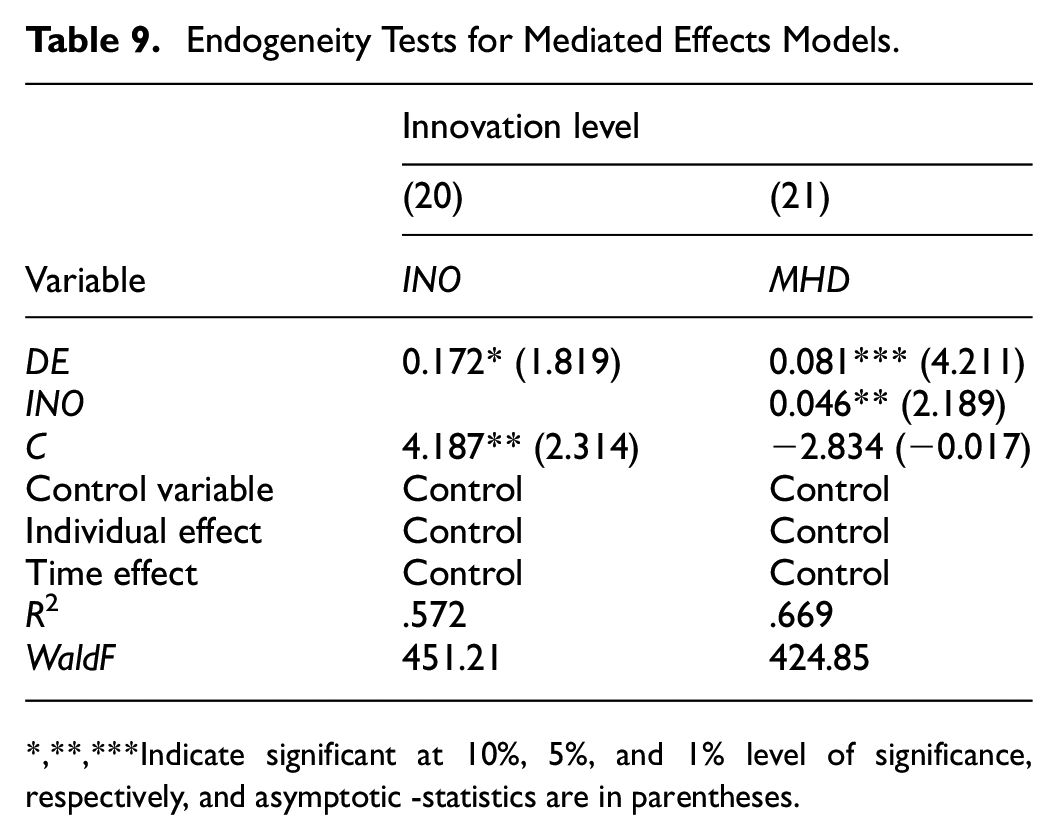
,**,***Indicate significant at 10%, 5%, and 1% level of significance, respectively, and asymptotic -statistics are in parentheses.
From the above original model and mediated effects model robustness test, it can be seen that after using the effective instrumental variables, the positive and negative coefficients of the relevant variables in the estimation results are generally consistent with the original model estimation, and at the same time, in the aforementioned empirical evidence, the positive and negative signs of the main explanatory variables in the estimation results of different samples are also generally consistent with the original model, which illustrates the model’s robustness, and further indicates that the digital economy can effectively promote the high-quality development of the manufacturing industry.
Conclusions and Suggestions
Correctly recognize and grasp the role of digital economy on the high-quality development of the manufacturing industry is of great theoretical and practical significance for the smooth realization of China’s transformation from a “big country” to a “strong country” in the manufacturing industry. The main conclusions of this paper are as follows: (1) The development level of China’s digital economy is gradually improving, the inter-regional development gap is gradually narrowing, the development of Northeast China is relatively slow, and the development of central and western regions is fast. The high-quality development of the manufacturing industry is relatively stable as a whole, and the eastern region has obvious advantages, while the development of the Northeast region is weakening. (2) Digital economy has a significant positive promotion effect on the high-quality development of manufacturing industry, but the strength of the promotion effect on the high-quality development of different types of manufacturing industry is different, and the promotion intensity of technology-intensive and capital-intensive industries is higher than that of labor-intensive industries. (3) Digital economy has an impact on the high-quality development of manufacturing industry, and innovation can produce indirect effects as a medium. (4) The development of digital economy has a significant nonlinear impact on the high-quality development of manufacturing industry, and the nonlinear impact on different types of manufacturing industry is different. The impact on labor-intensive industries is “first inhibition, then promotion,” and the capital-intensive and technology-intensive industries show the characteristics of “promotion - inhibition - promotion,” and with the continuous development of the digital economy, its network effect is obvious.
Based on the above analysis and conclusions, in order to rationally and effectively utilize the enabling effect of the digital economy and continuously promote the high-quality development of the manufacturing industry, this paper puts forward the following suggestions:
Firstly, promote the integrated development of digital economy and traditional manufacturing industry, and use the network effect of digital economy to strengthen its role in promoting the high-quality development of manufacturing industry. To promote the transformation and upgrading of the real economy as the main line, the use of the “industry-university-research” innovation network, through the construction of digital and networked innovation platforms, strengthen the interaction between universities, research institutes and enterprises, and promote the effective docking of the “supply side” and “demand side” of innovation.
Secondly, digital technology will be utilized to enhance the efficiency of innovation resource allocation, reduce the “sunk costs” of the digital economy, and promote the role of innovation in promoting high-quality development. Enhance the efficiency of gathering innovation factors, improve the commercialization system of science and innovation, and promote the transformation efficiency of science and innovation. Relying on university science and technology parks, science and technology business incubators and other carriers, cultivate scientific and technological innovation space; By using digital technology, we try to establish an exchange market of scientific and technological factors and improve the circulation efficiency of scientific and technological innovation resources.
Thirdly, “tailor-made” digital economy policies should be formulated in line with regional resource endowments and characteristic industries. Each region should take into account the development of its own leading industries, formulate special plans to enhance the region’s technology absorption and transformation capacity, make full use of the spillover effect of digital technology on the intelligent transformation of the manufacturing industry, and promote the sustained and high-quality development of the manufacturing industry in the region.
Footnotes

Funding
The author(s) disclosed receipt of the following financial support for the research, authorship, and/or publication of this article: The authors gratefully acknowledge the support provided by the national social science foundation (Grant No. 22XJY040).
Declaration of Conflicting Interests
The author(s) declared no potential conflicts of interest with respect to the research, authorship, and/or publication of this article.
Data Availability Statement
The labeled datasets used to support the finding of this study are available from the corresponding author upon request.