




Abstract
Using the panel data of China’s 286 prefecture-level cities from 2011 to 2019, this paper explores the causal relationship between digital economy and urban innovation ability by panel vector auto-regression (PVAR), examines the spatial and dynamic effects of digital economy on urban innovation ability by spatial dynamic panel Durbin (SDPD) model, and studies the nonlinear effects of digital economy on urban innovation ability under different external environments using threshold spatial dynamic panel (TSDP) model. The results show that: (a) The urban innovation ability has significant spatial dependence and presents a U-shaped evolution trend. (b) In the short term, the digital economy has a positive impact on urban innovation ability, both directly and indirectly; in the long term, only the indirect effect of the digital economy remains significantly positive. (c) In different external environments, the impact of digital economy on urban innovation ability is nonlinear and has significant external environmental threshold characteristics. Specifically, the digital economy is more conducive to the improvement of urban innovation ability with a moderate degree of marketization; the effect of digital economy empowering urban innovation ability is better in a good legal environment or technological environment.
Plain language summary
Facing the great changes in the world such as the COVID-19 epidemic and the Russian-Ukrainian war, the rise of digital economy has prompted cities in China to carry out digital transformation, creating favorable conditions for improving urban innovation ability. However, while using the digital economy as a new engine to promote high-quality economic development, problems such as development imbalance, governance dilemmas, and digital divide have gradually emerged. In the context of the “New Normal” of China, can digital economy supported by information technology become a new driving force for improving urban innovation ability? With the development of the Internet and information technology, the spatial mobility of innovation resources has become more frequent and convenient. Is there a certain spatial rule in the impact of the digital economy on urban innovation ability? Resource endowment, marketization process, financial and technological support may often differ among cities. Is the digital economy empowering urban innovation ability non-linear due to the differences in the external environment? Clarifying the above issues has important practical significance for grasping the “digital opportunities” in the digital economy era and effectively promoting urban innovation ability. Based on the panel data of 286 prefecture-level cities in China from 2011 to 2019, this paper explores the causal relationship between digital economy and urban innovation ability by Panel Vector Auto-Regression (PVAR), examines the spatial and dynamic impacts of digital economy on urban innovation ability by Spatial Dynamic Panel Durbin (SDPD) model, and analyzes the nonlinear impacts of digital economy on urban innovation ability under different external environments by Threshold Spatial Dynamic Panel (TSDP) model.
Keywords
Introduction
According to the data from the China National Intellectual Property Administration, China has ranked first in the world in 2019 with a total of 4.333 million patent applications (Dai & Chapman, 2022). However, among these patents, only 32% are invention patents known for their technical content, and the implementation rate and industrialization rate of effective invention patents are only 49.4% and 32.9%. This means that the process of innovation-driven and high-quality development is greatly hampered by China’s patents, which keep being in the embarrassing predicament of “higher quantity and lower quality” (Liang et al., 2021). At the same time, digital technologies, including blockchain, big data, Internet and Internet of Things, have become ubiquitous in both production and life, indicating the arrival of the digital era. As a result, the digital economy has emerged as a crucial driver of high-quality, innovation-driven development high-quality, innovation-driven development. (Ren & Li, 2022; Zhao et al., 2020). According to the White Paper on the Development of China’s Digital Economy published by the China Academy of Information and Communications Technology (CAICT), the total size of the Chinese digital economy was 31.3 trillion yuan in 2018, accounting for 34.8% of the country’s GDP; by 2020, this figure had increased to 39.2 trillion yuan, accounting for 38.6% of GDP. The growth of the digital economy has had a significant influence on a number of sectors and industries within China’s national economy.
Cities have evolved into the primary places for innovation output and digital economy resources as they serve as the spatial carriers of innovation activity and the digital economy (Li & Yang, 2019). The initiative to increase cities’ capacity for innovation is intricate and systematic, and its primary goal is to boost the innovation vitality of businesses and other types of organizations so that they can truly take the lead in driving innovation. China’s urban structure has been transformed by the growth of the digital economy, resulting in the emergence of new first-tier cities like Hangzhou and Chengdu. These cities are largely associated with the rise of the digital economy. Therefore, to build an innovative country, it is crucial to conform the general trend of digital economy development, consolidate the basic conditions of urban innovative development, break through the bottleneck limitation of transformation, and achieve high-quality economic development. Additionally, the dynamic system and growth trajectory of China’s urban innovation have been significantly impacted by the rapid expansion of the digital economy, creating new prospects for enhancing urban innovation ability. Digital economic resources are concentrated in urban regional space, and when they extend to other cities, they initially help the local economy grow quickly and with high quality. In conclusion, it is very sensible and crucial to investigate how the digital economy affects innovation by taking cities as the research object.
Facing the great changes in the world such as the COVID-19 epidemic and the Russian-Ukrainian war, the rise of digital economy has prompted cities in China to carry out digital transformation, creating favorable conditions for improving urban innovation ability. However, as the digital economy being a new engine to promote high-quality economic growth, issues including development imbalance, governance conundrums, and digital divide have gradually surfaced (Zhao et al., 2023). In the context of the “New Normal” of China, can the information economy-supported digital economy serve as a new engine for enhancing urban innovation ability? Due to the advancements in the Internet and information technology, the spatial mobility of innovation resources has become more frequent and convenient. Is there a certain geographical rule governing how the digital economy affects urban innovation ability? Resource endowment, marketization process, and financial and technological support may often differ among cities. Is it nonlinear for the digital economy to enable urban innovation due to various external environments? Answering the abovementioned questions is crucial for grasping the “digital opportunities” in the digital economy era and enhancing the ability to promote urban innovation effectively.
To this end, this paper measures the urban innovation ability of China’s 286 prefecture-level cities, explores the causal relationship between digital economy and urban innovation ability by using panel vector auto-regression (PVAR), examines the spatial and dynamic impacts of digital economy on urban innovation ability by using spatial dynamic panel Durbin (SDPD) model, and explores the nonlinear impacts of digital economy on urban innovation ability under different external environments by using threshold spatial dynamic panel (TSDP) model. The marginal contributions of this paper are as follows. First, based on the realistic background of China, this paper develops a reasonable and feasible analytical framework to discuss the causal relationship between digital economy and urban innovation ability, and reveals the spatial and non-linear effect of digital economy empowering urban innovation ability. This not only provides empirical evidence at the city level, but also makes up for the lack of quantitative analysis in this field. Second, this paper explores the potential non-linear impact of the digital economy on urban innovation capacity, which furthers the relevant research by integrating external environment elements into the research framework. Third, combined with the research findings, the policy recommendations concerning “how to use better the digital economy to foster urban innovation ability” are put forward from the perspectives of government agencies, industry stakeholders, and city planners.
Literature Review
Digital Economy
The concept of digital economy first appeared in Tapscott’s (1996) book The Digital Economy: Promise and Peril the Age of Networked Intelligence during the American New Economic Period (Liu et al., 2022). Information technology and e-commerce may be used to characterize the early digital economy (Brynjolfsson & Kahin, 2000). With the widespread adoption of digital technology across different sectors of economy and society, the concept of digital economy has increasingly surpassed its previous boundaries. It becomes a new economic structure resulting from digital technology, with the features of digitalization and informatization (Li et al., 2021). Although the definition of digital economy is still controversial among academics, it has become an important standard to define the digital economy by taking knowledge, information and other digitized data as key factors of production (Li et al., 2022). Measurement of digital economy is a crucial component of quantitative analysis of digital economy. However, as the digital economy involves various walks of life and is not limited by geography, it is challenging to precisely measure the digital economy (Wang et al., 2022). Researchers have attempted to measure the digital economy from different dimensions using various methods, which has somewhat enriched the measuring system of digital economy (Xu & Zhang, 2020). The current calculation methods are mainly divided into two categories: “direct method” and “comparison method.” The direct method is to measure or estimate the total size of digital economy in different countries or regions within a defined accounting scope (Barefoot et al., 2018). The comparison method is to integrate various dimensions and levels to quantify the indicators of digital economic growth in different regions, and finally obtain the relative level of digital economy among regions through analysis and comparison (Liu et al., 2020; Zhao et al., 2020). Limited by the availability of data, academics mostly use comparison method to measure digital economy (Li & Wang, 2022). Subsequently, some researchers have started a discussion about the impact of the digital economy on economic and social progress. (Chen et al., 2022). At the macro level, it primarily concerns the impact of digital economy on economic growth (Ozili, 2018; Qian et al., 2020; Zhang et al., 2019), industrial restructuring and upgrading (Bai et al., 2021; Liu & Chen, 2021), total factor productivity (Guo & Liang, 2021; Pan et al., 2022; Yang & Jiang, 2021), regional innovation efficiency (Wen et al., 2020), and eco-environmental governance (Aaron & Jason, 2016; Guo et al., 2022). At the micro level, it mainly involves the digital economy’s price addition to firms (Bai & Yu, 2021), firm technology diffusion (Dang et al., 2021), firm R&D innovation (Hu & Yu, 2022; Jiang & Pan, 2022), resource allocation efficiency (Thompson et al., 2014), management model change, etc. (Caputo et al., 2019; Qi & Xiao, 2020).
Urban Innovation Ability
In the past few years, there has been an increasing number of researches on urban innovation ability. One of the important reasons is that competition in regional economic is increasingly focused on the city level, and urban innovation abilities are regarded as the key to the transformation to new from old economic engines and the upgrading of economic internal driving force (Wang et al., 2020). Distinguished from the mere quantitative growth of urban innovation, innovation ability reflects breakthroughs in technological innovation (Zhang et al., 2020). Currently, research on urban innovation ability can be summarized into the following three major aspects. (a) In terms of the measurement of urban innovation ability, despite varying generalizations among researchers regarding the definition of urban innovation ability, there is an increasing convergence in the research on the measurement of it (Bai & Jiang, 2015). (b) In terms of the improvement path of urban innovation ability, urban innovation ability is not only regionally heterogeneous, but also has differentiated path dependence (Gu & Shen, 2018). (c) In terms of influencing factors of urban innovation ability, government expenditure (Lu & Liu, 2015), institutional supply (Jin et al., 2019), environmental regulation (Chen & Liu, 2019; Zhao & Sun, 2016), intellectual property protection (Deng et al., 2019; Zhang, 2019a), tax policy (Cappelen et al., 2012), and industrial agglomeration (Ning et al., 2016) and other factors can all have a significant impact on urban innovation ability.
Digital Economy and Urban Innovation Ability
Although the digital economy and urban innovation ability are different fields of research, they share a common constraint: technological innovation, which has led some researchers to combine the two for research (Ma & Zhu, 2022). Related research is still in infancy, so the literature is few and focuses on the following three aspects. (a) Scientific and technical innovation is utilized as a bridge to explore the evolution of urban innovation ability (Zhang, 2019b) and the mechanism of the digital economy on urban innovation ability (Ding, 2020) from a theoretical level. (b) The digitalization and informatization characteristics of digital economy are fully utilized to empirically investigate the influence of Internet technology (Yousaf et al., 2021) and digital finance (Tang et al., 2020; Yao & Yang, 2022) on urban innovation ability. (c) The evaluation index system for digital economy development constructed at the provincial level is applied to test the influence of digital economy development on regional innovation level (Li et al., 2022), regional innovation intensity (Ding et al., 2022), etc. However, few researches have explored the spatial spillover effects and nonlinear effects of digital economy affecting urban innovation ability (Huang et al., 2022).
In addition, the relevant studies have the following shortcomings. First, owing to the availability of data, most of the researches are based on the provincial or regional (including city clusters) level. Therefore, it is necessary to refine the scale of research more precisely on the digital economy. Second, recent empirical researches neglect the spatial correlation between the growth of digital economy and the innovation ability of cities, leading to some bias in the results of empirical model. Finally, recent researches have not sufficiently considered the external environment, ignoring its effects on the relationship between the digital economy and urban innovation ability, including the degree of marketization and property rights.
Temporal and Spatial Characteristics of Urban Innovation Ability in China
Urban innovation ability is the capability of a city to transform knowledge, information and other resources into new technologies, new products, new processes, and new services (Li et al., 2020). The research sample for this paper consists of 286 prefecture-level cities in China, spanning from 2011 to 2019. And the patent authorization score, as indicated by the Index of Regional Innovation and Entrepreneurship in China (IRIEC), is used as the proxy variable to measure urban innovation ability. Note that the patent authorization score includes the newly increased invention patents score (50% weight), the newly increased utility model patents score (30% weight), and the newly increased design patents score (20% weight). The IRIEC is constructed by the Center for Enterprise Research (CER) of Peking University (https://opendata.pku.edu.cn) as an objective, real-time and multi-dimensional index to reflect the temporal and spatial distribution of innovation and entrepreneurship activities, utilizing administrative business enterprise registration database in China from 1990 to 2019 in combination with big data from other sources. This index mainly focuses on three core elements, i.e., entrepreneurship, capital, and technology, using the number of new enterprises, outside direct investment, venture capital investment, number of patents granted, and trademark registration, which can effectively reflect the vitality and performance of innovation of prefecture-level cities in China (Cheng & Zheng, 2023).
Temporal Characteristics
The average values and the coefficients of variation for urban innovation ability in China from 2011 to 2019 are shown in Figure 1. From 2011 to 2019, the urban innovation ability grows on average from 5.594 to 7.211, with an average annual growth rate of 3.23%, showing a consistent upward trend during the period. The coefficient of variation of urban innovation ability shows a decreasing trend.

Temporal characteristics of urban innovation ability.
Spatial Characteristics
Global Moran’s I is used to reveal the spatial autocorrelation of urban innovation ability (see Equation 1). According to LeSage (2014), the non-geo-spatial weight matrix cannot accurately quantify the spatial effects, and the simple spatial weight matrix should be constructed as much as possible to describe the spatial connection of geographical units (Zhang & Yang, 2016). Two of the geo-spatial weight matrices are chosen: matrix based on geographic adjacency weight (

where
As shown in Table 1, the spatial autocorrelation test for urban innovation ability is consistently significant, regardless of whether the geographic adjacency or geographic distance weight matrix is used. Additionally, Moran’s I under both weight matrices is positive. It indicates that from 2011 to 2019, there is a significant positive spatial autocorrelation of urban innovation ability in China. In other words, a city’s ability for innovation is influenced by the cities around it.
Results of Spatial Autocorrelation Test.

Indicates significant at the 1% statistical level.
Research Design
Methodology
First, the panel vector auto-regression (PVAR) model is used for clearly exploring the causal relationship between digital economy and urban innovation ability. In PVAR model (Equation 2), all variables are considered endogenous and interrelated, both dynamically and statically (Abrigo & Love, 2016). This model can not only effectively address the issue of variable endogeneity (Wu & Zhao, 2019) but also accurately describe the shock response and variance decomposition between digital economy and urban innovation ability.

where
Second, we use spatial dynamic panel Durbin (SDPD) model to explore the spatial effect of digital economy on innovation ability (Equation 3). The introduction of both explained and explanatory variables with spatial lags can help to alleviate the issue of omitted variables and effectively extracts the spatial effects of explanatory variables (Fischer & Nijkamp, 2020; LeSage, 2014). The model is as follows:
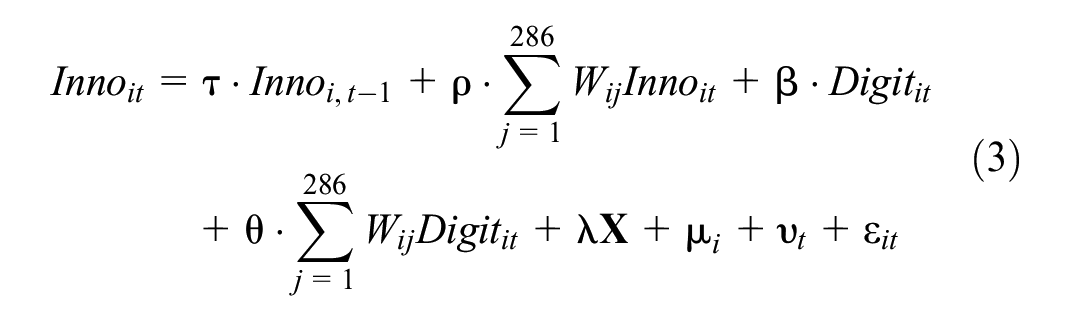
where
Third, the threshold spatial dynamic panel (TSDP) model is used to explore the possible asymmetric and nonlinear effects of digital economy on urban innovation ability. Equation 3 can explore the homogeneous spatial effect of digital economy on urban innovation ability. To delve deeper into the asymmetric and nonlinear impacts of digital economy, the TSDP proposed by Wu and Matsuda (2021) is employed. This model is inspired by the threshold non-dynamic panel with fixed effects, allowing parameters

where
Data
The data are mainly from the Index of Regional Innovation and Entrepreneurship in China (IRIEC) constructed by the Center for Enterprise Research (CER) of Peking University (https://opendata.pku.edu.cn/), the Chinese Innovation Research Database (CIRD) provided by Chinese Research Data Services Platform (CNRDS, https://www.cnrds.com/), the Digital Inclusive Financial Index jointly published by Digital Finance Research Center of Peking University and Ant Financial Group (https://en.idf.pku.edu.cn/), and the “Internet Plus” Urban Digital Economy Development Index compiled by Tencent Research Institute. The marketization index stems from Wang et al. (2021). The number of intellectual property cases comes from “Peking University Legal Treasure database” (PKULAW.COM). The remaining indicators are derived from “China City Statistical Yearbook.”
Combining the availability of data and referring to (Deng & Zhang, 2022; Zhao et al., 2020), the index measurement of the digital economy is designed (Table 2). This measurement assesses the digital economy levels of 286 cities across two dimensions: digital industry and digital finance. The first dimension “digital industry” mainly involves digital industry infrastructure and digital industry economy. The former is calculated by Internet penetration rate, the scale of Internet employees and cell phone penetration rate; the latter is calculated by the volume of Internet business. The second dimension “digital finance” is based on the “Digital Inclusive Financial Index,” which focuses on “coverage breadth of digital finance,”“usage depth of digital finance,” and “digitalization level of finance” (Jiang et al., 2021).
Measurement of Digital Economy.

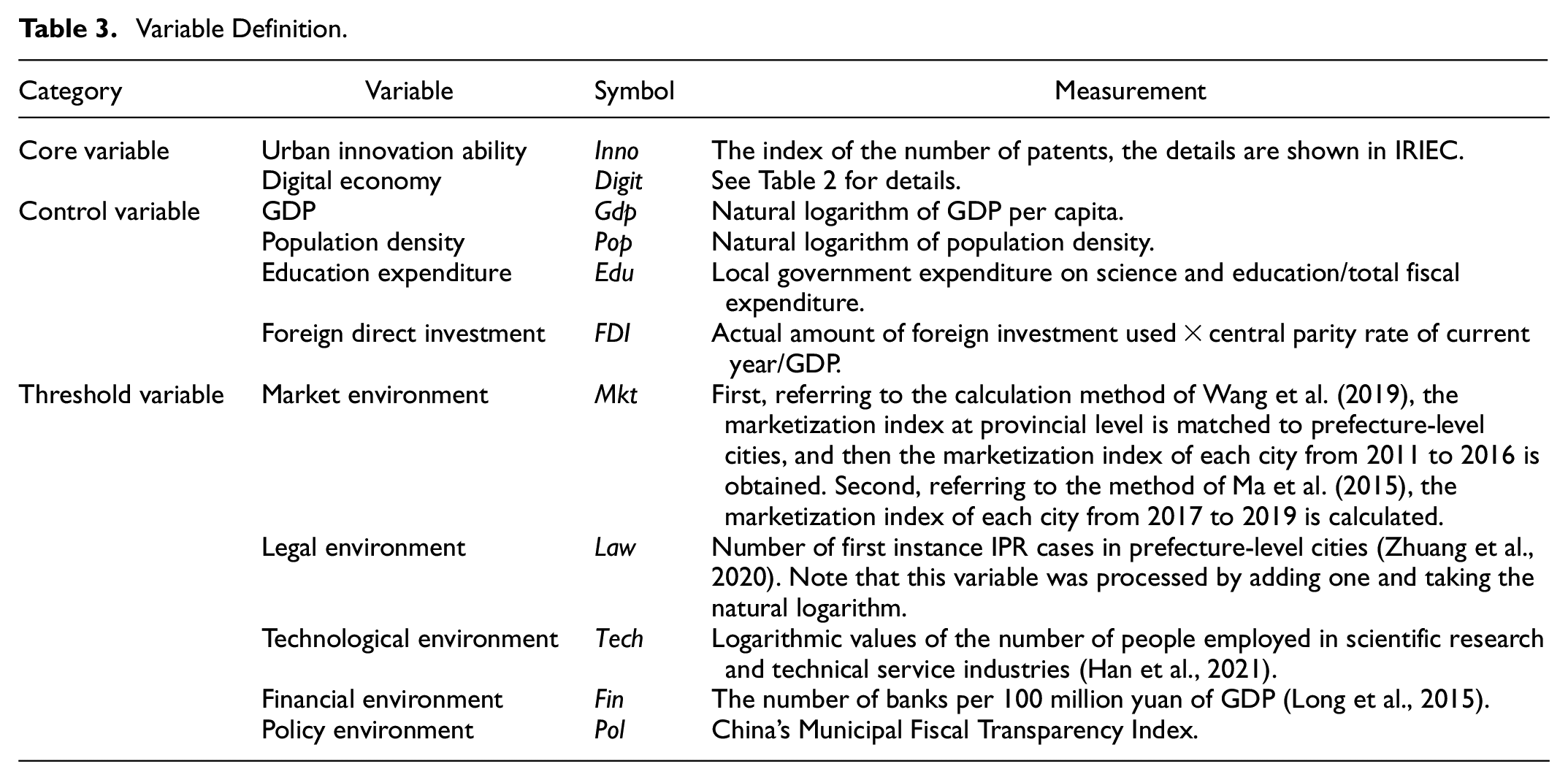
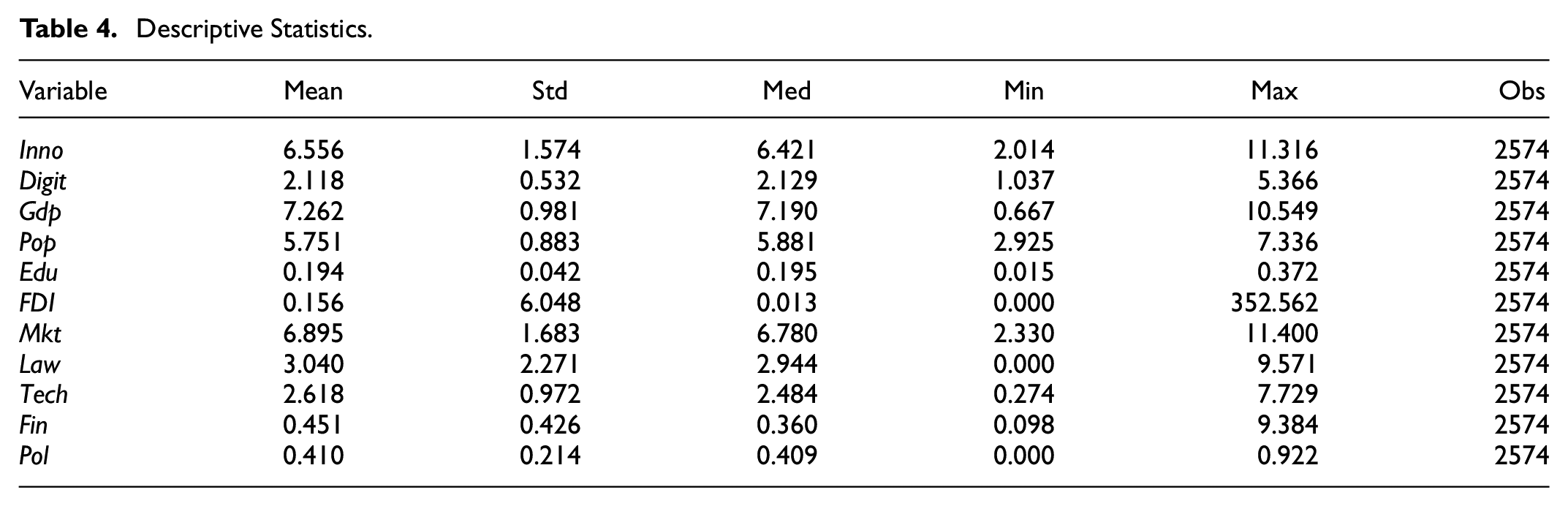
Besides, this paper examines other significant factors, including control variables at city level and threshold variables that measure the external environments. The city-level control variables include GDP (Gdp), population density (Pop), education expenditure (Edu), and foreign direct investment (FDI). The external environment, as a Petri dish for innovation, is a significant factor to promote the urban innovation ability. Under the background of imperfect intellectual property protection system and obvious regional differences in China, external environmental factors such as the degree of marketization, the financial environment, and the technical environment may affect the relationship between digital economy and urban innovation ability (Zhao & Xu, 2023). The symbols and measurements of the main variables are summarized in Table 3. The descriptive statistics for the abovementioned variables are reported in Table 4.
Variable Definition.
Descriptive Statistics.
Empirical Discussion
Causal Relationship
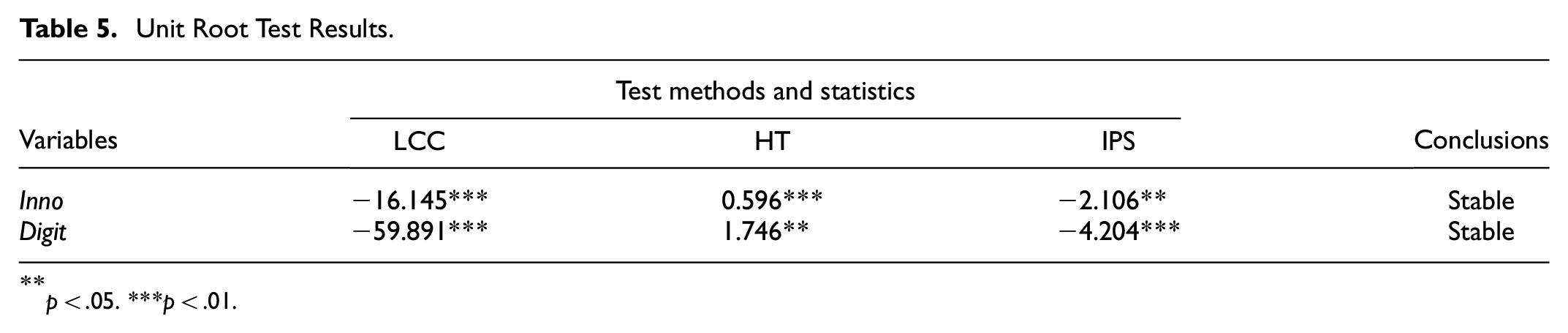
Since non-stationarity of the variables frequently leads to spurious regressions, results in biased or even invalid conclusions. To analysis the relationships between digital economy and urban innovation ability, the stationarity test must be conducted beforehand. As shown in Table 5, Levin-Lin-Chu test (LLC), Harris-Tzavalis test (HT), and Im-Pesaran-Shin test (IPS) are used to verify whether there are unit roots. The test results reject the assumption that the variables are non-stationary, suggesting that the two variables are stable and suitable to PVAR analysis.
Unit Root Test Results.
p < .05. ***p < .01.
According to the information criteria shown in Panel A of Table 6, the PVAR model with a lag order of 1 is established. Furthermore, the Granger causality test results are shown in Table 6 (Panel B). At a 1% level of significance, the initial hypothesis, the initial hypothesis “The change of
Results of PVAR Model and Granger Test.

Note. Robust standard errors in parentheses.
p < .1. ***p < .01.
Spatial effect
Benchmark
The estimated results of SDPD using the explanatory variable of urban innovation ability are presented in Table 7. Referring to Elhorst (2014), some verifications such as LM tests, Wald tests, Hausman tests, are proceeded. Firstly, the Hausman test results for the model with two different spatial weights significantly reject the hypothesis of using a random effects model. Secondly, according to the LR statistics for time fixed effects and city fixed effects, using a two-way fixed effects model is demonstrably superior to a one-way fixed effects model. Thirdly, according to the results of Wald test and LR test, the SDPD with two-way fixed effects should be selected.
Estimated Results of SDPD.

Note. Robust standard errors in parentheses.
p < .1. **p < .05. ***p < .01.
Lagging factors are introduced into the SDPD, so that the direct impact of the digital economy on urban innovation ability cannot be obtained from Table 7. Nevertheless, the results below are still informative. (a) The estimated coefficient of the time-lagged term of urban innovation ability (
Effect Decomposition
The results in Table 8 confirm that in the short term, the digital economy has a significantly positive impact on urban innovation ability in both direct and indirect ways, but in the long term, only the indirect effect remains significant. It suggests that the positive spillover effects of the digital economy are evident in the short term, not only within the local city but also in neighboring cities. In the long run, the growth of digital economy is more beneficial to the transfer and diffusion of innovation resources and frontier technologies outside the city, which significantly promotes the innovation ability of neighboring cities, but the positive spillover to the city will decay with time and has a certain timeliness.
Effect Decomposition of Digital Economy on Urban Innovation Ability.
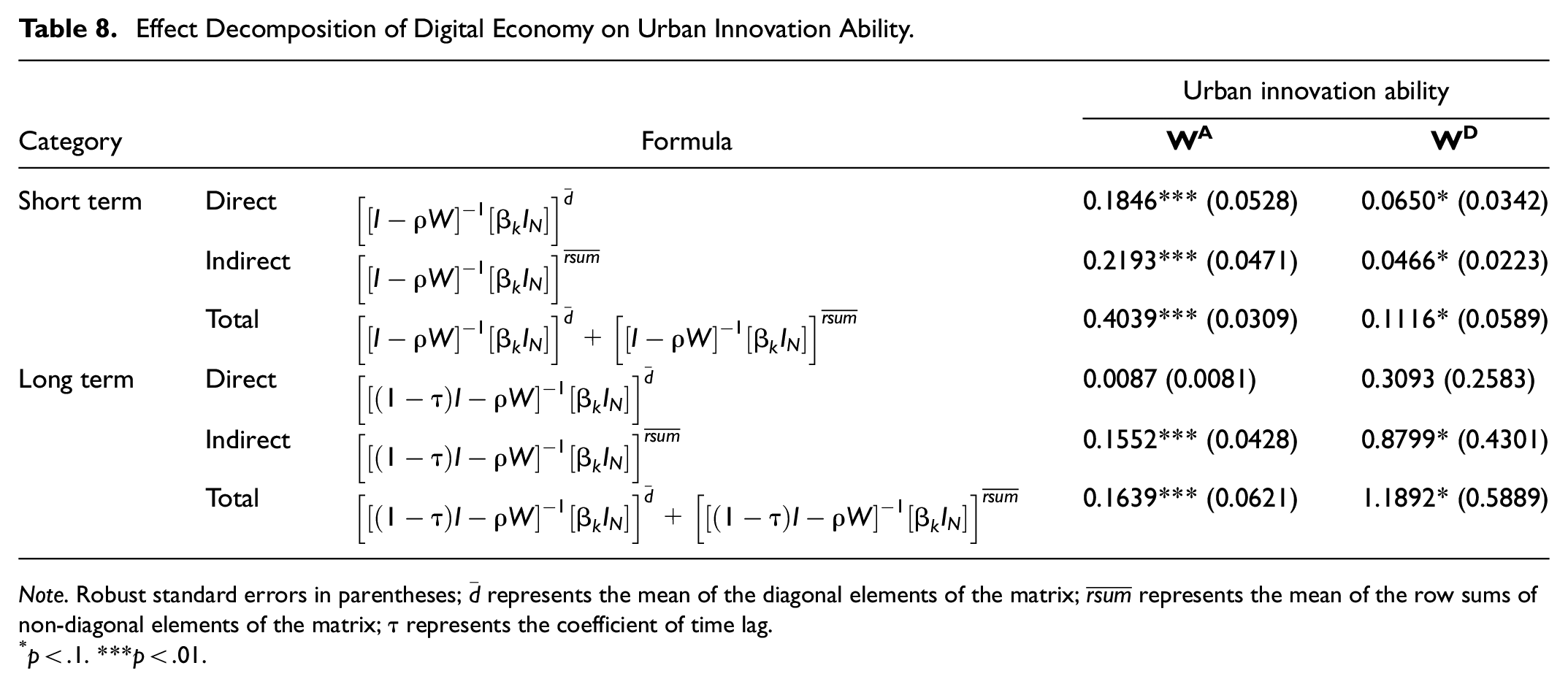
Note. Robust standard errors in parentheses;
p < .1. ***p < .01.
Robustness Check
In order to reduce the impact of statistical variable selection on estimate results, this paper conduct robustness tests by substituting the original statistical variables with comparable ones.
Explained Variable
We take the number of patent applications in each city as a proxy variable of urban innovation ability, then assigns 50%, 30% and 20% weights to invention patents, utility model patents and design patents respectively, and finally adopts the weighted number of patent applications as a measure of urban innovation ability. The estimated results after replacing the explained variables are show in Table 9, where the coefficients of the time and space lag items of urban innovation ability (
Robustness Test: Replacement of Explained Variable.

Note. Robust standard errors in parentheses.
p < .1. **p < .05. ***p < .01.
Explanatory Variable
Referring to Wei (2022), this paper takes the “Internet Plus” Urban Digital Economy Development Index from 2014 to 2018 compiled by Tencent Research Institute as a proxy variable for the core explanatory variable to verify the robustness of empirical results. In Table 10, the estimated coefficients are all positive and significant, indicating that the estimates remain robust after replacing the explanatory variable.
Robustness Test: Replacement of Explanatory Variable.

Note. Robust standard errors in parentheses.
p < .05. ***p < .01.
Nonlinear Effect
Using the Bootstrap method, the results of threshold test for each external environmental factor after sampling 300 times are compiled in Table 11. Specifically, the Bootstrap findings are significant for both the single threshold hypothesis and the double threshold hypothesis whether the market environment or policy environment is employed as the threshold variable, but the test results are not significant under the triple threshold hypothesis. It is confirmed that there are two significant thresholds for the market and policy environment. The Bootstrap findings for the single threshold hypothesis are significant when the regulatory environment, technical environment, or financial environment is utilized as the threshold variable, however the test results for the double threshold hypothesis are not significant. It indicates that there is only one significant threshold for legal environment, technological environment and financial environment. Based on the threshold estimations and their test results presented in Table 11, the market environment is classified as “high marketization (
Threshold Test Result.

Note. “—” represents that it does not exist.
p < .1. **p < .05.
The estimated results of TSDP with different external environments as threshold variables are reported in Table 12. The results show that: (a) When the degree of marketization is either too high or too low, it becomes challenging for the digital economy to foster urban innovation ability. However, a moderate degree of marketization (
Estimated Results of TSDP.

Note. Robust standard errors in parentheses.
p < .1. ***p < .01.
Conclusion
The burgeoning development of digital economy in China is a new engine for boosting urban innovation ability and provides strong support for the promotion of innovation. Based on the panel data of 286 prefecture-level cities in China from 2011 to 2019, this paper explores the causal relationship between digital economy and urban innovation ability by PVAR, examines the spatial and dynamic impacts of digital economy on urban innovation ability by SDPD, and analyzes the nonlinear impacts of digital economy on urban innovation ability under different external environments by TSDP. It is found that: (a) The urban innovation ability has significant spatial dependence and presents a U-shaped evolution trend. (b) In the short term, the digital economy can empower urban innovation ability, and it is not only limited to its own city, but also has a significant impact on nearby cities. In the long run, the growth of digital economy can also promote neighboring cities’ ability for innovation, which is more beneficial to the transfer and diffusion of innovation resources and cutting-edge technologies to outside of the city. However, the positive spillover effect on the city itself decays with time, which has certain timeliness. (c) The impact of the digital economy on urban innovation ability varies in different external environments, showing obvious nonlinearity and significant external environmental threshold characteristics. Specifically, a moderate degree of marketization is beneficial to the digital economy in enhancing urban innovation ability; a better legal or technological environment also facilitates the digital economy in empowering urban innovation ability; in a poor financial environment, the digital economy has a stronger effect on promoting urban innovation ability; on the contrary, in a moderate or poor policy environment, it is challenging for digital economy to effectively promote urban innovation ability.
Based on the above findings, this paper provides recommendations on how government agencies, industry stakeholders, and city planners can leverage the digital economy to foster urban innovation ability.
First, for government agencies. The relationship between the digital economy and the capacity for urban innovation can be impacted by the external environment. Therefore, relevant government agencies should constantly improve the external environment such as technological environment, and create a good operating ecology where the digital economy can effectively foster urban innovation ability. While promoting the digital economy, the relevant government agencies should control a moderate level of marketization to realize the promoting effect of digital economy on urban innovation ability. Additionally, the relevant government agencies should try to establish a favorable policy implementation environment, improve the transparency of fiscal revenue and expenditure, introduce policies and regulations related to technological innovation, improve the system of laws and regulations and the supply system of intellectual property rights, and create a fair external environment in an all-round and multi-dimensional way, thus actively encouraging urban innovation activities. Besides, relevant government agencies should focus on the common growth of digital economy and urban innovation ability. In terms of digital infrastructure construction and provision of public goods, government agencies should constantly broaden the channels for all kinds of subjects (e.g., enterprises and universities) to participate in urban innovation and development, and strive to make more capable and willing innovative subjects participate in improving urban innovation ability through the mode of government purchasing services, so as to enhance the stickiness between innovative subjects and urban innovation and achieve the goal of common growth.
Second, for industry stakeholders. Industry stakeholders involve enterprises, investors and employees. Strengthening digital transformation, promoting the deep integration of digital economy and real economy, and improving their own innovation ability are the primary tasks of enterprises. Meanwhile, enterprises should actively strengthen the cooperation and coordination of digital economy, promote the transfer and diffusion of innovative resources and cutting-edge technologies, and share the “knowledge dividend” of digital economy. Additionally, enterprises should enhance the cultivation of talents in digital economy and invest in R&D, advocate and establish an innovative culture, and continuously improve their innovation ability and market competitiveness. As far as investors are concerned, they should comprehensively understand the urban innovation ability and the growth of digital economy, pay attention to the changes of external environment and the developing tendency of technology in order to formulate corresponding and reasonable investment strategies. Concerning employees, they should constantly improve their digital skills, master digital tools and technologies, and actively participate in digital innovation to better meet the needs of the digital era.
Third, for city planners. From the perspective of time and space, digital economy can foster urban ability for innovation. On the one hand, city planners should optimize the urban spatial layout and encourage digital business to gather in the city, which helps to fully exploit the contribution of the digital economy to fostering urban innovation ability. On the other hand, according to the spatial effect of the digital economy, city planners should enhance the cooperation between cities, break the administrative boundaries, attract multi-agents to participate in a wider range, and jointly promote the growth of the digital economy, so as to expand the spillover radius of the digital economy and achieve mutual benefit and “win-win” results. In addition, city planners should strengthen the construction of urban innovation ecosystem, provide better ecological environment and support for digital economy and innovation resources, in order to further promote the improvement of urban innovation ability.
This study still has some limitations which need to be further explored and improved in future studies. First, many other external environmental factors worth exploring. Due to the length of the paper, only five environmental factors, such as market environment and legal environment, are considered in this paper. And future research on the influence mechanisms of other elements of the external environment (such as the cultural environment) is possible. Second, due to the limited availability of data, the study on measuring urban innovation ability is still in the exploratory stage, and the choice of indicators for measuring the digital economy at the city level is limited. Therefore, we will further optimize and improve the measurement of these important indicators in future study.
Footnotes
Acknowledgements
The authors are grateful to Prof. Sebastien Menard for his helpful comments and contribution to this manuscript.
Declaration of Conflicting Interests
The author(s) declared no potential conflicts of interest with respect to the research, authorship, and/or publication of this article.
Funding
The author(s) disclosed receipt of the following financial support for the research, authorship, and/or publication of this article: The research was funded by Shandong Provincial Natural Science Foundation [grant number ZR2023MG075 & ZR2024QE171], and Shandong Province Youth Innovation and Technology Support Program for Higher Education Institutions(2023KJ111).

Data Availability Statement
Data available on request from the authors.