




Abstract
This research explored a South African bank that was undergoing the implementation of advanced digital technologies at the time of the study. The aim of the research was to develop a framework for talent management amid advanced digitalisation within the bank. This research used a qualitative case study approach, and 18 one-on-one interviews were conducted with employees from the bank, selected through purposive sampling. Thematic analysis was used on the qualitative data collected, by applying an initial inductive coding process to the interview transcripts, followed by two further coding processes that gave rise to precise themes and subthemes. We found that digital technologies influenced the talent management value chain within the bank. These technologies require the transformation of talent management processes and practices. We also found that a reimagined Human Capital function delivery is required from the Human Capital function and Human Capital professionals. We then established that the delivery must encompass a digitised Human Capital function and Human Capital must operate as a strategic business partner, which must become a change management agent by partnering with business leaders to lead digital transformations in the bank. Overall, the research revealed that a sound response to the Fourth Industrial Revolution requires a new approach to talent management within the selected bank, and such an approach must be continuously recalibrated as and when new and substantially impacting technologies arise. This paper, therefore, offers unprecedented insights into the key talent management elements to be implemented in the bank during the adoption of advanced digital technologies.
Keywords
Introduction and Background
The digital disruption caused by the Fourth Industrial Revolution (4IR) requires a unique way of leading today’s workforce, as uncertainty and complexity in the workplace necessitate new ways of thinking (Dhanpat et al., 2020). The workplace technology advancements underway constantly lead to new competency requirements for employees (Nesindande et al., 2024). The digital shifts have influenced talent activities in the workplace in terms of speed, accuracy, quality, innovation, and flexibility (Chytiri, 2019).
Digital technologies have brought benefits in the workplace, characterised by reduced cost, a deviation from traditional hierarchical structures, the introduction of flexible work arrangements, and increased collaboration (Papadimitropoulos, 2019). Furthermore, the use of technologies like artificial intelligence (AI) and robotics increases productivity, automates tasks, and frees up employees’ time to do more fulfilling work (Zervoudi, 2020). Thus, the human capital (HC) function must rethink its value proposition in the evolving workplace and develop solutions to assist organisations to effectively manage digital changes by transforming talent management processes and practices (Saputra et al., 2022).
This research explored the implications of digital technologies on the talent management value chain in a selected bank in South Africa. We consequently recommend a framework for talent management amid advancing digitalisation in the chosen bank, since the 4IR is continuously transforming work and creating opportunities for the workplace to re-engineer talent management (Claus, 2019).
Research Aim and Objectives
Implementing digital technologies in the banking workplace has implications for the talent management value chain. This research aimed to propose a framework for talent management in digital banking by exploring the implications of digital technologies for the talent management value chain in the selected bank. The first objective was to determine the required talent management practices and processes concerning the implementation of digital technologies in the chosen bank. The second objective was to describe how talent management should evolve to adapt to the chosen bank’s digitally advancing workplace.
A Brief Literature Review
Diffusion of Innovation Theory
According to Dearing and Cox (2018), Rogers (2003) and Sahin (2006), the diffusion of innovation theory outlines that deliberate actions must be taken to increase the chances of the positive workplace perception of a new technology that is adopted and implemented. Four main elements must be considered when diffusing technology in the workplace namely, innovation, communication channels, time, and the social system. Firstly, organisations must decide on the innovation they want to implement in the workplace and its appropriateness. Secondly, they must select the communication channels that will be used to influence employees about technology. Thirdly, they must consider the time needed for the technology to be implemented in the workplace. Finally, they must manage the social system and how employees influence each other in adopting the technology, as well as eliminate barriers and resistance.
Furthermore, to avoid uncertainty about the technology, organisations must ensure that the technology’s characteristics and benefits are clearly outlined to employees. Employees need to understand what the technology can do for them and how it will affect their work. Therefore, an organisation must undergo an innovation-decision process (Dearing, 2010). This involves five steps, including knowledge, persuasion, decision, implementation and confirmation. Figure 1 below outlines these steps.

A model of five stages in the innovation-decision process (Rogers, 2003).
The first step, which is the knowledge stage, is characterised by the search among employees for knowledge regarding the technology. This includes awareness about the technology, how to use it and understanding its functioning and the vision that undergirds it. The second step is represented by the persuasion stage, when employees form opinions about the technology and its functioning. At this stage, they either develop a positive or negative opinion of the technology and may need persuasion from peers in the organisation to adopt it. Employees need to understand the characteristics of the technology. This relates to its relative advantage; the perception that it will improve the status quo; an understanding of its workings; seeing its compatibility with the needs of the workplace; understanding its complexity; ensuring its continuous trialability and improvement; and showcasing it to enhance observability and indicate benefits to employees.
The third step is the decision stage, when employees decide to adopt or reject the technology. In this stage, employees trial the technology and decide to adopt it immediately or at a later stage. Some think about adopting the technology but later decide to reject it, while some reject the technology from the outset. The fourth step is the implementation stage, when the technology is being practiced and integrated into daily tasks. In this step, employees may still feel uncertain about the technology and change management may be implemented to alleviate their fears about it. The fifth step is the confirmation stage, when employees have adopted the technology and want confirmation that this was the right decision. This is affirmed by means of positive messages about the technology and its advantages.
Roger’s theory moreover indicates that the rate of adoption regarding technology can be managed in the organisation by classifying employees into various categories: innovators, early adopters, early majority, late majority and laggards. Figure 2 below depicts this.

Adopter innovativeness categorisation based on time of adoption (Rogers, 2003).
The innovators are the first to adapt to technology. They are excited to lead the change and are not constrained by social norms. The group represents 2.5% of employees in the workplace and includes influential leaders. The next group is early adopters, who adapt to change, as they can see the benefit and advantages of the technology, represented by 13.5% of employees. The early-majority and late-majority groups adapt to technology, as they feel the pressure and are influenced to do so by the groups who have done so already, and they represent 68% of employees. Laggards are the last group to adapt to technology: they take their time and are characterised as digital immigrants, and they represent 16% of employees in the workplace. Suitable strategies to manage these groups of employees must be utilised as they adapt to technology (see Dearing & Cox, 2018; Dhanpat et al., 2020; Rogers, 2003).
The complexity in the workplace brought about by technology requires employees to adapt to changes at a faster pace. Employees need knowledge about technology and must be open to work with it. Organisations must understand that employees adapt to technology at different rates. Thus, they need to put mechanisms in place to ensure that employees understand the technology and are equipped with the skills to navigate it, so that they can adapt to it faster (Beer & Mulder, 2020). Rogers’ diffusion of innovation theory was therefore used in this research to address the matters concerning the diffusion of, readiness for, and adaptation to advanced digital technologies within the selected bank.
A Multi-Level Theoretical Framework
A multi-level theoretical framework for understanding digital transformation in the workplace, as described by Trenerry et al. (2021), was also used in this research to explore the effects of digital technologies and their transformations within the selected bank. The framework indicates that digital transformation takes place at multiple levels, including the individual, the group and the organisation levels.
The first level of the multi-level theory centres on the individual. Five factors influence the digital transformation of employees at this level, namely technology acceptance and adoption; perceptions and attitudes towards technological change; skills and training; workplace resilience and adaptability; and work-related stress and wellbeing (Trenerry et al., 2021). When organisations implement change, it causes uncertainty, and digital transformations are received with fear by employees because of perceived job uncertainty and technological stress. Therefore, factors at the individual level need to be understood by organisations when they implement digital transformation in the workplace to increase the rate and extent of adoption (Ferreira et al., 2021).
According to Maran et al. (2022), Oosthuizen et al. (2023) and Rogers (2003), digital transformation in the workplace needs to be properly communicated to all employees to eliminate fears and barriers around the adoption of technology. Employees need to understand the benefits of digital transformation and the way in which it will change their jobs for the better. Organisations need to influence employees towards adapting to technology by implementing proper change-management practices and influencing employees through peers, as well as changing the social system within the workplace. Furthermore, training and developing employees’ skills are likely to improve their self-efficacy and use of technology.
The group level is characterised by factors such as team communication and collaboration, workplace relationships, team identification and team resilience and adaptability. Selimović et al. (2021) indicate that collaboration and teamwork are essential for the digital workplace, as teams collaborate at faster rates through digital platforms, which also increases cross-functional collaboration and information sharing. Furthermore, employees need to feel connected to the workplace by having positive relationships with peers and supervisors. These relationships influence technology adoption and innovation in the workplace. Rogers (2003) explains that some employees adapt to technology through pressure from others who have already adopted it, thus, team communication and workplace relationships are important considerations.
At the organisational level, three factors are crucial when it comes to digital-workplace transformation. These include leadership, human resources (HR), organisational culture and climate. Firstly, leaders are critical for leading change initiatives in the workplace: the success of digital transformation rests in leadership that plays a transformational role. Leaders need to support change, have flexible leadership styles, be digitally aware and help employees navigate change and uncertainty (Alade & Windapo, 2021; Schutte et al., 2019; Selimović et al., 2021; Shingenge & Saurombe, 2022). Secondly, digital change is transforming traditional HR departments into electronic human resource management (e-HRM) ones. Areas such as recruitment and selection are being digitised by using AI and robots, and learning and development interventions are delivered virtually by means of digital tools (da Silva et al., 2022; Naidu et al., 2025). Lastly, organisational culture and climate are important for shaping the way in which digital technologies are landed and the extent to which they succeed in the workplace. The digital workplace will require organisational cultures to be adaptable, anticipate business needs and use analytics and technology to address these requirements (Antonucci et al., 2021; Harteis, 2018). Organisations with traditional command-and-control management cultures will struggle with successful digital transformation, while those that embrace engagement, flexibility and collaboration will thrive (Oosthuizen et al., 2023).
The multi-level theoretical framework lends to this research as it underpins the exploration of digital transformation in the workplace. This framework was a lens through which to explore some of the elements described on the three levels, namely digital workplace transformation – which has to do with technology acceptance and adoption, skills and training – which are required for employees to effectively adapt to the digital transformation, and the effects of the digital transformation on the organisational HC. These elements are briefly discussed in some of the following sections of this literature review.
Digital Banking
The banking landscape is facing a digital change that requires banks to adapt to technology at a rapid pace (Diener & Špaček, 2021). Banks will need to be strategic about the way in which they manage the effect of digitalisation on operations, culture, people and business processes (Antonucci et al., 2021).
Digitalisation in banking will need to be used as a tool to manage information, optimise work, manage customer experiences and drive change. Optimisation of work by means of digital tools will improve jobs and facilitate new ways of work practices (Tran et al., 2022) Thus, to achieve success, banks must create collective organisational cultures that support digitisation and lead to positive organisational performance (Ngobeni et al., 2022).
If banks wish to respond appropriately to the digital technologies and their effect, they will need to apply new strategies for managing talent and helping employees deal with the vast amount of change that has been brought by technology (Nesindande et al., 2024; Ngobeni et al., 2022). Talent management strategies and practices that address a digital skills gap, build engagement, manage work-life integration and retain talented and digitally savvy employees will need to be defined in digital banking (Chytiri, 2019).
Digital Workplace Transformation
The digital era has forced organisations to transform their workplaces to what is referred to as “digital workplaces.” The digital workplace encompasses digital infrastructure, digital skills, digital culture, employee wellbeing and employee ability to embrace technology (Selimović et al., 2021). Digitalisation not only comes with new technology, but also directly influences employees’ jobs in the workplace. As new processes are introduced by technology, employees are required to adapt, learn and develop the required skills (Oosthuizen, 2022).
Digital-workplace transformation requires banks to reconsider their workplace practices and technologies and develop new leadership practices, while aligning competencies and employee profiles to digitalisation (Vallo Hult & Byström, 2021). This paper therefore considers 4IR digital technologies and their effects on employees, work, leadership, culture and talent management aspects.
The digital workplace requires employees and organisations to adapt to technological changes. Technologies such as AI and robotics have revolutionised the workplace through their power of automation (Ferreira et al., 2021). The automation of work underway requires changes in work design and the integration of automated activities and employee jobs. This includes creating new capabilities and a new identity of work, adopting new ways of thinking about work, combining new tasks and old ones and making structural changes to work and the organisation (Baptista et al., 2020).
Effects of Digital Transformation on Employees and Work
The digital workplace requires a new employee profile: this is an employee who is adaptable to change, trusts their ability to use digital technologies, is open to new experiences and has the right mindset and skills (Maran et al., 2022). Implementing digital work poses challenges such as a change in job functions, necessitating new contracting with employees. Employees are increasingly finding it hard to disconnect from work since they are always switched on; thus, social connections are negatively impacted resulting in health and mental issues, among others (Yalina & Rozas, 2020).
To appropriately respond to the digital transformations in the workplace, HC departments must overhaul their legacy systems and business processes, take advantage of innovations such as applications that connect employees to the workplace and facilitate collaboration and the sharing of information. However, concomitant challenges centre on data security, cloud-based applications and governance. In this instance, HC and IT professionals will need to work together and find secure ways of collating and analysing data to solve business problems in banking (Dhanpat et al., 2020; Oosthuizen, 2022).
Digital Transformation of Talent Management Practices in Banking
Digital technologies are disrupting HC practices in banking. Technologies such as AI and robotics are transforming certain HC tasks and functions. These technologies are used in recruitment, predictive analytics and overall management of talent. Therefore, new ways of work aligned to digital transformation need to be designed. Professionals within HC must lead the digital revolution by partnering with organisations to create and shape digital cultures in response to digitalisation (da Silva et al., 2022).
According to Bansal et al. (2023), HC practices should evolve and adopt a technological approach by developing technologically enabled recruitment processes; onboarding; training and development interventions; performance management; and technologically led rewards and incentives. This approach will, however, need proper digital infrastructure, digital skills and creativity. HC departments will need to craft strategies to manage the effects of technology on careers (Adekanmbi & Ukpere, 2022).
Development and Skills Required for Digital Banking
Employees in the digital workplace of banking must learn to solve unseen problems. This means that they must develop curiosity, imagination, intuition, creativity, empathy and social intelligence (Hagel & Wooll, 2019). The digital technologies require that employees develop technical and non-technical skills to remain employable (Kraus et al., 2021). HC departments will need to partner with their bank to help employees navigate digital changes and build the digital skills needed in the digital workplace of banking (Mazurchenko et al., 2022).
Banks will need to continuously support their employees to gain digital skills and involve them when rolling out technological changes. Banks will also need to create the right cultural climate to ensure smooth adoption, as well as leadership practices that support change (Marsh et al., 2022).
Methodology
Research Method
This research followed a qualitative research methodology to develop our assumptions regarding the social phenomenon examined and the creation of knowledge about it (see Busetto et al., 2020). The qualitative techniques employed allowed us to examine participants’ lived experiences, gain a rich understanding of the way in which they perceived their reality, while ensuring the discovery of knowledge that did not already exist (see Bhangu et al., 2023). The research specifically utilised a case study strategy to explore the social phenomena at hand (see Jahja et al., 2021), by focusing on a single context with the aim of understanding the topic at hand – that is, talent management amid accelerated digitalisation in a bank in South Africa – in similar multiple contexts. The exploratory case study approach employed further allowed us to add to extant literature on the subject, while providing a basis for future related research.
The research paradigm adopted in this research was a constructivist, and social constructivism in particular. We studied the phenomenon in its natural setting and interpreted the meanings that participants gave to the social phenomenon studied (see Bibi et al., 2022; Brinkmann, 2018). We played the role of passionate participants who were able to authentically understand the setting of the social context (see Phillips, 2023).
Research Design and Approach
Sampling and Participants
Purposive sampling was used, and participants were selected based on the different roles they held in the bank, as indicated (see Ngulube, 2020). While purposive sampling was suitable to help us obtain specific insights into talent management in the context of ongoing technological advancement within the bank during the time when this research was conducted, this sampling approach inherently limited the generalisability of the findings to the broader research population and similar broader research contexts. While purposive sampling has further been criticised for its reliance on researcher judgement which could give rise to bias (Andrade, 2021), we strove to maintain impartiality by establishing the criteria for participant selection in line with the objectives of the research. For example, the participants were primarily selected based on their proximity to the digitisation/automation strategic agenda within the bank, with a minimum tenure expectation of one year in the particular bank, as this was around the period within which the implementation of advanced digital technologies had prior begun at the time when the research was conducted.
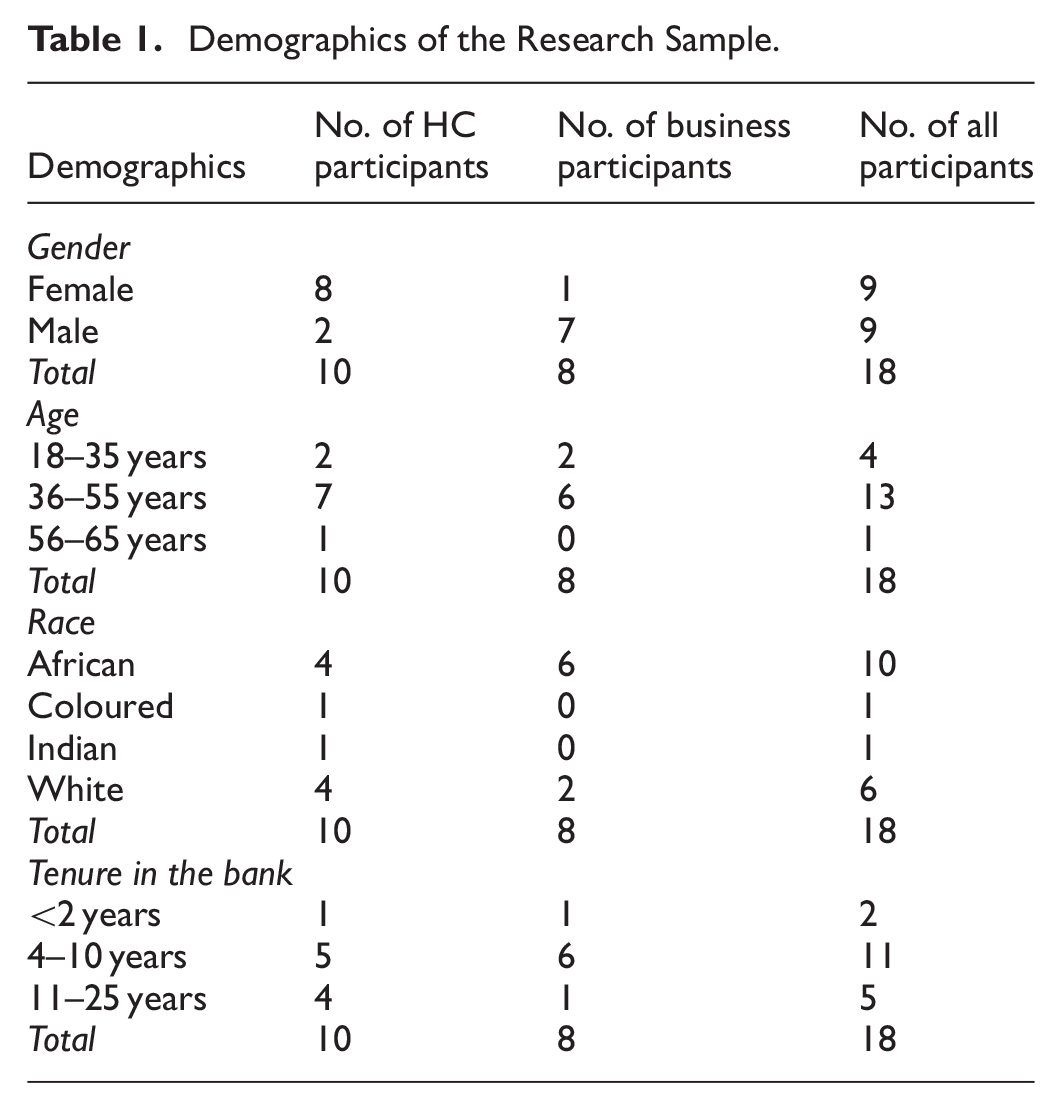
In-depth, one-on-one, semi-structured interviews were conducted in English with 18 participants comprising three heads in business departments, five business managers and 10 HC professionals. The sample size was also informed by existing knowledge on what is considered as acceptable for obtaining noteworthy insights in line with other qualitative case studies of a similar nature (see Ngulube, 2020; Vasileiou et al., 2018). Some demographics of the sample are depicted in Table 1 below.
Demographics of the Research Sample.
Data Collection
To appropriately answer the research questions, a self-developed interview guide was used for the collection of data (Dunwoodie et al., 2023), and specifically, in-depth semi-structured interviews were conducted. Using in-depth interviews as opposed to other qualitative data gathering methods was best suited to answering the research questions, as the design of such interviews was constructed in a manner that ensured the credibility and analysability of the research outcomes (see Roller & Lavrakas, 2015). Additionally, this approach afforded us flexibility in the interviewing process by helping us build rapport and ask open-ended questions, yet all the while maintaining the necessary structure (Bailey, 2018). Depending on the preference of and convenience for participants, the interviews were conducted either face-to-face, or via virtual platforms such as Microsoft Teams, Zoom and Google Meet. All the interviews were conducted one-on-one and in English. To ensure the validity of the self-developed questionnaire, a pilot interview – which eventually formed part of the research – was conducted to check for any questions that may have been difficult to understand and/or required amendment.
Data saturation was carefully considered during data collection (see Braun & Clarke, 2021), however, we continued our exploration beyond the point of saturation, as the greater objective was to garner profound insights into talent management in the era of advanced digitalisation in the bank. This approach of collecting data beyond the mere observance of saturation helped bring us closer to the phenomenon by facilitating the more profound understanding of participants’ beliefs, the direct accessing of their thoughts and the examination of what they did in reality (see Busetto et al., 2020). Field notes were taken during the interviews, which later helped us reconcile the thoughts and emotions experienced while analysing the data, compared to those experienced during data collection. Each interview lasted about 60 min on average. We encouraged the participants to ensure their interviews occurred in a safe and secluded environment to the greatest extent possible, so that no one else besides the relevant parties involved in the interview process was privy to these conversations. Each interview – whether face-to-face or online – was captured on an external recording device and the recordings were stored on a cloud in a password-protected folder accessible to each of us.
Data Analysis
In the data analysis stage, we undertook the process of immersing ourselves in the data collected by personally transcribing the interviews (see Mattimoe et al., 2021). Each interview was transcribed by listening to each recording, noting verbatim, what each participant said during the interview process, making summaries of the data and preparing the data by plotting information in an Excel worksheet for the coding process to bring about the trustworthiness of the findings (see Hammond & Wellington, 2013). We initially undertook an inductive approach to manually generate codes for analysing the data by colour coding various parts of the interview transcripts and making notes on them based on these colour codes, then further coding the data by grouping similar codes that emerged from the first coding cycle, based on their broader identified meaning from the notes (see Byrne, 2022). We then used manual thematic analysis to further analyse the data, by once more grouping similar coloured codes into fewer subthemes which were identified as falling under broader crafted themes that corroborated the objectives of the research (see Mattimoe et al., 2021).
Strategies Employed to Ensure Rigour and Quality of the Data
We took steps to ensure the reliability, trustworthiness and validity of the findings. The total quality framework was applied in the research in accordance with the work of Roller and Lavrakas (2015). Firstly, we achieved credibility by ensuring accuracy in data gathering. Secondly, we ensured analysability of the data by being accurate in the processing and verification of the data, and that all interviews were recorded and transcribed, as indicated. Thirdly, we applied transparency by ensuring that the research can be fully evaluated and is transferrable to other contexts to an extent (Ahmed, 2024).
Ethics and Authorisation
According to Flick (2022), ethics provide guideline for the way in which participants will be treated during the research process and the way in which their information will be handled and safeguarded. This is done by ensuring data security and confidentiality. These considerations were important in this research, as we engaged with participants and handled confidential information, thus, our engagement with participants had to be treated ethically by building a trusting relationship with them from the onset (see Phillips, 2023).
Ethical clearance was sought from and granted by the Research Ethics Committee of the College of Business and Economics at the University of Johannesburg: ethical clearance reference number: IPPM-2022-694(D). The authors were considerate of both the values endorsed by the committee and those of the participants when conducting the research. The authors fully adhered to the university’s ethical clearance processes ensuring that the research was conducted ethically without harming the participants.
Findings
The findings of this research are discussed in this section, encompassing three main themes and their respective sub-themes. The main themes include the following: The evolution of technology, Talent management in the bank’s digital workplace, Reimagined HC function delivery, The themes and sub-themes have also been categorised under the talent management context as outlined in Table 2 below.
Themes And Subthemes.

Research Objective One
The following themes were identified regarding the first objective of the research, which relates to: The talent management practices and processes in relation to the implications of implementing digital technologies in the selected bank.
Theme 2: Talent Management in the Bank’s Digital Workplace
Talent management in the bank’s digital workplace engendered four sub-themes. Sub-theme 1 is Talent management challenges, Sub-theme 2 is New talent management approach, Sub-theme 3 is Automation of talent management processes and Sub-theme 4 is Building digital capability of talent.
Sub-Theme 1: Talent Management Challenges
Participants agreed that they had observed several challenges regarding talent management in the bank caused by the fact that it was transforming in terms of the introduction of advanced digital technologies. These included keeping good talent, traditional approaches to talent management, the definition of talent, stagnation, policies, leadership, employee value propositions and a shift in HC.
The challenge is keeping good talent. The traditional talent management processes within the HC environment are frustrating(Participant 7, business head, male, eight years’ experience in the bank). Talent management is a big challenge in the bank because I think the approach to talent management has been traditional and we always look at it from a single point but [with] the work we are in now, with people that work in this industry, you need to be a lot more creative (Participant 9, business head, male, ten years’ experience in the bank). I don’t think there’s enough focus on creating opportunities for growth. Stagnation is a big reason why top talent feels frustrated and stretched (Participant ten, business manager, female, 12 years’ experience in the bank). The definition of talent is one that is not clearly understood. The definition is critical, we must start by understand[ing] what is it that we deem as Talent and what is it that informs that talent (Participant 9, business head, male, ten years’ experience in the bank). I hear people talking about HC policies, but I have not seen a retention policy. I think the bank needs to have the right policies that will support the strategy (Participant 16, business manager, male, < 2 years’ experience in the bank). Change happens when leaders drive that change, I don’t think in HC we have been strategic. Where other business departments have achieved the digitised investment that they’ve needed to keep up with the pace of change, HC has not had that investment (Participant 5, HC professional, female, nine years’ experience in the bank). Another challenge is around the Employee-value proposition. What are we promising employees? The talent that we are attracting what are they looking for? [mis]Understanding the talent that we are employing is one of the challenges that we need to breach (Participant 2, HC professional, female, 11 years’ experience in the bank). A radical shift is required in the HC stream as the talent we want to attract has more demands and the traditional benefits will no longer work (Participant 4, HC professional, female, ten years’ experience in the bank). With all the growth that the bank is going through we have a lot of external hires that come in, we are not seeing a lot of people promoted internally (Participant 3, business manager, male, 4 years’ experience in the bank).
Sub-Theme 2: New Talent Management Approach
Participants agreed that the bank’s talent management processes and practices were traditional in nature. HC policies needed to be aligned to support the bank’s digital strategy. Participants noted that the HC function had not been in the forefront of investing in digital technologies within the ambit of HC and, therefore, had not been able to keep up with the pace of change, unlike other business departments within the bank.
As the custodians of people in the organisation we need to be putting ourselves into the shoes of our customers and understanding a lot more quickly, how this new world is going to affect our people. We must change traditional thinking within HC with regards to structures and policies (Participant 5, HC professional, female, nine years’ experience in the bank). We must create people experiences that are competitive and employee centric. HC processes and practices need to be agile, competitive enough with the other banks, and use technology to streamline them (Participant 14, business manager, male, 4 years’ experience in the bank). Re-imagining benefit structures and educating people around benefits is key. I think employee experience is critically important because a lot of organisations talk about [the importance of] employee experience but impractical policies and processes within HC affect that (Participant 4, HC professional, female, ten years’ experience in the bank). We need to keep talent stimulated and with the bank having fewer layers we need to understand how to manage talent and keep talent engaged (Participant 8, HC professional, female, < 2 years’ experience in the bank). Finding creative ways of engaging potential talent, giving them access to our environment for them to play around, and giving them a more detailed view of how our environment looks prior to them joining [is important]. For the internal talent that we already have, we need proper talent mapping (Participant 9, business head, male, ten years’ experience in the bank). HC must partner with business to see what can be done to shuffle things around and create pockets of opportunity. [We also need to] Be more open and create roles to retain people even if we don’t already have them in our structures, to just create more room for opportunity (Participant10, business manager, female, 12 years’ experience in the bank). Our recruiting system needs to be different; we need to ask ourselves if that [(our current system)] is giving us the type of data we need to be able to make relevant recruitment decisions. We need to have a system that enables us to be getting things at the push of a button (Participant 15, HC professional, male, 5 years’ experience in the bank).
Sub-Theme 3: Automation of Talent Management Processes
Participants agreed that, with the introduction of digital technologies in the bank, certain shifts had occurred within the ambit of HC regarding certain talent management processes done online. Participants noted that these improvements were implemented to enhance processes and draw insights to equip business for making decisions about people. However, the use of automated talent management processes was still new and rolled out only to some parts of the bank, while others were still using manual processes.
A few HC processes are done on the system online which include talent management processes of contracting and confirming key performance indicators (KPI’s) (Participant 13, HC professional, female, eight years’ experience in the bank). Standardised processes that allow for levels of consistency are required to get quality information. It’s all about meaningful input and making the right talent decisions about people using data (Participant 8, HC professional, female, < 2 years’ experience in the bank). Our personal developmental plans and learning plans are now automated. There are a few things that we have improved, and we need to get people to use the system (Participant 1: HC professional, male, 25 years’ experience in the bank). We have done the change piece with regards to performance management, but some parts of the bank are using the system while some parts are not (Participant 2, HC professional, female, 11 years’ experience in the bank). We really need to upskill our line leaders and our business partners to update information on the system, we need something that’s a lot more user friendly (Participant 8, HC professional, female, < 2 years’ experience in the bank). The digitised process enabled us to draw insights to equip the business in decision making. There is a positive impact doing things digitally on any process or person (Participant 11, HC professional, female, 15 years’ experience in the bank). We showed the benefits of using the system, showed people how they can apply for leave online and that they no longer had to complete a form anymore (Participant 1: HC professional, male, 25 years’ experience in the bank).
Sub-Theme 4: Building Digital Capability of Talent
Participants agreed that it was critical to build digital capability centred on talent in the bank for the success of the bank’s digital strategy. Furthermore, it was agreed that the bank required employees and leaders that were digitally savvy, able to build a new mindset and lead digital transformations in the bank. Thus, talent management processes and practices focused on digital skills development, education and bringing awareness to employees regarding digital technologies were required.
It’s not just about getting ABC skills, it’s about building a new mindset, which is radically different from what we have today. We did a lot of different learning interventions. Some were digital, some were face-to-face, [where] we focused on products and systems and the way people would work in the future. Through ongoing monitoring and support in the workplace we conducted coaching and leadership tracking to see that people were adapting to the new ways of working (Participant 5, HC professional, female, nine years’ experience in the bank). We realised we needed to go serious on digitalisation. It took us about a year to design courses that were focused on building the digital capability. We have a lot of support from leaders driving development. Development is owned by leaders and employees (Participant 12, HC professional, female, 1seven years’ experience in the bank). We need to educate ourselves and our staff to keep up with the times. What are the new trends in terms of digitisation and what are the new processes and tools? (Participant ten, business manager, female, 12 years’ experience in the bank). If employees are thinking out-of-the-box, [and] they want to add new technologies so that they feel like they are adding value, then give them that opportunity (Participant 6, business head, male, 6 years’ experience in the bank). Since the new way of working [era began], there has been a lot of effort from the HC team to equip our managers to lead now that we are in a hybrid way of work (Participant 2, HC professional, female, 11 years’ experience in the bank). From a learning perspective, to get people the same, if not more, learning on digital platforms is massive and difficult because rapport is not built as easily. The bulk of our people in our environment have not yet adapted sufficiently to be able to maximise online initiatives (Participant 4, HC professional, female, ten years’ experience in the bank).
Research Objective Two
The following themes were identified regarding the second objective of the research: The way in which talent management should evolve to adapt to the selected bank’s digital workplace.
Theme 1: The Evolution of Technology
The evolution of technology engendered two sub-themes. Sub-theme 1 is Shift in business processes and Sub-theme 2 is Shift in HC processes. Most of the participants agreed that they had experienced a shift with regard to work processes upon the implementation of new technology in the bank and the introduction of new platforms, tools and systems.
Sub-Theme 1: Shift in Business Process
The introduction of new technology in the bank affected business processes and interactions with customers internally and externally. Participants agreed that the shift caused by technology tools and platforms meant that they interacted with customers in real time and were brought closer to them. They had to develop new ways of performing certain processes while reducing risk and increasing profitability for the bank.
The implementation of the bank’s new digital channel and moving the bank to a digital platform, changed the whole business from end to end. It was a transformational change, which affected everyone quite significantly(Participant 5, HC professional, female, eight years’ experience in the bank). The technical platforms changed the way that we monitored [the] customer experience (Participant 5, HC professional, female, nine years’ experience in the bank). There’s been a big shift, with certain technology stack within the bank. As opposed to us receiving activity from the customer in a delayed sense, we are testing out real time interactions with the customer which then means as soon as you transact, we will immediately within a minute or two send you a survey. We are now getting to the customer in real time, and obviously that customer experience has shifted (Participant 9, business head, male, ten years’ experience in the bank). The biggest change has been seeing the value of non-traditional data and how that can improve overall customer experience, reduce risk and increase profitability (Participant 7, business head, male, eight years’ experience in the bank). IT departments need to keep up with technology and update core skills. The world is moving towards cloud-based storage for a developer, [thus] they must keep up as there are new languages coming up, a wave of technology and new ways of writing code (Participant 3, business manager, male, 4 years’ experience in the bank).
These comments show that the digital platforms implemented in the bank brought transformational change across it. The introduction of new technology in the bank affected business processes and interactions with customers internally and externally. Participants agreed that the shift caused by technology tools and platforms meant that they interacted with customers in real time and were brought closer to them. They had to develop new ways of performing certain processes while reducing risk and increasing profitability for the bank. Moreover, participants indicated that the bank had taken advantage of technology to drive the customer experience to its internal and external clients.
Sub-Theme 2: Shift in HC Processes
Participants agreed that change was experienced with regard to HC processes when the bank introduced new technologies. Certain HC processes were moved online by using systems. The talent management processes of tracking development plans shifted to online systems and further employees were able to complete leave and access payslips via the system.
Shifts from a systems perspective include tracking personal developmental plans. An individual can now go on to the system [and] complete their developmental plan according to business requirements (Participant 11, HC professional, female, 15 years’ experience in the bank). We have automated several processes. Employees are no longer required to complete manual leave forms, they can go into the system and apply for leave and employees can also view their payslips online(Participant 1: HC professional, male, 25 years’ experience in the bank). What is nice is that reports are available on the system, once information is captured managers can pull reports regarding those employees that report under them (Participant 15, HC professional, male, 5 years’ experience in the bank). When Covid hit, we had to digitise a lot of the learning curriculum so that we can continue. Where learning was face-to-face, that now changed (Participant 12, HC professional, female, 1seven years’ experience in the bank).
Theme 3: Reimagined HC Function Delivery
The third theme identified was the need for a reimagined HC function delivery system, as categorised in two sub-themes. Sub-theme one was Digital HC function and Sub-theme two was HC as a strategic business partner.
Sub-Theme 1: Digital HC Function
Participants agreed that a digital HC function was required for the sake of aligning the digital strategy of the bank with the HC function. The HC function required a transformation of its HC delivery to be digitalised so that the function could keep up with developments and lead the digital change in the workplace of banking. A reimagined HC function approach would enable the HC function to be creative when it came to attracting and engaging people, requiring the use of AI in recruitment processes and creating platforms that have the employee as customer at heart, thereby transforming the HC delivery. Additionally, participants noted that the employee profile was changing at a fast pace and that the bank needed critical skills such as creativity and digital savviness to succeed in the digital era. Thus, the HC function would need to partner with business and create platforms to find these sought after skills and develop them.
We need to get rid of any type of paper. The moment that you allow people to use paper then I think it defeats the digital agenda. Our workforce has 67% of millennials who want to use social media to work, and they really do not want to do paperwork (Participant 1, HC professional, male, 25 years’ experience in the bank). It is important to apply design thinking from a HC platform perspective and have apps and systems that can be accessible and user-friendly (Participant 8, HC professional, female, < 2 years’ experience in the bank). When you appreciate that HC is really about engagement with people, you would create platforms for your existing employees to engage with their HC partners, to address personal challenges that they’re facing. The key thing is to bring the people closer through technology (Participant 9, business head, male, ten years’ experience in the bank). We have some catching up to do in becoming a digitised HC function. We must create a digitally led customer experience and become facilitators of business value. I think we must become, digital natives and continually upskill ourselves (Participant 5, HC professional, female, nine years’ experience in the bank). We need to find a way of using technology to support the HC process in assessing people and engaging people and use test environments to see what people can do prior to taking them through the recruitment process. We must use AI to attract people and create a pool of candidates. (Participant 6, business head, male, 6 years’ experience in the bank). The profile of the people that we are looking for is changing tremendously and at a faster pace. I think it’s important that we source people that have the critical skills that we are looking for, [particularly] those of being creative and being digitally savvy (Participant 13, HC professional, female, eight years’ experience in the bank).
Sub-Theme 2: HC as a Strategic Business Partner
Participants agreed that the HC function needed to be a strategic business partner and create value for the business. They believed that a strategic partnership with business was required in the new world of work that is driven by digitalisation. participants thought that the HC function and HC professionals were operating in an administrative capacity rather than as strategic business partners. They agreed that a shift was required in this respect, as the HC function and HC professionals should be proactive and digitally savvy and should not get left behind in the digital workplace of banking.
We should not be inundated by admin as HC. We must be able to empower business, be digital savvy and shift with the market and not get left behind. We should always be proactive in terms of the HC solution (Participant 18, HC professional, female, ten years’ experience in the bank). The HC strategy must be forward thinking and linked to the digital agenda. As the HC community, we need to understand the business better. We need to speak the business language and not just speak the HC language; we must find a good balance (Participant 8, HC professional, female, < 2 years’ experience in the bank). HC processes are mostly administrative, manual and with limited interface. Things have evolved, things have changed, things are smarter, but we are still doing things the old way. However, this will be changing as we have been given the go ahead to upgrade our HC system (Participant 12, HC professional, female, 1seven years’ experience in the bank). Adopting speed is required to get people on board. HC has a bigger mandate than just following processes as they are. The mandate is to reduce pain points for potential employees and existing employees. If HC is left behind, then that says that Our People are left behind (Participant 9, business head, male, ten years’ experience in the bank). I think as the HC community we are moving in the right direction. We have a seat at the table and the business acknowledges our existence and sees our role. We need to understand business needs well and be able to respond appropriately to the business needs. HC must partner with each other, to deliver a value proposition to the business (Participant 2, HC professional, female, 11 years’ experience in the bank).
Discussion
The findings of this research suggest that digital technologies implemented in the workplace of banking have several implications for the selected bank as these technologies have necessitated transformation in the workplace. This need for transformation thus prompts various changes in the selected bank including enhancing jobs, redesigning structures and aligning with the digital revolution underway in the overall South African banking sector (Nesindande et al., 2024; Ngobeni et al., 2022).
The findings further suggest that the implementation of digital technologies in banking emanated from the bank’s digital strategy, as the bank wanted to remain competitive by improving its customer experience and creating efficiencies. This entailed optimal use of the bank’s resources. Participants indicated that these technologies influenced digital shifts in the talent management context of the bank. They noted that they experienced talent management in the bank as traditional in its approach, and that challenges had arisen related to retention, growth and promotions. Moreover, the bank required a shift towards a more compelling employee value proposition that is better aligned with the digital workplace of banking. Participants agreed that a new talent management approach was required to attract, retain, and keep employees engaged in the digital workplace. Furthermore, automated talent management processes were needed, including building the digital talent capability to support the bank’s digital strategy. Digital skills for sustaining the bank had to be built through bespoke digital programmes, employees’ education and awareness programmes needed to be facilitated utilizing an appropriate combination of online and face-to-face platforms.
Additionally, participants noted that the HC function in their banking institution required a reimagined HC delivery approach by digitising HC platforms and systems, thereby digitally transforming its people offering. The HC function needed to strategically partner with business and understand business language, create value, facilitate processes and practices that create employee experiences, navigate the bank through change and lead the digital revolution in the bank.
The findings of this research are interpreted through a proposed integrated framework for talent management in digital banking within the selected bank. The recommended framework in Figure 3 below outlines the implications of digital technologies in the bank.

A recommended framework for talent management amid advancing digital technologies in the selected bank (Author’s own illustration).
The Evolution of Technology
Participants noted that implementing the bank’s digital channel and moving the bank to a digital platform caused transformational change across the bank, including certain talent management aspects. According to Schwab (2015), the 4IR technologies will disrupt “business as usual” by changing jobs, skills, and business, thus increasing innovation and productivity. Nesindande et al. (2024) state that the digital technologies of the 4IR created opportunities for banks to transform products and services and offer digitised solutions to customers. Rahman and Abedin (2020) say in a similar vein that the traditional approach to banking is shifting to digital banking, AI, online, and app-based banking.
The evolution of technology in the bank has pertinently influenced changes in the talent management value chain of the selected bank, which has given rise to the need for a new talent management approach amid advancing digital technologies in the bank. Thus, digital technologies have implications for talent management that centre on many aspects. These include that employees are to learn new tasks, change work routines, perform work in new ways, use technological tools, operate flexibly, be engaged, and be retained. Talent management is therefore an important aspect when it comes to the evolution of technology (Shivakumar, 2020; Simmers & Anandarajan, 2018).
A New Talent Management Approach
The findings of this research indicate a direct link between the implications of digital technologies and the talent management value chain in the selected bank. This direct link has given rise to a new recommended talent management approach for the bank, which is characterised by aspects such as a digitised approach to talent management, leveraging AI for recruitment and selection, digitised employee value propositions, engagement and retention strategies, career growth and mobility, innovative reward and benefits and building digital capability (Naidu et al., 2025; Ngobeni et al., 2022; Saurombe & Barkhuizen, 2020).
The findings suggest that talent management processes and practices in the selected bank must transform and be automated through technology. The digital approach encompasses digitally enabled recruitment processes, onboarding, training and development interventions, performance management, and technologically led rewards and incentives. However, this approach needs proper digital infrastructure, skills, and creativity (Bansal et al., 2023).
The application of the research findings may enhance talent management within the HC function of the selected bank. The new talent management approach recommended in the findings seeks to transform the talent management value chain digitally. First, this can be done by the HC function; it should adopt a digitised approach to talent management and ensure practices and processes are aligned with the bank’s digital strategy. Talent management processes and practices within the bank must be redesigned to be agile and able to respond appropriately to the digital banking workplace. This will require the HC function to leverage technology around aspects such as using data for insights, new organisational structures, changes in job profiles, newly emerging jobs, digital skills, and new leadership practices (Schwarzmüller et al., 2018).
Reimagined HC Function Delivery as an Enabler of the New Talent Management Approach
The findings outline that a reimagined HC function delivery is a critical delivery model for the new talent management approach in the selected bank. The findings indicate that banks must reimagine HC delivery to effectively transform themselves in the 4IR. Banks must transform their HC delivery to align with their digital strategy. A digitised HC delivery is required that can create digitally led customer experiences by bringing employees closer to them through technology, attracting and engaging candidates by using AI, creating HC platforms that are user friendly, applying design thinking for the creation of processes and practices and having the employee as the customer at heart (da Silva et al., 2022).
The findings further suggest that the technological shifts within the broader banking sector require a different approach to HC delivery. A digitised HC function will ensure that HC can lead the digital transformations underway in the selected bank and align these to the bank’s digital strategy (Zhang & Chen, 2024). In leading the digital revolution in the workplace, the HC function must go beyond digitising HC platforms for developing digital workplaces and digital workforces and change how employees work and interact with one another and the workplace (Kraus et al., 2022). The findings showed that the bank’s HC function must operate as a strategic business partner to help businesses and employees navigate the digital era (Saputra et al., 2022). HC must lead the digital era by ensuring that HC professionals and the workplace are digitally skilled and knowledgeable to meet the digitalisation requirements of the workplace. Furthermore, all functions within HC must be aligned to deliver on the bank’s digitalisation strategy (see Fenech et al., 2019 ).
Implications for the HC Function
The HC function is focused on building the organisation of the future with digitally savvy employees and creating an integrated digital experience in the workplace (Walsh & Volini, 2017). The findings of this research are thus crucial in terms of the HC function’s ability to understand the role it is required to play in the selected bank amid the ongoing digital era. The integrated framework for talent management in digital banking developed in this research may be used by the HC function within the selected bank to transform talent management digitally. The HC function was found to be rather traditional in its current approach, and the research findings suggested a new talent management approach to transform this profession: its delivery must be strategic and digital.
Reimagined HC Function Delivery
The research findings, as related to a reimagined HC function delivery, imply that the HC function will rethink its value proposition, evolve its delivery, and embrace technology. The delivery of the HC function may shift and take a technological approach by digitising the function, getting rid of paperwork, designing digitally led employee experiences, taking the lead in driving the digital culture, automating processes and using digital applications, tools and systems to connect employees to the workplace of banking (see Shivakumar, 2020).
Strategic Business Partnering and an Enhanced HC Profile
The research findings also suggest that the HC function and HC professionals must be strategic business partners; that is, they must partner with business leaders. If the research findings are applied, the nature of HC work and HC roles may be enhanced. HC professionals are required to craft talent management strategies that improve the employee experience in the workplace and create value for business (Bansal et al., 2023; Shivakumar, 2020; Simmers & Anandarajan, 2018). The HC function may need to train HC professionals to build the digital skills required in the workplace of banking. This will require an ongoing learning approach driven by HC professionals and the HC function through technology. However, HC professionals must self-develop to stay relevant and navigate the new digital context (Vallo Hult & Byström, 2021).
Continuous Learning and Development of Digital Skills
The findings of this research further suggest that the selected bank may need to invest in continuous learning and development of digital skills. Ongoing learning efforts may need to be driven by employees and the workplace through technology. Employees must stay relevant and navigate the new digital context (Vallo Hult & Byström, 2021).
Limitations and Recommendations
Limitations
This research had some limitations. For instance, the case study approach adopted limited the findings to the selected bank within which the research was conducted. Consequently, the generalisability of the findings to the broader banking sector is inherently limited. The exploratory qualitative methodology utilised in the research also meant the forfeiture of other methodologies, such as the quantitative or mixed methods, as well as observations and focus groups within the broader qualitative research approach, which may have affected the findings differently.
Additionally, institutional aspects within the bank, such as the size of the workplace, its levels of performance, and employee motivation, were not considered. In contrast, such aspects may have affected the perceived readiness for and reception of the digital transformations. There were also constraints regarding scheduling interviews during data collection, as the country was experiencing Stage 6 loadshedding (rolling power/electricity blackouts). As a result, several interviews had to be rescheduled due to these power interruptions, where participants either did not have backup power or sufficient battery life on their respective devices to complete the interview.
Recommendations for Practice
The integrated framework developed in this research for talent management amid advanced digitalisation in the selected bank may be used by the bank’s HC function to transform talent management digitally. The HC function was found to be rather traditional in its current approach, and the findings suggested a new talent management approach to transform this profession, recommending that its delivery must be more strategic and digitalised (see Bansal et al., 2023).
The findings showed that the digital technologies of the 4IR are disrupting HC practices in the bank, while AI and robotics are transforming certain HC functions. Digitally enabled recruitment processes, onboarding, training and development, talent management, employee experiences, retention, rewards and incentives are required in the selected bank. In this instance, the HC function must rapidly change its employee delivery and HC professionals must lead the digital revolution by strategically partnering with the bank’s business management unit to create and shape the digital workplace required (Bansal et al., 2023; da Silva et al., 2022).
Applying the research findings may enhance talent management within the bank’s HC function. The new talent management approach recommended in the findings seeks to digitally transform the talent management value chain. Firstly, this can be done by the HC function, which should adopt a digitised approach to talent management and ensure practices and processes are aligned with the bank’s digital strategy. Talent management processes and practices must be redesigned to be agile and respond appropriately to the digital banking workplace. This will require the HC function to leverage technology such as using data for insights, new organisational structures, changes in job profiles, newly emerging jobs, digital skills, and new leadership practices (Schwarzmüller et al., 2018).
Secondly, HC professionals must leverage AI for recruitment and selection to ensure data-driven decisions are made when acquiring talent. Technology in this space will improve the identification and selection of talent, enhancing talent management and supporting the bank’s digital strategy (Allal-Chérif et al., 2021). Thirdly, a digitised employee value proposition is required that designs agile, competitive, and technology-streamlined people experiences, while creating positive employee experiences that enhance job satisfaction in the selected bank (Barkhuizen & Gumede, 2020; Ngobeni et al., 2022).
Fourthly, proper engagement and retention strategies that are creative and aligned with the digital workplace must ensure that the bank retains its talent. These strategies must allow employees to be innovative and encourage ideas, enable flexible work practices, meet employee expectations, and remove barriers for success (Buchanan et al., 2016; Swanepoel & Saurombe, 2022). Fifthly, career and growth development are critical aspects of the new world of work. Thus, the HC function within the bank needs to partner with leaders and employees to co-create career roadmaps that are flexible and mobile and not restricted by organisational structures (Dery et al., 2017). Sixthly, innovative reward and benefit structures are to be implemented that will follow a design-thinking approach and allow employees to be part of crafting motivating work factors and preferred incentives (Saurombe et al., 2017). This may create a sense of citizenship among employees and retain talent in the digital workplace of the selected bank (Van Zyl et al., 2017).
Seventhly, the findings suggest building digital capability in the selected bank, which must be prioritised if the bank is to be successful in its digital strategy. Digitally savvy leaders and employees are required, and the bank must develop these skills through bespoke programmes, digital learning tools and platforms, and a hybrid approach towards learning that includes online and face-to-face strategies (Allal-Chérif et al., 2021).
If applied, the findings of this research, as related to a reimagined HC function delivery suggest that the HC function will rethink its value proposition, evolve its delivery, and embrace technology. The delivery of the HC function may shift and take a technological approach by digitising the function, getting rid of paperwork, designing digitally led employee experiences, taking the lead in driving the digital culture, automating processes and using digital applications, tools and systems to connect employees within the selected bank (Shivakumar, 2020).
The findings also suggest that the HC function within the bank may need to update its human resources information system (HRIS) to appropriately manage and extract insights about people data (HR analytics). This must be done to drive business decisions and invest in advanced technology platforms, AI software, and tools aligned to the workplace context; processes and practices to deliver on the digital agenda must also be transformed (Varadaraj & Al Wadi, 2021). As custodians of the people function, HC professionals must create an environment conducive to digital disruption in AI, robotics, big-data analytics, available digital infrastructure, creativity, employee capability, and innovative solutions (Bansal et al., 2023).
The research findings further suggest that the HC function and HC professionals must be strategic business partners; that is, they must partner with business leaders. If the findings are applied, the nature of HC work and HC roles may be enhanced. HC professionals are required to craft talent management strategies that improve the employee experience in the workplace and create value for business (Bansal et al., 2023; Mthintso et al., 2024; Shivakumar, 2020; Simmers & Anandarajan, 2018). Therefore, HC professionals should possess various skills and capacities: understanding business language, acting in forward thinking ways, acting in digitally savvy manners, being future ready, spearheading digital change, using data to drive business decisions and integrating digital tools and processes (Nesindande et al., 2024; Ngobeni et al., 2022).
The bank’s HC function may also need to train HC professionals to build the required digital skills. This will require an ongoing learning approach driven by HC professionals and the HC function utilizing technology. However, HC professionals must self-develop to stay relevant and navigate the new digital context (Vallo Hult & Byström, 2021). Additionally, the HC function may change the profile of HC professionals around hiring decisions to align with the requirements of the digital workplace within the bank. This may require the development of a new profile for HC professionals such that they strategically partner with businesses to lead the digital revolution in the workplace (Saputra et al., 2022).
The research findings additionally suggest that the bank may need to invest in continuous learning and development of digital skills. Through technology, ongoing learning efforts may need to be driven by employees and the workplace. Employees must stay relevant and navigate the new digital context (Vallo Hult & Byström, 2021). Continuous learning may ensure that the bank has the appropriate skills required in the digital era. Employees may need to be empowered to drive their learning through online platforms and formal education. The bank may need to partner with higher education institutions to craft bespoke training and development programmes geared at developing digital skills, while enhancing employees’ skillsets to perform their roles alongside technologies such as AI and other advanced technologies. Furthermore, the bank may consider on-the-job learning by exposing employees to assignments and special projects. Employees may be required to work across various teams and collaborate with fellow employees to be multiskilled. Thus, the bank must support employees to gain digital skills, involve employees when they roll out technology changes and create the right cultural climate and leadership practices that support continuous learning and change (Marsh et al., 2022).
Recommendations for Future Research
Studies on the implications of implementing digital technologies on the talent management value chain within banking are both emergent and ever-changing. Thus, various aspects of HC and technology require further examination. Future research could take a different methodological approach and investigate digital technologies and their implications on talent management within the banking sector on a national scale by using the mixed-method or quantitative research approaches.
Future similar studies should also consider organisational aspects other than digital technology, as these may also affect talent management in the workplace of banking. Aspects such as the workplace size, organisational performance, and employee motivation factors should also be considered in future studies to better determine the readiness for and receptiveness to digitalisation regarding talent management. Furthermore, the future should not be limited to a selected bank but rather the broader South African banking industry, which would give rise to more generalizable findings.
Though specific skills were identified in this research as necessary for HC professionals to possess, future studies can better clarify the profile that would better facilitate hiring decisions within the HC function of the broader banking sector. It is also crucial for future research to ascertain how automation will affect current roles and how these jobs could be transformed in the future.
Conclusion
This research aimed to propose an integrated framework for talent management amid advancing technologies in a selected bank, to enable the appropriate response to and implementation of talent management practices that are aligned with the new digital workplace as affected by digitalisation. Extant literature on integrating talent management practices and digital technologies does not sufficiently include the South African perspective. Thus, the study makes a theoretical contribution to extant literature by exploring the theory on 4IR technologies and the resultant implications for talent management practices in the digital workplace in South Africa.
The framework developed in this paper proposes that the talent management value chain must be digitally transformed to address people-centred challenges in the selected bank appropriately. This future-oriented approach proposes that the bank and specifically, its managers, should follow a digital approach to talent management; leverage technologies such as AI for recruitment and selections; digitise the employee value chain to create compelling people-experiences; formulate engagement and retention strategies; give centre stage to career growth and mobility; apply design thinking around reimagining reward and benefit structures in the workplace; and build digital capability in the workplace by applying development strategies. This framework will allow HC professionals to be strategic business partners and change management leaders that will add tangible value to the selected bank, which will enhance the HC function and the profiles of professionals in that workplace.
Footnotes

Ethical Considerations
Principles of informed consent, confidentiality and academic integrity were strictly adhered to.
Ethical clearance was sought from and granted by the Research Ethics Committee of the College of Business and Economics at the University of Johannesburg: ethical clearance reference number: IPPM-2022-694(D).
Author Contributions
This article was adapted from the doctoral research of ARN who primarily executed and wrote-up the research, while MDS and RJ were the study leaders and provided supervision, conceptualisation guidelines, methodological refinement and editorial inputs for the research, as well as the final compilation of this article.
Funding
The author(s) received no financial support for the research, authorship, and/or publication of this article.
Declaration of Conflicting Interests
The author(s) declared no potential conflicts of interest with respect to the research, authorship, and/or publication of this article.
Data Availability
The data that support the findings of this research are available on request from the corresponding author. The data are not publicly available due to privacy or ethical restrictions.
Disclaimer
The views expressed in the submitted article are the authors’ own and not an official position of the authors’ affiliated institution.