




Abstract
Technological advancements, particularly Technologies 4.0, have become pivotal in reshaping the hospitality industry thanks to a wide range of new opportunities but knowing when, and how their adoption is beneficial to a company is an arduous task. This uncertainty of whether the investment is worth it or not hinders managers in taking the leap into the future, restraining business performance from reaching its maximum potential. This study investigates the synergistic relationship between the integration of Technologies 4.0 and the hospitality sector’s pursuit of enhanced service quality, operational efficiency, and sustainable growth. Drawing upon an extensive literature review and empirical data, this research aims to shed light on the added values that Technologies 4.0 offer to the hospitality sector, as well as the entry barriers that organizations encounter in their pursuit of technological integration.
Plain language summary
This study investigates the impact of disruptive technologies from the Fourth Industrial Revolution on the tourism and hospitality industry. It aims to contribute to organizational understanding of the benefits and barriers associated with adopting these technologies, including AI, Virtual Assistants, Robotics, Metaverse, Blockchain, and more. The research methods involve a thorough literature review and the analysis of over 100 commercial products related to these technologies. The findings reveal that these disruptive technologies have the potential to profoundly transform the tourism industry by enhancing guest experiences and operational efficiency. However, their adoption carries financial and non-financial costs, such as acquisition, installation, maintenance, and staff training. Resistance from employees and consumers also poses challenges. Additionally, the selection and deployment of technology must align with a company’s culture and customer readiness. The study’s implications are two-fold. Firstly, it provides valuable insights for tourism industry stakeholders, aiding informed decision-making regarding technology adoption. Secondly, it categorizes these technologies into a matrix, labeling them as experimental, exclusive, expansion, or extraneous, facilitating organizations in determining their suitability. Nonetheless, this research has limitations. The analysis of commercial products may not encompass the full spectrum of available technologies, and the categorization into the matrix is subject to interpretation. Furthermore, findings may evolve as technology advances, necessitating ongoing research to stay relevant in the ever-changing Fourth Industrial Revolution landscape.
Keywords
Introduction
Demand and supply have fluctuated throughout the years alongside the sector’s growth and other external factors such as globalization, the emergence of new technologies and the birth of new generations (Navío-Marco et al., 2018). The shifts in consumer behavior and market dynamics have forced the tourism industry to re-engineer tourism experiences, business strategies and operations to differentiate themselves and gain competitive advantages, technology being a major player in such transformation (OECD, 2020). The burst of the Fourth Industrial Revolution, also known as Industry 4.0, sets the tourism and hospitality industry in a new context provided with the emergence of disruptive technologies that are and will propel further digital transformation, drastically transforming consumers’ experiences, workplace dynamics and how businesses develop (Sima et al., 2020). Concepts such as Artificial Intelligence (AI), Big Data (BD), Internet of Things (IoT), Virtual Reality (VR), and Augmented Reality (AR), among many others, are taking a lead role in today’s and the future’s environment, and the tourism industry must not lag. It is burdensome and almost problematic for a company to deploy technological innovations. The reason for such is because knowing when, what and how the adoption of technology is beneficial to a company is an arduous task. Although technological solutions have their benefits, most have both financial (acquisition, installation, maintenance, adapting the premises, hiring specialists, staff training) and non-financial (employee/consumer resistance) costs (S. Ivanov & Webster, 2019). In addition to costs, technology must be selected and deployed according to the company’s culture, customer readiness, and other factors that are to be considered for striking the right balance. This uncertainty of whether the investment is worth it or not hinders managers in taking the leap into the future, restraining business performance from reaching its maximum potential (S. Ivanov, Webster, & Berezina, 2022).
The aim of this research is to contribute towards to the organization’s understanding about the added values and entry barriers entailed by the current types of technological solutions based on disruptive technologies resulting from the Fourth Industrial Revolution. The work is dedicated to unraveling the multifaceted impact of AI, Intelligent Conversational Virtual Assistants, Robotics, Reality-virtually continuum, Metaverse, Biometrics, Internet of Things (IoT), Blockchain, Web 3.0, and Data-Driven Technologies. While each of these technological facets exhibits a unique mode of operation, they converge synergistically to elucidate the path towards an era distinguished by unparalleled innovation, heightened efficiency, and an unswerving dedication to guest-centric principles within the domain of tourism. Apart from the literature review, the work also analyzes over 100 commercial products to highlight their added values and benefits. As a result of this last part, the different types of technological solutions are organized into a matrix that illustrates if they can be considered as experimental, exclusive, expansion, or extraneous.
The article is divided into five different sections. Section “Disruptive Technologies Applied in Tourism” sets the landscape of the current disruptive technologies applied in the tourism and hospitality industry as well as regarding models to assess technology from different perspectives. Section “Main Trends, Added Values, and Entry Barriers” organizes the disruptive technologies considering their purpose as well as identified the main added values and entry barriers. Section “Are Disruptive Technologies Ready for All Organizations?” reflect about the maturity of technologies. Finally, Section “Conclusions and Further Work” ends with conclusions, limitations, and further work.
Disruptive Technologies Applied in Tourism
Disruptive technologies are those that affect the normal operations of a market or an industry in a way that there is a significant economic and social impact on society (Osei et al., 2020). Technological innovation has incited a profound paradigm shift, fundamentally reconfiguring the operational framework of these industries. The transformative potency inherent in disruptive technologies is conspicuously discernible, poised to not only reconceptualize the way travelers engage with the world but also revolutionize the methods by which service providers address their requisites.
This section summarizes these groundbreaking innovations, expounding upon their profound significance within the intricate web of the tourism ecosystem (Lee et al., 2023). From the adept utilization of the cognitive capacities intrinsic to Artificial Intelligence to the navigation of immersive domains epitomized by Virtual Reality and the Metaverse, building online or physical interactive environments using Virtual Agents or Internet of Things, as well as the assurance of security through the mechanisms of Biometrics and Blockchain or gaining insights from business using data-driven technologies, these approaches are orchestrating a radical transformation of the operational landscape of tourism and hospitality.
Artificial Intelligence, Machine Learning, Deep Learning and Large Language Models
Artificial Intelligence (AI) and Machine Learning (ML) have become core catalyzers of the current disruption due to its versatility to boost other technologies. AI term was coined more than 40 years ago as it is a broad field of computer science that aims to create systems or machines that can perform tasks that typically require human intelligence. These tasks encompass a wide range of activities, from reasoning and problem-solving to natural language understanding and decision-making. On the other hand, ML is a subset of AI that focuses specifically on the development of algorithms and statistical models that allow computer systems to improve their performance on a task through learning from data. In essence, ML systems can learn patterns and make predictions or decisions based on data without being explicitly programmed. AI has a diverse array of uses that can be which organized in three major interrelated categories: cognitive engagement as the interaction of AI with employees and/or customers, cognitive insights as data analysis and the generation of insights and process automation (Davenport & Ronanki, 2018).
The hospitality industry abounds with instances where AI is offering new ways of improving current services and innovating in new ones such as provide tailored experiences that cultivate guest loyalty and contentment (Parvez, 2021), streamline repetitive tasks to curtail operational expenses and enhance workforce efficiency thanks to task automation (Jabeen et al., 2022), or apply AI for the facilitation of data-driven strategies aimed at bolstering competitiveness (Lv et al., 2022). Nevertheless, AI implementation requires careful consideration of privacy, costs, technical challenges, ethical issues, and the delicate balance between automation and preserving the human touch that characterizes hospitality. When harnessed effectively, AI can position businesses in these industries to thrive in an increasingly competitive and dynamic landscape, providing unparalleled services and guest satisfaction (Doborjeh et al., 2022) Other important player to be aware is Deep Learning (DP), a subset of ML focused on artificial neural networks with multiple layers (deep neural networks). These networks are inspired by the structure of the human brain and are designed to automatically learn hierarchical representations from data. In this case, they are capable of automatically learning features from raw data and excelling in tasks that involve large amounts of unstructured data which is critical in situations such as semantic analysis of reviews (Liu et al., 2023) as well as other tasks which are impossible to do using conventional approaches (Essien & Chukwukelu, 2022).
Finally, Large Language Models (LLMs) or generative artificial intelligence has been one of the major recent breakthroughs in all industries. LLM is a DL algorithm with the ability to understand natural language and create new content in text, image, or video format. These characteristics present LLM as way of significantly improving the hospitality and tourism sector by creating personalized content for marketing and customer engagement, enhancing customer service through AI-powered chatbots, analyzing data to provide insights and tailored experiences, offering voice-based digital assistance, performing sentiment analysis on customer feedback, optimizing pricing strategies and revenue management, generating personalized travel recommendations, and streamlining operational processes for cost savings and improved efficiency. These advancements can revolutionize the industry by enhancing customer experiences and providing data-driven insights for better decision-making (Carvalho & Ivanov, 2024). In contrast, its implementation also comes with challenges such as the high costs of AI development and maintenance, the need for skilled personnel to manage AI systems, concerns about data privacy and security, potential biases in AI-generated content, the risk of over-reliance on AI leading to a loss of human touch, and the need to ensure AI systems are transparent and explainable. Despite these challenges, the potential benefits of LLMs and AI in the industry are significant, and addressing these issues will be crucial for businesses to fully harness the power of AI and enhance customer experiences (Dwivedi et al., 2023).
Intelligent Conversational Virtual Agents (ICVAs)
Intelligent Conversational Virtual Agents include chatbots and virtual assistants (Ukpabi et al., 2018) and their main difference regarding systems based on LLM lies in their design and purpose. ICVAs also use AI to recognize human speech and engage in natural conversations with users but they are designed to simulate basic human interactions such as answer simple and specific questions, perform predictable tasks, and make limited recommendations. The reason is because they often rely on predefined rules or decision trees for interaction, which can limit their ability to handle complex and nuanced conversations. In contrast, they are less complex, which makes them cheaper and easier to develop and maintain. For example, the first chatbot called ELIZA was created in 1966. ELIZA used pattern matching and substitution methodology to simulate conversation and it was designed to mimic human conversation. It played the role of a psychotherapist and was a significant milestone in the development of chatbot technology. Advances in AI and Natural Language Processing have been the key to unlock their potential using LLM.
ICVA have swarmed the internet hoping to assist customers in their purchases by providing information or during post-purchase services and thus improve their experience (Dash & Bakshi, 2019; Pillai & Sivathanu, 2020). Chatbots are usually implemented to provide information and assist customers in bookings, payments, and other online processes to facilitate their decision and help purchase along their journey so that is why many organizations adopt them (Buhalis & Moldavska, 2022; Cai et al., 2022). Virtual assistants exist to assist a person in, for instance, reminding them of meetings, managing to-do lists, and other similar tasks. Their adoption automates 24/7 customer service, resulting in enhanced customer experience through personalization and rapid service while reducing employees’ time on calls and freeing them to dedicate more time to those customers with more complex situations that the chatbot cannot resolve. Operational efficiency is clearly improved, increasing both customer and employee satisfaction as well as expanding service capacity since ICVAs can provide services to multiple customers at the same time. Another major benefit is that these act as a data source, providing customer insights. The challenges faced by the implementation of ICVAs are information privacy, technical issues regarding language and the impact in the culture organization (Adamopoulou & Moussiades, 2020).
Reality-Virtuality Continuum and Metaverse
Virtual and Augmented Reality (VR and AR respectively) can be defined as the Reality-Virtuality Continuum (Flavián et al., 2019). The two extremes delimiting the spectrum are Real Environment (RE), which is the actual setting where users interact solely with elements of the real world, and Virtual Environment, which is a completely computer-generated environment where users can interact solely with virtual objects in real-time. Both worlds collapse at a different degree depending on the approach and technologies to engage users and create interactive and immersive experiences (Pratisto et al., 2022). Several applications of VR within the tourism sector can be enumerated: Planning and Management, Marketing, Entertainment, Education, Accessibility, and Heritage Preservation (Lodhi et al., 2024). Orwell VR conducted a pilot project in Florence (Italy) in which users wore a VR headset to interact with each of Leonardo da Vinci’s creations within minigames. Feedback was enthusiastic and visitors became significantly involved with the experience (Orwell, 2017).
AR is mostly used in mobile applications (Loureiro et al., 2020) which enhance the experience based on elements of interaction and engagement (Bec et al., 2019). The Palace of the Popes located in Avignon (France) partnered with Histovery, a French company that produces augmented experiences (Avignon Tourism, 2021). Visitors have a histopad which is a tablet that, using AR and geo-location, provides a self-guided tour through the premises, allowing visitors to see through the screens how the rooms used to look in their golden years. In addition to other elements of gamification, the tour becomes an engaging, interactive and educational experience for people of all ages. El-Said
Metaverse is a new trending concept where virtual environments are moved to a new level where, allegedly, users should be able to feel, interact and socialize as they do in the real world (Ioannidis & Kontis, 2023; Mystakidis, 2022). Thus, this new reality is said to provide a totally seamless experience where users could experience a virtual life with other virtual users (Z. Chen, 2023). Staging experiences in the metaverse, understanding possible changes in the consumer behavior, and marketing and operations strategies in the metaverse are some of the main current topics (Buhalis et al., 2023; Gursoy et al., 2022). This concept is generating many expectations because it will provide a whole new channel of touchpoints throughout the entire customer journey, presenting companies with countless opportunities to engage with their customers (Go & Kang, 2023). However, improvement in devices and software are required to reach this ambitious goal as happens in AR and VR (Bruni et al., 2023; Jung et al., 2024).
Finally, this type of technologies played an important role in the COVID-19 pandemic thanks to the possibility of enjoying museums or tours among other type of activities due to the restrictions (El-Said & Aziz, 2022).
Robotics
Robotics technologies have emerged as a pivotal force in the Tourism and Hospitality sector thanks to their automation capabilities which enhance the guest experience through innovative means (Christou et al., 2020). For example, robot concierges are adept at offering information and assistance, while robotic servers can artfully deliver food and drinks, crafting a novel and entertaining atmosphere for tourists. Beyond the realm of guest engagement, these technologies boost efficiency and productivity in hotel management and housekeeping, seamlessly executing tasks like room cleaning, luggage handling, and inventory management with remarkable precision, thereby trimming operational costs and elevating overall productivity (Belanche et al., 2020; A. P. H. Chan & Tung, 2019). Moreover, in the context of health and safety, robots have proven indispensable, particularly during the COVID-19 pandemic, by sanitizing areas, facilitating contactless item delivery, and overseeing compliance with rigorous health protocols (N Alia et al., 2022; Zeng et al., 2020). Notably, their prowess extends to addressing language barriers in the tourism sector, where language-processing robots adeptly provide translation services, thereby enhancing seamless communication between tourists and service providers, a testament to their multifaceted contributions to the industry (de Kervenoael et al., 2020). Nevertheless, their adoption should be carefully considered taking into account the initial investment, the need for ongoing maintenance, and the balance between automation and human touch. While robotics can enhance many aspects, it is essential to strike a balance that preserves the unique, human-centered aspects of hospitality while leveraging the advantages of automation and technology to improve overall service quality and efficiency (S. Ivanov & Webster, 2020; Samala et al., 2022)
Biometrics
Biometrics technologies are gaining prominence due to their capacity to enhance security, streamline processes, and provide a more personalized guest experience. Biometrics, such as fingerprint recognition, facial recognition, and iris scanning, provide a robust and secure means of verifying guest identities (S. H. Ivanov, Webster, Stoilova, et al., 2022). This is especially important for access control, secure payment authorization, and ensuring the safety of guests and they have been successful implemented in industries such as airports (Negri et al., 2019), hotels (Boo & Chua, 2022; Morosan, 2019) or events (Norfolk & O’Regan, 2020). As a result of its application, it can expedite the check-in and check-out processes so guests can simply use their biometric data for authentication, eliminating the need for cumbersome paperwork and reducing waiting times. Moreover, this can enable a highly personalized experience and allows staff to tailor services to individual preferences. Moreover, biometrics offers a touchless and hygienic alternative for guest interactions, reducing the risk of virus transmission as it was critical in the COVID-19 pandemic (Liyanaarachchi et al., 2024; Rahimizhian & Irani, 2021). Their adoption should be accompanied by rigorous privacy protections, meticulous planning, and attention to technical challenges (Lehto et al, 2023). When implemented effectively, biometrics can significantly enhance the guest experience while simultaneously addressing security and health concerns, making them a valuable asset for the modern hospitality sector.
Internet of Things
Internet of Things (IoT) is an ecosystem where objects interact and collaborate through meaningful actions to create value thanks to their connectivity capabilities (Mercan et al., 2021). Thus, customers are given a more personalized interactive experience in which they can co-create with their environment. IoT usage in tourism firms is mostly concentrated in the hospitality industry, predominantly in hotels. For example, IoT sensors can automate room functions like adjusting lighting, temperature, and window blinds based on guest preferences, and IoT-enabled mobile apps can act as digital keys, streamlining check-in processes. Many hotels have implemented systems based on Alexa, a very easy intuitive gadget to use, for Hospitality in their rooms and results have been very positive, providing customized contactless experiences, useful information, freeing employee time (J. Kim et al., 2024). Other benefits include location-based services powered by IoT beacons which can guide guests to nearby attractions, restaurants, and events, enhancing their overall experience. Moreover, IoT contributes to guest safety through surveillance cameras and access control systems while also optimizing energy usage and reducing costs. For example, hotels can monitor energy consumption through IoT sensors, ensuring efficient lighting and HVAC systems. Additionally, IoT sensors can monitor the condition of equipment and infrastructure within the hotel by collecting real-time data so hotels can implement predictive maintenance strategies, reducing downtime and preventing guest inconveniences due to equipment failures. Nevertheless, as IoT adoption grows, safeguarding data privacy and security remains critical, necessitating robust measures to protect guest information and ensure transparent data usage policies as well as the management of the huge amount of data collected (Elkhwesky & Elkhwesky, 2023; Nadkarni et al., 2020).
Blockchain and Web 3.0
Blockchain is a technology based on advanced cryptography focused on recording transactions in a way that all of them are recorded chronologically, so every transaction happens one after other. That is why it is called a chain. And finally, it is all immutable which means that as you add all these transactions onto the blockchain, the file can never be changed. The reason why blockchain is described as disruptive is because it is said that it will change business models and operations (Prados-Castillo et al., 2023), attested by the numerous headlines that claim its disruptive nature put out by the press and other leading companies (Thees et al., 2020). One relevant project is the Camino network, a blockchain-based ecosystem developed by Chain4Travel AG that aims to revolutionize the travel industry by using blockchain to build and deploy decentralized applications that can streamline processes and reduce costs and, consequently, make the travel industry more efficient by reducing the impact of intermediaries.
Blockchain technologies has a wide range of applications in Tourism due to their key characteristics which include decentralization, immutability, and cryptographic security (Jain et al., 2023; Samara et al., 2020). Thus, it is possible to design applications where transparent and secure transactions are required. In this case, Blockchain ensures transparency and security in financial transactions, making it ideal for handling reservations, payments, and bookings in the industry (Filimonau & Naumova, 2020). This reduces fraud and enhances trust among customers. Other application is the definition of smart contracts, which are self-executing contracts with the terms directly written into code. They can automate various processes in the tourism and hospitality sector, such as check-ins, refunds, and loyalty program rewards. Supply Chain Management is other situation when this technology is extremely useful because it can be used to track the origin and quality of products like food and beverages in the hospitality sector, enhancing safety and traceability. Finally, privacy-focused identity verification is other essential application where technology can be applied for check-ins and access to certain services (Önder & Gunter, 2022).
On the other hand, Web 3.0—often referred to as the Semantic Web—is the next stage of internet evolution. It aims to create a more intelligent and interconnected web where data is not just presented but also understood by computers. Key features include linked data, machine learning, and natural language processing (Chicotsky, 2023; R. Huang et al., 2024). In Tourism and Hospitality, Web 3.0 technologies offer several advantages such as a highly personalized experiences for travelers by understanding their preferences, search history, and social connections, as well as offer for more sophisticated and context-aware search capabilities, making it easier for tourists to find relevant information about destinations, accommodations, and activities. Finally, Web 3.0 promotes data interoperability, which can streamline information sharing between different travel services and platforms, leading to a seamless user experience (C. Chen et al., 2022).
Blockchain and Web 3.0 are related because they both represent significant advancements in the field of technology, particularly in the way data is managed and shared on the internet (Wang et al., 2022). While they are distinct concepts, they share common principles and objectives that make them interconnected in certain contexts where different elements are becoming critical in the application development. Both advocates for data ownership and control, they envision an environment where individuals have greater control over their personal data and can decide how and where it’s used. They require reliable and effective interoperability and data standards so data and services can interaction across platforms. Other core elements are assessing trust and transparency where data from various sources must be reliable and data integrity is a must. Security and privacy are other important elements to consider in a world where everything goes around data. Finally, decentralization is also a key principle, as it aims to reduce reliance on central authorities and create a more user-centric internet. In summary, blockchain can provide a secure and transparent infrastructure for data and transactions in the Web 3.0 ecosystem, contributing to the realization of a more user-centric, decentralized, and trustworthy internet. This synergy between blockchain and Web 3.0 holds significant potential for reshaping how data is managed and shared in the digital age (Ray, 2023). In conclusion, both technologies hold great promise for the Tourism and Hospitality industry by enhancing security, efficiency, and customer experiences. However, their implementation requires careful consideration of the associated complexities and privacy issues. Researchers and practitioners in this field should explore how to harness these technologies effectively to gain a competitive edge and provide superior services to travelers (Jain et al., 2023).
Data Driven Technologies
Big Data (BD) and Business Intelligence (BI) are two powerful tools for the analysis of data and generation of insights that lead to better decision-making at both a strategic and operational level. BD involves the management of vast amounts of structured, semi-structured, and unstructured data collected by organizations. BI involves technology-driven processes and tools that convert raw data into useful information with the aim of finding solutions to known business questions. It focuses on organizing and analyzing data to generate reports and insights that drive profitable business actions. As a result of their combination, organizations improve business outcomes and decision-making such as enhance customer experiences, optimize operations, or improve overall performance (Ibrahim & Handayani, 2022).
The analysis of large volumes of data allows to identify trends, purchasing patterns or customer preferences among other aspects which can be used to develop targeted marketing campaigns, personalized offers, and tailored promotions, resulting in more effective customer targeting and increased conversion rates. Thus, the possibilities of meeting individuals’ needs are increased, and it leads to enhance customer satisfaction and loyalty. For example, the Four Seasons hotel chain has implemented Medallia’s customer insight solution in over 90 worldwide locations, achieving a seven-point increase in their NPS (Net Promoter Score) and reducing detractors by 38% (Medallia, 2022). On the other hand, analytics can assist in revenue management by analyzing historical data, market trends, and demand patterns. This enables businesses to optimize pricing strategies, adjust room rates, and allocate resources effectively to maximize revenue and profitability. Another relevant benefit is that BD and BI can improve operational efficiency by identifying bottlenecks, streamlining processes, and optimizing resource allocation. The analysis of data on inventory management, staff scheduling, and customer flow, businesses can make data-driven decisions to enhance efficiency and reduce costs. Finally, analytics can provide useful insights about the proactive identification of potential risks or detect fraudulent activities which give the opportunity of implementing proactive measures to mitigate risks, enhance security, and protect customer data (Lv et al., 2022; Stylos et al., 2021).
Implementing these solutions can come with several challenges, including data integration, data quality, low user adoption, complex analytics, ineffective data visualization and dashboards, lack of expertise and skilled workforce, security and privacy concerns, and measuring return on investment (ROI). To address these challenges, organizations can employ data integration tools, establish data governance practices, implement data cleansing processes, provide training, create user-friendly interfaces, employ data scientists or analysts, invest in intuitive data visualization tools, provide training programs, partner with external experts, implement robust security measures, encryption techniques, and data access controls, and define clear metrics to measure the ROI. By addressing these challenges, organizations can harness the power of big data and business intelligence to gain valuable insights, make informed decisions, and drive business growth (Yallop & Seraphin, 2020).
Main Trends, Added Values, and Entry Barriers
The most relevant capability of disruptive technologies is the ability to elevate the interaction of humans and machines to unprecedented levels. In general, these technologies share intricate connections so many of them cannot be comprehensively understood or deployed without considering the influence of others. Additionally, their collective progress hinges on three pivotal factors: computational power, management of huge amounts of data, and real-time hyperconnectivity. Thus, their confluence into a harmonious alignment is crucial to success and it has revolutionized the tourism and hospitality industry. This closer connection also implies that they share some added values and entry barriers depending on the type of need required for the companies. Therefore, analyzing them is more enriching from the need’s perspective than from the single and specific technology’s perspective.
This section categorizes and analyzes the main added values and entry barriers of the application of disruptive technologies considering the different types of motivation behind the needs of organizations.
Methods
Research Approach
The methodology employed in this study is based on the combination of two instruments within the context of the tourism and hospitality industry. Firstly, it draws from an extensive review of the literature concerning the different types of analyzed disruptive technologies in the previous section. Secondly, it encompasses an examination of over a hundred real-world solutions. This approach contributes to the creation of an integrative view from academic and professional perspective.
Research Method
PRISMA is used as a suitable and rigorous protocol to enhance the transparency and replication of review findings (Moher et al., 2016) and it has been successfully used in tourism (Pahlevan-Sharif et al., 2019). The protocol defines four stages illustrated in next figure.
Identification: The initial search was carried out looking for different keywords in title, abstract, and keywords in Web of Science database: “disruptive technology,”“artificial intelligence,”“virtual reality,”“augmented reality,”“mixed reality,”“metaverse,”“blockchain,”“big data,”“biometrics,”“internet of things,” or “robotics.” Authors also used the following criteria: (1) technology is applied in the hospitality and tourism industry, (2) paper is written in English, (3) only peer-review journals are considered, and (4) publication date since 2018. A pool of 2,705 articles is obtained after removing duplicated articles (Figure 1).
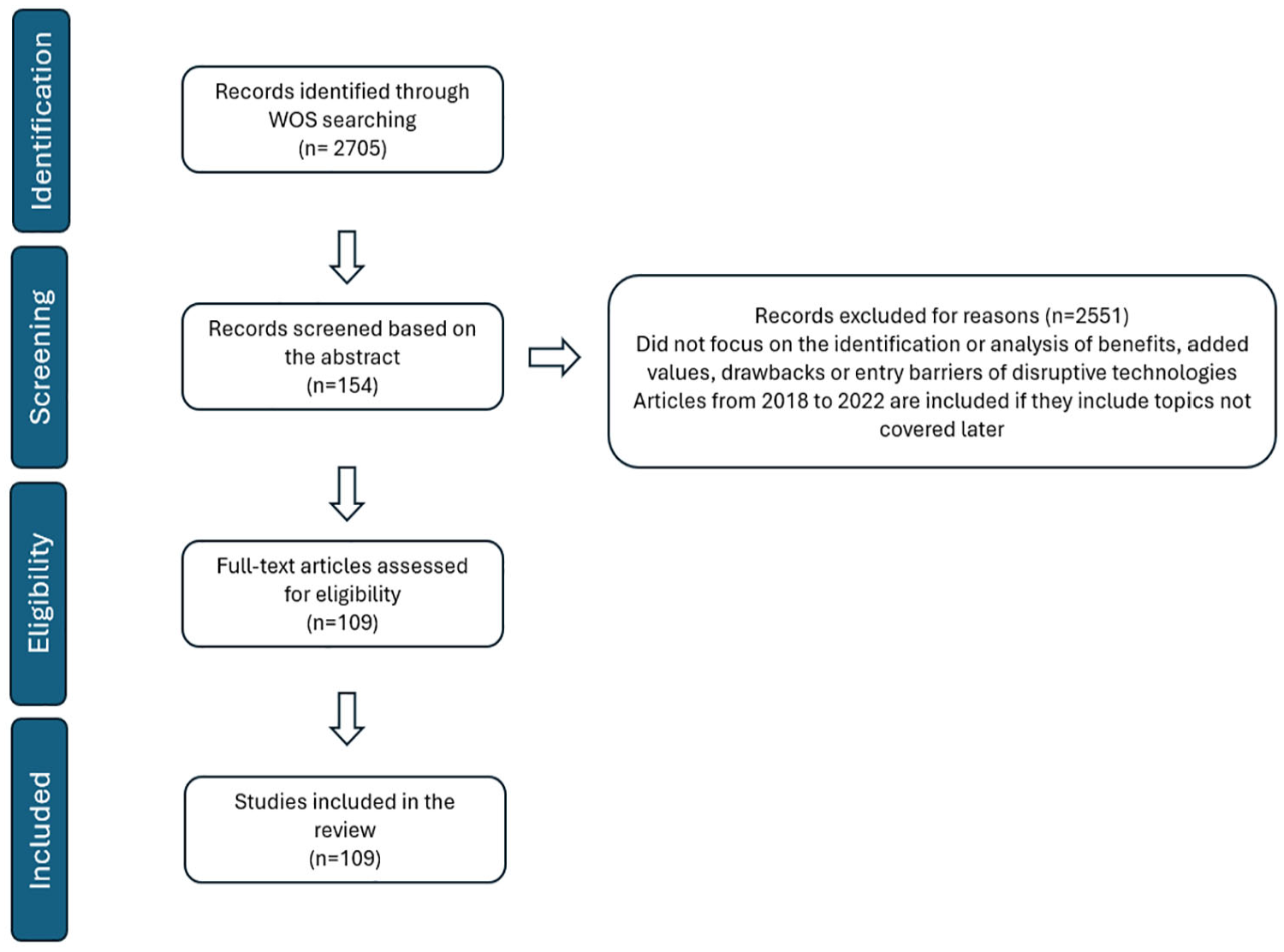
PRISMA flowchart for selecting publication for the current research.
Screening: Authors screened the abstracts based on the following inclusive criterion: (1) it focuses on the identification and analysis of relevant benefits, drawbacks, entry barriers or added values of these disruptive technologies as innovation in the hospitality and tourism industry, (2) articles from 2018 to 2022 are included if they include topics not covered later. The list decreased to 154 items. Journals are mainly from the tourism and hospitality area, but others are considered when their analysis refers to the field of study.
Eligibility. Authors read independently the whole text of the remaining 154 articles to carefully re-evaluate whether those studies are significantly appropriated for this study based on the identification of added values and/or entry barriers of technologies.
Included. 109 journal articles were considered eligible and included in the final synthesis and analysis.
Regarding the second instrument, the review encompassed an Internet search for commercial products related to tourism and hospitality and associated with at least one of the disruptive solutions described in Section “Disruptive Technologies Applied in Tourism,” including both established companies and start-ups. Start-up companies are also included because they play an important role in innovation which often arises from the inception of new ventures. In total, a set of 127 solutions is selected considering (1) all technologies are represented and, (2) there are solutions from different world regions. The collection period comes from September 2021 to August 2023.
Data Analytic Strategy
As a result of this analysis, three dimensions are proposed to categorize the main types of applications based on their general purpose. Next, different subdimensions are identified into each dimension to reflect more specific uses. Finally, their main added values and entry barriers are categorized. It is noteworthy that the benefits vary across different application types depending on their respective purposes. Conversely, the identified entry barriers are shared, as they are closely linked to limitations or challenges in the development or implementation of technologies.
Types of Technological Solutions
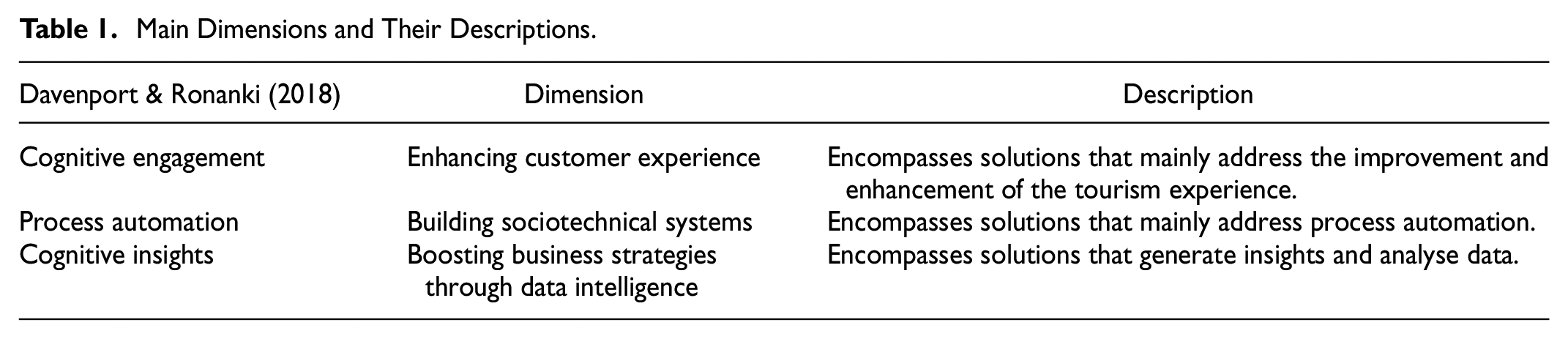
The application of algorithms with intelligent capabilities has served as a catalytic driver for many disruptive technologies so they are able to perform actions which are different from conventional software or hardware developments, or in other words, they introduce a disruptive element. Davenport and Ronanki classified solutions based on AI into three main categories based on their general purpose (Davenport & Ronanki, 2018). In this sense, Table 1 illustrates our proposal about how this list could be adapted to cover the different types of solutions based on disruptive technologies in the tourism and hospitality industry. The three proposed dimensions covers the customer side—Enhancing the customer experience—, the organization side—Boosting business strategies through data intelligence—and the automation of interactions between people and machines—Building sociotechnical systems.
Main Dimensions and Their Descriptions.
On the other hand, Table 2 describes in detail how these dimensions can be split into different subdimensions to represent specific types of needs. Additionally, the core technologies required to tackle the challenge are also included. It is important to consider that subdimensions have been included in a dimension considering their main purpose.
List of the Identified Subdimensions Including a Description and the Core Technology.

Added Values and Entry Barriers
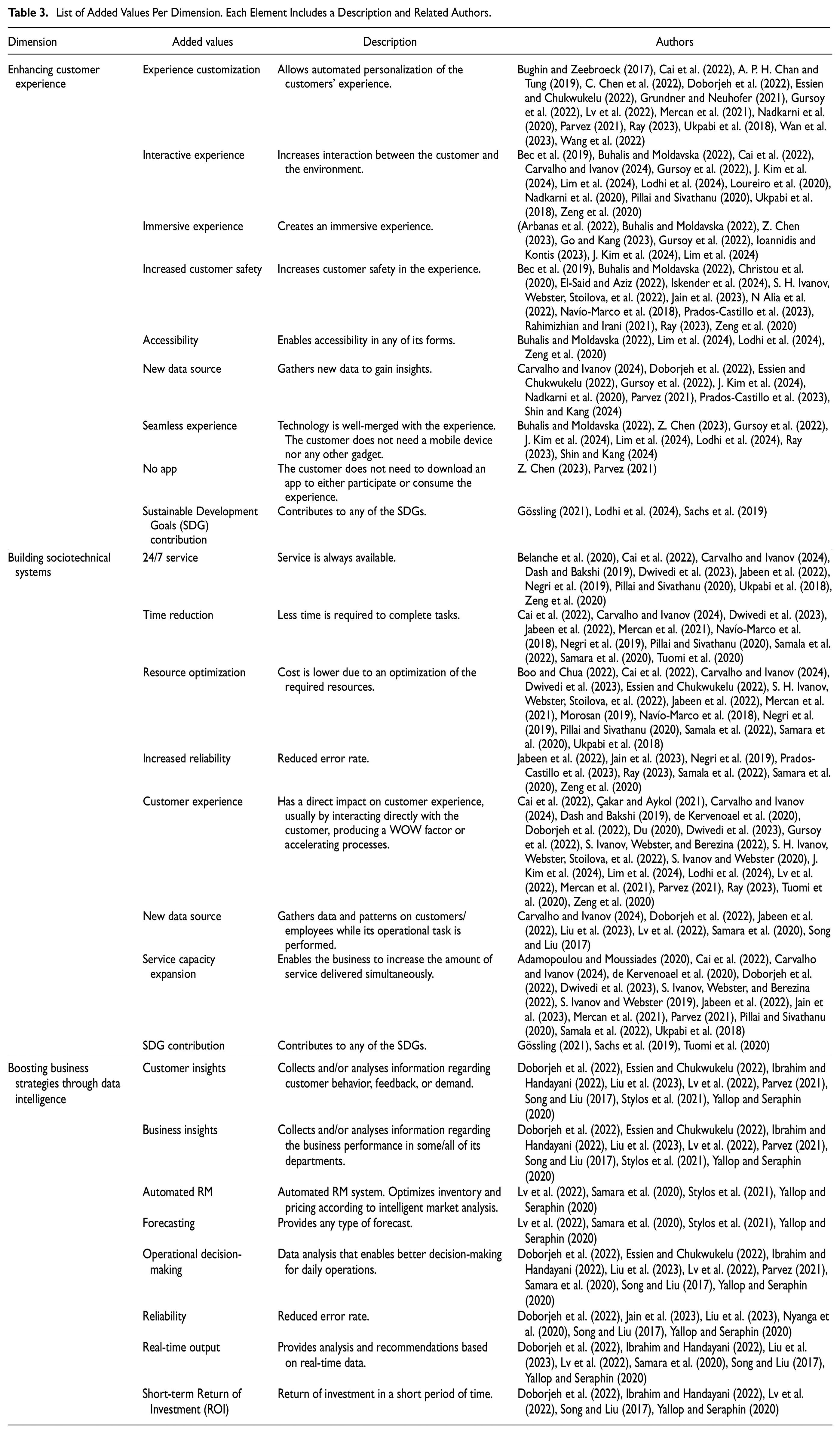
The duality that the deployment of technology entails is represented by added values and entry barriers. Added values can be described as the factors that positively contribute to company development while entry barriers are factors that hinder the implementation of a technological solution. Because each dimension has a different general purpose, the associated added values are specific to that dimension. In contrast, entry barriers are shared because they are based on disruptive technologies based on equivalent requirements.
Tables 3 and 4 list and describe the added values of each dimension and general entry barriers, respectively. The authors mentioned in Tables 3 and 4 may not directly discuss the added value but allude to it in their research as a characteristic of a specific technology and/or its application.
List of Added Values Per Dimension. Each Element Includes a Description and Related Authors.
List of Entry Barriers Shared for All Dimensions. Each Element Includes a Description and Related Authors.

Are Disruptive Technologies Ready for All Organizations?
Disruptive technologies, by their nature, are not universally ready for all organizations. Their readiness and suitability depend on the maturity level of the technology as well as other external factors including the organization’s industry, size, capabilities, and strategic objectives. Although maturity models are a useful tool to understand the development of a technology, they are not focused on what elements or entry barriers are hindering the usage of those technologies, which is a relevant element that help managers to better understand the technology’s situation.
Maturity Models
Technology innovation entails the necessity of research to assess investments made on its implementation so, maturity models have become very popular. These models can either take a technology readiness perspective, as in where it stands on its implementation readiness, or a company’s capacity perspective, identifying dimensions that organizations need to work on to reach a specific digital goal. Numerous models have been developed to understand Technology Acceptance Model (TAM) specifically when it comes to technology and its usage. TAM is based on the Theory of Reasoned Action and it emphasizes the importance of including customer readiness in the design and/or implementation of the technology in question (Davis, 2011). Regarding the design, evidently one can assess user behavior and necessities to create a technological product that is easily accepted and hence of regular and/or satisfactory usage. Regarding implementation, managers corroborate that the technology to be deployed is easy to use either for themselves and/or their subordinates. Literature is swarmed with the application of this model in a diverse array of domains, including the tourism and hospitality industry. Among such, papers use and extend the TAM in various topics such as social media (Singh & Srivastava, 2019) and smartphones (Lin et al., 2020), tourism (Sahli & Legohérel, 2016), e-learning (Goh & Wen, 2021), e-tourism (Alkhatib & Bayouq, 2021; Mohamed & Ahmed, 2020), AI-related websites (Go et al., 2020), airlines (H. B. Kim et al., 2009), and many others.
Industries, especially engineering and manufacturing ones that have considerable dependence on technology, develop their own technology assessment models. As is the case of the aerospace industry. NASA’s Technology Readiness Levels (TRL) is a 9-level scale that assesses a particular technology maturity state. When technology is at TRL 1, it means that information already learned from basic scientific research is taking its first step from an idea to a practical application of a lesson learned. Achieving TRL 9 indicates that technology has been incorporated fully into a larger system; proved to work smoothly and is considered operational. Tech companies, such as Gartner and IBM, have developed their own. Gartner’s Hype Cycle depicts the path that new technologies and innovations go through with the passing of time regarding the expectations around it (Shi & Herniman, 2023). Depending on the time of adoption, companies are classified either as aggressive, majority, or conservative. This matrix helps managers to understand which technologies are of high priority and which are not.
Finally, it is important to be aware that measuring the maturity level of a technological solution which is a combination of different disruptive technologies is may non-realistic due to the large number of involved factors.
The 4E Matrix
The integration of disruptive technologies within organizational frameworks is a complex process which is closely related to the elements identified in Table 4. Some sectors naturally lend themselves to rapid technology adoption, while others, especially highly regulated industries, may face more significant hurdles. Organizational readiness is paramount; it depends on the internal capabilities, from technological infrastructure to the digital literacy of employees. Financial resources play a key role so organizations with robust budgets may have an advantage. Nevertheless, robust budgets are often associated with big companies which may lack adaptability and flexibility. Any case, strategic alignment and leadership are two essential elements that are required to successfully deploy disruptive technologies because the cost of failing in the implementation can be critical for the organization.
Understanding, in general, the main added values and entry barriers of technological solutions is extremely useful because it gives a first perspective about the possibilities and limitations. Using the information collected with the second instrument, we have designed a matrix called 4E to organize the different types of solutions as a cycle of four stages (Experimental, Exclusive, Expansion, and Extraneous) where the relationship between the number of added values and entry barriers illustrates interesting insights. Added values and entry barriers represent the axis and define four main quadrants (Q1, Q2, Q3, and Q4), each of which embed a different stage. Additionally, the analyzed solutions are represented in the graph by calculating the average of entry barriers and added values of solutions according to their subdimension.
Experimental (Q1)
This represents the first phase where technology is not sufficiently developed to bring enough benefits to counterpart the entry barriers, and thus either unavailable, poorly developed and/or uncommonly distributed in the market. Companies who choose to implement these types of technologies look for uniqueness and being pioneers in their implementation. The two subdimensions resulting in this quadrant are Immersive experiences and Blockchain.
Although there was a boom in 2010 of the usage of AR&VR technologies, those technologies did not reach their full potential mainly because they required specific and expensive hardware, and the result of the experience was far away from being seamless. However, the improvement of devices in terms of seamless experience and cost reduction as well as the definition of new business models related to the metaverse are crucial to make those technologies as relevant for the forthcoming years because they will offer the user live social, immersive, and seamless experiences.
On the other hand, the development and adoption of blockchain in tourism has been quite slow even though it has existed for a decade already. There is a great gap between the professionals’ knowledge on the matter and the required level to be massively adopted as well as the technology still being underdeveloped in the hospitality industry (Tyan et al., 2021). Nonetheless, blockchain is becoming quite a popular technology and big companies in the tourism industry have either been adopting it or keeping an eye on it since, as seen in the literature review, it does have an extensive impact range of potential positive contributions to the industry.
Exclusive (Q2)
Once the technology’s added values become relevant and feasible, it will move over to Q2 where technology provides a great benefit event at a high cost. This type of technology usually entails a significant initial investment due to the cost of the machinery or the infrastructure modifications that are needed, which makes it exclusive for those with high purchasing power. So it happens that the subdimensions that have resulted in this quadrant are Cyber-physical spaces and Service Robots, all of which are hardware-based and may require infrastructure modification.
The subdimension of Cyber-physical spaces has its strong points in accessibility, seamless experience, and new source of data. The explanation for the latter is that guests, while interacting with the virtual assistant and/or app, leave a trail of personal data regarding their likes, behaviors and other insights that prove to be worthy to the hotel for personalizing their guests’ experiences. This however is very much connected to the data confidentiality entry barrier since the guest should be able to reject the usage of this data and if they were to agree, then their data must be fully protected. Regarding accessibility, Cyber-physical spaces are major allies for people with reduced mobility and other disabilities since they enable the control of room features from a distance (Giousmpasoglou & Hua, 2020) .
Service Robots is a subdimensions where its added values are quite similar since, they both provide 24/7 service, increase reliability, expand service capacity, reduce task time and optimize resources. Robots also provide a new source of data which happens as well with smart rooms. Although they are a viable alternative for tourism companies, mass adoption is still unattainable due to the high costs of purchase and maintenance (S. Ivanov & Webster, 2020). The same theory applies to all subdimensions that have fallen under this very quadrant.
Expansion (Q3)
The subdimensions that are relatively easy to implement and are highly beneficial to the company fall under this quadrant. The groups that have resulted in Q3 are Biometric authentication, Business insights, Customers insights, Workflow automation, Customer interaction using natural language, Automated customization, Operational decision-making. No subdimension from Enhancing customer experience has landed in this quadrant.
Business insights as well as Customer insights are two subdimensions that are of great value to companies. This is an eye-opening finding since data analytics tools are at an ideal stage for adoption and implementation; what must be realigned is the intellectual needs this technology has for the realization of its actual potential. However, many managers feel uncomfortable accessing or using data from their tools and resources (Law et al., 2024). Besides, there is a lack of trust in managers when companies implement those data platforms for interpreting the local market and consumers (Egan & Haynes, 2019). This attests to the fact that any data analytics tool without the necessary digital mindset is of no use or will not give the company the maximum potential these tools can actually provide. Workflow automation, Biometric authentication and Customer interaction using natural language are spread and used worldwide.
Extraneous (Q4)
The final quadrant accommodates technology that provides some added values with very few entry barriers. Since it has been developed for quite some time (it has already passed through all stages), there is no excuse for not deploying it. Nonetheless, it can either be considered as mandatory, as happened with Wi-Fi access, or it could be thought of as complimentary to the main product, as may happen with a virtual tour of the premises. This is where managerial judgment takes place and the importance of staying up to date with current and future trends as well as customer needs. As a result, it is a technological solution that is not going to become either relevant or a differential element in the organization.
Several groups have landed in this quadrant: from Enhancing customer experience there is Virtual tourism and Customer safety & accessibility. The reason why Virtual Tourism is in Q4 is because these solutions still provide a desktop-based experience, lacking immersiveness and other elements that would increase its added values. Customer safety & accessibility solutions are clearly directed to safety and accessibility elements but prove to have other added values such as personalization and interactivity (Lim et al., 2024; Loureiro et al., 2020).
Data Confidentiality and Digital Mindset at the Top of the Entry Barriers
Figure 2 illustrates the top three entry barriers which turn out to be digital mindset, data confidentiality and initial investment. This finding is very much aligned to what was previously commented and it confirms that the current managerial mindset, in general terms, has still a long way to go to reach the optimum level in which technology merges correctly with human resources. The other entry barriers in level of importance are training and adoption, infrastructure suitability and legal framework.

A maturity state model of technological solutions based on entry barriers and added values.
Additionally, consumers are to have the correct digital mindset for the usage of technology as well. As mentioned in the literature review, critical questions to be considered when implementing technology are understanding how the consumer will interact with the technology and what possible challenges that person may have (de Kervenoael et al., 2020; Taherdoost, 2019).
Regarding data confidentiality, the tourism and hospitality industry collects huge amounts of data and this is critical for business success. Personal data from travelers, their preferences and many other elements that are not only collected when, for example, checking in at a hotel but also through distribution channels and other platforms that are constantly gathering data (Thomaidis, 2022). Data is not only required for authentication but the increasing demand on personalized experiences also obliges hosts to get to know their consumer’s preferences. The need for personalization contradicts with the concerns that arise with data privacy and its ethical use (Yallop et al., 2023) (Figure 3).

Ratio of the entry barriers of the analyzed solutions within each dimension.
Conclusions and Further Work
Technology has become a strategical element in all organizations thanks to all added values. In contrast, not all technological solutions can be applied in all organizations because their need, infrastructure and capacity are different. Thus, each technological solution has different entry barriers that new adopters need to be aware of before they decide to move on.
Examples put in evidence that the current disruptive technologies enhance customer experience, increase productivity by automating processes and enable more accurate decision-making. Additionally, technology can become a great ally in crisis such as it happened in the COVID-19 pandemic (Iskender et al., 2024).
However, managers must conduct a cost-benefit analysis before committing to their implementation as well as limitations. Adoption of robots, AI and service automation in the tourism industry offers many opportunities but it is critical being aware about all financial and non-financial costs. Apart of investment and maintenance costs, the obsolescence risk, staff training as well as the adaptation of the premises if the technology requires it (S. Ivanov, Webster, & Berezina, 2022; S. Ivanov & Webster, 2019; Reis et al., 2020; Rosete et al., 2020). Besides, resistance from employees and customers can be found which might entail negative word-of-mouth as well as negative psychological effects for employees. Another major debate is the replacement of human jobs by technology, yet authors remark on how robots take on mundane repetitive tasks, enhancing productivity and employee satisfaction in tandem (Lu et al., 2020). Furthermore, it is oftentimes difficult to seamlessly introduce technologies such as AR and VR to tourism experiences since these require specific hardware (Keckes & Tomicic, 2017). Other issues involve the customer’s perspective such as ease of use and user comfort. Data confidentiality, privacy and protection is a concern that has risen transversely in literature, no matter the technology. Specially data-based technologies such as Big Data or Blockchain, concerns regarding ethics and privacy as well as security, misinterpretation and risk of data breaches are some of the critiques held by several authors (Rennock et al., 2018; Thomaidis, 2022; Yallop et al., 2023; Yallop & Seraphin, 2020) and certainly users. However, other technologies are also data collectors such as intelligent robots, virtual assistants and chatbots, biometrics, IoT, including remarks on customer fear of identity theft (Lehto et al., 2023; Negri et al., 2019), data mismanagement, technology anxiety and general concerns on data privacy and protection (Car et al., 2019; Carvalho & Ivanov, 2024; Thomaidis, 2022). Lastly, businesses should not take it lightly when implementing AI since experiences and service processes are to be reengineered for customer interaction and engagement to be transformed (S. Ivanov & Webster, 2019). Moreover, implementation in the workplace entails an adaptation process throughout the whole organization to build a successful sociotechnical workforce (Samala et al., 2022; Van Der Schaft et al., 2022) that ultimately generates sociotechnical capital (Makarius et al., 2020).
There are two main limitations in this research. First, it encompasses the tourism and hospitality industry, which is comprised of many different sectors that have very diverse needs and challenges. The second is the identification of added value and entry barrier. Technological solutions become obsolete as fast as they evolve so if the same study is conducted today results may be slightly different. Therefore, the constantly review of literature and commercial products may raise some new trends.
Further research is mainly focused on extending the sampling to overcome the previous limitations. First, conducting an analysis for specific tourism industries and even different levels of specificity within the sector, where each one has very different needs and challenges. Another option can be basing the research on general topics such as sustainability or accessibility within the industry, instead of focusing singly on tourism sectors, or it can even be both, by improving sustainability through the adoption of technology.
Footnotes
Declaration of Conflicting Interests
The author(s) declared no potential conflicts of interest with respect to the research, authorship, and/or publication of this article.
Funding
The author(s) received no financial support for the research, authorship, and/or publication of this article.
