




Abstract
The fast pace of advances within the Industry 4.0 era has had a direct impact on the process of technology transfer, as well as brought forth new and hitherto unknown challenges. This study pursues the goal to delineate the challenges and/or limitations of the I4’s process of technology transfer in terms of anthropotechnological aspects. For this purpose, the combination of two methodologies, PRISMA and Methodi Ordinatio, was carried out. The final portfolio analysis was divided into quantitative and qualitative sections. As a result, the current and recurring challenges of this interaction were reported in an overlap. Moreover, it was demonstrated that most studies have been focusing their attention on what involves a more holistic issue of the whole scenario, be they in the organizational, educational, cultural, governmental, security, human capital, technologies, innovations, or sustainable development issues. Finally, this research can serve as a starting point for further researches, as well as contribute to the understanding of industries during the implementation of the Industry 4.0 and their challenges regarding processes of technology transfer.
Keywords
Introduction
Industry 4.0 (I4) topic has been discussed mainly in Germany in terms of a new industrial revolution. I4 represents an intelligent industry concept, since machines and products are integrated (Ivanov, 2015) with attributes of adaptability and efficient use of productive resources (Jasiulewicz-Kaczmarek et al., 2017). In this context, the underlying idea of I4 is the constant connectivity and the facilitation of data and information exchange, as well as the creation of intelligent networks across the entire value chain, which in turn is autonomously controlled and leads to a fast and flexible decision-making process (Basl, 2017).
All industrial revolutions brought new production concepts and especially new technologies, which entails the need and challenge to integrate entire production process. It is assumed that the technologies emerging during I4 are interconnected. Process virtualization is allied with real-time communication. These modern technologies change the corporate culture and increase the complexity of existing production systems (Baena et al., 2017; Bangemann et al., 2016; Binner, 2014; Hozdić, 2015)
Not only do the industrial revolutions change production systems and technologies in industries, they also change the circumstances of labor. I4 brings changes in the corporate landscape and consequently new work areas (Reuter et al., 2017), since human skills cannot yet be fully replaced (Müller et al., 2017). Whysall et al. (2019) argue that, with speed of technology changes brought by I4, human resources management must fill gaps in the functions and requirements of workers.
It is worth noting that the COVID-19 acts as a factor that has influenced this process of technology transfer in I4, as well as the whole industrial ecosystem (Rahman et al., 2021). Obradović et al., (2021) and the World Economic Forum (2020) have already presented this concern regarding managerial competencies, training, team work, change management, open innovation, as well as the requirement of skills due to the COVID-19 pandemic.
Mahmood and Mubarik (2020) argue that the global pressure asserted by the COVID-19 pandemic upon industrial sectors has been responsible for the increasing adaptation of companies of the 4.0 era. This new normality seems to force the interested parties to implement the Industry 4.0 (Rahman et al., 2021) and to elaborate new strategies to constantly minimize the impacts on the economy (Dasha et al., 2021).
Concerning the technology transfer process in I4, Alharbi (2020) states that the it is still at its initial phase and occurring gradually. Due to its complexity, this process depends on the integration of universities, industries, and governments. Ayentimi and Burgess (2019) question the relevance of the implementing process of I4 in emerging countries, and this process concentrates most of their discussions in countries with advanced economies. Kovacs (2018) adds that the studies should focus not only on the positive effects of I4, but also on the unwanted negative consequences.
In the process of technology transfer, the acquisition or adaptation of a new technology in order to become efficient and achieve favorable results involves multiple sectors, organizations, and people. In a more holistic view of this process, it is possible to mention the anthropotechnology, which, in addition to studying macro factors of ergonomics, allows a broad view of the whole scenario to which the technology will be transferred. For the technology transfer process to be successful, there is a need for a preliminary anthropotechnological study. This study involves knowledge about industrial systems, cultural, housing, demographic, climate, transport, technical, socioeconomic, organizational, and human resources issues in the region to be transferred.
This way, the present research aims at filling this literature gap and pointing out the direction of these studies, thus contributing to the further studies regarding technology transfer and I4. Most of the studies found have been focused on only one type of technology or on a single, country-/region-specific context, and they do not debate the limitations of the technology transfer within I4 from a general perspective. Therefore, a thematic overlap regarding anthropotechnological aspects is herein intended, since they share a concern about technology transfer and I4.
By means of a systematic review of the literature, the challenges and/or limitations of the process of technology transfer in I4 shall be perused in terms of anthropotechnological aspects to answer the following research questions:
Is there a concern about anthropotechnological aspects within the process of technology transfer of I4?
What are the factors/challenges of the process of technology transfer in I4?
Method
Systematic Literature Review
In order to fit the goals of this research, the underlying methodology is the systematic literature review. All academic articles with emphasis on I4 and technology transfer concerning anthropotechnological aspects shall be synthetized to achieve the intended goal and answer the research questions.
PRISMA Flowchart
The steps of the methodology—from the research to the final selection—are briefly presented in the data-flow diagram (Figure 1). The literature review followed partially the research guidelines of PRISMA methodology (Moher et al., 2009, together with the proposal of Pagani et al., 2015). The option for the two methods is based on their complementarity and their critical, transparent, and extensive review. This way, the research may be replicated, and their methods lead to a portfolio of consistent articles, as verified by Van Laar et al. (2020) and Miranda et al. (2021).

PRISMA flow diagram.
The strategy of the systematic review is described below.
Search Terms
Considering the pursued goal, the research questions to be answered, as well as in order to facilitate the organization of the information, three keyword groups with their due terms and synonyms were initially structured, as shown in Table 1. As there are no studies using the combination of the three groups, it was decided to carry out the research with only two groups (Table 2). Group 1 comprises the entire scenario of I4 and its technologies, while Group 2 refers to the technology transfer. The keywords were combined and inserted into the two selected databases: Scopus and Web of Science. The search on international bases was carried out on December 10th, 2020.
Search Strategy 1 (December 10th, 2020).

Source. Own Authorship (2021).
Search Strategy 2 (December 10th, 2020).
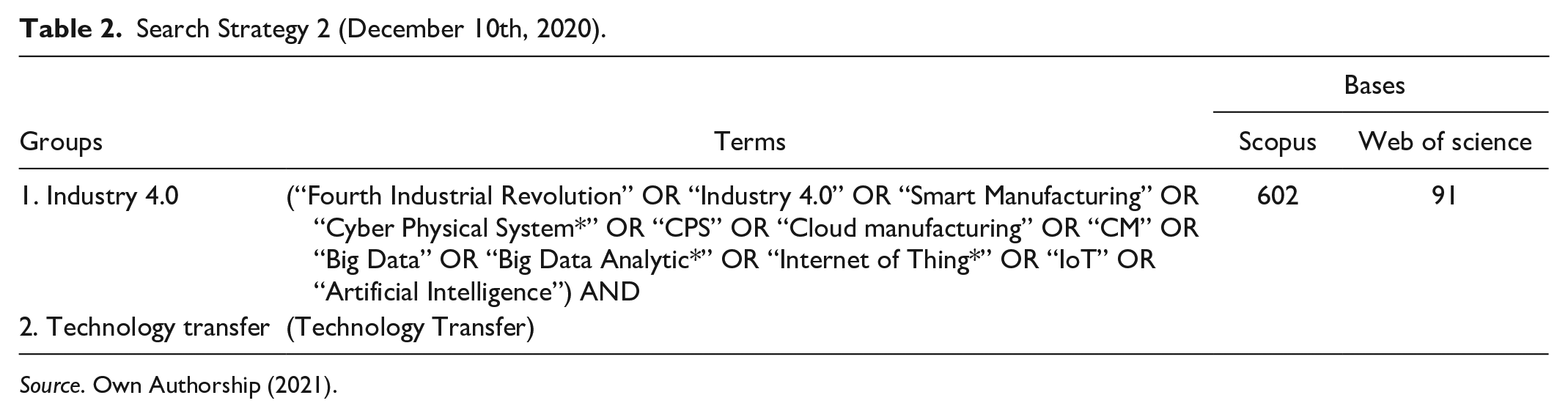
Source. Own Authorship (2021).
Screening and Filtering Phase
It was intended to refine the search results to the studies that direct their contributions to the Scenario 4.0. Therefore, a time limitation was set from 2011, since the term Industry 4.0 was introduced in this year by the German Promoters Group of Industry-Science Research Alliance. Against this backdrop, 48 Scopus records from 1983 to 2010, and 10 records from 1996 to 2010 on the Web of Science were deleted. Subsequently, it was limited to only papers and review papers. Then, records with a language other than English, Portuguese, French, or German were excluded, representing 19 records in Scopus and 3 records in Web of Science. Duplicates of both databases were also excluded (a total of 42). With the aid of the JabRef® reference manager, duplicates were firstly removed in an automated way, and then manually. After the entire delimitation process, the total number summed up to 181 studies.
Eligibility Phase
To ensure that the records found are evaluated consistently and objectively, the eligibility criteria ought to be defined. The records were excluded according to the following criteria (title, keywords, summary):
Focus only on I4 or its technologies.
Focus only on technology transfer.
Not having the focus on both.
A total of 26 records remained after this exclusion process, including the ones that discussed about technology transfer in I4.
Still as an eligibility criterion, the step 7 of the Methodological Ordering of Pagani et al. (2015), called InOrdinatio from Methodi Ordinatio®, was applied. The InOrdinatio equation helps in the decision-making process regarding the definition of the scientific relevance of each article using three criteria (impact factor, year of publication, and number of citations by the proposed process). In this way, it is possible to obtain relevant studies in relation to the mentioned scientific criteria. No article was excluded at this stage, because there was no return of any article with a negative index after the application of the equation (Supplemental Appendix A).
Included Phase
Finally, two portfolios of articles were generated after checking the availability of the full text of the articles. The first portfolio was generated for a bibliometric analysis and quantitative analysis, while the second one was created for a qualitative analysis, retaining the pertinent contributions to the proposed theme. Secondary data sources have also been added to assist in the analyses (Supplemental Appendix B). Occurrences that did not present any insights for the technology transfer in I4 regarding anthropotechnological aspects were excluded from the qualitative analysis. These six excluded articles shall be briefly explained in the results.
The quantitative analysis was performed using the VOSviewer software to discover the differences and common characteristics of the publications. The qualitative analysis containing the main contributions and results of the studies, on the other hand, was presented using an overlap of the challenges extracted from the 20 articles included in the analysis. This assessment took place by fully reading the articles obtained by the main contributions and limitations of the studies.
Results
Bibliometrics
The 26 articles were written by 78 authors and co-authors and published in 24 journals between 2015 and 2021. Most articles are empirical studies: 16 studies and 10 review studies. The most used keywords were Industry 4.0 (14 occurrences), Transfer of Technology and Internet of Things (IoT; 5), Big Data (4), Cyber Physical System (CPS; 3), and Knowledge, Innovation, 3D Printing (2 each). The authors of the portfolio who published together and have the highest number of publications are Kovalevski, J.L.; Pagani, R. N.; and Silva, V. L. Each author published a total of three articles and they all share the same affiliation: the Post-Graduate Program in Production Engineering (PPGEP), from the Federal University of Technology—Paraná (UTFPR), in Paraná, Brazil.
The five most quoted articles are presented in Table 3. The complete list of articles and their citations is presented in Supplemental Appendix A.
Five Most Quoted Articles.

Source. Own Authorship (2021).
Figure 2 shows the co-occurrence of keywords that appeared at least twice in the studies, and a timeline representing the current research topics and their trends.

Co-occurrence of keywords.
Table 4 shows the number of publications by country, considering the origin academic country of the first author. Germany and Brazil are on the top of the list, followed by South Africa, Portugal, and Australia.
Number of Publications Per Country.
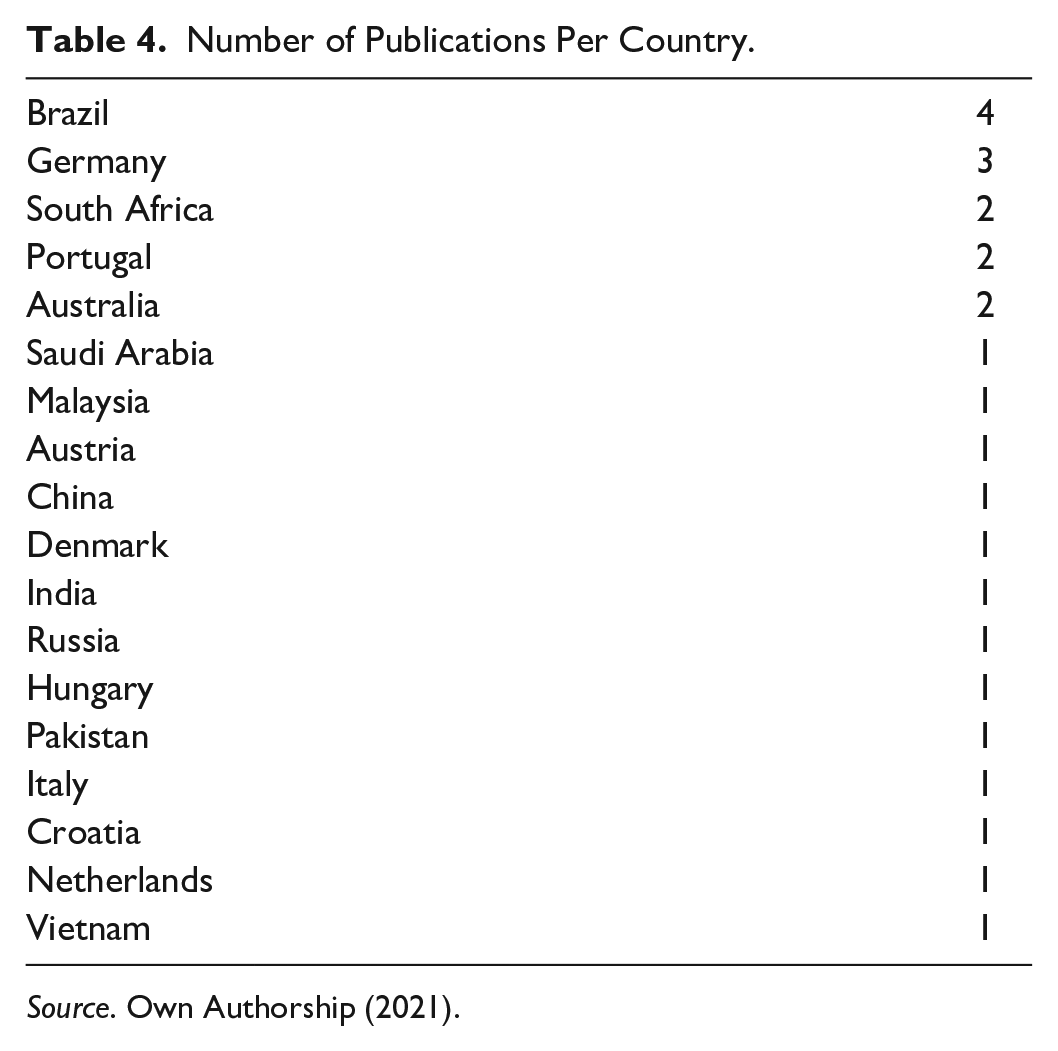
Source. Own Authorship (2021).
Deleted Articles
The following brief explanation refers to the six articles excluded from the final selection of publications. The reason for their exclusion lies in the fact that either they do not present insights regarding I4 and technology transfer, or they do not address this process in the manufacturing industry.
Bail et al. (2021) specifically targets their study in a literature review on the use of the Internet of Things (IoT) in disaster management. Costa et al. (2020), in turn, present the main findings of a literature review of recent advances in printed batteries in 2D and 3D. The study by Silva et al. (2019), a literature review, focuses on the contextualization of technology transfer with focus on the supply chain in the Industrial Scenario 4.0. The research by Ituarte et al. (2018) is based on a single study case, on the applicability of additive manufacturing of a polymeric component in the automotive industry. Pîrvan et al. (2019) focused on revealing insights on how to facilitate the emergence of disruptive IoT innovations. Finally, Tran et al. (2019) focus their study on medicine by means of a systematic review. Their proposal concentrates on elaborating interdisciplinary research topics on the theory and practice of artificial intelligence in medicine.
Discussion
The in-depth qualitative analysis focused on the insights/challenges that were most found in the articles. These articles outline improvements or limitations associated with anthropotechnological aspects of technology transfer in the I4. With approximately 76% of the studies, 20 articles, the authors thought that it is appropriate to focus and turn their analysis in this direction. Figure 3 shows an overlap of these studies followed by the discussion. The overlap was adapted from the one presented by Barros et al. (2020). High-impact studies pertinent to the analysis were added to the discussion (Supplemental Appendix B). The discussions aim to answer the research questions.

Technology transfer and Industry 4.0 overlap.
Challenges in I4
Firstly, on the I4 side, it is observed that the fast development of this new industrial model refers to the broad integration of technologies, greater automation, energy savings, sustainability (economic, social, and environmental), improvements in quality, and efficiency that will possibly be achieved in a near future (Thoben et al., 2017).
Regarding the technologies combined with this new industrial scenario, a new type of technological system can be characterized by cyber-physical systems. I4 is built on Cyber-Physical Systems (CPS), which integrate physical elements (machines, tools, and sensors), computational, and human beings through the internet. CPS is the basic technology for I4, it provides autonomous and self-adjusting machines and intelligently establishes production, making it decentralized, self-organized, and self-coordinated (Bagheri et al., 2015; Ding & Jiang, 2017; Götz & Jankowska, 2017).
Fleischmann et al. (2016) address that CPSs are connected to the Internet of Things (IoT). Harrison et al. (2016) reaffirm that these heterogeneous and interconnected systems are related to the concept of IoT.
The intelligent object, or integrated system, is the central element of the IoT. Connected to the internet, it makes it possible to access and control data from distant sensors. Some examples of IoT technology devices are radio frequency identification (RFID) tags, sensors, cell phones, etc. IoT can also be utilized in the telemonitoring of COVID-19 patients (Shabbir et al., 2022). These devices can interact with each other (Georgakopoulos et al., 2016; Hortelano et al., 2017; Hozdić, 2015) and have several applications, namely Health Care System, Smart Home, Smart Farming, Smart Grid, Industrial Internet, among others (Thaung et al., 2020).
The combination of IoT and cloud solutions is important for manufacturing, making it more efficient. The union of connected IoT machines, sensors, and devices generates detailed data, that, when used in real-time and through cloud technology, results in productivity and quality for the production process (Georgakopoulos et al., 2016).
The main objective of Cloud Manufacturing is to package and expose its resources and production capacities in the cloud, in addition to allowing flexible production networks to meet the several demands of customers (Yu et al., 2015). According to Kang et al. (2016), the concept of cloud manufacturing consists of four elements: resources, tasks, processes, and knowledge.
Big Data Analytics (BDA) aims to remove and analyze information from a large set of data so that problems can be solved quickly with an agile decision making. It is driven by the explosion of data in all areas, such as social media (generation of new data), IoT (measurement capacity), cloud manufacturing (data storage), and artificial intelligence (improved computing technology for analysis; Chiang et al., 2017).
There are challenges in implementing the BDA so that you can take advantage of these large volumes of data. Some are unification of communication standards, flexible governance policies concerning data and cloud integration, lack of support for industrial devices (O’Donovan et al., 2015). Alias et al. (2018) reiterates that “data” rules the world and calls the fourth industrial revolution a data-based industrial revolution. Pinto et al. (2019) argue that Big Data technologies can be favored by the transfer of technology from different areas of knowledge within the field of computing, always following an interdisciplinary approach.
Thoben et al. (2017) reiterate presenting the barriers related to the increase of available raw data, as being: increased complexity, dynamics, data quality, validation/verification, and communication. Faced with the breaking of these barriers, it is possible to find excellence in the storage and processing of large volumes of data.
In addition, Huang et al. (2018) propose a model of technology delivery system (TDS), applied to the BDA industry, to characterize the supply side in the emergence of technology. Various sources of data related to political, economic, and academic factors, among others, were investigated. Regarding the technology transfer, it appears that its activities seem to be very active to obtain a technical advantage. Based on the TDS directed at the BDA industry, four phases were identified for the construction of the model: the identification of the macroeconomic and political environment; the specification of the main public and private institutions; the addressing of the main technical complements and their owners, then the tracking of their interactions through information connections and technology transfers; and the description of market prospects, and the assessment of potential influences on technological changes and social developments.
These technologies are individually important to the process, but their combination allows them to cooperate, providing the perfect integration of all activities (Ang et al., 2017), that is, the integration of the entire network of products and processes of production. Kruger and Steyn (2020) state that innovation spaces are an important mechanism for this integration and that they can assist in the use of these technologies.
In retrospect of the previous revolutionary development of manufacturing from its inception to the present day, it is observed that the period between revolutions has been drastically reduced. The integration into production systems is inevitable, which affects the increasing complexity of existing production systems (Shafiq et al., 2015).
Technology Transfer at I4: An Anthropotechnological View
On the other hand, the main elements of technology transfer are presented which aligned to I4, and the challenges presented in the central part of the overlap (Figure 3), play an essential role in this process.
The set of these elements confirms that the integration and implementation of I4 and its technologies takes place simultaneously with the technology transfer process, mainly the ones focused on anthropotechnological aspects. Since it is not an easy or fast route in addition to cultural challenges and the optimization of industrial processes, especially in emerging economies, the central region of the overlap has been investigated.
Alharbi’s (2020) study was applied to an industrial scenario in Saudi Arabia (there is no mention in the article, although it was identified by the authors’ universities). There is no direction for the reality of the region as to the operator’s education’s level, and whether the same reality is found in the world. The research presented by the author compiles the main knowledge that is missing from operators in the 4.0 Scenario, highlighting IT knowledge and language barriers.
IT knowledge is also identified in studies related to I4 as IT basics (Nyikes, 2018; Reddy et al., 2016) and solid IT skills by Bremer (2015), Falck and Schüller (2016), Kiatsuranon and Suwunnamek (2017), Kulyk and Parmová (2017), Régio et al. (2017), Sackey and Bester (2016), Shamim et al. (2017), and Stocker et al. (2014).
The language barriers found by Alharbi (2020) are identified in studies of I4 as intercultural skills (Kiatsuranon & Suwunnamek, 2017; Kulyk & Parmová, 2017; Régio et al., 2017), since the field of work in this scenario is not restricted only to the city or country, it has become international; fluency in different languages; and understanding different cultures, especially divergent work habits, when working globally. In general, Alharbi (2020) makes a pertinent contribution to the anthropotechnology vision focused on human resources, presenting strong evidence of the importance of human capital and that the technology transfer process depends strongly on the integration of universities, industries, and governments.
The transformations in teaching resulting from the industrial revolution present a new form of universities and research. The university and the integration of knowledge have become more interdisciplinary, with classrooms and virtual laboratories (Alias et al., 2018; Schumann et al., 2015). The study of Kashyap and Agrawal (2019) questions why universities have failed to become knowledge providers in developing countries, such as in India, and focuses their findings on two parallel paths. The first refers to the conversion of universities into research centers in strategic areas according to their capabilities; the second path refers to the consideration of universities as a unit that contributes to the value chain, supporting industry partners. The Russian study by Kochetkov et al. (2017), on the other hand, presents the university as the main actor of economic change. And they expresses that in terms of knowledge transfers, Russian universities are still far from reaching the list of the best global universities. Veile et al. (2019) state that training and continuing education assist in the development and improvement of vital skills and know-how.
Some initiatives are proposed to prepare and qualify I4 workers and assist in the interaction between university and industry, the Learning Factories (LF). LFs are defined as replicas of industry sectors in which informal, formal, and non-formal learning take place. They can be used as a basis for research, external training (employees expand their skills in the areas of the “smart factory”), and technology education and concepts of the factories of the future, that is, the LFs assist in the learning and knowledge process of I4 (Baena et al., 2017).
Other challenges concern hybrid configurations or human-machine interaction, and they are reported in the studies by Alharbi (2020), Alias et al. (2018), Ansari et al. (2020), and Botha (2018), Schumann et al. (2015). Ansari et al. (2020) aim at an approach in something already implemented and well consolidated in search of improvements in human-machine interaction in TU Wien Pilot Factory Industry 4.0. There are severe and complete items analyzed and mainly not leaving out the ergonomic issues of this interaction. Botha (2018) states that human-machine interaction is inevitable, and some examples of this interaction are presented by Schumann et al. (2015), as virtual reality.
The studies of Andújar-Montoya et al. (2017), Basl (2017), Bremer (2015), Caruso (2017), Fantini et al. (2020), Fleischmann et al. (2016), Gorecky et al. (2017), Hannola et al. (2018), Hirsch-Kreinsen (2016), Krugh and Mears (2018), Kulyk and Parmová (2017), Müller et al. (2017), Obi et al. (2017), Peruzzini and Pellicciari (2017), Reddy et al. (2016), Régio et al. (2017), Sackey and Bester (2016), Sivathanu and Pillai (2018), Stocker et al. (2014), Thoben et al. (2017), Vysocky and Novak (2016), Weyer et al. (2015), Wilkesmann and Wilkesmann (2018), and Zhou et al. (2016) also present human-machine interactions in the 4.0 Scenario, such as: Virtual Reality, Augmented Reality, Collaborative Robots, and Smart Wearables. Most studies are entirely or partially focused on human-machine interaction, and it can be said that these insights are of real importance between technology transfer and I4.
In addition, the high qualification of workers also represents a challenge. Through a literature review focused on empirical studies Silva et al. (2020) identified the lack of qualified labor (knowledge and experiences) as a barrier in the implementation of I4. Margherita and Braccini (2020) present a highly qualified workforce capable of analyzing and managing the large volume of organizational data. It appears that this challenge of high qualification, which arises with the change in the manufacturing scenario and the new technologies, is also presented in the studies of Bremer (2015), Caruso (2017), Falck and Schüller (2016), Jovanovic and Hartman (2013), Kiatsuranon and Suwunnamek (2017), Macurová et al. (2017), Wilkesmann and Wilkesmann (2018), and Yousif (2016).
Four studies raise concerns about the challenges facing data security. Kovacs (2018), through a literature review and available data on the development of I4, presents the uncertainties related to security in the digital universe concerning defense and integrity issues. In the research conducted by Veile et al. (2019), based on 13 semi-structured interviews with managers of German companies with experience in Industry 4.0, one of the concerns raised by managers is related to data protection and security, while maintaining a healthy balance between security and openness. Thoben et al. (2017) state that data security problems, with full integration and connectivity through CPS and IoT and data being the core of manufacturing companies’ competitive advantage, have become a priority target for criminal third parties.
Parasol’s (2018) study focuses on the question of whether international fears about China’s new Cybersecurity Law are justified, whether it will affect China’s attempt to attract major foreign technology companies, as well as their talents and technology transfers. It is also questioned whether this influence will lead to more innovations or more restrictions. Evidence from 2018 suggests that the new law is driven by a desire to protect key infrastructure from cyber vulnerabilities, and that the government is unlikely to want to stifle its innovation agenda.
When speaking of emerging economies, the challenges follow the line of studies that change the focus of the impacts of I4 from advanced to emerging economies. Ayentimi and Burgess (2019) reinforce that governments (policies), universities (labor), and industries need to be well aligned concerning all I4-related involvement. Kruger and Steyn (2020) argue that the universities are key actors in the government-university-industry interaction, as already stated by Alharbi (2020). Kovacs (2018), in turn, stresses the negligence in the interaction between developed and emerging countries. Besides, Kruger and Steyn (2020) lay emphasis on innovation spaces that stem from academic environments in South African universities as being an important mechanism for the improvement of entrepreneurial ecosystems. Their results present valuable information for emerging economies, even with the accelerated pace of business focused on the 4.0 Scenario.
In Brazil, an emerging economy, the research, the discoveries, and the preparations for future challenges, as well as the main incentives from the government can be found within the framework of the “Brazilian Agenda for the Industry 4.0” and in the creation of the Working Group for the Industry 4.0 (GTI 4.0). More than 50 institutions (government, companies, organized civil society, among others) offer several contributions and debates on different perspectives and actions for I4 (Brazil, 2018).
Finally, there is a concern about the strategies for sustainable development. Margherita and Braccini (2020) carry out an in-depth investigation of four Italian companies that have successfully implemented I4 technologies in flexible manufacturing. The focus is directed toward social and economic sustainability. As their main finding, they argue that the adoption of I4 technologies generates sustainable value when its implementation process focuses on the worker and the machinery adaptations.
Kovacs (2018) outlines his findings around basic principles of economic governance 2.0 to contribute to sustainable structural change through I4; he also reaffirms that this growth will only be inclusive when trust and social acceptability are strengthened.
Finally, it can be said that the technology transfer process at I4 has been directing its studies toward a more holistic issue in the whole scenario, be it in terms of organization, human capital, teaching, culture, governments, sustainable development, or other areas. All these challenges presented in the central region of the overlap interact to improve technology transfer at I4, being current and recurring challenges.
However, many studies turn their conclusions to a local or regional scenario. An example is Alharbi (2020), who concludes that workers are supported by a strong educational system in which creativity, inventiveness, and knowledge are rooted in national culture. It appears that this scenario is not seen in countries with emerging economies.
In contrast, in the study conducted by Alias et al. (2018), in which the focus lies on the process of transformations in teaching at universities, there is a general concern for innovation. Each flow of innovation resources, be it internally, locally, regionally, or globally, must be used appropriately. But when it comes to technology transfer, they argue that the speed of technology transfers ought to be increased to boost economic and social development.
Limitations
The limitations of this study concern firstly the literature review, which, on the one hand, allowed the identification of the main challenges in the process of technology transfer in I4; on the other hand, an empirical study to compare and identify these findings in different scenarios is still desirable. A second limitation refers to the low number of articles found. Although a growth in the number is perceivable, the studies that focus on technology transfer and I4 are still recent. As it was verified, there are still a lot of relevant challenges that the researches have so far presented, and there will likely be even more in the future, especially due to the pandemic and/or the digitalization processes. Therefore, there is a need for more theoretical and empirical studies about the influence of technology transfer on I4.
Future Directions
This systematic literature review may shed some light on future researches and researchers, academics, universities, governments, and industries during the implementation of I4, while minimizing the challenges of the process of technology transfer, be they related to security, human capital, sustainable development, technologies, innovations, adaptability, among others. The results found in this research represent a starting point for further investigations regarding the importance of anthropotechnological aspects in the transfer of technology in I4. However, they also open new research gaps, such as: future researches that use the same methodology to verify if there have been changes in the verified challenges; further researches with a focus on emerging countries; comparisons between countries as provider and recipient of the technology that will be transferred in the 4.0 Scenario; anthropotechnological studies in I4; and the deepening of investigations within cooperative contexts between university, government, and industry.
Conclusion
In light of the accelerated rhythm of I4, the complex transfer of technology, in particular in terms of new innovative technologies, as well as the boost given by the COVID-19 pandemic, the questions regarding technology transfer in I4 tend only to increase. These challenges identified in the researches show the variety of countries and scenarios—for instance governments (politics), universities, and/or industries. By means of these studies it was possible to point out that there have been concerns about this transfer process in I4, as well as researches focusing on developing countries—studies that ought to be further developed. This overlap presents challenges from a global perspective that encompass the aspects of an anthropotechnological study for both developed and emerging economies. In addition, it allows a focus on the analysis and even comparison of specific economies.
This study’s main contribution lies in the investigation of anthropotechnological aspects. As it was verified, the articles focused on specific challenges and sectors. By means of the overlap, the main challenges found during the process of technology transfer in I4 could be presented to facilitate this process. It could also be confirmed that these challenges are neither few nor easy. This emphasizes the need and importance of anthropotechnological studies in the processes of technology transfer in I4 that do not solely focus on the technology itself, but on the process as a whole. Finally, this study aimed at filling this gap on the literature.
Finally, the implications for the practice envisage that all organizations, regardless of their operating sectors and their positions in the value chain, will somehow contribute to the I4, either in the implementation of a specific technology or within the whole I4 context. What concerns the theoretical implications, this review contributes to the creation of current and future knowledge, as well as the broadening of the understanding of the relation between technology transfer and I4.
Supplemental Material
sj-docx-1-sgo-10.1177_21582440221111104 – Supplemental material for The Challenges of Technology Transfer in the Industry 4.0 Era Regarding Anthropotechnological Aspects: A Systematic Review
Supplemental material, sj-docx-1-sgo-10.1177_21582440221111104 for The Challenges of Technology Transfer in the Industry 4.0 Era Regarding Anthropotechnological Aspects: A Systematic Review by Fanny Kovaleski, Claudia Tania Picinin and João Luiz Kovaleski in SAGE Open
Supplemental Material
sj-docx-2-sgo-10.1177_21582440221111104 – Supplemental material for The Challenges of Technology Transfer in the Industry 4.0 Era Regarding Anthropotechnological Aspects: A Systematic Review
Supplemental material, sj-docx-2-sgo-10.1177_21582440221111104 for The Challenges of Technology Transfer in the Industry 4.0 Era Regarding Anthropotechnological Aspects: A Systematic Review by Fanny Kovaleski, Claudia Tania Picinin and João Luiz Kovaleski in SAGE Open
Footnotes
Declaration of Conflicting Interests
The author(s) declared no potential conflicts of interest with respect to the research, authorship, and/or publication of this article.
Funding
The author(s) disclosed receipt of the following financial support for the research, authorship, and/or publication of this article: This study was financed in part by the Fundação Araucária, Conselho Nacional de Desenvolvimento Científico e Tecnológico (CNPq) and the Coordenação de Aperfeiçoamento de Pessoal de Nível Superior—Brazil (CAPES)—Finance Code 001.

Supplemental Material
Supplemental material for this article is available online.
References
Supplementary Material
Please find the following supplemental material available below.
For Open Access articles published under a Creative Commons License, all supplemental material carries the same license as the article it is associated with.
For non-Open Access articles published, all supplemental material carries a non-exclusive license, and permission requests for re-use of supplemental material or any part of supplemental material shall be sent directly to the copyright owner as specified in the copyright notice associated with the article.
