




Abstract
With the advent of 5.5G, China’s sports service industry is intricately linked to digitization. Digitization propels the upgrading of sports media and information services, digitalizes sports goods sales on e-commerce platforms and online retail, and drives the digital broadcasting of sports events and virtual sports development. This study focuses on the relationship between digitization and sub-industries within the sports service industry. Utilizing Eviews 13 software, a Vector Autoregression model analyzes China’s digital industry and sports service industry data from 2015 to 2022. Findings reveal a significant Granger causal relationship between the digital industry and sports media and information services. Cross-elasticity analysis shows growing interaction between the digital industry and sports media and information services over time, implying a strengthening promotional effect on the sports service industry. This study provides empirical support for understanding the relationship between the digital industry and the sports service industry.
Plain language summary
This study explores the relationship between the digital industry and the sports service industry in China, focusing on how digital technology impacts sub-industries such as sports media, information services, and sports goods sales. With data collected from 2015 to 2022, the researchers used advanced methods like the Vector Autoregression (VAR) model to examine the connections between these industries. The research found that the digital industry has a strong and growing influence on sports media and information services. As digital platforms like online streaming and mobile apps become more popular, traditional sports media is adapting to this digital shift. However, the study also highlights that not all areas of the sports service industry are equally affected by digitalization. For example, the sales of sports goods and related services are not as directly impacted by the growth of the digital industry. The findings show that digital technologies are crucial for improving service quality and expanding the market within the sports industry. As digital transformation continues, closer collaboration between different sectors will help the sports service industry innovate and grow. This research provides useful insights for policymakers and businesses on how to better navigate the challenges and opportunities of digital development in the sports sector.
Introduction
As China has entered the new period of the 14th Five-Year Plan, digital industry and sports service industry have been given a more strategic position and become an important field to promote economic development. Digital industry is increasingly becoming the key force to promote economic and social development, leading the new era of economic progress. In 2015, China launched its “Internet Plus” strategy, which is not only a technological innovation, but also a comprehensive wave of deepening industrial transformation (Z. Liu et al., 2022). Driven by the “Internet Plus” strategy, various industries are undergoing digital transformation in which online payment has become a major means of payment, bringing consumers faster and more efficient payment experience. All of this is driving the rise of the digital economy, as digital technologies permeate every aspect of production, circulation, and consumption, and inject new impetus into economic development. In the sports industry and services industry, digitization fosters innovation and growth by making the sports experience more accessible, personalized, and interactive. For example, the E-sports industry has emerged rapidly, providing players with access to online live streams, competitions, and social interactions (Ye et al., 2024). Digital communication of sports events has become increasingly popular, and platforms have changed the landscape of traditional sports media by providing online live streams, on-demand broadcasts, and sports news. Sports training is now more adaptable and effective thanks to the digital revolution, with training results being improved by immersive technologies like VR and AR as well as online platforms. Simultaneously, automation and intelligent management systems have decreased operating expenses and increased efficiency in sports venue management. Digitalization promotes the dissemination of sports content, the development of sports social and the application of sports data, and provides users with richer and more convenient sports experience.
Many scholars have put forward rich theoretical views on the relationship between digitization and sports service industry in China, and studied how digitization leads to economic reform in sports field. They have a profound discussion on the interaction between digital technology and sports economy, and explore the economic benefits and innovation of sports service industry brought by digitization. Shen et al. studied and judged the trend of sports service digitalization by analyzing the digital scene template enabled by 5G technology. Upgrading and transformation of services through digital technology is the current trend (Shen et al., 2020). From a different development perspective, the digital transformation of sports service industry ushered in development opportunities. Based on the perspective of TOE (technology—organization—environment) theory, Hu et al. analyzed the problems faced by the digital transformation of sports service industry, and explored the inter-industry data linkage mechanism and the industry data collaboration mechanism that are shared and efficient, and believed that it is crucial to enhance the initiative and driving force of enterprises’ digital transformation (Hu et al., 2024). From the perspective of coordinated development, the coordinated development of digital industry and sports service industry can realize the organic combination of online and offline business, promote the coordinated supply and demand chain of the sports service industry to develop in an information-based, visualized and digitalized way. These studies not only reveal the potential application of digital technologies such as AI, big data, cloud computing, but also emphasize the key role of innovative management thinking in promoting high-quality development of sports services. Intelligent equipment and platforms make it possible to collect and analyze athletes’ training data in real time, so as to provide them with individualized training plans and health management programs (Zheng, 2023). Meanwhile, digital transformation has also provided the sports service industry with new business models and service models, such as live virtual events, online fitness courses, e-sports and other emerging formats, significantly enriching the sports consumption market and satisfying consumers’ demands for diversified sports consumption (Q. Liu et al., 2022). Further, with the popularization of the 5G network and the development of the Internet of Things, the intelligent transformation of stadiums and fitness facilities will be further accelerated, which not only improves the accessibility and convenience of sports services, but also realizes the efficient allocation and management of resources. The application of these digital technologies has not only optimized the internal operational efficiency of the sports service industry but also expanded the external market space for sports services, enhancing the overall competitiveness and influence of the sports industry (Ráthonyi et al., 2018).
This study addresses two main questions regarding the current academic research in the digitalization and sports sectors in China. Firstly, current research primarily focuses on theoretical exploration but lacks specific empirical analysis. Not all sub-industries in the sports service sector are linked to digitalization, and there is insufficient empirical data analysis concerning the sub-industries associated with digitalization. Many studies focus on the impact of digitization on sports service industry, but they are usually theoretical and lack of analysis based on concrete data, especially on sub-industry level. For example, the digital transformation of sports media and information services and sports goods sales industry mainly rely on O2O (Jiang et al., 2022). However, this successful model is difficult to replicate across other sub-industries, and this type of inter-industry variability has been minimally addressed in the existing literature. Zhou and Tuo pointed out that the majority of China’s fitness industry, which connects to the market through an O2O e-commerce model, is undergoing a rapid digital transformation. However, this phenomenon cannot be universally applied to other sub-industries (Zhou & Tuo, 2022). Chai et al. emphasized the importance of the digital economy in driving the sports industry and analyzed five sub-sectors to explore its development trajectory (Chai et al., 2023). Among these, the venue service industry in China has shown relatively weak integration with digitalization, overlooking the digital disparities among various sports sub-sectors. This oversight contributes to a disconnect between theoretical research and practical application. Moreover, although some studies have attempted to explain these disparities through case studies, they lack extensive empirical data to support their conclusions (B. Zhang, 2021).
Secondly, there is a lack of theoretical depth in the research on intrinsic mechanisms. When exploring the intrinsic mechanisms between the sports field and digitalization, most studies overly rely on theoretical frameworks, lacking in-depth research on the empirical economic relationships between the two domains. This further underscores the imbalance between theoretical and empirical research. Zheng revealed the evolutionary process of sports economics as a discipline and emphasized the dominant role of economics and its integration with the sports industry, aiming to promote the development of sports economics with Chinese characteristics through theoretical framework innovation (Zheng, 2023). However, despite its in-depth discussion on the macro-theoretical aspects of disciplinary development, it lacks concrete empirical research to validate these theoretical assumptions, raising doubts about the practical applicability of its theoretical innovations. The study by Kou et al. comprehensively reviewed policy documents, academic achievements, and industry reports related to the digital economy. Through literature review and logical analysis, they investigated the implications of sports digital transformation in the digital economy era and proposed relevant strategic recommendations (Dašić, 2023). However, this research method may suffer from a lack of specific empirical data to support analysis and conclusions, potentially leading to a one-sided perspective. Ren and Huang pointed out the mechanisms and challenges of how China’s digital economy empowers the sports industry to integrate into the “dual circulation” new development pattern, illustrating the complex economic relationship between sports and the digital economy. However, their discussion remains at a theoretical level, failing to uncover the mechanisms of interaction between the two (Ren & Huang, 2024). Additionally, Liddle et al. (2020) estimated the income and price elasticities of energy demand in middle-income countries, demonstrating that energy intensity decreases with economic growth (Liddle et al., 2020). The significance of applying cross elasticity in the sports field lies in understanding the degree of mutual influence between different industries, thereby formulating sound policies to balance the development of the sports industry with its resource consumption and environmental impact.
This study aims to explore the relationship between the digital industry and the sports service sector, with particular attention to whether the digital industry can promote further development of the sports service sector. It seeks to address key questions of concern to both the academic and industrial communities. The practical significance lies in guiding innovation and upgrading within the sports service sector, promoting deep integration between the digital industry and the sports service sector, and thus facilitating the optimization and upgrading of the economic structure. The remainder of this paper is organized as follows: the next section introduces the data indicators and research methodology, followed by the presentation of the empirical results. Finally, the key findings are discussed and analyzed, along with recommendations and a summary of future research directions.
Methods
Data Sources and Indicators Description
On August 27, 2015, the 12th executive meeting of the National Bureau of Statistics of China adopted the National Statistical Classification of Sports Industry, which classifies the data of sports industry in detail, including the segmentation of sports service industry. There is no relevant statistical data of sports service industry before 2015 and at the time of writing, the statistical bureau of China has only released data up to 2022, with subsequent data yet to be published. Therefore, this paper analyzes the relevant data of the sports service industry from 2015 to 2022. The time series data of digital industry and sports service industry and sub-industries related to digital economy are collected, and the analysis covers important economic indicators of digital industry (such as the scale of e-commerce transaction, etc.) and key indicators of sports service industry and sub-industries related to digital industry (such as sports media and information services industry, sales of sports goods and related products, trade agency and rental, etc.). The specific indicators are described as follows:
Digital Industry
Digital Industry: due to Due to the broad scope of China’s current digital industry, it is difficult to comprehensively measure its scale. Therefore, this paper uses key economic indicators of the digital industry, with the scale of China’s e-commerce transactions serving as a measure of the Digital Industry’s scale,., denoted as DI, and the data are quoted from China’s e-commerce Report.
Sports Media and Information Services
Sports Media & Information Services: the Sports Media and information service industry includes many forms of media such as television, broadcasting, internet, and social media, provides services such as sports news, live broadcast of sporting events, special topic programs, analysis and review, and is closely related to China’s digital economy. The annual added value can objectively represent the new output value created by an industry in the new stage of production, and can more accurately evaluate the development scale and speed of the industry. In this paper, the annual added value of sports media and information services industry is used as analysis data, denoted as SMIS, and the data are sourced from the General Administration of Sport of China.
Sports Goods and Related Products Sales, Trade Agency and Rental
Sports Goods & Related Products Sales, Trade Agency, and Rental: mainly including selling Sports Goods, equipment, and apparel, as well as providing services of trade agency and equipment rental. Digitalization is transforming warehousing and sales models, particularly the O2O (online-to-offline) model for sporting goods, which has rapidly gained popularity in China, driving the adoption of e-commerce and intelligent supply chains. Through digitalization, sales, and leasing, more efficient resource management and customer service have been effectively realized, enhancing the economic efficiency of the industry. Therefore, its annual added value is used as analysis data, denoted as SGPRS-TAR, and the data are sourced from the General Administration of Sport of China.
VAR Model Analysis Method
The specific reason for selecting the regression model (VAR) as the analytical method in this paper lies in its ability to handle the relationships between time-series variables, making it particularly suitable for studying the causal relationship between the digital industry and the sub-industries of the sports service sector. The model requires the pre-establishment of dependency structures between variables and is capable of capturing the mutual influence between different economic variables. This is crucial for exploring the dynamic interactions between the digital industry (such as the scale of e-commerce transactions) and sub-industries like sports media and sporting goods sales (Hamilton & Susmel, 1994). In this paper, Eviews 13 is used to establish a vector regression model (VAR) to explore the causal relationship between the development of sports service industry and digital industry under digital development, using the key indicators in digital industry, the sub-industries related to digital economy industry in sports service industry, sports media and information services industry, and the sports goods and related products sales, trade agency and rental industry as variables (Li et al., 2021). The modeling process is shown in Figure 1.
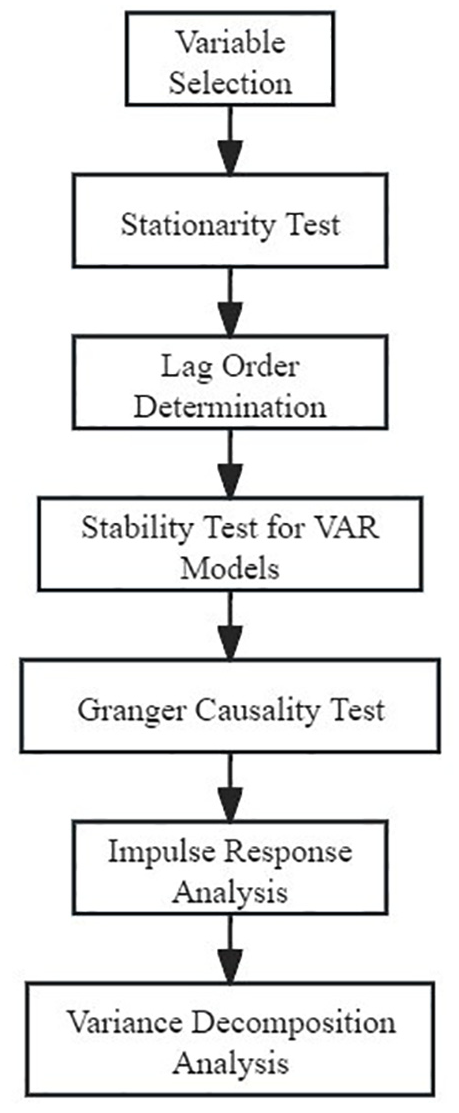
VAR modeling process.
Cross Elasticity Analysis Method
Cross Elasticity is an economic concept that measures the extent to which two different goods or services influence each other. It is generally represented by the letter E (Tian et al., 2023). It assesses the sensitivity of a change in the quantity of one good or service to a change in the quantity of another good or service. Specifically, cross elasticity is used to analyze the relative change between two variables, usually expressed as a percentage change. Through cross-elasticity analysis, a deeper understanding can be gained of the relationships between sports media and information services, sporting goods and related product sales, trade agency and rental industries, the scale of China’s e-commerce, and gross domestic product. This is of great significance for policy formulation, strategic development, and understanding the characteristics of the economic system. For two variables X and Y, the formula for calculating the cross elasticity is as follows (Yu et al., 2022):

Where: EXY is the cross elasticity of X with respect to Y;%ΔY represents a percentage change in variable Y. %ΔX represents a percentage change in variable X. Specifically, a positive cross elasticity indicates that the two variables are positively correlated, that is, variable Y increases when variable X increases, and a negative cross elasticity indicates that the two variables are negatively correlated, that is, variable Y decreases when variable X increases. This formula shows the percentage by which a 1% increase in X changes Y.
Results
Examination of Variable Data
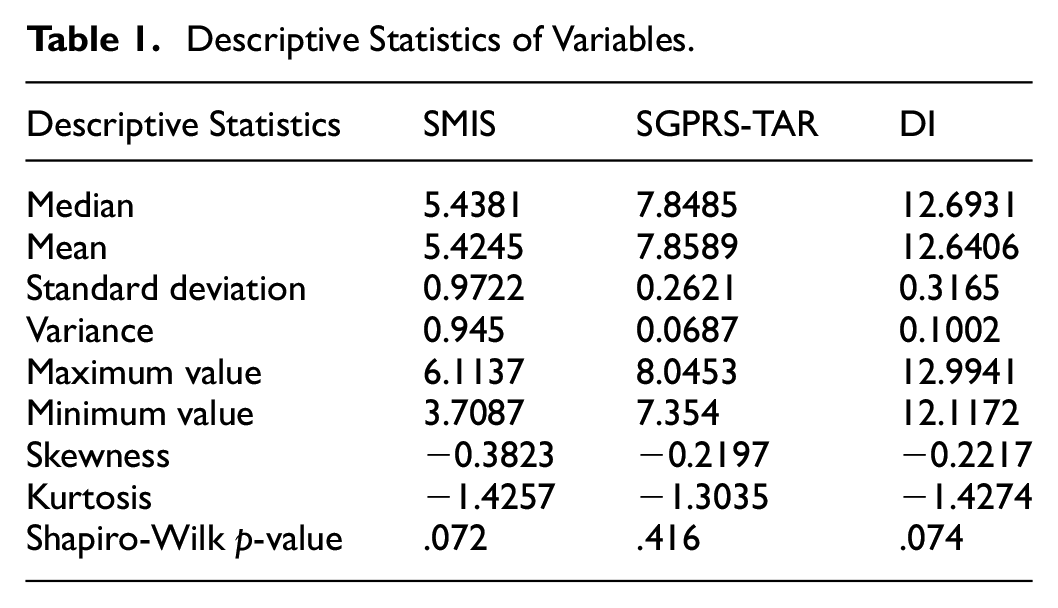
To explore the relationship between the variables in the VAR model, SMIS, SGPRS-TAR and DI, after taking natural number logarithm, are described in Table 1. The p-value of Shapiro-Wilk test shows that the three variables are all greater than .05 at the 5% significance level, indicating that the variables obey normal distribution.
Descriptive Statistics of Variables.
Examination of VAR Stationarity
To avoid the false regression problem in the VAR model, which may result in the meaninglessness of the model (Gordon, 2021), before construction of the VAR model, ADF unit root test is performed on relevant indicators of digital industry, sports media and information services industry, sporting goods and related product sales, trade agency and rental industry based on the logarithm of natural numbers to ensure the accuracy of the VAR model (Arfaoui & Yousaf, 2022).
Table 2 shows that the sequence data for digital industry (DI) and sports media and information services (SMIS) reject the original hypothesis at a 1% significant level, indicating that the primary data is stationary. In contrast, the ADF value of sports goods and related products sales, trade and rental (SGPRS-TAR) after first order differencing rejects the original hypothesis at a 5% significant level, and is below the relevant threshold. This indicates that the sequence after differencing meets the stationarity condition, and dSGPRS-TAR (sports goods sales and trade agency) is a stationary sequence.
ADF Unit Root Test Results.

Note.*** indicates rejection of the null hypothesis at the 1% significance level; ** indicates rejection of the null hypothesis at the 5% significance level; d indicates the first-order differenced data obtained from the original data.
Determination of the Lag Order of the VAR
The lag phenomenon refers to the fact that in the construction of the VAR model, the effect of the explanatory variable on the explanatory variable does not occur immediately, but there is a certain time lag (Guo et al., 2022). This shows that it is very important to select an appropriate lag order for reflecting the relationship between variables accurately when analyzing the dynamic relationship of time series data. It is very important to determine the lag order of the VAR model to ensure its stability. The selection of the lag order not only balances the number of lag terms needed to capture the dynamic relationship between variables and the demand for model stability, but also avoids excessive model complexity and loss of freedom caused by too many lag terms (Ivanov & Kilian, 2005).
The empirical results are shown in Table 3. The lag order is selected by using criteria such as FPE (Final Prediction Error), AIC (Akaike Information Criterion), SC (Schwarz Criterion), HQ (Hannan-Quinn Criterion) and LR (Likelihood Ratio). According to these criteria, the optimal lag order is determined to be the first order.
Lag Order Determination for VAR Model.

Note.* represents the optimal lag suggested by the criterion.
Examination of the Stability of the VAR Model
The examination of the stability of the VAR model aims at ensuring that the coefficients of the model remain stable in different time periods, that is, the structure of the model does not change significantly in time (Kharchenko & Ziming, 2021). In Figure 2, we can see that all the three characteristic roots are distributed within the unit circle, and this observation confirms the high stability of the model.

AR root test results.
Granger Causality Test
As shown in Table 4, the original hypothesis “DI is not the Granger cause of SMIS” has a p value of .0257, which is rejected at the 5% significance level. Therefore, it is concluded that the relationship is statistically significant at the 5% significance level, indicating that digitization affects the development of the sports media industry (Z. Liu, 2023). However, for “DI is not the Granger cause of SGPRSTAR,” the original hypothesis, that is, DI is not the Granger cause of SGPRSTAR, is accepted at the 5% significance level.
Granger Causality Test Results for Each Variable.

Note.** indicates rejection of the null hypothesis at the 5% significance level.
VAR Impulse Response Analysis
Impulse response functions show how endogenous variables dynamically affect other endogenous variables over time after a shock (impulse) in a system, showing positive and negative changes (Inoue & Kilian, 2020). Figure 3 shows the impulse response functions of variables in different time periods (the number of periods is 10). If the model parameters are not significant, the curves of the impulse response functions of shocks in different time periods will coincide (J. Q. Zhang et al., 2018). The results show that the impulse response of the digital industry to the sports media and information service industry shows an obvious trend. It can be seen from Figure 3 that the impact of the digital industry shock (DI ↑→ SMIS) in different time periods on the sports media and information service industry begins to show a negative effect, that is, the growth of the digital industry thus has a negative impact (Z. Liu et al., 2022). In Period 2, this negative effect reaches a peak, possibly because the traditional sports media and information service industry cannot adapt to the development of the digital industry in time, resulting in a decline in competitiveness and market share. With the passage of time, the negative effect gradually weakens, turns to show a gradually positive effect, and even shows an increasing trend. In Period 3, the strength of its positive response reaches a peak, and then the trend gradually slows down (Yang et al., 2022). This may be because the sports media and information service industry gradually begins to realize the importance of the digital industry, and adopts corresponding adjustments and changes to adapt to the change. After a certain period, the negative effect changes to a stable positive effect, which indicates that the sports media and information service industry begins to benefit from the development of the digital industry, possibly by adopting new technologies, innovating business models, or providing more digital contents and services. The impact of the digital industry innovation on the sports media and information service industry is a process of change from negative to positive, and finally brings a positive role in promoting the long-term development of the industry (Perpetuini et al., 2021).

Impulse response between variables.
Results of the Cross-Elasticity Operation
In view of the foregoing study showing that there is a significant correlation between the digital industry and the sports media and information service industry, in order to further explore the deep-seated mechanism, we calculated the cross-elasticity for the digital industry, sports media and information service industry from 2015 to 2022 according to formula 1 (Auer & Papies, 2020).
As can be seen from Figure 4, the cross-elasticity (E) represents the correlation between SMIS and DI, and from 2015 to 2020, E increases year by year, indicating that the degree of interaction between sports media and information service industry and the digital industry is gradually strengthened. From 2021 to 2022, the growth rate of E accelerates significantly, possibly due to the rapid development of the digital industry, leading to its gradual strengthening of the impact on the sports media and information service industry. The faster growth rate may reflect the increasingly important position of the digital industry in the field of media and information service. With the development of digital technology, the dependence of the sports media and information service industry on the digital industry increases, thus enhancing the mutual influence between the two (Litman, 2021).

Trend of cross-elasticity.
Discussion and Analysis
In this study, the research on the sub-industry of the sports service industry and the digital industry shows that the trend of integration of the digital industry and the sports service industry is very significant. The important finding is that the digital industry is the Granger cause of the sports media and information service industry, and the development of the digital industry has a positive impact on the changes of the sports media industry. Through this result, we can reveal the impact of the digital industry on the sports service industry. As a sub-industry of the sports service industry, the sports media and information service industry is affected by the digital industry, and then affects the development of the whole sports service industry. As we have already introduced, the relationship between the sports service industry and the digital economy is very close in the digital era. As a branch of the information service industry, sports media uses digital technology to collect, process and distribute sports content, while the digital industry provides the necessary technical support and platform, so that sports content can be more widely and effectively disseminated (X. Chen et al., 2023). Wu et al. studied the development and future outlook of sports communication research in China since the 21st century. They analyzed the problems of sports media from micro, medium and macro levels, and proposed the development path of sports media under the digital movement, its trend of integration is very significant (Wu et al., 2022). With the rapid development of the digital industry, China’s sports media industry has undergone tremendous changes. The traditional television broadcast model has gradually been replaced by digital platforms, and live streaming, mobile viewing and social media dissemination of sports events have become the mainstream. For example, Chinese sports events, such as Chinese Super League, CBA Basketball League, etc., are broadcast live through digital channels such as online video platforms, mobile apps, and viewers can use their mobile phones or computers to watch the game anytime, anywhere. This digital transformation not only enhances the convenience and comfort of the game-watching experience, but also brings new business models and profit paths to the sports media industry, such as paid subscriptions, advertising and marketing (Summerley, 2020). The results of this paper fully demonstrate the impact of the digital industry on the sports media industry, as well as the great potential of the digital economy in the field of sports services. During the impulse response analysis phase, the digital industry has shown a positive impact on the sports media and information services industry over time. However, this impact gradually diminishes, suggesting potential negative effects of digitization on traditional sports media. Digitization may lead to a reduction in the market share of traditional sports media, as audiences shift toward online platforms and digital content, thereby weakening the influence and revenue streams of traditional media. Furthermore, the digital transformation could intensify competition, forcing traditional media to face greater survival pressures, which could even result in the decline or elimination of some traditional sports media outlets. Therefore, understanding the comprehensive impact of digitization is a crucial prerequisite for formulating industry development strategies.
In addition, in the analysis of cross elasticity, the study shows the extent of the interaction between the digital industry and the sub-industry of the sports service industry. This provides a more comprehensive perspective for the study. The cross elasticity of the digital industry and the sports service industry has important theoretical and practical value (Ialenti & Pialli, 2024). This concern is based on four considerations. First, the trend of industry convergence. Digital industry and sports service industry are increasingly showing the trend of convergence in today’s economic environment. The development of digital technology has affected the way of sports communication, product development and sales strategy, which has a far-reaching impact on the development of the two industries. Second, the diversity of influencing factors. Sports service industry includes many subfields, such as media, supplies sales, trade agency, etc., and the influencing factors of the digital industry come from many dimensions (Bai, 2024). Focusing on the cross elasticity can better understand the relationship between the various fields, and provide a comprehensive perspective for the impact of internal and external factors in the industry. Third, market opportunities and challenges. The continuous innovation of digital technology has brought new market prospects and challenges for the digital industry and the sports service industry. An in-depth study of the cross elasticity between them will help us grasp the pulse of market development and find more cooperation opportunities and innovation. Fourth, data-driven decision making. The digital age emphasizes data-driven decision making, and the elasticity analysis is based on sufficient data. By focusing on the cross elasticity of the digital industry and the sports service industry, we can make better use of data and conduct more scientific and accurate decision analysis. By combining the digital industry and the sub-industry of the sports service industry to conduct an in-depth study, and using the cross elasticity analysis method, this paper opens up a new exploration approach and method in academic research and practice. This interdisciplinary perspective and method provide a more comprehensive and in-depth understanding of the impact of the digital industry on the sports service industry, and are of great significance to the further study in the related fields, which is the second highlight of this paper.
We also find that there is no Granger causality between the digital industry and the sales of sports goods and related products, and between the trade agency and the rental industry, which may indicate that there are relatively independent development paths or impact mechanisms between the digital industry and the sports goods and related products. For example, although the digital industry in China is booming, the growth of the sports goods market is more influenced by factors such as brand image, product innovation and policy support (Y. Chen & Tian, 2024). Take Adidas for example, although consumers can easily buy its products through e-commerce platforms, the company’s sales growth mainly depends on the competitiveness of its brands and marketing strategies. Therefore, the development of the digital industry may change sales channels, but the overall growth of the sports goods market depends more on factors such as brands, products and policies.
To sum up, the digital industry and the sports service industry are showing a gradual integration of the development trend. The growth of the digital industry will continue to promote the expansion of sports media and other areas. Although its impact on the sales of sports goods is relatively indirect, it may be more closely related through many factors in the future. From an economic point of view, the impact of the sports service industry on the overall economy and the digital industry will be further strengthened, especially when the digital industry is booming, its promotion will be more significant. This mutually reinforcing relationship has created growth opportunities for both sides, which may promote the coordinated development of the overall economy and the digital industry by enhancing the degree of digitization in the future.
Conclusion
This study explores the impact of digital development on the sports service industry through VAR modeling and cross-elasticity analysis, yielding the following key conclusions. First, the digitalization process has a significantly positive impact on the development of the sports service industry, particularly in enhancing service quality and expanding market scale. Second, the VAR model analysis reveals that digital technologies have a profound influence on consumer behavior, market demand, and service innovation, especially in areas such as sports event broadcasting, digital platforms, and online services. Third, cross-elasticity analysis demonstrates the crucial role of digital development in fostering synergy and interconnectedness among various sectors of the sports service industry. This suggests that the future growth of the sports service industry will depend on closer collaboration and resource sharing across different sectors, with digital technology serving as a key driving force. However, the study also highlights that the digital transformation of the sports service industry is not an overnight process and still faces challenges such as technological barriers, policy constraints, and market volatility. Therefore, sports service companies must adopt more flexible strategies in their application of digital technologies to address these uncertainties. Future research should further investigate the integrated application of different technologies within the sports service industry and their potential impacts, helping the industry better navigate the opportunities and challenges of the digital era.
Recommendations
Considering the in-depth exploration of the relationship between digitization and the sports service sector in this paper, along with the results drawn from the research, we propose several recommendations aimed at bridging theoretical knowledge with practical applications. These suggestions are intended to guide relevant industries in actively embracing the opportunities and challenges of the digital age.
(1) Optimize industry policies to promote the development of sports goods sales and trade agency industry: Research findings indicate that the digital industry is not the Granger cause of sports goods and related products sales, trade agency, and rental industry. Further investigate other potential factors that may influence sports goods sales and trade agency, including consumer preferences, market competition dynamics, product innovation, etc., and consider these factors in policy-making and business strategies. Although the direct impact of the digital industry on these sectors is limited, opportunities for collaboration with the digital industry can be explored, particularly in areas such as supply chain management and marketing. Businesses should regularly conduct consumer behavior research to analyze the purchasing decision process and market competition landscape, and subsequently adjust product lines and marketing strategies based on market demand. The government can incentivize product innovation through mechanisms such as research and development subsidies and tax incentives, particularly in the fields of smart devices and green technology. Meanwhile, it should promote collaboration between digital supply chain platforms and sporting goods companies to improve inventory management and logistics efficiency. The diversification of e-commerce platforms is also crucial. Companies should actively explore emerging sales models such as social commerce and live streaming. Additionally, industry associations and the government should regularly publish industry reports to monitor the impact of digitalization on sporting goods sales. This will help businesses dynamically adjust their strategies and ensure fairness and effectiveness in market access and regulatory measures.
(2) Enhance the level of collaborative innovation between the sports media and information services industry and the digital industry: Granger causality test results demonstrate a close relationship between the sports media and information services industry and the digital industry, providing support for promoting collaboration and driving innovation between the two. In addition to strengthening research and development cooperation in digital technology, diverse collaboration models such as cross-disciplinary talent cultivation, shared data resources, and innovative content partnerships should be actively explored. Sports media companies and tech enterprises should strengthen joint research and development in fields such as virtual reality, augmented reality, and 5G to innovate the user experience. At the same time, educational institutions and businesses need to collaborate in establishing interdisciplinary courses to cultivate talent with dual backgrounds in digital technology and sports media. In addition, promoting the establishment of shared data platforms contributes to precise marketing and content innovation, enhancing the user experience. Innovating content collaboration models is equally important. Sports media and tech companies can develop personalized content recommendation systems based on big data and artificial intelligence. At the government level, policies and institutional safeguards should be promoted to support cross-industry data sharing, incentivize cross-sector collaboration, and ensure data privacy and security.
(3) Maintain focus on the driving effect of the digital industry on the sports service sector: Cross-elasticity analysis results indicate that the driving effect of the digital industry on the sports service sector is increasing year by year, suggesting a continued deepening of digital technology applications in the sports industry. Businesses should regularly conduct forward-looking research on digital technologies, exploring the application of cutting-edge technologies such as quantum computing and blockchain in event management. The government should formulate targeted policies based on these research findings, such as supporting the development of digital platforms and promoting the establishment of data service standards, to help businesses adapt more quickly to technological changes. Industry standardization and regulation are also crucial. Establishing a technical standards committee can help develop and promote the application standards for digital technologies in sports services. In addition, sports service companies should closely monitor the development trends of digital technologies and promptly adjust their technological deployment strategies, such as optimizing customer management and event experiences through cloud services and artificial intelligence, to ensure sustained competitiveness in the digitalization process.
Limitations of the Study
Although this study provides a relatively systematic and in-depth analysis of the VAR model and cross-elasticity in the sports service industry under digital development, there are still certain limitations. Firstly, there are limitations in the data source, as the time span and sample size of the data are restricted. Due to the difficulty of data collection, the data used in this study mainly focuses on key variables in recent years, which may not fully reflect the long-term trends in the sports service industry. Secondly, the applicability of the model is not comprehensive enough. While the analytical model adopted in this study can explain the relationships between some influencing factors, it does not fully account for other external variables that may affect the sports service industry, such as policy changes and market fluctuations. Future research should explore more complex models or methods to analyze the impact of these external factors more comprehensively. Additionally, although this study discusses the application of VAR technology, its effectiveness may vary due to differences in technological development levels. Therefore, future research should further explore the technological thresholds and impacts on enterprises of different sizes. Regionally, the background of this study is China, and the conclusions drawn may not be applicable to other global markets. Future research should expand to other regions to test the cross-regional applicability of the findings. Lastly, the digitalization process of the sports service industry is a dynamic one. This study is based on the current technology and market conditions, and as technology and markets evolve, long-term follow-up studies will help capture the sustained impact of digitalization on the industry.
Footnotes
Acknowledgements
We extend our sincere gratitude to all participants for their invaluable contributions of time and expertise.

Ethical Considerations
This study methods were performed in accordance with the relevant guidelines and regulations. Ethical approval for this study was obtained from the Human Research Ethics Committee.
Consent to Participate
A written informed consent was obtained from all participants included in the study.
Funding
The author(s) disclosed receipt of the following financial support for the research, authorship, and/or publication of this article: This work was funded by National Social Science Fund of China (22FTYB005) and General Projects of Philosophy and Social Sciences funded by the Ministry of Education (19YJA890001).
Declaration of Conflicting Interests
The author(s) declared no potential conflicts of interest with respect to the research, authorship, and/or publication of this article.
Data Availability
Data will be made available on request.