



Abstract
The panel vector autoregression (PVAR) model preserves the advantages of the vector autoregression model while expanding its time series to the spatial direction, which can effectively solve the problem of individual heterogeneity using panel data. It is derived from econometrics but has been applied interdisciplinarily because of its advantages in metrology. Given its increasingly important role in econometrics and interdisciplinary applications, a systematic review based on the bibliometric tool was conducted by screening 292 articles related to PVAR from the Web of Science. First, a descriptive analysis of the related articles was conducted to identify the current research status of PVAR. It reveals that macroeconomic effects, economic growth and environmental protection, and model adaptation are the primary topics in PVAR-related research. Then, the study classifies PVAR models into three categories and summarizes the four estimation methods within the knowledge domain. Having clarity on the different categories and estimation methods enhances the practical utility of the PVAR model. Finally, to gain insight into the knowledge evolution of PVAR, this study discusses how research hotspots in the field have evolved over time. This analysis provides a historical perspective and allows researchers to anticipate future trends and emerging areas of interest within PVAR. Based on these findings, this study identifies three research opportunities that can guide future investigations in the field of PVAR. This study aims to foster extension applications of the model in econometric research and highlight its potential for interdisciplinary applications.
Plain Language Summary
The panel vector autoregression model is an extension of the autoregressive model to a spatial dimension. It is derived from the field of econometrics but has been applied interdisciplinarily because of its advantages in metrology. Given its increasingly important role in econometrics and interdisciplinary applications, a systematic review was conducted based on 292 articles related to panel vector autoregression screened from Web of Science. First, descriptive statistics of the articles were performed using bibliometric tools to recognize the current research status. The development process and theoretical knowledge of the panel vector autoregression model are then discussed. Finally, we present a future research agenda. Most studies use the panel vector autoregression model to develop empirical research, but few have addressed its theoretical concerns. This work will meet the challenge of enlightening the extension application of the model in econometric research and illustrate its potential in interdisciplinary applications.
Keywords
Introduction
Christopher Sims, a professor at Princeton University, created a vector autoregressive (VAR) method in 1980 to analyze how the economy is affected by temporary changes in economic policies and other factors (Sims, 1980). The Compared to other models, the PVAR model stands out because it treats each variable as an endogenous variable. This approach avoids predefining the causal relationships between variables, and instead focuses on identifying the impacts of each variable and its lag variables on other variables (Alsaedi & Tularam, 2020). VAR model is one of the models to easily analyze and predict multiple economic indicators and opens the door to inductive methods for investigating the correlation and causal relationship between random variables in equation sets (Mussard & Ndiaye, 2018). Sims won the 2011 Nobel Prize in economics for his great achievements in this field. With time going by, the original VAR method has been adapted to many different types by the following scholars according to different research demands to solve various econometric problems, which has become an indispensable tool in the field of econometric research.
Among them, the panel vector autoregression (PVAR) model, proposed by Holtz-Eakin et al. (1988), is a new model based on panel data that adapted from the VAR model. It allows for the presence of unobservable individual heterogeneity and time effects. Unlike the VAR model, the PVAR model does not have strict requirements on data volume and format. Additionally, it effectively controls estimation bias resulting from spatial and individual heterogeneity (Jawadi et al., 2016). To this end, the PVAR model has gained popularity in research (see Figure 1). Although the effect of the PVAR model is similar to that of a multivariate regression equation, it offers several distinct advantages (A. Khan et al., 2020):
The commonly used multivariate regression equation is difficult to measure the interaction between variables. Firstly, in the process of variable selection, the commonly used multivariate regression equation should determine whether the variable is endogenous or exogenous. Sometimes, some important lag variables may be easily omitted. While, one advantage of the PVAR model is that it treats all variables as endogenous variables. This helps to reduce model uncertainty that may arise from subjective decisions in common multivariate regression equations(Acheampong, 2018). In traditional multivariate regression equations, a variable is considered endogenous only if it passes the prediction test in advance. However, the PVAR model does not have this requirement, allowing for more flexibility in the analysis (Mamipour et al., 2019).
It can be understood that the prediction results obtained by a simple and reasonable PVAR model are often more scientifically sound than those obtained by complex multivariate simultaneous regression equations. This is primarily due to the PVAR model’s ability to effectively circumvent the influence of multiple constraints imposed by common multivariate regression models, thereby ensuring the identifiability of the modeling structure (R. Yang et al., 2022).
The general form of the PVAR model allows for easier parameter estimation compared to other multivariate regression equations. As a result, the calculation process is relatively straightforward (Kuang et al., 2020).

Yearly number of papers.
Although PVAR model was initially applied in the field of economics, in view of its unique advantages, scholars have employed this model to develop empirical research in recent years (see Figure 2), like environmental science, mathematics, public administration, computer science, engineering and etc., which fully shows that this model has a promising future. Hence, conducting a systematic review of this model has important theoretical value and practical significance. Secondly, the incorporation of theories and research tools from diverse disciplines has led to a continuous flow of new research topics in this field. For example, R. Yang et al. (2022) combined the DEA model with the PVAR model to evaluate China’s ecological efficiency while examining the dynamic relationship between the economic, social, and environmental subsystems within China’s ecological efficiency system. In a study conducted by Girón and Kazemikhasragh (2022), the PVAR and Arellano-Bond models were comprehensively adapted to analyze the effects of gender inequality on economic growth. As knowledge in this field continues to evolve, it can be challenging for readers to grasp the current research hotspots, the evolution process, and the existing research gaps solely through non-visualization techniques owing to the overwhelming number of papers available. A systematic review based on visualization techniques is a type of research that focuses on the contents of the literature and investigates the distribution, quantitative relationships, evolution process, and frontier trends of the literature through statistical and mathematical principles (He et al., 2018), which is considered to be an effective way to meet the above challenges and better guide future research (Darko et al., 2019). Thirdly, scanning through the articles in this field, it can be found that PVAR model in most literature was employed to carry out empirical research (e.g., Sigmund & Ferstl, 2021; R. Yang et al., 2021). On the one hand, it is necessary to gain the lessons from the empirical experience of PVAR model, so as to better expand the application of it. On the other hand, although the PVAR model has been widely used to support various economic theories and test economic behavior (e.g., C. Canova et al., 2010; Dizaji & Farzanegan, 2023), it is necessary to further enrich the relevant theoretical research of PVAR model under the background of interdisciplinary application, so that it can better serve the development of research in different fields. This is also one of the important objectives of this work. To achieve the aforementioned research objectives, this study conducted a systematic review of existing PVAR-related research using visualization techniques. The study adhered to the guidelines provided by the Preferred Reporting Items for Systematic Reviews and Meta-Analyses (PRISMA) framework (Moher et al., 2009). By utilizing bibliometric tools, this study visually analyzed 292 PVAR-related papers obtained from the Web of Science (WoS) core database. The goal is to gain insights into the current research status of PVAR, trace its evolutionary process, and identify future opportunities in this field.

PVAR model employed in different research areas (top 15).
The remaining sections of this work are organized as follows: Section 2: Literature review—This section aims to establish a solid foundation for the subsequent research by reviewing relevant literature in the field. Section 3: Research design—The research design is outlined in this section, which includes the methodology and data sources that will be used for analysis and discussion of the results. Section 4: Synthesis analysis—In this section, a synthesis analysis of the collected data will be presented. Section 5: Future research opportunities—This section highlights potential areas for future research based on the findings of the study. Section 6: Conclusion—The final section summarizes the research findings, contributions made by the study, and any limitations encountered during the research process.
Literature Review
The PVAR model is built upon the foundation of dynamic equilibrium theory and is used to examine the interactions among endogenous variables in panel data (C. X. Liu, 2021). It is important to note that the PVAR model is derived from the VAR model. The VAR model, introduced by Sims (1980), has gained popularity as a widely-used model for analyzing multivariate time series data. However, one limitation of the VAR model is that as the number of variables increases, the number of parameters that need to be estimated grows exponentially. Hence, only when researchers are able to get the observable and enough sample values, can they effectively estimate the model parameters. Since the panel data can be used to obtain more observable sample values, scholars proposed PVAR model by combining the advantages of panel data and VAR model, to better serve the research needs (e.g., Altinoz & Aslan, 2022; Y. Zhang et al., 2022).
Bai (2019) pointed out that the research of PVAR model actually began with the discussion of Chamberlain (1984) based on pooled data. Then, Holtz-Eakin et al. (1988) studied a kind of PVAR model with time-varying coefficients and proposed a method of two stage least squares (2SLS) estimation, to explore the endogeneity between variables. This is the prototype of PVAR model. In fact, there is only one endogenous variable in the PVAR model proposed by Holtz-Eakin et al. (1988). However, the sample observations of endogenous variables are panel data, not a PVAR model containing multiple endogenous variables. On the basis of previous studies, Pesaran and Smith (1995) have made a series of adaptations to the PVAR model. They firstly found that the model parameters can be estimated by establishing the time series PVAR model for the individual average time series of each variable in this model. After that, more and more scholars adapted the PVAR model according to the research needs. For example, Binder et al. (2005) investigated the independent micro panel data of time series, which solved the common problems contained in the traditional PVAR model due to many individuals, short individual time series and individual heterogeneity. It was the first time that the PVAR model is applied to the micro level. K. Yang and Lee (2021) adapted a dynamic PVAR model, examined the characteristics of dynamic and spatial interactions that this model can generate, and classified the model as stable or unstable situations by dividing the parameter space. Tuğan (2021) studied the dynamic and simultaneous interactions between macroeconomic variables by constructing a PVAR model with interactive fixed effects. In addition, some scholars have discussed how to optimize the estimation method of PVAR model (e.g., F. Canova & Ciccarelli, 2013; Y. Liu et al., 2021; Sigmund & Ferstl, 2021). several scholars have made efforts to design and enhance the application steps and software of the PVAR model. For example, Abrigo and Love (2016) focused on improving the steps and software used in the application of the PVAR model. In general, the application of the PVAR model typically involves the following five steps: (1) Unit root test: This step is used to test the stationarity of the relevant variables, which is important to determine their suitability for the PVAR model (Liao et al., 2018). (2) Co-integration test: The co-integration test is conducted to determine whether there exists a long-term and equilibrium relationship between variables (Kao, 1999). However, it is worth noting that some scholars have omitted this step in their studies (e.g., A. Khan et al., 2020; Kuang et al., 2020). (3) Lag selection: The optimal lag period is selected to construct the PVAR model (Carrasco-Gutierrez et al., 2009; Shen & Li, 2023). This step helps determine the appropriate time frame to capture the dynamics of the variables. (4) Impulse response analysis: In this step, impulse response function diagrams are utilized to observe the dynamic interactions between variables (B. Lin & Wang, 2019). This analysis provides insights into how shocks or changes in one variable affect the others over time. (5) Variance decomposition: The variance decomposition step quantifies the degree to which the fluctuation of one variable can be explained by the influence of another variable (B. Lin & Wang, 2019). It helps understand the relative importance of different variables in explaining the variability of the system. By following these steps, researchers can apply the PVAR model effectively and gain valuable insights into the dynamic relationships and interactions among variables. (Mamipour et al., 2019). Besides, a small number of scholars have specially added the test of Granger causality to the above steps to analyze the Granger causality between the variables (e.g., Z. Khan et al., 2020; B. Lin & Wang, 2019). In most studies, scholars used the software of Stata to complete the above steps (e.g., Kuang et al., 2020; R. Yang et al., 2021).
To our best knowledge, no scholars have systematically reviewed the papers in the field of PVAR yet. While, the existing research experience provides great supports for this work. On the one hand, the application scope of PVAR model is gradually extension with the joint efforts of scholars, which fully illustrates the good application prospects of the model. On the other hand, to promote the further development of PVAR model, it is significant to sort out the settings, classifications and estimation methods of it, and find out the problems that should be attached importance in the future.
Research Design
Research Overview
In order to ensure the quality of systematic review, the research objectives are supposed to be clearly set first (He et al., 2018). The main objectives of this work are to recognize the research focuses, unearth the evolution progress, and identify future research agenda related to the PVAR model. These objectives serve as benchmarks for the subsequent steps of the review. To ensure the quality of the review, rigorous procedures for data collection are formulated. Following the PRISMA guidelines, the articles relevant to the research topic are accurately and comprehensively screened out. This approach enhances the transparency and reproducibility of the research results. The next step involves conducting a synthesis analysis of the selected literature samples. This includes descriptive analysis, examination of the knowledge domain, and identification of the knowledge evolution path. By adopting these multiple perspectives, the set research objectives can be comprehensively addressed. Figure 3 presents an overview of the research process in this systematic review. Each step will be introduced in detail in the subsequent chapters, allowing for a systematic and comprehensive exploration of the PVAR model’s research landscape.

Research overview.
Data Preparation
The screening process of sample literature in this study involved the following steps: The authors selected the Scientific Citation Index (SCI) and Social Science Citation Index (SSCI) databases within the WoS core database as the sources for literature retrieval. The WoS core database covers various disciplines, including the SCI, SSCI, and Art and Humanities Index (A&HCI). The selection of the WoS core database as the literature retrieval source is widely acknowledged in previous studies (e.g. Cabeza et al., 2019; de Jong et al. (2015); Yang et al., 2019). The SCI and SSCI databases were specifically chosen because they contain literature relevant to the natural and social sciences, which aligns with the research field of PVAR. On the other hand, A&HCI focuses on the humanities and art fields, which are different from the scope of this research. However, it should be noted that some articles related to natural and social sciences may also be included in A&HCI, but are typically covered by SCI and SSCI databases (R. Yang et al., 2020). The search was conducted using the keyword “panel vector autoregression” within the “topic” column of the SCI and SSCI databases, covering all years. This search yielded 294 results as of November 10, 2021. In order to ensure a comprehensive screening of published literature in the research field and conduct a systematic review, the study aimed to identify synonyms and similar expressions related to “panel vector autoregression” in existing literature. However, no such results were found. To ensure the accuracy of the selected sample documents, the authors removed noise documents such as editorial materials. The research employed a double expert discussion method to independently evaluate the selected articles. Two researchers, well-versed in the PVAR model, read and reviewed the literature to determine their relevance to the field of PVAR. Any differences in assessment were discussed until a consensus was reached, thus minimizing bias in data collection (R. Yang et al., 2020). Ultimately, the author saved 292 selected sample documents in the form of full records and standardized them. The full records of each article in WoS included basic information such as author names, titles, abstracts, keywords, published year, and references. Similarly, each retrieved reference contained authors’ names, publication years, source types, issue numbers, volume numbers, and DOIs. This standardized basic information serves as the basis for identifying internal relationships among the articles and lays the foundation for subsequent result analysis in the study.
To facilitate understanding, the specific search criteria are shown in Table 1.
The Search Criteria of This Research.

Bibliometric Tool
In recent years, bibliometric tools such as VOS-viewer, CoPalRed, and CiteSpace have gained popularity for visual analysis. Among these, CiteSpace stands out because of its comprehensive functionality and user-friendly interface. It is a bibliometric tool that offers diverse real-time and dynamic features (C. Chen, 2006). Additionally, CiteSpace supports various co-citation analyses, enabling researchers to quantitatively and objectively analyze related fields and reveal quantitative relationships between different areas of research. Through visualization analysis results, scholars can easily uncover hidden links and trends in the relevant literature, including temporal and spatial distribution characteristics, research status, cutting-edge studies, and future development trends in specific research fields (Shi & Liu, 2019). CiteSpace not only provides an overview of the research field, but also highlights important studies within this field (Zhu & Hua, 2017). Owing to its comprehensive bibliometric functions and high reliability, it has been widely utilized in systematic reviews (e.g., Mou et al., 2019; R. Yang et al., 2021). Therefore, future studies will rely on CiteSpace to conduct the analysis accordingly.
Synthesis Analysis
This section encompasses three main parts: descriptive analysis, the knowledge domain, and knowledge evolution. Synthesizing these parts provides a comprehensive understanding of the research focus, evolutionary process, and emerging topics in the field of PVAR. This synthesis analysis enhances the logical and systematic presentation of this study (R. Yang et al., 2020). The first part, descriptive analysis, identifies the current research status and focuses on PVAR. It establishes a foundation for further exploration of the knowledge domain and knowledge evolution. The analysis of the knowledge domain in PVAR untangles the key areas that require significant attention in the empirical application of PVAR models. This analysis is crucial for understanding the adaptation and interdisciplinary application of PVAR models in future studies. Finally, revealing the knowledge evolution of PVAR enables researchers to understand how hotspots in the field evolve over time. This aids in identifying research frontiers and provides guidance for future PVAR studies. By combining descriptive, knowledge domain, and knowledge evolution analyses, researchers can gain a comprehensive understanding of the PVAR field, including its current state, key areas of focus, and future research directions.
Descriptive Analysis
This part focuses on the descriptive analysis of three parts: prolific authors, highly cited literature, geographical distribution and cooperation, all aimed at providing a comprehensive understanding of the research status in the field of PVAR.
Prolific Authors and High-Cited Literature
Indeed, authors with a substantial output of literature play a significant role in advancing PVAR research. Additionally, the academic influence of a scholar can be assessed by the number of citations their published articles receive. Therefore, this section aims to identify prolific authors and highly cited literature in the field of PVAR, which helps identify research focuses and important scholars in the field. Following the Price law (S. Chen et al., 2019; Y. Chen et al., 2019), this study has identified a total of nine authors who have published >3 papers and are considered prolific authors in the field of PVAR (refer to Figure 4). These authors have made significant contributions to the field through their extensive publication output. Furthermore, this study presents detailed information on articles that have been cited >100 times. This information includes the citation frequency, author, research field, publication year, and article title, as outlined in Table 2. This allows for a comprehensive understanding of the most influential and highly cited literature in the field of PVAR. By examining both prolific authors and highly cited literature, researchers can gain insights into the research foci and key scholars in the PVAR field. This information is valuable for identifying influential voices and research directions within the field.
High-Cited Literature.


Prolific scholars.
Seen from Figure 4, Coad Alex has published five studies related to PVAR, whose publications is most in this field. All his articles contained PVAR model are to investigate the relationship between firms and macroeconomic effects (Coad & Broekel, 2012; Coad, 2010; Coad & Binder, 2014). Then, the scholars of Kim Soyoung, Skare Marinko and Zhang Yan published four articles respectively with PVAR model. Although all of them focused on the topic of macroeconomic effects, they have different focuses. Kim mainly studied the impact of financial and trade models on macro-economy, and particularly focused on Asian area (e.g., Kim et al., 2011a, 2011b; Kim & Lee, 2012). Skare examined the impact of carbon emissions (Škare et al., 2021), COVID-19 (Skare et al., 2021) and financial crisis (Škare & Porada-Rochoń, 2021) on macroeconomic effects. Zhang concentrated on the impact of estate prices (Y. Zhang et al., 2015), paid knowledge market (Zhang et al., 2020), and foreign exchange (Y. Zhang et al., 2014) on China’s macroeconomic effects. Altinoz Buket and Aslan Alper jointly published three articles related to PVAR. They mainly focused on the relationship between environmental protection and economic growth (Altinoz & Aslan, 2022; Aslan et al., 2021; Aslan & Altinoz, 2021). Kling Gerhard published three relevant articles of PVAR as well. Among them, two were also related to macroeconomic effects (Kling, Paul, & Gonis, 2014; Kling, Ghobadian et al., 2014), and the other one discussed how to develop the PVAR model with the causal order in longitudinal research by combining binary and continuous dependent variables (Kling et al., 2017). The three articles published by Lee Jong Wha were all in the cooperation with Kim Soyoung, and Park Cyn-young has also cooperated with them in two articles, which will not be repeated here. Besides, Park studied the determinants of financial pressure in emerging market economies (Park & Mercado, 2014). By and large, the research of prolific scholars is basically related to macroeconomic effects, economic growth and environmental protection, and model adaptation.
Moreover, Table 2 highlights that among the 8 PVAR-related articles cited >100 times, Goodhart and Hofmann’s (2008) research on the relationship between house price, money, credit, and macroeconomic factors received the highest number of citations. There are two main reasons for its high citation count. Firstly, the research by Goodhart and Hofmann has made significant contributions to advancing our understanding of macroeconomic effects. Their findings have had a profound impact on the field and have been widely referenced by subsequent studies. Secondly, the relatively early publication date of 2008 may be a crucial factor contributing to its high citation count. As one of the pioneering works in the field, it laid the foundation for subsequent research and has been frequently cited over time. It is worth noting that most of the highly cited literature in Table 2 is also related to macroeconomic effects, economic growth, environmental protection, and model adaptation. These topics align with the research focuses of the identified prolific authors. In addition, the studies by Kang et al. (2016) on corporate social responsibility and firm performance, as well as Dewan and Ramaprasad (2014) on media platform and sales, are also closely linked to economic activities. These studies demonstrate the interdisciplinary nature of PVAR research, where economic activities intersect with other domains.
Based on the analysis provided, three key topics emerge in PVAR-related research: macroeconomic effects, economic growth and environmental protection, and model adaptation. However, there is a growing interdisciplinary trend in the application of the PVAR model (e.g., Antonakakis et al., 2017; Dewan & Ramaprasad, 2014; Kuang et al., 2020), which is still within the field of economics, with sporadic usage in other areas. This observation is supported by the research topics that prolific authors have focused on, and the themes of the highly cited articles mentioned earlier. Notably, most scholars have predominantly employed the PVAR model for empirical research, while theoretical considerations regarding the empirical application of the PVAR model have not received sufficient attention. This indicates the need for further theoretical research to enhance the applicability of the PVAR model and to promote its effective cross-disciplinary application. By deepening our understanding of the theoretical underpinnings of the PVAR model, we can enhance its practical value and encourage its use across various disciplines.
Geographical Distribution and Cooperation
Figure 5 provides a list of productive countries with >10 PVAR studies, encompassing a total of nine countries. Analyzing the geographical distribution of sample literature can provide valuable insights into the regional background and cultural context of PVAR research, facilitating cross-regional research collaborations and cultural integration. It is important to note that the geographical distribution of the sample literature is based on the institutional affiliation of the scholars at the time of publication. This methodology is consistent with previous studies (He et al., 2018) and allows for a comprehensive understanding of the geographic origins of PVAR research. By examining Figure 5, we can gain a better understanding of the countries that have contributed significantly to PVAR research.

Geographical distribution.
It is evident from Figure 5 that American scholars hold the highest position in terms of PVAR research, followed by China. As mentioned earlier, the PVAR model finds extensive use in the field of economics. Given that the United States and China are the world’s two largest economies, it is natural for scholars to pay significant attention to their economic development. The United States represents a typical developed country, while China stands as the largest developing country globally. Research on these countries has substantial implications for global economic development, and can provide valuable insights for other nations’ economic activities and policy-making. In today’s interconnected global economy, economic development is not confined to individual countries. It is intricately linked to trade exchanges, monetary policies, and economic activities among nations. Achieving global economic prosperity requires joint efforts from countries worldwide. Consequently, many developed and developing nations have conducted relevant PVAR studies, drawing upon their regional and cultural contexts, and generating a variety of implications. These studies play a vital role in expanding the breadth and depth of the PVAR model. However, as illustrated in Figure 5, research in the field of PVAR is predominantly conducted by developed countries. This may be attributed to the fact that developed countries tend to have higher-quality economic development, closer foreign trade ties, and a greater need for comprehensive economic policy formulation. Scholars in these countries delve deeper into the subject matter. Conversely, many developing countries are still at early stages of economic development, resulting in insufficient attention from domestic scholars toward theoretical research and economic problems in their respective countries. Nevertheless, certain developing countries have witnessed notable progress in their economies and societies in recent years. Consequently, the prominence of PVAR model applications in these developing countries has increased compared to the past. Examples include India, Russia, Ukraine, and several African countries (Adeniyi et al., 2023; Girón & Kazemikhasragh, 2022; Love & Rachinsky, 2015; Reddy, 2019).
To gain a deeper understanding of cross-regional collaboration in the field of PVAR, this study utilizes CiteSpace software to analyze the co-occurrence network of countries/regions (refer to Figure 6). This analysis will provide valuable insights into the collaborative relationships among different countries and regions in PVAR research.

Country/region co-occurrence network.
From Figure 6, it is evident that the top three countries identified in Figure 5 play leading roles in their respective country/region co-occurrence centers within the co-occurrence network. American scholars exhibit close collaborative relationships with scholars from various countries around the world, including both developed and developing nations. This can be attributed to the pivotal position of the United States in the global economy and trade, with trading partners spanning the globe. British and Chinese scholars tend to collaborate more closely with scholars from neighboring countries in their research endeavors. For instance, British scholars engage in extensive cooperation with French and German scholars, while Chinese scholars collaborate more with scholars from Thailand, Singapore, and Brunei.In general, scholars from different countries have begun to establish robust cooperative networks in the field of PVAR. However, these networks are predominantly dominated by countries with strong economic strength, such as the USA, China, England, Germany, and Australia. To further expand the application scope of the PVAR model, it is crucial to enhance cooperative relationships among countries with diverse cultural backgrounds in the future.
Building upon the aforementioned analysis, this study proceeds to examine the institutional co-occurrence network (see Figure 7). Firstly, the institutional collaboration network offers a clearer view of the important academic institutions across different countries involved in PVAR research. It reveals which institutions engage in transnational cooperation, thereby contributing to the integration of PVAR research. Secondly, understanding the key academic institutions in the field of PVAR can guide scholars toward strengthening their contacts, leading to higher achievements in the future. Thirdly, this knowledge also aids national economic authorities and practitioners in focusing on these institutions, thereby promoting the rapid transformation of academic achievements into practical applications.
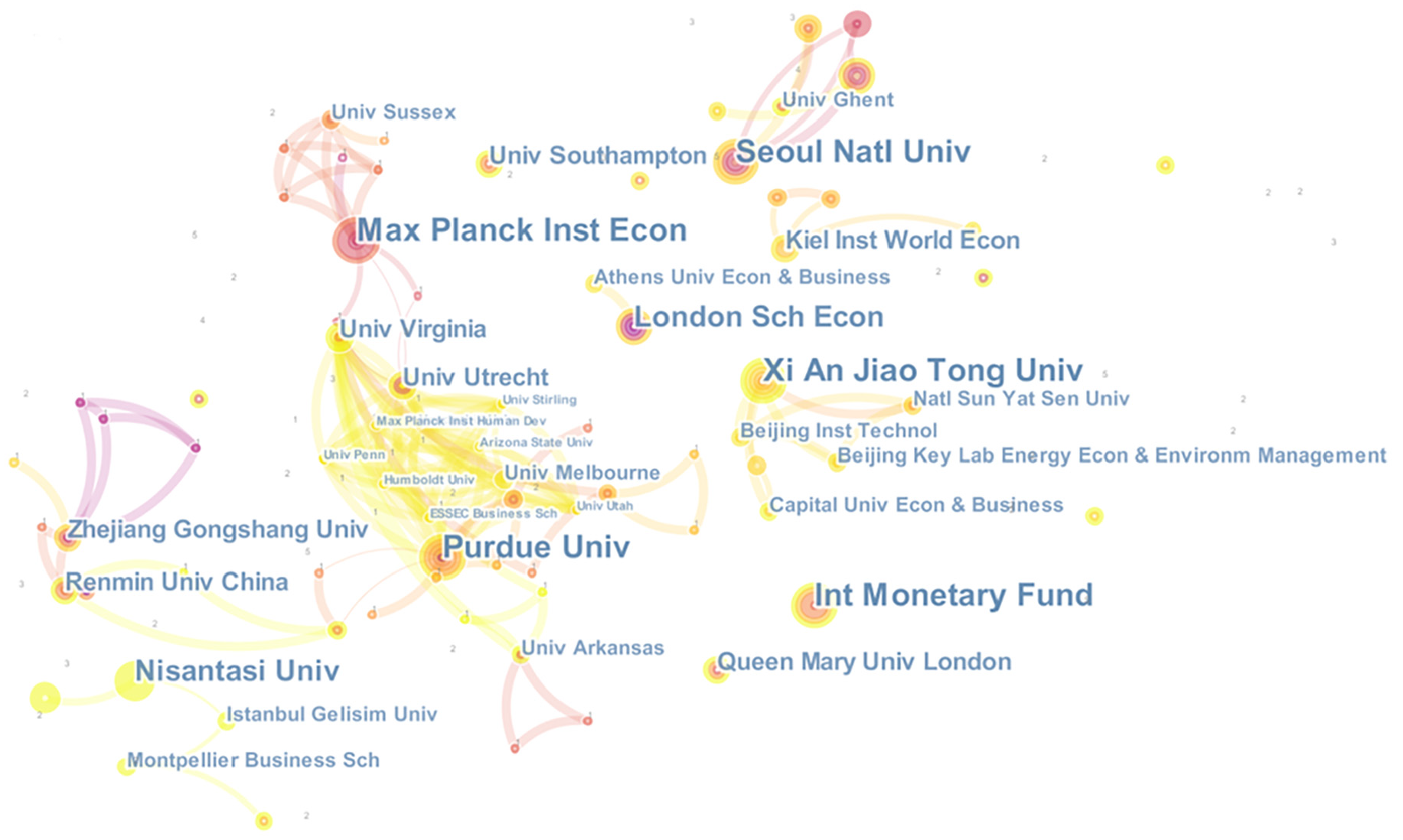
Institutional co-occurrence network.
As can be seen from Figure 7, there are more academic institutions from the United States, China and the United Kingdom. Purdue University in the United States is one of the institutions with concentrated research in the field of PVAR. It has a very close transnational cooperation relationship with the academic institutions from all over the world, such as the University of Melbourne in Australia and ESSEC business school in France. The Max Planck Institute of economics in Germany and the University of Sussex in the UK cooperate closely, which confirms the above explanation of the cross-national cooperation between Britain and Germany in Figure 6. China’s academic institutions focus more on the connection with other domestic institutions, and there is relatively few transnational cooperation. Among Chinese academic institutions, Xi’an Jiao Tong University is the one that studies the PVAR most, which has more cooperation with many universities in Beijing and Sun Yat-sen University. Additionally, Seoul National University in Korea, Nisantasi University in Turkey and International Monetary Fund are the institutions with many achievements in the field of PVAR.
Knowledge Domain
This section consists of two parts: the settings and classifications of PVAR models, and the estimation methods of PVAR models. As outlined above, the testing process of PVAR model generally covers five steps (see section 2), and they are all close to the model settings and model estimations. As a result, the discussion contained in this section are important knowledge domains about the application of PVAR model.
Settings and Classifications of PVAR Model
Set Y it as the M×1 vector of M interdependent endogenous variables of individual i in period t, Xit is the N×1 vector of N exogenous variables of individual i in period t. And, set ε it as the M×1 vector of M un-observable individual fixed effects of individual i in period t, which is called individual intercept vector. αij(l) and βij(l) is the short-term influence coefficient of phase l lag vector Yj,t-l and Xj,t-l on vector Yit, which is called regression coefficient. They are M×M matrix and M×N matrix respectively, and the PVAR model can be set as:

According to the setting of model (1), PVAR model has the following three characteristics (Bai, 2019). First, all endogenous variable lag terms of all individuals enter the equation of any endogenous variable of each individual, which is called that the endogenous variables of the system have dynamic inter-dependencies. Second, uit only has cross-section correlation. That is to say that there are different individuals i ≠ j, making the matrix M×M non-zero, which means that there are static inter-dependencies in the system. Third, vector ε it , regression coefficients αij(l) and βij(l) are different due to individual i, which indicates that the system has cross-sectional heterogeneity. However, the three features in model (1) may not always coexist simultaneously. For example, R. Yang et al. (2021) investigated the interaction between technological innovation and eco-environment. In such cases, analyzing dynamic cross-sectional heterogeneity assumes greater importance. It is because the sample includes the data of developed areas in eastern China and underdeveloped areas in central and western China. Bai (2019) pointed out that when examining the impacts of national financial markets on transnational transmission, static correlation may be more common if it is modeled by monthly or quarterly data. Therefore, scholars usually set different forms of PVAR model according to different research needs. In general, according to different setting conditions of PVAR model, it can be divided into the following three categories:
① Micro PVAR model and macro PVAR model.
The division of micro and macro PVAR models is mainly based on the type of panel data. If the data constitute a series of national or regional time series data, the PVAR model will have the macro panel data structure. For example, Kim et al. (2011a) investigated the changes of regional and global trade linkages in Asia and their impact on macroeconomic relations in Asia, Europe and Southeast Asia by constructing a macro PVAR model. In addition, Kuang et al. (2020) took China as an example, proposed the term urban land consumption intensity (ULCI) based on PVAR model, and discussed the impact of urbanization on ULCI. Based on the research of Holtz-Eakin et al. (1988), Pesaran and Smith (1995), and Love and Zicchino (2006), the general form of macro PVAR model can be set as follows:
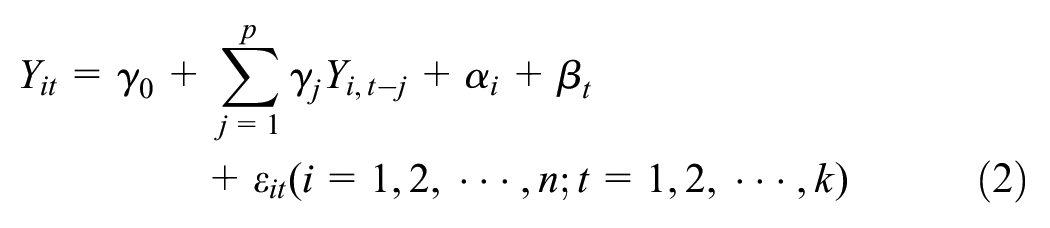
In the model (2), Yit is the endogenous variables, which is identified through the dimensions of time and region. Γ0 refers to the estimated coefficients of the constant term, while γj indicates the lagged endogenous variable. P suggests the lag period while j is the lag order. As for α i , it signifies the individual effects and can display the otherness of the cross-sectional. Similarly, β t is a time effect vector that can exhibit the temporal characteristics of variables. The last is ε it , which is the random disturbance item.
If the data structure is time series data reflecting individuals, such as enterprises or other social organizations, it is called micro panel data structure (e.g., Kang et al., 2016). Bai (2019) pointed out that for the micro PVAR model, it can be assumed that there is no possibility that all correlations and section coefficients are homogeneous. Considering the sample size, the micro PVAR model often set in the study is as shown in model (3):

In addition, F. Canova and Ciccarelli (2013) believed that when the research scope is small or island country, a PVAR model without dynamic correlation can be set as model (4) shown:

② Homogeneous PVAR model and heterogeneous PVAR model
According to the slope coefficient characteristics of model parameters, PVAR models can be divided into homogeneous and heterogeneous PVAR models.
Homogeneous PVAR model refers to the model with the same slope coefficients of i and t after controlling the unobservable time-constant individual heterogeneity (see Holtz-Eakin et al., 1988), which is shown in model (5):

Where t is the time dimension, wit is the observable random vector, α i * is the vector composed of the specific constant of individual i, β* is a constant vector, ε it is the random vector, L is the lag sub phase, and p is the order.
If the slope coefficient of PVAR model changes with individuals, the model is called heterogeneous PVAR model (Hsiao, 2017), which is shown in model (6):

③ Stable PVAR model and error correction PVAR model
According to whether the series in the time dimension is a stationary series, the PVAR model can be divided into stable PVAR model and error correction PVAR model (C. X. Liu, 2021).
Specifically, the roots of the companion matrix need to be tested. If all the roots fall inside the unit circle, it is referred to as a stable PVAR model. For instance, A. Khan et al. (2020) conducted an empirical study on the relationship between economic growth, environmental degradation, and social welfare using a PVAR model. To assess the stability of the model, they tested the roots of the adjoint matrix. The results are illustrated in Figure 8, where all the roots are within the unit circle, indicating the stability of the employed PVAR model. Conversely, when the roots are outside the unit circle, the model is considered an error correction model.

Stability test of PVAR model in the research of A. Khan et al. (2020).
The classifications of PVAR models are helpful to solve the matching problem between model setting and data preparation for future researchers. As mentioned above, according to different data preparation and research needs, it is necessary to consider whether the data is macro type or micro type, whether the slope coefficient belong to the case of variable slope coefficient or constant slope coefficient. These factors often determine different PVAR model settings.
Estimation Methods of PVAR Model
The estimation method used in PVAR research is a crucial aspect. In traditional parametric econometric models, the parameter estimation for PVAR models typically employs the least squares (LSE) method, generalized method of moments (GMM), and maximum likelihood estimation (QML) method. Binder et al. (2005) also pointed out that LSE estimation, GMM estimation and QML estimation of PVAR model are consistent estimates with asymptotic normal distribution. However, Pesaran (2007) noted that when the panel data sequence has the problem of unit root, the GMM estimation method cannot be used. Pesaran used the QML method to estimate the parameters of PVAR model in the case of stationary or non-stationary, and found that the parameter estimators obtained by the QML estimation method are consistent and effective estimates in the case of stationary, first-order single integration or co-integration. However, C. X. Liu (2021) believed that the parameter estimation method in the study of PVAR contains k endogenous variables, the number of lag periods is p, the number of observations is n, and the time length is t. without considering exogenous variables, individual effects and time factors, the number of parameters is as high as N × k × (p × k + 1). In terms of the fitting effect of the data itself, the larger amount of data, the more comprehensively it can reflect the laws behind economic phenomena. However, the model parameters will also increase with the increase of the amount of data. Namely, the more parameters, the greater the estimation error will be. Similarly, the methods of LSE estimation and QML estimation have similar problems in the process of parameter estimation PVAR model (C. X. Liu, 2021). And these three estimation methods are often used in the estimation of micro PVAR model (Bai et al., 2020).
In view of this, C. Canova et al. (2010) proposed a posteriori estimation of PVAR model based on the hierarchical Bayesian approach of Bayesian principle. Without considering the time-varying coefficients, the Monte Carlo simulation shows that this kind of estimation method has better mathematical properties than the methods of LSE, QML and GMM. Moreover, this hierarchical Bayesian approach can be applied to the estimation of macro PVAR model. However, scholars have found that the estimation process of hierarchical Bayesian approach is not feasible when the PVAR coefficients of different individuals and variables are time-varying (Hsiao, 2017). After nearly a decade of research, F. Canova and Ciccarelli (2013) combined the PVAR model with the exponential model proposed by Stock and Watson (2008), and completely solved the problem of hierarchical Bayesian approach in the calculation process by employing Bayesian method and Markov chain Monte Carlo method.
Many scholars have demonstrated and investigated the LSE, GMM, QML and Bayesian estimation methods in detail (e.g., Binder et al., 2005; A. Khan et al., 2020; B. Lin & Wang, 2019; Pesaran & Zhao, 1998; Zhang et al., 2019), which will not be repeated here.
Knowledge Evolution
By visualizing the knowledge evolution of PVAR using CiteSpace, researchers can identify changes in research hotspots and determine the research frontiers (R. Yang et al., 2020). Therefore, this section will analyze the evolution of research hotspots and research frontiers in the field of PVAR by examining the time zones and strongest citation bursts.
Research Hotspot Evolution
In a short period of time, literature with strong internal relationships is clustered, which can be considered as a research focus (C. Chen, 2004; Cheng & Ding, 2012). The selected time zone map reflects the evolution of research hotspots based on the time dimension (J. Chen et al., 2019). Additionally, tracking the research hotspots in different stages is achieved through high-frequency keywords, as they concentrate and generalize the core content of the literature. To maintain the integrity of the diagram, no network pruning algorithm is applied, and other settings remain unchanged. The obtained time zone map is presented in Figure 9:
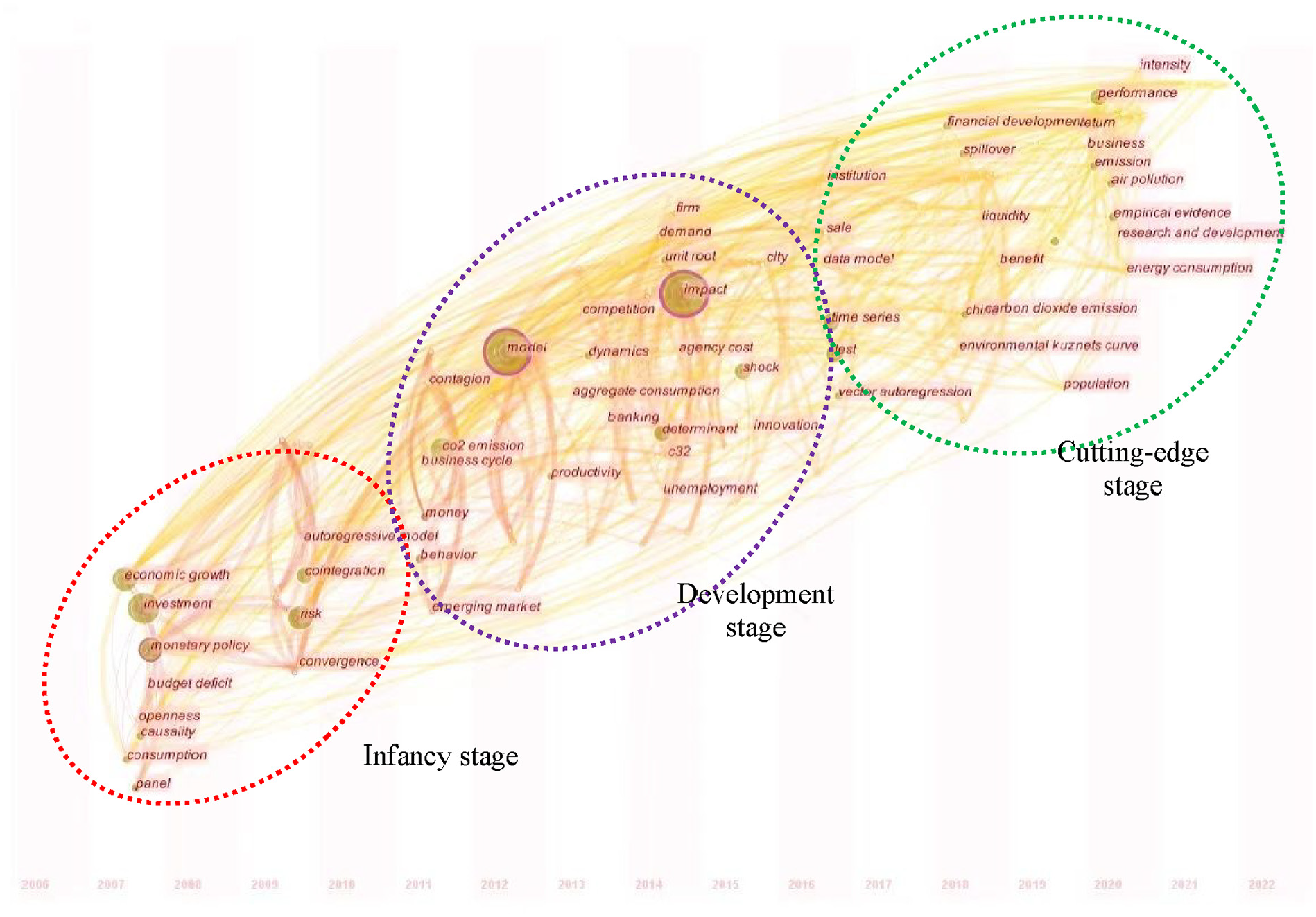
Time zone map.
As time progresses, important keywords undergo constant alternation. Based on the keyword co-occurrence in the time zone map, the research on PVAR has evolved through three stages: infancy stage, development stage, and cutting-edge stage. Figure 9 illustrates that during the infancy stage, PVAR research primarily focused on the field of economics, including keywords such as economic growth and monetary policy. This finding aligns with the previous analysis. Considering the metrological advantages of the PVAR model, its application has been continuously extended in the field of economics, leading to the inclusion of keywords like banking, business cycle, and emerging marketing. Furthermore, scholars have started employing this model to explore the relationship between economic growth and environmental protection, evident in the consideration of CO2 emission during the development period. The interdisciplinary application of the PVAR model becomes particularly apparent in the cutting-edge stage, as indicated by keywords such as energy consumption, air pollution, and environmental Kuznets curve. For instance, R. Yang et al. (2021) utilized the PVAR model to examine the interaction between technological innovation and eco-environmental quality. Similarly, Kuang et al. (2020) discussed the impact of urbanization on urban land consumption intensity based on the PVAR model. Building upon these findings, it can be observed that, on one hand, the PVAR model is expanding widely and deeply in the field of economics. On the other hand, its interdisciplinary application represents an important direction for future research.
Research Frontier Analysis
The academic development can be inferred from the keywords of published papers, which indicate the research frontiers and areas of emphasis. By examining the transition phenomenon of keywords, we can gain insight into the forward-looking and exploratory nature of research in this field (X. Su et al., 2019; H. N. Su & Lee, 2010). The strongest citation burst of 292 sample literature in the PVAR domain can be identified using CiteSpace, which highlights articles that have received significant attention from the scientific community. To recognize the research frontiers in PVAR, CiteSpace provides two methods for sorting literature with citation bursts: by the start time of the burst and the intensity of the burst. In this work, the sorting is based on the start time, following previous research experience (R. Yang et al., 2021). Figure 10 illustrates the beginning and end time as well as the intensity of the top 17 keywords with the strongest citation bursts in the field of PVAR. These bursts began in 2009 and peaked in 2018. Notably, keywords such as performance, CO2 emission, and policy have gained popularity in recent years. A further analysis reveals the following latest development trends in PVAR research.

Top 17 keywords with the strongest citation bursts.
Firstly, it appears that among the 17 keywords with the strongest citation bursts, those related to economics (such as money, market, monetary policy, etc.) are predominantly associated with the early stage of PVAR research. In the later stage, keywords such as CO2 emission and performance appeared, indicating the trend of the interdisciplinary application of PVAR model, which is consistent with the previous analysis. In the context of the global initiative to reduce carbon emissions, PVAR model has also been included in the research because of its advantages in measurement and evaluation. For example, Z. Khan et al. (2021) used PVAR model to study the impact of CO2 emission on economic shock. Akbar et al. (2021) studied the two-way correlation between CO2 emissions and human development index based on PVAR model. For the topic of performance, scholars not only study the economic performance, but also use the PVAR model to examine the social performance (e.g., Kang et al., 2016; W. L. Lin et al., 2019) and environmental performance (Altinoz & Aslan, 2022; Song & Sung, 2014). Secondly, in these 17 keywords with the strongest citation bursts, there are a few keywords about model application, like: autoregressive model, convergence, and unit root test. However, the apparition of these keywords is relatively earlier. For example, the keywords of convergence and autoregressive model appeared in the year of 2009. Or, the lasting period of strong citation burst of these keywords is relatively short. For instance, the lasting period of strong citation burst of the keyword: unit root test span only 1 year (from 2017 to 2018). This phenomenon indicates that most of the existing studies directly used PVAR model to carry out empirical research, but the theoretical concerns of its application have not been attached enough importance or scattered in the literature, which is one of the outlets for future research.
Future Research Agenda
According to the above analysis, this study will put forward the corresponding future research agenda for the PVAR model.
Firstly, although the estimation methods of PVAR model have been improved during the decades, an important problem remained to be addressed is the problem of excessive parameters. It is because the bias of the model increases with the increase number of parameters (C. X. Liu, 2021). In the theoretical research, the common treatment for the issue is to appropriately reduce the number of parameters by imposing certain conditions. For example, it is assumed that the endogenous relationship between variables does not change with the change of cross-section, that is the constant coefficient PVAR model (C. X. Liu, 2021). The fact is that the endogenous influence relationship between cross-sections may be different, and the variable coefficient PVAR model needs to be taken into account (C. Canova et al., 2010). However, the variable coefficient PVAR model studied by C. Canova et al. (2010) needs to determine the special factors by sampling or setting the time-space effect, so as to obtain the overall parameter estimation. Therefore, the above treatment is difficult to be applied to the research of empirical problems. Verdier (2016) also supported that he parameter estimation of the PVAR model can be challenging and may lead to the instability of model parameters. This instability can arise from two factors: the excessive number of moment conditions and weak instrumental variables. Accordingly, how to solve the problem of excessive parameters should be attached more importance in the future study.
Secondly, Scholars have directly employed the PVAR model to conduct empirical research in different fields (e.g., Antonakakis et al., 2017; Dewan & Ramaprasad, 2014; Kuang et al., 2020), but few have concentrated on the theoretical problems of its interdisciplinary application. For example, is its application in other research fields consistent with its in economics? What special attention needs to be paid? The model setting in other research fields should be supported by corresponding principles or theories. And, whether the relationship between explained phenomena is applicable to this model? These questions are exceedingly important, but ignored in the current research, which leads to the phenomenon that many scholars only know how to employ PVAR model to conduct the research, but do not know the essence of it. Over time, some scholars have explored the adaptation of the PVAR model to make it more applicable, but the above problems remain to be addressed.
Thirdly, based on the analysis provided, it appears that there is a need to strengthen cross-cultural cooperation in PVAR research. It is undeniable that PVAR model has become an important research tool in many fields owing to its advantages in metrology. Strengthening the cooperations among the cross-cultural backgrounds will be conducive to a more in-depth interpretation of economic and social phenomena and analysis of economic and social behavior, which is the focus of future researchers.
Conclusion
The research related to PVAR is growing explosively and applies interdisciplinary. In view of the promising application prospect of PVAR, this paper systematically reviews the papers related to PVAR through the visual bibliometric tool: Citespace, so as to recognize its research focuses, unearth its evolution process and find out its research gaps, and provide research agenda for future research and enrich the theoretical research results in this field.
Specifically, this study selects 292 PVAR-related literature from the core database of the WoS database to lay the foundation for the systematic review. This paper begins with a descriptive analysis of various aspects, such as prolific authors, highly cited literature, geographic distribution, and cooperation among researchers in the field of PVAR. This analysis helps to identify the current research focus and provides insights into the key contributors to the field. Furthermore, this paper delves into the knowledge domain of PVAR, which is essential for guiding researchers in setting up PVAR models based on their specific research needs. Understanding the knowledge domain can assist researchers in identifying relevant variables, data sources, and methodologies employed in their studies. The analysis continues by unveiling the knowledge evolution process of PVAR through techniques such as time-zone mapping and strong citation bursts. This allows the study to reveal how research hotspots in the field have evolved over time, as well as the rise and fall of the main keywords. This analysis provides valuable insights into the dynamic nature of PVAR research and highlights emerging trends. The paper concludes by offering three implications for future PVAR research. These implications address important concerns that can contribute to further extension and improvement of the PVAR model. By identifying these implications, this study outlines potential directions for future research and encourages further advancements in the field.
Four main findings have been obtained: Firstly, the topics of macroeconomic effects, economic growth, environmental protection, and model adaptation are the research focuses of PVAR. Second, PVAR models can be divided into three classifications: macro and micro PVAR models, homogeneous and heterogeneous PVAR models, and stable and error correction PVAR models. The four PVAR model estimation methods are summarized as follows: LSE, GMM, QML, and Bayesian models. Third, the knowledge evolution process of PVAR can be divided into three distinct stages: infancy, development, and cutting edge. Each stage is characterized by different research hotspots and areas of focus. Generally, the PVAR model not only has wider and deeper applications in the field of economics but also plays an important role in other fields. Fourth, PVAR-related research has the following three research opportunities: (1) addressing the problem of excessive parameters of the PVAR model; (2) concentrating on the problems of interdisciplinary application of the PVAR model, deepening the theoretical research on the expansion and improvement of the PVAR model; and (3) strengthening the cross-cultural cooperation on PVAR research.
Indeed, the work described in this paper is valuable for outlining the research progress in the field of PVAR and identifying the research focus and gaps in the existing literature. It enriches the knowledge system of PVAR and provides guidance for future research. However, it is crucial to acknowledge the rapid pace at which the literature on PVAR is being updated. To enhance the results of this study, it is important to regularly update the literature sources to include the most recent publications. This ensures that the analysis reflects the current state of the field and captures any emerging trends or changes in the research focus. Additionally, while this paper utilizes CiteSpace for bibliometric analysis based on the WoS database, it is worth considering the limitations of this tool in terms of database selection. Although CiteSpace allows for comprehensive analysis within the selected database, it may not be as effective when applied to other databases, such as Scopus or Derwent. Exploring the use of multiple bibliometric tools and databases is a promising avenue for future research.
Footnotes
Declaration of Conflicting Interests
The author(s) declared no potential conflicts of interest with respect to the research, authorship, and/or publication of this article.
Funding
The author(s) disclosed receipt of the following financial support for the research, authorship, and/or publication of this article: This work is supported by the Philosophy and Social Science Research Planning Project of Heilongjiang Province (Grant no. 21jyc244).

Data Accessibility Statement
The data used in this work are available from the databases SCI and SSCI.