



Abstract
Scholarly interest on the dark side of international interorganizational relationships has seen an upward trend in recent years. Nevertheless, there is no systematic review of literature on the dark side of international interorganizational relationship. Realizing this gap, this study adopted Preferred Reporting Items for Systematic Reviews and Meta-Analyses (PRISMA) to distinguish, analyze and synthesize 96 articles published in peer-reviewed journals with respect to theoretical foundation, data analysis approach, relationship characteristics and direct and indirect relationships. The findings show that significant progress has been made between 1993 and 2022 with opportunism and conflict as the most frequent manifestations of the dark side. The specific characteristics of the findings include rigorous theoretical foundation, research design that heavily focus on formalized approach, tendency to employ large sample size and propensity toward topics about behavioral dimensions and relationship characteristics. This comprehensive review addresses specific concerns and offers suggestions for future research.
Keywords
Introduction
The dark side of international inter-organizational relationships (IOR) is a pivotal aspect of international business, as it may lead to damaging outcomes for the involved parties (Gillani et al., 2021; Son et al., 2021) and reduced performance (Griffith & Zhao, 2015). While the bright side of international IOR is broadly recognized, knowledge about the dark side of international IOR helps to mitigate potential negative impacts (Verbeke et al., 2021). The literature suggests that exploring the dark side can enhance the theoretical foundation of international IOR (Aykol & Leonidou, 2018), More importantly, a clear understanding of the topic allows effective management of the collaboration as the dark side may also result in positive outcomes if manage properly (Amason, 1996). Previous research has addressed this phenomenon by exploring topics like exporting (Skarmeas, 2006), outsourcing (Wei et al., 2021), parent-subsidiary exchange (Struwe & Slepniov, 2021), alliances (Musarra et al., 2021), and joint ventures (Westman & Thorgren, 2016). While there is considerable debate about the manifestation as well as the antecedents and outcomes of dark side, there’s a knowledge gap about the dark side of relationship between two organization that reside in different countries as existing reviews neglected the international dimension. Accordingly, understanding about the state of research on the dark side of international IOR is necessary.
Several literature reviews have been conducted which contribute little to the state of knowledge about the dark side of international IOR. For example, Oliveira and Lumineau (2019) systematically reviewed literature from 1993 to 2017 and reports no distinguish and meaningful findings about international IOR. Recently Wu et al. (2023) performed a bibliographic review of articles from 1989 to 2021 on IOR conflict which also did not produce specific analytical findings and research direction on international IOR conflict. These reviews missed the nuanced details (S. Huang et al., 2021) and the lack of a comprehensive review hinders our understanding of this stream of research and of the topic’s evolution. Nevertheless, this offers opportunities for intellectual discourse between different fields of research and generates analysis and synthesis about international aspects of the dark side of IOR. International IOR especially involves psychic and geographical distance that relates to distinct cultural values and behavior which is prone to create conflict and other types of dark side manifestation. In addition, cross-border barriers such as regulation, formal and informal institutional differences and geographical boundaries may also significantly contribute to the development of the dark side. The complicatedness and complexity of international environment, pressure of international competition and difficulty in the acquisition of adequate knowledge about international market significantly influence business practices in international market (İpek & Bıçakcıoğlu-Peynirci, 2020).
The dark side of IOR is viewed from two perspectives: broad and narrow (Zhang et al., 2021). In our study, we embrace the broad viewpoint (Oliveira & Lumineau, 2019) and define the dark side of IORs as all elements, whether intentional or unintentional, that negatively impact IORs, typically stemming from competence or integrity concerns. Existing studies on the dark side of international IOR remain fragmented. For instance, research predominantly emphasizes opportunism (M. Wang et al., 2016) and conflict (Barnes et al., 2010), overlooking characteristics like infidelity (L. C. Leonidou et al., 2017a, 2017b). By consolidating the fragmented literature via integrative review, this paper provides a clear state of knowledge in this stream of research and the relevance of the dark side of international IOR area of study underpinned by the fit between risk exposure of distance collaboration and the pressing need for effective management of this phenomenon.
Acknowledging this gap, this study’s review question is, “How has the research on the dark side of international IOR progressed, and where should future studies focus?”. As such, this study aims to understand research progression, knowledge voids, and potential research avenues on the dark side of international IOR by analyzing and synthesizing the extant literature. We systematically review the empirical research between 1993 and June 2023. This study seeks to achieve the following objectives: (1) offer a theoretical evaluation concerning backgrounds, conceptual approaches, and interrelationships of pertinent variables; (2) explore the research context, including designs and scope; (3) discuss the theoretical and methodological traits of extant studies; and (4) identify research gaps, suggesting directions for subsequent empirical studies.
This timely review of extant literature on the dark side of international IOR provides three significant areas of advancement. First, the adoption of distinctive theories has resulted in a more comprehensive and perceptive yet fragmented and inconclusive view. Second, a considerable number of factors were introduced as antecedents and outcomes of IORs’ dark side, and the moderators and mediators of the relationships demonstrate a divided view of international IOR. Third, advanced but different statistical approaches are employed in investigating the complex correlation between antecedents and the manifestation of the dark side.
The article unfolds as follows: We first detail the scope, data collection, and analysis methods. We then delve into findings across subsections: theoretical foundation, research design, research scope, methodology, and study traits. The subsequent section structures prior research into a cohesive framework, followed by a synthesis of the antecedents, outcomes, and moderators of the dark side manifestation. We address key conceptual gaps in specific fields. Concluding, we chart a path for future research based on the TCCM framework by Paul and Rosado-Serrano (2019), as leveraged in prior reviews (Aaltonen, 2020; Srivastava et al., 2020).
Methodology
This study intends to consolidate the literature pertaining to the dark side of international IOR. published between 1993 and 2022. In doing so, this study employs a systematic review methodology (SLR) which is known for its relevance and thoroughness (Del Vecchio et al., 2022; Paul & Criado, 2020; Tranfield et al., 2003), resulting in greater quality, fewer errors, higher legitimacy, and synthesis of extant literature on specific topics that may lead to the theoretical framework (Battisti et al., 2021). The SLR helps minimize bias associated with a review that is based on narrative and integrative (Davies et al., 2023).
Our approach incorporated a sequence of interrelated procedures underpinned by a set of protocols that were strictly followed. First, to be included, the articles must focus on the following domains: international IOR, empirical nature, and published in peer-reviewed journals. Exclusions were made if the article was a: (a) a book, chapter, review, proceeding paper, editorial, letter, or meeting abstract, (b) a non-English publication, or (c) a journal not listed in the 2021 Academic Journal Guide (AJG) of the Association of Business School (ABS) for quality assurance (S. Huang et al., 2021; İpek, 2021).
An electronic search was conducted using Web of Science, EBSCOhost Business Source Premier, and Science Direct databases, focusing on international business and management topics. The process of article searches and selection comprised four stages (Page et al., 2021). At the first stage, keywords were identified using the term “dark side” combined with search words from the abstracts of previous studies, like Oliveira and Lumineau (2019), and negatively valanced terms found in literature reviews. Keywords were based on the definition by Aykol and Leonidou (2018; see Table 1), identifying 2,078 articles. In the second stage, titles, abstracts, and journals were screened for relevance, leading to the removal of 1,823 articles.
The Search String Used for the Systematic Review Process.

The third stage is eligibility, where the full text of articles was accessed, including the research objective and topic. A total of 159 articles were excluded because they were not based on the dark side and international IORs and were conceptual, review, and meta-analysis articles. This was done through several iterations. Initially, the two authors independently read the full abstract. In case of disagreement, both authors then read the full papers in detail with the aim of 100% joint agreement. The fourth stage of the review resulted in a total of 96 articles published in 29 different journals. An overview of the literature search strategy is presented in Figure 1.
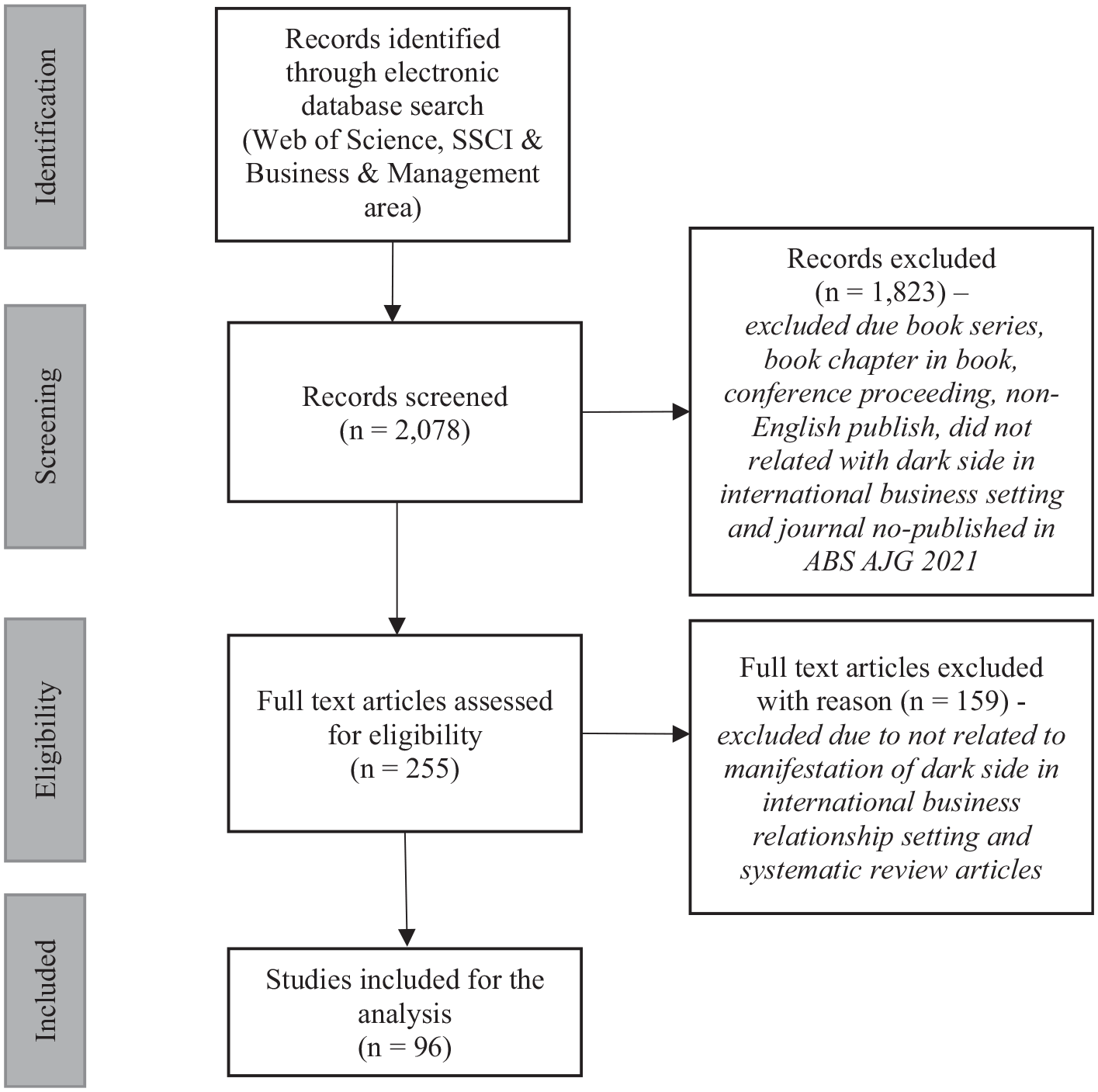
Literature search strategy.
Major publication outlets (see Table 2) are Journal of Business Research (14.6%), Journal of Business and Industrial Marketing (12.5%), Industrial Marketing Management (11.5%), and Journal of International Marketing (11.5%). By area of study, based on the ABS classification, the literature is skewed toward marketing (20.7%), international business (20.7%), operations and technology management (20.7%), ethics, CSR and management (17.2%), strategy (10.3%), and others (10.4%), but the validity of the topic in academic research is somehow maintained.
Number of Publications in Selected Journal Articles.

Finally, for the thematic analysis, we employed a full-text content analysis and synthesis using the protocol by Aykol and Leonidou (2018), which covers: (1) theoretical background, (2) research design, (3) research scope, (4) sampling/data collection, and (5) data analysis and thematic areas. This methodology provides a robust literature analysis (İpek, 2021).
To establish the trend, we classified the articles into three periods of time. The summary of the review articles based on publication dates indicates that 9.4% of the articles were published between 1993 and 2002 (first period), 22.9% appeared between 2003 and 2012 (second period), and a sharp increase or 67.7% of articles were published between 2013 and 2022 (third period). This implies a continuing trend and increasing interest level throughout time in the area of cross-border IOR. This is also a manifestation that the dark side of international IOR is an important topic that is worthy of future investigation.
The concepts in the articles were coded based on pre-specified codes extracted from prior research, including theoretical background (Aykol & Leonidou, 2018; Chen et al., 2016; Daddi et al., 2018), research design, the scope of research, methodology, and empirical issues (Aykol & Leonidou, 2018; İpek & Bıçakcıoğlu-Peynirci, 2020). In coding the articles, two coders were selected and worked independently. However, the coders work jointly to reconcile disagreements. The inter-coder’s reliability resulted in 82% similarity.
Analysis and Findings
Theoretical Background
Of the reviewed articles, 10 lacked information on underlying theories, while the rest introduced 39 theories. The most prevalent theories were transaction cost economics (TCE; 25.3%), social exchange theory (11.0%), and relational exchange theory (11.0%). These theories also experienced a significant increase in the third period. In addition, the number of theories used in research has increased three fold in the third period, reflecting the trend to explore new and broader perspectives. While TCE continues its dominant throughout the three periods, it was social exchange (sixfold) and institutional (two fold) theories that experienced a more significant jump. This trend demonstrates two interesting phenomena; (1) a more diverse underpinning theory used in the research framework by recent research and (2) a continuation of the dominant of governance perspective using different mechanism ranging from contract to social relational norm. Although the governance mechanism is often seen as a measure to safeguard the international IOR from dark behavior, the same governance mechanism may also cause a dark side when they are used excessively, suggesting the inverted U-shape relationship.
A substantial (50.0%) of articles were rooted in at least one theory. Additionally, 39.6% of the reviewed papers merged two or three theories (10.4% not stated), suggesting a more integrated approach to explain the complex phenomena. This evolution helps broaden the understanding of the dark side of international IOR in terms of assumptions, theorization, and focus. We delve deeper into the three most prevalent theories in the subsequent section. We delve deeper into the three most prevalent theories in the subsequent section.
Research Design
Regarding research design (Table 3), most studies adopted formalized approaches (84.4%) that primarily employ hypotheses to articulate research problems (Aykol & Leonidou, 2018). However, there was a significant decrease in the use of formalized approach in the third period. Conversely, exploratory approach was used by only 15.6% of the articles but the growth pattern throughout the study period was consistent, especially in recent years where research using this approach has increased significantly from 4.5% in the second period to 21.5% in the third period. This shift might be attributed to the need for greater understanding about the dark side of international IORs due to the scarcity of study in the previous periods, prompting researchers to delve deeper into internationalization complexities (Luo et al., 2021). Specifically, this growing pattern can be ascribed to the interest in exploring new dark side manifestations such as betrayal, infidelity, distrust and tension.
Research Design of Articles on the Dark Side of International IORs.
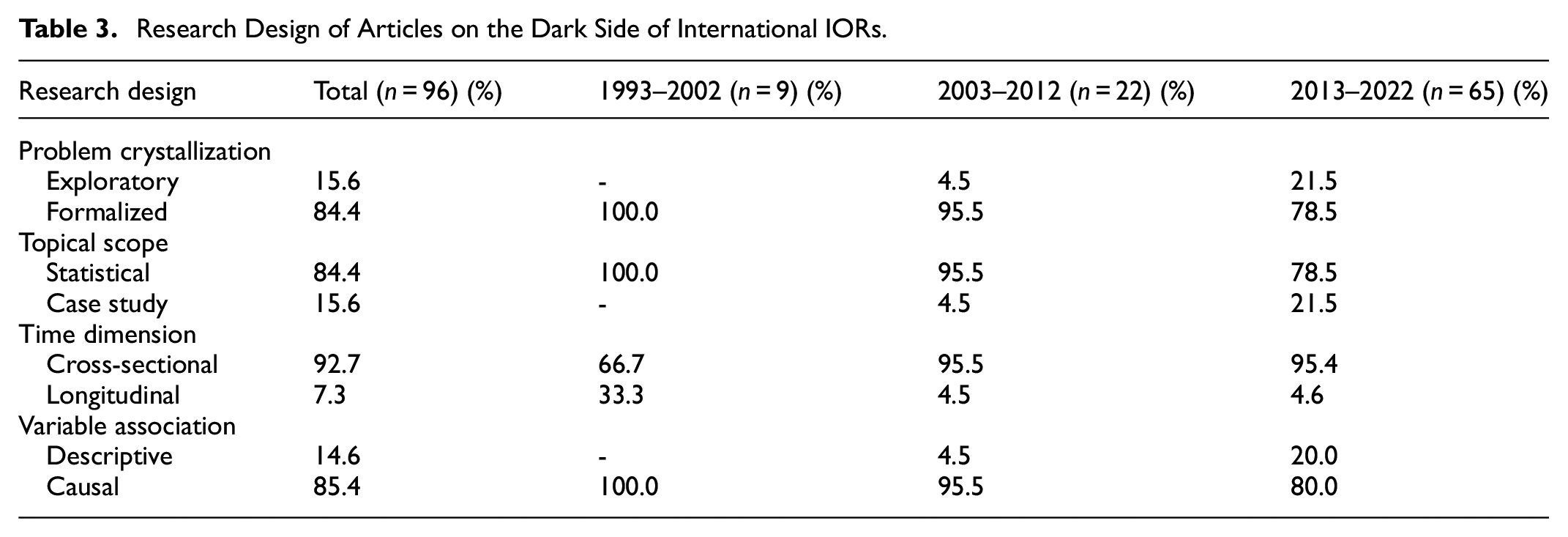
The majority (84.4%) of the articles employed statistical methods across all periods. However, there’s a marked rise in case approach, parallel to the increase in exploratory research approach. This surge signifies growing researchers interest in not just quantitative insights but also comprehensive understanding via case studies. Such in-depth analysis, evidenced over the past 30 years, facilitates the topic’s progression.
More than nine-tenths (92.7%) of the 96 articles employed cross-sectional research. This approach experienced a significant rise in the second period (95.5%) and maintained about the same percentage in the third period. Despite the advocacy for increased longitudinal analysis (Zhou & Poppo, 2010), it was utilized by 7.3% of the articles. Longitudinal research, which allows for a deeper understanding of topics like the role of contingency variables and variable relationships (Ali & Khalid, 2017), involves high cost and long period of time to complete (Aykol & Leonidou, 2018), declined from 33.3% in the initial period to 4.6% in the latest one. This signifies a methodological gap as IOR is dynamic in nature and factors that contain the dark side of IOR may also trigger the dark side at different stages of relationship.
Regarding research variables, a large majority of the 96 articles (85.4%) examined causal (cause and effect) relationships. Although descriptive studies made up a smaller fraction (14.6%), they witnessed significant growth in the third period or 20.0% from just 4.5% in the second period. This trend aligns with the rise in exploratory and qualitative studies, highlighting a deeper interest and robust investigation into the subject as research horizon expanded beyond exploration of different perspectives and new variables.
Scope of Research
Most research (77.1%) sourced data from one party in the dyadic relationship as evident in this review (see Table 4). More interesting the number upsurge significantly over the past three decades from 22.2% in the first period to 84.6% in the third period. On the other hand, data from multicountry shows a significant decrease over the study period. This could be attributed to the challenges and expenses of dyadic studies with partners in separate nations. Yet, focusing solely on a single firm’s view might miss potential imbalances within a relationship (Bouazzaoui et al., 2020). Cross-cultural analyses often took a multi-country stance (Graham et al., 2020) and incorporated feedback from both exporters and importers (Charterina et al., 2018).
Scope of Research of Articles on the Dark Side of International IORs.

Geographically, Asia, especially China, garnered the most focus (45.8%), followed by Europe (18.8%) and America, mainly the United States (15.6%). While Asia’s prominence persisted as the region increasingly becoming more important in global economy, the growing attention to Europe was influenced by the economic uplift in countries like Greece and rising multi-country studies. Both developed (44.8%) and developing nations (42.7%) attracted equal research attention, with a particular spotlight on emerging markets like China (75.6%) and Bangladesh (12.2%). This equilibrium reflects the surging relevance of emerging markets in international commerce. This explains that while Europe and Asia recorded an increasing pattern of growth over three periods of study, North America experienced a significant decline in the third period (4.6%) from a high in the first period (55.6%). Africa and Oceania emerged as the two new focus regions in the third period but were completely ignored in the earlier periods. The lack of study on Latin American countries like Brazil indicate a significant gap on regional context of research that need to be the focus in future study.
In terms of the industrial sector, cross-industry sampling enhanced generalizability (Navarro et al., 2010) and was adopted by three-quarters of the articles. Single-industry designs were less common where less than one-fifth (18.8%) of the articles adopted it. As for the product emphasize, manufacturing was predominant (66.7%) compared to services (3.1%) and others (6.3%). Some studies combine manufacturing and services industries (13.5%). However, research exclusively on the service industry emerged in the third period due to a more precise reporting in the period as the service sector is expanding in emerging economies like China, previously under-represented.
Historical analysis underscored firm size focus, whether small (3.1%), medium (5.2%), or large (10.4%) which emerged in the second and third period of study. Some studies combined different sized firms either small and medium-sized enterprises (SMEs; 10.4%) or small, medium and large (32.3%) but their growth pattern throughout the study period were the opposite. While research on small, medium and large experienced increasing momentum, SMEs on the other hand suffered a significant drop from 22.2% in the first period to only 7.7% in the third period. There was also an increasing trend to focus on large firms.
Sampling/Data Collection
More than three quarters (76.0%) of the studies used samples larger than 100 units (see Table 5). A large sample coincides with cross-industries and smaller sized sample, implying better generalizability of the findings and the ability to use more complex statistical analysis. However, there was an increasing trend that research tended to use larger sample size of 250 to 499 against 100 to 249 which showed decreasing trend over the study period. This might be explained by the fact that in recent years more research tends to include firms of small, medium and bigger size in their study.
Sampling/Data Collection of Articles on the Dark Side of International IORs.

In terms of data gathering, the survey approach was the most common (82.3%) due to being less expensive yet more convenient and efficient (Sekaran & Bougie, 2016). However, the use of interviews shows an upward trend where research in the third period has increased by more than four-fold from the second period, indicating a positive direction in methodology rigor. A very small number of articles report on mixed methods in the third period. Mixed method allows research to address matters in social sciences that cannot be investigated via either quantitative or qualitative methods (Taheri & Okumus, 2024). These trends demonstrate a greater inquiry and tendency among researcher to gain more in-depth knowledge about the dark side of international IOR as study in this stream of research make significant progress over times and introduced new manifestations especially in the third period.
Approximately 40.6% of the articles reported a response rate of 40% and above, followed by a response rate of 30% to 39% (19.8%) and 20% to 29% (15.6%). This trend matches prior reviews (Aykol & Leonidou, 2018). Almost three-quarters of the reviewed articles report a response rate of more than 20%, well exceeds the acceptable rate (15%–20%) for management research (İpek & Bıçakcıoğlu-Peynirci, 2020; Menon et al., 1999). Specifically, this is an upward trend throughout the study period. However, the emergence of research in the third period that chose not to reveal the response rate is alarming.
As for the key informants, managers (e.g., marketing manager, general manager) were cited as major informants (38.5%), followed by CEOs and managers (30.2%), export executives (14.6%), and CEO’s/President (6.3%), highlighting the cross-functional character of export operations. Interestingly, the key informants were about the same throughout the review time frame, reflecting the consistent functions over time in export activity among SMEs, with the managers being considered the most knowledgeable and responsible.
With respect to analytical tools, structural equation modeling (SEM) was used by almost half (46.9%) of the studies. This was followed by multivariate analysis (31.3%), uni/bivariate (e.g., ANOVA test; 9.4%), and others (18.8%), including the t-test, the chi-square test, correlation, triangulation, and content and event analysis. SEM approach is known for its superiority for allowing simultaneous estimation of a set of unique relationship or measurement model consisting of latent variables (Chen et al., 2016). However, studies using SEM in the third period (41.5%) were much lower than in the second period (59.1%). On the contrary, the use of multivariate statistical methods such as hierarchical regression analysis has gained momentum in recent times due to its ability to analyze complex data sets and provide valuable insights into the relationships between multiple variables.
Research Topics
Research on the dark side of international IOR has covered a wide range of topics. For the thematic analysis, the topics were grouped into 11 different areas and examined in three ways: (1) the manifestation of the dark side, (2) the direct empirical correlations between dark side manifestations and their antecedents and outcomes and (3) the influence of moderator/mediator variables on the dark side manifestations and their antecedents and outcomes. This study proposes an integrated conceptual framework (Figure 2) depicting relationships among variables that were grouped under different thematic areas and research characteristics in the dark side of international IOR.

A conceptual framework of the dark side of international IORs.
Manifestation of Dark Side
First, this study observes the findings about the dark side manifestations. Overall, research on the manifestation was dominated by opportunism and conflict which together constitute more than three-quarters of the articles. In terms of research trends, at the initial stage, the research focus was primarily on a limited number of manifestations, such as conflict, opportunism, and distance. Only in the recent period has research focus expanded to include other manifestations such as unethical behavior, infidelity, violation, betrayal, distrust, etc. At the same time, conflict demonstrates a decreasing trend throughout the study period. This could be explained by the interest of research to get the insight into the dark side of international IOR and enhance the understanding of this phenomenon especially more businesses venture into overseas market via business-to-business relationship. While there was no clear pattern for opportunism, half of the articles focus on it in the third period maintaining its dominance in the last two decades.
Antecedents of Dark Side Manifestation
In the reviewed studies, 120 variables were found as antecedents (see Table 6), which were grouped into four themes: (1) behavioral dimensions, (2) environmental influences, (3) internal influences, and (4) relationship characteristics. Overall, behavioral dimensions display a significant jump in the third period from the second period, at the expense of environmental influences that experienced continuous drop over time. The large drop in research on environmental influences was due to more research examining it as a condition (moderating factor) affecting other antecedents (see Table 8). Meanwhile, relationship characteristics show no clear pattern amid a decreasing centrality in the third period. Nevertheless, together relationship characteristic and behavioral dimensions dominate the research especially in the third period where both topics constitute more than nine-tenths of overall articles.
Antecedents of the Dark Side of International IORs.

Note. n = Total number of antecedent variables from 96 articles reviewed.
A substantial number of antecedents linked to relationship characteristics (45.0% of 120 antecedents) were grouped into eight sub-categories: control (9.3%), cultural similarity (14.8%), dependence (9.3%), governance mechanism (20.3%), network ties (1.9%), relationship quality (29.6%) and transaction-specific asset (14.8%). While control and cultural similarity experienced decreasing trend, relationship quality and transaction specific investment showed no clear pattern of research throughout the period of study. On the other hand, governance mechanism and dependence emerged in the second period and continued an upward trend in the third period. Network ties emerged in the third period with a small amount of research (3.0%).
Research in relationship quality focuses on the influence of relationship quality on unethical behavior (Obadia & Vida, 2011), factors affecting infidelity and betrayal such as level of satisfaction (L. C. Leonidou et al., 2017a, 2017b), social bonding and inter-partner compatibility (L. C. Leonidou et al., 2018), factors affecting conflicts such as trust (Wei et al., 2021) and commitment (Tsang et al., 2004) and factors influencing opportunism such as trust (M. Wang et al., 2016) and commitment (Saleh, Ali, & Julian, 2014; Saleh, Ali, & Mavondo, 2014). In terms of governance mechanisms, previous research converges on issues such as the effect of contracts on conflict (Bai et al., 2016), unethical behavior outcomes of contractual and relational (Verbeke et al., 2021), and the influence of contract (Yang et al., 2017) and guanxi (Abosag et al., 2021) on opportunism, and contract on unethical behavior (Griffith & Zhao, 2015). As for dependency, previous research examines its effect on opportunism (L. Wang et al., 2017) and conflict (Rose & Shoham, 2004). The determinants of the dark side also dealt with firms’ transaction-specific investments (TSIs; 14.8%). The unilateral supplier TSIs relationship with opportunism (L. Wang et al., 2020). As for cultural similarity/sensitivity (14.8%), previous research investigated the relationship between opportunism, conflict (Skarmeas, 2006), and unethical behavior (Popli et al., 2016). In terms of control, the firm’s demand for control and its relationship with conflict (Wei et al., 2021) and opportunism (Ju et al., 2011).
The antecedents also centered on behavioral dimensions, emphasizing latent, manifest, and outcome variables that show increasing pattern over time. The research found that although less than half of the antecedents reviewed (41.7%) focused on a particular theme, during the third period, this topic emerged as the focus of more research (52.4%) than any other theme. Latent variables contributes the biggest number of articles in the third period focusing on feelings connected with relationships, with the most frequently examined being trust and opportunism which was investigated with conflicts (Silva et al., 2012), betrayal (L. C. Leonidou et al., 2017a, 2017b), performance efficiency (Musarra et al., 2021) and the reassessment of the relationship (L. C. Leonidou, Aykol, Fotiadis et al., 2019, L. C. Leonidou, Aykol, Spyropoulou et al., 2019). Also, previous studies have investigated the effect of uncertainty on betrayal (L. C. Leonidou et al., 2017a, 2017b) and opportunism (Um & Kim, 2018) to a lesser extent. The influence of manifest variables clearly shows an upward trend in the third period emphasizing collaboration, commitment, communication, conflict, and power. Previous studies investigated the relationship between competition and conflicts (Chai et al., 2020), commitment and infidelity (Padin et al., 2017), also on communication and opportunism (Saleh, Ali, & Julian, 2014; Saleh, Ali, & Mavondo, 2014; Yam & Chan, 2015) and betrayal (L. C. Leonidou et al., 2018). In addition, existing research also investigates the effect of power on conflict (Pfajfar et al., 2019) and opportunism (Huo et al., 2019). As for outcome variables, it is an emerging topic in this stream of research and reviewed studies investigate the relationship between satisfaction and infidelity (L. C. Leonidou et al., 2017a, 2017b) and long-term orientation and betrayal (L. C. Leonidou et al., 2018).
Environmental influences (12.5%) were the third main category of determinants. Cultural distance demonstrates the biggest drop in research from its dominant in the initial stage. It influences opportunism (Zhou & Xu, 2012), unethical behavior (Popli et al., 2016) and sensitivity to national business culture are important to reduce conflict (LaBahn & Harich, 1997). Studies also discovered that because of the high degree of volatility, the perceived environmental uncertainty in export channels has a negative influence on knowledge and commitment (Saleh, Ali, & Julian, 2014; Saleh, Ali, & Mavondo, 2014). Along this line, the greater the instability of the atmosphere around the exporter-importer connection, the larger the opportunism of overseas suppliers in the relationships (Skarmeas et al., 2002). Another determinant is psychic distance. The high-level psychic distance is associated positively with opportunism (Katsikeas et al., 2009). Meanwhile, institutional forces such as the rule of law and dysfunctional competition link to opportunism (Chang et al., 2015).
A small number of empirical studies (0.8%) explored internal influences that affect the dark side manifestation. Specifically, the article investigated exporters’ market orientation in terms of exporters’ responsiveness to market intelligence as a safeguard against their distributor’s opportunistic behavior (Ju et al., 2011). According to Aykol and Leonidou (2018), there are crucial organizational factors and personal traits of managers that can raise intriguing questions about their behavioral interactions with foreign partners and the impact it has on their relationship, thus this study findings provide an opportunity to explore ways to enhance the relationship atmosphere through addressing such issues.
Outcomes of Dark Side Manifestation
In terms of the outcomes, a total of 72 outcomes variables were observed from 96 articles reviewed (see Table 7) and are categorized into four themes, illustrating the diverse approaches to the literature especially in the most recent period.
Outcomes of the Dark Side of International IORs.
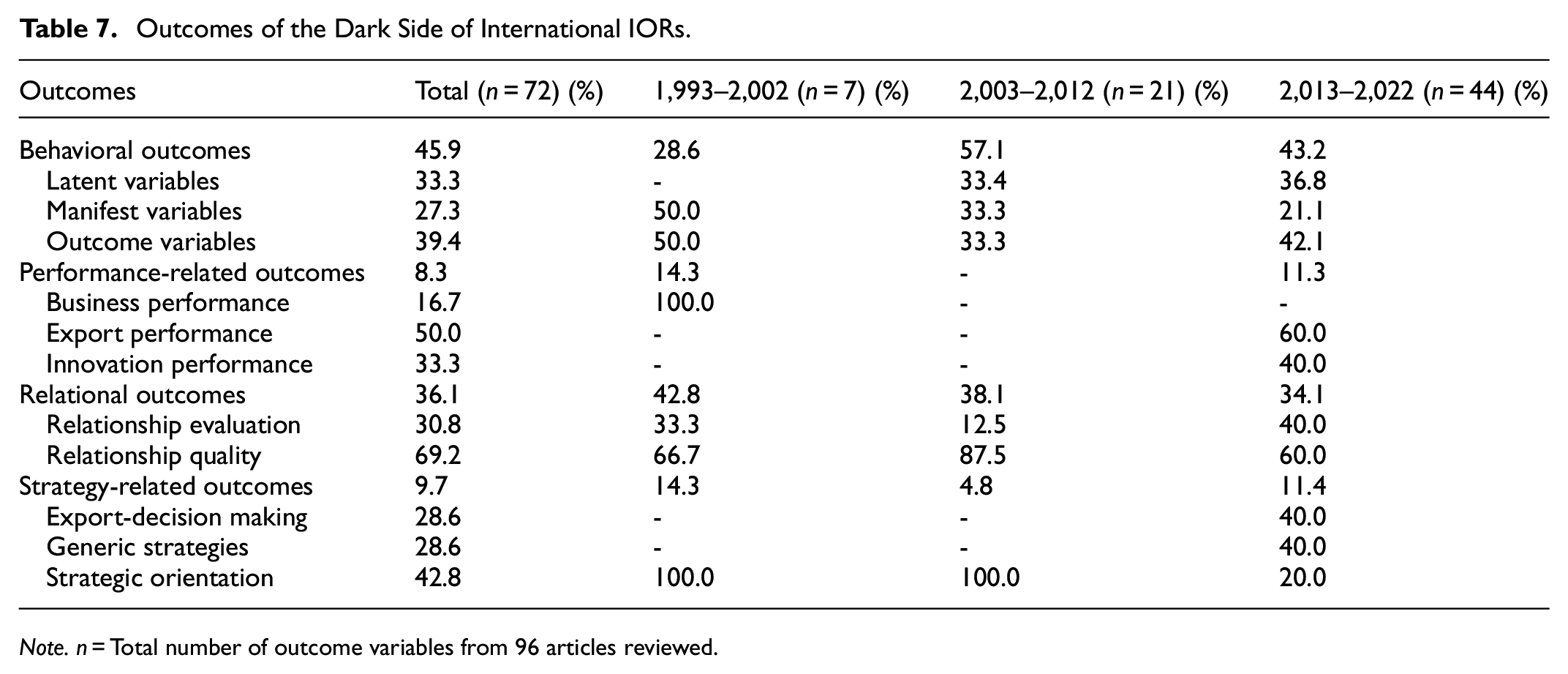
Note. n = Total number of outcome variables from 96 articles reviewed.
Less than half of the research investigated the effects of the dark side on behavioral outcomes (45.9%) and followed by relational outcomes (36.1%). Less than one-fifth of the variables focused on strategy-related (9.7%), and performance-related (8.3%) outcomes. There is no clear development pattern observed across the three periods of study for all themes except relational outcomes which show decreasing pattern.
In terms of behavioral outcomes, scholars analyzed the impact of dark side manifestation on various behavioral dimensions (45.9%), such as latent variables, including opportunism (M. Wang et al., 2016), infidelity (L. C. Leonidou, Aykol, Fotiadis et al., 2019, L. C. Leonidou, Aykol, Spyropoulou et al., 2019) and betrayal (L. C. Leonidou et al., 2018). Latent variable shows a consistent growth in research where the number jumped significantly in the third period. Outcome variables also received greater attention in the third period with the focus on variables such as the effect of dark side manifestation on relational performance (L. C. Leonidou, Aykol, Fotiadis et al., 2019, L. C. Leonidou, Aykol, Spyropoulou et al., 2019) and long-term relationship satisfaction (Barnes et al., 2010). Meanwhile, manifest variables, that indicate cooperation (Padin et al., 2017), and commitment (Saleh, Ali, & Julian, 2014; Saleh, Ali, & Mavondo, 2014) shows a decreasing trend in the third period.
Among the relational outcomes, relationship quality emerged as the most extensively studied (69.2%) as measured by trust, commitment, and satisfaction. Specifically, dark side manifestations such as conflict, uncertainty, and exporters’ unethical behavior were investigated with relationship quality (C. N. Leonidou et al., 2013). In addition, the previous study examined the impact of dark side manifestation on relationship evaluation (30.8%), implying a negative relationship between opportunism and relationship continuity (Chang et al., 2015).
Another corpus of research conducted by previous studies was the effect of dark side manifestation on strategic-related outcomes (9.7%). For instance, Gnizy and Shoham (2018) assert that conflicts can spur innovative thinking useful in the strategy and operations of any power of international marketing. A small number of studies investigated the effect of dark side manifestation on performance-related outcomes (8.3%), in which the dark side manifestation was found to be negatively associated with innovation performance (Chai et al., 2020) and business performance (Chung et al., 2016). While strategic orientation shows consistently decreasing in research, export-decision making, and generic strategies emerged as new research focus in the third period.
Moderators on the Dark Side and Its Antecedents
Aside from investigating the direct interactions between the dark side and its antecedents and outcomes, numerous efforts were taken to investigate the indirect linkages by incorporating the moderating variables (see Table 8), drawing adequate interest from 2013 to 2022. The review shows an increasing trend toward investigating relationship characteristics as moderators. Environmental influences were the only moderating themes in early research but gained high attention in the third period as more research shifted their study of environmental influences from antecedents to moderator. whereas behavioral dimensions (14.7%), internal influences (5.9%), and network ties (5.9%) were only covered to a limited extent.
Moderators on the Dark Side of International IORs and Its Antecedents.

Note. n = Total number of moderator variables (on the dark side manifestation and its antecedents) from 96 articles.
Relationship characteristics is an emerging area in this stream of research as it demonstrates increasing interest among researchers over time. We observed significant attention on variables such as contracts and demographic attributes as well as governance mechanisms and relationship quality in a lesser extent. L. Wang et al. (2020) suggest a detailed contract weakens the tie between supplier dependence and international buyer opportunism. L. C. Leonidou et al. (2017a, 2017b) found relationship length tempers the connection between relationship quality and infidelity. Additionally, the relationship’s start significantly impacts opportunism. If importers initiated ties with suppliers reactively, opportunism’s negative effect on trust became notably pronounced (Barnes et al., 2010).
Considering network ties, past studies show corporate and personal value similarity’s effect on export marketing unethical behavior is tempered by varying network link levels among relationship participants (C. N. Leonidou et al., 2013). On internal influences, firms with robust marketing capabilities can mitigate foreign partners’ opportunism in markets with a strong rule of law. However, in uncertain conditions, these capabilities might exacerbate opportunism (Chang et al., 2015).
Although environmental influences did not show a clear pattern of research over three periods of study, several variables emerged as new topics of interest among scholars in recent period. Notably, topics such as environmental volatility and environmental mechanism equally received significant attention. Research has highlighted the significant positive influence of environmental volatility on supplier opportunism (Saleh, Ali, & Julian, 2014; Saleh, Ali, & Mavondo, 2014), underscoring that foreign suppliers might pursue short-term gains opportunistically (Kwok et al., 2018). psychic distance shows a jump in research attention to a lesser extent in the third period. The focus is on the impact of inter-partner incompatibility and relational distance on betrayal is influenced by foreign market dynamism. This suggests that fluctuating international markets can introduce fresh risks or opportunities in business relationships, driving self-centered behavior and potential betrayal (L. C. Leonidou et al., 2017a, 2017b).
Regarding country attributes, studies indicate that country business risk and globalization notably influence the link between contract specificity and contract violation (Griffith & Zhao, 2015). Specifically, contracts from high-risk countries are less effective at preventing breaches. Behaviorally, elevated trust diminishes the connection between vertical competition and cognitive conflict (Chai et al., 2020). Current research also points to the dampening role of emotional intelligence on relationship distance and conflict, especially when factoring in opportunism (L. C. Leonidou, Aykol, Fotiadis et al., 2019, L. C. Leonidou, Aykol, Spyropoulou et al., 2019).
Another emerging topic in this stream of research is behavioral dimension which received scholarly interest in the third period but was completely ignored in the previous periods. Researchers tried to diversify the focus and ventured into this new area of study in recent years. The focus was primarily on examining the moderating role of trust and opportunism in shaping the interactions between companies, affecting the overall performance of these relationships.
Moderators on the Dark Side and Its Outcomes
Research has covered many areas on the indirect interactions between the dark side manifestation and its outcomes. In this regard, 18 moderators were discovered in the analysis of 96 articles (see Table 9), where the researcher paid great attention to relationship characteristics (61.1%).
Moderators on the Dark Side of International IORs and Its Outcomes.

Note. n = Total number of moderator variables (on the dark side manifestation and its outcomes) from 96 articles reviewed.
Of the relationship characteristics, relationship demographics are frequently used to refer to elements that influence the interaction between the dark side and its outcomes (36.4%). According to L. C. Leonidou et al. (2018), as the relationship length increases, the tendency to engage in betrayal action diminishes. Information exchange norms positively moderate the relationship between output monitoring and a firm’s performance, reducing worries about opportunism and inefficiencies (Musarra et al., 2016). Institutional distance between partners also moderates the relationship between contract and opportunism. For example, M. Wang et al. (2016) mentioned that contracts help curb opportunism more in domestic than international relationships.
Contract specificity negatively influences the effect of supplier dependence on international buyer opportunism (L. Wang et al., 2020). The negative relationship between contract breach and relationship performance can be minimized by contract enforcement (Griffith & Zhao, 2015). When relational governance is high, the detailed contract is adversely correlated with opportunism, whereas the centralized control mechanism is connected with greater (less) levels of opportunism when relational governance is low (high; Zhou & Xu, 2012). Furthermore, the effect of betrayal intention on actual betrayal is weaker in international business relationships governed by written contracts than in those without (L. C. Leonidou et al., 2018).
Regarding environmental influences, culturally congruent firms with similar values and norms are less likely to act opportunistically (Andaleeb et al., 2022). Conversely, power distance magnifies the adverse impacts of dysfunctional conflict on both exporter and importer performance (Pfajfar et al., 2019). Scholars have spotlighted a country’s business value as modifiers of the dark side and its effects. The relationship between uncertainty and long-term orientation is influenced by Guanxi—durable social ties firms employ for reciprocal favors—acting as a safeguard to prolong relationships and mitigate uncertainty’s negative effects (Yen & Abosag, 2016). Moreover, Chung et al. (2016) noted that overly investing in political ties can impede a firm’s management capability development.
Future Research Directions
Based on this review, research on the dark side of international IOR has reached significant progress in recent years. The empirical studies reveal new areas which direct us toward future research. The findings are described in four key areas following the TCCM framework: Theory, context, characteristics, and methodology.
Theoretical Underpinning
Our comprehensive review offers fresh, valuable insights. Prior studies on the dark side of international IORs reveal a widely accepted theoretical framework explaining the phenomenon of the dark side of international IOR, indicating the state of understanding about the topic. Nevertheless, a profound theoretical underpinning based on meaningful theory is pertinent to enhance our understanding. Therefore, further efforts should incorporate these theories into research settings as it can explicate the coordination and magnitude of all variables and relationships (Chen et al., 2016).
While transaction cost economics remains a dominant theory in studying international IOR’s dark side, throughout the study period, other theories like relational theory and social exchange theory also experienced continuous increase in scholar’s interest. The focus on transaction cost theory coincides with the dominant of opportunism, as the most studied of dark side manifestation, and the governance mechanism particularly contract in monitoring the opportunistic behavior. Nevertheless, opportunism is a complex phenomenon whereby different kinds of opportunistic behavior might occur at different levels of partnership. Therefore, what opportunistic behavior detrimental to performance outcome is a topic to be investigated in future study (Westman & Thorgren, 2016). Furthermore, in lieu of the fact that contracts are costly and rigid which might be effective at some level but counterproductive at another causing an inverted U shape effect and therefore may have distinctive influence on difference opportunistic behavior. Transaction cost theory was also used to examine the governance mechanism of contracts in safeguarding relationship conflict with the focus on dependency (Eckerd & Sweeney, 2018). Since conflict is a multidimensional construct (functional and dysfunctional; Amason, 1996), using disaggregated approach allows research to examine the correlation between different dimensions of conflict and contractual governance.
Researchers should also explore further other disciplines like sociology by delving into social exchange and social capital theories. This shift reflects the multifaceted and evolving nature of international IORs, emphasizing their social aspects. The underpinning notion of social exchange theory is grounded on the concept of mutual reciprocity in exchanging social resources and material resources guided by the rule of exchange (Cropanzano & Mitchell, 2005; Kahiya & Butler, 2022). However, interfirm transactions are not discrete but rather interrelated (Macneil, 1980) entailing the dynamic process of relationship. As coined by L. C. Leonidou, Aykol, Fotiadis et al. (2019) and L. C. Leonidou, Aykol, Spyropoulou et al. (2019) relationship norm of information exchange may be interrupted in term of its flow, hence future study can examine how this interruption leads to opportunistic exploitation or betrayal. Another intriguing avenue of future study is firm responses to partner infidelity by examining its implications for future relationship criteria, control mechanisms, and trust levels (L. C. Leonidou et al., 2021). Extending the relational exchange theory sheds light on conditions where seemingly “positive” traits could amplify dark side tendencies and would be insightful.
With relational theory, future research should be more focused in extending our knowledge on the dark side of relational norm or behavioral dimensions such as trust, cooperation and commitment, and the consistency between relational norm/behavioral dimensions and the dark side manifestation. As such research on the dark side of international IORs often underscores its negative facets. The relational view suggests a counterproductive effect; excessive relationship marketing enhancement diminishes its value, manifesting an inverted U-shape relationship value (Miocevic, 2021). The exchange theory indicates that escalating cooperation can engender dysfunctional relationships, with firms sidelining complexities for harmonious relations, leading to unresolved issues (Obadia & Robson, 2021). Therefore, more study is needed to investigate the relationship between different levels of behavioral dimensions or relationship norms and the darks side manifestation or the outcomes.
Underexplored theories include dynamic capability, bargaining power and dependency perspective, and transaction-specific investment. Further research should probe new dimensions of international IOR’s dark side and the conditions fostering their rise (Aykol & Leonidou, 2018). For example, existing studies adopt the perspectives that perceive the phenomenon of the dark side statically, overlooking firm capability dynamics. By leveraging theories like dynamic capability, researchers can explore the dark side’s influence on strategic planning. The emphasis should also be on understanding the learning dynamics, underscored by organizational learning theory. Oliveira and Lumineau (2019) advocate bridging the dark side of literature with organizational learning to fathom firms’ learning capacities.
Contextual Issues
In term of country setting, like other systematic review pertaining to IOR (İpek & Bıçakcıoğlu-Peynirci, 2020), a single country context has seen increasing in focus despite the call for multiple country research for greater understanding and insightful knowledge about international dyadic relationship. The bulk of the literature focused on either exporters or importers as the unit of analysis. Therefore, given the possibility of perceptual discrepancies between partners from distant nations, conducting a thorough investigation would be prudent to use a dyadic method (Chai et al., 2020). The collaborative nature of business partnerships involves the adoption of both exporter and importer viewpoints, thus lending deeper insight into certain dark-side manifestation issues (L. C. Leonidou et al., 2018). Nevertheless, we follow the perspective that cross-country research concerns data collection from multiple countries hence future study should be directed toward cross-country despite the challenges, providing complete picture of international business relationship (Katsikeas et al., 2009).
The awareness among scholars about emerging markets was due to its idiosyncrasy (Golgeci et al., 2021). The focus on China can be linked to the fact that it is the world’s largest emerging market (Huidrom et al., 2020) and the second-largest economy. Institutional influences may also be considered as a variable to determine whether the framework works differently in advanced, emerging, and developing markets (Liu et al., 2018). Therefore, we better know the dark side manifestations in those countries considering the significant differences between the institutions in developing markets and developed economies. Future research may focus on different market settings as other big emerging economies (e.g., India, Brazil, and Indonesia) or smaller emerging economies (e.g., Vietnam, Malaysia, and sub-Saharan Africa) due to the variance across country-specific factors.
As for the industrial sector, the previous study was defined by the presence of multiple industrial settings (Crick, 2021). Service industries, which confront a unique set of problems when expanding into new international markets, may provide additional insight and novel contextual elements (Vissak et al., 2020). By developing industry-specific methodologies, researchers can identify parallel and inconsistencies that may apply in a broader industrial setting (Y. Huang et al., 2020). More research on non-manufacturing industries is required to bridge research gaps and generalization.
In terms of firm size, this review shows that the majority of past studies were conducted among small and large businesses. We suggest future research should draw parallels between small and large organizations by investigating the circumstances under which larger firms experience dark side manifestations (Verbeke et al., 2019). Additionally, it would be fascinating to compare firms that failed to internationalize with successful-born global enterprises and evaluate how the acquired knowledge and engagement in networks affect their performance (Vissak et al., 2020).
For future direction, research on the dark side of international IORs can be extended to various modes of cross-border business relationships such as franchising, strategic alliances, and joint ventures (Kwok et al., 2018). Aside from that, reciprocity is also relevant in other types of bilateral activities, such as joint marketing campaigns and research and development investments between multinational corporations’ headquarters and subsidiaries (Liu et al., 2018). More research is needed in other cross-border buyer-seller relationship contexts to assess the generalizability of the current empirical evidence (Pfajfar et al., 2019).
Characteristics
Despite the significant progress of study especially the phenomenal growth of relationship characteristic as antecedent to dark side of international IOR, more empirical research should be channeled into specific areas such as TSI, cultural similarity/sensitivity, governance mechanisms and relationship quality. As for the TSI, previous study examined the effect of export’s specific investment on export’s opportunism (Katsikeas et al., 2009) and international distributor’s (Liu et al., 2019) or buyer’s (Wang et al., 2020). However, empirical evident shows that as importer makes investment during relationship the risk exposure increases as relationship routine develops (Obadia & Robson, 2021). Therefore, future research may look at the effect of importer’s transaction specific investments (TSI) on exporter’s opportunism as cooperation grew.
Regarding cultural factors, future research should include measures of cultural sensitivity and distance to enhance comprehension of their influence on the conflict-performance relationship (Leckie et al., 2017). As global economic integration increases, cultural disparities gain significance in international IOR. As such cultural literacy warrants more attention because institutions and managers that are well-versed in cross culture may achieve superior financial and relational outcomes (Dobrucalı, 2020). In addition, cultural dimension such as masculinity/femininity, power distance, uncertainty avoidance, local values, business culture, and firm strategies that strengthen the use of power and coordination are all possible topics for future research in the context of institutional influences (Elliot et al., 2019). Scholars might investigate how the cultural aspects of importer’s market affect the efficiency of relational norms (Obadia et al., 2017) in term of value reduction. It would be beneficial to gain a better understanding of the interplay among variables in comparative research design with different contexts (e.g., low vs. high context cultures).
Additional attention should be paid to constructs that may contribute to the manifestation of the dark side in the working relationship, including those classified as managerial (e.g., decision-maker personality characteristics, conscientiousness, risk-taking), organizational (e.g., organizational culture, relationship building, retention capabilities), and inter-organizational (e.g., perceived partner uniqueness, relationship-specific investments) and environmental (e.g., uncertainty, market dynamism, and institutional dimensions; L. C. Leonidou et al., 2018). Future studies must also move beyond the resources factor and dedicate more attention to industry and institution-level forces, as well as a comprehensive approach comprising environmental factors (Haddoud et al., 2021).
Regarding the outcomes, scholars may be particularly interested in other consequences, namely behavioral outcomes, performance-related outcomes, and strategy-related outcomes. In terms of performance-related outcomes, researchers should not focus exclusively on export market performance; rather, they should analyze other dimensions of performance (e.g., customer performance) and capture the importer’s perspective (Obadia & Robson, 2021). The harmful consequences of the dark side have been highlighted in the reviewed studies. Direct or indirect exposure to dark activities, on the other hand, might improve an organization’s daily management activities, vision, and long-term strategy. Therefore, future study is urged to investigate how experiences from the dark side can influence the strategic decision-making process of a company.
Vissak et al. (2020) suggest delving into firms’ internationalization processes to discern how experiential and non-experiential knowledge, be it mainly positive or negative, is utilized. Additional research into how small businesses address conflicts constructively is also recommended (Ratajczak-Mrozek et al., 2019). Beyond behavioral outcomes, the dark side of IORs may entail emotional, perceptual, and financial ramifications, meriting further exploration.
Studies on indirect connections between dark side occurrences and their precursors are still in infancy. Upcoming research might consider macro-level network aspects, such as trade, political, and diplomatic ties, which can influence the effects of relational drivers on relationship value (Miocevic, 2021). Emphasis should also be placed on the moderating roles of internal factors, notably managerial elements (L. C. Leonidou, Aykol, Fotiadis et al., 2019, L. C. Leonidou, Aykol, Spyropoulou et al., 2019) and firm strategies that might shape the dynamics between dark side occurrences and their results (Pfajfar et al., 2019).
Methodology
Our review on methodology provides a comprehensive overview about the state of method employed by existing studies. Nevertheless, areas of concern exist and should be addressed in future research. For example, with regard to the sample more research used smaller sample for qualitative study to explore and understand the new concept pertaining to the manifestation of the dark side. On the other hand, while the trend in using larger samples should be continued as it provides better generalization especially for multi-industry study, research should be cautious at the same time as larger samples tend to generate statistical errors such as strengthening what seems to be weak correlation (Armstrong, 2019).
Empirical research predominantly employs cross-sectional studies and formalized approach that utilized various analytical methods. Yet, for a nuanced grasp of the intricate dark side of international IORs, longitudinal studies are apt, delineating behavioral patterns across IOR lifecycle stages (Bouazzaoui et al., 2020). Although longitudinal research is resource-intensive, it’s advantageous for assessing causation and probing IOR complexities (Pfajfar et al., 2019).
While surveys were the primary data collection method, diversifying methods is paramount. This review clearly indicates that there was a pattern of growth in qualitative approach. This trend should be continuously emphasized as many of the manifestations are still in need of exploratory approach via conceptual study or case study for in-depth understanding of the concept. Future designs addressing IORs’ negative facets should incorporate qualitative approaches. It’s advisable to undertake in-depth personal interviews focus groups, and harness archival sources, given the dark side’s subjective nature (Jukka et al., 2017). Case studies could further offer comparative insights and facilitate theory development. However, future study should be cautious as more research should investigate the causal effect of the manifestation and the antecedents, outcomes, moderators and mediators through quantitative study.
Conclusion and Limitations
The exploration of international IOR relationships has enriched our understanding of the dark side of international IORs. This review delivers an organized synthesis of the dark side of international IORs, beneficial for academics seeking a foundational grasp of the topic. It also refines the direction and caliber of subsequent studies, advancing the field’s research. Addressing the research question, “How has literature on the dark side of international IOR developed, and where should future research focus?” we rigorously reviewed 96 articles via the SLR method, enhancing our comprehension of the topic.
State-of-the-art research was categorized into five topics: theoretical foundation, research design, research scope, methodology, and study characteristics. We then present an integrative framework detailing antecedents, outcomes, and moderators of the dark side manifestation, based on the TCCM framework, addressing future research directions and asking, “What area of research should the future study focus on?”
This study recognized the expansion of research in the dark side of international IOR from 1993 to 2022. While the dominant of several manifestations such as opportunism and conflict was consistent with other review (Oliveira & Lumineau, 2019), the growing interest of studies on other manifestations shed lights on direction of future study toward greater understanding about the topic. In terms of the specific characteristics of the findings, this study found rigorous theoretical foundation with the most popular theory were transaction cost economy, social exchange theory and relationship theory relating to IOR governance mechanism. In addition, the findings show that the research design was heavily emphasized on formalized, statistical, cross sectional and causal approach. As for the scope of the study, existing research tends to employ a single country context and multi-industries sampling frame focusing on manufacturing sector with Asia and European as the dominant regions. The method focuses on survey, SEM and multiple regression analysis, higher response rate and large sample size. There was a propensity toward topics pertaining to behavioral dimensions and relationship characteristics. This comprehensive review addresses specific concerns and offers suggestions for future research.
Our SLR has limitations. While we sourced from respected databases like Web of Science, EBSCOhost Business Source Premier, and Science Direct, some articles might have been overlooked. Yet the 96 articles that we have endeavored to analyze aptly represent the literature on the subject. The protocol we adopted might have also influenced article selection, and other review methods might yield more comprehensive insights (Davies et al., 2023). In conclusion, this study effectively reveals that despite the growth of research, the empirical investigation is still in its infancy and demands a greater attention of the scholars to further the investigation into the insight of the dark side of international IOR.
Footnotes
Acknowledgements
We would like to express our sincere gratitude to all the individuals who contributed to this research. Their valuable insights, feedback, and support have been instrumental in shaping our ideas and guiding our work. We would also like to acknowledge the funding and resources provided by the Centre for Research and Instrumentation Management, Universiti Kebangsaan Malaysia. Without their support, this research would not have been possible.

Ethical Considerations
Not applicable.
Funding
The author(s) disclosed receipt of the following financial support for the research, authorship, and/or publication of this article: This work was supported by the Centre for Research and Instrumentation Management, Universiti Kebangsaan Malaysia, under the Research University Grant Scheme (GUP-2022-001).
Declaration of Conflicting Interests
The author(s) declared no potential conflicts of interest with respect to the research, authorship, and/or publication of this article.
Data Availability Statement
Data sharing not applicable to this article as no datasets were generated or analyzed during the current study.