




Abstract
A systematic literature review was conducted to summarize research that examined the association between problematic social media use (PSMU) and employee work-related and psychological outcomes. Following rigorous protocols, 42 peer-reviewed studies published from 2013 to 2022 were identified from the Web of Science, Elsevier, and PubMed databases, which were used to analyze and evaluate the current research boundary, explore the accumulated knowledge, and propose approaches to further enrich this research area. The findings of this review revealed that the current research mainly focuses on four research themes (a) focal areas of effects, (b) divergence of effects, (c) contextual specificity, and (d) investigated variables. However, the existing knowledge on this domain is still limited in understanding the conceptualization of PSMU, along with the narrow focus on methodological, geographical focus, and objective measures. This study contributes to theory, as it is one of the few reviews that link PSMU to employee outcomes, building an integrated framework to outline future research trends.
Plain language summary
Purpose – Research examining the association between problematic social media use (PSMU) and employee outcomes is increasingly prominent, with a growing number of studies exploring this phenomenon. Despite the increased academic interest, no attempts have been made to synthesize extant knowledge of this domain. There is a limited holistic understanding of the association between PSMU and employee outcomes. To address this gap, an exhaustive systematic literature review on the association between PSMU and employee outcomes is presented. Design/methodology/approach – Systematic review analysis method used to analyze and synthesize insights from 42 empirical studies obtained from three academic databases: Web of Science, PubMed, and Elsevier. Findings – Significant diversity in prior research on the association between PSMU and employee outcomes was encapsulated in four themes. There are significant limitations in the conceptualization of PSMU, along with a narrow focus on geographic, methodological, and contextual foci of prior studies. The authors propose an integrated framework to aid future research directions. Originality/value – This systematic literature review has significant implications for psychologists and managers who consider facilitating the reasonable use of social media, particularly in organizations
Keywords
Introduction
Conceptualization of Problematic Social Media Use
According to the present statistics, the amount of social media users worldwide has increased to more than 4.26 billion (Statista, 2023). It is also figured that the daily amount of time spent on social media platforms has concurrently grown from 96 min in 2012 to approximately 135 min in 2018 (Kemp, 2019). Social media usage can become addictive or hazardous (Chai et al., 2019) if not moderated which may have a negative effect on individuals’ well-being (van Zoonen et al., 2022). The “dark side” of social media, or problematic aspects of using social media, has received a lot of scholarly attention (see Dhir et al., 2019; Talwar et al., 2020; Tandon et al., 2020). Researchers have identified “problematic social media use” (PSMU) as a crucial and emerging component of social media’s negative aspects (Moqbel & Kock, 2018).
Despite an increasing number of relative studies, experts and scholars in the field currently have not reached an agreement on the definition and measurement of PSMU (Carbonell & Panova, 2017; Fernandes et al., 2019). First, various terms are used to describe problematic social media use, complicating the understanding of this behavior and communication between researchers. Examples include “social media addiction” (Savci & Aysan, 2017), “overuse of social media” (Savci & Aysan, 2018), “compulsive use of social media” (Blackwell et al., 2017), “social media dependence” (Wang et al., 2015), and “pathological use of social media” (Holmgre & Coyne, 2017). Recently, Montag et al. (2021) put forward the term “social network use disorder” and whether problematic social media use accords with the disorder is still controversial. Some scholars emphasize PSMU as a broader phenomenon that includes a series of similar but distinct problematic behaviors on the Internet (Andreassen et al., 2016; Musetti et al., 2016; Starcevic & Billeux, 2017). As such, this systematic literature review focuses on problematic social media use (PSMU) rather than problematic behaviors on the Internet (Savci & Aysan, 2018; Starcevic & Billieux, 2017). In this review, terms (e.g., social media addiction, etc.) in the original text used to describe PSMU also were retained.
Second, Hussain and Starcevic (2020) pointed out that, PSMU is not listed as an official or provisional diagnostic category in ICD-11 or DSM-5 and is different from online gaming disorder. In order to overcome the difficulty in identifying PSMU, Wegmann et al. (2022) have assigned several classification criteria: (a) the increase of the desire to use social media over time; (b) some conditions meeting the diagnostic criteria of Diagnostic and Statistical Manual of Mental Disorder, 5th Edition (DSM-5) for addiction disorders; (c) severe functional impairment; (d) potential mental factors and processes. Also, (e) deterioration in professional, social, and personal functioning also be considered as classification criteria of PSMU (Savci and Aysan, 2018; Perales et al., 2020). In summary, some key characteristics of PSMU are mainly manifested in behavioral and substance addiction, including salience, mood modification, conflict, tolerance, withdrawal, and relapse, and has a negative influence on both personal and professional functioning. In this systematic literature review, given that previous studies in this domain are different on theoretical and methodological underpinnings, the authors endorse this comprehensive classification criterion of PSMU.
It is supported that a wide range of risk factors are associated with problematic social media use in work environments. Present evidence suggests that risk factors involve two aspects: behavior (e.g., low employee performance, turnover intention; Choi, 2018) and psychological outcomes (e.g., emotional exhaustion, cognitive preoccupation; Javed et al., 2019; Tandon et al., 2021; Zheng & Lee, 2016). Furthermore, an increasing number of studies focus on the connection between PSMU and employee outcomes including employees’ performance and well-being recently (Salo et al., 2018).
Employee Outcomes and Its Relationship With PSMU
Employee outcomes mainly include work-related behaviors and psychological outcomes, such as job performance, job satisfaction, and work engagement (Chu, 2020). Also, social media has been supported to be significantly related to employee outcomes in the modern workplace. For example, a meta-analytic review by Chu (2020) revealed the “two-sided” nature of social media use with employee job performance, job satisfaction, work engagement, and work-life conflict. Following the increasing attention to the “dark side” of social media (Tandon et al., 2021), the relationship between PSMU and employee outcomes has also become one of the topics of concern for scholars.
Some studies have emphasized the serious negative outcomes induced by PSMU in the workplace (van Zoonen et al., 2022). For example, PSMU would lead to employees’ distraction, hindering decision-making ability (Yu et al., 2018), increasing conflict between social, work, and personal life (Zheng & Lee, 2016), or even inducing psychological-related issues such as stress (Zheng & Lee, 2016), fear of missing out (FoMO; Rozgonjuk et al., 2020), cognitive engagement (Shahzad et al., 2021), etc. Some statistics also indicated that people use social media platforms in the workplace at a rate of 60% to 80%, reducing employee productivity by 30% to 40% (Alharthi et al., 2019). However, some researchers hold different views regarding the association between PSMU and employee outcomes. For example, Carlson et al. (2016) argued that a higher intensity of social media usage would be beneficial for employees to access more resources (e.g., information, or interpersonal relationships). Similarly, Zhang et al. (2021) and Cai et al. (2021) emphasized the PSMU positively related to employee outcomes. The findings of extant research regarding the association between PSMU and employee outcomes are not unified.
Aims
Despite a number of empirical studies, there is no more comprehensive understanding of the relationship between PSMU and employee outcomes. Even though the van Zoonen et al. (2022) review indicated that the excessive social media usage patterns induced negative well-being of employees, there is no narrow focus on the association between problematic social media use and employee outcomes. The extant knowledge about the relationship between PSMU and employee outcomes is still fragmented and lacking (Moqbel & Kock, 2018). More research on the existing intellectual boundaries in this domain is required to understand the correlation between PSMU and employee outcomes. This demand, in turn, forms the basis for the motivation of this study and allows a systematic literature review to collect a broad range of findings.
Therefore, four primary research questions were addressed in this systematic literature review (SLR) to address this gap.
RQ1 What is the current status of the research profile on the possible correlation between problematic social media use and employee outcomes?
RQ2 What is the focus of previous research in terms of the association between problematic social media use and employee outcomes?
RQ3 What are the limitations of previous related research regarding the knowledge gap?
RQ4 What are the suggestions for practitioners and scholars in future research?
To answer these RQs, the present study follows a rigorous protocol proposed by Behera et al. (2019) to build a more comprehensive understanding of the association between PSMU and employee outcomes. This review is one of the few to explore the association between PSMU and employing outcomes by adopting a narrow focus. By addressing RQ1, this review identified, summarized, and described a contemporary profile of existing research such as publication trends, prior research methods and design. By addressing RQ2, synthesized extant evidence on different research themes examined in prior studies. In response to RQ3 and RQ4, different research gaps and limitations suggested by previous studies are critically discussed. Further, possible avenues for future research and an integrated framework are proposed based on existing research and the insights derived from this SLR. By addressing these RQs, the findings of this SLR may have significant implications for organizational, social, and clinical initiatives to avoid and mitigate the problematic use of social media among employees.
Research Methods
The advantage of the SLR method is that it enables scholars to perform a reproducible, transparent, and systematic synthesis of previous literature (Tranfield et al., 2003). According to the protocol developed by Behera et al. (2019), this SLR could be divided into two stages: planning and execution, followed by a presentation of assimilated results (Figure 1). Relevant databases, research objectives, selection criteria, and search criteria were established in the first stage. A single search was used to execute the review plan, including a feedback loop and direct citation. Based on the strict protocol, a state-of-the-art research profile of previous literature regarding the relationship between PSMU and employee outcomes was shown in the second stage. An integrated overview of available knowledge was finally provided by summarizing and discussing the review results (Mehta and Pandit, 2018).

Review protocol.
Review Process
Search Strategy
This systematic literature search was conducted by two authors, and publications from 2013 to 2022 were included.
This SLR was searched from the Web of Science, Elsevier, and PubMed databases. Using the Boolean AND/OR and restricted to the title, abstract, and keywords, the search method combined essential components that were used to address the research questions of this SLR.
The search string was: (“problematic social media use” OR “social media addiction” OR “excessive social media use” OR “compulsive social media use” OR “pathological social media use” OR “social media disorder” OR “social media dependence”) AND (“job performance” OR “job engagement” OR “job burnout” OR “job satisfaction” OR “work-life conflict” OR “psychological issues” OR “physical issues”). No additional filters were applied. In order to find potential additional publications, we also scrutinized the reference lists which may include other relevant empirical articles regarding the relationship between problematic social media use and employee outcomes.
Eligibility Criteria
Studies would be included if they meet all the following criteria (IC):
IC1: related to the theme of the association between the problematic use of social media and work;
IC2: peer-reviewed journals and written in English;
IC3: use a measure of PSMU;
IC4: available in full texts
Studies would be excluded if they met one of the following criteria (EX):
EX1: any articles published as a review, monologue, conceptual study, book chapter, conference paper, and thesis;
EX2: studies that failed to provide important insight regarding the association between PSMU and employee outcomes or deal with problematic social media use specifically in an empirical survey;
Identification and Selection of Studies
In the review, both quantitative and qualitative research was considered if the association between the problematic use of social media and employee outcomes has been examined in these studies. Initially, articles across databases (n = 200) were excluded, and 60 articles were re-examined. The relevant studies were selected by two authors who evaluated titles and abstracts independently. The results were compared after preliminary screening and resolved by consensus in case of disagreement. Subsequently, the full text was used for eligibility assessment, and 18 articles were removed according to the exclusion criteria (see Supplemental Table S1). The full texts of the remaining 42 articles were checked, and all meet the inclusion criteria. Finally, 42 articles were selected for the subsequent SLR. Figure 2 and Supplemental Table S1 show the process of literature selection.
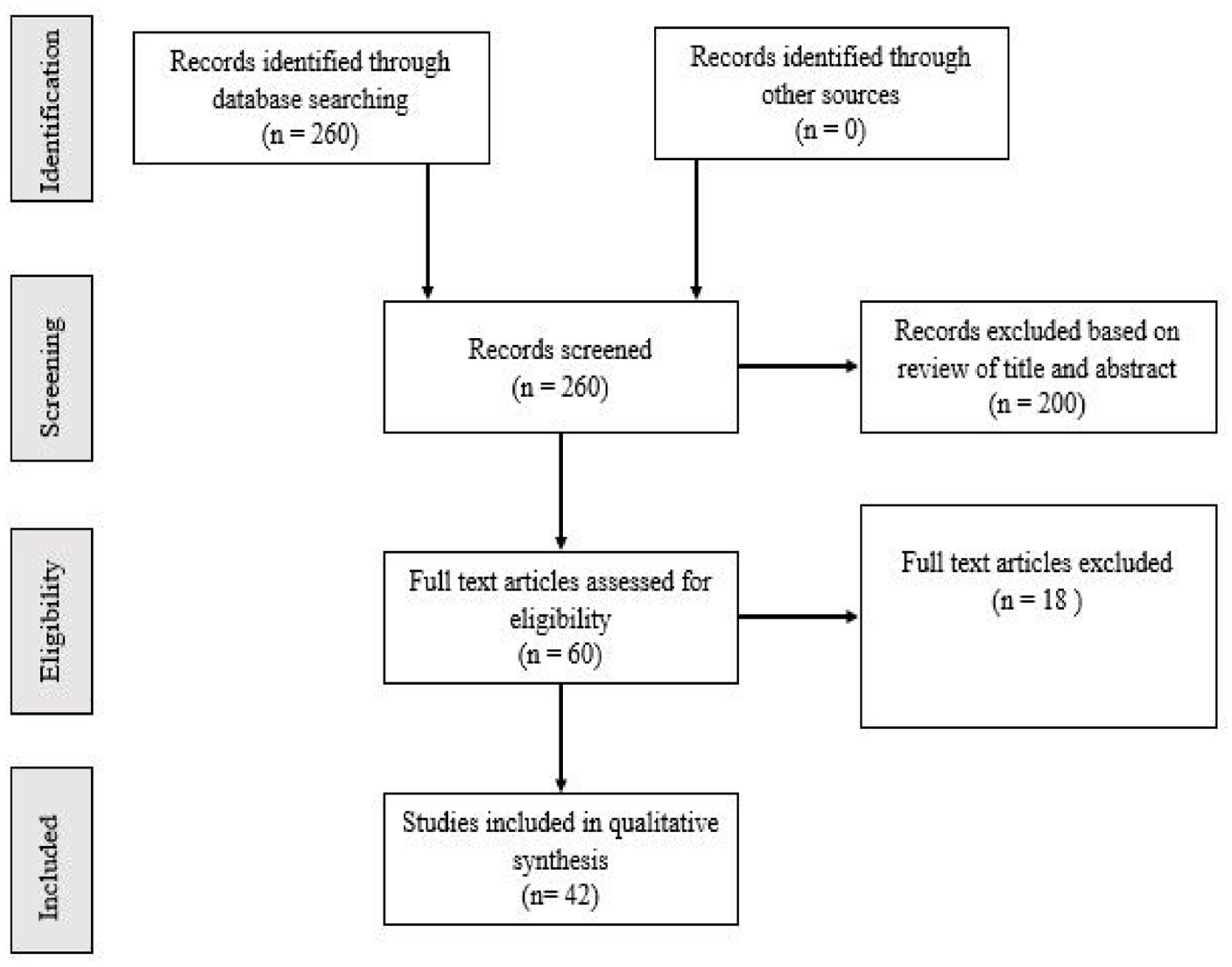
PRISMA flowchart of selected articles.
Quality Rating
A quality rating was conducted to assess the quality and reliability of the selected 42 articles. According to Nidhra et al. (2013), Zheng and Ling (2021), each article was evaluated based on the five criteria for quality assessment, namely the relevance of the theme of this paper to that of the association between PSMU and employee outcomes, the clarity of the research context, the adequate description of the research methodology, the precise explanation for the data collection process of this paper, and the accurate evaluation of the data analysis approach. Each criterion was scored in three ratings (Nidhra et al., 2013). Studies ultimately and partially fulfilling the criterion were rated 2 and 1, respectively, while those failing to fulfill the criterion were rated 0. Hence, one article can reach a total score of 0 to 10 according to the five criteria.
Furthermore, this review used a score of 5 as a “watershed”: Articles with a total score equal to or higher than 6 and equal to 5 were considered “high and medium quality,” respectively, and those with a total score below 5 were excluded (namely “poor quality”; Ahmed et al., 2019). According to the results of the quality evaluation, all 42 articles were found to meet the criteria, categorized as literature with high quality (see Supplemental Appendix A), and hence included in the final sample of the SLR. The Kappa statistic was used to analyze the ratings of all authors for inter-rater reliability. The acceptable agreement was expressed as a coefficient of 0.83 (Landis & Koch, 1977; Carpentier et al., 2017).
Data Collection and Organization
One of the most crucial steps in the systematic review process is data extraction. In order to precisely record all the data from 42 studies, the authors of this work created a data extraction form in this phase. This section’s major goal was to appropriately record the information gleaned from the review using data extraction forms. To extract data from the collected studies, the author first conducted content analysis manually and then used a data extraction form/base to record the technical characteristics of the paper (e.g., author(s), publication date). The following columns were also considered for this review, including sample characteristics, data collection method, data analysis method, theory, social media platform adopted (e.g., Facebook, WeChat, etc.), and the main findings.
Research Profile
In response to RQ1, the research profile of the reviewed articles was discussed by identifying the study contexts, challenges, and restrictions of previous research.
Publication Trends
The included articles were published between 2013 and 2022. The number of articles on the association between PSMU and employee outcomes has been explored over the past years. From Figure 3, we can see that nearly 63% of articles were published within the last 3 years, with the highest number of 11 appearing in 2020 and 2021, respectively. Additionally, the number of publications by country is shown in Figure 4. Nearly 40% studies were conducted in China (n = 16), with the USA (n = 6), Pakistan (n = 5), and Thailand (n = 3) following closely behind. Other research was conducted in developing and industrialized countries, including Germany, Finland, and the Republic of Korea.

Annual trends of publications.
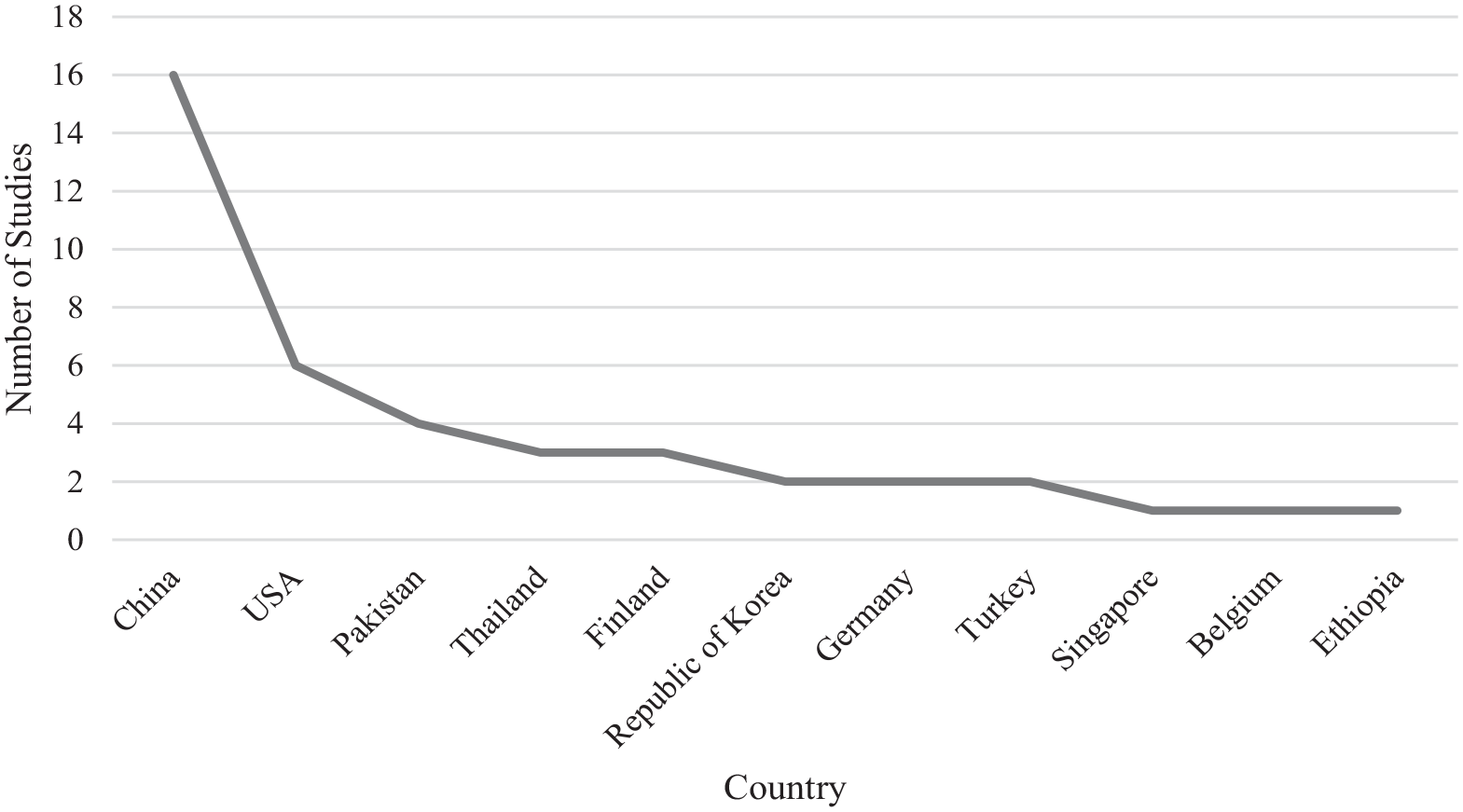
Number of publications by countries.
The top authors in this research field are Moqbel, M., Charoensukmongkol, P. and Tandon, A., and Khan, N.A. Finally, among the top journals are Computers in Human Behavior (n = 6), Frontiers in Psychology (n = 3), Information Technology & People (n = 3) and Technology in Society (n = 2). Related studies have appeared in publications covering a wide range of fields, including psychology (e.g., Stress and Health), social sciences (e.g., SAGE Open), and business (e.g., Research in International Business and Finance). It is believed that exploring the relationship between PSMU and employee outcomes from an interdisciplinary perspective will contribute to future research.
Prior Research Methods and Design
Other profiles of the screened studies are shown in Table 1. The survey (n = 36) was used to collect empirical data for the data collection approach, with a sample size between 122 and 74,025 respondents. In the five exceptional cases, the close-ended survey was adopted in one study, the mixed approach of the cross-sectional survey and the time-lagged survey was applied in one study, the two studies adopted the longitudinal survey, and the last one adopted a two-phase survey. As for the approach to data analysis, nearly two-thirds of studies applied structural equation modeling, while other approaches to data analysis included one-way analysis of variance (ANOVA), bivariate analysis, and the like. Thus, existing literature has mainly taken the quantitative approach to investigate the statistical relationship between variables. By contrast, the qualitative approach has been adopted in only two studies to offer some in-depth insights into the complex association between PSMU and employee outcomes.
Profile of Prior Studies (Sample and Research Design).

Note. *The table details the number (count) of data analysis methods. Some studies used multiple methods of data analysis to which count exceeds a total number of studies. Multivariate analyses include regression, and structural equation modeling, whereas univariate analyses include correlation, t-test, and ANOVA. Others refer to the use of mixed data analysis method.
Furthermore, some assessment instruments were utilized to investigate the problematic use of social media at work in reviewed research. As the most widely utilized measurement in previous studies (Hoşgör et al., 2021; Majeed et al., 2020; Sriwilai & Charoensukmongkol, 2016; Tandon et al., 2020; Tandon et al., 2021; Zivnuska et al., 2019), the Facebook addiction scale is a self-report questionnaire that measures six core addition elements: “salience,”“tolerance,”“withdrawal,”“conflict,”“relapse,” and “mood modification” (Musetti et al., 2016).
Comparatively, some research does not use any specific questionnaires or standards but concentrates on frequency (Charoensukmongkol, 2016; Sriwilai & Charoensukmongkol, 2016), time spent on social media in work (Labban & Bizzi, 2020), addiction status (Tulu, 2017), and other concrete issues. Other measurement instruments employed are as follows:
Social media use questionnaire (SMUQ) which includes questions about the addiction status of social media and dependence on social media (Khan et al., 2022).
German short smartphone use disorder scale (d-KV-SSS) which evaluates the seriousness of adversities related to excessive social media use, with higher scores demonstrating more (frequent) problematic social media use (Rozgonjuk et al., 2020).
The generalized problematic intent use scale (GPIUS) for assessing the amount of time spent on social media (Cao & Yu, 2019; Saleem et al., 2021; Shahzad et al., 2021; Zheng & Lee, 2016).
The Facebook intensity scale for evaluating people’s perception of their personal attachment levels to social media (Cai et al., 2020; Charoensukmongkol, 2014; Charoensukmongkol, 2016; Moqbel et al., 2013).
Compulsive Internet use scale (CIUS) which assesses the psychometric characteristics of Internet addiction in various contexts and among various populations (Marttila et al., 2021).
Internet addiction scale modified for SNSs (s-IAT-SNS) which contains two dimensions (i.e., loss of control and craving) with problematic social media use (Koessmerier & Büttner, 2021).
Maladaptive technology dependence behavior scale (MTDB) includes four dimensions (i.e., cognitive absorption, dysfunctional utilization, blind trust, and overreliance), which reflect the users’ salient behaviors and their subjective experiences with technology (Andreassen et al.,2012).
To gain insight into the understating of the common terms and themes addressed by researchers in included studies, we created word clouds using keywords (see Figure 5). Popular keywords included “addiction,”“excessive,”“performance,”“technology,” and “cognitive.”

Word cloud for key words.
Discussion
The following are the four research themes: the focal area of effects, the divergence of effects, the contextual specificity, and the investigated variables. The synthesized results discussed differences between previous studies as well as research gaps and limitations.
Research Themes
In order to systematically gather, evaluate, and analyze findings from an interpretive examination of prior literature about the association between PSMU and employee outcomes, content analysis—a popular technique for assessing a large amount of qualitative data—was utilized (Heish & Shannon, 2005). It consists of three primary steps: identifying valuable information, grouping, and coding insights, and restructuring the derived results into different themes (Palvia et al., 2007). In this review, the pool of included studies were methodically reviewed to extract key themes and insights, and then the three content analysis steps were carried out independently. Themes were described after the first round of recognition, coding, and reorganization, and the reliability of inter-coders was assessed by consensus on the themes. The reliability test was based on the Kappa statistic. The coefficients of all coded categories from 0.21 to 0.40 (“fair to good agreement beyond chance”) to ≥0.81 (“excellent agreement beyond chance”) (49), showing the inter-coder reliability was appropriately achieved (Landis & Koch, 1977).
To answer RQ2, the four representative themes (i.e., focal area of effects, divergence of effects, investigated variables, and contextual uniqueness) from previous research were discussed in this section.
Focal Area of Effects
According to the SLR, prior research can be categorized based on employee reactions explored in the evaluated studies. These outcomes fall into two categories: (a) Job performance, and (b) Psychological outcomes.
Job Performance
Job performance is a key element of human resource management, an assessment of expected outcomes, and a kind of behavioral participation. Any restrictions conflicting with work may lead to negative consequences, such as task distraction (Majid et al., 2020) and turnover (Choi, 2018). According to the review, three significant aspects of job performance related to PSMU were identified in previous research.
(1) In-role performance
The in-role performance of employees means the work conduct specified in their job description, which has been widely studied in previous studies and assessed either directly or indirectly, such as task distraction (Javed et al. 2019), and procrastination at work (Tandon et al., 2021). Furthermore, cognitive deficits induced by PSMU (Liu et al., 2020), diversion of cognitive and energetic resources (Tandon et al., 2020), social isolation (Moqbel & Kock, 2018), low-level concentration (Koessmeier & Büttner, 2021), overload (Yu et al., 2022), work-technology conflict (Khan et al., 2021) and interruptions (Liu et al., 2021), invasions (Shahzad et al., 2021) are positively related to the poor in-role performance of employees.
(2) Innovation performance
There are few empirical surveys focusing on employee innovation performance and employee creativity. Studies have suggested that overusing social media may encourage knowledge sharing and affect employee creativity (Khan & Khan, 2019; Zhang et al., 2021). On the other hand, PSMU may be harmful to an individual’s innovative work behavior (Moqbel & Kock, 2018). Such consequences, while accounting for moderate variables, may reduce their association (Khan et al., 2022).
(3) Contextual performance
Contextual performance can be defined as a range of group-oriented, organizational, interpersonal, and voluntary behaviors, which are necessary for employees’ personal development and organizational development. Heavy reliance on social media may impair employees’ offline social skills, connect, empathize, or communicate effectively with others, which in turn affects team participation (Bata et al., 2018). However, the higher intensity use of social media may help newcomers socialize, or change their interpersonal relationships (Cai et al., 2020; Yang, 2020), which may also help reduce organizational turnover.
Psychological Outcomes
Studies posit that social media use may blur the lines between personal and professional life, causing unanticipated spillovers into both work and life (Heish, 2010; Lawson et al., 2013), thus leading to various psychological problems of employees (Han et al., 2020). For instance, depression (Majeed et al., 2020), cognitive preoccupation (Zheng & Lee, 2016), stress (Cao & Yu, 2019), low self-esteem (Khan et al., 2021), burnout (Charoensukmongkol, 2016; Sriwilai & Charoensukmongkol, 2016), and loneliness (Marttila et al., 2021). Studies presume that these effects can lead to employee experiencing more stress, which is increasingly associated with problematic social media use and results in employee outcomes. For instance, employee may need more time and energy to reply or handle non work-related information or connections, and create technology-work-life conflict (Cao and Yu, 2019), which could account for the alleged link between PSMU and the development of the psychological problems.
While discussion of the relationship between PSMU and employee outcomes is dominated by psychological issues, some research also points to the possibility of negative physiological effects caused by this relationship. The relationship between PSMU and poor sleep hygiene has been proved in a previous study (Tandon et al., 2020). Thus, we argue that PSMU also affects employees’ physiological health.
Differences in Effects
According to this SLR, PSMU has differential effects on employee outcomes. This difference could be reflected in the (a) effect duality, and (b) individual variability.
Effect Duality
In the work environment, the duality effect of PSMU is mainly related to employee social relationships and employee creativity. Previous studies revealed that PSMU will occupy employees cognitive resources and energy, and in turn lead to conflicted social relationship or low creativity (Si et al., 2023). However, Zhang et al.’s (2021) research showed entirely different findings. Information and Knowledge would be shared and spread through the excessive use of social media, providing employees with more inspiration, which in turn stimulates their creativity (Khan & Khan 2019; Zhang et al., 2021). In addition, as a newcomer in the workplace, higher intensity use of social media allows them to quickly build professional relationships, access work-related resources, and perform better (Cai et al., 2020; Charoensukmongkol, 2014; Moqbel et al., 2013). Hence, it is believed that there exists a dual effect in the relationship between PSMU and employee outcomes.
Individual Variability
The association between PSMU and employee outcomes also be dependent on individual variability (i.e., gender and age). For example, the findings of Cao and Yu (2019) and Cai et al. (2020) emphasized that the role of gender influencing the relationship between PSMU and employee outcomes. Hoşgör et al. (2021) suggested that social media addiction has a greater impact on the work engagement of Generations Y and Z than middle-aged users.
Likewise, Cao and Yu (2019) emphasized that young people may have poor job performance under the influence of problematic social media use than old ones. However, Tandon et al. (2021) and Saleem et al. (2021) found that age differences have no effects on PSMU and job performance. Hence, the SLR suggests that the stated findings on age differences are inconsistent.
Investigated Variables
The investigated variables affecting employee outcomes can be divided into four groups under the influence of PSMU.
Individual Factors
In this theme, for instance, sociodemographic factors including gender (Khan et al., 2022; Liu et al., 2020), age (Cao & Yu, 2019), income (De Cock et al., 2014), educational level (Moqbel et al., 2013), marital status (Lin et al., 2020), work experience (Khan et al., 2021) have been explored. Also, these have been considered control variables (Demircioglu & Chen, 2019; Moqbel et al., 2013; Sun et al., 2020).
Characteristics of Social Media Use
The characteristics of social media and its usage were included in the second sub-theme. Sun et al.’s (2020) research discussed how message transparency and network translucence affect employees’ excessive social media use from the perspective of uses and gratification. Concurrently, previous research has suggested the increased and invasive properties of social media use may displace normal work time and resources, resulting in counterproductive work behaviors (Demircioglu & Chen, 2019). The instrumental nature of social media (e.g., social or learning, communication, or sharing) may determine the different impact of PSMU on employee outcomes (Zhang et al., 2021). In addition, social media interactivity (i.e., synchronicity, two-way communication, richness, and mobility) may influence employees’ job performance (Liu et al., 2021). Therefore, a deeper investigation is required for the characteristics of social media platforms that may encourage employee problematic use. These characteristics included the type of media or technology being used (Rozgonjuk et al., 2020), intensity (Charoensukmongkol, 2014; Moqbel et al., 2013), and frequency (Özbek & Karas, 2022). These characteristics of social media platforms have a negative association with work interruption and poor performance when social media dependence is high (Liu et al., 2021).
Organizational-related Factors
In this theme, for example, social media organizational policies (Labban & Bizzi, 2020), and perceived organizational support (Choi, 2018; Khan et al., 2022) have been explored and considered as indirect influencing factors. Moreover, the organizational culture which may be influenced by leadership also can be considered antecedent or indirect influencing factors in the association between problematic social media use and employee outcomes. Compared to abusive supervision (Choi, 2018; Khan et al., 2022), transformational leadership prompts organizational learning, and knowledge sharing, subsequently impacts employee innovation (Khan & Khan, 2019). Additionally, work conflict (Cao & Yu, 2019), workplace fun and stress (Lin et al., 2020), agency size and types of agencies (Demircioglu & Chen, 2019) are also considered indirect influencing factors in the effect of problematic social media use on employee outcomes.
Indirect Influencing Factors
Especially, variables such as task distraction (Javed et al., 2019; Moqbel & Kock, 2018), job burnout (Zivnuska et al., 2019), emotional exhaustion (Sriwilai & Charoensukmongkol, 2016) mediate the effect of problematic social media use on employee outcomes. “Conflict” and “overload” also have been explored in the relationship between problematic social media use and employee outcomes like strain (Zheng & Lee, 2016), and job performance (Yu et al., 2018) as mediating variables, respectively. Further, some research has considered other mediating variables, such as strain (Saleem et al., 2021), fear (Majeed et al., 2020), technostress (Shahzad et al., 2021), self-esteem (Khan et al., 2021), and perceived irreplaceability (Liu et al., 2020).
Contextual Uniqueness
The research theme of existing literature on the association between PSMU with employee outcomes can be classified into the following two-subthemes specific to contexts.
Platform Uniqueness
In most studies, PSMU has been examined as a mixed phenomenon (Khan et al., 2020; Majeed et al., 2020; Tandon et al., 2021), while only a little research has tried to investigate the influence of PSMU on employee outcomes in the context of specific social media platforms. For example, Facebook (Javed et al., 2019; Rozgonjuk et al., 2020; Yang, 2020); WeChat (Cai et al., 2020; Han et al., 2020; Liu et al., 2020; Zhang et al., 2021), and enterprise social media (Sun et al., 2020).
Geographic Uniqueness
According to this SLR, the current literature on the relationship between PSMU and employee outcomes is mainly connected in developed countries or emerging countries, especially China (Cao and Yu, 2019; Han et al., 2020; Yu et al., 2018), and Thailand (Charoensukmongkol, 2014; 2016). Prior research in this area is limited to industrialized countries, such as the United States (Moqbel and Kock, 2018), the Republic of Korea (Choi, 2018).
Prior Theoretical Foundations
As indicated by the SLR, most studies have explicitly proposed theoretical frameworks. More importantly, these were considered to be core theories in the analysis and discussion of results, rather than being simply mentioned in the literature. The field of personal behavior generated the most popular theoretical frameworks: social cognitive theory (Khan & Khan, 2019; Moqbel & Kock, 2018), self-determination theory (Demircioglu & Chen, 2019), cognitive behavioral theory (Saleem et al., 2021), and P-E fit model (Cao & Yu, 2019). These theories help researchers to have an understanding of the relationship between PSMU and employee outcomes in the individual level. In addition, many studies have also “borrowed” theoretical frameworks from other disciplines, including social behavior, organizational research, and mass communication. These theoretical frameworks consist of use and satisfaction (Sun et al., 2020), job demand-resource model (Charoensukmongkol, 2014), conversation of resources (Khan et al., 2022; Majeed et al., 2020; Zivnuska et al., 2019), stressor-strain-outcome framework (Shahzad et al., 2021; Tandon et al., 2021), etc. According to the SLR, the investigation of such relationships was mostly based on the propositions, ideas, and theoretical understandings presented in the literature (Tandon et al., 2020). For example, Javed et al. (2019) used the proposition of Moqbel and Kock (2018) that PSMU influences task distraction and subsequently affects job performance. Besides, Tandon et al. (2020) incorporated concepts from two motivational theories—Self-determination theory (SDT; Ryan & Deci, 2000) and the Theory of compensatory internet use (TCIU; Kardefelt-Winther, 2014) to discuss the relationship between compulsive social media use and employees’ physical health. Moreover, few studies have extended and developed previous theories to support the results obtained. Yu et al. (2022) used the stressor-strain model (Koeske & Koeske, 1993) to develop a use experience-stressor-strain model, to explore the association between excessive social media use, and employee psychological state.
Existing Literature and Research Gaps
According to the findings of SLR, the conclusions of existing literature show significant inconsistency. Evidence indicates the differential effects of variables while the duality effect of problematic social media use on employee outcomes has been demonstrated in some studies (see more details in Section “Platform-specific Studies”). However, there still remains a limited investigation into such differences. In addition, four significant gaps for future research were identified in the SLR to address RQ3.
Conceptual Challenges
The SLR claims that an overemphasis from the perspective of usage patterns (e.g., social, cognitive, and hedonic) and some other features of problematic social media use to interpret problematic social media use, subsequently may lead to limited understanding of the association between problematic social media use and employee outcomes. This disparity can be explained by a narrow research emphasis, a shortage of theoretical underpinning and the application of relevant seminal theories.
Platform-specific Studies
Recent studies have shown that the customer value base of social media other than Facebook and WeChat (e.g., Instagram, Snapchat, WhatsApp, LinkedIn, etc.) is growing rapidly (Sha et al., 2019; Zhou, 2019). However, most of the screened studies regarding the relationship between problematic social media use and employee outcomes have been conducted on platforms for Facebook users (Javed et al., 2019; Özbek and Karas, 2022; Rozgonjuk et al., 2020; Tandon et al., 2020; Yang, 2020) and WeChat users (Cai et al., 2020; Han et al., 2020; Liu et al., 2020; Zhang et al., 2021). Thus, with reference to other social media, there is only limited understanding of the relationship between PSMU and employee outcomes.
Lack of Geographic Focus
Some countries or regions like Turkey (64%) and Germany (53%) have a significantly higher penetration rate of social media than the world with an average penetration rate of 49% (Kemp, 2022). However, these countries have not received much academic investigation regarding the relationship between problematic social media use and employee outcomes. Instead, the current literature on the relationship between problematic social media use and employee outcomes is mainly concentrated in developed countries or emerging countries such as China (Cao & Yu, 2019; Lawson et al., 2013; Liu et al., 2020; Saleem et al., 2021; Zheng & Lee, 2016), Thailand (Charoensukmongkol, 2014; Charoensukmongkol, 2016), Ethiopia (Tulu, 2017), Pakistan (Javed et al., 2019; Khan & Khan, 2019; Majeed et al., 2020; Majid et al., 2020; Shahzad et al., 2021), and Singapore (Demircioglu & Chen, 2019). This is a significant gap in current research, as Cao and Yu (2019) treat PSMU in organizational settings as a culturally prevalent phenomenon. However, communication patterns differ across cultures and countries due to the different norms that guide social communication. It can be argued that geographic and cultural contexts have an impact on the relationship between problematic social media use and employee outcomes. Thus, while there is a growing interest in the relationship between problematic social media use and employee outcomes, there is also a lack of operationalized geographic diversity research that could help cross-validate these relationships.
Lack of Objective Measures
The fourth weakness discovered concerns the objective identification and measurement of problematic social media use. For example, previous research has used various pre-validated scales like the social media addiction scale (Hoşgör et al., 2021; Zivnuska et al., 2019), which initially alluded to general problematic social media use-related issues. Furthermore, few studies have included assessments for objective usage variables in their research, such as frequency, time spent on and usage intensity on social media (see Section “Prior Theoretical Foundations”). It is claimed that this measurement of problematic social media use is contextual and limited in its generalizability because these scales are not expressly geared to the setting of the organizational context. Therefore, it is posited that developing particular measures to assess problematic social media use during working hours is very necessary.
Methodological Challenges
As Table 2 shows, methodological challenges mainly include sample design and research design.
Methodological and Design Challenges in the Existing Studies.

(1) Focus on self-reports and cross-sectional surveys: Prior literature have overwhelmingly focused on self-reports, which are prone to self-selection (Javed et al., 2019), recall (Lin et al., 2020) and social desirability biases (Yang, 2020), and may result in common method variance (Zivnuska et al., 2019). Cross-sectional surveys provide only limited inferences and do not address causality among the examined associations (Cao & Yu, 2019; Saleem et al., 2021).
(2) Small effect size: The small effect sizes in the studied associations were also a limitation (Choi & Lim, 2016; Sun et al., 2020) as they limit the degree of explanation that may be drawn for the relationship between problematic social media use and employee outcomes under examination.
(3) Measurement: Prior studies raised concerns related to objective measurement of problematic social media use (Moqbel & Kock, 2018) and employee outcomes (Sriwilai & Charoensukmongkol, 2016). Scholars have argued for stability of constructs over time (Majeed et al., 2020) and across different contexts (Javed et al., 2019).
(4) Generalizability: Most studies have also cited generalizability as a restriction, which is a typical issue in empirical research. For example, specific respondent profiles (Sriwilai & Charoensukmongkol, 2016) and limited geographical breadth cause generalizability concerns (Yu et al., 2018; Zhang et al., 2021).
Future Research Agendas
Future Research Suggestions
According to the above-mentioned research gaps, existing studies on the relationship of problematic social media use with employee outcomes remain limited and are in their early state, facing significant challenges. To address RQ4, some specific research directions in this field were proposed as follows:
(1) Expand conceptual understanding. The conceptual evolution in this field can be supported by expanding the boundaries of existing research frameworks to deeply understand the relationship of problematic social media use with employee outcomes. For example, additional measurements like workplace bullying (Choi, 2018) can be included as potential antecedents. Future studies may also identify specific features of social media—for example, the types of online content (i.e., interact, promote, status updates, news updates, etc.) (De Cock et al., 2014; Demircioglu & Chen, 2019; Tandon et al., 2021)—that may prompt employee problematic social media use and subsequently affect employee outcomes.
(2) Research design diversification. Future research can adopt longitudinal research, collecting data at different time points to uncover the causality dilemma (Moqbel & Kock, 2018; Rozgonjuk et al., 2020; Sun et al., 2020). Additionally, a neurobiological approach is suggested for future research. Biological systems have detected that they take action before users express introspective feelings, or reporters conceal some maladaptive cognitions (Zheng & Lee, 2016). For example, whether self-reported social media distraction is accompanied by a higher distraction from social media cues can be examined using eye-tracking (Koessmeier & Büttner, 2021). Moreover, other objective measures of problematic social media use and outcome variables such as observational and interventional studies (Majid et al., 2020), or the collection of objective data to capture the actual usage conditions of social media users (Cao & Yu, 2019), that is also encouraged in the future study. Such a research design could add to the evidence and validation regarding the influence of problematic social media use on employee outcomes, such as job performance, burnout, and physiological well-being.
(3) Sample diversification. The respondents of existing studies are mainly full-time employees (Cao & Yu, 2019; Demircioglu & Chen, 2019; Moqbel & Kock, 2018; Tandon et al., 2021). Therefore, it is suggested that more representative samples be included in future studies to more inclusively understand the research theme. Accordingly, two suggestions for future research were put forward in this study. •More diverse social media user groups of different cultures, regions, education levels, incomes, job positions, individual roles (Hoşgör et al., 2021; Majid et al., 2020), and other industries (Javed et al., 2019) should be sampled. It would be equally interesting to compare the responses of different stakeholders in different cultures or regions on how problematic social media use could affect employee outcomes (Majid et al., 2020). A cross-examination of the issue could generate different and more authentic results (Charoensukmongkol, 2014). •The friends, spouses or parents of employees using social media should be included in research to achieve observational reports on their behavior patterns (Luqman et al., 2020) and insights into the behavioral patterns of seniors less studied but perplexed by the problematic use of social media.
(4) Strengthening of theoretical foundations: The theoretical underpinnings of earlier research on the relationship between PSMU and employee outcomes are not yet robust, which may be because the idea of PSMU is still in its infancy and was not investigated until 2012. According to our review, researchers have largely referred to stressor-strain-outcome theory (Shahzad et al., 2021; Tandon et al., 2021), social cognitive theory (Khan & Khan, 2019; Moqbel & Kock, 2018), and cognitive behavior theory (Saleem et al., 2021). We suggest that researchers further establish theoretical underpinnings by combining classic and modern theories in the fields of psychology, media and communication, sociology, information systems, and management. Technology threat avoidance theory (Liang & Xue, 2009) and behavioral reasoning theory (Westaby, 2005) are examples of potential substitutes.
Framework for Future Research
In Figure 6, the SLR findings suggest the development of an integrative framework that informs future research directions. Kaur et al. (2021) developed an integrative framework on the relationship between social media use/problematic social media use and sleep, which advances the understanding of problematic social media use. The integrated framework in this SLR continues to expand the boundaries of knowledge about problematic social media use by exploring the relationship between problematic social media use and employee outcomes and elucidating unexamined variables. A multidisciplinary approach is necessary to test these correlations (Kaur et al., 2021). In addition, we believe that future scholars must use organizational, social, and professional peer groups as viable sources of information to examine the relationship between problematic social media use and employee outcome surveys.

Integrated framework.
Problematic Social Media Use
According to the SLR findings, expanding the knowledge framework of PSMU may be beneficial for future researchers to deepen the understanding of its influences. Previous research has suggested that social media use at night is manifested in the obsessive concern about social media, harming the physical and mental health of individuals (Shahzad et al., 2021). Some scholars argue that nocturnal social media use is likely to be seen as problematic social media use (Kaur et al., 2021). However, the influence of nocturnal social media use on daytime employee performance and its resultant effects, including on the subjective well-being of individuals, is a limited research field (Tandon et al., 2021).
By using social media, individuals are more likely to achieve different purposes and goals, like relief and relaxation (Tulu, 2017), or alleviating stress (Yu et al., 2022), which may be implied as situational triggers (Yu et al., 2022). Therefore, it is necessary to explore the typology of features in future studies, possibly alleviating situational triggers that lead to longer periods of social media use (Majeed et al., 2020). These features include cyberloafing, health monitoring, gaming, shopping, dating, or news reading, possibly prompting users to multitask between professional and leisure activities while using social media at work.
Communication Channels and Problematic Social Media Use
The influence of communication channels is another aspect of problematic social media use to be further investigated. Communication channels, including smartphones, tablets, and smartwatches, have penetrated every aspect of people’s lives (Rozgonjuk et al., 2020). The characteristics of such communication channels (e.g., multiple functions and increased accessibility) enable individuals to use social media even at work (Blackwell et al., 2017). As emphasized by Wang et al. (2023), problematic usage may not be smartphones themselves, but rather the excessive use of social media applications.
Antecedents
Multiple antecedents influencing the relationship of problematic social media use with employee outcomes have been investigated in previous studies. According to the SLR results, future research may benefit by narrowly focusing on exploring the variables related to the problematic use of social media and employment outcomes as well as distinct factors. Accordingly, two possible groups of antecedents were proposed as a reference for future research–individual and organizational factors.
(a) Individual factors: Future research can pay attention to an understanding of context-specific characteristics that affect individual social media users. Understanding the situational triggers of problematic social media use (Sun et al., 2020) that affect personal motivation could be helpful for elucidating the process of its influence on employee outcomes. Such potential antecedents contain individual factors, including personality traits (Kircaburun et al., 2020), and habits (Wang et al., 2015). In addition, we venture to propose other addictive behaviors or incivility behaviors in workplace may lead to employee problematic social media use, such as phubbing at workplace (Tandon et al., 2022). Other antecedents may include pre-existing psychological and emotional issues like self-esteem (Aladwani et al., 2016), and hypertension (Majeed et al., 2020).
(b) Organizational factors: Little research has focused on the association between organizational-related factors and problematic social media use. The current study indicates that social expectations for instant communication via social media are likely to rise, especially at work (Coker, 2013). Furthermore, cyberbullying at work including aggressive, threatening behavior to social ostracism (Oksanen et al., 2020) may affect employee problematic social media use. Additionally, organizational identification (van Zoonen et al., 2018; van Zoonen et al., 2019), workplace ostracism (Chung & Kim, 2017), and HR practices (Naim & Lenka, 2021) may be the potential triggers of problematic social media use.
Outcomes
Similarly, multiple employee outcomes of problematic use of social media like job performance and psychological issues have been examined in previous research. Based on the literature review, the following suggestions for accumulating additional knowledge in this field through further research were developed.
(1) Responses: Since psychological issues, such as emotional exhaustion, strain, and overload have been examined in previous research, future studies may concentrate on other potential employee consequences in terms of behavior (e.g., phubbing), and disruption to daily activity, including sleep habits.
(2) Relationships: Future research can be conducted to examine how problematic social media use is related to employees’ social connections and social memberships. Such knowledge will facilitate researchers’ understanding of the potential impact of problematic social media use on society as a whole.
Indirect Factors
The current research scope can be expanded to examine the role of individual factors, including users’ demographic characteristics, such as the geographic location of companies (Sun et al., 2020), marital status (Tulu, 2017), economic conditions (Özbek & Karas, 2022), and social media accounts (Saleem et al., 2021). In addition, due to problematic social media use, employee responses to negative outcomes may vary by individual roles (e.g., marketing or sales) and individual differences (Koessmeier et al., 2021). Future studies may expand the scope of factors (e.g., work shifts or occupations) as indirect factors. In addition to individual roles, other characteristics of employment that may affect employee social media usage patterns and subsequently affect employee outcomes, such as job shift (day/night) can be investigated in future studies.
Research Methodology
Future scholars in this field should address the diversification of methodological techniques as a crucial concern. Despite helping explain the association of problematic social media use with employee outcomes, cross-sectional studies limited the capacity to determine causation from the findings (Charoensukmongkol, 2016). Researchers may consider collecting real-time and longitudinal data across multiple social media platforms through more objective and sophisticated research (Marttila et al., 2021). Based on the findings of this review, the author also suggested that future research should examine problematic social media use at work or in leisure time, respectively (Majeed et al., 2020). This could be augmented by studies aimed at determining the transiency of the interactions between variables influencing the relationship of problematic social media use with employee outcomes (Labban & Bizzi, 2020). It will be of great informativeness if future studies measure subjective social media usage data or employ precise diagnostic criteria (Cao & Yu, 2019) and other sources (like supervisors or spouses) to evaluate the outcomes of employees’ problematic social media use to develop more objective research frameworks in future studies (Zivnuska et al., 2019).
Moreover, studies conducted in the fields of psychology, psychiatry, human resource management, and information management have already examined the relationship between problematic social media use and employee outcomes (Demircioglu & Chen, 2019; Moqbel & Kock, 2018; Özbek & Karas, 2022; Zhang et al., 2021). Given these results, future research frameworks may provide a new clinical perspective that can help to develop more scientifically based constructs and measures of problematic social media use. A multidisciplinary approach may also help to overcome the current methodological challenges, such as social desirability bias (Lin et al., 2020; Yang, 2020), and objective measurement (Moqbel & Kock, 2018), by developing an experiment-based research protocol. Moreover, with the non-invasive media technology (e.g., eye tracking), the protocol may help to understand the physical representation of problematic social media use symptoms and the cognitive processing of social media communiqué (Koessmeier & Büttner, 2021).
Expansion of the Research Scope
Future research needs to address the currently narrow geographic scope of research in this field. Some countries or regions like Turkey (64%) and Germany (53%) have a significantly higher penetration rate of social media than the world with an average penetration rate of 49% (Kemp, 2022). However, current literature fails to fully understand the relationship of problematic social media use with employee outcomes in these countries or regions. Thus, future research attempts should be made to facilitate the understanding of problematic social media use in these under-investigated regions.
In addition, problematic social media use patterns may be influenced indirectly by specific connections of culture or ethnicity. Culture may have a substantial impact on individual usage behavior. Zhang et al. (2021) emphasized that Chinese social media users prefer to share information and provide social support on social media in collectivist cultures. The role of social media in satisfying the social and information needs of employees in Chinese cultures may differ from that in Western cultures (Sun et al., 2020), subsequently affecting employee outcomes differently. Therefore, future studies may consider using the same methodology and cross-cultural context study for better comparison (Cai et al., 2020; Lin et al., 2020).
Other Stakeholders
According to the findings of the review, there is a need to more fully understand the relationship between problematic social media use and employees’ performance and well-being. Thus, it is suggested that future research should more deeply investigate the associations of problematic social media use with employees active in social media and the development of subsequent employee outcomes.
(1) Companions: It is believed that problematic social media use harms employees’ physical health (Tandon et al., 2020), thereby making it necessary to widen the current research scope to achieve more in-depth insights into the research theme. However, existing literature on the correlation of problematic social media use with employee outcomes is based on social media users’ self-reporting (Majid et al., 2020; Rozgonjuk et al., 2020). The viewpoints of these users’ companions such as colleagues, friends, spouses, parents, and supervisors should also be considered to broaden the current research scope. For instance, a spouse or supervisor could be a good rating source for employee performance and well-being (Zivnuska et al., 2019). Colleagues’ observational data may remedy the potential bias caused by self-reported scores (Yang, 2020).
(2) Professional practitioners: Psychologists, psychiatrists or other professional practitioners who focus on the hazard of problematic social media use should also be considered in future studies. Due to their unique positions, they have an in-depth understanding of employees’ psychological state or even symptoms, thus helping illustrate the harm of problematic social media use and giving a precise and uniform definition of problematic social media use.
Conclusion
In this study, existing research on the relationship between problematic social media use and employee outcomes was curated and assimilated using the SLR method. A strict protocol for article search was used to select relevant studies from three different databases, including PubMed, Elsevier, and Web of Science. Based on the specific article selection and quality assessment criteria, 42 empirical studies on the relationship between problematic social media use and employee outcomes were collected in this study (Table 3).
Summary of the Selected Studies.

To simultaneously summarize the present status of research on the relationship between problematic social media use and employee outcomes and to address RQ1, a structured profile of previous research covering the publication year, geographic research scope, sample description, and research methods and design was developed. Then, four key research themes (i.e., the focal areas of effects, the divergence of effects, the contextual specify, and the investigated variables) were to address RQ2, which emphasized the research focuses of prior studies. RQ3 was addressed to identify and summarize the four knowledge gaps in the existing research (i.e., conceptual challenges, platform-specific studies, lack of geographic focus, and lack of objective measures). Subsequently, the SLR findings were used to discuss future research agendas, develop an integrated framework that informs future research directions, and address RQ4.
This SLR offers a reliable process for aggregating literature on the existing knowledge of the correlation between problematic social media use and employee outcomes. This paper represents one of the first attempts to capture the state of the literature on the association between problematic social media use and employee outcomes. According to the strict protocol, the SLR provides evidence to confirm that most employees of problematic social media use report issues, such as poor job performance, psychological well-being and other adverse outcomes regarding individuals’ mental health and lives. Nevertheless, the available knowledge about this theme only provides a fragmented understanding of such associations, which is still in its nascence. Further studies are needed for driving conclusive causal inferences about the impact of problematic social media use on employee outcomes. Therefore, this research has implications for both researchers and practitioners.
Theoretical Implications
This review enriched the existing research on the association of problematic social media use with employee outcomes, providing implications for future research in five aspects. Firstly, this study made a contemporary summary of the literature on the relationship of problematic social media use with employee outcomes, thus providing a more comprehensive knowledge of the research focus in this domain.
Secondly, this review suggested a need for the enhancement of the theoretical foundation and conceptual development in this field. Also, it is critical to explore other prospective variables, particularly antecedents and mediating/moderating variables receiving insufficient academic attention apart from investigating correlations between unknown existent variables.
Thirdly, this review established an integrated framework capable of helping scholars focus on underappreciated issues and variables in this field. Future research in this area should investigate the impact of characteristics such as communication channels, chronotype and job roles on the problematic use of social media and employee outcomes.
Fourthly, the present study indicated the necessity of developing methods of studying the association between problematic social media use and employee outcomes based on a summary of existing research limitations and challenges. Therefore, the findings of this review could be favorable for developing more complicated and specific research designs, thus further understanding the relationship of problematic social media use with employee outcomes.
Lastly, the application of a multidisciplinary approach was highlighted in this study. For example, more concepts and theories from the study of psychology and behavior can be considered to expand the current knowledge of the association of problematic social media use with employee outcomes, especially the long- and short-term impact of the former on the latter at the individual level.
Practical Implications
The findings of this review provide four major implications for practice in this domain. First, the SLR findings suggest the need for the observation of supervisors and spouses, which could be useful for evaluating the job performance and subjective well-being of employees to encourage companies or individuals to take targeted measures to reduce the risks posed by problematic social media use. This would enable psychologists or psychiatrists to more completely understand the effect of problematic social media use, and raise public awareness of its negative impact on the work and lives of individuals, allowing people to consciously use social media rationally.
Additionally, the findings of this study encourage organizations to consider introducing supportive and regulatory policies to assist employees in coping with work-related and personal communication at work. For instance, organizations can formulate and perform social media policies that prohibit its misuse and clarify its proper use at work (Yu et al., 2022); organizations can install timers that start at the time of opening social media apps and inform users after a given time passes (Zivnuska et al., 2019). They should also limit the intensity of social media use at work by encouraging face-to-face communication. It is worth emphasizing that employees can prevent colleagues from using social media at work, and employees should minimize or stop problematic social media use if it has negative implications that they cannot handle.
Third, tailored psychological interventions mainly aim to employ an approach based on the process of clinical interventions (Kindermann et al., 2013), certain individuals and interpersonal factors associated with social media that promote the advancement of problematic social media use. Since people may highly depend on social media to handle interpersonal problems (Cai et al., 2020; Yang, 2020), it is recommendable to apply metacognitive and socio-emotional learning programs (Durlak et al., 2011) and mentalizing practices (Lecointe et al., 2016) to relieve passive social media use (PSMU) symptoms.
At last, the findings also have wider implications. Considering the composition of the living environment by the interest and interaction of online and offline activities (Musetti and Corsano, 2018), the government may formulate health policies to raise public awareness of the dangers of problematic social media use. Furthermore, service providers could develop an anti-addiction system like time reminders to prevent users’ excessive usage experience and avoid adverse effects induced by problematic social media use.
Limitations
This SLR has some limitations. Firstly, the search for relevant studies was limited to three digital databases. Secondly, the reviewed sample only includes peer-reviewed journal articles. Thus, the findings were not generated from all the available literature on the relationship of problematic social media use with employee outcomes. Papers from other sources like conference proceedings may be included in future assessments. Thirdly, the author only considered relevant literature in three fields (management, psychology, and social sciences) in the criteria for article selection, resulting in subjective bias. Finally, this review only looked at publications between 2013 and 2022, which may lead to the omission of some important findings from social media platforms like Facebook or WeChat which had grown rapidly and possessed a user base before 2013. The author acknowledged that the time limit on publication may have resulted in subjective bias, and suggested that future researchers address this issue. Despite these limitations, the current study presents a more comprehensive knowledge structure for the relationship between PSMU and employee outcomes by assimilating findings from 42 empirical investigations. The subsequent research framework may act as a significant guide for future research on the relationship between PSMU and employee outcomes.
Supplemental Material
sj-docx-1-sgo-10.1177_21582440241259158 – Supplemental material for Problematic Social Media Use and Employee Outcomes: A Systematic Literature Review
Supplemental material, sj-docx-1-sgo-10.1177_21582440241259158 for Problematic Social Media Use and Employee Outcomes: A Systematic Literature Review by Siyu Gao and Bilin Shao in SAGE Open
Footnotes
Appendix
Quality Assessment Scores of the Selected Articles.

Note. QA1: “Is the topic addressed in the paper related to the association between problematic social media use and employee outcome?”. QA2: “Is it clear in which context the research was carried out?”. QA3: “Is the research methodology adequately described?”. QA4: “Is the process of the data collection method clearly expla1ined in the article?”. QA5: “Is the data analysis approach accurately evaluated in the paper?”.
Declaration of Conflicting Interests
The author(s) declared no potential conflicts of interest with respect to the research, authorship, and/or publication of this article.
Funding
The author(s) received no financial support for the research, authorship, and/or publication of this article.

Supplemental Material
Supplemental material for this article is available online.
References
Supplementary Material
Please find the following supplemental material available below.
For Open Access articles published under a Creative Commons License, all supplemental material carries the same license as the article it is associated with.
For non-Open Access articles published, all supplemental material carries a non-exclusive license, and permission requests for re-use of supplemental material or any part of supplemental material shall be sent directly to the copyright owner as specified in the copyright notice associated with the article.
