




Abstract
Governments budget cuts to free agricultural extension services in developing countries have led to advocacy for development and implementation of cost-effective extension services to be partly paid for by beneficiary farmers. Accordingly, understanding farmers’ preferences and willingness to pay is essential for successful implementation of any such cost-sharing extension service schemes; but empirical studies to support cost-sharing extension service schemes in the Ghanaian cocoa sector is hard to find. The study contributes to the knowledge gap by examining key drivers of cocoa farmers’ preferences and willingness to pay for a climate-smart extension service using discrete choice experiment data which was analysed with a mixed logit model. Data was collected from 720 cocoa farmers who were sampled using multistage sampling process. The study finds that farmers have significant preference for the climate-smart extension service, with a marginal willingness to pay of approximately GH¢ 15.15 for improvements in product attributes. Farmers’ preferred product attributes include in-person accessibility, advanced climate-smart content, flexible demand-based delivery and high service reliability, taking into consideration price affordability. Additionally, willingness to pay is significantly influenced by perceived service quality, rainfall and temperature variability, climate change impact, age, education, access to credit, and farm income. The study recommends that extension service providers and policymakers should focus on the identified climate-smart cocoa extension service attributes preferred by farmers and the significant determinants of the farmers’ willingness to pay when developing and implementing climate-smart extension services to enhance cocoa farmers’ resilience to climate risks.
Plain Language Summary
There has been declining government budgetary allocation to the free-to-use agricultural extension service scheme in most developing countries; thus, advocacy for a complementary cost-sharing service scheme. The successful implementation of any such cost-sharing service scheme requires understanding of farmers’ preference and willingness to pay. Choice experiment approach was used to collect data from 720 cocoa farmers about their preference and willingness to pay for a climate smart cocoa extension service. Farmers prefer climate smart cocoa extension service attributes that comprise of: an in-person face-to-face accessibility mode, advance climate-smart cocoa extension service content, a flexible demand-based extension service delivery and above-average service reliability, taking into consideration price affordability. Farmers willingness to pay for the climate smart cocoa extension service is significantly influenced by perceived extension service quality, perceived rainfall variability, perceived temperature variability, perceived impact of climate change, age, education, access to credit and farm income. It is recommended that extension providers and policymakers to focus on the preferred attributes of the climate smart cocoa extension service and to give attention to the observed determinants of willingness to pay in the development and implementation of a climate smart cocoa extension service to farmers to improve cocoa farmers resilience to climate risks.
Keywords
Introduction
Agriculture is a vital economic sector globally, particularly in sub-Saharan African countries. The sector significantly contributes to GDP growth, employment, poverty alleviation and food and income security; with a substantial potential for sustainable rural development (Sehgal & Batool, 2024). However, it has been asserted that the timely dissemination of technological knowledge and innovations to farmers through efficient extension service is pivotal in achieving significant transformation in agriculture and the realization of its full potential. For instance, Raji et al. (2024) opined that extension services and innovative training programmes play a crucial role in enhancing agricultural practices and productivity, enabling smallholder farmers to effectively adopt modern technologies for increased productivity and income. Otishua et al. (2020) also posited that agricultural transformation in Africa is dependent on disseminating the required information at the right time to producers who are key actors in the agricultural sector. Additionally, Ananda et al. (2024) and Okringbo and Amaegberi (2024) emphasized that access to extension services and training programmes is crucial for smallholder farmers to effectively adopt modern agricultural technologies and climate-smart practices and that this access is vital for enhancing productivity and income. An efficient and effective agricultural extension service is essential for farmers adaptive and adoption behaviour. The World Bank defines agricultural extension as the process that helps farmers adopt improved technologies to enhance their efficiency, income and welfare (World Bank, 2024). Drawing from this, it can be adduced that extension service is crucial for transforming agriculture from subsistence to a more productive and climate-resilient sector, thereby supporting socio-economic development in developing countries, particularly in the context of climate change. Agricultural extension services are vital in the agricultural value chain, bridging the knowledge gap between farmers and the scientific community, driving strategic changes and enhancing productivity, income, and food security for farming households (Oluoch & Kitanaka, 2024; Raji et al., 2024).
Recognizing the strategic importance of extension services, several argument has been made for the development and provision of effective and efficient agricultural extension services to educate farmers in adopting scientifically advanced farming techniques for improved agricultural productivity at the farm level (Ananda et al., 2024; Anil & Bhat, 2024). However, the significant cost implications of central government extension services, often constrained by budgets and a supply-driven approach, highlight the necessity for private alternatives, which offer tailored, integrated services that enhance productivity and income of farmers (Rajkhowa & Qaim, 2021; Rushdie et al., 2022). In the Ghanaian cocoa sector, despite significant government investment via the Ghana Cocoa Board (COCOBOD), budgetary limitations have raised concerns about the sustainability of cocoa extension services. Consequently, there have been increased calls for greater private sector involvement and the adoption of a cost-sharing model to address gaps in service provision, improve service quality, and enhance farmer participation, aiming to balance the extension agent-to-farmer ratio and overcome the limitations of free public services (Abed et al., 2020; Chavula et al., 2022; Norton & Alwang, 2020). However, the development and provision of cost-sharing extension services should be demand-driven, cost-effective, and positively impact service quality and efficiency, while also relying on farmers’ preferences, willingness to pay, and ability to patronize such services (Ajayi, 2017; Otishua et al., 2020; Shausi et al., 2019). Despite the general recognition of the importance of cost-sharing agricultural extension schemes to address inefficiencies in free-to-use services, their implementation has been largely unsuccessful in many developing countries, including Ghana (Otishua et al., 2020) and this could largely be attributed to limited information on farmers’ preferences and willingness to pay for such services. Given the socioeconomic importance of the cocoa sector in Ghana and the specialized extension scheme, we focus our research on evaluating farmers’ preference and willingness to pay for a cost-sharing climate-smart extension service scheme, so as to lend empirical support to policies that seeks to build farmers climate resilience.
Although some previous studies have assessed farmers’ willingness to pay for agricultural extension related services in Ghana (e.g., Asare & Kofituo, 2023; Hidrobo et al., 2022; Otishua et al., 2020), the estimation methods used in these studies did not consider the influence of product attributes, which, according to Lancaster’s theory of consumer choice, is a crucial determinant of individual willingness to pay (Lancaster, 1966; Lancsar et al., 2017; K. E. Train, 2009). The neglect of product attributes in prior research has created a significant knowledge gap concerning farmers’ preferences and their willingness to pay for fee-based extension services, impeding the development of such schemes in Ghana. To fill this knowledge gap, we employed a discrete choice experiment within a mixed logit framework to estimate farmers’ preferences and willingness to pay for a climate-smart extension service, emphasizing the need for such services to adapt to the increasing impacts of climate change on agricultural productivity. We argue that this approach will enhance the efficiency and effectiveness of extension services in building cocoa farmers’ adaptive capacity and resilience to the adverse consequences of climate change on their farm-level productivity and livelihoods (such as income and food security). Given the unpredictable climatic conditions and the damming effects of climate change and variability, the necessity for a Climate-smart Extension Service (CES) to support cocoa farmers is paramount, a factor overlooked by previous studies. We conceptualize CES as that kind of extension service that provides capacity building for cocoa farmers to transition towards a more climate-smart cocoa production system while protecting them from climate change (including climate variabilities and extremes). Further, such service will offer cocoa farmers’ opportunity to accurately access, acquire and efficiently utilized climate information and services in their production activities (Ghana Cocoa Board [COCOBOD], 2019; Ghana Cocoa Board [COCOBOD] and Forests Initiative, 2017; Wiah, 2017). In addition, we firmly opined that, an empirical estimation of cocoa farmers’ preference and willingness to pay a climate smart extension service, following the discrete choice experiment approach will provide more credible evidence to inform the appropriate policy direction. This study aligns with the UN SDGs, particularly Goal 13 on Climate Action and Goal 2 on Zero Hunger, by exploring cocoa farmers’ preferences and willingness to pay for climate-smart extension services in Ghana, thereby enhancing their resilience to climate-related hazards and promoting sustainable agricultural productivity with implication for food security. The next section discusses the methodological approach adopted for this study and highlights issues on study setting, data collections and analytical procedures. The paper proceeds with results and discussion section, followed by the conclusion and policy implications and ends with limitations of the study.
Research Methods
Study Setting and Data Collection Process
We conducted a cross-sectional survey to investigate cocoa famers preference and willingness to pay for climate-smart extension services. The study spanned the major cocoa-growing regions of Ghana, including the Western (Western North and South), Ashanti, Eastern, Central, Brong Ahafo and Volta regions. These regions collectively represent an estimated farming population of about one million farmers, who primarily rely on cocoa production as their main economic activity (ECLAC, 2020; Ghana Cocoa Board [COCOBOD], 2020, 2024). The Yamane’s sample size determination formula (Yamane, 1973) was initially used to estimate a sample size of 400 farmers. However, in order to increase representativeness, precision, and reduce margin of error, the sample size was increased by 80%, resulting in a final sample size of 720 farmers. The multistage sampling procedure was then employed to select these 720 cocoa farmers for data collection, distributed equally across the three regions. First, the seven cocoa regions were regrouped into six cocoa regions as reflective on the national production level data by COCOBOD. Here, the western north region and western south region were put together as western region. It must be noted that western north and western south regions were hitherto together and the national production data still puts outputs from the two regions together as one production value from the western regions. The study therefore considered the two regions as one western region following how they are still handled when it comes to data by the Cocoa Marketing Board. After this, three regions (i.e., Western, Central and Brong Ahafo) were randomly selected from the six cocoa regions. At the second stage of the sampling process, two major cocoa-growing districts were randomly selected from each of the three regions, resulting in a total of six districts. The selected districts included Amefi West and Ellembelle from the Western Region, Agona East and Assin Fosu from the Central Region and Asunafo North and Asunafo South from the Brong Ahafo Region. Further at stage three, six major cocoa-growing communities were randomly selected from each district, resulting in the selection of a total of 36 communities. From each of the selected community, a list of cocoa farmers with over 10 years of farming experience and a farm size of at least 2 hectares was generated with the assistance of cocoa extension workers. From this list, 20 farmers were randomly selected from each community, resulting in a final sample size of 720 cocoa farmers. Data was collected from these farmers using a semi-structured interview schedule. Additionally, a discrete choice experiment (DCE) was conducted to collect data on the cocoa farmers’ choice and preferences for climate-smart extension service scheme. The DCE data was analysed within the mixed logit framework to effectively and precisely estimate farmers’ preferences and willingness to pay for climate-smart extension service. The next subsection gives detailed description of the Discrete Choice Experiment (DCE) as applied in this study.
Description and Empirical Implementation of the Discrete Choice Experiment (DCE) Design as Employed in This Study
In empirical literature, survey researches involving choice experiments have predominantly employed different approaches including the Discrete Choice Experiment (DCE) and the Randomized Conjoint Experiment (RCE). However, when selecting an appropriate experimental design to understand preferences and willingness to pay, it is crucial to consider the specific objectives, context, and constraints of the study. In line with this, choice experiment that simulate real-world scenarios, capturing the complexity of decision-making on consumers’ preference and willingness to pay for a hypothetical market products, has largely favoured DCE approach most (Ozdemir et al., 2024). Discrete Choice Experiment (DCE) is preferred over a Randomized Conjoint Experiment (RCE) due to its enhanced realism and relevance (Ozdemir et al., 2024). It offers statistical efficiency and reduces the cognitive load on respondents (Alamri et al., 2023). Moreover, DCE provides flexibility in design and more straightforward interpretability of results while maintaining predictive accuracy (Jumamyradov et al., 2024; Nishi & Hara, 2023). Given the added advantage of DCE and inspired by Lancaster’s theory of consumer behaviour (Lancaster, 1966), which posits that individuals’ consumption decisions are driven by the utility derived from a product’s attributes rather than the product itself, we designed a Discrete Choice Experiment (DCE) to modelled farmers’ preference and willingness to pay for a hypothetical Climate-Smart Extension Service (CES). To design the hypothetical Climate-Smart Extension Service (CES), a thorough empirical literature review was conducted. Expert opinions were gathered, and stakeholders were consulted to identify product attributes. These attributes were then validated through additional collaboration with experts and stakeholders in the cocoa industry. The validated product attributes for the CES encompass both monetary and non-monetary attributes. The monetary attribute, specifically the price, is categorized into three levels: GHℂ10, GHℂ15, and GHℂ20 per month. This pricing structure is informed by the government’s estimated average per capita expenditure on extension services per production period. Data indicate that the government allocates approximately GHℂ106,457,600 annually to cocoa extension service delivery. This expenditure suggests an average per capita cost of about GHℂ200 per production year, equating to GHℂ20 per month. We validated the price attributes through focus group discussions and expert opinions, revealing that farmers would typically commit GHℂ100 to GHℂ200 per production period for the CES, which informed the average minimum and maximum monthly fees for the CES package development.
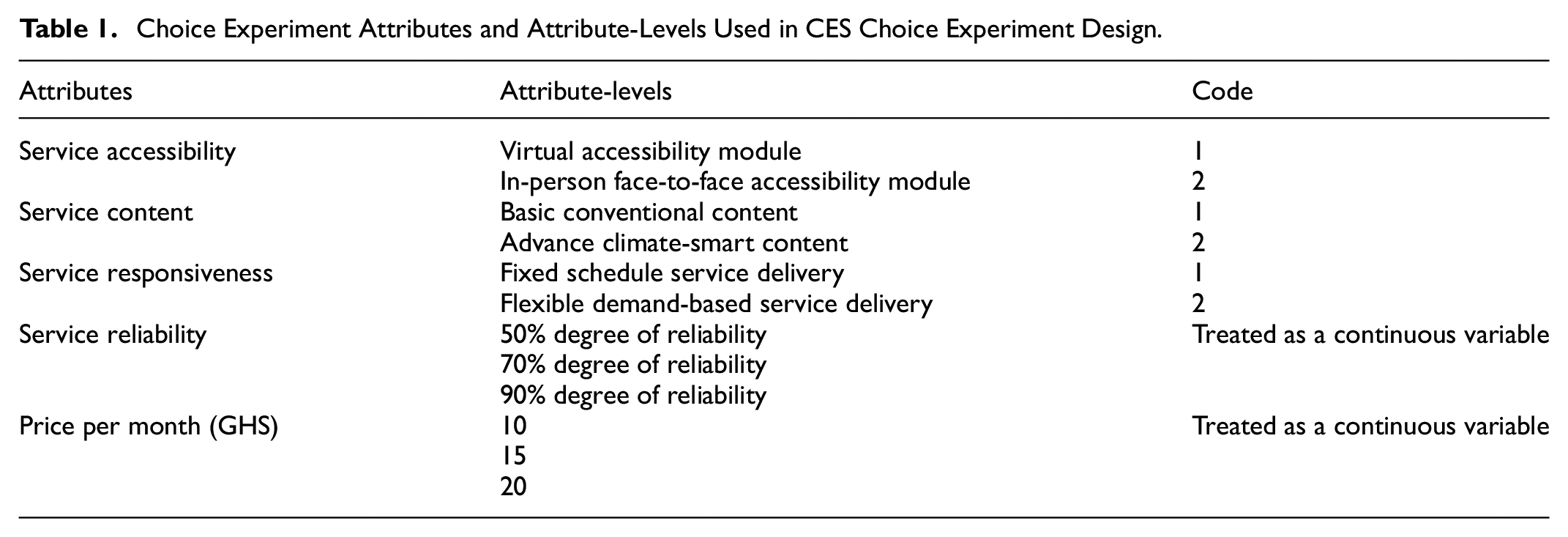
The non-monetary attributes encompass accessibility, content, reliability and responsiveness. The accessibility attribute specifies the preferred mode of service delivery and access. We developed two levels for this attribute: ‘In-person face-to-face accessibility mode’, which emphasizes direct, in-person interactions and ‘Virtual accessibility mode’, which leverages mobile calls, text messages, mobile apps, social media platforms, and radio and television broadcasts. The content attribute defines the preferred service content and its perceived relevance and usefulness. This attribute has two levels: ‘Basic content- The product provides basic, essential climate focused content information and training service that meets consumer requirements-’ and ‘Advanced Content– The product offers comprehensive, detailed, and high-quality climate focused content information and training services that meets diverse consumer needs’. The content encompasses climate related package, incorporating elements such as shade tree management, enterprise diversification, insurance packages, irrigation systems, pruning services, input delivery services, artificial insemination or hand-pollination services, climate information services, digital information services (Agritech) and other climate-related services designed to enhance farmers’ adaptive capacity and resilience to climate change. The responsiveness attribute defines the preferred frequency and promptness of service delivery. It has two attribute levels: ‘Fixed schedule service delivery’, in which contact periods are arranged on fixed dates and times, and ‘Flexible demand-based service delivery’, which permits contact outside the fixed periods as the need arises. The reliability attribute defines the extent or degree to which the service provided is accurate and dependable. This attribute has three levels: ‘50%, ‘70%’ and ‘90%’, indicating the degree of service reliability. This was based on the understanding that farmers would not accept any service with below-average reliability, as gathered from expert and stakeholder consultations.
Upon finalizing the product attributes and their respective levels, we proceeded to design choice cards for the Discrete Choice Experiment (DCE), which were subsequently used to collect data on cocoa farmers’ choices and preferences regarding climate-smart extension services. In this phase, we generated choice cards that presented farmers with two alternative product packages, in addition to an opt-out option. Including opt-out options in discrete choice experiments (DCE) is essential for accurately simulating real-world decision-making processes. This practice not only enhances the realism of the experiments but also improves data quality by capturing true utility and providing valuable behavioural insights. Furthermore, it respects respondent autonomy, thereby leading to more reliable and actionable research outcomes. The design of our choice cards follows a systematic approach. Initially, considering the number of attributes (4) and attribute levels (3), we employed a fractional factorial design to derive a representative choice set from the full factorial design. This process involves coding the attributes and their respective levels, after which the Support.CEs and AlgDesign packages in the R programming environment were utilized to generate the choice sets or cards. The coded product attributes and attribute levels used to generate the product alternative packages on the choice card are detailed in Table 1. From the full factorial design, an initial set of 108 choice sets was generated. Presenting this number of choice cards to farmers would be onerous and impose a cognitive burden, potentially leading to non-cooperation and non-responsiveness(Aizaki et al., 2014; Aizaki & Nishimura, 2008). To mitigate this issue, it was necessary to adopt measures that could efficiently and impartially reduce the number of choice sets. Consequently, the fractional factorial design approach was applied to reduce the choice set to 16, divided into two blocks of 8 sets each. To create two product alternatives, two copies of the fractional factorial design were generated. Subsequently, a random selection method within the AlgDesign package was employed to select four individual choice sets or cards from each block, resulting in a total of eight choice questions presented to farmers in the survey. This approach was adopted to accommodate the respondents’ capabilities and to enhance cooperation and response rates. A sample of the CES choice scenarios or tasks used in the choice experiment is provided in Table 2. During the choice experiment survey, farmers were instructed to consider only the attributes specified in each choice task and to evaluate each choice task independently of the others. In each experiment, farmers were presented with three options and asked to identify the option they preferred as the best. This process was repeated until each farmer had completed all eight distinct choice tasks.
Choice Experiment Attributes and Attribute-Levels Used in CES Choice Experiment Design.
Example of the Choice Card Presented to Farmers to Respond.

Formal Framework and Model Specification
Mixed Logit Model Assuming Preference Heterogeneity
To empirically model Discrete Choice Experiment (DCE) data from our survey, we employed the mixed logit framework due to its advantages over traditional models like the Multinomial Logit (MNL) model. The MNL model’s restrictive assumptions, such as Independence of Irrelevant Alternatives (IIA) and homogeneous preferences, which can lead to biased estimates (Jumamyradov et al., 2024; McFadden & Train, 2000; K. E. Train, 2009). Conversely, the Mixed Logit model allows for random taste variation, flexible substitution patterns, and correlation in unobserved factors (Jumamyradov et al., 2024; McFadden & Train, 2000; Nishi & Hara, 2023). This flexibility enhances the realism and explanatory power of the model, capturing preference heterogeneity and complex interdependencies, thus providing more accurate and reliable parameter estimates for informed policy recommendations (Beeramoole et al., 2024; Jiang & Anderson, 2024; McFadden & Train, 2000; Wang et al., 2022). Additionally, the mixed logit model allows for a general distribution of the random component, which can adopt various distributional forms such as normal, lognormal, uniform, or triangular, providing further flexibility in modelling (McFadden & Train, 2000; K. E. Train, 2009). In particular, McFadden and Train (2000) have shown that the mixed logit model is able to approximate any discrete choice model, making it an ideal choice for our study due to its ability the ensure a more accurate and nuanced understanding of the DCE data.
According to the random utility function, the utility a of person ‘n’ in a choice situation ‘j’ is estimated by the sum of the systematic utility component (

Where

Where

However, since

Assuming that the utility derived (

The empirical description of the variables and parameters in Equation 5 is according presented in Table 3.
Description of Parameters and Variables Contained in Equations 5 and 7 Respectively.

Note. The variables in the table as also specified in the models that have been estimated in the study were based on review of extant literature (see Ajayi, 2017; Khanal et al., 2019; Sedebo et al., 2022; K. Train, 2016).
Willinness to Pay Space Model in the Mixed Logit Framework
The willingness to pay (WTP) space model within the mixed logit framework as proposed by K. Train and Weeks (2005) offers a robust approach for estimating individual preferences and heterogeneity in valuation. This model allows for direct estimation of marginal WTP, addressing limitations found in traditional preference space models (Bazzani et al., 2018; Helveston, 2022). Following the wtp space approach, the utility function (Equation 2) is re-specified to separate the price attribute from the vector of non-monetary attributes. That is,

The incorporation of individual-specific variables into the wtp space model allow researchers to predict determinant of wtp. To estimates, the marginal wtp estimates and their determinants, the mixed logit model in Equation 5 was empirically respecified in Equation 7 as:


The variables included in the empirical models 5 and 7 and their apriori expectation are presented in Table 3.
Summary Description of the Socio-Economic Characteristics of Cocoa Farmers
This section presents summary statistics that give a descriptive scenario of selected farmer-specific characteristics of the sampled population.
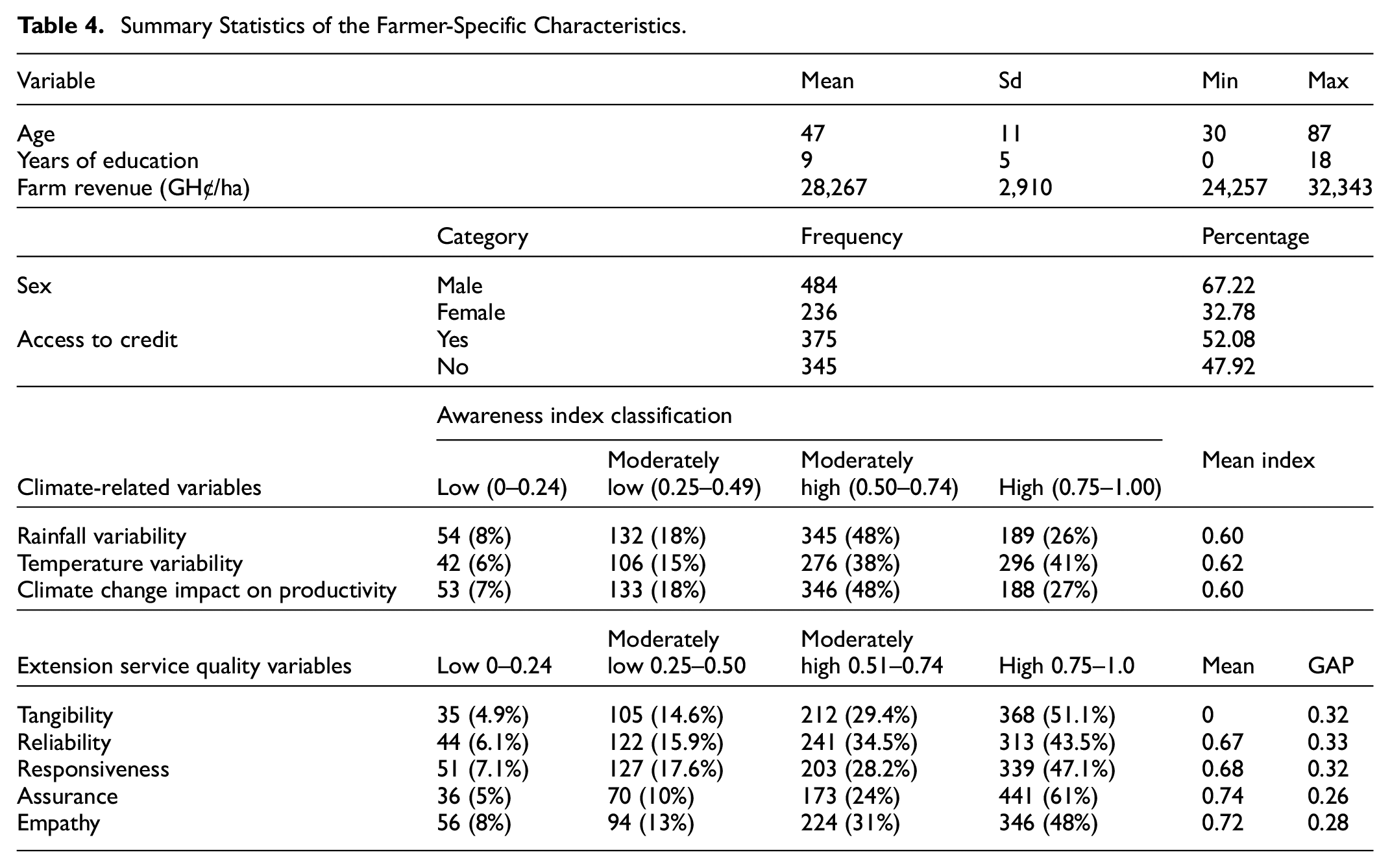
The information as detailed in Table 4, reveals significant insights into the demographics and socio-economic conditions of cocoa farmers in the study. It indicates that a majority (67.2%) of the farmers interviewed are males, highlighting a male dominance in the cocoa farming sector. This trend is attributed to the cultural norm in Ghana where women predominantly engage in food crop production, leaving cash crop cultivation, such as cocoa, to men. The age of the farmers ranges from 30 to 87 years, with an average age of 47 years and a standard deviation of 11 years. This suggests that most cocoa farmers are within the active working-age group, as defined by the Ghana Statistical Service, with an estimated 13 years of productive work life remaining. However, the average age of 47 years raises concerns about the long-term sustainability of the industry. Educationally, 79.31% of the farmers have received some formal education, averaging 9 years of schooling. This level of literacy suggests that farmers are likely capable of understanding technical information, which is crucial for improving farming practices. Financially, approximately 51% of the farmers have access to credit, reflecting the positive impact of efforts to formalize the cocoa sector and improve financial accessibility. The study also reports an average farm revenue per hectare of GH¢ 28,267, with a standard deviation of GH¢ 2,910, indicating variability in income. This variability suggests that while many farmers earn a moderate income, those at the lower end may face economic challenges affecting their productivity and livelihood. The study also evaluated the quality of agricultural extension services based on farmers’ perceptions, measured across dimensions such as tangibility, reliability, responsiveness, assurance and empathy. The overall mean quality index was 0.69, indicating a moderately high perception of service quality but also a 31% gap from the optimal benchmark. The perception index categorized service quality into four groups: low, moderately low, moderately high, and high, with moderate scores across all dimensions, highlighting significant areas for improvement. Furthermore, the study assessed farmers’ awareness of climate-related variables. For rainfall variability, the mean awareness index was 0.60, and for temperature variability, it was 0.62. Awareness of climate change’s impact on productivity also had a mean index of 0.60, with varied levels of awareness among the farmers. Overall, the study underscores the need for enhanced resource capacities, responsiveness, accuracy, trustworthiness, and empathy in service provision to improve the quality of agricultural extension services and support the sustainability
Summary Statistics of the Farmer-Specific Characteristics.
Results and Discussion
Farmer’s Preference for the Climate Smart Agricultural Extension Service With Preference Heterogeneity
Given the detrimental effects of climate change on cocoa production, the development of climate-smart extension services is crucial for strengthening farmers’ ability to respond effectively and efficiently, thereby mitigating negative impacts on productivity and enhancing the resilience and adaptive capacity of cocoa farmers in Ghana. Following a DCE approach, we designed a hypothetical choice card to collect stated preference data to investigate farmers’ preference and willingness to pay for climate-smart extension service delivery, which was then analysed using the mixed logit model via the simulated maximum likelihood approach, with the results reported in Table 5. We estimated the model using 1,000 Halton draws to enhance the efficiency of parameter estimates, assuming a normal distribution for product attributes. Adhering to the inverse demand function principle, we posited that farmers, like all consumers, exhibit a homogeneous negative preference for price. Consequently, the price attribute of CSCES was fixed, while non-price attributes were treated as random with preference heterogeneity. This approach anticipates that farmers will positively value non-price attributes such as service accessibility, content, responsiveness and reliability. Fixing the price attribute mitigates the risk of extreme trade-off values, thereby ensuring accurate willingness to pay estimates (K. Train, 2016; K. Train & Weeks, 2005). The mixed logit model’s efficiency and robustness were validated through a log-likelihood ratio test, demonstrating its superiority over the conditional logit model. As evidenced in Table 5, the mixed logit model exhibits a significantly better fit for the dataset, characterized by notable log-likelihood, high chi-square, and the associated p-value statistics of less than .05. This model adeptly accounts for preference heterogeneity, as indicated by the significant standard deviations of the random parameter coefficients, which underscore the presence of unobserved variability within the population. The model fitness test suggests that we can accept the estimated model results to be unbiased and efficient and as such can the discussed the results and make the necessary inferences.
Maximum Likelihood Estimates of Mixed Logit Model of CES Choice With Preferences Heterogeneity.

Note. Signif. codes: ‘***’ .01, ‘**’ .05 (i.e., level of significance : 1% and 5% respectively).
The Alternative Specific Constant (ASC) coefficient, which reflects the impact of the opt-out option, was found to be negative and highly significant at the 1% significance level. In particular, the ASC coefficient was estimate to be – 3.8701 with a standard error or 0.2339. The ASC represent the intrinsic preference for a specific alternative, independent of the observed attributes. Thus, the highly significant and negative Alternative Specific Constant (ASC) coefficient for the opt-out option indicates a strong intrinsic disinclination among respondents towards opting out, demonstrating that this preference is statistically robust and practically significant, with important implications for choice experiment design and marketing strategies for the CES product. Furthermore, the results suggest that farmers benefit from choosing an alternative rather than the opt-out. This implies that opting for a climate smart cocoa extension service delivery will provide better climate resilience benefit to cocoa farmers. The observed negative Alternative Specific Constant (ASC) in our studies aligns with the findings of Admasu et al. (2021). In their choice experiment study on farmers’ preferences and willingness to pay for land use attributes in Northwest Ethiopia, they also reported a negative ASC coefficient from the model estimates.
The results presented in Table 5 indicate that all estimated coefficients of the CES attributes are significant and exhibit the expected signs. Notably, the price attribute was found to be both negative and significant, suggesting that farmers’ utility decreases as prices increase. This implies that farmers at every point in time, all other things being equal will show greater disutility towards a climate-smart extension scheme that is prohibitively expensive. The finding emphasize that the elevated cost of climate-smart extension schemes diminishes farmers’ willingness to adopt them, underscoring significant cost sensitivity. To promote adoption, it is imperative that the schemes be made financially accessible through flexible payment plans or other financial incentives. The study corroborates Admasu et al. (2021) regarding cost aversion but contrasts with Castillo-Eguskitza et al. (2019), indicating that price sensitivity may vary depending on the context. It is advisable to implement tailored programmes with flexible payment options. From this it is clear that addressing cost barriers is essential for the successful implementation and sustainability of the climate-smart extension service initiatives imperative consideration for policy makers or programme developers. The coefficient estimates associated with the non-monetary attributes of the CES (i.e., accessibility, content, responsiveness, and reliability) were all observed to be positive and significant at 1 and 5% significance level respectively. This in regards to the opt-out option suggests that farmers exhibit a higher utility preference for the available product alternatives in comparison to the opt-out option. This implies that, when presented with a choice, farmers are more inclined to select one of the product alternatives rather than opting out altogether. These positive utility preferences indicate that the product alternatives are perceived as more valuable or beneficial to the farmers than the option to opt-out. This behaviour can be explained by the fact that the product alternatives may better meet the farmers’ needs, offering benefits like increased productivity, cost savings or improved quality. Additionally, these alternatives might be seen as more innovative or superior, making them more appealing.
The positive and significant service accessibility attribute indicates that farmers derive greater utility from in-person, face-to-face accessibility compared to virtual accessibility. This implies that farmers would prefer a face-to-face mode of delivery for the climate-smart extension service. Consequently, the preference for in-person interactions suggests that implementing face-to-face service delivery could enhance the effectiveness and adoption of climate-smart practices among farmers. Moreover, it highlights the potential limitations of virtual accessibility in meeting the needs and preferences of the farming community, thereby underscoring the importance of maintaining and possibly expanding in-person service options to ensure optimal engagement and support. The positive and significant coefficients associated with the content attributes of the Climate Extension Services (CES) indicate that farmers derive greater utility from the advanced content attribute level of CES compared to the basic content attribute level. This implies that, when presented with the CES product, farmers exhibit a higher preference for service content that encompasses comprehensive, detailed and quality climate-smart adaptation packages. These packages may include, but are not limited to, shade tree management, enterprise diversification, insurance packages, irrigation packages, pruning services, input delivery services, artificial insemination or hand-pollination services, weather information services and digital information services. Consequently, it is evident that farmers value comprehensive and advanced service offerings that enhance their ability to adapt to climate challenges effectively and efficiently, guaranteeing them sustainable productivity and livelihood. This result intuitively supports the assertion that the content of agricultural extension services significantly influences farmers’ choice preferences. This is particularly evident in the context of site-specific recommendations, as corroborated by Oyinbo et al. (2019). Their study reported that farmers exhibit a strong preference for tailored extension services over traditional blanket recommendations, as these are perceived to better meet the specific needs of farmers and enhance productivity.
The results emphasize the pivotal role of service responsiveness and reliability in agricultural service delivery. The significant coefficient of the service responsiveness attribute indicates a strong preference among farmers for a flexible service model that can cater to their immediate needs, rather than a rigid, pre-determined schedule. This preference stems from the variable nature of agricultural activities, where service requirements can fluctuate due to factors such as weather conditions, crop cycles and unforeseen challenges. Consequently, a responsive service model is more effective and valued by farmers. Moreover, the findings in Table 5 highlight the importance of service reliability. The significant coefficient of the service reliability attribute demonstrates that farmers highly value accurate and dependable services. In agriculture, where errors can have severe consequences, consistent and reliable service delivery is crucial. Enhancing service reliability beyond the 50% benchmark indicates a commitment to exceeding average expectations, fostering greater trust and satisfaction among farmers. These findings have profound implications for the design and implementation of the CES scheme. By prioritizing service responsiveness and reliability, service providers can enhance the perceived utility of the CES scheme, increasing its adoption and sustained use. Investments in technologies and processes that enable real-time responsiveness and ensure high standards of reliability are recommended. Additionally, continuous feedback mechanisms should be established to monitor and adjust service performance according to the evolving needs of farmers. from the observed results it can be argued that an appreciation of the combined effect of non-monetary attributes can significantly enhance the value proposition of the CES scheme, promoting its success and the well-being of the farming households. The revealed importance responsiveness and reliability of agricultural extension services in significantly influencing farmers’ choice preferences, impacting their adoption of recommended practices lends empirical supports to the assertion by Sani and Abubakar (2023) on the premium farmers plays on the as nature of approaches adopted by extension services providers in service delivery.
To address the source of heterogeneity, as indicated by the significant standard deviation of the random attributes, selected socioeconomic variables were interacted with each random attribute within the mixed logit framework. This interaction process was conducted iteratively in a stepwise manner until the most effective socioeconomic predictors were identified. The findings revealed that the socioeconomic variables significantly explaining preference heterogeneity include sex, age, education and farm income. As depicted in Table 5, the results indicate that sex interacted positively with all attributes except the accessibility attribute. This implies that male farmers exhibit a strong preference for the advanced climate-smart cocoa extension service content attribute, the flexible demand-based service delivery attribute and a service reliability attribute exceeding the 50% threshold. Conversely, female farmers demonstrated a strong preference for the in-person face-to-face accessibility module attribute. Furthermore, the analysis shows that age interacted positively with all four non-monetary attributes, suggesting that older farmers have a strong preference for the in-person face-to-face accessibility mode attribute, the advanced content attribute, the flexible demand-based service delivery attribute, and a service reliability attribute above the 50% threshold. Similarly, more educated farmers were found to have a strong preference for the in-person face-to-face accessibility module attribute, the advanced content attribute, the flexible demand-based service delivery attribute, and an above-average service reliability attribute. Additionally, the results revealed that an increase in farm income is likely to induce a strong preference among farmers for the in-person face-to-face accessibility mode attribute, the advanced content attribute, the flexible demand-based service delivery attribute, and a service reliability attribute exceeding the 50% threshold. The observed influence of sex, age, education and farm income is consistent with the findings of other studies. For instance, Admasu et al. (2021) have documented similar observations in their research. Similarly, Bannor et al. (2022) have corroborated these findings in their study. Khanal et al. (2019) have also reported comparable results, further supporting the observed influence. Additionally, Tesfaye et al. (2023) have provided evidence that aligns with these observations. These studies collectively reinforce the notion that the variables of sex, age, education and farm income significantly impact the outcomes under investigation.
Furthermore, to determine the share of the sample population that shows a positive preference for the non-monetary attributes of the CES, the cumulative probability of the standard normal deviate was computed. This was accomplished by dividing the mean of each random parameter by its associated standard deviation. The resulting value was then compared to the standard normal distribution table. For the service accessibility attribute, a cumulative probability value of .97 was obtained. When compared to the standard normal distribution table, this yielded a share of 0.8339. This implies that approximately 83% of the farmers are estimated to prefer the in-person, face-to-face accessibility mode of service delivery, while about 17% prefer the virtual accessibility module of service delivery. Regarding the service content attribute, a cumulative probability value of .98 was obtained. When compared to the standard normal distribution table, this resulted in a share of 0.8365. This suggests that about 84% of the farmers are estimated to prefer the advanced content attribute, with 16% preferring the basic content attribute. Similarly, for the service responsiveness attribute, the cumulative probability was estimated to be .66. When compared to the standard normal distribution table, this gave a share of 0.7454. This implies that approximately 75% of the farmers are estimated to prefer the flexible, demand-based service delivery option, while 25% prefer the fixed schedule service delivery. Lastly, concerning the service reliability attribute, the cumulative probability value was estimated to be 2.2. Cross-checking this value with the standard normal distribution table gave a share of 0.9783. This indicates that about 98% of the farmers are estimated to prefer an above-average service reliability in terms of service accuracy and dependability.
Willingness to Pay (WTP) Estimates for Climate Smart Extension Service
With the increasing demand on government budgets from competing sectors, especially due to the adverse effects of climate change on agricultural productivity and farmers’ livelihoods, the need for efficient and effective climate-smart extension services is paramount. However, this entails additional costs for the government. Globally, it has been suggested that fee-paying extension services could help bridge the financing gap for efficient service delivery (Otishua et al., 2020). This requires an empirical understanding of farmers’ willingness to pay for such services. Our study estimated cocoa farmers’ marginal willingness to pay for climate-smart cocoa extension services using the willingness-to-pay space modelling approach. The results, presented in Table 6, indicate the monetary commitment farmers are willing to make for improvements in CES product attributes, assuming a base price of GH¢ 10.0 per month.
Willingness to Pay Space Estimates for the Marginal Improvement in the CSCES Attributes.

Note. Signif. codes: ‘***’ .01, ‘**’ .05 (i.e., level of significance : 1% and 5% respectively).
From the results presented in Table 6, it was observed that farmers are willing to pay an additional GH¢ 2.60 for an improvement in service accessibility attributes, as this enhancement would facilitate the delivery of an efficient in-person, face-to-face accessibility module. This preference is attributed to farmers’ strong utility preference for the in-person, face-to-face accessibility module. Benchmarking this to the base price of GH¢ 10.00 suggests that farmers are willing to pay approximately 26% more for an improvement in the service accessibility attribute of CES. Furthermore, it was observed that cocoa farmers are willing to pay an additional GH¢ 7.60 for an improvement in the service content attribute, which ensures the delivery of an efficient climate-smart cocoa extension service content module. This preference is due to farmers’ strong utility preference for the advanced climate-smart cocoa extension service content module. When benchmarked against the base price of GH¢ 10.00, it reveals that cocoa farmers are willing to pay approximately 76% more for an improvement in the service content focused on climate smartness. Additionally, the study results, as depicted in Table 6, indicate that cocoa farmers are willing to pay GH¢ 7.20 more for an improvement in the service responsiveness attributes, which ensures the delivery of an efficient, flexible, demand-based service delivery module. This preference is based on farmers’ strong utility preference for the flexible, demand-based service delivery module of the service responsiveness attribute. When benchmarked against the base price of GH¢ 10.00, it reveals that farmers are willing to pay approximately 72% more for an improvement in the service responsiveness attribute of CES. Our study findings further revealed that farmers are willing to pay GH¢ 3.10 more for an improvement in the service reliability attribute, particularly if it leads to increased accuracy and dependability. Referencing the estimated WTP to the base price of GH¢ 10.00 suggests that farmers are willing to pay approximately 31% more for an improvement in the service reliability attribute of CES. Cumulatively, the results portrayed in Table 5 indicate that farmers are willing to commit additional funds for any marginal improvement in the non-monetary product attributes of the climate-smart agricultural extension service product. However, it must be noted that, according to the results presented in Table 5, farmers place more importance on the service content attribute and service responsiveness attribute than on the service reliability and accessibility attributes. This information is valuable for service providers in packaging and presenting CES products to farmers. The observed willingness of farmers to pay for CES products, should they be developed and presented to them, aligns with findings from other studies. These studies indicate that farmers are generally willing to make monetary commitments for private, tailored extension services, provided they anticipate significant benefits from their usage. For instance, Otishua et al. (2020) in their study employing the Contingent Valuation Method (CVM), observed that farmers in the Ada East District of Ghana expressed a willingness to pay GH¢190 for agricultural extension services for the cropping season. In a similar Discrete Choice Experiment (DCE) study on farmers’ willingness to participate in a cocoa pension scheme in Ghana, Bannor et al. (2022) observed that farmers were inclined to participate in the scheme and to commit themselves to premium payments.
Determinants of Farmers’ Willingness to Pay
Upon estimating the willingness to pay behaviour of cocoa farmers, it became imperative to investigate the underlying factors influencing this behaviour. We incorporated key intrinsic and extrinsic variables to evaluate their impact on farmers’ willingness to pay. Empirical evidence suggests that willingness to pay varies with the quality of extension services (Ajayi, 2017; Gosbert et al., 2019; Praveen et al., 2024; Temesgen & Tola, 2015). Consequently, to enhance the policy implications of the estimated willingness to pay, this study analysed how perceived extension service quality, as an intrinsic factor, predicts farmers’ willingness to pay for a climate-smart cocoa extension service scheme. The mixed logit model estimation was employed, and the results are presented in Table 7. The findings reveal that perceived quality of extension services, across the five service quality dimensions (tangibility, reliability, responsiveness, assurance and empathy), positively and significantly influences farmers’ willingness to pay, corroborating previous studies (Ajayi, 2017). Specifically, an increase in perceived service tangibility (ESQTB) positively affects farmers’ willingness to pay for improvements in service accessibility, content, reliability, and responsiveness by margins of 2.70, 6.30, 0.30, and 1.04, respectively. This suggests that enhancing the tangibility dimension of service quality impacts face-to-face accessibility, advanced climate-smart cocoa extension, flexible demand-based service delivery and above-average service reliability. Efforts to improve physical, human, and technological resources for effective service provision will positively influence farmers’ willingness to pay. Additionally, increased perceived service reliability (ESQRB) significantly affects willingness to pay for improvements in service accessibility, content, and reliability by margins of 3.37, 1.49, and 0.17, respectively.
Determinants of Willingness to Pay for a Hypothetical CSCES by Cocoa Farmers.

Note. Signif. codes: ‘***’ .01 ‘**’ .05 ‘*’ 0.1 (i.e., level of significance: 1%, 5% and 10% respectively).
Linking this to farmers’ stated preferences for individual product attributes, as presented in Table 5, indicates that a marginal improvement in the reliability dimension of service quality has significant implications for various attribute levels. Specifically, these include the in-person, face-to-face accessibility attribute level, the advanced climate-smart cocoa extension attribute level, and an above-average service reliability attribute level. Therefore, it can be concluded that if extension service providers can implement measures to enhance their ability to deliver accurate and dependable services as promised to farmers, there will be a resultant positive impact on farmers’ willingness to pay for climate-smart cocoa extension services. The results indicate that an increase in the quality-of-service assurance (ESQAS) perceived by farmers positively influences their willingness to pay for marginal improvements in service accessibility, content and responsiveness by margins of 4.16, 7.55 and 8.37, respectively. This suggests that enhancing the assurance dimension of service quality impacts in-person face-to-face accessibility, advanced climate-smart cocoa extension and flexible demand-based service delivery. Consequently, if extension service providers can offer rapid responses and prompt service, farmers’ willingness to pay for climate-smart cocoa extension services will increase. Additionally, an increase in perceived quality of service empathy (ESQEM) positively influences farmers’ willingness to pay for marginal improvements in service accessibility and responsiveness by margins of 3.77 and 7.90, respectively. This implies that improving the empathy dimension of service quality affects in-person accessibility and flexible demand-based service delivery. Service providers who can identify with farmers’ concerns and address their issues with specialized attention will positively impact farmers’ willingness to pay for these services. The empirical relationship observed between service quality dimensions and willingness to pay underscores the importance of access to quality extension services. Neglecting service quality will undermine efforts to achieve higher subscription rates for fee-paying extension service packages.
We investigated whether farmers’ perceptions of climate change influence their willingness to pay for climate-smart agricultural extension services. The results, as shown in Table 6, indicate that perceived variability in rainfall (RAIN_VP) significantly affects farmers’ willingness to pay for improvements in service content and reliability by margins of 1.81 and 0.04, respectively. This aligns with findings in Table 4, suggesting that perceptions of rainfall variability significantly impact the desired level of advanced climate-smart extension services and above-average service reliability. Farmers’ awareness of decreased and unreliable rainfall patterns influences their willingness to pay for climate-smart agricultural extension services. Additionally, perceived temperature variability (TEMP_VP) positively and significantly correlates with farmers’ willingness to pay for improvements in service accessibility, content, and reliability by margins of 1.75, 1.69, and 0.76, respectively. Table 5 supports that temperature variability perceptions impact the preference for in-person accessibility, advanced service content and above-average service reliability. Farmers’ awareness of significant temperature increases affects their willingness to pay for enhanced climate-smart agricultural services. Lastly, Table 6 shows that the perceived impact of climate change on productivity (CCIMPACT) significantly influences willingness to pay for improvements in service content and reliability by margins of 0.05 and 0.01, respectively. This finding, corroborated by Table 5, indicates that perceived climate change impact affects the preference for advanced climate-smart cocoa extension services and above-average service reliability. In conclusion, farmers’ acknowledgement of climate change and its adverse effects on productivity is crucial in their willingness to pay for climate-smart agricultural extension services, aiding resilience and adaptive capacity to climate change. Our research highlights the importance climate related variables on farmers’ willingness to invest in climate-smart extension services is consistent with Tesfaye et al. (2019) observation of climate related variables, underscore the importance of incorporating farmers’ climate change awareness into service design. Farmers concerned about climate variability are more likely to financially support services that help them adapt, enhancing the agricultural sector’s resilience and adaptive capacity.
In examining farmer-specific characteristics and their influence on willingness to pay (WTP) behaviour, we identified age, educational background, access to credit and farm income level as significant determinants for cocoa farmers. Age exhibited a significant negative relationship with service accessibility, reliability and responsiveness attributes. Notably, older farmers were less willing to pay for marginal improvements in these attributes by margins of 3.76, 0.19, and 8.37, respectively. This trend aligns with the notion that older individuals are more sensitive to higher service charges. The age group’s preferences suggest that in-person accessibility, above-average service reliability and flexible demand-based service delivery are crucial considerations. Educational level showed a positive relationship with WTP, indicating that more educated farmers were willing to pay for marginal improvements in service accessibility by a margin of 2.82. This implies that educational background significantly affects in-person face-to-face service accessibility. Access to credit facilities also positively influenced WTP. Farmers with credit access were more willing to pay for improvements in service accessibility and reliability by margins of 1.94 and 0.47, respectively. This underscores the importance of facilitating farmers’ access to credit to enhance their WTP for fee-based extension services. Farm income emerged as a significant predictor of WTP for climate-smart cocoa extension services. Specifically, higher farm income positively influenced WTP for service reliability improvements by a margin of 0.03. This suggests that increases in farm income significantly impact the willingness to pay for enhanced service reliability, highlighting the need to support income growth among farmers to stimulate their WTP for improved services. The observed significant socioeconomic variables in this study corroborate findings from other studies on farmers’ willingness to pay for extension services (Ajayi, 2017; Gosbert et al., 2019; Otishua et al., 2020; Praveen et al., 2024; Temesgen & Tola, 2015). For instance, the results align with the research conducted by Ajayi (2017) which highlighted the critical role of age and farmer income in determining farmers’ readiness to invest in extension services. Similarly, the study by Temesgen and Tola (2015) corroborates these findings, emphasizing the significant impact of farmers’ incomes on farmers’ willingness to pay. Overall, the consistency of these results across multiple studies underscores the pivotal role of socioeconomic variables in influencing farmers’ decisions regarding the payment for extension services, thereby providing a robust foundation for the conclusions drawn in this study.
Conclusions and Policy Implications
Our study findings indicate that farmers are generally willing to pay for the climate-smart extension service product, underscoring their importance in enhancing resilience to climate change. The Discrete Choice Experiment revealed that farmers’ utility decreases as prices increase, demonstrating a higher disutility or aversion to costly climate-smart extension service packages. This suggests that while farmers are open to subscribing to improved extension services, they exhibit a negative preference for higher prices and are likely to opt out of fee-paying services with elevated subscription costs. Policymakers and extension service providers should consider implementing attractive pricing mechanisms for climate-smart extension services by adopting flexible pricing models to enhance their adoption. These measures should make the services more affordable, ensuring broader accessibility and increasing farmers’ resilience to climate change. Furthermore, our study identified that farmers showed positive utility for certain CES product attributes: in-person face-to-face accessibility, advanced climate-smart extension service content, flexible demand-based service delivery, and above-average service reliability. Based on these findings, we propose that policymakers and extension service providers should focus on these attributes when developing climate-smart agricultural extension service products. Specifically, they should prioritize in-person accessibility, advanced climate-smart content, flexible demand-based delivery, and high service reliability to better meet farmers’ preferences and enhance adoption. Regarding farmers’ willingness to pay, our findings indicate that farmers are willing to pay GH¢ 2.60 more for improved in-person face-to-face accessibility, GH¢ 7.60 more for advanced climate-smart cocoa extension service content, GH¢ 7.20 more for flexible demand-based service delivery and GH¢ 3.10 more for above-average service reliability. The study also observed that extension service quality significantly affects farmers’ decision-making behaviour concerning their willingness to pay for climate-smart agricultural extension services. The significant relationship between willingness to pay and perceived service quality suggests that any proposed cost-sharing extension service module must prioritize improving the five dimensions of service quality: tangibility, reliability, responsiveness, assurance and empathy. Policymakers and service providers should ensure that any cost-sharing extension service module prioritizes enhancing these five dimensions of service quality, given the significant correlation between farmers’ willingness to pay and perceived service quality.
Farmers’ perceptions of climate variability, including changes in rainfall, temperature and climate change impacts, significantly influence their willingness to pay for climate-smart agricultural services. Therefore, we recommend that policymakers and extension service providers educate and orient farmers about climate change and variability, highlighting their potential impacts on farm productivity and livelihoods. Additionally, socioeconomic variables such as sex, age, education, access to credit, and farm income were found to be significant predictors of farmers’ willingness to pay. Given that farmers’ perceptions of climate variability significantly influence their willingness to invest in adaptation measures, policymakers should prioritize the development and dissemination of clear, accessible information on climate change impacts. This information should focus particularly on how changes in rainfall, temperature and other climatic factors can affect farm productivity and livelihoods. Educational initiatives could include workshops, seminars and the distribution of informational materials that explain the science of climate change, its expected local impacts, and practical adaptation strategies. These programmes should be designed to be inclusive, considering the diverse socioeconomic backgrounds of farmers, including variations in sex, age, education levels, access to credit and farm income. By doing so, policymakers can ensure that all farmers, regardless of their socioeconomic status, are equipped with the knowledge and tools needed to make informed decisions about investing in climate adaptation measures. Furthermore, extension service providers can play a crucial role in this educational effort by acting as intermediaries who communicate scientific findings in an understandable and actionable manner to the farming community. This approach not only enhances farmers’ willingness to pay for adaptation measures but also contributes to the overall resilience of the agricultural sector to climate variability and change. In summary, to achieve higher participation of cocoa farmers in a fee-paying, climate-responsive extension service, we recommend that COCOBOD collaborate with interested private partners to develop a climate-responsive cocoa extension service. This service should focus on key attributes such as in-person face-to-face accessibility, advanced climate-smart cocoa extension service content, flexible demand-based service delivery and above-average service reliability. Efforts should also be made to improve service quality dimensions and address farmers’ perceptions of climate change and its impact on productivity.
Limitations of the Study
The cross-sectional design of this study captures farmers’ preferences and willingness to pay at a single point in time. However, farmers’ perceptions and economic conditions are subject to change over time due to various factors such as climatic variability, market fluctuations, and policy changes. This study does not account for potential temporal changes in preferences and willingness to pay, which could affect the long-term applicability and relevance of the findings. Future research would benefit from longitudinal studies to monitor these changes over time and provide a more dynamic understanding of farmers’ preferences and economic behaviours.
Footnotes

Ethical Considerations
The study is a non-sensitive survey into cocoa farmers’ preference and willingness to pay for climate-smart extension services in Ghana, and as such, no personal, sensitive or identifiable information was collected. Participation in the study was strictly voluntary, and the nature of the study was made known to all the respondents. At any time, they could withdraw from the survey without providing a reason. All data used in this research are anonymous to maintain participant confidentiality, and no harm or discomfort was caused to participants. This study received ethical approval from the University of Cape Coast IRB (approval #UCCIRB/CANS/19/03) on June 11, 2019.
Consent to Participate
Respondents gave verbal consent before starting interviews. To participate in the study, all participants had to agree to an informed consent statement. The informed consent statement was read and interpreted to the participants and only those who agreed to participate were included in the survey administration.
Funding
The author(s) received no financial support for the research, authorship, and/or publication of this article.
Declaration of Conflicting Interests
The author(s) declared no potential conflicts of interest with respect to the research, authorship, and/or publication of this article.
Data Availability
Data would be made available upon reasonable request