




Abstract
Extant mobile game research has paid great attention to men who play mobile games while ignoring female players. Although “willingness to pay” (WTP) is regarded as an important dependent variable in gaming research, few studies have explored this variable from an anthropomorphic perspective. To fill these gaps in the literature, this study aims to study the antecedents of WTP, with a focus on virtual in-game items and the mediating effect of work/play motivation. Based on the determinants of anthropomorphism, this work examines certain aspects of mobile games, including servant role in mobile games, a sense of communion, and the attractiveness of the characters. This study explores the effects of such characteristics on work/play motivation, as well as its influence on WTP. A game called “Love and Producer” was selected for this study, and the feedback from 230 female respondents was analyzed using Structural Equation Modeling (SEM). The results show that the servant role and the attractiveness of the characters affect female players’ desire to work with the characters, and the communion and the attractiveness of the characters affect female players’ desire to play with these characters. The female players’ desire to work and play with the characters directly influenced their willingness to pay for virtual game items. Moreover, the mediating effect that playing games has on female players’ desire to work/play with the characters was also validated. This article introduces new information on female game character design and interactivity in games.
Introduction
The digital economy was able to develop significantly during the COVID-19 pandemic. Moreover, consumers have paid increasing levels of attention to mobile games, which constitute an important component of the digital culture industry. People usually play mobile games during their free time; it helps them relax, relieves pressure from work, and it provides relief from being quarantined at home. Mobile games are becoming increasingly popular, mostly because they only require a mobile phone and they do not require outstanding gaming skills (Koivisto, 2006). With the increasing popularity of smartphones and tablets, mobile games are becoming one of the most popular forms of entertainment in China. In 2020, according to the 2020 China Game Industry Report, the actual sales revenue of the Chinese mobile game market reached CNY 2,096.76 billion; this comprises 32.61% of the global mobile game market’s revenue. In 2020, the number of mobile game users in China was 654 million (China Game Industry, 2020).
Traditionally, the games industry has been dominated by men, who are stereotypically considered to have a broader worldview, more flexible fingers, and better gaming skills; however, with the emergence of the digital economy, both men and women are involved with mobile gaming. Male consumers generally enjoy the sense of accomplishment that games bring; however, when women play such games, their feelings are often discounted. This is despite the fact that more women are playing mobile games, and thus, it is becoming a large target market; therefore, studying women’s willingness to pay for virtual items in games that are targeted towards women helps businesses dominate the market and achieve higher profits. Indeed, although investigating female-oriented games is important, little research has been conducted on this topic. A female-oriented game refers to a game that targets women as its main demographic and aims to provide female players a better experience in terms of the game’s visuals, plot, dubbing, among other aspects. This study focuses on a famous, Chinese female-oriented game named “Love and Producer”; of those who play this game, 95% are female.
The objective of this study is to explore the willingness of female players to pay for mobile games that are aimed at women. To this end, we explored the motivations behind women who play mobile games. Previous studies have mainly focused on the influence of players’ motivation when it comes to their willingness to continue playing a game (B. Patzer et al., 2020); in doing so, they revealed the specific driving forces underlying people’s gaming motivations (Olson, 2010; Osmanovic & Pecchioni, 2016; B. Patzer et al., 2020; Vorderer et al., 2003). For example, Vorderer et al. (2003) argued that interactivity and competition are two such forces; the former relates to communication and cooperation, whereas the latter enables the player to compare themselves with other players. Another study found that for college students, challenges, diversions, and competition were the strongest motivational forces (Greenberg et al., 2010).
Previous studies have tended to explore players’ gaming motivations from the perspective of their gaming experience, with a specific focus on the interactions a player chooses to make when playing the game; this has led to the relationship between in-game characters and players being understudied (Bányai et al., 2019). Moreover, especially with regard to games aimed at women, wherein anthropomorphic characters are abundant, little research has been conducted on female players’ gaming motivations regarding their relationships with AI-controlled in-game characters.
According to Deci and Ryan (2012), regarding the self-determination theory (SDT), the satisfaction of one’s basic psychological needs, which are relatedness, competence, and autonomy, is assumed to guide the individual toward more vital, competent, and socially integrated behavior; in particular, autonomy and competence play significant roles in facilitating an individual’s intrinsic motivation to perform an activity. These basic psychological needs are considered to be essential for one’s sense of wellbeing and psychological growth (Gotthardt et al., 2023). Competence refers to the propensity to strive toward mastering a skill, and the desire to be optimally challenged (Legault, 2017). When one’s need for autonomy is fulfilled, the individual is left with a sense of control and freedom when performing a specific activity. Relatedness refers to one’s sense of belonging and the sense that one has forged a meaningful connection with others (L. M. W. Li et al., 2021). By applying SDT to gaming motivations, we argue that people not only want to win games, but they also want to connect with others. These connections exist not only between players, but also between players and AI-controlled characters, especially in games that are rich in anthropomorphic characters; however, as few studies have explored the relationship between female players and characters in female-oriented games, this is a gap in the literature. Therefore, research on gaming motivations, with regard to the relationship between game characters and female players, is necessary.
Character anthropomorphism is one of the most important features in female-oriented games (Lee & Oh, 2021). Character building is an anthropomorphic process (Airenti, 2018). Game roles are characterized using a series of anthropomorphic cues that enable them to mimic a real person. Anthropomorphic characters are socialized (H. C. Kim & Kramer, 2015); thus, the interactions between real human players and AI-controlled characters are similar to those between people (Youn & Jin, 2021). According to SDT, competence and relatedness constitute the basic needs of people; indeed, regarding female-oriented games, on the one hand, women want to win the game, but on the other hand, they want to connect with others. Therefore, game characters need to be designed with the multiple needs of female players in mind. In other words, game characters need to be submissive, in that they help players finish tasks, or they need to fulfil the other half of a partnership, in that they keep the player company throughout the game; however, previous research concerning game characters’ features mainly focused on color, shape, touch, feelings, and so on (Z. Liu, 2006; Plass et al., 2019). For example, Plass et al. (2019) explored these aspects of character design in a game that focused on learning outcomes. Little research has paid attention to the characters in female-oriented games from the perspective of female players’ needs; therefore, regarding character design, it is particularly important to explore the role of servant role and the sense of communion that can be obtained from playing the game in order explain the relationship between female players and in-game characters.
In addition, people judge others based on how they perceive their overall appearance (Langlois et al., 1991). Most studies have shown that attractiveness increases interpersonal effectiveness, which makes attractive people more persuasive (Ahearne et al., 2010; G. L. Patzer, 1983); therefore, with regard to the relationship between characters and players, it is necessary to explore the role of attractiveness. This study mainly focuses on the visual and auditory stimulation brought about by the characters.
In sum, this study aims to explore the following: (i) in-game characters’ servant role, the sense of communion felt when playing the game, the attractiveness of in-game characters, and the effects that these factors have on female players’ gaming motivations; and (ii) the psychological motives that are evoked during players’ interactions with in-game characters and the impact this has on a player’s willingness to pay for virtual in-game items. Moreover, the mediating effect that playing a game has on a player’s motives is also explored. To this end, we employed a between-subject design, and we conducted an online survey to collect data. In the next section, we will review previous research and propose our hypotheses.
Theoretical Background and Hypotheses Development
Characteristics of Chinese Female Consumers
In China, male superiority, the marginalization of women, and the low status of women have been social phenomena for a significant period of time (He et al., 2013; Peng et al., 2022). As an increasing number of steps have been made toward gender equality, the impact of these phenomena has gradually lessened, especially in big cities. At present, most Chinese women possess an independent consciousness and personality, and compared with previous, more traditional generations, they are no longer as reliant on men (Attané, 2012). With the rise of feminism, Chinese women have become more independent. They also want to be associated with their achievements, autonomy, and desire for power and independence. They are more likely to perceive people, and events surrounding those people, to be self-centered.
The term “female game” originated in Japan; it refers to games that are specifically developed, designed, and operated with female users in mind. The most important feature of these games is the inclusion of elaborate, well-designed characters. Games from the romance and educational genres are typically female games. Such games provide women with opportunities to enjoy an experience where they can do what they want, and where they can affect the storyline and the characters’ fates. Most of these games provide opportunities to make choices throughout each chapter. Depending on the choice, players will enter different scenarios and have different experiences. Today, there are many games that allow the players to tailor the story through in-game choices (such as Detroit: Become Human; Beyond: Two Souls). As technology has developed, players can even fight and communicate with other characters in these games.
Anthropomorphism in Female Games
An interesting gaming phenomenon has shown that an increasing number of players are treating in-game characters as their friends, lovers, partners, and other living individuals. This phenomenon can be approached through an anthropomorphic lens. Anthropomorphism describes the process by which people imbue non-living objects with human patterns of thinking, characteristics, and even emotions (Lee & Oh, 2021; C. Wang et al., 2023). Anthropomorphic products are able to increase consumers’ attachment to the product (Yuan & Dennis, 2019). Individuals were found to have a more positive attitude toward products that were anthropomorphized as the psychological distance between themselves and the product was decreased (X. Li & Sung, 2021). Moreover, previous research suggests that people who were lonelier were more likely to anthropomorphize their possessions (Bartz et al., 2016; Dang & Liu, 2023). Anthropomorphism provides a platform for people who are losing their social connections, or who are unable to establish social connections. In other words, for some people, anthropomorphism reduces the sense of loss that comes with losing social connections.
Epley et al. (2007) showed that there are three psychological determinants in the process of anthropomorphism: the accessibility and adaptability of anthropomorphic knowledge (i.e., “seek”), the ability to understand the motivations of other individuals (i.e., “effectance”), and the desire for social contact and confirmation (i.e., “sociality”). In gaming scenarios, the three determinants of anthropomorphism can be regarded as “player,”“character,” and “the relationship between ‘player’ and ‘character’.” During the “seeking” process, the “player” should have knowledge of anthropomorphism, and when the “player” plays the game, their knowledge of anthropomorphism should be awakened so that the characters in the game can be regarded as friends, partners, or even lovers. During the process of “effectance,” the “player” should have the ability to understand what actions the characters perform and why they perform them. When gaming, “effectance” helps players decide what to do based on their understanding of the characters’ motivations. Regarding the process of “sociality,” the “player” should be interested in interacting with the characters and they should try and establish a relationship with the characters.
Willingness to Pay for the Virtual Items in the Game
“Willingness to pay” is the construct used in economics by researchers to study the amount of money that consumers are prepared to pay for a service, product, or other resources (Kasilingam & Krishna, 2022). Viewing in-game characters as one’s lovers, friends, or partners is the antecedent to a player purchasing virtual items for their in-game characters (Yuan & Dennis, 2019). In the gaming industry, game publishers are starting to sell virtual goods in games, not only to generate revenue, but also to enrich the gaming experience. Generally, virtual commodities in games fall into two main categories. The first category comprises virtual goods that the player can purchase in order to enhance the in-game character with additional attributes, such as a powerful weapon or other such equipment. The other comprises additional items such as the character’s clothes, skins, and so on. (Juho & Vili Lehdonvirta, 2010).
In “Love and Producer,” the characters depicted on the higher-level cards have more expressive images. Additionally, the cards become more beautiful as the level of the cards improve. When the card reaches a star level, more interactive scenarios (e.g., dating male characters, SNS interactions, etc.) can be unlocked; however, to receive a star rating, additional materials are required. In this game, female players need to expend energy in order to complete missions and gain high-grade materials; however, the energy that female players can restore each day is fixed. This means that when female players need more materials to upgrade their cards, their energy levels will be insufficient, thus making them more willing to recharge their energy to complete missions and gain more materials.
Two Motivations in Games: Work and Play
Use and gratification theory (U and G) suggests that media users are individuals with specific needs; indeed, they usually want to satisfy themselves by using a form of media (Sherry et al., 2006). In accordance with U and G, players that engaged with mobile games had different special motives and goals (Yang & Liu, 2017). For example, when playing mobile games, some players focus more on how to finish the task or win the game, whereas other players focus more on being entertained. Cheah et al. (2022) argued that these individual differences stem from players having different motivations and goals. They proposed that digital players were motivated to play digital games to achieve their goals because they wanted to fulfil their competency needs (Winand et al., 2022; Zsila et al., 2018). Achievement motivations instill a goal-setting function in the player’s mind (Groening & Binnewies, 2019; Winand et al., 2022). Moreover, Koo (2009) noted that people may be driven by extrinsic motives, intrinsic motives, or social motives when playing online games (Koo, 2009). Some people may want to relax, whereas other people may pursue the sense of achievement that comes from playing games. Furthermore, some people may want to be entertained, whereas other people may be focused on finishing the task in the game. This is akin to the findings in Bae et al. (2016), which stated that people who play online games can be driven by affective motives, as well as cognitive motives (Bae et al., 2016); thus, people are driven by different game motives, and therefore, they may adopt different strategies when they are playing the game. When playing mobile games, people who are problem-oriented tend to focus on problem-solving and finishing tasks, whereas people who are emotion-oriented tend to focus on positive emotions and pursuing enjoyment in a game (C. Liu et al., 2018). Thus, pursuing different goals may cause the player to have different focuses when playing the game, as well as different ways of achieving their goals (Kruglanski et al., 2018). Based on these studies, within the context of mobile games, our study defines focusing on finishing the task, or winning the game, as “work,” and it defines focusing on enjoying the process as “play.”
With regard to gaming, “work” may be defined as a mandatory, serious, purposeful, and task-oriented activity. Work always focuses on products and emphasizes output (Dandridge, 1986). These characteristics also indicate that work is a type of instrumental behavior. Based on the characteristics of “work,” players who play a game in order to achieve a certain goal could be regarded as “workers.” The desire to achieve a goal indicates that the player prefers games where they can accomplish goals or overcome difficulties based on their level of effort. Such games include ways in which the player can purchase items to assist them with their progress and achieve their goals. Moreover, these games comprise new challenges which always arise after one problem is resolved. These continuous new challenges ask the players to continue adapting to these new problems (Gross & John, 2003). Players of such games may enjoy the process of solving problems or collecting virtual items. Alternatively, some players may just want to win the game and enjoy the satisfaction that comes with completing a task. Such players feel pleasure when they overcome these challenges.
Lo et al. (2019) argued that if the game includes more randomized elements (i.e., traps), and comprises more difficult levels, players tend to find the game more challenging, and they show a greater willingness to continue playing the game. Evans et al. (2021) noted that if the players find the game interesting, they will be more motivated to play the game, and they will feel a greater sense of achievement. In the game “Love and Producer,” female players constantly need to complete new shooting missions to progress in the game. Prior to certain game scenarios, female players sometimes face dangers or emergencies, at which point, characters will appear beside the protagonist to help the players complete their relevant tasks; however, attributes pertaining to certain characters require female players to invest money by choosing to pay for them. Based on the explanation above, the current study hypothesizes the following:
H1:“Desire to work with the characters” will positively influence female players’ willingness to pay for the virtual items in the game.
Conversely, “play” may be described as an experience-oriented, relaxed, spontaneous, freely-chosen, and purposeless activity (Moore, 2019; Schaefer, 1993). As a type of consummatory behavior, people can select ways to love and enjoy the process of playing. The process of playing is most associated with enjoyment, companionship, intimacy, and relaxation, whereas work is frequently associated with reward, outcome, altruism, and accomplishment (Tinsley et al., 1993). People tend to describe “play” as being fun, pleasurable, freeing, and delightful, whereas “work” is more often described as labor-intensive, boring, and as an activity that requires output. Gamers who play games for fun mainly enjoy games because of the pleasurable and relaxing experiences that the games provide. Such experiences comprise the process known as “play.” This concept may be easier to understand because numerous researchers have found that games are always regarded as hedonic products. Olson (2010) showed that players select games as a way to experience positive emotions. Many studies that examine the positive effects of games on players’ emotions (Osmanovic & Pecchioni, 2016; C. Wang et al., 2023) found that they reduce stress and anxiety (Pallavicini et al., 2022; Russoniello et al., 2009), and they help to maintain emotional stability (Przybylski et al., 2013). Additionally, as players tend to want to stop negative thinking, playing games can act as a form of escapism (Green et al., 2004); in turn, during the process of playing games, players are able to generate positive emotions, such as fulfillment.
Playing mobile games is a social activity which allows players to interact with each other, and it provides players with a place on the Internet to meet real-life friends (Cole & Griffiths, 2007). Possler et al. (2017) suggested that social interactions are a primary motivation for why individuals play online videogames in general. In the game “Love and Producer,” some female players enjoy the experience of interacting with male characters in the game—such players play games for fun. Players can date the male characters in the game, interact with them on SNS, go shopping together, have dinner together, and so on. Unlocking these activities also requires the female players to invest money. Willingness to pay (WTP) was regarded as the maximum monetary amount a consumer would spend to obtain a given product or service. In this study, we defined WTP as the monetary expression of the sum of gains that an individual anticipated acquiring from playing mobile games; thus, we hypothesized that:
H2:“Desire to play with the characters” will positively influence female players’ willingness to pay for the virtual items in the game.
Perceived Communion Offered by In-Game Characters
Communion, defined as “getting along,” requires focusing on others; it manifests itself through benevolent actions and interpersonal connections, and it entails consideration of others, helping others, and a sense of social connectedness (Buchanan & Bardi, 2015). Communion, in accordance with its definition, can be used to describe a person when they try to be intimate with another person, and when they put their own needs and interests beneath the needs and interests of another (Frimer et al., 2011; Horowitz et al., 2006; Kumashiro et al., 2008). Arguably, this word encompasses a great deal more than warmth, especially as it emphasizes one person putting their needs beneath another’s. When one’s behavior serves others’ interests, other communal virtues, in addition to warmth, can also be found (Cislak & Wojciszke, 2008). Groups, as well as individuals, adapt in order to profit from the altruistic nature of communion. People tend to regard communal individuals as friends and allies (Cacioppo et al., 1997). These helpful and warm behaviors from communal individuals usually result in others reciprocating with prosocial behaviors (Cuddy et al., 2008).
Moreover, a desire to belong is one of the basic needs of people. People tend to look out for others if they have formed a positive connection with them (West et al., 2007). When it comes to choosing a partner or a friend, people often choose those who are cooperative, willing to contribute, and pleasant (Neuberg & Cottrell, 2008); therefore, people usually hope that others will be friendly enough to offer them benefits (Trivers, 1971). Furthermore, communion tends to be used to measure how people think of others (Weisskopf, 1967). When it comes to judging whether a person is trustworthy or communal, communion is the first and best indicator of a person’s approachability (Scholer & Higgins, 2008).
The female-oriented romance game, “Love and Producer,” tries to establish connections between female players and male characters. Even though the four characters in the game have different personality traits, they all share one common feature: they are each termed as being a “considerate guy.” This is a new Chinese term that can be used to define a certain type of man that appears in media and real life. A “considerate guy” usually has the following characteristics: “He is considerate, and he is good at communicating with women on emotional topics, which are easy to understand for him. Women are often treated with sufficient care and respect [when] getting along with the considerate guys” (Z. Wang, 2015).
Social factors profoundly impact user behavior (Barr & Copeland-Stewart, 2022). Today, many digital games encourage some level of interactivity between their players, whether internal, or external, as a means to facilitate dialogues and connections between players of the game (Cabeza-Ramírez et al., 2020). A study by Wohn et al. (2010) suggests that players are often motivated to play social games in order to share common ground, reciprocate feelings, cope with emotions, or pass the time and experience a sense of escapism. Furthermore, a study by Van Reijmersdal et al. (2013) on gendered gaming revealed that social interactions and interest in the subject matter of the game (i.e., modelling) are the most important motivations for playing “pink games.” The details of the game, “Love and Producer,” provides the female players with a fully realized sense of communion, enabled by the characters. For example, one character gives the player a watch with GPS positioning and tells the female player, “What I want is to protect you…all the time.” Additionally, during certain holidays in the game, players can receive text messages and phone calls, which comprise considerate behaviors that give the male characters a warmer image. The characters’ traits give the female players a more enhanced game experience with feelings of enjoyment, companionship, and intimacy. This may make the female players more likely to form a bond with the characters; therefore, the following hypothesis is presented:
H3: The perceived level of communion offered by the characters will positively influence female players’ desire to play with the characters.
Perceived Servant Attributes of In-Game Characters
Character building is an anthropomorphic process (Airenti, 2018). The game’s characters are programmed with a series of anthropomorphic cues that enable them to act like a real person, and these anthropomorphic characters can then socialize with the players (H. C. Kim & Kramer, 2015); thus, the interactions between real, human players and AI-controlled characters are similar to the interactions shared between people (Youn & Jin, 2021). Consistent with consumer–brand relationships, in the game, in-game characters can either act as a “servants as the outsourced providers of benefits” or a role of “partners as the coproducers of benefits” (H. C. Kim & Kramer, 2015, p. 286). In other words, in-game characters can act as servants who help players finish tasks, or they can be the player’s partner who keeps the player company during gaming. A servant can be considered similar to an assistant, as they are tasked with taking care of the players’ needs (Aggarwal & McGill, 2012), whereas a partner can be regarded as a friend, who remains in an equal relationship with the player (Huang et al., 2013).
Both the anthropomorphic design cues of the characters and introduction of the servant/partner roles can activate players’ perceptions of the in-game characters (Araujo, 2018). The game, “Love and Producer,” offers plenty of opportunities for female players to feel as though everything is under their control, and the male characters are always there, ready to help the female players. Consistent with most female games, “Love and Producer” also centers on the female players and the male characters who appear to help the players to solve problems in the various game scenarios. For example, in the game, female players should finish every chapter by filming a program for the entertainment company. As they complete this task, different male characters help the female players finish the missions so that they can move to the next chapter. In addition, when male characters and female players interact, the male characters are usually very submissive and receptive to what the female players say. The fact that the four male characters are so attentive and submissive to the heroine helps female players feel as though the events of the game are fully centered on them; therefore, in the current study, based on the characters’ attributes (creating benefits for female players and prioritizing their interests), female players are more likely to perceive the male characters as submissive, that is, players may perceive their character as a servant.
With regard to finishing the game and achieving goals, recalling the characteristics of “work,” the characters who act as partners should be accommodating and altruistic. The partner should help the female player to achieve their goals in the game; therefore, the submissive nature of the game’s characters may increase female players’ desire to “work” with them.
H4: The characters’ submissive nature will positively affect female players’ desire to “work” with the characters.
Perceived Attractiveness of the Characters
Attractiveness is considered to be a key factor in interpersonal communication, and an important factor in consumer evaluation (Ahearne et al., 2010; Judge et al., 2009; Wan & Wyer, 2015). The earliest studies that focused on attraction examined physical attractiveness. It was originally defined as “the degree to which a person’s physical appearance appeals to others” (Morrow, 1990). As an aesthetic evaluation index, attractiveness refers to one’s emotional response to a stimulus that holds an aesthetic value, which is also thought to be positively correlated with hedonic feelings (Leder et al., 2010; Rolls, 2017). Attractiveness is subjective; however, after testing responses in infants, researchers found that humans are drawn to “beautiful” things by nature, thus suggesting that popular standards are often stuck in the “beauty is good” phase (Langlois et al., 1991). People judge others based on how they perceive their overall appearance. Most studies have shown that attractiveness increases interpersonal effectiveness and it makes people more persuasive (Ahearne et al., 2010; G. L. Patzer, 1983).
Regarding mobile video games, players tend to anthropomorphize their characters by imagining them to be their lovers, friends, or partners; thus, the character’s attractiveness is an important evaluation indicator in this process. People tend to gravitate toward fashionable, beautiful, and appealing characters (S. J. Kim et al., 2012); therefore, visual and auditory stimuli are the most important components of the characters’ image. Research has also shown that our judgments of other people and characters are influenced by their voices and faces (Y. Li et al., 2019; Oleszkiewicz et al., 2017); therefore, this research mainly focuses on visual and auditory stimulation.
In the game “Love and Producer,” all four male characters are aged between 20 and 28 years old, which is considered to be the best time for men to fall in love with women. In terms of character design, all four male characters are handsome, well-proportioned, and forceful in figure—their bare-chested body lines are also shown in the game. In terms of clothing, the game follows the aesthetic trends of women, such as Li Zeyan’s turtleneck sweater, Bai Qi’s windbreaker, Zhou Qiluo’s One Piece cartoon hoodie, and Xu Mo’s laboratory uniform. These designs are not only consistent with the characters’ images, but they also align with the female fantasy of the ideal man. In terms of auditory stimulation, the four characters are dubbed by the following famous Chinese dubbing actors: Bian Jiang, Zhang Jie, Wu Lei, and Xia Lei. These four actors are the most popular male voice actors in Chinese romantic dramas, and thus, their voices are also the most suitable for the characters. These actors provide rich, full, performances that imply that these characters have a great deal of perspective.
Previous studies have shown that attractive individuals are generally more persuasive (McGloin & Denes, 2018; Ozanne et al., 2019). The characteristics associated with attractiveness mean that individuals who are perceived as attractive tend to do receive more job offers. People tend to comment positively on attractive individuals, especially their personality traits and abilities (Feingold, 1992). Furthermore, people also tend to believe that attractive items or people function better. Extending this phenomenon for application in this research paper, it can be assumed that female players are more willing to complete tasks alongside attractive characters; therefore, the following hypothesis is presented:
H5: The perceived attractiveness of the characters will positively affect female players’ desire to “work” with the characters.
Moreover, research on attractiveness also shows that individuals are more likely to communicate and get along with attractive people (Wan & Wyer, 2015). People also feel happier being served by an attractive sales representative, and in such instances, they believe the quality of the service is higher. During the gaming process, people try to experience fun, pleasure, freedom, and delight; thus the following hypothesis is presented:
H6: The perceived attractiveness of the characters will positively affect female players’ desire to “play” with the characters.
Based on the aforementioned hypotheses, a model was constructed, which is shown in Figure 1.

Research model.
Empirical Study
Experiment Design
This study investigates the servant role of the characters, their perceived attractiveness, the sense of communion felt by female players, and the effects that these factors have on the female players’ desire to work/play with the characters. Moreover, this study also examines the mediating effect that playing games has on female players’ desire to work/play with the characters, as well as the effect that this has on WTP.
To achieve this, survey data were collected from female players of the game “Love and Producer” in China. Although the game also has English, Japanese, and Korean versions, the game first came onto the Chinese market, where it succeeded.
Measurement of Concepts
In accordance with the theoretical background, relevant studies were found in the literature, and they were adapted to align with our theories of the game. Respondents were asked to rate their feelings concerning the game on a 7-point scale, ranging from 1 (not at all) to 7 (very much) (Table 1).
Measurement of Concepts.

Note. “Willingness to pay” = willingness to pay for the virtual items in the game; “Communion” = perceived sense of communion with the characters; “Work” = desire to work with the characters; “Attractive” = perceived attractiveness of the characters; “Play” = desire to play with the characters; “Servant role” = servant role of the characters.
Pre-testing and Data Collection
The steps of our experiment are as follows. First, we conducted a pre-test to ensure the reliability of our questionnaire items. Thirty-six Chinese female players helped us complete the questionnaire. They provided feedback on the questionnaire, and based on that feedback, we modified the questionnaire and created our final, formal survey.
Secondly, in order to collect data, we uploaded the questionnaire on a professional questionnaire website named “WEN JUAN XING.” We then communicated with a fan club of the game. We promised to give 10% of the participants a refund for the game, up to the amount of CNY 30. The questionnaire collection process went smoothly as a result of the fan club’s cooperation.
Third, we asked participants if they had ever played the game. Then, scenes from the game were shown so that the participants could conduct a questionnaire as players. Afterwards, participants rated perceived character characteristics, game motivation, and willingness to pay for the game, in accordance with the requirements of this study. The researchers also collected information pertaining to the demographics of the participants, such as gender, age, and personal income.
Finally, 272 questionnaires were collected; however, 42 of them were not used because of missing data and the players’ gender. Therefore, 230 valid questionnaires were used for follow-up analysis. The reliability and validity of the developed scales were tested using SPSS 22.0, and Amos 24.0 was used to test the structural model and verify the hypotheses.
Empirical Investigation
Demographic Analysis Results
The participants’ demographic information shows that all of the participants were female (N = 230, 100%). Moreover, 54.3% (N = 125) of the participants were under the age of 20, and 43.9% were 21 to 30 years old. Only 1.7% (N = 4) were 31 to 40 years old. As for personal income, more than 50% participants report their monthly income is between 3,000 CNY and 9,000 CNY. And only a few participants earn more than 9,000 yuan or less than 3,000 yuan per mouth (see Table 2). Through a demographic analysis of the subjects, we found that the average age of the female players was less than 30 years old. In this age group, female players are generally yearning for companionship and love. As a result, they are more likely to invest time and energy into this type of game. Moreover, the female players in the study generally earned more, per month, than the average monthly household income in China; thus, the subjects had greater spending power than the average person in China, and they were subsequently more likely to pay for the virtual components in the game. These findings were also conducive to improving the quality of our questionnaires.
Demographic Results.

Reliability and Validity
Before the hypothesis analysis, SPSS 22.0 was adopted to check the reliability and validity of the measurement construct in this study. To ensure reliability, Cronbach’s α was used to check the internal consistency. Additionally, confirmatory principal component analysis, based on Varimax, was conducted in order to explore the principal components of this study.
The results of the analysis are shown in Table 3. The six components studied are as follows: willingness to pay for the virtual items in the game (α = .946), perceived sense of communion with the characters (α = .918), desire to work with the characters (α = .955), perceived attractiveness of the characters (α = .910), desire to play with the characters (α = .941), and the servant role of the characters (α = .840).
Results of the Component Analysis.
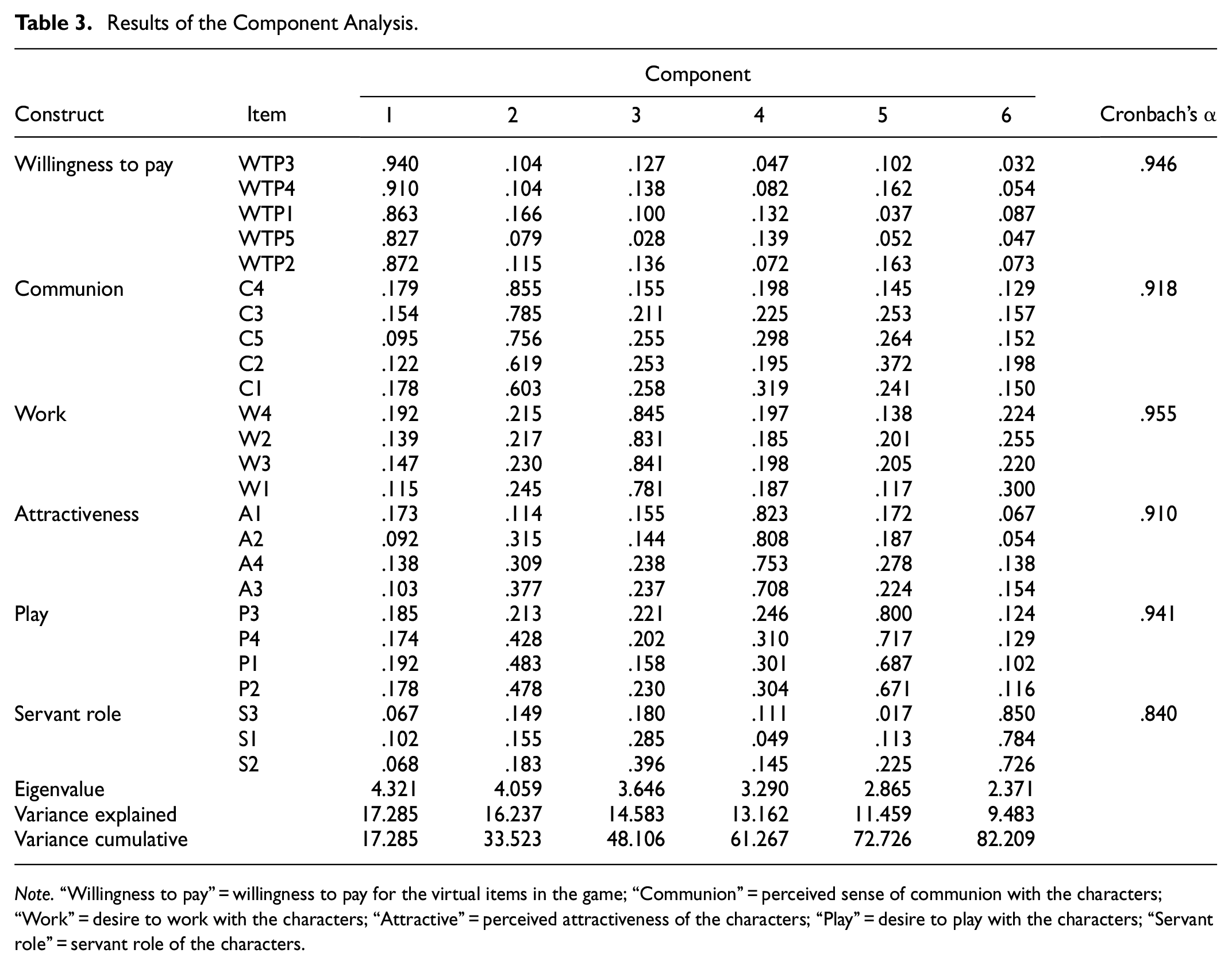
Note. “Willingness to pay” = willingness to pay for the virtual items in the game; “Communion” = perceived sense of communion with the characters; “Work” = desire to work with the characters; “Attractive” = perceived attractiveness of the characters; “Play” = desire to play with the characters; “Servant role” = servant role of the characters.
Correlations Between Constructs
The results of the correlation analysis, which includes the correlation coefficient, the squares of the correlation coefficients, and AVE, are shown in Table 4. Additionally, all values of AVE are above .5 and bigger than the squares of the correlation coefficients, which implies a good discriminate validity (Fornell & Larcker, 1981).
Results of Correlation Analysis.

Note. The figures on the diagonal line mean AVE, and the figures in parentheses are the squares of correlation coefficients.
Testing the Hypotheses Model
To test the hypotheses model, the AMOS 22.0 program was used. The model fit results show that χ2 = 479.377 (df = 260, p = .000), GFI = .861, AGFI = .826, CFI = .962, TLI = .956, IFI = .962, RFI = .909, NFI = .921, and RMSEA = .061. Additionally, the AVE values, which were calculated using the formula by Hair et al. (1998), were mostly found to be above .7.
The convergent validity and discriminant validity were used to evaluate the construct validity. All of the items showed convergent validity with statistically significant (p < .01) factor loadings (Anderson & Gerbing, 1988). Moreover, the standardized factor loadings were above .70 (Hair et al., 1998), with critical ratios above 2.57 (Netemeyer et al., 2003). The results of the measurement model are shown in Table 5.
Results of the Hypotheses Model.
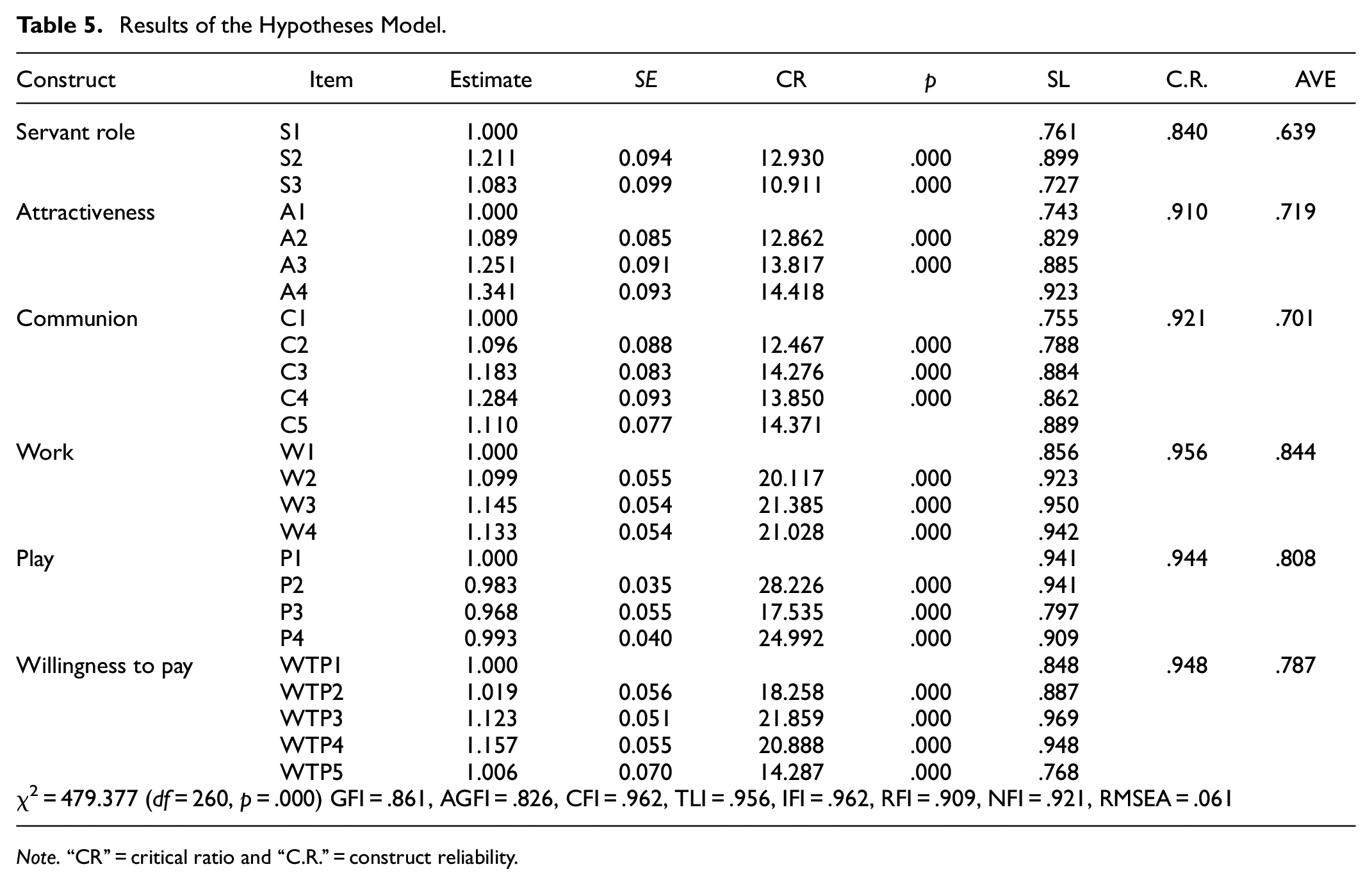
Note. “CR” = critical ratio and “C.R.” = construct reliability.
Testing Hypotheses
To obtain the correct test results from the hypotheses, direct paths were added to the model; then, AMOS 22.0 was used to test the model again. The results were as follows: χ2 = 486.988 (df = 266, p = .000), GFI = .859, AGFI = .828, CFI = .962, TLI = .957, IFI = .962, RFI = .909, NFI = .920, and RMSEA = .060.
The test results of the hypotheses are shown as Table 6. The results show that both the desire to work with the character (Estimate = .210, CR = 2.503, p = .012), and the desire to play with the character (Estimate = .384, CR = 3.909, p = .000), positively affect female players’ willingness to pay for virtual items in the game; this supports hypotheses 1 and 2. Moreover, the perceived sense of communion with the characters was found to positively influence female players’ desire to “play” with the characters (Estimate = .744, CR = 8.325, p = .000). The servant role of the characters was shown to positively affect female players’ desire to “work” with the characters (Estimate = .587, CR = 8.035, p = .000); this supports hypotheses 3 and 4. Lastly, the perceived attractiveness of the characters was found to positively affect both female players’ desire to work (Estimate = .591, CR = 5.258, p = .000) and desire to play (Estimate = .435, CR = 4.076, p = .000) with the characters; hence, hypotheses 5 and 6 are supported.
Results of Testing Hypotheses.

Mediation Effect Analysis
A mediation effect analysis was conducted using bootstrapping in Amos, wherein the “perceived sense of communion with the characters,”“perceived attractiveness of the characters,” and “servant role of the characters” were used as endogenous variables. Moreover, “willingness to pay for the virtual items in the game” was used as an exogenous variable, and “desire to play with the characters” and “desire to work with the characters” were used as mediation variables. Additionally, before the analysis, the number of bootstrap samples was set to 2,000, and the confidence intervals were adjusted to 95%.
The results of the mediation analysis are shown in Table 7. The direct path from “servant role of the characters” to “willingness to pay for the virtual items in the game” is insignificant, because the confidence intervals (lower bound, upper bound) include 0 and the p-values are greater than .05; however, the indirect path from “servant role of the characters” to “desire to work with the characters” to “willingness to pay for the virtual items in the game” is significant (CI = [0.031, 0.353], p = .017). Therefore, “desire to work with the characters” plays a full mediating role in the pathway from “servant role of the characters” to “desire to work with the characters” to “willingness to pay for the virtual items in the game.”
Mediation Effects.

Similarly, “desire to play with the characters” plays a full mediating role in the pathway from “perceived sense of communion with the characters” to “desire to play with the characters” to “willingness to pay for the virtual items in the game”(CI = [0.033, 0.662], p = .031). “Desire to work with the characters” plays a full mediating role in the pathway from “perceived attractiveness of the characters” to “desire to work with the characters” to “willingness to pay for the virtual items in the game” (CI = [0.033, 0.404], p = .014 < .05). Finally, “desire to play with the characters” plays a full mediating role in the pathway from “perceived attractiveness of the characters” to “desire to play with the characters” to “willingness to pay for the virtual items in the game” (CI = [0.017, 0.404], p = .032 < .05).
Discussion and Conclusions
Research Conclusions
With the development of AI, anthropomorphism is becoming a new topic of interest for researchers. As games use AI to communicate with customers, in-game characters are able to take on more important roles. These characters not only help the game move forward, but they also help build a relationship with the female players who work/play with the characters by communicating with them. The present research defines “work” as the challenge of finishing a task with an AI character, or the completion of a task alone. On the other hand, “playing “with AI characters is defined as enjoying the game with AI characters and experiencing pleasure and fun during the gaming process. Moreover, this study shows that female players’ desire to work/play with the characters positively affected their willingness to pay for virtual items in the game (Hypotheses 1 and 2).
This study explored the relationship between the servant role of the characters and the female players’ desire to work with the characters. It also explored the relationship between the sense of communion with the characters and the female players’ desire to play with the characters. The servant role of a character in the game is generally shown in situations wherein the character helps the female player to complete a task, they obey the players’ commands, and they follow the player’s instructions. The findings show that the servant role of the characters positively affects the female player’s desire to work with the characters (Hypothesis 4). Moreover, the sense of communion with the characters was achieved as a result of the characters’ ability to be with the female player when needed. Furthermore, the characters were kind, warm, and considerate. This was a crucial factor in terms of interpersonal interactions; this study found that a sense of communion had a positive effect on female players’ desire to play with the characters (Hypothesis 3).
Finally, attractiveness has been identified as one of the determinants of interpersonal relationship quality; thus, the effects of the characters’ attractiveness on the female players’ desire to work/play with the characters were explored. Moreover, the study found that the characters’ attractiveness positively affected the female players’ desire to work/play with the characters (Hypotheses 5 and 6).
Theoretical Contributions
Based on the abovementioned findings, this study has several theoretical contributions to offer.
First, this research focused on female consumers in the mobile game market; this filled a gap in the literature, as previous research tended to focus solely on the male perspective. There are many studies that pay attention to male players’ purchasing behaviors; however, the growing market comprising female gamers has been ignored (Hsiao & Chen, 2016). This study bestowed more importance on female consumer groups, and it tried to ascertain the factors that may affect their willingness to pay for in-game items. Moreover, our study suggests that female players pay a great deal of attention to the experience of playing games.
Additionally, this study explored the reasons behind players’ willingness to pay from a psychological perspective. Furthermore, this paper proposed, for the first time, that there are two kinds of motivational relationships between players and characters in games: work and play. Although there have been many previous studies on the motivations of players (Dalisay et al., 2015; Kneer et al., 2022; B. Patzer et al., 2020), this study is the first to explore such motivations from the perspectives of both “work” and “play.” Studies have found that consumers are willing to pay based on their desires to work or play with characters in the game. This requires game developers and managers to take a closer look at the relationship between characters and players. Players not only want to achieve their goals and win the game, but they also want to experience and have fun with the characters in the game.
Third, this work points out two relationships that players may have with their in-game characters. They may perceive the character as adopting one of the following two roles: servant or assistant. These roles are based on the characters’ personalities, and the findings suggest that when the players perceive the characters to be submissive, in the servant role, they are more likely to activate the players’ work motive rather than play motive.
Managerial Implications
With regard to traditional games, the player is more likely to complete a mission with the help of the in-game characters. This is consistent with our research in that servant role positively affect players’ desire to work with them. Furthermore, the present research also found that a sense of communion, fostered by in-game characters, can also positively affect the players’ desire to play with them; thus, game designers could develop in-game characters and game content accordingly in order to attract players who want to play with such characters.
As for the plot design, game designers should focus more on the interactions between the female players and the in-game characters—especially emotional interactions. For example, when a player is ill, the character in the game can appear beside the player and take care of them. The existence of such interactions will make players feel a greater sense of communion, which, in turn, could enhance their desire to play the game, and thus, make them more likely to pay for virtual items in the game.
Additionally, our results show that the characters’ attractiveness has a positive influence on the female players’ desire to work and play with the characters. This means that character designers should pay attention to the visual and auditory aspects of the characters in order to attract more female players to the game. In particular, with the development of science and technology, particularly the development of mobile communication technology, players can play games anytime, and anywhere, using mobile game terminals. At the same time, with the development of the visual and auditory functions of mobile game terminals, especially with regard to mobile phones; therefore, the visuals, and the sound design of the game, also need to echo the attractiveness of the in-game characters to some extent. For example, game marketers can make greater use of voice actors who match the characters’ descriptions in order to make the interactions between the female players and the in-game characters more realistic.
Finally, this study focuses on female players’ motivation and behaviors, clarifying the effects of the characters’ submissive attributes, the perceived in-game sense of communion, and the attractiveness of the characters on female players’ motives and their willingness to pay. The findings of our research imply that game design should focus more on the gender of gamers and their psychological needs. Men and women players usually exhibit different motivations when playing games, and they focus on different aspects of the gaming experience.
Limitations and Future Research
Although this study offers many theoretical and managerial contributions, there are still some limitations that require further exploration. First, this research examines women’s perspectives with regard to their willingness to pay for virtual game items; however, it does not make comparisons between male and female players. That is, it does not examine whether there are differences between men and women in terms of their character preferences with regard to common mobile games; thus, future work could explore the role of gender in greater detail.
Second, the current work only focuses on players’ willingness to pay for the virtual items in mobile games. Upon examination of the current gaming markets, there are many new popular mobile games that become available in app stores each day (Chang, 2021); therefore, players can easily decide to play other games before they decide to pay for any virtual items in the original game. Thus, it is necessary to explore whether the submissive characteristics of the in-game characters, the perceived in-game sense of communion, and the attractiveness of the characters have effects on mobile game loyalty.
Third, this work emphasized the mediating role of psychological motivations; in particular, the effects that characters’ features could have on psychological motivations, and thus, WTP. However, this study ignored other possible reasons that could explain players’ purchase behaviors. Previous research has suggested that perceived enjoyment when playing mobile games can significantly affect players’ desire to continue playing the game (Merikivi et al., 2017; B. Patzer et al., 2020; Sinlapanuntakul et al., 2022); thus, in the future, research can focus on the mediating role of perceived enjoyment when playing games, or the perceived value of the virtual items in game, and whether this affects players’ willingness to pay.
Footnotes
Acknowledgements
Thanks for all contributions of authors toward current study.
Declaration of Conflicting Interests
The author(s) declared no potential conflicts of interest with respect to the research, authorship, and/or publication of this article.
Funding
The author(s) disclosed receipt of the following financial support for the research, authorship, and/or publication of this article: This study was supported by Universities’ Humanities and Social Science General Research project of Henan Province (2023-ZZJH-018) and the Research Start-up Foundation of Henan Finance University (2021BS009).

Data Availability Statement
The data used to support the findings of this study are available from the corresponding author upon request.