




Abstract
Wildlife especially large mammals such as elephants are an important part of an ecosystem providing various ecological functions and services, although they are often involved in human-wildlife conflict. The National Elephant Conservation Center (NECC) in the Pahang state of Peninsular Malaysia was established to ensure that the survival of the Asian Elephant (Elephas maximus) in Peninsular Malaysia through direct management, as well as educational and public awareness activities. However, no entrance fee has been imposed since the establishment of the center in 1989 (32 years). This study aimed to determine public willingness to pay for an entrance fee in the NECC. By using the open-ended contingent valuation method (CVM), the mean public willingness to pay for an entrance fee in the NECC during the non-peak season amounted to RM4.65/person/visit whereas it was RM7.09/person/visit during the peak season. The study would serve as a reference for entrance fee implementation for a conservation center as a form of financial aid to sustain the center as well as highlight the importance of public engagement in elephant conservation.
Introduction
National parks and wildlife conservation centers play an integral role in the conservation and preservation of biodiversity and the provision of other benefits associated with the maintenance of ecological integrity via in situ and ex situ approaches (Bhatt & Bhatt, 2016). Such places not only provide opportunities for people to learn and explore wildlife and their habitats but also significant contributions to the local communities’ livelihoods when community engagement programs are properly planned (Bhatt & Bhatt, 2016).
The Department of Wildlife and National Parks (DWNP) Peninsular Malaysia, under the Malaysia Ministry of Natural Resources, Environment, and Climate Change, is a government agency responsible for the management and conservation of wildlife in Peninsular Malaysia, including the Asian Elephants (Elephas maximus). The National Elephant Conservation Center (NECC) is one of the largest wildlife centers in Peninsular Malaysia and is popularly referred to as the Elephant Orphanage Sanctuary. It was established to protect and manage those elephants whose habitat had been lost due to land use changes such as agricultural development, and those involved in human-elephant conflict (Department of Wildlife and National Parks, 2019). Managing human-elephant conflict through digging trenches, installing electric fences and translocation are some of the common mitigation measures undertaken in Malaysia which involve substantial amount of expenses (Saaban et al., 2011). In addition to direct management of elephant populations, the center also carries out public awareness activities related to the elephant conservation issues in Malaysia. However, since the establishment of the NECC in 1989 (about 32 years ago) no entrance has been imposed.
The NECC is one of the main attractions for the tourism sector in the Pahang state. Based on the statistics recorded by the Tourism Pahang agency, more than 100,000 visitors visited the NECC from 2015 to 2019. There was an increase (35.68%) in the visitors’ arrivals from 159,005 in year 2015 to 215,742 in 2019. The increasing number of visitors often occurs during the peak seasons, such as public and school holidays, and this may cause congestion in the NECC (Department of Wildlife and National Parks, 2019). Charging an entrance fee may provide a solution to control visitor numbers. However, before imposing an entrance fee in the NECC, the estimated willingness to pay (WTP) of the public for the entrance fee must be determined in addition to identifying factors influencing the public’s WTP for such an entrance fee.
There are several studies related to the WTP for elephant conservation elsewhere. Bandara and Tisdell (2005) explored the WTP of 300 urban residents for the conservation of Asian Elephants in Sri Lanka via contingent valuation method and found that there was a probability of increasing their WTP for those who had a positive perception toward conservation of elephants; emphasized on the importance of the animal’s bequest and existence values (non-use values); held pre-conservation values, had higher income, and/or level of education (Bandara & Tisdell, 2005). The study found that the residents believed that the conservation center built for elephants would reduce human-elephant conflicts and help prevent elephants from destroying crops. Similarly in China, Wang et al. (2020) found that knowledge and perception toward wildlife is a factor that can influence people’s WTP for conservation and so is bequest value. That study investigated 442 Chinese residents’ WTP for the African Elephant (Loxodonta spp.) conservation using a choice experiment model and found their WTP was USD231.65 annually for conserving the African Elephants. In Malaysia, Kaffashi et al. (2015) employed factor analysis and a double-bounded contingent valuation method to estimate WTP for a proposed entrance fees based on 304 visitors to the NECC. The average visitors’ WTP for an entrance fee was RM6.25 per person. The study also showed that the respondents’ motivation to support the elephant conservation by paying an entrance fee was influenced by their direct experiences with the elephants, their satisfaction with the NECC programs and services, and their perception toward elephant conservation.
Currently, the DWNP has little information about visitors’ attitudes and perceptions on elephant conservation (Department of Wildlife and National Parks, 2021; Ghosh et al., 2016). In many cases, policy makers are faced with difficulties in determining a fee that should be imposed in wildlife conservation centers without information on how much visitors are willing to pay for such initiatives (Bakar et al., 2021). This study would offer the relevant authority’s justification for financial allocations while providing a reference on the appropriate amount of entrance fees for the NECC. The money generated can potentially support the operational costs of the center as well as elephant management in the wild. Moreover, this study also captured the economic value of a wildlife conservation center highlighting the importance of conserving local wildlife, especially elephants to the public. Hence, after a decade since the study by Kaffashi et al. (2015), using contingent valuation method, this study reassessed public’s WTP for an entrance fee to the NECC as well as their attitudes and perceptions toward the center.
Methods
Study Site
The NECC, Kuala Gandah, is located about 15 km from Lanchang town within the Temerloh district of Pahang, at the center of Peninsular Malaysia. The NECC is located about 100 km to the east of Kuala Lumpur. The center covering an area of 5.8 ha is located within the Krau Wildlife Reserve, which was established to preserve wildlife species within a pristine forest. Established in 1989 and being managed by the DWNP, the center has been coordinating activities conducted by the Elephant Relocation Team formed in 1974. Being the first and largest elephant sanctuary in Malaysia, the center is in charge of locating, subduing, and translocating elephants that run into conflict with humans (Department of Wildlife and National Parks, 2019). The NECC was chosen in this study due to its roles in supporting elephant conservation related research and enhancing public awareness through educational programs. The center is open throughout the year to visitors at no cost.
Sampling Techniques and Questionnaire Design
The survey was administrated through convenience sampling method by focusing on people who were from the state of Pahang only. The respondents had to be at least 18 years old and employed. The survey was conducted using an online survey. The questionnaire was prepared in Google Form in two languages, namely English and Malay. The questionnaire was distributed in Google Form via social media (primarily Facebook and Instagram).
The open-ended questionnaire used comprises of four main sections including questions on the social demography of the respondents, their attitudes, and perceptions toward the elephant conservation, and WTP for an entrance fee to the NECC. For WTP, the respondents were given open-ended questions and being asked to specify the maximum value they were willing to pay for an entrance fee to the NECC during the non-peak and peak seasons based on the scenario given below:
The National Elephant Conservation Center (NECC), Kuala Gandah is known as the largest wildlife conservation center in Malaysia, specifically established for the Asian elephants, and has attracted visitors from all over the world. Since the establishment of the NECC, in 1989, no entrance fee has been imposed for the past 32 years. The purpose of the entrance fee can be used for elephant conservation activities. Therefore, the aim of this study is to determine the willingness of the public to pay for an entrance fee a proxy to understand the value placed by the public with respect to elephant conservation. Before answering the following questions, you are reminded that: (a) The money received is solely to support the elephant conservation center and elephant conservation services in the NECC, and (b) The willingness to pay for an entrance fee is measured based on your ability to pay for each visit.
Example of the willingness to pay section of the questionnaire:
D1. Based on the scenario above, are you willing to pay for an entrance fee to visit the National Elephant Conservation Center, Kuala Gandah?
□ Yes (If yes, go to D2 (i) (ii))
□ No (If no, go to D3)
If yes, given that there is an intention to avoid congestion, the National Elephant Conservation Center is imposing separate entrance fees based on:
i. Non-peak season
ii. Peak season (public and school holidays).
D2. In non-peak season what is the maximum payment per visit that you are willing to pay to enter the National Elephant Conservation Center, Kuala Gandah?
RM/person/visit ____________
D3. In peak season how much in proportion (%) based on the above value stated in D2 would you be willing to allocate for sustaining the center?
_____________ %
D4. If no, why? (You may choose more than)

Other reasons _________________
There were 10 people involved in the pretesting process and another 30 respondents were selected for the pilot study. The pilot study was conducted to ensure the reliability and validity of the questionnaire prior to the actual survey. For the Likert scale questions, Cronbach’s alpha values generated from SPSS software version 24 was used for the reliability test. The values of the Cronbach’s alpha were above .8 for all sections, that is, .822 for questions pertaining to the public’s attitude and it was .891 for questions on perception. This indicated that the questions were reliable and accepted for further analysis.
In order to test the validity of the research instrument, the questionnaire was validated by four validators, of which three validators had expertise in wildlife conservation and the other validator had exposure to economic valuation studies. The 4-point scale rating with 1 = Not Relevant, 2 = Medium, 3 = Relevant, and 4 = Very Relevant had been used to evaluate all the sections of the questionnaire. Content Validity Index (CVI) and Aiken’s V method were employed to validate the points made by the validators. The scale-level CVI (S-CVI) was calculated using the number of items in the measurement tool that received a “very relevant” rating (Rodrigues et al., 2017). It is recommended that scales with content validity of .78 or higher for the I-CVI whilst for the S-CVI/UA (proportion of items achieving a score of higher than 3) and S-CVI/Ave (average of scores for all items) the values should be .8 and .9 or higher, respectively (Shi et al., 2012). Other than that, a value of 1.00 in the item-level CVI (I-CVI) should be present if there are five or fewer judges, and in the case of six or more judges, the I-CVI should not be less than .78 (Shrotryia & Dhanda, 2019). In this study, the value of the S-CVI of .98 was obtained, suggesting the content validity was very high.
Chi-squared test was used to identify the significant differences between the socio-demographic variables and public WTP for an entrance fee to the NECC. The presence of multicollinearity among the variables was assessed prior to conducting a Tobit Regression which was used to determine significant factors influencing WTP. The estimated mean value of WTP for an entrance fee to the NECC was calculated using the equation proposed by Honu (2007).
Tobit Regression
To date, various studies have considered a variety of WTP estimation approaches. The most prevalent modeling approaches have been logit models (Czajkowski et al., 2017), Tobit models (Ren et al., 2020; Yang et al., 2018), and ordinary least squares (OLS; Javan-Noughabi et al., 2017). Each of these techniques comes with its own set of advantages and disadvantages. When it comes to WTP estimation, the ordinary least squares technique is less preferred. This is because the estimates derived from OLS regression become inconsistent when the data for the dependent variable are either positive or zero (Yang et al., 2018). As a result, the OLS estimates were unable to capture the full effect of this quantitative data.
Considering the nature of the data in this study, Tobit models are the preferred technique to estimate WTP (Ren et al., 2020; Yang et al., 2018). A Tobit regression model was used in this case because the WTP values were not normally distributed. In this case, if

and

Where X denotes the matrix of explanatory variables and the error term
Results and Discussion
Socio-Demographic Variables
More than half the respondents were female at 55.5% (111) compared with male respondents (45.5% or 89 respondents; Table 1). The majority of the respondents were from the younger generation, that is 54.0% (108) of the respondents were 20 to 29 years old, followed by 30 to 39 years old (32.5%), 40 to 49 years old (10%), and only 7 respondents were 50 to 59 years old. The majority of the respondents, which was 50.5% (101), had an education level of the Malaysian Higher School Certificate/Diploma/Matriculation Programs. There were 38.0% (76) of the respondents who had a bachelor’s degree which was followed by 9.5% (19) of the respondents who had received high school education. Only 2.0% (2) of the respondents had a master’s degree. About 48.5% (97) of the respondents were working in the private sector, followed by 34.5% (69) of the respondents working in the civil servant sector, and 14.5% (29) were in businesses while only 2.5% (5) were retirees. In terms of income, a total of 49.5% (99) of the respondents had individual gross monthly incomes of RM2,001 to RM4,000. The second largest gross income category was those below RM2 001 (76 respondents), followed by the RM4,001 to RM6,000 income range (17 respondents), and only 8 respondents had monthly income of above RM6,000.
Socio-Demographics of the Respondents (n = 200).

Note. Significance level of .05* and .01**.
Chi-squared test, α = .05.
The result of the chi-squared test indicated the significant difference in the socio-demographic variables, namely gender, age, educational level, occupation, and individual gross monthly income and public willingness to pay for an entrance fee into the NECC between non-peak and peak seasons.
Attitudes Toward Elephant Conservation
Referring to Table 2, the mean scores for all items were 3, implying a positive attitude toward elephant conservation. First, for the statement that they would enjoy taking part in elephant conservation activities, more than half of the respondents strongly agreed at 75.0% (150) and 25% (50) agreed with this statement. This corroborated with Wang et al. (2020), that is, the participation of the public in elephant conservation activities organized by NECC can help generate more support from the public as well as the related authorities to make a difference in protecting elephants in their natural habitat. About 73.0% (146) of the respondents strongly agreed to support the effort of the government to establish the NECC in order to conserve elephants and 54% (27) of the respondents agreed. This was supported by Kaffashi et al. (2015) who found that the establishment of wildlife conservation centers is useful in protecting wildlife from danger and preventing them from extinction.
Mean Scores Pertaining to Attitudes Toward Elephant Conservation (n = 200).

For a 5-point Likert scale, using the formula (highest value – lowest value)/no. of categories in statistics calculation: low (1) = 1 to 2.339, medium (2) = 2.34 to 3.669, and high (3) = 3.67 to 5.00.
The Perceptions Toward Elephant Conservation
In terms of perceptions toward elephant conservation (Table 3), the mean scores for all the items were 3, implying a high level of perception toward elephant conservation. The finding showed that most of the respondents (92.5%) strongly agreed and 7.5% (15) of the respondents agreed that wildlife is important as a part of the ecosystem for balancing the environment. According to Wang et al. (2020), as part of the world’s ecosystems, wildlife is important in maintaining the balance and stability of ecosystems and the ecological processes. There were 92.0% (184) of the respondents who strongly agreed while another 8.0% (16) of the respondents agreed that elephants need to be protected for future generations. This is a reflection of bequest value which was supported by Adamu et al. (2015) who stated that if wildlife conservation measures are not put in place, future generations will not have a chance to see some of the wildlife that exist today.
Perceptions Toward Elephant Conservation.

For a 5-point Likert scale, using the formula (highest value – lowest value)/no. of categories in statistics calculation: low (1) = 1 to 2.339, medium (2) = 2.34 to 3.669, and high (3) = 3.67 to 5.00.
Factors Influencing WTP to Enter the NECC
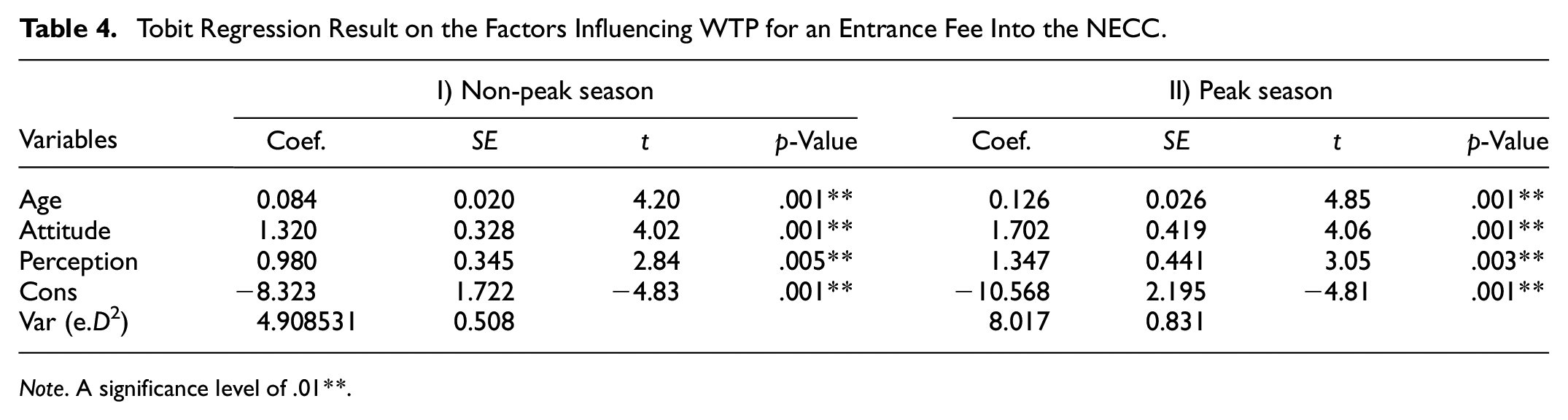
Table 4 shows the results of the continuous variable to measure the factors that influence WTP for an entrance fee to the NECC in the peak and non-peak seasons. The results showed that all the variables, namely age, attitude, and perception significantly influenced the respondents’ WTP for an entrance fee regardless of peak or non-peak seasons. A positive coefficient for age implied that this factor had more influence on the decon of the respondents toward WTP. Such a finding implies that that nowadays young generations have more exposure toward wildlife conservation and they enjoy participating in wildlife conservation activities (Witt, 2019).
Tobit Regression Result on the Factors Influencing WTP for an Entrance Fee Into the NECC.
Note. A significance level of .01**.
In addition, the attitude of respondents toward elephant conservation had significant positive influence on their WTP for an entrance fee for both seasons. It showed that the increase level of public’s positive attitude toward elephant conservation would increase their WTP for an entrance fee. This may imply their awareness toward the outcome of their contribution to ensure that wildlife can be protected. Similarly, the public’s perception toward elephant conservation also had significant positive influence on their WTP for an entrance fee. This implies positive perceptions about elephant conservation would lead to a higher WTP in our case.
Estimation of the Willingness to Pay for an Entrance Fee Into the NECC
The mean WTP derived for the non-peak season was RM4.65/person/visit whereas the mean WTP for the peak season was RM7.09/person/visit based on the maximum and minimum WTP stated by the respondents. The values obtained from this study is quite similar to that of Kaffashi et al. (2015) who found the average visitors’ WTP for an entrance fee to NECC was RM6.25 per person/visit.
Conclusion and Policy Implications
This study revealed positive perceptions and attitudes of the public toward elephant conservation in Malaysia and their support toward such initiative via their WTP remained unchanged after a decade. Their WTP was significantly influenced by their socio-demographic backgrounds including gender, age, educational level and income. Our findings showed consistency in support wildlife conservation and public engagement is possible to generate financial support for such attempts.
The Asian Elephants play a significant ecological role in influencing the floristic composition and distribution in the tropical forests (Campos-Arceiz & Blake, 2011). However, human-elephant conflict is not uncommon in many tropical countries in which the animal is found, and the resulted losses and damages are substantial (Montez & Leng, 2021; Saaban et al., 2011; Zafir & Magintan, 2016). In Malaysia, elephants have the longest history in such conflict with human (Lim & Campos-Arceiz, 2022; Zafir & Magintan, 2016) and the associated consequences are excruciating. Local communities ranging from indigenous people, villagers, farmers to even general public may be a victim of such conflict. Between 2001 and 2007, it was reported that the human-elephant conflict cases had increased about 85% to 22% annually in the states of Pahang, Terengganu, and Kelantan (Clements et al., 2010).
Various mitigation measures such as creating barriers by digging trenches, installing electric fences and translocation have been implemented at hotspots in which human-elephant conflict occurs. In 2018 alone, a total of 45 operations had been made to catch elephants in Kedah, Perak, Kelantan, Terengganu, Pahang, and Johor. These measures often involved help and support from the local communities and their roles are significant to deal with the problem effectively (Terada, 2021). For years, the NECC serves as a base for the elephant relocation team of the DWNP in Peninsular Malaysia. The role of the center has expanded into research and creating public awareness of the animal. To date, the center does accept donation from the public but has yet to implement an entrance fee, despite the visitor numbers are increasing and placing the center as an attraction for tourists. In this study, in terms of WTP estimation, the value was found to be RM4.65 per person per visit during the non-peak season and RM7.09 per person per visit during the peak season. A reassessment of WTP after a decade indicates such value is quite consistent and can be applied as an entrance fee at a fixed price per visit for maintenance and the conservation of elephants in the NECC. In addition, imposing an entrance fee is particularly important for the elephant relocation team as the costs of elephant translocation as well as human-elephant conflict mitigation measures are high (Saaban et al., 2011).
In addition, the increase in public engagement can be done by the DWNP to public support and participation in elephant conservation activities in the country. If the public gets to know more information about elephant conservation and the importance of conservation activities, the efforts and outcome of such activities could be improving. For example, our study indicated that when the public has a high level of positive attitude toward elephant conservation, they will tend to participate in elephant conservation activities. The DWNP can conduct campaigns using various mediums, such as social media, broadcasts, newspapers, and talks, to attract the public to join elephant conservation activities. Thus, the public will gain more information about the elephant conservation. Other than that, the current education curriculum may be improved to ensure wildlife conservation issues will be exposed to the younger generations sooner in schools. For example, reforming the education curriculum at the primary schools will provide greater insights and awareness during early age. Moreover, it can improve the public’s positive perception toward elephant conservation issues in the long run and will also contribute toward higher WTP to support such conservation centers.
In conclusion, our findings imply positive implications toward many parties to ensure wildlife, especially elephants, can be protected. First, the DWNP can include the information about the public’s attitude and perception toward wildlife conservation in education and community programs. It should be noted that the main limitation of our study was the limited sample size of respondents which were coming from one state and those who happened to use social media. Nonetheless, we cannot deny the positive response from this particular group of respondents. Furthermore, this indicates the need of covering a wider group of respondents which is likely to increase the WTP values. More importantly, the finding regarding the factors influencing public WTP for an entrance fee into the NECC will be useful for the DWNP for the reference to propose an entrance fee to be implemented during peak and non-peak seasons or days. Locally, the policy makers can decide what is the appropriate value amount that can be considered as the entrance fees into other conservation centers located throughout the country. This study highlighted the importance of public engagement and thus their support. When properly implemented, the public would have an opportunity to participate in the species conservation planning and the related activities and this would ensure public interest is being incorporated in the decision- and policy making process pertaining to species conservation efforts (Terada, 2021).
Footnotes
Acknowledgements
The authors would like to give thanks to Dr Irina Harun, Dr Diana Emang, and Puan Nik Atiqah for validating the questionnaire of this research.
Declaration of Conflicting Interests
The author(s) declared no potential conflicts of interest with respect to the research, authorship, and/or publication of this article.
Funding
The author(s) disclosed receipt of the following financial support for the research, authorship, and/or publication of this article: The publication fee for the article was funded by the Research Management Centre, Universiti Putra Malaysia.
