



Abstract
Risk is a crucial concern in the field of tourism safety research and is widely recognized as a constraining factor that influences tourists’ decision-making process. However, heterogeneity exists in tourists’ perceptions of risks, yet few studies have focused on understanding when and how perceived risks can enhance potential tourists’ travel intention. Drawing upon risk homeostasis theory and the theory of planned behavior, this study constructs theoretical models encompassing perceived risk, travel intention, desired risk, attitude, subjective norm, and perceived behavior control. Moreover, empirical analysis was conducted via 716 valid questionnaires collected from potential adventure tourists. The findings reveal an inverted U-shaped curve effect of “initial increase followed by decrease” regarding the influence of perceived risk on the travel intention of potential adventure tourists, with the desired risk acting as a key moderating variable. Furthermore, perceived risk may influence travel intention by mediating through attitude. The conclusions drawn from this paper provide valuable theoretical support for product design, marketing strategies and safety management within the adventure tourism industry while contributing to its sustainable and healthy development.
Plain language summary
Risk is an important topic in tourism safety research and is generally regarded as a restraining factor that affects tourists’ decision-making. However, few scholars have noted the heterogeneity of tourists’ risk perceptions. Perceived risk, as a new perspective of research on the decision-making behavior of adventure tourists, is not fully understood because of its incentive effect on travel intention. Based on risk homeostasis theory, this paper clarifies the multiple concepts of risk and their relationships and constructs a structural equation model to test the decision-making mechanism of tourists’ adventure tourism under risk conditions using the theory of planned behavior. The findings are as follows: (1) Perceived risk may be a restraining factor or a motivating factor for adventure tourism, and desired risk plays a key moderating role. (2) The travel intentions of potential adventure tourists are most affected by perceived risk, followed by subjective norms, and least affected by attitude. (3) Perceived behavioral control cannot significantly affect the travel intentions of potential adventure tourists. The conclusions of this paper not only provide theoretical support for the product design, marketing and safety management of adventure tourism but also contribute to its sustainable and healthy development.
Introduction
As it continues to grow in popularity globally, adventure tourism has strengthened in appeal to mainstream mass tourists, gradually transitioning from an activity for the bravest to a form of mass tourism (T. Q. Zhou et al., 2009), and has become one of the fastest growing segments in the travel industry (J. Wang et al., 2019; N. Wang et al., 2019). The World Adventure Tourism Association noted that adventure tourism is an important part of the tourism industry in developed countries such as the United States; it contributes 220 billion US dollars to the US economy every year (Cater, 2006) and is progressively gaining prominence in the tourism industry of emerging countries such as China (M. Cheng et al., 2018). Furthermore, an increasing market size and social influence mean that adventure tourism has wider research significance. In recent years, adventure tourism has attracted much attention from industry and academia (Doran et al., 2022) and has become a cutting-edge topic and an important subject in tourism research (Song et al., 2009). However, the current academic research on adventure tourism is not deep enough; in particular, the impact of risk on the behavior of potential adventure tourists is not clear and needs to be explored.
Tourism, especially adventure tourism, which is full of risks and uncertainties, is most vulnerable to risks (Ritchie, 2004). Risk is generally defined as the subjective understanding of the severity of consequences and the cognitive assessment of occurrence probability (Wolff et al., 2019), which is a key factor affecting tourists’ travel decisions (Cong et al., 2017; Lepp & Gibson, 2003). When the perceived potential risk exceeds the personal risk threshold, tourists experience fear, anxiety, and threats and may cancel their travel plans (Law, 2006) or choose safer options for travel (Batra, 2008). Therefore, risk is generally regarded as a restraining factor for travel decisions and behaviors (Quintal et al., 2010). However, some scholars have found that individuals have heterogeneity in their risk perceptions (Olofsson & Öhman, 2014). This view has also been validated in the field of tourism (Seabra et al., 2013), where there are significant differences between older and younger adults and between male and female respondents in terms of the perceived risks of space tourism (Kim et al., 2023). Matiza and Kruger (2021) proposed that tourists with different risk perceptions have significant differences in their safety perceptions of tourist activities and tourist behavior (travel intention). Although some studies have noted that tourists have different levels of perceived risk, few studies have used empirical methods to verify the impact of tourists’ different levels of perceived risk on travel intention. In addition, studies have explored the inhibitory effect of perceived risk on tourists’ behavioral intentions (Bi & Gu, 2019; Lin et al., 2023). However, in the context of adventure tourism, perceived risk may have an incentive effect on travel intentions, but at present, few studies have explored when and how perceived risk stimulates potential tourists’ travel intentions.
Risk may be a motivating factor in the context of adventure tourism (E. C. L. Yang & Nair, 2014). Adventure that tourists are not risk averse but actively seek out risky activities. Studies have shown that risk is an indispensable part of adventure tourism, as it is the core element that stimulates and challenges tourists, triggers pleasant experiences, and attracts potential tourists (Beckman et al., 2017; J. Wang et al., 2019; N. Wang et al., 2019). Therefore, the study, which is based on the theory of planned behavior and risk homeostasis theory to influence the perceived risk potential of adventure tourists, aims to address the following questions:
Does perceived risk have an impact on potential adventure travelers?
How does the desired risk moderate the relationship between perceived risk and travel intention?
What psychological mechanisms underlie the influence of perceived risk on travel intention?
To answer the above questions, Hainan surfing tourism is chosen as an empirical case study. Surf tourism has become an important segment of the global adventure tourism industry, which has great economic, social and environmental significance and deserves the attention of the academic community (Buckley, 2002). As the largest tropical island in China, Hainan, with its good wave conditions and suitable climate temperature, attracts many enthusiasts at home and abroad and has become a surfing resort in China and even the world. Hainan is already a top destination for Chinese surfing tourists. With the popularization of the surf tourism market in Hainan, safety problems such as the operational norms of surf clubs and the qualifications of coaches have become increasingly prominent, and the risk of injury to and drowning of surf tourists has increased sharply, which has restricted the healthy and orderly development of surf tourism in Hainan.
Accordingly, our research sorts the conceptual dimensions and development characteristics of adventure tourism, clarifies multiple concepts constructs a research model combined with the theory of planned behavior (Ajzen, 1991) to conduct a questionnaire survey to gather the perspectives of potential adventure tourists. Through structural equation verification, the role and path of perceived risk in the process of influencing travel intention are analyzed, and the functional logic and influence boundaries of perceived risk are fully revealed, which provides theoretical support for the design innovation of adventure tourism products, marketing promotion and safety risk management and contributes to the sustainable and healthy development of adventure tourism.
Literature Review and Research Hypotheses
Concept Definition and Development Trend of Adventure Tourism
Once a relatively marginal or niche segment of the travel industry, adventure tourism has become one of the mainstream global travel markets, and it was worth $683 billion as of 2020. Despite the rapid growth of adventure tourism, academic research on this topic is still undeveloped (Nicolae et al., 2021). Academic circles have not yet reached a consensus on the conceptual core of adventure tourism and the essential difference between adventure tourism and traditional tourism. At present, adventure tourism is still an abstract and complex phenomenon (Janowski et al., 2021) with different concepts and characteristics. The World Adventure Tourism Association (ATTA) defines adventure tourism as any tourism that involves at least two of the following three elements: natural interaction, cultural interaction, and physical activity. Clearly, the concept of adventure tourism conflicts with that of other types of tourism, such as sports tourism and ecotourism. For example, wilderness trekking can include adventure tourism, sports tourism or ecotourism. To understand adventure tourism more deeply and define its essential differences from sports tourism and ecotourism, there is an urgent need to recognize the characteristics of adventure tourism and redefine its concept. Through text mining and statistical analysis, Janowski et al. (2021) reported that risk and danger (Cater, 2006; Imboden, 2012), the natural environment (Giddy & Webb, 2018), stimulation and excitement (Buckley, 2012), challenge (Tsaur et al., 2013), and physical activity (Sung, 2004) are the five essential characteristics of adventure tourism. Thus, adventure tourism can be defined as a tourism activity that relies on the natural environment; offers challenging, stimulating and exciting experiences; and requires the support of special sports equipment that involves certain risks and uncertainties (Palmer, 2002; L. F. Yang et al., 2022).
With the expansion of the market scale, the commercialization and “soft” trend of adventure tourism is obvious (Dickson & Dolnicar, 2004). Based on the level of risk, adventure tourism is usually divided into “hard” and “soft” categories. Soft adventure tourism refers to activities involving perceived risk but a low level of real risk, requiring a very low level of skill and physical fitness; most of these activities are guided by experienced tour leaders, so novices may participate (Beckman et al., 2017). Hard adventure tourism refers to high-risk activities that require high levels of investment and skills (Hill, 1995). With changes in the climate environment, equipment conditions, guidance levels, tourist experiences, skills, psychology and other factors, “soft” and “hard” adventure tourism are mutually convertible (Janowski et al., 2021). Tourism operators should actively improve adventure equipment and infrastructure, provide stronger expert guidance and safety management, and promote “soft” high-risk adventure activities for low-risk or even risk-free adventure tourism products. For example, hiking tours or beginner training courses led by mountaineering experts are very attractive to novice mountaineers. The scholar Varley (2006) noted that the commercialization of adventure tourism—“adventure”—is sold as a controllable and manageable experience product. “Safe” adventure tourism products have occupied the main share of the adventure tourism market and have promoted the accelerated expansion of the commercial scale of adventure tourism. Therefore, why are adventure tourism products still sought after by the enormous emerging tourist source market after the loss of real risk? The existing studies do not fully elucidate the level and type of risk potential that adventure tourists actually want. Thus, there is an urgent need to deepen our understanding of the risk attitudes of potential adventure tourists.
Incentive Effect of Perceived Risk
The advantage of adventure tourism lies in providing tourists with relatively strong sensory stimulation experiences (Muller & Cleaver, 2000). Therefore, are “safe” adventure tourism products still at risk? Can such products still provide a stimulating experience? To better answer these questions, it is necessary to clarify the concepts of absolute risk, real risk, perceived risk and desired risk and their interrelationships. These concepts have been the focus of early research in the field of outdoor sports risk management. Absolute risk refers to the uppermost limit of inherent risk; real risk refers to the actual amount of risk, which is a subset of absolute risk. Perceived risk is an individual’s subjective perception of real risk, which may be underestimated or overestimated (Dickson & Dolnicar, 2004). From the perspective of social psychology, the perception of risk before travel reflects respondents’ anxiety (Korstanje, 2009) because respondents’ perceptions are based on their imagined future travel experiences (E. C. L. Yang & Nair, 2014). Desired risk is a subset or extension of an individual’s perceived risk and can be greater or less than the perceived risk (Dickson & Dolnicar, 2004).
Perceived risk has a greater impact on potential adventure tourists than does real risk. Studies have shown that adventure activities are regarded as adventures by tourists, not because they represent real risks but rather because of perceived risks (Nicolae et al., 2021). For example, surfing, in most people’s minds, is thrilling and exciting, but under customized arrangements made by tour operators, it has become “no risk.” In other words, tourists’ risk demand is derived mainly from perceived risk, not from real risk (Cater, 2006). Therefore, the key for adventure tourism operators is to strike a balance between real risk, perceived risk and desired risk. When designing surfing tourism products, tourism operators mitigate risk by carefully selecting suitable surfing locations and providing trained safety coaches. Previous studies have indicated that tourists’ perceptions of risk can influence their behavioral intentions (Lin et al., 2023; J. G. Wang et al., 2022). However, for adventure-seeking tourists who are drawn to excitement, perceived risk may actually enhance their willingness to engage in such travel experiences by evoking emotions (Chen & Cui, 2023). When evaluating surfing tourism products, tourists tend to assess the associated risks. Based on risk homeostasis theory and existing research findings, it can be inferred that tourists’ perceived risk significantly impacts their purchase intention toward surfing tourism products. Therefore, the following hypothesis is proposed:
To reach the optimal level of stimulation, operators effectively commercialize “stimulation” and tailor the perceived risk level brought about by adventure tourism products to exactly meet the desired risk needs of tourists (Dickson & Dolnicar, 2004). The greater the adventure experience of potential travelers is, the greater their acceptance of risk and their expectations are (Baláž et al., 2024). According to risk homeostasis theory (Wilde, 1998), the interplay between perceived risk and desired risk significantly impacts travel intentions. When the desired risks associated with potential adventures align closely with perceived risks and are at an optimal level of stimulation, travelers exhibit the strongest intention to engage in travel. However, when perceived risk does not reach the desired risk, travel intention increases with increasing perceived risk (D. Wang et al., 2023), and when perceived risk exceeds the desired risk, travel intention decreases with increasing perceived risk (Figure 1). In other words, when the perceived risk is lower than the desired risk, risk is the motivating factor; conversely, when the perceived risk is higher than the desired risk, risk is the inhibiting factor. Therefore, the following hypotheses are proposed in this paper:

Indicates the optimal stimulation level of adventure tourism.
An Extended Theory of Planned Behavior Model
The theory of planned behavior (TPB) is a rational decision-making model that uses three independent variables, attitude (AT), subjective norm (SN) and perceived behavior control (PBC), to explain and predict individual behavior intention (Ajzen, 1991). It has been widely used in the field of tourism research and has strong explanatory power (Gstaettner et al., 2017). Scholars usually extend and optimize the TPB model appropriately according to specific research problems (Dang et al., 2017). For example, Quintal added variables of “perceived risk and uncertainty” on the basis of the TPB model to explore the impact of risk and uncertainty on tourism decision-making (Quintal et al., 2010). The TPB has been utilized extensively in determining tourists’ decision-making process for selecting pet-friendly hotels (Meng et al., 2024), revisiting intentions (Susanto et al., 2024), and choosing experiential destinations (Bianchi et al., 2017). It has demonstrated strong predictive and explanatory capabilities. However, there is a lack of research that employs the TPB to investigate how potential adventure tourists’ perceived risk affects travel intention. To fill this research gap, the study integrated risk factors into the TPB model. The expanded TPB (Figure 2) helps clarify the decision-making process and key factors influencing tourists in the context of perceived risk and can provide a comprehensive understanding of the decision-making mechanism of adventure tourism.

Research model.
According to the theory of planned behavior, attitude refers to an individual’s evaluation of their preference or aversion toward a specific behavior (Ajzen, 1991). Attitude plays a pivotal role in influencing decision-making processes, and tourists’ attitudes toward toward pets significantly impact their selection of pet-friendly hotels (Meng et al., 2024). When potential surfing tourists encounter decisions involving risk, they develop an attitude toward risk-taking behaviors that is accompanied by positive or negative emotional inclinations (Gstaettner et al., 2017). A positive attitude toward risk among potential adventure tourists stimulates their travel intentions (Quintal et al., 2010), whereas a negative attitude inhibits the travel intentions of potential adventure tourists. On these premises, the following hypothesis is proposed:
Subjective norms denote the social pressures that individuals perceive when determining whether to engage in a specific behavior (Ajzen, 1991), which stem from family members, friends, colleagues, and other social circles. Prior research has demonstrated that subjective norms significantly influence tourists’ intentions to visit destinations within a virtual tourism context (Li et al., 2021). Furthermore, potential tourists also recognize subjective norms during their decision-making processes and are swayed by them. Observing peer groups participating in adventure activities—such as surfing—increases their likelihood of engaging in similar pursuits (Furman et al., 2010). Consequently, the following hypothesis is proposed:
Perceived behavior control refers to the influence of tourists’ past experiences and anticipated future obstacles on their behavioral intentions (Ajzen, 1991), such as the time, money, and virtual tourism hardware available to them. The greater the resource endowment that tourists possess and the smaller the expected difficulties are, the greater their perceived behavioral control will be; a high level of perceived behavioral control leads to stronger behavioral intentions (Erul et al., 2020). For potential surfing tourists, a stronger sense of perceived behavioral control correlates with lower anticipated difficulties related to surfing and increased confidence, which in turn enhances their intention to engage in surfing tourism (Ulker-Demirel & Ciftci, 2020). On this basis, the following hypothesis is proposed:
In addition, protection motivation theory (PMT) states that people evaluate the severity, probability of occurrence and effectiveness of risk responses based on risk information, thus stimulating protection motivation and influencing attitudes and behavior intentions (Rogers, 1975). J. G. Wang et al. (2022) discovered that perceived risks among tourists at cultural heritage sites can engender negative attitudes toward cultural activities. Research by Bi and Gu suggests that perceived risks in outbound tourism may provoke a risk-averse attitude among tourists, thereby diminishing their travel intentions. Conversely, J. Cheng et al. (2024) reported that engaging in challenging tourism activities with friends—rather than family—can foster positive attitudes toward risks among tourists. However, perceived risk does not affect subjective norms or perceived behavior control (Quintal et al., 2010). Since subjective norms refer mainly to the influence of family and friends, individuals’ social attributes determine that the perceived risks associated with adventure activities are unlikely to affect their perception of the pressure of social norms. Second, perceived behavior control reflects an individual’s ability to control factors that promote or limit exploration behavior, such as money, time and physical health, whereas perceived risk represents the expectation of potential risks and is unlikely to affect self-assessment of the ability and resources needed to carry out exploration behavior. Thus, the following hypothesis is proposed:
Methodology
Measurement
The questionnaire items were designed according to the characteristics of surf tourism and use the mature scales of domestic and foreign studies (Dang et al., 2017; Dickson & Dolnicar, 2004; J. Wang et al., 2019); thus, a preliminary draft of the questionnaire was formed. An interview with a tourism professor and surf coach was used to refine the setting and expressions of the items. We subsequently conducted a questionnaire pretest on 10 master’s and doctoral students from academic backgrounds in tourism management to validate the content and understanding of the questions. The formal questionnaire (Table 1) was ultimately administered through the presurvey. The formal questionnaire consisted of four parts. The first part involved screening potential tourists who had not participated in surfing tourism. The second part focused on the TI, AT, SN, and PBC of the respondents who participated in surfing tourism. The third part asked respondents about their DR and PR regarding their participation in surf tourism. The fourth part collected background information, including demographic characteristics such as gender, age, education and income. The questionnaire was evaluated via a Likert scale ranging from 1 (strongly disagree) to 7 (strongly agree).
Items of the Measurement.

Source. Designed according to Dickson and Dolnicar (2004), Dang et al. (2017), and J. Wang et al. (2019).
Data Collection
Prior to the formal survey, a total of 180 questionnaires were gathered through snowball sampling on the WeChat platform (Pattison et al., 2013). Additionally, the reliability and validity of the questionnaire were validated via SPSS version 26.0. The analysis revealed a KMO value of 0.839, surpassing the acceptable threshold of 0.6, while Cronbach’s α coefficient was found to be .926, also exceeding the minimum standard of 0.6, thereby indicating that the questionnaire possesses strong reliability and validity (Gerbing & Hamilton, 2016)
The formal survey was conducted via the snowball sampling method on the WeChat platform, resulting in a total of 831 collected questionnaires. Among the returned questionnaires, those that selected the same option for seven consecutive items and those with two or more unanswered items were excluded, yielding 716 valid responses and an effective response rate of 86.16%. According to the requirements of structural equation modeling for sample size, a sample size of 716 would be appropriate for our study, accounting for the 19 total measurement items (Hair et al., 2006; Zhao & Shen, 2024).
Respondent Demographics
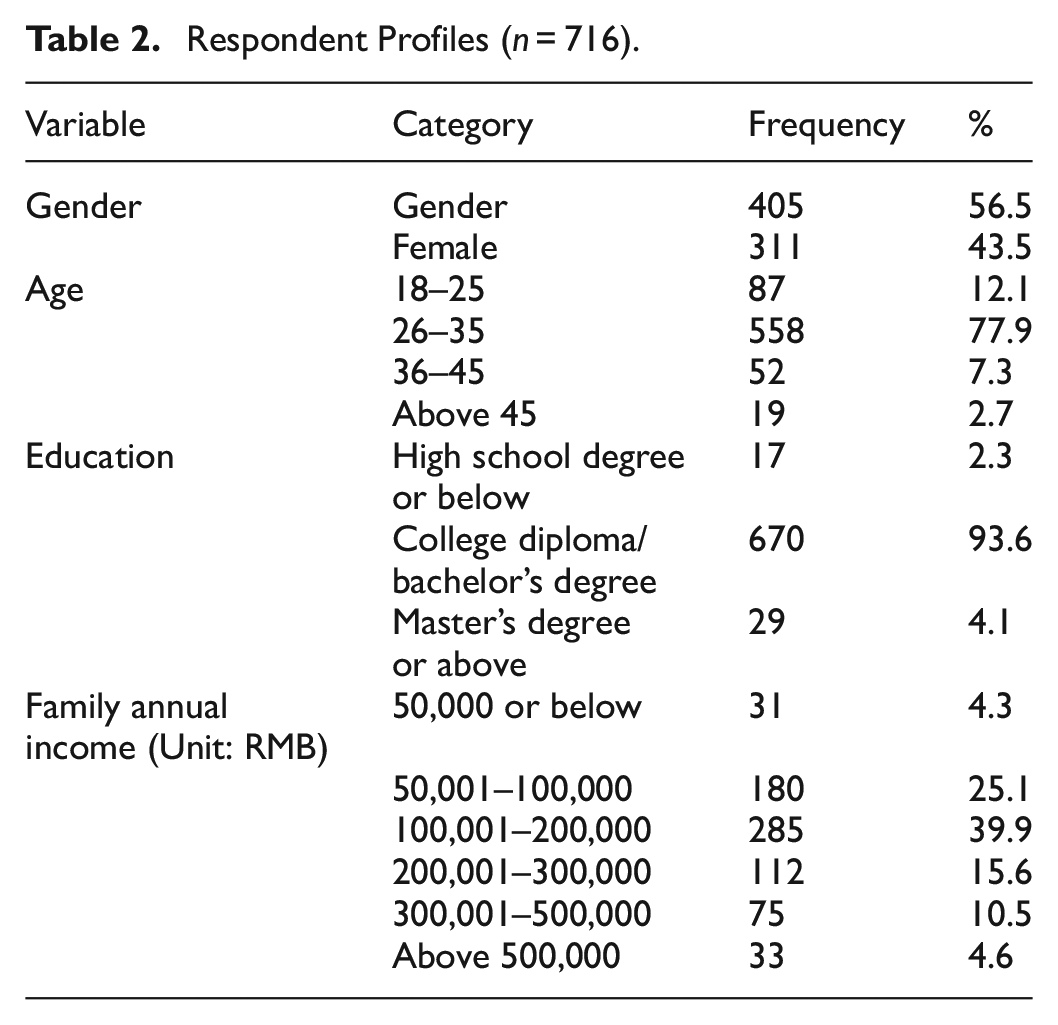
Using SPSS 28.0, a descriptive statistical analysis was performed on the 716 valid samples (Table 2), comparing the demographic characteristics of the sample with those of surf tourists (J. Wang et al., 2019; N. Wang et al., 2019). The results indicate that the study sample’s characteristics regarding gender, age, income, and other factors align with findings from previous reports, suggesting that this study’s sample effectively represents potential adventure tourists. The demographic characteristics of the sample are as follows: in terms of gender, there is a slight predominance of males over females, which corresponds to observations indicating that male surf tourists outnumber their female counterparts; concerning age distribution, an impressive 89.0% of participants fall within the young tourist category aged 18 to 35 years, reflecting a trend where Chinese surf tourism predominantly attracts younger individuals; regarding educational attainment, an impressive 93.6% of respondents possess at least a bachelor’s degree, demonstrating their ability to adequately comprehend questionnaire content; finally, in terms of annual family income, 70.6% report earnings exceeding 100,000 yuan annually—consistent with evidence suggesting that surfing enthusiasts generally enjoy higher family incomes.
Respondent Profiles (n = 716).
Common Method Bias
The data utilized in this study were gathered through questionnaires completed by the participants, which may introduce concerns regarding common method bias. To mitigate this effect, the study implemented stringent procedural controls, including meticulous questionnaire design, anonymous testing, and allowing participants to independently complete the questionnaires to minimize mutual contamination effects. Furthermore, after data collection, the extent of common method bias was statistically assessed via Harman’s single-factor test. The analysis revealed that the first factor accounted for 16.784% of the variance—below the critical threshold of 40%—indicating no significant issue with common method bias in this study’s data (H. Zhou & Long, 2004).
Results
SPSS 28.0 was utilized for conducting descriptive statistical analysis and assessing the reliability and validity of the scale to ensure data quality (Gerbing & Hamilton, 2016). AMOS 23.0 statistical software was subsequently employed to perform structural equation model analysis to examine the covariant relationships between variables. The data analysis results were reported following the two-step approach proposed by Anderson and Gerbing (1988), wherein the measurement model was analyzed first, followed by the analysis of the structural model.
Measurement Model
SPSS 28.0 was used to test the reliability and validity of the survey data. The results of principal component analysis (PCA) revealed that the KMO value of the whole scale was 0.857, the associated probability according to the Bartlett chi-square test was .000 (p < .001), the load coefficient of each variable factor was above .5, and the total explanatory variance was 77.359%, indicating that the research scale had a good validity structure. The Cronbach’s α value of the scale as a whole was .842, and the Cronbach’s α values of PR (.841), AT (.889), SN (.922), PBC (.875), TI (.937), and other variables were all greater than 0.8, indicating strong internal consistency of the scale (Gerbing & Hamilton, 2016). The data reliability was good.
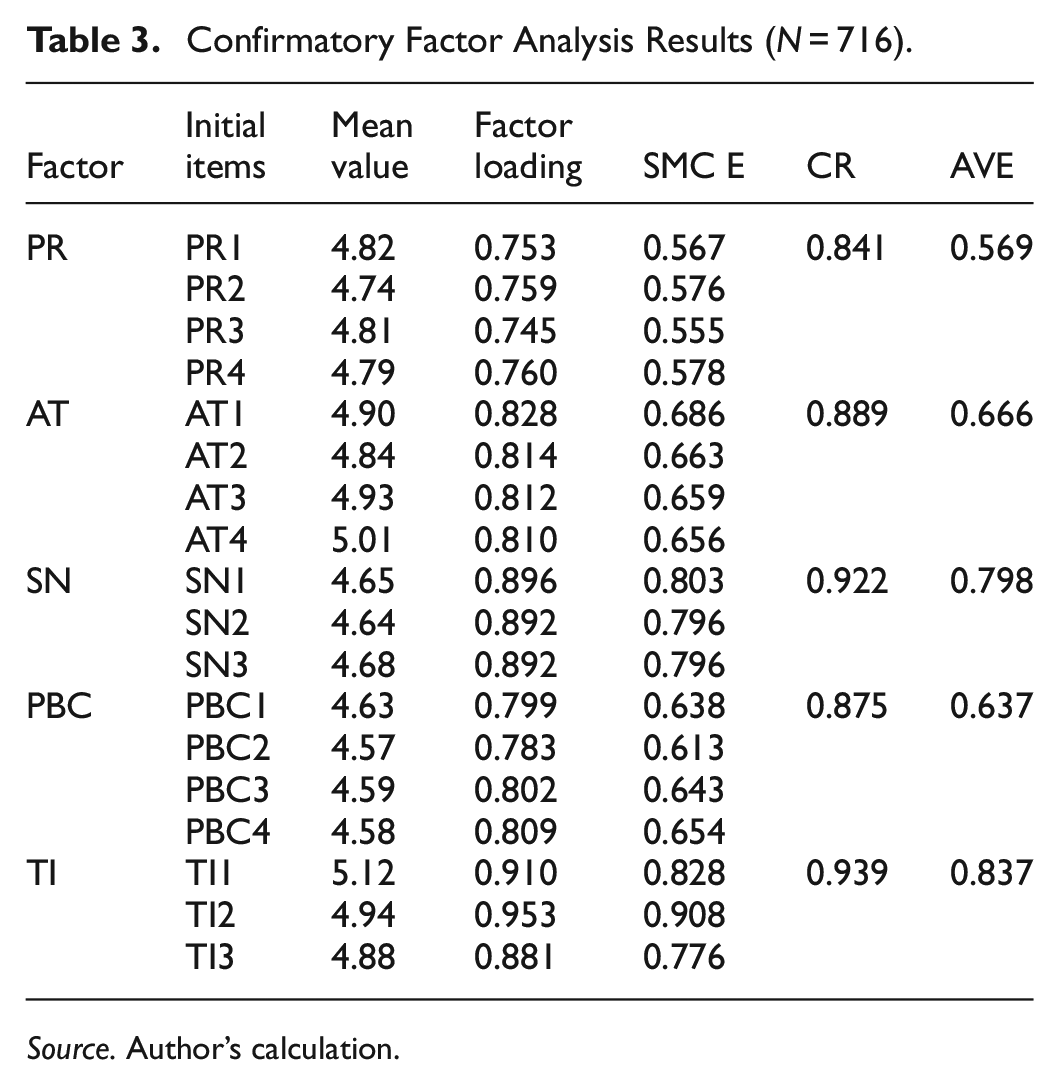
Amos 23.0 was used to establish a confirmatory factor model. Multiple goodness-of-fit indices were calculated as follows: χ2/DF = 1.197, GFI = 0.977, AGFI = 0.969, CFI = 0.997, TLI = 0.996, IFI = 0.997, RMSEA = 0.017, and RMR = 0.042. The fit indices of the models all reached the standards (χ2/DF less than 3; GFI, AGFI, CFI, TLI, and IFI greater than 0.95; and RMSEA and RMR less than 0.05), which indicates that the models were valid. When the factor load of each measurement item was greater than 0.7, the combined reliability (CR) value of each variable was greater than 0.8, and the average variance extracted (AVE) value was greater than 0.6 (Table 3), indicating that the convergent validity of all variables was considered satisfactory and that all the variables met the evaluation criteria suggested by Hair et al. (2006). The square root of the AVE value of each latent variable (the diagonal values) is larger than the other values in the same row and column (Table 4), supporting the discriminant analysis’s validity (Fornell & Larcker, 1981). Furthermore, the heterotrait–monotrait ratio (HTMT) was assessed to evaluate discriminant validity (Henseler et al., 2015). The results showed that the HTMT values of the constructs ranged from 0.105 to 0.658 and were less than 0.85; thus, the criterion for the discriminant validity of the variables under study was met.
Confirmatory Factor Analysis Results (N = 716).
Source. Author’s calculation.
The Construct of Discriminant Validity.

Source. Author’s calculation.
Means being significant at the .01 level; the diagonal bold value is the square root of the variable AVE.
Structural Model
Amos 23.0 was used to construct the model, and the maximum likelihood method was selected to test the hypothesis. The overall fit indices of these research models are as follows: χ2/DF = 1.179, GFI = 0.977, AGFI = 0.97, CFI = 0.997, NFI = 0.982, TLI = 0.987, IFI = 0.997, RMSEA = 0.016, and RMR = 0.042. These findings indicate that the model has a good overall fit and can be tested for its main effect.
Hypothesis Testing of the Direct Effect Test
According to the verification results of the structural model (Table 5), hypotheses H1, H3, H4, and H6 are valid, whereas hypothesis H5 is not. In other words, the AT and SN of potential adventure tourists have significant positive impacts on TI, PR has a significant negative effect on TI and AT, and PBC has no significant effect on TI.
Test of the Hypothesis Model.

Source. Author’s calculation.
Indicates significance at the .001 level.
Test of the Moderating Effect of DR on the Relationship Between PR and TI.T
When the regulating variable is a categorical variable, the interaction term method is not suitable for testing the moderating effect (Wen et al., 2005). In accordance with the suggestions of Wen et al. (2005), the AMOS multigroup comparison method was used to test the moderating effect of DR on the relationship between PR and TI. First, by comparing the levels of DR and PR, the samples were divided into two sample groups: the high-DR group (DR was higher than PR, N = 204) and the low-DR group (DR was lower than PR, N = 304). The research model of PR (independent variable) → TI.T(dependent variable) was subsequently established and verified. The verification results are shown in Table 6. In the high-DR group, the PR of potential adventure tourists has a significant positive effect on TI (β = .640, p = .000). That is, the greater the perceived risk is, the stronger the travel intention is; thus, H2a is valid. In the low-DR group, the PR of potential adventure tourists had a significant negative effect on TI (β = −.469, p = .000). That is, the greater the perceived risk is, the weaker the travel intention is; thus, H2b is valid. Overall, hypothesis H2 is valid. DR plays a moderating role in the influence of PR on TI.
Test Results of the Adjustment Effect.

Source. Author’s calculation.
Indicates significance at the .001 level.
Test of the Mediating Effect of AT on the Relationship Between PR and TI.T
In this study, bootstrapping analysis was used to test the mediating effect. Bootstrapping was conducted with 5,000 replicates at the 95% confidence interval (Hopwood, 2007). The results are shown in Table 7. The total effect of PR on the TI of potential adventure tourists is −0.306 (p = .000), the direct effect is −0.233 (p = .000), and the indirect effect is −0.073 (p = .000). The 95% confidence interval did not include zero (95% CI = [−0.121, −0.041]), indicating that AT plays a partial mediating role between PR and TI, and the mediating effect accounts for 23.86% of the total effect.
Results of the Mediating Effect Test.

Source. Author’s calculation.
Indicates significance at the .001 level.
Discussion
Based on risk homeostasis theory and the theory of planned behavior, this study takes risk as a motivating factor in the context of adventure tourism as a logical starting point, introduces risk factors into the study of the adventure tourism decision-making mechanism, builds a theoretical model of adventure tourists’ travel decision-making, focuses on how perceived risk affects tourists’ travel intentions, and conducts an empirical test using the case of surf tourism in Hainan. The significant effect of perceived risk on travel intention and the moderating effect of desired risk were confirmed, and the role and path of perceived risk on travel intention were revealed, thus providing theoretical support for a comprehensive understanding of the logic of perceived risk and its influence boundary.
First, perceived risk is not only an inhibiting factor for adventure tourism but also a motivating factor, and desired risk is its key moderating variable. This finding is in line with the conclusion of Wilde’s (1998) research that the relationship between perceived risk and desired risk affects consumers’ purchasing behavior but contrasts with the view that perceived risk is an inhibiting factor affecting tourists’ travel decisions (Quintal et al., 2010). Logically, considering risk as only a negative attribute is one of the main limitations of the application of risk perception theory in the field of tourism (Korstanje, 2009). This study reveals that in adventure tourism, risk is what tourists need. As noted in relevant studies, risk is an important and positive facet of the adventure tourism experience (Bentley et al., 2001). In the decision-making process of adventure tourism, risk has different meanings from different tourist perception perspectives (J. Cheng et al., 2024). When perceived risk is lower than desired risk, risk is regarded as a challenge that is actively pursued by adventure tourists, which provides them with thrilling sensory stimulation and the pleasure of self-transcendence, thus enhancing their willingness to travel. When perceived risk exceeds the desired risk, adventure tourists regard risk as a security threat and worry that their own skill level cannot cope with the challenge, thus reducing their willingness to travel. In other words, with increasing perceived risk, the influence of perceived risk on adventure tourists’ travel decision-making is first Motivating and then Restraining.
Second, potential adventure tourists’ travel intentions are most affected by perceived risk, followed by subjective norms, and least affected by attitudes. Previous studies have generally shown that attitude has an important positive effect on travel intention, and the path coefficient is approximately 0.4 (Li et al., 2021). In the context of adventure tourism, the positive effect of potential adventure tourists’ attitudes tends to weaken. This may be related to adventure tourism’s appetite for risk. Tourists always seek an optimal level of stimulation—an experience that combines fear, challenge, excitement and excitement (Palmer, 2002). Therefore, perceived risk is particularly important in decision-making related to adventure tourism. Tourists’ perceived risk is affected by both internal and external factors. External factors include travel advice and sources of risk information such as media and destination image. However, how to interpret and perceive risk depends on internal factors, which are closely related to one’s own attitude, experience and ability (E. C. L. Yang & Nair, 2014). The perceived risk variable contains some attitude attributes. This partly explains the weakening of the positive effect of attitudes. Notably, this study empirically tested the mediating effect of attitude between perceived risk and travel intention and revealed that perceived risk not only has a direct effect on adventure-related tourism intention but also has an indirect effect on this intention, thus further revealing the driving path through which perceived risk affects adventure-related tourism intention. In addition, subjective norms significantly positively affect travel intention, indicating that a greater level of support from family and friends with the preferences of young people leads to a stronger willingness to participate in adventure tourism activities.
Third, perceived behavior control cannot significantly affect potential adventure tourists’ travel intentions. This finding contradicts the research hypothesis derived from the theory of planned behavior. The underlying reason may be that surfing tourism products in Hainan have been developed for several years and are nearing maturity. To attract mass tourists, operators intentionally decrease the difficulty level of these surfing experiences, resulting in high perceived behavioral control among participants, which ultimately leads to statistically insignificant outcomes. On the other hand, surfing does not require swimming skills, there is a coach to guide the whole process, and the physical and informational requirements are not high. In other words, the threshold for potential surf tourists to experience surf tourism in Hainan is low. Time, economic factors, body conditions, information and other perceived behavioral factors cannot directly affect the intention to pursue adventure tourism.
Conclusions
Theoretical Implications
First, this study explores the impact of perceived risk on potential tourists’ travel intentions within adventure tourism activities based on risk homeostasis theory. The introduction of the desired risk as a moderating variable elucidates the boundary conditions under which and how perceived risk influences potential adventure tourists’ travel intentions. This further enhances the academic understanding of the relationship between perceived risk and travel intention while expanding the application context of risk homeostasis theory. Despite previous studies suggesting that perceived risk has negative impact on tourism intentions (Lin et al., 2023; J. G. Wang et al., 2022), this study reveals a nonlinear inverse U-shaped relationship between perceived risk and tourism intention, where perceived risk has a positive effect in the context of adventure tourism and provides a deeper understanding of the negative impact of perceived risk from the perspective of changes in risk perception. This study enriches the understanding of the role of perceived risk in potential adventure tourists’ travel intentions and contributes to a better understanding of the mechanism by which perceived risk affects their travel intentions.
Second, this study refines the psychological mechanisms through which perceived risk affects travel intention in adventurous contexts based on both risk homeostasis theory and the theory of planned behavior. It broadens the application scope of the theory of planned behavior while providing empirical support for the relationship between “perceived risk—attitude-travel intention.” Existing studies have explained how tourists’ perceptions of risk influence their travel intentions (Bi & Gu, 2019) and explored the pathways through which emotional arousal mediates this influence (Chen & Cui, 2023). However, few studies have investigated how attitudes toward facing risks further explore these mechanisms affecting travel intention from a tourist’s perspective. Overall, our research model theoretically explains adventure tourism decision-making processes well by identifying attitude as a mediator of how perceived risk affects travel intention and highlighting the positive impact of subjective norms on those intentions.
Practical Implications
First, research indicates that the relationship between perceived risk and adventure tourists’ travel intention follows an inverted U-shaped curve with an initial increase followed by a decrease. Moreover, desired risk serves as a crucial moderating variable whereby perceived risk has a negative impact once it surpasses the level of desired risk. Therefore, a higher perception of risk is not always preferable. The optimal perception of risk level for each individual is one that aligns with their own desired risk level. The level of desired risk varies among individuals and over time, typically increasing with an individual’s tourism experience and skill proficiency. Consequently, in adventure tourism marketing, overemphasizing excitement and adventure might lead to the loss of potential tourists with a relatively low desired risk level. Tourism operators can draw upon relevant studies on the heterogeneity of tourism perception risk (Kim et al., 2023; Seabra et al., 2013) to design questionnaires on risk heterogeneity in order to determine the desired risk levels of different tourist groups. For potential adventure tourists with different desired risk levels, differentiated risk marketing strategies should be adopted, providing comprehensive and accurate risk information to assist them in achieving a balance between perceived risk and desired risk, thereby enhancing their willingness to travel. From the perspective of product design, adventure tourism operators must contemplate how to fulfill tourists’ optimal perception of risk experience, ensuring it precisely meets the desired risk requirements and thereby stimulating the consumption behavior of potential adventure tourists. Successful adventure tourism operators are capable of identifying the desired risk levels of potential tourists and customizing the design of adventure tourism products that offer the best perception of risk experience along with safety guarantees that are in line with them. Adventure tourism products lacking risk stimulation might imply the loss of core appeal for potential adventure tourists with a high desired risk level. For instance, potential surf tourists with a high desired risk level are more likely to be attracted by challenging surf tourism products for a more thrilling risk experience, and vice versa.
Second, research indicates that the desired risks faced by adventure tourists primarily stem from perceived risk rather than actual risk. In other words, tourists engaging in commercial adventure tourism activities are actively seeking the exhilarating experiences associated with perceived risk, rather than being motivated by the safety threats posed by actual risk. Consequently, perceived risk exerts a more significant influence on potential adventure tourists compared to real risk. However, as an individual’s subjective interpretation of actual risk, perceived risk is susceptible to cognitive biases. A majority of accidents in adventure tourism arise from misjudgments regarding potential real risks. Therefore, using surfing tourism as a case study, it is imperative for surfing clubs to routinely update and disseminate comprehensive risk assessment reports that clearly outline potential risks and their probabilities within surfing activities. This will assist tourists in developing accurate perceptions of these risks. Simultaneously, surfing clubs should enhance safety protocols to ensure all equipment complies with established safety standards and provide essential safety gear (such as life jackets) to mitigate accident rates. Surfing instructors play a crucial role in directly interacting with tourists; thus they must improve their safety management competencies. Surfing coaches should regularly engage in training courses focused on safety to acquire up-to-date knowledge and emergency response skills so they can implement effective measures promptly when potential risks emerge. Before surf sessions, coaches ought to guide participants in identifying and assessing risks while clarifying safety regulations and swiftly addressing any unsafe behaviors exhibited by tourists. Furthermore, governmental regulatory bodies should intensify oversight of the surfing tourism sector by implementing measures such as evaluating the inherent risks associated with surfing products and establishing comprehensive safety standards along with service norms for these offerings.
Limitations and Prospects
In academic circles at home and abroad, adventure tourism is still viewed as an abstract and complex phenomenon; therefore, the incentive effect of perceived risk on adventure tourists’ travel intentions and the decision-making mechanism of adventure tourism need additional empirical attention. First, the risk intensity associated with surf tourism is relatively low, categorizing it as a “soft risk” project within the realm of adventure tourism. This may lead to an underestimation of the potential impact that risk has on tourists’ decision-making processes. Future research should explore adventure tourism activities characterized by higher levels of risk intensity, such as cave exploration, cross-country skiing, and skydiving. By comparing the decision-making behaviors of adventure tourists engaged in activities with varying degrees of risk intensity, researchers can gain deeper insights into this phenomenon. Second, this study employed questionnaires to validate the conceptual model; however, future investigations could benefit from using situational experimental methods—such as VR technology—to simulate adventure tourism scenarios. This approach would allow prospective tourists to gain a comprehensive understanding of adventure tourism prior to completing questionnaires for data collection purposes, thereby enhancing the robustness and validity of the research findings.
Footnotes

Institutional Review Board Statement
Not applicable.
Consent to Participate
Not applicable.
Funding
The author(s) disclosed receipt of the following financial support for the research, authorship, and/or publication of this article: This work was supported by National Social Science Foundation Project(21BGL019) and High-level Talent Project of Hainan Natural Science Foundation (420RC528).
Declaration of Conflicting Interests
The author(s) declared no potential conflicts of interest with respect to the research, authorship, and/or publication of this article.
Data Availability Statement
Data sharing not applicable to this article as no datasets were generated or analyzed during the current study.