




Abstract
The following study first examined how consumers are influenced by social media advertising and what role vloggers play in influencer marketing. Secondly, the factors considered by consumers while making a final decision for purchasing and traveling are explored, affected by the destination image for the country of origin. The aim of the research was fulfilled by reviewing relevant literature and defining and exploring the relationship among variables: vlog marketing, YouTube, Facebook, Instagram, Snapchat, E-WOMs, consumer travel intent, consumer purchase intent, destination image, and ease of travel. A self-administered survey questionnaire with a 5-point Likert scale was utilized and shared online among social media users for collecting data via two resources: personal connections and relevant social media platforms. A total of 428 valid responses were collected. The PLS-SEM software was used to analyze and interpret the data. The measurement model, structural model, regression analysis, and t-tests were used for testing and concluding results for hypotheses. The results concluded that vlog marketing, with all its higher-order constructs, except Snapchat, has a significant positive effect on consumer travel intent and purchase intent. Moreover, destination image and ease of travel enhance the relationship of vlog marketing and consumer travel intention but not that of vlog marketing and consumer purchase intention. The study contributes to the literature on influencer and content marketing on social media networks by emphasizing the role of vloggers in shaping consumer behavior and placing a distinct image of a destination place, and how ease of travel affects the decision to travel and buy travel goods and services advertised on vlogs.
Keywords
The digital revolution (2003–2005) started with the advent of new social media forums like Facebook and YouTube, providing a platform for people where they can easily communicate by sharing any type of content. It also paved many opportunities for businesses to flourish and shift their focus to social media marketing. As such, written editorials blogs with photos become an effective, popular tool for content marketing, initially gaining attention, engagement, and influencing readers globally (Bayazit et al., 2017). When Google purchased YouTube, in 2006 for 1.65 billion dollars, blogging changed with the rapid growth of video blogs and YouTube became one of the most popular social media channels on the internet (Bärtl, 2018; J. Kim, 2012). YouTube allows users to produce, view, post, and share videos about any topic of the day, products, and services they utilize (Khalid & Siddiqui, 2019; Ladhari et al., 2020). This rising popularity changed the trends in consumer behavior and social media marketing from text to visual marketing (Russmann & Svensson, 2016).
The swift advancement in technology and increase in the usage of smartphones has become a cause of the emergence of new social media platforms, hence leading to more user-generated content. For example, Instagram (2011) and Snapchat (2012) became new sources for sharing content and vlog marketing (VM) other than YouTube and Facebook (Russmann & Svensson, 2016; Tropp & Baetzgen, 2019). Moreover, not just the world, but Pakistan has also witnessed a rise in social media users in the recent years. Vlogging became popular in Pakistan in early 2017 when video-sharing sites started giving monetizing opportunities for video creators (Khalid & Siddiqui, 2019; J. Kim, 2012). According to a report by Digital Global Insights, there are approximately 4.7 billion social media users worldwide, with nearly 47 million active users in Pakistan, while the number is still rising both globally and locally (Ilyas & Ara, 2021; Kemp, 2021).
Marketing through vlogs can be done in many ways. Marketers either create their own vlogging social media channel for promotions, or they may also sponsor vloggers to advertise their goods and services through vlog advertising as it is a great source to reach out to the followers of the vloggers and increase their profits (De Jans et al., 2018). It also helps in improving the perceptions of their products. Vlogging is also a source of consumer-to-consumer marketing, as vloggers can help improve perception related to a destination by engaging the consumer or their followers and promote tourism by providing useful information (Peralta, 2019). Travel vloggers document their adventures on vlogs for various destinations, including culture, people, food, etc. using audio-visual aids, helping their followers to consume similar experiences through their feedback in the form of E-WOMs, which may produce a positive influence on followers’ travel routine, frequency, and intention, thereby convincing them to eventually follow (Cheng et al., 2020).
Furthermore, tourism has become a fast-growing industry in recent years, affecting the economic growth of most countries. In 2019, the global tourism industry contributed approximately US$ 10.7 trillion, or 13.5% of the global GDP, making it the ninth year in a row showing steady growth in the tourism industry and a 500% increase in VM (Peralta, 2019). The same year was significant for Pakistan as its reputation as a tourist destination improved, and many international visits of several reputed international travel vloggers took place, whose efforts paved the way for Pakistan’s reputation to change and encouraged the Royal couple from the United Kingdom, Prince William and Duchess Kate, to visit Pakistan (Pirzada, 2020). As such, Vlog Marketing is also benefiting the tourism industry across the globe by improving the destination images (DI) of various places through destination advertising or promotions, including Pakistan (Leung et al., 2015).
Despite travel constraints in some countries, ease of travel (EOT) is continuously promoted, drawing more tourists through a variety of policy packages, such as visa exemption or a basic visa policy (Lawson & Roychoudhury, 2016; Yudhistira et al., 2020). Moreover, countries from transitioning economies are increasingly relying on tourism as a source of revenue. For example in recent years, China has shown how quickly outbound and inbound tourism can be developed when appropriate national policies are implemented (Lawson & Roychoudhury, 2016). It is also essential to comprehend how tourism is affected by visa policies and the perceived image of the place. The problem arises when the vloggers may get successful in increasing travel intent and a positive destination image toward a specific country but the travel policies of a country may act as constraints, for example, strict visa policies, security threats, rising disparity issues, domestic traveling facilities, regulations, and deregulations issues etc. (C. C. Chen & Petrick, 2016; Khan et al., 2017, 2019). Given these facts and considering this gap the study is unique in examining the effects of travel intention on perceived travel ease. Most of the prior research on vlog marketing (VM) was focused on fashion products purchase intention (Ladhari et al., 2020), while tourism products and services are not addressed frequently in this manner. Previous studies have discussed the destination image of a country and perception related to it variously, but how the perception of an individual is influenced, enhanced, or changed after an experience for the country of origin through visual-based marketing has to be explored (Dedeoğlu et al., 2020), because traditional marketing can provide information but not a visual experience.
The paper first discusses the concept of vlogging and most popular social media platforms used by vloggers and consumers. It also examines the significant relationship between vlog marketing and consumer purchase intent, when consumers are influenced by different social media channels. The study also examines the relationship between vlog marketing and consumer travel intent in a similar way. The impact of vloggers in vlog marketing (VM) is studied as an independent variable on an individual’s perception and intentional behavior related to consumer purchase intent and consumer travel intent as dependent variables. Notably, ease of travel (EOT) and destination image (DI) have not been discussed in this manner before (see Figure 1), as they can either enhance or devalue consumer intentions. Thus the paper studies ease of travel and destination image as moderates addresses the objectives with quantitative results, and finally underlines the findings with recommendations and limitations for the future.

Conceptual framework.
Literature Review
Many studies have been proposed on social media and how it has changed the way people interact or share information online. However, the focus of this study is how vlog marketing plays its role in influencing consumers’ perceptions about a particular destination and creating purchase and travel intention. This part of the study includes the relevant past literature, definitions of variables, and their relationship as proposed in the conceptual framework.
Vlog Marketing
Global consumer dynamics and digitalization have caused a generational shift in social media usage and changed the way people access knowledge, especially in the tourism industry (Minazzi, 2015). Accordingly, vloggers of this era have increased consumer motivation and involvement, opinion generation, and expressing thoughts on experiences by their exclusivity and how they create content, thus increasing the value of content marketing (Abubakar & Ilkan, 2016; Leung et al., 2015). M. T. Liu et al. (2019) defined vlogging as a new form of video blogging where vloggers use storytelling and audio-visual aids to share their product or service experience across social media platforms. Vlogs are classified into many categories, based on their content, for example, personal life, beauty, fitness, food, travel, and gaming vlogs, which helps in generating electronic word of mouths (E-WOMs), influencing people and diffusing knowledge across social media (Abubakar & Ilkan, 2016; Choi & Lee, 2019).
Vlogging can be either expressing opinions on any subject—free from forming partnerships or making alliances with marketing brands—for promoting products, services, or travel places, called influential marketing (Khalid & Siddiqui, 2019; Y. C. Liu et al., 2016). Different social media networks like, Facebook, Snapchat, YouTube, and Instagram are used for vlogging. Vloggers help in promoting travel destinations through vlogs, highlighting all aspects of the country they have traveled to. New marketing strategies involve repeatedly broadcasting the same message from the same sources, which makes a customer believe and trust the source (Husnain & Toor, 2017; Lee & Watkins, 2016).
YouTube
Lee and Watkins (2016) identified YouTube as an easy, fast, and accessible source of information provided through videos. It has evolved as the most used, productive, and innovative social media platform for vlogging, purposely benefitting the marketers to encourage and capitalize E-WOMs, encouraging them to use it as a marketing tool (W. H. Kim & Chae, 2017). It helps the tourist to have realistic and immediate information about a location when a tourist views videos of another tourist. The benefit of YouTube over Snapchat is timing for content advertising, which is a minimum of 20 minutes, or the duration specified by the creator (Ladhari et al., 2020).
Achen (2016) defined Facebook as a social media framework where people share, interact, and engage in a virtual environment through ideas, information, and experiences related to any subject using photos and videos. The author further explored that Facebook adopted a video-sharing approach to compete with other social media networks shortly after YouTube became popular, causing an increase in many videos shared on Facebook. As such, popular vloggers consider vlogging as a full-time job after gaining millions of followers. It not only helps in making videos viral but facilitates communication, fosters relationships between users, and is considered the best communication social media platform across the globe with approximately three billion people joining every month (Khalid & Siddiqui, 2019; J. H. Park et al., 2016).
Lup et al. (2015) mentioned Instagram as a photo-sharing social media forum that allows people to post and share photos and short videos. In terms of popularity, it is second to Facebook, easily accessible from mobile devices, helping vloggers in increasing consumer engagement in their VM activity, which makes it unique (Johansson & Engström, 2016). Additionally, Instagram is becoming more critical than Facebook in terms of marketing strategies and promotion (Casalo et al., 2017; Shuqair & Cragg, 2017).
Snapchat
Billings et al. (2017) regarded Snapchat as a photo-sharing application that allows consumers to share videos and images. It is the third most popular, fastest, and utilized social media medium. It is exclusive of other social media platforms as it is just an application. Images shared on Snapchat disappear after 24 hours and the application supports a geographical location filter, allowing users to post when they are at a specific location (Billings et al., 2017; H. Chen & Lee, 2018). Since the use of Snapchat in the context of vlogging has not been discussed, this study would provide insight into how this technology is used in VM.
Electronic Word of Mouths (E-WOMs)
Ladhari and Michaud (2015) explained E-WOMs as group phenomena and one of the main factors that influence consumer perceptions through positive or negative buzzwords created by opinion leaders (influencers) on the internet. The importance of traditional word of mouth for businesses has been extensively researched specifically after an increase in social media marketing. They can reach a larger number of people in a shorter amount of time, thus are effective over traditional WOMs, prompting marketers to collaborate with vloggers on different social media networks for engaging and motivating consumers (Bayazit et al., 2017; Peralta, 2019).
Theory of Reasoned Action of Consumer Behavior
Theory of Reasoned Action or TRA model proposed by Fishbein and Ajzen (1975) explains the phenomenon of association between consumers’ behavioral intentions and their pre-existing attitudes. The theory also predicts that consumer attitude is affected by perceived behavior that imposes pressure on consumers due to subjective norms (Belleau et al., 2007; Madden et al., 1993; Schiffman et al., 2010; K. Z. Zhang et al., 2015). This theory has been frequently used in past studies concerning consumer intentional behavior. Consumer intentions are assumed to encompass the driving force behind the behavior, while subjective norms play as motivators that make consumers feel accepted (Bianchi et al., 2017; Lada et al., 2009), either purchase or travel behavior in the proposed study context. It is a conscious decision and showing a willingness to purchase a product or service. Consumers make mindful choices and decisions (Husnain & Toor, 2017; Lee & Watkins, 2016). Schiffman et al. (2010) stated that the actions of consumers in seeking, purchasing, using, evaluating, and discarding products and services lead to them believing their needs will be met. As a rule of thumb, the intent to perform a behavior increases the likelihood of its performance (Belleau et al., 2007). Kotler (2010) further added that it is based on consumers’ perceptions of products and services, marketing messages, and mental images formed before and after experiences. Purchase intention is triggered by an attitude toward a product or service. Higher intention to purchase is due to the positive attitude to a product or service (Choi & Lee, 2019; Ladhari et al., 2020).
The focus of the proposed study is how consumer purchase and travel intentions are developed by the influence of subjective norms, which result from social circle influences such as family, neighbors, friends, and peers who can directly or indirectly influence each other’s behavior (Ham et al., 2015; Lada et al., 2009; Schiffman et al., 2010). According to Belleau et al. (2007) consumers from generation Y was grown up in a fast-changing, consumer-driven society. Later these trends were followed by generation Z and the same trends are observed by generation alpha also known as mini millenniums, who frequently multitask by watching TV, surfing the internet, and listening to music (De Jans et al., 2018; Thomas et al., 2018). To effectively target these types of consumers, marketers need a broad, multifaceted approach for advertising because traditional marketing will not be effective. The consumers belonging to these generations get easily influenced by electronic word of mouth (E-WOM) spread through social media (Dedeoğlu et al., 2020; Xu & Pratt, 2018; K. Z. Zhang et al., 2015). The present study aims to validate the theory, as it can also be assumed that following a specific vlogger and being influenced by what the vlogger promotes leads to a positive intention for the product, service, or travel place by the consumer.
Consumer travel intent (CTI)
Y. C. Liu et al. (2016) defined consumer travel intent as the likelihood of particular travel behavior. J. H. Park et al. (2016) explained travel intentions as based on subjective norms, consumer perceived behavior, and attitudes. People need information before planning their trips because travel products and services are intangible, and decisions about them are costly and risky. Accordingly, electronic word of mouth generated on social media and knowledge gained from visitors’ experience help create travel intention (Chi et al., 2020). Furthermore, positive E-WOM can increase a visitor’s desire to travel to a location, regardless of origin (Abubakar & Ilkan, 2016; Y. C. Liu et al., 2016; Shuqair & Cragg, 2017). Since consumer perception influences travel intentions for a location, personal experience, or information from trusted sources on social media can change these perceptions. Zhumadilova (2016) added that each consumer has exclusive perceptions so they may interpret a positive message as negative or vice versa, which can cause an alternative effect that is not intended. As tourism is experiential, consumers tend to evaluate the message they perceive from travel vlogs and try to minimize the risk associated with their decision and travel destination (Chi et al., 2020; De Jans et al., 2018; H. Zhang et al., 2017). This emphasizes studying the impact of vlog marketing (VM) on CTI in the context of tourism.
Consumer purchase intent
Husnain and Toor (2017) define consumer purchase intent as a stage in the consumer decision-making process where the consumer is willing to buy a product. Bhatti and Rahman (2019) described consumer purchase intent as an individual’s plan to buy the product or service. These purchase intentions are influenced by consumers’ few perceived factors like ease of use and risk associated with it (De Jans et al., 2018; Hashim et al., 2018; Kian et al., 2017). M. T. Liu et al. (2019) added that when celebrities or vloggers endorse products and services on social media, they try to convey their emotions which influences consumer attitudes and emotions. The positive emotions shown in the vlog or social media activity have a positive impact on consumers or vice versa. Consumers are more likely to buy a product if they are explicitly exposed to it (Bhatti & Rahman, 2019; Ham et al., 2015; Thomas et al., 2018; Weismueller et al., 2020). Online celebrities influence consumer purchase intention for products or services they recommend (Poturak & Softic, 2019; Weismueller et al., 2020). In addition to that Sharma et al. (2018) stated that awareness and information are found as the most important aspects which drive consumer purchase intention, and how marketers use social media to promote their products or services is critical.
Vlog Marketing and CTI
It is evident from the past studies that there is a significant relationship between consumer travel intent (CTI) and travel vlog marketing, as Huang et al. (2010) explored that vloggers play a significant role in evoking these travel intentions based on their involvement and the type of content they share. Xu and Pratt (2018) added that the message promoted by travel vlogging has varying effects on consumers depending on their engagement, which is based on consumer perception related to the content being advertised. YouTube and Facebook allow users to have unbiased communications and play an important part in effectively communicating risks associated with tourism destinations, significantly affecting CTI (De Jans et al., 2018; Ilyas & Ara, 2021; J. Kim, 2012). Instagram and Snapchat let marketers work with diverse influencers to promote a DI, providing an opportunity to share travel experiences based on cultural and geographical factors (Billings et al., 2017; Casalo et al., 2017; Tsai, 2016). In addition, W. H. Kim and Chae (2017) found that consumers use social media for both goal-oriented and entertainment purposes. Social media can increase consumer satisfaction and motivation due to positive E-WOMs, if the message is from a trusted source (Abubakar & Ilkan, 2016; Casalo et al., 2017; Zhumadilova, 2016). Moreover, creating E-WOMs with relevant information to target customers can encourage them to visit the destination and due to recent global crisis, it is critical to inform travelers about risk and safety factors. Therefore accurate, credible, and reliable E-WOMs generated by vloggers for a travel destination are significant (Amir et al., 2021; H. Chen & Lee, 2018; Chi et al., 2018, 2020; Ladhari & Michaud, 2015). However, likes, dislikes, and comments on vlogs are unidentified, making it difficult to evaluate their effectiveness (Achen, 2016; Amir et al., 2021; Tropp & Baetzgen, 2019). Moreover, Ong and Ito (2019) claim that DI awareness is unrelated to travel intentions.
H1: Vlog marketing has a significant relationship with consumer travel intent.
H1a: YouTube has a significant relationship with consumer travel intent.
H1b: Facebook has a significant relationship with consumer travel intent.
H1c: Instagram has a significant relationship with consumer travel intent.
H1d: Snapchat has a significant relationship with consumer travel intent.
H1e: E-WOMs have a significant relationship with consumer travel intent.
Vlog Marketing and CPI
Several marketing authors studied how companies engage consumers in their purchase decisions and how social media celebrities create an impact by influencing consumer purchase intention for recommended products and services. It is apparent that there is a significant relationship between vlog marketing and CPI (Huang et al., 2010). Consumers are willing to buy any product or service to meet their desires and needs. Given the rise in social media marketing, marketers are frequently using different social media networking platforms to monetize and maximize opportunities (Ham et al., 2015; Hashim et al., 2018; Weismueller et al., 2020). Advertising products and brand quality are key elements in generating preferences through vlogging that affect consumer purchase intentions (Akbariyeh et al., 2015; Younus et al., 2015). Jung et al. (2017) explored the important role of Facebook in building trust among consumers through sharing unprejudiced experiences, which had a significant effect on CPI. For instance, Instagram has a higher rate of interaction than Facebook, which positively affects purchase intentions (Khalid & Siddiqui, 2019; J. H. Park et al., 2016). When more users are engaged and feel relatable on Snapchat, the more likely they are to buy a product (Achen, 2016; Chen & Lee, 2018; Tropp & Baetzgen, 2019). The more relevant the social media content, the more positive the impact on consumer purchase intent.
According to Poturak and Softic (2019), a vlogger’s influence rate affects customer engagement and purchase intent, as more customers create positive word-of-mouth and strong recommendations, it reduces consumer fear of using a new product or service. Hence, positive E-WOMs and strong recommendations help consumers who are hesitant to try a new product or service to reduce doubt (Bayazit et al., 2017; Bhatti & Rahman, 2019; Hashim et al., 2018; Ladhari et al., 2020). However, Rahimi and Gunlu (2016) argued that prior experience with the product or service and content advertised are more important factors in influencer marketing and vloggers’ endorsements do not cause the same purchase intent as traditional advertising. Hew et al. (2018) further contradicted that consumer attitudes are influenced by a country’s cultural orientation, not vloggers.
H2: Vlog marketing has a significant relationship with consumer purchase intent.
H2a: YouTube has a significant relationship with consumer purchase intent.
H2b: Facebook has a significant relationship with consumer purchase intent.
H2c: Instagram has a significant relationship with consumer purchase intent.
H2d: Snapchat has a significant relationship with consumer purchase intent.
H2e: E-WOMs have a significant relationship with consumer purchase intent.
Moderating the Role of Destination Image
Jalilvand et al. (2012) defined destination image as a traveler’s perception of a destination place that shapes an individual’s travel plans. Zhumadilova (2016) added that destination image is the mental representation of a place that is directly affected by the psychological stereotyping measures associated with a destination. These stereotypes help build consumer travel intent perception. Mege and Aruan (2018) further added that travelers rely on motivational cues, which influence their both pre and post travel behavior. By sharing their experiences on the video blog, travel vloggers have the potential to change consumers’ perceptions of destinations (Cheng et al., 2020; Dedeoğlu et al., 2020; Y. C. Liu et al., 2016; M. T. Liu et al., 2019). As marketers carefully project images of their products and services into consumers’ minds, similarly building a destination image requires developing unique and distinctive features of a particular place (Foroudi et al., 2018). It can be either positive or negative as projected in the world unless the consumer encounters a self-experience. There is a lot of empirical evidence of how the perception around destination image changes for a traveler or consumer since it has been studied as a mediator variable in the past. The study proposes to examine DI as a moderator to better understand the relationship between dependent and independent variables. J. H. Park et al. (2016) referred to destination image marketing as a group of people who work together to present the destination in the videos and create distinctive images of the travel place. Travel vlogs are being actively used by marketers in the tourism industry for promoting travel destinations for a global audience (Cheng et al., 2020; Dedeoğlu et al., 2020; Khan et al., 2017). Marketers’ basic goal is to understand how consumers make travel and purchase decisions. This digital era is helping both the marketers in optimizing the opportunity of visual marketing and consumers in stimulating their decisions, leading from intentions to actual decisions (Abad & Borbon, 2021; Xu & Pratt, 2018). They are a good source of supporting and strengthening the destination’s image and affecting CTI and CPI related to the perceived images of the travel destination in consumers’ minds. Here the digital influencer plays an important role as the consumer evaluates DI based on the service quality the vloggers are encountered by, products they purchase, and the cultural and natural features of that particular destination portrayed in a vlog (Chi et al., 2020; Mege & Aruan, 2018; Peralta, 2019). Vloggers’ novelty in representing the travel destination can increase consumer involvement, leading to positive perceptions. Chang et al. stated that tourists’ experience with the destination place influences travel involvement and CTI. Abubakar and Ilkan (2016) explained that consumers are eager to post and read online criticism and experiences. The author further added if consumers are excited to travel to the advertised destination, they will be excited to buy the products and services associated with that destination. However, Zhumadilova (2016) criticized that travelers avoid watching vlogs for destinations they want to visit so they can have a real experience rather than through a screen.
Moderating the Role of Ease of Travel
Lawson and Roychoudhury (2016) examined ease of travel as global cross-border travel. Biggiero et al. (2017) referred to ease of travel as how an individual is impacted by the transportation infrastructure of a specific place. Abdullah and Lui (2018) further added that ease of traveling is referred to low-cost transportation within a country that benefits both domestic and international tourists and helps boost economic growth. Globalization has facilitated many economic benefits (Czaika & Neumayer, 2017; Khan et al., 2017, 2019). Travel ease is defined in many ways based on factors that have been studied for a few recent years. For example, poor infrastructure, regional instability, and visa policies create travel barriers, affecting location experience and travel behavior (Aditjandra et al., 2016; Khan et al., 2017; J. H. Park et al., 2016). The authors added that food services, shopping facilities, quality of public transport, and residential location are the key factors affecting tourist convenience. The more easily accessible public transportation is within a destination, the more travelers will favor it, and nonetheless travel constraints hinder cross-border travel, reduce travel flow, and prevent tourists from visiting certain locations (C. C. Chen & Petrick, 2016; Khan et al., 2017, 2019). Thus, the study explores EOT as a moderator bringing novelty to the research, to understand how these travel barriers mentioned above hinders a consumer’s travel experience and how it will enhance CTI and CPI when they are less in number.Tourism is a major economic driver. A liberal tourist visa policy can result in billions of dollars in annual gains for any economy, with no significant negative impact on cross-border movement (Czaika & Neumayer, 2017; Lawson & Roychoudhury, 2016). Smoother policies like short-term visas or waivers affect consumer purchase and travel intentions (Yudhistira et al., 2020). Hence, an accessible environment encourages travelers of all kinds, local, or foreigners.
Tsai (2016) found a significant relationship between food accessibility, public transportation, and tourist behavior. Most tourists prefer to save money by walking around the neighborhood or traveling with a friend as a guide to a destination (Abdullah & Lui, 2018; Biggiero et al., 2017). When people are confined and unable to move freely, it negatively affects consumer travel intentions, even if the destination is positive. Moreover, tourists are concerned about government assistance and travel costs (Aditjandra et al., 2016; C. C. Chen & Petrick, 2016). Thus, nations must understand the importance of EOT for vloggers, as they can change consumer travel and purchase intentions by promoting the country’s products and culture.
H3: Vlogging has a positive significant relationship with consumer travel intent through the moderation of destination image and ease of travel.
H4: Vlogging has a positive significant relationship with consumer purchase intent through the moderation of destination image and ease of travel.
Research Methodology
Quantitative Research
The goal of the study is to discover how vloggers and their content influence consumers of social media. Any method used to solve the problem must be consistent with the research objectives and measure the validity of the variables involved (Wieringa, 2015). The results are obtained using a quantitative analysis approach. This approach establishes a link between what is already known and what can be discovered more thoroughly using statistical methods to test the research hypotheses (Henseler, 2018; Queirós et al., 2017). The focus of the study is on gathering numerical data through a self-administered survey and analyzing the results using inferences drawn from a sample of a population survey.
Data Collection
The data for this study was gathered through a self-administered survey shared online, using cross-sectional analysis due to limited time and other constraints. Respondents were chosen through personal and social networks, including both the native citizens of Pakistan and foreigners who have a certain destination image; either have visited or are willing to visit. Participants were asked to share the survey form with their network, for example, peer groups, colleagues, and communities. Since the data is gathered from the population at a particular point in time for the current study, whatever occurs before and after this particular timeframe is not taken into account.
Self-administered survey
A self-administered questionnaire was used as a survey tool, consisting of organized questions in a certain order to measure variables objectively and collect data either online or in-person from accessible geographical areas (Queirós et al., 2017; Wieringa, 2015). For the following study scales were validated through a pilot questionnaire, which was approved by a panel of experts, belong to relevant field. Approved questionnaires were circulated online among the relevant population through e-mail, WhatsApp, and Facebook groups. The accuracy is determined by the structure and reliability of responses, which is determined by standardizing questions and comparing the results. The questionnaire included 52 items from well-established scales (see Table 2). A 5-point Likert scale—a psychological metric for assessing respondents’ attitudes—is utilized, consisting of choices from strongly disagree, disagree, neutral, agree, and strongly agree (Joshi et al., 2015). Five items measured VM (M. T. Liu et al., 2019). Four items were developed from Lee and Watkins (2016) for each social media platform: YouTube (Y), Facebook (F), Instagram (I), and Snapchat (S), and modified to measure the respondents’ behavior toward vloggers on different social media platforms. Four items measured E-WOMs (Jalilvand et al., 2012); five items measured CPI (Husnain & Toor, 2017), while four items measured CTI (Jalilvand et al., 2012). For moderating effects, 7 items measured DI (Jalilvand et al., 2012), and 11 items measured EOT (Sadi & Henderson, 2005). The survey also included demographic questions about age, gender, country of origin, frequency of travel, and income level (see Table 1), assisting in evaluating answers that were influenced by the limitations of the study.
Demographic Characteristics of the Sample.

Data Analysis Techniques
The data analysis was conducted using done in two models: structural and measurement. The former represents structural paths between variables while the association between variables and their indicators represents the latter (Hair et al., 2019; Sarstedt et al., 2017). Partial Least Square—Structural Equation Modeling (PLS-SEM) is a statistical tool for data analysis, which estimates the constraints of a set of conditions in the structural model by merging those conditions with primary components of regression-based investigation of the proposed study (Hair et al., 2019). The reliability of the collected data and questionnaire is tested through regression analysis and Cronbach alpha respectively. The measurement and structural models are explored through confirmatory factor analysis (CFA) and structural equation modeling (SEM) methods separately. The validity of data collected via questionnaires is also tested using correlation and moderation.
Sampling
The data was gathered from Asian and foreign tourists and social media users. The survey received 428 questionnaires, with no way of knowing how many responses came from each source, because an anonymous link for the survey was shared on various social media platforms. The current study used random sampling and Morgan’s table to determine sample size, which is feasible and appropriate for over 360 cases (Krejcie & Morgan, 1970).
Results and Discussion
Measurement Model Assessment
The first phase in assessing the measurement model is factor analysis, composite reliability (CR), Cronbach’s alpha, and average variance extracted (AVE). The Partial Least Square (PLS) software calculates these values by running the PLS algorithm. Factor loading measures the correlation among variables and their common factor; values greater than or equal to 0.70; supports correlation in a better way; the items less than 0.40 should be ignored (Sarstedt & Cheah, 2019). Internal consistency and reliability of the items are measured by Cronbach alpha while according to Sarstedt et al. (2017), composite reliability (CR) is a better way to assess internal consistency. This is because the PLS algorithm treats each indicator individually rather than as a whole. Acceptable values for Cronbach’s alpha are .70 or higher, and for CR are .6 to .7, although some studies suggest .7 to .95 are acceptable (Hair et al., 2017; Henseler et al., 2015; Hult et al., 2018). AVE estimates the value of disparity in a variable or its constructs, measuring model convergent validity, and the degree of closeness of a variable’s indicator with an acceptable cut-off point of .5 or greater (Sarstedt & Cheah, 2019; Sarstedt et al., 2017). R2 represents the combined effect of independent variables on dependent variables, with values of .25, .50, and .75 being accepted as weak, medium, and strong predictive correctness (Hair et al., 2015; Henseler, 2018; Hult et al., 2018).
Discriminant validity is assessed by comparing the average variance (AVE) extracted from each variable to the shared variance. AVE is interpreted diagonally; for satisfactory results, diagonal values must be higher than non-diagonal values in corresponding columns and rows (Hair et al., 2017; Henseler et al., 2015). It is critical to understand the model’s structure, including the variables and their indicators, before testing. The path model represents the relationships between constructs and their indicators of the proposed hypothesis, as a graphical illustration, which can be presented in two ways, reflective or formative (Sarstedt et al., 2017). In the reflective model, constructs and indicators are directly related, so removing one does not cause many changes in the model, whereas in the formative model, removing one indicator causes huge variations (Henseler, 2018; Henseler et al., 2015). Figure 2 illustrates the current study’s path model, which was observed to be reflective and satisfactory, as the constructs and indicators are closely related.
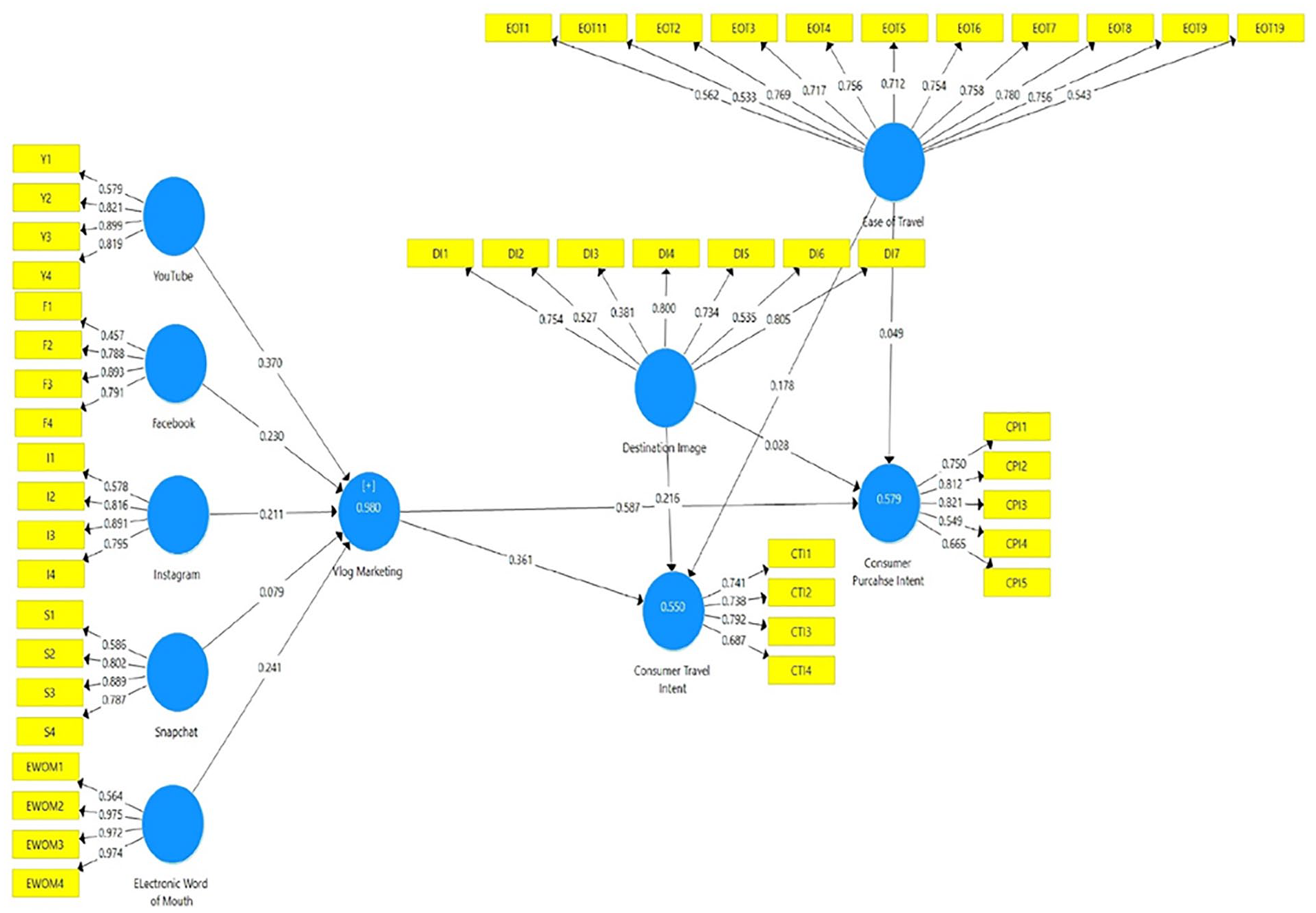
Measurement model.
Table 2 shows all constructs with their items and factor loadings; most of them are above .50 and satisfactory, while the statistics for composite reliability and Cronbach’s alpha are acceptable, that is, above the .70 threshold level. The AVE values are above .50, which is satisfactory. Regression effect R2 for consumer purchase intent is .579, showing a 57.9% effect while for consumer travel intent, it is .550, showing a 55.0% effect.
Content Validity for Model Assessment.

Note. Indicators are the representation of items developed in the questionnaire. R2 represents regression values, and CR and AVE symbolize composite reliability and average variance extracted, respectively.
Table 3 shows the results of discriminant validity, which are also acceptable with diagonal values higher than non-diagonal values in the corresponding columns and rows.
Fornell-Lacker Criterion for Discriminant Validity.

Structural Model Assessment
This section assesses the path coefficients, as standardized beta (β), and their significance level for t and p statistics to test the proposed hypotheses. These results are obtained by bootstrapping in PLS-SEM. Positive or negative signs with the values obtained show the effect of the relationships of the variables. Path coefficients of variables are significant at error level with 5% probability if it falls within 95% confidence level (Hair et al., 2017; Hult et al., 2018).
p-Value must be below .05 and t-value must be above 1.95 (Hair et al., 2019). The moderation effect in PLS-SEM can only be created as an interaction term and shown only on the dependent variable, graphically, but it mentions the independent variable while creating this effect.
Table 4 illustrates the results of H1, the direct relationship between VM with its constructs and CTI. The results show that for H1 (β = .355, t = 6.592), H1a (β = .265, t = 1.963); H1b (β = .322, t = 1.988); H1c (β = .043, t = 3.308); H1e (β = .051, t = 2.550) are supported and accepted and have a positive relationship. However, H1d (β = .246, t = 0.806) is not supported and rejected as the relationship between Snapchat and consumer travel intent may appear to be positive, but it is not significant.
Hypothesis Testing for H1 Constructs.

Table 5 illustrates the results of H2, the direct relationship between VM (VM) with its constructs and consumer purchase intent (CPI).The results show that for H2 (β = .322, t = 5.551), H2a (β = .762, t = 2.490); H2b (β = .588, t = 1.979); H2c (β = .430, t = 2.139); H2e (β = .037, t = 2.313) are supported and accepted have a positive relationship. H2d (β = −.401, t = 1.038) is not supported and rejected, similarly to H1 the relationship between Snapchat and CPI, which may appear to be positive, but it is not significant.
Hypothesis Testing for H2 Constructs.
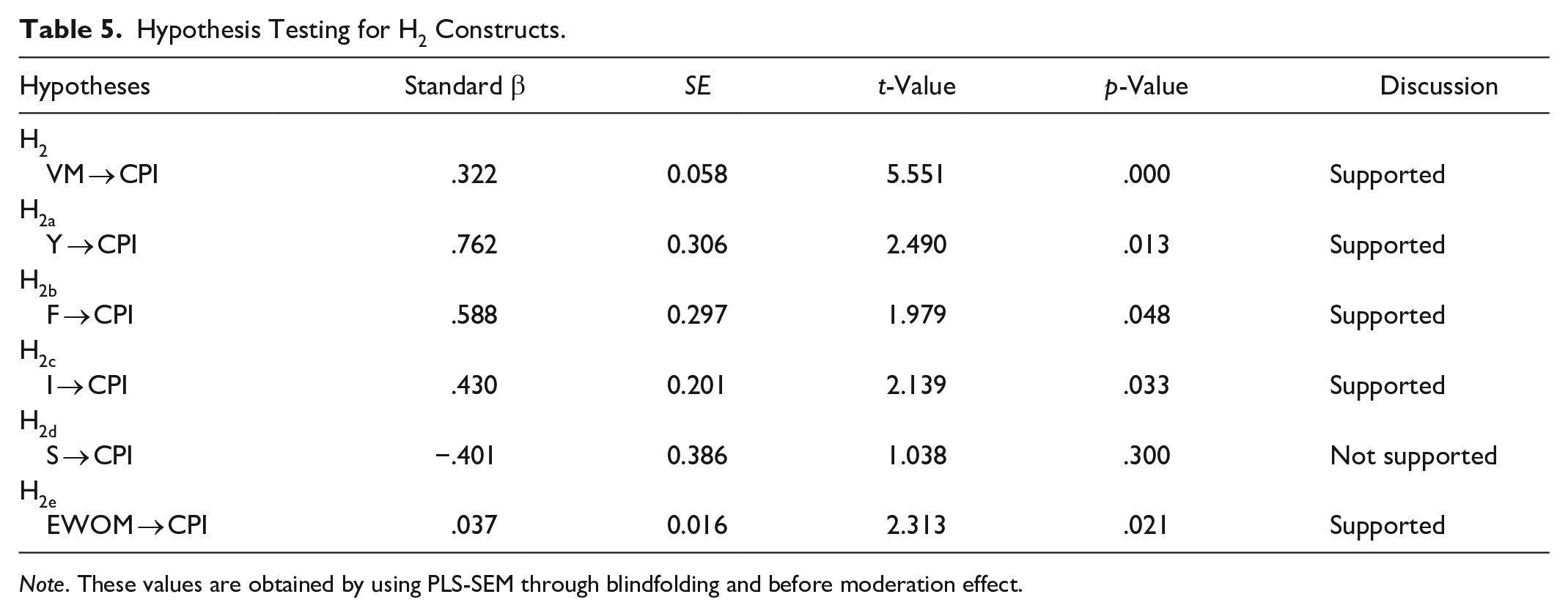
Note. These values are obtained by using PLS-SEM through blindfolding and before moderation effect.
Table 6 shows that for H3, DI and EOT positively moderate the relationship between VM and CTI (β = .152, t = 2.338) and (β = .169, t = 2.874), respectively. On the other hand, H4 shows a negative moderation effect of DI and accessibility for CPI (β = −.050, t = 0.546) and (β = −.062, t = 0.574). Since the significance level is not satisfactory, H4 is rejected.
Hypothesis Testing for Moderation Effects in H3 and H4.

Note. DI × CTI and EOT × CTI represent the moderation effect of DI and EOT on CTI. While DI × CPI and EOT × CPI represent the moderation effect of DI and EOT on CPI.
Figure 3 depicts the moderation effects of DI and EOT on dependent variables. DI × CTI and EOT × CTI depict the moderation effects for DI and EOT on CTI. Similarly, DI × CPI and EOT × CPI depict the moderation effects for DI and EOT on CPI. Moderation effects can also be examined through linear graphs. For interpreting these graphs, it is supposed that the interaction occurs outside the box, where the lines intersect and the inclination of the slopes is examined. Because the interaction occurs outside the box, the results are not solely dependent on the slope, but also the p- and t-values.

Moderation effect.
Figure 4 shows the graph for the moderation effect of DI and EOT on CTI. Two slopes show high and low values of moderators DI and EOT, deviating from +1SD to −1SD. In Figure 4a, the X-axis represents the relationship between DI and VM while the Y-axis represents the relationship between DI and CTI. The high DI slope is now steeper than the low DI slope, indicating a moderation effect of DI on the relationship between VM and CTI. The positive slope indicates a positive effect of moderation. In Figure 4b, X-axis represents the relationship between EOT and VM while Y-axis represents the relationship between EOT and CTI. The high EOT slope is steeper than the low EOT slope, indicating that EOT has a moderating effect on the relationship between VM and CTI. The positive slope indicates a positive effect of moderation.

Liner graphs representing the moderation effect of DI and EOT on CTI.
Figure 5 shows the graph for the moderation effect of DI and EOT on CPI. Two slopes show high and low values of moderators DI and EOT, deviating from +1SD to −1SD. In Figure 5a, X-axis represents the relationship between DI and VM while Y-axis represents the relationship between DI and CPI. This graph shows that the lines are intersecting, indicating that the DI moderation effect is not improving the relationship between VM and CTI. In Figure 5b, X-axis represents the relationship between EOT and VM while Y-axis represents the relationship between EOT and CPI. In this graph, the high EOT slope has moved slightly left from the low EOT slope, indicating some kind of moderating effect of EOT on the relationship between VM and CPI, but does not show any significant effect.
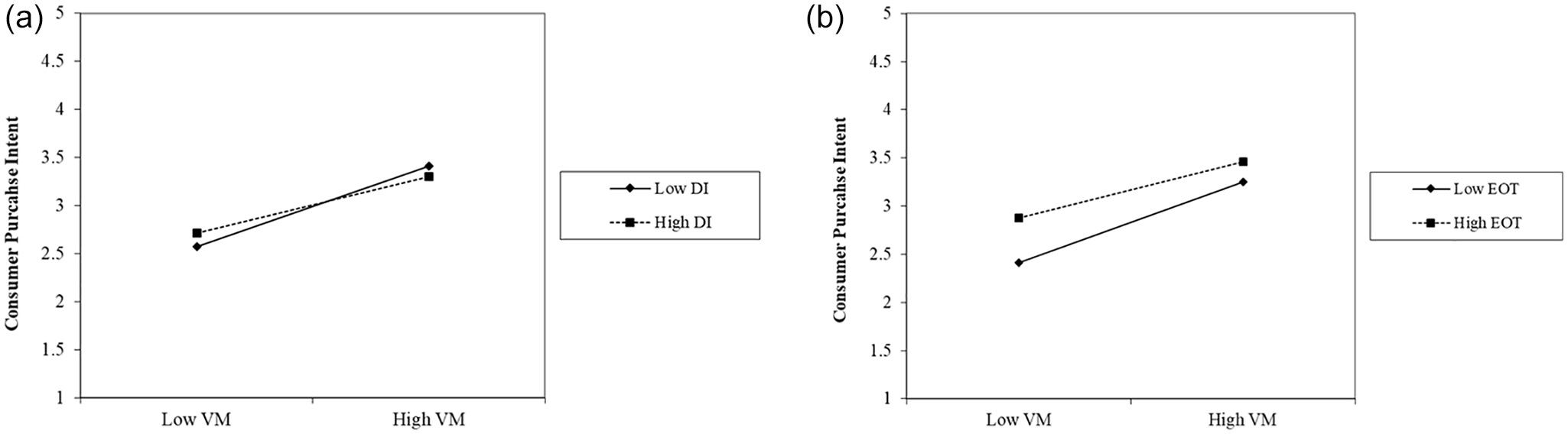
Liner graphs representing the moderation effect of DI and EOT on CPI.
Predictive relevance (Q2) measures and predicts how well the model has excluded the cases, with the acceptable value of greater than zero (Hair et al., 2019; Henseler, 2018). The value is achieved by running blindfolding in PLS-SEM. Table 7 shows the model’s predictive relevance, which is greater than zero, indicating that the model has predictive relevance.
Predictive Relevance for the Model.

Robustness assessment
The current study’s structural model is tested for robustness using unobserved heterogeneity, nonlinear effects, and endogeneity through PLS-SEM. Assessing heterogeneity is important in behavioral, social, or marketing research, especially while analyzing consumer data (Hair et al., 2017; Kotler, 2010). It is difficult to attribute significant differences in model relationships to observable traits like gender, age, or income. Thus, single homogeneous population bias can lead to unrealistic results (Matthews et al., 2016). Heterogeneity is evaluated by running FIMIX through PLS from the results of fit indices of one to five segments. FIMIX can be assessed by six criteria: AIC (Akaike’s Information Criterion), AIC3 (modified AIC with factor 3), AIC4 (modified AIC with factor 4), BIC (Bayesian Information Criterion), CAIC (Consistent AIC), MDL5 (Minimum description length with factor 5), and En (entropy criterion; Akaike, 1973; Bozdogan, 1987, 1994; Sarstedt et al., 2020; Schwarz, 1978). AIC overestimates and gives a higher number of segments and MDL5 underestimates and gives fewer segments. In MDL5, we collectively retain the segments between them. Other criteria are HQ (Hannan Quinn criterion), LnL (Log-Likelihood), NFI (Non-Fuzzy Index), and NEC (Normalized Entropy Criteria). Research suggests that we choose those segments where AIC3 and CAIC values lie in the same number of segments, or where AIC4 and BIC values lie in the same number of segments, and EN greater than .5 is satisfactory (Sarstedt et al., 2020).
Table 8 represents the fit indices for measuring heterogeneity and according to the values, segment two can be retained as the values of AIC4 and BIC are in the same segment and EN value is higher than .5. Thus, there is no objectionable heterogeneity in data.
Fit Indices for One to Five Segments of FIMIX.

Note: The best outcome per segment retention criterion is bolded. na = not available.
Path models are typically assumed to be linear, but this is not always the case. There is a chance of non-linearity because the relationships are calculated as approximately linear (Sarstedt et al., 2020). When the relationship is nonlinear, the effect size depends on the exogenous variable’s magnitude (Hair et al., 2019). A few techniques are used by PLS to analyze non-linearity in data, for example, quadratic effect as an interaction term effect while impact-asymmetry analysis, adaptive neuro-fuzzy inference systems, and artificial neural networks as second stage analysis (Hew et al., 2018; Šerić et al., 2018). As PLS results for non-linearity are limited, the Ramsey RESET test in SPSS, Stata, or R statistical software are recommended (Sarstedt & Mooi, 2018). In this study, the quadratic effect is used as an interaction term in PLS-SEM, and the values are obtained using the PLS algorithm and PLS bootstrapping. R calculates the RESET test values. The model is linear in PLS if the effect size (f2) and p-values are not significant; from R, we interpret the F-values and p-values in a similar way (Sarstedt et al., 2020). F-values can be interpreted in two ways. The null hypothesis states that there is no significant linearity in the model, while the alternative hypothesis states that there is significant linearity in the model; to accept f2 are 0.1, 0.15, and 0.3 as smaller, moderate, and higher effect sizes are considered satisfactory, respectively (Astivia & Zumbo, 2019).
Table 9 represents the value assessment of non-linearity. Non-linearity in the model is not shown by either of the following: the partial regression values of RESET test of CTI on VM, DI, and EOT are (F (1,685) = 1.459, p = .135); the partial regression values of CPI on VM, DI, and EOT are (F (1,685) = 1.355, p = .184). Moreover, the values for the interaction term are not significant, hence showing non-linearity in the model.
Non-Linearity Assessment.

Endogeneity occurs when a predictor construct is correlated with the error term of the dependent construct, arising from omitted constructs or variables that correlate with one or more predictor constructs and the dependent construct in partial regression of the PLS path model (Hult et al., 2018). The Gaussian copula method is used to assess this error; it controls endogeneity by directly modeling the endogenous variable’s correlation with the error term utilizing original model latent variable scores as input in R statistical tool (S. Park & Gupta, 2012). When the p-values of endogenous variables are higher than .05, that is, if the values are not significant, the model does not have any endogeneity (Hult et al., 2018; S. Park & Gupta, 2012).
Table 10 represents the results of the endogeneity test assessment using Gaussian copula. According to the findings, none of the Gaussian copulas (VM, DI, and EOT), for both dependent variables (CPI and CTI) is significant (p > .05). Thus, there is no endogeneity in the current study that supports the robustness of the model.
Endogeneity Test Assessment Using Gaussian Copula.

Recommendations and Conclusion
The prominent use of social media has led people to easily seek information from an influencing source, as vloggers innovatively provide information in their short videos to create mutual interaction and engagement. The study aims to understand how vlog marketing affects CTI and CPI, with DI and EOT as moderators Vloggers use a variety of social media platforms and these platforms have been studied independently as constructs of the main variable of vlog marketing including YouTube, Facebook, Instagram, and Snapchat. H1 hypothesized the relation between vlog marketing and consumer travel intent, including the constructs; YouTube, Facebook, Instagram, Snapchat, E-WOMs as H1a, H1b, H1c, H1d, and H1e, respectively, analyzing relation in different dimensions of social media platforms. The findings depict that vlog marketing has a significant positive impact on consumer travel intent, and these results are parallel with the previous studies. Currently, social media is most commonly used to generate E-WOMs, attract or engage, and influence consumers, thus the content and E-WOMs published in the vlog hold an important value for consumers (Bärtl, 2018; Chi et al., 2020; Russmann & Svensson, 2016; H. Zhang et al., 2017), similar outcomes were observed for YouTube, Facebook, and Instagram. Conclusively, two-way interactions can stimulate customers to travel to a place being marketed in vlogs, as opposed to one-way promotions through pictures in magazines or social media. However, the results of H1d revealed that E-WOMs created through Snapchat negatively impact CTI, despite being a similar application to Instagram. Billings et al. (2017) predicted that Snapchat will be marginalized due to the hostile business environment and its unique features.
H2 was hypothesized in the same manner as H1 analyzing the relation between vlog marketing and consumer purchase intent with hypotheses of constructs as H2a, H2b, H2c, H2d, and H2e, respectively, the results were achieved likewise. Consumer behavior is shaped by vlog marketing when used as influencer marketing, as online selling and advertising activity depending upon the level of relatability (Bayazit et al., 2017; Hashim et al., 2018; Kian et al., 2017; W. H. Kim & Chae, 2017). The effectiveness of a marketing campaign depends on how well the company can connect customers and help them relate to that specific activity, vlog marketing as influencer advertising does play a crucial role in altering consumer intention, perceptions, and overall behavior in this regard (H. Chen & Lee, 2018; Johansson & Engström, 2016). The results validates the theory of reasoned action and subjective norms, that consumers show and inclination toward purchase due to their most persuasive sources are companies, peer groups, or associates (Ham et al., 2015; Thomas et al., 2018; Weismueller et al., 2020). Moreover the reulsts of H2d were also likewise as H1d, there is a negative significant relation between vlog marketing and CPI when consumers are targeted through Snapchat; because of the similarities it has with Instagram, its downside of time-limited content, and the superiority of Instagram to let consumers share any promotional content with their followers, either sponsored or not, magnifies the impact of why consumers feel more engaged on Instagram (Billings et al., 2017; Tropp & Baetzgen, 2019)
H3 predicted that destination image and ease of travel strengthens the relationship between VM and CTI. Since social media is also used to generate opinions about destinations and promoting the travel places, the results, they have strengthened the relationship and have a significant positive effect. These finding are in line with the prior results empirical studies that DI exerts a beneficial impact on consumer travel behavior, especially if the destination region is familiar (Dedeoğlu et al., 2020; Foroudi et al., 2018; Ladhari & Michaud, 2015). When the consumers find the vlog entertaining, with shared values, or the material presented is important; they show more participation in a vlog and engage with the vlogger more enough to stimulate their interest (Casalo et al., 2017; Mege & Aruan, 2018). It is also revealed that accessibility, mobility, safe environment, and sociability are important factors for travelers because people use public transports if they are easy to travel (Aditjandra et al., 2016; Biggiero et al., 2017; Cheng et al., 2020).
Similarly, H4 predicted that destination image and ease of travel strengthens the relationship between VM and CPI. The results showed a significant negative effect and do not strengthen the relationship, though vlog marketing causes a positive effect on CPI (Bhatti & Rahman, 2019). Although videos provide a comprehensive visual experience to the consumer for a travel place but the sometimes the intensions for the purchase of travel products are affected by the personal biasness (Abad & Borbon, 2021; Biggiero et al., 2017; Khan et al., 2017).
Research Implications
The current study adds to the body of knowledge about influencer marketing and content advertising on social media networks by emphasizing how vloggers shape consumer behavior and place a distinct image of a destination, while contributing to the validation of the theory of reasoned action. It also contributes to the literature on how EOT affects the decision to travel and buy travel goods and services in destinations advertised on vlogs. It helps researchers from the fields of social media marketing and the hospitality industry to understand the relationship between emerging applications for creating E-WOMs and how they can shape consumer behavior. The research further contributes to the literature on product placement by combining the advantages of traveling and purchase with the image of the destination. The research also serves as guidance and reference for managerial implications in using vlogs to promote a DI and influence consumer behavior. Besides, influencer marketing may generate purchase intentions but there is still room to investigate why consumers may not complete their purchases including, price, income level, post satisfaction, and expecting the same experience for the product as marketed, thus making it important to understand how consumers make decisions, specifically related to travel destination and accessibility in this regard. There is substantial scope for marketers to learn how content is generated and impacts consumer behavior through persuasion, as it has many dimensions which can be further explored. The influence of vlog marketing on consumer intention or behavior has been researched extensively in prior studies, addressing apparel and other consumer goods, and results have shown a significant positive impact, though there still exists a gap in terms of travel goods and services. Visual experience through a screen and a personal experience in the real world is very different for the tourism industry, the marketers need to understand the importance of this difference. Thus, governments and destination advertisers may help by encouraging vloggers to spread the proper message globally.
Limitations and Future Directions
Despite the study’s contribution, it also has some limitations and offers research avenues for the future. This study covered social media platforms that are extensively used for vlogging and how they stimulate consumer purchase and travel intentions. Future research can examine how Snapchat and Instagram influence customer behavior in different ways, despite being similar social media applications. The study does not differentiate between vloggers, for example, food vlogger, celebrity, travel vlogger, etc. so future researchers can analyze their impact. Additionally, a quantitative approach was used with a self-administered survey to determine the correlations between the variables involved. As a result, it cannot rule out the likelihood that consumers who already like a product or holiday destination may be persuaded by the vloggers promoting it. Finally, by adding or deleting constructs, the relationship between the moderators can be improved for future research. There is also an opportunity to study EOT in more detail, beyond specific dimensions.
Footnotes
Declaration of Conflicting Interests
The author(s) declared no potential conflicts of interest with respect to the research, authorship, and/or publication of this article.
Funding
The author(s) received no financial support for the research, authorship, and/or publication of this article.
