




Abstract
Most of the previous studies on the impact of risk perception on travel intention are based on an individual psychological perspective, and the understanding based on the perspective of macropsychology is insufficient. Analyzing the temporal and spatial characteristics of risk perception theory at the macropsychological and regional levels will expand the scope of risk perception theory, which may help to promote the orderly recovery of tourism activities under the normalization of epidemics at the regional level. This study uses Baidu big data, through a panel VAR analysis, to explore the impact of people’s epidemic risk perception on travelers intentions from a macropsychological level and to analyze the temporal and spatial differences of this impact. From a temporal perspective, this study found that the early stage of epidemic risk perception had a negative impact on travel intentions, and later, a compensatory effect on travelers intentions appeared. From the perspective of risks at different threat levels, the Wuhan epidemic with a high degree of threat had a greater impact, while foreign epidemics had less impact. From the perspective of spatial differences, this study indicated that the negative impact of attention to epidemics on attention to tourism basically shows a gradual decay from the core to secondary and then to peripheral areas. This research will reveal some new findings on the impact of perceived risk on behavior intention at the temporal and spatial levels, and will have certain reference value for regional tourism restoration and marketing under the influence of epidemics.
Introduction
Engagement in tourism activities is fragile and sensitive, and very vulnerable to crises (Aliperti et al., 2019). The emergence of a pandemic poses new challenges to tourism demand. Tourism requires the tourists have an intention to travel and other supportive conditions (Goeldner & Ritchie, 2007; Wang et al., 2020). Border closures and social distancing restrict the mobility of tourists (Gössling et al., 2021), and travel demand has been hit hard by the COVID-19 pandemic, as people are planning to travel less due to the perceived risks associated with the pandemic (McKercher & Chon, 2004; Zheng et al., 2021). According to the UNWTO data, international tourist arrivals were expected to remain 70% to 75% below 2019 levels in 2021, a similar decline as in 2020 (UNWTO, 2021). Understanding the changes in tourism demand due to the impact of epidemics, especially the characteristics presented at the macroreginal level, provided important reference values for the overall prevention of the impacts of the threat of epidemics, and the formulation of tourism demand recovery policies.
Travel intention is a predictor of tourist future behavior and represents a benchmark (Yang, Mohd Isa, et al., 2020). Tourists’ favorable travel intentions help destinations achieve a sustainable competitive advantage (Apostolopoulou & Papadimitriou, 2015), and form a cost-effective and desirable market segment for destination marketing organizations (Zhang et al., 2014). Therefore, the investigation of the causes of travel intention is very important for tourism industry. Scholars have used a number of theoretical models to explore the causes of tourist intentions, including destination personality (Usakli & Baloglu, 2011; Yang, Mohd Isa, et al., 2020), self-congruity (Yang et al., 2021, 2022), and risk perception (Bae & Chang, 2021; Tian et al., 2022). Previous research on tourism intentions set an ideal, normalized, and static environment, mainly based on questionnaire data. However, in the context of the pandemic, the threat of the pandemic itself has become the most critical antecedent (Zheng et al., 2021). As the variability and complexity of the pandemic brings about a dynamic process in terms of its impact on the psychology of tourists, it is necessary to look at travel intentions from a dynamic and temporal perspective.
Risk perception is the most important antecedent of travel intentions during the pandemic (Bae & Chang, 2021). Many studies have investigated the decision-making process regarding the impact of pretravel health risk perception in the context of COVID-19 (Bae & Chang, 2021; Zheng et al., 2021). Protection motivation theory (Wang et al., 2019; Zheng et al., 2021), the health belief model (Huang et al., 2020), Theory of planned behavior (Bae & Chang, 2021), and risk perception attitude (RPA) frameworks (Su et al., 2022) are theories commonly used to explain the role of health risk perception in affecting tourists’ travel intention during an epidemic. These theories suggest that tourists’ assessment of the danger of and vulnerability to an epidemic triggers fear arousal, which leads to protection motivation and has an impact on traveler intentions (Bhati et al., 2021; Huang et al., 2020). However, most studies are focused on the individual psychological level, and the characteristics of the relationship between health risk perception and travel intentions at the macrogroup psychological level are relatively unexplored. Exploring the relationship between the two at the regional and macropsychological levels will enrich risk perception theory and extend its application.
Compared with the research on risk perception at the micropsychological level, risk perception theory at the macro level focuses on the temporal and spatial variation characteristics of the impact of risk perception on travel intention. From the temporal perspective, the evolution of the COVID-19 epidemic itself has a cyclical character (Tian et al., 2020); from outbreak to recession, the negative impact of the threat it poses to tourism demand is gradually decreasing (Bae & Chang, 2021). On the other hand, the psychology of tourists is complex (Zheng et al., 2021). Tourism demand changes over time because of long-term suppression, and there may be compensatory consumption and other complex characteristics (Kim et al., 2022). Understanding the time evolution characteristics of the impact of risk perception on tourism demand within the epidemic cycle, helps to provide a dynamic temporal perspective for our understanding of macropsychological risk perception. From a spatial perspective, psychological attitudes and values are distributed unevenly across geographic regions (Rentfrow et al., 2008; Talhelm et al., 2014). A similar spatial pattern may exist for travelers risk perceptions and travel intention. Furthermore, the impact of the crisis on tourism demand is characterized by the law of distance decay (McKercher, 2021; Yicong et al., 2016). At the macropsychological level, the relationship between the risk perceptions in response to epidemics and travel intention will reflect a pattern of spatial differentiation and dynamic change over time, which is worthy of research attention.
With the availability of big data on the internet, we are able to measure the attitudes and psychological states of potential travelers based on their internet usage history (Li, Hu, et al., 2020). The application of big data at the macropsychological level can effectively reveal the psychological perception of groups (Jędrzejewski & Sznajd-Weron, 2019), with better accessibility (Galesic et al., 2021), and avoid individual bias (Lee et al., 2019), can be used effectively for sensing the psychosocial perception of the epidemic (Rashid & Wang, 2021).
In this study, we quantify and characterize people’s epidemic risk perception and travel intention at the macroregional level by studying the most commonly searched terms on the internet during the pandemic, analyze the impact of epidemic risk perception on tourism intention and reveal the differences in the temporal and spatial dimensions. From a temporal perspective, we explore the dynamic characteristics of the impact of people’s risk perceptions on travel intentions over an epidemic cycle. From the perspective of spatial heterogeneity, this study analyzes the spatial distance decay pattern of the effect of concern about the COVID-19 pandemic on attention to tourism. That is, we explore the variability of the impact of perceived risk on travel intentions from the core area to the peripheral areas affected by the COVID-19 pandemic. On a certain level, the research could reveal changes in tourism market demand during pandemics and has practical implications for the recovery of the tourism market.
Literature Review
Health Crisis and Tourism
The tourism industry has encountered various global health crises, such as the Spanish influenza (1918–1920) (Weinberger et al., 2012), the Severe Acute Respiratory Syndrome (SARS) outbreak (2003) (Mao et al., 2010), Avian Influenza (2009) (Page et al., 2006), and the Ebola epidemic (2014–2016) (Novelli et al., 2018). Although the impact of these crises tended to be regional in comparison (Su et al., 2022), COVID-19 is a global outbreak that could change global socioeconomic conditions and the tourism industry (Gössling et al., 2021), with sweeping impacts on various tourism sectors such as opinions about destinations (Yang et al., 2022) and hospitality sustainability (Jones & Comfort, 2020). There is an inherent conflict between tourism and epidemics. International tourists visit the areas experiencing epidemic, thereby accelerating the global spread of the disease (Mason et al., 2005). Many tourists are forced to quarantine at home after traveling during epidemics (McKercher & Chon, 2004). When the World Health Organization defines an epidemic as “a pandemic” or even as a Public Health Emergency of International Concern, it causes global panic that far outweighs the actual danger of the virus (McKercher & Chon, 2004; Novelli et al., 2018). After a crisis, tourists’ safety concerns become one of the main factors restricting tourism (Mizrachi & Fuchs, 2016; Wen et al., 2020), and the risks perceived by tourists will negatively affect their travel intentions (Chew & Jahari, 2014).
Theoretical Background
Theories of risky decision-making
The impact of risk perception on tourism demand has been widely validated (Lee et al., 2011; Wen, Kozak, et al., 2021). The main factors influencing travel intentions in the context of COVID-19 are a hot topic of research, such as people’s perception of epidemic risk (Li, Nguyen, et al., 2020; Neuburger & Egger, 2021), opinions about the health risk related to the destination (Bhati et al., 2021; Rasoolimanesh et al., 2021), travel fear and anxiety (Zenker et al., 2019; Zheng et al., 2021), and health-related culture (Wen, Wang, et al., 2021). The vast majority of such literature is related to risk perception. Several mature frameworks for understanding the impact of risk perception on tourists’ intentions have developed, such as health risk model (Huang et al., 2020), motivation protection theory (Zheng et al., 2021), theory of planning behavior (Shin et al., 2022), and risk perception attitude (Su et al., 2022) frameworks. These theories generally suggest that before taking action, people will assess the severity of the epidemic risk and the vulnerability of individuals to threats, and thus form basic judgments about travel decisions (Wang et al., 2019).
Research on the relationship between tourism and COVID-19 is a multidisciplinary topic (Wen, Wang, et al., 2021). At present, the relationship between risk perception and tourism intention has been extensively researched at the individual psychological level. However, questions about the relationship between the two at the macropsychological level remain: What kind of relationship will they present? What are the dynamic characteristics over time?
Different levels of risk perception
Risk perception is a concept commonly used to describe people’s attitudes and intuitive judgments about risk (Cui et al., 2016; Slovic, 1987). Schiffman and Kanuk (1991) originally identified seven specific types of risk associated with consumer behavior (i.e., financial, functional and performance, physical, psychological, satisfaction, social, and time). This early risk typology has been extensively validated in different tourism contexts (Maser & Weiermair, 1998; Sönmez & Graefe, 1998). In the context of pandemic, health-related risks are considered to be an important consideration in relation to international travel (Zheng et al., 2021). Li, Zhang, et al. (2020) analyzed six types of perceived risk in relation to COVID-19, including health risk, psychological risk, social risk, performance risk, image risk, and time risk.
Different types of risk factors will possess different threat levels due to psychological distance (Li, Zhang, et al., 2020). For example, people who feel psychologically close to environmental pollution perceive pollution as a more specific threat, leading to greater perceived risk (Fox et al., 2020). The impact on travel intentions varies depending on the level of perceived risk. In a study on sporting event destinations, Kim et al. (2021) classified destinations into three categories based on differences in risk level (i.e., obvious risk, less imminent risk, and unidentified risk), and found that tourists’ perceptions of terrorism risk in South Korea, which had obvious risk, had the greatest impact on their intention to travel, followed by general destinations outside the United States (unidentified risk).
The distance decay law
Tobler (1970) first recognized distance decay and he stated “everything is related to everything else, but near things are more related than distant things.” It is so ubiquitous that it satisfies the criteria required for the “laws” of geography (Waters, 2017). The law of distance decay is widely recognized in infectious disease research (Bharti et al., 2008). This phenomenon is largely determined by the spatial patterns of population movement (Viboud et al., 2006). Since populations spread out from a fixed center point, showing a decreasing trend with distance, the spread of infectious diseases also follows a distance decay law (Stark et al., 2012), as does its impact. In tourism research, distance decay theory is often used to study the relationship between demand and distance, generally speaking, tourism demand decreases exponentially with increasing distance (McKercher, 2021). Although geographical distance is considered an important factor influencing destination choice (Smith, 1985), this relationship is influenced by many other contextual factors (Decrop & Snelders, 2005). In some studies, distance is not just geographical distance, but a proxy variable based on geographical distance that indicates the degree of socio-economic linkages between places (e.g., economic distance, Wong et al., 2021). In the context of COVID-19, epidemic risk is a key variable influencing destination choice, and the impact of epidemic risk on travel intentions is bound to be spatially heterogeneous as distance decays.
Hypotheses Development
People’s perceptions and level of interest regarding the risk of an epidemic will lead to protective behaviors to avoid risks, which greatly affects travelers intentions (Golets et al., 2021). However, some studies have shown that because of fear and anxiety about the risk of an epidemic, people will engage in compensatory behaviors (Kim et al., 2022). Especially under the long-term impact of an epidemic, compensatory travelers intentions may be triggered in reverse (Zhang et al., 2021). In this study, we explore the impact of risk perception on travel intention at a macropsychological level, using people’s attention to the COVID-19 pandemic to represent risk perception and people’s attention to tourism during the pandemic to represent travel intention. Accordingly, the following assumptions are proposed:
Hypothesis 1: Tourists’ risk perception of the pandemic negatively affects travel intentions and the negative impact decreases as time progresses.
Studies have shown that tourists’ perceptions of different risk levels have varying effects on tourists’ intentions (Kim et al., 2021; Sönmez & Graefe, 1998). In a study on the impact of perceived risk of air pollution on inbound tourism in Shanghai, Xu and Reed (2019) separately discussed the impact of foreign tourists’ attention to Shanghai, Beijing and China’s air pollution on Shanghai’s inbound tourism. Shanghai is a primary destination and its air pollution risk is the most significant threat to tourism. Beijing is a destination of secondary concern, and its air pollution risk is relatively minor. The risks from air pollution in China have a relatively marginal impact. Drawing on Xu and Reed (2019), this study similarly explores the impact of differential epidemic risk perceptions on travelers intentions at three levels: attention to the pandemic in Wuhan (the central area of the pandemic), attention to the pandemic in China (the country mainly affected by the pandemic in the study period), and attention to the pandemic in other countries (the impact of the early stages of the pandemic was small). And the following research hypothesis is proposed in this study.
Hypothesis 2: The higher the threat level of the pandemic, the stronger the negative impact of people’s perception of its risk on their travel intentions.
In the field of tourism crisis research, some scholars believe that the impact of disasters on tourism will be affected by distance, reflecting spatial differences (Mazzocchi & Montini, 2001). Yicong et al. (2016) studied the case of the Jiuzhaigou scenic area the region suffered from the 2008 Wenchuan earthquake and found that the neighboring tourism market was greatly affected by the impact of this natural disaster and remained sensitive to crisis events, while the main scenic market was relatively unaffected and maintained a robust demand for postdisaster long-distance tourism. The distance decay law was also verified in a study of the effect of COVID-19 on travelers decision to travel (McKercher, 2021). Based on the above, this study divides the research area into core, secondary, and peripheral areas based on the severity of the epidemic, and explores the distance decay pattern of the effect of attention to the COVID-19 pandemic on attention to tourism from a macropsychological perspective. And, this study proposes the following hypothesis.
Hypothesis 3: The impact of the risk perception of the pandemic on travel intentions follows a law of distance decay (i.e., the impact is greatest in the core area, decreases in the secondary area and is lowest in the periphery area).
Methodology and Data
Epidemic Impact Intensity Index
There are spatial differences in the impact of an epidemic. Wuhan city, where early outbreaks of COVID-19 occurred, is located in Hubei Province, which was thus the most affected area. The impact of the pandemic was also comparatively severe in provinces close to Hubei. The gravity model method is commonly used in research on distance decay. The general gravity model is calculated using equation (1).

In regional research,


Panel Vector Autoregression Model
The panel VAR approach developed by Abrigo and Love (2016) is applied in this study to explore the impact of attention to the COVID-19 pandemic on attention to tourism attention. The advantage of the pVAR model is that it combines the VAR model with panel data, considers each variable as endogenous, and analyzes the impact of changes in each variable as well as its lagged variables on the other variables in the model. In this study, the relationship between attention to the COVID-19 pandemic and attention to tourism is not yet clear. The pVAR model can ignore endogenous issues and explore the impact of COVID-19 on tourists’ attention. In addition, the use of the pVAR model can effectively investigate the dynamic changes in the relationship between attention to the COVID-19 pandemic and attention to tourism, and can effectively solve the problem of individual heterogeneity. Adjusting the performance of each province in this period to include local characteristics also aligns with the original aim of this research to consider regional differences. The pVAR model is defined as follows:

Research Data
The total population of each province is derived from the population surveys in the 2018 statistical yearbook released by each province. The total number of confirmed cases in each province comes from the cumulative number of confirmed cases of COVID-19 announced by the National Health Commission during the study period (before March 27). The road distance between each province and Hubei Province is from the China Traffic Yearbook, expressed in road miles from each provincial capital to Wuhan.
This study examines the impact of the COVID-19 pandemic on tourism by looking at two, namely, attention to the COVID-19 pandemic and attention to tourism. A total of four variables
Baidu is the most widely used search engine in China. Research shows that Baidu’s index can interpret Chinese people’s search attention more accurately than Google’s index (Yang et al., 2015). Therefore, this study used the Baidu index to represent attention to the COVID-19 pandemic and attention to tourism. We compiled the search indices of relevant keywords in each province from January 11 to March 27. This period represents the phase covering the outbreak of the epidemic in China to its decline.
We have listed the following keywords related to epidemic searches to reflect accurate concerns about the pandemic:
Figure 1 plots total attention to the COVID-19 pandemic and attention to tourism for 31 provinces. The figure indicates that two attentions to the pandemics (i.e., attention to domestic pandemic and attention to Wuhan pandemic), show opposite trends to travel attention, and attention to tourism fluctuates as attention to foreign pandemic gradually increases. Specifically, what kind of mathematical relationship exists between them and how the relationship differs between different types of attention to the COVID-19 pandemic require further analysis and demonstration. To eliminate the influence of heteroscedasticity, logarithm processing is performed on all data.

Trends in attention to the COVID-19 pandemic and attention to tourism of 31 provinces.
Empirical Results
Epidemic Areas
The epidemic impact gravity model was used, and the EIII values of each province were obtained, as shown in Table 1. Then, a natural breaks classification based on EIII values was conducted, and all provinces were divided into three categories. The EIII value of Hubei Province was set as the maximum value. The provinces adjacent to Hubei, such as Hunan, Jiangxi, Anhui, and Henan, followed next. Although provinces, including Jiangsu, Zhejiang, Guangdong, and Shandong, are not adjacent to Hubei, transportation and population links have been developed, and their EIII values are also relatively high. All these provinces are classified as the core areas of the pandemic. The provinces of Fujian, Shanghai, Hebei, Shaanxi, Chongqing, Sichuan, Beijing, Shanxi, Guizhou, and Guangxi are categorized as the secondary areas of the pandemic. Although Shaanxi and Chongqing are connected to Hubei by geographical boundaries, they are only considered secondary areas because the population center of Hubei Province is shifted to the east. In addition, there are large topographic barriers between western Hubei and Shaanxi or Chongqing, and transportation links between them are relatively weak. Thus, Shanxi and Chongqing are weakly affected by the pandemic. The remaining 12 provinces are considered as peripheral areas.
Epidemic Impact Intensity Index (EIII) and Classification of the Pandemic-Affected Areas of 31 Provinces.

According to the EIII values and the results of the area divisions, the pandemic-affected areas shown in Figure 2. In general, the areas with infections show a circular distribution with Hubei as the epicenter, gradually decaying from the center to the edge. The core area consists mainly of Hubei and its surrounding provinces and some eastern provinces. These provinces have relatively large populations, aggregated economic infrastructure and developed tourism-based economies and are relatively open. The secondary area primarily consists of outlying regions around the core area. Overall, these provinces have moderate tourism-based economies and are also active in foreign trade and international tourism. The peripheral influence area is distributed in the northern, western, and border areas, which are distant from Hubei Province. The provinces located in the area are economically backward, and their overall tourism economy and foreign trade are weak.

Epidemic areas map of China.
Stationarity and Cointegration Analysis
Cross-sectional dependence
The first step of the estimation process is to check the data properties of the cross-sectional dependence of all series, which is necessary before estimating values with the PVAR model for these series. In this study, Pesaran CD tests were used to test the cross-sectional dependence of each series. The results are shown in Table 2. The results show that all four variables in the three epidemic areas, totaling 12 series, reject the null hypothesis of cross-sectional independence at the 1% significance level. Therefore, it can be concluded that all the series in each area have a cross-sectional dependence. This result can be explained by the high degree of similarity between provinces in each area, and it also shows that the following panel unit roots should use a method that includes cross-sectional dependence.
Cross-Section Dependence Test Results.

***, **, and * indicate significance at the 1%, 5%, and 10% levels, respectively.
Panel unit root test
In this study, two commonly used tests for long panel data, the LLC test for homogeneous unit roots and the IPS test for heterogeneous unit roots, are used. From the results in Table 3, the first difference of all the series are stationary series at the 99% confidence level, that is, all variables are integrated with first order. A cointegration test is needed to determine whether there is a long-run equilibrium relationship between the variables.
Panel Unit Root Test Results.

***, **, and * indicate significance at the 1%, 5%, and 10% levels, respectively.
Cointegration test
Before the cointegration test, it is necessary to determine the lag order. We established a panel VAR model for the core area data and chose five periods according to lagged order based on AIC, SC, and LR values. The LM test shows that there is no serial residual autocorrelation when the fifth order is selected. Similarly, the optimal lag order for the secondary area is five periods, and the optimal lag order for the peripheral area is four periods.
The lag period in the cointegration test is the (P-1) period. Thus, a panel cointegration test was conducted to test whether there is a long-run equilibrium relationship between attention to the COVID-19 pandemic and attention to tourism. In this study, the Pedroni test was used to construct four statistics based on regression residuals for the cointegration test. The results are shown in Table 4, which shows that all statistics of the core, secondary, and peripheral areas passed the significance test, indicating that attention to the COVID-19 pandemic has a long-term stable “balanced” relationship with attention to tourism.
Pedroni Cointegration Test.

indicate significance at the 1%.
To prevent the expansion of the long-term relationship deviation and maintain a long-term stable “balanced” relationship between them, the relationship between attention to the COVID-19 pandemic and attention to tourism was studied through an error correction model. This study establishes vector error correction (VEC) models for the three areas to further reveal the causal relationship and impulse response changes between variables.
Granger Causality Between Attention to the COVID-19 Pandemic and Attention to Tourism
The Granger causality test was performed based on the VEC model, and the results are shown in Table 5. In all pandemic-affected areas, overall attention to the COVID-19 pandemic is the Granger cause for effects on attention to tourism. In general, attention to tourism is significantly affected by attention to the COVID-19 pandemic. The causal relationship between different types of attention to the COVID-19 pandemic and attention to tourism varies across the three areas. Attention to domestic pandemic is the cause of attention to tourism in the three areas. Attention to foreign pandemic is the Granger cause of effects on attention to tourism in the core and secondary areas, but not in the peripheral area. This is because the core and secondary areas have experienced a more severe pandemic and are mostly eastern and central provinces, which are more closely linked to foreign countries. Thus, attention to tourism will be significantly affected by attention to foreign pandemic. In the secondary and peripheral areas, attention to Wuhan pandemic was the Granger cause of effects on attention to tourism, while the causality between the two was not significant in the core area. The core area was collaterally affected by the Wuhan epidemic. In the face of threats to life and health, people’s attention to hygiene and survival, such as buying masks and obtaining food supplies, has increased. In contrast, the effect of attention to Wuhan pandemic on attention to tourism and leisure activity is crowded out, resulting in a nonsignificant relationship.
VEC Granger Causality Test Results.

Impulse Response of Attention to Tourism to Attention to the Pandemic
Impulse response functions are typically used in VAR models, but these functions are also useful for the VEC model to gain insight into the size of the relationship. The difference is that in the VEC model, the impact of the shock is permanent rather than transient. Figure 3 shows the impulse response results of DEA, FEA, and WEA to TA. The horizontal axis represents the lag period, and the vertical axis represents the impulse response value.

Impulse response.
The impact of domestic attention to the COVID-19 pandemic (DEA) on attention to tourism (TA) in the three epidemic areas is mainly positive, which is due to the improvement in the domestic effects of the pandemic. The impact has certain characteristics of distance decay. In the first two periods, attention to tourism in the core area was negatively impacted, indicating that in the early stage of the pandemic, attention to tourism in the core area was greatly impacted, while the impact in the secondary area and in the peripheral area was comparatively small and lagging. After the third period, attention to tourism in the core area was positively impacted by attention to the COVID-19 pandemic and is rising. Although the secondary and peripheral areas were also positively impacted, the change curve is relatively mild or decreasing. This is because the domestic aspects of the pandemic were under control in the later phase. People have been quarantined at home for a long period, and their willingness to travel is increasing; thus, their attention to tourism has increased. On the other hand, the impact of the pandemic on the secondary and peripheral lagged and was relatively moderate in the later period.
The impact of attention to foreign pandemic attention (FEA) on attention to tourism (TA) shows an overall rising trend of decrease in the three epidemic areas, but there are also differences. In the first two periods, the change in attention to tourism due to the impact of attention to the COVID-19 pandemic is positive in all three areas. The foreign effect of the pandemic was not significant in the early period and did not significantly impact tourist’s intentions. In periods 2 to 4, attention to tourism began to decline due to the outbreak, with a relatively small decline in the peripheral area. This indicates that core and secondary areas were highly affected by the pandemic and are more connected to foreign countries, such that the pandemic in foreign countries had a greater impact in these two areas. After the fourth period, the curves begin to rise, but the shock received showed signs of cyclical decay. The impact of attention to tourism in the core area due to attention to foreign pandemic was always negative, the impact of attention to tourism in the secondary areas gradually changed from negative to positive, and attention to tourism in peripheral areas was positively impacted over a long period.
Attention to Wuhan pandemic (WEA) was similar to the shock effect of attention to foreign pandemic because it also has a rising-falling-rising trend overall. In the first two phases, attention to the pandemic in Wuhan did not have a large impact on attention to tourism in the three epidemic areas. In periods 2 to 4, attention to tourism in all three districts was significantly impacted, dropping below the horizontal axis, which was stronger than the negative impact of domestic and foreign epidemic attention, suggesting that concerns about Wuhan, the core city of the pandemic, contributed to the decline in attention to tourism to a greater extent. After the fourth period, attention to tourism began to rise in the three areas, which is similar to the shocks of attention to foreign pandemic. The core zone remained below the horizontal axis, the secondary zone shocks moved from negative to positive, and the peripheral area rose more quickly above the horizontal axis. The above results reflect the pattern of distance decay.
Overall, from the perspective of different epidemic areas, the impact of attention to the COVID-19 pandemic on attention to tourism has gradually decayed from the core area to the secondary area and then to the peripheral area. For the three types of attention to the pandemic, the overall curve for the peripheral area is relatively high, indicating that the negative impact was weak, followed by the impact on the secondary area. The core area has a lower curve, with a greater portion below the horizontal axis. From the three different threat levels of attention to the pandemic, the impact of attention to domestic pandemic on attention to tourism is relatively weak, reflecting that attention to domestic pandemic has improved in the later stage of the epidemic, and the threat has gradually receded. Attention to the COVID-19 pandemic in Wuhan has the largest negative impact on attention to tourism, reflecting long-standing concerns about the epidemic in the city at the heart of the pandemic, greatly dampening people’s willingness to travel. The degree of impact of attention to foreign pandemic lies between the previously discussed impacts, reflecting the gradual increase in foreign epidemics, leading to a decrease in people’s willingness to travel.
Variance Decomposition of Attention to Tourism on Attention to the Pandemic
Variance decomposition was conducted to illustrate the importance of the effect of different types of attention to the COVID-19 pandemic on attention to tourism. The results of the variance decomposition are shown in Table 6. The three epidemic areas gradually stabilized after 10 forecast periods.
Variance Decomposition.
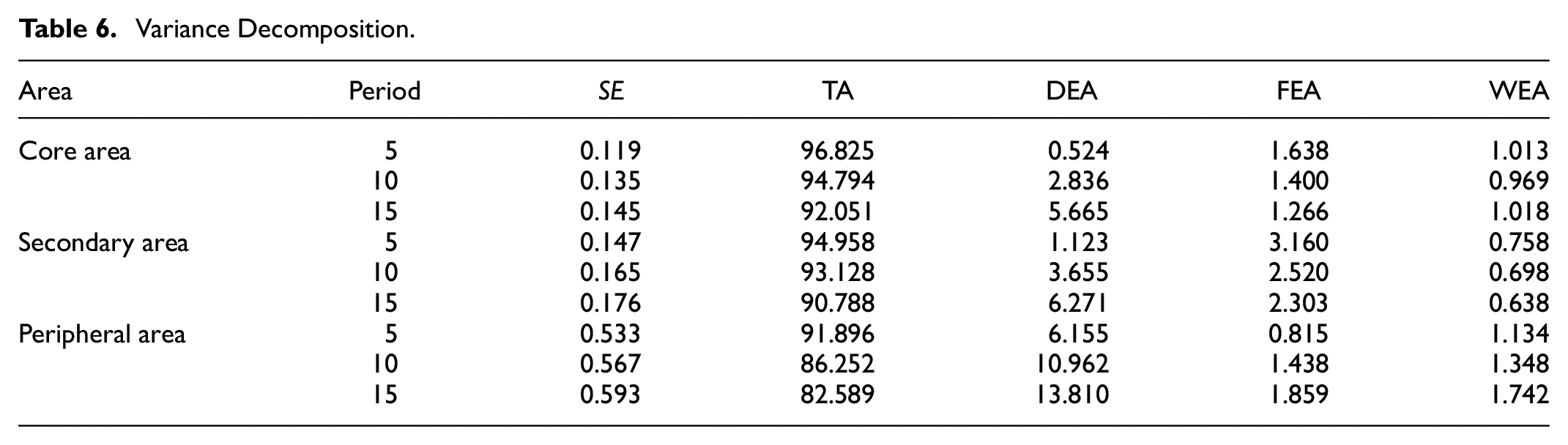
Attention to tourism has the greatest explanatory power, indicating that most of the disturbance of attention to tourism is explained by itself. However, as a general trend, the explanatory power of attention to tourism gradually declined, while the explanatory power of attention to the COVID-19 pandemic is increased, indicating that the impact of attention to the COVID-19 pandemic on tourists’ intentions is increasing. In terms of the proportion of explanations of attention to the pandemic, overall attention to domestic pandemic was the highest, followed by foreign attention to the pandemic and attention to Wuhan pandemic, reflecting that people’s concerns about the domestic aspects of the pandemic are more likely to affect their intention to travel. In terms of the proportion of attention to the pandemic, overall attention to domestic pandemic ranks the highest, followed by attention to foreign pandemic and attention to the pandemic in Wuhan, reflecting that people’s attention to domestic aspects of epidemics has a greater influence on their willingness to travel. Specifically, the change in attention to tourism in the core area was highly influential, with changes in the secondary and peripheral areas subsequently decreasing. This is because there is a certain gradient of economic decrease from the core to the peripheral areas. The core area mostly includes developed provinces, where people’s intention to travel is relatively strong, and the traveler willingness to travel is highly influenced by internal factors. While the peripheral area is relatively limited in tourism and economic development, and people’s travel frequency is relatively low, and the overall willingness to travel is weak and flexible.
In terms of differences in pandemic-affected areas, attention to domestic pandemic can best explain the changes in attention to tourism in the peripheral area, followed by the secondary and core areas. The reasons are similar to those discussed above, as the overall attention to the pandemic of peripheral areas explains a higher proportion of tourists’ intentions. Attention to tourism is influenced by attention to foreign pandemic to a higher degree in the secondary area and to a lesser extent in peripheral and core areas. This is because the core area’s attention to tourism has a relatively high degree of individual-based interpretation, and the overall interpretation of the attention to the COVID-19 pandemic is low. In addition, the outbound tourism of the secondary area is greater than that of the peripheral area, so the willingness to travel in the secondary area is more affected by attention to foreign pandemic. The explanatory power of the attention to Wuhan pandemic in the peripheral area is higher than that in the core area, and that in the core area is higher than that in the secondary area. The high proportion in the peripheral area is also due to its higher explanatory power for the overall attention to the pandemic. Since the core area has a higher degree of connection with the pandemic in Wuhan, it is more threatened than the secondary area, so the degree of explanation is higher than that of the secondary area.
Discussions
Theoretical Implications
Previous research on the effect of risk perception on travelers intentions is mostly based on the individual psychological level, with insufficient empirical research at the macro level. This study draws on the theoretical basis of research results related to the relationship between risk perception and travelers intentions (Huang et al., 2020; Shin et al., 2022; Su et al., 2022; Zheng et al., 2021), reflecting the basic relationship between the two as defined by risk perception theory (Su et al., 2022). More importantly, this study elevates this psychological relationship to a macropsychological level, exploring the relationship between the two at the regional psychological level, which will enhance the research horizon of risk perception theory and yield new findings at the temporal and spatial dimensions. Summarizing the findings of this study, a theoretical framework of risk perception and tourism intention from a macro-psychological perspective is proposed, as shown in the following Figure 4:

The framework for the impact of travelers’ risk perceptions on travel intentions during COVID-19 based on a macro-psychological perspective.
Most of the previous studies on the relationship between perceived risk and travel intentions have been conducted in normative and static contexts. This study considers the dynamics of the relationship between risk perception and travelers intentions in the temporal dimension. Studies about COVID-19 mostly focused on the negative relationship of perceived pandemic risk on travelers intentions (Golets et al., 2021; Shin et al., 2022), but some studies proposed the idea of compensatory consumption (Kim et al., 2022; Zhang et al., 2021). Using a dynamic framework can well explain the conditions for the difference between the two conflicting views. The early stage is risk-oriented, and the anxiety and fear of an epidemic may lead to reduced travel intentions; In the later period, compensatory psychological effects occur, and the intention to travel increases.
Furthermore, this study compares the differences in the impact of perceived risks with different threat levels on travelers intentions. Risk factors have different effects on travel intentions because of differences in threat levels (Kim et al., 2021). In this study, the epidemic was classified into Wuhan epidemic, domestic epidemic and foreign epidemic according to the threat level, following the approach of Xu and Reed (2019). The results show that the greater the degree of risk, the stronger the impact on travelers intentions, this is in line with most studies on risk perception. Li, Zhang, et al. (2020)’s study could explain this phenomenon. The Wuhan pandemic is closer to people in terms of psychological distance because of its frequent appearance in media reports in the early stage, and the threat level is higher, with a more serious negative impact on travel intentions. Foreign pandemics, on the other hand, are more distant from people in terms of psychological distance and have a weaker impact.
Finally, this study finds that the relationship between risk perception and travel intention is consistent with the law of distance decay. Differs from the large number of studies that focus directly on the impact of geographical distance and travel intentions (McKercher, 2021), this study proposes the epidemic impact intensity index (EIII) based on the law of distance decay which is somewhat similar to the concept of economic distance or economic connectedness (Wong et al., 2021), and then divides the epidemic area accordingly. This finding is in line with the basic identification of the law of distance decay in the field of infectious disease research (Bharti et al., 2008; Stark et al., 2012; Viboud et al., 2006). At the same time, the findings of this study corroborate the views of relevant scholars in the field of tourism crisis research regarding the law of distance decay (Mazzocchi & Montini, 2001; McKercher, 2021; Yicong et al., 2016). However, in this study, the relationship between attention to the COVID-19 pandemic and attention to tourism was not completely explained by distance from the core area. It was also affected by factors such as regional differences in the development of tourism. This is also in line with the arguments related to the irregular decay of distance (Eldridge & Jones, 1991; Taylor, 2010), where spatial economic and cultural factors also shape spatial heterogeneity.
Practical Implications
Attention to tourism under the pandemic also reflects suppressed demand and the changes in attention to tourism are directly related to tourism recovery after an epidemic; therefore, this study also has some relevance to tourism recovery.
Specifically, this study demonstrates an approach for destination marketing organizations (DMOs) to monitor and respond to tourists’ risk perception and travel intentions during an epidemic. Using big data and social sensing, it is possible to obtain more accurate information about tourists’ potential travelers intentions, and to better grasp the dynamic relationship between epidemic risk and travelers intentions. More importantly, long-term recovery and resilience planning is needed when destinations face an ongoing tourism crisis (Lew, 2014; Ritchie, 2004). During the pandemic, destinations should enhance the safety image (Avraham, 2013) and find new niche markets (Kim et al., 2021) in order to speed up the recovery process. When the risk perception of the pandemic is high, destination managers should aim to alleviate visitors’ safety concerns and reduce the inhibitory effect of COVID-19. Destinations should reallocate resources to meet the new health and safety standards expected by travelers, implement scientifically based pandemic prevention policies (e.g., strengthening visitor access management, controlling visitor flows, and enforcing social distances) to project a safe and healthy destination image and gain traveler confidence. Furthermore, as consumers express their desire to escape “Corona life,” destinations can respond to consumer expectations in niches market by upgrading products such as virtual tours, live tours and developing their “staycation” products (Jacobsen et al., 2021) in the face of the pandemic.
This study has some specific implications for the implementation of tourism market recovery strategies by DMOs during the pandemic. First, the DMOs can follow our ideas to divide the different stages of the epidemic and formulate appropriate strategies in response to the changes in travelers intentions at each stage. marketing efforts should focus on the later stage of the epidemic, where the risk perception of the pandemic and its impact have decreased and tourism intentions have risen. Second, the marketing department should divide the risk events into different levels. For example, epidemics can be divided into key regional epidemics, national epidemics and foreign epidemics, and the destinations should focus on the key regional or domestic epidemics, which are more threatening, and respond with more strict management strategies. Third, the tourism marketing department should divide the different regions affected by the crisis and adopt the appropriate amount of marketing efforts according to local conditions. For example, the DMOs can divide the epidemic-affected area into core, secondary and peripheral areas, putting more marketing effort in the secondary and peripheral zones. Based on the above ideas, we can realize flexible and precise marketing strategies under a crisis situation.
Limitation and Future Research
The conclusions of this study are vulnerable to certain limitations. Due to the emergency nature of the COVID-19 pandemic, actual tourism flow data were difficult to obtain. In addition, the pandemic changes rapidly and there are few high-frequency daily data available; therefore, this study mainly chose to use the Baidu index data. Although the Baidu index has been used in many studies, some scholars have criticized its reliability. In future studies, as the study period of the pandemic increases, multiple sources and types of data could be considered, such as data collected monthly and over other time spans, to analyze the long-term effects of epidemics on attention to tourism.
Conclusion
This study attempts to explore the temporal and spatial impact of people’s perceptions of epidemics on travelers intentions during the COVID-19 pandemic. From a temporal perspective, this study selected a cycle of the pandemic from outbreak to decline, and discussed the dynamic changes in different risk perceptions (i.e., attention to domestic pandemic, attention to foreign pandemic, and attention to Wuhan pandemic) over time on the impact of travelers intentions. From the perspective of spatial differences, based on the distance decay law for epidemics, this study has divided the pandemic-affected area in China into core, secondary and peripheral areas and constructed a VEC model to analyze the impact of perception about the pandemic on travelers intentions in different areas.
(a) In general, there is a long-term cointegrated relationship between epidemic risk perception and travelers intentions in the three pandemic-affected areas, with travelers intentions being significantly affected by epidemic risk perceptions.
(b) In the cyclical process of the pandemic from outbreak to recession, the pandemic risk perceptions had a significant impact on travelers intention in the early stage. This impact gradually weakened, and travelers intentions showed a compensatory rebound in the later stage.
(c) In terms of the three different threat levels of attention to the pandemic, the negative impact of attention to domestic pandemic on attention to tourism is relatively weak. Attention to the COVID-19 pandemic in Wuhan has the greatest negative impact on attention to tourism. The impact of attention to foreign pandemic falls somewhere in between.
(d) The relationship between attention to the COVID-19 pandemic and attention to tourism is characterized by spatial cyclical decay according to the partitioning of regions into the core, secondary, and peripheral areas. In addition to the distance attenuation factor, the differences in tourism development across provinces contribute to the heterogeneity.
Footnotes
Declaration of Conflicting Interests
The author(s) declared no potential conflicts of interest with respect to the research, authorship, and/or publication of this article.
Funding
The author(s) disclosed receipt of the following financial support for the research, authorship, and/or publication of this article: This paper was supported by the National Natural Science Foundation of China (Grant No. 42001145), MOE (Ministry of Education in China) Project of Humanities and Social Sciences (20YJC790080), and the program B for Outstanding PhD candidate of Nanjing University (202101B036).
Ethics Statement
This article does not contain any studies involving animals and human participants performed by any of the authors.
