



Abstract
Facing the growing awareness of food safety hazards and related issues associated with premade dishes, this study incorporated health consciousness and social trust into the benefit–risk analysis model to examine the determinants of risk acceptance for premade dishes, and assess the stability and dynamic evolution of risk acceptance pathways before and after media exposure. In total, 911 Chinese consumers (383 in Period I and 528 in Period II) were collected through an online questionnaire and analyzed using structural equation modeling in this study. The results indicated that perceived benefits were the prominent mediator that outweighed perceived risks in explaining consumers’ risk acceptance of premade dishes. Social trust enhanced perceived benefits while simultaneously amplifying perceived risks, as well as positively affecting consumers’ risk acceptance through perceived benefits. Health consciousness, as individuals’ intrinsic motivation, positively affects risk acceptance through social trust and perceived benefits. Comparative analysis across two periods demonstrated a dynamic shift: the significantly negative impact of perceived risks on risk acceptance diminished while the dominance of perceived benefits substantially strengthened. This study provides insights into relevant theories on risk acceptance and contributes to policy development regarding food safety in the PD industry.
Plain Language Summary
The way people feel about the safety of food is a mix of thinking about how good it is for them and how much they like it, and how safe they think it is. When it comes to pre-made meals in schools and canteens, this becomes even more complicated because there are arguments about whether they’re nutritious, fresh, safe or not. To understand factors and dynamic evolution influencing Chinese consumers’ risk acceptance towards pre-made meals with potential risks of premade dishes (like food safety concerns), especially as awareness of these issues grows, we totally surveyed 911 consumers at two different periods to see how their views changed, particularly after media coverage. The study found that the benefits consumers see in premade dishes (like convenience) are a much bigger factor in their acceptance than the risks they perceive. Essentially, the good things outweigh the worries for most people. Social trust (trust in companies, regulators, etc.) plays a key role: it increases the perceived benefits and makes people more aware of risks. However, overall, social trust still leads to greater acceptance because it boosts the perception of benefits so strongly. Health consciousness (personal concern about health) also promotes acceptance, but it works indirectly by increasing social trust and perceived benefits. Comparing the two survey periods showed that consumers shifted from simply avoiding risks to actively weighing benefits. This change happened because premade dishes improved, companies better met consumer needs, people became more familiar with the products, and busier lifestyles increased demand for convenience. In short, when it comes to premade dishes, consumers focus more on the convenience and other benefits than the risks, especially as time passes. Trust in the system and personal health concerns drive this focus on benefits. These insights can help policymakers and the premade dish industry address safety concerns effectively.
Keywords
Introduction
Since the COVID-19 pandemic, there has been a significant surge in demand for convenient food products and ready-to-eat (RTE) meals. Premade dishes (PDs) has shifted cooking and preparation tasks from households to manufacturers, catering to consumers’ needs for a fast-paced lifestyle and emerging as an increasingly popular convenient food option (Imtiyaz et al., 2021; Kahma et al., 2016). According to Fortune Business Insights (2025), the global PDs market size was valued at USD 166.62 billion in 2023 and is projected to grow from USD 177.58 billion in 2024 to USD 305.68 billion by 2032. PD industry originated in the USA and developed rapidly in the European market (Jackson & Viehoff, 2016), and gradually penetrate to the Asia-Pacific region such as Japan and Korea (Li et al., 2025; X. Liu et al., 2025; Ji & Han, 2022). Compared to Western cuisine, many traditional Chinese dishes demand diverse cooking techniques and multi-layered flavors, which are difficult to replicate (Li et al., 2025). Food processing technologies and cold chain logistics facilities have made prepared Chinese dishes accessible, offering consumers a more convenient meal alternative (Wang et al. 2025; Xiong et al., 2023). China’s PD market, deeply rooted in traditional dietary practices, has witnessed exponential expansion. By the end of 2023, the number of PD enterprises in China had approximately 61,900, with market size of RMB reaching 500 billion yuan, and it is expected to exceed RMB one trillion yuan by 2026 (Fu et al., 2024).
Since 2020, non-contact online purchases pattern have become popular in China (Li et al., 2025). Driven by algorithms and the “fear of missing out” of E-commerce and live-streaming sales, consumers are used to impulsively purchase PDs to stock up PDs in case of need (Xiong et al., 2023). Despite widespread of PDs in China, the absence of unified quality safety standards for PDs in China leads to many food safety scandals and PDs companies exposed by media, raising public’s negative perceptions over health concerns. In 2022, CCTV’s 3.15 Gala exposed the unsanitary production of pickled cabbage in soil pits, which was a supplier for a popular instant noodle brand, causing widepread panic and raising public concerns on food safety. Recent studies also indicated that PDs face criticism for containing excessive fat and salt, poor nutritional quality with high in sodium, preservatives, hidden ingredients and additives, which can lead to various health issues such as obesity, high blood pressure, and heart disease (Hwang et al. 2022; Li et al., 2025; Xiong et al., 2023). Furthermore, after 2021, China’s PDs market targeted business institutions such as hotels and chain restaurants, entering a period of rapid development. Particularly facing the controversy of food safety issues arising from PDs entering school canteens, criticisms directed at the negligence of educational authorities and the ethics of manufacturers (Shu et al., 2024).
Public’s risk acceptance of emerging food technologies is influenced by psychological, social and cultural aspects (Zimmer et al., 2009). The perceived benefits-risk analysis (BRA) model is a widely used theoretical framework for understanding food-related behaviors. Consumers’ consumption decisions to make food choices are influenced by their assessment of both perceived benefits and perceived risks (Cai et al., 2022; Chen & Li, 2007; Fischer & Frewer, 2009; Uhm et al., 2022; Van Dijk et al., 2008, 2012). With the development of innovative food technologies, research indicates that on the one hand, “industrialized foods” offering convenience benefits are perceived positively (Santos et al., 2024); on the other hand, consumers’ perceptions of potential food safety risks significantly impact their willingness to accept and purchase innovative food products (Djekic et al., 2022). Furthermore, trust and familiarity significantly influence how risks are perceived (P. Liu et al., 2019; Machado Nardi et al., 2020; Melewar et al., 2013; Siegrist et al., 2000; Xiong et al., 2023). Due to consumers’ limited knowledge of food technology, they often cannot directly evaluate benefits and risks and must rely on information from experts and other sources to accept food with potential risks (Chen & Li, 2007). In addition, health consciousness positively influences the adoption of health behaviors (Michaelidou & Hassan, 2010). However, few empirical studies has integrated health consciousness and social trust into BRA model to examine the determinants of risk acceptance of PDs from the consumer perspective (Kant & Graubard, 2018).
Previous research emphasized that situational differences, such as time, place and events, are particularly important in understanding consumer behavior (Belk, 1974; Lutz & Kakkar, 1975). Food safety incidents gain frequent and high visibility on social media exposure to food safety risk information leads to increased public perception of risk due to the stimulation of dread (Zhang et al., 2022). Influenced by negative media coverage in certain period, consumers with negative emotions might have high risk perception (Mou & Lin, 2014). Yan et al., (2019) indicated that in China, public’s risk perception of food safety issues stem not from technological risk inherent in food processing, but rather from production-related factors such as illegal additives, preservatives, abuse drugs and pesticides during food production. Particularly within the context of traditional Chinese dietary cultures, artisanal cooking techniques have long been essential for maintaining the flavor advantage and nutritional value of food rather than processed food (Chen et al., 2024). However, a recent study examining the differences in nutrient content among six Chinese cuisines prepared using industrial versus traditional cooking methods found no statistically significant difference (Wang et al., 2025). Therefore, it is necessary to examine the stability and evolution of determinants influencing consumers’ RA of PDs during different periods in Chinese context.
In September 2023, PDs became increasingly prevalent in school canteens. The use of food additives in their production has raised concerns among parents regarding the potential impact on their children’s health. In response, China’s State Administration for Market Regulation issued a notice in March 2024 aimed at strengthening food safety oversight of PDs. Subsequently, in March 2025, the revised versions of three key standards and regulations concerning food labeling were officially released. With the continuous improvement of legal regulations for PDs, as well as the increasing acceptance among young consumers (X. Liu et al., 2025), it is crucial to examine the key determinants influencing consumers’ risk acceptance of PDs and assess the stability and dynamic evolution of risk acceptance pathways when and after media exposure. Accordingly, the following research questions are proposed: (1) What factors influence consumers’ risk acceptance of PDs? (2) How do health consciousness, social trust, and perceived benefits and risks impact consumers’ decision-making processes regarding risk acceptance of PDs? (3) What are the similarities and differences in risk acceptance pathways for PD consumption across two periods?
This study incorporates health consciousness and social trust into the BRA framework, addressing a critical gap in understanding how internal and external factors jointly influence consumers’ risk acceptance of PDs within the Chinese context. Moreover, by employing a temporal comparative design, the study investigates how food safety incidents and the media’s information environment shape consumer decision-making regarding emerging food technologies. The findings provide valuable insights that can inform policy development, enhance risk management strategies in the PD industry, promote transparent labeling practices, and support the development of PD options emphasizing health benefits.
Literature Review and Conceptual Framework
Perceived Benefits-Risk Analysis Model
The BRA model includes perceived benefits (PB) and perceived risks (PR). PB are defined as the utility that consumers expect to derive from a product or service compared with its total cost, including monetary, temporal, and effort-related aspects (Zeithaml, 1988). PR refer to the uncertainty consumers consider when purchasing a product or service, particularly in terms of its performance and potential unfavorable or unexpected outcomes (Featherman & Pavlou, 2003). Higher PR lead to a lower likelihood that consumers will purchase the product or service. Factors such as high price, safety concerns, and relevance to personal health and well-being can contribute to elevated PRs (Kerin & Hartley, 2019).
Consumers’ intention toward food products is influenced by their perceptions of benefits and risks (Cai et al., 2022; Chen & Li, 2007; Uhm et al., 2022). Consumers weigh the calculated risks against the benefits associated with the product to make an informed purchasing decision. Consumers evaluate the overall benefit of food is generally related to external attributes such as product quality, as well as added values such as convenience, product value, and ethical considerations. At the same time, health and environmental benefits are also related to customers’ PB of food (Cai et al., 2022). Furthermore, consumers are often more emotionally driven when perceiving benefits of food consumption than assessing risks (Jin et al., 2022). However, in contrast to tangible hazards or disasters, food risk is largely defined in terms of the public’s subjective perceptions and judgments, encapsulating an informed risk-taking attitude that consumers or producers of food products adopt following a subjective assessment of expected outcomes and experiences (Huang et al., 2021). Perceived food risk is influenced by many food safety problems, such as pesticide residues in food and GM foods. Studies have indicated that attitudes toward GM foods are related to the trade-off between PR and PB (Jin et al., 2022). Individuals tend to make decisions by evaluating benefits and risks in the face of increasingly uncertain and imperceptible food safety hazards (Huang et al., 2021). The BRA model can be employed to examine consumers’ risk acceptance (RA) of PDs.
Association and Causal Chain Models of Social Trust
Trust refers to an individual’s confidence or expectation that another person or party will behave as anticipated, given the established relationship between them (Cha & Lee, 2022; Machado Nardi et al., 2020). Social trust (ST) can be defined as a psychological condition characterized by the willingness to embrace vulnerability, grounded in optimistic assumptions about the motives or actions of others (Eiser et al., 2002; Rousseau et al., 1998). ST includes people’s reliance on experts and institutions for risk and technology management. When consumers face complex and unfamiliar decision-making situations, ST can reduce cognitive complexity, simplify the decision-making process, and improve decision-making efficiency (Siegrist & Cvetkovich, 2000). Studies have indicated that the public’s PB is often influenced by their trust in institutions responsible for technology promotion and risk management (Siegrist & Cvetkovich, 2000).
Most food safety hazards arise from problems with reliability in food control systems (Akinwehinmi et al., 2022). In the context of food safety and risk perception, ST plays an essential role in simplifying the decision-making process for consumers who face complexity and information asymmetry, particularly in uncertain environments (Britwum et al., 2021; Nocella et al., 2014). Due to their limited knowledge of food technology, individuals often cannot directly evaluate benefits and risks and must rely on information from experts and other sources (Chen & Li, 2007). Machado Nardi et al. (2020) conducted a meta-analysis to examine the antecedents of food safety risk perception. They concluded that ST comprises trust in government, trust in the food chain, trust in third parties, trust in experts, general trust, and trust in media.
Regarding the role of ST in individuals’ risk assessment process, the associationist and causal chain models are either knowledge-based or adapted to specific contexts (Huang et al., 2021). The associationist model suggests that trust, as a subjective reflection of the public’s risk assessment process, involves a dynamic assessment of the trustworthiness of a trusted party (e.g., a government agency) based on the public’s attitude and perceptions. The causal chain model suggests that a strong prior attitude of trust in risk regulation influences how individuals interpret messages about risk, resulting in different perceptions of risk and subsequent judgments (Earle, 2010; Siegrist, 1999, 2000). When consumers lack sufficient knowledge of food science and technology to assess the benefits and risks of a product directly, they must rely on regulatory authorities’ guidance for their decision-making (Dong et al., 2022). Thus, the causal chain model is effective.
The public may have positive expectations of regulators’ behavior and believe that regulators help protect them, which emphasizes the crucial role of ST in risk assessment (Huang et al., 2021). By evaluating the intention and competence of familiar regulators, the public can simplify their risk judgments and increase their willingness to accept risks (Earle, 2010; Dai et al., 2022). Additionally, the risks associated with PDs are similar to the technological risks described by Macht et al. (2023), making the causal chain model particularly applicable. Therefore, this study considered trust in regulators to be a precursor to PR and RA.
Research Hypotheses and Conceptual Model
Perceived Benefits, Perceived Risks and Risk Acceptance
Consumers are influenced by various PB when purchasing PDs, including food quality (i.e., freshness, taste, and nutritional value), appearance and packaging, convenience, price, accessibility, and the quality of the delivery service (Bumbudsanpharoke & Ko, 2022; Jang et al., 2011). Kang et al. (2019) investigated the relationship between consumers’ perceptions of value and their intention to repurchase heated PDs for lunch at convenience stores, discovering that perceived functional value—comprising perceptions of product quality, function, price, and service—affects attitude and purchase intention. Convenience, economic value, and quality are the most common PB of PDs. However, the risks associated with PDs should not be ignored.
PR are influenced by a combination of chance, uncertainty, and the consequences of adopting undesirable behaviors in purchase decisions (Choi et al., 2013). People’s perceptions of food risks affect their choices and acceptance of novel food technologies (Siegrist & Hartmann, 2020), such as gene technology, as well as their acceptance of food irradiation technology and additives. Nagaraj (2021) indicated that the higher the PR of organic food, the lower the acceptance and intention to purchase organic food. Hygiene and food safety risks, particularly microbial contamination, are pertinent to PDs due to inadequate hygiene practices in some small and medium-sized enterprises (Hwang et al., 2022). Furthermore, the widespread use of disposable packaging for PDs contributes greatly to environmental pollution due to the generation of waste (Beitzen-Heineke et al., 2017).
Chen and Li (2007) discovered that consumers’ attitude toward genetic modification technology depends on their perceptions of the benefits and risks of GM food. In their study, PB were more crucial than were PR, and consumers had higher RA if the GM food was perceived to provide substantial benefits that compensated for the known risks. Although the PR and PB of GM foods were found to be moderately stable during specific periods, perceptions can change in response to a food safety crisis (Dong et al., 2022). This implies that PB have a significant positive effect on the RA of PDs. However, news of food scandals leads to changes in the public’s assessment of PB and PR, which in turn affects their RA of PDs. Therefore, the following hypotheses were proposed:
Relationship of Social Trust and Risk Acceptance
Prior studies found that the ST of consumers significantly influences their food purchase decision-making (Gong et al., 2019; Ladwein & Sánchez Romero, 2021), and consumers’ ST in the promotion and regulatory agencies of emerging food technology affects their acceptance of such food technology (Chen & Li, 2007; Zhang et al., 2024). Major research focused on GM foods and found that ST can increase PB but reduce PR; when consumers with ST in GM food enterprises and government regulations is higher, the benefits of GM foods perceived by the public are higher and the PR are lower, with the PB and PR then affecting RA (Ali et al., 2020; Bord & O’ Connor, 1990; Hu et al., 2020). Some studies concluded that ST can directly influence consumers’ purchase decision making or indirectly affect their decision-making process through PB and PR (Gong et al., 2019; P. Liu et al., 2019). However, other studies have also indicated that the indirect effect of ST on RA through PB and PR (Antwi, 2021; Hu et al., 2020; Marques et al., 2015). Bratanova et al. (2013) revealed that ST is fully mediated by PR on RA during a waterborne disease outbreak. As PDs being widely spread in school canteens and physical restaurants without any labels informed, causing criticisms of authorities and the ethics of manufacturers (Shu et al., 2024). The social amplification framework of risks might be more complex influenced by kinds of dynamic social activities and media exposure (Burns et al.1993; Yan et al., 2019), ST might not have a direct effect on RA. Therefore, the following hypotheses were proposed in this study:
Health Consciousness as a Critical Precursor of PDs Decision-Making Process
Health consciousness (HC) refers to an individual’s willingness to prioritize their well-being and undertake the necessary actions to improve their health status (Smit et al., 2018). HC has an impact on individuals’ attitudes and behaviors in the PDs domain. Research has highlighted the significance of HC in motivating individuals to adopt and maintain healthy behaviors and make health-related behavior changes (Sakib et al., 2020). Consumers believed that eating unhealthy food influences their risk of contracting diseases, and thus may be less inclined to consider unhealthy food choices as their diet (Siegrist et al., 2022). Hagmann et al. (2018) found that an association between diet-related health consciousness and acceptance of interventions on reducing sugar intake in the general population. Furthermore, individuals with positive health beliefs and attitudes are more likely to accept food products with attributes such as organic food (Schifferstein & Oude Ophuis, 1998) or functional food (Chen, 2011; Nagaraj, 2021; Sakib et al., 2020; Sun & Liang, 2021; Sun & Li, 2023). Thus, a high level of HC may be associated with a reduced RA of PDs when making dietary decisions. Therefore, the hypothesis was proposed:
HC as individual’s subjective belief, is a determinant of ST. Empirical evidence indicates positive associations between self-rated health and ST (Gilbert et al., 2013; Giordano & Lindström, 2016; Mewes & Giordano, 2017; Murayama et al., 2012). Consumers may evaluate potential risks on the basis of their beliefs, placing trust in stakeholders despite uncertain risks and limited public knowledge of PDs. Manufacturers can build trust with consumers by clearly communicating product quality through transparent labeling and product claims (Lang & Conroy, 2021); health-conscious consumers often rely on front-of-back nutrition labels, certifications (e.g., organic, non-GM foods), and institutional safety standards to reinforce trust and mitigate perceived risks (Penzavecchia et al., 2022; Steinhauser et al., 2019; Wu et al., 2021). Therefore, individuals tend to make trust-related assumptions based on their health beliefs under high-risk food consumption circumstances (McKnight et al., 1998; Tzeng & Ho, 2022). Therefore, the hypothesis was proposed:
Consumers exhibiting strong HC demonstrate a preference for high-quality, nutrient-rich, health-enhancing, and organic food products, while showing reluctance toward items containing additives or preservatives (Teng & Lu, 2016). Furthermore, compromised HC can lead to heightened PR (Chou et al., 2020). Individuals with elevated HC typically place greater emphasis on food safety and are more inclined to recognize potential food-related risks, especially those that are less commonly acknowledged, such as allergens like gluten (Siegrist et al., 2022). Chou et al. (2020) stated that consumers with high HC may perceive nonorganic products to pose a high risk, leading to frequent purchase of organic products. High HC can increase perceptions of harmful diseases, which in turn can significantly influence consumers’ decision-making and food choices (Shimul et al., 2021). HC, to a certain extent, can be negatively associated with PB but positively linked to PR in the decision-making process of PDs.
However, given that fresh green food often lacks convenience, functional food that combines health and convenience attributes is more appealing to consumers with higher HC (Sijtsema et al., 2012). PDs provide a convenient and comparatively healthy option, considering their processing technologies, hygiene standards, cold chain logistics, packaging design, visual appeal, and pricing (Yu & Song, 2024), thereby addressing the growing consumer demand for food that is both nutritious and easy to consume (Janssen et al., 2021; Ramadan et al., 2023). Consequently, individuals with a heightened focus on health may perceive greater benefits in PDs through technological innovation compared to fresh food, thereby increasing their risk acceptance (RA) of PDs. However, Xiong et al. (2023) found that consumers with strong subjective beliefs often suspect that PDs may involve the use of leftover ingredients to mask undesirable flavors or odors through processing techniques. Therefore, high HC could potentially elevate consumers’ perception of risk, which in turn might reduce their RA toward PDs. Based on the above, this study proposes the following hypotheses:
Dynamic Influence of Situational Factors on PDs Consumption Patterns
Food decision-making process typically occur within particular contexts, where situational factors influence how consumers process product information, form evaluations, and ultimately impact their intention to purchase (Belk 1974; Loebnitz et al., 2015; Lutz & Kakkar, 1975; Park et al., 1989). Previous studies indicated that the high visibility of food safety incidents on social media stimulates public feelings of dread and negative emotions, which in turn contribute to increased PR within such an environment (Mou & Lin, 2014; Yan et al., 2019; Zhang et al., 2022); however, a sense of efficacy serves to mitigate this effect. Situations can impact which benefits are considered important (Wendel & Dellaert, 2009). Manufacturers are expanding product lines with reformulated PDs (lower sugar/salt/fat) to meet health demands while maintaining market position (Ilieva et al., 2025; Onyeaka et al., 2023). Concurrently, retailers offer light meal options like salads, chicken breasts, and sandwiches to cater to dietary preferences (Wumaierjiang et al., 2024). Simultaneously, industry safeguards are gradually improving through enhanced production standards, certification systems, and regulatory frameworks, which boost consumer confidence via transparent labeling and customized nutritional information (Ilieva et al., 2025). A recent study proposed that there is no significant difference in nutrient between freshly cooked cuisines and PDs (Wang et al., 2025). Two years after media exposure following PDs’ entry into campus canteens, increased public awareness, accumulated purchasing experiences and strengthened industry regulations may shift consumer attitudes, thereby promoting RA of PDs. As a consequence, this study raised the following research question: What are the similarities and differences of RA paths for PDs consumption across two periods?
Based on the hypotheses and research questions, this study designed the PD research model illustrated in Figure 1.
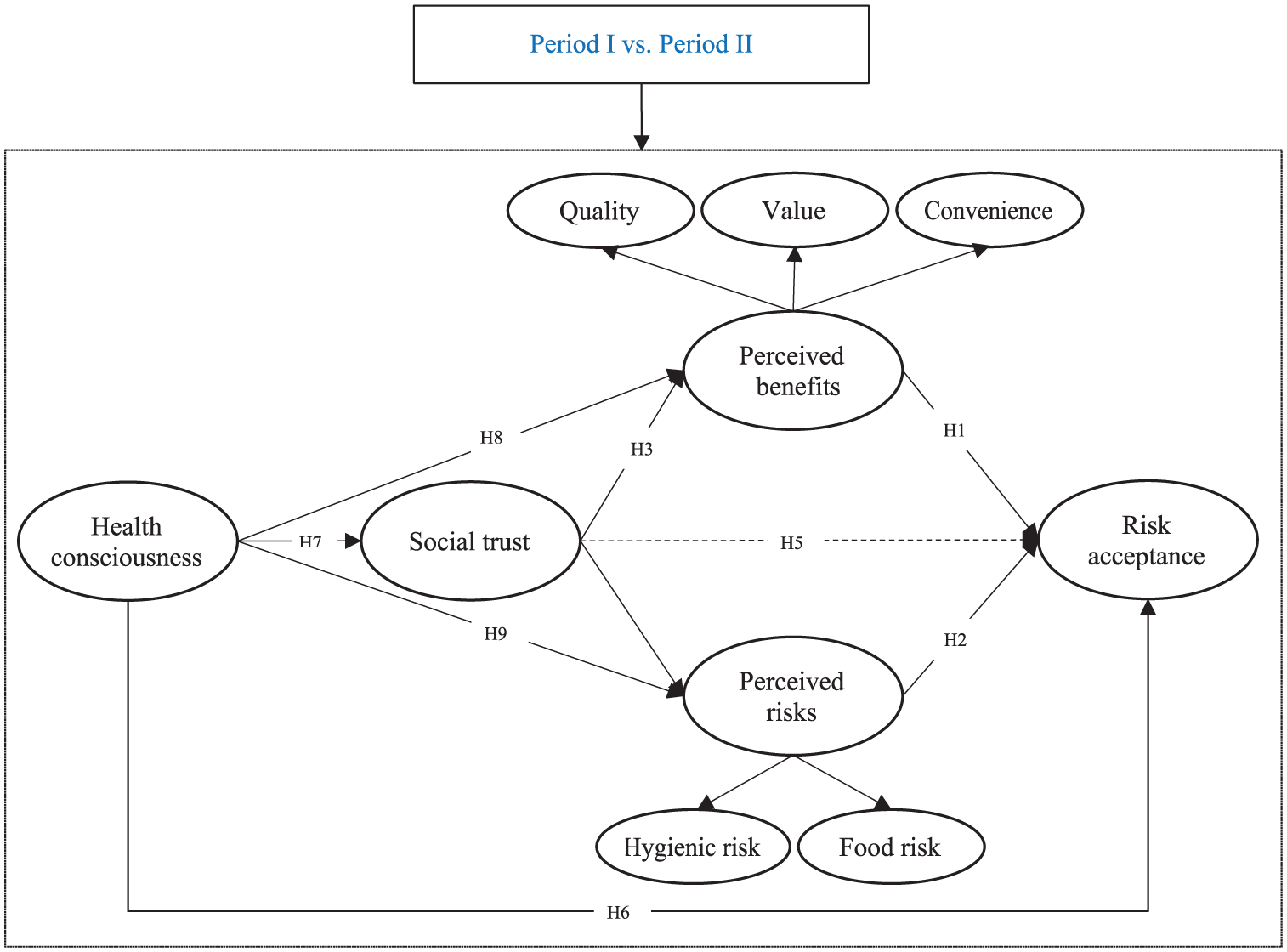
RA model for PDs.
Methods
Sampling and Respondents
This study employed the BRA model and the causal chain model of trust to investigate the determinants influencing consumers’ RA of PDs. An online survey was conducted in two periods (September 25–October 12, 2023, and June 22–June 30, 2025), targeting consumers who have purchased and consumed PD products, aiming to examine the similarities and differences of PDs’ RA patterns across 2 years. Purposive sampling was employed to guarantee that participants were selected from all regions of China and fulfilled the specific requirements of the study. The survey was administered using an online questionnaire platform Wenjuanxing (https://www.wjx.cn/). As of 2023, Wenjuanxing, with a sample base exceeding 6.2 million users covering all provinces in China and reaching nearly 300 million users per month, could provide a sufficient and scientifically robust sample, tailored to users’ interests and geographic and demographic characteristics.
The online questionnaire was distributed through the Wenjuanxing team, who randomly selected adult respondents from its sample base. 911 adult respondents were randomly selected by the Wenjuanxing team to answer this survey questionnaire. The validity of the online questionnaire responses was assessed based on the following five indicators: participants with verified real-name accounts, Internet Protocol (IP) addresses registered in China, unique and non-repetitive IP addresses, a response duration exceeding 5 min, and prior experience in purchasing PDs. During period I, a total of 397 questionnaires were returned, of which 383 had been fully completed. During period II, 542 questionnaires were returned and 528 were fully completed. A total of 911 effective samples were collected and then analyzed in this survey questionnaire. Participation was anonymous and voluntary.
Research Constructs and Measures
The questionnaire consisted of three parts. The first part gave the respondents basic information on the definition, forms, and characteristics of PDs. The second part collected the respondents’ basic information and consumption data. The third part, the main body of the questionnaire, comprised eight scales for measuring five constructs (HC, PB, PR, ST, and RA). To ensure the reliability and validity of this study measurements and facilitate comparability with international research, all constructs were operationalized using multi-item scales adopted from well-established instruments previously validated in the literature on consumer behavior, food safety, and technology acceptance. As PDs are considered to be covenience foods, RTE meals, ultra-processed foods, functional foods, GM foods, and innovative food technologies, scales represent common characteristics measured in related international studies. Furthermore, to ensure cross-cultural validity for Chinese consumers, the study employed rigorous translation and back-translation for each item by native speakers, followed by a pretest with 50 participants to validate the Chinese version’s design and wording. Additional details of each construct are presented below.
HC scale: An seven-item scale based on relevant research was used to evaluate HC (Chen, 2011; Michaelidou & Hassan, 2010). The items included the following: “I’m aware of the state of my health as I go through the day,”“I consider myself very health conscious,” and “I’m usually aware of my health.”
ST scale: Six items were used to measure ST (Chen & Li, 2007; Machado Nardi et al., 2020), such as “I have confidence in my government and its regulations on PDs,”“I have confidence in PD-related companies and supply chains,” and “I have confidence in nongovernmental organizations and consumer protection entities.”
PB scale: 13 items in three constructs—quality, value, and convenience benefits were measured for PB (Choi et al., 2013; Jang et al., 2011). Six items measuring the quality benefit were developed on the basis of relevant studies (Jang et al., 2011). The three items in the value benefit scale referred to two items from Choi et al. (2013) and one item of “PDs increase the added value of food” based on PD attributes. The convenience benefit measurement comprised three items from Choi et al. (2013) and one additional item, totaling four items.
PR scale: On the basis of relevant research, 13 items measuring PR were divided into two subdimensions: perceived hygiene risk and perceived food risk. The three items used to measure perceived hygiene risk referred to Choi et al. (2013) and were “The ingredients in PDs are not fresh,”“Food is stored improperly,” and “Food is prepared under unsanitary conditions.” Ten items from Van Der Vossen-Wijmenga et al. (2022) were employed to measure perceived food risk.
RA scale: Three items were employed to measure RA (Huang et al., 2021), including “I have relatively high acceptance of the food risks posed by PDs” and “After careful deliberation, I think PDs have more benefits than risks.”
The respondents rated each item on a 6-point Likert-type scale from 1 (strongly disagree) to 6 (strongly agree). General recommendations suggest using at least three items to measure latent variables in structural equation modeling (SEM; Hair et al., 2014). Thus, all latent variables in this study were measured with three or more items.
Procedures
Confirmatory factor analysis (CFA) is a modeling technique that examines the relationships between latent variables and observed measurements. Second-order CFA is a suitable approach for representing second-order variables because it expresses an ordinary factor model wherein the covariances of latent variables are determined by one or more higher-order latent variables (Hair et al., 2014). Similar to first-order factor models, second-order CFA models describe the relationships between first-order factors and an underlying second-order factor (Rudnev et al., 2018). Consequently, second-order factor models are more interpretable and parsimonious than are first-order factor models. and adapted a maximum likelihood estimation method to fit the model. The Structural Equation Model (SEM) serves as a multivariate statistical approach frequently utilized to assess underlying theoretical relationships and simultaneously examine internal interactions among multiple variables (Hair et al., 2014; Kline, 2015; Malhotra et al., 2017). By integrating several multivariate methods, such as multiple regression analysis, SEM facilitates the examination of both dependent and interdependent variable relationships (Hair et al., 2014).
In this study, IBM SPSS 25.0 was used to perform descriptive statistical analyses of demographic variables. CFA was utilized to determine the reliability and validity of the scale used to measure RA of PDs. Subsequently, data analysis was executed through SEM with maximum likelihood estimation to examine the hypothesized relationships by using the R lavaan package in R software (version 4.10).
Result
Descriptive Statistical Analysis
According to iiMedia Research (2023), female consumers account for 62.1% of PD consumers in China, whereas male consumers account for 37.9% (Xiong et al., 2023). In this study, the majority of the respondents were women (58.29%), which aligned with the aforementioned demographic trend. The age distribution in the present sample was as follows: 31.06% were aged ≤25 years, 34.25% were 26–35 years, 20.53% were 36–45 years, and 14.16% were ≥46 years. Among the respondents, 47.42% were office workers, 37.65% were on-campus students, and the majority held a bachelor’s degree (42.70%). Regarding monthly income, respondents with income of RMB ≤2,000 represented the smallest group (6.81%), whereas the proportion of other income groups is relatively even. Additionally, 57.30% of the respondents preferred RTH PDs, 24.48% preferred RTC PDs, and only 18.22% preferred RTP PDs. Descriptive statistics of the respondents’ sociodemographics are displayed in Table 1.
Respondents’ Sociodemographic Data (n = 911).

CFA Results
Schermelleh-Engel et al. (2003) proposed criteria for a good model fit, including χ2/df < 2, RMSEA < 0.05, SRMR < 0.05, NNFI and CFI > 0.97, NFI > 0.95. CFA in this study for the five second-order latent constructs—HC, ST, PB, PR, and RA—yielded a good model fit [χ2/df = 1.433, CFI = 0.994, NFI = 0.982, NNFI = 0.994, RMSEA = 0.027, SRMR = 0.046]. The reliability and validity of the measurement model were assessed through the examination of latent variables and their associated indicators (Hair et al., 2017). Cronbach’s α is generally employed to estimate the reliability. Nunnally and Bernstein (1994) suggested that the minimum Cronbach’s α should not be lower than .7. All Cronbach’s α and composite reliability (CR) coefficients exceeded the recommended threshold of .70 (see Table 2), suggesting strong internal consistency (Hair et al., 2017). Furthermore, all factor loadings in this research were above 0.7 (Hair et al., 2011), and the average variance extracted (AVE) for each construct surpassed the cutoff of 0.50 (Hair et al., 2014), supporting adequate convergent validity. No items were removed from any latent construct due to the satisfactory loading values. The overall Cronbach’s α for the second-order constructs was .913, with the α value for PB being .914 and for PR being .982.
Scale Items and Quality Criteria of the Constructs (n = 911).

To assess the discriminant validity (DV) among the five second-order constructs, confidence intervals of the inter-factor correlations were computed (Fornell & Larcker, 1981). Additionally, the heterotrait-monotrait ratio (HTMT) was utilized in this study as a more accurate method for evaluating discriminant validity, as it has been recognized as a more robust indicator in recent literature (Henseler et al., 2015). The HTMT values among the five constructs, as presented in Table 3, were all below the threshold of 0.9 (Henseler et al., 2015), confirming sufficient discriminant validity among the measured constructs. Overall, these results confirm that the scales, adopted from established international instruments, performed reliably and validly within the context of this study.
Result for Discriminant Validity of HTMT (n = 911).

SEM Analysis and Mediation Effects
The hypotheses were tested through SEM with the maximum likelihood estimation, performed using the R lavaan package. According to the criteria set by Tabachnick and Fidell (2007), the final model had robust fit (χ2 = 3317.482, df = 805, p < .001, RMSEA = 0.059, CFI = 0.960, NFI = 0.947, and TLI = 0.957). The results of the hypothesis testing and paths coefficients obtained from the SEM are presented in Table 4 and Figure 2.
Summary of Hypothesis Testing.

p < .05, **p < .01, ***p < .001.
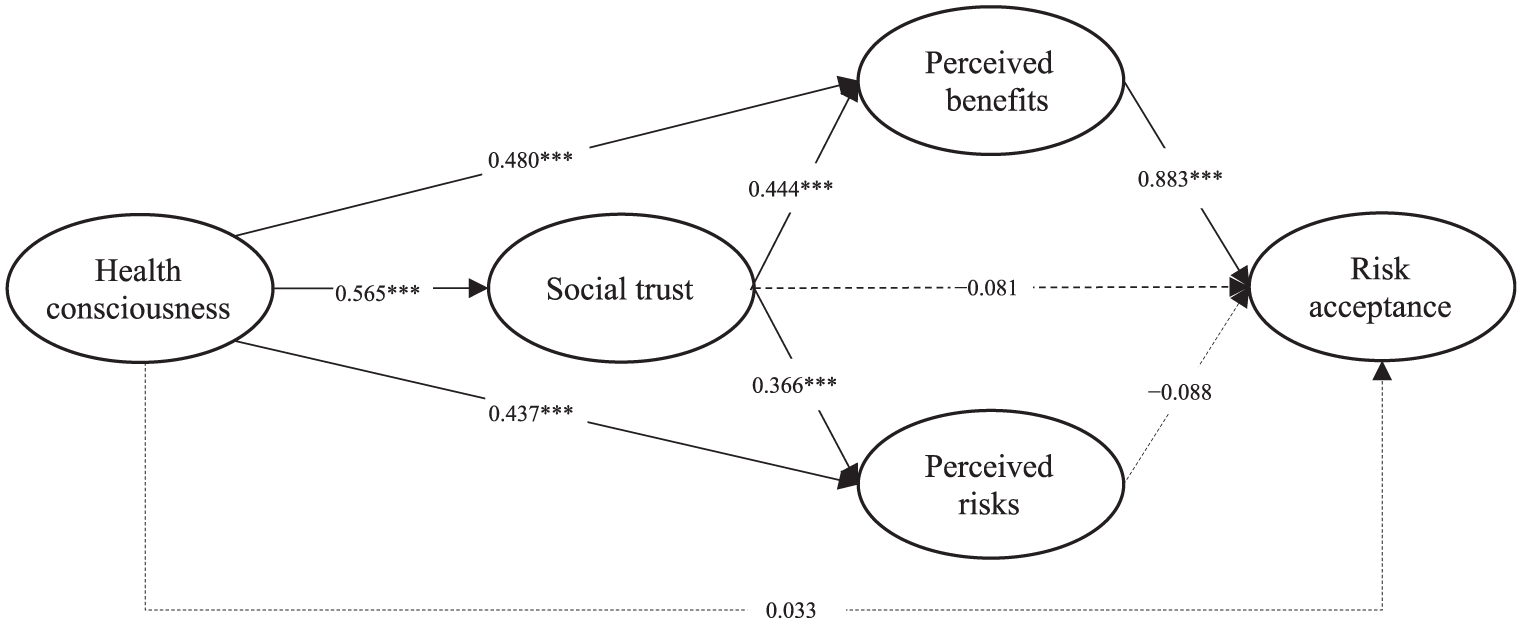
Paths coefficients and mediation model of RA (n = 911).
PB significantly positively affected consumers’ RA of PDs (β = .883, p < .001), supporting H1. PR had no significant effect on RA (β = −.088, p > .05), thus H2 was not supported. Regarding ST, consumers’ ST significantly and positively affected the PB of PDs (β = .444, p < .001); the stronger consumers’ ST, the higher the PB of PDs; thus, H3 was supported. ST had a significant positive effect on the PR of PDs (β = .366, p < .001), and the more consumers had trust in related sectors and stakeholders, the higher were the PR of PDs; thus, H4 was not supported. The effect of ST on PB was stronger than the effect of ST on PR (β = .444 vs. .366). The effect of ST on RA was not significant (β = −.078, p > .05), and H5 was thus supported. Therefore, ST’s effect on RA is fully mediated through its effects on PB and PR. The effect of HC on RA was nonsignificant (β = .033, p > .05), and H6 was thus not supported. Consumers’ HC significantly positively affected their ST in PDs (β = .565, p < .001), and the higher the HC of consumers, the higher their trust in related institutions; thus, H7 was supported. Consumers’ HC had a significant and positive influence on both PB (β = .480, p < .001) and PR (β = .437, p < .001) of PDs. This suggests that as consumers’ HC increases, their perception of the benefits of PDs becomes stronger, thereby supporting H8. Likewise, higher levels of HC correspond to a stronger perception of potential risks associated with PDs, which supports H9. Consequently, HC may serve as a key antecedent that shapes consumers’ ST and their evaluation of benefits and risks prior to making decisions about PDs.
Indirect Effects
The mediating effect paths in this study are also detailed in Table 5. Consumers’ ST totally exerted a significant and positive effect on RA (β = .279, p < .001) of PDs. The mediating path ST → PB → RA (β = .391, p < .001) was significant and positive, indicating that PB fully mediates the positive relationship between ST and RA of PDs. The mediating path ST → PB → RA (β = −.032, p > .05) was nonsignificant. Consumers’ HC totally had a significant and positive effect on RA (β = .622, p < .001) of PDs. PB fully mediates the positive relationship between HC and RA (β = .424, p < .001) of PDs. The path HC → PR → RA (β = −.038, p > .05) was not significant. The path HC → ST → PB → RA (β = .221, p < .001) was significant and positive, suggesting that HC triggers a chain mediating process through ST and PB where higher HC strengthens ST which subsequently enhances PB and ultimately increases RA. However, the path HC → ST → PR → RA (β = −.018, p > .05) was nonsignificant. These findings demonstrated that PB fully mediates the positive relationships between ST and HC with consumers’ RA of PDs.
Indirect Effect Paths.

p < .05, **p < .01, ***p < .001.
Paths Comparison of Two Periods
A multigroup SEM analysis approach was adopted to examine each path in period I and period II. The model of period I demonstrated a fit comparable to that of the initial model (χ2 = 1302.928, df = 805, p < .001, RMSEA = 0.040, CFI = 0.960, NFI = 0.902, and TLI = 0.957). The model of period II also indicated a fit comparable to that of the initial model (χ2 = 2046.551, df = 805, p < .001, RMSEA = 0.054, CFI = 0.953, NFI = 0.925, and TLI = 0.950). The results and the path coefficients for both two periods obtained from the SEM are presented in Table 6 and Figure 3.
Paths Coefficients of Two Periods.

p < .05, **p < .01, ***p < .001.

Paths comparison across two periods (n = 383/528).
Three paths were found to exhibit significant differences between two periods through SEM-MGA comparison (Table 6). The first difference was that the PR → RA path was significantly negative only in period I (β = −.164, p < .01), but was nonsignificant for period II (β = −.014, p > .05). The second was that the significant positive effect of ST on PB increased from period I to period II, with β values of .219 (p < .05) and 0.364 (p < .001), respectively. The third was that ST significantly and positively affected PR, and a stronger positive effect of ST → PR was observed in period II (β = .203, p < .001) than it did in period I (β = .115, p < .05).
In both two periods, PB → RA was significantly positive with a stronger effect in period II (β = .637, p < .001) compared to period I (β = .579, p < .01). Consumer HC significantly positively affected ST, and a stronger effect in period II (β = .294, p < .001) compared to period I (β = .156, p < .01). HC → PB and HC → PR were significantly positive in both two periods. The effect of HC on PB in period II (β = .361, p < .01) was stronger than it did in period I (β = .251, p < .01). Similarly, HC → PR in period II (β = .637, p < .001) was stronger than it did in period I (β = .579, p < .01). Two paths ST → RA and HC → RA were nonsignificant in two periods.
Regarding mediating effects, PB significantly and fully mediated both the ST–RA and HC–RA associations. However, the positive effect of ST–RA was stronger in period II (β = .232, p < .001) than in period I (β = .127, p < .01); similarly, a stronger positive effect of HC–RA was observed in period II (β = .230, p < .001) than it did in period I (β = .150, p < .01). PR negatively mediated the ST–RA relationship in period I (β = −.019, p < .05) compared with nonsignificant for period II (β = −.003, p > .05). PR significantly and negatively mediated the HC–RA in period I (β = −.034, p < .001) compared with nonsignificant for period II (β = −.003, p > .05). However, the negative effect of HC–RA was weaker in period II (β = −.003, p > .05) than in period I (β = −.034, p < .001). The chain mediation path HC → ST → PB → RA was significant and positive across both two periods, with a stronger effect in period II (β = .068, p < .01) than did in period I (β = .020, p < .05). The chain mediating effect of HC → ST→ PR → RA path was significantly negative only in period I (β = −.003, p < .05), compared with β = −.001, p > .05 for period II.
Discussion
Dominant Role of PB: Substantial Gains Outweigh Risks to Foster Sustained RA
The present study reveals that Chinese consumers’ RA of PDs is mainly determined by PB, such as convenience and price. Higher levels of PB correlate with more positive RA, aligning with prior research while also emphasizing the crucial roles of perceived value attributes and positive word-of-mouth in shaping overall consumer acceptance (Bumbudsanpharoke & Ko, 2022; Cai et al., 2022; Chen & Li, 2007; Jang et al., 2011; Kang et al., 2019; X. Liu et al., 2025; Uhm et al., 2022; Wang et al., 2023). However, different from previous conclusions, this study finds no significant impact of PR on PD acceptance even though the average of PR (M = 5.148, SD = 0.899) is higher than that of PB (M = 4.590, SD = 1.514), suggesting that consumers’ attitude toward PD products is not consistently linked to actual rejection behavior (Loebnitz et al., 2015). This aligns with Zhang et al., (2024)’s findings that social, health, quality, psychological and purchasing risk had no significant impact on continuous consumption intention. Furthermore, this study resonate with the work of Chen and Li (2007), who argued that consumers’ RA of PDs relates to a weighing of PR and PB and that the PB of using emerging technology to produce PDs is seen as outweighing the PR. In other words, if consumers’ requirements can be fulfilled by substantial benefits provided by PDs, they could tolerate its potential risks, aligning with the “tangibility bias” theory (Atasoy et al., 2022), where substantial benefits create a sense of security against abstract risks.
Dual-Edged Role of ST: Catalyzing PB and Intensifying PR
ST is a crucial factor influencing PB and PR. When consumers have more trust in the sectors and stakeholders involved in producing PDs, they perceive the benefits of PDs more clearly. This finding aligns with conclusions drawn in relevant studies (Ali et al., 2020; Chen & Li, 2007). Furthermore, the significantly positive effect of ST influences PB more strongly than it influences PR. Although food safety incidents amplify the risk perceived by the public, food knowledge discussed by different actors, policy support for the PD industry, and consumers’ daily eating experience can help the public to weigh the benefits against the risks and thus perceive that the benefits of PDs outweigh the risks. Contrary to relevant studies, this study found that ST significantly positively affects PR; consumers with greater trust in societal institutions also perceive higher risks, and conversely, lower trust correlates with lower PR. Prior studies concluded that ST is positively, though nonsignificantly, related to PR because the public believes that rumors and fake news emerged from word-of-mouth among people amplifies the perception of risk (Kasperson et al., 1988; Ma & Christensen, 2019). As Media exposure in 2023 regarding PDs entering school campuses sparked considerable public concern about the hidden food risks, consumers’ trust in related sectors and stakeholders lead to share these information on social media without fact-checking on social media, thus increasing risk perceptions. Additionally, ST was found to have a significantly positive effect on RA of PDs through PB. In other words, ST results in better PB through the public’s daily consumption experience of PDs and enhances consumers’ RA of PDs, consistent with the finding of Chen and Li (2007).
Intrinsic Role of HC: Connecting Personal Beliefs to Rational Risk-Benefit Assessment
HC is a crucial factor influencing consumers’ ST in PDs. This study provides insights into a significant association between an individual’s well-being and ST. Consumers with high HC were found to be more likely to have trust in related sectors and stakeholders, consistent with empirical evidence of positive associations between self-rated health and ST (Gilbert et al., 2013; Murayama et al., 2012). This study outlines a pathway that demonstrates how individual HC affects ST in the Chinese context. Because food safety is closely related to individual health and well-being, Chinese consumers may evaluate potential risks on the basis of their beliefs and place their trust in stakeholders despite uncertainty and limited knowledge.
HC had a significant positive effect on PB and PR, which is consistent with the findings from food choice studies, which have shown that consumers with high HC prioritize food safety; prefer high-quality, nutritious, and healthy functional foods; and avoid food additives or preservatives (Siddiqui et al., 2023). Consumers’ assessment of PDs’ benefits and risks is driven by the rational variable HC. The higher their HC, the more consumers perceive the value of the functional benefits of PDs and the stronger their perception of hidden safety and health hazards. HC does not directly affect consumer RA of PDs; instead, it exerts a positive influence indirectly through mediators such as PB and ST. This result is consistent with those of relevant studies; that is, consumers perceive benefits through evaluation of the value attributes of PDs and external trust of related sectors and then easily accept the risks of PDs when the PB satisfy their health needs (Teng & Lu, 2016).
Temporal Transition: Shifting Priorities from Risk Avoidance to Benefit Salience
The comparative analysis reveals both stability and evolution in the mechanisms influencing RA of PDs across two periods. In Period I, consumers relied heavily on PR to reject PDs, as shown by PR’s significant negative effect on RA and its full mediation of the ST–RA and HC–RA links. While in Period II, the negative effect of PR on RA, and its mediating role between ST and RA, HC and RA diminished. This shift reflects how the “ripple effect” extends to the impact of risk events disseminated through negative social media information (Yan et al., 2019), aligning with Loewenstein et al. (2001)’s “risk as feelings” framework, which highlights the role of emotions experienced at the moment of the decision-making process. When individuals lack awareness of PDs risks/benefits, providing risk information on social media can elicit a negative affect heuristic, reducing willingness to explore further and leading to judgments dominated by initial information (Fischer & Frewer, 2009).
PB consistently dominated and strengthened consumers’ RA of PDs during the decision-making process across both periods. Currently, as manufacturers reform PDs with low sugar/salt/fat ingredients, retailers offer light meals, and industry safeguards improve with transparent labeling, benefits of PDs has been gradually salient. This finding demostrates that familiarity fosters “benefit salience,” making positive framing critical for sustained acceptance of convenience foods like PDs (Perlstein, 2024). Furthermore, repeated exposure reduces uncertainty, pushing individuals from PR avoidance to proactive evaluation of trade-offs guided by PB (Lee, 2001). Additionally, the path coefficients for ST-RA and HC-RA declined in period II, although these effects were statistically nonsignificant; these results suggest that consumers may have become less risk-averse due to increased familiarity with PDs or improved industry regulations (Frez-Muñoz et al., 2024; Wong et al., 2025) over time. Results of this study also indicated that current widespread acceptance of PDs by Chinese consumers reflects a reluctant adaptation to shifting social dynamics and increasing lifestyle pressures, consistent with Shu et al., (2024)’s conclusions. Overall, these findings of period I and II revealed the dynamic interplay between trust, risk-benefit appraisal, and food innovation adoption.
Implications
Theoretical Implications
This study makes several theoretical contributions. First, this study provides a unique research perspective for the PDs industry and extends the BRA model to examine the determinants of food RA and its influential factors, enriching the research on consumers’ food decision-making processes in the context of China’s emerging food market. Second, compared with previous studies focusing on food consumption behavior associated with attitude (D’Souza et al., 2021; Rana & Paul, 2017; Zhao et al., 2024), this study indicates that negative risks perception toward PDs does not necessarily transfer to rejection behavior, while positive benefits perception could continuously affect high acceptance, particularly in examining the balance of PB and PR regarding dynamic evolution of risk acceptance. Third, this study integrates cross-sectional and temporal approach and provides empirical evidence for consumers’ change from affective to cognitive decision-making when and after food safety incidents. Fourth, ST amplifies PR during risk incidents—contradicting assumptions that trust universally mitigates risk perception. This extends the Social Amplification of Risk Framework (Kasperson et al., 1988), demonstrating that social trust in related sectors and stakeholders can accelerate the diffusion of risk information when unverified information has been issued by these institutions and then shared by consumers. Moreover, ST should not be considered a single antecedent or consequence in the public’s risk assessments; it can be influenced by an individual’s awareness and can affect both PB and PR in consumers’ food decision-making processes. Any single model would have difficulty explaining multiple paths of consumers’ food choices in risk communication.
Practical Implications
First, trust as a mitigating force can generate certainty and affect individual’s choice (Roh et al., 2022), the dual-edged role of ST demands institutional vigilance and consumers right to know of the benefits and risks associated with consuming PDs. The Chinese government and regulatory institutions should strengthen the supervision of food safety and quality in the PD industry and improve food safety certification regulations. Introducing monitoring and certification programs could assure consumers that products and services meet certain standards, thereby enhancing trust and managing risk concerns. Related stakeholders in the food supply chain must provide transparent information on the benefits and potential risks of PDs to cultivate trust to ensure that consumers are well-informed. For example, food labels with certain unobservable dimensions of the quality and value of their products (Coderre et al., 2022) should be attached to enhance consumers’ perceptions of their benefits and decrease the PR. Furthermore, word-of-mouth of restaurants and delivery platforms is influenced by consumers’ trust and perception of benefits (Das & Ramalingam, 2023). Restaurants and food delivery platforms should clearly identify which dishes are prepared to protect consumers’ right to know and should provide clear food labels on dishes, allowing consumers to make informed decisions that balance personal health with taste preferences. This would not only help individual consumers make informed choices but also contribute to the reputation and long-term standardized development of PDs in a competitive market.
Second, the significantly negative impact of PR on RA diminished while the dominance of PB substantially strengthened over time. Facing publics’ high perceived risks driven by food safety incidents, sustained PD market growth hinges not on eliminating perceived risks but on regulatory improvements, visible industry safeguards, consumer education and aligning product development with health-conscious values. Regulators and industry must establish rapid-response fact-checking system during incidents to counter unverified information through official channels, while proactively publisize every step of the PDs processing flow to build trust resilience. Third-party entities play a vital role in verifying food safety standards and certifications, inducing consumers’ purchase behavior to PDs by focusing on HC which appeal to consumers’ desire for food safety (Dong et al., 2022). This requires third-party entities to spot-check the quality of PDs and implement strict quality assessment throughout the entire production process of PDs. Crucially, health-conscious segments require tailored approaches: emphasizing safety certifications and nutrient fortification for high-HC consumers while highlighting convenience for pragmatic adopters. Additionally, PD manufacturers should make strategies of providing visible benefits from risk mitigation to benefit salience: reformulating PDs with health-positive attributes (low sugar/salt/fat), ensuring transparent labeling, and designing retail environments that concretely communicate convenience and value to trigger “tangibility bias.”
Conclusion, Limitations and Further Research
This study examines determinants and the complex dynamics shaping Chinese consumers’ risk acceptance of PDs. The findings reveal that first, RA is not a simple function of risk avoidance but rather a nuanced outcome driven by the interplay of perceived benefits, perceived risks, social trust, and health consciousness, evolving significantly over time. Second, the dominant role of PB, such as quality, convenience and value attributes outweigh PR can consistently as the primary drivers of sustained acceptance, suggesting consumers can tolerate potential risks when tangible and substantial benefits meet their needs. Third, ST strongly enhances the perception of benefits but also unexpectedly amplifies perceived risks; particularly when triggered by negative media exposure, consumers could share the information issued by the institutions they trust, which in turn heightens their risk perceptions. Fourth, individual HC provides the intrinsic beliefs for social trust and risk-benefit trade-offs, suggesting that consumers’ risk assessment of PDs is a rational process with benefits align with individuals’ intrinsic health needs and external trust in related sectors. Finally, the temporal transition of consumers’ acceptance of PDs—from reactive risk avoidance to proactive evaluation driven by tangible benefits—reflects a dynamic process of balancing technologically enhanced PDs market offerings, proactive industry improvements catering for consumers’ diversified needs, consumers’ growing familiarity with PD products, and their adaptation to lifestyle pressures.
Although this research has made some contributions in theory and practice, it also some limitations. First, the cross-sectional comparison between two periods may introduce variability due to differences in sample size and demographic composition, potentially limiting direct inferences about temporal trends. Future longitudinal studies with a stable cohort will be conducted to better examine the dynamic influence of situational factors on PDs acceptance. Second, relevant studies have indicated that key factors affecting food safety risk perception—such as knowledge, subjective characteristics, and sociodemographic characteristics—may have negative effects on consumers’ food choices and willingness to purchase PDs. These factors could be examined in the future. Third, this study employed the causal chain model to examine the role of social trust in consumers’ risk acceptance of PDs. Chen and Li (2007) indicated that consumers’ general and prior attitudes strongly influence perceived benefits and then affect attitudes toward GM foods, but no significant effect on perceived risks exists; the associationist model may be partially effective. As the PD industry develops and food safety regulations improve, integrating the associationist and causal chain models would perhaps yield a better model for explaining the complex determinants of PD choices.
Footnotes

Ethical Considerations
The authors confirm that they obtained electronic informed consent from participants.
Funding
The authors disclosed receipt of the following financial support for the research, authorship, and/or publication of this article: This study was supported by the Project on Economic and Social Development of Liaoning Province (2025lslqnkt-051), Fundamental Research Funds for Higher Institutes of Educational Department of Liaoning Province (LJ112510166033 and LJ112510166022), Planning Project for Philosophy and Social Sciences of Shenyang (SY20240301Q) and the Shenyang Normal University (BS202538).
Declaration of Conflicting Interests
The authors declared no potential conflicts of interest with respect to the research, authorship, and/or publication of this article.
Data availability Statement
Data are available on request from the authors.