



Abstract
Dynamic assessment (DA), based on Vygotsky’s Sociocultural Theory, integrates instruction and assessment into a single activity through interactive dialog between the mediator and learner to promote development. This research utilized the interactionist DA to assess and enhance five types of listening inferential abilities of Chinese EFL learners. Micro-genetic analysis was used to track the developmental trajectory. The study compared four students’ independent and mediated performances across the pre-test, post-test, and transfer test. Results showed that DA positively influenced the students’ listening inferential abilities, with all five inference types showing varying levels of improvement after DA. The findings can be grouped into three primary categories: (1) Students demonstrated the most significant enhancement in thematic inference during both the post-test and transfer test; (2) Students faced challenges with predictive and motivational inference; (3) Although progress in the transfer test remained below average, there was notable advancement in conversational implicature in the post-test. Conversely, the situation with attitudinal inference showed the opposite trend. This study demonstrated that implementing DA could offer a nuanced understanding of EFL learners’ listening inferential abilities and provide valuable empirical support for the use of DA in future foreign language classroom instruction.
Plain language summary
“Promoting L2 Listeners’ Inferential Ability through Dynamic Assessment” is a research paper that focuses on enhancing second language (L2) listeners’ inferential ability using dynamic assessment techniques. Dynamic assessment is an interactive process that evaluates learners’ capabilities not only based on what they currently know but also on their capacity for growth when provided with appropriate assistance. Unlike traditional assessments that focus solely on measuring learners’ matured ability, dynamic assessment also puts emphasis on their emerging abilities. In this study, we employed the one-to-one interactionist DA between the learner and the mediator in three sessions as an enrichment program to diagnose and promote Chinese university EFL learners’ five types of inferential abilities in listening comprehension. The results show that DA had a beneficial impact on the micro-genesis of the students’ listening inferential ability. Micro-genesis refers to development of linguistic capacity within a short period. We also find that the quality of mediational moves needed was similar across the five types of inference in general, with a slight difference in frequency. In addition, after the DA-based enrichment program, the five types of inference showed discrepancy in micro-genesis. Our findings contribute to both the listening inferential literature and the application of dynamic assessment.
Introduction
Listening comprehension can be defined as a complex mental process that demands cognitive effort and draws upon multiple sources of information (Buck, 2003). Inference-making is a crucial cognitive process that enables listeners to deduce implied meanings, and it is vital for achieving effective comprehension (Freed & Cain, 2017; Y. S. Kim, 2016; Thu et al., 2023). Inference-making ability, also known as inferential ability, is an essential top-down processing skill in English as a Foreign Language (EFL) listening comprehension. Research on assessing inferential ability in listening has received limited attention from L2 researchers (Marisa, 2007). Furthermore, many students encounter significant challenges in this area, hindering their progress (Alavinia & Sameei, 2012; Kao & Kuo, 2021; Mulyaningsih et al., 2013; Yang & Qian, 2017). This difficulty could be partially explained by the complex nature of the inferential process, which necessitates students to identify word clusters, connect facts and concepts, and integrate contextual cues with prior knowledge (Cain & Oakhill, 1999; Garnham, 2010). Moreover, L2 teachers often lack a clear understanding of the significance of effective listening pedagogies in fostering students’ inferential abilities (Grabe, 2009; Thu et al., 2023; Vandergrift & Goh, 2012).
To help learners overcome the challenges of listening comprehension and assist teachers in developing effective pedagogical approaches, this study is framed within DA. It applies Vygotsky’s sociocultural theory by merging instruction with assessment into a unified process and has been proven effective for diagnosing students’ growth potential (Kao & Kuo, 2021; Zhang, 2023). DA not only identifies learning difficulties but also tracks the process of their comprehension skills as time progresses (Ableeva, 2010; Huhta, 2008). This study explores how DA-based instruction can enhance the micro-genesis of college EFL learners’ English inferential ability in listening, endeavoring to bridge the research gap in the assessment of listening comprehension within the EFL context.
Literature Review
Inferencing in L2 Listening
Inferential ability is the ability to deduce the meanings of unfamiliar words, complete missing information, or anticipate results using one’s linguistic knowledge, schemata and contextual cues (Guo, 2015; Zhang, 2012). Inference is a crucial yet challenging skill that requires students to listen attentively and form well-reasoned judgments based on specific outcomes, events or actions from the listening materials (Harvey & Goudvis, 2000). The literature identifies various types of inferences in listening comprehension. Hildyard and Olson (1978) study, categorized inferences into three distinct types for a clearer understanding. Firstly, they introduced propositional inferences, which are the logical conclusions drawn directly from any statement. Secondly, they talked about enabling inferences that delve into the cause-and-effect relationships between different events or ideas. Lastly, they highlighted pragmatic inferences, which add non-essential but enriching details that aid in interpreting the text more comprehensively. From a test-taking perspective, Buck (1991) outlined five types of inferences, such as deducing a character’s feelings, determining the reasons behind the information, making deductions, predicting the progression of a story, and identifying the reasons behind an apparent inference. Additionally, listeners may infer a speaker’s attitudes, intentions, hidden meanings, thoughts, motivations and purposes and anticipate the speaker’s next statement (Rivers, 1971). However, there is no consensus among academics regarding the categorization of inferences (Freed & Cain, 2017).
This study mainly delves into five types of inferences, namely, thematic inference (deducing the main idea or gist of a text), motivational inference and attitudinal inference (understanding the speaker’s motivation and attitude), predictive inference (predicting their next words or actions) and conversational implicature (inferring meanings that are not explicitly stated or strictly implied). These chosen categories align with this study’s objectives. Inferential skills constitute one of the most important constructs in most listening comprehension tests (Kang et al., 2019). For example, the TOEFL iBT multiple-choice questions (MCQs) place a strong emphasis on inferential abilities, making them an ideal choice for this research (Ableeva, 2010). Research indicates that common inference-type questions of TOEFL correspond closely with the inference types being analyzed in this study (Afriani, 2017). These altogether lay a solid theoretical and practical groundwork for the selection of the five types in this study, highlighting their relevance, necessity, and significance.
Major Concepts of Dynamic Assessment
According to Vygotsky, higher-order thinking arises from social and cultural influences. Human interactions, along with the utilization of both physical and symbolic instruments like books and language, are vital in developing these advanced cognitive abilities (Lantolf & Poehner, 2004). Thus, an individual’s connection to the world is mediated by external factors. By allowing closer collaboration between the mediator and the learner during an assessment, mediation facilitates the learners’ progress to higher levels within their Zones of Proximal Development (ZPDs). Vygotsky (1978), defines ZPD as the gap between a learner’s current abilities and their potential level of development, determined by their independent problem-solving skills or collaborative problem-solving with more advanced peers or experts. This gap can be bridged by providing learners with external forms of mediation that enable them to achieve beyond their current abilities. ZPD highlights capacities and operations that are still internalizing and emerging. Lantolf and Poehner (2004) propose that DA encompasses both interventionist and interactionist approaches. Interactionist DA refers to flexible mediation that arises from dialog between the mediator and the learner, adapting the mediation provided based on the learner’ responses (Poehner & Lantolf, 2013). Interventionist approach is more structured, employing standardized administration procedures and assistance to obtain measurable outcomes (Lantolf & Poehner, 2004).
Vygotsky prioritized development over isolated experiments and advocated for the genetic approach as a solution. The genetic approach tracks changes in students’ intellectual growth and cognitive functioning over time (Wertsch, 1985). To observe the emergence of specific mental processes, such as linguistic capacity in a short span, the micro-genetic process is employed. In L2 studies, this method has been applied in one-on-one interactionist DA between the learner and the mediator (e.g., Ableeva, 2010; Ableeva & Lantolf, 2011; Aljaafreh & Lantolf, 1994). Ableeva (2010) employed a pre-test, enrichment program, and post-test design to assess learners’ listening comprehension and track the development. The study analyzed the frequency and type of mediation, ranging from implicit to explicit. The findings demonstrate that micro-genesis effectively captures both the types of mediation by the mediator and the types of response by the learner, helping monitor changes in emerging and mature abilities. This offers valuable methodological insights for future research. The concept of mediation typology provides a framework for categorizing mediation moves, ranging from abstract to concrete and from implicit to explicit (Poehner, 2005). The learner reciprocity typology is a rating scale that emphasizes the different moves used by learners that are helpful in capturing their contributions to the performance and in understanding their developmental level (Poehner, 2005). Together, these two typologies offer a comprehensive approach to analyze learner-and-mediator interactions, considering both the quality and quantity of mediation and response.
Studies on Inferential Ability in Listening
Inference is crucial in aiding listeners to comprehend the meaning of a recording by analyzing both textual and contextual information (Zhang, 2012). Studies in EFL learning and teaching explored the theoretical aspects of inferencing skills and strategies, emphasizing its importance for effective listening comprehension (such as Al Musalli, 2001; Buck, 2003; O’Malley & Chamot, 1990; Rickheit et al., 1985; Rost, 1990). Other existing studies investigated the factors (such as linguistic factor, paralinguistic factor, non-linguistic factor, contextual clues, prior knowledge, and L2 vocabulary knowledge, working memory, and gender) influencing inference in listening comprehension (Barati & Biria, 2010; Currie & Cain, 2015; Mulyaningsih et al., 2013; Müsseler et al., 1985; Ningrum et al., 2022; Van Zeeland, 2014). Several studies delved into the significance of drawing inferences in understanding listening text, revealing that making inferences is essential for proficient listening comprehension (such as Guo, 2015; Y. S. Kim, 2016; Lepola et al., 2012; Marisa, 2007). Chao and Chen (2014) explored how teaching inference strategies impacts EFL learners’ listening comprehension and examined how these strategies’ effectiveness is intertwined with the students’ language proficiency levels. Additionally, Thu et al. (2023) conducted a study on how teachers view listening inference skills and the pedagogical techniques they employ to teach them. However, research on assessing listening inferential ability has received little attention from L2 acquisition researchers (Becker, 2016; Lee, 2024; Marisa, 2007; Van Zeeland, 2014). And the assessments conducted by teachers on student learning are frequently high-stakes, yet they lack a structured approach, systematicity and a deep theoretical insight into development (Rea-Dickins & Gardner, 2000; Torrance & Pryor, 1998). As a result, students struggle to identify specific problems with their listening inference, and teachers cannot provide targeted guidance. A potential solution lies in Dynamic Assessment (DA), which emphasizes the mediational process and provides deeper insights into teaching the inferential process in listening. By incorporating the mediator-learner interactions, DA illuminates learners’ understanding and control over listening inferencing, while also pinpoints the root causes of underperformance. This approach integrates instruction and assessment into one unity, enabling both the mediator and learners to achieve a more profound comprehension of students’ abilities. Consequently, this shared insight facilitates development of learners’ abilities through continuous interaction (Poehner, 2005).
Despite some efforts to apply DA in L2 studies, research on DA in listening inference remains limited. Previous investigations have primarily focused on pragmatic aspects of listening inference. Some studies examined DA’s applicability to enhance students’ understanding of conversational implicatures in listening (Hashemi Shahraki et al., 2015; Moradian et al., 2019; Qin & van Compernolle, 2021; Rassaei, 2023; Tajeddin & Tayebipour, 2012). Findings showed that DA brought about notable improvement in learners’ listening abilities and comprehension of conversational implicature. Other studies assessed the effects of different DA models on speech production or behavior in pragmatic comprehension in listening among L2 learners. For instance, Malmir (2020) explored how interactionist and interventionist DA influenced the listening comprehension accuracy and speed among intermediate EFL learners. Kao and Kuo (2021) used computerized dynamic assessment (C-DA) to accurately identify the listening challenges faced by English learners, determine their educational requirements and enhance their abilities. Results showed that while inference-type questions were challenging for students, they benefited significantly from assistance in answering them. Qin and van Compernolle (2021) focused on C-DA administration in a significant area of pragmatics: implicature comprehension. Findings indicated that all learners improved with mediation, suggesting that mediation-based assessments offer a more informative diagnosis of learner capabilities than independent performance alone.
The different types of inferences discussed above have been studied to varying degrees, with some receiving significant research attention (conversational implicature) while others have been largely overlooked within DA. By collectively exploring the five types of inferences, this is study is designed to improve students’ overall listening abilities. This improvement not only leads to a better understanding of practical communication but also deepens their comprehension of the text, ultimately promoting higher-order thinking (Baghaei et al., 2020). The former aspect helps learners effectively interpret language during communication, enabling them to discern the speaker’s motivations and attitudes conveyed in their utterance. The latter focuses on improving learners’ skills in understanding the context of listening materials and recognizing the connections between preceding and subsequent information.
Overall, this study applied interactionist DA to offer tailored mediation that meets the learners’ needs. It also provided an in-depth and well-rounded understanding of how listening inferential abilities develop. By exploring these five inference-types collectively within the framework of DA, this study aims to improve learners’ better grasp of implicit meanings and nuances within listening materials over time, and thus sharpen learners’ deeper and higher-order thinking.
Methodology
Based on the available empirical evidence, this paper seeks to explore and address the research questions outlined below:
(1) How does DA facilitate the development of listening inferential ability in Chinese EFL contexts?
(2) To what extent does the development of five types of inference vary after the implementation of DA?
Participant
Four students volunteered for this study. They are from non-English majors and enrolled in the same English course at a polytechnic university in Northwest China, ensuring their homogeneity of background among them. They consisted of three females and one male, all of them were English L2 learners aged between 18 and 20. They came from similar educational backgrounds and had all taken the same version of College Entrance Examination in China. Their scores on this test ranged from a minimum of 90 to a maximum of 134, reflecting a diverse range of overall English proficiency (see Table 1).
Participant Language-Learning Information.

Participant Zhu loves listening to English songs, which fuels her passion for language learning and helps her achieve excellent grades. She recognizes that mastering English is essential for everyday life, extending beyond mere exam preparation. Right now, she is working hard to prepare for the upcoming Band 4 exam. Wang began learning English in the third grade of elementary school. Initially, she struggled to find interest in English learning. However, after learning English fairy tales at an extracurricular program, she discovered her passion for learning English. Now, Wang views English not only as a tool to achieve her career goals but also as a way to enhance her personal skills. Zhao has been learning English since the third grade of elementary school. She finds listening comprehension particularly challenging, which has influenced her overall English performance. She aspires to speak fluent English and is eager to connect with foreign friends who can assist her in improving her language proficiency. Feng began learning English in 2012. Beyond the English taught at school, he studied New Concept English from 2014 to 2017. However, Feng does not find joy in learning English and has little enthusiasm for language studies. Currently, his motivation to learn English primarily stems from requirements of his department.
The mediators who facilitated the DA sessions were the authors of this study. They were native Chinese speakers with 12 to 25 years of experience teaching English. They independently applied coding guidelines to the verbal reports and dialogic interactions, ensuring agreement and comparing their codes.
Instrument and Procedure
Inferential Items in Listening
The study utilized 75 carefully chosen inferential listening items, sourced from a variety of TOEFL iBT multiple-choice questions. These included dialogs and academic lectures on topics such as university life, social culture, philosophy, psychology, and other relevant subjects. Several reasons influenced the choice of TOEFL iBT listening inferential items as the preferred instrument. First, TOEFL test has been rigorously validated by its developers, ensuring its reliability and effectiveness in measuring language proficiency. Second, TOEFL enjoys widespread recognition within the realms of second language instruction and assessment research. Lastly, the listening sections of TOEFL iBT focus significantly on inferential items, making them ideal for the present study (Ableeva, 2010).
Mediation Typology and Reciprocity Typology
This study builds upon prior research on mediation typology, focusing on identifying difficulties and enhancing inferential competence in listening (Hashemi Shahraki et al., 2015; Poehner, 2005). The Regulatory Scale introduced by Aljaafreh and Lantolf (1994) highlights a clear principle for organizing different types of mediation: the progression from abstract forms to more concrete ones. This typology, as summarized in Table 2, starts with the most implicit forms of mediation and moves toward the most explicit guidance. This structure allows for an analysis of how learners interact with the teacher, considering both the quality and quantity of the mediation they received. Aljaafreh and Lantolf (1994) reports that there is an inverse relationship between the level of explicit mediation and a learner’s ability to work independently. In simpler terms, when learners receive more explicit guidance, their autonomy tends to decrease. Conversely, when mediation is more implicit, it encourages greater independence among learners. Understanding this dynamic can help mediators create effective mediation that strike a balance between providing support and fostering learner autonomy (Lantolf et al., 2016).
Mediation Typology.
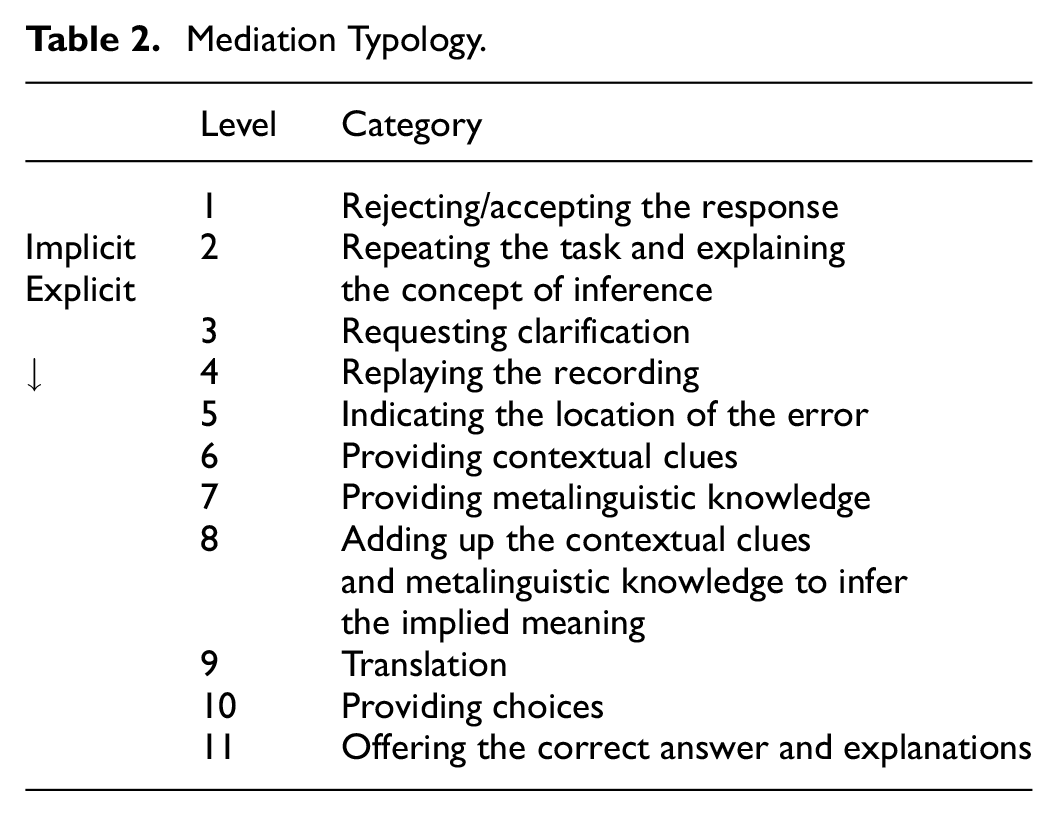
This study also examines students’ reciprocity throughout the interactive mediation process through micro-genetic analysis. To facilitate this analysis, students’ problem-solving abilities are classified into nine levels, ranging from 1 to 9, with each level representing a gradual increase in competence (Ableeva, 2010; Poehner, 2005). A lower level of reciprocity from learners to mediation suggests a lack of independence, while a higher level indicates greater autonomy (Lantolf et al., 2016). The reciprocity typology consists of the following nine types in order of hierarchy: unresponsive, repeats mediator, responds incorrectly, requests additional assistance, incorporates feedback, overcomes the problem, offers an explanation, uses mediator as a resource and rejects mediator’s assistance (Poehner, 2005).
Based on the elements from the previous study to achieve a thorough understanding of a recording, we utilized the coding scheme created by Goh and Vandergrift (2022) and Yang and Qian (2023) to analyze the verbal reports from the students (see Table 3). This coding scheme was developed to assess learners’ independent performance in making inferences during listening comprehension. It supports the idea that verbal reports, as a form of mediation, promote learning rather than merely documenting thought processes. Vygotsky suggested that speaking does more than just convey ideas; it actively molds our thinking processes (Lantolf & Appel, 1994; Vygotsky, 1997). In this study, the students’ retrospective verbal reports were treated as independent performances, as the researchers avoided influencing their thinking with leading questions or prompts. As a result, any changes in their responses were interpreted as the students’ final decisions and analyzed as independent rather than mediated performances.
Coding Scheme for the Independent Performance.

Examples include Categories 2–4, which draw on information from the text, while Category 5 involves inferencing based on external information. Subcategories were identified and used to code data from the three tests. Drawing on previous research (Rost, 1990; Yang & Qian, 2023), the four categories in Table 3 were further coded into “understanding,”“partial understanding,” and “non-understanding” to reflect students’ accuracy in interpreting the text. The “main idea of the text” category was used to assess the key concepts or claims presented, including supporting evidence or explanations. Selective listening, aimed at achieving specific objectives, was evaluated through the third category, while the fifth category examined whether students used contextual knowledge to infer implied meanings.
This study utilized Cohen’s Kappa to assess agreement between participants’ verbal reports and mediator-learner interactions. A high Kappa value indicates strong expert consensus on participants’ independent performance, while a low value suggests significant discrepancies requiring further verification and refinement.
Procedure
Pilot Study
A pilot study with 650 undergraduate students (320 freshmen, 330 sophomores) specializing in arts, sciences, and engineering was conducted to evaluate item difficulty for test refinement. Participants provided verbal consent and completed TOEFL-based listening assessments. Using the 2PL-IRT model, difficulty coefficients were calculated (range: −3 to 3). Parallel tests were designed using two parameters: inference type and item difficulty. The final pretest, posttest, and transfer test each included 15 items (3 per inference type), while the DA enrichment program had 10 items (2 per type). Pretest, posttest, and enrichment tests showed comparable difficulty (mean = 1.37; range: 1.28–1.77), whereas the transfer test was more challenging (mean = 1.95; range: 1.32–2.45). Despite high difficulty levels, DA leverages appropriately challenging tasks to expand learners’ Zone of Proximal Development (ZPD) and enhance higher-order cognitive skills.
Main Study
The pre-, post-, and transfer tests were conducted in the first, fifth, and sixth weeks following the class schedule, using the “sandwich” format. Each test included both dynamic and non-dynamic elements. A 3-week enrichment program took place between the pre-and post-tests, using the issues identified in the pretest as a baseline for subsequent enrichment activities and other tests. The transfer test, in essence, assessed how well students internalized their prior learning and demonstrated proficiency in applying acquired skills from their mediated interactions with the mediator.
Students first approached the test items independently in each test. Upon completing each item, they were required to make verbal reports to articulate their thinking process. To ensure clarity in expressing their ideas, the students were asked to use their first language. Then, one-on-one DA sessions commenced, during which the mediator and the learner reviewed the recorded verbal reports of the students. If there was any confusion regarding the understanding of a text, the recording would be paused, and the student would be prompted to clarify his understanding. The next step involved flexible mediator-learner interaction. This entailed several moves such as rejecting the response, requesting clarification, replaying the recording, providing contextual clues, providing metalinguistic knowledge, adding up the contextual clues and metalinguistic knowledge to infer the implied meaning, providing choices and offering the correct answer and explanations. The mediator guided each step with leading questions, illustrative examples, and clear explanations, customizing the mediation to meet the unique needs of the students. Students were invited to ask questions at any stage of the process, ensuring a supportive and interactive learning environment. Each DA session typically lasted between 2 and 2.5 hr, depending on the individual requirements of the learners.
In the sixth week, a semi-structured interview would be conducted to gather their perceptions of DA. Acknowledging the vulnerability of listening inference to linguistic and paralinguistic factors, especially when students encounter unfamiliar vocabulary (Mulyaningsih et al., 2013), this study provided students with handouts including new words and phrases before the formal experiment. However, to minimize potential negative impacts on the experiment, this article also considers the learners’ psychological traits (e.g., exhaustion, anxiety, etc.) and environmental factors (e.g., text clarity).
Data Collection, Coding, and Analysis
The collection of data from four Chinese EFL learners occurred between August and October 2023. Throughout this period, the first author carefully explained the procedures to the students at every step. All dialogic interactions were captured on audio, detailed notes were taken for future reference. These recordings were then meticulously transcribed, following guidelines inspired by Poehner and Swain (2016), and prepared for analysis using Nvivo software. Through analysis of the transcripts, consistent patterns within DA interactions were uncovered, leading to the identification of codes. These codes helped determine the students’ independent performance. Independent performance focused on assessing the students’ response accuracy, comprehension of main ideas, ability to locate target sentences, interpretation of meanings, and selection of correct answers. Mediated performance examined the mediation and reciprocity typology used in the interactions between the teacher and student. To ensure reliability, the coders, namely the two authors, independently coded each instance of the mediation and response for each participant in each episode according to the mediation and reciprocity typology.
Inter-rater reliability reached 87% agreement between two coders, with discrepancies resolved through discussion to ensure consistency. In this study, multiple analytical methods were used to explore the impact of dynamic assessment (DA) on EFL learners’ listening inferential abilities.Quantitative analysis focused on two dimensions: independent performance and mediated performance. For independent performance, descriptive statistics were calculated for five metrics: (1) response accuracy (counts of correct to incorrect answers in non-dynamic tasks), (2) main ideas of the text (rated on a 3-point scale: 1 = non-understanding, 2 = partial understanding, 3 = understanding, based on verbal reports), (3) identification of the target parts, (4) understanding of the meaning of the target parts (instances where learners independently inferred meaning using context), and (5) use of contextual clues (evaluated through inference coherence in transcripts). These metrics were tracked across pre-test, post-test, and transfer test phases to identify trends.
Mediated performance was analyzed by coding 11 types of teacher mediation (e.g., rejecting the response, requesting for clarification, metalinguistic clues) and calculating their frequencies for each learner in all test phases. Percentage changes in mediation frequency were derived using the formula: [(Pre-test frequency − Post-test frequency)/Pre-test frequency] × 100, to quantify shifts in mediation intensity. For example, a reduction in direct prompts from 20 instances (pre-test) to 8 instances (post-test) would yield a 60% decrease, signaling potential internalization of strategies. Visualization tools, such as line charts, were employed to illustrate temporal trends in mediation frequency and independent performance progression.
Qualitative analysis triangulated verbal report excerpts with coded mediation patterns to contextualize quantitative findings.Verbal report excerpts (e.g., “I started guessing meanings from the speaker’s tone”) were cross-referenced with coded reductions in explicit mediation (e.g., fewer direct hints) to identify strategy internalization. Ultimately, this study addressed research questions by documenting the quantity and quality of mediational moves that learners required to complete tasks during DA sessions.
Results and Discussion
Independent Performance of Learners’ Overall Listening Inferential Ability
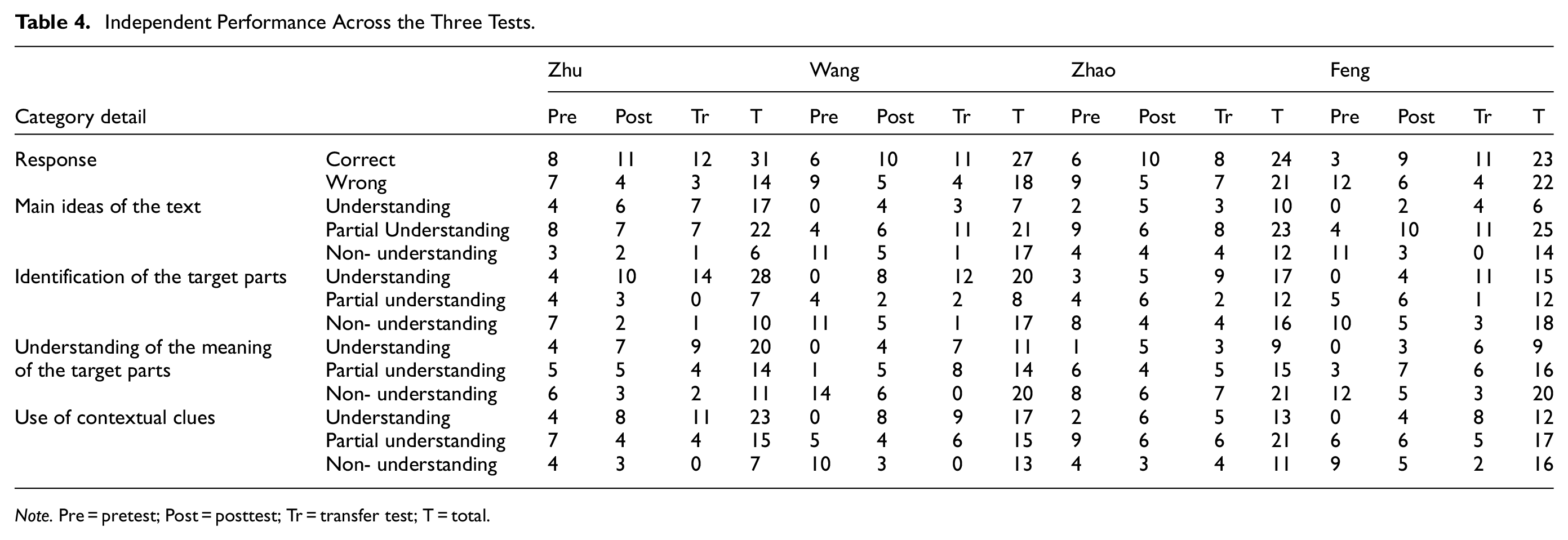
Learners’ independent performance in listening inference was evaluated through their completion of non-dynamic assessments and the coding of their verbal reports (see Table 4). Learners’ independent performance was evaluated through non-dynamic assessments and verbal report analysis. All four students demonstrated improvement in post-test scores compared to pre-tests, with similar performance in the more challenging transfer test (see Figure 1). Wang showed consistent progress across three tests (pre-test: 6, post-test: 10, transfer test: 11), while Zhu maintained high accuracy (pre-test: 8, post-test: 11, transfer test: 12). Zhao improved moderately in the post-test (pre-test: 6, post-test: 10) but declined slightly in the transfer test (8 correct items). Feng exhibited the most significant gains, increasing by six correct answers in the post-test and eight in the transfer test. DA-based mediation enhanced overall performance from pre-test to post-test, achieving comparable results even in the higher-difficulty transfer test, underscoring its effectiveness in academic development.
Independent Performance Across the Three Tests.
Note. Pre = pretest; Post = posttest; Tr = transfer test; T = total.

Participants independent performance in the three tests.
In pre-test “main idea identification,” Wang and Feng failed to grasp any main ideas, with only partial understanding (27% accuracy across 4/15 items). Zhu and Zhao performed marginally better, achieving full comprehension in 27% (4/15) and 13% (2/15) of items respectively, alongside partial understanding at 53% (8/15) and 60% (9/15). Post-enrichment, Wang and Zhao improved to 27% (4/15) and 33% (5/15) accuracy (+27% and +20% gains), but their transfer test performance declined to 20% (3/15), reflecting 7% and 13% drops, highlighting challenges in applying skills to advanced tasks. Feng showed no comprehension of main ideas (0%), with partial understanding at 27% (4/15 items). Zhu and Zhao performed slightly better: Zhu fully understood 27% (4/15) and partially 53% (8/15), while Zhao fully grasped 13% (2/15) and partially 60% (9/15). Post-enrichment, all students improved variably: Wang and Zhao reached 27% (4/15) and 33% (5/15) in main idea accuracy, marking increases of 27% and 20% from pre-tests. However, transfer test performance declined (both at 20%, down 7% and 13%), indicating their failure to extend the ability to more difficult transfer tests. Feng showed modest improvement in main idea identification (posttest:13% [2/15], transfer test:27% [4/15]). Generalizing main ideas remained challenging, with post-test progress limited and transfer test declines observed. This difficulty can be attributed to the fact that global questions (e.g., main ideas) require synthesizing discourse-level information (Y. S. G. Kim & Pilcher, 2016; Tong, 1997), which may exceed learners’ working memory capacity, especially in retaining textual coherence (Cain & Oakhill, 1999).
In the “identification of target parts” task, all four students initially struggled during the pre-test. Wang and Feng were unable to locate any target parts, while others identified fewer than one-third of the items (≤5/15). However, significant improvement was observed post-test: Wang correctly identified 12 out of 15 targets (an increase of 8 items), and Feng achieved 11/15 (a gain of 4 items), despite the tests’ heightened complexity. Transfer test performance remained strong overall, with only minor errors. Notably, failures typically occurred when students experienced cognitive overload, leading them to focus narrowly on specific sections of the text—a strategy termed selective listening (Goh & Vandergrift, 2022). This approach reduces processing demands by prioritizing critical information over full-text comprehension, aligning with working memory constraints (Pan, 2017). However, reliance on selective listening risks misaligning attention, as students might overlook contextually essential details. Accurate identification of target segments is particularly vital for answering multiple-choice questions (MCQs), where locating specific information directly impacts response accuracy (Yang & Qian, 2023). When learners cannot recall target locations, their focus drifts, undermining task performance.
In the fourth category (understanding target parts), students showed minimal improvement from pre-test to post-test, indicating persistent challenges. Wang and Feng progressed moderately, grasping 4 and 3 additional items in the post-test, respectively. During the transfer test, Zhu, Wang, and Feng demonstrated modest gains (9, 7, and 6 items understood), while Zhao lagged significantly (3 items). Analysis of Zhao’s verbal reports revealed that her performance was heavily influenced by a reliance on memorized word meanings rather than making inferences from context, a finding consistent with Yang and Qian’s (2023) study, which indicated that when a learner encounters a new word, he often lacks the necessary resources to grasp its meaning. This issue primarily arises during inferencing or when engaging in top-down processing. In these situations, individuals often struggle to use their prior knowledge effectively, which hinders their ability to infer implicit meanings or information that could be gathered through bottom-up processing (Chaudron & Richards, 1986; Pan, 2017).
Students demonstrated significant gains in using contextual clues, a skill initially challenging for all (pre-test: <1/3 accuracy). Wang improved markedly, applying eight additional clues in the post-test(15 items total), while Zhao progressed from two (pre-test) to six clues (post-test), though slightly declining to five in transfer tests. These fluctuations align with sociocultural theory’s emphasis on non-linear developmental trajectories (Vygotsky, 1997), where skill acquisition involves iterative progress and regression, particularly in complex tasks. Findings corroborate interactionist DA’s role in fostering L2 inferencing abilities (Lee, 2024), highlighting effective use of top-down strategies (e.g., contextual knowledge integration) despite variability in transfer scenarios.
In conclusion, Zhu exhibited the highest inferential ability among the four students, as evidenced by her correct responses across all three tests and her growth within the categories. Wang and Feng displayed the most substantial improvements from the pre-test to the post-test and from the pre-test to the transfer test, while Zhao showed the least progress. However, it’s important to note that Table 4 highlights a notable difference between the outcomes in the “response” category compared to the other categories. Addressing the first research question, most students’ independent performances indicated varying degrees of improvement from the pre-test to the post-test and from the pre-test to the transfer test, showing that they had internalized the knowledge gained from mediation during the DA sessions (Yang & Qian, 2023).
Comparison of Mediated Performance in at the type level Five Types of Inference
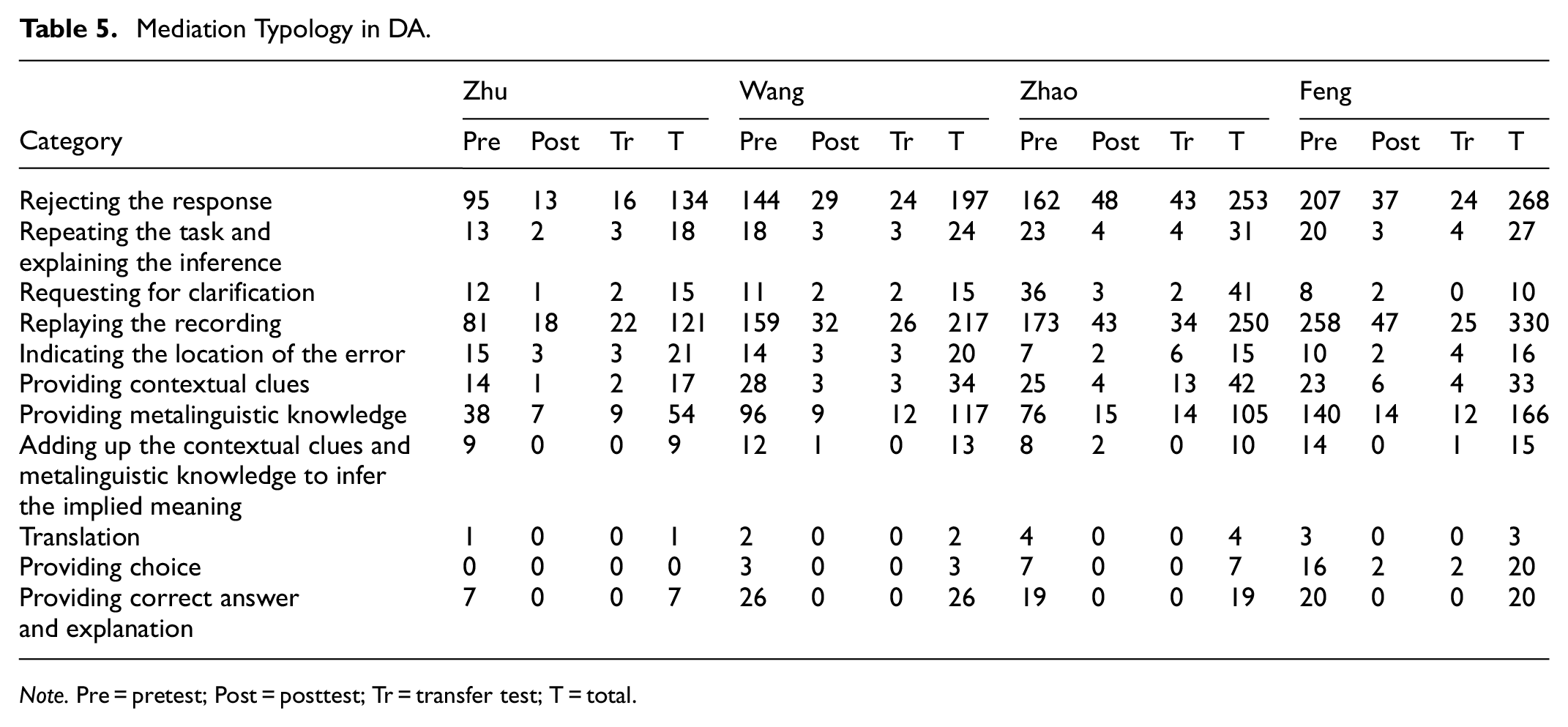
In connection with the diagnostic assessment and a thorough understanding of the text, 11 distinct moves were identified during the DA process, as detailed in Table 5. These mediational moves followed the framework set forth by Aljaafreh and Lantolf (1994), varying from the least to the most explicit. Table 5 illustrates the mediators’ 11 categories alongside their frequency across three tests. These types of mediation allow the mediator to evaluate the learner’s existing knowledge and listening inferential abilities, while also aiding learners in reassessing and reorganizing their comprehension. The differences in the number of required mediation typologies within specific categories across the three tests are outlined in Table 5. For example, Zhu utilized 14 moves in Category 6 during the pre-test, 1 move in the post-test, and 2 in the transfer test. In contrast, Feng required 23 moves in the pre-test, 6 in the post-test, and 4 in the transfer test. The outcomes demonstrate a substantial reduction in frequencies under particular categories, indicating considerable growth through mediational moves.
Mediation Typology in DA.
Note. Pre = pretest; Post = posttest; Tr = transfer test; T = total.
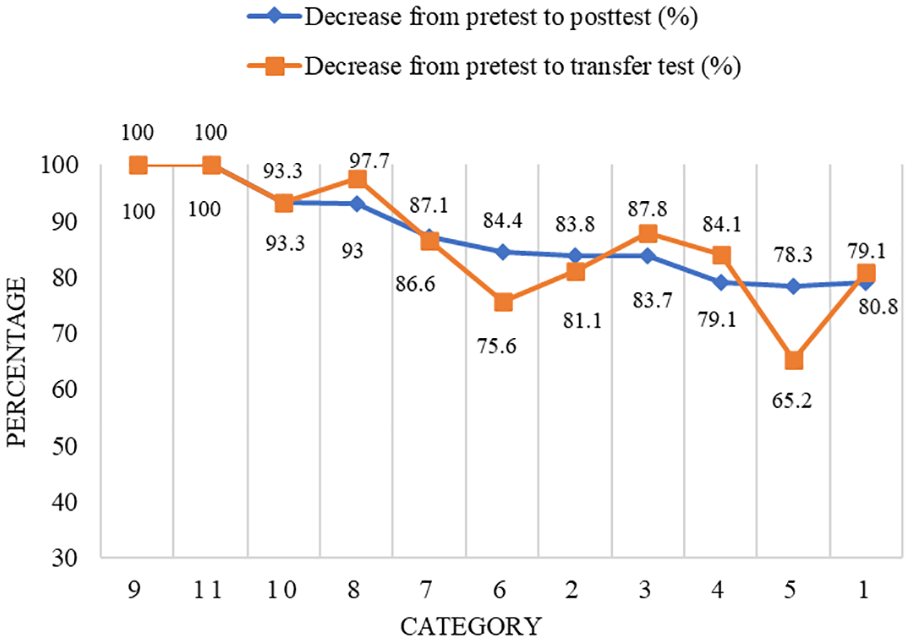
To gain a deeper understanding of these changes, the authors calculated the difference in the frequency of mediational moves required in a specific category between the pre-test and post-test. This difference was then divided by the frequency of moves needed in that same category during the pre-test (Yang & Qian, 2023). As a result, the percentage decrease in the number of mediational moves from the pre-test to the post-test, as well as from the pre-test to the transfer test, was determined. For instance, students required 608, 671, and 350 mediational moves in the pre-test, and 127, 140, and 45 in the post-test for Categories 1, 4, and 7, respectively, as depicted in Figure 2. The number of moves for each category decreased by 481, 531, and 305, leading to percentage reductions of 79.1%, 79.1%, and 87.1% (e.g., (127 − 608)/608 = −0.791, resulting in a 79.1% decrease).

Frequencies of mediational moves by category in the three tests.
Figure 3 illustrates the frequency of mediational moves arranged in descending order across the 11 categories for the three tests (Yang & Qian, 2023). Overall, there was a notable reduction in mediation frequency from the pre-test to the post-test, averaging an 88.7% decrease (max. = 100%, min. = 78.3%). Comparisons between the pre-test and transfer test revealed similar findings, with an average reduction of 86.6% (max. = 100%, min. = 80.8%). The frequency of mediation required in the transfer test showed a significant decline from the pre-test to the transfer test, with only a slight increase of 2.1% from the post-test to the transfer test. These findings indicate that mediation within an interactionist DA framework positively influences the development of learners’ listening inferential abilities. This finding reinforces earlier research indicating that L2 listening inferential abilities can be developed through Interactionist DA (Lee, 2024).
Comparison of mediational moves across the three tests.
Figure 4 illustrates the changes in conversational implicature observed in the study. The results show a significant decrease in the frequency of mediation typology, with an average decline of 94.1% from the pretest to the posttest (max. = 100%, min. = 84.6%) and 83% from the pretest to the transfer test (max. = 100%, min. = 50%). Additionally, mediation required in the transfer test increased by 11.1% from the posttest. After the mediational process, students demonstrated noticeable improvement from the pretest to the posttest. According to their verbal reports, students’ understanding primarily stems from a solid grasp of the literal meanings of the sentences. By leveraging background knowledge and contextual clues, they can effectively infer implied meanings within the texts (Buck, 2003; Lee, 2024).

Changes of categories in conversational implicature.
In addition, it was also observed that conversational implicature recordings in the TOEFL test were relatively brief and occasionally were repeated, potentially reducing the learners’ cognitive load and enhancing their focus. However, in the transfer test, learners failed to internalize what they’ve learned, particularly in Category 6, showing that utilizing contextual clues in the transfer test posed greater difficulty than in the posttest. This challenge may arise from learners with lower proficiency and encountering more obstacles in processing linguistic and contextual information, thereby only possessing limited pragmatic knowledge (Goh & Vandergrift, 2022). Failure to infer conversational implicature may stem from the fact that less proficient students often struggle to connect general knowledge to the text, which is essential for filling in the missing details (Cain & Oakhill, 1999). It is important to note that teaching pragmatic inference has often been neglected in L2 classrooms, with many EFL teachers lacking sufficient training to effectively integrate it into their instruction (Basturkmen & Nguyen, 2017).
Thematic inference comparisons between the pretest and posttest, as well as the pretest and transfer test, showed a similar trend (see Figure 5). There was an average reduction of 99.8% in mediation frequency from the pretest to the posttest (max. = 100%, min. = 98.7%). The pretest to transfer test comparison revealed an average decrease of 94% (max. = 100%, min. = 78.6%). Mediation frequency in the transfer test significantly decreased from the pretest, with only a minor increase of 5.8% from the posttest.
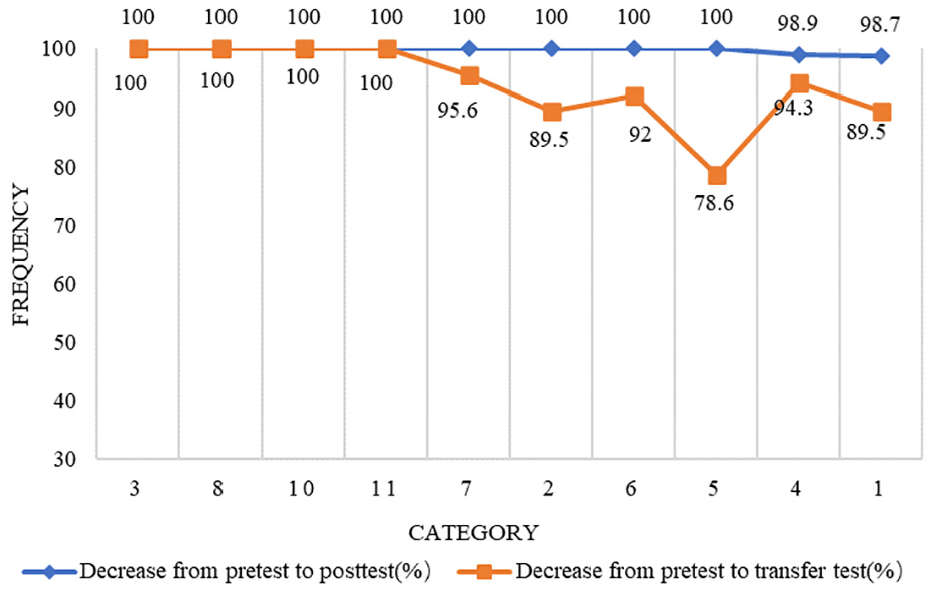
Changes of categories in thematic inference.
Thematic inference is important because it contributes to the text’s global coherence and deeper comprehension. Contrary to other inferences, the frequency of thematic inference categories experienced the most significant decrease in the post-test, indicating that students had the least difficulty in inferring the theme of the recording across the three tests. This can be attributed to the students’ understanding of the significant features and functions of cohesive devices as well as discourse markers (e.g., to begin with, in addition) in identifying the relationships between sentences and discourse (Goh & Vandergrift, 2022). These cohesive devices provided listeners with a clue about the type of information they could expect to hear. Additionally, students indicated in their verbal reports that they found it easy to grasp the repeated key information, which was essential for a comprehensive understanding of the text. They asserted that they were capable of not only understanding explicit information but also identifying and abstracting key details to create thematic inferences. This conclusion is consistent with previous research, which suggest that students utilize not only the explicit information provided but also their context and background knowledge to form thematic inference (Kimura, 2013).
The motivational inference decreased moderately in comparison with thematic inference, indicating that learners struggled more with inferring the motive of the speakers than grasping the main ideas. The percentage of mediational moves decreased from the pretest to the posttest by an average of 85.9% (max. = 100%, min. = 33%) and from the pretest to the transfer test by an average of 79.1% (max. = 100%, min. = 32%). To establish a theme or deduce motivation within a text, one uses global coherence inferences (Currie & Cain, 2015). As illustrated in Figure 6, the “centrality” of the information addressed by the question—connected to story themes, the setting, or the main character—led students draw motivational and thematic inferences. Students were able to identify an exact match between the keyword (s) in the item stem and those in the original text (Currie & Cain, 2015). Just as Pan (2017) pointed out in his study, for top-down processing, the input was analyzed for elements that align with the listener’s expectations, including contextual cues that clarify the speaker’s motivations. The study’s findings on global coherence indicate that these inferences rely heavily on knowledge, as they use various facts to deduce a character’s motivations.

Changes of categories in motivational inference.
During predictive inference, students draw upon their topical knowledge (understanding of specific topics) and situational knowledge (awareness of communicative contexts and events). This top-down discourse processing enables them to anticipate the forthcoming information in the text (Pan, 2017). As shown in Figure 7, the average percentage decrease in mediation typology frequency from the pretest to the posttest was 69.8% (max. = 100%, min. = 37.5%). This indicates that predictive inference posed the greatest challenge among the five types, with students struggling significantly to predict the next move across the three tests. The average percentage decrease when comparing the pretest and transfer test results was 72.3% (max. = 100%, min. = 37.5%). Additionally, mediation required in the transfer test decreased by 2.5% from the posttest, reflecting steady improvement in predictive skills. Some students noted in their verbal reports that memory is fleeting, making it difficult to activate predictive inferences after a brief delay. This finding supports previous studies, demonstrating that predictive inferences are not only activated but also encoded in memory (Fincher-Kiefer, 1995; Peracchi & O’Brien, 2004). The challenge of predictive inference arises from the interplay between the broader context and the inference-evoking sentence. This interaction significantly influences how inferences are activated (O’Brien et al., 2015). Furthermore, predictive inference sits at the pinnacle of the learning process, relying on students’ knowledge and a sufficiently high level of engagement to inspire their predictive efforts. In the current study, the bottom-up processing, based on linguistic data, either supports or refutes these predictions. So, when the options fit the test-takers’ prior knowledge, choosing one of the given choices as the answer is psychologically plausible (Alderson, 1983).

Changes of categories in predictive inference.
For attitudinal inference, students showed moderate progress from the pre-test to the post-test and significant improvement from the pretest to the transfer test. The average percentage decrease in mediational moves from the pretest to the posttest was 73.9% (max. = 100%, min. = 30.6%), while from the pretest to the transfer test, it was 89.7% (max. = 100%, min. = 66.7%). Compared to other inference types, the decrease in mediational moves for attitudinal inference from pretest to posttest was relatively small, likely due to initial difficulties in grasping essential phrases or keywords, which affected their ability to match the speakers’ attitudes. The mediation needed in the transfer test decreased by 15.8% from the posttest, indicating significant progress (see Figure 8).

Changes of categories in attitudinal inference.
During the DA training, students learned that content words (such as verbs, adjectives, and adverbs), as well as moods and tone, are crucial for inferring speakers’ attitudes. Some students noted in their verbal reports that stressed words aided in inferring the speaker’s attitude. Grosjean and Gee (1987) suggest that listeners leverage stressed syllables, primarily found in content words, while Field (2008) observed that students often improve their recognition of content terms as their language skills develop in DA-based enrichment programs. That’s because content words are more meaning-loaded and L2 listeners must be selective due to the short span of working memory.
Overall, students made remarkable strides in inferring attitudes, extending this skill to the transfer test. This test facilitated the transfer of knowledge from the inter-mental plane of mediator-learner interaction to the learner’s intra-mental plane (Vygotsky, 1978). Specifically, fully developed listening inferential ability manifests itself at the intra-psychology level where students independently perform a task while emerging abilities are displayed on the social level and students are mediated by more experienced teachers. In other words, learners have internalized what they’ve learned and moved beyond their current Zone of Proximal Development (ZPD), stepping into a broader one (Poehner, 2005).
Mediation frequency decreased significantly, confirming its critical role in advancing listening inferential abilities. Students showed substantial pre-to-post-test gains, with smaller but consistent improvements in transfer tests. Thematic inference saw the strongest progress, while predictive and motivational inferences remained challenging. Although attitudinal inference improved minimally post-test, enrichment programs enabled significant transfer-test gains. These findings resolve the second research question, demonstrating varied development levels across inference types under DA-based instruction.
Excerpts of a Mediated Listening Inference-Making Session
The following are the interaction excerpts of the pre-test and post-test for analysis. Due to space constraints, only Zhu’s predictive inferences are presented here.
Excerpt 1 Listening script: When you come in, you sign your name on the list and are assigned a room number. The videos are over there. L1. T: What did you hear? ((leaning forward and smiling at Zhu)) L2. S: I didn’t catch the word before “a room number.” L3. T: Listen again. ((playing the video again)) L4. S: +“And are assigned a room number.” L5. T: Good. What else? L6. S: +“You sign in your name on the list and are assigned+’, L7. T: The former part of your utterance is right. L8. S: L9. T: Assign is synonymous with appoint. ((writing appoint on the paper)) L10. S: L11. T: Right. Move on. Listen to the next sentence. ((playing the video)) L12. S: +“The videos are over there.” L13. T: Right. Combine these two sentences with the previous context. The dialogue took place in a language lab, and speculate on the students’ next steps. L14. S: (11) D. L15. T: + Um… What is the purpose of student’s coming to the language lab? L16. S: ++ Um… Watch a Spanish video. L17. T: Good. To predict his next move, we should reflect on + his intentions for visiting the language lab and employ logical analysis as a guide. L18. S: I initially interpreted the worker’s utterance, + like “The video is over there” as an instruction to retrieve that specific video. L19. T: This is an introduction to the viewing process of videos. Here, students are invited to sign up and borrow videos directly from the administrator for on-site viewing. Please note, these videos must remain within the lab premises and cannot be taken out. L20. S: (silent) L21. T: B and D, which is better? L22. S: + Oh! ((laughter)) I thought “sign out” meant taking the video home. I understood now. I choose B. L23. T: Right
In the excerpt, Line 2 shows that Zhu was unable to independently recall complete sentences, showing the reciprocity typology of “requests additional assistance” (Level 4). In Line 7, the mediator uses the mediation typology of “Requesting clarification” (Level 3) while Zhu just gave a wrong response, indicating a low level of reciprocity (Level 3), therefore the mediator provides a more explicit seventh-level typology in Line 9 (“Providing metalinguistic knowledge”), but Zhu is not very certain about her understanding of the meaning and asks for clarification in L10, demonstrating a reciprocity typology of Level 4. In Line 13 and Line 17, the mediator provides even more explicit eighth-level (“Adding up the contextual clues and metalinguistic knowledge to infer the implied meaning”), but Zhu still struggles to leverage the contextual clues provided by the language lab and the linguistic information available, which prevents her from making accurate predictive inferences. This suggests a lack of responsiveness on her part to mediation. The mediator then provides Zhu with the sixth-level of mediation typology in Line 15 and Line 19 respectively (“Providing contextual clues”). Zhu effectively addresses the contextual question in Line 16, demonstrating a strong level of reciprocity (Level 6: Overcoming Problems). However, her inability to respond in Line 20 shows a level of unresponsiveness (Level 1). In instances where the mediation efforts mentioned earlier prove ineffective, the mediator offers a more explicit level-10 prompt in Line 21 by suggesting “Providing choices.” As a result, Zhu successfully anticipates the speaker’s next action, which is to sign out a Spanish video (Level 6).
Excerpt 2 Listening script: I will leave her a note about what we have discussed. She will get you started. L1 T: What did you hear? ((leaning forward)) L2 S: +“I will let her know what we have discussed.” L3 T: I will let her know? ((looking at Zhu)) L4 S: I will inform her ++ Is it “inform” ? ((looking at the mediator)) L5 T: This is a phrase that + relates to “leave.” Listen Again. L6 S: Leave inform ++ No . “Leave” should be followed by a noun or preposition, not a verb. L7 T: Right. “Leave” is normally followed by a noun. Listen Again. L8 S: + Leave a note. L9 T: Right. Move on. What did you hear? L10 S: “She will get + you + started.” L11 T: Right. L12 S: She said that she had already helped him get started. ++ But why is there still a “start”? L13 T: The term “start” here indicates the moment they begin to tackle the issue they previously discussed. L14 S: Ah + What they discussed is +“I will leave her a note about what we have discussed.” The previous staff has already entered the information into the system and provided an ID number, why do they need to start again? ((frowning)) L15 T: When students are planning to transfer, they need to contact academic advisors, professors, etc. at the target university. This student is just getting started with the preparation. L16 S: Oh, he stopped by just for a consultation ((laughing)). The information that was entered into the system, along with the ID number, is simply for the staff to guide the student through the transfer process. L17 T: Right. Connect the above context with that lady, Ms. Brinker + L18 S: I chose D ((laughing)). Initially, I heard the staff asking the student for his ID number, leading me to believe she would handle it immediately. However, I realize that it is Ms. Brinker who is going to take care of this job.
Zhu’s responsiveness transitioned from dependence in the pre-test to relatively strong independence in the post-test, where she not only answered correctly but also offered explanations. The shift is exemplified by her ability to provide correct answers and articulate explanations, demonstrating a strong sense of autonomy within the reciprocity typology. Specifically, she progressed to Level 6, where she effectively overcomes challenges, and Level 7, where she offers insightful explanations. Zhu self-corrected her mistake in Line 6, questioned her understanding in Line 12, and provided justifications for questioning in Line 14 in response to the teacher’s explanations, demonstrating the development of her autonomy, independence, and self-regulation (Poehner, 2008). Presenting questioning with supporting arguments is an indicator of development and reflects students’ deep understanding capabilities (Lantolf et al., 2016). In addition, regardless of whether the questioning is correct or not, being able to verbalize thoughts is equally important, as it prompts teachers to adjust mediation in a targeted manner. According to sociocultural theory, verbalization serves as a means of an expression of internalizing knowledge (Vygotsky, 1997). In Line 14, Zhu actively prompted discussion of contextual clues needed for predictive inferencing, resulting in improvements in both the quantity and quality of mediation. In L16 and L18, Zhu successfully predicted Ms. Brinker’s actions by combining the contextual clues and linguistic information provided by the teacher, and offered further explanations for her own thoughts. Overall, Zhu has the basic ability to engage in dialog with the teacher, interpreting the micro-genesis of predictive inferential ability in listening.
Participants’ Perceptions of their DA Experience
Understanding the participants’ views on Dynamic Assessment (DA) is crucial in assessing and enhancing this method, particularly when it is unfamiliar to those being assessed. The researcher carried out a semi-structured interview to gather insights into their experiences. The initial question aimed to explore the students’ opinions on how DA contributes to the enhancement of their listening inferential abilities. All participants agreed that DA significantly enhanced their listening inferential ability. They attributed this improvement to several factors: heightened focus, the effectiveness of mediation, and other supportive elements. They emphasized the role of mediation as an invaluable tool. This not only directed them toward identifying key information within the listening materials but also assisted in diagnosing errors, encouraged active engagement throughout the learning process, and provided opportunities for repeated attempts. Participant Zhu noted, “When I made mistakes, the prompts provided me with opportunities to revisit details I had overlooked on my first attempt.” Wang shared, “Mediation allows me to recognize the vocabulary or syntactic structures I have learned, which enhances my comprehension of the text’s meaning and main idea.” Participant Zhao mentioned, “The prompts enable me to review previous information promptly, preventing any disruption in my understanding of subsequent content.” Feng added, “Dynamic assessment helps me identify my learning challenges. Some prompts activate my background knowledge while making inferences.” Additionally, students expressed that this format was engaging and convenient for listening tasks.
The second question explores students’ preferences regarding assessment formats. All four participants expressed a preference for the dynamic assessment (DA) approach, as it provided immediate and targeted feedback through prompts when they made mistakes. Feng noted, “I prefer dynamic assessment methods to the traditional listening tests. I am open to taking multiple attempts in the future using dynamic assessment. The support offered, transitioning from implicit to explicit, is particularly beneficial for students with lower English proficiency, like myself.” Zhao added, “I feel more relaxed with dynamic assessment. It boosts my motivation to learn.” Wang shared, “Mediation has been instrumental in helping me understand key vocabulary and allows me to answer questions multiple times. It can be a bit frustrating when I keep getting it wrong. Fortunately, the teacher is very patient and offers reassurance.” Interviews with students reveal that the DA procedure not only helps these students gain confidence in their learning but also ignites their interest in studying English and improves their ability to make inferences.
The third question invites students to share suggestions for enhancing the DA procedure. Their concerns primarily revolve around two key areas: the quantity of listening recordings and the duration of the DA sessions. Some students requested a wider variety of listening texts, while others suggested shortening each DA session by 20 min and increasing the frequency of the sessions.
Implications
First, the findings from this study show significant empirical support for the DA mediation model, demonstrating its effectiveness as both a pedagogical framework and a diagnostic tool for university students. For educators, the 11-stage DA mediation framework offers a practical guide tailored to local contexts. By implementing a graduated prompt scale tailored to specific tasks alongside personalized tutoring, teachers can more effectively pinpoint the developmental challenges faced by their students. This approach enhances their understanding of students’ listening inferential abilities and informs necessary mediation strategies for ongoing development.
Second, our research findings show that learners improved their listening inferential abilities after DA, aligning with previous studies. Learners exhibit varying degrees of development in specific inference areas, emphasizing the need for personalized support. We recommend that educators tailor activities to strengthen these weaker areas and organize workshops to equip instructors with the skills to create effective, customized prompts.
Third, instructors can further enhance learners’ higher-order thinking regarding their listening skills through DA. This increased awareness will enable learners to develop self-regulated listening plans tailored to their proficiency levels.
Limitation
Several limitations should be addressed in future research. First, this study serves as an initial exploration into five types of inferences for listening comprehension. Future research could investigate additional inferential abilities, such as inferring special, temporal, and other logical relationships, as well as social and cultural contexts. Second, this research included only three DA sessions with progressively challenging items, resulting in modest learning advancements for some participants. Therefore, more customized enrichment initiatives are necessary. Lastly, while initially designed for a specific group of learners, the DA mediation model is versatile enough for application with younger or more experienced students.
Conclusion
This study found that the DA-based enrichment program has the potential to effectively enhance learners’ ability to make inferences while listening. As evidenced by the number of the correct items after the enrichment program, the learners demonstrated noticeable enhancement not only in their mediated performances, but in their independent performance as well across the three tests, providing strong proof of DA’s effectiveness. Notably, students improved in their use of contextual cues and in identifying target parts.
This study aimed to explore the varying development levels of the five types of inference following mediation based on DA-informed instruction. Findings indicated that the students excelled in making thematic inferences but faced difficulties with predictive and motivational inferences. Notably, there was less advancement in attitudinal inference between the pre-test and post-test. However, following DA, they exhibited remarkable progress, which also carried over to the transfer test. These results offer insightful information into listening inference pedagogy. They suggest that instructional development should be guided by an assessment that identifies learners’ emerging abilities. Additionally, it is essential to continuously monitor students’ responses to instructional support. It was all of these taken together that allowed for identification of learner developmental trajectories.
Footnotes

Ethical Considerations and Consent to Participate
Verbal informed consent was obtained from all subjects before the study. The studies involving human participants were reviewed and approved by the Ethics Committee of Xi’an University of Posts and Telecommunications (No. 032459). Written informed consent to participate in this study was provided by the participants.
Funding
The author(s) disclosed receipt of the following financial support for the research, authorship, and/or publication of this article: This work was supported by 1) Shaanxi Province Social Fund: Diagnosis and Intervention of Township Middle Schools English Based on the Balanced Development (2022K005); 2) AI-empowered “Human-Computer Cooperation” in Foreign Language Teaching Evaluation System Construction (SK2024085) (2024-2025). 3) Research on Practical Approaches to Cultivating Intercultural Communication Competence in College English Education (2025HZ0803) (2025-2026).
Declaration of Conflicting Interests
The author(s) declared no potential conflicts of interest with respect to the research, authorship, and/or publication of this article.
Data Availability
Data sharing not applicable to this article as no datasets were generated or analyzed during the current study.
Research Interests
Xue Geng
Research interests: Dynamic assessment, computerized dynamic assessment, L2 Listening
Yaru Meng
Research interests: Language testing, dynamic assessment, cognitive diagnostic assessment, L2 listening
Risk Mitigation and Participant Protection
The study posed minimal risk to participants, as it involved non-invasive, routine classroom-based activities (e.g., listening tasks, dialogic interactions) that mirrored standard EFL pedagogy. No personally sensitive topics or physiological interventions were included. To further minimize risks:
1. All data were anonymized during transcription and analysis, with pseudonyms replacing real names.
2. Participants were informed of their right to withdraw at any stage without penalty.
3. Audio recordings and transcripts were stored securely, accessible only to the research team.
Benefit-Risk Justification
The potential benefits of this research—advancing understanding of dynamic assessment’s role in developing listening inferential skills—outweighed the negligible risks to participants. Findings may inform EFL teaching practices, ultimately benefiting learners globally. Participants also received individualized feedback on their listening strategies, enhancing their own learning experiences.