



Abstract
The study aimed to investigate the effects of Reader’s Theater on EFL learners’ English reading comprehension. The roles of English learning anxiety and learning styles in the RT instruction were also explored. Mixed methods research was conducted to collect and analyze quantitative and qualitative data. The subjects were 11 graders in a senior high school in New Taipei City. There were 25 students in the experimental group and 26 in the control group, and the total number of students was 51. Experiment group received RT instruction for 16 periods in 16 weeks, while the control group was distributed with the same scripts without RT instruction as outside reading. Reading tests based on scripts were adopted to examine the difference of learners’ reading comprehension with RT instruction intervention. Questionnaires of Foreign Language Classroom Anxiety and learning styles were conducted to realize the correlations among learners. To understand students’ views on RT instruction, 24 subjects from the experimental group received an interview. The results of the study indicated that most students thought RT helped improve their reading comprehension. In addition, most students regarded that RT decreased English learning anxiety. However, among the six stages of RT, Instant Reading was the stage that students felt most anxious because they were worried about others’ opinions. Finally, the study found that RT was a suitable platform for students with different learning styles. However, RT provided less time for students with visual modality to practice and learn best. It was suggested that instructors adopting RT instruction could use more pictures or graphic organizers.
Keywords
Introduction
While 12-year Basic Education Curriculum Guidelines were set to commence in 2019 (The Ministry of Education [MOE], 2014), the significance of English four skills, listening, speaking, reading, and writing, are highly emphasized in Taiwan. The new curriculum requires English teachers to design elective classes based on their specialty, which gives students more opportunities to cultivate autonomous learning. However, Taiwanese teenagers has been reported to receive a setback in English performance compared to those in other countries (Yen-fen, 2019). In the fifth edition of 12-year Education Curriculum Guidelines (National Academy for Educational Research, 2017), Reader’s Theater (hereafter as RT), English camps, speech, and so on, are listed in the content of being willing to participate in English activities in the fourth learning stage, which is a step further to put English four skills into application. The instruction of RT includes five phases, shared reading, echo reading, partner reading, choral reading, and performance (Mraz et al., 2013). The instructor introduces a script, and learners repeat lines after the instructor. Learners take turns reading out different characters’ lines before they concentrate on practicing their assigned role and deliver a performance. Learners can even write their own scripts when getting familiar with RT.
Furthermore, previous empirical evidence has highlighted that reading fluency can be improved considerably with RT (Mraz et al., 2013; Young & Rasinski, 2018). For example, Young and Rasinski (2018) found that students who participated in RT gained more word recognition while Vandergrift and Cross (2017) emphasized the difficulty of listening skill may result in anxiety for L2 learners. The anxiety of students might also play an important role in the success of RT. Hence, RT promotes learners’ English learning. Besides learning and synthesizing four skills, students are encouraged to develop their learning motivation and positive attitude toward English learning. Based on this, the implication of RT motivates us to explore the role of anxiety of students how and to what extent RT would influence learners’ English learning.
Finally, the aim of RT also encourages students to cooperate with each other and may result in the reduction of the psychological burden for beginning English readers (Mraz et al., 2013; Young & Ortlieb, 2018). According to previous studies (Mraz et al., 2013), Mraz et al. (2013) indicated that Reader’s Theater was an application of integrated language by involving readers in an interpretive oral reading activity. Furthermore, many studies have shown the advantages of RT implemented in English classes. Huang (2014) pointed out RT benefited intermediate and low-level achievers’ English proficiency in her research on sixth graders. Peng and Peng (2010) indicated fourth graders receiving RT instruction made significant improvement in reading comprehension and word recognition. However, much of the related research was conducted on young learners or seventh to ninth graders. Lin (2016) found most of the studies on RT targeted at elementary schools, and only one paper studied on vocational high school in Taiwan during past 10 years. Most importantly, little studies focused on tenth to 12 graders. To improve students’ English learning, it is important to investigate how RT impact subjects aged from 15 to 18 years old and their learning styles.
While the English language has been a crucial part of Taiwan’s policy for economic development, education policies have been particularly dedicated to promoting the use of English in the public sphere (Price, 2014; Rigby, 2021).With several years of instruction of English as Foreign Language, the Secondary education called for further helping students to enhance their English ability (The Ministry of Education, 2014). Listening was also added in addition to the reading comprehension in the English test—The Comprehensive Assessment Program for Junior High School Students (CAP). The CAP has put much emphasis on English reading and the length of the reading passages gets longer, which may increase students’ psychological burden, especially low achievers. Above also has increased students’ foreign language anxiety.
To sum up, it still remains unclear whether there is a difference in English learning anxiety through RT intervention and the role of learners’ learning styles demands further exploration. Therefore, this study intended to investigate the relationship among RT instruction, English learning anxiety, learning styles, and reading comprehension. Due to loads of reading in high school English textbooks, it is worth studying the amounts of influence RT exerted over students’ reading comprehension. In addition, the study was designed to find out the role of English learning anxiety played in RT instruction. The role of learning styles playing in RT instruction was also explored. The presence of correlation might help instructors take it into consideration when designing teaching activities. According to the research purpose as mentioned above, a mixed-methods research was adopted to explore the following research questions: How Reader’s Theater affects students’ English reading comprehension in vocational high school? What was the difference between the students with different learning styles in RT? Which of RT caused higher learning anxiety? What was the degree of learning anxiety of the students with different learning styles in RT.?
Readers Theater, Foreign Language Anxiety, and Learning Styles
The use of Reader’s Theater in English Learning
RT is regarded as learners working in groups reading out scripts, adopting interpretive reading to create dramatic effects in English class (Shepard, 2004). Shepard (2004) defined Reader’s Theater as a miniature theater with no full stage sets and costumes. Narrators read scripts openly without memorization. Similarly, Bennett (2011) pointed out that RT represents learners utilizing voices to interpret lines and doing an oral reading performance with scripts in hands, but without sets, costumes, and actions. Readers use their voice to read out scripts with different intonation or tones to create dramatic effects. More attention is paid on how readers interpret scripts. In English classrooms, RT provides opportunities for learners to focus more on their speaking. No more outfits or props divert learners’ attention or nervousness on memorizing lines. Learners can fully focus on their preparation of reading scripts fluently and accurately. In short, RT is one kind of easily adaptable instruction and provides students with opportunities to hear and see readers like actors. Therefore, RT enables students to comprehend the text (Young & Rasinski, 2018; Zimmerman et al., 2019).
Previous studies have yielded positive effects of RT instruction on English learning. RT instruction had a higher impact on automaticity and prosody and repeated reading increased reading fluency (DiSalle & Rasinski, 2017; Young & Rasinski, 2018). Further progress in reading fluency contributed to the improvement of reading comprehension (Pikulski & Chard, 2005). In doing so, this learning process of RT leads to a good conduit for practicing writing and fostering comprehension. (DiSalle & Rasinski, 2017). The series of effects have proven that RT instructions enhance reading comprehension.
However, Tsou (2011) held a different idea that the RT group did not outperform the control group in reading comprehension. It still deserves further studies to look into the influence of RT instruction on reading comprehension. Moreover, RT studies in Taiwan have little focus on senior high students. Lin (2016) reviewed recent papers on Taiwanese RT instruction and found many studies on RT targeted at young learners. A study further indicated that different reading levels of learners resulted in different relations of reading fluency and comprehension (Kim et al., 2012). Therefore, RT instruction might bring about different outcomes on 10 to 12 graders in their reading comprehension. More studies are needed to be conducted on RT instruction in Taiwanese high school.
In addition to positive influence on English reading, Reader’s Theater may reduce students’ anxiety in English learning (Drew & Pedersen, 2010). Drew and Pedersen (2010) found pupils generally regarded RT as a low anxiety activity that was enriched with education and entertainment. In an investigation into students’ views, RT fostered English learning and interpersonal relations, while reducing learning anxiety (Huang, 2007). Hung (2008) indicated RT instruction assuaged learning anxiety significantly in both high achievers and low achievers, especially in high achievers. In doing so, learners are assigned roles they can cope with and they cooperate with group members to complete a task by reading out scripts. The process of practicing RT is enjoyable and feels at ease. However, performance anxiety that influenced language anxiety was not fully taken into consideration in RT instruction. Some learners may have difficulty reading aloud in front of the whole class. For example, Visser and Edge (2013) recommended that video recording of RT is needed for learners who scared of speaking to the audience on stage. As a result, more empirical studies are required to explore the difference of language anxiety during or after RT instruction.
The Influence of Foreign Language Anxiety on RT
Foreign language anxiety (FLA) is an anxiety associated with foreign language learning (Horwitz et al., 1986; MacIntyre & Gardner, 1989). To measure FLA, Foreign Language Classroom Anxiety Scale (FLCAS) was developed with a 5-Point Likert Scale and 33-items questionnaire (Horwitz et al., 1986). The
Many studies have shown that foreign language anxiety (FLA) had an impact on learners’ English achievement in FL learning (Azher et al., 2010; Hyang, 2012). Language anxiety exhibited a negative correlation with language achievement (Azher et al., 2010). Consistent with study by Huang (2012), students with lower anxiety had a positive relationship with reading comprehension, while higher anxiety led to worse reading comprehension. However, Bashosh et al. (2013) found out the correlations among EFL proficiency and several factors, such as gender, shyness, anxiety, and willingness to communicate; furthermore, above study further showed that there was no significant relationship between foreign language anxiety and language proficiency (Bashosh et al., 2013). Another research even indicated students with higher anxiety performed better in tests because anxiety might arouse facilitating anxiety that improves performance (Park & French, 2013). Therefore, previous studies showed that anxiety had uncertain correlation with language performance and reading comprehension. Moreover, researchers suggested that instructors lacked awareness of learners’ anxiety and they should take FLA into consideration in their teaching (Tran et al., 2013). Therefore, it requires further research to examine the impact of language anxiety on learners.
To sum up, RT is then adopted as an experimental instruction to see if it can substantially help learners reduce FLA, and thus low anxiety may help improve learners’ English learning. The study will examine how the role of students’ FL anxiety plays in RT instruction.
The Influence of Learning Styles in the Different Stage of RT
Learning styles are considered as individual learning patterns, which affects learning performance (Sadeghi et al., 2012). Learners have their own preferred approaches to learning certain items distinctively. With this in mind, individual learning differences lead to different aspects of achievement in English performance. Hollie (2001) proposed success in language achievement built on suitable instructional methods catering to different learning styles and collaborative learning activities, take RT for example, were one of primary strategies. RT provides opportunities and challenges for individual differences to process their particular ways of learning.
In general, learning styles refer to individuals who differ in how they learn. Based on modalities approaches, the theories of learning styles have already offered us a range of competing and contesting theories that aim to explain individual learning differences (Dunn & Dunn, 1978). Barbe et al. (1981) showed that learning modality strengths can occur independently or in combination and change over time while learning modality becomes integrated with age. Furthermore, Fleming (1995) expanded the original VAK model into VARK model by adding read/write learning sensory modality and then Sprenger (2008) divided it into three styles as follows. Firstly, visual learners ensure that students can see written words, use pictures, and draw timelines for events. Secondly, auditory learners repeat words aloud, have group discussion, debate, listen to books on tape, and give oral reports and interpretation. Finally, kinesthetic learners enjoy hands-on activities, projects, experiments, frequent movement, role play, and field trips. VARK adopt four sensory modalities to define learning styles as learners’ preference to absorb new information as follows: Visualizing modality (V); Auditory modality (A); Read/write modality (R); and Kinesthetic modality (K).
There are several studies to demonstrate the influence of the learning styles of VARK (Barbe et al., 1981; Shah et al., 2017): Visual learners prefer symbolic devices and different formats that represent what words can describe, such as flow charts, diagrams, graphs, and models (Shah et al., 2017). Auditory learners have preference for “heard or spoken” information, and learn better through activities like discussion, lectures, and talking through materials with others. Read/ write learners acquire new information through printed words, like reports, handouts, textbooks, and lecture notes. Kinesthetic learning favors simulations of real practices and experiences, including demonstrations, field trips, case studies, “real life” examples, and role-plays. Finally, unimodal learners learn from a certain learning modality, while multimodal learners employ two or more of the modalities.
RT is suitable instruction for the individual difference. As Sprenger (2008) states that learning is fun for both teachers and learners when they can learn under the right circumstances. By using a variety of teaching methods that suit these learning styles, teachers provide a learning platform for students with different learning styles at once, and challenge students to learn in different ways. Therefore, learning style assessment can provide a window to understanding and managing learning process.
Previous studies have proposed categories of learning styles contributing to the outcome of learning. AlKhasawneh (2013) recommended teachers accommodate their teaching to meet students’ learning styles and needs. Another study suggested helping students learn effective is significant after categorization of their sensory modalities because learning ways are based on different contexts (Krätzig & Arbuthnott, 2006). However, it requires further research to acknowledge RT instruction can provide a platform for students with different learning styles. The investigation of learning styles in RT instruction helps identify students’ learning styles, challenge them to adopt different learning ways, and likely provides further contribution for instructors in classroom adjustment.
Method
Research Design
The study aims to explore the influence of RT instruction on learners’ reading comprehension. In addition, the study intends to explore the roles of English learning anxiety and learning styles in RT instruction. In doing so, a mixed methods research was used to carry out both quantitative and qualitative data collection in the study. Qualitative data included reading comprehension tests and questionnaires, while qualitative data contained student interview and teaching observers’ interview. If infrequently collected quantitative indicators were merely relied on, changes in reading comprehension or difficulties in instruction would be easily neglected. Therefore, a mix-methods research was adopted to include qualitative questions whenever possible to allow the author to reflect on what research participants meant by their answers or simply to provide a more engaging learning experience (Ivankova et al., 2006). The research design was adapted and shown in Figure 1.

Research design.
A conceptual framework was shown in Figure 2. The independent variable was RT instruction, consisting of six stages which were Primary Reading, Round Robing Reading, Instant Reading, Cooperative Reading, Rehearse Reading, and Performance (Walker, 2005). Dependent variable was reading comprehension. Control variable was students’ English learning experience. In the control group, one of the students had studied American school for 3 years. Hence, the data of the student was excluded. In addition, the impacts of English learning anxiety and learning styles on RT instruction were explored. Learning styles referred to VARK learning styles (Fleming, 1995), which contained visual modality, auditory modality, read/write modality, and kinesthetic modality.

Conceptual framework.
Participants
The participants in the study are selected from 11th graders of a public school in New Taipei City. Proximate number of freshmen enroll in the school annually is 684. There are three grades, with every grade including 18 classes. Eight classes are counted as vocational high school and students are allocated in each class based on their interests. The other ten classes belong to high school normal class grouping. In 11th grade, 10 high school classes are classified into social science majors and natural science majors.
In the study, 51 participants come from two natural science classes. Each class is respectively made up of 25 and 26 students. The former (25 students) is experimental class receiving the RT interventional instruction (the RT group), while the latter is control group with normal English teaching instruction.
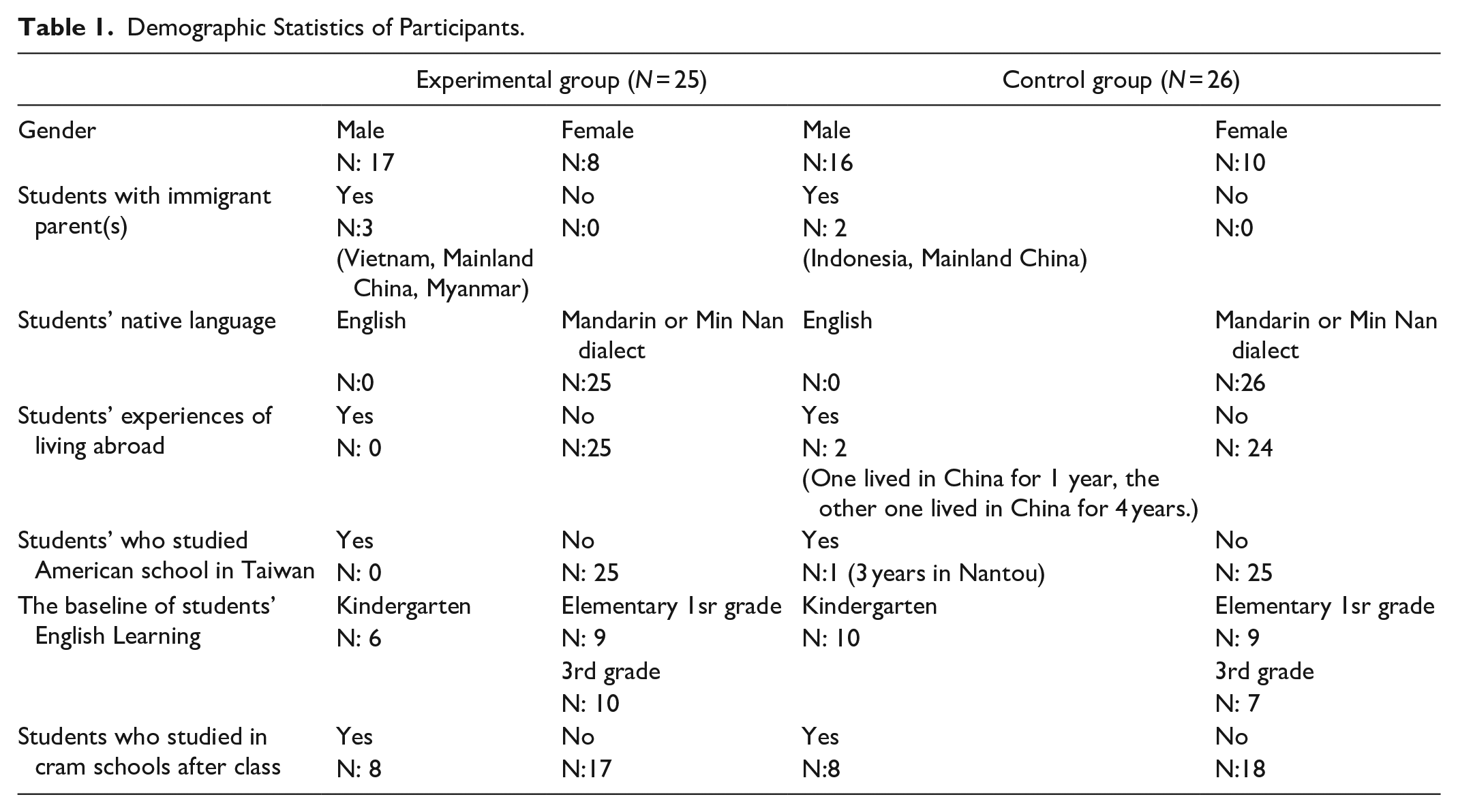
In Taiwan, English is learned as a foreign language at school. According to English Learning Background Questionnaire, the demographic statistics of the participants from two groups are demonstrated in Table 1. None of the participants were English native speaker. All of them were indigenous Taiwanese speaking Mandarin or Min Nan dialect. Only five of them had immigrant mothers, who were from Mainland China, Vietnam, Myanmar, and Indonesia. Many of students started to learn English in kindergarten, and most of them started from first grade or third grade in elementary school. Around one third of the participants went to cram schools for extensive English learning. During the experiment, students attended four English classes per week, and each of the class lasted 50 minutes.
Demographic Statistics of Participants.
Based on the pretest of reading comprehension, students in distinct groups are categorized into higher achievers (Group A), intermediate learners (Group B), and lower achievers (Group C). According to the upper and lower 27% subgroups (Kelley, 1939), students’ grades above the percentile rank 73 are classified into Group A. Group B consists of students whose grades rank between 28 percentile and 72 percentile. Students’ grades fell below percentile rank 27 are marked as Group C.
Table 2 shows the classification of students’ English level classification in experimental and control groups.
Grouping of Research Participants of 11 Grades.

Note. Level A ≥ 73 PR (percentile rank); 28 PR ≤ Level B < 72 PR; Level C < 27PR.
Instruments
The study adopted both quantitative and qualitative data to achieve the research purpose. Quantitative data involved five instruments, including English learning background questionnaire, an English reading comprehension pretest and posttest, pretest and posttest of the Foreign Language Classroom Anxiety Scale, and lastly VARK learning styles questionnaire. Qualitative data involved interviews with participants. These instruments are explained as follows.
English learning background questionnaire
The questionnaire was conducted before the experiment to realize students’ English learning experience (see Supplemental Appendix B). Question 1 to 5 focus on students’ background, probing whether they are native speakers or English as Foreign Language speakers. The last three questions were designed to probe students’ English learning background and experience, including the length of their English learning.
Pilot tests for reading comprehension pretest and posttest
As to reading comprehension tests, pilot tests were administered to 12th graders to achieve validity and reliability, including reading comprehension pretest and posttest relevant to each respective script. As for expert evaluation, four experienced English teachers teaching in senior high schools examined the reading comprehension tests before the implementation of pilot tests.
Pretest and posttest respectively comprise 20 reading comprehension questions with a total score of 100. In addition, the pilot test for reading comprehension pretest was given to 142 12th graders. The reliability of the test and each item was checked to ensure the appropriateness of the test. Cronbach’s alpha of .726 proved the test was reliable. The difficulty of each item was between 0.2 and 0.8, which indicated moderate difficulty. As to the item discrimination, the item 20 was under 0.2, which showed the difficulty to tell the right from the wrong answer. Thus, item 20 was deleted, while the other 19 items were reserved (See Supplemental Appendix A).
Based on an English textbook published by The Far East Book Company for 11th graders, the pretest consists of three reading passages Lesson 2, Lesson 7, and Lesson 12 and the posttest consists of passages from Lesson 2, Lesson 7, and Lesson 11. The author formulated reading comprehension tests based on the three levels of comprehension, which are literal, interpretive, and critical comprehension (Mohamad, 1999). Literal comprehension, the basic level, involves literal meanings that are explicitly stated in the text. Interpretive comprehension asks readers to connect ideas and see implied meanings. Critical comprehension. Critical reading is the third level that requires readers to evaluate ideas and information.
In doing so, the pretest ensures both groups had the identical reading proficiency. pretest was conducted to guarantee the homogeneity of the experimental and control groups and further classify students into high achievers, intermediate learners, and low achievers to compare the difference between experimental and control group in terms of foreign learning anxiety. On the other hand, the reading comprehension posttest intended to check to what extent the participants comprehend the designated passages and scripts after the experiment. The experimental group received RT instruction on the three scripts, while the control group were distributed with the scripts. Posttest was designed with 20 four-multiple choice questions. After 16 weeks of RT intervention, both groups undertook the posttest to probe the improvement of overall reading comprehension.
Foreign language classroom anxiety scale (FLCAS)
The FLCAS was developed by Horwitz et al. (1986) and meant to measure learners’ levels of anxiety in foreign language classroom. The FLCAS belongs to 5-point Likert scale, consisting of 33 items marking from “strongly agree” to “strongly disagree.” According to Horwitz et al. (1986), the FLCAS is composed of three performance anxieties: (1) communication apprehension; (2) test anxiety; and (3) fear of negative evaluation. Communication apprehension concerns a fear of communicating with others. Test anxiety refers to a fear of making errors and failure in tests and quizzes. Negative evaluation means a fear of others judging us negatively, including social aspects.
In Taiwan, English is viewed as foreign language. The FLCAS was executed in this study to assess students’ anxiety in English classrooms. This study adopted the FLCAS questionnaire, a Chinese version translated by Tseng (2005).
VARK learning style questionnaire
Fleming’s (2017) VARK questionnaire from the VARK website was used to identify students’ learning styles. The questionnaire consists of 16 multi-select questions, in which questions are consistent with sensory modalities: visual, aural, read/write, and kinesthetic modalities. Every answer represents a certain sensory modality, and students can select more than one choice due to their preference. The frequencies they choose later determine their dominant learning preference.
Interview on students’ reflections on RT instruction
The measurement was designed by the author to probe deeper into participants’ perspectives toward the RT instruction (Supplemental Appendix C). RT groups were interviewed to describe their feelings after receiving RT instruction. Twenty-four out of twenty-five students agreed to have an interview. After one script was finished for RT instruction, eight participants from Group A, Group B, and Group C were averagely picked out to have interview. There were 3 scripts and 24 interviews in this study. The interview consisted of students’ views on the effects of RT on English reading comprehension, students’ anxious feelings toward RT and the similarities and differences between students’ preferred learning and RT activities.
Teaching Materials
RT instruction materials were adapted from three reading articles in an English textbook published by The Far East Book Company for 11th graders. The selected reading passages were (1) The Owl Who Was God; (2) An Unpunished Crime; and (3) Going Home. Flynn (2004) described scripts written based on classroom curriculum content as Curriculum-Based Readers Theater, focusing on entertaining and informing through dialog. RT scripts are rich in conversational characteristics.
The three adapted reading passages are stories in which some dialogs were inserted. Each script was designed for approximately a 10-minute performance, including repetition of important words. After reading passages were adapted into scripts, scripts were sent to four English teachers for expert evaluation. The RT group ran the scripts in class, while the control group was distributed with the same scripts as outside reading materials.
Procedure
The experiment extended to 16 weeks and the research procedures were illustrated in Figure 3 In the preparation stage, both experimental group and control group were distributed with background questionnaire to realize subjects’ past English learning experience. Next, pretests of reading comprehension, the FLCAS, and VARK questionnaires were conducted. The results of reading pretest functioned to ensure the identical reading proficiency in both groups prior to the experiment. The FLCAS referred to the level of anxious status, and VARK displayed their learning preference. The RT instruction intervention came along for 16 weeks before the posttests of reading comprehension and the FLCAS to examine the difference after the experiment.
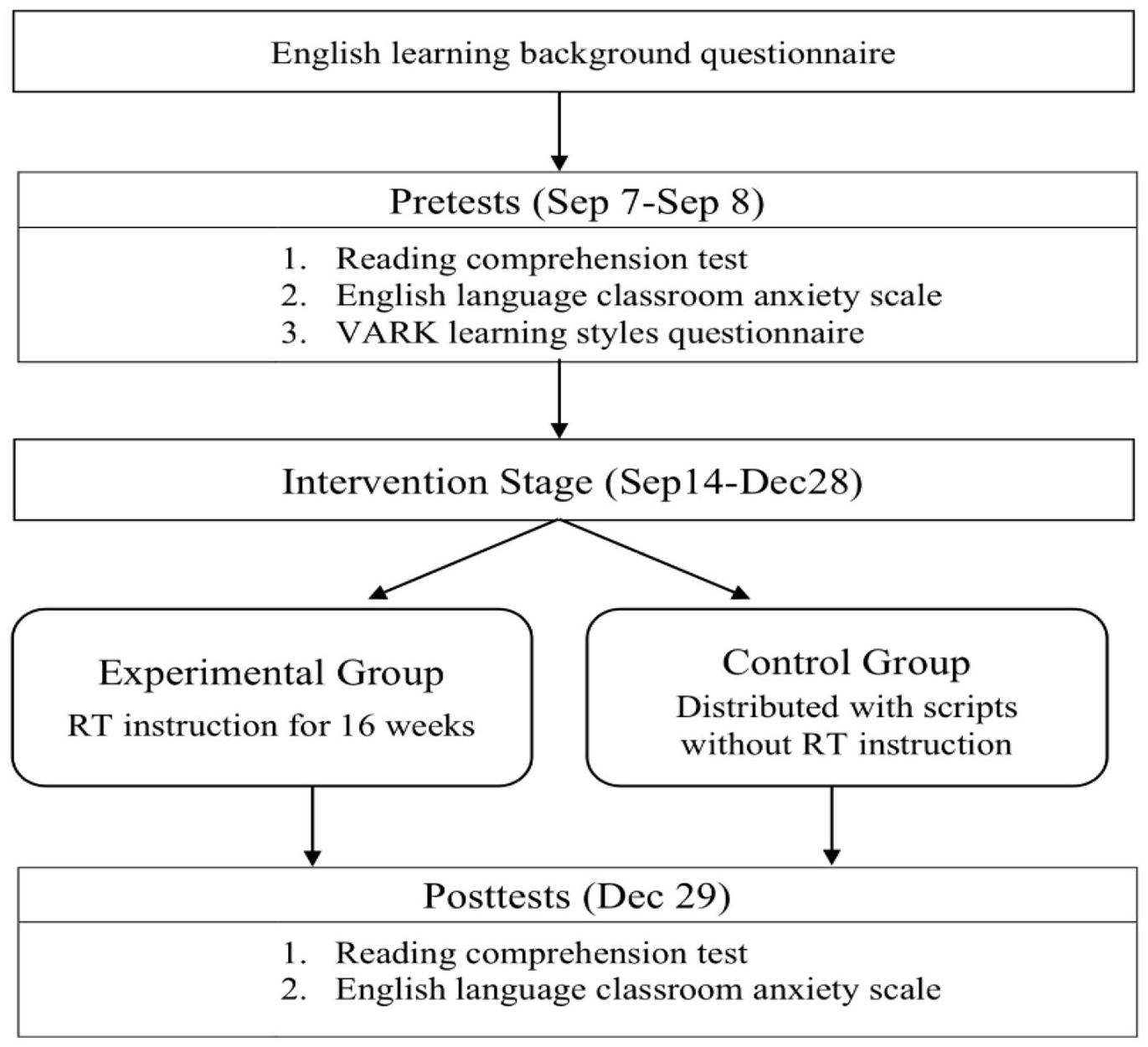
Research procedures.
The experimental group received the RT instruction one period for 50 minutes in a week. The pretests and instructional explanation were administered in the first week. It took 5 weeks to practice one script. Three scripts took up 16 weeks. The total RT instructional duration was 16 weeks. Walker (2005) introduced a six-stage procedure to operate RT instruction: Primary reading, round robin reading, instant reading, and cooperative reading, rehearsal reading and performance. To be noticed, assisted reading is required during the implications of round robin and instant reading (Rasinski & Hoffman, 2003). In this study, reading passages were adapted into scripts with expert evaluation of four English experienced teachers for expert evaluation. An outline of RT instruction in this study presented main activities of practicing a script (Table 3).
Main Activities of RT Stages.

Note. From Using readers theater at the elementary level. Readers theater in the classroom (Li, Y.R. Trans.), by Walker, L., 2005, Taipei City: East & West Book Co., Ltd.
Results and Analysis
Since we adopted a mix method research, each issue of each section is explained and analyzed through both qualitative and quantitative data, followed by the discussion of results with finding from literature review.
The Effect of Reader’s Theater on English Reading Comprehension
This section intends to answer Research Question 1 through qualitative and quantitative data. To begin with, we examine the effect of RT on English reading comprehension by determining whether there are significant differences between the RT group and the control group.
English reading comprehension pretest and posttest
Table 4 shows the descriptive statistics of both groups on English reading comprehension pretest and posttest. Then an Independent t-test and a Paired Sample Test were applied to process the data of both groups. The pretest score showed that there was no violation of homogeneity of variance, which indicated there was no significant difference between two groups in reading comprehension pretest.
Descriptive Statistics of English Reading Comprehension Pretest and Posttest.

In the posttest, Paired Sample Test was conducted to see whether there were differences between pretest and posttest reading comprehension in the RT group and the control group, as shown in Table 5. In the RT group, the posttest score showed no significant difference between the pretest and posttest reading comprehension tests (t = −0.496, p > .05). Neither did the control group show any significant difference (t = 1.303, p > .05).
Paired Sample Test of RT Group and Control Group on Reading Comprehension Tests.

The effect of RT on English reading comprehension was not significant. The results of this study which showed no significant difference was in line with the findings of the previous study (Tsou, 2011). One possible explanation is the adoption of different reading processing. Rapid and automatic lower-level reading process, such as word recognition, plays a vital role in reading comprehension. However, there is limited contribution of the lower-level reading process to reading comprehension. Readers’ schema and higher-order reading process, such as predicting, making references, monitoring ongoing understanding, also play critical roles in reading comprehension (Anderson & Pearson, 1984). Despite basic skills like word decoding, higher-order reading skills is essential to successful reading comprehension, especially applying to struggling readers (Alvermann et al., 2006). The results of RT showed no significant difference, which could not strongly support the idea that RT improved reading comprehension. Therefore, qualitative data was required to explain the effects of RT on reading comprehension.
Qualitative Data on English Reading Comprehension
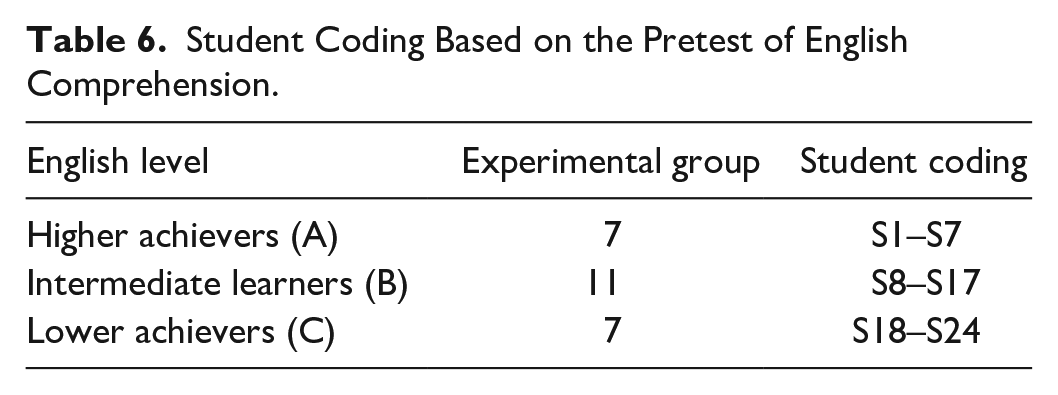
From Table 6 to Table we provide the coding of students’ qualitative data. To triangulate the quantitative data, qualitative data were collected from interviewing students in the RT group who were coded according to their English levels. Students with higher English reading comprehension in Level A were coded from S1 to S7, students with intermediate English reading comprehension in Level B were S8 to S17, and students with lower English reading comprehension in Level C were S18 to S24 (as seen Table 6).
Student Coding Based on the Pretest of English Comprehension.
There were 25 participants in Reader’s Theater instruction, and 1 of the students refused to receive an interview. Hence, there were 24 students doing interviews, and each section lasted about 30 minutes. In addition, three English teachers acted as classroom observers recording students’ reactions and behaviors during RT instruction. Supplemental Appendix D showed the dates of each student’ interview on RT instruction. In addition, three English teachers acted as classroom observers recording students’ reactions and behaviors during RT instruction.
Most students considered Reader’s Theaters conducive to English reading comprehension through repeated reading, word recognition, group cooperation, and the form of content. Eighteen out of twenty-four students thought Reader’s Theater was effective in enhancing English reading comprehension. Among those 18 students who considered RT contributed to reading comprehension, 3 are higher achievers, 7 are intermediate learners, while 7 students are low achievers (Table 7).
Number of Students at the Three English Achievement Levels in the Experimental Group that Agreed on the Positive Effect of RT on English Reading Comprehension.

However, low achievers confirmed that repeated reading helped word recognition through RT, which improved their reading comprehension.
S25 said, “Repeated practice of RT made me understand the reading and I grew to know those difficult words.” (10/27, 12:30-13:00)
S24 said, “Because I had to read the script out, I had to understand the meaning of vocabulary. When I knew the words, I grew to know the content.” (12/07 12:30-13:00)
To low achievers, processing words is vital for them to understand the reading texts in RT. Unlike low achievers, intermediate learners expressed what vocabulary meant to them in other ways.
S14 said, “RT helped me know more vocabulary. The content became easier when I did the repeated reading.” (01/10, 12:30-13:00)
S18 said, “After repeated reading, I came to know the meaning of every sentence and understand the content.” (01/16, 12:00-12:30)
Intermediate learners focused more on the meaning of sentences or the whole content instead of a single word. On the other hand, higher achievers considered RT help their reading comprehension through cooperation and the form of reading content.
S1 stated, “RT presented in dialogue, and it becomes easier to read English.” (11/02, 12:00-12:30)
S5 said, “It was more interesting to read the dialogue with classmates. It was easy to understand the content through interaction.” (12/06, 12:00-12:30)
Of note was the finding that four out of seven higher achievers disagreed with the idea that RT helped their reading comprehension. They stated that the reading contents were easy for them to understand and RT didn’t help much. Different reading processes might explain learners’ self-descriptions toward the effect of RT on reading comprehension. To high achievers, lower-level reading process, like word recognition, has limited effects on reading comprehension, while higher-order reading process, such as predicting, making references, monitoring ongoing understanding, is of great importance in reading comprehension (Anderson & Pearson, 1984). There was little challenge in RT for high achievers since word recognition posed no problem to them, and they needed more training for high reading skills to improve their reading comprehension.
To sum up, students at varied levels held different opinions toward the influence of RT instruction on reading comprehension. In RT instruction, low achievers enhanced their reading comprehension from learning more words. Poor word decoding influenced students’ reading comprehension negatively (Hudson et al., 2005). To low achievers, RT improved word recognition and thus enhanced their reading comprehension.
With higher English levels, students looked beyond word recognition. Intermediate learners still focused on word recognition, but they stressed more on the meaning of sentences and content.
As to higher achievers, they took highly on cooperation and the form of reading content that helped their reading comprehension. However, some expressed that they obtained little improvement in reading comprehension from repeated reading in RT, probably because of limited benefits from the lower-level reading process.
The Role of EFL Students’ Anxiety Plays in RT
While previous literature has shown that low anxiety is one of keys to a successful language learner (Krashen, 1982), this section displayed how anxiety played in implementing RT stages through interviewing both students and observing teachers. In the qualitative data, the interview aimed to find out the ways that RT affects students’ anxiety in English learning. In this regard, we explored anxiety in the beginning and then compared the difference and level of anxiety among five stages of RT.
General anxiety toward RT
In RT instruction, students were willing to help each other, which reduced their anxiety when reading aloud (Drew & Pedersen, 2010). However, few literature showed how RT helped lower students’ anxiety and few recorded how anxious students felt during RT instruction.
The qualitative data found that most of students generally indicated RT instruction made them feel relaxed through cooperation. In a word, through students’ self-description and observers’ narrations presented students’ lower anxiety in RT instruction.
S2 said, “It is relaxing and interesting to practice and perform with classmates. Although RT took time, I improved my reading comprehension and speaking.” (01/09, 12:00-12:30)
From observing teachers’ perspectives, three observers agreed on students’ relaxed attitudes during the implement of RT instruction.
Observer1 stated, “Students were quite comfortable after the teacher when being corrected by the teacher and being asked to repeat after the teacher.”
Observer2 said, “Students looked relaxed when they asked for help from classmates. Plus, most of students were so happy and excited during every stage of RT instruction.”
Observer3 said, “Groups which needed to perform on stage next would practice secretly. They all looked relaxed rather than anxious.”
However, there were some students holding the opposite views. Few students were worried they weren’t good enough to support their group, or even influence the group in bad ways.
S19 said, “I feel worried and scared of holding my group back, but I try my best.” (12/05, 12:30-13:00)
Although students were generally comfortable in RT instruction, observers indicated students’ anxiety from time to time.
Observer1 said, “Many students were shy to read out aloud. When students showed their reactions, like laugh or any evaluation, the levels of anxiety raised and speakers recoiled from reading aloud.”
Observer2 said, “Students’ low volume of voice might result from their lack of confidence.”
Others’ opinions toward students turned out to be one of the main sources of anxiety. When students were aware of others’ attention, mostly when they performing on stage, they were likely to recoil from reading aloud.
To sum up, most students were at ease in RT instruction because they enjoyed group work that made RT relaxing to them, but anxiety rose when they cared about others’ opinions. Since the previous research provides little evidence for the role of anxiety that played in RT, the highlight of this study was to explore the variation of anxiety in RT instruction.
Anxiety students felt during different stages of RT
Table 8 demonstrates that students’ levels of anxiety toward RT instruction fluctuated during different stages by comparing percentage of students’ anxiety. By interviewing 24 out of 25 students, the table compares the difference among six stages: Primary Reading, Round Robin Reading, Instant Reading, Cooperative Reading, Rehearse Reading, and Performance. In this study, the stage of RT with 1% to 25% of students in class feeling anxious was defined as a low anxious stage, 26% to 50% was a moderate anxious stage, 51% to 75% was a high anxious stage, while 76% to 100% was an extremely high anxious stage. Furthermore, we further analyzed the differences of stages with the findings of the interview as following stages of Primary Reading, Round Robin Reading, Instant Reading, Cooperative Reading, Rehearse Reading, and Performance.
Percentage of Students Feeling Anxious During Different Stages of RT.

Primary Reading
Primary Reading brought little anxiety to students. In Primary Reading, 22 out of 24 interviewers viewed it as a relaxing activity when they read lines with the whole class after the teacher.
S21 said, “I felt not a trace of stress at all when repeating lines after the teacher.” (01/14, 12:30-13:00)
S9 said, “No one would discover my wrong pronunciation when I read with the whole class.” (12/07, 12:00-12:30)
Although few students found it stressful to read out the unfamiliar words in the scripts, most students felt comfortable when there was a teacher modeling for them and the whole class read aloud together.
Round Robin Reading
In Round Robin Reading when students rotated to read different character’s lines in groups, 18 students remained relaxed after some practice in the former stage.
S16 said, “I felt relaxed and it was great to read every character’s lines. Plus, other group members would help me read unfamiliar words.” (01/09, 12:30-13:00)
S20 said, “I felt quite comfortable because it was like reading out a text. I would ask for help if I didn’t know how to read the word.” However, few students expressed a bit anxiety because of unfamiliar words. (10/31, 12:30-13:00)
S14 said, “I was a bit anxious because I was not so familiar with the lines of characters.” (01/10, 12:30-13:00)
S17 said, “I felt annoyed to help others to read out words.” (01/15, 12:30-13:00)
In general, most students remained relaxed in group work in Round Robin Reading.
Instant Reading
However, students who felt relaxed dropped to eight in Instant Reading when students were picked out randomly to read lines in front of the class. Those who took it easy either considered it interesting to play different roles in the scripts or found it easy to read every word. Most students felt under pressure because they were unsure of how to pronounce some unfamiliar words and worried about being laughed at when mispronouncing words.
S8 said, “I lowered my voice because I felt anxious to be noticed mispronouncing words.” (11/02, 12:30-13:00)
S12 recalled, “I was worried because other male classmates would laugh at me if I mispronounced words.” (12/05, 12:00-12:30)
S22 said, “I was extremely anxious because I didn’t want to be picked out to read lines.” (12/06, 12:30-13:00)
Compared to Round Robing Reading where students felt safe to make mistakes in groups, students going through Instant Reading were highly anxious when the whole class paid attention to them.
Cooperative Reading
The situation changed in Cooperative Reading when students took on one role in a script and practiced lines with group members. Twenty-three students felt totally without stress because they thought it delightful to work with group members. Moreover, they had much confidence and became familiar with scripts after repeated practice.
S15 said, “I had practiced the script many times in the former stages. I felt quite relaxed and confident.” (12/04, 12:30-13:00)
Some even expressed their attempts to change tones and add more emotions into the characters. After repeated practice for a few classes, students became more confident and enjoyed group work.
Staged Reading
In Staged Reading, most students felt no anxiety because of repeated practice in the former stages. Staged Reading contains practice of Instant Reading and Cooperative Reading, in which groups went on stage to rehearse. Fifteen students felt relaxed and even confident after repeated practice.
S1 said, “I was more confident and relaxed because of repeated practice.” (11/02, 12:00-12:30)
S23 said, “It felt good to speak out loud maybe because I became familiar with the lines.” (01/16, 12:30-13:00)
Still, 10 students were self-conscious about their performance in front of the class.
S6 said, “I was anxious when others stared at me.” (10/30, 12:00-12:30)
S11 said, “Performing on stage made me worried and stressed. I trembled when speaking and I was worried about my bad performance.” (10/27, 12:00-12:30)
They expressed anxious when others were looking at them and they were afraid of not doing well.
Final performance
In the final performance, most of the students remained relaxed and confident as they were in Staged Reading after practicing for many times, while 12 students felt anxious about being stared at by the class and making mistakes.
S18 said, “Reading aloud English wouldn’t make me nervous because of repeated practice. It was when others looked at me that made me anxious.” (01/16, 12:00-12:30)
Students’ anxiety increased when they were worried about being negatively evaluated in front of the class. Brown (2004) indicated FNE (Fear of Negative Evaluation) is one type of anxiety in language classroom, in which learners concerned about other classmates’ negative opinions on them. In the previous two stages in the RT, only few students felt anxious when they were worried about mispronouncing words and making mistakes in groups. However, the situation got worse in Instant Reading, when students were called up by the teacher and aware of being watched by the whole class. In addition, although students felt confident enough to perform in front of the class in the final performance after repeated practice, the anxiety of being evaluated when performing in front of others still lingered in nearly half of the students with different levels of English proficiency.
Discussion with quantitative data
To figure out the variations on students’ anxiety in the RT group, the Paired Sample Test was adopted to see the differences of FLCAS before and after the implementation of RT instruction. As Table 9 presented, the result revealed great significant difference (t = 2.262, *p < .05) in the RT group. After receiving the instructor’s RT instruction for 15 weeks, the RT group felt less anxious than they were in the beginning of the semester. However, the control group showed no significant difference (t = 1.711, p > .05) after traditional instruction implemented for 15 weeks. The study found that students’ levels of anxiety lowered after RT instruction intervention.
Paired Sample Test of RT Group and Control Group on FLCAS.

p < .05.
To conclude, through an interview, students at different English proficiency levels confirmed that RT Instruction helped reduce students’ anxiety, mostly because of group work that made them engaged. Observing teachers also expressed that students were at ease in groups. When others’ opinions or evaluation were concerned, students tended to have higher levels of anxiety. Furthermore, FLCAS supported the idea of students’ decrease of anxiety after RT instruction. Hence, this study highlighted that RT provided a relaxing atmosphere, but levels of anxiety that students felt fluctuated in different stages. During those stages, students’ anxiety increased greatly especially in Instant Reading.
The role of Learning Styles in RT
According to previous literature, a survey of teachers in five countries (Britain, the Netherlands, Turkey, Greece, and China) revealed that over 90% of them agreed that learners learn better if information delivered catered to their learning styles (Howard-Jones, 2014). Reader’s Theater that includes performing arts strategies caters to different learning styles, which enhances involvement and reading achievement of students with disabilities (Schoen-Dowgiewicz, 2016). However, few research clearly stated how RT was suitable for learners with different learning styles. This study meant to presented qualitative data to affirm RT is a suitable platform.
After students were identified with their learning styles, qualitative data were collected from students’ interview to describe the similarities and differences between their learning habits and RT instruction. To identify their learning styles, students were asked to complete Fleming’s (2017) VARK questionnaire. This questionnaire has 16 multi-select questions, as each answer represented a certain learning preference. When each learning preference was added up, the most highly scored one characterized the student’s learning styles. The result of the survey showed that eight students belonged to visual learners (S3, S6, S7, S9, S11, S17, S20, and S23), six were tagged as auditory learners (S4, S5, S8, S10, S14, and S16), 2 were Read/ Write styles (S18 and S22), and nine were viewed as kinesthetic learners (S1, S2, S12, S13, S15, S19, S21, S24, and S25). Among them, 6 out of 25 students gained the same scores for two types of learning styles (S10, S11, S12, S14, S17, and S22), and thus had two types of learning styles.
To sum up, according to the result of VARK questionnaire, Table 10 showed that students with two learning styles were averagely categorized into certain learning style with different English levels, as High achievers, Intermediate learners, and Low achievers.
Categories of Students’ Learning Styles.

After RT instruction, students were interviewed to tell the similarities and differences between their learning habits and RT instruction, and key-words of their descriptions were presented in Table 11.
Students’ Descriptions of Similarities and Differences between Their Learning Styles and RT Activities.

Note. S: Similarities; D: Differences.
Visual learners
Visual learners prefer images, visual charts or models that symbolize what words depict (Fleming, 1995). In RT, graphic organizers were adopted in each script as visual materials to improve students’ reading comprehension, and further engage students in reading aloud scripts. In students’ self-description, visual learners in RT group were not in habits of using graphic organizers, they relied much on their sights to read the texts. To them, reading aloud or embodying characters with voice were the most peculiar traits of RT that they didn’t do before.
S6 said, “Reading script is the same as reading texts in textbooks. However, I have to read it aloud in RT and it’s hard to imitate the character’s emotions.” (10/30, 12:00-12:30)
S20 said, “I read texts silently as I read the script, but RT requires me to read aloud, know the character’s emotion, and try to keep in character.” (10/31, 12:30-13:00)
Auditory learners
Auditory learners learn best with “heard or spoken” information, such as discussion and lectures (Fleming, 1995). In RT, students were provided chances to discuss the main ideas of the scripts, to read aloud, listen to others, and keep the process on. In RT group, students pointed out their habits of reciting words either in high or low volume.
S4 said, “I will sit and study quietly at desk, but I tend to recite words at low volume.” (01/15, 12:00-12:30)
S8 said, “I will read out English as I do in RT, but RT stresses cooperation with classmates. I won’t discuss with classmates when I study.” (11/02, 12:30-13:00)
S16 said, “I tend to read the texts on my own, and read out the words in my mind. If there is anything I don’t understand, I search online. However, I need to speak out in RT with intonation.” (01/09, 12:30-13:00)
Read/Write
Read/ write learners prefer printed words (Fleming, 1995). Activities suitable for read/ write learners involve more with reading texts and writing notes. In RT, script reading played a vital role and took much of time. In the class, read/ write learners were used to this activity.
S18 said, “Like what I usually do while I study, I will try to read and get to know the reading in RT, but I am not used to reading aloud the texts.” (10/31, 12:00-12:30)
S22 said, “Usually, I memorize words on my own and I won’t read the words out. RT provides chances for me to discuss with others.” (12/06, 12:30-13:00)
Kinesthetic learners
Kinesthetic learners favor physical activities, from demonstrations, real practice, to role-plays (Fleming, 1995). Kinesthetic learners in RT group expressed that RT involved them in many kinds of activities, and they were used to those activities and even quite enjoyed them.
S2 said, “I tend to read by myself. I understand more of the reading after discussing with classmates or teachers.” (01/09, 12:00-12:30)
S15 said, “Like what I do in RT, I tend to use graphic organizers to outline the reading. Plus, I will read out as what I do in RT.” (12/04, 12:30-13:00)
S25 said, “RT suits me because of interaction, changing information, and listening and speaking. I like dynamic ways.” (10/27, 12:30-13:00)
With above qualitative data, this study argued that RT might provide a suitable platform for students with different learning styles to learn English better. The main focus of Reader’s Theater is to require students to use their voices to convey the meaning of the scripts (Young & Rasinski, 2018). The teaching activities mainly focus on the practice of reading lines aloud and the interpretation of the scripts with voices. RT offers chances for auditory learners to have discussion, listen to others’ lines and keep process going. Therefore, read/write learners fit in the activities by reading scripts.
While RT requires participants to embody characters, kinesthetic learners are doing role-plays by imitating proper emotions or using their voice to act out. In this way, RT provides most of time for learners to read texts and read aloud, which belongs to auditory, read/ write types and kinesthetic learners, and less of time for visual learners to practice. Therefore, this study may neglect the part that teaching activities in RT didn’t cater to all kinds of learning styles because of the lack of activities for visual learners. It was suggested that the content of scripts could also be presented with pictures or other forms besides graphic organizers so that visual learners could have more opportunities to learn best from RT instruction.
Conclusions
This paper firstly investigates how Reader’s Theater affects students’ English reading comprehension in vocational high school? What was the difference between the students with different learning styles in RT? Which of RT caused higher learning anxiety? What was the degree of learning anxiety of the students with different learning styles in RT.? Finally, research limitations and recommendations are proposed for future research.
To begin with, the influence of RT on English reading comprehension was shown in this study clearly in qualitative ways, not quantitative ways. The effect was not significant through quantitative data because no significant difference was shown in statistical tests. After RT instruction for 15 weeks, the experimental group didn’t outperform the control group in reading comprehension.
However, while different adoptions of reading processing lead to the capabilities of reading comprehension, basic reading skills such as word decoding, and higher-order reading skills, like predicting and making reference, are also essential to successful reading comprehension (Anderson & Pearson, 1984). In this study, qualitative data from students’ interviews showed the effects of RT on reading comprehension. Students at varied English levels thought RT contributed to reading comprehension in different ways. Low achievers regarded RT helped word recognition and thus improved their reading comprehension. In addition to word recognition, intermediate learners considered that RT helped understand sentences and content. Higher achievers attributed reading comprehension to group cooperation and the form of reading. Unlike the result of quantitative data, qualitative data affirmed the effect of RT on English reading comprehension.
Second, the interview data explained that students at different English proficiency levels agreed RT helped reduce their anxiety, and students’ levels of anxiety toward RT instruction fluctuated during different RTs’ stages. According to students’ interview, cooperation with classmates made students comfortable to operate RT. However, worrying about others’ opinions and evaluations would raise students’ levels of anxiety. Therefore, during different stages of RT (Primary Reading, Round Robin Reading, Instant Reading, Cooperative Reading, Rehearse Reading, and Performance), Instant Reading involving students called up by thee instructor and reading lines, was regarded as the most anxious activity by students because they were worried about making mistakes and evaluated by others. It was also worth noting that students’ levels of anxiety fluctuated in different stages, especially in Instant Reading. On the other hand, quantitative data were collected from Foreign Language Classroom Anxiety Scale (FLCAS) (Horwitz et al., 1986). The data showed the decrease of anxiety in the RT group but not in the control group, which indicated RT helped lower students’ anxiety in English learning.
Finally, this study argued that RT might be tailored to different learning styles of learners based on evidence from students’ interviews. VARK (visual, auditory, read/write, and kinesthetic learners) were questionnaires to identify learners’ learning styles (Fleming, 1995). Visual learners prefer images, auditory learners like listening, read/ write learners favor printed words, and kinesthetic learners stress physical movement. While RT requires participants to cooperate to complete the activity, RT offers chances for learners to have discussion, read lines, listen to others’ lines and keep the process going, and use voices to embody characters. According to students’ self-description, their preferred learning habits had much similarities with identified their learning styles. Furthermore, the variety of RT activities help challenge students to adopt different learning styles.
Research Limitation
The findings in this study suggested further research into RT instruction to affirm the effect of RT on reading comprehension and the role of anxiety and VARK in RT to help learners acquire better proficiency in English. Some research limitations in RT instruction need to be taken into account. First, because of limited samples, the quantitative data were insufficient to support that RT indeed improved students’ reading comprehension or decreased students’ anxiety. Second, there were other factors that might have influenced students’ levels of anxiety during RT instruction. In this study, students’ familiarity with the instructor might be the cause. As the time progressed, students felt at ease to get along with the teacher and therefore feel comfortable to receive RT instruction. Third, more samples were needed so that students with different learning styles could express their opinions toward RT and in which part that suited their learning styles. Besides, more questions related to each activity in RT and students’ preferred learning ways should be designed to probe deeper into how RT can be designed to provide a better platform to students with different learning styles. Therefore, the area of RT instruction still calls for further research in the future.
Recommendations for Future RT Instruction
Although RT might cater to different learning styles, this study might neglect the part that RT provides little activities for visual learners. Visual learners prefer learning like formats, space, graphs, charts, diagrams, maps, and plans (Fleming, 1995). In the study, a visual teaching strategy was presented by a graphic organizer. In the stage of Primary Reading, groups were asked to draw graphic organizers to put down key words in organized ways and assist their reading comprehension. Another one was to analyze characters’ personalities and put down in charts. There was no other visual teaching strategy provided in other stages. Therefore, it was suggested that more pictures or other visual images could be added into the teaching activities in RT to help visual learners learn with their learning preference. Take the first script “The Owl Who was God,” for example. In Cooperative Reading, the instructor can ask students to make a diagram to tell the differences between a good leader and bad leader. It is a way to probe deeper into the morals or meaning that the reading tries to convey, and provide more visual activities to vary the teaching activities for students with different learning styles. To create RT instruction more suitable for learners with different learning styles, the study encourages instructors to design teaching activities for each stage in RT instruction.
Supplemental Material
sj-docx-1-sgo-10.1177_21582440211061576 – Supplemental material for The influence of Reader’s Theater on High School Students’ English Reading Comprehension-English Learning Anxiety and Learning Styles Perspective
Supplemental material, sj-docx-1-sgo-10.1177_21582440211061576 for The influence of Reader’s Theater on High School Students’ English Reading Comprehension-English Learning Anxiety and Learning Styles Perspective by Chih-Cheng Lo, Shih-Yun Lu and Dou-Dou Cheng in SAGE Open
Footnotes
Author note

Declaration of Conflicting Interests
The author(s) declared no potential conflicts of interest with respect to the research, authorship, and/or publication of this article.
Funding
The author(s) received no financial support for the research, authorship, and/or publication of this article.
Supplemental Material
Supplemental material for this article is available online.
References
Supplementary Material
Please find the following supplemental material available below.
For Open Access articles published under a Creative Commons License, all supplemental material carries the same license as the article it is associated with.
For non-Open Access articles published, all supplemental material carries a non-exclusive license, and permission requests for re-use of supplemental material or any part of supplemental material shall be sent directly to the copyright owner as specified in the copyright notice associated with the article.
