




Abstract
As China transitions away from electric vehicles (EVs) purchase subsidies, understanding the factors influencing consumer adoption becomes increasingly important. While much research has focused on subsidies and technical attributes, few studies have examined the role of environmental perception in shaping consumer willingness to pay (WTP) for EVs. This study addresses this gap by investigating how different environmental stimuli influence WTP for key EVs attributes. A randomized controlled experiment involving 112 participants in Nanyang City was conducted using a choice experiment to assess WTP for attributes such as driving range, charging time, and emissions reduction. Participants were divided into groups exposed to different stimuli: distal (policy information), proximal (environmental quality images), both combined, and a control group with no stimuli. Results indicate that proximal stimuli significantly increased WTP, especially for driving range and charging time, while distal stimuli alone had a modest effect, enhancing WTP mainly for driving range. Combined stimuli yielded the highest overall increase in WTP across all EVs attributes, suggesting a strong synergistic effect of emotional and informational perception. These findings suggest that emotionally engaging, visual environmental perception heighten perceived value, while abstract policy information alone is less effective. This study provides practical insights for policymakers and EVs businesses, recommending strategies that blend tangible product improvements with emotionally resonant messaging to sustain market growth post-subsidy. Future research could explore the long-term impact of environmental perception and their applicability in broader geographic settings.
Plain language summary
This study explores how people’s views about the environment influence their willingness to pay for electric vehicles (EVs) in China, especially now that government subsidies for EVs have ended. This study used experiments to understand whether different kinds of environmental messages affect how much people value key EV features like driving range, charging time, and reducing emissions. Participants were divided into groups and shown different types of information: some received detailed policy facts (distal stimuli), others viewed images of local environmental improvements (proximal stimuli), and a third group received both. The findings reveal that visual and emotional messages about the environment had the strongest impact, making people more willing to pay for practical EV features like better driving range and faster charging. Policy-related messages alone had a smaller effect but were still valuable when combined with emotional imagery. These results highlight the importance of blending emotional and informational approaches to encourage EV adoption in the absence of subsidies. For policymakers, the study suggests campaigns that combine clear environmental benefits with engaging visuals to motivate consumers. Businesses can use these insights to focus on features that consumers value most, such as performance and convenience, while incorporating sustainability messaging into their marketing. Ultimately, the study shows that making environmental benefits feel more immediate and personal can help sustain the growth of EVs in China’s post-subsidy market.
Introduction
China’s electric vehicle (EVs) industry has rapidly expanded, reaching a significant milestone in 2021 with sales of 3.4 million units—accounting for 50% of the global EVs market. This remarkable growth has been largely driven by government subsidies aimed at promoting sustainable transportation (S.-C. Ma et al., 2019). However, the landscape has shifted with the complete phase-out of these subsidies by the end of 2022, leaving the industry to navigate a post-subsidy era (China Association of Automobile Manufacturers, 2020). The absence of direct financial incentives now raises new challenges for maintaining consumer demand and market growth.
With the shift from government subsidies for EVs in China, it has become increasingly important to understand alternative factors that influence consumer interest and willingness to pay (WTP) for EVs. Although extensive literature has examined WTP for EVs, much of it has focused on the effects of subsidies and technical attributes, such as vehicle performance and infrastructure availability (D. Greene et al., 2018; Noel et al., 2019). However, there is a gap in understanding how non-financial factors, like environmental perception, influence consumer preferences in the absence of subsidies. Environmental perception refers to how individuals interpret and understand their surroundings through sensory information and cognitive processes (Gärling & Golledge, 1989). This concept plays a crucial role in shaping people’s attitudes, behaviors, and decision-making regarding environmental issues (Zeng et al., 2023). Prior studies have overlooked how consumers’ environmental perception, shaped by both government policies and local environmental conditions, affects their purchasing decisions for EVs.
This study addresses this gap by introducing environmental perception as a key external factor influencing consumer behavior. Specifically, it examines how distal stimuli (e.g., government environmental expenditure) and proximal stimuli (e.g., perceived environmental quality) interact to influence consumer WTP for EVs. This research contributes novel insights by integrating these dimensions of environmental perception into the analysis of consumer preferences in a post-subsidy market.
This study seeks to answer the following research questions:
How do environmental perceptions, shaped by both distal and proximal stimuli, influence consumer WTP for electric vehicles in the post-subsidy context?
Which attributes of EVs, such as driving range, charging infrastructure, and carbon emissions, are most valued by consumers in light of environmental perceptions?
Can environmental perception effectively drive EVs adoption in the absence of financial incentives?
The primary objective of this research is to explore the relationship between environmental perception and consumer preferences, providing insights into how policymakers and businesses can sustain the EVs market in a post-subsidy era.
To address these questions, the study employs a mixed-method approach, combining randomized controlled trials (RCTs) with discrete choice experiments (DCEs). The RCTs test the causal impact of environmental perception by exposing participants to different types of stimuli: textual information on government environmental expenditure (distal stimuli) and images of environmental quality (proximal stimuli). The DCEs quantify consumer WTP for various EVs attributes, allowing the study to estimate how environmental perceptions influence preferences for practical features like driving range and charging time.
This study was conducted in Nanyang City, China, with a randomized controlled trial involving 112 participants from April to June 2023. Participants were randomly assigned to one of four groups, each exposed to different types of environmental stimuli. The study found that environmental perception significantly impacts WTP for EVs, particularly when proximal stimuli, such as visual representations of environmental quality, are involved. Participants exposed to images of improved environmental conditions demonstrated a higher WTP for attributes like driving range and charging time. In contrast, distal stimuli, such as information about government environmental expenditure, had a more limited effect on WTP. However, when both types of stimuli were combined, the influence on consumer behavior was most pronounced, suggesting a synergistic effect.
This research addresses a critical gap by shifting focus from financial incentives to non-financial drivers, such as environmental perception, to foster EVs adoption. Insights from this study will benefit stakeholders seeking to encourage EVs adoption in a market no longer reliant on subsidies.
The study’s findings hold significant value for policymakers and businesses alike. For policymakers, recognizing the influence of environmental perception can inform public campaigns that advocate for EVs adoption through environmental awareness, reducing dependency on financial incentives. For businesses, insights into consumer responses to environmental factors can guide both marketing and product development. By identifying which EVs attributes—such as driving range or reduced carbon emissions—are most valued in relation to environmental perception, companies can better align their products and messaging with consumer expectations in a post-subsidy market. This approach provides actionable strategies for sustaining growth in the EVs market as financial incentives decline.
The remainder of the paper is organized as follows: Section “Literature Review” reviews the literature on consumer preferences for EVs and environmental perception. Section “Methods” outlines the research methodology, including the experimental design and data collection process. Section “Results” presents the results of the RCTs and DCEs, while Section “Discussion” discusses the implications of the findings for policymakers and businesses. Section “Conclusions” concludes with recommendations for promoting EVs adoption in the post-subsidy era.
Literature Review
The goal of this literature review is to critically assess the existing research on consumer WTP for EVs, with particular attention to the role of environmental perception. The review addresses WTP for EVs in Section “Willingness to Pay for EVs,” examining the factors that influence consumer WTP for EVs. Section “Environmental Perception and the Lens Model” explores Environmental Perception Theory and the Lens Model, providing a framework to understand how perceptions shape attitudes toward EV adoption. Section “Gaps in the Literature and Hypotheses Development” identifies gaps in the literature and develops hypotheses, while Section “Methodological Approach” outlines the methodological approach. Section “Literature Contribution” summarizes the unique contributions of this study, advancing the discussion from current knowledge to research contributions within existing debates.
Willingness to Pay for EVs
Research on consumer WTP for EVs has evolved rapidly in recent years, driven by the global transition toward more sustainable energy systems. However, the factors that influence WTP are diverse and can be categorized into three broad areas: technical attributes of EVs, psychological factors, and external environmental influences (Bjerkan et al., 2016; Sierzchula et al., 2014).
The first area focuses on the technical performance of EVs. Studies by Dorcec et al. (2019), Pevec et al. (2020), and Ayodele et al. (2021) highlight that attributes such as charging speed, driving range, and vehicle safety significantly influence consumers’ WTP for EVs. These studies emphasize that range anxiety and inadequate charging infrastructure are common barriers to adoption (S.-C. Ma et al., 2019). Although this body of research is crucial, it centers primarily on the product’s technical features, often neglecting the broader environmental and policy-related factors that may also drive consumer preferences, especially in the post-subsidy era where financial incentives are diminishing.
The second area examines consumer psychology, focusing on how individual factors such as environmental consciousness, green values, and risk perception influence WTP for EVs (He et al., 2018; Kim et al., 2018). Research has shown that environmentally aware consumers are more willing to pay for sustainable products like EVs (Bansal et al., 2021). However, these psychological models often treat environmental awareness in isolation, failing to explore how external environmental stimuli—such as policy signals or observable environmental quality—interact with individual consumer attitudes.
The third area extends beyond individual and product-related factors to examine external environmental and policy influences. Government subsidies and tax incentives have been critical drivers of EVs adoption, as evidenced by (Xiao et al., 2020; Zhao et al., 2024). However, as these financial incentives are reduced or eliminated, it becomes necessary to explore how environmental perception—influenced by both policy and local environmental conditions—can shape consumer behavior in the absence of direct financial support.
These three areas of research suggest that while consumer behavior is influenced by technical attributes and psychological factors, there is a need to better understand how external environmental perception—both policy-related and experiential—affect consumer WTP for EVs, particularly in a market transitioning away from subsidies.
Environmental Perception and the Lens Model
Environmental perception refers to how individuals interpret external environmental factors that impact their lives (Gärling & Golledge, 1989). Much of the literature on environmental perception theory originates from psychology, but it has also found applications in environmental science (Q. Chen et al., 2021; Yang & Yuan, 2022) and economic research (Ahmed et al., 2021; Han, 2021). Environmental perception arises from two main sources: distal and proximal stimuli. Distal and proximal are terms that describe how different stimuli affect consumer behavior.
The Lens Model, developed by Brunswik (1955), provides a theoretical framework for understanding how consumers process these diverse stimuli. It categorizes environmental perception into distal and proximal stimuli. Distal stimuli are indirect, encompassing less tangible elements like government environmental policies or environmental spending, which are abstract and may not evoke an immediate emotional response (Cai et al., 2023; Z. Li et al., 2024). Proximal stimuli, by contrast, are direct and more immediately observable cues—such as visible pollution reduction or local air quality improvements—that elicit more immediate emotional responses due to their direct experiential nature (Maiella et al., 2020; Morris et al., 2017; Ng et al., 2024). The Lens Model explains how consumers combine both distal and proximal stimuli to make decisions. Although primarily applied in psychology (Kaufmann et al., 2013), the Lens Model has also been utilized across fields like medicine, management, and economics to study differences in how experts and novices use cues and feedback to improve performance and accuracy (Karelaia & Hogarth, 2008). Kozyreva and Hertwig (2021) used the Lens Model to examine the relationship between ecological environmental uncertainty and cognitive uncertainty in people.
Gaps in the Literature and Hypotheses Development
While extensive research has examined the technical and psychological factors driving EV adoption, there remain gaps in understanding how environmental perception, particularly the interaction between distal and proximal stimuli, shapes consumer behavior. This section identifies three key gaps that form the basis for the following hypotheses:
Government policies and environmental spending are critical in promoting EV adoption, yet most studies focus on their influence within subsidy frameworks (Santos & Rembalski, 2021; Xiao et al., 2020). In a post-subsidy environment, it is uncertain whether environmental policies alone can effectively motivate consumer WTP for EVs, as they may lack the immediacy needed to engage consumers without tangible benefits.
Visible environmental improvements, such as cleaner air and reduced pollution, have a more immediate impact on consumer behavior (Y. Wang et al., 2023). However, there is still limited research on how such proximal stimuli influence WTP for EVs in a subsidy-free context.
There is potential synergy between distal and proximal stimuli (Badura et al., 2020). Consumers are more likely to value in EVs when they both understand the long-term environmental benefits and see tangible improvements in their local environment (Shi et al., 2023). But few have systematically explored how these stimuli interact to influence WTP. According to the Lens Model, combining abstract policies (distal) with tangible environmental improvements (proximal) may be more effective in influencing behavior than either stimulus alone.
Methodological Approach
This study employs a combination of RCTs and DCEs to empirically test how environmental perception affects WTP for EVs. RCTs are a robust method for determining causality by controlling for external variables and systematically manipulating (Banerjee, 2020). RCTs have been extensively applied in various fields, particularly in behavioral economics and environmental studies, for their precision in isolating the effects of specific stimuli on consumer behavior (Frederiks et al., 2016; Podbregar et al., 2021). By randomizing participants into different treatment groups, RCTs reduce the risk of selection bias and allow for a more reliable estimation of the direct impact of environmental stimuli on consumer willingness to pay for EVs (Kacperski et al., 2022). DCEs, a widely used method in choice modeling, allow researchers to estimate the trade-offs consumers make between different attributes of a product (Tinelli et al., 2016). This method is particularly suited for understanding consumer preferences for EVs attributes in relation to environmental factors. Previous research has successfully applied DCEs to quantify consumer preferences in the context of sustainability (Han & Sun, 2024; S.-C. Ma et al., 2019; Rahmani & Loureiro, 2019), making it an ideal complement to RCTs for this study.
Literature Contribution
This study contributes to the literature in three key ways: First, it addresses a critical gap in understanding consumer behavior in the post-subsidy EV market. As subsidies for EVs are phased out in key markets like China (Shi et al., 2023), it is essential to identify non-financial factors that sustain demand. Previous research has largely focused on subsidies and technical features influencing WTP for EVs (S. Chen et al., 2020; S.-C. Ma et al., 2019; Qian et al., 2019; Zheng et al., 2022), with limited attention to the role of environmental perception—specifically distal and proximal stimuli. By examining these factors, this study offers insights into how governments and businesses can promote EV adoption without financial incentives, emphasizing the importance of leveraging environmental awareness to maintain market growth.
Second, by exploring how external environmental stimuli (distal and proximal) influence behavior, the study bridges a gap in the literature. Using the Lens Model, it demonstrates how consumers process distal (policy-related) and proximal (experience-related) stimuli in shaping their WTP for EVs, providing a more comprehensive understanding of how environmental factors drive consumer decisions.
Finally, this study advances methodological rigor by employing a combination of RCTs and DCEs. By employing a combination of RCTs and DCEs, this study provides empirical evidence on the complex interactions between environmental stimuli and consumer behavior. This approach strengthens the reliability of the findings and offers a fresh perspective for future research on EV consumption.
Methods
Environmental Perception and the Lens Model
This study utilizes the Lens Model and environmental perception theory to investigate how external environmental stimuli influence consumers’ WTP for EVs in a post-subsidy context. The Lens Model categorizes environmental stimuli as either distal or proximal, each shaping consumer behavior differently (Burgoon et al., 2022). Distal stimuli are indirect and abstract—such as information on government environmental spending—which indirectly impacts consumer perceptions by signaling governmental commitment to environmental concerns (Bian et al., 2020). In contrast, proximal stimuli are direct and observable, represented here by visual images of local environmental improvements, which elicit more immediate, emotional responses (Dang et al., 2021).
This design allows us to examine how consumers weigh and integrate these stimuli to form environmental perceptions and, subsequently, determine their WTP for EVs. By combining both policy information (distal) and tangible environmental cues (proximal), the study aims to capture a comprehensive view of environmental factors influencing EV adoption in the absence of financial incentives.
In a post-subsidy market, the Lens Model becomes especially relevant, as consumers increasingly rely on environmental perceptions rather than direct financial benefits when making purchasing decisions. This model provides insights into how consumers process information under uncertainty, balancing cognitive responses to distal stimuli with emotional reactions to proximal stimuli. The framework is thus robust for assessing how these distinct yet interconnected stimuli shape WTP for sustainable technologies like EVs.
The study evaluates the relative influence of distal versus proximal stimuli to determine which type more strongly impacts consumer decision-making. While proximal stimuli, such as visible environmental improvements, often have a more immediate emotional influence on consumer behavior (Qi & Mou, 2024), distal stimuli contribute to long-term cognitive frameworks that shape environmental awareness over time (Grelle & Hofmann, 2024). Furthermore, recent studies suggest a potential synergy, wherein proximal stimuli can reinforce the effects of distal stimuli by making abstract policies more tangible and relevant (Z. Li & Choi, 2024). This integration of emotionally charged and abstract information is particularly effective in green consumption contexts (Luan et al., 2023).
Figure 1 illustrates the shift from a subsidy-driven model of consumer WTP for EVs to one shaped primarily by environmental perception. In the Subsidy Era, shown on the left, government financial incentives such as subsidies were the dominant drivers of consumer WTP, lessening the need for deep environmental engagement. The Post-subsidy Era, illustrated on the right, highlights the increasing role of both distal and proximal environmental stimuli in shaping consumer perceptions and decisions. This shift emphasizes the role of environmental perception as consumers synthesize various environmental signals to evaluate the value of EVs in the absence of direct financial incentives.

The relationship between government, environment, and EVs.
Methodology
This study adopted a mixed-method approach, combining RCTs with DCEs to explore how environmental perception influences consumers’ WTP for EVs. This methodology captures complexities of decision-making in the post-subsidy EVs market, allowing for a detailed analysis of how specific environmental stimuli influence preferences for EVs attributes like driving range, charging time, and emissions. The RCTs established causal links between environmental stimuli and consumer behavior by differentiating between proximal and distal stimuli, while the DCEs quantified the trade-offs consumers made among EVs attributes. This combined approach enabled a nuanced understanding of how environmental perceptions drive preferences in the absence of direct financial incentives.
RCTs Design
RCTs were utilized to establish causal relationships between environmental stimuli and consumer behavior. Participants were randomly assigned to one of four groups: a control group receiving no environmental stimuli, a distal stimuli group exposed to textual information about government environmental expenditure, a proximal stimuli group exposed to visual representations of improved environmental quality, and a combined stimuli group exposed to both textual and visual stimuli. RCTs are widely regarded as the gold standard for experimental research due to their ability to eliminate bias and control for confounding variables (Webber & Prouse, 2018).
To ensure robust randomization and enhance the internal validity of the experiment, a stratified randomization process was implemented. This process was based on key demographic characteristics—age, gender, education, and income—ensuring a balanced distribution of participants across these variables in each group. Stratified randomization is particularly effective in improving the precision of treatment effect estimates in smaller samples by controlling for baseline differences across groups (Athey & Imbens, 2017). This approach reduced the likelihood of confounding factors due to imbalanced group characteristics, enhancing the ability of RCTs to control external variables (Banerjee & Duflo, 2017), ensuring that observed effects on WTP were directly attributable to the interventions.
DCEs Design
In conjunction with the RCTs, DCEs were used to estimate how environmental stimuli influenced WTP for specific EVs attributes. DCEs are commonly used to model consumer preferences by simulating real-world decision-making (Rakotonarivo et al., 2016). In this study, DCEs quantified WTP for specific EVs attributes, complementing the RCTs findings by offering a practical perspective on consumer trade-offs. Respondents were presented with choice sets, each containing various combinations of EVs attributes, and asked to choose the option that maximized their utility.
The selection of attributes and their corresponding levels in the DCEs was based on a combination of industry standards, empirical research, and input from a multidisciplinary focus group. The group consisted of experts in economics, environmental science, the automotive industry, and both conventional and electric vehicle owners. This ensured that the selected attributes and levels reflected real-world conditions and consumer concerns. The key attributes selected for the DCE were in Table 1:
Attributes and Levels.
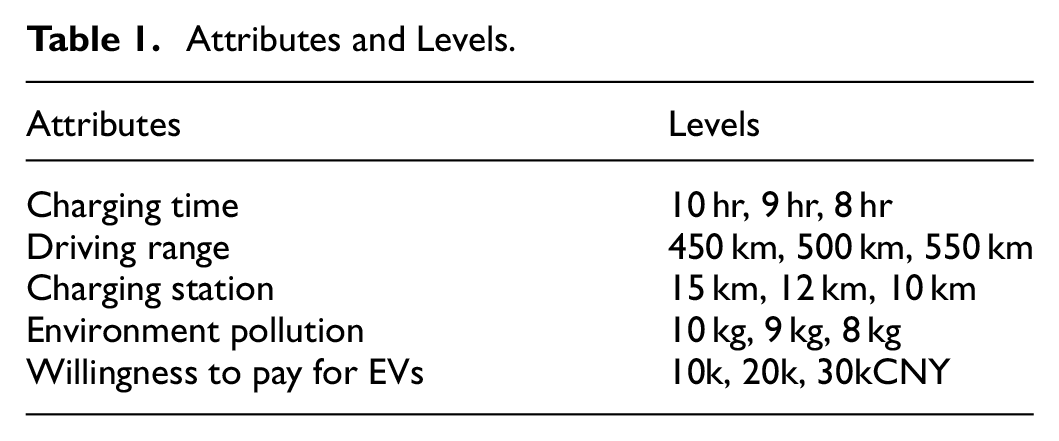
The attributes selected for the DCEs represent key decision-making factors for EVs buyers, chosen to reflect both realistic and policy-relevant scenarios (Singh et al., 2020). The key attributes were chosen because they are widely recognized as critical decision-making factors for EVs buyers. Charging time refers to the duration required to charge the EV from 0% to 100% battery capacity. It significantly affects consumer convenience and is central to adoption likelihood (Fotouhi et al., 2019); Driving range represents the maximum distance the EV can travel on a full charge. It is critical to mitigating range anxiety and ensuring practical use for longer commutes or road trips (Pevec et al., 2020); Access to nearby charging stations significantly impacts perceived convenience and ease of use (Pareek et al., 2020); Carbon emissions reduction is a core environmental benefit of EVs (J. Li & Yang, 2020). The levels were carefully selected to reflect both policy-relevant and realistic scenarios. Payments attributes were based on incremental price options (10,000 CNY, 20,000 CNY, 30,000 CNY) relative to traditional vehicles, informed by the 2022 Chinese automobile market (Khaleel et al., 2024).
To manage the complexity of the DCEs while ensuring statistical efficiency, an orthogonal design was employed. This method systematically reduced the number of attribute combinations from a full factorial design of 243 possible combinations (5 attributes, each with 3 levels) to a more manageable subset of 32 choice sets. This reduction maintained maximal variation across attribute levels while minimizing the number of tasks participants needed to complete, thus avoiding respondent fatigue and cognitive overload.
The 32 choice sets generated by the orthogonal design were further divided into 2 blocks of 16 sets each. Participants were randomly assigned to one of these blocks, ensuring exposure to only eight choice sets per session. This approach balanced the need for manageable task complexity with the statistical requirements for accurately estimating consumer preferences. The random assignment of participants to these blocks was crucial for maintaining the internal validity of the DCEs design, ensuring each participant had an equal chance of being exposed to any of the 16 sets while preserving the statistical independence of the attributes.
Table 2 shows an example of choice set. Each choice set in the DCEs contained three options: Two EVs alternatives, differing in their levels of the four attributes (charging time, driving range, charging station distribution, and carbon emissions). One fossil-fuel vehicle option, which served as a baseline for comparison.
Examples of Choice Sets.

The analysis of the study employed both conditional logit model (CLM) and mixed logit model (MLM) to evaluate the DCEs data. The CLM, which assumes homogeneous preferences across individuals, provided a baseline understanding of average consumer choices for EVs attributes. The MLM accounts for preference heterogeneity by allowing random variations in individual preferences, offering deeper insights into how consumers value different attributes of EVs. This flexibility in modeling is critical for capturing the diversity of consumer preferences that a simpler CLM may overlook.
To model these preferences, the respondents’ choices were analyzed based on maximum utility, expressed by the following optimization problem:


Where,
Respondents obtaining maximum utility from the choice set can be expressed by the following formula:

Expressing maximum utility using an econometric model can be formulated as the following equation:

The explanatory variable
To estimate consumer preferences, the study employs two key econometric approaches: conditional logit and mixed logit models. These models offer different insights based on how they handle preference homogeneity and heterogeneity. The utility for both models is expressed as:

To quantify the mean willingness to pay (MWTP) for different attributes, distinct formulas are used for the CLM and MLM. For the CLM, MWTP is calculated as:

In the CLM, under the assumption that all other factors remain constant, the average willingness to pay can be calculated as the negative ratio of the electric vehicle attribute coefficient
The MWTP for a mixed logit model can be obtained using:

In Equation 7,
Using both CLM and MLM models ensures a robust analysis of consumer behavior. The CLM provides a clear baseline for understanding general preferences, while the MLM offers deeper insights into the heterogeneity of consumer decision-making. This dual approach reinforces the reliability of the findings and provides practical insights into how consumers perceive and value various EV features, which is essential for guiding future policy and business strategies for EV adoption.
Survey Design
Each survey questionnaire comprised three sections. The first section gathered respondents’ demographic information. The second section contained questions related to environmental perception, tailored to each respondent’s assigned group. The third section presented a choice experiment to measure WTP for various EV attributes. The first and third sections were identical for both the control and experimental groups. Only the second section, containing questions related to environmental perception, differed based on each respondent’s assigned group.
The control group’s survey was designed to capture baseline WTP for EVs attributes without exposure to environmental stimuli, providing a crucial point of comparison for the experimental groups. In contrast, the experimental groups received tailored questionnaires based on their assigned stimuli, allowing for a systematic evaluation of how different types of environmental stimuli affect consumer preferences:
Distal Stimuli Group: This group received policy-driven information about government environmental expenditure, testing how cognitive processing of abstract, long-term environmental factors influences decision-making.
Proximal Stimuli Group: Participants were shown visual representations of improved local environmental quality, examining the impact of immediate, emotionally engaging environmental cues on consumer preferences.
Combined Stimuli Group: This group was exposed to both distal and proximal stimuli, exploring how the interaction between abstract policy information and tangible environmental improvements shapes WTP for EVs.
The survey, including specific questions and stimuli for each group, is attached in the Supplemental Appendix. This design allowed for a comprehensive assessment of how different environmental information types shape consumer preferences for EVs, utilizing the Lens Model to understand the influence of environmental stimuli on decision-making.
The study adhered to ethical guidelines for research involving human participants. Since the survey only collected anonymous responses regarding consumer preferences and did not involve any personal or sensitive data, ethical approval was deemed unnecessary. Before participation, respondents were informed about the purpose of the study and their right to withdraw at any time. Completing the survey was considered implied informed consent.
Results
Survey Results
A structured, face-to-face interview methodology was employed to gather data, conducted by two groups of trained interviewers: students from the School of Economics at a local university in Nanyang City and sales personnel from local automobile dealerships. Both groups received thorough training prior to data collection to ensure consistency and minimize potential biases. Respondents were recruited from consumers visiting automobile dealerships for consultations, providing a sample directly relevant to understanding consumer preferences for EVs. Data collection spanned 3 months, from April to June 2023, and out of 120 consumers initially surveyed, 112 completed questionnaires were deemed valid for analysis, yielding an effective response rate of 93.3%, which reflects the reliability of the data. Participants were randomly assigned to one of four experimental groups. This randomization within the population enhances the generalizability of the findings, supporting both internal and external validity.
Table 3 provides descriptive statistics for key demographic variables, including age, gender, education, and income. The average age score is 3.22 on a categorical scale, with most respondents falling in the 36 to 45 and 46 to 55 age brackets. Gender distribution is balanced, with 55% male and 45% female respondents. The average education level is 3.70 on a scale from 2 to 6, indicating that most respondents have completed high school or middle school, while fewer have attained a bachelor’s degree or higher. Income displays a broad range, with a mean score of 5.11 on a 1 to 9 scale.
Descriptive Statistics of the Questionnaire.

Table 4 provides socio-demographic data for Nanyang’s general population, serving as a comparative benchmark for the characteristics of the study sample. The population statistics are drawn from the Nanyang Statistical Yearbook 2022. The age distribution in the general population aligns closely with the sample, with the largest proportions in the 36 to 45 age group (29.46%) and the 46 to 55 age group (30.36%). Gender distribution is also consistent, with males comprising 55% and females 45%. Regarding educational background, middle school and high school are the most common levels of attainment. The average income level in the general population is approximately 5,547 CNY.
Socio-demographic Data in Nanyang.

Figure 2 provides a detailed view of the demographic characteristics of the survey participants. The gender distribution is relatively balanced, with 55% male and 45% female respondents, indicating that the sample is not heavily skewed toward one gender, though there is a slight predominance of male respondents. Most participants fall within the middle-aged demographic, particularly in the 36 to 45 and 46 to 55 age groups.

Description data of the respondents.
In terms of educational background, the largest proportion of respondents had completed high school, followed closely by those with a middle school education. A smaller number held a bachelor’s degree, while very few had completed only elementary school or attained a master’s degree or higher.
The income distribution further complements the demographic profile, with most respondents reporting monthly incomes between 6,000–7,000 CNY and 8,000–9,000 CNY. Fewer participants reported incomes below 3,000 CNY or above 10,000 CNY, reflecting a primarily middle-income population concentrated in the 6,000 to 9,000 CNY range.
Baseline Regression Results
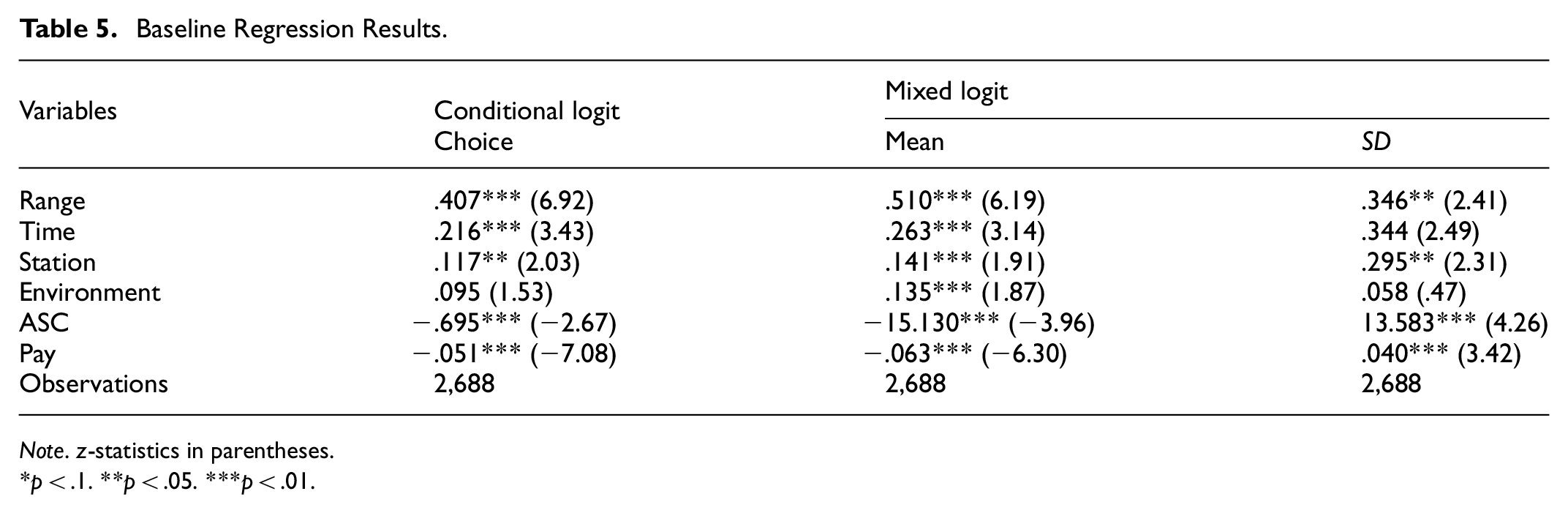
The baseline regression analysis was conducted using Stata 16.0, employing both CLM and MLM, with the results presented in Table 5. These models were used to examine consumer preferences and WTP for key EVs attributes, including driving range, charging time, the distribution of charging stations, and environmental factors such as emissions.
Baseline Regression Results.
Note. z-statistics in parentheses.
p < .1. **p < .05. ***p < .01.
Driving range stands out as the most influential factor, with significant positive coefficients of 0.407 in the CLM and 0.510 in the MLM, confirming its critical role in reducing range anxiety—a major barrier to EV adoption. Charging time is another key determinant, with significant coefficients of 0.216 in the CLM and 0.263 in the MLM. These values highlight that consumers are willing to pay more for shorter charging times, as reduced downtime adds to the convenience and appeal of EVs. Although the distribution of charging stations shows positive coefficients in both models, these values are lower than those for driving range and charging time, indicating that consumers prioritize the vehicle’s performance over the supporting infrastructure. The environmental emissions attribute produces mixed results. In the CLM, the coefficient of 0.095 is not significant, suggesting that environmental concerns are less crucial to consumer decisions. However, in the MLM, the coefficient of 0.135 is significant, implying that while environmental factors do play a role, they are secondary to practical considerations like driving range and charging time. Lastly, the negative and highly significant ASC values in both models reflect a general reluctance to adopt EVs, likely due to barriers such as price, infrastructure, or unfamiliarity with the technology. However, this resistance is offset by the positive influence of performance-related EV attributes. Price sensitivity is also evident, with higher prices decreasing the likelihood of EV adoption, underscoring the need for competitive pricing.
These results provide a comprehensive understanding of the factors that influence consumer preferences for EVs, with a clear emphasis on the critical role of driving range and charging convenience in shaping purchasing decisions, while environmental considerations, although present, remain less influential.
Results of the Willingness to Pay for Overall Respondents
Table 6 presents the estimated WTP for various EVs attributes, calculated using both the CLM and MLM. The WTP estimates are conducted based on formulas (6) and (7) respectively. The computation of willingness to pay in the context of MLM employs the Krinsky-Robb approach, determined through 1,000 iterations of Halton sampling (Krinsky & Robb, 1986). The results offer valuable insights into how much consumers are willing to pay for improvements in key EVs features.
Estimated Willingness to Pay for Electric Vehicle Purchase for All Respondents.

Driving range emerges as the most highly valued attribute, with consumers willing to pay approximately 8,000 CNY for improvements in this area. The WTP is 8,024 CNY in the CL model and 8,131 CNY in the MLM, indicating strong and stable consumer preference for enhanced driving range.
Charging time ranks as the second most important attribute, with consumers showing a WTP of 4,270 CNY in the CLM and 4,198 CNY in the MLM. This underscores the importance of convenience and efficiency, as consumers are willing to pay substantial amounts to reduce charging durations.
The WTP for the availability of charging stations is positive but lower than for driving range and charging time, at 2,304 CNY in the CLM and 2,250 CNY in the MLM. While charging infrastructure is still important, consumers prioritize driving range and charging time as more immediate concerns.
Environmental improvements, such as emissions reduction, have the lowest WTP among the evaluated attributes, with values of 1,881 CNY in the CLM and 2,159 CNY in the MLM. Although consumers recognize the environmental benefits of EVs, their willingness to pay for this attribute is significantly lower compared to more functional aspects like driving range and charging time.
The total WTP across all attributes is 16,479 CNY in the CLM and 16,739 CNY in the MLM, highlighting the dominant influence of driving range and charging time on consumer preferences. Charging station availability and environmental factors, although considered, play a secondary role in the decision-making process.
Results of Control and Experiment Groups
The baseline model analysis identifies driving range and charging time as the most critical attributes influencing consumer WTP for EVs. The following sections explore how different environmental stimuli affect these preferences across control and experimental groups.
Control Group Results
The results of control group shown in Table 7. In the control group, charging time emerged as the most valued attribute, with a significant positive coefficient, indicating a strong WTP for reduced charging durations. This highlights convenience as a primary driver of EVs adoption. Conversely, driving range showed no significant influence on WTP, while environmental benefits had minimal impact, with both mean and standard deviation coefficients near zero and statistically insignificant. High price sensitivity confirmed that cost remains a key factor in EVs purchasing decisions.
Control Group Regression Results.

Note. z-statistics in parentheses.
p < .1. **p < .05. ***p < .01.
The WTP estimation in Table 8 revealed a clear preference hierarchy, with charging time being the most valued feature. The mean WTP for reduced charging time was 12,857 CNY, emphasizing that, in the absence of external environmental stimuli, consumers prioritize practical usability, particularly charging efficiency. Other attributes—such as driving range, station availability, and environmental benefits—exhibited negative WTP values, suggesting they add little perceived value without specific environmental context. The total WTP across all attributes was estimated at 10,944 CNY, largely driven by the high valuation of charging time. These findings underscore the dominance of practical factors in shaping preferences when environmental considerations are not highlighted.
Estimated WTP for EVs Purchases for the Control Group.

Experimental Group 1 (Distal Stimuli) Results
Analysis of Experimental Group 1 shown in Table 9, exposed to distal environmental stimuli, revealed significant variations in WTP for EVs attributes. Driving range emerged as the most influential factor. In contrast, charging time, station availability, and environmental attributes showed minimal impact on WTP. The ASC was highly negative, suggesting a persistent hesitancy toward EVs adoption despite environmental messaging. Price sensitivity remained evident, with a negative mean coefficient for the price variable, underscoring the continued importance of cost considerations. These results indicate that while distal environmental stimuli enhanced the perceived value of driving range, they did not significantly influence WTP for other attributes or overall EVs adoption attitudes.
Regression Results for Experimental Group 1.

Note. z-statistics in parentheses.
p < .1. **p < .05. ***p < .01.
The Experimental Group 1 reveals a distinct pattern in WTP for EVs attributes shown in Table 10. The driving range stands out as the most highly valued feature, with a substantial mean WTP of 11,498 CNY, indicating that distal environmental perception significantly enhances consumers’ perceived value of an extended vehicle range. This result suggests that when exposed to abstract, future-oriented environmental benefits, participants place a strong emphasis on practical EVs features. In contrast, other EVs attributes exhibit less pronounced effects on WTP.
Estimated WTP for EVs in Experimental Group 1.

The total WTP across all attributes for this group is estimated at 10,911 CNY. These results indicate that while distal environmental stimuli strongly increase WTP for driving range, their influence on other EVs attributes remains relatively limited.
Experimental Group 2 (Proximal Stimuli) Results
Analysis of Experimental Group 2 reveals a nuanced pattern of preferences for EVs attributes shown in Table 11. Driving range emerges as the most valued feature. This is closely followed by charging time, underscoring the importance participants place on reduced charging durations. In contrast, the environmental attribute exhibits a positive but insignificant mean coefficient, indicating minimal impact on WTP. The ASC remains significantly negative, reflecting a persistent baseline reluctance toward EVs adoption. Additionally, price sensitivity is pronounced. These findings collectively suggest that proximal environmental stimuli enhance the appeal of both driving range and charging time, while environmental benefits remain a secondary consideration. This preference structure indicates that tangible, immediate benefits are more influential in shaping consumer attitudes toward EVs when exposed to proximal environmental perception, although a general hesitancy toward EVs adoption persists.
Regression Results for Experimental Group 2.

Note. z-statistics in parentheses.
p < .1. **p < .05. ***p < .01.
In Experimental Group 2 the WTP results shown in Table 12. The estimated WTP for driving range was notably high, with a mean value of 6,812 CNY. Similarly, charging time emerged as another critical attribute, with a mean WTP of 4,778 CNY. In addition to driving range and charging time, participants also expressed a positive, albeit lower, WTP for charging station availability, with a mean value of 2,000 CNY. Interestingly, the WTP for environmental benefits was relatively low at 585 CNY. This low figure suggests that even when exposed to visual stimuli showcasing environmental improvements, participants did not prioritize the environmental impact of EVs as a key motivator for adoption.
Estimated Willingness to Pay for EVs in Experimental Group 2.

The total WTP across all attributes in group 2 was estimated at 14,175 CNY, reinforcing the idea that proximal environmental perception primarily enhances consumer WTP for functional and performance-related attributes. The relatively low emphasis on environmental benefits implies that, in this context, practical utility outweighs environmental consciousness as a motivating factor for EVs adoption. These findings suggest that while proximal stimuli can effectively drive preferences for practical features of EVs, they are less successful in elevating the importance of environmental considerations in consumer decision-making.
Experimental Group 3 (Combined Stimuli) Results
As shown in Table 13, driving range emerged as the most significant attribute in Experimental Group 3, with a high mean coefficient of 1.192. Station availability also held considerable importance. The environmental attribute also showed a positive mean coefficient, indicating that exposure to both types of stimuli enhanced WTP for environmentally beneficial features. The ASC was significantly negative. Price sensitivity was negative and significant. These results suggest that combined stimuli significantly boost WTP for both functional and environmental attributes, particularly driving range and environmental impact.
Regression Results for Experimental Group 3.

Note. z-statistics in parentheses.
p < .1. **p < .05. ***p < .01.
In Experimental Group 3, the estimated WTP reflects strong preferences across a range of EVs attributes. In Table 14 the highest WTP was assigned to driving range, with a mean value of 9,670 CNY, suggesting that the combination of distal and proximal environmental stimuli significantly boosts the perceived importance of this performance-related feature. In addition to driving range, participants also valued station availability and environmental benefits, with WTP values of 4,453 CNY and 4,197 CNY, respectively. Charging time also exhibited a positive WTP of 3,326 CNY. The total WTP across all attributes in this group was estimated at 21,646 CNY, reflecting a marked increase in consumer valuation when both distal and proximal stimuli are integrated. This suggests that the combination of distal and proximal environmental information not only enhances WTP for practical features but also elevates the perceived value of environmental benefits, resulting in a more holistic appreciation of EVs attributes.
Estimated Willingness to Pay for EVs in Experimental Group 3.

Across all groups, distinct patterns of WTP for EV attributes were observed. Proximal and combined stimuli more strongly influenced WTP for both practical and environmental attributes compared to distal stimuli alone. These findings underscore the differential impact of environmental perception on consumer behavior, highlighting the importance of combining distal and proximal stimuli in strategies to promote EV adoption.
Discussion
The results section provides insight into the complex relationships between environmental stimuli and consumer WTP for EVs in a post-subsidy context. The key results reveal that proximal stimuli significantly enhanced WTP, while distal stimuli had a more limited effect on consumer preferences. In the following discussion, these findings are interpreted in light of existing literature, contributing to our understanding of environmental perception in consumer behavior and offering implications for policy and industry strategies to promote EVs adoption in post-subsidy markets.
Comparison With Existing Literature
Across all experimental groups, driving range emerged as the most valued EVs attribute, with consumers consistently showing strong WTP for extended range. This is consistent with prior research that emphasizes range anxiety as a significant barrier to EV adoption (Ashkrof et al., 2020). The fear of running out of battery on long trips remains a primary concern for consumers, and until EVs offer ranges comparable to gasoline vehicles, this anxiety will continue to influence consumer choices (Danielis et al., 2020). The substantial WTP observed for faster charging times underscores the importance of convenience in consumer preferences, aligning with the need for EVs to integrate seamlessly into daily life by minimizing disruption and enhancing the overall driving experience (L. Li et al., 2020).
The value placed on convenient and rapid charging infrastructure further reinforces findings from recent studies, which demonstrate that a well-developed charging network is critical to consumer satisfaction and WTP (D. L. Greene et al., 2020). Charging convenience has been shown to significantly reduce perceived inconveniences associated with EVs, making it an essential component for promoting broader adoption in the post-subsidy era (Visaria et al., 2022).
Interpretation of Findings on Proximal and Distal Stimuli
In the control group, the results indicate a relatively low WTP for environmental benefits. This suggests that, absent explicit environmental framing, consumers prioritize practical features such as driving range and charging time over sustainability considerations. This finding aligns with recent studies showing that consumers often prioritize practical features, such as driving range and charging time, over sustainability in the absence of explicit environmental framing (Filippini et al., 2021). While sustainability is recognized as important, it often ranks secondary to immediate, personal benefits (Upadhyay & Kamble, 2023). Additionally, research suggests that pro-environmental behaviors are frequently motivated by social norms and personal gains rather than intrinsic environmental values, explaining why environmental benefits might be deprioritized without explicit contextualization (Xu et al., 2021).
The analysis of Experimental Group 1, shows a modest increase in WTP, particularly for driving range. However, the overall impact of this type of factual information on consumer behavior was limited. This aligns with the findings of (X.-W. Wang et al., 2021), who suggest that factual information, while informative, does not often evoke the emotional engagement required to significantly alter consumer behavior. Similarly, (Z. Chen et al., 2021) argue that abstract messages about environmental benefits fail to resonate with consumers unless they are tied to personal and tangible benefits. These results suggest that while distal stimuli can influence WTP for certain attributes, they are less effective in driving comprehensive behavioral change unless supplemented by more immediate, emotionally engaging information.
In Experimental Group 2, exposed to proximal stimuli, a significantly higher WTP was observed across multiple EV attributes, particularly for driving range and charging time. The effectiveness of visual and emotional stimuli is supported by behavioral studies showing that emotionally information can heighten environmental awareness and increase the perceived value of sustainable features (Chang et al., 2019; Zsidó, 2024). The visual stimuli in this group likely evoked an emotional response, making the benefits of EVs more immediate and personally relevant.
The synergistic effect observed in Experimental Group 3 further supports the idea that combining factual information with emotional engagement is a highly effective strategy. This group demonstrated the highest overall WTP for EVs attributes, suggesting that the combination of rational, fact-based arguments with emotionally engaging imagery can significantly enhance consumer sensitivity to both practical performance features and environmental benefits. This aligns with the dual-process theory of persuasion (Petty & Briñol, 2015; Samson & Voyer, 2012), which posits that messages are more effective when they appeal to both cognitive and emotional processing. Additionally, the increase in WTP for environmental attributes in this group highlights the importance of making sustainability more salient and personally relevant, as suggested by Sajjad et al. (2020). The combined approach appears to integrate abstract environmental benefits with tangible, personal relevance, thereby maximizing the influence on consumer decision-making.
Theoretical and Practical Implications for Policy and Business
This study offers crucial insights for policymakers and businesses aiming to promote sustainable consumer choices in the post-subsidy EVs market. The results emphasize the importance of environmental stimuli—especially visual and combined stimuli—in shaping consumer WTP for environmentally friendly products. This aligns with the growing body of literature that highlights multimodal messaging—which integrates factual information with visual and emotional elements—as a powerful tool for influencing consumer behavior (Mertens et al., 2022).
For policymakers, the study highlights the importance of focusing on environmental governance and ensuring that improvements in environmental quality are not only achieved but also made visible to the public is important in post-subsidy era. Recent literature, such as that by (Scherrer, 2023), has noted that visible improvements in environmental conditions can significantly influence public attitudes toward sustainability. Furthermore, media campaigns that leverage emotional engagement through proximal stimuli—such as compelling imagery of environmental degradation and the positive impact of EVs—can foster a sense of urgency (Dai et al., 2024). By combining factual information with emotionally resonant content, policymakers can effectively promote environmentally friendly behavior without relying solely on financial incentives. This is particularly relevant as governments phase out subsidies, and non-financial motivators become crucial in driving EVs adoption.
For EVs marketers, the study reinforces the need for a balanced marketing approach that emphasizes both practical performance features—such as driving range and charging time—and the environmental benefits of EVs. Marketing campaigns that use storytelling and visual content to highlight the environmental advantages of EVs are likely to resonate more deeply with consumers, increasing demand. This aligns with findings from (Worakittikul et al., 2024), which suggest that integrating practical and emotional appeals in marketing strategies significantly increases consumer engagement and WTP for sustainable products. Additionally, promoting corporate environmental responsibility can enhance brand loyalty by positioning companies as leaders in sustainability—an increasingly critical factor for environmentally conscious consumers. According to Hanson et al. (2019), consumers are more likely to support brands that actively demonstrate their commitment to environmental stewardship.
The study reaffirms that while environmental benefits are important, practical considerations—such as performance and convenience—remain key drivers in consumer decision-making. This is consistent with recent studies (Steg et al., 2021), which suggest that consumers still prioritize usability and cost-efficiency when making purchasing decisions, even in the context of environmentally friendly products. Businesses should therefore continue to prioritize these functional features in product development and marketing efforts. However, the findings also suggest that incorporating storytelling and visual content that emphasizes the personal relevance of environmental benefits can further enhance consumer engagement. By effectively merging practical and emotional strategies, companies can drive higher WTP and expand their market share in the growing EVs sector.
The study provides actionable insights for both policymakers and businesses seeking to promote EVs adoption in the post-subsidy era. By addressing both practical needs and emotional connections to sustainability, these stakeholders can enhance consumer demand for EVs and contribute to broader sustainability goals.
Limitations and Future Research Directions
While this study offers valuable insights, several limitations warrant acknowledgment, suggesting directions for future research.
One potential limitation is the limited consideration of confounding variables or alternative explanations that may have influenced the results. Although this study controlled for influencing factors, it did not fully account for participants’ prior knowledge or experiences with EVs, which could have affected their responses to environmental stimuli and WTP. Future research should control for these pre-existing biases by collecting comprehensive data on participants’ background knowledge, attitudes, and experiences with electric vehicles or similar sustainable technologies.
The sample size and generalizability of findings present additional limitations. With 112 respondents from a single city, results may not be representative of broader populations. Future research should aim to replicate the study with larger, more diverse samples across different regions and cultural contexts to enhance result robustness and applicability to wider consumer markets.
Another limitation involves the study’s focus on immediate effects of environmental stimuli. The research examines short-term responses, leaving open the question of effect persistence over time. Future research could address this by conducting longitudinal studies exploring whether long-term exposure to environmental stimuli has a sustained impact on consumer behavior and WTP.
Conclusions
This study offers critical insights into the shifting dynamics of consumer behavior in the EV market by employing the Lens Model and a unique combination of discrete choice and randomized controlled trial methods to investigate how environmental perceptions shape WTP for EVs in a post-subsidy landscape. By distinguishing between distal stimuli, such as government environmental policies, and proximal stimuli, like visible improvements in environmental quality, the research elucidates the psychological and emotional mechanisms driving consumer decisions. Findings demonstrate the Lens Model’s powerful applicability within the EV market, revealing how cognitive and emotional environmental perceptions jointly influence consumer behavior as traditional subsidies wane.
The study’s integration of RCTs and DCEs provides a robust methodological framework, delivering both causal insights and an in-depth understanding of consumer preference structures. This approach offers policymakers and industry stakeholders a multidimensional view of sustainable consumer behavior. By capturing both the immediate, emotional impact of environmental stimuli and the nuanced importance of EV attributes such as driving range and charging infrastructure, this research delivers a comprehensive perspective on factors that will shape consumer demand in the post-subsidy era.
The study makes a significant contribution to the literature on environmental perception and consumer behavior by illustrating the distinct roles that distal and proximal stimuli play in determining WTP for sustainable technologies. It aligns with psychological distance theory (M.-F. Chen, 2020), which posits that consumers respond more strongly to those that are vivid, immediate, and emotionally evocative than to abstract information. This suggests that proximity in both sensory experience amplifies the emotional connection consumers feel toward environmental concerns, thereby eliciting stronger behavioral responses.
The implications of these findings are substantial for promoting EV adoption in a post-subsidy context. For government bodies, while long-term environmental policies remain indispensable, the study suggests that media campaigns emphasizing immediate, tangible benefits of EV adoption—such as improved air quality and reduced emissions—are more likely to resonate with consumers. Leveraging emotionally engaging, visually compelling content can reinforce a consumer’s sense of environmental responsibility, fostering a lasting connection with sustainability goals.
For businesses, prioritizing consumer-valued attributes like driving range, charging convenience, and emissions reduction is essential to remain competitive. Marketing strategies that integrate emotionally resonant storytelling, coupled with a demonstrated commitment to environmental responsibility, have the potential to elevate consumer WTP. By addressing both practical and emotional consumer motivations, companies can strengthen their market position and contribute meaningfully to sustainable EV adoption.
In conclusion, this study underscores the pivotal role of environmental perception—particularly the power of proximal stimuli—in shaping consumer WTP for EVs. As the EV market evolves beyond subsidy reliance, both policymakers and industry leaders must balance rational, cognitive messaging with content that speaks to consumers’ emotional connection to environmental sustainability. This research emphasizes the importance of a dual approach that not only champions sustainable technologies but also resonates on a personal level, driving meaningful behavioral change and supporting broader global sustainability objectives.
Supplemental Material
sj-docx-1-sgo-10.1177_21582440251335517 – Supplemental material for Environmental Perception and Willingness to Pay for Electric Vehicles: An Analysis Using the Lens Model
Supplemental material, sj-docx-1-sgo-10.1177_21582440251335517 for Environmental Perception and Willingness to Pay for Electric Vehicles: An Analysis Using the Lens Model by Yinan Dong in SAGE Open
Footnotes

Ethical Considerations
This study was conducted in accordance with the ethical principles outlined in the APA Ethical Principles of Psychologists and Code of Conduct (Section 8.05). Since the study involved a voluntary survey on consumer preferences without any collection of personal or sensitive information, formal ethical approval was not required. All participants were informed of the study’s purpose, and their participation was entirely voluntary.
Author Contributions
The author confirms sole responsibility for the following: study conception and design, data collection, analysis and interpretation of results, and manuscript preparation.
Funding
The author received no financial support for the research, authorship, and/or publication of this article.
Declaration of Conflicting Interests
The author declared no potential conflicts of interest with respect to the research, authorship, and/or publication of this article.
Data Availability Statement
Raw data supporting the findings of this study are available from the corresponding author on request.
Supplemental Material
Supplemental material for this article is available online.
References
Supplementary Material
Please find the following supplemental material available below.
For Open Access articles published under a Creative Commons License, all supplemental material carries the same license as the article it is associated with.
For non-Open Access articles published, all supplemental material carries a non-exclusive license, and permission requests for re-use of supplemental material or any part of supplemental material shall be sent directly to the copyright owner as specified in the copyright notice associated with the article.
