



Abstract
This study examines households’ willingness to support the emissions reduction policy and their perceptions of climate change using an Internet survey of more than 1,000 households in Queensland, Australia. Respondents were asked for their willingness to pay (WTP) to support the emissions reduction target proposed by the Australian Government by paying extra on their electricity bills. The results can be summarized in four key findings. First, respondents’ WTP to support the emissions reduction target is higher if they perceive that climate change will result in high loss of biodiversity. Second, respondents were willing to support a higher emissions target than proposed by the Australian Government. Third, there is a correlation between respondents WTP to support the emissions reduction and their beliefs about climate change, its effect on standards of living, the environment, and future generations. Fourth, as the data show a high rate of zero responses, common for the contingent valuation method (CVM) used in the survey, the zero bids were further investigated using the non-parametric Turnbull model and the more recent spike model. The results showed that although there is some support for the emissions reduction policy, it is not sufficient for the policy to be successful.
Introduction: Background and Objectives of the Study
Climate change is a serious issue for Australia. It is not only predicted to cause higher temperatures, more droughts, more extreme weather, and rising sea levels but is also claimed to directly threaten local agriculture, water suppliers, and tourism icons such as the Great Barrier Reef and the Kakadu wetlands (Swan, 2010). Various emission reduction targets had been suggested by different groups, including greenhouse gas emissions reduction targets between 5% and 10% by 2020 compared with the level of emissions in 2000 (or between 60% and 80% by 2050 compared with the level of emissions in 2000). In the absence of climate change actions, by 2020 Australia’s emissions can grow more than 20% above 2000 level (Swan & Combet, 2011). That would lead to a complete destruction of environmental icons such as the Great Barrier Reef. Even a 5% reduction in emissions will result in some loss of the Great Barrier Reef and other coral reefs (Garnaut, 2008; Hoegh-Guldberg et al., 2007).
Most Australians believe that the climate is changing and that Australia should take actions on climate change regardless of what other countries are doing. However, there is no consensus on what policy action Australians prefer (Leviston, Leitch, Greenhill, Leonard, & Walker, 2011).
The “Carbon Pollution Reduction Scheme,” the name of the “Emissions Trading Scheme” proposed for Australia, aimed at limiting carbon dioxide emissions. Carbon dioxide is one of the greenhouse gases thought to cause climate change and is produced when fossil fuels such as oil and coal are burnt. Under the “Carbon Pollution Reduction Scheme,” the Government sets a limit (known as a “cap”) on the amount of carbon dioxide pollution. The Australian Government was planning to introduce such a scheme to help slow climate change and to reduce the environmental damage from greenhouse gas emissions.
A variety of climate change impacts (e.g., loss of biodiversity) can be categorized as impacts that are difficult to assess using the current market system. Although market-related impacts can be estimated using traditional economic techniques such as hedonic pricing method or travel cost methods, non-market valuation techniques such as the contingent valuation method (CVM) can elicit values associated with public and non-market goods. The CVM has been widely used to estimate non-use values and was included in the damage assessment of the Exxon Valdez oil spill in Alaska in 1989 (Carson et al., 1992).
Success of environmental policies depends largely on the support from not only businesses and government but also consumers. Therefore, evaluation of community concerns about the consequences of climate change and their support of emissions reduction policy is important to investigate. Once an evaluation of community support is performed, the corresponding estimates can be used in the assessment of the feasibility of environmental policy.
In this study, the CVM is applied to the complex issues of climate change policy to estimate willingness to support the emissions reduction policy in Australia. This study also aims to provide insights on how different models affect the estimates of willingness to pay (WTP) in CVM. It uses three broad types of models: parametric, non-parametric, and the spike models (which has appeared in the CVM literature as an advantageous approach when the WTP distribution has a high percentage of zero responses). This study further investigates whether the non-traditional bidding approach should be used in the CVM, particularly for the spike model.
Data were collected through a survey of households in Queensland, Australia. Focus groups were used to pilot test the survey instrument before it was distributed to participants.
Literature Review
The CVM is a non-market valuation method used to evaluate goods and services that are not traded in the market. CVM can be used in a variety of scenarios, such as to evaluate the support for a specific policy, or to estimate WTP to mitigate climate change effects. Non-market valuation techniques are particularly important when dealing with climate change where the potential impact does not have a monetary trade-off in the real market. The CVM allows a thorough statistical analysis to identify monetary trade-offs (values) for relevant scenarios.
The CVM typically uses a single valuation trade-off, where respondents are asked whether they are willing to pay (i.e., support) a given amount for a specific environmental or social change. The decision process normally uses either a referendum format (yes/no) or open-ended format (respondents can state any amount). The dichotomous choice (DC) approach has many advantages over the open-ended approach. For example, it is simple for respondents to use as it reduces the incentive for respondents to provide strategic responses (Hoehn & Randall, 1987). Although the use of the open-ended bid format has declined (due to the National Oceanic and Atmospheric Administration [NOAA] panel recommendation; Arrow et al., 1993), it has certain advantages for some valuation problems. For example, it requires a much smaller sample size than the DC question, reducing the cost of surveying dramatically. It is also easier to compute welfare measures using open-ended question rather than dichotomous valuation question. Furthermore, while choices in competitive markets are thought to be made in a “referendum” style, the contingent markets for non-market goods such as public goods might not be treated in a similar fashion (Halstead, Lindsay, & Brown, 1991). 1 For these reasons, in this survey the DC question was modified to use the follow-up open-ended question, following the Chestnut, Keller, Lambert, and Rowe (1996) study. The results of modeling can be used to generate estimates of compensation surplus or welfare as well as to check the feasibility of the environmental policy.
Despite the importance of public acceptance of any policy involving changes to emissions (such as emissions tax, cap, and trade), only a limited number of studies focus on public support for environmental policies regarding climate change. Some studies on WTP to support climate change–related policies found that the respondents’ perceptions of climate change affect their WTP. For example, Akter and Bennett (2011) found that respondents’ willingness to support the climate change policy is influenced by their beliefs of future temperature rises, their perception of policy failure, global agreements, and the information they accessed. Although their survey covers similar issues, the respondents in this work were asked on the Likert scale to allow distinguishing the magnitude of respondents’ perceptions. Cameron (2005) and Viscusi and Zeckhauser (2006) found that WTP increases with respondents perceptions of the scale of climate change. Zahran, Brody, Grover, and Vedlitz (2006), using geographic information systems techniques to map and measure survey respondents’ climate change risk at various levels of special resolution and precision, found a robust effect of risk perception on climate policy support, with the extent to which respondents view climate change as threatening to their material well-being the most important predictor of the support of climate change policy.
In contingent valuation survey, it is not uncommon to have so-called protest bids where respondents state a zero WTP (Kristrom, 1997). There are many possible reasons for protest bids such as detesting of payment vehicle or mistrust on how the money will be spent. Protest responses are generally excluded from the contingent valuation analysis, introducing a bias (Calia & Strazzera, 2001; Jorgensen, Syme, Bishop, & Nancarrow, 1999). For example, an inclusion of zero protest bids in the dataset might lead to not valid and not reliable results of the analysis. However, an exclusion of protest bids might lead to a sample selection bias, which could produce biased parameters of the model estimates (Strazzera, Genius, Scarpa, & Hutchinson, 2003).
Another issue is that “protestors” might have a positive WTP, but as it is not stated, the conservative way is to treat those responses as “no” responses (Carson & Czajkowski, 2014). To identify protest responses, typically a set of attitudinal questions, addressing different reasons for protesting such as ethical beliefs, vehicle payment, or fairness among others are presented to respondents (Morrison, Blamey, & Bennett, 2000; Strazzera et al., 2003). Based on those answers, various criteria specific to the studies have been proposed in the literature. However, there are no established rules for determining protest beliefs. Furthermore, the instruments used by different authors to identify protest responses differ to some extent. That means that a protest response in one study could be identified as a valid one in another study leading to a subjective analysis (Dziegielewska & Mendelsohn, 2007; Meyerhoff & Liebe, 2008, 2009). Moreover, Jorgensen and Syme (2000) showed that respondents who are willing to pay can hold significant protest beliefs as well. Therefore, deleting all zero protest bids would also require to delete those who are willing to pay and hold protest beliefs comparable to respondents who are not willing to pay.
Some studies (e.g., García-Llorente, Martín-Lopez, & Montes, 2011; Meyerhoff & Liebe, 2010) linked various socio-demographic characteristics of respondents and attitudes toward environment among other factors to the zero bids. However, Halstead, Luloff, and Stevens (1992) using a discriminant analysis tested the differences between zero protest bidders and other respondents could not reject the hypothesis that protest and non-protest bidders are the same socio-demographically. They found that zero protest bidders have lower WTP than other respondents. They suggested that removal of zero bids might introduce the bias whose direction cannot be determined a priori.
Although recently the latent class models (LCMs) have been used to identify classes of individuals with similar characteristics such as attitudes (e.g., Grammatikopoulou, Olsen, & Pouta, 2012), the problem is how to select the correct set of attitudinal questions to identify the relationship between attitudes and WTP. Cunha-e-Sa, Madureira, Nunes, and Otrachshenko (2012) used attitudinal data to develop a latent class model for estimating WTP from contingent valuation study. LCMs, however, present at least two major issues: (a) theoretical problem (there is no theoretical background according to which attitudinal questions can be used to identify the protesters) and (b) classification problem (it is hard to segregate consumers into latent classes from the policy implementation perspectives). Furthermore, the extensive literature on LCMs applied in medical and veterinary sciences revealed problematic issues related to the methodology and reporting of studies using LCMs (e.g., van Smeden, Naaktgeboren, Reitsma, Moons, & de Groot, 2013). The latent class approach has been criticized on several grounds, such as absence of formal definitions, lack of robustness, sensitivity to assumptions (e.g., the assumed LCM is not fully testable with the observed data); if model is incorrect, the resulting estimates are not meaningful, and they do not account for various degrees of output severity (Albert & Dodd, 2004; Pepe, 2003, pp. 203-205; Pepe & Janes, 2007).
As a removal of zero bids leads to an estimation bias and it is hard to separate responses of zero bids to true zeros and to protest bids, another approach was suggested by Kristrom (1997). Zero values can be treated as a problem of the probability mass at the point zero or so-called “spike” in distribution (e.g., Kristrom, 1997; Yoo, Kwak, & Kim, 2000).
Design of Survey
The contingent valuation survey was designed to estimate the support for the emissions reduction policy in Australia. First, respondents were asked several questions related to their perceptions of the potential impacts of climate change on Australia. The questions assessed respondents’ views on the potential effects of rising sea levels, more natural disasters, harsher weather, decrease in water supply/increased incidence of drought, decreases in agricultural production, health problems, economic costs, loss of biodiversity, and damage to the Great Barrier Reef and the Kakadu wetlands. Respondents were also asked whether they believed that climate change was occurring and whether it was a natural process or due to the human activities.
More information on respondents knowledge of climate change was obtained by asking whether they watched/read/heard discussions about various climate change issues and whether they actively tried to reduce their own carbon footprint, for example, by reducing the use of electricity or installing a solar hot water system in their house. Respondents were also asked about their beliefs on the likelihood of climate change occurring, the timing, and the expected annual average temperature by 2050.
The valuation part of the survey asked respondents to indicate whether they were willing to pay to support the emissions reduction target proposed by the Australian Government. The CVM using a referendum format (DC question) was used in this study to estimate respondents’ WTP to support emissions reduction policy. Four different bids (i.e., $100, $200, $500, and $1,000) per household per year for the next 10 years were used in the survey.
To investigate further respondents who stated that they were not willing to pay, they were asked to nominate their own support for the emission reduction policy (open-ended question). Mitchell and Carson (1989, p. 245) suggested that the question should be designed in a way that respondents who were not willing to pay anything for the good felt comfortable in giving that response. The open-ended valuation format assists with providing such responses. 2 Chestnut et al. (1996) tested this format for angina symptoms by asking a repeated DC question followed by open-ended questions in which respondents were asked to provide an estimate of the maximum amount they would be willing to pay to prevent the increase in angina symptoms. Chestnut et al. (1996) argued that it was easier for respondents to provide a monetary amount after first being asked to consider a specific amount suggested by the interviewer. To reduce the possible anchoring bias from the dichotomous question, the dichotomous bids were randomized when administered to respondents. Chestnut et al. (1996) emphasized that there might be a tendency for respondents to state that they would pay a higher amount when presented with a yes/no choice, but provide a lower amount in the open-ended question, making it a more accurate estimate of the maximum WTP for these respondents.
In this survey, a similar approach was used. First, the DC was presented to respondents. If the suggested bid in the first valuation question was higher than the respondent’s WTP, the second follow-up open-ended evaluation question was used to give respondents an opportunity to indicate their lower WTP. It is likely that respondents who answered “no” to the DC valuation question do have a positive WTP that is less than the asking bid. If the second DC question was provided, it also could yield the “no” or “zero” response because of its potentially being higher than respondent’s WTP. Although the DC format introduces a starting point bias, the follow-up question under the assumption of continuous WTP allows (a) to elicit the respondents who have positive WTP, and (b) approximate their true WTP. For those reasons, providing an open-ended follow-up question can be superior to the double-bounded DC format.
If respondents have zero or negative WTP, then they would choose a “no” response in the first valuation question. The zero WTP bids were further investigated in the analysis using the spike model.
The payment question was framed as follows: If the cost of achieving a current 5% emissions reduction target by 2020 in Australia is $500 per household per year, would you be willing to participate? This would be $500 each year for the next 10 years paid through higher electricity and fuel costs.
Please answer this question bearing in mind how much you are
If  Yes No Not sure
In this survey, in addition to the attitudinal questions and the contingent valuation question respondents were asked socio-demographic questions to analyze the effect of main variables that influence WTP (i.e., income, education, and gender).
Survey Results
Survey Performance
An Internet survey first was pretested in focus groups and then administered to 1,113 respondents from Queensland, Australia, in 2009. The survey was conducted in a web-based format through a market research company for Queensland households. The participants were chosen randomly from a research-only panel that is managed by the private company providing Internet sampling services to universities. This company monitored the representativeness of the sample. Quotas were introduced to ensure that each sample split reflects the overall sample target:
Location (approximately 60% Brisbane/40% other areas of Queensland)
Age (approximately 50% below 35 years and 50% above 35 years)
Gender (approximately 50% female/50% male)
Table 1 shows that the survey respondents’ are representative of Queensland. The chi-square test of proportions and z-tests revealed that there is no difference between survey respondents and Queensland population.
Survey Respondents and Queensland Residents Characteristics.

ABS (2006) Census data.
Different models were applied to estimate the mean WTP value in order to be able to compare the results and determine which one is more suitable given the characteristics of the data. The traditional Logit model was estimated first. Then the more robust non-parametric Turnbull model was applied (Turnbull, 1976). Finally, as only 42.5% of the respondents stated that they were willing to pay the suggested amount, the spike model is used to analyze the zero bids. 3 The data showed an interesting pattern. Out of those who stated that they are not willing to pay the suggested amount in the dichotomous question, almost 35% indicated their preferred amount of payment in the follow-up open-ended question. None of those respondents who stated they are not willing to pay the suggested amount in the dichotomous question and those who stated that they are unsure indicated their preferred amount in the follow-up question. Therefore, adding the open-ended follow-up question allowed capturing the lower WTP than the suggested amount of the dichotomous question without increasing the sample size.
Perceptions of the Effects of Climate Change
Views and concerns of the potential effects of climate change on Australia
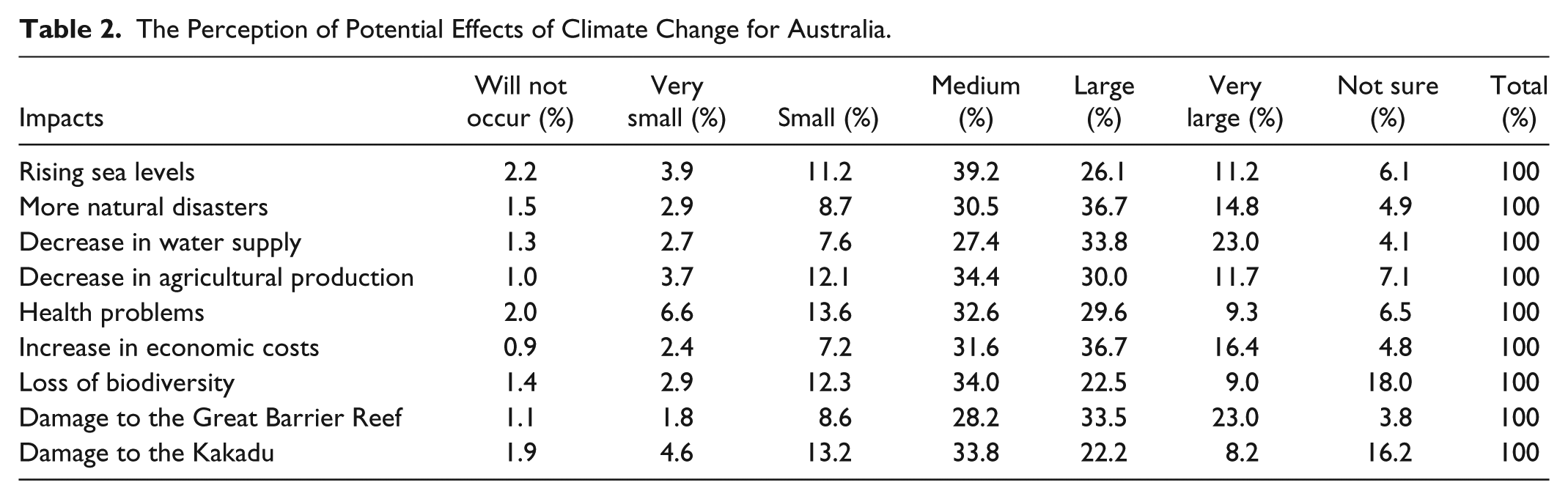
First, respondents were asked to rank some policy issues (education, health, law and order, and the economy) with the addition of the climate change issue. The health issues were ranked first by about 35% of respondents. The economy was ranked first by more than 29% of respondents. The education was a priority for more than 18% of respondents. The climate change issues were the priority for less than 10% of respondents, whereas law and order was the top priority for only 8% of respondents. These results are consistent with finding of Akter and Bennett (2011) but provide a better indication of the magnitude of respondent’s perceptions regarding various issues. More than 37% of respondents stated that the potential effects of climate change on rising sea levels for Australia will be large 4 (Table 2). More than 51% of respondents were concerned about large impacts of more natural disasters and harsher weather due to the climate change in Australia. The large impact on decrease in water supply/more drought was a concern for about 57% of respondents. Almost 41% of respondents anticipated large impacts of climate change on decrease in agricultural production in Australia. More than 39% of respondents stated that the impact on health problems for Australia will be large. More than 53% of respondents anticipate large economic cost impacts of climate change for Australia. Loss of biodiversity was not seen as being a large impact of climate change. Only about one third of respondents stated that the impacts on biodiversity or damage to the Kakadu wetlands will be large. However, the damage to the Great Barrier Reef from climate change was seen as being large by 56.5% of respondents.
The Perception of Potential Effects of Climate Change for Australia.
Views and beliefs regarding climate change
The respondents were asked whether they believed that climate change was occurring, that it was a natural process, or due to human activities (Table 3). Although 69.5% of respondents agreed 5 that climate change was occurring, more than 20% of respondents stated the climate change was a result of natural process. More than 65% of respondents agreed that human activities increased the rate of climate change. There was also a concern that even if all countries reduced their emissions dramatically, climate change would not stop (36.5% of respondents agreed). Respondents considered climate change as an important issue because it affected the environment, standards of living, and future generations (agreed 68.2%, 51.2%, and 70.9%, respectively). Only 25.2% of respondents agreed that climate change would decrease their family’s standards of living.
Respondents Views and Beliefs Regarding the Climate Change.
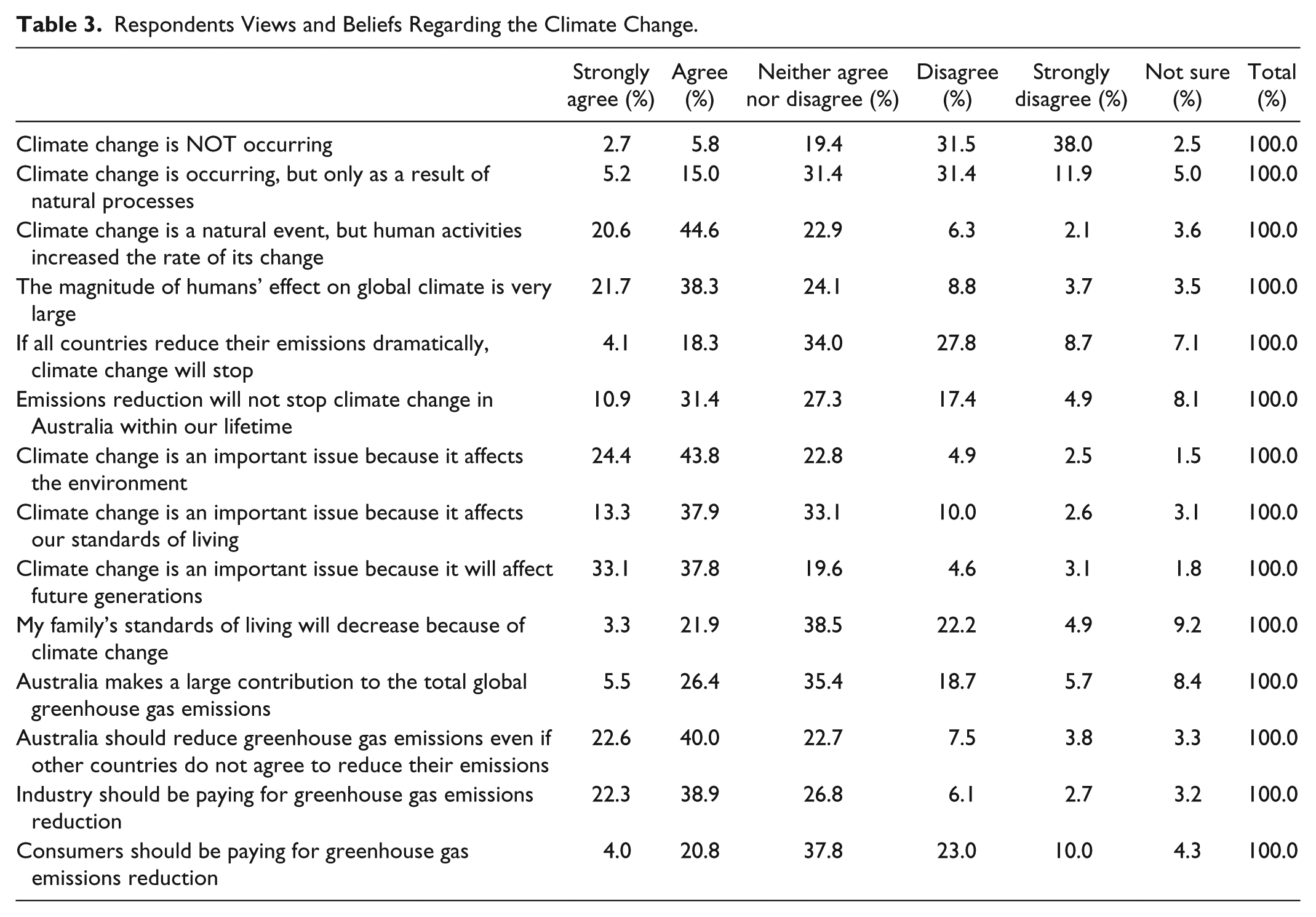
Respondents thought that Australia makes a large contribution to the total global greenhouse gas emissions. Only 24.4% of respondents disagreed or strongly disagreed with this statement. More than 64% of respondents agreed with the statement that Australia should reduce greenhouse gas emissions even if other countries did not agree to reduce their emissions. Respondents’ perception of the Australian contribution to the total global emissions was significantly positively correlated with their agreement that Australia should reduce the greenhouse gas emissions regardless of the actions of other countries (Pearson correlation coefficient is .45, significant at 0.01 level). That means that, on average, respondents who thought that Australia made a large contribution to the global emissions also thought that Australia should reduce its emissions.
Knowledge of climate change and respondents actions
Following the Akter and Bennett (2011) survey, some questions regarding respondents actions were asked to identify whether respondents were familiar with the issues presented in the survey. More information on respondents knowledge of climate change was obtained by asking whether they watched/read/heard discussions about various climate change issues and whether they actively tried to reduce their own carbon footprint, for example, by reducing the use of electricity or installing solar hot water system in their house.
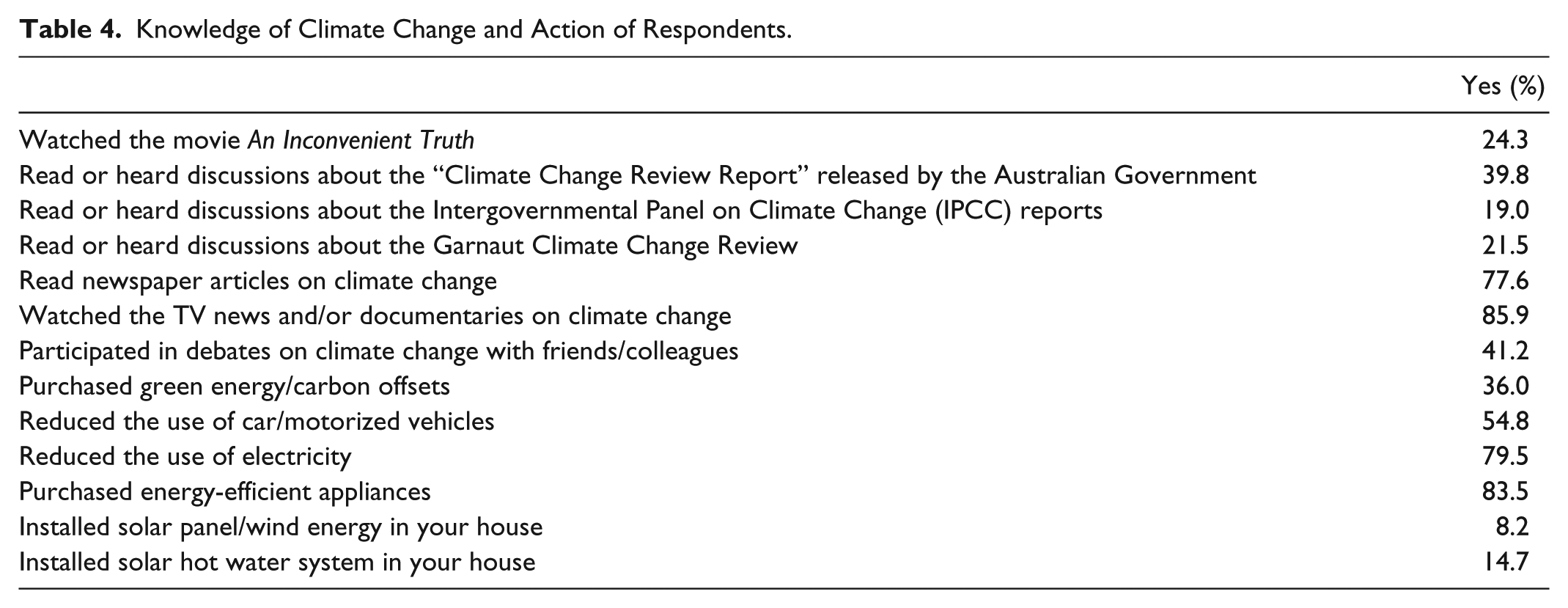
Most respondents did not watch the movie An Inconvenient Truth (75.7%), did not read the climate change review (60%), Intergovernmental Panel on Climate Change report (81%), or Garnaut report (78.5%). However, a majority of respondents were familiar with general climate change issues by reading newspapers (78% of respondents) and watching TV (86% or respondents). About 36% of respondents purchased green energy (Table 4). Less than 55% of respondents reduced use of their car, whereas about 80% of respondents reduced electricity use and more than 83% of respondents purchased energy efficient appliances. Some (8% of respondents) installed photovoltaic solar panels, and about 15% of respondents installed solar hot water systems.
Knowledge of Climate Change and Action of Respondents.
Only 3% of respondents stated that climate change is very unlikely, whereas 26.4% of respondents thought that major impacts of climate change will be 25 years from now with expected rise in temperature of 3 degrees (almost 25% of respondents). Almost 72% of respondents stated that Australia should try to achieve a 10% or more emissions reduction target by 2020 compared with the level of emissions in 2000 regardless of what other countries did to reduce emissions. The results showed that respondents were familiar with the issues of climate change and emissions reduction and therefore were able to make a decision regarding their willingness to support emissions reduction policy.
Willingness to Support the Emissions Reduction Policy
The results showed that respondents were willing to support the 5% emissions reduction target by paying extra through higher electricity costs. As expected, respondents were less willing to pay an increased amount to support the emissions reduction policy (Figure 1). More than 62% of all respondents who answered the contingent valuation question stated that they were willing to pay $100 per year to support the current 5% target. About 48% of respondents were willing to pay $200/year, 34% of respondents stated that they were willing to pay $500/year, and 26% of all respondents indicated that they would be willing to pay $1,000/year to support the current 5% emissions reduction target.

Willingness to support the emissions reduction policy.
The correlations between WTP to support Government emissions reduction target policy were examined. The support for the policy is significantly correlated with how respondents perceive the effects of climate change. For example, those respondents who perceived the loss of biodiversity due to climate change to be strong were likely to pay more to support the emissions reduction policy (correlation coefficient is 0.21). Those who strongly disagreed with the statement that “climate change is NOT occurring” were willing to support the emissions reduction policy more compared with those respondents who stated they agreed with this statement (correlation coefficient is .2). Those respondents who perceived that climate change affects our standards of living, environment, and future generations were more likely to indicate their support for the emissions reduction policy.
Logistic regression model
To estimate WTP to support Government emissions reduction target policy, the logistic regression models were estimated 6 (Table 5). The first model is a logistic model with the cost and constant, whereas the second model includes attitudinal and socio-demographic variables. The results of the first model showed that cost is a significant variable in determining respondents’ choices.
The Logistic Regression Models.

The extended model shows that while age and education were not significant predictors of the respondents WTP, being a male and having a higher income were significant predictors of willingness to support Government's emissions reduction policy. Those who perceived the impacts of climate change as being large (i.e., a large loss of biodiversity) and would like to see higher emissions reduction targets were more likely to support the emissions reduction policy. Respondents engaged in emissions reduction activities such as purchasing green energy/carbon offsets, reduced use of car/motorized vehicles, and reduced use of electricity were more likely to be willing to pay for an emissions reduction policy. The higher the level of international participation, the more likely respondents were willing to pay for the emissions reduction policy in Australia.
The mean/median WTP (logistic regression) is $243 (95% CI [$98, $476]) for the whole sample.
The Turnbull non-parametric approach
Although several distribution-free estimators for binary data are available, the Turnbull approach for single-bounded questions is similar to Kristrom (1990) and McFadden (1994) but easier to calculate. Haab and McConnell (1997) demonstrated that the Turnbull model provides a straightforward alternative to parametric models in estimation of WTP. The Turnbull non-parametric approach estimates only the fraction of the density falling into the dollar intervals (Table 6). Table 6 illustrates that a majority of respondents were willing to pay between $0 and $100, while only 25.8% of respondents were willing to pay a $1,000. The mean WTP (lower bound) was $242, median WTP was less than $100, and the mode WTP was $0.
The Turnbull Estimates.

Note. WTP = willingness to pay.
Turnbull estimates of the lower bound of the mean are robust across distributions. Turnbull estimates provide a solution to negative and zero WTP. Although parametric methods restrict the distribution of WTP to positive by either truncating the distribution of WTP or by estimating a truncated distribution, Haab and McConnell (1997) showed that restricting WTP to positive bids tends to increase the sensitivity of parametric models to the distributional assumptions.
Spike model
A stated zero consumption of a public good can arise from strategic behavior or a free rider problem. In spite of that, the traditional (e.g., Logit and Probit) models do not account for zero bids. Kristrom (1997) developed a model to account for a non-zero probability of zero WTP contingent valuation surveys. A probability other than zero assigned to the WTP = 0 can cause a spike (i.e., a discontinuity or a jump at the zero bids) in the WTP distribution function. The spike model allows distinguishing between the zero bidders and those with a positive WTP. It is assumed that WTP is non-negative, implying that no individuals are made worse off by the proposed change. Spike model can be estimated using a variety approaches, including parametric maximum-likelihood methods or non-parametric approach (Kristrom, 1997). The model estimated in this article is based on Kristrom (1997) and Yoo and Kwak (2009). This study uses an open-ended question to capture the positive WTP that is lower than the asking bid. The outcomes were assigned to three categories: (a) Answer to the suggested bid was “yes” (yes), (b) answer to the suggested bid was “no” followed by a stated WTP to the open-ended question (no-yes), and (c) both answers were “no” (no-no). Two spike models are estimated: first model is without the follow-up question, and second model is with the follow-up question.
Del Saz-Salazar and Garcia-Menendez (2001) showed the disparity in the results of traditional and spike models. Although the traditional models indicated a negative mean WTP, the results of the spike model showed positive WTP. The median of the spike model was zero as in their study more than a half of respondents were not willing to pay anything. Del Saz-Salazar and Garcia-Menendez (2001) results illustrated that WTP distribution of the provision of the public good is asymmetrical.
Although more than 42% of respondents in this study stated that they would pay the stated amount to support the emissions reduction policy, the rest of respondents indicated different WTP to support such a policy. Out of 58% of respondents that indicated that they will not pay the stated amount, 35% stated that they are willing to pay for the emissions reduction policy but less than the stated amount. Only 38% of the total sample indicated true zero WTP for the emissions reduction policy.
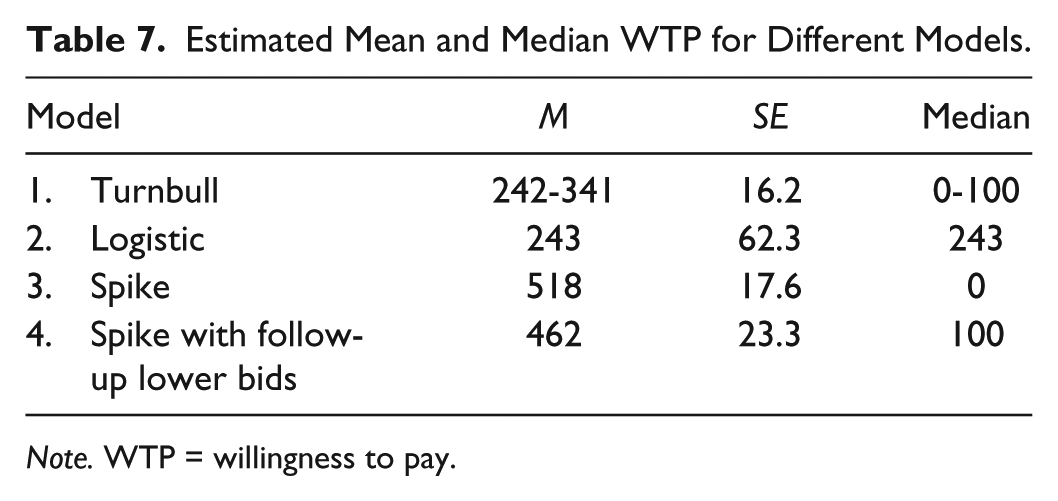
Table 7 reports the estimation results from the Turnbull model, conventional Logit model with positive bids (where it was assumed following Johansson, Kristrom, and Mdler, 1989, p. 73, that the follow-up question had not been used), and the spike model with and without the follow-up question. 7 The estimates derived from parametric and non-parametric approaches yield comparative results, but the median of the logistic model is higher than the median of non-parametric model. The median of the spike model 1 (without the follow-up question) reflects the fact that more than 50% of respondents were not willing to pay any amount to support the emissions reduction policy. Spike Model 2 (with the follow-up question) reflects WTP of additional respondents who stated zero WTP for the suggested bid but indicates a positive WTP (lower than the suggested bid).
Estimated Mean and Median WTP for Different Models.
Note. WTP = willingness to pay.
Although mean WTP is the mostly appropriate to use in cost–benefit analysis (Johansson et al., 1989), the median WTP is a preferred measure (Hanemann, 1984) due to the mean being sensitive to outliers. The only median WTP that is comparable to the projected cost of the emissions reduction policy of $6 to $7 per week per household ($312-$364 annually) according to the Treasury (2008) report is the one from the logistic model. That means that although the emissions reduction policy has some support from the respondents, there is not enough public support for such a measure.
Discussion and Conclusions
An assessment of the climate change impacts, mitigation, and adaptation options is a difficult task. Although the non-market costs and benefits of climate change–related impacts can form a large proportion of total costs and benefits, the traditional approaches of impact assessment do not include those in the decision-making process. Furthermore, the appropriate climate change policy has to be developed taking into consideration various market and non-market impacts. It also has to be supported by the citizens affected in order to be successful. There are a variety of non-market valuation tools that can be used, such as CVM to address the issues of climate change.
The results of the contingent valuation study showed that Queensland residents in general supported emissions reduction policy. Males were more likely than females to state that they were willing to pay the suggested amount. Respondents on higher income were more likely to contribute to the emissions reduction policy than those on lower income. Moreover, the attitudes toward climate change impacts were important predictors of WTP. Respondents were willing to pay more if there was a higher international participation or if they held the view that there would be large impacts on biodiversity among other impacts.
Although the traditional parametric methods such as logistic model provide WTP estimates that are sensitive to the distributional assumption, non-parametric Turnbull estimates are the most conservative estimates of WTP. However, only spike model accounts for the large number of zero responses and projects a higher WTP for the rest of the respondents. Adding an open-ended follow-up question allows reduction of zero protest bids by capturing the additional WTP that is lower than the suggested bid without increasing the sample size.
Several models indicated that although there was some support for the emissions reduction policy, the respondents' WTP was lower than the projected costs of the policy. Therefore, alternative emissions reduction options should be considered.
Footnotes
Declaration of Conflicting Interests
The author(s) declared no potential conflicts of interest with respect to the research, authorship, and/or publication of this article.
Funding
The author(s) disclosed receipt of the following financial support for the research and/or authorship of this article: The research was funded by Faculty of Business and Informatics Small Grant Scheme and Centre for Environmental Management, CQUniversity.