




Abstract
The potential of educational augmented reality systems to improve students’ learning performance, motivation, and cognitive load has been demonstrated by recent studies. To help students learn the design history material, this study suggests an AR-integrated learning application strategy. In this study, we use Modernism as the theoretical underpinning for the creation of an augmented reality-integrated learning program. We compare the motivation and performance test results of 60 college students (N = 60) studying design history between the AR-supported and a corresponding traditional multimedia learning environment. The experimental findings show that students’ learning performance and motivation are much enhanced by this educational mobile augmented reality system approach and that their unnecessary cognitive load during the study was greatly decreased.
Introduction
A definition of augmented reality (AR) is a technology that superimposes virtual things, or augmented components, over the physical world. Then, it appears as though these virtual items and real-world objects share the same area (R. Azuma et al., 2001; Iatsyshyn et al., 2020). Over the past decade, AR has emerged as a prominent focus in educational research (Garzón, 2021). Educators, researchers, and practitioners are actively developing various tools and methodologies that incorporate this technology to enhance students’ and teachers’ learning and teaching experiences (Iqbal et al., 2022).
Research has indicated that AR holds great promise for revolutionizing the field of education by offering students dynamic and captivating learning experiences that increasing engagement and motivation (Avila-Garzon et al., 2021). For instance, AR can be used to create virtual environment, bring historical events to life, and enable 3D visualization of complex scientific through immersive scenarios (Calvi, 2020). Students can explore historical eras in an entirely fresh manner thanks to the immersive experience offered by AR, which enables them to interact closely with the past like never before (Remolar et al., 2021). By physically being present at historical locations, this ecological engagement fosters a sense of historical empathy that is frequently lacking in standard classroom settings (Challenor & Ma, 2019). Since students inability to see how historical learning relates to their current situation, they frequently become passive and lose interest in the material (Kaur et al., 2020), posing a significant challenge in contemporary educational settings. By using AR technology, students can improve their comprehension of socioeconomic circumstances and how they relate to world history, especially while studying the history of their city and country (Groff, 2016). As Mink (2022) points out, learning about the past can help people build a shared understanding of it, which paves the way for promoting empathy and acknowledgment on a worldwide scale.
Additionally, according to Gao and Kuang (2022), the creation of educational resources related to the arts must consider the cognitive load experienced by students to facilitate effective learning, as highlighted by various studies. The pressure that specific tasks impose on a student’s mental processing capabilities is known as “cognitive load” (Makransky & Mayer, 2022). Sweller et al. (2011) identified three types: intrinsic (related to task complexity), extraneous (unnecessary processing), and germane (effort dedicated to learning). AR can reduce extraneous cognitive load by providing intuitive visual aids and increase the germane load by promoting active learning (Suzuki et al., 2024). Since each learner has a limited capacity for cognitive processing, as task complexity rises, cognitive load likewise rises and may eventually result in cognitive overload, which can reduce task performance accuracy and efficiency (Sweller et al., 2011). By overlaying digital content onto the real world, AR can potentially reduce extraneous cognitive load by providing contextual and visual aids that make complex information easier to understand, which enables students to share their knowledge and experiences with others, encouraging more direct and interactive conversation (Buchner et al., 2022). Multiple studies have demonstrated that AR may significantly reduce cognitive load (Barta et al., 2023), improve working memory (Jeffri & Awang Rambli, 2021), and facilitate learning performance (AlNajdi, 2022), assisting learners in comprehending and applying complex subjects (Thees et al., 2020), which increase the learning motivation (Anuar et al., 2021). However, poorly thought-out AR can also result in an excessive cognitive load, potentially hindering learning by disrupting and distracting learning activities, which leads to a lack of motivation, or providing an overwhelming amount of information (Jeffri & Awang Rambli, 2021). Thus, when developing AR technologies for education, it is important to strike a balance between improving cognitive processes and preventing cognitive overload (Liu et al., 2021).
Traditional multimedia strategies involve tools like PowerPoint presentations and video lectures that present static information. Unlike AR, these methods lack interactivity and fail to provide real-time contextual cues, which can reduce student engagement and motivation (Park & Braud, 2017). To address these limitations, this study developed an educational augmented reality application based on the design history course, focusing specifically on the Modernism movement.
The research was conducted within the university’s design course, particularly examining the “Modernism movement” unit to assess students’ understanding of the topic. The AR application for the Modernism unit allows students to explore virtual representations of key design figures and their works. By scanning pictures in the textbook, students access 3D models, animations, and voiceovers, facilitating deeper engagement with the subject. In the AR learning process, students are tasked with learning information related to key design figures and their works, aligning with the textbook of design history. This approach aids in organizing the information gathered through the application and integrating it with the knowledge acquired from the textbook.
To assess the effectiveness of this approach, the study investigates its impact on university students’ academic performance and motivation, as well as explores their cognitive load during learning activities, addressing the following research questions:
Q1: Does the AR-integrated learning strategy increase the learning performance of pupils when compared to the conventional multimedia strategy?
Q2: Does the AR-integrated learning strategy improve the learning motivation of pupils when compared to the conventional multimedia strategy?
Q3: Does the AR-integrated learning strategy minimize the cognitive load of pupils when compared to the conventional multimedia strategy?
This study employed a quantitative research approach. Data collection involved a performance test (pre-test and post-test) to measure academic outcomes and two questionnaires: one adapted from the Science Motivation Questionnaire-II (Glynn et al., 2011) to assess learning motivation, and another developed based on cognitive load measures from Sweller et al. (1988) and F. G. Paas (1992).
Literature Review
AR in Education
AR is a cutting-edge technology that bridges the gap between the physical and digital worlds by superimposing computer-generated content onto a user’s view of the real world (R. T. Azuma, 1997; R. Azuma et al., 2001). This integration of virtual elements with the real environment is achieved through devices such as smartphones, tablets, AR glasses, or headsets, which utilize cameras and sensors to map the physical world and align digital information with it (Mokmin et al., 2024). Unlike Virtual Reality (VR), which creates a completely immersive digital environment, AR adds to the existing environment rather than replacing it (Akçayır & Akçayır, 2017; Garrett et al., 2018). AR encompasses a wide array of distinctive features that contribute to its innovative appeal, and these characteristics include integration with the real world, remarkable convenience, stereoscopic display, multi-sensory experiences, and versatility (Zhang et al., 2024). These features make AR a powerful and versatile tool that enhances the user’s interaction with their surroundings by enriching the real world with immersive digital content (Balakrishnan et al., 2021).
AR technology currently boasts a wide array of applications across various fields (Sirohi et al., 2020). For example, in retail, AR allows customers to visualize products in their homes before purchasing (Tan et al., 2022). In healthcare, it aids in complex surgeries by overlaying critical data on the patient’s body (Campisi et al., 2020). AR enhances user experiences in gaming by bringing digital characters into the real world (Videnovik et al., 2020). These diverse applications demonstrate the broad potential of AR to transform how we interact with both digital content and the physical world.
AR is revolutionizing education by introducing new ways of learning that go beyond traditional methods (Al-Ansi et al., 2023). The application of AR in education has been shown to provide unique interactive experiences, enhance student achievement (Sahin & Yilmaz, 2020), improve motivation (Anuar et al., 2021), and affect the cognitive load (Thees et al., 2020).
By utilizing AR technology, learners can enhance their educational experience and cultivate competencies that are often difficult to acquire through traditional teaching approaches (Safar et al., 2016). For example, according to a study by Garzón et al. (2019), AR applications helped students comprehend complex structures and enhance their spatial abilities, which decreased their intrinsic cognitive load. Additionally, design education benefits significantly from AR technology, which provides students with tools to visualize and manipulate 3D models in real time within a physical space (Schez-Sobrino et al., 2021). This interactive capability allows for better spatial understanding and design concepts, which are crucial in fields such as architecture, interior design, and product design (Kalantari & Neo, 2020).
AR enables design students to experience their creations in a real-world context, facilitating a deeper understanding of scale, proportion, and esthetics (Ibáñez & Delgado-Kloos, 2018), which improves motivation and engagement (Dakeev et al., 2020). Ultimately, AR not only enhances the creative process but also bridges the gap between theoretical knowledge and practical application, making it an invaluable tool in design education (Kerr & Lawson, 2020). Despite the significant advances in AR technology and its widespread applications in various fields, its utilization for curriculum innovation (Tetiranont et al., 2024), particularly in design history education, remains underexplored. Few studies have examined how AR can support students in understanding complex historical design narratives and trends, making this an area worthy of investigation.
Cognitive Load, Performance, and Motivation
Sweller (1976) created the Cognitive Load Theory (CLT), later developed in 2011 (Sweller et al., 2011), cognitive load refers to the amount of mental effort being used in the working memory. The concept is central to CLT, which aims to optimize instructional methods based on the understanding of human cognitive architecture. As cognitive load increases, students may experience difficulty in managing the information, which can negatively affect their academic performance and motivation (Sweller, 2020).
According to CLT, cognitive load is divided into three types: intrinsic, extraneous, and germane (Sweller et al., 2011). Intrinsic cognitive load refers to the inherent complexity of the material being learned. This type of load is determined by the complexity of the information and the learner’s expertise in the topic (Orru & Longo, 2019). Extraneous cognitive load is the additional burden caused by the way the material is designed or presented. Poorly designed instructional materials can increase the extraneous load, making it harder for learners to process information effectively (Klepsch et al., 2017). Germane cognitive load refers to a beneficial cognitive endeavor that is directly related to the construction of knowledge in the learning process (Klepsch & Seufert, 2020). Therefore, excessive cognitive load impairs students’ ability to effectively process new information, leading to reduced performance in learning tasks (Sweller, 2020). Prior studies suggest that AR learning environments can influence cognitive load in multiple ways. For example, Lai et al. (2019) found that AR can reduce intrinsic load by providing interactive learning experiences, whereas poorly designed AR interfaces may increase extraneous load due to unnecessary visual distractions (İbili, 2019). Additionally, AR can enhance germane load by promoting deeper conceptual understanding and knowledge construction (Buchner et al., 2022). In a physics lab experiment on heat conduction, Thees et al. (2020) integrated AR by having students use a thermal imaging camera to assess the temperatures of heated metal rods. By using see-through smart glasses, they transformed conventional displays into virtual overlays linked to experimental components, creating a unified AR experience for real-time data. The finding showed that undergraduates reported considerably lower cognitive load compared to the traditional setup. This suggests that AR’s ability to structure and present information intuitively may also contribute to germane cognitive load, supporting more efficient knowledge acquisition.
Moreover, motivation significantly affects how students engage with learning tasks (Yu et al., 2021). Motivated learners are generally more persistent and engaged, positively influencing their academic performance (Agustina et al., 2021). Studies have shown that students who are motivated, or driven by an inherent interest in the subject matter, tend to exhibit better academic performance and are more resilient to challenges (Filgona et al., 2020). This motivation is often bolstered by well-designed multimedia learning environments that cater to learners’ needs and interests (Tsai et al., 2020). For instance, Dunn and Kennedy (2019) discovered that effectively structured multimedia learning environments can enhance students’ motivation and engagement. When motivated, students are more likely to invest effort and persistence in learning tasks, which can mitigate the negative effects of high cognitive load and improve overall academic performance.
Design History Education and Modernism
Since the turn of the 20th century, design disciplines have gained scrutiny, and their theoretical explication in relation to human creation behavior has focused on both usefulness and esthetics, a key element of design disciplines in higher education is the design history curriculum (Yin & Shao, 2016). The study of design history is at a point where it is highly developed at this time. Some researchers (Fry, 2008; Brewer & Porter, 2013; Meyer & Norman, 2020) examined the historical setting, industrial procedures, trade dynamics, consumption trends, and even the modern design culture. Design history has developed into a discipline that acknowledges the intricate relationships that shape design processes and outcomes between cultural, social, political, and economic aspects (Zhu, 2017). It gives a general overview of the beginning, evolution, and current state of the history of modern world design describes the significant schools, figures, and works of each era, and presents the essential framework and outline of that history (Wang, 2015).
Design history education plays a crucial role in fostering a comprehensive understanding of how design influences and is influenced by various societal factors (Meyer & Norman, 2020). The curriculum often encompasses a wide range of topics, including the evolution of design movements, the impact of technological advancements, and the socio-political contexts driving design innovation (Margolin, 2016). Examining the complex interplay of cultural, social, political, and economic factors, equips students with a deep understanding of the historical and contemporary contexts of design (McLain et al., 2019). This broad-based education not only enhances students’ critical thinking and analytical skills but also prepares them to contribute meaningfully to the evolving landscape of design (Drake & Reid, 2020).
In China, the design history curriculum encompasses both the rich history of Chinese design and that of global design. A key component of the world design history segment is the course dedicated to the history of modern design. This includes an exploration of significant design movements such as the Arts and Crafts Movement, Art Nouveau, Modernism, and Postmodernism. The evolution of design in various countries is also explored, providing a comprehensive view of how design practices and philosophies have developed across different cultural and historical contexts. By integrating these elements, the course offers a thorough understanding of the dynamic and multifaceted nature of modern design history.
Modernism, which emerged in the late 19th and early 20th centuries, emphasized minimalism, functionalism, and the rejection of ornamentation, resulting in innovative approaches across architecture, graphic design, and industrial design (Greenhalgh, 1997). The movement aimed to align design with the needs of modern society, making it more accessible and practical for everyday use. Figure 1 showcases one of Frank Lloyd Wright’s masterpieces, Fallingwater (1937), a renowned example of Modernist architecture. However, Fallingwater is just one of many significant buildings within the Modernist movement. To fully understand Modernism, it is essential to study the entire spectrum of influential designers and their works. This comprehensive understanding enables students to appreciate the evolution of design principles and practices, highlighting the dynamic interplay between historical context and contemporary trends. The influence of Modernism remains evident in today’s design landscape, where its principles continue to shape and inspire new generations of designers (Triggs, 2009).

Wright’s Fallingwater.
Since Modernism has exerted a profound and transformative impact on the field of design, as noted by Gill et al. (2023), we have decided to draw upon Modernism as the foundational background for the development of an AR-integrated learning program in this study. Instead of utilizing conventional multimedia learning, AR supports students to gain a deeper comprehension of the development of design history and better grasp the subtleties and complexity of historical design narratives. This approach enhances their grasp of key historical design movements and trends, facilitating a deeper comprehension of the development and influence of various design styles over time.
Development of an AR-Integrated Learning Application
In this study, we aimed to develop an AR-integrated learning application to enhance students’ learning performance and motivation. Each student was equipped with a desktop computer, a mobile phone, and courseware. The experimental group interacted with the AR-based design learning system and courseware using their mobile devices, while the control group engaged with traditional multimedia learning methods. All students, under the guidance of their instructor, completed the entire learning process and covered all the course materials.
The experimental group utilized this AR application, which was developed and implemented using Unity 3D. The learning module focuses on the Modernism movement, shown in Table 1, encompassing Russian Constructivism, De Stijl, and Bauhaus. It also highlights the pioneers who contributed to the establishment of modern design ideologies, such as Le Corbusier, Ludwig Mies van der Rohe, Walter Gropius, Alvar Aalto, and Frank Lloyd Wright.
Modernism Movement.

The AR application implementation was structured in preparation, interaction, and reflection. Figure 2 illustrates this AR-integrated learning application process.

AR-integrated learning application.
In the preparation phase, students were provided with a mobile application, installed on their devices, and guided on how to use it for learning.
During the interaction phase, students scanned images from the courseware related to Modernism movements using the AR application. By scanning an image, a 3D model of the relevant design appeared on their device screens. They could interact with the model by rotating, zooming, and exploring its features. The system also provided text, audio, and video explanations for additional context. For instance, scanning an image of Wright’s Fallingwater would trigger an overlaid 3D model that students could rotate, zoom, and explore, accompanied by textual and audio explanations.
Finally, in the reflection stage, students completed interactive quizzes and tasks to consolidate their learning.
Methodology
For the Modernism section of a university course on design history, a quasi-experiment was conducted to assess the effectiveness of the suggested AR-integrated learning strategy. The course section has been acknowledged as a component of the school-based curriculum of the chosen school for over 10 years, during which time it has been formally included in the curriculum. Our goal was to find out how the suggested method affected the students’ cognitive load, learning motivation, and academic accomplishment.
Motivation in this study is treated as a global construct, aligning with the research scope and sample size. While intrinsic and extrinsic motivation are recognized as distinct components (Deci & Ryan, 2013), a more detailed differentiation would require a more extensive dataset, which is beyond the scope of this study.
Research Design
This study employs a quantitative research approach to investigate the impact of AR-integrated learning strategies on students’ learning performance, motivation, and cognitive load. Based on the research questions, the following hypotheses are proposed:
H1: The AR-integrated learning strategy will significantly improve students’ learning performance compared to the traditional multimedia strategy.
H2: The AR-integrated learning strategy will significantly enhance students’ learning motivation compared to the traditional multimedia strategy.
H3: The AR-integrated learning strategy will significantly reduce students’ cognitive load compared to the traditional multimedia strategy.
Participants
The participants of this study comprised two classes of second-year college students hailing from a university located in a certain province in China. There were 30 students in each class, which is representative of the usual arrangement in many universities in this province, where multiple classes of this size are accommodated in each grade level. In other words, the selected disciplines in this investigation reflect the genuine educational landscape prevalent at universities within the province. It is noteworthy that both classes were instructed by the same teacher, who had been teaching design classes at a university for more than 5 years. This ensured consistency in teaching quality and course delivery across groups.
This study was approved by the Ethics Committee. Participation was voluntary, and students provided written informed consent before the experiment. To minimize risks, the study followed standard educational practices without introducing additional psychological or academic pressure. Students were informed that they could withdraw at any time without penalty. The research was designed to enhance learning experiences, and no identifiable personal information was collected.
A quasi-experiment was created by designating the pupils in one class as the experimental group and the other class as the control group. Both the experimental and control groups utilized printed textbooks as a core part of the learning process. However, the experimental group used an AR-integrated strategy (ARS), where AR technology was implemented on top of the traditional textbook content. The AR elements included interactive 3D models and multimedia content designed to enhance the understanding of key Modernism topics. The control group, on the other hand, followed a conventional multimedia strategy (CMS) using PowerPoint presentations, videos, and audio files alongside the same printed textbooks. This approach ensured that both groups had access to comparable baseline content, while the AR integration in the experimental group served as the primary variable for comparison.
Instruments
The instruments utilized in this study comprised a performance test (both pre-test and post-test), along with two questionnaires designed to evaluate the student’s learning motivation and cognitive load.
Two professional educators created the pre-and post-tests for the performance test. The purpose of the pre-test was to assess the student’s previous understanding of the course material—20 yes or no questions made up the exam, which had a perfect score of 100. Each test included a 20-min time limit, providing sufficient time for students to answer all questions while maintaining focus on their knowledge and comprehension rather than their test-taking speed. The content and difficulty level of the questions in the pre-test and post-test were identical to ensure consistency and comparability between the two assessments. The only difference was in the sequence of the questions, which was rearranged in the post-test to minimize the risk of memorization or question-order bias.
The learning motivation questionnaire was adapted from the Science Motivation Questionnaire-II (SMQ-II; Glynn et al., 2011). It encompasses five key components: intrinsic motivation (e.g., “I enjoy learning design history”), self-determination (e.g., “I am confident I will do well on design history tests”), self-efficacy (e.g., “I put enough effort into learning design history”), career motivation (e.g., “Scoring high on design history tests matters to me”), and grade motivation (e.g., “Learning design history will help me get a good job”). Comprising 25 items, the items are structured according to five scales corresponding to those in the SMQ-II. According to DeVellis (2003), a Cronbach’s alpha coefficient exceeding .80 indicates a “very good” questionnaire, while a range of .70 to .80 is deemed “respectable.”
The cognitive load questionnaire was created using measurements from Sweller et al. (1998) and F. G. Paas (1992). Eight items total, three for “mental effort” (for instance, “I had to put a lot of effort into answering the questions in this learning activity”) and five for “mental load” (such as “The instructional way in the learning activity was difficult to follow and understand”), are rated on a five-point Likert scale to access extraneous and intrinsic cognitive load. The scale’s reliability and validity have been demonstrated, and its non-intrusiveness is indicated by a Cronbach’s alpha of greater than 0.85 (F. Paas et al., 2016; F. G. W. C. Paas & Van Merriënboer, 1994).
Experiment Procedures
The procedure used to experiment is shown in Figure 3. Before the learning activity, both groups of students completed a 2-week course covering fundamental knowledge and design movements before Modernism. This course was part of the design history curriculum at the selected school.

Procedure of the experiment.
At the outset of the learning activity, all participants took a pre-test. During the activity, students in the ARS studied Modernism with the assistance of AR, while those in the CMS used traditional multimedia tools without AR. Despite the different methods, both versions of the learning activity featured the same background story of design history, learning objectives, and content. Each participant engaged in the learning activity for 45 min.
Following the learning activity, students completed a post-test, as well as questionnaires on motivation and cognitive load. The results were used to compare the learning performance, as well as the changes in motivation and cognitive load, between the two groups.
Results Analysis
Analysis of Learning Performance
Examining the efficacy of using AR in class in raising students’ learning achievement was the goal of this study. With the aid of the Statistical Package for Social Sciences (SPSS), we acquired data and analyzed it. An Independent T-test was used to assess the statistical significance of the difference between the means of the two treatment groups. As shown in Table 2, for the ARS group, the pre-test mean values and standard deviations were 53.50 and 7.895, while for the CMS group, they were 52.67 and 8.380. Although the Independent T-test results (t = 0.396, p > .05) showed no statistically significant difference in mean scores, the slightly higher standard deviation for the ARS group suggests potential heterogeneity within this group. This limitation will be further discussed in the Limitations section. As a result, the two student groups had similar prior knowledge before the instruction activity.
The T-Test Results of the Pre-Test.

Completed the instruction activity, the CMS group’s post-test mean value and standard error were 66.50 and 8.110, respectively, whereas the ARS group was 72.37 and 9.046, as indicated in Table 3. Additionally, the pretest results were utilized as the covariate and the post-test results as the dependent variables in the analysis of covariance (ANCOVA) to determine whether there was a difference between the two groups, presented in Table 4. The students in the ARS group demonstrated much superior learning gains than those in the CMS group, as indicated by the results (p = .011, p < .05) indicating a significant difference between the two groups.
Statistic for the Post-Test.

Tests of Between-Subjects Effects.

Analysis of Learning Motivation
After carrying out the learning activity, the two groups of students proceeded to complete the learning motivation questionnaire. As illustrated in Table 5, the CMS group recorded an average score of 97.27 with a standard deviation of 7.296, whereas the ARS group achieved an average of 106.60 accompanied by a standard deviation of 8.834. The analysis revealed that the motivation questionnaire ratings for the two groups showed a significance value is less than .01 (p < .05), we can conclude that there is a significant difference between the ARS and CMS groups in motivation.
The T-test Results of Motivation.
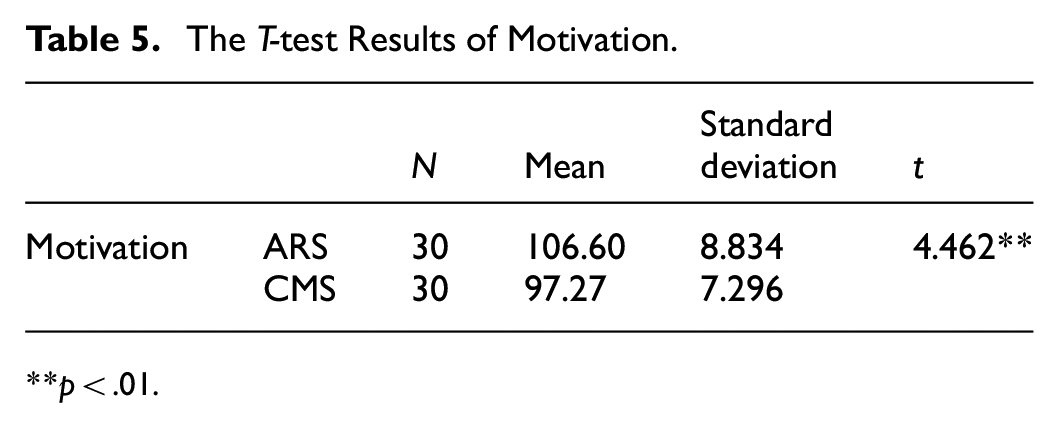
p < .01.
Analysis of Learning Cognitive Load
After participating in the learning activity, the two groups of pupils completed the cognitive load questionnaire. As shown in Table 6, the ARS group had an average score of 14.00 with a standard deviation of 3.484, while the CMS group had an average score of 16.93 with a standard deviation of 2.852. As indicated by the cognitive load questionnaire scores for the two groups, with a significance value is less than 0.01 (p < .05), indicating a significant difference in cognitive load between the ARS and CMS groups.
The T-test Results of Cognitive Load.
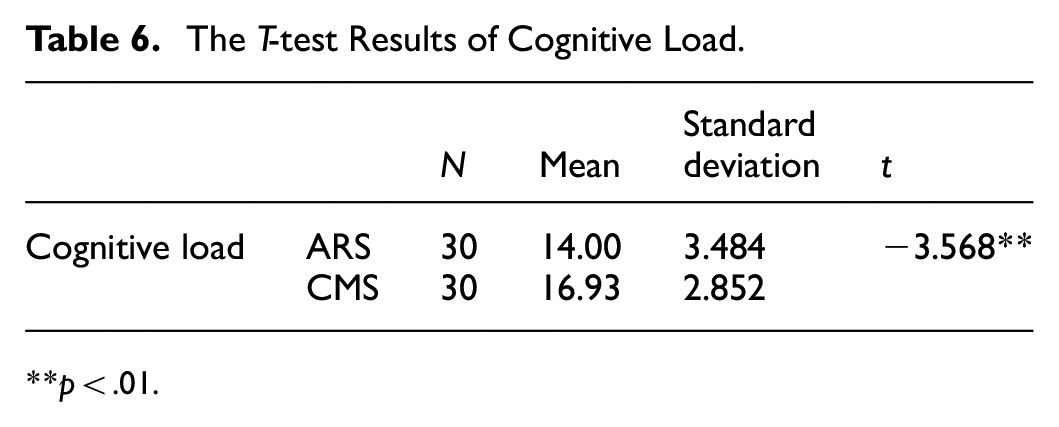
p < .01.
The study analyzes two aspects of cognitive load: mental load and effort, as shown in Table 7. The ARS group had an average mental load score of 8.70 (SD = 2.602), while the CMS group had 9.60 (SD = 1.812). The t-test showed a significance value of 0.076 (p > .05), indicating that no significant difference in mental load between the groups, and the AR-based learning strategy had no discernible impact on students’ intrinsic cognitive load. For mental effort, the ARS group averaged 5.30 (SD = 1.264) compared to the CMS group’s 7.33 (SD = 1.626). The t-test yielded a significance value of less than 0.001 (p < .05), suggesting a significant difference in mental effort, with ARS students experiencing lower extraneous cognitive load than those using traditional learning materials
The T-test Results of Cognitive Load Dimensions.

p < .01.
Discussion and Conclusion
Implications for Teaching Methods
In this study, we designed and developed an AR learning application to support college students in design history classes. To find out how this new strategy affected college students’ motivation, cognitive load, and academic achievement, a quasi-experiment was conducted. The outcomes demonstrated the considerable benefits our strategy had on the student’s motivation and performance in the classroom. Furthermore, our results demonstrated a significant reduction in the cognitive load related to the learning tasks.
One possible explanation for this result is the multi-sensory experience provided by AR. By integrating visual, auditory, and kinesthetic elements, AR creates a more interesting learning environment that accommodates different learning styles. The use of 3D models played a significant role in enhancing students’ comprehension of complex concepts, which enabled problem-solving tasks more creatively (Teplá et al., 2022). Research has shown that interactive 3D models provide learners with spatial and visual representations that aid in breaking down abstract ideas into tangible forms, thereby fostering deeper understanding (Fatemah et al., 2020). Such immersive learning environments can facilitate a deeper understanding of complex concepts, thereby enhancing learning outcomes. For example, Topu (2024) emphasized that AR-enabled 3D models in a science education setting significantly improved students’ problem-solving skills, as the hands-on interaction helped bridge the gap between theory and practice. Kaur et al. (2020) investigated the application of AR as a teaching aid to understand the material being covered through practical exercises in engineering education, this integration of theoretical concepts with real-world applications enhanced motivation. Aldeeb et al. (2024) explore AR as a concept-association tool in primary schools to boost learning outcomes, motivation, and engagement, highlighting AR’s potential to enhance learning experiences in primary education.
Furthermore, since AR can convey information in a more intuitive and user-friendly way, it can combine various components into a unified experience. This reduces the cognitive load on students, as they do not need to expend additional mental effort to reconcile disparate pieces of information. According to Sweller’s Cognitive Load Theory (1988), reducing extraneous cognitive load allows students to allocate more cognitive resources to processing intrinsic load, which is directly related to learning the material. The structured nature of AR can enhance germane cognitive load by fostering deeper schema construction, leading to more effective learning outcomes. However, it is important to note that the nonsignificant results for mental load in our study warrant further exploration. One possible explanation is that the AR environment, while immersive, may have introduced additional complexity, potentially increasing cognitive load for some students. According to Cognitive Load Theory (Sweller, 1988), while AR can help reduce extraneous load by improving instructional design, it can also increase intrinsic cognitive load if the environment is too complex or unfamiliar to learners. Prior research has shown that overly detailed AR interfaces or excessive interactivity can overwhelm students, leading to cognitive overload (İbili, 2019). Additionally, the novelty of AR itself may require additional cognitive resources for adaptation, further increasing mental effort (Buchner et al., 2022).
Moreover, the interactive nature of AR likely played a critical role. Unlike conventional multimedia tools, which are often passive, AR supports active participation, prompting students to engage with the content more deeply (Hirsch et al., 2022). This active learning approach has been shown to improve knowledge retention and problem-solving skills, as students are not merely recipients of information but are actively involved in constructing their understanding, which aligns with constructivist learning theories (Piaget, 1973). For instance, a study by Ibáñez and Delgado-Kloos (2018) found that students using AR in mathematics education not only demonstrated higher academic performance but also exhibited increased motivation compared to those using traditional methods. The study highlighted that the interactive and immersive features of AR allowed students to manipulate 3D models and receive immediate feedback, which enhanced their comprehension of complex mathematical concepts. This hands-on engagement made learning more enjoyable, fostering intrinsic motivation as students felt a greater sense of achievement and satisfaction in mastering the material.
Suggestions for Future Studies
Nonetheless, there are several limitations to this study. First of all, the slight difference in the standard deviation of pre-test scores between the ARS and CMS groups, with the ARS group showing a higher standard deviation (7.895 compared to 8.380). This suggests that the ARS group may have been more heterogeneous in terms of prior knowledge. While this difference did not reach statistical significance in the T-test analysis, it may have introduced some variability in the outcomes, potentially influencing the observed effects of the AR-integrated strategy. Future research should employ more rigorous sampling methods to ensure comparable levels of prior knowledge between groups.
Second, because of equipment limitations and class size, the experiment had a comparatively small number of participants. Future research should include a more diverse group of students from different backgrounds and regions to make the findings more generalizable.
Thirdly, the AR content and 3D models utilized in the course were quite basic, even though these models provided an effective introduction to complex design concepts, more thorough and varied content should be incorporated in future research. For example, future studies could explore the impact of more complex or gamified AR content on cognitive load and learning outcomes. This could include simulating game-based elements, incorporating highly detailed 3D models, and improving the game module and online test module. Additionally, exploring the role of AR in other educational contexts beyond design history, such as science, mathematics, language learning, or vocational training, to further validate its effectiveness and applicability across disciplines.
In addition to these limitations, it is important to acknowledge potential technical issues and device compatibility constraints that influenced the study outcomes. As the AR application was exclusively developed for Android operating systems, this inherently limited its accessibility to students using other platforms. During implementation, some students encountered performance-related difficulties, such as lagging or crashes, particularly when running resource-intensive 3D models. These technical issues may have disrupted the learning experience for some participants, potentially affecting their cognitive load and engagement levels. Future research should focus on optimizing the AR application’s performance across various devices to ensure smoother operation and minimize technical disruptions to the learning process.
As a result, the effective incorporation of AR into the learning situations may have contributed to the suggested approach’s successful performance in this study. Students can view and interact with individual masters’ construction projects, visualize complicated concepts in real-time, and gain a deeper understanding of design history content with the use of an AR-integrated learning application approach. More research is required in the future to completely grasp the possible advantages and disadvantages of this technology, but for now, it serves as a useful reference for those looking to develop educational augmented reality with learning support systems.
Footnotes
Author Note
All authors contributed to this article.
We confirm that informed consent was obtained from all participants. The datasets generated during and analyzed during the current study are not publicly available due to the participant’s willingness but are available from the corresponding author on reasonable request.

Ethical Considerations
This study was approved by the Ethics Committee of Fuzhou University (Approval No.: ERBA-0803373644).
Consent to Participate
All participants provided informed consent before participating. The research posed minimal risk to participants, as it involved standard educational practices. Participation was voluntary, and students could withdraw at any time without consequences.
Funding
The author(s) received no financial support for the research, authorship, and/or publication of this article.
Declaration of Conflicting Interests
The author(s) declared no potential conflicts of interest with respect to the research, authorship, and/or publication of this article.
Data Availability Statement
Data will be made available upon reasonable request