




Abstract
Academic self-efficacy is identified as one of the strongest predictors of students’ academic performance. However, few studies have explored the factors that influence students’ academic self-efficacy in a blended learning environment. By developing a comprehensive model, this study investigates the main factors that influence students’ academic self-efficacy in blended learning from the personal, interpersonal, and environmental perspectives. The relevant information was acquired through a questionnaire survey. The participants included 366 college students at a university in central China. Hierarchical regression analysis shows that intrinsic motivation, extrinsic motivation, instructor support, performance expectancy, and facilitating conditions are significant predictors of students’ academic self-efficacy in blended learning. The findings expand the understanding of students’ academic self-efficacy in technology-enhanced learning environments and provide valuable insights that could help to improve the appropriateness of instructional design in blended learning courses.
Keywords
Introduction
Traditional face-to-face instruction occurs only in the physical classrooms, and fully online learning that occurs only in cyberspace. Blended learning, however, is defined as the “thoughtful integration of classroom face-to-face learning experiences with online learning experiences” (Garrison & Kanuka, 2004, p. 96). Well-designed blended learning can improve pedagogy, increase access and flexibility, and increase cost-effectiveness (Bonk & Graham, 2012). As a result, blended learning has become widely adopted and has become a significant trend in higher education (Alexander et al., 2019; Wei et al., 2017). Recently, the coronavirus disease 2019 (COVID-19) pandemic significantly increased the prevalence of blended learning teaching models, and this is a trend which many anticipated to continue increasing, even after the COVID-19 pandemic is over (Siripongdee et al., 2020; Yang et al., 2022). As such, research on blended learning and related educational variables, such as academic self-efficacy are topics of significant importance.
Having been identified as a key predictor of academic performance (Honicke & Broadbent, 2016; Richardson et al., 2012), students’ academic self-efficacy (ASE) is one of the major areas of interest within blended learning (Prifti, 2022; Warren et al., 2021; Wei et al., 2019). In general, ASE refers to personal beliefs of one’s capabilities to organize and execute courses of action to attain designated standards of educational performance (Elias & MacDonald, 2007). Specifically, ASE represents one’s self-efficacy as related to learning or academy; ASE it is the performance of self-efficacy in the learning process. Students with higher ASE tend to handle difficult tasks and activities more easily (Bandura, 2010); they have increased levels of academic persistence (Jung & Lee, 2018), and they develop more in-depth strategies for completing tasks (Li, Liu, et al., 2020). It is worth pointing out that existing research has found that blended learning can improve students’ ASE (e.g., Chang et al., 2022; Owston, 2018). However, current research on ASE is more focused on its effect on academic performance (Honicke & Broadbent, 2016; Shoval et al., 2021), while the factors that influence the development of ASE are less studied. Although a few studies have focused on factors that influence students’ ASE, these studies have been conducted primarily in the context of either face-to-face or online instruction (Peechapol et al., 2018), but not blended learning. It has been suggested that the development of students’ ASE is influenced by various factors (Bong & Skaalvik, 2003). These factors come from a variety of sources, including the learners themselves (personal aspect), others with whom learners interact in the learning process (interpersonal aspect), and the learning environment (environmental aspect) in which the learners are placed (Schunk & Pajares, 2002). To the best of our knowledge, few studies have systemically explored the factors that influence ASE in blended learning from multi-dimensional perspectives.
To this end, the present study aims to develop a comprehensive model to investigate the main factors that influence students’ ASE in a blended learning environment, from the personal, interpersonal, and environmental perspectives. Specifically, this study aims to fill the existing research gap by investigating the following research questions:
From the personal perspective, to what extent do students’ intrinsic and extrinsic motivations influence their ASE in blended learning?
From the interpersonal perspective, to what extent do instructor support and peer connectedness influence students’ ASE in blended learning?
From the environmental perspective, to what extent does the technology-enabled learning environment or setting influence students’ ASE in blended learning?
Among the influencing factors, which of them can best predict students’ ASE?
It is hoped that this study, by exploring the factors that influence students’ ASE and by determining the predictive value of these factors, can provide beneficial insights for understanding the effect of blended learning in improving students’ ASE.
Research Framework
Few studies have specifically investigated the factors that influence students’ ASE in blended learning. However, prior research has systematically examined the main factors associated with students’ ASE from individual, interpersonal, and environmental perspectives. In this section, the current study reviews the relevant studies and proposes the research hypotheses accordingly.
Personal Factors: Intrinsic and Extrinsic Motivations
Among the various personal factors, existing studies have suggested that students’ learning motivation is one of the variables most closely related to students’ ASE (Linnenbrink & Pintrich, 2003; Prat-Sala & Redford, 2010). Learning motivation is defined as the extent to which students continue to work hard to learn (Law et al., 2010), which in turn can promote students’ learning and academic success (Linnenbrink & Pintrich, 2002). According to the self-determination theory (Deci & Ryan, 1985), motivation can be categorized into intrinsic and extrinsic forms, based on the different causes or objectives that lead to action. Intrinsic motivation refers to those actions in which individuals engage for their inherent satisfaction or enjoyment, rather than for some separable consequences (Ryan & Deci, 2000). The origin of intrinsic motivation comes from the individual’s desire, such as being curious or wanting to challenge or master the contents. On the other hand, extrinsic motivation refers to a construct that pertains whenever an activity is done to attain some separable outcomes (Ryan & Deci, 2000). Extrinsic motivation is induced by external rewards or other positive outcomes, such as achieving a reward, getting good grades, or avoiding being criticized or punished.
Some studies have pointed out that students’ learning motivation could affect their ASE. For example, Alt (2015) found that undergraduate college students’ motivation toward reflection and concept investigation was the most important positive predictor of ASE. Hassankhani et al. (2015) also found that increased learning motivation could be related to the improved self-efficacy of professional nursing students. However, the influence of learning motivation on students’ ASE in blended learning has not yet been explored. Since students’ learning motivation is an important personal factor related to their ASE, two hypotheses are proposed as follows:
Hypothesis 1 (H1): Intrinsic motivation is positively related to the degree of ASE in blended learning.
Hypothesis 2 (H2): Extrinsic motivation is positively related to the degree of ASE in blended learning.
Interpersonal Factors: Instructor Support and Student-to-Student Connectedness
According to social constructivism, learning can be conceptualized as a participatory social process in which multi-stranded interpersonal transactions mediate the exchange of knowledge (Cole & Engestrom, 1993; Moll & Greenberg, 1990). Two main interpersonal relationships exist in the classroom environment: the relationship between instructors and students (e.g., instructor support), and the relationships among students (e.g., student-to-student connectedness). Thus, to stimulate and maintain students’ ASE, understanding students’ perceptions of instructor support and student-to-student connectedness are of great importance.
Instructor support is defined as the students’ perceptions that their instructor cares about their learning and wants to help them learn (Trickett & Moos, 1973). Instructor support includes prosocial instructional behaviors and practices, such as providing clear feedback and instructions on the students’ assignments, correcting the students’ misunderstandings, offering learning resources, and making constructive suggestions regarding the students’ performances (S. J. Lee et al., 2011).
Instructor support can be expected to influence students’ judgments of self-efficacy (Schunk & Pajares, 2002). Studies have shown that instructor support can serve to develop and maintain both students’ self-confidence in learning (Eakman, et al., 2019; Hughes & Chen, 2011; Li, Gao, & Sha, 2020) and student-centered learning engagement (E. Lee & Baird, 2021). In math and science classes, students who feel that they have more support from instructors have a higher sense of their competence and are more active in these subjects (Rice et al., 2013). Gutiérrez and Tomás (2019) also found a positive correlation between perceived instructor support and the ASE of university students in face-to-face instruction. In blended learning, the availability of online resources may provide instructors with opportunity to present teaching content differently. The instructors have more time to do what they do best, namely to create interesting and well-designed lessons (Lungu, 2013). They can have more interaction with students, in ways such as presenting teaching content, organizing more classroom activities, and providing students with more feedback. Accordingly, students perceive that instructor support may influence their ASE in blended learning. Another interpersonal factor is student-to-student connectedness, which is referred to as the perception of supportive and cooperative communication through peer interaction (Bolliger & Inan, 2012; Dwyer et al., 2004; MacLeod et al., 2019). Peers influence students’ ASE in various ways, such as through model similarity and peer networks (Schunk & Pajares, 2002). This friendly and social connection includes students praising and caring for each other, sharing personal stories or experiences, and engaging in general gossip (Prisbell et al., 2009).
Unlike traditional face-to-face classroom instruction, the use of technology promotes interaction and the exchange of ideas between students. Therefore, in addition to the instructor-centered direct instruction that is mainly used in traditional face-to-face classrooms, other teaching methods can be used in blending teaching, such as student self-directed learning. In blended learning, students are encouraged to work in teams to develop knowledge through peer interaction and participation. Thus, student-to-student connectedness may influence their ASE in a blended learning and student-centered environment. Therefore, two hypotheses are proposed, as follows:
Hypothesis 3 (H3): Instructor support is positively related to students’ ASE in blended learning.
Hypothesis 4 (H4): Student-to-student connectedness is positively related to students’ ASE in blended learning.
Environmental Factors: Performance Expectancy, Effort Expectancy, Social Influence, and Facilitating Conditions
The learning environment can influence students’ perceptions of autonomy and relatedness, which in turn influence students’ ASE and academic performance (Schunk & Pajares, 2002). Previous studies have shown that the learning environment (or setting) can affect students’ ASE (Dorman & Adams, 2004; McMahon et al., 2009). Compared to traditional classrooms, blended learning includes not only a face-to-face environment but also an online environment, supported by information technologies. In blended learning, the degree to which students perceive such a technology-enabled system or setting may also influence their judgment of their ability to complete the assigned learning tasks. When students perceive that the technological learning environment is conducive to learning, they will have higher confidence in the task and display greater persistence in completing the task.
Various theories and models exist about users’ perceptions and acceptance of technology systems or settings. One of the more commonly-used models is probably the Unified Theory of Acceptance and Use of Technology (UTAUT) model, which contains four determining components: performance expectancy, effort expectancy, social influence, and facilitating conditions.
Performance expectancy is defined as “the degree to which an individual believes that using the system will help him or her to attain gains in job performance” (Venkatesh et al., 2003, p. 447).
Effort expectancy is defined as “the degree of ease associated with the use of the system” (Venkatesh et al., 2003, p. 450). In the present context, effort expectancy stands for the extent to which students believe in the ease of use of the online learning system.
Social influence reflects the effect of environmental factors, such as the opinions of a user’s friends, relatives, and superiors, on the user’s adoption and usage of a new system (Prasad et al., 2018). Across the various contexts of this study, social influence describes how students may appreciate the opinions of their classmates, friends, and their instructors when encountering a new online learning system.
The term “facilitating conditions” refers to “the degree to which an individual believes that an organizational and technical infrastructure exists to support the use of the system” (Venkatesh et al., 2003, p. 453). In general education studies, facilitating conditions have been found to positively and directly affect students’ attitudes toward the use of technology (Abbad et al., 2009; Hoi, 2020; McGill & Klobas, 2009).
In blended learning, the combination of face-to-face instruction and the online learning components not only allows students to choose their learning materials according to their preferences and needs (Picciano, 2009), but also provides students with a variety of affordable learning opportunities (Davidson-Shivers et al., 2018). Meanwhile, students will inevitably encounter some difficulties in a technology-enabled learning environment. For example, Yang et al. (2022) reported that performance expectancy is one of the main factors that influence the popularity and acceptance of blended learning. Thus, students’ perceptions and acceptance of a technology-enabled learning environment are critical to developing their ASE of blended learning. Accordingly, the following four hypotheses are proposed:
Hypothesis 5 (H5): Performance expectancy is positively related to students’ ASE in blended learning.
Hypothesis 6 (H6): Effort expectancy is positively related to students’ ASE in blended learning.
Hypothesis 7 (H7): Social influence is positively related to students’ ASE in blended learning.
Hypothesis 8 (H8): Facilitating conditions are positively related to students’ ASE in blended learning.
Based on a review of related studies, the research model was proposed, as shown in Figure 1. We propose that personal factors (intrinsic and extrinsic motivations), interpersonal factors (instructor support and student-to-student connectedness), and environmental factors (performance expectancy, effort expectancy, social influence, and facilitating conditions) will influence students’ ASE in blended learning.
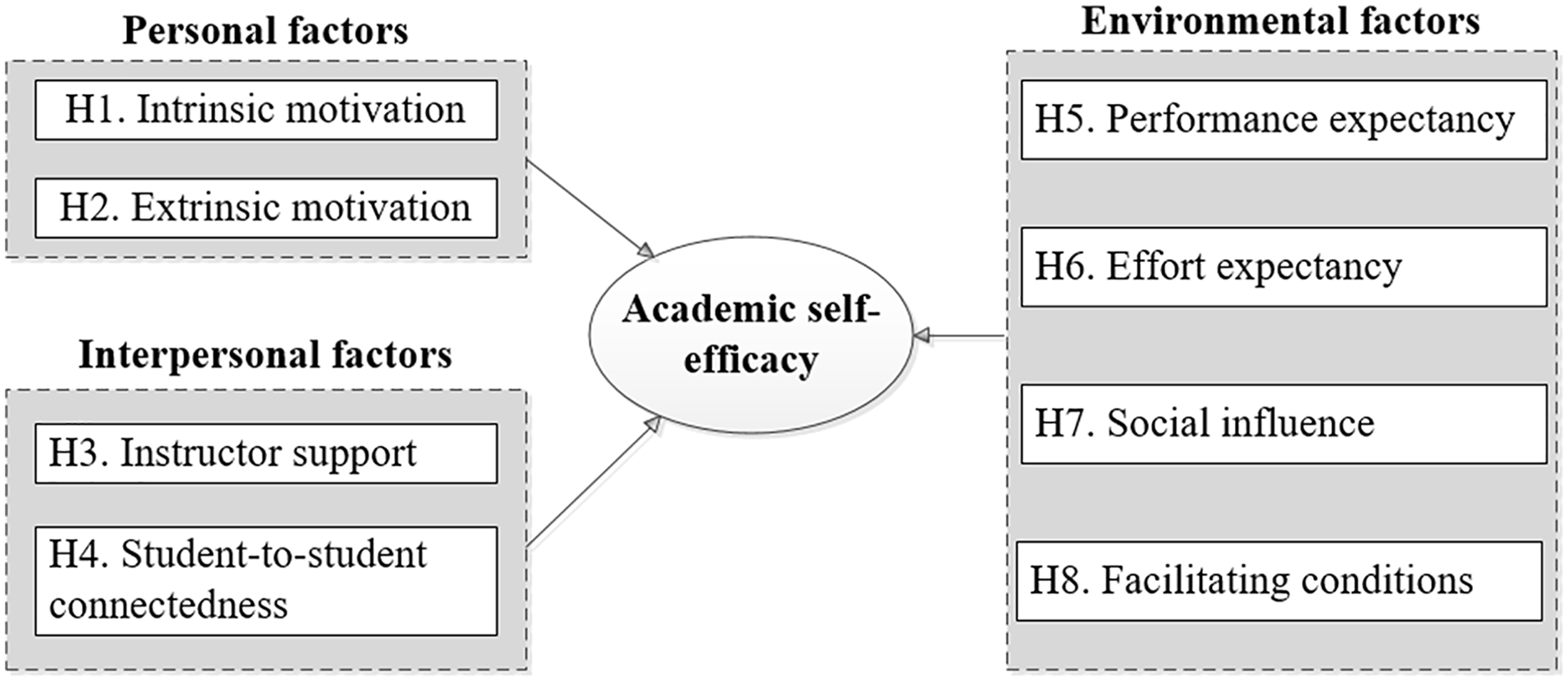
Diagram of the research model.
Methodology
Participants and Setting
The participants included 366 third-year students from a university located in central China. The response rate of complete and valid surveys was 96%. Therefore, 351 participant responses were included for data analysis. Among the included participants, 73 are male, and 278 are female, which provided a female-to-male ratio of approximately 4:1. This is a representative gender composition of this university. The academic majors of the 351 valid student responses included science (chemistry, life science, mathematics, and physics), language (Chinese Language and Literature and English), humanities and arts (art, history, and music).
This university was selected because it has a stable history of using a common institutional blended learning program since 2013. This fact reduced concerns related to instructor and student technical competencies. This blended learning program encourages academic staff to explore and implement blended learning through the use of an online learning management system (LMS). The LMS serves as an online learning community for communication, as well as content distribution and collection. The LMS also provides digital resources, user-specific tools and applications, and third-party content (see Figure 2). As such, this university well reflects the overall application of blended learning.
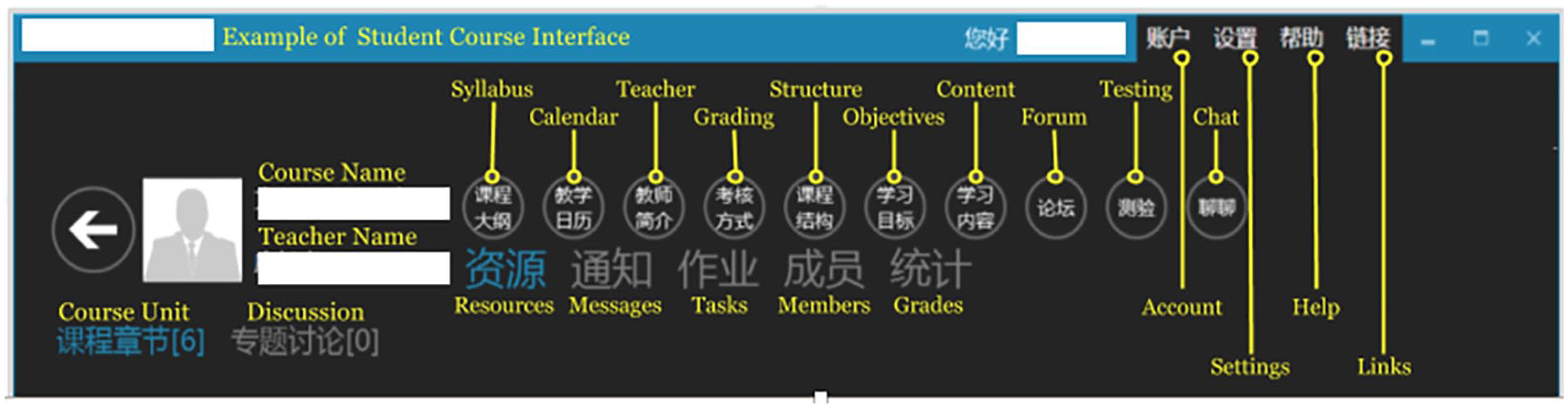
Screenshots of LMS (with translation).
Six classes of students taking the general requirement course entitled Application of Modern Education Technology were selected as participants in this study. The course duration was 9 weeks, and the average number of students in each class was about 60. This course is designed to improve students’ abilities to use ICTs in their study fields and professional life. This course was purposely selected for three reasons. Firstly, it is a public compulsory course that is taught with a blended learning approach in this university. As such, the course was able to provide enough samples for the present study. Secondly, six instructors who participated in this study had similar blended teaching experiences. They were provided with training opportunities for the LMS and can operate the LMS skillfully. In this study, these six instructors worked together to design and prepare learning materials before the start of the course. All the instructors shared the same learning materials and had the same teaching schedule. Thirdly, all students enrolled in the course similarly had 2 years of blended learning experience, thereby ensuring the homogeneity of the sample. Among the 366 participants, 15 individuals’ responses were omitted from the data analysis, due to the incompleteness of their responses. Therefore, the valid response rate for this study was approximately 96% (n = 351).
The course included face-to-face instruction and online learning. Overall, the time spent on this course was half face-to-face instruction and half online learning. In the face-to-face course setting, because of the large class size, instructor-led activities (such as lecturing and explaining important concepts, answering students’ general questions, and providing feedback on students’ work) were primarily carried out. These activities took place mainly between the instructor and the students, but rarely just among the students. In the online course setting, more student self-directed learning activities were conducted such as reading and reviewing digital learning resources (micro-videos, courseware, leading questions, examples, and cases) that the instructor uploaded to the LMS, participating in online discussions, and finishing individual and group learning tasks. At the same time, the instructor would monitor the learning process and answer students’ specific questions, etc.
Instrumentation
In this study, a structured three-part questionnaire was employed to test the proposed hypotheses. The first part collected demographic information. The second part used several scales to measure the personal, interpersonal, and environmental factors. The third part measured students’ level of ASE in blended learning. The scales used in this study were adapted from scales that have been validated in previous studies.
With regard to the second part, the personal factors included the intrinsic motivation scale and extrinsic motivation scale, both of which were adapted from the motivated strategies for learning questionnaire (MSLQ) developed by Pintrich et al. (1991), with each scale containing four items. The Cronbach’s alpha for the two scales are .74 and .62, respectively.
The interpersonal factors included the instructor support scale and student-to-student connectedness scale. The instructor support scale, consisting of eight items, was adapted from Walker and Fraser (2005). The student-to-student connectedness scale was adapted from Dwyer et al.’s (2004), which was comprised of four items. The Cronbach’s alpha for the two scales are .87 and .94, respectively.
The environmental factors included the performance expectancy scale (four items), effort expectancy scale (four items), social influence scale (four items), and facilitating conditions scale (four items). These four scales were adapted from Venkatesh et al. (2003). The Cronbach’s alpha for the four scales are all greater than .70.
The ASE scale, which was adopted from the MSLQ, was used to measure students’ ASE (Pintrich et al., 1991). Some necessary modifications were implemented, to fit the context of blended learning. The Cronbach’s alpha for the ASE scale is .93. All items in the nine scales were rated on a 5-point Likert scale, ranging from 1 = strongly disagree to 5 = strongly agree.
Data Collection and Analysis Procedures
To ensure participants understood the questionnaire’s content, this study translated all items into Chinese by committee reconciliation. The committee consisted of three researchers. Then, the questionnaire received a bilingual assessment from an educational technology expert with over 20 years of university teaching experience in the USA and China. In addition, three students with blended learning experience (excluded from the present study) were surveyed and interviewed to determine whether the statements were appropriate. These students confirmed that the statements were unambiguous and easily understood. Feedback collected from the expert and students was taken into consideration, and the wording for several items was adjusted to improve the overall readability of the survey.
After approval was granted by the National Engineering Research Center for E-Learning of the university to conduct the research, the survey was administered via paper format during a mid-class break in the middle of the fall semester of 2019. After being informed of the purpose of the research and having been given instructions on how to complete the questionnaire, the participants completed the questionnaire in the presence of the research staff. The procedure took approximately 5 to 10 minutes. All participants in the survey were informed that their responses were anonymous and that their participation was voluntary. After data collection, Pearson correlation analyses were used to examine the relationships between influencing factors and ASE. Further, a hierarchical regression analysis was employed to determine the strength of critical influencing factors, to predict ASE.
Results
Descriptive Statistics
Table 1 presents the descriptive statistics and reliability of each scale. The results show that students’ overall ASE was above average (M = 3.68, SD = 0.49). With regard to learning motivation, the mean scores for intrinsic motivation and extrinsic motivation were 3.56 and 3.68, respectively. Student-to-student connectedness was shown to have the lowest score (M = 3.33, SD = 0.69), followed by instructor support (M = 3.42, SD = 0.58). Mean scores for environmental factors ranged between 3.46 and 3.80, with effort expectancy (M = 3.80, SD = 0.62) being relatively higher than the other three dimensions.
Descriptive Data of Independent and Dependent Variables.

Regarding the scale reliabilities, this study used Cronbach’s alpha to assess measurement reliability. The results indicate that the Cronbach’s alpha values of these factors were all above .70, except for social influence, facilitating conditions, and extrinsic motivation. These results indicate good reliability (Hair et al., 1998). The Cronbach’s alpha values of social influence, facilitating conditions, and extrinsic motivation were all above .60 and within acceptable limits (Hair et al., 2010).
The Relationship Between ASE and Its Influencing Factors
Pearson correlation analyses were utilized to investigate the relationships between ASE and the factors that influence ASE. As illustrated in Table 2, ASE was observed as being significantly correlated to its influencing factors. The results show that students who had greater learning motivation, perceived higher levels of instructor support and student-to-student connectedness, and indicated higher acceptance of the LMS, tended to have higher ASE in blended learning. Meanwhile, almost all the influencing factors were significantly positively correlated, except for student-to-student connectedness and facilitating conditions.
Pearson Correlations for Independent and Dependent Variables.

p < .05. **p < .01.
Based on the confirmation that ASE was associated with its influencing factors during this study, a hierarchical regression analysis was conducted to identify the critical factors for predicting the level of students’ ASE. Before conducting regression analyses, the research model was assessed for multicollinearity issues between independent variables. It is generally believed that tolerance of less than 0.20 or 0.10 and/or a variance inflation factor (VIF) of 5 or 10 and above indicates a multicollinearity problem (O’Brien, 2007). As shown in Table 3, all the tolerance values were above 0.20, and all the VIF values were lower than the conventional threshold (10). These results indicate that no multicollinearity problems existed.
Results of Multiple Collinearity Statistics.

Then, a hierarchical regression analysis was conducted to identify the factors that are critical for predicting the level of students’ ASE in blended learning. The results of the regression are presented in Table 4.
Summary of the Hierarchical Regression Analysis.

p < .05. **p < .01. ***p < .001.
In Step 1, the two types of learning motivations were simultaneously explored in relation to ASE. The results show that students’ ASE could be predicted by the intrinsic motivation and extrinsic motivation, which explains 36.4% of the variance (F (2,348) = 99.743, p < .001). Thus, H1 (intrinsic motivation: β = .501, p < .001) and H2 (extrinsic motivation: β = .255, p < .001) are confirmed.
In Step 2, the interpersonal factors were entered into the model. The addition of the two variables that correlated positively to ASE explained an additional 4% of the variance (F (4,346) = 60.524, p < .001). Although the previous correlation analysis showed that student-to-student connectedness was significantly related to the level of ASE, with r = .41(p < .01), the hierarchical regression analysis revealed that student-to-student connectedness was not a significant predictor. Thus, H3 is confirmed (instructor support: β = .220, p < .001), while H4 (student-to-student connectedness: β = .050, p > .05) is rejected.
In the final step, environmental factors were added to the model. These factors explained an additional 4% of variance, with performance expectancy and facilitating conditions as the significant predictors of ASE. These results confirm H5 (performance expectancy: β = .121, p < .05) and H8 (facilitating conditions: β = .106, p < .05), while H6 (effort expectancy: β = .059, p > .05) and H7 (social influence: β = .025, p > .05) are rejected.
Therefore, it was concluded that the three-step model was appropriate for predicting the level of students’ ASE (F (8, 342) = 35.194, p < .001).
Altogether, intrinsic motivation, extrinsic motivation, instructor support, performance expectancy, and facilitating conditions made significant contributions to predicting students’ ASE.
Discussion and Implications
Discussion
Blended learning has been widely recognized and advocated worldwide. To ensure the application of empirical research results of successful blended learning design is therefore of great importance (Müller & Mildenberger, 2021). As one of the strongest predictors of academic performance (Altermatt, 2019), ASE provides a reference for teachers to successfully design blended learning programs. Thus, exploring the factors that influence ASE can be conducive to enhancing students’ ASE, as well as to further improving students’ academic performance in blended learning.
The current study investigates the influence of personal, interpersonal, and environmental factors on students’ ASE in blended learning. The hierarchical regression analysis showed that motivation, instructor support, performance expectancy, and facilitating conditions were observed to be the predictors of ASE in blended learning. Student-to-student connectedness, effort expectancy, and social influence, however, were unexpectedly not found to be predictors.
Among the influencing factors, a hierarchical multiple regression analysis revealed that motivation was the most significant predictor of ASE in this study. The results suggest that, when students are willing to actively participate in learning and classroom activities, they will have stronger beliefs in organizing and executing actions to achieve the desired academic performance. The prediction of students’ ASE by motivation is consistent with previous research on the relationship between self-efficacy and the learning motivation of professional nursing students (Hassankhani et al., 2015). In addition, to provide more detailed results and implications, this study follows the previous research model that distinguished the different types of motivation (e.g., Liu, 2020). Research has shown that both intrinsic motivation and extrinsic motivation are significant predictors of ASE, which suggests that participants’ learning motivation, whether for their inherent interest and enjoyment or external demands and rewards, can predict the level of ASE. That is to say, extrinsic motivation is not necessarily harmful to learning or incompatible with intrinsic motivation (Gonzales, 2011; Mezei, 2008; Wang, 2008). What is also noteworthy is that students’ intrinsic motivation can predict ASE better than their extrinsic motivation can. This finding is in accordance with the results of previous studies. For example, Huang (2011) found that students with intrinsic motivation are more likely to persist when facing learning challenges than students with extrinsic motivation.
Regarding the interpersonal factors that affect students’ ASE, only the level of instructor support was observed to be predictive. This finding is consistent with previous studies on the relationship between perceived instructor support and self-efficacy in learning (Eakman et al., 2019; Hughes & Chen, 2011). The results of those studies indicated that students’ perception of instructor support, such as an instructor providing clear guidance, relevant resources, and constructive feedback on students’ assignments and performance, is an important factor for predicting students’ ASE.
However, the factor of student-to-student connectedness was not found to have a significant effect on ASE in this study. This finding is contrary to those of some similar studies, which showed that student-to-student connectedness had a significant positive effect on ASE (Datu & Yuen, 2020). The different effects could be explained by the number of samples and the content of class activities. In this study, six relatively large classes of students were enrolled in the same course. Faced with so many students, the instructor in the face-to-face instruction setting mainly imparted knowledge, answered questions, and encouraged students to engage in self-directed learning. However, due to the large number of students in the face-to-face classroom, the instructors rarely gave students opportunities for group work. As a result, students lacked interaction with their peers, and this likely made them feel less supported by their classmates, given that the pedagogical strategies employed did not have the students actively engaged in dialog and collaborative learning tasks. Thus, one can understand why students’ sense of a peer connection did not help students in terms of improving their confidence in completing academic tasks.
Unlike traditional face-to-face instruction that takes place primarily in the classroom, blended instruction takes place not only in the classroom, but also in the LMS. With regard to the environmental factors, this study found that the level of performance expectancy and facilitating conditions can predict students’ ASE in technology-enhanced blended learning environments. Specifically, students’ perception of value in using the LMS, as well as the availability of appropriate technical support, can be used to predict students’ ASE. The results indicate that, when students perceive the LMS to be useful, or when they believe that an organizational and technical infrastructure exists that will support the use of the LMS, they will make a greater effort and have long-term persistence to achieve academic goals.
However, the results also show that effort expectancy is not a significant predictor of ASE in technology-enhanced blended learning environments. Particularly, it seems the degree of ease associated with the use of the LMS may not affect students’ ASE. When interpreting this result, it is important to consider the participants’ experience of using the LMS. All the samples in this study are third-year students; all of them had 2 years of blended learning experience and were very proficient in the operation of the LMS. Therefore, compared with the usefulness of the LMS, the ease of use of the technological tool is not a decisive factor in determining student use of the LMS. In addition, the results reveal that social influence is not a significant predictor of ASE, which further indicates that the degree to which students perceive that important people think they should use the LMS may have little effect on their ASE. This finding may be explained by the study’s context of the examination of activity within a compulsory course. Whether or not students saw their classmates perform better on academic tasks in the online learning environment did not affect students’ perception of the online learning environment. Besides, as previously discussed, the large sample size led to a decrease in student interaction during the course activities, which further led to the perception of some students in the online learning environment having less social impact on other students.
Implications
A growing body of evidence is mounting that suggests institutions can provide increased levels of learning flexibility while effectively maintaining academic outcomes through blended learning (Müller & Mildenberger, 2021; Shi et al., 2020). As such, additional research is necessary to help inform both policy and practice. The findings in this study have both theoretical and practical implications. From a theoretical standpoint, this study extends the understanding of factors that will be beneficial in terms of increasing the levels of students’ ASE in blended learning. Thus, this study expands the self-efficacy theory in both the physical classroom and the digital learning environment. This study also provides value by exploring key influencing factors that are critically important for understanding students’ ASE in technology-enhanced blended learning environments. Understanding these important predictors of ASE may be beneficial for instructors in higher education.
From a practical standpoint, the factors that have significant influences on ASE can provide a reference for teachers trying to develop effective blended teaching strategies. In terms of the personal factors, learning motivation (intrinsic motivation and extrinsic motivation) has significant effects on college students’ ASE in blended learning. Thus, instructional activities should serve to attract students’ learning interest, stimulate their curiosity to learn, and inherently make them feel a sense of enjoyment and satisfaction, to further stimulate their intrinsic motivation. Meanwhile, instructional activities, such as rewarding or praising students, should provide students with external factors that enhance their extrinsic motivation. In terms of the interpersonal factors, instructor support was reported to have a significant effect on ASE. Thus, adequate pedagogical assistance should be provided to students. Feedback and instant communication play a key role in ensuring that students are supported in a course (S. J. Lee et al., 2011). Particularly when students are in difficulty, the support provided by instructors can help relieve pressure on students, and increase their trust in their capacity to execute the tasks and achieve their objectives (Oriol et al., 2017). It is worth noting that the social isolation and loneliness experienced in online learning have been considered a serious problem (Walther & Parks, 2002). Instructor support can establish a positive relationship between teachers and students, help students to develop social interaction, and reduce loneliness in the online learning environment (Bedeck, 2015).
In terms of the interpersonal factors, this study provides evidence that performance expectancy and facilitating conditions also contribute to a high level of ASE in technology-enhanced blended learning environments. Therefore, instructors should offer useful digital resources to students, to increase the degree to which students perceive the usefulness of the LMS. The digital learning resources should be up-to-date, relevant, and comprehensive. Only when students believe that digital learning resources have positive effects on learning will they make greater efforts to complete the learning tasks. Moreover, the level of facilitating conditions is another technical factor that affects students’ ASE. Partridge et al. (2011) stated that a decrease in face-to-face contact between teachers and students will cause the learners’ demand for complex technical knowledge to increase. Consequently, two stakeholders involved in the provision of technical support—the LMS developers and school administrators—should guarantee the construction of technical infrastructure and the availability of organized technological support. For example, LMS developers should offer technicians who are ready to support students in terms of dealing with technical problems. Adequate skill training should also be provided, to help students build confidence in the use of technology. Without sufficient support from these technicians, the effective implementation of the LMS is impossible. Technicians can also help students master the technology and overcome any technical problems they may encounter (Khechine et al., 2014).
Limitations and Conclusions
While this study has important implications, it still has some limitations. Firstly, this study only examines nine main factors that influence students’ ASE in blended learning from personal, interpersonal, and environmental perspectives. Future studies should be encouraged to involve more factors, such as learning style and learning strategy. Secondly, this study only employs the self-reported questionnaire method, which inherently possesses definite subjectivity. Mixed methods, such as behavioral observation and interviews, could be incorporated into future studies to support the triangulation of both qualitative and quantitative results. Lastly, the selected participants in this study are from only one university; the participants were organized in large classes with a lecture-based pedagogical approach. As such, they have a similar blended learning experience and similar LMS usage experience. However, individuals’ perceptions of technology vary with gender, age, and their experience of using technology (Teo & Zhou, 2014; Venkatesh et al., 2003, p. 467), and these perceptions have further different effects on ASE. Therefore, future researchers are encouraged to involve participants of different ages, cultural backgrounds, levels of learning experience, and technological usage experience, as well as instructors with active learning pedagogies.
In conclusion, this study identifies underlying factors that influence students’ ASE in blended learning. This is achieved by incorporating personal, interpersonal, and environmental factors. The present study extends the ASE field by exploring the factors that influence ASE in technology-enhanced blended learning environments. The findings of this study can provide direction for future ASE-related research. Furthermore, the insights provided by this study can assist researchers, instructors, educational administrators, and LMS developers to make blended learning environments more effective through the targeted cultivation of ASE.
Footnotes
Declaration of Conflicting Interests
The author(s) declared no potential conflicts of interest with respect to the research, authorship, and/or publication of this article.
Funding
The author(s) disclosed receipt of the following financial support for the research, authorship, and/or publication of this article: This study was supported by the National Natural Science Foundation of China (Project No.: 61907019).
