




Abstract
Paradoxical thinking (PT), a cognitive approach to addressing conflicting managerial demands, plays a dual role in shaping corporate innovation outcomes. This study explores how PT in team management affects innovation performance using a dual-path model based on data from 122 enterprise innovation teams. The findings show that while PT enhances innovation by fostering employee action learning (AL), it also impairs performance by increasing Cognitive load (CL). Additionally, power distance strengthens the positive mediating effect of AL but does not significantly influence the negative impact of CL. These findings contribute to organizational behavior research by deepening the understanding of cognitive strategies and offering practical insights for managing cognitive demands in team-based innovation.
Plain Language Summary
Introduction: Modern management practices reveal that a linear thinking approach is increasingly inadequate for navigating the complexities of contemporary enterprises in the networked landscape. Enterprises must grapple with dual-level contradictions, such as competition and cooperation, long-term and short-term goals, and team and individual dynamics. Aim: It aims to explore how paradoxical thinking differentially impacts innovation strategy decision-making and examines the path mechanisms, specifically the mediating roles of action learning and cognitive load, along with the moderating role of power distance tendency. Method: This paper presents a theoretical model that illustrates the impact of paradoxical thinking on corporate innovation performance. Subsequently, empirical research involving 122 enterprise innovation teams was conducted using this model. In the data processing phase of this study, we primarily used SPSS26.0 Results: The findings can be summarized as follows: first, the study finds that paradoxical thinking can enhance corporate innovation performance through action learning. This finding aligns with previous research highlighting the positive role of certain thinking patterns in fostering innovation. Second, paradoxical thinking can hinder improvements in corporate innovation performance through increased cognitive load. Importantly, unlike many previous studies that focus solely on the positive effects of paradoxical thinking, this study reveals the “double-edged sword” effect of paradoxical thinking on firms’ innovation performance in conjunction with the first finding above. Third, power distance tendency positively moderates the mediating effect of action learning between paradoxical thinking and corporate innovation performance.
Keywords
Introduction
Modern enterprises engage in dynamic innovation activities characterized by situational shifts, time sensitivity, path ambiguity, and outcome uncertainty (Han et al., 2016). To gain a competitive advantage, organizations must effectively navigate these challenges and build a diverse portfolio of innovation components (O’Reilly & Tushman, 2004). As research progresses, scholars recognize that innovation involves not only resource acquisition and technological capabilities but also the cognitive processes of team members (Waldman et al., 2019). Cognitive matching theory supports this view, emphasizing that task performance depends on the alignment between problem-solving approaches and task characteristics. Effective problem-solving requires knowledge depth, cognitive ability, and thinking style (Mennecke et al., 2000). In this context, modern management practices increasingly show that linear thinking is insufficient for addressing the complexities faced by contemporary enterprises operating in highly networked environments. Enterprises often face dual-level contradictions, such as competition versus cooperation, long-term versus short-term goals, and team versus individual dynamics. Paradoxical thinking (PT) is a valuable cognitive approach that enables teams to embrace and integrate opposing forces during the innovation process. It emphasizes the importance of individuals actively learning from, accepting, and reconciling conflicting elements within team settings, thereby enhancing problem-solving and uncovering new opportunities (Smith & Tushman, 2005). This mode incorporates elements of golden mean thinking (Wei, 2019), critical thinking (Tu et al., 2015), and innovative thinking (Lu & Peng, 2019) in organizational management. According to paradox theory, salient team conflicts can lead to either a positive cycle of gains or a negative spiral of losses, depending on how well PT aligns with the demands of the innovation task.
When aligned with task representation in innovation activities, PT can enhance team members’ ability to process complex information, reconcile differing viewpoints, lower innovation costs, and increase innovation benefits. It offers organizations a strategic path to balance stability and change; however, its misalignment with task demands can intensify team contradictions, overload members with novel and complex ideas, and reduce their efficiency, potentially resulting in communication breakdowns, higher innovation costs, and diminished performance. To explore this dynamic, the survey data were analyzed to examine the relationship between PT and corporate innovation performance (CIP), as well as the underlying mechanisms driving this relationship. Unlike previous studies, this research contributes to the field in three distinct ways.
First, previous studies have primarily highlighted the positive impact of PT, viewing it as a key driver of synergy and enhanced creativity among conflicting elements within organizations (Chen, 2011; Miron-Spektor et al., 2018). However, emerging research has begun to uncover its potential downsides, showing that PT can, under certain conditions, lead to issues such as miscommunication, reduced decision-making efficiency, and resource misalignment (Shao et al., 2019; Sleesman, 2019). Despite these insights, the existing literature has yet to provide a comprehensive analysis of both the positive and negative effects of PT on CIP. This study addresses this gap by examining the boundary conditions under which PT exerts beneficial or detrimental influences and the mechanisms through which these effects occur.
Second, prior research on PT and management styles has largely focused on the individual level-examining how paradoxical leadership affects employees (Yang et al., 2021; Zhang & Han, 2019) and corporate management practices (Liu et al., 2021; Yang et al., 2024)—this study shifts the focus to team management, exploring how PT influences innovation performance at the team level. Specifically, it investigates the boundary conditions under which PT is effective, with particular attention to its impact on team action learning (AL) and Cognitive load (CL), and how these factors, in turn, affect a firm’s innovation outcomes.
Finally, unlike previous studies that have primarily examined how power distance moderates the relationship between leadership styles and individual employees (Guo et al., 2022; Mehmood et al., 2024), this study investigates the moderating role of power distance at the team level. This study specifically explores how superior-subordinate dynamics influence the effectiveness of team thinking patterns in the context of team management, thereby highlighting the critical role that power relationships play in shaping team processes and outcomes.
The remainder of the study is organized as follows: Section “Literature Review” reviews the existing literature and outlines the research hypotheses; Section “Research Design” details the variable selection, measurement, and research methodology; Section “Data Analysis and Results” presents the data analysis and results; Section “Discussion” discusses the differences between this study’s findings and those of previous research; and section “Conclusion” highlights the significance and implications of the study.
Literature Review
Power Transformation: The Role of Team Paradoxical Thinking, Action Learning, and Corporate Innovation Performance
In team decision-making processes, innovative strategy proposals are often limited by individual thinking patterns and departmental silos, which can hinder efforts to improve innovation efficiency. PT, which emphasizes the integration of opposing ideas, offers a new managerial approach to overcoming these challenges and enhancing innovation outcomes. Encouraging the reconciliation of contradictions, promotes more open and meaningful communication among team members, thereby expanding the innovation network and creating new opportunities and platforms for collaboration (Lyytinen et al., 2016). In task-driven innovation environments, cultivating mutual trust and cooperation within teams is essential for boosting exploratory efforts and overall innovation efficiency (Farjoun, 2010). PT encourages individuals to set aside initial cognitive biases, reassess the complex relationships between opposing elements, recognize paradoxes as potential sources of opportunity, and develop strategies to manage the resulting tensions and conflicts—thereby fostering innovation and driving optimal performance. The cognitive and behavioral shifts prompted by PT led team members to engage in spontaneous, experimental learning, actively acquiring and sharing complex—even contradictory—knowledge through a “learning by doing'” approach, which ultimately strengthened the team’s action-learning capabilities.
Drawing on AL theory, this study argues that AL positively influences CIP by encouraging proactive employee behaviors that drive innovation outcomes. Innovation performance is seen as a downstream result, dependent on the active input and engagement of team members. AL supports innovation in several key ways. First, it contributes essential innovative elements by promoting a process-oriented learning approach. Taylor et al. (2004) emphasized that AL helps teams evolve into learning organizations, enabling enterprises to rapidly establish supportive social networks that provide critical resources for innovative decision-making. Second, AL fosters reflective learning through hands-on experiences, allowing teams to continuously challenge and reshape existing knowledge and behavioral patterns. This promotes the development of creative strategies that improve innovation performance. Additionally, Rana et al. (2016) noted that AL creates a transparent and open decision-making environment, which further encourages teams to engage in creative activities.
Building on prior research, team PT emphasized the self-learning and resource integration abilities of team members, thereby promoting more effective communication and collaboration with external economic factors (Li et al., 2004). This interaction fosters a knowledge spillover effect driven by the exchange and collision of diverse ideas, which enhances team creativity and, ultimately, improves CIP (Miron-Spektor et al., 2022). In essence, team PT motivates members to acquire innovation resources through observation, experimental learning, and strategic suggestions. As team members’ learning abilities increase, innovation costs tend to decrease, whereas the likelihood of achieving innovation gains rises. Thus, the motivational transformation pathway unfolds, whereby PT enables team members to transcend individual, professional, and departmental boundaries, strengthen their self-directed learning, and contribute to the development of a learning organization, thereby boosting CIP. Therefore, this study proposes the following hypothesis:
Stress Transformation: The Interplay of Team Paradoxical Thinking, Cognitive Load, and Corporate Innovation Performance
Paradoxical situations inherently draw attention to the irrationality of coexisting contradictions, which often trigger defensive behaviors in individuals or organizations. Such paradoxes are sometimes viewed as obstacles to both personal and organizational growth, potentially leading to “organizational paralysis” (Smith & Berg, 1987). In relatively stable team settings, PT can overcomplicate otherwise straightforward problems, making them harder to solve and draining psychological resources. This strain may increase work-related stress and contribute to communication breakdowns or even team conflict (Liu & Zhang, 2016). Furthermore, individuals with high levels of PT may heighten task complexity and uncertainty, disrupting the team’s conventional, task-oriented thinking patterns (Calic et al., 2019). As a result, teams may struggle to capitalize on opportunities arising from the integration of internal and external resources, which can ultimately undermine decision-making effectiveness and increase CL among members.
CL, a common source of stress in workplace environments, has been shown in numerous studies to negatively impact CIP (Mamad et al., 2024; Mundlos et al., 2025). According to Resource Conservation Theory, individuals must expand their cognitive resources when engaging in mentally demanding tasks (Sweller, 2016). However, when the complexity and intensity of these activities exceed an individual’s cognitive capacity, cognitive fatigue can occur, thereby reducing the cognitive resources available for decision-making (Royzman et al., 2015). This depletion often leads individuals to invest less effort in cognitive tasks, resulting in decreased learning and problem-solving efficiency and ultimately constraining overall cognitive performance (Baddeley, 2013). In essence, heightened CL leads to diminished cognitive efficiency, lower capacity for learning and problem-solving, and a consequent decline in enterprise innovation performance.
However, to conserve available resources, individuals often reduce behaviors that demand significant cognitive effort by adopting a conservation-oriented approach. This process of stress transformation is influenced by PT, which frequently requires team members to engage in extra-role cognitive efforts as reconciling contradictions or thinking beyond formal duties—that consume valuable resources like time and energy. As a result, employees may experience increased CL. In response, they may reduce their participation in resource-intensive innovative activities, ultimately diminishing the overall CIP. Based on these observations, this study proposes the following hypothesis:
The Moderating Influence of the Power Distance Tendency
This article focuses on examining managerial mindset within the context of team innovation decision-making—a process inherently shaped by power dynamics between superiors and subordinates, this study incorporates the variable of power distance tendency (PDT). Power distance refers to the extent to which individuals accept unequal distributions of power within an organization (Liao et al., 2010). A higher PDT indicates that employees are more accepting of authority, more sensitive to hierarchical expectations, and more likely to internalize and comply with superiors' demands. In contrast, a lower PDT indicates reduced sensitivity to external expectations, and employees are more likely to rely on personal judgment and individual needs when making decisions (Liu et al., 2018). Given these attributes, this study explored the moderating role of PDT in the relationship between PT and both AL and CL. Based on the above analysis, this paper posits the following:
The research model is shown in Figure 1.

Research model.
Research Design
Selection and Description of Variables
To ensure the collection of highly representative survey data, this study draws its sample from enterprises located in a formally registered science and technology (S&T) park in Hefei City, Anhui Province. Hefei was selected as the research site primarily because it ranked among the top ten cities in China for S&T innovation in 2023, highlighting its strong capabilities and broad influence in this field. From a national perspective, Hefei’s performance in S&T innovation is both exemplary and representative. Additionally, the S&T park is home to numerous high-quality local, research and development (R&D) centers, international research institutions, and a concentration of high-tech enterprises. These centers span diverse industry sectors and collectively foster a dynamic corporate innovation ecosystem. This environment offers a rich and varied sample base, enabling a more comprehensive analysis of innovation practices and trends across different industries and enterprise types.
To ensure a suitable sample size for this investigation, several steps were undertaken. First, the number of participating companies was determined based on established research standards. A review of the existing literature indicated that the correlation coefficient between PT and corporate performance typically exceeds .3. The minimum required sample size was calculated using G*power software. Under the parameters of a minimum effect size of .3, a significance level (α) of .01, and a statistical Power of .8, the analysis indicated that at least 122 team samples were necessary for the initial phase of the study.
Next, the number of research teams per enterprise was then determined. While Liu et al. (2020) conducted their analysis using data from nine innovation teams within each enterprise, preliminary research for this study revealed that most of the target enterprises were small to medium-sized and typically had no more than five full-time innovation teams. As a result, the number of research teams per enterprise was adjusted to 2–3. From the collected samples, 122 product development team leaders and team members were randomly selected as survey participants. With the consent of both enterprises and their team leaders, data were collected using a leader–subordinate pairing method. Ultimately, responses were received from 121 supervisors and 315 members, resulting in a recovery rate of 81.59% based on the supervisor-member matching questionnaire. During the data analysis phase, the team leader samples were duplicated as needed to maintain consistency in the paired dataset.
Variable Measurement
To enhance the precision and scientific rigor of this study, all variables were measured using established scales, with both the questionnaire design and data analysis based on a five-point Likert scale.
PT was measured using the 10-item scale developed by Sagiv et al. (2010), featuring statements such as “I usually make decisions in a systematic and organized manner,” with team leaders completing the scale and yielding a Cronbach’s alpha coefficient of .961.
CL was measured using the five-item scale developed by Peterson et al. (1995), which included statements such as “My workload impacts the quality of work I strive to maintain,” and was administered to team members, yielding a Cronbach’s alpha coefficient of .883.
CIP was measured using the six-item scale developed by Gemünden et al. (1996), which included items such as “Compared to our peers, we frequently lead in introducing new products/services within the industry,” and was completed by team members, yielding a Cronbach’s alpha coefficient of .936.
AL was measured using the five-item scale developed by Lee and Duffy (2019), which included items such as “I carefully observed the behavior of this colleague,” and was completed by team members, resulting in a Cronbach’s alpha coefficient of .904.
PDT was measured using the six-item scale developed by Dorfman and Howell (1988), featuring statements such as “I believe managers should limit their interactions with employees to work-related matters,” and was completed by team members, yielding a Cronbach’s alpha coefficient of .912.
Statistical Analysis
In the data processing phase of this study, SPSS 26.0 and Mplus 8.2 were primarily used for statistical analysis. Specifically, Mplus 8.2 was used to perform confirmatory factor analysis on the study variables, while SPSS 26.0 was applied for descriptive statistics and correlation analysis. Additionally, the PROCESS macro in SPSS 26.0 was employed to examine both mediating and moderating effects.
Data Analysis and Results
Distinguishing Validity
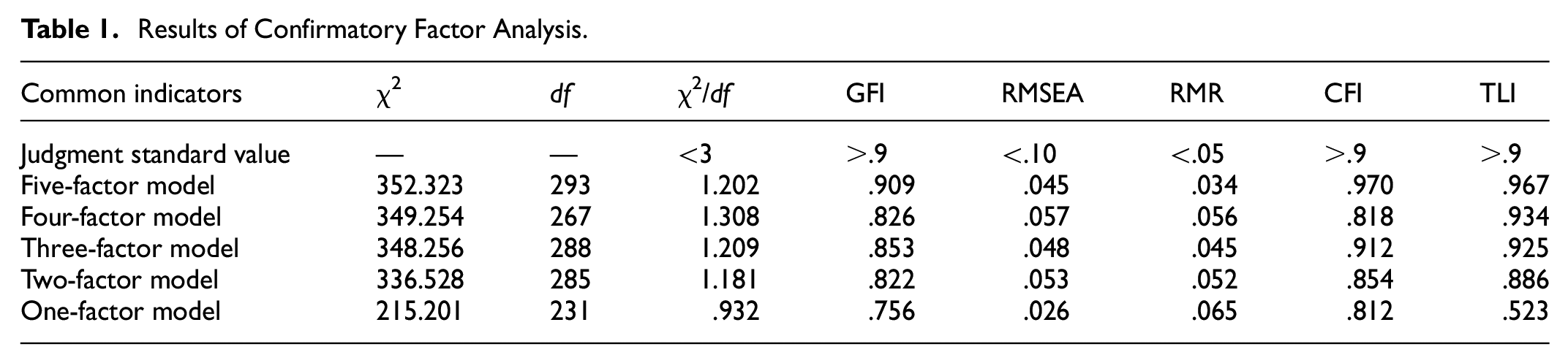
The results of the confirmatory factor analysis are presented in Table 1, with the five-factor model demonstrating the best overall fit (χ2/df = 1.202, CFI = .970, TLI = .967, RMSEA = .045). Notably, the fit indices of this model are significantly better than those of the alternative factor models, indicating strong discriminant validity among the study’s variables.
Results of Confirmatory Factor Analysis.
Correlation Analysis Among Variables
Table 2 presents the means, standard deviations, and correlation coefficients of the study variables. The results indicate that PT is significantly and positively correlated with AL (r = .411, p < .01) and CL (r = .224, p < .01). Additionally, AL is positively correlated with CIP (r = .486, p < .01), whereas CL showed a significant negative correlation with CIP (r = −.366, p < .05). These results provide preliminary support for the proposed hypotheses.
Descriptive Statistical Analysis.

p < .1. **p < .05. ***p < .01.
Hypothesis Testing
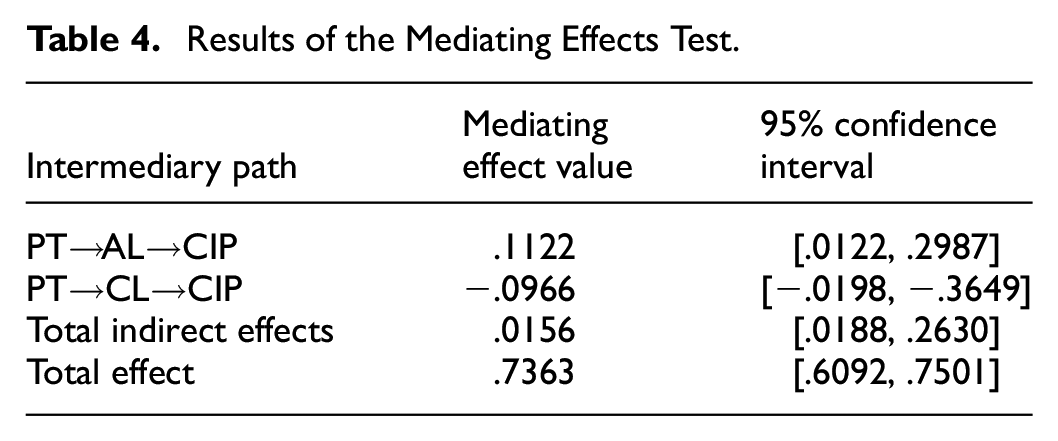
The hypotheses were tested using the PROCESS macro in SPSS software. As shown in Tables 3 and 4, PT significantly predicted both CIP (p < .01) and AL (p < .01). Furthermore, AL significantly predicted CIP (p < .01). The indirect effect of PT on CIP through AL was also significant, as the 95% confidence interval excluded zero. This confirms that PT has a significant indirect impact on CIP through AL. Additionally, PT positively predicts workload (p < .01), whereas workload negatively predicts CIP (p < .01). The indirect effect of PT on CIP through workload was also significant, with a 95% confidence interval that excluded zero. These findings support the notion of a “double-edged sword” effect, whereby PT simultaneously enhances and hinders innovation performance through different pathways.
Basic Regression Analysis Results.

Results of the Mediating Effects Test.
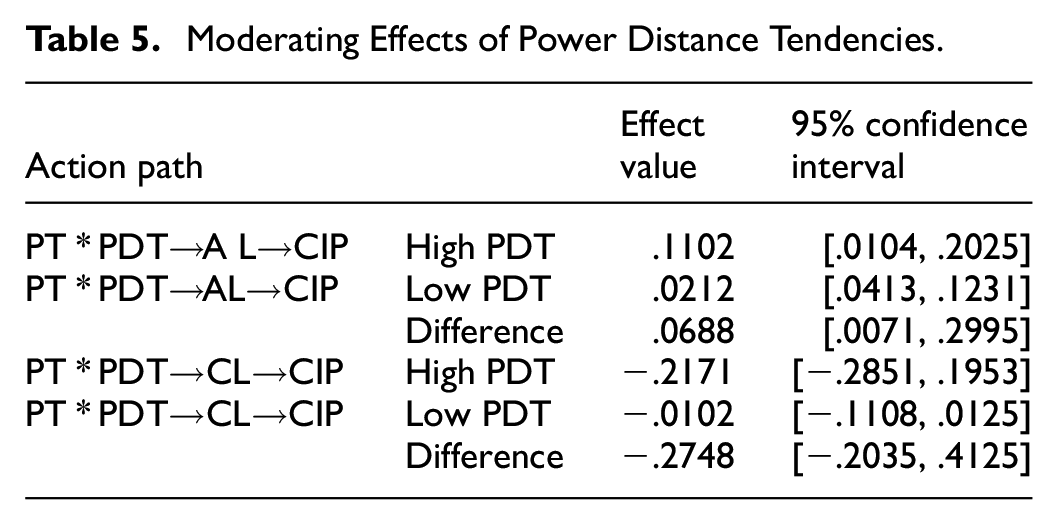
Using Process Model 7 to test moderated mediation, the results (see Table 5) show that the indirect effect of PT on CIP through AL is significant when PDT is high (indirect effect = .1102, 95% CI [.0104, .2025], excluding 0). In contrast, when PDT is low, the effect size and significance of this indirect effect diminish (indirect effect = .0212, 95% CI [.0413, .1231], excluding 0). The difference in the indirect effects across levels of PDT is also significant (difference = .0688, 95% CI [.0071, .2995]), highlighting the moderating role of PDT in the relationship between PT and CIP via AL. However, the indirect effect of PT on CIP through workload is not significant under high or low PDT. This may be attributed to the possibility that, as workload intensifies, employees become less responsive to their superior’s influence, reducing the moderating effect of PDT in this pathway.
Moderating Effects of Power Distance Tendencies.
Discussion
This study investigates the “double-edged sword” effect of PT on CIP from a team innovation management perspective. This study explores how PT can exert both positive and negative influences on innovation strategy decision-making by examining the underlying mechanisms—specifically, the mediating roles of AL and CL, as well as the moderating role of PDT. First, the findings reveal that PT enhances CIP through AL. This result is consistent with previous research that emphasizes the constructive role of certain cognitive patterns in promoting innovation. For instance, Yao and Ji (2021) found that moderate levels of PT enable employees to integrate diverse perspectives and develop new cognitive frameworks, thereby fostering the generation of innovative ideas. Second, PT can impede CIP by increasing the CL. This finding—that PT is positively associated with CL—is consistent with that of previous research. Burmeister et al. (2022) found that when individuals are required to process complex and contradictory information, their limited cognitive resources are rapidly exhausted, resulting in cognitive overload. Notably, unlike many earlier studies that emphasize only the positive effects of PT, this study highlights its “double-edged sword” nature by demonstrating both positive and negative impacts on innovation performance. Third, PDT positively moderates the mediating effect of AL in the relationship between PT and CIP. This result aligns with studies on leadership influence, such as Yating et al. (2024), who found that employees with higher power distance tendencies are more responsive to their superiors' instructions and expectations. When leaders actively promote innovation and support AL, employees are more likely to engage in these activities, ultimately enhancing CIP. However, the moderating effect of PDT on the relationship between PT and CL was not significant. This result aligns with prior studies indicating that when cognitive resources are limited, individuals tend to prioritize internal task demands over external cues (Tams et al., 2020). A possible explanation, grounded in resource conservation theory, is that high CL caused by PT compels employees to concentrate their limited mental resources on managing internal tasks and alleviating cognitive pressure. Consequently, they become less responsive to external contextual factors, such as PDT. These findings contribute to the literature on cognitive matching theory and PT and offer practical implications for human resource and innovation management within organizations.
Conclusion
Theoretical Implications
Many previous studies have primarily regarded PT as a beneficial strategy for resolving managerial contradictions and fostering team creativity; however, few have empirically examined both its positive and negative effects. This study offers a more comprehensive understanding of the effectiveness of PT by incorporating it into the team management context and investigating the diverse factors that influence team creativity.
This study further clarifies the “double-edged sword” nature of PT. Unlike prior research that primarily explored its boundary conditions through literature reviews, this study introduces AL and CL as key mechanisms to investigate the nuanced effects of PT on team innovation decision-making. Due to the complex and often conflicting elements involved in the innovation process, isolating task dynamics and capturing contextual characteristics has proven difficult. By addressing these challenges, the study contributes meaningfully to the literature on the dynamic PT model and offers valuable insights for advancing team management and decision-making theories.
Finally, by incorporating the concept of PDT, this study provides empirical insights into how superior-subordinate relationships influence team innovation decision-making, thereby advancing research on the dynamics of PT. A harmonious relationship between superiors and subordinates can effectively align with managerial philosophies and enhance the team’s capacity to explore the creative potential of PT. Conversely, a lack of mutual understanding may obstruct this process and limit team creativity development. Thus, the study not only validates the role of collective cognition in fostering innovation but broadens the theoretical scope and practical applicability of team management frameworks.
Practical Implications
First and foremost, organizations should acknowledge the diversity and complexity inherent in PT and guide team members in applying it effectively to address complex problems in appropriate task contexts while mitigating potential drawbacks. Managers are encouraged to adopt a balanced perspective—neither fully embracing nor outright rejecting PT. Instead, they should consider the nature of specific tasks, particularly during demanding phases that require extensive information gathering and thorough discussion. For instance, when tackling exploratory tasks such as developing entirely new products that demand innovative approaches beyond traditional thinking, managers should actively encourage and support team members in confidently applying PT to stimulate creativity and novel solutions. Team members should evaluate the diversity and simplicity of product functions from multiple perspectives, deeply analyze strategies for targeting customer segments with both breadth and precision and actively stimulate creative inspiration to uncover breakthrough opportunities for innovation. However, during the more stable phases of a project—such as standardized production or product launch—It is important to remain mindful of the potential downsides of PT, which may lead to delays in decision-making and misallocation of resources. At this stage, managers should prioritize fostering a cohesive and positive team environment by organizing diverse team-building activities, establishing fair and motivating performance evaluation and reward systems, and strengthening team cohesion and collaboration. Such efforts can effectively minimize internal conflicts that may arise from mishandled contradictions, thereby ensuring the smooth and sustained progress of the team’s innovation efforts.
Second, managers should adapt their leadership strategies and behaviors promptly based on the evolving stages of innovation tasks while strengthening effective communication with team members. Simultaneously, attention should be given to developing mechanisms for managing stress to effectively regulate the intensity of work pressure and CL experienced by team members. This is especially important given the study’s findings that AL and CL act as drivers of positive and negative innovation outcomes, respectively. Therefore, during innovation implementation, team leaders should actively inspire members' initiative and creativity, closely monitor and appropriately manage cognitive stress, and foster a high-quality team environment that encourages open information exchange and constructive debate. During the project kick-off meeting, managers should clearly define the project objectives and stage-specific tasks, while encouraging team members to maintain an open mindset throughout the innovation process—welcoming contradictory viewpoints but adhering to agreed-upon discussion rules and time limits to avoid unproductive debates that drain team energy and time. Throughout the implementation phase, managers should hold regular progress updates and brainstorming sessions to stay informed about team members’ ideas and concerns and help them resolve cognitive conflicts stemming from PT through logical reasoning and data-driven analysis. For instance, when debating whether to prioritize emerging market development or consolidating existing markets, managers can guide the team to gather relevant market data and analyze competitor strategies, enabling a balanced decision that maximizes innovation performance.
Policy Implications
At the macro policy orientation level, policymakers should encourage enterprises to actively integrate the concept of PT into innovation strategy planning and organizational management policymaking. By introducing supportive industrial policies and providing management guidelines, they can help businesses recognize that in today’s complex and rapidly changing market environment—characterized by challenges such as technological innovation, market adaptation, and the need to balance short-term gains with long-term development—effectively applying PT can significantly boost innovation vitality and industry-wide competitiveness. For instance, in the policy planning of high-tech industrial parks, specialized training programs and lectures on PT could be organized to engage management and innovation teams. These initiatives would equip enterprises with tools to better evaluate and balance the risks and rewards associated with R&D investment, intellectual property protection, and technology diffusion, thereby fostering the healthy development of regional innovation ecosystems.
Furthermore, policymakers should consider how power structures and organizational culture within enterprises influence the application of PT and develop appropriate policies to guide and support this process. Given the moderating role of PDT in the relationship between PT and CIP, policies can encourage enterprises to adopt flatter organizational structures and more democratic communication styles. For example, corporate governance policies can promote the establishment of diversified decision-making mechanisms, such as by involving employee representatives in innovation strategy committees. This approach helps reduce hierarchical distance between management and staff, fosters open information exchange, and enhances the positive impact of PT on innovation-related decision-making. At the same time, it helps prevent the suppression of innovation that can result from excessive centralization of authority or rigid hierarchical barriers.
Additionally, industry associations and professional organizations should be supported by policies to develop and promote industry standards related to PT and innovation management. Through self-regulation and professional guidance, these associations can help enterprises reach a unified consensus on how to apply PT and establish best practices within the industry. For example, industry associations can create guidelines for incorporating PT into innovation project management, outlining how to balance contradictions such as product diversification versus cost control, and market segmentation versus full coverage at various stages of innovation, including idea generation, product development, and market launch. These guidelines can include case studies and evaluation frameworks to help enterprises enhance their capacity to apply PT, thereby improving the overall innovation performance of the industry.
Footnotes

Ethical Consideration
All procedures performed in the study were in accordance with the ethical standards of the university. The School of Public Policy and Management Ethics Review Committee at Anhui Jianzhu University approved our interviews on December 18, 2023.
Consent to Participate
Respondents gave written consent for review and signature before starting interviews. Informed consent was obtained from all individual participants included in the study.
Author Contributions
Writing – original draft, Writing – review & editing, Methodology: Binbin Zhao. Investigation, Formal analysis: Zhongli Zhang and Mengyun Zhang. Writing – original draft, Writing – review & editing, Methodology: Binbin Zhao and Zhongli Zhang. Writing – review & editing, Conceptualization, Funding Acquisition, Supervision: Binbin Zhao and Mengyun Zhang.
Funding
The author(s) disclosed receipt of the following financial support for the research, authorship, and/or publication of this article: This research was funded by Anhui Social Science Planning Youth Project (Grant No. AHSKQ2021D78).
Declaration of Conflicting Interests
The author(s) declared no potential conflicts of interest with respect to the research, authorship, and/or publication of this article.
Data Availability Statement
The data presented in this study are available on request from the first author.