




Abstract
Previous research has proposed a conceptual model of the relationships between motivation, emotions, cognition, and metacognition related to students’ learning performance and validated it in a blended learning context that combines traditional learning with the use of educational technology. This study examined these relationships to test the hypothesis that the levels of some factors in a face-to-face learning environment differ from those in a blended learning context, finding that the conceptual model is valid for both settings. The role of positive emotions was significant in blended learning but not in face-to-face learning. Furthermore, help-seeking and peer learning were relevant only in blended learning. A positive relationship between academic motivations and metacognitive strategies was found in the face-to-face context, whereas one from motivations to metacognitive and cognitive strategies was found in the blended context. Negative emotions were present in both learning settings. This shows that the role of emotions is relevant to students’ perceived success.
Introduction
Students’ poor learning outcomes are a multifactorial problem related to low learning performance, motivation, self-regulation, and negative emotions, among other inter- and extrapersonal factors. Theories and models have been proposed to explain the relationships between the intrapersonal factors that influence students’ learning performance, including motivation, emotions, cognition, and metacognition. Motivation is an instigated, sustained, and goal-directed process influenced by social and cognitive factors (Anderman & Dawson, 2011; Schunk et al., 2008). Emotions include real or unreal feelings that an individual has about a situation or another individual (Pons et al., 2011). Cognition comprises judgments, memory, and reasoning (Efklides, 2011; Mayer et al., 1997; Pintrich, 2004). Finally, metacognition is cognition about cognition (Broadbent, 2017; Efklides, 2011; Flavell, 1976; Metcalfe & Shimamura, 1996), a higher level function that can affect the cognitive process.
The control-value theory (Pekrun, 2006) is a framework for analyzing the relationships between cognition, motivation, and emotion that has been validated in different learning contexts (Artino, 2009; Butz et al., 2015, 2016; Daniels & Stupnisky, 2012; Niculescu et al., 2015; Pekrun et al., 2011; Putwain et al., 2018; Stark et al., 2018). This theory analyzes achievement emotions, which refer to emotions related to achieving an academic goal, such as studying for an exam. The control-value theory deems two dimensions of appraisals, perceived control and perceived value. Perceived control includes a sense of control over activities and outcomes that can be executed by the student or external factors; it also involves the probability to obtain the desired outcome. Perceived value implies the degree of importance that activity has for the students and the positive or negative value that the students give an academic assignment. Both students’ control and value appraisals predict their emotions (Pekrun & Perry, 2014). The achievement emotions are crucial in an academic setting because these determine the learning strategies, and metacognitive and cognitive resources that students are going to use and, ultimately, will determine their academic performance (Daniels & Stupnisky, 2012).
Other studies have investigated these relationships in different terms; for example, Efklides (2011) proposes the metacognitive and affective model of self-regulated learning as a dynamic process that studies the effect of cognition, metacognition, motivation, and emotions on self-regulated learning. Students’ decisions on what strategies they will use are determined by their abilities, metacognitive skills, motivation, and emotions, as well as their metacognitive, emotional, and affective experiences on academic activities. Thus, it is essential to study the effects of these links on students’ performance.
The conceptual model proposed by (Ramirez-Arellano et al., 2018) indicates causal and reciprocal relationships between motivation, emotions, cognition, metacognition, and students’ academic achievements (Figure 1). However, the model has only been validated in a blended context.

Conceptual model of the relationships between motivation, emotions, cognition, metacognition, and academic achievements (adapted from Ramirez-Arellano et al., 2018).
The face-to-face learning context is a traditional environment for instruction, which relies on human–human interaction (Vernadakis et al., 2012). The blended learning context is the mixture of face-to-face (or traditional) learning methods, instructions, and practices with an online environment (Brown, 2016; Drysdale et al., 2013) for sharing learning materials and evaluating the students that support asynchronous communication (teacher–student and student–student).
Educational psychologists have demonstrated that academic motivation is contextual and may vary depending on the educational context (Linnenbrink-Garcia et al., 2016). While the role that emotions play during students’ learning is essential, these emotions may be influenced by the affective attachment that students develop with teachers (Moriña, 2019). This shows that teachers play a crucial role in fomenting students’ motivation and emotions (Trigueros et al., 2020). Both academic emotions and motivation are a critical part that determines students’ learning and persistence in the classroom (Linnenbrink-Garcia et al., 2016).
Analyzing the effects of academic motivation and emotions in a traditional classroom, several studies have shown that students’ motivation is highly related to emotions (Butz et al., 2015; Pekrun & Perry, 2014; Putwain et al., 2018; Stark et al., 2018) and performance (Chatzistamatiou et al., 2015; Cho & Heron, 2015).
Others studies have also compared the effects of students’ emotions and motivation in a different learning context, their findings have demonstrated that levels of negative emotions differ between face-to-face and online learning contexts, online students reported higher levels of anger and anxiety than face-to-face students (Butz et al., 2015), while the boredom levels of face-to-face students were higher than those of online students (Butz et al., 2016). However, other studies have found no differences in the emotions experienced by students in online and face-to-face contexts (Daniels & Stupnisky, 2012).
The effects of the motivation and emotions on the use of learning strategies have also been investigated comparing different learning settings. For example, in comparing online and traditional students, some educational researchers have been found that negative emotions—frustration and anxiety—predicted the use of learning strategies for students in the traditional environment, but not for students in the online learning environment (Marchand & Gutierrez, 2012). In contrast, another study found that students in the online context perceived that metacognitive and effort regulation strategies were stronger than for traditional students (Quesada-Pallarès et al., 2019). Similarly, the study by Broadbent and Poon (2015) demonstrated that learning strategies of time management, metacognition, critical thinking, and effort regulation were relevant to academic success in the online context, while that in the traditional context their effects were smaller. However, a few studies have analyzed these effects between online and blended contexts. The research by Broadbent (2017) found that students’ academic performance is highly determined by the use of cognitive practices, metacognitive strategies, and resource management strategies for both online and blended contexts.
To the authors’ best knowledge, only a few comparative studies have been conducted on face-to-face and blended learning contexts. To clarify the role of the learning context on motivation, emotion, learning strategies, cognition, metacognition, and learning achievements, the objective of this study is to compare the relationships introduced by the model in (Ramirez-Arellano, Acosta-Gonzaga, Bory-Reyes and Hernández-Simón, 2018) to support the conjecture that the levels of some factors in a face-to-face learning environment differ from those in a blended learning context. Thus, this study analyzes the following hypothesis:
This article is organised as follows. The first section introduces a brief description of relevant related work. The next sections illustrate the methodology, research method, and results, respectively. Finally, the last section presents the discussion and conclusions.
Related Work
The following section presents previous research on face-to-face and technology-based learning settings concerning the effects of cognition, metacognition, emotions, and motivation on students’ learning outcomes.
Cognition and Metacognition in Face-to-Face and Technology-Based Learning Contexts
Several studies have compared the relationships between learning outcomes and forms of metacognition such as self-regulation (Barnard et al., 2009; Broadbent, 2017; Broadbent & Poon, 2015).
In terms of face-to-face learning contexts, the significant effects of metacognition and learning strategies on students’ learning achievement have been widely studied (Asikainen et al., 2018; Efklides, 2018; King & McInerney, 2016). In studying the self-regulated learning strategies (metacognitive factors), several studies have corroborated that students with higher levels of self-regulation achieved higher learning outcomes (Chatzistamatiou et al., 2015; González et al., 2016). In particular, regarding the research about the metacognitive construct of critical thinking, it was demonstrated that this has a positive effect on learning outcomes (Haseli & Rezaii, 2013; Kong, 2014; Mega et al., 2014; Pérez et al., 2012). Therefore, the studies above show that the effects of the cognitive and metacognitive strategies on students’ learning achievements were corroborated in a face-to-face context.
The effects of metacognition on students’ learning outcomes have recently been analyzed in blended and online contexts as well. It has found evidence that there is a correlation between cognitive and metacognitive strategies with students’ motivations and emotions (Kim et al., 2014). The strategies of self-regulation are also highly correlated with motivation, which plays an essential role in encouraging students to use learning strategies to obtain the desired goal (Schumacher & Ifenthaler, 2018).
This evidence is sustained by Vanslambrouck et al. (2019) who examined the self-regulation strategies of adult students in a blended learning context, finding that students used strategies such as organizing, rehearsal, and help-seeking. Moreover, a systematic review by Broadbent and Poon (2015) showed that critical thinking, a metacognitive process, correlated positively with the online grade, whereas learning strategies (rehearsal, elaboration, and organization) did not correlate with academic outcomes.
Similar findings can be seen in the meta-analysis by Ohtani and Hisasaka (2018) who demonstrated that the relationships between metacognitive strategies, academic performance, and intelligence, finding that metacognition was a more significant predictor of academic achievement than intelligence in the online learning context. Broadbent (2017) similarly analyzed self-regulation (a metacognitive strategy), time management, elaboration, and rehearsal (learning strategies) in online and blended contexts, finding that self-regulated learning correlates with academic performance, time management and elaboration are relatively important, while rehearsal is not relevant to academic achievement in online and blended contexts. Finally, Broadbent and Poon (2015) found a weaker relationship between metacognitive processes and self-regulation in online than in face-to-face contexts.
Emotions in Face-to-Face and Technology-Based Learning Environments
Emotions have a significant effect on learning achievement in face-to-face, blended, and online settings. In face-to-face environments, emotions are positively associated with motivations and learning strategies in reaching achievements (Pekrun & Perry, 2014). Research has shown that positive and negative emotions influence cognitive and learning strategies in different ways (Daniels et al., 2015; Marchand & Gutierrez, 2012; Mega et al., 2014). Positive emotions (enjoyment, curiosity, and pride) increase the use of flexible learning strategies, self-regulation, and critical thinking (Pekrun et al., 2011; Pekrun & Perry, 2014). For example, the study by Chatzistamatiou et al. (2015) found that enjoyment was related to motivation and self-regulation, which in turn can influence students’ current and future engagement. Also, Ranellucci et al. (2015) demonstrated that enjoyment was useful to predict students’ learning strategies such as elaboration, critical thinking, and self-monitoring.
On the contrary, negative emotions reduce the use of self-regulation practices and promote external guidance (Mega et al., 2014; Pekrun, 2011; Tze et al., 2014, 2016). Evidence was found in the study by Tze et al. (2016) who noted that boredom has a significant impact on motivation, learning strategies, and academic outcomes, having the highest detrimental impact on students’ achievement. Similarly, Marchand and Gutierrez (2012) demonstrated that students who felt very frustrated were more likely to use less meaningful learning strategies; their study also gives evidence that there is a strong relationship between anxiety and the use of meaningful learning strategies. Furthermore, Pekrun (2011) showed that negative emotions—anger, anxiety, and shame—decrease intrinsic motivation but increase extrinsic motivation, encouraging students to avoid failure. Daniels et al. (2015) suggested that cognitive strategies may reduce the effect of boredom.
In online settings, Kim et al. (2014) found that students’ emotions to be positively correlated with motivation and performance. This can be observed in the study by Butz et al. (2015) and Price et al. (2018) who examined the effects of emotions on students’ overall achievements, analyzing their impact on metacognitive and cognitive strategies. Students with a lower level of boredom but higher levels of enjoyment and pride used higher levels of cognitive strategies, whereas students who felt less bored, angry, shameful, and hopeless but more engaged and prideful used a higher level of metacognitive strategy (self-regulation).
Similarly, Kim and Hodges (2012) indicated that enjoyment and pride have positive effects on motivation, whereas boredom, anxiety, anger, shame, and hopelessness have the opposite effect. This is also in line with Cho and Heron (2015), who found that negative emotions (anger, anxiety, and shame) reduce intrinsic motivation, which encourages students’ avoidance of failure and the use of more meaningful learning strategies, concluding that students need motivational and emotional support to reach achievement satisfaction.
Finally, in comparative studies, Marchand and Gutierrez (2012) found that in blended and face-to-face settings, the positive emotion of hope has a positive relationship with the cognitive strategy of elaboration, and that self-efficacy is the most important predictor of students’ emotions in both contexts. However, the effect of frustration and anxiety on learning strategies was significant for traditional students but not for online students. While Acosta-Gonzaga and Walet (2018) compared computer-based versus traditional assessments for teaching mathematics, their results suggest that enjoyment plays an important role in adopting online assessments.
Motivation in Face-to-Face and Technology-Based Learning Environments
In traditional settings, it has been demonstrated that motivation has a significant effect on students’ learning outcomes. For example, the study by González et al. (2016) found a direct effect of motivation on metacognition, whereas the study by Stewart et al. (2015) showed that the effects of self-efficacy (a motivational component) during the use of metacognitive strategies were stronger than the negative emotion of anxiety. In English teaching, Zhang et al. (2017) found that learning strategies mediate the relationship between motivation and vocabulary acquisition. Likewise, Pekrun and Perry (2014) and Putwain et al. (2018) proposed that motivation is positively related to enjoyment and negatively related to boredom. Furthermore, Chatzistamatiou et al. (2015) suggested that students who value an academic task (a component of motivation) will use metacognitive or cognitive strategies to attain a better outcome. Thus, the degree of motivation will determine the selection and use of learning strategies, which in turn will affect students’ academic achievement (Ulstad et al., 2018).
The effects of motivation on students’ emotions have also been observed in online contexts. For example, in comparing online students versus on-campus students, Butz et al. (2015) found that students with a higher self-efficacy have lower levels of boredom, anxiety, anger, shame, and hopelessness; higher levels of enjoyment and pride; and higher levels of cognitive strategy and self-regulation. This finding is similar to that found by Barak et al. (2016), who have corroborated that intrinsic motivation encourages students to learn in Masive Open Online Courses (MOOC). This means that when a student feels competent, it has observed that self-efficacy beliefs are positively related to positive emotions, whereas students who feel very frustrated are more likely to use less meaningful learning strategies (Marchand & Gutierrez, 2012). Also, in using multimedia resources for learning, it has found that the learning environment influences the emotions of students, which in turn affected their achievements; the study highlighted that students’ emotions were essential predictors of their learning (Stark et al., 2018). Therefore, similar to the face-to-face context in online settings, is well recognized that motivations and emotions are associated with students’ achievements (Cho & Heron, 2015).
Contrasting online and blended contexts, Vanslambrouck et al. (2018) examined students’ motivations and found that students appreciate face-to-face sessions, while the flexibility of online sessions motivates students’ participation, concluding that the right balance between face-to-face and online sessions is necessary. Similarly, Butz et al. (2015) found that students’ control and value appraisals are highly associated with emotions and students’ achievements and that this relationship is affected by synchronous hybrid learning environments.
Research Method
The authors used structural equation modeling (SEM) to estimate the causal relationships in both face-to-face and blended models. In the face-to-face learning context, data to construct the causal model were collected from 222 university students enrolled in several courses in management and industrial engineering degree programs at a University in Mexico: 119 participants are male and 103 participants are female between the ages of 19 and 21 years (M = 20.5, SD = 2.1). Students were surveyed at the end of their courses. The surveys were anonymous and answered in pencil-and-paper format. To obtain their final grade, the students had to take three paper-based exams. Data collection took place from September to December 2018, and all the students participated voluntarily.
In the blended learning context, data were collected from 116 Mexican students (49 males and 67 females) between the ages of 20 and 22 years (M = 20.66, SD = 1.87). University students were enrolled in a blended course in applied computing in biological sciences as part of a chemical biology degree program. The Moodle platform was utilized to deliver lectures, learning activities, and materials, which were designed following multimedia principles (coherence, redundancy, spatial contiguity, and modality; R. E. Mayer, 2001) and considering the SCORM (Sharable Content Object Reference Model) standard (The Advanced Distributed Learning Initiative, 2004). A Moodle log file was utilized to record the interactions between the students and the learning materials. The blended course also included face-to-face sessions (one per week) for student feedback and in-depth explanations of learning activities. The lectures and learning content were organized on a weekly schedule, often comprising learning activities that had to be delivered within the same week through Moodle. The lectures that were scheduled for a given week remain opened until the end of the course; thus; the students can review it several times as they need. Three online course exams were considered for the overall grade (OG) of each student. At the end of their courses, students were surveyed using the Moodle platform.
From the beginning of the study, all students were informed of the aim of the research; they expressed their consent to participate voluntarily in the study. It was also explained that they could withdraw their consent at any time. All students agreed for their data to be used in the study (British Educational Research Association, 2018).
Instruments
For both learning settings, the authors used the Student Engagement and Disaffection in School (SED; Skinner et al., 2008) questionnaire to measure students’ negative—boredom, frustration, and anxiety—and positive—enjoyment, enthusiasm, fun, pride, and interest—emotions. The students responded on a 5-point Likert-type scale between 1 (strongly disagree) and 5 (strongly agree).
The Motivated Strategies for Learning Questionnaire (MSLQ; Pintrich, 1991; Pintrich & de Groot, 1990) evaluates the value and expectancy components of motivation in both face-to-face and blended learning contexts. The value component comprises intrinsic goal motivation (IGM), extrinsic goal motivation (EGM), and task value, whereas the expectancy component comprises control of learning beliefs, self-efficacy, and test anxiety. Self-regulation and critical thinking belong to metacognitive strategies. Organization, elaboration, and rehearsal belong to cognitive strategies, whereas help-seeking, peer learning, effort regulation, and time and environment belong to learning strategies. The questions in this survey were answered on a Likert-type scale between 1 (not at all true of me) and 7 (very true of me).
Finally, a construct of learning achievement was computed for both learning contexts, including OG. For the face-to-face learning context, OG was calculated by considering learning activities and exams. For the blended learning context, OG was calculated by considering online examinations, learning activities, and an end-of-term project. The interactions between the students and the learning content were recorded in a Moodle log file. As the learning content complies with the SCORM standard (The Advanced Distributed Learning Initiative, 2004), Moodle can track the number of items reviewed in each piece of learning content. The learning content and SCORM objects were organized in a hierarchical structure of topics and subtopics. Students had to examine all topics and subtopics to review a given learning content. Students needed to log in to Moodle each time to review the learning content of the current or previous session. They were not permitted to download the learning content or to browse it offline. A weekly face-to-face session was scheduled to give feedback and explain the learning activities in detail.
Data Gathering and Data Analyses
The study aimed to validate and compare a set of causal relationships between the constructs in two learning contexts. For both learning contexts, students answered the SED and MSLQ instruments in the middle of the course, after the first exam was done. Each student’s OG was reported at the end of the semester.
Before applying the SEM, the validity and reliability of the constructs were confirmed. Cronbach’s alphas higher than or equal to .70 were acceptable for internal consistency. Composite reliability (CR) and average variance extracted (AVE) indicate convergent validity, with values higher than .7 for CR and .5 for AVE being acceptable (Hair et al., 2006). Discriminant validity is established when the square root of AVE of each construct is higher than the correlation between the other constructs (Fornell & Larcker, 1981).
The SEM analyses were performed using AMOS (Version 22) with the maximum likelihood estimation procedure. To measure the model’s fitness, χ2/df, Tucker–Lewis index (TLI), comparative fit index (CFI), normed fit index (NFI), and root mean square error of approximation (RMSEA) were considered. The acceptable values for χ2/df were below 5 (MacCallum et al., 1996), those for TLI, CFI, and NFI were above 0.90 (Byrne, 2016), and those for RMSEA ranged from 0.08 to 0.05 or less (Byrne, 2016). Also, a two-way analysis of variance (ANOVA) was conducted to measure the effect of the students’ gender and the learning context (blended or face-to-face) on the subconstructs of the causal model such as IGM, EGM, and help-seeking.
Results
Reliability and Validity
Table 1 presents the results of the causal models for face-to-face and blended settings with Cronbach’s alpha, CR, and AVE. In the face-to-face context, the latent variables included motivation, negative emotions, metacognitive strategies, cognitive strategies, learning strategies, and learning outcomes. The Cronbach’s alphas of all constructs ranged between .727 and .865, which are acceptable for the SEM, and the CR and AVE values were above .9 and .6, respectively.
Cronbach’s Alpha, CR, and AVE of Constructs (Latent Variables) of the Hypothetical Causal Models in the Face-to-Face and Blended Learning Contexts.
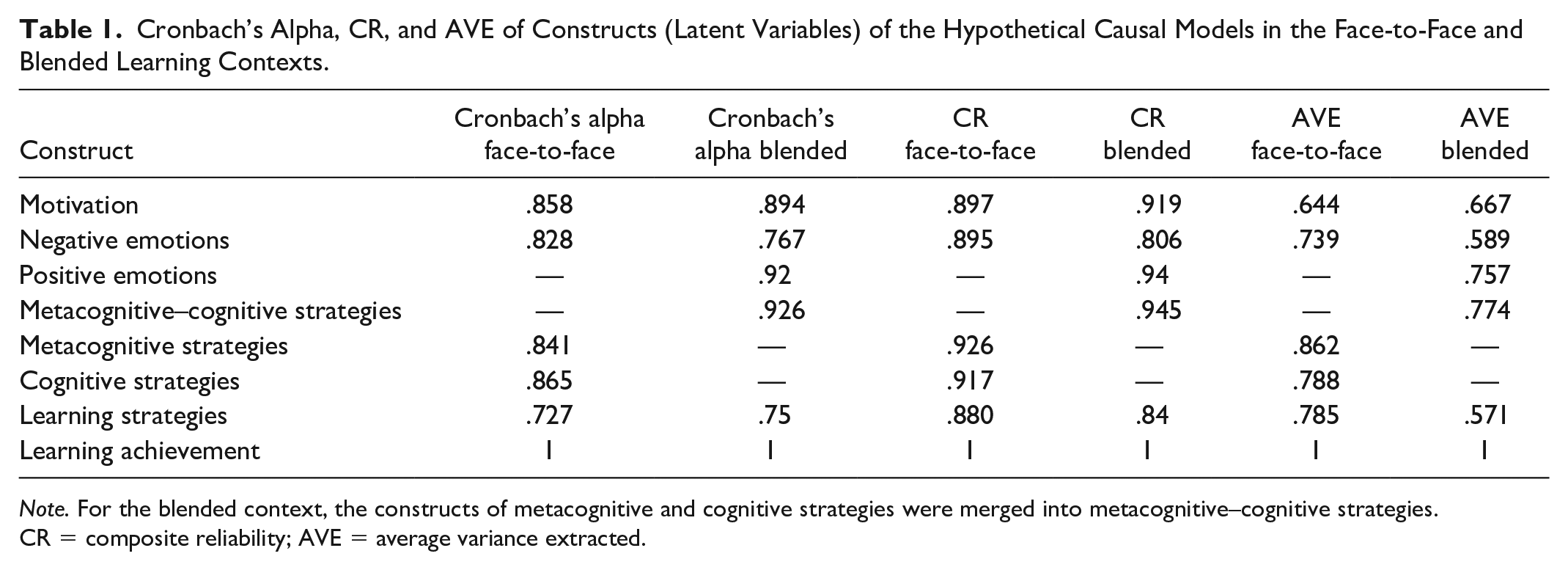
Note. For the blended context, the constructs of metacognitive and cognitive strategies were merged into metacognitive–cognitive strategies. CR = composite reliability; AVE = average variance extracted.
In the blended context, the latent variables included motivation, positive emotions, negative emotions, metacognitive–cognitive strategies, learning strategies, and learning outcomes. The Cronbach’s alphas of all constructs ranged between .767 and .926, which are acceptable for the SEM, and the CR and AVE values were above .9 and .6, respectively. Thus, for both contexts, convergent validity was confirmed for all the constructs.
Table 2 shows the discriminant validity for the face-to-face context, and Table 3 shows the discriminant validity for the blended context. In both tables, the values aligned diagonally show the square root of AVE, and the others show the correlations. As the diagonals show higher values than the correlations, discriminant validity was established for all the constructs. Therefore, discriminant validity was confirmed in the face-to-face learning context. To confirm the discriminant validity in the blended context, the constructs of metacognitive and cognitive strategies were merged into one and named metacognitive–cognitive strategies.
Discriminant Validity of Constructs (Latent Variables) of the Hypothetical Causal Models in the Face-to-Face Learning Context.

Note. The values in the diagonal are the square root of each construct’s AVE, and the values off-diagonal are the correlations between the constructs. AVE = average variance extracted.
Discriminant Validity of Constructs (Latent Variables) of the Hypothetical Causal Models in the Blended Learning Context.

Note. The values in the diagonal are the square root of each construct’s AVE, and the values off-diagonal are the correlations between the constructs. AVE = average variance extracted.
Causal Model
Figure 2 shows the results of the causal model in the face-to-face and blended learning contexts with path weights standardized. In the blended context, the causal model fit the data well with χ2/df = 1.737, TLI = 0.904, CFI = 0.919, NFI = 0.90, and RMSEA = 0.080. In the face-to-face context, the results are also suitable, with χ2/df = 2.633, TLI = 0.917, CFI = 0.936, NFI = 0.902, and RMSEA = 0.080. All the constructs except positive emotions were significant for both contexts, with positive emotions only being meaningful in the blended context.

Results of the causal model.
The following relationships were significant for both learning contexts. Motivation has a positive causal relation with metacognitive strategies, as motivated students emphasize the autonomy and control of the learning (Figure 2). The path coefficient of motivation to metacognitive strategies in the face-to-face context was higher than the path coefficient of motivation to metacognitive–cognitive strategies in the blended context, indicating that face-to-face students apply reasoned judgments and analyze data and facts to draw reasonable conclusions more so than blended learning students.
In the face-to-face setting, students use learning strategies such as time and environment management and effort regulation, which are influenced by cognitive strategies such as organization, elaboration, and rehearsal. Students in the blended context apply the same learning strategies as traditional students except for peer learning and help-seeking. Furthermore, learning strategies have a positive influence on students’ achievements, and the path coefficients in both contexts are similar (face-to-face: .312***; blended: .369***). A relationship between metacognitive and cognitive strategies was only observed in the face-to-face context because the two were joined into a single construct in the blended context.
The latent endogenous construct of motivation has a significant causal relation with negative emotions. The difference in the contexts’ path coefficients (face-to-face: –.754; blended: –.325) means that students’ motivation in the blended context mitigates negative emotions more effectively. The results also highlight the negative impact of negative emotions on learning strategies. This effect is higher in the blended learning environment (–.181*) than in the face-to-face context (–.424***).
Finally, in the blended learning context, students’ academic motivation influences positive emotions, which are critical in determining how students select metacognitive and cognitive strategies.
The Effect of Learning Context and Gender
The result of two-way ANOVA shows no significant interaction between the effect of the learning context and gender on IGM, EGM, task value, control of learning beliefs, self-efficacy, rehearsal, elaboration, organization, self-regulation, critical thinking, boredom, frustration, anxiety, effort regulation, and time and environment (p >.01). However, the main effect of learning context shows that face-to-face students have higher levels of IGM (M = 5.28, SD = 0.72), EGM (M = 5.24, SD = 0.86), task value (M = 5.45, SD = 0.78), control of learning beliefs (M = 5.23, SD = 0.71), and self-efficacy (M = 5.33, SD = 0.71) than blended students: IGM (M = 4.94, SD = 0.76), EGM (M = 4.69, SD = 0.75), task value (M = 5.0, SD = 0.75), control of learning beliefs (M = 4.84, SD = 0.73), and self-efficacy (M = 4.78, SD = 0.66) (p < .01). On the contrary, face-to-face environments have less level of help-seeking (M = 4.26, SD = 0.7) than their counterparts in a blended environment (M = 4.58, SD = 0.78) (p < .01). The female students report significantly higher levels of organization (M = 5.1, SD = 0.73) than male students (M = 4.84, SD = 0.79) (p < .01).
Discussion and Conclusion
Based on the literature and “blinded,” this study validated the influence of motivation, emotions, cognition, and metacognition on students’ learning performance in face-to-face and blended learning settings, confirming that these relationships depend on the learning context (Pekrun, 2006; Ranellucci et al., 2015). However, positive emotions were significantly related to metacognitive strategies only in the blended context. This indicates that positive emotions such as enthusiasm or enjoyment encourage students to use more sophisticated metacognitive and cognitive strategies, as was also pointed out by Linnenbrink-Garcia et al. (2016). Similar results are also mentioned by Kim et al. (2014), who found that students’ cognitive processes can differ according to their emotions. Likewise, Butz et al. (2015) stated that emotions are useful in explaining cognitive processes and metacognitive strategy (such as self-regulated learning), whereas Marchand and Gutierrez (2012) demonstrated a positive association between hope and sophisticated studying strategies (such as elaboration).
This study also found that peer learning, help-seeking, and test anxiety were significant for blended learning students but not for traditional students (Broadbent, 2017; Broadbent & Poon, 2015). This could indicate that blended learning students tend to support their learning by using strategies such as peer learning and help-seeking more often than traditional students do. Broadbent (2017) and Maki and Maki (2007) found similar results, with blended learning students outperforming traditional students in the use of learning strategies. This is also consistent with Sun et al. (2018), which found that students tended to apply help-seeking as a learning strategy in the pre-class component (internet-based learning) of a flipped math course. Their results also showed that help-seeking was essential in obtaining higher academic achievements.
The results also showed that students’ motivations in the blended context were significantly correlated with positive emotions, as indicated by Butz et al. (2015) and Schumacher and Ifenthaler (2018).
The relationships between motivation, emotions, cognition, metacognition, and learning achievements are preserved in the face-to-face context, except that blended learning students do not recognize the use of metacognitive and cognitive strategies separately. Although Broadbent and Poon (2015) compared online and traditional students, their findings indicated that peer learning (a learning strategy) is prioritized in the context of online learning. The authors also pointed out that cognitive strategies such as rehearsal, elaboration, and organization were related to traditional students’ grades, concluding that the effects of the metacognitive strategy of self-regulation are weaker in the online context than in the traditional classroom, as was confirmed in this study.
The findings reveal a strong relationship between students’ academic motivations and metacognitive strategies (i.e., self-regulation and critical thinking) in the face-to-face context, and motivation and metacognitive–cognitive strategies in the blended context, which means that students who are motivated by IGM, EGM, and task value tend to apply more sophisticated metacognitive strategies such as self-regulated learning and critical thinking. The differences found in the contexts imply that academic motivation depends on the learning context; in other words, academic motivation is contextual, and can vary over time and be determined by teachers, parents, or peer activity (Linnenbrink-Garcia et al., 2016). This finding is consistent with the findings of Butz et al. (2015). Moreover, a component of motivation, self-efficacy, is essential in applying various metacognitive strategies and resources that are crucial for academic achievement (Komarraju & Nadler, 2013; Linnenbrink-Garcia et al., 2016) as was validated in this study. Students who chose blended and online courses were more willing to perceive themselves as competent to be successful in their studies (Clayton et al., 2010).
In the face-to-face learning context, a positive and direct association was observed between metacognitive and cognitive strategies, which may imply that students who practice critical thinking and self-regulated processes also apply cognitive strategies such as organization, elaboration, and rehearsal (Varasteh et al., 2016).
Students’ motivation has been found to decrease negative emotions (Pekrun & Perry, 2014 ; Putwain et al., 2018). However, previous evidence also highlights that technology-based students report higher levels of technology-related anger, anxiety, and helplessness (Butz et al., 2015; Loderer et al., 2020). The findings of this study show that those negative emotions occurred in both learning contexts, indicating a significant role of emotions in students’ perceived success (Butz et al., 2015; Cho & Heron, 2015; Ranellucci et al., 2015) and that emotions depend on the related technology-based learning environment (Loderer et al., 2020).
Cognitive learning strategies in the face-to-face context increase the use of learning strategies such as effort regulation and time and environment (Stegers-Jager et al., 2012). For both learning contexts, the results showed that bored, frustrated, and anxious students tend not to use learning strategies. This is consistent with Tze et al. (2016), who mentioned that academic boredom negatively affects students’ learning process and achievement. In addition, the path from negative emotions such as frustration and anxiety to learning strategies was significant for the traditional setting (Linnenbrink-Garcia et al., 2016; Marchand & Gutierrez, 2012; Ramirez-Arellano et al., 2018); also, learning strategies positively influence students’ learning achievement (Price et al., 2018; Puzziferro, 2008; Ramirez-Arellano, Acosta-Gonzaga, et al., 2018; Ramirez-Arellano, Bory-Reyes, & Hernández-Simón, 2018; Sun et al., 2018). The learning strategies, peer learning and help-seeking were significant for blended learning students but not for face-to-face students, suggesting that these strategies compensated for the guidance teachers would provide (Pekrun, 2011; Pekrun et al., 2002). This was supported by a one-way ANOVA that shows a significant difference in help-seeking between the face-to-face (M = 4.26, SD = 0.7) and the blended (M = 4.58, SD = 0.78) contexts.
In summary, the findings of this study suggest that the conceptual model can be useful for both learning contexts confirming the proposed hypothesis. However, positive emotions are relevant for blended learning students, as they positively affect metacognitive–cognitive strategies, but not for traditional students, which may imply that the role of emotions is specific to the learning environment (Ranellucci et al., 2015).
For both learning settings, students’ emotions play an important role in academic performance; it is suggested to establish motivators that help students increase their positive emotions. Also, decision-makers should seek motivators that foster academic enjoyment, enthusiasm, and fun to promote the use of metacognitive skills in students.
In the face-to-face context, negative emotions had a negative influence on learning strategies and, consequently, on academic performance; thus, the self-efficacy and task value (higher values of the indicator variables) must be developed to reduce negative emotions.
These recommendations aim to establish effective teaching strategies in the classroom and can be used by educational practitioners to improve the use of technology for teaching. Notably, however, motivation and emotions may vary during the course, and these fluctuations cannot be captured in the proposed causal model. To tackle this issue, an experiment with repeated measures over a semester could analyze these psychological factors. This study paves the way for new research into the interactions between motivation, emotions, cognition, and metacognition in a longitudinal study.
Footnotes
Author Contributions
A.R.-A. analyzed and interpreted the student’s data regarding the relationships between emotions, motivations, and academic achievements, and has also substantively reviewed the final draft. E.A.-G. performed the theoretical background of the relationships included in the model to validate it, and has also drafted the paper and was a major contributor in writing the manuscript. Both the authors read and approved the final manuscript.
Declaration of Conflicting Interests
The author(s) declared no potential conflicts of interest with respect to the research, authorship, and/or publication of this article.
Funding
The author(s) disclosed receipt of the following financial support for the research, authorship, and/or publication of this article: This work was supported by Instituto Politécnico Nacional (Grant Numbers: 20195324 and 20194925).
