




Abstract
The advancement of networking technology has significantly facilitated the emergence and growth of platform ecosystems. This study develops a comprehensive platform ecosystem competition model, incorporating both the comprises a single platform that provides in-house app (IHAs) and multiple third-party platforms who provide third-party apps (TPAs). The research findings underscore the significant influence of three key factors, namely the platform’s adjustment speed, platform scale, and the platform fees imposed on third-party platforms, on the overall stability of the platform ecosystem. Specifically, higher adjustment speeds are found to be inversely associated with platform ecosystem stability. Furthermore, during periods of stability, the platform typically sets higher IHA price compared to TPAs price. Consequently, the instability within the platform ecosystem results in profit losses for the IHAs and TPAs. Moreover, a larger scale of the platform, which means a higher number of TPAs is identified as a catalyst for enhancing the stability of the platform ecosystem. In a state of stability, increased participation of TPAs leads to higher profitability for the platform, while dampening the profitability of the third-party platforms. Furthermore, the research demonstrates a negative correlation between higher platform fees and platform ecosystem stability. Although raising platform fees may enhance the platform’s profits, it significantly intensifies the challenges associated with platform management and results in losses for third-party platforms. Finally, the implementation of time-delayed feedback control (TDFC) methods effectively improves the stability of the platform ecosystem Platform managers need to balance platform profits with stability to foster the development of the platform ecosystem.
Introduction
The progress of network technology and the development of the market economy have led to the growth of platform ecosystems. These ecosystems are further facilitated by the evolution of customized consumer demands. A platform ecosystem is a dynamic network of interconnected applications and services that interact within a digital platform. Each app or service contributes to the overall functionality and value of the platform, creating a collaborative yet competitive environment. The ecosystem’s success is influenced by how well these apps compete and cooperate, impacting user engagement, innovation, and revenue generation. Understanding these interactions helps in optimizing platform management strategies and enhancing overall performance. Platform ecosystems serve several crucial functions. Firstly, they enhance the decision-making speed of platforms. With the emergence and widespread application of digital platforms, the increase in platform scale and technological advancements has significantly accelerated the decision-making speed of platform participants (Stallkamp et al., 2022; Wu et al., 2022). Secondly, platform ecosystems effectively match the information and resources of different platform participants, reducing matching costs for both consumers and enterprises and improving overall matching efficiency. In the construction of platform ecosystems, various aspects are involved. For example, in platforms like Microsoft and Apple, the integration of both the platform’s own apps and third-party apps enriches the platform’s content and enhances the consumer experience. As platform ecosystems continue to evolve, certain aspects such as decision-making speed, the scale of the platform ecosystem (Varga et al., 2023), and the fees charged to external businesses become essential. The complexity of platform decision-making behaviors increases as the platform ecosystems grow. Therefore, in strategically constructing platform ecosystems, it becomes an advantage to establish an ecological network that effectively adapts to the platform’s structure and external environmental changes. This enhances the strategic flexibility and adaptability of companies and encourages collaboration with affiliated enterprises to collectively mitigate risks and shape a shared destiny.
However, platform ecosystems pose numerous challenges. Within these symbiotic relationships, the allocation of costs and benefits among participants based on market forces often results in detrimental competition, such as predatory pricing and winner-takes-all dynamics, as evidenced by the exclusivity-driven competition in platform ecosystems (Castro & Sant’Anna, 2023). Platform ecosystem managers face the task of effectively harnessing the advantages of technological innovation spillover while mitigating operational risks, enhancing strategic adaptability, and responding to the ever-evolving business environment. Analyzing the impact of decision speed, ecosystem scale, and platform fees on profitability and stability becomes a crucial consideration for platform managers.
Through the application of chaos theory to platform ecosystem competition, the following objectives are pursued: First, to demonstrate the impact of platform ecosystem decision-making models on stability and how to achieve a balance between profit and system stability. Second, to analyze the effect of the platform ecosystem’s matching mechanism on its operation. Matching efficiency can reduce matching costs and improve overall operational effectiveness. However, pricing may lead to complex behavior. Third, to investigate the influence of decision-making speed, platform scale, and platform fees on the strategic flexibility and adaptability of platform managers. These three factors can also lead to complex behavior within platform ecosystems. Fourth, to regulate complex behavior and promote the development of platform ecosystems. In contrast to existing academic literature, this study presents a novel application of chaos theory to decision-making patterns, scale determination, and fee structures within platform ecosystems. It recognizes the limited information accessible to participants in these ecosystems, highlighting their dependence on historical decision outcomes and the impact of participant scale on profitability and stability. The study ultimately offers valuable recommendations for managers of platform ecosystems.
The paper is organized as follows: Section 3 introduces the platform ecosystem model. In Section 4, we analyze the dynamics of the platform ecosystem game model. Specifically, we derive stability regions of the Cournot-Nash equilibrium point and analyze their bifurcation behaviors. Section 5 presents numerical simulations, including bifurcation diagrams, maximum Lyapunov exponents, strange attractors, and platform profit. In the final section, Section 6, we conclude the paper and provide management implications based on our findings.
Literature Review
Currently, relevant literature is divided into two main branches: the literature on two-sided platforms and the literature on complexity theory.
The first branch focuses on pricing mechanisms and platform ecosystem strategies for two-sided markets, which have gained significant attention. Two-sided platforms serve as intermediaries, connecting users on both sides and playing a crucial role in socio-economic life. Scholars such as Armstrong (2006), Armstrong and Wright (2007), Gabszewicz and Wauthy (2014), and Rochet and Tirole (2003, 2006) analyze the influence of externalities on pricing mechanisms through a pricing game model. Varga et al. (2023) examine the stability conditions of pricing in two-sided platforms, taking into account consumer heterogeneity. Gabszewicz and Wauthy (2014) analyze the shift in platform emphasis from network effects to efficiency improvement. Armstrong (2006) and Jullien (2011) explores the impact of cross-network externalities on pricing in two-sided markets and proposes a “divide and conquer” strategy for platforms to maximize profits by bundling the two sides. Increasing platform scale refers to enhancing network externalities through quantity expansion (Varga et al., 2023). The effectiveness of platform firms in market segmentation by offering differentiated products to address varying consumer preferences is extensively discussed (Kazantsev et al., 2023). H. Zhou et al. (2022) predicted platform enterprise operations using Monte Carlo simulation methods. Jiang et al. (2014) demonstrated that competition between two players can be managed through intrinsic growth rates and competition coefficients. Tang and Zhang (2005) analyzed that technological innovation between two CPU inventors, rather than strategy, is the critical factor for competition. Barrett et al. (2015) explored four avenues of service innovation in the digital age. In the context of platform ecosystems, innovation is primarily driven by app development. De Pelsmacker et al. (2018) conducted empirical research indicating that online reviews influence hotel room occupancy and performance. Establishing a platform ecosystem and opening it to a wider array of third-party apps generates greater value (Parker et al., 2017). Additionally, the strategic utilization of data resources within platform ecosystems, particularly data sharing, is analyzed (Stallkamp et al., 2022). It’s worth noting that competition and cross-network externalities can be intensified when discounts or weakened differentiation strategies are employed on one side of the market with quality differentiation in two-sided market competition. Furthermore, the recent emergence and widespread adoption of digital platforms have led to a growing number of firms entering the platform-based marketplace to seize market opportunities. However, due to low entry barriers, the marketplace has become highly crowded, resulting in fierce competition and high market turbulence for participating firms (Hanninen et al., 2017). The platform ecosystem also accelerates the decision speed of platforms (Stallkamp et al., 2022). While researchers have already investigated the impact of decision speed, platform scale, and platform fees on two-sided platform ecosystems, there is limited research that simultaneously explores the effects of these factors on platform profitability and stability. Therefore, further research is needed to provide a comprehensive understanding of how decision speed, platform scale, and platform fees interact and influence platform profitability and stability within two-sided platform ecosystems.
The second branch of literature delves into complexity theory. The presence of bounded rationality among economic system participants often leads to decision-making by businesses exhibiting systemic complexity. As a result, the focal point of current research lies in analyzing the influential factors and consequences of complexity in economic operations (Levy, 1994). An increasing number of researchers employ the theory of bounded rationality to analyze economic models, such as the studies conducted by Akhtar et al. (2021), X. Ma et al. (2021), and Peng et al. (2020). In their work, Akhtar et al. (2021) undertook an analysis of the dynamic behavior of discretizing a continuous-time Leslie prey-predator model. The complex behavior in investment behavior on cooperation in spatial public goods game was analyzed by X. Ma et al. (2021). It becomes evident that bounded rationality gives rise to decision problems within market systems, spanning supply chains and platform ecosystems. In the platform ecosystem described by Etro (2022), the entry price of an app affects the platform’s pricing decisions. However, as noted by Etro (2022), consumer myopia can lead to irrational behavior that impacts the platform, neglecting its potential to cause instability in the long term. The presence of time delays and bounded rationality subsequently results in complex system dynamics, often leading to phenomena such as bifurcations and chaos. To effectively control these complex system behaviors and reduce the influence of time delays and weights on the dynamic characteristics, researchers have turned to feedback control methods, as explored by Ding and Lei (2023), Fradkov et al. (2006), Guo et al. (2013), Pahnehkolaei et al. (2017), K. Pyragas (2006), and V. Pyragas and Pyragas (2018). Within their research, Pahnehkolaei et al. (2017) discovered that adaptive fractional state feedback control effectively mitigates complexity in fractional systems. Fradkov et al. (2006) conducted a comparative analysis of the effects of different control methods on system complexity. Notably, Guo et al. (2013) examined the impact of delay feedback on the Lorenz system, confirming its ability to significantly reduce system complexity. Consequently, feedback control has emerged as an effective method for managing complex system phenomena across various industries. To summarize, the application of bounded rationality and complexity theory, coupled with the utilization of feedback control methods in the realm of management, has garnered significant attention.
It is evident that current research has predominantly focused on decision speed, platform scale, and platform fees within platform ecosystems, particularly emphasizing static game analysis. Conversely, relatively limited attention has been given to dissecting these aspects from a dynamic standpoint. This study seeks to expand chaos theory’s application to platform ecosystems, serving as a valuable complement to prior research. Furthermore, a closer alignment with the actuality of platform ecosystems is attained by considering the assumption of bounded rationality among participants.
This study employs a dual-step methodological framework integrating chaos theory to analyze platform ecosystem dynamics. The first step involves deriving insights through a game theory model of the platform ecosystem, while the second step uses numerical simulations to illustrate the complex phenomena inherent in these ecosystems. Initially, this research applies a game theory model for theoretical derivation. By summarizing the operation of actual platform ecosystems, game theory serves as a powerful analytical tool, revealing the strategic interactions and decision-making processes of IHAs and TPAs within the ecosystem. Developing a mathematical model allows us to explore the behavioral strategies of various players and identify potential equilibrium states. This theoretical foundation is crucial, particularly in chaotic contexts where minor changes in initial conditions can result in significantly different outcomes. Subsequently, building on the theoretical framework established through game theory, we utilize numerical simulations to concretize and validate the identified complex phenomena. Computational simulations visually demonstrate how factors such as adjustment speed, platform scale, and platform fees impact the dynamics of the platform ecosystem. This phase examines the non-linear interactions and emergent behaviors within the ecosystem.
Model
As shown in Figure 1, the platform ecosystem model presented in this article comprises a single platform that provides in - house apps (IHAs) and n third - party platforms that provide third - party apps (TPAs). Assuming a consumer distribution spanning the unit line segment between IHA and TPA, and drawing parallels with two-sided market assumptions, we define the direct utility experienced by platform consumers as


Platform ecosystem model.
Where

where
When consumers perceive no distinction between engaging with IHA and THA, which is

The number of consumers participating in each third-party platform is:

By combining Equations 3 and 4, we obtain:
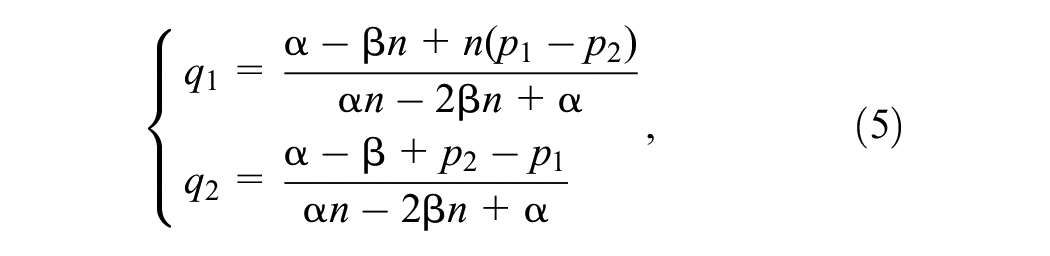
From this, we can derive the profit function of the platform as:

The profit function of each third-party is as follows:

By substituting Equation 5 into Equations 6 and 7, we obtain:

By taking the derivative of the profit function of the platform with respect to
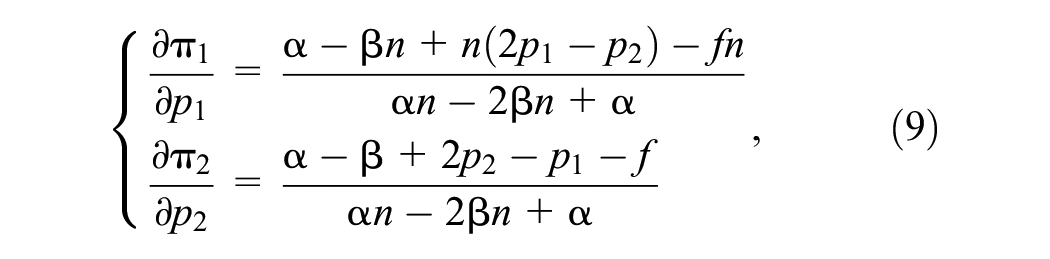
The platform and third-party platform engage in price competition. We assume that both the platform and third-party platform adopt a myopic adjustment mechanism, similar to the approach proposed by Elsadany (2017). Each participant in the platform ecosystem displays bounded rationality and adjusts their prices based on the marginal profit information from the previous period. Consequently, the dynamic system formed by these platforms can be described as follows.
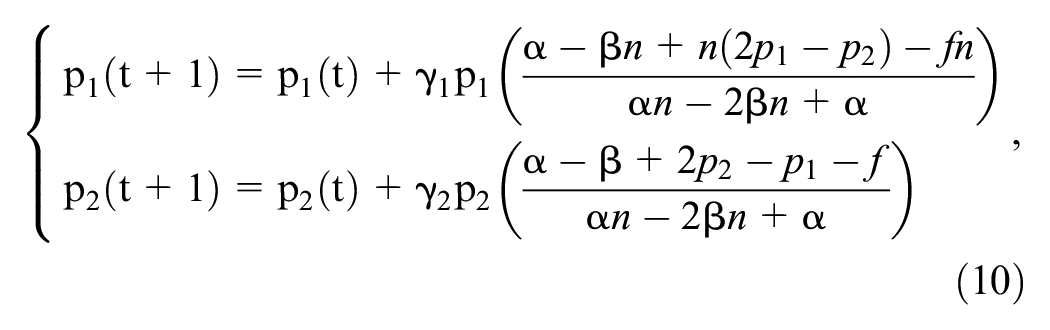
The adjustment speed of platform owner/third-party platform, denoted as
Equilibrium
In this section, we will analyze the stability of the platform ecosystem system (10). The platform ecosystem (10) achieves stability when the following condition is met:

Then we can get four fixed points, E1
Where
The Jacobian matrix of platform ecosystem (10) is:

The characteristic equation of matrix

The trace of Jacobian matrix

The determinant of Jacobian matrix

The stability of the fixed points is analyzed below, with the Jacobian matrix of fixed point E1 being:

Because
The Jacobian matrix of fixed point E2

The two roots of equation is
The Jacobian matrix of fixed point E3

The two roots of equation is
For point E4

It is evident that the trace(Tr) is given by
The determinant(Det) is calculated as
The condition for the characteristic equation condition is given by
In accordance with the Jury condition (Dubiel-Teleszynski, 2011; Elsadany, 2017), the stability of J(E4) can be determined by the following conditions:

Under the (a) condition, it follows that:

Consequently, it can be inferred that
The (b) condition can be presented as:

Thus, we can deduce that the (b) condition is satisfied.
Proceeding to the (c) condition:

Consequently, we can conclude that:
The stable region of the platform ecosystem model is depicted in Figure 2. It is evident that Area I represents the stable region, while Area II satisfies conditions (b) and (c) but falls short of meeting condition (a). Conversely, Area III does not satisfy condition (c) but adheres to conditions (a) and (b).

Stable area of platform ecosystem competition.
Figure 1 illustrates that chaotic behavior emerges when the adjustment speed surpasses a specific threshold. This poses challenges in predicting and controlling the consequences of specific actions within the platform ecosystem. When the participants in the platform ecosystem make decisions at excessively high speeds, the platform ecosystem experiences bifurcation and even chaos, making it difficult for managers to control platform operations, ultimately causing losses to all participants in the platform ecosystem.
This section may be divided by subheadings. It should provide a concise and precise description of the experimental results, their interpretation, as well as the experimental conclusions that can be drawn.
Simulation
This section aims to demonstrate the dynamics of competition within the platform ecosystem, particularly in the context of bounded rationality among participants. We present numerical evidence to exemplify the nonlinearity observed in the platform ecosystem. Furthermore, we illustrate the effects of three factors on the stability of the platform ecosystem (10). Given our focus on analyzing its instability, we specifically examine the influence of platform adjustment speed, platform scale, and platform fees. Subsequently, we delve into an analysis of how platform adjustment speed impacts the ecosystem.
Adjustment Speed of Platform Effects
Initially, we set the parameter set to
Figure 3 illustrates the bifurcation diagram for

Bifurcation diagram with respect to
It is evident that the application of internet technology enhances the responsiveness of platform decision-making. However, excessively fast response times also present challenges to the platform ecosystem. When the platform enters bifurcation and chaotic states, the difficulty of managing the platform significantly increases.
Figure 4 reveals the fluctuations of the maximum Lyapunov exponent (LE), closely following the pattern depicted in Figure 3. Wolf’s Jacobian algorithms are employed for LE computation. At

The maximum Lyapunov exponent with respect to

Strange attractor of the system (12) when
In Figure 6, it is evident that once the adjustment speed surpasses a specific threshold, there is a substantial decline in profits for both the platform and third-party platforms. Furthermore, the platform ecosystem (10) experiences a bifurcation, resulting in further profit decrease and the introduction of chaotic conditions within the ecosystem. This underscores the formidable challenge confronted by enterprise managers in effectively navigating and controlling the intricate nonlinear dynamics, thereby preserving stability. Hence, it becomes imperative for managers to prioritize the maintenance of equilibrium in decision-making and stability during this critical juncture.

The platform and third-party platform aggregate profits according to
Platform Scale Effects
In the context of platform ecosystems, the number of participants plays a crucial role in measuring ecosystem vitality. Our analysis focuses on examining the influence of participant quantity on platform ecosystem behavior. We maintain the same initial conditions as our previous assumptions, with the parameter set as follows:
Figure 7 displays a bifurcation diagram that depicts the quantity of THA. By observing Figure 7, it becomes apparent that an increase in THA quantity initially results in chaotic states for

Bifurcation diagram with respect to
Consequently, we can ascertain that an increasing THA quantity amplifies the externalities of the platform ecosystem. However, it is important to note that excessively rapid reactions also pose challenges to managing the platform ecosystem. As the platform ecosystem undergoes bifurcation and chaos, the complexity of managing it escalates significantly.
Figure 8 demonstrates the fluctuations in the maximum Lyapunov exponent (LE), which closely align with the pattern illustrated in Figure 7. The computation of LE utilizes Wolf’s Jacobian algorithms. When
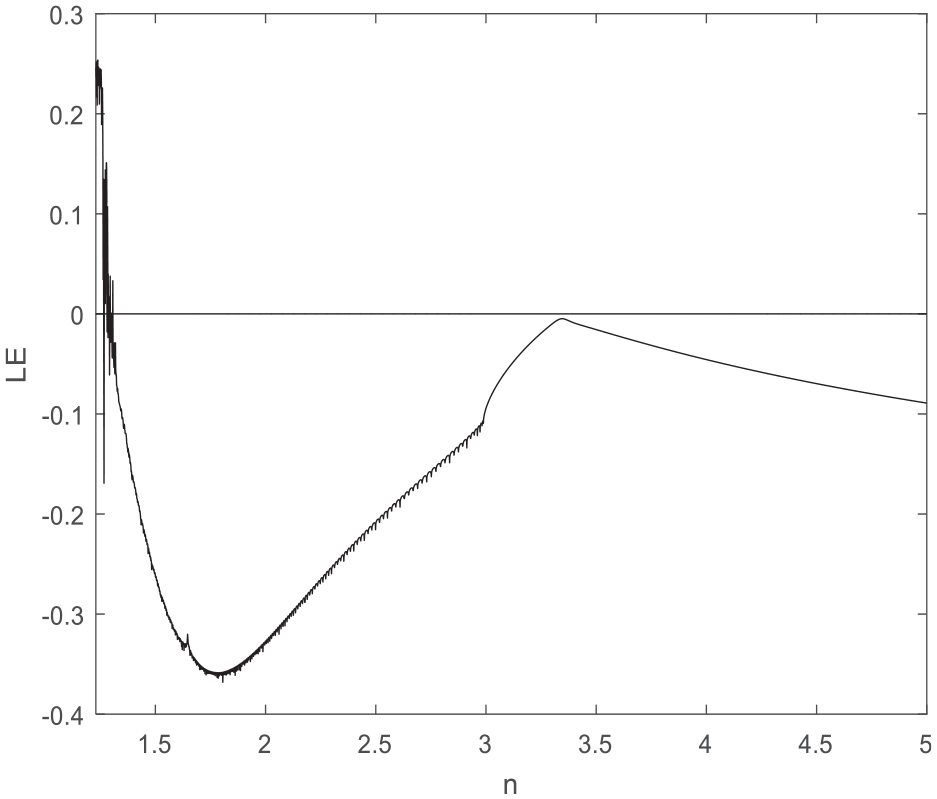
The maximum Lyapunov exponent with respect to

Strange attractor of the platform ecosystem (10) when
Increasing THAs quantity results in enhanced stability within the platform ecosystem (10). However, as can be seen in Figure 10, it is essential to recognize that as n increases, the platform experiences greater profits, while third - party platform profits decrease due to the growing number of THAs. Consequently, third-party platforms naturally desire a higher count of THAs to attain system stability. Nevertheless, an excess of THAs dilutes profits, leading the third-party platform to impose limitations on their quantity. Regulators play a role in maintaining the profit rate of third-party platforms and fostering participants’ innovation drive by imposing necessary constraints on the number of THAs.

The platform and third-party platform aggregate profits according to
Platform Fees Effects
The analysis of the impact of platform fees is consistent with the settings analyzed earlier. We define the parameter set as
Figure 11 illustrates the bifurcation diagram for platform fees. It shows that when

Bifurcation diagram with respect to
Figure 12 reveals the fluctuations of LE, closely following the pattern depicted in Figure 11. At

The maximum Lyapunov exponent with respect to
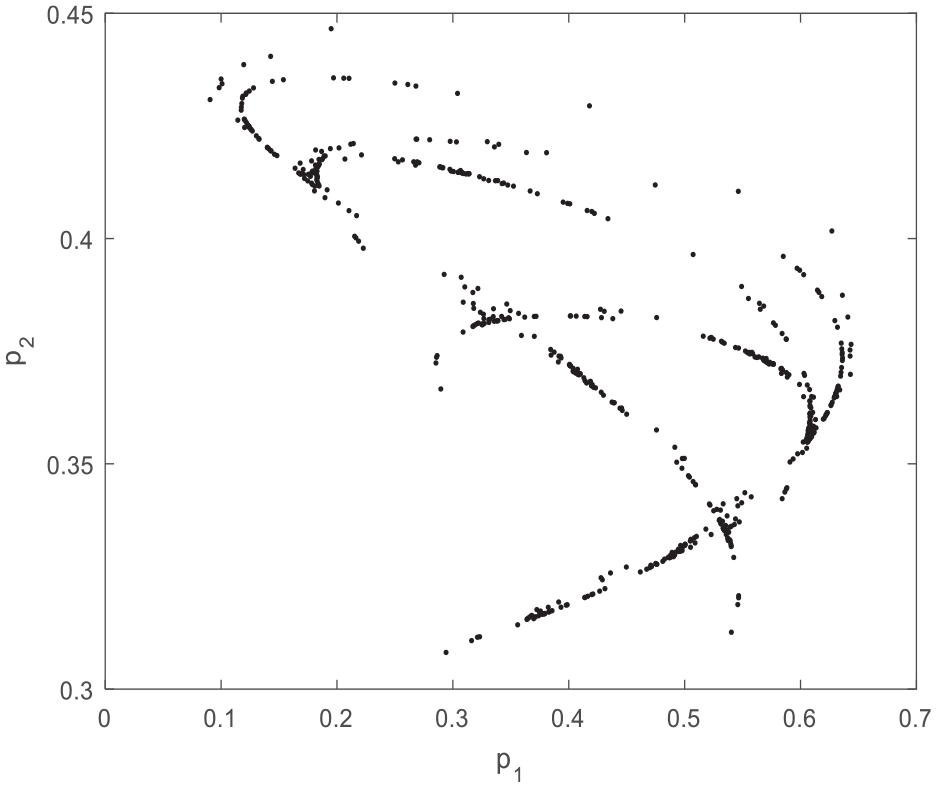
Strange attractor of the platform ecosystem (10) when
After analyzing Figure 14, it becomes apparent that as the platform fee increases, the platform’s profitability rises while the profit of third-party platforms decreases. It is worth noting that the platform’s profit increases at a faster rate, whereas the decline in third-party platform profit is relatively gradual. However, once the platform fee surpasses a certain threshold, the platform’s profits begin to grow at a slower pace, accompanied by a significant decline in the profit of third-party platforms. In light of maximizing the platform ecosystem’s overall objectives, managing the difficulty of maximizing its own profitability becomes crucial. Additionally, regulating the platform fee plays a significant role in ensuring the sustainable development of the entire market.

The platform and third-party platform aggregate profits according to
Time Delayed Feedback Control
In the preceding section, we have observed that the disruption of the platform ecosystem (10) has adverse effects on the profitability of the primary platform. As the platform ecosystem (10) descends into a chaotic state, the predictability of the platform’s pricing decisions diminishes. To restore stability, it is common to employ chaos control measures. Following the approach presented by J. Ma and Xie (2016), we utilize the TDFC (Time Delayed Feedback Control) mechanism, which can be represented by the equation:

Thus, we can deduce that the TDFC system is being pursued as outlined below:

For the purpose of comparison, we utilized similar coefficient configurations as the preceding model. We established the parameter set
Figure 15 demonstrates that when K is below 0.043, the platform ecosystem system is in a state of chaos. When
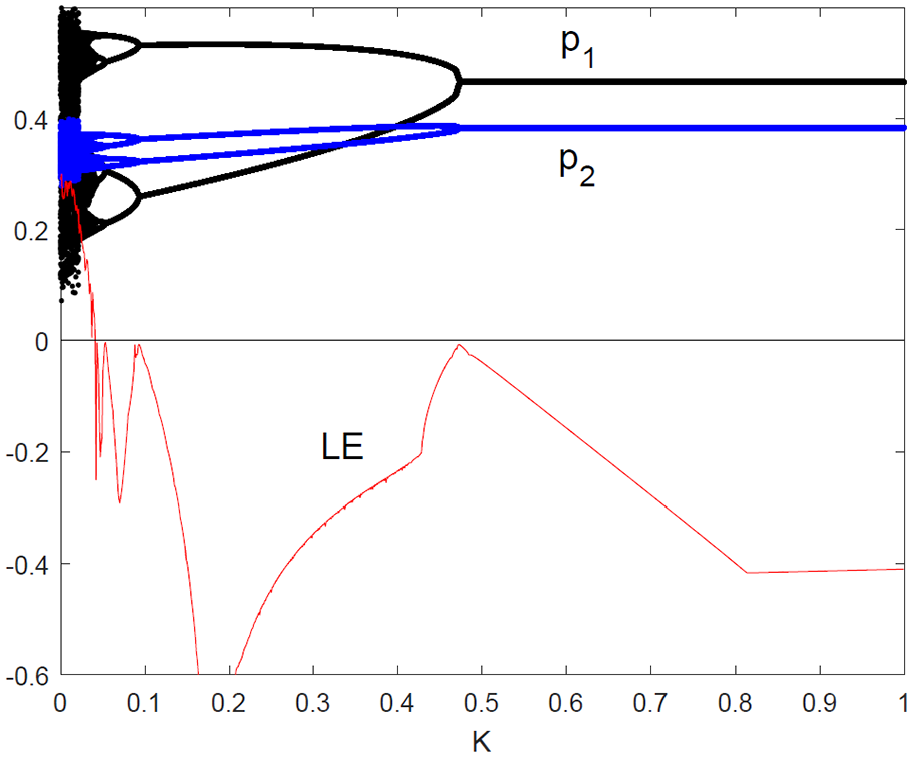
Bifurcation diagram and the largest Lyapunov exponent with respect to K when
We executed simulations of the TDFC system with K = 0.3 and K = 0.6. Figure 16 presents the original platform system alongside the TDFC system. It is evident that the original platform ecosystem (11) is in a state of chaos but under TDFC method, with K = 0.3 resulting in bifurcation of the platform ecosystem, and K = 0.6 leading the platform ecosystem to stability.

The time series difference between platform ecosystem (10) and under TDFC method.
Conclusions and Discussions
Discussions
Our study elucidates the intricate dynamics of the platform ecosystem competition model. Departing from existing empirical and theoretical investigations, such as Parker et al. (2017) and G. Zhou and Song (2018), this research broadens the inquiry into the dynamism of platform ecosystems by incorporating the impacts of decision models, platform scale, and platform fees, thereby making platform ecosystem management more practical, especially in light of the increasing governmental focus on platform scale. We ascertain that adjustment speed, platform scale, and platform fees all significantly influence the stability of platform ecosystems. Contrary to previous governmental focus on platform fees and scale limitations, our findings reveal that excessively small platform scales can lead to dual losses in platform profitability and economic stability. Regulatory measures should extend beyond traditional antitrust frameworks to address the overall health of the platform ecosystem. The rise of artificial intelligence and other new technologies has further complicated competitive behavior within platform ecosystems. Additionally, as platforms’ influence grows and data-sharing capabilities advance, platform services have evolved into a quasi-public good (Kazantsev et al., 2023). Consequently, future regulation of platform ecosystems should not rely solely on fee structures and market dynamics but should also consider the impact of new technologies on the entire decision-making model.
Conclusions
During the process of establishing an authentic platform ecosystem, businesses should integrate a greater array of third-party platforms to enhance their ecosystem and attract consumers through the network effects of diverse product and service offerings. Based on the analysis conducted in this study, the following conclusions can be drawn: (1) The adjustment speed is made significantly impacts the stability of the platform ecosystem. Leveraging platform and internet technologies improves the platform’s responsiveness to the market, thus affecting its stability. Prioritizing flexibility in decision-making is crucial from a platform stability perspective, enabling sustainable development and maximizing profits. (2) It is evident that the platform scale influences the stability of the ecosystem. The more third-party platforms are available, the more stable the platform ecosystem becomes. (3) Platform fees have an impact. While increased fees contribute to higher profits, they can also disrupt the stability of the platform ecosystem. Therefore, platforms should exercise caution in regulating fee levels to ensure the fulfillment of their profit objectives. (4) TDFC can effectively maintain the sustainability of the ecosystem.
Management Implications
The research findings of this study demonstrate that in the competitive landscape of platform ecosystem, the platform ecosystem undergoes phases of stability, bifurcation, and even chaos. During periods of stability, the pricing strategy and profit targets of the platform ecosystem remain consistent, allowing businesses to achieve their desired profits. This implies that investments made by companies can yield expected returns. Conversely, when the platform ecosystem enters an unstable state, it fails to meet the expectations of participating businesses, hindering their development. Several key insights emerge from this analysis: the platform ecosystem’s stability is influenced by factors such as decision adjustment speed, platform scale, and platform fees. If the platform ecosystem experiences bifurcation or even chaotic states under specific conditions, the profits of platform participants decrease, rendering the existing business strategies ineffective. To secure profit and stability objectives, platform managers can adopt two approaches: firstly, by adjusting the speed of decision-making, scaling up the platform, and fine-tuning platform fees; secondly, by implementing feedback control methods to guide the evolutionary process of the entire platform ecosystem toward stability. Consequently, alongside the traditional focus on market demand volatility, platform managers should prioritize understanding the dynamic evolution of the platform ecosystem to prevent the occurrence of chaos.
Limitations
This article acknowledges the following limitations in the research: The establishment and analysis of the platform ecosystem model in this study are based on certain idealized assumptions, which inherently impose limitations on the resulting conclusions. Given the inherent diversity of platform ecosystems, it is essential to develop customized models that align with the specific characteristics of each ecosystem, such as shared mobility or e-commerce platforms. This approach will undoubtedly generate more intriguing and meaningful insights, thus warranting future research attention. Furthermore, it should be noted that certain research methodologies within complex system theories, such as synergy and dissipative structure theory, are still in the process of theoretical maturation. To achieve more robust outcomes, it is crucial to integrate model construction with empirical findings, thereby enhancing the overall sophistication of the models employed.
Footnotes
Acknowledgements
During the preparation of this work the authors used ChatGPT in order to improve language. After using this service, the authors reviewed and edited the content as needed and takes full responsibility for the content of the publication.

Author Contributions
Conceptualization, J.X. and Z.H.; methodology, J.X. and Z.H.; software, J.X.; writing—original draft preparation, H.X.; writing—review and editing, Z.H.; visualization, J.X.; funding acquisition, J.X. All authors have read and agreed to the published version of the manuscript.
Funding
The author(s) disclosed receipt of the following financial support for the research, authorship, and/or publication of this article: This research was supported by the Research Initiation Foundation Project of Yiwu Industrial & Commercial College (RCKY202309).
Declaration of Conflicting Interests
The author(s) declared no potential conflicts of interest with respect to the research, authorship, and/or publication of this article.
Data Availability Statement
The data that supports the findings of this study are available upon request from the author Jianli Xiao at